

“Then I looked, and behold, on Mount Zion stood the Lamb, and with him 144,000 who had his name and his Father’s name written on their foreheads” (Revelation 14:1 ESV).
So unlike those who accepted “…the mark or the name of the beast, or the number of his name” (Revelation 13:17), the 144,000 referenced here in Revelation 14:1 carried the mark of their Creator. Thus, they stand in stark contrast to those who openly rebelled against Him by taking the mark of His adversary.
In addition to their sexual purity, Revelation 14:4 offers another characteristic quality that described these individuals: “…they follow the Lamb wherever he leads” (CEV). So, these were people who looked to Jesus and followed His direction for their lives. They took that responsibility seriously, especially in view of Jesus’ repeated exhortations to “follow me” as recorded within the gospel accounts of His life. As Jesus Himself once said, “My sheep listen to my voice; I know them, and they follow me” (John 10:27 NLT).
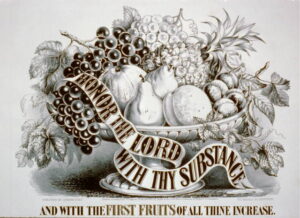 Revelation 14:4 next refers to their status as, “…firstfruits to God and to the Lamb” (NET). The term “firstfruits” denotes the first and best portion of a flock or harvest. That share was consecrated to God as a gesture of worship and thanksgiving (Exodus 23:19). God’s people continue to affirm this principle today whenever they give the first and best of their time, talent, and financial resources to God in gratitude and appreciation for His blessings.
To illustrate the importance of this concept, consider God’s message through the Old Testament prophet Malachi to those who presented Him with the “leftovers” of their lives…
“’A son honors his father, a servant honors his master. I am your Father and Master, yet you don’t honor me, O priests, but you despise my name.’
‘Who? Us?’ you say. ‘When did we ever despise your name?’
When you offer polluted sacrifices on my altar.
‘Polluted sacrifices? When have we ever done a thing like that?’
Every time you say, ‘Don’t bother bringing anything very valuable to offer to God!’ You tell the people, ‘Lame animals are all right to offer on the altar of the Lord—yes, even the sick and the blind ones.’ And you claim this isn’t evil? Try it on your governor sometime—give him gifts like that—and see how pleased he is!
‘God have mercy on us,’ you recite; ‘God be gracious to us!’ But when you bring that kind of gift, why should he show you any favor at all?” (Malachi 1:6-9 TLB).
Therefore, we should ensure that we do not offer God our second best, for He is worthy of our finest efforts.
Image Attribution: Currier & Ives. (ca. 1872) Honor the Lord with thy substance and with the first fruits of all thine increase. , ca. 1872. New York: Published by Currier & Ives. [Photograph] Retrieved from the Library of Congress, https://www.loc.gov/item/2002695910/.