

“for when Gentiles, who do not have the law, by nature do the things in the law, these, although not having the law, are a law to themselves” (Romans 2:14).
The Old Testament book of Psalms contains a verse that relates to the passage quoted above: “God gave his laws and teachings to the descendants of Jacob, the nation of Israel. But he has not given his laws to any other nation” (Psalm 147:19-20 CEV). Our text from Romans 2:14 thus offers some insight into God’s judgment of those who have not had access to those “laws and teachings.” But to establish that connection, we must lay some groundwork first.
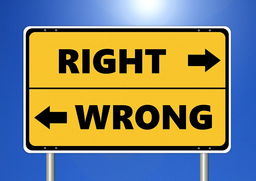 First, we can say that no one (including those who do not possess the Old Testament Law) can deny the self-evident existence of “right” and “wrong.” A simple dialogue with someone who does not believe the concepts of “right” and “wrong” exist help demonstrate that reality…
Statement: “There is no such thing as right and wrong.”
Response: “Is that right?”
This hypothetical exchange highlights an important point: while we may debate the meaning of “right” and “wrong,” the self-evident nature of those concepts is undeniable. Therefore, when those who have never had access to God’s Law abstain from theft, lying, adultery, and other such behaviors, their actions align with the Law despite their lack of exposure to it.
In a similar manner, societies and individuals generally recognize that “justice” is right, and “injustice” is wrong. While the definitions of justice and injustice may vary, these recognitions are “laws unto themselves,” to borrow a phrase from Romans 2:14.
So, even though “…no one does good, not even one” as we’ll read later in Romans 3:12, this does not mean that human beings are incapable of recognizing and performing good deeds. As Jesus Himself once said, “If you do good to those who do good to you, what benefit is that to you? For even sinners do the same” (Luke 6:33). In light of this, we can say that everyone recognizes that some things are good (or right) and some things aren’t. The criteria may change, but the principle remains the same.
Thus, everyone possesses a set of standards that informs their decision-making processes. Those standards determine right and wrong behaviors and enable us to make moral and ethical judgments. We can turn once again to the observations of Dr. Norman Geisler for some additional insight on this topic…
“What person does not expect to be treated as a person? Who ever actually believed that it was right to take what belonged to anyone at any time? Who ever truly believed that murder, rape, or cruelty to children was morally right? To be sure, mankind has not always lived up to its moral ideals—this is an indication of our depravity and need for Christ’s redemption…” (1)
(1) Geisler, N. L., & Feinberg, P. D. (1980). Introduction to Philosophy: A Christian Perspective. Baker Publishing Group (MI).
Image Attribution: Tumisu, CC0, via Wikimedia Commons, public domain, via Wikimedia Commons