
“What should we say then? Should we continue in sin so that grace may multiply?” (Romans 6:1 HCSB).
As we continue our look at the opening verse of Romans chapter six, we should note that our text does not refer to an isolated sin that one might commit in a moment of weakness. Instead, this verse addresses the practice of habitual sin…
“The word ‘continue’ is men, ‘to remain, abide.’ It is used in the New Testament of a person abiding in some ones home as a guest, or of a person abiding in a home. It has in it the ideas of fellowship, of cordial relations, of dependence, of social intercourse.
The question now can be further interpreted to mean, ‘Shall we continue habitually to sustain the same relationship to the sinful nature that we sustained before we were saved, a relationship which was most cordial, a relationship in which we were fully yielded to and dependent upon that sinful nature, and all this as a habit of life.’
…The fundamental question therefore is not with regard to acts of sin but with respect to the believers relationship to the sinful nature. This is after all basic, acts of sin in his life being the result of the degree of his yieldedness to the sinful nature.” (1)
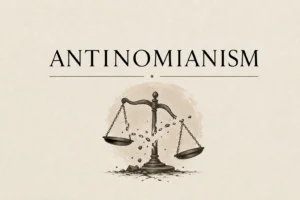
Romans 6:1 thus addresses the subject of antinomianism, a word that means “against the law.” We derive this word from the prefix anti (or “against”), and nomos, an ancient Greek word that means “law.” From a secular vantage point, we can find several variations of this concept in the following moral philosophies…
 “If it feels good, do it,” or, “If it feels right, it can’t be wrong.”
- “You only live once.”
- “Eat, drink, and be merry, for tomorrow we die.”
In this context, antinomianism promotes the idea that God’s grace absolves us from the responsibility to emulate His moral character. While it is unlikely that any practicing Christian would endorse that idea, the following source directs our attention to a far more common expression of lawless behavior…
“It is a characteristic error of our times, the error of hedonistic Antinomianism. This view says, ‘What really matters is not the law but what I feel in my heart. So even if the law of God says that something is wrong, as long as I feel it is all right, it must be right. Or at least it is right for me.'” (2)
So, Romans 6:1 serves as an important reminder: we should never underestimate the human capacity to invent clever loopholes that permit us to rationalize our preferred behaviors. For many, this approach is highly attractive, for it serves to neutralize the nagging sense of guilt that might otherwise prohibit us from doing whatever we please.
(1) Kenneth S. Wuest, Word Studies in the Greek New Testament [Romans 6:1] Copyright © 1942-55 by Wm. B. Eerdmans Publishing Co.
(2) Boice, J. M. (1992). Romans Volume 2 The reign of grace, Romans 5:1-8:39. Baker Books. pg. 801