

“Remember therefore from where you have fallen; repent and do the first works, or else I will come to you quickly and remove your lampstand from its place–unless you repent” (Revelation 2:5).
For some, the word “repent” is associated with the image of a wild-eyed radical who carries a sign warning others that “The End Is Near!” However, repentance actually involves a change of mind that leads to a change of behavior. Genuine repentance (like the kind mentioned here in Revelation 2:5) thus implies more than just a feeling of sorrow or regret.
Genuine repentance always involves action, much like a motor vehicle driver might stop from going the wrong way by making a U-turn. In this instance, “turning around” for the Ephesian Christians meant returning to Christ as their first love (Revelation 2:4). Those who prioritize their relationship with Jesus through prayer and daily devotional readings in the Scriptures are those who are well positioned to maintain this kind of “first love” relationship with Him.
However, a “first love” relationship with Christ isn’t just a good idea, for there are repercussions for those who choose an alternative path…
“…If you do not repent, I will come to you and remove your lampstand from its place” (Revelation 2:5 NIV).
If we fail to put our relationship with Christ first, we set a negative example for those around us. We also face the prospect of losing the good things that God seeks to give those who genuinely love Him. In such instances, a church or an individual may continue to self-identify as “Christian” with little or no connection to Christ, except in name only.
Unfortunately, this seems to be the fate that befell the Christian community at Ephesus. That busy, dynamic city of the first century is little more than a ruin today and the church there has long since ceased to exist. This historic overview reminds us that we make real choices in real time each day. Those choices lead to real consequences that may produce a lasting effect in the present, as well as the future. Thus, we ignore this admonition at our risk.
Now this is a point within this letter where we might expect Jesus to conclude His remarks. However, He had one additional message to share with the church at Ephesus: “But you have this in your favor: You hate the practices of the Nicolaitans, which I also hate” (Revelation 2:6 NIV). There are only two places in the entire New Testament where Jesus expresses His hatred for something. Those two places are here in Revelation chapter two. We’ll consider this emotionally charged response next.
 In our text from the Gospel of Mark, Jesus informs us that humanity’s primary job description involves the responsibility to love God with all our heart, soul, mind, and strength. Thus, our highest-ranking love should be expressed toward God. Unfortunately, it seems as if the Christians in Ephesus were so busy doing good things that they forgot the most important thing: to love God first and foremost.
 Judging from this portion of Jesus’ letter, we may conclude that the church at Ephesus featured a group of individuals who refused to give up, even during times of hardship. If the Christians at Ephesus “patiently suffered” for their belief in Christ, then it can only mean that they remained steadfast in their commitment to Him despite the trials, adversities, and difficulties they encountered. It also seems reasonable to assume that the members of the Ephesian church displayed unwavering determination and resilience in the face of various challenges. Finally, we can say that the Ephesian Christians exhibited faithfulness in dealing with stressful conditions.
 Ephesus boasted a large theatre with a seating capacity of approximately 20-30,000 people that appears in
  Imagine if Jesus wrote a personal letter to your church. What would He say in that message? Would His message be complimentary, or would He emphasize the need for change and improvement? Well, the answers to those questions were not a matter of speculation for seven churches of the New Testament era. Instead, Jesus provided those answers in the form of a personalized message to each church.
 So Revelation 1:19 provides us with a reference to the past (“what you have seen“), the present (“what is“), and the future (“what will take place after this“), all within a single verse. That being said, how do we know when the future begins in the book of Revelation? How can we separate the present from the future within this book?
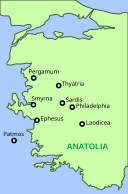 The seven churches discussed in this text were not symbolic representations; they were actual churches that existed in John’s era. In fact, one can embark on a tour of these church locations today. The distance between these congregations varied from approximately thirty to fifty miles (48 to 80 km), and a first-century messenger would likely distribute this book in the order mentioned here.
 In the original language of this passage, Alpha and Omega function much like the letters A and Z, for they each represent the first and last letters of their respective alphabets. Thus, we can understand this reference to mean that Jesus is the first, the last, and the “A to Z” of everything. Therefore, our text from Revelation 1:8 establishes Jesus as the beginning and the end of all things.
 One notable aspect of Revelation 1:4 involves the repetition of the number seven. This holds considerable significance, for the number seven recurs fifty-four times within the twenty-two chapters of Revelation.
 The Biblical book of Revelation was authored by a man named John, a person who identifies himself by name three times within this book (
 We should also note the descriptive phrase that closes this verse: “the error of the wicked.” This serves to remind us that heretical teachers are not mistaken, confused, or misguided. Instead, this passage describes such individuals as wicked…
 The New Testament letter of 1 John highlights the need to evaluate the spiritual ideas and beliefs we encounter when it tells us, “Dear friends, do not believe every spirit, but test the spirits to see whether they are from God, because many false prophets have gone out into the world” (1 John 4:1 NIV). That portion of Scripture reminds us that many spiritual teachings, experiences, or supposed displays of supernatural power may not come from God.
 This also reminds us that context is important whenever we encounter those who seek to use a Biblical text to support their views. The word “context” refers to “the part of a text or statement that surrounds a particular word or passage and determines its meaning.” (2) In other words, the chapters and verses that surround a Biblical text help determine the meaning of that text. When verses are quoted outside their context, it is sometimes possible to make the Bible say some very unbiblical things.
 By highlighting some of the challenging aspects of Paul the Apostle’s Biblical letters, Peter directs our attention to a practical application from this passage. For example, some may justify their reluctance to read the Bible by claiming that it is too difficult to understand. But today’s age of technological advancement has made it increasingly difficult to rationalize that argument.
 So, unlike the unscrupulous advertiser who markets a “new” product that is little more than an old product dressed up in a different package, the new heavens and new earth will be pristine and unspoiled. If we were to employ some technical jargon to describe this future event, we might say that God will not simply “power off” the current universe and “reboot” it. Instead, He will completely rewrite its operating system.
 We can also view this reference to “hastening” from a different perspective. As we’ve already seen, the word “hasten” is used to describe an attempt to expedite an action or activity. In light of this, our text from 2 Peter 3:12 underscores the need to avoid a passive mindset in anticipation of that day. Instead, we should actively employ the talents, skills, abilities, gifts, and opportunities that God has graciously given us for use in His service today.
 Our text from 2 Peter 3:10 reminds us that the best investments are the ones that are made in view of eternity. We should thus prioritize our business endeavors, our finances, and our material possessions in light of these things. As we read in another portion of Scripture…
 We’ll return to this verse from 2 Peter 3:11 shortly. But for now, we can also approach this reference to the day of the Lord from a different perspective. You see, “the day of the Lord” also arrives in a multitude of human lives each day. In this sense, the day of the Lord occurs whenever someone departs from this earthly life and enters the realm of eternity.