
About This Chapter: Revelation chapter nine continues the sequence of trumpet visions. When the fifth trumpet is sounded, John sees a star fallen from heaven. The star is given the key to the shaft of the abyss, from which smoke and locust-like creatures emerge to torment those who were not sealed by God. When the sixth trumpet sounds, four angels are released from their captivity at the Euphrates River to kill one third of humanity. The chapter concludes with the unrepentant response of those who remain.
Revelation 9:1–6 — The Opening of the Abyss
Revelation 9:7–10 — The Locusts who Emerge
Revelation 9:11–19 — The Sixth Trumpet and the Ensuing Devastation
Revelation 9:20–21 — The Response of the Unrepentant
Revelation 9:1–6 — The Opening of the Abyss
Four judgments have unfolded within the Book of Revelation since the beginning of chapter eight, each heralded by the sound of a trumpet. The first trumpet brought widespread environmental devastation. The second trumpet unleashed destruction upon the planet’s marine environment, aquatic life, and seafaring vessels. The third trumpet rendered one-third of the earth’s freshwater supply undrinkable. Finally, all natural light was reduced by one-third at the sound of the fourth trumpet.
Each of these judgments had one thing in common: they each brought large-scale ruin to the natural realm. But now, as we move forward into Revelation chapter nine, we will encounter God’s spiritual adversaries as they begin to unleash their terrifying power upon humanity…
“Then the fifth angel sounded: And I saw a star fallen from heaven to the earth. To him was given the key to the bottomless pit. And he opened the bottomless pit, and smoke arose out of the pit like the smoke of a great furnace. So the sun and the air were darkened because of the smoke of the pit” (Revelation 9:1-2).
Earlier in Revelation chapter eight, we read of “…a great star, burning like a torch, [that] fell from heaven” (Revelation 8:10 CEB). While a cursory glance at these passages might suggest a relationship between these stars, a closer examination of our text from Revelation 9:1 reveals something very different.
First, the imagery of a star clearly plays a prominent role in each narrative. But in Revelation chapter eight, a blazing star plunges to the earth, while Revelation nine depicts a star that opens a bottomless pit. Our text from Revelation chapter nine also tells us that this star had “…fallen from heaven to the earth.” This indicates that the events pertaining to the fall of this star had taken place in the past. On the other hand, the appearance of the star from Revelation chapter eight was a contemporaneous event for those who experienced it.
We should also note that the star in Revelation nine “…was given the key to the bottomless pit.” This tells us that we are not dealing with an inanimate object or cosmic phenomena like the star of Revelation chapter eight.
Finally, the star of Revelation chapter nine “…opened the long shaft of the Abyss (the bottomless pit)” (Revelation 9:2 AMPC). Unlike the star from our previous chapter, this star possessed the ability to think and interact. The passage also makes use of pronouns like “he” and “him,” thus identifying this star as a personal being.
We’ll seek to identify that being next.
“The fifth angel sounded his trumpet, and I saw a star that had fallen from the sky to the earth. The star was given the key to the shaft of the Abyss” (Revelation 9:1 NIV).
The entity described in Revelation 9:1 as the “star that had fallen to earth” is clearly a sentient being capable of thought and interaction. Jesus once identified someone who fell in a similar manner when He told a group of His followers, “…’I saw Satan fall like lightning from heaven’” in Luke 10:18. Thus, we should consider the possibility that these two entities may be one and the same.
This individual received the key to a realm known as “the Abyss,” or “bottomless pit.” The Abyss is associated with the abode of demons, and represents a chasm of immeasurable depth. (1) It also seems to function as a place of confinement for some particularly wicked demons until their release here in the book of Revelation. Thus, it remains securely locked until God elects to release the key.
So this fallen star received access to the Abyss and immediately put that access to use…
“And he opened the bottomless pit, and smoke arose out of the pit like the smoke of a great furnace. So the sun and the air were darkened because of the smoke of the pit.
Then out of the smoke locusts came upon the earth. And to them was given power, as the scorpions of the earth have power. They were commanded not to harm the grass of the earth, or any green thing, or any tree, but only those men who do not have the seal of God on their foreheads. And they were not given authority to kill them, but to torment them for five months.
Their torment was like the torment of a scorpion when it strikes a man. In those days men will seek death and will not find it; they will desire to die, and death will flee from them” (Revelation 9:2-6).
 These verses present us with the imagery of a key that opens the door to malevolent spiritual forces. This should prompt us to consider other doors that should remain closed as we travel the corridor of life. For instance, some of those doors may open the way to an inappropriate relationship, financial devastation, or involvement with various forms of the occult, among others.
You see, the road to alcoholism, marital infidelity, compulsive gambling, and other harmful behaviors rarely starts with a conscious decision to embrace those activities. Instead, they often begin with an ill-advised decision to open a door that should have remained sealed. If we never open the door to such things, we may avoid the negative consequences that await on the other side.
Image Attribution :silhouette of door knob, via PickPik
(1) G12 – abyssos – Strong’s Greek Lexicon (nasb20). (n.d.). Blue Letter Bible. https://www.blueletterbible.org/lexicon/g12/nasb20/mgnt/0-1/
“Then locusts came from the smoke and descended on the earth, and they were given power to sting like scorpions. They were told not to harm the grass or plants or trees, but only the people who did not have the seal of God on their foreheads” (Revelation 9:3-4 NLT).
Revelation 9:3 presents us with a swarm of locusts that emerge from the Abyss mentioned earlier in verse one. Their emergence from this bottomless pit suggests these locusts are demonic in nature, or at least demonically influenced.
While an ordinary locust will consume most growing plants, these locusts don’t eat such vegetation. In fact, Revelation 9:4 specifically informs us they “…were told not to harm the grass or plants or trees.” So there is clearly something unnatural regarding the behavior of these creatures. But even though these locusts abstained from consuming the world’s plant life, they were far from benign: “They could harm only the people who do not have the seal of God on their foreheads” (GW). So their damage will be inflicted upon those who neglect to establish a relationship with God.
“The shape of the locusts was like horses prepared for battle. On their heads were crowns of something like gold, and their faces were like the faces of men. They had hair like women’s hair, and their teeth were like lions’ teeth. And they had breastplates like breastplates of iron, and the sound of their wings was like the sound of chariots with many horses running into battle.
They had tails like scorpions, and there were stings in their tails. Their power was to hurt men five months. And they had as king over them the angel of the bottomless pit, whose name in Hebrew is Abaddon, but in Greek he has the name Apollyon” (Revelation 9:7-11).
It’s interesting to note that the lifespan of an average locust typically ranges from three to five months, depending on the species and environmental conditions. That neatly coincides with this reference to “five months” here in Revelation 9:10. But that’s where those similarities end, for the locusts of Revelation chapter nine also “…had tails with stingers like scorpions” (HCSB).
Scorpion venom contains neurotoxins that can lead to a range of symptoms, including severe pain and swelling, numbness, frothing at the mouth, respiratory paralysis, and convulsions. With this in mind, it’s easy to understand why we are told, “During those days people will seek death but will not find it; they will long to die, but death will elude them” (Revelation 9:6 NIV).
Revelation 9:7–10 — The Locusts who Emerge
“In appearance the locusts were like horses prepared for battle: on their heads were what looked like crowns of gold; their faces were like human faces, their hair like women’s hair, and their teeth like lions’ teeth; they had breastplates like breastplates of iron, and the noise of their wings was like the noise of many chariots with horses rushing into battle. They have tails and stings like scorpions, and their power to hurt people for five months is in their tails” (Revelation 9:7-10 ESV).
Revelation 9:7-10 offers a physical description of the locust creatures that emerge from the bottomless pit described earlier in this chapter. Some associate these physical characteristics with the advent of modern day weaponry. For example, these “crowns of gold” may refer to a type of helmet. If face shields were deployed with such helmets, a first century observer (like the author of Revelation) might note a resemblance to “human faces.”
This reference to “…breastplates of iron” might refer to some type of body armor. The audible comparison to a sound “…like the thundering of many horses and chariots rushing into battle” may represent a primitive reference to a helicopter gunship or other form of mobile weaponry. But whatever these descriptions pertain to, one thing is clear: these creatures are targeting those who have rejected God. In fact, these attacks will be so horrific that people “…shall desire to die, and death shall flee from them” (Revelation 9:6 KLV).
This portion of Scripture thus illustrates what can occur when God removes the restraints He places upon the members of the demonic realm. It also reminds us that demonic beings do not resemble the cartoonish pranksters some portray them to be. Instead, Revelation chapter nine offers a realistic portrait of these dangerous entities in their natural predatory state.
With these things in mind, we would do well to refrain from any form of involvement with occultism, or contact with the spirit world. For instance, recall Jesus’ cautionary message from John 8:44: “…[The devil] was a murderer from the beginning, and does not stand in the truth, because there is no truth in him.” In addition, the Biblical book of 1 Peter tells us, “…Your enemy the devil prowls around like a roaring lion looking for someone to devour” (1 Peter 5:8 NIV).
Taken together with our text from Revelation chapter nine, these passages illustrate the violent, aggressive nature of these dangerous spiritual entities. So while the book of Revelation speaks largely of the future, this passage offers a valuable and relevant lesson for today as well.
Revelation 9:11–19 —The Sixth Trumpet and the Ensuing Devastation
“And they had as king over them the angel of the bottomless pit, whose name in Hebrew is Abaddon, but in Greek he has the name Apollyon” (Revelation 9:11).
Abaddon and Apollyon are words that convey a similar meaning: destruction, or destroyer. This has led some to speculate that a single demonic entity governs the Abyss and directs these locust beings to inflict pain and suffering upon their human victims.
“One woe is past. Behold, still two more woes are coming after these things. Then the sixth angel sounded: And I heard a voice from the four horns of the golden altar which is before God, saying to the sixth angel who had the trumpet, ‘Release the four angels who are bound at the great river Euphrates.’
So the four angels, who had been prepared for the hour and day and month and year, were released to kill a third of mankind. Now the number of the army of the horsemen was two hundred million; I heard the number of them” (Revelation 9:12-16).
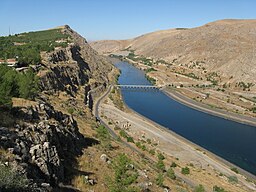 The Euphrates River is a lengthy waterway that traverses a significant portion of the Middle East. This body of water flows from the mountains of Turkey through the nations of Syria and Iraq and later joins the Tigris River before it reaches the Persian Gulf on the Iranian border. The Euphrates River once formed the eastern boundary of the ancient Roman Empire for several centuries, as well as the land God promised to Abraham’s descendants, the Jewish people (see Genesis 15:18).
Other ancient civilizations that controlled portions of the Euphrates river valley included the Hittites (the modern day inhabitants of Turkey), the Assyrians (modern day Syria), the Babylonians (modern day Iraq), and the Persians (modern day Iran). These people groups brought considerable adversity upon the nation of Israel during the Old Testament period. In addition, the Biblical book of Daniel chronicles the account of an angelic being who had been intercepted by a spiritual adversary who was identified as “the Prince of Persia” (see Daniel chapter ten, verses thirteen and twenty).
Therefore, it should not surprise us to learn that four demonic beings have been incarcerated within this area. And even though the locusts that were released from the Abyss were truly horrific, they only possessed the capability to inflict suffering and torment upon their victims. In contrast, the angelic beings seen here in Revelation 9:12-16 are executioners who hold the power to act upon their murderous intent.
Image Attribution : Alen Ištoković, CC BY 3.0, via Wikimedia Commons
“Then the four angels who had been prepared for this hour, day, month, and year were set free to kill a third of humanity” (Revelation 9:15 NET).
We should not move past this portion of Scripture without giving serious thought to its content. First, notice that these four angels “…had been held ready for the hour, the day, the month and the year” (Phillips). This passage evokes the image of four predators, each pulling at the end of its restraint, ready to be unleashed at the right moment.
So how long had these entities been waiting for their opportunity to decimate one-third of the remaining human race? Was it years? Centuries? Millennia? Eons? Or perhaps longer? How long have these beings visualized, strategized, and planned for this opportunity? Once again, this passage reminds us that demonic entities are not like the roguish little troublemakers that appear in various forms of media. Instead, this portion of Scripture serves to illustrate their true nature.
“Now the number of the army of the horsemen was two hundred million; I heard the number of them” (Revelation 9:16).
So these angels seem to be the motivating force behind these armed forces. Nevertheless, an army comprising two hundred million troops would have been unimaginable when these words were first authored, for that figure likely encompassed the world’s entire population during that period. In fact, that number is significantly larger than the estimated 127 million people who comprised the collective armed forces of all the nations that took part in World War II.
Because of this, some commentators believe that Revelation 9:16 simply refers to a significant number of troops. However, the fact that the author of Revelation specifically tells us “I heard their number,” suggests that we should take this figure literally.
“And thus I saw the horses in the vision: those who sat on them had breastplates of fiery red, hyacinth blue, and sulfur yellow; and the heads of the horses were like the heads of lions; and out of their mouths came fire, smoke, and brimstone.
By these three plagues a third of mankind was killed–by the fire and the smoke and the brimstone which came out of their mouths. For their power is in their mouth and in their tails; for their tails are like serpents, having heads; and with them they do harm” (Revelation 9:17-19).
These references have led some to speculate that this passage refers to some sort of futuristic mechanized warfare. We’ll consider that possibility next.
“For the power of the horses is in their mouths and in their tails, for their tails, which resemble snakes, have heads, and they inflict injury with them” (Revelation 9:19 HCSB).
If we associate these references from Revelation 9:17-19 with various forms of mechanized warfare, then these “breastplates” may translate to some form of protective gear. “Fire, smoke and sulfur” might describe the use of an ordinance launcher or similar type of armament. Revelation 9:19 also provides us with the following description: “The power of these horses is in their mouths and their tails” (GW). Whatever form that power takes, it clearly describes the use of front and rear mounted weaponry.
“But the rest of mankind, who were not killed by these plagues, did not repent of the works of their hands, that they should not worship demons, and idols of gold, silver, brass, stone, and wood, which can neither see nor hear nor walk. And they did not repent of their murders or their sorceries or their sexual immorality or their thefts” (Revelation 9:20-21).
This passage establishes a relationship between the “works of their hands” and the broader concept of worship. “Worship” signifies a profound act of reverence toward another person or thing. In also conveys the image of kissing one’s hand, just as one might do in the presence of royalty. (1) So those who survived the onslaught described in Revelation chapter nine stubbornly continued to offer the respect and reverence that is reserved for God alone to His enemies and/or inanimate objects.
That brings us to this reference to “…idols of gold, silver, bronze, stone, and wood, which cannot see, hear, or walk” (GNT). While idolatry may encompass a range of behaviors, we can associate an idol with anything we love, fear, or depend upon more than God. When something takes God’s place within our lives, that thing (whatever it is) effectively becomes an idol.
 When we speak of idolatry, we are essentially referring to a question of misplaced priorities. For instance, let’s take the case of an individual who prioritizes the acquisition of financial wealth above all else. A person who prioritizes money in that manner is just as guilty of idolatry as those who worshipped “idols of gold, silver, brass, stone, and wood, which can neither see nor hear nor walk.” The same is true of anything that takes God’s place within our lives.
Objects of idolatry might include material possessions, positions of power or influence, or other human beings, to name a few examples. Therefore, we may rightfully classify anything that displaces the love and devotion that belongs to our Creator as an idol.
Image Attribution :unattributed, via Pixabay
(1) See G4352 – proskyneo – Strong’s Greek Lexicon (kjv). (n.d.). Blue Letter Bible. https://www.blueletterbible.org/lexicon/g4352/kjv/tr/0-1/
Revelation 9:20–21 — The Response of the Unrepentant
“The rest of mankind that were not killed by these plagues still did not repent of the work of their hands; they did not stop worshiping demons, and idols of gold, silver, bronze, stone and wood– idols that cannot see or hear or walk. Nor did they repent of their murders, their magic arts, their sexual immorality or their thefts” (Revelation 9:20-21 NIV).
The final verse of Revelation chapter nine references several unlawful or destructive behaviors. First among those behaviors is murder, or the unlawful killing of one human being by another. (1) While homicides come in various forms, these killings are clearly premeditated and would likely meet the legal threshold for first-degree murder in many jurisdictions.
The next item on our list from Revelation 9:21 is “magic arts” or “sorceries” (NKJV). Although we commonly associate these practices with witchcraft, they also encompass the use, or administering, of drugs. (2) These words are derived from the word pharmakeia in the original language of this passage, a word that serves as the basis of modern-day terms like “pharmacy” and “pharmaceutical.” In contrast to a contemporary pharmacy where qualified professionals dispense medicinal compounds to heal the sick and injured, this term carries a very different meaning…
“In ‘sorcery,’ the use of drugs, whether simple or potent, was generally accompanied by incantations and appeals to occult powers, with the provision of various charms, amulets, etc., professedly designed to keep the applicant or patient from the attention and power of demons, but actually to impress the applicant with the mysterious resources and powers of the sorcerer.” (3)
So this informative portion of Scripture tells us that any teaching or philosophy that involves the use of drugs to achieve an altered state of consciousness is not of God.
Next comes “sexual immorality.” This refers to any type of physical relationship that occurs outside of a Biblically valid marriage partnership. Jesus defined that standard for us in the following manner…
“…at the beginning of creation God ‘made them male and female.’ ‘For this reason a man will leave his father and mother and be united to his wife, and the two will become one flesh.’ So they are no longer two, but one. Therefore what God has joined together, let man not separate” (Mark 10:6-9 NIV).
This list of negative behaviors then closes with a reference to “thefts.” This word embodies the idea of a “thing stolen.” (3) While we might associate this idea with the actions of a bank robber or shoplifter, this concept applies to anyone who takes something that does not belong to them, regardless of their intent or the value of that item.
So the horrific events described here in Revelation chapter nine should underscore our need for prayerful self-examination to help ensure our lives are free from similar practices today.
(1) murder. (n.d.) American Heritage® Dictionary of the English Language, Third Edition, Copyright © 1992 by Houghton Mifflin Company.
(2) G5331 – pharmakeia – Strong’s Greek Lexicon (kjv). (n.d.). Blue Letter Bible. https://www.blueletterbible.org/lexicon/g5331/kjv/tr/0-1/
(3) G2809 – klemma – Strong’s Greek Lexicon (kjv). (n.d.). Blue Letter Bible. https://www.blueletterbible.org/lexicon/g2809/kjv/tr/0-1/
Featured Image: Joshua Keller, CC BY 2.0, via Wikimedia Commons