
About This Chapter: Revelation chapter thirteen continues as John sees a beast rising out of the sea, having seven heads and ten horns with crowns. The dragon gives power to this beast, and the people of the earth respond in worship and allegiance as the beast makes war with the saints and overcomes them. John then sees a second beast coming up out of the earth, which performs signs and directs people in their response to the first beast. The chapter concludes with a reference to “the mark of the beast” and the ominous number 666.
Revelation 13:1–4 — The Beast from the Sea Appears
Revelation 13:5–10 — The Authority of the First Beast
Revelation 13:11–15 — The Beast from the Earth
Revelation 13:16–18 — The Mark and the Number
Revelation 13:1–4 — The Beast from the Sea Appears
Three pivotal figures will serve as the focus of our narrative here in Revelation chapter thirteen. We encountered the first of those figures earlier in Revelation chapter twelve when we were introduced to “the dragon,” a being who is clearly identified as Satan in Revelation 12:9. The second figure is identified in verse one as the “beast rising from the sea.” The final character appears in verse eleven where he is referred to as “beast coming up out of the earth.” Over time, these latter two figures have come to be known as “the antichrist” and “the false prophet.”
We can also separate our text from Revelation chapter thirteen into three primary sections. The first section outlines the blasphemous political system that will characterize that era. Section two describes the unholy religious structure of that period. The concluding section delves into the godless economic system that will dominate that age. That final section is also where we will encounter the ominous number 666.
“Then I stood on the sand of the sea. And I saw a beast rising up out of the sea, having seven heads and ten horns, and on his horns ten crowns, and on his heads a blasphemous name.
Now the beast which I saw was like a leopard, his feet were like the feet of a bear, and his mouth like the mouth of a lion. The dragon gave him his power, his throne, and great authority. And I saw one of his heads as if it had been mortally wounded, and his deadly wound was healed.
And all the world marveled and followed the beast. So they worshiped the dragon who gave authority to the beast; and they worshiped the beast, saying, ‘Who is like the beast? Who is able to make war with him?’” (Revelation 13:1-4).
In Revelation chapter twelve, we learned that Satan was permanently ousted from heaven prior to the events that take place in the passage quoted above. As a result, Revelation 12:12 tells us that he was “…filled with fury, because he knows that his time is short” (NIV). Here now in the following chapter, he expresses that deep emotional anger by calling forth a being from the sea that verse one identifies as a “beast.”
This word refers to a dangerous animal in the original language of these verses. However, this being has also acquired another name: the antichrist. The prefix “anti” means “against,” and appears in commonly used words such as “antifreeze” (an agent that protects against freezing), and “antibiotic” (or a medication that protects against bacteria).
However, the prefix “anti” can also mean “instead of,” or “in place of.” So the term “antichrist” can describe a person or belief that attempts to substitute Christ for someone or something else. Thus, any person or teaching that attempts to take the place of Jesus in someone’s life might be characterized by the term “antichrist.”
Featured Image : Patrick Fore patrickian4, CC0, via Wikimedia Commons
“And I saw a beast rising out of the sea, with ten horns and seven heads, with ten diadems on its horns and blasphemous names on its heads” (Revelation 13:1 ESV).
For many, the word “antichrist” evokes a wide array of scary, media-driven images. Unfortunately, this only serves to obscure the substance of this verse. Therefore, we would do well to leave those fictional elements behind in order to focus our attention on the message of this passage.
As mentioned earlier, the prefix “anti” means “against” or “in place of.” The term “antichrist” will thus find its ultimate definition in the period described here in Revelation 13:1. At that time, a man will emerge whose life will be one of total and unrelenting submission to the power and influence of sin. He will become a living, breathing personification of “the antichrist” in every sense of the word.
The Biblical book of 2 Thessalonians discusses the rise of this individual as well…
“Don’t let anyone deceive you in any way, for that day will not come until the rebellion occurs and the man of lawlessness is revealed, the man doomed to destruction. He will oppose and will exalt himself over everything that is called God or is worshiped, so that he sets himself up in God’s temple, proclaiming himself to be God” (2 Thessalonians 2:3-4 NIV).
As we’ll see, this man will be defined by his opposition to Christ as well as his efforts to supplant him. This passage offers a further description by informing us that this beast arises from the sea. The book of the Biblical prophet Isaiah may shed light on this detail, for it tells us, “…the wicked are like the tossing sea, which cannot rest, whose waves cast up mire and mud” (Isaiah 57:20 NIV). That characterization is certainly true of the beast who emerges here in Revelation 13:1.
Next, we’re told, “It had ten horns, seven heads, and ten crowns on its horns” (GW). In this context, “horns” are synonymous with power. The reference to seven heads serves to associate him with Satan, who appeared earlier in chapter twelve as a seven-headed dragon. These horns likely allude to national powers, for each horn features a crown (or diadem) that speaks of political leadership or royalty.
Finally, we’re also told that each head featured a blasphemous name. So this person’s spiritual allegiance is unquestionable, for blasphemy refers to the act of cursing, slandering, demonstrating contempt, and/or lack of reverence for God.
“Now the beast that I saw was like a leopard, but its feet were like a bear’s, and its mouth was like a lion’s mouth. The dragon gave the beast his power, his throne, and great authority to rule. (Revelation 13:2 NET).
Each predator mentioned here in Revelation 13:2 is a dangerous, carnivorous animal. For instance, leopards are one of the fastest creatures on earth, and no human being can outrun them. Bears relentlessly hunt their prey, leaving no hiding place safe from their destructive pursuit. As for lions, their dominant presence commands respect, thus earning them the title “king of the beasts.”
These creatures all possess a common denominator: they each pose a lethal threat to human beings. Taken together, these attributes highlight the violet, aggressive nature of the figure who is introduced to us here in the opening verses of Revelation chapter thirteen.
This passage goes on to tell us, “The dragon gave him his power, his throne, and great authority” (HCSB). In other words, this individual will derive his power and authority directly from Satan. However, the following verse presents us with a curious bit of information: “One of the heads of the beast seemed to have had a fatal wound, but the fatal wound had been healed. The whole world was filled with wonder and followed the beast” (Revelation 13:3 NIV).
The events described in this verse seem to be consistent with an attempted assassination. Thus, it’s possible that an attempt will be made on this person’s life that initially appears to succeed, only to be followed by an astonishing (and presumably miraculous) recovery. In this way, the beast of the sea may appear to function as a Christ figure, even mirroring the narrative of death and resurrection.
 This stunning recovery will have a profound effect on all who see and hear of it: “…The whole earth was amazed and followed the beast. Everyone worshiped the dragon because he had given his authority to the beast. They worshiped the beast also, saying, ‘Who is like the beast? Who can fight against it?’” (Revelation 13:3-4 GNB).
This represents a key passage in in Revelation chapter thirteen, for it offers an explanation for much of what will transpire. Note the response of those who worshipped the dragon and the beast: “Who is like the beast? Who is able to make war with him?” Much like the distorted image produced in a carnival funhouse, those statements reflect a corrupt reimagining of Psalm 113:5, where we read, “Who is like the Lord our God, Who dwells on high.”
It also reveals the dragon’s underlying objective, one that we’ll examine next.
Image Attribution : agracier – NO VIEWS, CC BY-SA 3.0, via Wikimedia Commons
“They worshiped the dragon because he gave authority to the beast. And they worshiped the beast, saying, ‘Who is like the beast? Who is able to wage war against him?’” (Revelation 13:4 HCSB).
“Who is like the Lord our God?” the psalmist asked in Psalm 113:4. In a distorted echo of the psalmist’s question, the beast of Revelation chapter thirteen will elicit a similar query: “who is like him?” But more disturbing is the fact that the people of that era will worship the dragon and the beast.
This helps answer an important question regarding the events of this chapter. For instance, let’s consider the following questions: what does Satan ultimately want from humanity? What does he seek from relatively insignificant human beings? We find the principal answers to those questions here in Revelation 13:4: the devil desires to be worshiped. In other words, the adversary seeks the recognition, devotion, and respect that is befitting of God alone.
These references to worship represent a key concept in this passage. For example, the word translated “worship” here in Revelation 13:4 is proskuneo in the original language of this verse. This word carries a highly descriptive definition: “to kiss, like a dog licking his master’s hand, to fawn (over), (to) do reverence to, (to) adore.” (1) This illustrates the way these populations will respond to the dragon and the beast.
The book of the Old Testament prophet Isaiah sheds light on this subject and helps reveal the underlying motive behind the adversary’s objective…
“You said in your heart, ‘I will ascend to heaven; I will raise my throne above the stars of God… I will make myself like the Most High’” (Isaiah 14:13-14 NIV).
While it’s easy to see the pretentious arrogance behind such a statement, it’s important to guard against the subtle attraction of that mindset lest a similar attitude seep into our thinking. An incident from the life of the Babylonian king Nebuchadnezzar illustrates the human tendency to adopt a similar mentality…
“…as [Nebuchadnezzar] was walking on the roof of the royal palace in Babylon, the king exclaimed, ‘Is this not Babylon the Great that I have built by my vast power to be a royal residence and to display my majestic glory?’” (Daniel 4:29-30).
Nebuchadnezzar’s pride and arrogance brought a swift reprisal that continued until he learned to humble himself before God (see Daniel chapter four). Instead of following that poor example, the New Testament book of 1 Peter shows us a better path….
“So humble yourselves under the mighty power of God, and at the right time He will lift you up in honor” (1 Peter 5:6 NLT).
(1) G4352 – proskyneo – Strong’s Greek Lexicon (kjv). (n.d.). Blue Letter Bible. https://www.blueletterbible.org/lexicon/g4352/kjv/tr/0-1/
Revelation 13:5–10 — The Authority of the First Beast
“And he was given a mouth speaking great things and blasphemies, and he was given authority to continue for forty-two months” (Revelation 13:5).
There is no need to speculate regarding the “proud words” (NET), and “monstrous blasphemies” (Phillips) uttered by the beast in this passage, for the following verse offers an example…
“It opened its mouth to blaspheme God, and to slander his name and his dwelling place and those who live in heaven” (Revelation 13:6).
“Blasphemy” involves the act of cursing God or living in a way that demonstrates a lack of reverence or respect for Him. A blasphemous person is someone who speaks or lives in a way that expresses scorn for his or her Creator. The essence of that attitude is captured by the word “contempt,” a word that defines those who show disdain for something deemed worthless (1) The beast of Revelation 13:6 will not only display that attitude, he will lead others to adopt it as well.
“Slander” is a related concept that involves the spread of false information with the intent to harm another person. It also represents one of the oldest weapons in the adversary’s arsenal. For instance, consider the serpent’s interaction with Eve in the Garden of Eden. When Eve told the serpent that the fruit of the tree in the midst of the garden would bring certain death if she consumed it, the serpent responded in the following manner…
“You will not surely die. For God knows that in the day you eat of it your eyes will be opened, and you will be like God, knowing good and evil” (Genesis 3:4-5).
As Eve (and the rest of humanity) ultimately learned, that was a slanderous falsehood spoken with the intent to harm God’s character as a truthful and benevolent Creator. Not coincidentally, the same slanderous tactic chronicled in the first book of the Bible reappears here in the last book of the Bible.
However, the slanderous insults directed towards “…those who live in heaven” involve more than God and the angelic inhabitants of that realm. They also involve every man and woman of God as well. The following passage from the Biblical book of Philippians offers some additional insight into that reality…
“For our citizenship is in heaven, from which we also eagerly wait for the Savior, the Lord Jesus Christ” (Philippians 3:20).
So these defamatory statements also encompass those who are citizens of heaven by extension.
“It was granted to him to make war with the saints and to overcome them. And authority was given him over every tribe, tongue, and nation. All who dwell on the earth will worship him, whose names have not been written in the Book of Life of the Lamb slain from the foundation of the world” (Revelation 13:7-8).
While the beast of Revelation 13:7 will secure a fleeting victory over the people of God in this passage, these saints will return in Revelation chapter nineteen in a very different manner.
(1) contempt: OneLook Thesaurus. (n.d.). https://www.onelook.com/thesaurus/?s=contempt&loc=wildcard4
“If anyone has an ear, let him hear” (Revelation 13:9).
Revelation 13:9 offers a familiar admonition to readers of this book. In His earlier letters to the seven churches of Revelation chapters two and three, Jesus repeated the following cautionary message: “He who has an ear, let him hear.” That message reappears here in verse nine as a warning to avoid the mistake of abandoning the Creator to worship a blasphemous substitute.
“He who leads into captivity shall go into captivity; he who kills with the sword must be killed with the sword. Here is the patience and the faith of the saints” (Revelation 13:10).
As this future era unfolds, the people of God will face intense pressure to abandon their faith in God amidst the pervasive evil that will characterize that period. They will also have to hold to God’s promise of a future world where righteousness dwells despite the apparent triumph of evil over good. Nevertheless, this is something that has always held true for God’s people.
For instance, we may look at the grievous events that occur within our world and ask, “Where is God in this?” Those harsh realities call for “…steadfast endurance and faith from the saints” (NET) whenever they take place. As the Biblical book of Romans reminds us, “…God will reward each of us according to what we have done” (GNT). Thus, we can rest assured that God give people whatever they deserve, both now and in the future.
“Then I saw another beast coming up out of the earth, and he had two horns like a lamb and spoke like a dragon. And he exercises all the authority of the first beast in his presence, and causes the earth and those who dwell in it to worship the first beast, whose deadly wound was healed. He performs great signs, so that he even makes fire come down from heaven on the earth in the sight of men.
And he deceives those who dwell on the earth–by those signs which he was granted to do in the sight of the beast, telling those who dwell on the earth to make an image to the beast who was wounded by the sword and lived. He was granted power to give breath to the image of the beast, that the image of the beast should both speak and cause as many as would not worship the image of the beast to be killed” (Revelation 13:11-15).
We have already seen two of the three major figures in Revelation chapter thirteen. The first is the dragon who was previously identified as Satan in chapter twelve. The second is the beast from the sea, commonly known as “the antichrist.” Verse eleven now marks the unveiling of our third and final character: the beast of the earth. As we continue our look at Revelation chapter thirteen, we will soon discover why this figure is also known as “the false prophet.”
Revelation 13:11–15 — The Beast from the Earth
“Then I saw another beast rising out of the earth. It had two horns like a lamb and it spoke like a dragon” (Revelation 13:11 ESV).
The false prophet who arises here in Revelation 13:11 serves to illustrate a truth that underlies an ancient adage: “looks can be deceiving.” This individual may bear some of the characteristics of a lamb, but his “…voice was like that of the dragon” (NLV). This should prompt us to consider two of Jesus’ messages from the gospel of Matthew.
In one exchange with the religious establishment of His day, Jesus directed His listeners to a fundamental spiritual truth: “…Your mouth says what comes from inside you” (Matthew 12:34 GW). Thus, our words, like fingerprints, eventually reveal who we are. In this instance, the beast who arises in the latter portion of Revelation chapter thirteen “…spoke like a dragon.” That quality pointed to his internal alignment with “the great dragon… called the Devil and Satan” (Revelation 12:9). Thus, the things he says will give away his true intent.
Jesus also gave us the following admonition in Matthew 7:15-20…
“Beware of false prophets, who come to you in sheep’s clothing, but inwardly they are ravenous wolves. You will know them by their fruits. Do men gather grapes from thornbushes or figs from thistles? Even so, every good tree bears good fruit, but a bad tree bears bad fruit. A good tree cannot bear bad fruit, nor can a bad tree bear good fruit. Every tree that does not bear good fruit is cut down and thrown into the fire. Therefore by their fruits you will know them.”
This serves as an excellent designation for the beast who appears in Revelation 13:11 and helps explain why he has come to be known as the false prophet. The words he speaks, and the fruit produced by his works will bear the hallmarks of our spiritual adversary, no matter how benign he may appear. With this in mind, we can say that the message of our text from this passage transcends the events of a seemingly distant future. It also reminds us of the need to exercise diligence when evaluating the teachings we encounter today.
All false prophets (both ancient and modern) will find their culmination in the being who emerges here in verse eleven. Therefore, as we’re told in the New Testament book of 1 John, “Dearly loved friends, don’t always believe everything you hear just because someone says it is a message from God: test it first to see if it really is” (TLB).
“He exercised all the ruling authority of the first beast on his behalf, and made the earth and those who inhabit it worship the first beast, the one whose lethal wound had been healed” (Revelation 13:12 NET).
Revelation 13:11 offered a brief character sketch of the beast who arose from the earth. Now that character sketch is followed by a job description in the passage quoted above. Here, we find that he will not only exercise political authority, but will also play a key role in transforming the world’s view of the antichrist from a powerful governmental leader to a religious figure to be worshipped.
One method he will use to achieve that objective appears in Revelation 13:13: “He did astounding miracles, even making fire flash down to earth from the sky while everyone was watching” (NLT). This miraculous ability invites a comparison to the events described in Exodus chapter seven. That portion of Scripture recounts Moses’ appearance before Pharaoh, the ancient king of Egypt. God provided Moses with several miraculous signs to validate his calling, but Pharaoh’s magicians were able to duplicate those miracles, at least to a point.
These past and future examples remind us that “miraculous events” do not offer conclusive evidence to prove that someone’s message originates with God. In fact, the New Testament book of 1 Timothy tells us, “Now the Spirit expressly says that in later times some will depart from the faith by devoting themselves to deceitful spirits and teachings of demons, through the insincerity of liars whose consciences are seared” (1 Timothy 4:1-2 ESV).
Thus, we may fall prey to deception if we fail to measure a speaker’s alleged miracles against the authoritative text of Scripture. For instance, the false prophet referenced here in Revelation chapter thirteen will fool others so badly that they will willingly obey his directive to erect an image of the antichrist who first appeared in Revelation 13:1…
“And he deceives those who dwell on the earth–by those signs which he was granted to do in the sight of the beast, telling those who dwell on the earth to make an image to the beast who was wounded by the sword and lived. He was granted power to give breath to the image of the beast, that the image of the beast should both speak and cause as many as would not worship the image of the beast to be killed” (Revelation 13:14-15).
This may allude to some form of artificial intelligence or similar technological advancement. But whatever it refers to, everyone on earth will worship this image at the risk of death. This brings us to one of the most controversial passages in all Scripture, a passage that will form the basis of our next study.
Revelation 13:16–18 — The Mark and the Number
“He causes all, both small and great, rich and poor, free and slave, to receive a mark on their right hand or on their foreheads, and that no one may buy or sell except one who has the mark or the name of the beast, or the number of his name. Here is wisdom. Let him who has understanding calculate the number of the beast, for it is the number of a man: His number is 666” (Revelation 13:16-18).
As mentioned at the beginning of our look at this chapter, we can divide Revelation thirteen into three sections. Verses one to ten discussed the blasphemous political climate that will characterize that era. Verses eleven to fifteen described the godless religious structure of that period. The last section (covered here in verses sixteen to eighteen) will lift the veil on the anti-God economic system that will dominate that age.
Most people (even the non-religious or spiritually indifferent) are likely to have a passing familiarity with certain elements of this passage. Verse sixteen serves as a case in point: “The beast forced all the people, small and great, rich and poor, slave and free, to have a mark placed on their right hands or on their foreheads” (GNT).
Before we consider this reference at greater length, let’s examine the meaning of the word “mark” as it appears in our text. In the original language of this passage, this word conveys the image of a stamp or imprint. (1) With this information in mind, it appears this mark will involve a label on one’s skin for identification purposes. This has led to many theories, conjectures, and speculations, some of which are well-informed, and others that are less so.
Those theories range from radio frequency identification (RFID) implantations and bar codes, to various types of symbols. Then there are other, less credulous views that involve corporate entities, medical procedures, or different forms of technology. At best, some of the more outlandish theories regarding this passage appear to be nothing more than thinly veiled efforts to generate internet page views for profit. At worst, they bring discredit upon God’s Word and provoke unnecessary fear and speculation among those who are spiritually naïve.
While there is much we don’t know about this mark, there are some things we can say with certainty. First, this will be a global initiative that will be mandatory for everyone, regardless of their socioeconomic status. In addition, this mark does not appear to represent a form of currency, for it allows (or authorizes) users to buy and sell. Finally, the mark is the name of the beast, or the number of his name, and will appear on one’s right hand or forehead.
(1) G5480 – charagma – Strong’s Greek Lexicon (kjv). (n.d.). Blue Letter Bible. https://www.blueletterbible.org/lexicon/g5480/kjv/tr/0-1/
“And he requires everyone—small and great, rich and poor, free and slave—to be given a mark on his right hand or on his forehead, so that no one can buy or sell unless he has the mark: the beast’s name or the number of his name. Here is wisdom: The one who has understanding must calculate the number of the beast, because it is the number of a man. His number is 666” (Revelation 13:16-18 HCSB).
The placement of this mark on the right hand or forehead is probably not coincidental. For instance, the Old Testament book of Deuteronomy may shed light on the factors that influenced these specific locations…
“Hear, O Israel: The LORD our God, the LORD is one. Love the LORD your God with all your heart and with all your soul and with all your strength. These commandments that I give you today are to be upon your hearts. Impress them on your children. Talk about them when you sit at home and when you walk along the road, when you lie down and when you get up. Tie them as symbols on your hands and bind them on your foreheads” (Deuteronomy 6:4-8 NIV).
We can view this reference to “the hands” as an allusion to the activities of our lives. In a similar manner, the word “forehead” can be used to represent our thought life. So, in practical terms, this passage tells us that God’s Word should influence our thoughts and deeds. However, Revelation 13:16-17 presents us with a grotesque parody of that command, for the false prophet will use this mark to gain control over every form of commercial interaction.
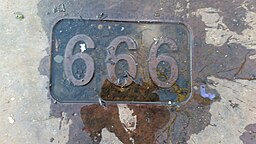 This is followed by one of the most famous verses in the Bible: “This calls for wisdom: let the one who has understanding calculate the number of the beast, for it is the number of a man, and his number is 666” (Revelation 13:18 ESV). One popular theory regarding this individual is that the numeric value of his name will add up to 666. But much like the mark of the beast mentioned earlier, this passage has led to many conjectures and speculations, some of which are reasonable, and others much less so.
Thus, we should not allow fear and superstition to influence our response to this number whenever we encounter it in its various forms. Our text from this passage simply provides us with the following information: some aspect of this individual’s existence will calculate to a value of 666. Thus, we should add this factor to the list of identifying traits given to us here in Revelation chapter thirteen.
Image Attribution: Ceescamel, CC BY-SA 4.0, via Wikimedia Commons