
“For if Abraham was justified by works, he has something to boast about, but not before God” (Romans 4:2).
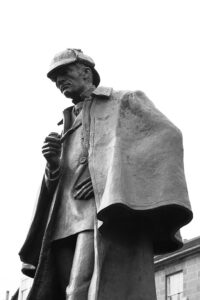 Sherlock Holmes, the celebrated fictional detective, once solved a suspected murder case by focusing on an unusual occurrence that others had overlooked. In the course of his investigation, Homes discovered that a guard dog on duty at the time of the incident did not bark at the presence of the intruder. Based on that observation, Holmes inferred that the assailant had a prior acquaintance with the dog. That deduction subsequently reduced his pool of potential suspects, thus enabling him to establish the truth. (1)
While the fictional exploits of an imaginary detective may seemingly have little to do with our text from Romans 4:2, these accounts have something in common: the absence of evidence. Here in Romans 4:2, the word “if” introduces a statement that is assumed to be true. Thus, “if” Abraham’s righteousness stemmed from his works, he would have had ample reason to form a high opinion of himself. In a similar manner, those who are justified by their works could rightfully claim credit for the works that earned their status.
But much like the dog that didn’t bark in Sherlock Holmes’ murder mystery, such works are conspicuous by their absence from Abraham’s life. In other words, Abraham would have had something to boast of if he had been justified by his own efforts. But the absence of such boasting is evidence itself, thus indicating that Abraham was justified by some other means.
One pastoral commentator offers a further explanation…
“If it was Abraham’s works that brought him justification, then Abraham could boast in his works. He could say, ‘I left my home, I left my family on the other side of the Euphrates River, and I journeyed not even knowing where I was going, just waiting for God to show me. And I was willing to offer my son.’ He could have boasted if he was justified by his works, but he could not have boasted in God; he would have had to have boasted in himself.” (2)
Another source offers the following insight…
“The point is that Abraham was justified by faith in God’s Word, but he then was asked to demonstrate that his faith was genuine by his works. He was justified before God by faith but was justified before men by his works (see Jam 2:21-24).” (3)
This will lead us into an important discussion concerning the relationship between faith and works. Fortunately, we have two of the foremost Biblical authorities on those subjects to guide us along the path of that discussion: the Apostles Paul and James.
Image Attribution: Siddharth Krish. The original uploader was Siddharthkrish at English Wikipedia., CC BY-SA 3.0, via Wikimedia Commons.
(1) See Wikipedia contributors. (2026, January 29). The Adventure of Silver Blaze. Wikipedia. https://en.wikipedia.org/wiki/Silver_Blaze
(2) Smith, C. (2005, June 1). Verse by Verse Study on Romans 3-4 (C2000). Blue Letter Bible. https://www.blueletterbible.org/Comm/smith_chuck/c2000_Rom/Rom_003.cfm
(3) Institute for Creation Research, New Defender’s Study Bible Notes [Romans 4:2] https://www.icr.org/bible/Rom/4/2/ Accessed 2 February, 2026