
“What shall we say then? Shall we continue in sin that grace may abound?” (Romans 6:1).
Romans chapter six marks the beginning of a three-chapter segment that explores the subject of God’s people and their relationship to sin (chapter six), the Mosaic Law (chapter seven), and the role of the Holy Spirit in their lives (chapter eight). Chapter six lays the groundwork for that discussion by contrasting the grim reality of sin and the transformative process of sanctification.
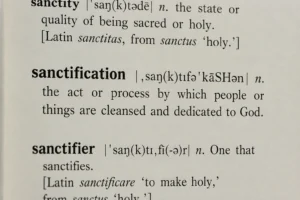 When we speak of “sanctification,” we’re speaking of a dual action that involves separation from sin and dedication to God. Sanctification can also be defined as “the act or process by which people or things are cleansed and dedicated to God…” (1) First, God declares us righteous in a positional sense through Christ. Then we grow in our experiential knowledge of God’s grace. That ongoing growth process relates to the idea of sanctification.
This yields holiness, or God-honoring character. The following source expands on these concepts and their relationship to the chapters that follow…
“When a sinner experiences redemption, he or she begins a process of progressive practical sanctification. This process of becoming progressively more righteous (holy) in his or her daily experience is not automatic. It involves growth and requires the believer to cooperate with God to produce holiness in daily life. God leads the believer and provides the enablement for him or her to follow, but the believer must choose to follow and make use of the resources for sanctification that God provides.
…In chapters 6—8 Paul explained how justified sinners can become more holy (godly, righteous) in daily living before our glorification. We need to understand our relationship as believers to sin (i.e., victory, ch. 6), to the Law (i.e., liberty, ch. 7), and to God (i.e., security, ch. 8) to attain that worthy goal.” (2)
While this source offers a look at what lies ahead, the following commentary explains how we arrived at this portion of Scripture…
“Paul’s words in Romans 6:1–14 do not simply drop out of the sky. They are integrally related to his argument in the preceding section of Romans 5:12–21. There, Paul describes the effects of Adam’s sin and how they impact the whole of humanity. Adam was the first man. In that capacity, he was also the representative of the whole human race before God. His fall carried implications for the whole of humanity.
In that sense, we all share in Adam’s sin. We all sinned and we all die in Adam (Rom. 5:12–14). But there is good news in the gospel. God has sent a second Adam, Jesus Christ (strictly speaking, ‘the last Adam’; 1 Cor. 15:45). He also represents all of His people in undoing what Adam did and in doing what he failed to do.” (3)
(1) New Dictionary of Theology, (Leicester/ Downers Grove: Inter-Varsity, 1988) pg. 613
(2) Dr. Thomas L. Constable, Notes on Romans 2021 Edition. (n.d.). https://soniclight.com/tcon/notes/html/romans/romans.htm
(3) Ferguson, S. B. (2010). By Grace Alone: How the Grace of God Amazes Me. Reformation Trust Publishing. pg. 103