

“For all who have sinned without the law will also perish without the law, and all who have sinned under the law will be judged by the law” (Romans 2:12 ESV).
What evidence do we have to support the conclusion that those who “sin without the law” possess an internal comprehension of God’s existence? The axiological argument for God’s existence offers another potential answer to that question. This approach capitalizes on the existence of values or morality to support the premise that God exists. Much like our previous two examples, the axiological argument consists of three points:
- Objective or absolute moral laws exist for all humanity. In this context, “objective” refers to something that exists independently of our perception or individual conception.
- Every law must have a point of origin (sometimes stated as “every law must have a lawmaker”).
- Therefore, the existence of these absolute moral laws points to the existence of an absolute source from which these moral laws derive.
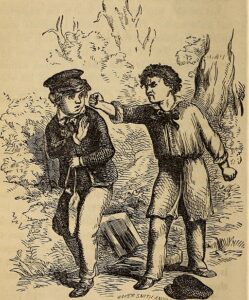 This approach argues for the existence of universal moral statutes that transcend time and culture. It also asserts that all laws have authors who create them. In order to prescribe those transcendent moral absolutes, our law source must also transcend time and culture as well. If we can document the existence of transcendent moral laws that every culture, tribe, and society recognizes and accepts, then it means that such laws must also derive from a transcendent source as well.
To put it another way, the existence of an absolute moral law requires the existence of an absolute moral source. That source ultimately defines what is good, right, and just. In general terms, we recognize this transcendent moral source as “God.” Consider how the well-known author and apologist C. S. Lewis once framed this idea…
“My argument against God was that the universe seemed so cruel and unjust. But how had I got this idea of just and unjust? A man does not call a line crooked unless he has some idea of a straight line… Of course I could have given up my idea of justice by saying it was nothing but a private idea of my own. But if I did that, then my argument against God collapsed too- for the argument depended on saying that the world was really unjust, not simply that it did not happen to please my private fancies.”(1)
We’ll consider some examples of transcendent moral absolutes and look at an objection to the axiological argument for God’s existence next.
(1) Lewis, C. (1960). Mere Christianity. Macmillan Paperbacks Edition [pg. 31]
Image Attribution: Internet Archive Book Images, No restrictions, via Wikimedia Commons