
“so that as sin reigned in death, even so grace might reign through righteousness to eternal life through Jesus Christ our Lord” (Romans 5:21).
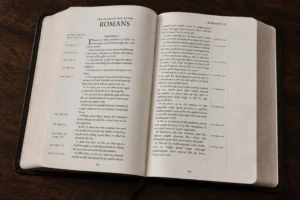 Many Biblical translations offer marginal notes that help explain the meanings of various words within the text. Some versions even offer inline references or expansive renderings of individual verses that seek to communicate the nuance behind each Biblical passage. These tools are often useful in helping us gain a deeper understanding of God’s Word.
As we close our study of Romans chapter five, we can adopt a similar approach by defining some of the concepts that appear within this final verse…
sin. The foundational definition of “sin” is “to miss the mark.” Much like an archer who fails to hit his or her target, every human being misses the mark of God’s standard of perfection.
reign. This word means “to exercise the highest influence, to control.” (1)
death. As mentioned earlier, the concept of “death” is rooted in the idea of “separation.” Physical death occurs when a person’s spirit separates from his or her body. Spiritual death involves one’s separation from God. Eternal death describes one’s everlasting separation from his or her Creator.
grace. Grace involves God’s unmerited favor towards undeserving human beings.
righteousness. “Righteousness” characterizes a state of right standing with God that He makes available to us through Jesus’ sacrificial death on the cross.
Jesus Christ. We might ordinarily assume that “Jesus Christ” refers to a first name and a surname. However, this is not the case. “Jesus” is the Greek form of the Hebrew name Joshua. Joshua means, “Yahweh (God’s self-designation) saves” or, “the Lord is salvation.” “Christ.” is taken from the Greek word “Christos” and refers to the Messiah, or “Anointed One.” So, a more accurate way to look at “Jesus Christ” is to say that “Jesus” refers to a name and “Christ” refers to a title or an office.
Lord. Just as we might use a word like “Sir” or “Mr.” today, the New Testament word “Lord” (kurios) was sometimes employed as a term of respect. However, this word was also used to represent the covenant name of God in copies of the Old Testament translated into ancient Greek. Therefore, in this context, the word “Lord” serves to affirm Jesus’ deity.
These definitions help prepare us for our entry into Romans chapter six, a portion of Scripture that features one of the most famous quotations in all the Biblical Scriptures…
“For the wages of sin is death, but the gift of God is eternal life in Christ Jesus our Lord” (Romans 6:23).
(1) G936 – basileuo – Strong’s Greek Lexicon (KJV). (n.d.). Blue Letter Bible. https://www.blueletterbible.org/lexicon/g936/kjv/tr/0-1/