
About This Chapter: Romans 3 addresses objections concerning God’s faithfulness and the privileges entrusted to the Jewish people. Paul the Apostle affirms the value of receiving God’s revealed Word while explaining that human unfaithfulness does not invalidate God’s faithfulness or justice. He then establishes that both Jews and Gentiles are under sin and that no one can be justified by observing the law. Paul explains that God’s righteousness is made available through faith in Jesus Christ. Because justification rests on God’s grace rather than human achievement, boasting is excluded, and faith does not nullify the law.
- Romans 3:1–8 — God’s Faithfulness and the Objections Against His Judgment
- Romans 3:9–20 — All Humanity Is Accountable to God
- Romans 3:21–26 — God’s Righteousness Revealed Through Faith in Jesus Christ
- Romans 3:27–31 — Boasting Excluded: Justification by Faith and its Relation to the Law
God’s Faithfulness and the Objections Against His Judgment
In Romans chapter two, the Apostle Paul dealt with a variety of topics related to hypocritical spirituality. He first confronted those who claimed a position of moral superiority by saying: “You, therefore, have no excuse, you who pass judgment on someone else, for at whatever point you judge the other, you are condemning yourself, because you who pass judgment do the same things” (Romans 2:1 NIV).
He then addressed those whose behavior failed to reflect their external profession of spiritual belief: “You who boast in the law, do you dishonor God by breaking the law?” (Romans 2:23 CSB). Finally, Paul turned his attention to the consequences of spiritual hypocrisy by saying: “No wonder the Scriptures say that the world speaks evil of God because of you” (Romans 2:24 TLB).
 Here now in Romans chapter three, Paul will hold something of a “Question and Answer” session to help address some inquiries that might arise in the minds of his audience. To do so, Paul will structure portions of Romans chapter three as a dialog with a hypothetical opponent. This approach should come as no surprise given what we know of Paul’s time in the ancient city of Athens…
“Therefore [Paul] reasoned in the synagogue with the Jews and with the Gentile worshipers, and in the marketplace daily with those who happened to be there” (Acts 17:17).
Those who confronted Paul in these venues undoubtedly influenced his literary approach…
“Some of the Epicurean and Stoic philosophers also conversed with him. And some said, ‘What does this babbler wish to say?’ Others said, ‘He seems to be a preacher of foreign divinities’–because he was preaching Jesus and the resurrection’” (Acts 17:18 ESV and following).
Thus, in the words of one source…
“It often becomes easier to follow Paul’s arguments if the reader imagines the apostle face to face with a heckler, who makes interjections and receives replies which sometimes are withering and brusque. It is by no means impossible that some of the arguments in Romans first took shape in this way, in the course of debates in synagogue or market place.” (1)
Finally, the prolific 17th-century commentator Matthew Henry offers a brief, verse-by-verse outline of this chapter that will help us follow along with the flow of these arguments…
- (1–8) Objections answered.
- (9–18) All mankind are sinners.
- (19, 20) Both Jews and Gentiles cannot be justified by their own deeds.
- (21–31) It is owing to the free grace of God, through faith in the righteousness of Christ, yet the law is not done away. (2)
Image Attribution: Question and answer icons created by Anggara – Flaticon
(1) Barrett, C. K. A Commentary on the Epistle to the Romans. Harper’s New Testament Commentaries series. New York: Harper & Row Publishers, 1957 [ p. 43]. Quoted in Notes on Romans 2025 Edition Dr. Thomas L. Constable https://soniclight.com/tcon/notes/html/romans/romans.htm Accessed 5 December, 2025.
(2) Matthew Henry’s Concise Commentary on the Bible – Christian Classics Ethereal Library. (n.d.). https://ccel.org/ccel/henry/mhcc/mhcc.xxxvii.iii.html
The first portion of Romans chapter three is marked by Paul the Apostle’s appearance on a type of judicial witness stand. However, there is a difference between the type of questioning we find here in Romans chapter three and the type of interrogation that might occur in a court of law. The difference is this: Paul is serving as both the prosecuting attorney as well as the defendant here in Romans chapter three.
In his role as prosecutor, Paul will probe for disparities in the testimony of Paul, the defendant. That “testimony” will take the form of Paul’s teaching from the first two chapters of this book. This approach will enable Paul to address questions that might arise from those teachings in the minds of his “jurors.” Those “jurors” comprise the audience for this epistle, both ancient and modern.
For instance, the opening verse of Romans chapter three presents us with some questions that Paul likely encountered on his missionary journeys…
“What advantage then has the Jew, or what is the profit of circumcision?” (Romans 3:1).
To address these questions, we must return to an earlier portion of Romans chapter two. There, Paul entered into a lengthy discussion regarding regarding the ritual of circumcision and what that practice was supposed to represent. Paul used the act of circumcision as part of that discussion to to make two important points:
- Circumcision is profitable if one keeps the Law. In other words, the practice of Judaism would benefit those who live up to the requirements of the Mosaic Law.
- But if one fails to live up to the Law, then he or she effectively becomes just like anyone else. To use Paul’s terminology, one’s “circumcision will become uncircumcision” no matter how “religious” that person seems to be (see Romans 2:25).
There were many who were trusting in the Mosaic ritual of circumcision for their salvation, but their disobedience to the spirit of the Law invalidated that observance. In addition, Paul also reminded his audience that “…there is no preferential treatment with God” (Romans 2:11 Phillips). With these things in mind. one might ask, “What spiritual advantage does a Jewish person have over anyone else?”
Our author will go on to answer that question with a confident affirmation…
“Much in every way! Chiefly because to them were committed the oracles of God” (Romans 3:2).
Paul will later expand on those advantages as we move further into the book of Romans. However, our next study will focus on the chief advantage mentioned here: “the oracles of God.”
“Much in every way! Chiefly because to them were committed the oracles of God” (Romans 3:2).
In Romans 3:1, Paul the Apostle asked, “So what’s the advantage of being a Jew?” (CEB). He now proceeds to answer that question here in verse two: the Jewish people were “…entrusted with the oracles of God” (NET).
For some, the word “oracle” conjures up the image of a mystical artifact, or a being who shares cryptic prophecies and visions of the future. But in the context of Romans 3:2, the word “oracle” refers to a divine communication or revelation. (1) Paul employs that terminology to describe the Hebrew Scriptures, thus affirming the Jewish people’s honored role in publishing God’s written revelation. In fact, the people of Old Testament Israel embraced that privilege with remarkable dedication…
“The reason we do not possess many older copies of the Hebrew Scriptures is because of the reverence with which the Jews protected the purity of God’s Word. The Jews considered the text so sacred that they ceremoniously disposed of worn copies. The worn copies were first stored in a special room in the synagogue, called a Genizah. After a number of copies accumulated, they were all buried together (usually in the grave of some Jewish scholar). The Jews believed that this would protect readers from misreading God’s Word because of worn spots in older manuscripts.” (2)
Another scholar discusses the extraordinary consistency that exists between today’s Old Testament and earlier Biblical manuscripts such as the Dead Sea Scrolls….
“The main reason for all this consistency is that the scribes who made the copies had a profound reverence for the text. Jewish traditions laid out every aspect of copying the text as if it were law, from the kinds of materials to be used to how many columns and lines were to be on a page; nothing was to be written from memory. There was even a religious ceremony to perform each time the name of God was written. Any copy with just one mistake in it was destroyed. This guarantees us that there has been no substantial change in the text of the OT in the last 2000 years and evidence that there was probably very little change before that.” (3)
Finally, we have the testimony of Flavius Josephus, the ancient Jewish historian and contemporary of the Apostle Paul…
“How firmly we have given credit to those books of our own nation is evident by what we do; for during the many ages that have already passed, no has been so bold as either to add anything to them, or take anything away from them, or to make any changes in them; but it becomes natural to all Jews immediately, and from their very birth, to esteem those books to contain divine doctrines, and to persist in them, and if occasion be, to die for them” (4)
(1) λόγιον. (n.d.). billmounce.com. https://www.billmounce.com/greek-dictionary/logion
(2) McDowell, J. (1997). Josh McDowell’s handbook on apologetics (electronic ed.). [pg. 20]
(3) Geisler, N. (2018, June 5). How Reliable is the Modern Bible? Ankerberg Theological Research Institute. Retrieved December 12, 2025, from https://blog.atriresearch.org/articles/how-reliable-is-the-bible
(4) Against Apion by Flavius Josephus. (n.d.). https://www.gutenberg.org/files/2849/2849-h/2849-h.htm
“For what if some did not believe? Will their unbelief make the faithfulness of God without effect?” (Romans 3:3).
The Apostle Paul continues his brief Q&A session here in Romans 3:3 by asking, “What if some of the Jewish people were faithless? Will their lack of faith nullify God’s faithfulness?” To put it another way, “Will God be unfaithful because some are unfaithful to Him?” Paul responded to that question with a resounding no…
“Certainly not! Indeed, let God be true but every man a liar. As it is written: ‘That You may be justified in Your words, And may overcome when You are judged’” (Romans 3:4).
To illustrate the idea behind these statements, let’s consider a contemporary expression of faithlessness: the belief that “god” does not exist, and the universe is merely a product of random chance. While some may disbelieve in the idea of a Creator, their disbelief has no bearing on the question of His existence. In other words, a lack of faith on our part does not invalidate God’s existence. Nor does it negate His faithfulness to us. As Paul would later write in the Biblical letter we know today as 2 Timothy, “If we are faithless, He remains faithful; He cannot deny Himself” (2 Timothy 2:13).
One source draws an interesting correlation between Romans 3:3 and the psychological theory of projection, a condition where one attributes (or “projects”) an undesired thought, emotion, or impulse to someone (or something) else…
“Paul is calling attention to a point of difference between God and humanity. We are, by our sinful nature, covenant breakers. We do not always tell the truth. We do not always keep our promises. Does this mean that we can project our own sinfulness onto God and suggest that God might from time to time break his promises? …It is utterly unthinkable that God would ever break a promise. But God never said people would be redeemed by unrighteousness or by disobeying his commandments. He never promised automatic salvation apart from faith. Instead, God has the perfect right to judge sin.” (1)
In light of this, we must take care to avoid projecting our negative experiences with untrustworthy human beings onto God, for we can always rely on God’s faithfulness towards us. Finally, we would also do well to remember the message of Hebrews 11:6…
“But without faith it is impossible to please God: for he that comes to God must believe that he is, and that he is a rewarder of them that diligently seek him.”
(1) Sproul, R. C. (1992). Before the face of God: Book 1: A daily guide for living from the book of Romans (electronic ed.). Grand Rapids: Baker Book House; Ligonier Ministries.
“Certainly not! Indeed, let God be true but every man a liar. As it is written: ‘That You may be justified in Your words, And may overcome when You are judged’” (Romans 3:4).
Paul the Apostle was appalled by the implication that God could not be trusted simply because others lacked faith in Him (Romans 3:3). Various translations have characterized Paul’s vehement opposition to that idea with phrases such as “Absolutely not!” (GNT), “By no means…” (AMPC), and, “That would be unthinkable!” (GW) in verse four.
One commentator expands upon Paul’s response by cleverly recasting this portion of Scripture as a question and answer session between Paul and an unnamed objector…
The objector: “…But what if some of the Jews disobeyed these commandments and were unfaithful to God and came under his condemnation? You have just said that God gave the Jews a special position and a special promise. Now you go on to say that at least some of them are under the condemnation of God. Does that mean that God has broken his promise and shown himself to be unjust and unreliable?
Paul: Far from it! What it does show is that there is no favouritism with God and that he punishes sin wherever he sees it. The very fact that he condemns the unfaithful Jews is the best possible proof of his absolute justice. He might have been expected to overlook the sins of this special people of his but he does not.” (1)
Paul went on to support this assertion with an allusion to Numbers 23:19: “let God be true but every man a liar.” The underlying message behind that statement is unmistakable: even if every member of the human race promoted a falsehood, we can depend upon God’s commitment to the truth. In commenting on this passage, one source offers some valuable counsel: “Whenever there is a question whether God or man is right, always proceed on the basis that God is right and every man is a liar.” (2)
Our author then reached back to the Old Testament Scriptures once again to present another supporting reference: “That You may be found just when You speak, And blameless when You judge” (Psalm 51:4). One Pastoral commentator ties these references together with an important observation: “The fact that the Jews, who were given the Word of God did not obey the Word of God, in no way invalidates the Word but simply confirms the purpose of the Word, which is to convict all men of the undeniable reality that they are sinners.” (3)
(1) Barclay, William. “Commentary on Romans 3”. “William Barclay’s Daily Study Bible”. https://www.studylight.org/commentaries/eng/dsb/romans-3.html. 1956-1959.
(2) William Macdonald, Believer’s Bible Commentary Edited by Arthur Farstad. Thomas Nelson Publishers [Romans 3:1-20]
(3) Dick Woodward, Mini Bible College Booklet Twenty-Nine The Book Of Romans Verse By Verse (part one) [pg.26] https://mbc.icm.org/
“But if our unrighteousness demonstrates the righteousness of God, what shall we say? Is God unjust who inflicts wrath? (I speak as a man)” (Romans 3:5).
Here in Romans 3:5, Paul the Apostle offered another inquiry in this series of interactive, Q&A sessions with his audience. The New Living Translation (NLT) presents this exchange in a manner that is highly accessible for modern-day audiences: “’But,’ some might say, ‘our sinfulness serves a good purpose, for it helps people see how righteous God is. Isn’t it unfair, then, for him to punish us?’” Nevertheless, Paul was quick to add, “(This is merely a human point of view).”
In making that statement, it seems that Paul wanted to close off any avenue of speculation regarding the purpose of this question. For example, Paul did not support the premise of that question, nor did he support this conclusion. Instead, he employed that convoluted thought process as a diagnostic tool for the benefit of his audience.
By reminding his readers that he was “…arguing the way humans would” (GW), Paul drew back the curtain on the contorted logic of his opponents. He used a similar strategy in Galatians 3:15, and will later stretch this idea to its natural (and absurd) conclusion in Romans 3:8.
Much like a sparkling jewel against a black velvet background, this question sought to contrast God’s righteousness against the dark background of human sin. To this way of thinking, humanity’s sinful behavior serves a good purpose if the worst of humanity brings out the best in God. And if that behavior serves a good purpose, then God should refrain from condemning human sinfulness and credit humanity for serving Him instead. (1)
This brief hypothetical reminds us that we should never underestimate the human capacity to justify a desired outcome, even if that justification is patently absurd. The flaw in this premise is that God doesn’t need our unrighteousness to demonstrate His righteousness. Nor does He accept human wrongdoing as an excuse simply because it offers a greater opportunity to show His grace and patience.
Paul will begin dismantling this “human argument” (HCSB) beginning in the following verse, but first, one commentary offers some food for thought…
“Some may think they don’t have to worry about sin because (1) it’s God’s job to forgive; (2) God is so loving that he won’t judge; (3) sin isn’t so bad—it teaches valuable lessons; or (4) we need to stay in touch with the culture around us. It is far too easy to take God’s grace for granted. But God cannot overlook sin. No matter how many excuses they make, sinners will have to answer to God for their sin.” (2)
(1) See Bruce, F. F. (1986). New International Bible Commentary [pg.1322]
(2) Life Application Study Bible NKJV [Romans 3:5-8] Copyright © 1988, 1989, 1991, 1993, 1996, 2004 by Tyndale House Publishers Inc., all rights reserved.
“But if our unrighteousness demonstrates the righteousness of God, what shall we say? Is God unjust who inflicts wrath? (I speak as a man.) Certainly not! For then how will God judge the world?” (Romans 3:5-6).
The Apostle Paul’s response to the convoluted reasoning of Romans 3:5 was to say once again, “That’s unthinkable!” (GW). If God were to dismiss human sin, then how could He hold the members of His human creation accountable for their behavior? As one paraphrase renders this passage, “…If God were not entirely fair, how would He be qualified to judge the world? (NLT).
To understand why the premise of Romans 3:5 unravels, it helps to remember that God is both holy and just. The word “holy” means “set apart” and conveys the idea of absolute moral purity. “Holiness” means that God is completely separate from anything that may be wrong, dirty, or impure. It also expresses the qualities of honor, virtue, and ethical perfection by extension.
When we describe God as just, we are referring to the fact that He acts with complete fairness and equity in every aspect of His dealings with humanity. The Old Testament concept of a “just” individual communicates the idea of someone who is lawful, righteous, and/or correct. The New Testament concept of this word identifies someone who is virtuous, innocent, faultless, and/or guiltless.
These concepts are frequently associated with the word “righteous” in both testaments. This simply refers to one who does what is right, and helps explain Paul’s sharply negative reaction to the suggestion that God might condone human sinfulness simply because it displays His righteousness to a greater degree.
 We can also turn to a helpful analogy with respect to the scenario Paul offers here in Romans 3:5-8. For example, how many of us would keep a broken clock on a wall of our home simply because it happens to display the correct time twice a day? In that instance, most of us would repair the clock or discard it in favor of a replacement. In a similar manner, God does not accept human sinfulness simply because it serves to accentuate His purity on occasion.
While our sin may highlight God’s righteousness, that is not a valid excuse for God to reward it. As mentioned earlier, Paul likely fielded such questions from those who sought to discredit him and ease their discomfort over the implications of the gospel message. If that was the case, then the following verses will demonstrate that Paul was more than prepared to meet that challenge.
Image Attribution: Original photograph: Audrius Meskauskas; derivative work: Jahoe., CC BY-SA 3.0, via Wikimedia Commons
“For if the truth of God has increased through my lie to His glory, why am I also still judged as a sinner? And why not say, ‘Let us do evil that good may come’?–as we are slanderously reported and as some affirm that we say. Their condemnation is just” (Romans 3:7-8).
It has often been said that “the ends justify the means” in life. Those who embrace that philosophy believe that the methods we use to achieve a specific goal are less important than the goal itself, as long as the results are “good.” However, the Scriptures do not endorse that philosophy, and the passage quoted above helps us understand why.
Here in Romans 3:7, the “means” are represented by a lie. The “ends” represent the truth of God and His glory. Thus, we have a proposition that seeks to highlight the truth of God by means of a lie. Since lying involves an attempt to deceive by falsehood, and God is a God of truth, that approach can never bring “…honor to God by showing how truthful he is” (CEV).
One paraphrase of Romans 3:8 highlights the irrational nature of this argument: “If you follow through with that idea you come to this: the worse we are, the better God likes it!” (TLB). God’s glory does not require enhancement, and He certainly has no need of “enhancements” that find their origin in a lie. Our text from Romans 3:7-8 serves to illuminate that façade and expose it for what it is: an effort to rationalize or legitimize ungodly behavior by framing it in a manner that appears to bring glory to God.
Such attempts amount to sophistry, a word that describes a plausible, but misleading or fallacious argument. (1) Sophistry involves the use of cleverly deceptive arguments that seem reasonable, but exhibit logical inconsistencies when examined more closely. This type of argument does not aim for truth or accuracy; instead, it is often used to mislead or deceive someone while engaged in a discussion or debate.
Of course, this approach is hardly limited to questions of a spiritual nature. For instance…
- A trial lawyer might use a seemingly plausible (but untruthful) legal argument to win acquittal for a guilty client.
- A salesperson with questionable ethics might exaggerate the benefits of a product or service with a clever, but misleading presentation.
- A politician might twist and manipulate an opponent’s statement to create a false but convincing narrative that harms the opposition candidate.
While these techniques are commonly used today, Paul the Apostle repudiated such methods and set the standard for us to follow in representing Biblical truths to others…
“Instead, we reject secrecy and shameful actions. We don’t use deception, and we don’t tamper with God’s word. Instead, we commend ourselves to everyone’s conscience in the sight of God by the public announcement of the truth” (2 Corinthians 4:2 CEB).
(1) sophistry. (n.d.) American Heritage® Dictionary of the English Language, Fifth Edition. (2011). Retrieved December 15 2025 from https://www.thefreedictionary.com/sophistry
“Why not say–as some slanderously claim that we say–‘Let us do evil that good may result’? Their condemnation is just!” (Romans 3:8).
An attempt to discredit someone by misrepresenting something he or she said is an ancient strategy that dates back to an event that took place in the Garden of Eden. For instance, consider the serpent’s claim regarding the fruit of the tree of the knowledge of good and evil in Genesis chapter three.
When told that certain death would result if one were to partake of that fruit, the serpent replied, “…’You will not surely die. For God knows that in the day you eat of it your eyes will be opened, and you will be like God, knowing good and evil’” (Genesis 3:4-5). That was a lie, and a clear misrepresentation of God’s warning to Adam in Genesis 2:16-17.
Another spiritual misrepresentation appears here in Romans 3:7-8. The following source draws our attention to the contrast that exists between Jesus’ teachings and those who suggested that we should “…do evil that good may result”…
“It does not take an accomplished theologian to see that this is not true Christianity. Think, for example, how Jesus insisted on a radical change of behavior for all who would follow him. He said, ‘If anyone would come after me, he must deny himself and take up his cross daily and follow me’ (Luke 9:23).
He admonished those whose ‘faith’ was only verbal… Furthermore, he told the Jews of his day, ‘… unless your righteousness surpasses that of the Pharisees and the teachers of the law, you will certainly not enter the kingdom of heaven’ (Matt. 5:20).” (1)
Regrettably, Paul the Apostle had little control over what others did with his messages, and some chose to slander him by contorting his God-honoring teachings into something else. Paul documented one such example here in Romans 3:8. A similar example occurred in 1 Corinthians 5:9-10, where he sought to correct an erroneous application of his teaching concerning interpersonal relationships.
Other examples were cited by the Apostle Peter who wrote of “…our beloved brother Paul, according to the wisdom given to him, has written to you, as also in all his epistles, speaking in them of these things, in which are some things hard to understand, which untaught and unstable people twist to their own destruction, as they do also the rest of the Scriptures” (2 Peter 3:15-16).
As another source comments, “Tragically, the apostle’s gospel message of salvation by grace through faith alone had been perverted by his opponents who argued it provided not only a license to sin, but outright encouragement to do so (5:20; 6:1, 2).” (2) Thus, we should be mindful of Paul’s parting observation regarding those who misrepresent such teachings: “…They are condemned, and that’s what they deserve” (GW).
(1) Boice, J. M. (2005). Romans: Justification by Faith (Romans 1-4). Baker Books. [p.287]
(2) John F. MacArthur Jr., The MacArthur Study Bible: New American Standard Bible. (Nashville, TN: Thomas Nelson Publishers, 2006), Ro 3:8.
All Humanity Is Accountable to God
“What then? Are we better than they? Not at all. For we have previously charged both Jews and Greeks that they are all under sin” (Romans 3:9).
The Apostle Paul continued to engage his audience in Romans 3:9 with a summary question: “If being a Jew has many advantages, does it mean that we Jews are better than those who are not?”
We can address that question in the following way. While the Jewish people were privileged to receive God’s Word (verse two), God would not refrain from judging them if they chose to dismiss Him like the non-Jewish populations of the world (collectively referred to as the Greeks). One source illustrates this idea with an interesting analogy…
“The Christian is no better than a non-Christian, but he is infinitely better off. It is like two men on a plane, one of whom is wearing a parachute while the other is not. Neither is better than the other, but the man with the parachute is certainly better off than the man who is not wearing a parachute. The difference will be seen when they jump from the plane at 20,000 feet.” (1)
Of course, the advantage of having a parachute assumes that one will pull the ripcord and deploy the parachute when exiting the plane at 20,000 feet. Unfortunately, the Jewish people had many God-given advantages but failed to deploy them through unbelief. Thus, they are in no better position than anyone else from that perspective.
In further stating that all people are all under sin, this passage from Romans 3:9 does not mean that human beings are totally incapable of moral good. Indeed, we applaud those among us who are selfless, virtuous, charitable, and benevolent. We rightfully commend the bravery of a firefighter who dashes into a burning building to rescue the helpless from certain death. We are thankful for many others like trustworthy neighbors, helpful bystanders, and public-spirited community members.
However, genuine goodness is measured against God’s holy character. As Jesus told the rich young ruler of Mark chapter ten, “No one is good except God alone” (Mark 10:18 CSB). When we measure our goodness against God’s perfect standard, humanity falls woefully short. Therefore, we should not assume that we, or others, are in good standing with the Almighty simply because we are nice, good people. In fact, Paul will disabuse us of that notion entirely in Romans 3:23.
While there are likely to be many who perceive themselves to be “good people” who haven’t really done anything wrong or offensive to God, this passage from Romans 3:9 reminds us that all “…are under the control of sin and subject to its power” (AMP).
(1) The Evidence Bible [note on Romans 3:9] Bridge-Logos Publishers 2011
“As it is written: ‘there is none righteous, no, not one” (Romans 3:10).
“To err is human.”
“Nobody’s perfect.”
“Everyone makes mistakes.”
These maxims underscore the disparity between the ideal and the reality of human behavior. Because these truisms are so deeply ingrained and widely acknowledged as fundamental truths of human existence, we often miss their true significance: they reflect a universal admission that something is seriously amiss in basic human nature…
“Besides the feelings of guilt that people experience and to which we can appeal, there is also the proverbial wisdom of mankind that includes within it a recognition that something is objectively wrong with people.
Think of the familiar saying ‘nobody’s perfect.’ Although in itself this phrase does not acknowledge the law of the Lord, it recognizes that there is an ideal that no one meets. It recognizes that there is some kind of objective rule of perfection known to all people but that no one has ever actually fulfilled this standard.” (1)
Beginning here in Romans 3:10, Paul the Apostle will turn once again to the Old Testament Scriptures to support that premise. In doing so, he will draw upon several adaptations of various Old Testament Scriptures, including Psalms 5:9, Psalms 10:7, Psalms 14:3, Psalms 36:1, Psalms 53:3, Psalms 140:3, Isaiah 59:7-8, Ecclesiastes 7:20, and Proverbs 1:16. What follows over the next eight verses represents one of the most brutally honest assessments of human nature in all Scripture.
For instance, consider the first statement in this series: “…there is none righteous, no, not one.” This portion of Scripture alludes to Psalm 53:3…
“Every one of them has turned aside; They have together become corrupt; There is none who does good, No, not one.”
There are undoubtedly many who believe that human beings are essentially good at heart and that negative behaviors typically arise from external factors like social or environmental influences. Of course, most human beings are likely to be “good people” insofar as they are not deliberately wicked, cruel, or ruthless. It’s also true that social and environmental factors often exert a considerable influence on one’s conduct for better or worse.
But as much as we might like to think of ourselves as “good people,” this passage tells us something different. Our text from Romans 3:10 states that all human beings (even the “good” ones) are unrighteous. In the words of one commentary on Romans 3:10-18, “Paul uses these Old Testament references to show that humanity in general, in its present sinful condition, is unacceptable before God. Have you ever thought to yourself, ‘Well, I’m not too bad. I’m a pretty good person’? Look at these verses and see if any of them apply to you.” (2)
(1) Missing the Mark (2014, May 26). Ligonier Ministries. https://learn.ligonier.org/devotionals/missing-mark
(2) Life Application Study Bible NKJV [Romans 3:10-18] Copyright © 1988, 1989, 1991, 1993, 1996, 2004 by Tyndale House Publishers Inc., all rights reserved.
“as it is written: ‘None is righteous, no, not one’” (Romans 3:10 ESV).
A common thread runs through the appraisal that begins here in Romans 3:10 and continues into verse eighteen. That thread involves various aspects of the human body. For instance, the throat, tongue, and lips are mentioned in Romans 3:13. A reference to the mouth appears in verse fourteen, while the feet and eyes are noted in verses fifteen and eighteen.
These characteristics of human behavior are far from trivial, for they serve to illustrate the extent of human unrighteousness. For instance, our text from this portion of Romans is strikingly similar to the depiction of humanity that defined the era immediately preceding Noah’s flood…
“Then the LORD saw that the wickedness of man was great in the earth, and that every intent of the thoughts of his heart was only evil continually. And the LORD was sorry that He had made man on the earth, and He was grieved in His heart” (Genesis 6:5-6).
The following commentators offer some additional insight concerning this passage and the verses that follow…
“It is a terrible description of human nature in its Christless state. Vaughan has pointed out that these Old Testament quotations describe three things. (i) A character whose characteristics are ignorance, indifference, crookedness and unprofitableness. (ii) A tongue whose notes are destructive, deceitful, malignant. (iii) A conduct whose marks are oppression, injuriousness, implacability. These things are the result of disregard of God.” (1)
So, these verses present us with a stark depiction of the human race, an image of humanity that is not as it should be. We can attribute that condition to an internal human nature that naturally rebels against its Creator’s desires and the external actions that follow as a result. Consider the following description given to us in Romans 3:11…
“There is none who understands; There is none who seeks after God.”
In the Gospel of John, Jesus is quoted as saying, “No one can come to Me unless the Father who sent me draws him; and I will rise him up in the last day” (John 6:44). In John 14:6, He added, “…’I am the way, the truth, and the life. No one comes to the Father except through Me.’” In light of these Scriptures, we should be diligent to pray that God will draw others to Christ. If left to ourselves, Romans 3:11 tells us there are none who will seek after Him.
We’ll explore the ramifications of Romans 3:11 at greater length in our next study.
(1) Barclay, William. “Commentary on Romans 2”. “William Barclay’s Daily Study Bible”. https://www.studylight.org/commentaries/eng/dsb/romans-2.html. 1956-1959.
“no one understands; no one seeks for God” (Romans 3:11).
While the meaning of this passage is relatively straightforward, it presents us with several implications that may be difficult to accept. This verse confronts the stark reality of the human condition; thus, it requires careful thought and a commitment to follow the truth where it leads. To begin, let’s consider the spiritual underpinnings of Romans 3:11…
“Before Adam sinned, he had fellowship with God. We see Adam standing in the presence of God, wherein God speaks to him (Gen. 2:15–17). After Adam sins, however, he tries to hide himself from God (3:8). This is true of every fallen child of Adam. Even though he knows God’s ‘invisible attributes, namely, his eternal power and divine nature…in the things that have been made,’ he turns his thoughts and worship to dead idols rather than to the living God. This is why the Scripture says ‘no one seeks for God’ (Rom. 3:11) and ‘the mind that is set on the flesh is hostile to God’ (8:7).” (1)
However, this does not mean we are incapable of seeking God. Indeed, the Scriptures encourage us to do so in both the Old and New Testaments…
“Seek the LORD while He may be found, Call upon Him while He is near” (Isaiah 55:6).
“Draw near to God and He will draw near to you. Cleanse your hands, you sinners; and purify your hearts, you double-minded” (James 4:8).
The problem is that a religious pursuit does not automatically mean that one is seeking God. For instance, some who appear to be searching for God may only be seeking a “higher power” that aligns with their preferences and imposes no obligations upon them. In fact, Paul the Apostle spent the second half of Romans chapter one exploring that very subject.
Another source examines the question of motive by turning to the spiritual leadership of first-century Israel as an example…
“Knowing what the scripture says is one thing; following on to know the Lord is another. Since the Jews were not seeking after God, what was the point of all their study? Christ himself pinpointed the trouble: it was this, that they desired the praise of men rather than the praise of God (John 12:43). Christ said, Ye are they that justify yourselves in the sight of men; but God knoweth your hearts: for that which is exalted among men is an abomination in the sight of God (Luke 16:15). Moreover, they did not seek to glorify God, but only to glorify one another (John 5:44).” (2)
We’ll consider the challenging ramifications of this passage next.
(1) Paradise created by Guy Waters. (n.d.). Ligonier Ministries. https://learn.ligonier.org/articles/paradise-created
(2) Coffman, James Burton. “Commentary on Romans 3”. “Coffman’s Commentaries on the Bible”. https://studylight.org/commentaries/eng/bcc/romans-3.html. Abilene Christian University Press, Abilene, Texas, USA. 1983-1999.
“there is no one who understands, there is no one who seeks God” (Romans 3:11 NET).
If no one seeks God (as we are told here in Romans 3:11), then how can we account for those who seem to be doing so? One author addresses that question in a lengthy quote that merits our attention…
“[The medieval theologian] Thomas Aquinas was asked on one occasion why there seem to be non-Christians who are searching for God, when the Bible says that no one seeks after God in an unconverted state. Aquinas replied that we see people all around us who are feverishly seeking for purpose in their lives, pursuing happiness, and looking for relief from guilt to silence the pangs of conscience.
We see people searching for the things that we know can be found only in Christ, but we make the gratuitous assumption that because they are seeking the benefits of God, they must therefore be seeking God. That is the very dilemma of fallen creatures: we want the things that only God can give us, but we do not want Him. We want peace but not the Prince of Peace. We want purpose but not the sovereign purposes decreed by God. We want meaning found in ourselves but not in His rule over us.
We see desperate people, and we assume that they are seeking for God, but they are not seeking for God. I know that because God says so. No one seeks after God… Yet it is important to remember the distinction between seeking after God and seeking after His benefits. Jesus promises Christians that all things are added to us when we seek the kingdom first (Matt. 6:33), but let us be careful that we are seeking for the right reasons.” (1)
Thus, if someone is genuinely seeking God, we can be assured he or she is doing so because God initiated that search (John 14:6, John 6:44, John 6:65). While these passages inevitably prompt a discussion related to God’s sovereignty and human responsibility, the Biblical teaching concerning this subject is clear: God chooses, and human beings each choose in the matter of salvation. As one source explains…
“From the word translated chosen (ekloge) comes the English ‘election.’ That God has chosen to bless some individuals with eternal life is clearly taught in many places in both the Old and New Testaments (e.g., Deu_4:37; Deu_7:6-7; Isa_44:1-2; Rom_9:1-33; Eph_1:4-6, Eph_1:11; Col_3:12; 2Th_2:13).
Equally clear is the fact that God holds each individual personally responsible for his decision to trust or not to trust in Jesus Christ (cf. Joh_3:1-36; Rom_5:1-21). The difficulty in putting divine election and human responsibility together is understanding how both can be true. That both are true is taught in the Bible. How both can be true is apparently incomprehensible to finite human minds; no one has ever been able to explain this antinomy satisfactorily.” (2)
(1) Sproul, R. C. The Power of the Gospel: A Year in Romans. Ligonier Ministries, 2024. pp. 70-71
(2) John F. Walvoord and Roy B. Zuck, Bible Knowledge Commentary, note on 1 Thessalonians 1:4 pg. 691
“They have all turned aside; They have together become unprofitable; There is none who does good, no, not one” (Romans 3:12).
The Biblical book of Ezekiel offers a true-to-life illustration of Romans 3:12 along with a contemporary application. A selected portion of that Scripture begins as God reveals some disturbing truths to Ezekiel that would have ordinarily remained hidden from him…
“Then he brought me to the door of the Temple courtyard, where I could see a hole in the wall. He said to me, ‘Now, son of man, dig into the wall.’ So I dug into the wall and found a hidden doorway. ‘Go in,’ he said, ‘and see the wicked and detestable sins they are committing in there!’ So I went in and saw the walls covered with engravings of all kinds of crawling animals and detestable creatures. I also saw the various idols worshiped by the people of Israel…
Then the Lord said to me, ‘Son of man, have you seen what the leaders of Israel are doing with their idols in dark rooms? They are saying, ‘The Lord doesn’t see us; he has deserted our land!’” (Ezekiel 8:7-10, 12 NLT).
But there was more to come…
“Then he brought me into the inner courtyard of the Lord’s Temple. At the entrance to the sanctuary, between the entry room and the bronze altar, there were about twenty-five men with their backs to the sanctuary of the Lord. They were facing east, bowing low to the ground, worshiping the sun!” (Ezekiel 8:16 NLT).
The “inner courtyard of the Temple” suggests this meeting comprised a group of spiritual leaders who had turned their backs on God. However, such things had not escaped God’s notice…
“‘Have you seen this, son of man?’ he asked. ‘Is it nothing to the people of Judah that they commit these detestable sins, leading the whole nation into violence, thumbing their noses at me, and provoking my anger? Therefore, I will respond in fury. I will neither pity nor spare them. And though they cry for mercy, I will not listen’” (Ezekiel 8:17-18 NLT).
Ezekiel’s experience illustrates what God sees when He looks into the hearts and minds of unrepentant human beings. While a casual observer might not perceive such issues, God saw the truth of those behaviors with absolute clarity. In a similar manner, a seemingly earnest quest for God may be corrupted by motives that are clearly visible to our Creator but may remain hidden from us.
This sheds light upon our text from Romans 3:12: “All have turned away; all have become useless. No one does good, not a single one” (NLT). It also explains King’s Solomon’s pointed observation from the Old Testament book of Ecclesiastes: “Truly the hearts of the sons of men are full of evil; madness is in their hearts while they live, and after that they go to the dead” (Ecclesiastes 9:3).
“All have turned aside; together they have become worthless; no one does good, not even one” (Romans 3:12 ESV).
As mentioned earlier, there are undoubtedly many who believe that human depravity is solely (or principally) attributable to environmental factors, circumstantial elements, or economic causes. The idea is that the inherent goodness of humanity would shine forth if one could remove those negative attributes. While we should not ignore those factors and their potential contributions to human evil, that belief is neither supported by the Scriptures or real-world experience.
For example, even a very young child can exhibit things like greed, selfishness, envy, and a variety of similar behaviors. While children are often a source of great joy, virtually every parent knows this: a child doesn’t need to be taught how to lie or act deceptively. In addition, a young child doesn’t need to be prompted to say things like “Gimme,” “Mine,” or “No!” Those unfortunate realities do not change as we grow older; we simply become better at masking them.
In addition to what we read here in Romans 3:12, the Scriptures identify the root cause of such behaviors in a well-known passage from Jeremiah 17:9: “The heart is deceitful above all things, and desperately wicked; who can know it?” Jesus also provided us with insight into this subject when He said, “…what comes out of the mouth proceeds from the heart, and this defiles a person. For out of the heart come evil thoughts, murder, adultery, sexual immorality, theft, false witness, slander. These are what defile a person…” (Mathew 15:18-20 ESV).
This reference to having become “worthless” or “unprofitable” in Romans 3:12 originates in a word that offers a descriptive word-picture: “to go bad, [to] become sour like milk.” (1) One source offers an uncompromising assessment of this idea…
“While man looks upon the outward acts and judges them to be good, God looks upon not only the outward acts but also the inward motives that lie behind them, and because they proceed from a heart that is in rebellion against Him and they are not done for His glory, even these good deeds are like ‘filthy rags’ in His sight. In other words, fallen man’s good deeds are motivated not by a desire to please God but by our own self-interest and are thus corrupted to the point where God declares that there is ‘no one who does good, no not one!’” (2)
As another author reminds us…
“Good is a relative term. It is defined against some standard. If we establish what that standard is, we can congratulate ourselves and take comfort in our attainment of it. But if God establishes the standard, and His standard includes outward behavior (that our actions conform perfectly to His law) and internal motivation (that all our acts proceed from a heart that loves Him perfectly), then we quickly see that our pretended ‘goodness’ is no goodness at all.” (3)
(1) Kenneth S. Wuest, Word Studies in the Greek New Testament [Romans 3:10-12] Copyright © 1942-55 by Wm. B. Eerdmans Publishing Co.
(2) GotQuestions.org. (2022, January 4). GotQuestions.org. https://www.gotquestions.org/total-depravity.html
(3) None Righteous by R.C. Sproul. (n.d.). Ligonier Ministries. https://learn.ligonier.org/articles/none-righteous
“All have turned away; all alike have become useless. There is no one who does what is good, not even one” (Romans 3:12 HCSB).
Most definitions of “good” depend on someone’s interpretation of that word according to its context. However, a few personalized questions can help determine if human beings are really in the best position to serve as independent arbiters of moral goodness. For instance…
- Have you ever had an intense desire to possess someone or something that belonged to someone else?
- Have you ever told a lie?
- Have you ever stolen anything, even something small or inconsequential?
- Have you ever been involved in an inappropriate sexual relationship in thought or deed?
- Have you ever ended the life of another human being without just cause, either in thought or deed?
- Have you always honored your parents or guardians without fail?
- Have you always set apart one day a week to honor God?
- Have you ever referenced God in a frivolous, inappropriate, or disrespectful manner?
- Has there ever been a person, object, or possession that you loved, respected, or feared more than God?
- Has anything ever taken the place of God as the first priority in your life?
As some may have guessed, these questions represent an inverted list that rephrases the Ten Commandments from Exodus chapter twenty. This list is inverted because the second table of the commandments seems to be the relatively “easy” ones to keep. Yet how many of us have failed to keep the least of those commandments?
Jesus went through a similar exercise with the rich young ruler of Mark chapter ten. When the man asked Jesus, “…what shall I do that I may inherit eternal life?” He responded by saying…
“‘You know the commandments: ‘You shall not murder, you shall not commit adultery, you shall not steal, you shall not give false testimony, you shall not defraud, honor your father and mother.’ ‘Teacher,’ he declared, ‘all these I have kept since I was a boy’” (Mark 10:17-20 NIV).
This man must have thought, “I’ve lived an exemplary life. I’ve never murdered anyone. I don’t cheat on my wife. I don’t steal from anyone. I’m not a liar and I always treat my parents with respect.” But it was not until Jesus said, “Go and sell all you have and give the money to the poor…” (Mark 10:21 GNT) that the truth was revealed: “…the man was dismayed at this statement and went away saddened, because he had many possessions” (Mark 10:22 CEB).
This response exposed the rich young ruler’s affinity for material wealth. Even though he thought he was following the Commandments, he was actually guilty of violating the very first one: “You shall have no other gods before Me” (Exodus 20:3). His response thus serves to illustrate our text from Romans 3:12: “…there is none that doeth good, no, not one” (KJV).
“Every one has turned away; all have gone wrong. No one anywhere has kept on doing what is right; not one” (Romans 3:12 TLB).
Despite the discouraging assessment of human nature presented to us here in Romans 3:11-12, there is cause for hope. That hope is found in the Biblical encouragement to pray…
“First of all, then, I urge that petitions (specific requests), prayers, intercessions (prayers for others) and thanksgivings be offered on behalf of all people, for kings and all who are in [positions of] high authority, so that we may live a peaceful and quiet life in all godliness and dignity” (1 Timothy 2:1-2 AMP).
We find similar encouragements in Philippians 4:6-7, Colossians 4:2, and 1 Thessalonians 5:17. But even though God’s Word counsels us to pray on behalf of others, does prayer actually change God’s mind concerning the things we pray for?
The answer is “no,” for God is omniscient, and an all-knowing Being cannot change His mind. Since God knows all that He will or will not do, our prayers cannot change His mind. However, consider the insights offered by the following author…
“The Bible says there are certain things God has decreed from all eternity. Those things will inevitably come to pass. If you were to pray individually or if you and I were to join forces in prayer or if all the Christians of the world were to pray collectively, it would not change what God, in His hidden counsel, has determined to do.
…When God hangs His sword of judgment over people’s heads, and they repent and He then withholds His judgment, has He really changed His mind? The mind of God does not change for God does not change. Things change, and they change according to His sovereign will, which He exercises through secondary means and secondary activities. The prayer of His people is one of the means He uses to bring things to pass in this world. So if you ask me whether prayer changes things, I answer with an unhesitating ‘Yes!’” (1)
This is exactly how God promised to interact with human beings who live in this temporal world (see Ezekiel 33:14-16, 19). So, while it may seem as if we are not having much of an impact for God, our prayerful influence may be more significant than we realize. For example, how do you know that others have not been rescued from harm because of your Godly influence? How do you know that God has not spared others from serious misfortune because you were diligent to pray for them?
How do you know that you are not one of those secondary means that God intends to bring about His will in the lives of others? Whenever you pray (or have prayed), you can rest assured that God knew what you were going to pray- and perhaps He may have ordained your prayer as the means of accomplishing His purpose in someone else’s life.
(1) Does prayer change God’s mind? (n.d.). Ligonier Ministries. https://learn.ligonier.org/articles/does-prayer-change-gods-mind [emphasis added]
“Their throat is an open tomb; With their tongues they have practiced deceit. The poison of asps is under their lips” (Romans 3:13).
The Apostle Paul drew upon some vivid Old Testament imagery as he evaluated the characteristics of unrepentant humanity in Romans 3:10-18. However, verse thirteen contains some of the most graphic portrayals of the human condition in this portion of Scripture. The first (and most disturbing) of those portraits compares the human throat to an “open sepulchre” (KJV).
A contemporary rendering of this passage ties these metaphors together: “Their talk is foul, like the stench from an open grave” (NLT). This characterization is reminiscent of Jesus’ assessment of Israel’s corrupt spiritual leadership…
“Woe to you, scribes and Pharisees, hypocrites! For you cleanse the outside of the cup and dish, but inside they are full of extortion and self-indulgence. Blind Pharisee, first cleanse the inside of the cup and dish, that the outside of them may be clean also.
Woe to you, scribes and Pharisees, hypocrites! For you are like whitewashed tombs which indeed appear beautiful outwardly, but inside are full of dead men’s bones and all uncleanness. Even so you also outwardly appear righteous to men, but inside you are full of hypocrisy and lawlessness” (Matthew 23:25-28).
Then, as now, burial chambers were sealed to contain the stench of the dead. In fact, Martha of Bethany voiced her concern regarding that very prospect right before Jesus raised her brother Lazarus from the dead. When taken together, this imagery accurately reflects the way some people express themselves. Unfortunately, we need only spend some time in the workplace, the market, the airport, the train station, or any place where people gather to verify the general truth of this passage: “What comes out of their mouths is as foul as a rotting corpse” (Voice).
In addition, modern-day audio/visual platforms offer fertile ground for pundits, commentators, influencers, and content creators to validate this description from Romans 3:18. Our contemporary social media landscape also offers compelling evidence to support this verse. As any participant in today’s social media environment is undoubtedly aware, these unmoderated forums provide ample opportunity for participants to verify the truth of this passage through personal attacks, hostile criticisms, and hateful, malevolent comments.
If we ever feel inclined to dismiss this characterization of unregenerate humanity from Romans 3:13, the current state of social media should quickly dispel that notion. That brings us to another relevant quote from Jesus…
“…out of the overflow of the heart the mouth speaks. The good man brings good things out of the good stored up in him, and the evil man brings evil things out of the evil stored up in him” (Matthew 12:34-35).
“Their throat is an open grave; they use their tongues to deceive. The venom of asps is under their lips” (Romans 3:13 ESV).
Here in Romans 3:13, the progression of ideas follows a logical sequence that begins with the throat and moves to the tongue. Much like the polluted speech that emerges from the open grave of the throat, these individuals “…use their tongues to deceive (to mislead and to deal treacherously)” (AMPC). This goes far beyond the simple act of lying, for it also expresses the ideas of fraud, (1) guile, (2) and “to lure, as by a bait.” (3)
The New Testament epistle of James offers what is perhaps the most vivid characterization of the tongue in this regard…
“The human tongue is physically small, but what tremendous effects it can boast of! A whole forest can be set ablaze by a tiny spark of fire, and the tongue is as dangerous as any fire, with vast potentialities for evil. It can poison the whole body, it can make the whole of life a blazing hell.
Beasts, birds, reptiles and all kinds of sea-creatures can be, and in fact are, tamed by man, but no one can tame the human tongue. It is an evil always liable to break out, and the poison it spreads is deadly” (James 3:5-8 Phillips).
This allusion to poison from James 3:8 leads us into the venomous reference that concludes Romans 3:13: “the poison of asps is under their lips” (NET). That analogy finds its origin in the following quote from Psalm 140:3: “They sharpen their tongues like a serpent; The poison of asps is under their lips.” While several types of asps were active on the African and European continents in the Biblical era, these verses likely refer to one specific variety…
 “The Egyptian cobra (Naja haje) is a venomous snake also known as the Asp is one of the largest cobra species found in the African continent… The highly venomous Egyptian cobra is extremely dangerous, their venom contains primarily neurotoxins as well as cytotoxins…This is why Egyptian cobras are considered one of the most venomous snakes in Africa and responsible for many human fatalities, it can even kill an adult elephant in 3 hours. Its neurotoxic venom destroys nerves and tissue, and causes paralysis and will result in death due to respiratory failure within a short period of time.” (4)
So, taken together, this passage incorporates the symbolism associated with the serpent’s treacherous act of deception in the Garden of Eden along with the lethal aftermath that arose from the sin that followed.
Image Attribution: John Walker, derivative work by Soli, CC BY 2.0, via Wikimedia Commons
(1) G1387 dolioo. Mounce Concise Greek-English Dictionary of the New Testament https://www.billmounce.com/greek-dictionary/dolioo
(2) G1387 – dolioo – Strong’s Greek Lexicon (KJV). (n.d.). Blue Letter Bible. https://www.blueletterbible.org/lexicon/g1387/kjv/tr/0-1/<s/mall>
(3) Deceit, deceitful, deceitfully, deceitfulness, deceive, deceivableness – Vine’s Expository Dictionary of NT Words – StudyLight.org. (n.d.). StudyLight.org. https://www.studylight.org/dictionaries/eng/ved/d/deceit-deceitful-deceitfully-deceitfulness-deceive-deceivableness.html
(4) Egyptian Cobra, the mythical and deadly asp. (n.d.). Snake Facts. https://snake-facts.weebly.com/egyptian-cobra.html
“Whose mouth is full of cursing and bitterness” (Romans 3:14).
The characterizations of sinful human nature that we find in Romans 3:10-18 have certainly been difficult to bear. Nevertheless, Paul the Apostle has persistently drawn our attention to these troubling aspects of humanity despite our natural tendency to avoid them. Now as we approach the end of this portion of Romans chapter three, we will move more rapidly over those remaining characteristics.
Here in verse fourteen, Paul will conclude the natural progression he began in the previous verse. Romans 3:13 started with a reference to the open tomb of the throat before moving to the deceptive speech uttered by the tongue. He will now complete that trilogy with the image of a mouth that is filled with cursing and bitterness.
This reference to cursing involves “…wanting the worst for someone and publicly expressing that desire in caustic, derisive language.” (1) “Bitterness” refers to the “…open, public expression of emotional hostility against one’s enemy.” (2) These unfortunate traits lead quickly from sins of expression to sins of conduct…
“Their feet are swift to shed blood” (Romans 3:15).
This quote is sourced from Isaiah 59:7, a passage that offers further insight into the destructive mindset described here…
“Their feet rush into sin; they are swift to shed innocent blood. They pursue evil schemes; acts of violence mark their ways” (NIV).
As the great Protestant reformer Martin Luther once observed, “If the enemies of God cannot overcome the messengers of truth with their curses or slanders, they try to do away with them by killing them.” (3) Unfortunately, that observation has proven to be just as accurate today as it was in Luther’s era.
“Destruction and misery are in their ways” (Romans 3:16).
One ancient commentator offers another surprisingly contemporary take on this passage: “The ungodly pretend to be hurt by good people, but inside they are ready and eager to finish them off.” (4) A different source offers another distinguishing feature: “Wherever they go, you can trace them by the ruin and distress they leave behind,..” (5) Thus, as Jesus reminded us, “…just as you can identify a tree by its fruit, so you can identify people by their actions” (Matthew 7:20 NLT).
“And the way of peace they have not known” (Romans 3:17).
Given what we’ve already read in verses ten to seventeen, it should not surprise us to learn that these individuals are unfamiliar with the path of peace. It’s also worth noting that these individuals haven’t rejected the way of peace. Instead, we’re told that they possess no knowledge of it. Thus, they exclude themselves from Christ’s gracious blessing from the Gospel of Matthew: “Blessed are the peacemakers, For they shall be called sons of God” (Matthew 5:9).
(1) John F. MacArthur Jr., The MacArthur Study Bible: New American Standard Bible. (Nashville, TN: Thomas Nelson Publishers, 2006), Ro 3:14.
(2) MacArthur, Ibid.
(3) Martin Luther, Lectures on Romans, quoted in ESV Church History Study Bible: Voices from the Past, Wisdom for the Present. (2023). Crossway. p.1689
(4) Konrad Pellikan, Commentary on All the Apostolic Epistles, quoted in ESV Church History Study Bible: Voices from the Past, Wisdom for the present. (2023). Crossway. p.1689
(5) James Denney, quoted in Kenneth S. Wuest, Word Studies in the Greek New Testament [Romans 3:13-18] Copyright © 1942-55 by Wm. B. Eerdmans Publishing Co.
“There is no fear of God before their eyes” (Romans 3:18).
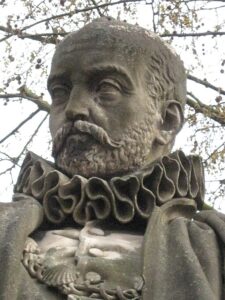 The French author, philosopher, and statesman Michel de Montaigne (1533–1592) was once quoted as saying, “My life has been full of terrible misfortunes, most of which never happened.” That statement reminds us that our fears may sometimes arise from potential scenarios that never actually materialize. However, Romans 3:18 alerts us to one legitimate fear that has been conspicuous by its absence over the general course of human history: the fear of God.
Regardless of their station in life, the vast majority of unrepentant human beings would undoubtedly choose to live differently if they truly possessed a healthy fear of God. For instance, it’s difficult to understand why some elect to travel a hurtful, destructive life-path that will surely bring pain to themselves and others. It’s hard to grasp why some choose to lie, cheat, or steal, even when there’s no obvious incentive for doing so. It’s unsettling to consider the many individuals who feel empowered to behave unethically, abuse their authority, exploit others, waste their skills and talents, or act in a manner that seems intentionally designed to cause harm.
While there might be any number of explanations for such behaviors, there is one overriding response that can account for each of those choices: such people have no genuine fear of God. That lack of fear might be attributable to a variety of sources. For example, some may have convinced themselves that God does not exist. Others may have fashioned an illusory god to suit their own preferences. Some may confidently assert that their “good works” will outweigh their “bad works” in the afterlife. Then there are those who are trusting in an ancestral relationship, a religious ritual, or some other ceremonial observance to guarantee their spiritual well-being.
The issue is that Paul the Apostle has demolished each of those facades over the first three chapters of this Epistle. Therefore, to borrow a phrase from earlier in this book, such individuals are without excuse. Thus, when we speak of “fearing God” in this context, it means that we should honor and respect Him above all else. That attitude of reverence is missing from the behavioral attitudes that Paul has cataloged over the past several verses of this chapter.
For those who seek to honor God, the following source leaves us with a balanced perspective on this idea…
“As Christians, we certainly must reject a servile fear of God, as if He were a cruel tyrant (Rom. 8:15). Romans 8:1 makes it plain that there is ‘no condemnation for those who are in Christ Jesus.’ Yet, it is still right for us as Christians who struggle daily with indwelling sin (7:15–23) to fear what that sin could do to our lives and what disciplines our heavenly Father might bring if we sin (Heb. 12:6).” (1)
Image Attribution: Jean-Marie DAVID Dinkley, CC BY-SA 3.0, via Wikimedia Commons
(1) Living out a healthy fear of the Lord | Tabletalk. (2020, March 30). Tabletalk. https://tabletalkmagazine.com/article/2020/04/living-out-a-healthy-fear-of-the-lord/
“Now we know that whatever the law says, it says to those who are under the law, that every mouth may be stopped, and all the world may become guilty before God” (Romans 3:19).
In 1994, the animated character Bart Simpson uttered a statement that became a viral catchphrase: “I didn’t do it, nobody saw me do it, there’s no way you can prove anything.” (1) Of course, that assertion predated the easy availability of video recording technologies, and the prospect of making such a claim with confidence has now diminished substantially. However, that has done little to stop people from trying.
Modern video-sharing platforms offer ample opportunity to document foolish criminals, inebriated motor vehicle operators, and others as they attempt to make hilariously implausible excuses for their recorded behavior. But while it may be amusing to watch such individuals proclaim,” I didn’t do it, nobody saw me do it, there’s no way you can prove anything,” our text from Romans 3:19 offers a much more serious rejection of that idea.
You see, Romans 3:19-20 clarifies two key objectives of the Old Testament Law. The first objective appears here in verse nineteen and begins by establishing human accountability. That makes human sanctimony, self-justification, and/or complacency impossible before God. The second objective will appear in the verse to follow.
One source provides us with a further explanation…
“The law, he says, speaks to those who are under the law; in other words, all people. Every human being has a responsibility to obey all of the provisions of the law all of the time. And every single one fails to do so. Therefore, the law acts like a neon sign, broadcasting God’s standards for all sinful human beings to see, to the end that ‘every mouth may be stopped, and all the world may become guilty before God.’
By posting His requirements for His creatures, God takes away any excuse, any claim of ignorance, and any self-righteous posturing. All of the human race stands before Him condemned and accountable. There is no question of the law being posted as a standard for people to keep; they simply cannot do it. That is why Paul can say that ‘by the deeds of the law no flesh will be justified in His sight.’ The law is given not to save from sin but to produce awareness of sin.” (2)
Thus, when we are confronted with our lifestyle and motivational choices in eternity, no one will be able to claim “I didn’t do it, nobody saw me do it, there’s no way you can prove anything,” for every mouth will be stopped in the presence of an all-knowing God.
(1) “Bart Gets Famous.” The Simpsons. Fox. 3 February, 1994.
(2) The Need for Faith (2001, April 11). Ligonier Ministries. https://learn.ligonier.org/devotionals/the-need-for-faith
“Therefore by the deeds of the law no flesh will be justified in His sight, for by the law is the knowledge of sin” (Romans 3:20).
The passage quoted above states the second objective of the Old Testament Law from Romans 3:19-20: “…through the law we become conscious of sin” (AMP). A modern paraphrase of this text communicates this idea in the following manner…
“Now do you see it? No one can ever be made right in God’s sight by doing what the law commands. For the more we know of God’s laws, the clearer it becomes that we aren’t obeying them; his laws serve only to make us see that we are sinners” (TLB).
Paul the Apostle expanded on this message in his epistle to the churches of Galatia when he said…
“…we know that people don’t receive God’s approval by any effort to follow the laws in the Scriptures, but only by believing in Jesus Christ. So we also believed in Jesus Christ in order to receive God’s approval by faith in Christ and not by our own efforts. People won’t receive God’s approval by their own efforts” (Galatians 2:16 GW).
He continued with a similar theme in the letter we know today as the Biblical book of 1 Timothy…
“We know that the law is good if one uses it properly. We also know that law is made not for the righteous but for lawbreakers and rebels, the ungodly and sinful, the unholy and irreligious; for those who kill their fathers or mothers, for murderers, for adulterers and perverts, for slave traders and liars and perjurers– and for whatever else is contrary to the sound doctrine” (1 Timothy 1:8-10 NIV).
Since the Old Testament Law provides us with the knowledge of sin (as we see here in Romans 3:20), it offers valuable guidance with respect to the general moral principles of God-honoring behavior. However, the Law also shows us how we have fallen from God’s standards. Much like a signpost that directs us to the proper destination, the Law directs us to our need for a Savior who can deliver us from our failure to fulfill that very same Law.
Paul will revisit this topic again in Romans chapter ten, but we will conclude our look at this passage with his summary of this concept from Galatians 3:24…
“Therefore the law was our tutor to bring us to Christ, that we might be justified by faith.”
Image Attribution : Signpost Blank by Karen Arnold, CC BY-SA 1.0 via Public Domain Pictures.net
God’s Righteousness Revealed Through Faith in Jesus Christ
“But now the righteousness of God apart from the law is revealed, being witnessed by the Law and the Prophets” (Romans 3:21).
The phrase “But now…” signals an important transition in the book of Romans. After a brief introduction that encompassed verses one through fifteen of Romans chapter one, Paul the Apostle moved to establish his theological foundation for the rest of this epistle. That section covered Romans 1:16-3:20 and addressed the following topics…
- Humanity’s deliberate rejection of God and the consequences that followed as a result.
- God’s righteous judgment of such conduct.
- Religious hypocrisy and true Godliness.
- Answers to objections.
- The true character of unrepentant human nature.
While the preceding verses of this chapter have presented us with a dark (but truthful) portrait of humanity, the next portion of Romans chapter three will break upon us like the dawn of a new day. In it, Paul will explore an important theme within this epistle: justification by faith. Starting here in Romans 3;21, the term “righteousness” will appear four times over the next six verses as Paul elaborates on how sinful human beings can attain a right standing with God through faith.
As we have come to expect, Paul grounded his position in the Scriptures by informing us that this way of salvation “…is attested by the law and the prophets” (NET). Much of that support will come in the following chapter when Paul turns to Biblical examples of Abraham, the great Old Testament patriarch, and David, the great king of Israel.
 For now, this portion of Scripture draws our attention to an important point: like Paul, we must establish a valid Scriptural basis for our doctrines and beliefs. Paul followed this custom (Acts 17:2-3), as did the Apostle Peter (Acts 2:16), as well as Jesus Himself (Mark 11:17). This principle is particularly important whenever we seek to validate a spiritual belief, activity, or movement today.
This does not mean that everyone will reach a consensus on spiritual matters of secondary importance. However, Paul’s example tells us that we should establish a Scriptural foundation for our beliefs. As Jesus once said to the religious leadership of His era…
“Do not think, however, that I am the one who will accuse you to my Father. Moses, in whom you have put your hope, is the very one who will accuse you. If you had really believed Moses, you would have believed me, because he wrote about me. But since you do not believe what he wrote, how can you believe what I say?” (John 5:45-47 GNT).
Image Attribution: Ryk Neethling, CC BY-NC 2.0, via flickr.com disclaimer notice
“But now the righteousness of God has been manifested apart from the law, although the Law and the Prophets bear witness to it” (Romans 3:21 ESV).
Like any good teacher, Paul the Apostle sought to reinforce the principles he established earlier with his audience. Here in Romans 3:21, that principle involved “…the righteousness of God.” This built upon the foundation Paul laid in chapter one of this epistle: “…the righteousness of God is revealed from faith to faith; as it is written, ‘The just shall live by faith’” (Romans 1:17).
In the context of Romans 1:17, “righteousness” characterizes the state of right standing with God that He makes available to us through Jesus’ atoning work on the cross. 2 Corinthians 5:21 elaborates on this idea when it tells us, “For He made Him who knew no sin to be sin for us, that we might become the righteousness of God in Him.” That righteousness is imputed to us through faith in Christ, and the following chapter of Romans will provide us with an opportunity to explore the subject of imputation in greater depth.
So, in speaking of “…a righteousness that is by faith from first to last” (NIV), Romans 1:17 directed us to an important spiritual truth: righteousness (or “right standing” with God) is only available through faith. Paul will further expand upon that teaching in our text from Romans 3:21 by informing us that this righteousness has been revealed apart from the law.
This reference to the “righteousness of God” in Romans 3:21 touches upon God’s method of bringing fallible human beings into a right relationship with Himself. That righteousness is independent of the Old Testament Law and our adherence to those commandments. One author clarifies this idea for us…
“…this word righteousness is highly misunderstood in our day. Often it is associated with behavior. If people are behaving in a right way, we say that they are behaving righteously. But in the book of Romans righteousness does not directly touch on behavior. It is not what you do; it is what you are! That is even more important, because your behavior stems from what you are. The gift Paul is talking about, the gift from God, is that of a righteous standing.” (1)
With these things is mind, our text from Romans 3:21 presents us with two important applications:
- We can be made right with God apart from the rules of the Law.
- As such, that righteousness is not attainable through human effort.
Thus, as several Biblical expositors, both ancient and modern, have observed, “The righteousness God demands is the righteousness He also provides.”
(1) Excerpted with permission from But Now © 1976 by Ray Stedman Ministries. All rights reserved. Visit www.RayStedman.org for the complete library of Ray Stedman material. Please direct any questions to webmaster@RayStedman.org. https://www.raystedman.org/new-testament/romans/but-now
“even the righteousness of God, through faith in Jesus Christ, to all and on all who believe” (Romans 3:22).
Romans 3:22 is a portion of Scripture that focuses on the relationship between faith and righteousness…
“When we trust Christ’s righteousness on our behalf and embrace Him, then God legally transfers His righteousness to us. A double transfer is involved in salvation. Christ dies for our salvation, but He also lives for our salvation. Our sins are transferred to Jesus, and He died for us on the cross to bear those sins… God assigned our guilt to His Son. He transferred it from us to Christ, but that is only half the transaction.
The other half is that He took Christ’s righteousness and assigned it to us when we believed so that now when God looks at us, knowing that all our righteousness is as filthy rags, we will not perish. He has given us the cloak of the righteousness of Jesus.” (1)
 So, once again, Paul the Apostle presents us with an important correlation: a right relationship with God is contingent upon putting our faith in Christ. Yet even though the Biblical Scriptures repeatedly highlight the importance of faith, what does that really entail? That brings us to several observations from earlier in our study of Romans chapter one that bear repeating.
For example, one Biblical dictionary offers a simple, but helpful definition of faith: “[Faith is a] belief in or confident attitude toward God, involving commitment to His will for one’s life.” (2) Authentic, Biblical faith is rooted in the conviction that God is who He claims to be, and that He will fulfill His promises. It also embodies the firm belief that God will keep His word, regardless of the external circumstances. This type of faith represents a defining feature of a God-honoring life.
Nevertheless, we should caution against “placing faith in our faith.” In other words, we should guard against placing our faith in the amount of faith we possess. That serves to redirect attention to ourselves and our level of faith rather than God, who should be the object of our faith. Therefore, it’s important to consider where our faith is invested. As Jesus once said, “…’I can guarantee this truth: If your faith is the size of a mustard seed, you can say to this mountain, ‘Move from here to there,’ and it will move. Nothing will be impossible for you’” (Matthew 17:20 GW).
Image Attribution: Sharon Tate Soberon, CC BY-NC 2.0, via flickr.com disclaimer notice
(1) Sproul, R. C. The Power of the Gospel: A Year in Romans. Ligonier Ministries, 2024. p. 86
(2) “Faith” Nelson’s Illustrated Bible Dictionary, Copyright © 1986, Thomas Nelson Publishers.
“for all have sinned and fall short of the glory of God” (Romans 3:23).
While Romans 3:23 contains one of the Bible’s most recognizable quotes, it references a concept that is often poorly defined: sin. For instance, “sin” is a relatively familiar word, but how many can explain its definition? Its probably safe to assume that most of us would likely (and correctly) associate “sin” with something wrong or bad, but what exactly is it?
 When we encounter the Biblical use of the word “sin,” it generally involves something more than just the mere presence of evil or corruption: it means “to miss the mark.” One way to understand the meaning behind this word is to visualize an archer as he or she prepares to shoot an arrow at a bulls-eye. For example, consider an archer as he or she takes aim, draws the bowstring, and lets the arrow fly towards its target.
But unfortunately for our hypothetical archer in this example, the arrow falls short of its intended destination and lands on the ground. In this instance, the archer missed the mark; in other words, he or she “sinned” by falling short and failing to hit the target.
Much like the archer in our illustration, sin involves more than inappropriate behavior; it means “to miss the mark.” When we consider the word “sin” in the context of Romans 3:23, it helps to remember this illustration, for every human being has missed the mark as well. You see, the mark (or target) that God has set for His creation is perfection. He has every right to demand we meet that standard, for God deemed the first human being (and the rest of His creation) “very good” prior to humanity’s fall (see Genesis 1:31).
But what fallible human being could ever hope to meet that standard? If we’re honest with ourselves, the answer is none. No one is without fault, for everyone has knowingly done something wrong, made a mistake, or spoken in error at some point in life. Thus, we have all fallen short of God’s intent for His human creation, and all have “missed the mark,” so to speak. Perhaps some may come closer than others, but everyone falls short.
Our earlier study of Romans 3:10 referenced several expressions that have become axiomatic in this regard. Those statements include “to err is human,” “nobody’s perfect,” and “everyone makes mistakes.” These sayings are widely acknowledged as fundamental truths of human existence; thus, we should have little need to defend the truth of Romans 3:23: “…all have sinned and fall short of the glory of God.”
Image Attribution :SIN | april | Flickr, CC BY-NC 2.0, April, via flickr.com disclaimer notice
“for all have sinned and fall short of the glory of God” (Romans 3:23 ESV).
Sean McDowell is a popular author, podcaster, and associate professor of Christian apologetics. In his book, Evidence That Demands A Verdict (an updated version of the classic apologetic work he co-authored with Josh McDowell, his father), McDowell made an important observation regarding the universal application of Romans 3:23…
“Apologist Clay Jones has spent decades studying the problem of evil. He closely examined the evil perpetrated in the twentieth century by Nazis in Germany, communists in Russia, China, and Cambodia, the Japanese in World War II, and other nations including Turkey, Pakistan, Uganda, Sudan, and the United States.
After immersing himself in these human tragedies, Jones concluded: ‘I first began to study human evil so that no one could disqualify me for having glossed over the immense sufferings that people perpetrate on each other. I didn’t want anyone to say that I had gotten God out of the problem of evil the easy way: by making evil seem less serious than it really is.
But as I read about one sickening rape or torture or murder after another, something strange happened: I was struck that evil is human. I realized that heinous evils weren’t the doings of a few deranged individuals or even of hundreds or of thousands, but were done by humankind en masse. I studied continent after continent, country after country, torture after torture, murder after murder and was staggered to discover that I hadn’t taken Scripture seriously enough: humankind is desperately wicked.’
Human fallenness makes the gospel powerful: we can only appreciate the extent of the work of Christ when we understand the evil and corruption we and the world truly contain.’” (1)
These observations underscore the depth and importance of our text from Romans 3:23: “…all have sinned.” The Biblical book 1 John offers some additional support for this conclusion with the following declaration: “If we say that we have no sin, we deceive ourselves, and the truth is not in us” (1 John 1:8 KJV). The Old Testament book of Ecclesiastes acknowledges this reality as well: “There is no one on earth who does what is right all the time and never makes a mistake” (Ecclesiastes 7:20 GNB).
Finally, we should note that our text from Romans 3:23 is rendered in the present tense. As such, we should guard against the tendency to apply this passage to previous generations that were seemingly less advanced than our own. Instead, this verse describes the present state of fallen humanity as we relate to God and one another.
(1) Jones, Clay. “Christians Don’t Take Human Evil Seriously So We Don’t Understand Why We Suffer:” Paper presented at the annual meeting of the Evangelical Theological Society, New Orleans, LA, November, 2009. Quoted in McDowell, J., & McDowell, S. (2017). Evidence that demands a verdict: Life-Changing Truth for a Skeptical World.
“and are justified by his grace as a gift, through the redemption that is in Christ Jesus” (Romans 3:24 ESV).
Earlier in Romans chapter two, we examined the spiritual concept of justification. “Justification” describes the manner in which sinful human beings are made acceptable to a holy God. (1) The original language of the New Testament defines “justification” as, “to declare, pronounce, one to be just, righteous, or such as he ought to be.” (2) In short, justification involves a divine act of God that eliminates the guilt and penalty of sin for those who trust in Christ.
This leads us to the legal aspects of justification. In addition to the definitions given to us above, “justification” represents a legal concept that pertains to one’s standing before God. One common way of expressing this idea involves the phrase “just as if I never sinned” to describe those who are justified in God’s sight. While that expression has merit, the concept of justification actually goes much further.
When God justifies someone, He legally attributes (or confers) the positive righteousness of Christ to those who place their faith in Him. Jesus’ atoning work on the cross makes this possible, for it satisfies the penalty demanded by the Law. This means divine mercy is now available to humanity because divine justice has been satisfied in Jesus’ sacrificial death.
Since justification pertains to our legal status before God through Christ, it is not subject to our personal faults, mistakes, or deficiencies. For instance, a person who has been acquitted of a crime in a human court of law is deemed “not guilty” even though he or she is a fallible human being. The fact that he or she is an imperfect person with human weaknesses and shortcomings has no bearing on that person’s legal status before the court. The same is true of our justification.
So, justification is more than just a mere pardon, as in, “just as if I never sinned.” Justification is an act by which God legally declares someone to be righteous in His sight. Those who are in Christ are deemed righteous before God under the Law, and we can summarize this concept in the following way…
“[Justification] is grounded in Christ’s lifelong obedience, in which He fulfilled the precepts of God’s law for us, and in His death on the cross, where He bore the penalty of God’s judgment against us… Therefore, believers now share the same righteous status as the risen Christ Himself, with whom they are united now and forever (2 Cor. 5:21).” (3)
(1) “Justification” Nelson’s Illustrated Bible Dictionary, Copyright © 1986, Thomas Nelson Publishers
(2) G1344 – dikaioo – Strong’s Greek Lexicon (kjv). (n.d.). Blue Letter Bible. https://www.blueletterbible.org/lexicon/g1344/kjv/tr/0-1/
(3) R. C. Sproul, ed., The Reformation Study Bible: English Standard Version (2015 Edition) (Orlando, FL: Reformation Trust, 2015), 1984.
“They are justified freely by His grace through the redemption that is in Christ Jesus” (Romans 3:24 HCSB).
Our text from Romans 3:24 features two familiar terms: grace and redemption. “Grace” involves God’s unmerited favor towards those who do not deserve it. Since grace involves God’s unmerited favor, it is not something we can earn through virtuous conduct or by fulfilling various requirements. Instead, grace describes God’s benevolence towards us without respect to our talents, capabilities, possessions, or social standing.
This reference to grace leads directly into the concept of redemption. From a Biblical perspective, the idea of “redemption” may vary significantly from the way we think about that word today. For example, redemption opportunities offered by merchants, airlines, and financial services organizations typically rely on the principle of an exchange. However, the Biblical concept of redemption is also defined by words such as “ransom,” “rescue,” and “deliverance.” (1)
One Pastoral commentator offers a further clarification…
“Redemption has the idea of buying back something, and involves cost – yet the cost is paid by God, because we are justified freely. The word redemption had its origin in the release of prisoners of war on payment of a price (the ‘ransom’); it was extended to include the freeing of slaves, again by the payment of a price. The idea of redemption means that we are bought by Jesus Christ; therefore we belong to Him: For you were bought at a price; therefore glorify God in your body and in your spirit, which are God’s (1 Corinthians 6:20).” (2)
Another source adds,
“The word redeem means ‘to buy out.’ The term was used specifically in reference to the purchase of a slave’s freedom. The application of this term to Christ’s death on the cross is quite telling. If we are ‘redeemed,’ then our prior condition was one of slavery. God has purchased our freedom, and we are no longer in bondage to sin or to the Old Testament law…
Related to the Christian concept of redemption is the word ransom. Jesus paid the price for our release from sin and its punishment (Matthew 20:28; 1 Timothy 2:6). His death was in exchange for our life. In fact, Scripture is quite clear that redemption is only possible ‘through His blood,’ that is, by His death (Colossians 1:14).” (3)
Thus, Jesus serves as our Redeemer, for His death on the cross served to ransom, deliver, and rescue us from sin and its resulting effects. As we’re told in Galatians 4:4-5…
“…when the fullness of the time had come, God sent forth His Son, born of a woman, born under the law, to redeem those who were under the law, that we might receive the adoption as sons.”
(1) H6299 – pada – Strong’s Hebrew Lexicon (KJV). (n.d.). Blue Letter Bible. https://www.blueletterbible.org/lexicon/h6299/kjv/wlc/0-1/
(2) Guzik, D. (2025, February 11). Enduring Word Bible Commentary Romans Chapter 3. Enduring Word. https://enduringword.com/bible-commentary/romans-3/
(3) GotQuestions.org. (2023, October 25). GotQuestions.org. https://www.gotquestions.org/redemption.html
“being justified freely by His grace through the redemption that is in Christ Jesus” (Romans 3:24).
Thus far, we have explored three key concepts in Romans 3:24: justification, grace, and redemption. Now, we will pause to consider one additional element that underlies these important ideas- the doctrine of atonement.
“Atonement” refers to an act that rectifies a shortcoming or deficiency. In a spiritual sense, atonement can be defined as “the act by which God restores a relationship of harmony and unity between Himself and human beings.” (1) With these things in mind, we can ask, “What is the nature of humanity’s shortcoming before God and why must Jesus atone for it?”
To address these questions, we can begin with our previous verse from Romans 3:23: “All have sinned and fallen short of the glory of God.” Since all have missed the mark of perfection that God intends for His human creation, everyone is deficient in their relationship to Him. The Biblical book of Proverbs presents this dilemma in the form of a rhetorical question: “Who can say, ‘I have made my heart clean, I am pure from my sin’?” (Proverbs 20:9). The assumed answer to that question is, “none.”
In response to that deficiency, God offered a path to reconciliation. Under the Old Covenant, that path to reconciliation featured an extensive system of animal sacrifices and other types of offerings. Under that covenant, God accepted the death of an animal on behalf of the guilty party, thus providing atonement for the sin of the one who brought it.
The Law of Moses outlined a broad set of requirements regarding the use of sacrificial animals. Some animals were appropriate for sacrificial use, others were not, and all had to be free of any defect. When offering a sacrificial animal, the person who presented that sacrifice had to identify with it by placing his hand upon its head (Leviticus 1:4).
While the people of Israel experienced genuine atonement through those sacrifices, there was a flaw within that system. First, the blood of those sacrificial animals had no inherent worth to remove sin. As Hebrews 10:4 tells us: “…it is impossible for the blood of bulls and goats to take away sins.” Instead, those sacrifices merely served to cover them up. Furthermore, those sacrifices did nothing to change the internal mindsets of those who offered them.
Something better was needed, and that “something” was Christ. Just as God provided the Old Covenant sacrifices for the people of ancient Israel, He also offered His Son as the New Covenant sacrifice. Jesus thus becomes our atonement, for He made up for our deficiency through the sacrifice of Himself.
(1) “Atonement” Nelson’s New Illustrated Bible Dictionary. General Editor Ronald F. Youngblood, Copyright © 1986, 1995 by Thomas Nelson Publishers.
“whom God set forth as a propitiation by His blood, through faith, to demonstrate His righteousness, because in His forbearance God had passed over the sins that were previously committed” (Romans 3:25).
Much like a mine-worker who discovers a rich vein of precious metal, Romans 3:25 presents us with a rich vein of spiritual insight ready to be explored. The opening words of this verse prepare us for those insights in speaking of the One “whom God set forth…” This tells us that the truths we’re about to read are not hidden from view. Instead, God has “set them forth” for all to see.
One of those insights is this: “God presented Him as a propitiation through faith in His blood…” (HCSB). “Propitiation” is an important theological term that conveys two primary ideas:
- The satisfaction of God’s justice.
- The appeasement of His righteous anger towards those who have broken His laws.
This word also possesses a colorful history that traces back to the idolatrous practices of antiquity. For instance, “propitiation” once referred to a sacrificial offering that one might present to a pagan deity. That offering sought to appease the wrath of an idolatrous god and avert any form of divine retribution. It also allowed for the restoration of a positive relationship with the offended deity.
However, these concepts underwent a significant transformation within the spiritual framework of Old Testament Israel. When ancient Jewish scholars translated the Old Testament Scriptures into Greek, they chose the phrase hilasterion, or “mercy seat,” to convey this image. This referenced the Jewish tabernacle and a crucial portion of the Old Testament sacrificial system.
The tabernacle of that era featured two veiled entrances, one exterior and one interior. The first veil separated the interior portion of the Tabernacle (known as the Holy Place) from the exterior courtyard. The second veil divided the Holy Place from another interior area known as the Most Holy Place, or Holy of Holies. At the heart of the Holy Place stood the Ark of the Covenant.
The ark was a wooden chest overlaid with gold. The top (or lid) of the Ark was known as the mercy seat. This communicated the image of a sovereign authority who pardoned the sins of His people under the terms of the Old Covenant. Two angelic beings (known as cherubim) were positioned above the ark at each end. These cherubim faced one another with their wings stretched above the mercy seat. It was there that God manifested His divine presence (see Exodus 25).
Once a year, the high priest would enter beyond this inner veil to sprinkle the blood of a sacrificial animal upon the mercy seat as an act of atonement. We’ll tie these images together in the context of Romans 3:25 next.
“God publicly displayed him at his death as the mercy seat accessible through faith. This was to demonstrate his righteousness, because God in his forbearance had passed over the sins previously committed” (Romans 3:25 NET).
Under the inspiration of the Holy Spirit, Paul the Apostle made a connection between the mercy seat of the Old Covenant and Jesus’ New Covenant work of atonement as the propitiation for human sin. One commentary offers a lengthy and detailed explanation that serves to illustrate that connection…
“One of the most unique types in the Old Testament is the mercy seat. This was the lid on the ark of the covenant and was covered with gold. At each end was a golden cherub, whose wings stretched toward the center of the lid. The ark was the meeting place between God and man. It contained the tablets of the Mosaic law (Ex 25:16–22). Therefore, the mercy seat was that which covered the law of God.
When the translation of the Hebrew Old Testament was made into Greek, which is called the Septuagint, the Greek word chosen to translate ‘mercy seat’ (Heb kaphorah) was hilasterion which means ‘the place of propitiation.’ To propitiate means to appease an offended party and the hilasterion (mercy seat) was the place where, by blood, the sins of Israel were atoned, the penalty paid, and wrath of God (the offended party) was appeased.
It is certainly no coincidence that the word Paul uses here to describe Jesus Christ is the same word used for ‘mercy seat,’ the hilasterion. Jesus Christ is our mercy seat. He is the person by whom our sins were atoned, our penalty paid, and the offended party appeased.” (1)
In addition to what we read here, three other New Testament passages refer to Jesus’ propitiation for our sins: Hebrews 2:17; 1 John 2:2; and 1 John 4:10. This act of propitiation is distinctly personal, for involves God’s righteous and holy wrath against humanity’s sinful attitudes and behaviors. Romans chapter one discussed God’s wrath and characterized it as a violent, passionate response to the presence of sin and evil. That response is not without justification, as we saw earlier in our study of Romans 3:10-18.
Christ thus propitiates God’s wrath through His substitutionary work on the cross. In that act of propitiation, He endured the divine wrath that should have been directed toward sinful humanity and satisfied the demands of God’s justice on our behalf. In doing so, God showed that “…he was being entirely fair, even though he did not punish those who sinned in former times. For he was looking forward to the time when Christ would come and take away those sins” (Romans 3:25 TLB).
(1) Edward E. Hindson and Woodrow Michael Kroll, eds., KJV Bible Commentary (Nashville: Thomas Nelson, 1994), 2222.
“whom God put forward as a propitiation by his blood, to be received by faith. This was to show God’s righteousness, because in his divine forbearance he had passed over former sins” (Romans 3:25 ESV).
This portion of Scripture offers a remarkable wealth of spiritual insight in one brief sentence. Here in the final segment of our three-part study of Romans 3:25, we’ll take a closer look at this reference to God’s forbearance in “passing over” these “former sins.” The quotation from the Living Bible paraphrase of this verse that closed our previous study points the way to a proper understanding of this idea.
To begin, we can view this passage in relation to those Old Testament saints who placed their trust in God before Jesus came into the world. God’s decision to pass over the sins of the Old Testament faithful does not mean He ignored, dismissed, or excused those sins. Instead, He graciously looked forward to the time when Jesus’ sacrificial death on the cross would atone for them.
One Biblical commentary offers a concise, but thorough explanation of this concept that warrants an extended excerpt…
“The finished work of Christ declares God’s righteousness for the remission of sins that are past. This refers to sins committed before the death of Christ. From Adam to Christ, God saved those who put their faith in Him on the basis of whatever revelation He gave them. Abraham, for example, believed God, and it was reckoned to him for righteousness (Gen_15:6).
But how could God do this righteously? A sinless Substitute had not been slain. The blood of a perfect Sacrifice had not been shed. In a word, Christ had not died. The debt had not been paid. God’s righteous claims had not been met. How then could God save believing sinners in the OT period?
The answer is that although Christ had not yet died, God knew that He would die, and He saved men on the basis of the still-future work of Christ. Even if OT saints didn’t know about Calvary, God knew about it, and He put all the value of Christ’s work to their account when they believed God. In a very real sense, OT believers were saved on credit. They were saved on the basis of a price still to be paid. They looked forward to Calvary; we look back to it.” (1)
In this manner, God saw fit to demonstrate His righteousness as He revealed the scope of His redemptive plan through the unfolding narrative of human history.
(1) William Macdonald, Believer’s Bible Commentary Edited by Arthur Farstad. Thomas Nelson Publishers [Romans 3:21-31]
“to demonstrate at the present time His righteousness, that He might be just and the justifier of the one who has faith in Jesus” (Romans 3:26).
Romans 3:26 highlights God’s just nature in speaking of Him as “…a God of justice” (GW). When we say that someone is “just,” we mean that he or she is acting in a manner that is appropriate and right. So, in declaring that God is just, we are saying that His conduct is always fair, impartial, and equitable.
But how do we know God is a just God? As an omnipotent being, God could simply cause us to believe anything He wished about His nature, and we, as mere mortals, would never suspect otherwise. Of course, that would call God’s just nature into question, but how would we know it? In light of this, how can we affirm God’s just nature with any degree of certainty?
To begin, it is important to note that God cannot overlook sin, because a just God is obligated to act against those who violate the law. The penalty for that violation fell upon Christ, for as we’re told in 2 Corinthians 5:21, “…He made Him who knew no sin to be sin for us, that we might become the righteousness of God in Him.”
Romans 3:26 follows with the end result of that process: “It was to show his righteousness at the present time, so that he might be just and the justifier of the one who has faith in Jesus” (ESV). Therefore, we can say with certainty that God is just because His unwavering commitment to justice came at a verifiable cost: the life of His Son.
In executing this plan of salvation, God implemented a divine strategy that was consistent with His just nature while enabling Him to justify the unjust at the same time. First, God’s justice is perfectly satisfied because the penalty for sin has been paid. Next, He also justifies the unrighteous because a perfect substitute has given His life in their place.
Since Jesus’ sacrificial death satisfies the legal sentence associated with sin, those who place their faith in Him are acquitted of all charges and declared to be justified. God then imputes (or legally transfers) Christ’s righteousness to those who accept Him (Romans 4:5-8). So, justification does not ignore sinful conduct, for God’s wrath against sin was fully satisfied in Christ’s atoning death. Therefore, He is both “…just and the justifier of the one who has faith in Jesus” as we see here in Romans 3:26.
Boasting Excluded: Justification by Faith and its Relation to the Law
“Where is boasting then? It is excluded. By what law? Of works? No, but by the law of faith” (Romans 3:27).
Because God is “…just and the justifier of the one who has faith in Jesus” (Romans 3:26) there is no room for boasting in something God has done on His own. While there is little shortage of those who seek to brag about who they are and what they have accomplished, there is nothing for us to boast of with respect to our salvation.
We can associate this reference to works in Romans 3:27 with an attempt to follow the Old Testament Law or anything else we might do to earn God’s favor. We will never find justification in taking that approach because human efforts to win God’s approval will inevitably fall short. As we were reminded earlier in Romans 3:20, “…no one is put right in God’s sight by doing what the Law requires; what the Law does is to make us know that we have sinned” (GW).
The Law of God accomplishes that purpose in showing us where we fall short of God’s standards. Consider the observations made by the following commentary…
“Some sins seem bigger than others because their obvious consequences are much more serious. Murder, for example, seems to us to be worse than hatred, and adultery seems worse than pride. But this does not mean that because we only commit ‘little’ sins we deserve eternal life. All sins make us sinners, and all sins cut us off from our holy God. All sins, therefore, lead to death (because they disqualify us from living with God), regardless of how great or small they seem. Don’t minimize ‘little’ sins or overrate ‘big’ sins. They all separate us from God, but they all can be forgiven.” (1)
That same source later adds…
“Most religions require specific duties that must be performed to make a person acceptable to a god. Christianity is unique in that no good deed that we do will make us right with God. No amount of human achievement or personal goodness will close the gap between God’s moral perfection and our imperfect daily performance. Good deeds are important, but they will not earn us eternal life. We are saved only by trusting in what God has done for us (see Eph_2:8-10).” (2)
So, before we begin to boast of who we are and what we have done, we would do well to take a more accurate perspective…
“Man takes credit for everything. We take pride in our abilities and accomplishments. We have self-confidence and trust in our money and strength. But who are we to boast? God is holding the molecules of our bodies together (Col. 1:17). God is the source of every good thing we receive (James 1:17). We must give Him the credit for all things…” (3)
(1) Life Application Study Bible NKJV [Romans 3:23] Copyright © 1988, 1989, 1991, 1993, 1996, 2004 by Tyndale House Publishers Inc., all rights reserved.
(2) Life Application Study Bible NKJV. Ibid. [Romans 3:27-28]
(2) Daniel, R. (n.d.). Revelation 14:1-20 | Ron Daniel’s Bible Studies. https://rondaniel.com/library/66-Revelation/Revelation1401.php
“Then what becomes of our boasting? It is excluded. By what kind of law? By a law of works? No, but by the law of faith” (Romans 3:27 ESV).
Several resources define the word “boasting” in the following manner:
- Speaking of yourself in superlatives. (1)
- To glorify oneself in speech; talk in a self-admiring way; To speak of with excessive pride. (2)
- To talk or write about oneself or something related to oneself in a proud or self-admiring way. (3)
- To call attention to one’s own accomplishments. (4)
As seen in the passage quoted above, the word translated “boasting” encompasses a word that means “that of which one glories or can glory, [and/or a] matter or ground of glorying” (5) The Scriptures disapprove of these attitudes because boasting is inconsistent with the type of love that is defined for us in 1 Corinthians 13:4-8…
“Love is patient, love is kind. It does not envy, it does not boast, it is not proud. It is not rude, it is not self-seeking, it is not easily angered, it keeps no record of wrongs. Love does not delight in evil but rejoices with the truth. It always protects, always trusts, always hopes, always perseveres. Love never fails…” (NIV).
 The noted author C.S. Lewis offers several valuable observations in this regard…
“There is one vice of which no man in the world is free; which everyone in the world loathes when he sees it in someone else; and of which hardly any people, except Christians, ever imagine that they are guilty themselves. I have heard people admit that they are bad-tempered, or that they cannot keep their heads about girls or drink, or even that they are cowards. I do not think I have ever heard anyone who was not a Christian accuse himself of this vice. And at the same time I have very seldom met anyone, who was not a Christian, who showed the slightest mercy to it in others. There is no fault which makes a man more unpopular, and no fault which we are more unconscious of in ourselves. And the more we have it ourselves, the more we dislike it in others. The vice I am talking of is Pride.” (6)
…Pride gets no pleasure out of having something, only out of having more of it than the next man. We say that people are proud of being rich, or clever, or good-looking, but they are not. They are proud of being richer, or cleverer, or better-looking than others. If everyone else became equally rich, or clever, or good-looking there would be nothing to be proud about. It is the comparison that makes you proud: the pleasure of being above the rest…” (7)
Image Attribution: C. S. Lewis, Levan Ramishvili, Public Domain CC BY-NC 1.0, via flickr.com. Disclaimer Notice
(1) Power Thesaurus. “BOASTING Definition & Meaning – Explained.” WordNet 3.1 © 2011 by Princeton University, 2026, www.powerthesaurus.org/boasting/definitions. Accessed 18 Dec. 2025.
(2) American Heritage® Dictionary of the English Language, Third Edition. (1992)
(3) American Heritage® Dictionary of the English Language, Fifth Edition. (2011). Retrieved December 18 2025 from https://www.thefreedictionary.com/boasting
(4) boasting. (n.d.) Picturesque Expressions: A Thematic Dictionary, 1st Edition. (1980). Retrieved December 18 2025 from https://www.thefreedictionary.com/boasting
(5) G2746 – kauchesis – Strong’s Greek Lexicon (KJV). (n.d.). Blue Letter Bible. https://www.blueletterbible.org/lexicon/g2746/kjv/mgnt/0-1/ [see relation to G2745]
(6) C. S. Lewis, Mere Christianity (New York: The Macmillan Company, 1958), p. 94. Quoted in Boice, J. M. (2005). Romans: Justification by Faith (Romans 1-4). Baker Books. [p.404]
(7) Lewis, Ibid. pp. 95, 96.
“Therefore we conclude that a man is justified by faith apart from the deeds of the law” (Romans 3:28).
As we approach the end of Romans chapter three, our text from verse twenty-eight prepares us for a larger discussion concerning the relationship between faith and works, or “…the deeds of the law.” We can identify four reasons why God has chosen to justify us by faith and not by our own efforts…
- “Faith eliminates the pride of human effort, because faith is not a deed that we do.
- Faith exalts what God has done, not what we do.
- Faith admits that we can’t keep the law or measure up to God’s standards—we need help.
- Faith is based on our relationship with God, not our performance for God.” (1)
Ephesians 2:8-9 contains what is arguably the most significant Biblical verse on this subject…
“For by grace you have been saved through faith, and that not of yourselves; it is the gift of God, not of works, lest anyone should boast.”
We can expand on this key Biblical teaching if we divide this portion of Scripture from Ephesians chapter two into its constituent elements…
- For by grace (or God’s undeserved favor).
- you have been saved (or delivered from an eternity of separation from God in a place of outer darkness and torment, where there is weeping and gnashing of teeth).
- through faith (trust and reliance on God).
- and that not of yourselves (not through human effort).
- it is the gift of God, not of works (salvation is a divine gift that is beyond the reach of human accomplishment).
- lest anyone should boast (or gloat, brag and/or show off).
One source draws a helpful analogy that serves to illuminate the nature of genuine faith…
“When God says, ‘Whosoever believes on Him [His Son] has eternal life’ (John 3:16), faith involves accepting that promise as true. Someone has compared saving faith to reaching out to accept a gift that another person offers, like a Christmas present. One must extend his or her arm to receive the gift, but that act does not constitute doing something that earns the gift.” (2)
Finally, many have seen what appears to be a disparity in the Biblical teaching that appears in our text from Romans 3:28 and the Biblical teaching that appears in James chapter two. We will address that seeming inconsistency when we enter into a discussion of Abraham, the great Old Testament patriarch, in our study of Romans chapter four.
(1) Life Application Study Bible NKJV [Romans 3:28] Copyright © 1988, 1989, 1991, 1993, 1996, 2004 by Tyndale House Publishers Inc., all rights reserved.
(2) Dr. Thomas L. Constable, Notes on Romans 2026 Edition (n.d.). https://soniclight.com/tcon/notes/html/romans/romans.htm
“Or is He the God of the Jews only? Is He not also the God of the Gentiles? Yes, of the Gentiles also” (Romans 3:29).
 The common-sense questions posed in Romans 3:29 enable us to draw some important conclusions. For instance, we might include a wide variety of groups, nationalities, social classes, or individuals within these designations. The point is that God reigns over all humanity, and He justifies all in the same way. That way is through faith, as Paul the Apostle will go on to explain in the following verse…
“since there is one God who will justify the circumcised by faith and the uncircumcised through faith” (Romans 3:30).
This passage carries significant implications for those who subscribe to the notion that there are many ways to God or that “all roads lead to God.” Our text from Romans 3:29 reminds us that God does not provide an alternate means of salvation for individual people groups. Instead, everyone must come to Him through faith in Christ. Jesus was unequivocal when it came to this idea…
“…’I am the way, the truth, and the life. No one comes to the Father except through Me’” (John 14:6).
Paul was equally direct in the New Testament letter we know today as 1 Timothy…
“For there is one God and one Mediator between God and men, the Man Christ Jesus” (1 Timothy 2:5).
These Biblical teachings refute the idea that roads lead to God. In addition, we should also remember that our existence does not end with when we pass from this earthly life. As we have repeatedly observed throughout our study of the first three chapters of Romans, eternal life is not a reward for accumulating enough “good deeds” throughout our lives. Eternal life can only be obtained through Christ, and those who place their faith in Him have full Biblical assurance of entry into heaven when their time on earth has come to an end.
Nevertheless, the Bible is equally clear that anyone who seeks an alternate means of salvation will not inherit eternal life. As we are told in the New Testament epistle of 1 John…
“And what is it that God has said? That he has given us eternal life and that this life is in his Son. So whoever has God’s Son has life; whoever does not have his Son, does not have life” (1 John 5:11-12).
So, there is one God who is sovereign over all people, regardless of their ethnicity. As the God of those diverse people groups, He accepts them all in the same way: by faith.
Image Attribution: Image by Wannapik Studio
“Do we then make void the law through faith? Certainly not! On the contrary, we establish the law” (Romans 3:31).
In addition to its doctrinal teachings, we should bear in mind that the Epistle to the Romans served as Paul the Apostle’s introduction to the first-century church at Rome. As such, it offered a helpful resource for those who were unfamiliar with his life, ministry, and doctrine. It also served to reassure the members of Paul’s Jewish audience and affirm the value of their cultural identity.
From one perspective, the final verse of this chapter serves as a mirror image of the first verse, as Paul affirmed the importance of the Jewish law and their shared cultural legacy. Paul’s standing as a Jewish scholar also lent credibility to this teaching, and it will later become a recurring theme within this epistle…
“God’s law was given so that all people could see how sinful they were. But as people sinned more and more, God’s wonderful grace became more abundant. So just as sin ruled over all people and brought them to death, now God’s wonderful grace rules instead, giving us right standing with God and resulting in eternal life through Jesus Christ our Lord” (Romans 5:20-21 NLT).
“For God has done what the law, weakened by the flesh, could not do. By sending his own Son in the likeness of sinful flesh and for sin, he condemned sin in the flesh, in order that the righteous requirement of the law might be fulfilled in us, who walk not according to the flesh but according to the Spirit” (Romans 8:3-4 ESV).
“For the commandments, ‘You shall not commit adultery, You shall not murder, You shall not steal, You shall not covet,’ and any other commandment, are summed up in this word: ‘You shall love your neighbor as yourself.’ Love does no wrong to a neighbor; therefore love is the fulfilling of the law” (Romans 13:9-10 ESV).
So, it seems that Paul anticipated this objection from Romans 3:31 and took steps to address it in advance. In doing so, he established the continuing merit of the law. Two crucial elements contributed to the law’s enduring significance. First, Christ fulfilled the law’s demands on our behalf. Next, the law itself foreshadowed the concept of justification by faith.
Thus, in the words of one Biblical translation, “…we confirm and establish and uphold the Law [since it convicts us all of sin, pointing to the need for salvation]” (AMP). We’ll explore that relationship at greater length in our next study.
“Do we then nullify the law through faith? Absolutely not! Instead we uphold the law” (Romans 3:31 NET).
After reading through portions of Romans chapter two, some of the initial recipients of this epistle might have wondered if the Old Testament law was still relevant. Nevertheless, the Apostle Paul’s contention that “…we uphold the law” should not have come as a surprise. We can validate this idea with a few quick observations.
First, Paul alluded to this conclusion earlier in this chapter in saying, “But now the righteousness of God apart from the law is revealed, being witnessed by the Law and the Prophets, even the righteousness of God, through faith in Jesus Christ, to all and on all who believe…” (Romans 3:21-22).
A person with a good working knowledge of the Mosaic Law could also point to Abraham’s example in Genesis 15:6: “…he believed in the Lord, and He accounted it to him for righteousness.” Paul will have much more to say about that aspect of Abraham’s life in the following chapter.
Furthermore, God is an impartial judge who refuses to invalidate or disregard the law for the benefit of those who have disobeyed it. Instead, He upholds the law by personally fulfilling its demands in the Person of His Son. That brings us to a specific aspect of the law’s purpose…
“Therefore the law was our tutor to bring us to Christ, that we might be justified by faith” (Galatians 3:24).
So, faith upholds the law by fulfilling one of its primary objectives. The law fulfills that objective whenever we acknowledge our inability to uphold its commandments and subsequently place our faith in Christ. One commentator has drawn a connection between this concept and Jesus’ own evaluation of His relationship to the law…
“His concluding thought is that justification by faith does not make void the Law of God. The Law of faith by which God justifies Jew and Gentile, establishes the Law of God. His concluding statements about the Law are an echo of the words of his Lord, Who told us on that mountaintop in Galilee that He had not come to destroy the Law or the Prophets, but to fulfill the essence of what the Law and the Prophets teach us (Matthew 5:17).” (1)
In this manner, “Justification by faith alone honors the law, because prior to Jesus Christ no one ever honored the law by perfectly keeping it. Since the Lord Jesus did, faith in the finished work of Christ on Calvary brings the ultimate respect to the law.” (2)
(1) Dick Woodward, Mini Bible College Booklet Twenty-Nine The Book Of Romans Verse By Verse (part one). Pg.30. https://mbc.icm.org/
(2) Edward E. Hindson and Woodrow Michael Kroll, eds., KJV Bible Commentary (Nashville: Thomas Nelson, 1994), 2223.
“Do we then cancel the law through faith? Absolutely not! On the contrary, we uphold the law” (Romans 3:31 HCSB).
The late James Montgomery Boice was a theologian, broadcaster, teacher, author, pastor, and prolific author of dozens of written works. Boice once shared an insight regarding the Old Testament Scriptures that relates to our study of Romans chapter three…
“It is beyond doubt that Jesus highly esteemed the Old Testament and constantly submitted to it as to an authoritative revelation. He taught that the Scriptures bore a witness to Him, just as He bore a witness to them. Because they are the words of God, Jesus assumed their complete reliability, in whole and to the smallest part.” (1)
In his commentary series on the book of Romans, Boice also delivered a summary of chapter three that reiterates the key subjects and important themes that appear within this chapter…
“1. God has provided a righteousness of his own for men and women, a righteousness we do not possess ourselves. This is the very heart or theme of the Word of God.
2. This righteousness is ‘by grace. We do not deserve it. In fact, we are incapable ever of deserving it.
3. It is the work of the Lord Jesus Christ in dying for his people redeeming them from their sin, that has made this grace on God’s part possible. Redemption describes the work of Jesus Christ in relation to ourselves; propitiation describes the work of Jesus Christ in relation to the Father; justification describes the act by which God the Father declares us to have met the demands of the law on the basis of Christ’s work for us. It is because of Jesus’ death that there is a Christian gospel.
4. This righteousness, which God has graciously provided, becomes ours through simple faith. Believing and trusting God in regard to the work of Jesus is the only way anyone, whether Jew or Gentile, can be saved. Faith is essential. ‘And without faith it is impossible to please God … ‘ (Heb. 11:6).
These points were stated at the very beginning of the letter, where Paul wrote: ‘I am not ashamed of the gospel, because it is the power of God for the salvation of everyone who believes: first for the Jew, then for the Gentile. For in the gospel a righteousness from God is revealed, a righteousness that is by faith from first to last, just as it is written: ‘The righteous will live by faith’ (Rom. 1:16-17).” (2)
(1) Boice, J. M. (2019). Foundations of the Christian faith: A Comprehensive & Readable Theology. InterVarsity Press. pg. 45
(2) Boice, J. M. (2005). Romans: Justification by Faith (Romans 1-4). Baker Books. pg 425
“Well then, if we emphasize faith, does this mean that we can forget about the law? Of course not! In fact, only when we have faith do we truly fulfill the law” (Romans 3:31 NLT).
As we close this portion of our journey through the book of Romans, we have made our way through several important topics. In addition, we have looked at many spiritual concepts related to faith and considered how we might apply those ideas in our daily lives.
In reflecting upon this chapter, it’s clear that we have navigated through some difficult passages. For instance, the first nine verses of Romans chapter three explored several potential counterarguments to the doctrines Paul the Apostle outlined in chapters one and two. We then embarked on a challenging and uncomfortable journey through the darkest aspects of unregenerate human nature in verses ten through twenty. Then came verses twenty-one to twenty-six, a portion of Scripture that functioned much like an oasis in the desert in speaking of the righteousness that is available to us through faith in Christ.
Now as we transition into Romans chapter four, Paul will solidify these concepts by turning to a human example: Abraham, the man of faith. As we’ll see, Abraham (with an assist from Israel’s king David) will flesh out the teachings of Romans chapter three in a literal manner. Abraham is mentioned over five dozen times in the New Testament Scriptures, and Paul will turn to his example in chapter four to further support the doctrine of justification by faith in Christ alone.
The perspectives offered by the following commentators will also prove helpful in preparing us for what lies ahead…
“Faith is such an important dimension of our justification that Paul devotes most of the fourth chapter of this letter to the example of Abraham – the Father of Faith. When God wants to communicate a great idea, He wraps that concept in a person. God considers faith an important concept. Therefore, God devotes a dozen chapters in the Book of Genesis to tell us the story of Abraham because he is a walking definition of faith.” (1)
“’Faith’ excluded the works of the Law. But did it abrogate the entire Old Testament revelation? Of course not! Paul will demonstrate in the next chapter by Old Testament illustrations of two men, Abraham and David, that it did not exclude that. These two key men, outstanding men, were saved, not by law but by faith. To begin with, Abraham was born and lived and died four hundred years before the Law was ever given. Abraham did not live on the basis of the Mosaic Law since it was not yet given in his day. God saved him on a different basis, which is by faith.” (2)
(1) Dick Woodward, Mini Bible College Booklet Twenty-Nine The Book Of Romans Verse By Verse (part one). Pg.29. https://mbc.icm.org/
(2) J. Vernon McGee, Thru The Bible with J. Vernon McGee, “Romans 3:21-31.” Copyright 1981 by J. Vernon McGee