
About This Chapter: Romans 4 develops Paul the Apostle’s teaching on justification by faith through the example of Abraham, whose faith was credited to him as righteousness. Paul contrasts righteousness received through faith with a status supposedly earned through works, and he draws on the words of Israel’s king David about the forgiveness of sin to reinforce his argument. He shows that Abraham was declared righteous before he was circumcised, making him a model for both circumcised and uncircumcised believers. Paul explains that God’s promise rests on faith and grace rather than the law, and he concludes by pointing to Abraham’s confidence in God’s power to fulfill His promises.
Abraham and David: Righteousness Apart from Works
“What then shall we say that Abraham our father has found according to the flesh?” (Romans 4:1).
The question posed by the Apostle Paul in Romans 4:1 held immediate implications for his initial audience. It also carries significance for us as well. The response to this question will unfold over the course of this chapter, with Abraham, the renowned Biblical patriarch, serving as the focal point.
Four distinct segments comprise Romans chapter four. The first eight verses remind us that God’s imputed righteousness is acquired by faith apart from works. Verses nine to twelve call our attention to the fact that Abraham was justified before God prior to the act of circumcision. In a similar manner, Abraham was justified by faith long before the Mosaic Law came into effect (verses thirteen to seventeen). Finally, Paul will discuss these historical realities and their contemporary relevance in the final eight verses of this chapter.
This historical detour into the life of Abraham also addressed a first-century doctrinal debate. For example, many in the first-century church found the practice of circumcision to be a contentious issue. At the center of that controversy was a group that is historically known as the Judaizers. The Judaizers were early converts to Christianity from Jewish backgrounds. Their teaching asserted that those of non-Jewish descent were obligated to follow the Old Testament Law in order to find salvation through Christ.
The New Testament book of Acts records one such example…
“And certain men came down from Judea and taught the brethren, ‘Unless you are circumcised according to the custom of Moses, you cannot be saved’” (Acts 15:31).
In essence, their argument was this: Jesus saves us, but only after we accept the Old Testament Law. In their view, the path to Christianity involved a conversion to Judaism first. However, Romans chapter four, and its comprehensive study of Abraham’s life, will serve to correct that heretical teaching and establish a healthy theological foundation for ancient and modern readers alike.
Thus, we can draw several valuable lessons from Abraham’s example. As one commentator reminds us, “Abraham is referred to as God’s ‘friend’ three times in the Bible (2 Chron. 20:7; Isa. 41:8; James 2:23). Why is that? The answer, as Paul is about to show, is that Abraham ‘believed God’ and so was credited with righteousness (Rom. 4:3). If Paul can show that Abraham, the father of all the faithful, came into a right relationship with God by faith and not by any amount of human good works, his case is proved… If he cannot prove this, the case is lost and so is Christianity.” (1)
(1) Boice, J. M. (2005). Romans: Justification by Faith (Romans 1-4). Baker Books. [p.431]
“What then shall we say was gained by Abraham, our forefather according to the flesh?” (Romans 4:1 ESV).
Under the inspiration of the Holy Spirit, the Apostle Paul devoted much of Romans chapter three to a crucial argument. The argument established that righteousness and justification do not stem from adherence to the Law, but from faith in Christ and His redemptive sacrifice on our behalf. For instance, Romans 3:21-23 tells us…
“But now a righteousness from God, apart from law, has been made known, to which the Law and the Prophets testify. This righteousness from God comes through faith in Jesus Christ to all who believe. There is no difference, for all have sinned and fall short of the glory of God” (NIV).
To support that argument, Paul will now shift his attention to one of the towering figures in Jewish history: Abraham, the man of faith. Romans chapter four opens with a question regarding Abraham and his experience regarding this concept of justification by faith: “What then shall we say that Abraham, our forefather… discovered in this matter?” (NET).
Paul clearly had a fondness for this type of rhetorical question; in fact, he will go on to employ this same literary device several more times over the next few chapters as a transitional bridge between subjects. In addition, this reference to Abraham as “our forefather” was more than just an aside, for that word designates the founder of a family, a tribe, or the progenitor of a people (1)
So, in his position as the forefather of the Jewish people, Abraham’s example offered a template or example for his descendants. If Abraham followed a certain path, his descendants were obligated to follow that course as well. This was important because Israel’s first-century spiritual leadership acknowledged Abraham and his role as their ancestral and spiritual father. We find one such example in John 8:33 and 39 in a volatile exchange between Jesus and Israel’s religious leaders.
Because of this, Abraham’s example was certain to end all debate regarding the means of justification. The following source alludes to Abraham’s pivotal role as a spiritual example…
“Abraham is remembered as the man who believed that God would do what He said He would do (Rom. 4:3)—a remarkable thing when we consider that at the time of the promises, Abraham had very little evidence that God would follow through, certainly far less than the NT writers or we who live today.” (2)
So, what was Abraham’s experience regarding justification by faith? Paul will answer that question by highlighting what Abraham lacked, rather than what he possessed.
(1) G3962 – pater – Strong’s Greek Lexicon (KJV). (n.d.). Blue Letter Bible. https://www.blueletterbible.org/lexicon/g3962/kjv/tr/0-1/
(2) Earl D. Radmacher, Ronald Barclay Allen, and H. Wayne House, Nelson’s New Illustrated Bible Commentary (Nashville: T. Nelson Publishers, 1999), 1430.
“For if Abraham was justified by works, he has something to boast about, but not before God” (Romans 4:2).
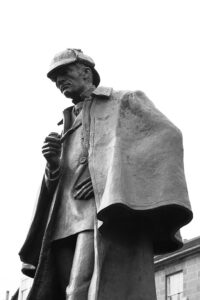 Sherlock Holmes, the celebrated fictional detective, once solved a suspected murder case by focusing on an unusual occurrence that others had overlooked. In the course of his investigation, Homes discovered that a guard dog on duty at the time of the incident did not bark at the presence of the intruder. Based on that observation, Holmes inferred that the assailant had a prior acquaintance with the dog. That deduction subsequently reduced his pool of potential suspects, thus enabling him to establish the truth. (1)
While the fictional exploits of an imaginary detective may seemingly have little to do with our text from Romans 4:2, these accounts have something in common: the absence of evidence. Here in Romans 4:2, the word “if” introduces a statement that is assumed to be true. Thus, “if” Abraham’s righteousness stemmed from his works, he would have had ample reason to form a high opinion of himself. In a similar manner, those who are justified by their works could rightfully claim credit for the works that earned their status.
But much like the dog that didn’t bark in Sherlock Holmes’ murder mystery, such works are conspicuous by their absence from Abraham’s life. In other words, Abraham would have had something to boast of if he had been justified by his own efforts. But the absence of such boasting is evidence itself, thus indicating that Abraham was justified by some other means.
One pastoral commentator offers a further explanation…
“If it was Abraham’s works that brought him justification, then Abraham could boast in his works. He could say, ‘I left my home, I left my family on the other side of the Euphrates River, and I journeyed not even knowing where I was going, just waiting for God to show me. And I was willing to offer my son.’ He could have boasted if he was justified by his works, but he could not have boasted in God; he would have had to have boasted in himself.” (2)
Another source offers the following insight…
“The point is that Abraham was justified by faith in God’s Word, but he then was asked to demonstrate that his faith was genuine by his works. He was justified before God by faith but was justified before men by his works (see Jam 2:21-24).” (3)
This will lead us into an important discussion concerning the relationship between faith and works. Fortunately, we have two of the foremost Biblical authorities on those subjects to guide us along the path of that discussion: the Apostles Paul and James.
Image Attribution: Siddharth Krish. The original uploader was Siddharthkrish at English Wikipedia., CC BY-SA 3.0, via Wikimedia Commons.
(1) See Wikipedia contributors. (2026, January 29). The Adventure of Silver Blaze. Wikipedia. https://en.wikipedia.org/wiki/Silver_Blaze
(2) Smith, C. (2005, June 1). Verse by Verse Study on Romans 3-4 (C2000). Blue Letter Bible. https://www.blueletterbible.org/Comm/smith_chuck/c2000_Rom/Rom_003.cfm
(3) Institute for Creation Research, New Defender’s Study Bible Notes [Romans 4:2] https://www.icr.org/bible/Rom/4/2/ Accessed 2 February, 2026
“For if Abraham was declared righteous by the works of the law, he has something to boast about — but not before God” (Romans 4:2 NET).
“Was not Abraham our father justified by works when he offered Isaac his son on the altar?” (James 2:21).
These quotations offer an opportunity to explore the relationship between faith and works as seen in the Biblical epistles of James and Romans. In addition to what we read here in Romans 4:2, the following portions of Romans address this topic as well…
“Now to him who works, the wages are not counted as grace but as debt. But to him who does not work but believes on Him who justifies the ungodly, his faith is accounted for righteousness” (Romans 4:4-5).
“[God’s] choice is based on his grace, not on what they have done. For if God’s choice were based on what people do, then his grace would not be real grace” (Romans 11:6 GNB).
“Therefore we conclude that a man is justified by faith apart from the deeds of the law” (Romans 3:28).
However, James 2:24 makes the following statement: “You see then that a man is justified by works, and not by faith only.” These apparent contradictions have led to considerable controversy. However, a closer look at the context of James’ message can help resolve this apparent discrepancy.
First, James prefaced his statement in James 2:24 with these questions: “What does it profit, my brethren, if someone says he has faith but does not have works? Can faith save him?” (James 2:14). So, the context of James 2:24 pertains to someone who claims to possess genuine faith, but may not actually have it. Therefore, we need a way to verify that assertion. We can do so by examining the works that proceed from that claim. This is precisely what James encourages us to do in his epistle.
On the other hand, this portion of Paul’s letter to the Romans is addressed to those who sought to maintain a works-based relationship with their Creator. To illustrate the error of that approach, Paul referenced Abraham, the foundational figure of Judaism, and a man who responded to God in faith. This context establishes a foundation that enables us to gain a proper understanding of these two portions of Scripture. For Paul, the question is this: “Where should we place our faith?” James addresses a different question: “What kind of faith is necessary for salvation?”
As one commentator observes…
“The NT does not teach justification by works, but it also does not teach justification by the profession of faith or the claim to faith; it teaches justification by the possession of true faith, and true faith always bears the fruit of love of God and neighbor. James has in mind a genuine, living faith that produces fruitful works, which is evidence that will vindicate (or prove) the validity of one’s authentic justifying faith…” (1)
(1) Sproul, R. C. (Ed.). (2015). The Reformation Study Bible: English Standard Version (2015 Edition) (p. 2230). Orlando, FL: Reformation Trust.
“For if Abraham was justified by works, he has something to boast about, but not before God” (Romans 4:2 ESV).
Given the historical controversy that has marked the relationship between the Biblical works of Paul and James on the subject of faith, we will close our look at this verse with some insights gleaned from the following commentators. Their observations tell us that the apparent conflict that exists between these respective teachings on faith dissipates when they are properly understood. In fact, these teachings are mutually complimentary…
“This verse may seem to contradict what James wrote in James 2:21: ‘Was not our father Abraham justified by works, when he offered up Isaac his son on the altar?’ The solution lies in the meaning of justification. Justification means ‘to declare righteous;’ it does not mean to make righteous. In Genesis 15:6, we read that God declared Abraham righteous. In Genesis 22:1-19, James wrote that Abraham’s works declared him righteous. In other words, two different things, God and Abraham’s works, on two different occasions, both declared or bore witness to Abraham’s righteousness.” (1)
“But someone may argue, ‘Doesn’t it say in Jam_2:21 that Abraham was justified by works?’ Yes it does, but there the meaning is quite different. Abraham was justified by faith in Gen_15:6 when he believed God’s promise concerning a numberless posterity. It was thirty or more years later that he was justified (vindicated) by works when he started to offer Isaac as a burnt offering to God (Gen. 22). This act of obedience proved the reality of his faith. It was an outward demonstration that he had been truly justified by faith.” (2)
“How can we reconcile James and Paul? We have to remember the theme of James 2. James is arguing against those who profess faith but have no good works to prove it… Thus, Paul is speaking of legal justification before the eyes of God, while James is speaking of visible justification before the eyes of men.” (3)
“If we want to interpret James’s single passage properly, we need to allow the many verses we find in Scripture to inform the one we find here, rather than allow the one verse to inform the many. When read in the context of the larger chapter… James appears to be saying that we are saved not by our good works but by the kind of faith that produces good works. That’s a critical distinction. According to James, there are two kinds of faith: one that leads to a godly life and good works and one that doesn’t. One is ‘dead,’ while the other is ‘alive.’ This interpretation is reasonable given the many verses that describe salvation by faith alone.” (4)
(1) Dr. Thomas L. Constable. Notes On Romans 2026 Edition (n.d.). https://soniclight.com/tcon/notes/html/romans/romans.htm
(2) William Macdonald, Believer’s Bible Commentary Edited by Arthur Farstad. Thomas Nelson Publishers [Romans 4:1-25]
(3) Sproul, R. C. (1993). Before the face of God: Book 2: A daily guide for living from the Gospel of Luke (electronic ed.). [80. Redeemed by Faith]. Grand Rapids: Baker Book House; Ligonier Ministries.
(4) Wallace, J. W. (2017). Forensic faith: A Homicide Detective Makes the Case for a More Reasonable, Evidential Christian Faith. [pg. 172]
“For what does the Scripture say? “Abraham believed God, and it was accounted to him for righteousness” (Romans 4:3).
Amidst this lengthy discussion concerning Abraham in Romans chapter four, the Apostle Paul raised an important question: “…what saith the scripture?” (KJV). While there are many information 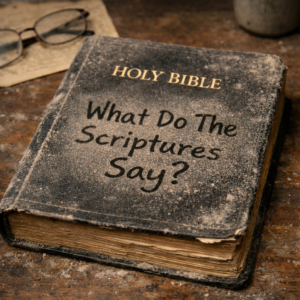 sources that contend for the opportunity to influence our opinions, the Biblical Scriptures should ultimately set the foundation for our convictions. This would encompass a wide range of areas, including our business practices, social interactions, interpersonal relationships, and other aspects of daily life. We can honor God and make wise choices in these areas whenever we pose this question from our text: “What do the Scriptures say?”
Paul advanced that question in Romans 4:3 and then proceeded to answer it himself. In contrast to those who view God’s Word as a dusty relic with little modern relevance, we should note that Paul applied Abraham’s example to a contemporary question of his day. In doing so, he offers a template that we would do well to follow. It also echoes his counsel to the ancient church at Corinth: “These things happened to them as examples, and they were written for our instruction…” (1 Corinthians 10:11 CSB).
So, Abraham believed God (and was justified by faith), long before he received the external sign of circumcision. Here again, this brief quotation from Genesis 15:6 yields some important insights regarding the nature of faith: Abraham believed God, and God subsequently credited that belief to him for righteousness. Nevertheless, we should exercise caution before we assume that a direct correlation exists between righteousness and mere belief.
Consider the following passage from the Biblical epistle of James: “You believe that there is one God. You do well. Even the demons believe—and tremble!” (James 2:19). In light of this, we can say that no one is righteous simply because he or she believes God exists. Even demonic beings (who are certainly not righteous) believe that. Instead, Abraham believed God. In other words, the emphasis is on the Object of his faith.
The following source offers a further explanation…
“Faith is something we exercise, but Paul does not consider it a work in the same way that obedience to the law is. Works involve the bringing of what we do to God and saying that we deserve justification. Faith involves the admission that nothing we can do makes us deserving of salvation…” (1)
So when we read that “…it was accounted to him for righteousness,” the “it” refers to Abraham’s conviction that God would do what He promised. Thus, Abraham’s faith in God Himself was the means by which he was accounted righteous.
(1) Not by works (2014, March 10). Ligonier Ministries. https://learn.ligonier.org/devotionals/not-works
“For what does scripture say about him? ‘Abraham believed God, and it was accounted to him for righteousness’” (Romans 4:3 Phillips).
Before we move on from our study of this passage, there is a key element within this verse that merits our attention. That element comprises a single word: accounted. Much like the modern-day derivative term “accountant,” the ancient version of this word conveys the idea of something that is calculated or computed to one’s account. (1) Contemporary translations of this verse use a variety of words, including credited (NET). counted (ESV). and reckoned (RSV), to express this idea.
While it may seem unwarranted to dwell on a single word from this passage, this particular word shows up repeatedly (and in several variations) over the course of Romans chapter four. Therefore, this reference (and the spiritual truth it represents) is well worth our consideration. One commentator places this idea in a contemporary framework…
“What do we mean when we say that faith was counted unto Abraham for righteousness? The word translated ‘counted’ (Gr logizomai) is a commercial term which is used with regard to credits or debits. It means to set to one’s credit or lay to one’s charge. If you authorize your lawyer to write checks on your bank account, and he does so, although the check is written by him and money received by him, nevertheless the amount of the check is charged to you.” (2)
Another New Testament scholar offers several ways to understand this concept…
“Thus Abraham believed God, and his act of faith was placed to his account in value as righteousness. He believed God and his act of faith was credited to him for righteousness. He believed God and his act of faith was placed on deposit for him and evaluated as righteousness. He believed God and his act of faith was computed as to its value, and there was placed to his account, righteousness. He believed God, and his act of faith was credited to his account for righteousness. Finally, he believed God, and his act of faith was credited to him, resulting in righteousness.” (3)
So, much like a monetary transfer that is deposited into a financial trust fund, “Abraham believed God, and God counted him as righteous because of his faith” (NLT). Abraham did not undertake any effort to facilitate that transfer; he simply took God at His word and believed He would do what He said He would do. We will return to this important idea again in Romans 4:8 when we consider another variation of this term: imputation.
(1) G3049 – logizomai – Strong’s Greek Lexicon (KJV). (n.d.). Blue Letter Bible. https://www.blueletterbible.org/lexicon/g3049/kjv/tr/0-1/
(2) Edward E. Hindson and Woodrow Michael Kroll, eds., KJV Bible Commentary (Nashville: Thomas Nelson, 1994), 2223–2224.
(3) Kenneth S. Wuest, Word Studies in the Greek New Testament [Galatians 3:6] Copyright © 1942-55 by Wm. B. Eerdmans Publishing Co.
“Now to him who works, the wages are not counted as grace but as debt. But to him who does not work but believes on Him who justifies the ungodly, his faith is accounted for righteousness” (Romans 4:4-5).
In contrast to an employee who labors to earn a paycheck, our text from Romans chapter four tells us that Abraham did not “earn” righteousness through his own efforts. Instead, righteousness was accounted to him through faith.
Abraham’s example serves as a remarkably informative case study, for his life included several instances where he made some highly questionable decisions. For instance…
- Abraham once misled an Egyptian Pharaoh by falsely representing his wife Sarah as his sister (Genesis 12:10–20).
- He later engaged in that same deceptive conduct with another king named Abimelech (Genesis 20).
- Abraham also heeded his wife’s ill-advised counsel and fathered a son with her maidservant (Genesis 16).
While Abraham was truly a great man of faith, these episodes from his life tell us that he was far from perfect. But to borrow Paul the Apostle’s terminology from the passage quoted above, Abraham was accounted righteous because he believed “…on Him who justifies the ungodly.”
The word “righteous” is often used in a variety of ways, some of which are far removed from its true meaning. However, the Biblical concept of righteousness denotes a state of right standing with God through Christ. As we have already seen thus far in our study of the book of Romans, God declares those who accept Christ’s atoning death to be “righteous” (or “without guilt”) in His sight. This concept is certainly not unique to the book of Romans, for Paul the Apostle expressed a similar idea in his epistle to the Philippians…
“Yet indeed I also count all things loss for the excellence of the knowledge of Christ Jesus my Lord, for whom I have suffered the loss of all things, and count them as rubbish, that I may gain Christ and be found in Him, not having my own righteousness, which is from the law, but that which is through faith in Christ, the righteousness which is from God by faith” (Philippians 3:8-9).
Finally, we should take note of the following excerpt from Jesus’ Sermon on the Mount: “Blessed are those who hunger and thirst for righteousness, For they shall be filled” (Matthew 5:6). Those who desire to live the kind of lives that reflect the right standing we enjoy with God in Christ, have Jesus’ personal assurance that God will fully satisfy that desire.
“Now to the one who works, his wages are not counted as a gift but as his due. And to the one who does not work but believes in him who justifies the ungodly, his faith is counted as righteousness” (Romans 4:4-5 ESV).
The Apostle Paul demonstrated the characteristics of a skilled communicator by turning to a familiar analogy to clarify his teaching on the subject of faith: “A person who works is paid wages, but they are not regarded as a gift; they are something that has been earned” (GNT).
 A paycheck has little to do with an employer’s generosity. Instead, that obligation stems directly from the work that an employee performs on the employer’s behalf. In contrast, the Scriptures tell us that heaven is not attainable through human effort, for salvation is a gift of God. If a person could earn his or her way into heaven, then salvation would no longer be free, nor would it be a gift. It would rather be an obligation that God owes to those who deserve it.
Let’s apply this analogy to those who seek to earn salvation through their moral and/or ethical efforts. In that scenario, God would incur an obligation to save those who worked for it. Much like the employer who assumes an obligation to pay an employee for his or her labor, God would incur a similar obligation to accept us into heaven based on our works.
While some may choose to gamble their eternity on such a belief, the Scriptures categorically reject that view. In addition to what we read here in Romans chapter four, consider these excerpts from the following New Testament epistles…
“By grace you are saved through faith, and this not of yourselves. It is the gift of God, not of works, lest any man should boast” (Ephesians 2:8-9 NIV).
“…no one anywhere can ever brag in the presence of God. For it is from God alone that you have your life through Christ Jesus….” (1 Corinthians 1:29-30 TLB).
“But when the kindness and the love of God our Savior toward man appeared, not by works of righteousness which we have done, but according to His mercy He saved us, through the washing of regeneration and renewing of the Holy Spirit” (Titus 3:4-5).
So, the Scriptures tell us that we cannot earn our way to heaven through our efforts. Thus. we can say that salvation is not a matter of what we can do for God; it is a matter of what God has already done for us through Christ.
“However, to the one who does not work but trusts God who justifies the ungodly, their faith is credited as righteousness” (Romans 4:5 NIV).
Thus far in our journey through the book of Romans, we have never been far from the word “justification” and its derivative concepts. For example, Romans chapter one told us, “…The just shall live by faith” (Romans 1:17). In Romans 2:13 we read, “…for not the hearers of the law are just in the sight of God, but the doers of the law will be justified.” Romans chapter three then followed by saying, “for all have sinned and fall short of the glory of God, being justified freely by His grace through the redemption that is in Christ Jesus” (Romans 3:23-24).
One source adds to our discussion of this important concept with the following insight into the legal origin of this term…
“The Greek word translated ‘justify’ or ‘justification’ means ‘to acquit,’ ‘to vindicate,’ or ‘to pronounce righteous.’ These are important judicial terms, and the theological meaning is borrowed from the courtroom. In justification God clears those who have been charged with sins or failures. The Bible makes it clear that God will clear no one of the charge of sin on the basis of his or her efforts to keep the Law. One can be justified — declared righteous — only on the basis of faith.” (1)
Thus, “In justification, God solves the legal or judicial problem that we have on account of our being lawbreakers who have violated His commandments, and He does so by means of a legal declaration of our status… Clearly, when a judge acquits an innocent person, he is not changing that person but merely making a declaration about that person’s status before the law.” (2)
Another commentary presents us with a personal application: “Notice that he believes on Him who justifies the ungodly. He doesn’t come with the plea that he has tried his best, that he has lived by the Golden Rule, that he has not been as bad as others. No, he comes as an ungodly, guilty sinner and throws himself on the mercy of God.” (3)
Here in Romans chapter four, Paul the Apostle has turned to Abraham’s example to find support for this premise. But over the next few verses, Paul will focus his attention on another prominent figure from the annals of Biblical history. That person is David, the celebrated monarch of Old Testament Israel. He will serve as a corroborating witness to the spiritual truths that Paul has worked to establish over the first four chapters of this letter.
(1) Richards, L. O., & Richards, L. (1987). Bible Teacher’s Commentary. David C Cook. “Study Guide 125: Romans 4-6.”
(2) Faith and Righteousness. (2017, June 13). Ligonier Ministries. https://learn.ligonier.org/devotionals/faith-and-righteousness-june-2017
(3) William Macdonald, Believer’s Bible Commentary Edited by Arthur Farstad. Thomas Nelson Publishers [Romans 4:1-25]
“just as David also describes the blessedness of the man to whom God imputes righteousness apart from works” (Romans 4:6).
 Let’s envision a scene inside a courtroom where a legal trial is underway. The prosecutor is an unapologetic and unrepentant human being who disavows the moral authority of humanity’s Creator. The defendant is God. The indictment consists of the following charge: God is guilty of a moral deficiency (and thus lacks moral authority) in light of His association with several individuals of questionable character.
The prosecutor presses this charge against God with several pieces of evidence…
Exhibit A: Noah found favor with God according to Genesis 6:8. Yet Noah was the same man who once got so drunk that he passed out naked according to Genesis 9:18-22.
Exhibit B: Abraham is called a friend of God in James 2:23. Yet, that very same man lied about his wife to protect himself- twice.
Exhibit C: The evidence shows that God referred to Moses as “my servant” in Numbers 12:7 even though He knew Moses was guilty of murder.
Exhibit D: Israel’s king David once arranged to send a man to his death so he could marry that man’s wife. But Acts 13:22 refers to David as “…a man after [God’s] own heart.‘”
After presenting this evidence, our hypothetical prosecutor concludes with a closing argument that seems utterly devastating: “What kind of God associates with such people? What does it reveal about God’s character when He speaks this way about such individuals? A civilized human society would incarcerate people for engaging in some of these behaviors. Why then should humanity look to God for any form of moral authority?”
While this argument may seem to hold validity, we should note that God has not yet had His say in this imaginary courtroom. As Proverbs 18:17 reminds us, “Any story sounds true until someone tells the other side and sets the record straight” (TLB). For instance, let’s consider the final exhibit in this sequence: Israel’s king David. We can begin with the acknowledgment that David (as well as the others in these exhibits) was a faithful individual, not a perfect individual.
In Psalm 32, David acknowledged God’s prerogative in forgiving such behaviors (and others that are equally, or more heinous) by saying, “Blessed is he whose transgression is forgiven, Whose sin is covered. Blessed is the man to whom the Lord does not impute iniquity, And in whose spirit there is no deceit” (Psalm 32:1-2). The following verses will use this Psalm to uncover the irrefutable legal defense associated with that act of forgiveness.
“Blessed are those whose lawless deeds are forgiven, And whose sins are covered. Blessed is the man to whom the Lord shall not impute sin” (Romans 4:7-8).
This quotation from Psalm 32 brings one of the great (and perhaps underappreciated) Biblical doctrines to the forefront of our discussion. That doctrine is imputation. A thorough understanding of this key Biblical concept will help bring comfort to anyone who seeks (and sometimes fails) to honor God in thought, word, or deed.
As alluded to earlier in our look at Romans 4:3, “imputation” conveys the idea of something that is counted, reckoned, or credited towards one’s account. When considering those whose sins are no longer counted against them through faith in Christ, we can begin with the actions taken by the very first human couple. The Apostle Paul will elaborate on this subject at greater length in Romans chapter five…
“Therefore, just as through one man sin entered the world, and death through sin, and thus death spread to all men, because all sinned” (Romans 5:12).
That portion of Scripture tells us that Adam’s sin is imputed, or credited to us, his descendants. Theologians sometimes refer to this concept as “inherited sin” or “original sin.” However, that sin was imputed to Jesus (or credited to His account) when He “became sin for us” through His sacrificial death (2 Corinthians 5:21). In the words of the Old Testament prophet Isaiah, “…the Lord has laid on Him the iniquity of us all” (see Isaiah 53:4-6).
Paul explained it this way in the Biblical epistle of Colossians…
“You were dead because of your sins and because your sinful nature was not yet cut away. Then God made you alive with Christ, for he forgave all our sins. He canceled the record of the charges against us and took it away by nailing it to the cross” (Colossians 2:13-14 NLT, see also Galatians 2:20, and 1 Peter 2:24).
Another source analyzes the original language of the passage and offers the following insight…
“Verse 8 contains a strong DOUBLE NEGATIVE, ‘will not under any circumstances’ be imputed, reckoned, taken into account. Notice the three VERBS in this quote; all denote the acquittal of sin… This is a quote from Ps. 32:2. It is the term ‘reckon,’ ‘impute,’ or ‘deposit to another’s account,’ used in a negative sense. God does not impute sin (DOUBLE NEGATIVE) into a believer’s spiritual bank account; He imputes righteousness.” (1)
The doctrine of imputation does not assert the belief that human beings will completely disengage from sinful behaviors on this side of eternity. It means that God no longer credits or holds those sins against us because Jesus settled them through His atoning death on the cross.
(1) Dr. Bob Utley. Free Bible Commentary, Copyright © 2014 Bible Lessons International. Romans 1. (n.d.). https://www.freebiblecommentary.org/new_testament_studies/VOL05/VOL05_04.html
“Blessed are those whose lawless deeds are forgiven, and whose sins are covered; blessed is the man against whom the Lord will not count his sin” (Romans 4:7-8 ESV).
As we have already noted, our sins are imputed to Jesus (or placed on His ledger) when we accept Him and His sacrificial offering through faith. However, there is another dimension to this idea, for the doctrine of imputation also involves a reciprocal (or corresponding) exchange. By this, we mean that a parallel transfer takes place: our sins are imputed to Christ while His righteousness is credited to us.
This brings forth several implications that are truly astounding when we pause to consider them. Since Jesus’ righteousness has been imputed to us, we are endowed with all the privileges and blessings that accompany it. One Biblical dictionary summarizes the sequence of events that characterize this double transfer…
“Thus in doctrinal language (1) the sin of Adam is imputed to all his descendants, i.e., it is reckoned as theirs, and they are dealt with therefore as guilty; (2) the righteousness of Christ is imputed to them that believe in him, or so attributed to them as to be considered their own; and (3) our sins are imputed to Christ, i.e., he assumed our ‘law-place,’ undertook to answer the demands of justice for our sins. In all these cases the nature of imputation is the same (Romans 5:12-19; comp. Philemon 1:18, 19).” (1)
Therefore, we can say that our sins were crucified along with Christ, and we receive the righteousness He possessed through His perfect and complete obedience to God the Father and the Law. In short, Jesus bore the penalty for our transgressions, and His righteousness has been bestowed upon us.
Finally, it’s important to consider the events that led to the quotation from Psalm 32 that appears here in Romans 4:7-8. Those events involved Israel’s king David, a man who entered into a series of highly inappropriate decisions at one point in his monarchy (see 2 Samuel 11-12:23). Those decisions (and their aftermath) brought forth this declaration from Psalm 32.
God forgave David, and he rightfully expressed the blessedness of those (like himself), “… whose lawless deeds are forgiven, and whose sins are covered.” Nevertheless, those choices brought many negative consequences, and David’s life was marked by recurring episodes of deep personal sorrow thereafter. Thus, we are reminded of an important personal truth: since Christ has borne our sins and we have received His righteousness, we should seek God daily for the will and wisdom to make choices that reflect those realities.
(1) “Imputation” M. G. Easton: Easton’s Bible Dictionary – Christian Classics Ethereal Library. (n.d.). https://www.ccel.org/ccel/easton/ebd2.html?term=imputation
Abraham’s Faith Before Circumcision
“Does this blessedness then come upon the circumcised only, or upon the uncircumcised also? For we say that faith was accounted to Abraham for righteousness” (Romans 4:9).
After a brief foray into the life of Israel’s king David, Paul the Apostle returned to Abraham’s example to pursue another line of evidence concerning “righteousness apart from works.” He did so in the form of a question: Does salvation by faith represent a privilege that extends only to those who have undergone the ritual of circumcision? The answer to that question held interest for Jewish and non-Jewish audiences alike…
“Paul anticipated what his Jewish readers would be thinking: If Abraham was justified by his faith alone, why did God command him and his descendants to be circumcised? His response not only answers those concerned with circumcision, but the millions who still cling to some other kind of religious ceremony or activity as their basis for righteousness.” (1)
From a contemporary perspective, some may also believe that participation in a religious ritual or observance will lead to God’s acceptance or favor. Paul will address that view in the following verse…
“How then was it accounted? While he was circumcised, or uncircumcised? Not while circumcised, but while uncircumcised” (Romans 4:10).
Abraham’s example demonstrates that righteousness (or right standing with God) does not come through a ritual act like circumcision. Instead, it comes through faith- specifically, faith in Christ’s sacrificial death on our behalf. A ceremonial act (in whatever form it takes) should then flow from our personal convictions and the faith that has already been credited to us as righteousness…
“The apostle pointed out that when God declared Abraham righteous, the patriarch was still ‘uncircumcised.’ He was a virtual Gentile. It was fourteen years later that Abraham underwent circumcision (Gen. 17:24-26). His circumcision was a ‘sign’ (label) of what he already possessed. This point would have encouraged Paul’s Jewish readers, who made so much of circumcision, to keep it in its proper place as secondary to faith. Paul used Abraham as more than just an example of faith, but a model.” (2)
We’ll take a closer look at the Biblical timeline that Paul references here in our next study. But before we continue, we should note that ceremonial observances (especially spiritual ones) are often deeply ingrained in the hearts and minds of individuals, families, and cultures. Those who are emotionally invested in such observances may dispute the Biblical teachings from this passage despite our best efforts to present them in a gracious and reasonable manner. Therefore, we should be diligent to pray for those who elevate such observances above the Scriptural teachings presented to us here.
(1) John F. MacArthur Jr., The MacArthur Study Bible: New American Standard Bible. (Nashville, TN: Thomas Nelson Publishers, 2006), Ro 4:9–12.
(2) Dr. Thomas L. Constable, Notes on Romans 2025 Edition https://soniclight.com/tcon/notes/html/romans/romans.htm
“How then was it accounted? While he was circumcised, or uncircumcised? Not while circumcised, but while uncircumcised” (Romans 4:10).
The Biblical account of Abraham does not specify when God deemed him righteous on account of his faith. However, we can establish a timeline that supports this conclusion from Romans 4:10 by piecing together several events from Abraham’s life.
The first data point on our timeline comes to us from Genesis 15:6: “[Abraham] believed the LORD, and he credited it to him as righteousness” (CSB). In the following chapter, we read how Abraham fathered a son named Ishmael at his wife’s behest. Ishmael’s mother was Hagar, a maidservant who served as a type of surrogate mother. That portion of Scripture also provides us with Ishmael’s approximate date of birth: “Abram [Abraham’s former name] was eighty-six years old when Hagar bore Ishmael to Abram” (Genesis 16:16).
The next stop on our timeline appears in Genesis chapter seventeen as God instructed Abraham to circumcise all the males within his household: “On that same day Abraham obeyed God by circumcising Ishmael. Abraham was also circumcised, and so were all the other men and boys in his household, including his servants and slaves. He was 99 years old at the time, and his son Ishmael was 13” (Genesis 17:23-27 CEV).
That leaves us with the following conclusion: God declared Abraham to be righteous at least fourteen years before he received the ceremonial rite of circumcision. In other words, God had already imputed righteousness to Abraham by faith long before he engaged in any ritual observance. Thus, “Circumcision was not the gateway to his right relationship with God; it was only the sign and the seal that he had already entered into it. His being accounted righteous had nothing to do with circumcision and everything to do with his act of faith.” (1)
Therefore, this passage holds great significance with respect to our spiritual observances. It also has implications for those who believe that Jesus’ atoning sacrifice on the cross must be accompanied by other meritorious works in order to achieve salvation. In Paul the Apostle’s era, that belief was promoted by those who taught that circumcision was a necessary prerequisite to salvation. Then there were others who believed that some form of hidden knowledge held the key to eternal life. This brief observation from Romans chapter four serves to negate those beliefs.
Finally, these verses help set the right foundation for the practical teachings that will appear later in chapters twelve to sixteen. In that section, Paul will apply these concepts to specific issues that faced the first-century church, and modern-day readers by extension.
(1) Barclay, William. “Commentary on Romans 4”. “William Barclay’s Daily Study Bible”. https://www.studylight.org/commentaries/eng/dsb/romans-4.html. 1956-1959.
“And he received the sign of circumcision, a seal of the righteousness of the faith which he had while still uncircumcised, that he might be the father of all those who believe, though they are uncircumcised, that righteousness might be imputed to them also” (Romans 4:11).
Our text from Romans 4:11 highlights two important terms: a “sign” and a “seal.”
A “sign” functions as  a marker that points, indicates, designates, or directs our attention to something else. Much like a guidepost or road sign that points the way to another destination, the covenant sign of circumcision was not an end in itself. Instead, that sign pointed to (or designated) something else. That “something else” was Abraham’s faith in God to deliver on His promises.
In its historical context, a “seal” referred to a stamp that incorporated a signet or private insignia as a means of security or proof of origin. Much like a contemporary seal that is used to validate an official document, ancient seals were also employed for authentication purposes in the Biblical era.
 A seal typically comprised a small amount of softened wax that was affixed to the enclosure of a letter or official document. A signet ring or other distinguishing mark was then pressed into the soft wax to authenticate the enclosed information. This method of identification proved especially valuable for letters and other forms of correspondence, for it served to establish a document’s provenance and verify its authenticity.
In a similar manner, the act of circumcision pointed to the covenant (or agreement) that God established with Abraham….
“Then [the Lord] brought [Abraham] outside and said, ‘Look now toward heaven, and count the stars if you are able to number them.’ And He said to him, ‘So shall your descendants be.’ And he believed in the Lord, and He accounted it to him for righteousness” (Genesis 15:5-6).
This interaction functioned as the “seal” that verified and affirmed Abraham’s faith long before he received the ritual sign of circumcision. In other words, circumcision did not confer righteousness upon Abraham or his descendants. Instead, that act pointed to Abraham’s right standing with God in view of the faith he already possessed. Paul the Apostle alluded to this concept earlier in chapter four when he said, “For what does the Scripture say? “Abraham believed God, and it was accounted to him for righteousness” (Romans 4:3).
But what did these things mean for the original audience for the book of Romans, and what do they mean for contemporary readers of this letter? Paul will unpack the answer to those questions with a straightforward response in the following verse.
God’s Promise Comes Through Faith
“and the father of circumcision to those who not only are of the circumcision, but who also walk in the steps of the faith which our father Abraham had while still uncircumcised” (Romans 4:12).
 The idea of those “…who also follow in the footsteps of the faith our father Abraham” (CSB) finds its origin in a term that expresses the idea of following in a track made by someone else. (1) In this sense, Abraham was much like a pioneer who established the path of faith. A person who travels that path (or follows in Abraham’s footsteps, so to speak), can find right standing with God just as he did, regardless of whether he or she has engaged in a religious ritual or ceremonial observance.
One source points to Jesus’ interaction with the religious leaders of His day in commenting on this passage…
“There is a difference between being Abraham’s descendants and Abraham’s children. Jesus said to the Pharisees, ‘I know that you are Abraham’s descendants’ (Joh_8:37). But then He went on to say, ‘If you were Abraham’s children, you would do the works of Abraham’ (Joh_8:39). So here Paul insists that physical circumcision is not what counts. There must be faith in the living God. Those of the circumcision who believe in the Lord Jesus Christ are the true Israel of God.” (2)
The following verse continues by saying…
“For the promise that he would be the heir of the world was not to Abraham or to his seed through the law, but through the righteousness of faith” (Romans 4:13).
So, the Apostle Paul summarized these ideas by reiterating some of the key thoughts he had already established in the preceding verses:
- God did not promise to make Abraham the heir of the world because he obeyed God’s laws. Instead, Abraham accepted that promise by faith.
- If we claim that God’s blessings accrue to those who follow the Law (or some other observance like circumcision or baptism, for example), then God’s promises to those who have faith must be invalid. If someone could work to achieve salvation, then he or she wouldn’t need to exercise faith. Salvation would then become something God owes us instead.
Therefore, “Paul reminded his readers that part of God’s promised blessing to Abraham was that he would be the ‘father of many nations’ (v. 17). God had given him this promise after his justification (Gen. 17:4-6), and He repeated it to Abraham’s descendants (Gen. 22:17-18)… Therefore the Israelites were not the only people God had promised to bless. They did not have a corner on God’s blessings.” (3)
(1) G2487 – ichnos – Strong’s Greek Lexicon (KJV). (n.d.). Blue Letter Bible. https://www.blueletterbible.org/lexicon/g2487/kjv/tr/0-1/
(2) William Macdonald, Believer’s Bible Commentary Edited by Arthur Farstad. Thomas Nelson Publishers [Romans 4:1-25]
(3) Dr. Thomas L. Constable, Notes on Romans 2025 Edition https://soniclight.com/tcon/notes/html/romans/romans.htm
“For if those who are of the law are heirs, faith is made void and the promise made of no effect, because the law brings about wrath; for where there is no law there is no transgression” (Romans 4:14-15).
Paul the Apostle was undoubtedly aware of the controversial nature of the spiritual truths he had already put forth throughout this portion of his letter. In light of this, Paul encouraged his audience to join him in considering the implications of those teachings. Much like a contemporary software developer who builds an application that performs various functions when certain conditions are met, Paul presented his readers with an “if-then” statement in this passage: “If God’s promise is only for those who obey the law, then faith is not necessary and the promise is pointless” (NLT).
One source illustrates this difference with an analogy that most families will likely recognize….
“If, for example, a father promised his son a new bicycle, the boy would look forward to receiving it as a gift. However, if the father added the condition that to get the bike, the boy had to be obedient, he would destroy his son’s confidence that he would get the bike. Now obtaining the bicycle depended on obedience. It was no longer a matter of faith (‘faith is made void’). The second effect, which is also evident in this illustration, is that ‘the promise’ would be ‘nullified’ (i.e., made worthless).” (1)
In a similar manner, God’s pledge to Abraham would lose its validity if those who follow his example could merit God’s approval by their works. The same applies to anyone who seeks to earn God’s favor by adhering to a ceremonial practice, tradition, ritual, family relationship, personal endeavor, or specific code of conduct. In addition to the fact that these approaches are mutually exclusive, the recurring narrative of ancient Israel’s history testifies to the fact that fallible human beings are consistently inconsistent in their ability to keep God’s Law.
This is what invokes God’s wrath, as we saw earlier in Romans chapters one and two . Thus, in the words of another commentary…
“No heir of Abraham, save Jesus Christ, has ever been able to entirely keep the law. If fulfillment of this promise depended on law-keeping, man’s inability to keep the law would insure that the promise would never be fulfilled and thus would be the promise made of none effect.” (2)
(1) Dr. Thomas L. Constable, Notes on Romans 2025 Edition https://soniclight.com/tcon/notes/html/romans/romans.htm
(2) Edward E. Hindson and Woodrow Michael Kroll, eds., KJV Bible Commentary (Nashville: Thomas Nelson, 1994), 2225.
“For the law brings wrath, but where there is no law there is no transgression” (Romans 4:15 ESV).
The following commentator considers these twin references to the law from Romans 4:15 and broadens their scope beyond the members of Paul the Apostle’s first-century Jewish audience…
“The first use of this term has the Greek ARTICLE while the second does not. Although it is dangerous to draw too much attention to the presence or absence of the Greek ARTICLE, it seems in this case to help show that Paul was using this term in two senses.
1. the Mosaic Law with its Oral Tradition in which some Jews were trusting for their salvation
2. the concept of law in general
This wider sense would include the self-righteous Gentiles who conformed to this or that cultural code of ethics or religious rituals and felt accepted by deity based on their performance.” (1)
 This brings us to the word “transgression” that appears within this passage. Though seldom used today, this word denotes an important Biblical concept. A “transgression” refers to a deliberate or willful act of misconduct. In other words, a transgression occurs whenever someone deliberately and purposely acts in violation of a known ordinance or law. Another commentary offers a definition of this word that expands on these meanings…
“Transgressions (Gr parabasis) mean a step beyond a fixed limit into forbidden territory. It is a willful act of violating an explicit law, overstepping what is right into the realm of what is wrong. The law was added much later to make men conscious of the existence and the extent of sin (Rom 3:19; 5:20). The law was added to reveal sin, not remove it. To show men the need of righteousness, not to be a means of securing righteousness.” (2)
The final portion of this verse serves to clarify this idea: “…where there is no law there is no transgression either” (NET). For instance, an action or behavior may still be wrong even if there is no law that prohibits it. However, that action or behavior becomes a transgression when we knowingly defy a law that forbids it. Thus, as Paul will go on to say in the following chapter…
“Yes, people sinned even before the law was given. But it was not counted as sin because there was not yet any law to break. Still, everyone died—from the time of Adam to the time of Moses—even those who did not disobey an explicit commandment of God, as Adam did…” (Romans 5:13-14 NLT).
(1) Dr. Bob Utley. Free Bible Commentary, Copyright © 2014 Bible Lessons International. Romans 1. (n.d.). https://www.freebiblecommentary.org/new_testament_studies/VOL05/VOL05_04.html
(2) Hindson, E. E., & Kroll, W. M. (Eds.). (1994). KJV Bible Commentary (p. 2387). Nashville: Thomas Nelson.
“Therefore it is of faith that it might be according to grace, so that the promise might be sure to all the seed, not only to those who are of the law, but also to those who are of the faith of Abraham, who is the father of us all” (Romans 4:16).
Romans 4:16 stands out as a deeply personal verse that engages its readers on an individual level. For instance, consider the implications of this passage with respect to our relationship with God…
“Do you believe that God can be depended on to honor His promises? Abraham did (Rom. 4:20–21). All of us rely on the promises of others in our daily lives and work. Vendors promise to deliver products in specified quantities and qualities. Project groups promise to deliver results by certain dates. Companies promise to stand behind their products with ‘satisfaction guaranteed.’ If we can believe the promises of fallible human beings, how much more can we trust the promises of God, who never fails?” (1)
So, having established that we cannot earn God’s approval by adhering to a system of rules and regulations, Paul the Apostle turned his attention to the alternative: salvation by God’s grace through faith. That salvation is available to those who received the Old Testament Law and those who have not; everyone can secure right standing with God though faith, just as Abraham did.
This concept runs like a shimmering thread throughout our text from Romans chapter four…
- “Abraham believed God, and it was accounted to him for righteousness” (verse four).
- “to him who does not work but believes on Him who justifies the ungodly, his faith is accounted for righteousness” (verse five).
- Israel’s king David recognized this same truth in celebrating “…the blessedness of the man to whom God imputes righteousness apart from works” (verses six to eight).
- Finally, we’re told, “…faith was accounted to Abraham for righteousness” before he received the ritual of circumcision so “…that he might be the father of all those who believe, though they are uncircumcised, that righteousness might be imputed to them also” (verses nine through sixteen).
Here in Romans 4:16, Paul underscored that reality by identifying Abraham as “…the [spiritual] father of us all” (AMP). Regardless of their heritage, anyone can approach God through faith in Christ with the assurance that He will credit them with righteousness. In this manner, we can look to Abraham as a model of someone whom God accepts through faith. Those who follow that good example can trace their spiritual lineage to him as well.
(1) Word in Life Study Bible, electronic ed. (Nashville, TN: Thomas Nelson, 1996), Ro 4:16–25.
“(as it is written, ‘I have made you a father of many nations’) in the presence of Him whom he believed—God, who gives life to the dead and calls those things which do not exist as though they did;” (Romans 4:17).
This passage from Romans 4:17 provides an opportunity to make a brief observation concerning the nature of Biblical inspiration. Consider the insights offered by the following author…
“The Holy Spirit moved men to write. He allowed them to use their own styles, cultures, gifts, and character. He allowed them to use the results of their own study and research, write of their own experiences, and express what was in their minds… they recorded accurately all God wanted them to say and exactly how He wanted them to say it in their own character, styles, and languages.” (1)
Although it may not seem obvious from the text, this passage showcases the manner in which the Biblical authors conveyed their distinct personalities and individual writing styles. For instance, Paul  the Apostle often wove parenthetical statements into his Biblical epistles. This refers to a word, phrase, or qualification that adds supplementary information to a message. As the name suggests, a parenthetical statement is typically bracketed in parentheses whenever it occurs within a written work.
We encountered a previous example of this approach in Romans 3:5, as Paul took a break from his central theme to offer a brief clarifying remark. Similar examples appear in 1 Corinthians 1:14–16, Galatians 2:8, and Ephesians 3:1–2 as well. Paul’s distinct communication style is evident in these passages, adding character, personality, and clarity to his divinely inspired works.
There are two parenthetical statements that appear here in Romans 4:17. The first (“I have made you a father of many nations“), builds on a concept Paul introduced in the previous verse: Abraham is the father of all who respond to God in faith, regardless of their national origin. The second (“God, who gives life to the dead and calls those things which do not exist as though they did“) refers to God’s sovereign ability to bring into being whatever He decrees. This also encompasses things that may seem impossible from a human perspective.
In the context of our text from Romans 4:17, this relates to Abraham’s physical ability to conceive a child with his wife Sarah despite their advanced ages. Thus, “If God could call the dead womb of Sarah to life, he can call those who are dead in trespasses and sins (Ephesians 2:1) to new life in Christ.” (2)
(1) Brian H. Edwards. Why Should We Believe in the Inerrancy of Scripture? Answers in Genesis. July 5, 2011. Retrieved 06 March, 2026 https://answersingenesis.org/is-the-bible-true/why-should-we-believe-in-the-inerrancy-of-scripture/
(2) Guzik, D. (2025, April 3). Enduring Word Bible Commentary Romans Chapter 4. Enduring Word. https://enduringword.com/bible-commentary/romans-4/
“as it is written, ‘I have made you the father of many nations’–in the presence of the God in whom he believed, who gives life to the dead and calls into existence the things that do not exist. (Romans 4:17 ESV).
We would do well to take a closer look at Romans 4:17 and its reference to God who “…calls into existence the things that do not exist.“ This can help us identify misinterpretations that may arise when we isolate this portion of Scripture from its original context. We can begin by defining the word “context” as “the part of a text or statement that surrounds a particular word or passage and determines its meaning.” (1) To put it another way, the surrounding chapters and verses of a Biblical text help establish its meaning. When individual verses are quoted outside their context, it is sometimes possible to make the Bible say some very unbiblical things.
In the context of Romans 4:17, God’s ability to summon forth things that do not yet exist relates to…
- Abraham.
- His wife Sarah.
- Their advanced physical ages and their inability to have children.
- God’s promise to make Abraham the father of many nations, a promise that seemed impossible from a human perspective.
In a larger sense, scholars often employ the Latin phrase “creation ex nihilo” to express God’s capacity to call something into being out of nothing. This doctrine states that God’s divine act of creation brought the elements of time, space, matter, and life into being from a prior state of non-existence. Romans 4:17 supports this concept in speaking of “…God who gives life to the dead and calls things that don’t exist into existence” (CEB).
The issue is that it is possible to isolate this portion of Scripture and quote it in a manner that makes it appear to support something else. For example, there are some who believe that we can simply speak (or confess) God’s Word over some aspect of our lives and bring something into being. Others point to God’s creative work in Genesis chapter one as a template for those who wish to speak something desirable into existence.
 These concepts reflect serious errors. For example, Genesis chapter one does not function as a model we can follow to “speak things into existence.” In addition, the context of Romans 4:17 precludes us from using this portion of Scripture as a license to call something into existence that previously did not exist. As the wise old rule of Biblical interpretation tells us, “If a Biblical passage makes good sense, we should accept it as it is, lest we end with nonsense.”
Image Attribution: ba1969 (Billy Frank Alexander)
(1) context. (n.d.) American Heritage® Dictionary of the English Language, Fifth Edition. (2011). Retrieved March 06, 2026 from https://www.thefreedictionary.com/context
Abraham’s Faith in God’s Promise
“who, contrary to hope, in hope believed, so that he became the father of many nations, according to what was spoken, ‘So shall your descendants be’” (Romans 4:18).
Abraham exhibited the type of faith that actively relied on God’s ability to fulfill His promises. That faith subsequently influenced the direction of his life. While there were some imperfections in Abraham’s faith, he genuinely believed God and His ability to enact His will.
Nevertheless, Romans 4:18 contains a curious reference: “Against hope Abraham believed in hope…” (NET). This statement may seem difficult to reconcile, but several Biblical translations have worked to express the idea behind this statement with greater clarity…
- “Abraham believed and hoped, even when there was no reason for hoping…” (GNT).
- “…when it all seemed hopeless, Abraham still had faith in God” (CEV).
- “Even when there was no reason for hope, Abraham kept hoping—believing that he would become the father of many nations. For God had said to him, ‘That’s how many descendants you will have!’” (NLT).
The following source explores this idea in a manner that is worthy of a lengthy excerpt…
“Two other aspects of faith emerge in Paul’s description of Abraham’s own faith in verses 18– 21. They are beautifully summarized in the seemingly paradoxical verse 18a: ‘contrary to hope, in hope [Abraham] believed.…’ How could Abraham’s faith be both ‘contrary to hope’ and ‘in hope’? In these verses, Paul refers to the way Abraham responded to God’s promise that he would father a child who would be the heir to the promises. When God made that promise, Abraham was a hundred years old and Sarah was 90—and barren (Gen. 17:15–17; Rom. 4:19). Truly, God’s promise seemed to fly in the face of all the ‘evidence.’ Yet Abraham did not let the apparent facts of the matter stand in the way of his faith. He believed ‘contrary to hope’—he believed despite the fact that, from a human point of view, there was no hope that he could ever father a child.
Stressing this ‘contrary to hope’ nature of faith, some theologians have compared faith to a ‘leap in the dark.’ But this is an unbalanced assessment, for Abraham also believed ‘in hope.’ He did not dream up the idea that he would have a child; his conviction was no wish fulfillment. God had promised. It was because Abraham was ‘fully convinced that what He had promised He was also able to perform’ (Rom. 4:21) that he believed. When assessing God’s promise to him, Abraham looked not at the physical evidence—he looked at the God who had promised.” (1)
(1) Douglas J. Moo. (2002). Aspects of Faith. Tabletalk Magazine. Retrieved March 6, 2026, from https://tabletalkmagazine.com/daily-study/2002/03/aspects-of-faith/
“And not being weak in faith, he did not consider his own body, already dead (since he was about a hundred years old), and the deadness of Sarah’s womb” (Romans 4:19).
From a human perspective, Abraham’s situation was seemingly beyond hope. But Abraham did not place his trust in human capability or potential. Instead, Abraham invested his faith in God’s ability to fulfill His agenda.
 In a sense, Abraham had to weigh two pieces of testimony. One piece of testimony involved his advanced physical age and that of his wife. That placed them well beyond their normal childbearing years. The other piece of testimony was offered by the all-powerful God who vowed to provide him with a biological son to serve as his heir. When viewed from this perspective, Abraham wisely chose to place his faith in the God who could bring His promises to fruition.
Of course, Abraham is not the only Biblical personality who exhibited this type of faith. For instance, many are familiar with the Biblical account of Jesus’ birth, but how many stop to consider the faith exhibited by Jesus’ mother, Mary, and His adoptive father, Joseph? For instance, God dispatched an angelic representative to visit Mary with the following message…
“…’Do not be afraid, Mary, for you have found favor with God. Now listen: You will conceive and give birth to a son, and you will name him Jesus.’ …Mary asked the angel, ‘How can this be, since I have not had sexual relations with a man?’ The angel replied to her, ‘The Holy Spirit will come upon you, and the power of the Most High will overshadow you. Therefore, the holy one to be born will be called the Son of God’” (Luke 1:30-31, 34-35 CSB).
Mary’s response to that announcement tells us that she possessed the same type of faith her ancestor Abraham exhibited…
“‘See, I am the Lord’s servant,’ said Mary. ‘May it happen to me as you have said’…” (Luke 1:38 CSB).
Later, we learn of Joseph’s reaction to the news of Mary’s pregnancy…
“Then Joseph her husband, being a just man, and not wanting to make her a public example, was minded to put her away secretly. But while he thought about these things, behold, an angel of the Lord appeared to him in a dream, saying, ‘Joseph, son of David, do not be afraid to take to you Mary your wife, for that which is conceived in her is of the Holy Spirit.’
…Then Joseph, being aroused from sleep, did as the angel of the Lord commanded him and took to him his wife, and did not know her till she had brought forth her firstborn Son. And he called His name Jesus” (Matthew 1:19-20, 24-25).
These faithful role models thus provide us with the right example to follow in our relationship with God.
“Abraham didn’t weaken. Through faith he regarded the facts: His body was already as good as dead now that he was about a hundred years old, and Sarah was unable to have children” (Romans 4:19 GW).
The translation quoted above reveals an important nuance in Abraham’s response that we would do well to consider: Abraham faced the facts concerning his physical limitations and those of his wife. In other words, Abraham accepted the reality of his situation and placed his trust in God and His ability to overcome those limitations.
The ability to confront the realities of life with an attitude of honesty is a virtue worth seeking in prayer. This is especially true in an era dominated by “deepfake” imagery, staged video presentations, and artificially generated content. In fact, we might argue that truth is one of our most valuable assets with respect to ourselves, our interactions with others, and the world around us. This passage thus offers a pattern to follow: Abraham faced the truth of his situation with honesty in choosing to believe God for His promises.
One author’s perspective helps us gain a greater appreciation for this aspect of Abraham’s faith…
“…Abraham looked at the facts. He faced them head-on. He considered his dead body and the barrenness of Sarah’s womb. He sat and thought about it, and he saw how hopeless the situation was. There was no chance at all! His body was a hundred years old and Sarah’s womb was ninety years old and had never borne children. She was far past the age of childbearing. It was hopeless.
There was no hope, yet Abraham believed in hope. How? Because when he looked at his dead body he remembered that he had a God who raises the dead. And when he thought about Sarah’s barren womb, he remembered that he had a God who calls into existence the things that do not exist. That would take care of everything, wouldn’t it? And so, against all hope, he believed in hope, because of the God in whom his faith was fixed.” (1)
So, in speaking of the physical challenges that seemingly made it impossible for God to fulfill His promise to Abraham, an author from an earlier generation offers the following insight…
“…the R.V. says that he looked them all quietly in the face, as though taking into account all their significance and force. Then he looked to the promise; and after balancing one against the other, he decided absolutely and confidently that the Word of God must stand, however great and forbidding the difficulties in the way. He was fully persuaded that what God had promised he was able to perform. (2)
(1) Excerpted with permission from The Faith of our Father © 1976 by Ray Stedman Ministries. All rights reserved. Visit www.RayStedman.org for the complete library of Ray Stedman material. Please direct any questions to webmaster@RayStedman.org. https://www.raystedman.org/new-testament/romans/the-faith-of-our-father
(2) Romans 4 – F.B. Meyer’s “Through the Bible” commentary – StudyLight.org. (n.d.). https://www.studylight.org/commentaries/eng/fbm/romans-4.html
“Without weakening in his faith, he faced the fact that his body was as good as dead–since he was about a hundred years old–and that Sarah’s womb was also dead” (Romans 4:19 NIV).
In commenting on this portion of Scripture, one author says, “The essence of Abraham’s faith in this case was that he believed that God could make the impossible possible.” (1) Yet, despite Abraham and Sarah’s inability to conceive a child, we should note that they were both living people. In contrast, Jesus did something more miraculous: He restored the lives of the dead on several occasions. The Gospel of Mark records one such example…
“And behold, one of the rulers of the synagogue came, Jairus by name. And when he saw Him, he fell at His feet and begged Him earnestly, saying, ‘My little daughter lies at the point of death. Come and lay Your hands on her, that she may be healed, and she will live.’
…Then [Jesus] came to the house of the ruler of the synagogue, and saw a tumult and those who wept and wailed loudly. When He came in, He said to them, ‘Why make this commotion and weep? The child is not dead, but sleeping.’ And they ridiculed Him.
But when He had put them all outside, He took the father and the mother of the child, and those who were with Him, and entered where the child was lying. Then He took the child by the hand, and said to her, ‘Talitha, cumi,’ which is translated, ‘Little girl, I say to you, arise.’ Immediately the girl arose and walked, for she was twelve years of age. And they were overcome with great amazement” (Mark 5:22-23, 38-42).
We find a similar example in Luke’s Gospel…
“Now it happened, the day after, that He went into a city called Nain; and many of His disciples went with Him, and a large crowd. And when He came near the gate of the city, behold, a dead man was being carried out, the only son of his mother; and she was a widow. And a large crowd from the city was with her. When the Lord saw her, He had compassion on her and said to her, ‘Do not weep.’
Then He came and touched the open coffin, and those who carried him stood still. And He said, ‘Young man, I say to you, arise.’ So he who was dead sat up and began to speak. And He presented him to his mother. Then fear came upon all, and they glorified God, saying, ‘A great prophet has risen up among us’; and, ‘God has visited His people’” (Luke 7:11-16).
Finally, Jesus’ resurrection of Lazarus is arguably the most prominent example of His power over death (John 11:1-44). Thus, when we face circumstances that are seemingly impossible (like Abraham and Sarah), we should remember that Jesus can even impart life to the dead.
(1) Barclay, William. “Commentary on Romans 4”. “William Barclay’s Daily Study Bible”. https://www.studylight.org/commentaries/eng/dsb/romans-4.html. 1956-1959.
“Yet he did not waver through unbelief regarding the promise of God, but was strengthened in his faith and gave glory to God” (Romans 4:20).
So, despite the obvious challenges involved in accepting God’s promise from a human perspective, “[Abraham] believed the LORD, and the LORD considered his response of faith as proof of genuine loyalty” (Genesis 15:6 NET). In this, Abraham served as a model of true, God-honoring faith. However, he also served as a testament to God’s faithfulness as well.
The following portion of the Biblical book of James reinforces these ideas…
“But if any of you lack wisdom, you should pray to God, who will give it to you; because God gives generously and graciously to all. But when you pray, you must believe and not doubt at all. Whoever doubts is like a wave in the sea that is driven and blown about by the wind. If you are like that, unable to make up your mind and undecided in all you do, you must not think that you will receive anything from the Lord” (James 1:5-8 GNT).
Abraham never “wavered through unbelief” in the sense that he never abandoned his faith in the God who had given His word. Abraham thus stood in contrast to some of Jesus’ own first-century followers. When confronted with one of Jesus’ more difficult teachings, we’re told, “Many of his disciples said, ‘This is very hard to understand. How can anyone accept it?’” (John 6:60 NLT). Jesus then replied with further clarification, and that’s when many of His listeners responded by making a pivotal decision…
“At this point many of his disciples turned away and deserted him. Then Jesus turned to the Twelve and asked, ‘Are you also going to leave?’ Simon Peter replied, ‘Lord, to whom would we go? You have the words that give eternal life’” (John 6:68-69 NLT).
We should note one area of commonality in these accounts: Abraham and Jesus’ twelve disciples focused on the Person behind the message rather than the challenging nature of what they had been asked to believe. In Abraham’s case, it was the natural impossibility of bearing a child. In the case of the twelve disciples, it was a difficult teaching that caused others to desert Jesus. Each placed their faith in a Person despite their limited ability to rationalize what they were asked to accept.
Nevertheless, those who abandoned Jesus also exhibited a type of faith. Their response reflected the true object of their faith, for they placed greater faith in their ability to grasp Jesus’ teachings than in Jesus Himself. That misguided trust led them to desert the One who had “…the words that give eternal life.”
“and being fully convinced that what He had promised He was also able to perform” (Romans 4:21).
Paul the Apostle highlighted Abraham’s unwavering faith in God by stating that, “…He was fully convinced that God was able to do what he promised” (CEB). Paul also turned to Abraham’s example to illustrate the nature of genuine faith in his Biblical letter to the churches of Galatia…
“The Scriptures say that God accepted Abraham because Abraham had faith. And so, you should understand that everyone who has faith is a child of Abraham. Long ago the Scriptures said God would accept the Gentiles because of their faith. This is why God told Abraham the good news that all nations would be blessed because of him. This means everyone who has faith will share in the blessings given to Abraham because of his faith” (Galatians 3:6-9 CEV).
One commentary provides us with a helpful perspective on these passages…
“Abraham did not know how God would fulfill His word, but that was incidental. He knew God and had every confidence that God was fully able to do what He had promised. In one way it was wonderful faith, but in another way it was the most reasonable thing to do, because God’s word is the surest thing in the universe, and for Abraham there was no risk in believing it!” (1)
This leads us to a timeless piece of wisdom that reminds us of the value of a promise: a promise is only as good as the person who makes it. The truth of that adage is undeniable, for we will inevitably encounter others who fail to deliver on their promises. However, we can rely on God’s promises, even when our external circumstances seem to suggest otherwise. To understand why, let’s consider the following attributes of God…
- God is immortal (1 Timothy 6:16).
- God is all-powerful (Genesis 1:1, Matthew 19:26).
- God is omnipresent (Psalm 139:7–12).
- God is omniscient (Psalm 139:1–4, Hebrews 4:13).
- God is immutable (or unchanging) (Malachi 3:6, James 1:17).
- God is just (Psalm 89:14)
- God is a God of truth (Deuteronomy 32:4, John 14:6).
- God is righteous (Psalm 11:7, Psalm 145:17).
While there may be some who lack the desire or ability to fulfill their promises, God is fully capable of fulfilling any promise He chooses to make. The following source addresses that reality with a comment worth considering: “Certain nouns and verbs are used in the New Testament according to Hebrew idiom. ‘Able,’ when applied to God or Christ, denotes both willingness and ability.” (2)
(1) William Macdonald, Believer’s Bible Commentary Edited by Arthur Farstad. Thomas Nelson Publishers [Romans 4:21]
(2) Smith, J. H. (2016). Romans 4:21. In The Ultimate Cross-Reference Treasury. Retrieved March 3, 2026.
“And therefore ‘it was accounted to him for righteousness.’ Now it was not written for his sake alone that it was imputed to him, but also for us. It shall be imputed to us who believe in Him who raised up Jesus our Lord from the dead” (Romans 4:22-24).
Many of Paul the Apostle’s New Testament letters share a common literary structure. These letters typically begin with a doctrinal section that establishes a foundation of spiritual truth. We are then presented with an application section that explores the practical implementation of those doctrinal principles. Here in the book of Romans, this “practical application” section appears in chapters twelve to sixteen.
Romans chapter four functions much like a miniature version of that literary structure, for Paul will now conclude his discussion of Abraham’s faith with some practical applications based on his life. The word “now” alerts us to that transition in verse twenty-two, for it marks a shift to the functional effect of Paul’s instruction regarding Abraham’s life.
Here is how one pastoral commentator addresses that transition…
“Paul is making an application to his teaching of justification by faith by presenting this example of the faith of Abraham. That application is that when we hear the Good News that God will declare us to be righteous simply because we believe the Gospel of Jesus Christ, we must believe God even as Abraham believed God and God gave him the gift of righteousness.” (1)
“He makes this same point when he explains the meaning of the word that tells us this righteousness was ‘accounted’ to Abraham. According to Paul, the word does not mean the righteousness was earned or deserved like wages for an honest day of work. It means precisely the opposite. This righteousness was a gift, freely bestowed on Abraham because he believed God.” (2)
So Abraham “invested” his faith in God, and God responded by “crediting his account,” so to speak. Genesis 15:6 identifies the nature of that credit when it tells us God “…counted it to him as righteousness” (ESV). A righteous person can be defined as someone who is in “right standing” with God, and our earlier text from Romans 4:20-22 explained that accreditation process in Abraham’s life: “[Abraham] did not waver through unbelief regarding the promise of God… This is why ‘it was credited to him as righteousness’” (NIV).
This has significant implications for us today, just as Paul notes here in Romans 4:22-24. We’ll expand on those implications with a look at a valuable study tool next.
(1) Dick Woodward, Mini Bible College Booklet Twenty-Nine The Book Of Romans Verse By Verse (part one) [pg.33] https://mbc.icm.org/
(2) Woodward, Ibid. [pg.34]
“But the words ‘it was counted to him’ were not written for his sake alone, but for ours also. It will be counted to us who believe in him who raised from the dead Jesus our Lord” (Romans 4:23-24 ESV).
One beneficial method of engaging with the Scriptures involves the principles of inductive Bible study. This technique approaches a Biblical text with three concepts in mind:
- What does this portion of Scripture say?
- What does this portion of Scripture mean?
- How can I apply the answers to those questions in my life?
An inductive Bible study approach begins with observations from a Biblical passage in order to uncover the facts regarding that text. An interpretative stage then comes next. This is where we examine the context of each passage to help gain a deeper understanding of the text and determine its meaning. The final stage involves the act of applying those insights with respect to our beliefs, our behaviors, and our response to the events of daily life.
An inductive approach to the Scriptures does not obligate us to view God’s Word as a mere subject for academic study. The idea is to prayerfully immerse ourselves in a Biblical text to help derive actionable insights concerning ourselves, our relationships with others, our surroundings, and our relationship to God. The following Scriptures from the Old and New Testaments serve to support this approach…
“These words I am commanding you today must be kept in mind, and you must teach them to your children and speak of them as you sit in your house, as you walk along the road, as you lie down, and as you get up” (Deuteronomy 6:6-7 NET).
“Let the word of Christ dwell in you richly, teaching and admonishing one another in all wisdom, singing psalms and hymns and spiritual songs, with thankfulness in your hearts to God” (Colossians 3:16 ESV).
An inductive approach to Romans 4:23-24 tells us that Abraham’s example offers a lesson that applies to us today. For instance, Abraham’s faithful example serves as a model for us to follow. This portion of Scripture thus presents us with an observation, interpretation, and an application that we can apply in our lives…
- Abraham believed God and it was counted to him as righteousness.
- Abraham’s faithful example was not recorded for his benefit alone.
- We will also be counted as righteous if we similarly “…believe in him who raised from the dead Jesus our Lord.”
“…It shall be imputed to us who believe in Him who raised up Jesus our Lord from the dead, who was delivered up because of our offenses, and was raised because of our justification” (Romans 4:24-25).
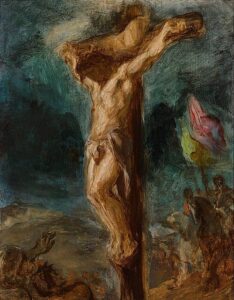 This portion of Scripture and its reference to Jesus’ resurrection serves to underscore some essential spiritual truths. For example, these verses highlight the importance of acknowledging the factual nature of Jesus’ crucifixion and subsequent resurrection, for those historic truths are indispensable to our salvation. As our text from Romans 4:24 reminds us, Jesus was “…delivered over to death for our sins and was raised to life for our justification” (NIV).
Paul the Apostle addressed this subject at greater length in the Biblical letter we know today as 1 Corinthians…
“…if Christ has not been raised from death, then we have nothing to preach and you have nothing to believe. More than that, we are shown to be lying about God, because we said that he raised Christ from death—but if it is true that the dead are not raised to life, then he did not raise Christ.
For if the dead are not raised, neither has Christ been raised. And if Christ has not been raised, then your faith is a delusion and you are still lost in your sins. It would also mean that the believers in Christ who have died are lost. If our hope in Christ is good for this life only and no more, then we deserve more pity than anyone else in all the world” (1 Corinthians 15:14-19 GNB).
In these verses, Paul addressed a number of serious repercussions that arise from the notion that Jesus’ death and resurrection were not literal, historic events……
- “…all our preaching is useless and your trust in God is empty, worthless, hopeless;” (TLB).
- “If the dead won’t be raised to life, we have told lies about God by saying he raised Christ to life, when he really did not” (CEV).
- “if the dead are not raised, then Christ has not been raised either” (NIV).
- “And if Christ has not been raised, then your faith is useless and you are still guilty of your sins” (NLT).
- “and what’s more, those who have died in Christ are gone forever” (CEB).
- “If we have put our hope in Christ for this life only, we should be pitied more than anyone” (HCSB).
Therefore, we can say that our affirmation of Jesus’ historic death and resurrection is comparable in importance to a proper understanding of His life and teachings.
Image Attribution: Eugène Delacroix, Public domain, via Wikimedia Commons
“… It will be counted to us who believe in him who raised from the dead Jesus our Lord, who was delivered up for our trespasses and raised for our justification” (Romans 4:24-25 ESV).
Having explored the negative repercussions that stem from a denial of Jesus’ crucifixion and resurrection, we can now turn our attention to the ideas presented to us in the closing verses of Romans chapter four. One of those ideas involves an uncomfortable subject: death.
In a broad sense, we can characterize “death” as a state of separation. Physical death is distinguished by the separation of one’s spirit from his or her body, for “…the body without the spirit is dead…” (James 2:26). The Biblical book of Revelation describes another type of death known as the “second death” in Revelation 20:14. This second death involves eternal separation from God in a place of torment and remorse. In essence, God will grant the desire of those who do not care to acknowledge Him in the form of this second death.
In the context of our text from Romans chapter four, we should note that death was not a component of God’s original creation. Instead, the Scriptures tell us that Adam’s transgression brought forth God’s judgment and the subsequent imposition of a death penalty. The following chapter of Romans will discuss Adam’s role in bringing death to humanity at greater length. This leads us to several foundational conclusions…
- Death, by its nature, is the inherent result of sin. As Romans 6:23 will later confirm, “…the wages of sin is death.“
- Jesus was the only sinless human being who ever lived.
- Since Jesus was unblemished by sin, death held no justifiable authority over Him.
- As such, Jesus died because our sins were imputed (or charged) to Him.
- He thus absorbed the wrath and chastisement that we deserve.
Therefore, He “…was delivered up for our trespasses” as we’re told here in Romans 4:25. The following author summarizes these ideas and their ramifications…
“By raising Christ from the dead, God the Father was in effect saying that he approved of Christ’s work of suffering and dying for our sins, that his work was completed, and that Christ no longer had any need to remain dead. There was no penalty left to pay for sin, no more wrath of God to bear, no more guilt or liability to punishment—all had been completely paid for, and no guilt remained…
When the Father in essence said to Christ, ‘All the penalty for sins has been paid and I find you not guilty but righteous in my sight,’ he was thereby making the declaration that would also apply to us once we trusted in Christ for salvation. In this way Christ’s resurrection also gave final proof that he had earned our justification.” (1)
(1) Wayne Grudem, Systematic Theology: An Introduction to Biblical Doctrine, Second Edition. (Grand Rapids, MI: Zondervan Academic, 2020). [pp. 35-36]
“He was delivered up for our trespasses and raised for our justification” (Romans 4:25 HCSB).
Just as the Apostle Paul opened this portion of his letter to the church at Rome with a reference to justification, he now touches upon that topic again in the closing verse of this chapter. As discussed earlier in our look at the first three chapters of Romans, “justification” describes the manner in which sinful human beings are made acceptable to a holy God.
Justification involves a divine act of God that eliminates the guilt and penalty of sin for those who trust in Christ. It also represents a legal concept that pertains to one’s standing before God. When God justifies a sinful human being, He legally attributes (or confers) the positive righteousness of Christ to those who place their faith in Him, while His atoning work on the cross satisfies the death sentence imposed by the Law.
Nevertheless, this correlation between Jesus’ resurrection and the doctrine of justification may not seem readily apparent. The New Testament epistle to the Hebrews can help us make that connection by linking Jesus’ resurrected life with His priestly intercession on our behalf…
“But He, because He continues forever, has an unchangeable priesthood. Therefore He is also able to save to the uttermost those who come to God through Him, since He always lives to make intercession for them” (Hebrews 7:24-25).
This priestly ministry hinges upon Jesus’ resurrection from the dead, for only a living Savior could fulfill that role. The following source approaches this question from another perspective…
“How does the resurrection of Jesus relate to our justification? …Jesus’ death without a resurrection would have indicated that his atonement was not acceptable to God. But the fact that God raised him shows that God is satisfied. This is the verdict of the Judge of heaven and earth: The atonement has been made, and all who trust in it will participate in the benefits of the righteousness of Christ.
Thus, the resurrection is the last step in God’s work to justify us. By raising Jesus, God shows that he is satisfied with his work. Because God’s wrath has been satisfied, he can accept us as sinners and justify us. Had Jesus not been raised, we could not be justified.” (1)
As another commentator adds, “The denial of the propitiatory death of Christ, or of his resurrection from the dead, is a denial of the gospel It is refusing to be saved according to the method that God has appointed.” (2)
(1) Sproul, R. C. (1992). Before the face of God: Book 1: A daily guide for living from the book of Romans (electronic ed.). Grand Rapids: Baker Book House; Ligonier Ministries.
(2) Charles Hodge, Commentary on Romans, quoted in ESV Church History Study Bible: Voices from the Past, Wisdom for the Present. (2023). Crossway. p.1689
“God gave Jesus to die for our sins, and he raised him to life, so that we would be made acceptable to God” (Romans 4:25 CEV).
Romans Chapter Four – Epilogue
“In chapter 4, Paul presented several irrefutable reasons why justification is by faith: (1) Since justification is a gift, it cannot be earned by works (vv. 1-8). (2) Since Abraham was justified before he was circumcised, circumcision has no relationship to justification (vv. 9-12). (3) Since Abraham was justified centuries before the Law, justification is not based on the Law (vv. 13-17). (4) Abraham was justified because of his faith in God, not because of his works (vv. 18-25).” (1)
“In this chapter, Paul clearly demonstrated that in no way does the Old Testament contradict the gospel of salvation by grace through faith. Instead the gospel is the fulfillment of the Old Testament, and Abraham – justified through faith – is our pattern.” (2)
“What can we learn from this chapter? The noun faith occurs ten times in this chapter and the corresponding verb believe occurs six times. Together the idea of believing faith is found no less than sixteen times in Romans 4. The words count, reckon, or impute, all of which mean to charge to one’s account, occur eleven times in Romans 4. The word righteousness occurs in one of its forms eight times in this chapter and the corresponding verb justified occurs in one of its forms three times. Together the idea of righteousness is found no less than eleven times in Romans 4. It is significant that, apart from the common words of our language, these three words occur so frequently. The application of Romans 4 is simple: faith imputes righteousness. There isn’t a thing anyone can do to become clothed with God’s righteousness except have faith in Jesus Christ as his Saviour from sin. (3)
“In Rom 4:1-25, Paul presented several irrefutable reasons why justification is by faith: (1) Since justification is a gift, it cannot be earned by works (Rom 4:1-8). (2) Since Abraham was justified before he was circumcised, circumcision has no relationship to justification (Rom 4:9-12). (3) Since Abraham was justified centuries before the Law, justification is not based on the Law (Rom 4:13-17). (4) Abraham was justified because of his faith in God, not because of his works (Rom 4:18-25).” (4)
“Anyone who believes in salvation by works must answer at least three questions: How do you know when you have done enough good works to be saved? How can you ever be sure of your salvation, and if you could save yourself by your good works, why did Jesus die on the cross?” (5)
(1) Witmer, John A. “The Man with Two Countries.” Bibliotheca Sacra 133:532 (October-December 1976) [pg.455]. Quoted in Dr. Thomas L. Constable, Notes on Romans 2026 Edition https://soniclight.com/tcon/notes/html/romans/romans.htm
(2) Guzik, D. (2025, April 3). Enduring Word Bible Commentary Romans Chapter 4. Enduring Word. https://enduringword.com/bible-commentary/romans-4/
(3) Edward E. Hindson and Woodrow Michael Kroll, eds., KJV Bible Commentary (Nashville: Thomas Nelson, 1994), 2227.
(4) John F. Walvoord and Roy B. Zuck, Bible Knowledge Commentary (1983), David C Cook. [Romans 4:25].
(5) Dick Woodward, Mini Bible College Booklet Thirty-Two The Book Of Romans Verse By Verse (part 4) [pg.45] https://mbc.icm.org/