• About
  • Contact
  • RSS
  • Audio
The Doctor's Office
Banner
  • Home
  • Old Testament Book Studies
    • The Book Of Genesis
    • The Book of Ruth
    • The Book of Nehemiah
    • The Book Of Esther
    • The Book Of Ecclesiastes
  • New Testament Book Studies
    • The Gospel Of Mark
    • The Book Of Romans
    • The Book Of 1 Corinthians
    • The Book Of 2 Corinthians
    • The Book Of Galatians
    • The Book Of Ephesians
    • The Book Of Philippians
    • The Book Of 1 Timothy
    • The Book Of Colossians
    • The Book Of 1 Thessalonians
    • The Book Of 2 Thessalonians
    • The Book Of 2 Timothy
    • The Book of Titus
    • The Book Of Philemon
    • The Book Of Hebrews
    • The Book Of 1 Peter
    • The Book Of 2 Peter
    • The Book Of James
    • The Book Of 1 John
    • The Books Of 2 John / 3 John
    • The Book Of Revelation

Hebrews – Chapter Twelve X

by Ed Urzi July 31, 2023

“For consider Him who endured such hostility from sinners against Himself, so that you won’t grow weary and lose heart” (Hebrews 12:3 HCSB).

No matter how difficult life becomes, we can be secure in knowing  that Jesus is familiar with the problems and issues we face. For instance, what if we were to compare the pressures of our lives to Jesus’ experience in the Garden of Gethsemane? Remember that it was there where His perspiration became like drops of blood as he prayed and contemplated the immediate future that awaited Him. Thus, it seems unlikely that our challenges exceed the struggles Jesus faced in respect to His approaching crucifixion.

A few minutes spent with a work such as Foxe’s Book Of Martyrs may also bring a fresh perspective to our view of the stresses we experience in life. This is important when we consider the natural human tendency to magnify the intensity of our personal struggles. The standard we use to measure their severity influences the accuracy of our perception.

This is not to say that our challenges are insignificant, or illusionary. Nor does it mean that we should ignore the problems we experience in life, or pretend they don’t exist. Instead, we can ensure that we accurately assess such things when we measure them against the example Jesus set for us.

The New Testament epistle of 1 Peter approaches this idea from a different perspective…

“For what credit is it if you sin and are mistreated and endure it? But if you do good and suffer and so endure, this finds favor with God. For to this you were called, since Christ also suffered for you, leaving an example for you to follow in his steps” (1 Peter 2:20-21 NET).

Much like a weary athlete who continues to press on towards the finish line, the knowledge that Jesus has set an example for us helps provide us with the proper mindset. The Apostle Paul also touched upon this idea in his letter to the Galatian church: “And let us not grow weary while doing good, for in due season we shall reap if we do not lose heart” (Galatians 6:9).

Paul echoed a similar theme in his letters to the churches at Corinth and Thessalonica as well…

“Therefore, my beloved brethren, be steadfast, immovable, always abounding in the work of the Lord, knowing that your labor is not in vain in the Lord” (1 Corinthians 15:58).

“But as for you, brethren, do not grow weary in doing good” (2 Thessalonians 3:13).

Therefore, we can find strength in the counsel given to us here in Hebrews 12:3 whenever we grow weary of the trials and oppositions we encounter.

Hebrews – Chapter Twelve IX

by Ed Urzi July 28, 2023

“For consider Him who endured such hostility from sinners against Himself, lest you become weary and discouraged in your souls” (Hebrews 12:3).

Like any good leader, Jesus is someone who leads by example. For instance, we would do well to consider the various acts of hostility that were inflicted upon Jesus whenever we face conflict with others. Those examples run like a thread throughout the New Testament gospel of John…

“Therefore the Jews sought all the more to kill Him, because He not only broke the Sabbath, but also said that God was His Father, making Himself equal with God” (John 5:18).

“After these things Jesus walked in Galilee; for He did not want to walk in Judea, because the Jews sought to kill Him” (John 7:1).

“[Jesus said] I know that you are Abraham’s descendants, but you seek to kill Me, because My word has no place in you” (john 8:37).

“Then they took up stones to throw at Him; but Jesus hid Himself and went out of the temple, going through the midst of them, and so passed by” (John 8:59).

“Then the Jews took up stones again to stone Him. Jesus answered them, ‘Many good works I have shown you from My Father. For which of those works do you stone Me?’ The Jews answered Him, saying, ‘For a good work we do not stone You, but for blasphemy, and because You, being a Man, make Yourself God'” (John 10:31-33).

“The Jews answered [Pontius Pilate], ‘We have a law, and according to our law He ought to die, because He made Himself the Son of God'” (John 19:7).

Some of our conflicts may grow out of relationships with disagreeable spouses, antagonistic co-workers, unreasonable employers. disruptive neighbors, or contentious family members. Others must deal with the hostilities imposed by government entities, business organizations, religious movements, or groups that are averse to Christianity.

When such things occur, we would be wise to “Think about the one who endured such opposition from sinners so that you won’t be discouraged and you won’t give up” (CEB). We might also consider Jesus’ cautionary message from John 15:20: “Do you remember what I said to you, ‘The servant is not greater than his master’? If they have persecuted me, they will persecute you as well, but if they have followed my teaching, they will also follow yours” (Phillips).

Thus, as one source concludes, “…if we would look to Christ’s example instead of looking at our own afflictions, we would not become so weary or fainthearted. Are you unhappy over your sacrifice? Take a new look at His!” (1)

(1) Edward E. Hindson and Woodrow Michael Kroll, eds., KJV Bible Commentary (Nashville: Thomas Nelson, 1994), 2576.

Hebrews – Chapter Twelve VIII

by Ed Urzi July 27, 2023

“looking to Jesus, the founder and perfecter of our faith, who for the joy that was set before him endured the cross, despising the shame, and is seated at the right hand of the throne of God” (Hebrews 12:2 ESV).

Although crosses are often sold as various forms of jewelry in many areas of the world, some who display crosses in this manner may be unfamiliar with the shame that accompanied the act of crucifixion. In Jesus’ case, the humiliation inflicted upon Him began long before He reached the site of His crucifixion…

“Then the soldiers led Him away into the hall called Praetorium, and they called together the whole garrison. And they clothed Him with purple; and they twisted a crown of thorns, put it on His head, and began to salute Him, ‘Hail, King of the Jews!’ Then they struck Him on the head with a reed and spat on Him; and bowing the knee, they worshiped Him” (Mark 15:16-19).

The Praetorium served as the place of residence for the Roman troops in that area. It was there that the soldiers in charge of Jesus mocked His kingship by spitting upon Him and dressing Him in purple, the color of royalty. These men created a crown made from thorns in a caricature of sovereign authority and gave Him a cane to serve as a kind of “royal scepter.” An entire garrison of soldiers witnessed this humiliating scene.

“They took Jesus therefore, and He went out bearing His own cross, to the place called the Place of a Skull, which is called in Hebrew, Golgotha” (John 19:17 RSV).

Regarding the act of crucifixion, one source makes the following observation: “Although the Romans did not invent crucifixion, they perfected it as a form of torture and capital punishment that was designed to produce a slow death with maximum pain and suffering. It was one of the most disgraceful and cruel methods of execution and usually was reserved only for slaves, foreigners, revolutionaries, and the vilest of criminals.” (1)

Yet now we’re told, Jesus “…is seated in the place of honor beside God’s throne” (NLT). One source explains this imagery behind this reference…

“…the idea being that He, after His work of providing a salvation was finished, sat down, and remains seated. He need never arise and repeat His work on the Cross for sinners. It is a finished work. He is not only seated, but He occupies the position of preeminence, at the right hand of God.” (2)

(1) “Christ Died Quickly On The Cross” William D. Edwards, quoted in “The Book Of Jesus” edited by Calvin Miller pg 388

(2) Kenneth S. Wuest, Word Studies in the Greek New Testament (Hebrews 12:2) Copyright © 1942-55 by Wm. B. Eerdmans Publishing Co.

Hebrews – Chapter Twelve VII

by Ed Urzi July 26, 2023

“Looking unto Jesus the author and finisher of our faith; who for the joy that was set before him endured the cross, despising the shame, and is set down at the right hand of the throne of God” (Hebrews 12:2 KJV).

One Biblical scholar draws our attention to the significance of the word “author” in this passage…

“The word ‘author’ is the translation of archegon… The word is made up of ago ‘to lead,’ and arche, ‘the first.’ The compound word means ‘the chief leader, one that takes the lead in anything and thus furnishes the example.'” (1)

Thus, we can say that Jesus stands at the starting line as we begin the course of faith that God has set before us and awaits us as we reach the finish line. As a merciful and faithful high priest who has been made like His brothers and sisters in every way, we can look to Him for strength and encouragement as we traverse the curves, obstacles, and hazards we encounter over the course of our lives.

This passage also offers insight into Jesus’ mindset during the period of His earthly ministry: “He endured the cross, ignoring the shame, for the sake of the joy that was laid out in front of him…” (CEB). So Jesus viewed His crucifixion as more than just a sacrificial offering; instead, He endured the shame of the cross with an eye towards the joy that awaited Him.

However, that joy was not for Jesus’ benefit alone…

“It is not difficult to trace an affinity between the joy of which our author speaks here and the joy to which Jesus Himself makes repeated reference in the upper room discourses of the Fourth Gospel. He tells His disciples there of His desire that His joy may be in them, so that their joy may be complete (John 15: 11; cf. 16:20, 21, 22, 24); and in His high-priestly prayer He asks the Father ‘that they may have my joy made full in themselves’ (John 17: 13).

So here, ‘the joy that was set before him’ is not something for Himself alone, but something to be shared with those for whom He died as sacrifice and lives as high priest.” (2)

So “the author and finisher of our faith” endured the cross for the joy of others, as well as Himself. Finally, Jesus emphasized the practical aspect of His work on the cross in some of His last words to His disciples…

“Most assuredly, I say to you, unless a grain of wheat falls into the ground and dies, it remains alone; but if it dies, it produces much grain” (John 12:24).

(1) Kenneth S. Wuest, Word Studies in the Greek New Testament (Hebrews 12:2) Copyright © 1942-55 by Wm. B. Eerdmans Publishing Co.

(2) The New International Commentary On The New Testament – The Epistle To The Hebrews, F. F. Bruce, General Editor © Copyright 1964, Wm. B. Eerdmans Publishing Co. Grand Rapids, Michigan [pg. 353]

Hebrews – Chapter Twelve VI

by Ed Urzi July 25, 2023

“looking unto Jesus, the author and finisher of our faith, who for the joy that was set before Him endured the cross, despising the shame, and has sat down at the right hand of the throne of God” (Hebrews 12:2).

The Biblical “heroes of the faith” mentioned earlier in Hebrews chapter eleven serve to challenge, inspire, and motivate us to follow God’s path for our lives. Undoubtedly, there are some who choose to approach the challenges they encounter along that path with a determination to simply “do better” in those areas where they may be falling short. But much like a New Year’s resolution that falls by the wayside, that approach is destined to fail.

The solution is to look unto Jesus, the author and the finisher of our faith, as we’re told here in Hebrews 12:2. Just as the ancient Magi fixed their gaze upon the Star of Bethlehem to guide them to their destination, we can stay the course of God’s direction for our lives if we continually focus upon Christ.

While the faithful men and women of Hebrews chapter eleven encourage us to live a life of faith, Jesus enables us to live a life of faith. Since Jesus is one upon whom “…our faith depends from beginning to end” (GNB), we are empowered to live faithfully as we look to Him. The Apostle Peter once discovered the importance of this truth in a dramatic fashion.

After feeding thousands of people with two fish and five loaves of bread, Jesus sent His disciples across the Sea of Galilee on the way to their next destination while He dismissed the crowds. It was later that night when Jesus walked across the surface of the water and approached the disciples as they struggled to navigate against a boisterous wind. The disciples were understandably terrified at this sight, but Jesus moved quickly to reassure them: “Don’t worry! It’s me! Don’t be afraid” (Matthew 14:27 ERV).

That led Peter to make a request: “Lord, if it is You, command me to come to You on the water” (Matthew 14:28). Jesus granted Peter’s request, but shortly after Peter left the boat, he began to sink beneath the waves as he grew fearful of the tumultuous winds. It was then that “…Jesus stretched out His hand and caught him, and said to him, ‘O you of little faith, why did you doubt?” (Matthew 14:31).

Peter’s experience thus serves as an object lesson that should encourage us to “…focus on Jesus, the source and goal of our faith” (GW).

Hebrews – Chapter Twelve V

by Ed Urzi July 24, 2023

“Therefore, since we are surrounded by such a great cloud of witnesses, let us throw off everything that hinders and the sin that so easily entangles. And let us run with perseverance the race marked out for us” (Hebrews 12:1 NIV).

As we close our look at Hebrews 12:1, we will take a moment to consider this reference to “…the race marked out for us.“ This terminology implies that every individual Christian follows a personalized spiritual course that is specifically designed for him or her. While there may be similarities in our individual courses, every race is held on a different track, so to speak.

We can gain further insight into this concept with a brief survey of Jesus’ parable of the Laborers in the Vineyard. That parable relates the account of a landowner who went out very early in the morning to hire laborers for his vineyard. He then hired additional laborers at 9am, noon, 3pm, and 5pm. When evening came, the landowner instructed his manager to pay the laborers for their work. He then provided a day’s wage to each worker, even those who were hired late in the day.

The workers who were hired first then began complain about their compensation. However, the landowner was ready with his response…

“…’Friend, I am not treating you unfairly. Didn’t you agree with me to work for the standard wage? Take what is yours and go. I want to give to this last man the same as I gave to you. Am I not permitted to do what I want with what belongs to me? Or are you envious because I am generous?'” (Matthew 20:13-15 NET).

For application purposes, we might say that our personal vineyard is comprised of the life and work that God has given us. The tools of our trade include the talents, skills, abilities, and/or opportunities that God has provided. Just as every human being is different, so is the type and volume of work that God has given us in our individual vineyards.

Because of this, we may be tempted to look at others’ vineyards to offer suggestions, criticisms, ideas, or opinions regarding what they ought to do. To be fair, this may be appropriate if God has placed us in a supervisory capacity, or if we encounter a teaching or behavior that is clearly misaligned with God’s Word. Nevertheless, it is usually best to focus upon our own “vineyard” and the work that God has given us. (1)

It is often difficult to produce quality work for Christ when we are focused on the work of others. Since God has marked out an individual plan for every man and woman of God (as implied here in Hebrews 12:1). we would do well to concentrate upon those areas of responsibility He has assigned to us.

(1) Also see Paul the Apostle’s comment to the Corinthian church in 2 Corinthians 10:13

Hebrews – Chapter Twelve IV

by Ed Urzi July 21, 2023

“Therefore, since we also have such a large cloud of witnesses surrounding us, let us lay aside every weight and the sin that so easily ensnares us. Let us run with endurance the race that lies before us” (Hebrews 12:1 HCSB).

While our natural, God-given talents and abilities are good and beneficial, we should always be alert to the potential influence of sin in those areas. Just as a cross-country runner must be attentive to the obstacles that lay ahead, we should humbly acknowledge our personal strengths and prayerfully assess the vulnerabilities they may present.

Those who come to Christ later in life should also be alert to the presence of detrimental thoughts, attitudes, memories, and/or behavior patterns that may have developed earlier. Since Hebrews 12:1 associates the Christian life with a race (as opposed to a sprint), this passage reminds us that an attitude of patient endurance may be required to overcome such things in Christ.

Finally, we should recognize our potential faults and weaknesses and their potential to allow sinful behaviors to gain a foothold in our lives. Just as a tenacious weed may exploit a fissure in the surface of a rocky cliff to germinate and grow, sin may also exploit those faults that may exist within our character. Israel’s king David touched upon this concern in Psalm 139…

“Search me, O God, and know my heart; Try me, and know my anxieties; And see if there is any wicked way in me, And lead me in the way everlasting” (Psalm 139:23-24).

These prayerful self-evaluations may be challenging, for they often compel us to face difficult and unpleasant truths about ourselves. However, we should note that professional athletes, business executives, and those from other walks of life must also engage in various types of self-assessments in order to grow and improve. Therefore, we would do well to take the initiative in following David’s example in this passage from Psalm 139.

This approach also finds Biblical support in the New Testament book of 1 Corinthians…

“But if we evaluated and judged ourselves honestly [recognizing our shortcomings and correcting our behavior], we would not be judged. But when we [fall short and] are judged by the Lord, we are disciplined [by undergoing His correction] so that we will not be condemned [to eternal punishment] along with the world” (1 Corinthians 11:31-32 AMP).

Hebrews 12:1 thus prepares us to approach the subject of God’s discipline that occurs later in this chapter. Therefore, we would be well-advised to consider the following admonition…

“Each of us has habitual ‘besetting sins’ we find it hard to imagine living without. Such sins are idols. We shall strive against such sins throughout life on earth, but they are the individual sin-challenges that God puts before each of us. Working on your besetting sin is the particular project God has given you.” (1)

(1) Sproul, R. C. (1994). Before the face of God: Book 4: A daily guide for living from Ephesians, Hebrews, and James (electronic ed.). Grand Rapids: Baker Book House; Ligonier Ministries.

Hebrews – Chapter Twelve III

by Ed Urzi July 20, 2023

“Therefore, since we are surrounded by such a great cloud of witnesses, we must get rid of every weight and the sin that clings so closely, and run with endurance the race set out for us” (Hebrews 12:1 NET).

Our look at Hebrews 12:1 continues with an analysis of the weights or encumbrances mentioned in this verse…

“The weight (Gr ogkos—used only here) refers to that which impedes or burdens by weighing one down. For a runner it could either refer to clothing or his own excessive body weight (Hughes, pp. 519–520). Obviously, for the Christian it would involve not wicked but weighty things. It would include anything that could hinder his effectiveness for service.

These are not things which are inherently wrong, but for the diligent runner or the faithful Christian they are an impediment that must be removed. The Christian is not allowed to be selective regarding these weights; he will remove them. He must put off every weight. Whatever does not aid in the race is a weight and must be cast aside.” (1)

Another source adds, “It may well be that what is a hindrance to one entrant in this spiritual contest is not a hindrance to another; each must learn for himself what in his case is a weight or impediment.” (2)

This brings us to the reference to “sin” within this passage. It’s probably safe to say that most people associate the word “sin” with something bad or wrong. However, the Biblical definition of sin also conveys the image of “missing the target,” much like an archer who fails to hit a designated mark. As mentioned earlier in our look at Hebrews chapter nine, sin involves a failure to live up to the perfect standard that God established when He created humanity.

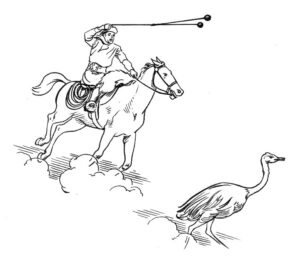
Hebrews 12:12 reminds us that sin is capable of “easily entangling” those who engage in it. We can illustrate this idea with the image of a bola, a weapon used by the indigenous peoples of North and South America. A bola served as a hunter’s weapon and comprised two or more lengths of cord that were tied together. Each cord was then secured with a weight on the other end. A hunter used a bola by throwing it to entangle the legs of his prey and immobilize it.

In one sense, sin is like a bola, for it serves to entangle and incapacitate its victim. Thus, we are encouraged to “…strip off anything that slows us down or holds us back, and especially those sins that wrap themselves so tightly around our feet and trip us up” (TLB).

Image Credit: Pearson Scott Foresman, Public domain, via Wikimedia Commons

(1) Edward E. Hindson and Woodrow Michael Kroll, eds., KJV Bible Commentary (Nashville: Thomas Nelson, 1994), 2575.

(2) The New International Commentary On The New Testament – The Epistle To The Hebrews, F. F. Bruce, General Editor © Copyright 1964, Wm. B. Eerdmans Publishing Co. Grand Rapids, Michigan [pg. 349]

Hebrews – Chapter Twelve II

by Ed Urzi July 19, 2023

“Therefore, since we are surrounded by so great a cloud of witnesses, let us also lay aside every weight, and sin which clings so closely, and let us run with endurance the race that is set before us” (Hebrews 12:1 ESV).

On one level, we might associate this passage with the image of a stadium that is filled with heroes of the faith who cheer us on as we run “…the race that God has planned for us” (NLV). However, we should also consider the possibility that these examples are given to us for a different purpose.

For example, if a reckless, alpha-male (Samson), a frightened, reluctant warrior (Gideon), a prostitute (Rahab), a son of a prostitute (Jephthah), and two men who were guilty of pre-meditated murder (Moses and David) can be counted among these members of the “faith hall of fame,” then we can as well. As one source observes, “It is not so much they who look at us as we who look to them- for encouragement. They have borne witness to the faithfulness of God…” (1)

In light of this, we are encouraged to “…throw off everything that hinders and the sin that so easily entangles… [and] run with perseverance the race marked out for us” (NIV). This illustration was just as familiar to ancient audiences as it should be to modern-day readers of this epistle. Just as today’s professional athletes train with weighed equipment, runners of the first century also trained with weighted attachments that were removed prior to competition.

This athletic imagery should prompt us to consider those spiritual weights that may restrict our growth in Christ today. While such hindrances might take the obvious form of sinful behavior, there may be other possibilities as well. For instance, something that is ordinarily good might easily devolve into something bad if it prevents us from moving forward on God’s agenda for our lives. Jesus provided us with a few such examples in His parable of the sower…

“…they are the ones who hear the word, and the cares of this world, the deceitfulness of riches, and the desires for other things entering in choke the word, and it becomes unfruitful” (Mark 4:18-19).

Therefore. “‘The Christian runner must rid himself even of innocent things which might retard him. And all that does not help, hinders. It is by running he learns what these things are. So long as he stands he does not feel that they are burdensome and hampering.'” (a) Thus, the word ‘weight’ has the idea of ‘encumbrance.'” (2)

(1) The New International Commentary On The New Testament – The Epistle To The Hebrews, F. F. Bruce, General Editor © Copyright 1964, Wm. B. Eerdmans Publishing Co. Grand Rapids, Michigan [pg. 346]

(2) (a) Nicoll, William Robertson, M.A., L.L.D. “Commentary on Hebrews 12”. The Expositor’s Greek Testament [Hebrews 12:1]. Quoted in, Kenneth S. Wuest, Word Studies in the Greek New Testament (Hebrews 11:1) Copyright © 1942-55 by Wm. B. Eerdmans Publishing Co. [Hebrews 12:1]

Hebrews – Chapter Twelve I

by Ed Urzi July 18, 2023

“Therefore we also, since we are surrounded by so great a cloud of witnesses, let us lay aside every weight, and the sin which so easily ensnares us, and let us run with endurance the race that is set before us” (Hebrews 12:1).

After providing us with an extensive list of faithful individuals in the previous chapter, the author of Hebrews will now follow with some important conclusions here in chapter twelve…

“Chapter 12 contains three resources that encourage and enable us to run the Christian race with endurance. They are: the example of Jesus (vv. 1- 4), the assurance of the Father’s love (vv. 5-13), and the enablement of God’s grace (help; vv. 14-29).” (1)

So this chapter opens with a reference to those “heroes of the faith” who comprise this gathering of witnesses. In this context, the word “cloud” conveys the image of a great multitude. The “witnesses” are those who provide testimony regarding the things they’ve seen or experienced. This word-picture thus portrays a large contingent of faithful individuals who serve to inspire and motivate God’s people today.

One question that often arises from this passage is this: “Can this cloud of witnesses view events on earth today much like a group of spectators in a stadium?” Two sources address that question from opposing perspectives…

“The fact that Hebrews 12:1 says, ‘We are surrounded by so great a cloud of witnesses,’ just after an entire chapter spent on the discussion of the faith of Old Testament saints who had died (Heb. 11) and the fact that the author encourages us to run the race of life with perseverance because we are surrounded by this great cloud of witnesses both suggest that those who have died and gone before have some awareness of what is going on in the earth. Scripture says very little about this, probably because it does not want us to pray to those who have died or to contact them in any way (note Saul’s great sin in 1 Sam. 28 :7-25). Nonetheless, Hebrews 12:1-2 does give us this slight hint, probably as an encouragement to us to continue also to be faithful to God as were those who have died and gone to heaven before us.” (2)

“The deceased people of chap. 11 give witness to the value and blessing of living by faith. …The great crowd is not comprised of spectators but rather is comprised of ones whose past life of faith encourages others to live that way (cf. 11:2, 4, 5, 33, 39).” (3)

(1) Constable, Thomas. DD, Notes on Hebrews 2023 Edition “3. The consequences of apostasy 12:25-29” [12:28-29] https://www.planobiblechapel.org/tcon/notes/html/nt/hebrews/hebrews.htm

(2) Wayne Grudem, Systematic Theology: An Introduction to Biblical Doctrine, Second Edition. (Grand Rapids, Ml: Zondervan Academic, 2020)

(3) John F. MacArthur Jr., The MacArthur Study Bible: New American Standard Bible. (Nashville, TN: Thomas Nelson Publishers, 2006), Heb 12:1

Hebrews – Chapter Eleven LXXXV

by Ed Urzi July 17, 2023

“God having provided something better for us, that they should not be made perfect apart from us” (Hebrews 11:40).

Our lengthy journey through Hebrews chapter eleven has now come to an end here in verse forty. As we close our look at this portion of Scripture and prepare for our entry into Hebrews chapter twelve, the examples set by these “heroes of the faith” offer an opportunity to reflect upon Jesus’ message from the Gospel of Matthew…

“Therefore do not worry, saying, ‘What shall we eat?’ or ‘What shall we drink?’ or ‘What shall we wear?’ For after all these things the Gentiles seek. For your heavenly Father knows that you need all these things. But seek first the kingdom of God and His righteousness, and all these things shall be added to you. Therefore do not worry about tomorrow, for tomorrow will worry about its own things. Sufficient for the day is its own trouble” (Matthew 6:31-34).

Finally, several commentators lend some important closing thoughts to this final verse…

“The faith of OT saints looked forward to the promised salvation, whereas the faith of those after Christ looks back to the fulfillment of the promise. Both groups are characterized by genuine faith and are saved by Christ’s atoning work on the cross (cf. Eph 2:8, 9).” (1)

“The Greek phrasing emphasizes this point by negating the opposite: ‘so that they would not be made perfect without us.'” (2)

“Hebrews 11 has been called faith’s hall of fame. No doubt the author surprised his readers by this conclusion: These mighty Jewish heroes did not receive all that God had promised because they died before Christ came. In God’s plan, they and the Christian believers (who were also enduring much testing) would be rewarded together.” (3)

“In the end he says a great thing. All these died before the final unfolding of God’s promise and the coming of his Messiah into the world. It was as if God had so arranged things that the full blaze of his glory should not be revealed until we and they can enjoy it together. The writer to the Hebrews is saving: ‘See! the glory of God has come. But see what it cost to enable it to come! That is the faith which gave you your religion. What can you do but be true to a heritage like that?'” (4)

“Verses 39-40 summarize the chapter by relating the list of exemplary witnesses to the audience’s experience, and they provide a transition to the argument of 12:1-13.” (5)

(1) John F. MacArthur Jr., The MacArthur Study Bible: New American Standard Bible. (Nashville, TN: Thomas Nelson Publishers, 2006), Heb 11:40

(2) NET Bible notes on Hebrews 11:40 https://classic.net.bible.org/bible.php?book=Heb&chapter=11&mode=print

(3) Life Application Study Bible [Hebrews 11:39-40] Copyright © 1988, 1989, 1991, 1993, 1996, 2004 by Tyndale House Publishers Inc., all rights reserved.

(4) Barclay, William. William Barclay’s Daily Study Bible, “The Defiance Of Suffering (Heb_11:35-40).”

(5) Constable, Thomas. DD., Notes on Hebrews 2023 Edition, [11:39-40] https://www.planobiblechapel.org/tcon/notes/html/nt/hebrews/hebrews.htm

Hebrews – Chapter Eleven LXXXIV

by Ed Urzi July 14, 2023

“And all these, having obtained a good testimony through faith, did not receive the promise” (Hebrews 11:39).

It is difficult to resolve the tension between the faith of those mentioned here in Hebrews chapter eleven and the terrible events that befell some of them. When tragic events occur to God’s faithful today, we can draw strength from the encouraging message found in Romans 8:28: “…all things work together for good to those who love God, to those who are the called according to His purpose.”

Whenever we face uncertainty regarding the way things have transpired in our lives, we can say that God has a definite purpose behind those events, even if we struggle to understand that purpose. When God allows us to experience those troubles and hardships, it helps to remember that He always has reasons for doing so.

For example, God may allow difficult times to enter our lives to strengthen us (2 Corinthians 12:10) and to increase our trust in Him (Psalm 50:14-15). We can also say that God uses such difficulties to help us develop patience (Romans 5:3-5) and endurance (as we read earlier in Hebrews 10:35-38). God may take the circumstances of our lives and use them as an example to others and demonstrate the proper way to handle trials and problems (2 Thessalonians 1:4). Finally, God may allow difficulties to enter our lives for the purpose of helping others who will later go through similar experiences (2 Corinthians 1:3-4).

With these things in mind, it helps to remember that tests do not always take the form of an exam or essay. Instead, the person who can view his or her problems as opportunities to exercise the kind of faith that pleases God is someone who can develop the spiritual endurance that our author will discuss later in the opening verse of the following chapter.

There would be no need for faith if God never allowed us to enter a circumstance that required us to exercise it. Moreover, there are options available to us whenever we face situations that challenge our faith. We can say, “Why did God allow this to happen to me?” Or we can say, “This is an opportunity to exercise the kind of faith that is pleasing to God.” As one commentator has observed, “The OT figures mentioned in ch. 11 did not experience the salvation of Christ’s new covenant during their lifetimes (9:15). Rather, they saw the promise from afar and eagerly awaited its fulfillment (vv. 13, 16).” (1)

(1) John D. Barry et al., Faithlife Study Bible (Bellingham, WA: Lexham Press, 2012, 2016), Heb 11:39.

Hebrews – Chapter Eleven LXXXIII

by Ed Urzi July 13, 2023

“They were stoned, they were sawn in two, they were killed with the sword. They went about in skins of sheep and goats, destitute, afflicted, mistreated–of whom the world was not worthy–wandering about in deserts and mountains, and in dens and caves of the earth” (Hebrews 11:37-38).

The best-known Old Testament example of a God-honoring person who “went about in skins of sheep and goats” is undoubtedly Elijah, the famous Biblical prophet. In fact, it appears that Elijah’s clothing made him instantly recognizable to others of his era. For instance, the Biblical book of 2 Kings relates the account of an injury suffered by Israel’s king Ahaziah. When Ahaziah sent messengers to “… inquire of Baal-Zebub, the god of Ekron”(2 Kings 1:2) regarding his recovery, they were stopped by a man who gave them the following message…

“…’Is it because there is no God in Israel that you are going to inquire of Baal-Zebub, the god of Ekron?’ Now therefore, thus says the Lord: ‘You shall not come down from the bed to which you have gone up, but you shall surely die’” (2 Kings 1:3-4).

When the king’s messengers returned with this report, Ahaziah asked where they had gotten their information. While these emissaries could not identify the source of their information, the king knew exactly who was involved…

“Then he said to them, ‘What kind of man was it who came up to meet you and told you these words?’ So they answered him, ‘A hairy man wearing a leather belt around his waist.’ And he said, ‘It is Elijah the Tishbite'” (2 Kings 1:7-8).

Although Ahaziah later attempted to arrest Elijah (a decision that cost the lives of two army captains and one hundred soldiers), he eventually “…died according to the word of the Lord which Elijah had spoken” (see 2 Kings 1:9-17). Nevertheless, we should remember that it was inherently dangerous to confront an influential leader in this manner- and others who did so were not so fortunate. (1) Therefore, we should not be surprised to learn that some among God’s followers were “destitute, afflicted, [and] mistreated” as mentioned here in Hebrews 11:37.

Then there were others (like Israel’s king David) who were forced to hide in caves from those who sought to arrest them. The same was true of those who lived during Gideon’s era, for that was a time when “…the children of Israel made for themselves the dens, the caves, and the strongholds which are in the mountains” to protect themselves from the destruction inflicted upon them by the neighboring people of Midian (Judges 6:1-6).

So, unlike those who sought to find their place in this world, these “heroes of the faith” ultimately found that this world was unworthy of their place within it.

(1) As illustrated by Elijah’s New Testament counterpart, John the Baptist.

Hebrews – Chapter Eleven LXXXII

by Ed Urzi July 12, 2023

“Others suffered mocking and flogging, and even chains and imprisonment. They were stoned, they were sawn in two, they were killed with the sword. They went about in skins of sheep and goats, destitute, afflicted, mistreated–” (Hebrews 11:36-37 ESV).

One source offers further insight into this reference to “chains and imprisonment” here in Hebrews 11:36: “[This refers] broadly to many within Israel’s history who experienced inhumane treatment at the hands of others (Jer 37:4–21; 20:1–2; 2 Chr 16:7–10; 1 Kgs 22:26–27; 4 Macc 12:2). The price of remaining faithful to God was often suffering, pain, and prison.” (1)

In addition, this passage reminds us that other faithful individuals were stoned to death, such as a prophet named Zechariah. Then we are presented with the horrific image of those who were “sawn asunder.” The Biblical prophet Isaiah may be the person who is most associated with this fate…

“Traditionally, Isaiah suffered death at King Manasseh’s hand by being ‘sawn in two.’ [a] ‘According to … mutually complementary rabbinic sources, Manasseh, enraged because Isaiah had prophesied the destruction of the Temple, ordered his arrest. Isaiah fled to the hill country and hid in the trunk of a cedar tree. He was discovered when the king ordered the tree cut down. Isaiah was tortured with a saw because he had taken refuge in the trunk of a tree…” [b] (2)

Hebrews 11:37 continues this brutal imagery with a reference to those who were “slain with the sword.” A third source brings us face-to-face with this cold-blooded, historic reality…

“Some through faith, we have been told, ‘escaped the edge of the sword’, but some through faith ‘were slain with the sword’. Elijah escaped Jezebel’s vengeance, but other prophets of the Lord were ‘slain … with the sword’ at that time (I Kings 19: 10).

If Jeremiah was delivered from Jehoiakim when that king sought his life, his fellow-prophet Uriah was not so fortunate; he foretold the doom of Judah and Jerusalem in similar terms to Jeremiah, and when he fled to Egypt he was extradited from there and brought before Jehoiakim, ‘who slew him with the sword, and cast his dead body into the grave of the common people’ (Jer. 26:23).

By faith one lived, and by faith the other died. So too in the apostolic age Herod Agrippa I ‘killed James the brother of John with the sword’ (Acts 12: 2); but when he tried to do the same to Peter, Peter escaped his hands.” (3)

Thus, as this same source concludes…

“Faith in God carries with it no guarantee of comfort in this world: this was no doubt one of the lessons which our author wished his readers to learn. But it does carry with it great ‘recompense of reward’ in the only world that ultimately matters.” (4)

(1) John D. Barry et al., Faithlife Study Bible (Bellingham, WA: Lexham Press, 2012, 2016), Heb 11:36.

(2) [a] The Martyrdom of Isaiah 5:1-14, [b] William L. Lane, Hebrews 9—13, p. 390. Quoted in Constable, Thomas. DD., Notes on Hebrews 2023 Edition, [11:35b-38] https://www.planobiblechapel.org/tcon/notes/html/nt/hebrews/hebrews.htm

(3) The New International Commentary On The New Testament – The Epistle To The Hebrews, F. F. Bruce, General Editor © Copyright 1964, Wm. B. Eerdmans Publishing Co. Grand Rapids, Michigan [pg. 341]

(4) Ibid , p. 342

Hebrews – Chapter Eleven LXXXI

by Ed Urzi July 11, 2023

“Still others had trial of mockings and scourgings, yes, and of chains and imprisonment” (Hebrews 11:36).

We can look to an event that took place during Jesus’ earthly ministry for insight on how to respond whenever we experience the type of mockery described here in Hebrews 11:36…

“Then one of the synagogue leaders, named Jairus, came, and when he saw Jesus, he fell at his feet. He pleaded earnestly with him, ‘My little daughter is dying. Please come and put your hands on her so that she will be healed and live.’ So Jesus went with him” (Mark 5:22-24 NIV).

But prior to their arrival at Jairus’ home, “…some people came from the house of Jairus, the synagogue leader. ‘Your daughter is dead,’ they said. ‘Why bother the teacher anymore?'” (Mark 5:34-35 NIV). That led to Jesus’ response…

“Overhearing what they said, Jesus told him, ‘Don’t be afraid; just believe.’ …When they came to the home of the synagogue leader, Jesus saw a commotion, with people crying and wailing loudly. He went in and said to them, ‘Why all this commotion and wailing? The child is not dead but asleep.’ But they laughed at him” (Mark 5:36, 38-40 NIV).

So the weeping and crying among this group of mourners turned to mockery and ridicule as they “…laughed [Jesus] to scorn” (KJV). Nevertheless, Mark 5:40 tells us, “…After he put them all out, he took the child’s father and mother and the disciples who were with him, and went in where the child was” (NIV).

We should notice that Jesus did not attempt to strike back at those who mocked Him, nor did He insult them in return. Instead, He “…sent them all out of the house” (CEV) and took control of the situation…

“Then He took the child by the hand, and said to her, ‘Talitha, cumi,’ which is translated, ‘Little girl, I say to you, arise.’ Immediately the girl arose and walked, for she was twelve years of age. And they were overcome with great amazement. But He commanded them strictly that no one should know it, and said that something should be given her to eat” (Mark 5:40-43).

So those who mocked Jesus were dismissed from His presence. But those who put their faith and trust in Him received an opportunity to see His miraculous work in this child’s life. Thus, as we are reminded in the New Testament epistle of 1 Peter…

“If you are reproached for the name of Christ, blessed are you, for the Spirit of glory and of God rests upon you. On their part He is blasphemed, but on your part He is glorified” (1 Peter 4:14).

Hebrews – Chapter Eleven LXXX

by Ed Urzi July 10, 2023

“Women received back their dead, raised to life again. There were others who were tortured, refusing to be released so that they might gain an even better resurrection” (Hebrews 11:35 NIV).

The closing portion of Hebrews 11:35 speaks of “others were tortured [to death], refusing to accept release [offered on the condition of denying their faith], so that they would be resurrected to a better life” (AMP). While these individuals might have sought to escape that terrible fate, they clearly preferred the eternal value of an honorable death before God.

As mentioned earlier, this passage serves to remind us that faith does not guarantee our deliverance in every instance. The Biblical letter of 1 Peter builds upon that reminder and helps us maintain the right perspective…

“Dear friends, do not be surprised at the fiery ordeal that has come on you to test you, as though something strange were happening to you. But rejoice inasmuch as you participate in the sufferings of Christ, so that you may be overjoyed when his glory is revealed” (1 Peter 4:12-13 NIV).

We can also gain insight into this portion of Hebrews with a look at one of Jesus’ parables…

“Therefore whoever hears these sayings of Mine, and does them, I will liken him to a wise man who built his house on the rock: and the rain descended, the floods came, and the winds blew and beat on that house; and it did not fall, for it was founded on the rock.

But everyone who hears these sayings of Mine, and does not do them, will be like a foolish man who built his house on the sand: and the rain descended, the floods came, and the winds blew and beat on that house; and it fell. And great was its fall” (Matthew 7:24:27).

It’s important to note that the same storm descended upon each of these homes. This implies that a life that is built upon the foundation of Christ is not necessarily immune from the common storms of life.

For instance, consider a scenario where God’s people never suffered through a financial issue, a physical ailment, an employment problem, or a business reversal. What would happen if a follower of Christ never wrecked an automobile, failed at school, or lost a loved one? Under those circumstances, Christianity would undoubtedly hold a far greater appeal for many. That appeal would have little or nothing to do with Jesus, but would simply serve as a vehicle to secure an easier life.

However, a life built on the secure foundation of Christ can stand against the storms of life and thus serves to encourage those who seek “…to deserve a more honourable resurrection in the world to come” (Phillips).

Hebrews – Chapter Eleven LXXIX

by Ed Urzi July 7, 2023

“Women received their dead raised to life again. Others were tortured, not accepting deliverance, that they might obtain a better resurrection” (Hebrews 11:35).

Two of the more prominent Biblical examples of women who “received their loved ones back from death” (CEV) are found in the Old Testament books of 1 and 2 Kings. In our first example, God directed the prophet Elijah to go to a town called Zarephath where He had arranged for someone to provide for his needs.

Upon his arrival in Zarephath, Elijah encountered a widow who had been gathering sticks to build a fire. She intended to use that fire to prepare a final meal with the last of the flour and oil she possessed. However, Elijah asked her to provide him with a small loaf of bread in advance, and assured her that her supplies would not run out. 1 Kings 17:15 then goes on to tell us, “…she went away and did according to the word of Elijah; and she and he and her household ate for many days.”

Unfortunately, we’re also told that this widow’s son later died from an illness. Elijah sought the Lord on her behalf, and 1 Kings 17:22 records God’s response: “…the Lord heard the voice of Elijah; and the soul of the child came back to him, and he revived.” That prompted the following acknowledgment from the widow of Zarephath: “…’Now by this I know that you are a man of God, and that the word of the Lord in your mouth is the truth'” (1 Kings 17:22).

In our second example, a kindly woman from the town of Shunem took it upon herself to prepare a meal for the prophet Elisha whenever he traveled through her area. She even furnished a guest room for his personal use whenever he was passing through. One day, while Elisha was partaking of her hospitality, he told the woman that she would give birth to a son in the following year. That prophetic statement eventually came to pass, just as he promised.

Unfortunately, the child succumbed to an apparent cerebral injury some time later. His mother rushed to inform Elisha, and he returned to Shunem at her insistence. When the curative action taken by his servant failed to revive the child, Elisha intervened and God miraculously restored the life of her son (see 2 Kings 4:8-37 for the complete account).

Thus, the examples set by these women serve to remind us of our author’s message from earlier in Hebrews chapter eleven: “But without faith it is impossible to please Him, for he who comes to God must believe that He is, and that He is a rewarder of those who diligently seek Him” (Hebrews 11:6).

Hebrews – Chapter Eleven LXXVIII

by Ed Urzi July 6, 2023

“quenched the power of fire, escaped the edge of the sword, were made strong out of weakness, became mighty in war, put foreign armies to flight” (Hebrews 11:34 ESV).

The ancient figure of a sword is often used to represent the concept of power and authority. For instance, the New Testament book of Romans makes use of this imagery in speaking of our relationship to human government…

“For rulers are not a terror to good works, but to evil. Do you want to be unafraid of the authority? Do what is good, and you will have praise from the same. For he is God’s minister to you for good. But if you do evil, be afraid; for he does not bear the sword in vain; for he is God’s minister, an avenger to execute wrath on him who practices evil” (Romans 13:3-4).

While the book of Romans employs this concept in a figurative sense, we can point to several Biblical examples of those who “escaped the edge of the sword” in a literal manner. Some of those individuals include…

  • Moses. Moses escaped the sword of Pharaoh, the leader of the world’s most powerful nation during his lifetime (Exodus 2:15).
  • David. He escaped the sword of Goliath as well as Israel’s king Saul (1 Samuel 17:1-58, 1 Samuel 19:9-10).
  • Elijah. Elijah escaped a death threat issued by the infamous Queen Jezebel (1 Kings 19:1-3).

Then there is a reference to those who “were made strong out of weakness” here in Hebrews 11:34. Gideon serves as an obvious example of this quality, in addition to other Biblical personalities such as Moses, Sarah, Esther, and Samson as well. This characteristic also recalls another passage from the Biblical book of Romans…

“Who are you to judge the servants of someone else? It is their own Master who will decide whether they succeed or fail. And they will succeed, because the Lord is able to make them succeed” (Romans 14:4 GNT).

Finally, we have a reference to those who “became valiant in battle” (NKJV) within this passage. Hebrews chapter eleven provides us with several individuals who fit this description, including Abraham, Joshua, Barak, Jephthah, and David.

Yet even though this passage emphasizes the victorious nature of God’s provision, the following verses will also provide us with an important counterbalance. You see, many Godly men and women escaped the edge of the sword, but some did not. This reminds us to take an objective view of this passage and acknowledge that faith does not guarantee our success in every situation.

Hebrews – Chapter Eleven LXXVII

by Ed Urzi July 5, 2023

“quenched the violence of fire, escaped the edge of the sword, out of weakness were made strong, became valiant in battle, turned to flight the armies of the aliens” (Hebrews 11:34).

When it comes to those who “quenched the violence of fire,” we need look no further than the example given to us by Shadrach, Meshach, and Abednego in the Biblical book of Daniel. Daniel chapter three relates the account of the Babylonian king Nebuchadnezzar and his decision to erect an enormous gold statue. He then issued the following mandate to his subjects…

“Trumpets, flutes, harps, and all other kinds of musical instruments will soon start playing. When you hear the music, you must bow down and worship the statue that King Nebuchadnezzar has set up. Anyone who refuses will at once be thrown into a flaming furnace” (Daniel 3:5-6 CEV).

That decree met with widespread compliance among the members of Nebuchadnezzar’s kingdom. However, there were three individuals who declined to follow the king’s edict- and their decision did not escape the notice of others who promptly reported them to the king: “…Shadrach, Meshach, and Abednego, refuse to worship your gods and the statue you have set up” (Daniel 3:12 CEV).

That led to the following exchange between Shadrach, Meshach, Abednego and the king…

“[Nebuchadnezzar said,] ‘I hear that you refuse to worship my gods and the gold statue I have set up. Now I am going to give you one more chance. If you bow down and worship the statue when you hear the music, everything will be all right. But if you don’t, you will at once be thrown into a flaming furnace. No god can save you from me.”

The three men replied, ‘Your Majesty, we don’t need to defend ourselves. The God we worship can save us from you and your flaming furnace. But even if he doesn’t, we still won’t worship your gods and the gold statue you have set up'” (Daniel 3:14-18 CEV).

This made Nebuchadnezzar so furious that he raised the furnace temperature to a level that was seven times hotter than normal. He then ordered his strongest soldiers to bind the three young men and toss them into the fire (Daniel 3:19-23). Here’s what happened next..

“Suddenly the king jumped up and shouted, ‘Weren’t only three men tied up and thrown into the fire?’ ‘Yes, Your Majesty,’ his officers answered.
‘But I see four men walking around in the fire,’ the king replied. ‘None of them is tied up or harmed, and the fourth one looks like a god'” (Daniel 3:24-26 CEV).

So by trusting God to protect them by faith in the midst of their fiery ordeal, Shadrach, Meshach, and Abednego personified the message of Hebrews 11:34.

Hebrews – Chapter Eleven LXXVI

by Ed Urzi July 4, 2023

“who through faith subdued kingdoms, worked righteousness, obtained promises, stopped the mouths of lions” (Hebrews 11:33).

Having spent much of this chapter extolling those who exemplified genuine faith, verses 33-40 will end this portion of our author’s letter with a list of their accomplishments. Nevertheless, we should not limit our view of this passage to those who appear here in Hebrews chapter eleven. Instead, these closing verses also pertain to others, as implied in the opening verse of the following chapter. While many of those individuals may be unknown to history, they are certainly well-known to God.

In looking at this passage, we can cite several Biblical personalities who fit the parameters given to us in this verse. For instance, the first characteristic quality listed in verse thirty-three is this: “Through faith they conquered kingdoms…” (CEB). While Joshua and David are undoubtedly the best-known examples of those who conquered kingdoms, we could add Hezekiah to that list as well (2 Kings 18:1-8).

In addition, the Old Testament book of 2 Chronicles mentions another leader named Uzziah who was highly successful in subduing the kingdoms held by several ancient enemies of God’s people. However, Uzziah’s life serves as a better illustration of our need to honor God in humility no matter how successful we become (see 2 Chronicles 26).

Then we have a reference to those who “worked righteousness.” In this context, “righteousness” refers to the quality of being right or just. (1) There are several Biblical examples we can follow in this respect. They include such exemplary Biblical characters as Jacob’s son Joseph and John the Baptist. Israel’s King Hezekiah also deserves mention here in light of his extensive spiritual reforms.

With respect to those who “obtained promises,” we can look to several of those who have already been mentioned throughout this chapter, including Abraham, Moses, and David. Joshua and Caleb would fit this category as well.

Finally, we have those who “stopped the mouths of lions.” The unquestioned leader among those who fit this description is the prophet Daniel. God’s gracious act of providence in allowing Daniel to emerge unscathed from an overnight stay in a lion’s den (as detailed in Daniel chapter six) is widely familiar to the religious and secular alike. However, there were some other “heroes of the faith” who also accomplished this feat, including Samson and David.

The following verse continues with this list of positive qualities, and we’ll consider several of them next.

(1) G1343 dikaiosune https://www.blueletterbible.org/lexicon/g1343/kjv/tr/0-1/

Hebrews – Chapter Eleven LXXV

by Ed Urzi July 3, 2023

“And what more shall I say? For time would fail me to tell of Gideon, Barak, Samson, Jephthah, of David and Samuel and the prophets” (Hebrews 11:32 RSV).

The Biblical book of 1 Samuel relates the account of the prophet Samuel and the dishonorable conduct of his sons, Joel and Abijah. Although Samuel’s children held positions of power and influence as judges over Israel, they leveraged those positions for personal gain. According to 1 Samuel 8:3, these men “…were greedy for money. They accepted bribes and were very corrupt in the administration of justice” (TLB).

This unfortunate situation deteriorated to the point where Israel’s national leadership felt the need to take action. However, the change they had in mind served to expose their misguided priorities…

“Finally, all the elders of Israel met at Ramah to discuss the matter with Samuel. ‘Look,’ they told him, ‘you are now old, and your sons are not like you. Give us a king to judge us like all the other nations have'” (1 Samuel 8:4-5).

That led God to respond to Samuel in the following manner…

“‘Do everything they say to you,’ the Lord replied, ‘for they are rejecting me, not you. They don’t want me to be their king any longer. Ever since I brought them from Egypt they have continually abandoned me and followed other gods. And now they are giving you the same treatment'” (1 Samuel 8:7-8 NLT).

God then told Samuel to warn the people about the consequences they would suffer under a king (1 Samuel 8:10-17). But that warning made no difference to Samuel’s audience…

“‘When that day comes, you will beg for relief from this king you are demanding, but then the Lord will not help you.’ But the people refused to listen to Samuel’s warning. ‘Even so, we still want a king,’ they said” (1 Samuel 8:18-19 NLT).

This sequence presents us with some interesting dynamics, none of which were good. First, the dishonorable conduct of Samuel’s sons led the elders of Israel to seek a change in judicial leadership. If Samuel’s two sons had chosen to follow their father’s God-honoring example, it’s likely that no one would have sought to make a change. But in asking for a king, the leaders of Israel exploited this situation as a means to pursue their rejection of God.

For Samuel, it must have been difficult to watch the people make this request, especially knowing that his sons provided the motivation for that demand. In circumstances like this, it takes genuine, Biblical faith to maintain the confident expectation that God will bring something good from a bad situation. Thus, we are reminded of Jesus’ message from the New Testament Gospel of Matthew: “…with God, everything is possible” (Matthew 19:26).

Hebrews – Chapter Eleven LXXIV

by Ed Urzi June 30, 2023

“And what more shall I say? For time will fail me if I tell of Gideon, Barak, Samson, Jephthah, of David and Samuel and the prophets” (Hebrews 11:32 NASB).

The final example of genuine Biblical faith from Hebrews chapter eleven involves the prophet Samuel. The Old Testament account of Samuel’s life tells us that he was a man who was dedicated to the Lord from his earliest youth (1 Samuel chapter one). He later went on to represent God before a wide variety of people. That list included the members of Israel’s general population, other priests, and the king of Israel himself. Samuel also served as a trusted confidant, political leader, and traveling magistrate at various points throughout his life as well.

The Biblical account of Samuel’s life (found mostly within the first twenty chapters of 1 Samuel), identifies him as someone who led an exemplary life of faith and service before God. In fact, Jeremiah 15:1 characterizes Samuel (along with Moses) as someone who clearly occupied a favored position with God. However, there is one aspect of Samuel’s life that speaks to the challenges involved in raising children who seek to honor God…

“As Samuel grew old, he appointed his sons to be judges over Israel. Joel and Abijah, his oldest sons, held court in Beersheba. But they were not like their father, for they were greedy for money. They accepted bribes and perverted justice” (1 Samuel 8:1-3 NLT).

It may be said that no one lead a more praiseworthy Old Testament life than Samuel. But somehow, his children did not follow his good example. While the Scriptural record does not tell us how or why this happened, it appears that Samuel somehow failed to convey his personal love and respect for God to his sons.

This unfortunate example links the great prophet Samuel with those parents who have worked to instill Biblical values in their children only to see them abandon those values in adulthood. These parents understand the heartbreak involved in watching a child suffer the repercussions that are often associated with unbiblical choices despite their efforts to help their child make decisions that honor God. For a man like Samuel, the conduct of his sons must have been something that brought him a great deal of pain.

However, there is more to this account of Samuel’s life. The behavior of Samuel’s children prompted Israel’s leaders to ask Samuel to appoint a monarch, much like the other nations that surrounded their country. We’ll close our brief look at Samuel’s life by examining that sequence of events next.

Hebrews – Chapter Eleven LXXIII

by Ed Urzi June 29, 2023

“And what other examples shall I give? There is simply not time to continue by telling the stories of Gideon, Barak, Samson and Jeptha; of David, Samuel and the prophets” (Hebrews 11:32 Phillips).

Our next “Hall Of Fame” member is David, the former king of Israel. Although David is far better known to contemporary audiences, he was a man much like Jephthah in certain respects. For example, David was someone who faced rejection from his family, much like Jephthah (see 1 Samuel 17:12-29). In a similar manner, David also became the leader of a group of malcontents, rebels, and anti-establishment types, just like Jephthah (1 Samuel 22:1-2).

David and Jephthah were also successful military leaders (1 Samuel 18:13-14), and both had faith in God (1 Samuel 17:45-46). Finally, David and Jephthah each made at least one unwise choice. Jephthah’s decision involved a foolish oath that committed him to sacrifice whatever emerged from his home following his successful military campaign against Israel’s enemies. David’s choice involved his sexual affair with Bathsheba, a woman who was married to another man.

When Bathsheba was found to be pregnant as a result of their encounter, David responded by summoning her husband Uriah from the battlefield. After two failed attempts to encourage Uriah to sleep with his wife, David sent him back to the war zone with specific orders for his deployment. David instructed his commanding officer to send Uriah to the hottest part of the battlefront, while the other members of his military unit withdrew. Uriah, along with some others, subsequently perished in combat.

Following a period of mourning, David took the occasion of Uriah’s death to marry Bathsheba, his widow. However, that portion of the account of David’s life ends with the ominous words of 2 Samuel 11:27: “…But the thing that David had done displeased the Lord.” Although David ultimately confessed his sin with Bathsheba and received forgiveness, his rule was subsequently plagued by tragedies and setbacks from that point forward.

Yet despite these things, the Scriptures tell us that David was a man after God’s own heart (Acts 13:22) and we cannot overlook his genuine love for God. Today, David is rightfully honored for his faith and Hebrews chapter eleven places him alongside these other members of the Biblical “Hall of Fame.” So just as we saw in our earlier look at the life of Jephthah, David’s experience tells us that a grievous mistake is not necessarily enough to keep one from entering God’s “Faith Hall Of Fame.”

Hebrews – Chapter Eleven LXXII

by Ed Urzi June 28, 2023

“And what more shall I say? For time would fail me to tell of Gideon, Barak, Samson, Jephthah, of David and Samuel and the prophets” (Hebrews 11:32 MEV).

Although God enabled Jephthah to secure a resounding victory over one of Israel’s great historic enemies, his foolish vow brought great sorrow in the midst of his triumph. Unfortunately, there are many who continue to follow this example through vows and oaths of their own. For instance, how often have we heard statements like these while engaged in casual conversation…

  • “So help me God…”
  • “I swear, I’m going to…”
  • “As God is my witness…”

Unfortunately, it often seems as if people give little thought to statements like these. However, Jesus issued a solemn warning to those who would take such oaths…

“But I say to you, do not swear at all: neither by heaven, for it is God’s throne; nor by the earth, for it is His footstool; nor by Jerusalem, for it is the city of the great King. Nor shall you swear by your head, because you cannot make one hair white or black. But let your ‘Yes’ be ‘Yes,’ and your ‘No,’ ‘No.’ For whatever is more than these is from the evil one” (Matthew 5:34-37).

It is important to remember that the term, “I swear…” equates to a vow, even when used informally. In addition to Jesus’ warning from the Gospel of Matthew, we also have the following counsel from the New Testament epistle of James…

“But most of all, my brothers and sisters, never take an oath, by heaven or earth or anything else. Just say a simple yes or no so that you will not sin and be condemned for it” (James 5:12 NLT).

So what does Jephthah’s experience tell us? Well, there are several lessons we can glean from Jephthah’s life…

  • First, Jephthah’s example tells us that anyone can have a “hall of fame” type of faith, regardless of his or her family origin.
  • Next, we should remember that the people of Jephthah’s hometown were content to exile him to a foreign land. But that changed when they needed him to help defeat their enemies. Nevertheless, Jephthah did not hold that slight against them. Instead, he accepted their leadership offer, and God used him to deliver the people from their adversaries.
  • Finally, Jephthah’s example reminds us that bad choices often bring terrible consequences. But even a foolish decision (like the one Jephthah made) will not necessarily keep someone from entering God’s Faith Hall Of Fame.

Hebrews – Chapter Eleven LXXI

by Ed Urzi June 27, 2023

“Do I need to give you more examples? I don’t have enough time to tell you about Gideon, Barak, Samson, Jephthah, David, Samuel, and the prophets” (Hebrews 11:32 ERV).

Prior to his military advance against the Ammonites, Judges 11:30-31 tells us that Jephthah offered the following pledge…

“And Jephthah made a vow to the Lord, and said, ‘If You will indeed deliver the people of Ammon into my hands, then it will be that whatever comes out of the doors of my house to meet me, when I return in peace from the people of Ammon, shall surely be the Lord’s, and I will offer it up as a burnt offering.'”

This was a terrible mistake, for when Jephthah returned home from his victory over the Ammonites, here’s what happened next…

“When Jephthah came to his house at Mizpah, there was his daughter, coming out to meet him with timbrels and dancing; and she was his only child. Besides her he had neither son nor daughter” (Judges 11:34).

Jephthah’s triumph over Israel’s enemies should have been cause for a joyous celebration, but his foolish vow turned it into an occasion of incredible sorrow. So after a short time to mourn her fate, Judges 11:39 tells us that Jephthah’s daughter then “returned to her father and he did to her as he had vowed” (NIV).

Hebrew and Christian scholars debate as to whether Jephthah actually presented his daughter as a sacrificial offering or simply committed her to a life of consecrated service and celibacy. While a definitive answer may be impossible, one commentator from an earlier generation reminds us to focus upon what’s most important…

“Concerning this and some other such passages in the sacred history, about which learned men are divided and in doubt, we need not perplex ourselves; what is necessary to our salvation, thanks be to God, is plain enough.” (1)

Nevertheless, it’s clear that Jephthah could have avoided this awful situation if he had not taken this foolish vow. Perhaps this is why Proverbs 20:25 tells us, “It is foolish and rash to make a promise to the Lord before counting the cost” (TLB). The Old Testament book of Ecclesiastes adds, “Don’t talk before you think or make promises to God without thinking them through. God is in heaven, and you are on earth, so don’t talk too much” (Ecclesiastes 5:2 CEV).

Unfortunately, there are many who continue to follow this poor example in various ways. We’ll consider some practical applications that can help us avoid that mistake next.

(1) Matthew Henry, Matthew Henry’s Commentary [Judges 11:29] https://bibleapps.com/mhc/judges/11.htm

Hebrews – Chapter Eleven LXX

by Ed Urzi June 26, 2023

“What more can I say? I would run out of time if I told you about Gideon, Barak, Samson, Jephthah, David, Samuel, and the prophets” (Hebrews 11:32 CEB).

As we move towards the end of our journey through Hebrews chapter eleven, we now pause to examine the life of a highly obscure member of the “Faith Hall Of Fame.” That individual is Jephthah, and we find the details of his life beginning in Judges chapter eleven.

Unlike Samson, it’s probably safe to say that many have never heard of Jephthah. Therefore, we might benefit from an introduction to this little-known member of the Hebrews “Hall of Fame.” Here is Jephthah’s Scriptural debut as given to us in Judges 11:1-2…

“Jephthah the Gileadite was a mighty warrior. His father was Gilead; his mother was a prostitute. Gilead’s wife also bore him sons, and when they were grown up, they drove Jephthah away. ‘You are not going to get any inheritance in our family,’ they said, ‘because you are the son of another woman'” (NIV).

This was certainly not an auspicious beginning for a hero of the faith. Here we have a man who was born out of wedlock as the son of a prostitute, and rejected by his siblings. Those negative family dynamics eventually led Jephthah to seek a change of address…

“So Jephthah fled from his father’s home and lived in the land of Tob. Soon he had quite a band of malcontents as his followers, living off the land as bandits. It was about this time that the Ammonites began their war against Israel.

“The leaders of Gilead sent for Jephthah, begging him to come and lead their army against the Ammonites. But Jephthah said to them, ‘Why do you come to me when you hate me and have driven me out of my father’s house? Why come now when you’re in trouble?’

“‘Because we need you,” they replied. ‘If you will be our commander-in-chief against the Ammonites, we will make you the king of Gilead.’

“‘Sure!’ Jephthah exclaimed. ‘Do you expect me to believe that?’ ‘We swear it,’ they replied. ‘We promise with a solemn oath'” (Judges 11:3-10 TLB).

If we read further into this narrative, we find that Jephthah first tried to talk things over with the Ammonites (see Judges 11:12-28). Unfortunately, the Ammonites didn’t seem very interested in talking. That was an unwise decision, for the Spirit of the Lord subsequently came upon Jephthah and he began a successful military campaign against Israel’s enemies (Judges 11:32).

However, Jephthah also made a tragic decision that we’ll read about next.

Hebrews – Chapter Eleven LXIX

by Ed Urzi June 23, 2023

“And what more shall I say? For time will fail me if I tell of Gideon, Barak, Samson, Jephthah, of David and Samuel and the prophets” (Hebrews 11:32 AMP).

After Samson foolishly shared the secret of his physical strength with a woman who deceived him, his Philistine enemies subsequently captured him. Samson’s captors mercilessly gouged out his eyes, imprisoned him, and set him to work at the grinding mill. Yet even though Samson was guilty of making some less-than-exemplary choices, the final act of his life served to demonstrate his faith…

“Now the rulers of the Philistines assembled to offer a great sacrifice to Dagon their god and to celebrate, saying, ‘Our god has delivered Samson, our enemy, into our hands.’ When the people saw him, they praised their god, saying, ‘Our god has delivered our enemy into our hands, the one who laid waste our land and multiplied our slain.’

While they were in high spirits, they shouted, ‘Bring out Samson to entertain us.’ So they called Samson out of the prison, and he performed for them. When they stood him among the pillars, Samson said to the servant who held his hand, ‘Put me where I can feel the pillars that support the temple, so that I may lean against them.’

Now the temple was crowded with men and women; all the rulers of the Philistines were there, and on the roof were about three thousand men and women watching Samson perform. Then Samson prayed to the LORD, ‘O Sovereign LORD, remember me. O God, please strengthen me just once more, and let me with one blow get revenge on the Philistines for my two eyes.’

Then Samson reached toward the two central pillars on which the temple stood. Bracing himself against them, his right hand on the one and his left hand on the other, Samson said, ‘Let me die with the Philistines!’ Then he pushed with all his might, and down came the temple on the rulers and all the people in it. Thus he killed many more when he died than while he lived” (Judges 16:23-30 NIV).

So despite his judgmental errors, Samson turned to God in faith in his final moments. Thus, he secured a place among these other members of the Hebrews 11 “Faith Hall Of Fame.”

Nevertheless, some critics may have difficulty reconciling this act of faith with the horrific deaths of three thousand human beings. In addressing this objection, we should note that those who perished had “…assembled to offer a great sacrifice to Dagon their god.” If they had not taken part in that idolatrous celebration, they would not have lost their lives. It also fails to recognize the fact that our Creator may require our lives at any moment. Therefore, we should carefully consider the state of our lives and the message of Corinthians 6:2…

“I tell you, now is the time of God’s favor, now is the day of salvation” (NIV).

Hebrews – Chapter Eleven LXVIII

by Ed Urzi June 22, 2023

“Well, how much more do I need to say? It would take too long to recount the stories of the faith of Gideon and Barak and Samson and Jephthah and David and Samuel and all the other prophets” (Hebrews 11:32 TLB).

Our next member of the Hebrews 11 “Faith Hall Of Fame” is Samson, a man whose life story begins in Judges chapter thirteen. Unlike some of the other individuals mentioned in Hebrews chapter eleven, Samson is a name that is probably familiar to most, even those who are unfamiliar with the Biblical Scriptures.

While many are undoubtedly aware of Samson’s great physical strength, a closer look at his life tells us that he demonstrated that strength in a variety of ways. For example, Samson once defeated a thousand enemy fighters with nothing more than a jawbone (Judges 15:15). Samson also killed a lion with his bare hands (Judges 14:5-6), and could easily split ropes that were used to tie him (Judges 16:12). In light of these feats, it’s not surprising to learn that Samson served as Israel’s leader for twenty years (Judges 15:20).

Unfortunately, Samson entered into some personal relationships that were very bad for him. We can find the best-known example of that tendency in Judges 16:4-21. That portion of Scripture relates the account of a woman named Delilah, and how she convinced Samson to share the secret of his strength. Once she persuaded Samson to reveal his secret, she immediately betrayed him to his enemies.

Following Delilah’s betrayal, the Scriptures tell us that Samson’s enemies captured him, dug out his eyes, tied him up with bronze chains, imprisoned him, and set him to work milling grain. So how could someone like Samson, a man who was set apart by God and served as Israel’s national leader for twenty years, end up in that state?

Well, the unfortunate truth is Samson made several bad choices that ultimately led to disastrous consequences. Thus, he serves as a living embodiment of the cautionary message given to us in Galatians 6:7: “Do not deceive yourselves; no one makes a fool of God. You will reap exactly what you plant” (GNT).

Nevertheless, Samson’s experience finds an unlikely parallel in the life of Gideon, another member of the “Faith Hall Of Fame.” Much like Gideon, Samson’s example reminds us that it is not necessarily how we start, but how we finish that counts. After a life of recklessness and imprudence that ultimately led to imprisonment at the hands of his enemies, Samson turned to God in faith. We’ll examine that portion of Samson’s life next.

Hebrews – Chapter Eleven LXVII

by Ed Urzi June 21, 2023

“And what shall I more say? for the time will fail me if I tell of Gideon, Barak, Samson, Jephthah; of David and Samuel and the prophets” (Hebrews 11:32 RV).

Judges 4:8 records Barak’s response to the prophetess Deborah and God’s call to rescue the people of Israel from the Canaanites: “‘I’m not going unless you go!’ Barak told her” (CEV). In light of that response, we may question how Barak ended up among these other members of the “Faith Hall Of Fame.”

The following passage from the Biblical book of Judges provides us with the answer….

“Then Deborah said to Barak, ‘Go! The Lord is leading you! Today he has given you victory over Sisera.’ So Barak went down from Mount Tabor with his ten thousand men. When Barak attacked with his army, the Lord threw Sisera into confusion together with all his chariots and men. Sisera got down from his chariot and fled on foot” (Judges 4:14-15 GNT). 

So despite his initial hesitation, Barak faithfully acted on God’s command as given through His prophet. Consider the sequence of events that took place after Deborah and Barak departed to engage Sisera’s army…

  • Deborah told Barak, “The Lord says go.”
  • Barak moved forward on God’s directive.
  • We’re then told, “At Barak’s advance, the LORD routed Sisera…” (Judges 4:15 NIV).

Once Barak demonstrated his faith by acting upon God’s call, God subsequently fulfilled His promise to deliver the people of Israel. In one respect, this account is reminiscent of Joshua’s experience with the city of Jericho. Like Joshua, Barak followed God’s directive and witnessed the fulfillment of His promise as a result. That expression of faith thus led to his recognition here in Hebrews 11.

As for Sisera, Judges chapter four records the gruesome account of his demise…

“Meanwhile, Sisera had fled on foot to the tent of Jael, the wife of Heber the Kenite, because there was peace between Hazor’s King Jabin and the family of Heber the Kenite… Then he said to her, ‘Stand at the entrance to the tent. That way, if someone comes and asks you, ‘Is there a man here?’ you can say, ‘No.’”

But Jael, Heber’s wife, picked up a tent stake and a hammer. While Sisera was sound asleep from exhaustion, she tiptoed to him. She drove the stake through his head and down into the ground, and he died. Just then, Barak arrived after chasing Sisera. Jael went out to meet him and said, ‘Come and I’ll show you the man you’re after.’ 

So he went in with her, and there was Sisera, lying dead, with the stake through his head. So on that day God brought down Canaan’s King Jabin before the Israelites. And the power of the Israelites grew greater and greater over Canaan’s King Jabin until they defeated him completely” (Judges 4:17, 20-24 CEB).

Hebrews – Chapter Eleven LXVI

by Ed Urzi June 20, 2023

“How much more do I need to say? It would take too long to recount the stories of the faith of Gideon, Barak, Samson, Jephthah, David, Samuel, and all the prophets” (Hebrews 11:32 NLT).

So far, our tour through the Hebrews 11 “Faith Hall Of Fame” has stopped to look at some familiar Biblical personalities (such as Moses and Noah) as well as some lesser-known figures (such as Enoch and Rahab). In this study, we will turn our attention to one of the more obscure individuals in this chapter, a man named Barak.

Barak was an Israelite who lived during the period that is recorded for us in the Biblical book of Judges. The Israelites of that era had suffered for decades under the oppressive rule of a man named Jabin (Judges 4:3). Jabin held a leadership position among the Canaanites, a people group who formerly possessed the land that Israel conquered following their departure from Egypt.

God had earlier decided to remove the Canaanites and several other tribal societies from that area due to their sinful misconduct. However, many remained there despite God’s call to eradicate them (Deuteronomy 20:16-18). Not surprisingly, this led to a great deal of conflict between the Israelites and the Canaanites throughout the ensuing years.

In Barak’s time, Jabin enforced his rule over Israel through a military leader named Sisera. Sisera led an army that included nine hundred iron chariots (Judges 4:3), an impressive display of force that helped the Canaanites maintain control over that region. Unfortunately for Jabin and Sisera, they would soon learn an important lesson concerning the error of trusting in military strength alone…

“Deborah, the wife of Lappidoth, was a prophet who was judging Israel at that time. She would sit under the Palm of Deborah, between Ramah and Bethel in the hill country of Ephraim, and the Israelites would go to her for judgment. 

One day she sent for Barak son of Abinoam, who lived in Kedesh in the land of Naphtali. She said to him, ‘This is what the Lord, the God of Israel, commands you: Call out 10,000 warriors from the tribes of Naphtali and Zebulun at Mount Tabor. And I will call out Sisera, commander of Jabin’s army, along with his chariots and warriors, to the Kishon River. There I will give you victory over him.’

Barak told her, ‘I will go, but only if you go with me.’ ‘Very well,’ she replied, ‘I will go with you. But you will receive no honor in this venture, for the Lord’s victory over Sisera will be at the hands of a woman.’ So Deborah went with Barak to Kedesh” (Judges 4:4-9).

This less-than-auspicious start will lead to a more favorable conclusion next.

Hebrews – Chapter Eleven LXV

by Ed Urzi June 19, 2023

“What more can I say, then? I’ve run out of time to tell you about Gideon, Barak, Samson, Jephthah, David, Samuel and the prophets” Hebrews 11:32 NTE).

After Gideon received some of the gold that the men of Israel plundered in their victory over the Midianites, Judges 8:27 tells us what he did with it: “Gideon made a sacred ephod from the gold and put it in Ophrah, his hometown. But soon all the Israelites prostituted themselves by worshiping it, and it became a trap for Gideon and his family” (NLT).

It is difficult to find fault with Gideon’s initial request for financial recognition. However, it’s clear that Gideon used those assets inappropriately. Remember that Gideon was a farmer and military leader who received God’s call to deliver Israel from the Midianites. But in creating an ephod (a symbol of spiritual leadership), Gideon clearly moved outside God’s call upon his life. Not surprisingly, the results were disastrous.

Paul the Apostle’s message to the Corinthian church is instructive at this point…

“We will not boast about things done outside our area of authority. We will boast only about what has happened within the boundaries of the work God has given us, which includes our working with you” (2 Corinthians 10:13 NLT).

Unlike Paul the Apostle. Gideon did not observe the God-ordained boundaries of his work when he chose to create this ephod. He also demonstrated an alarming lack of discernment in creating this image, especially when we consider Israel’s long-standing bias towards idolatry. In light of this, 2 Corinthians 10:13 (along with Gideon’s example) reminds us of the need to “stay in our lanes,” lest we venture outside God’s agenda for our lives.

To be clear, this does not mean we cannot move forward in a venture of faith when a need or opportunity exists. However, there is no benefit to stepping outside our “comfort zones” if we seek to enter an arena where we do not belong. While it is true that we sometimes learn the boundaries of God’s calling when we experience failure in an area of work or ministry, that was not the case with Gideon, for he was clearly not called to a position of priestly leadership.

This ill-advised decision hurt Gideon, his family, and many others because he took it upon himself to do something that God had not called him to do. Thus, we can avoid causing spiritual injury to ourselves and others if we seek to “…stay within the limits of the work which God has set for us” (2 Corinthians 10:13 GNT).

Hebrews – Chapter Eleven LXIV

by Ed Urzi June 16, 2023

“And what more shall I say? I do not have time to tell about Gideon, Barak, Samson and Jephthah, about David and Samuel and the prophets” (Hebrews 11:32 NIV).

Unfortunately, Gideon’s account does not end with the Biblical record of his victory over the Midianites. You see, the Old Testament book of Judges continues with a subsequent portion of Gideon’s life…

“The Israelites said to Gideon, ‘Rule over us—you, your son and your grandson—because you have saved us from the hand of Midian.’ But Gideon told them, ‘I will not rule over you, nor will my son rule over you. The Lord will rule over you'” (Judges 8:22-23 NIV).

When the people of Israel offered to serve as Gideon’s royal subjects, Gideon countered with the proper response: “…’I’m not the one who will rule over you, and my son won’t rule over you either. The Lord rules over you'” (CEB). If Gideon had only stopped there, things might not have taken a turn for the worse…

“And he said, ‘I do have one request, that each of you give me an earring from your share of the plunder.’ (It was the custom of the Ishmaelites to wear gold earrings.) They answered, ‘We’ll be glad to give them.’ So they spread out a garment, and each man threw a ring from his plunder onto it.

The weight of the gold rings he asked for came to seventeen hundred shekels, not counting the ornaments, the pendants and the purple garments worn by the kings of Midian or the chains that were on their camels’ necks. Gideon made the gold into an ephod, which he placed in Ophrah, his town. All Israel prostituted themselves by worshiping it there, and it became a snare to Gideon and his family” (Judges 8:24-27 NIV).

So the interval following Gideon’s great victory over the Midianites turned into a period where he fell into a grave spiritual error. In like manner, we should also be alert to the tests and temptations that follow a significant victory in our lives. If we fail to remain spiritually vigilant, we may find ourselves in a similar situation.

Seventeen hundred shekels of gold represented about fifty pounds (23.7 kg) in weight. If that amount of gold was to find its way to a modern-day currency exchange, the resulting value would equate to hundreds of thousands of dollars. We’re then told that Gideon used that reward to create an ephod that he subsequently erected in his hometown.

An ephod was a garment that was typically worn by a priest. As mentioned earlier in our look at Hebrews, one of the primary responsibilities of a priest involved the act of representing others before God. A priest was also responsible for presenting the sacrificial offerings that were necessary to atone for the sins of the people. So why did Gideon choose to create this symbol of spiritual leadership? Therein lies an important spiritual lesson that we’ll consider next.

Hebrews – Chapter Eleven LXIII

by Ed Urzi June 15, 2023

“And what more shall I say? For time will fail me if I tell of Gideon, Barak, Samson, Jephthah, of David and Samuel and the prophets” (Hebrews 11:32 NET).

We continue with the account of Gideon’s attack upon a group of enemy soldiers as chronicled in the Biblical book of Judges…

“[Gideon] divided the three hundred men into three units and equipped every man with a trumpet and an empty jar, with a torch inside each jar. ‘Now watch me,’ he ordered them, ‘and do what I do. When I get to the outpost of the camp, do just what I do. When I blow the trumpet, along with all who are with me, then you blow the trumpets, all of you surrounding the whole camp. And then shout, ‘For the Lord and for Gideon!’

Gideon and one hundred of his men moved to the outpost of the camp at the middle watch of the night, when they had just changed the guards. Then they blew the trumpets and smashed the jars that were in their hands. So the three units blew their trumpets and broke their jars, holding the torches with their left hands and blowing the trumpets in their right hands. And they called out, ‘A sword for the Lord and for Gideon!’

Each man stood fast in his position around the camp, and the entire camp took off running, shouting, and fleeing. When the three hundred trumpets sounded, the Lord turned the swords of fellow soldiers against each other throughout the whole camp. The camp fled as far as Beth-shittah toward Zererah, to the border of Abel-meholah, beside Tabbath” (Judges 7:16-22 CEB).

So this narrative reminds us that it is not how we start, but how we finish that counts. You see, Gideon may have begun as a frightened and insecure individual, but God transformed him into a person of leadership and courage. Gideon responded to God’s call with honesty, humility, and respect, and the Lord responded by enabling him to overcome his initial reluctance. Thus, God empowered Gideon to fulfill his calling.

The good news is that this is just as true for us as it was for Gideon. If God could help a person like Gideon overcome His fearfulness, then He can certainly do the same for us as well. God has the ability to write Gideon’s story in each of our lives- and if He could do this for Gideon, He can do so for us.

Unfortunately, Gideon’s account did not end there, and we will examine a far less encouraging episode from Gideon’s life next.

Hebrews – Chapter Eleven LXII

by Ed Urzi June 14, 2023

“And what shall I more say? for the time would fail me to tell of Gedeon, and of Barak, and of Samson, and of Jephthae; of David also, and Samuel, and of the prophets” (Hebrews 11:32 KJV).

After God invited Gideon to approach the enemy encampment of the Midianites, the Biblical book of Judges records what happened next…

“…So Gideon took Purah and went down to the edge of the enemy camp. The armies of Midian, Amalek, and the people of the east had settled in the valley like a swarm of locusts. Their camels were like grains of sand on the seashore—too many to count! Gideon crept up just as a man was telling his companion about a dream.

The man said, ‘I had this dream, and in my dream a loaf of barley bread came tumbling down into the Midianite camp. It hit a tent, turned it over, and knocked it flat!’ His companion answered, ‘Your dream can mean only one thing—God has given Gideon son of Joash, the Israelite, victory over Midian and all its allies!’

When Gideon heard the dream and its interpretation, he bowed in worship before the Lord. Then he returned to the Israelite camp and shouted, ‘Get up! For the Lord has given you victory over the Midianite hordes!'” (Judges 7:11-15 NLT).

This portion of Scripture illustrates God’s grace and patience as He encouraged Gideon to face the seemingly insurmountable odds that lay before him. It also demonstrates how the Lord continued to support and reassure Gideon in the midst of his uncertainty. Those efforts helped transform Gideon from a frightened, reluctant farmer to a bold, confident man of God.

In fact, the Old Testament book of Psalms describes many similar attributes of God that serve to comfort and encourage us as we face the challenges of life. For instance…

“But You, O Lord, are a God full of compassion, and gracious, Longsuffering and abundant in mercy and truth” (Psalm 86:15).

“The Lord is merciful and gracious, Slow to anger, and abounding in mercy” (Psalm 103:8).

“The Lord is gracious and full of compassion, Slow to anger and great in mercy” (Psalm 145:8).

Thus, we have the Biblical encouragement to emulate these characteristics within our lives…

“Since God chose you to be the holy people he loves, you must clothe yourselves with tenderhearted mercy, kindness, humility, gentleness, and patience. Make allowance for each other’s faults, and forgive anyone who offends you. Remember, the Lord forgave you, so you must forgive others” (Colossians 3:12-13 NLT).

Hebrews – Chapter Eleven LXI

by Ed Urzi June 13, 2023

“And what more can I say? Time is too short for me to tell about Gideon, Barak, Samson, Jephthah, David, Samuel, and the prophets” (Hebrews 11:32 HCSB).

After instructing Gideon to redeploy his troops to an area where they could obtain drinking water, God proceeded to separate the members of Gideon’s army in an unusual manner…

“‘…the Lord told him, ‘Watch how each man gets a drink of water. Then divide them into two groups—those who lap the water like a dog and those who kneel down to drink. Three hundred men scooped up water in their hands and lapped it, and the rest knelt to get a drink.

”The Lord said, ‘Gideon, your army will be made up of everyone who lapped the water from their hands. Send the others home. I’m going to rescue Israel by helping you and your army of 300 defeat the Midianites'” (Judges 7:5-7 CEV).

So why would God make this kind of selection? One answer was given to us earlier within the Biblical text: “The Lord said to Gideon, ‘You have too many warriors with you. If I let all of you fight the Midianites, the Israelites will boast to me that they saved themselves by their own strength'” (Judges 7:2 NLT). However, there may have been another contributing factor.

You see, a soldier who drinks while kneeling down to face a water source is at a disadvantage. For instance, an enemy combatant might sneak up from behind, push that soldier’s face into the water, and hold it there until he drowned. However, the soldiers who brought water to their mouths maintained their situational awareness and avoided that danger. So even though they were fewer in number, these soldiers may have been better prepared to fulfill their mission objective…

“So Gideon sent the rest of the Israelites home but kept the three hundred, who took over the provisions and trumpets of the others. Now the camp of Midian lay below him in the valley.

During that night the Lord said to Gideon, ‘Get up, go down against the camp, because I am going to give it into your hands. If you are afraid to attack, go down to the camp with your servant Purah and listen to what they are saying. Afterward, you will be encouraged to attack the camp.’ So he and Purah his servant went down to the outposts of the camp.

The Midianites, the Amalekites and all the other eastern peoples had settled in the valley, thick as locusts. Their camels could no more be counted than the sand on the seashore. Gideon arrived just as a man was telling a friend his dream…” (Judges 7:8-13 NIV).

We’ll look at this dream (and its interpretation by Israel’s enemies) next.

Newer Posts
Older Posts

Recent Studies

Promotion Image
Promotion Image
Promotion Image

Copyright © 1996-2026 | Privacy Policy | Developed by CI Design + Media


Back To Top
The Doctor's Office
  • Home
  • Old Testament Book Studies
    • The Book Of Genesis
    • The Book of Ruth
    • The Book of Nehemiah
    • The Book Of Esther
    • The Book Of Ecclesiastes
  • New Testament Book Studies
    • The Gospel Of Mark
    • The Book Of Romans
    • The Book Of 1 Corinthians
    • The Book Of 2 Corinthians
    • The Book Of Galatians
    • The Book Of Ephesians
    • The Book Of Philippians
    • The Book Of 1 Timothy
    • The Book Of Colossians
    • The Book Of 1 Thessalonians
    • The Book Of 2 Thessalonians
    • The Book Of 2 Timothy
    • The Book of Titus
    • The Book Of Philemon
    • The Book Of Hebrews
    • The Book Of 1 Peter
    • The Book Of 2 Peter
    • The Book Of James
    • The Book Of 1 John
    • The Books Of 2 John / 3 John
    • The Book Of Revelation