Revelation – Chapter Two

About This Chapter: In this chapter, Jesus speaks directly to four of the seven churches of Asia: Ephesus, Smyrna, Pergamum, and Thyatira. He commended the church in Ephesus for its perseverance and doctrinal discernment but rebuked them for abandoning their first love. The believers in Smyrna were materially poor, but spiritually rich, and Jesus encouraged them amidst great suffering and persecution. The church in Pergamum was loyal to Christ yet tolerated corrupting influences within the church. Finally Christ acknowledged the love, faith, and perseverance of the church in Thyatira but warned against tolerating false teaching.

Revelation 2:1–7 — Jesus’ Message To The Church In Ephesus
Revelation 2:8–11 — Jesus’ Message To The Church In Smyrna
Revelation 2:12–17 — Jesus’ Message To The Church In Pergamum
Revelation 2:18–29 — Jesus’ Message To The Church In Thyatira


Revelation 2:1–7 — Jesus’ Message To The Church In Ephesus

I

Imagine if Jesus wrote a personal letter to your church. What would He say in that message? Would His message be complimentary, or would He emphasize the need for change and improvement? Well, the answers to those questions were not a matter of speculation for seven churches of the New Testament era. Instead, Jesus provided those answers in the form of a personalized message to each church.

You see, Revelation chapters two and three comprise letters from Jesus to seven first-century congregations. Those letters contain personal messages to each church, but they also contain something more; they also contain important truths that are applicable to God’s people today.

Earlier in Revelation 1:11 we read this…

“Write down what you see, and send it to the seven churches: Ephesus, Smyrna, Pergamum, Thyatira, Sardis, Philadelphia, and Laodicea” (NLT).

This refers to the seven letters we’ll see beginning here in Revelation chapter two. But before we get to those letters, let’s first review their format. Each letter begins much like we might begin a piece of correspondence today. They start with a “To:” that is addressed to the angel of each church. That opening address is then followed by a “From:” that features a self-description of the One who sent it.

For example…

“Write this letter to the angel of the church in Ephesus. This is the message from the one who holds the seven stars in his right hand, the one who walks among the seven gold lampstands…” (Revelation 2:1 NLT).

This naturally leads to a question: why are these letters addressed “…to the angel” of each church? To answer that question, it’s helpful to consider the word “angel” more closely. While the term “angel” often refers to a supernatural being today, this word (“angelos“) simply means “messenger” in the original language of Revelation. (1) This may sound familiar to those who have traveled to southern California in the United States, for it explains why the city of “Los Angeles” is known as “The City of Angels.”

With respect to the letters of Revelation chapters two and three, we can understand this reference to “…the angel of the church” in two ways…

  1. Each church may have a “guardian angel.” If this is the case, then Jesus is dictating each letter to that entity.
  2. However, it’s probably better to understand this reference in a different way: Jesus is speaking to the human leader of each church in the sense that every church leader is (or should be) a messenger of God.

We’ll continue our overview of Revelation chapter two next.

Image Credit: Photo by Roman_Drits from Freerange Stock

(1) G32 – angelos – Strong’s Greek Lexicon (kjv). (n.d.). Blue Letter Bible. https://www.blueletterbible.org/lexicon/g32/kjv/tr/0-1/

II

As we read through Jesus’ letters to the churches of Revelation chapters two and three, we’ll find that there are certain commonalties within these messages. For instance, we’ll find that Jesus gets directly to His point in each of these letters. He will address the condition of each church and offer a message of praise and approval if the church deserves it. In other instances, He will present a message of reprimand and disapproval. Sometimes, He will offer both. Jesus tells each church what He wants them to do regarding the issues that exist and warns them about what will happen if they fail to act.

Finally, Jesus will end each letter with a statement of encouragement and a promise to those who are victorious in living a God-honoring life. He then closes each letter with the same statement: “Anyone who is willing to hear should listen to the Spirit and understand what the Spirit is saying to the churches” (NLT). This tells us that the things we read in these letters are for anyone who will listen and apply them- including those of us who live in the 21st century.

The first of these letters was delivered to the church that met in the ancient city of Ephesus. While the New Testament book of Colossians mentions the city of Laodicea (Revelation 3:14-22) and Acts chapter sixteen features the city of Thyatira (Revelation 2:18-29), Ephesus was a far more prominent city from a Biblical perspective.

The first-century city of Ephesus was located in an area of the world that encompasses the modern-day nation of Turkey. At the time of this letter, Ephesus was a busy metropolitan area. It held a strategic position within the Roman Empire and featured a large harbor that facilitated the shipment of goods and passengers to various ports throughout the known world. Ephesus was also a place where wealthy first-century residents might keep a summer home.

Ephesus boasted a large theatre with a seating capacity of approximately 20-30,000 people that appears in Acts 19:29. In addition, the city featured an extensive library for the academically inclined. However, Ephesus was perhaps best known as the home of the Temple of Diana, a structure that was considered to be among the seven wonders of the ancient world.

Diana (or Artemis as she was also known) was a pagan deity who was worshiped as the “goddess” of the moon, hunting and wild animals. Her Temple was constructed of marble and stood 425 feet (130m) long and 220 feet (67m) wide. One hundred and twenty-seven vertical support columns standing sixty feet (18m) tall served to uphold this impressive structure.

We’ll continue our look at Jesus’ message to this church next.

Image Credit: Hamilton, N. H. (n.d.). Seven Wonders of Ancient World, undated. Flickr. https://www.flickr.com/photos/nat507/44980191934>Roman_Drits

III

The ancient city of Ephesus was a prominent business, cultural, and religious center at the time of Jesus’ letter to the Christian community there. With these things in mind, here is how Jesus opened His message to the church at Ephesus…

“To the angel of the church of Ephesus write, ‘These things says He who holds the seven stars in His right hand, who walks in the midst of the seven golden lampstands’” (Revelation 2:1).

These references to “stars” and “lampstands” were explained earlier in Revelation 1:20: “The mystery of the seven stars that you saw in my right hand and of the seven golden lampstands is this: The seven stars are the angels of the seven churches, and the seven lampstands are the seven churches” (NIV). So, after this brief introduction, Jesus continued by saying…

“I know your works, your labor, your patience, and that you cannot bear those who are evil. And you have tested those who say they are apostles and are not, and have found them liars” (Revelation 2:2).

This passage begins with an important statement: “I know all the things you do” (NLT). This was not only true of the ancient Ephesians, but it is also true of us as well. You see, Jesus is someone who can say to everyone, “I know your works.” That realization should be troubling to those who may be seeking to hide or disguise their sins, or those who feel as if they can escape the consequences of their misconduct. This passage thus reminds us that Jesus sees every secret thought, every hidden motive, and everything we’ve ever done- and He alone can say, “I know your works.

On the other hand, let’s consider a scenario where someone faced a series of negative consequences, despite the fact that he or she chose to act with integrity. Or perhaps there was a time when someone made a God-honoring choice when no one seemed to notice or care. Or maybe someone rejected an opportunity to lie, steal, retaliate, or produce an inferior work product, and chose instead to work “…as though you were serving the Lord himself” (Colossians 3:23 CEV).

It may have seemed as if no one was watching in those instances. But Someone was watching, and Someone continues to watch today. No matter what the situation, it helps to remember that Jesus knows all the things we do. Happily for the Ephesian church, the words, “I know your works“ meant something good, as we’ll see next.

IV

“I know your works as well as your labor and steadfast endurance, and that you cannot tolerate evil. You have even put to the test those who refer to themselves as apostles (but are not), and have discovered that they are false” (Revelation 2:2).

When Jesus speaks of labor and endurance in this passage, He uses a word that alludes to “intense labour united with trouble and toil.(1) So it seems that there weren’t many lazy individuals within this church. In fact, it was just the opposite; they were determined to persevere when things became difficult.

He then continued by saying, “I know you don’t tolerate evil people. You have examined the claims of those who say they are apostles but are not. You have discovered they are liars” (NLT). This is especially interesting when we consider the Apostle Paul’s earlier warning to this fellowship…

“I know that false teachers, like vicious wolves, will come in among you after I leave, not sparing the flock. Even some men from your own group will rise up and distort the truth in order to draw a following. Watch out!…” (Acts 20:29-31 NLT)

So it appears that the Ephesian church took Paul’s warning seriously and Jesus responded with a message of approval. More good things follow in the next verse…

“and you have persevered and have patience, and have labored for My name’s sake and have not become weary” (Revelation 2:3).

Judging from this portion of Jesus’ letter, we may conclude that the church at Ephesus featured a group of individuals who refused to give up, even during times of hardship. If the Christians at Ephesus “patiently suffered” for their belief in Christ, then it can only mean that they remained steadfast in their commitment to Him despite the trials, adversities, and difficulties they encountered. It also seems reasonable to assume that the members of the Ephesian church displayed unwavering determination and resilience in the face of various challenges. Finally, we can say that the Ephesian Christians exhibited faithfulness in dealing with stressful conditions.

So things seemed to be going well for the Christian community at Ephesus according to Revelation 2:2-3…

  • The Christians in Ephesus were hard workers.
  • They didn’t tolerate people who dishonored God.
  • They tested those who claimed to be spiritual leaders and representatives of God to verify their truthfulness.
  • Those who weren’t what they claimed to be were exposed as liars.

The church at Ephesus thus offers a good example for us to follow today. However, Jesus had a few additional things to say to this fellowship, and we’ll consider that portion of His letter next.

Image Attribution: Perseverance by Nick Youngson CC BY-SA 3.0 Pix4free

(1) G2873 – kopos – Strong’s Greek Lexicon (kjv). (n.d.). Blue Letter Bible. https://www.blueletterbible.org/lexicon/g2873/kjv/tr/0-1/

V

Despite the positive developments that characterized the first-century church at Ephesus, there was a certain matter that required immediate attention…

“Nevertheless I have this against you, that you have left your first love” (Revelation 2:4).

So what is the “first love” that Jesus speaks of here? To answer that question, we can look in on a conversation that occurred between Jesus and a religious teacher that is chronicled for us in Mark chapter twelve. That passage relates the account of a spiritual leader who heard Jesus speak to another group of religious authorities. He was impressed by the way Jesus answered a seemingly impossible question, and His response prompted the religious leader to ask a question of his own: “…Which is the first commandment of all?” (Mark 12:28).

The following verses provide us with Jesus’ response…

“Jesus answered him, ‘The first of all the commandments is: ‘Hear, O Israel, the Lord our God, the Lord is one. And you shall love the Lord your God with all your heart, with all your soul, with all your mind, and with all your strength.’ This is the first commandment’” (Mark 12:29-30).

This answer offers some valuable insight into the term “first love” from Revelation 2:4. When Jesus says, “…I have this against you, that you have abandoned the love you had at first” (ESV), it implies that the Christians in Ephesus had departed from their greatest and most important love- their love for God.

In our text from the Gospel of Mark, Jesus informs us that humanity’s primary job description involves the responsibility to love God with all our heart, soul, mind, and strength. Thus, our highest-ranking love should be expressed toward God. Unfortunately, it seems as if the Christians in Ephesus were so busy doing good things that they forgot the most important thing: to love God first and foremost.

Of course, this message is just as applicable today (if not more so) as it was for the first-century church at Ephesus. We can gauge these potential vulnerabilities in our own lives with two questions:

  1. Has there ever been a time when I loved God more than I do now?
  2. Are there things in my life that have a higher priority than Christ?

If the answer to one or both of those questions is “yes,” then we should consider the possibility that Jesus’ message to the Ephesian church in Revelation 2:4 applies to us as well. Fortunately, we can address these concerns by following the instructions that Jesus offers next.

Image Attribution: pickpik.com

VI

“Remember therefore from where you have fallen; repent and do the first works, or else I will come to you quickly and remove your lampstand from its place–unless you repent” (Revelation 2:5).

For some, the word “repent” is associated with the image of a wild-eyed radical who carries a sign warning others that “The End Is Near!” However, repentance actually involves a change of mind that leads to a change of behavior. Genuine repentance (like the kind mentioned here in Revelation 2:5) thus implies more than just a feeling of sorrow or regret.

Genuine repentance always involves action, much like a motor vehicle driver might stop from going the wrong way by making a U-turn. In this instance, “turning around” for the Ephesian Christians meant returning to Christ as their first love (Revelation 2:4). Those who prioritize their relationship with Jesus through prayer and daily devotional readings in the Scriptures are those who are well positioned to maintain this kind of  “first love” relationship with Him.

However, a “first love” relationship with Christ isn’t just a good idea, for there are repercussions for those who choose an alternative path…

“…If you do not repent, I will come to you and remove your lampstand from its place” (Revelation 2:5 NIV).

If we fail to put our relationship with Christ first, we set a negative example for those around us. We also face the prospect of losing the good things that God seeks to give those who genuinely love Him. In such instances, a church or an individual may continue to self-identify as “Christian” with little or no connection to Christ, except in name only.

Unfortunately, this seems to be the fate that befell the Christian community at Ephesus. That busy, dynamic city of the first century is little more than a ruin today and the church there has long since ceased to exist. This historic overview reminds us that we make real choices in real time each day. Those choices lead to real consequences that may produce a lasting effect in the present, as well as the future. Thus, we ignore this admonition at our risk.

Now this is a point within this letter where we might expect Jesus to conclude His remarks. However, He had one additional message to share with the church at Ephesus: “But you have this in your favor: You hate the practices of the Nicolaitans, which I also hate” (Revelation 2:6 NIV). There are only two places in the entire New Testament where Jesus expresses His hatred for something. Those two places are here in Revelation chapter two. We’ll consider this emotionally charged response next.

VII

“But this you have, that you hate the deeds of the Nicolaitans, which I also hate” (Revelation 2:6).

So who were the Nicolaitans and what were they doing to provoke this kind of reaction from Jesus? We can respond to that question by considering two general theories regarding the Nicolaitans.

One theory holds that the Nicolaitans were the followers of someone (presumably known as Nicolaus) who taught and encouraged others to engage in various types of immoral behaviors. In view of the Biblical admonitions regarding such conduct, it’s easy to see why Jesus would express His hatred concerning such teachings.

Another view is grounded in the meaning of the word “Nicolaitan.” In the original language of the book of Revelation, the word “Nicolaitan” is derived from two words: nikos (meaning to vanquish or conquer) and laos (meaning people). Thus, we can interpret the word “Nicolaitan” as a reference to those who seek to conquer or lord over people.

Because of this, some believe that the Nicolaitans comprised those who sought to exercise a God-like degree of authority over others. Again, it’s easy to see why Jesus would strongly oppose those who followed that practice. Either way, it doesn’t take a great deal of common sense to know that it’s a bad idea to support something Jesus hates.

Jesus then closed His letter with these words…

“He who has an ear, let him hear what the Spirit says to the churches. To him who overcomes I will give to eat from the tree of life, which is in the midst of the Paradise of God” (Revelation 2:7).

The “tree of life” referenced here first appeared in Genesis 2:9. “Eating from the tree of life” is a poetic way of referring to eternal life with God in a perfect environment; a paradise where we will enjoy a loving, honest and genuine relationship with God forever. As we’re told later in the book of Revelation, this is a place where “there shall be no more death, nor sorrow, nor crying. There shall be no more pain, for the former things have passed away” (Revelation 21:4).

Finally, we have this reference to “those who overcome.” In respect to this idea, its been said that there are three obstacles that every God-honoring person must subdue. The first obstacle is the everyday world that goes about it’s business as though God did not exist. The second obstacle is our human tendency to think and act in ways do not align with God’s intent for humanity. The third obstacle is represented by Satan, a powerful, unseen spiritual enemy.

Taken together, these obstacles are commonly known as the world, the flesh, and the devil. While overcoming these obstacles may be difficult, a great reward awaits those who do so though the ability that God provides.

Revelation 2:8–11 — Jesus’ Message To The Church In Smyrna

VIII

“And to the angel of the church in Smyrna write, ‘These things says the First and the Last, who was dead, and came to life” (Revelation 2:8).

The Roman Empire ruled over most of the known world in the era when the book of Revelation was originally written. One strategy employed by the Empire to help ensure loyalty among its citizens involved a requirement to worship the Roman Emperor as a divine being. Those who lived within the Roman Empire were required to burn incense once a year in honor of the Emperor and publicly affirm his divinity. Once a citizen fulfilled that requirement, he or she received a certificate of loyalty to the Roman Empire.

Of all the cities under Roman jurisdiction, the city of Smyrna (pronounced “smer-na”) was one that stood out for its dedication to that initiative. In fact, Smyrna successfully competed against eleven other cities in an effort to construct the first temple dedicated to the worship of the Roman Emperor. But the worship of such “deities” wasn’t limited to the Emperor in Smyrna. Citizens of Smyrna also worshipped other pagan gods such as Zeus and Apollo, among others.

Smyrna was a seaport city that was located in what is now the modern-day country of Turkey. It was well-known in the first-century for it’s impressive architecture and wide, paved roadways. Smyrna was said to be the birthplace of the ancient poet Homer, and functioned as an important commercial center that imported and exported many types of goods.

This commercial activity helped establish Smyrna as a wealthy and prosperous city in the days of the first century. But unlike the ancient city of Ephesus mentioned earlier, the city of Smyrna still exists today under the contemporary name Izmir.

Jesus opened His letter to the church at Smyrna by identifying Himself as the First and the Last, the one who was dead and is alive. These terms are important because they establish several truths regarding the person of Christ. For instance, the term “First and Last” is associated with the all-powerful, eternal God who is the beginning and end of everything whenever it appears in a Biblical context.

Then there is the reference to “(He) who died and came to life again” (NIV). This description clearly identifies the speaker as Jesus, the One who died and rose from the dead according to Luke chapter twenty-four. So when these two references are taken together, they establish the clear Biblical teaching that Jesus is God.

Image Attribution: I, Sailko, CC BY-SA 3.0, via Wikimedia Commons

IX

“I know your works, tribulation, and poverty (but you are rich); and I know the blasphemy of those who say they are Jews and are not, but are a synagogue of Satan” (Revelation 2:9).

Just as we saw in His earlier message to the church at Ephesus, Jesus knew everything about the church at Smyrna. But how is it that the Christians of Smyrna were so poor while living in such a wealthy city? To answer that question, it helps to consider some of the political realities that were facing the church within that community.

First, it’s important to remember that the city of Smyrna promoted Emperor worship, along with the worship of other pagan deities during that time. A Christian who was serious about his or her relationship with Christ in that era was not likely to get along well in that environment. That may partially explain the reason why the Christians in Smyrna were suffering in poverty.

But there may have been another contributing factor as well. You see, Smyrna also featured a first-century version of modern day labor unions called “guilds” during that time. These guilds served as organizations for craftsmen and business owners that established rules and requirements for various industries. One such requirement involved an oath of loyalty to Caesar. Those who refused to declare that “Caesar is Lord” were denied membership within these guilds.

This meant that Christians who refused to worship the Emperor in Smyrna likely had difficulty finding employment. Furthermore, it was a traitorous offense for anyone to refuse to worship the Emperor during that period. The Roman government could respond to such acts of “disloyalty” by confiscating financial assets or property. These harsh realities may help explain why the Christians in Smyrna were so poor in a city of such great wealth.

In fact, when Jesus says, “I know… your poverty,” He uses a word that means. “the condition of one destitute of riches and abundance.” (1) But despite these things, Jesus also told the church at Smyrna, “… you are rich.” How could Jesus say such a thing to those who possessed so little? Well, it seems that Jesus was reminding His readers of something He said earlier in Matthew 6:19-21…

“Don’t store up treasures here on earth where they can erode away or may be stolen. Store them in heaven where they will never lose their value and are safe from thieves. If your profits are in heaven, your heart will be there too” (TLB).

(1) G4432 – ptocheia – Strong’s Greek Lexicon (kjv). (n.d.). Blue Letter Bible. https://www.blueletterbible.org/lexicon/g4432/kjv/tr/0-1/

X

“I know your tribulation and your poverty (but you are rich) and the slander of those who say that they are Jews and are not, but are a synagogue of Satan” (Revelation 2:9 ESV).

This portion of Jesus’ letter to the ancient church at Smyrna tells us that it is possible to live in poverty, yet still be rich. Conversely, it is also possible to possess an abundance of financial and material wealth, yet still be poor. This serves to remind us of Jesus’ message from Luke 12:15: “Beware, and be on your guard against every form of greed; for not even when one has an abundance does his life consist of his possessions” (NASB).

The Old Testament book of Ecclesiastes further illustrates the challenge facing those who are driven to accumulate financial wealth and/or material possessions: “He who loves money shall never have enough. The foolishness of thinking that wealth brings happiness! The more you have, the more you spend, right up to the limits of your income…” (Ecclesiastes 5:10-11 TLB).

For instance, there are some who are compelled to relentlessly buy, trade, or upgrade in order to have the latest model or version of something. Unfortunately, those who feel the need to accumulate such things are bound to become disappointed eventually. Today’s fast-moving development cycle demands continuous investment in order to acquire the latest version of a product or service, and there will inevitably be something newer or better than whatever we already possesses.

This means that we will often have to spend more just to keep up- and that ultimately leads to an ongoing cycle of discontentment and dissatisfaction. Philosophers refer to this condition as the “Hedonistic Paradox,” for it describes the self-defeating nature of this mindset. However, there is another concern facing those who seek to amass a stockpile of wealth or possessions…

“But people who long to be rich soon begin to do all kinds of wrong things to get money, things that hurt them and make them evil-minded and finally send them to hell itself. For the love of money is the first step toward all kinds of sin. Some people have even turned away from God because of their love for it, and as a result have pierced themselves with many sorrows” (1 Timothy 6:9-10 TLB).

Finally, the New Testament book of 1 Timothy tells us “…godliness with contentment is great gain” (1 Timothy 6:6). That was the path chosen by the Christian community at Smyrna, and Jesus voiced His approval via this message to them.

Image Attribution: mohamed hassan via Stockvault.net

XI

“I know your affliction and poverty, yet you are rich. I know the slander of those who say they are Jews and are not, but are a synagogue of Satan” (Revelation 2:9 HCSB).

“Slander” refers to the deliberate spread of false information in order to damage someone’s reputation. Today, we might use the term “character assassination” to describe such conduct.

Unfortunately, those who were targeting the Christians of Smyrna in this manner were acting as double-agents. On the outside, they displayed an external façade of God-honoring spirituality. But internally, they pursued an agenda that was aligned with the devil’s priorities. However, Jesus saw through that charade and furnished the church at Smyrna with an accurate assessment of their real identity: “…theirs is a synagogue of Satan” (NLT).

“Do not fear any of those things which you are about to suffer. Indeed, the devil is about to throw some of you into prison, that you may be tested, and you will have tribulation ten days. Be faithful until death, and I will give you the crown of life” (Revelation 2:10).

A “prison” of that era was not like the penal institutions that typically exist today. For example, there were no beds, toilet facilities, showers, or regular meals available to prisoners of that era. Instead, prisoners were usually chained in areas that were dark, cold, damp, and dirty. While these penitentiaries sometimes functioned as places of incarceration for criminal behavior, they primarily served as detention centers for individuals who were awaiting trial or execution.

Given these realities, this disclosure from Revelation 2:10 surely represented unwelcome news to the Christians who lived in Smyrna. Nevertheless, it’s important to recognize some important facets of this message…

  • First, Jesus was fully aware of this pending test. He was not surprised or caught off-guard by what was about to take place.
  • He advised the Christian community at Smyrna that their period of tribulation would be limited to an interval of “ten days.”
  • Finally, Jesus promised a reward for those who were “faithful unto death.”

So Jesus told His followers…

  1. What was going to happen.
  2. Why it was going to happen.
  3. How long it would last.
  4. The end result for those who remained faithful to Him.

Thus, Jesus was in control of the events that were about to take place in Smyrna, and the same holds true of our lives as well. And even though the devil had a part to play in this period of testing, it was only because it suited Jesus’ purpose in permitting him to do so.

XII

“Do not fear what you are about to suffer. Behold, the devil is about to throw some of you into prison, that you may be tested, and for ten days you will have tribulation. Be faithful unto death, and I will give you the crown of life” (Revelation 2:10 ESV).

Much like the ancient church at Smyrna, God may sometimes schedule periods of testing in the lives of those who follow Him. During those periods, it is often helpful to view them as opportunities to demonstrate the kind of faith that is pleasing to God. For instance, God may permit such things to enter our lives to strengthen us, increase our faith, develop good character, or serve as an example to others. This shift in perspective from “a trial” to “an opportunity” can help us view such things in a positive manner.

“He who has an ear, let him hear what the Spirit says to the churches. He who overcomes shall not be hurt by the second death” ‘ (Revelation 2:11).

Before we define this reference to “the second death” from Revelation 2:11, we should first consider the nature of death in a larger sense. The fundamental meaning of “death” relates to the idea of “separation” from a physical or spiritual perspective. Physical death occurs when a person’s spirit separates from his or her body, for “…the body without the spirit is dead…” according to James 2:26. In Biblical terms, this is called the “first death.”

The book of Revelation defines spiritual death as the “second death” that denotes a state of perpetual separation from God. Revelation 21:7-8 explains this concept in greater detail…

“All who are victorious will inherit all these blessings, and I will be their God, and they will be my children. But cowards who turn away from me, and unbelievers, and the corrupt, and murderers, and the immoral, and those who practice witchcraft, and idol worshipers, and all liars – their doom is in the lake that burns with fire and sulfur. This is the second death” (NLT).

One commentator offers a further explanation…

“The Bible teaches that there are two deaths: The first is physical, the second is spiritual… The second death is basically God granting people their earthly wish: to be apart from God. People who live their lives wanting nothing to do with God will spend eternity that way.” (1)

This second death stands opposed to the eternal life that Jesus promises to those who believe in Him (see John 3:16-18). Those who believe in Christ and accept His sacrificial death on their behalf have no need to fear this second death.

(1) Daniel, R. (n.d.). Revelation 19:1-20:15: Ron Daniel’s Bible Studies. Revelation 19:1-20:15 https://rondaniel.com/library/66-Revelation/Revelation1901.php

Revelation 2:12–17 — Jesus’ Message To The Church In Pergamum

XIII

Revelation chapters two and three contain seven letters from Jesus to various first-century churches. The third church to receive one of these letters was located in the city of Pergamum (also known as Pergamos). Pergamum was located fifty to seventy-five miles (80-120 km) away from the ancient city of Smyrna that received Jesus’ second letter.

Pergamum was an urban area that gained recognition for its contributions to the fields of education, art, healthcare, and literature. In addition, it reportedly housed a library with a staggering collection of over 200,000 books. Unfortunately, Pergamum was also noted for its involvement with pagan religions. For example, Pergamum featured a temple dedicated to the Greek god Zeus that stood forty feet (12m) tall and was located atop a hill that was eight hundred feet (244m) high. Other temples were dedicated to the worship of the Roman Emperor, as well as a pagan deity named Asklepios.

It’s uncertain how the church in Pergamum began, but some believe that the Apostle Paul helped establish the church during one of his missionary journeys. While Jesus’ letter to this fellowship is relatively brief, it tells us two important things. First, it reveals that this congregation had several admirable qualities that are worthy of emulation. However, it also tells us that the church at Pergamum tolerated some things that Jesus found intolerable.

Because of this, Jesus’ letter to the church at Pergamum reminds us of the need to measure our spiritual lives against the Biblical Scriptures to ensure that we are not slipping back in any areas…

“And to the angel of the church in Pergamos write, ‘These things says He who has the sharp two-edged sword” (Revelation 2:12).

In addition to what we read here in Revelation 2:12, the book of Revelation features four additional references that link Jesus with a sword that is usually described as sharp and/or double-edged (see Revelation 1:16, 2:16, 19:15, and 19:21). Of those five references, four of them associate that sword with Jesus’ mouth. Since a sword is typically worn at the hip or slung over one’s shoulder, how should we understand these references?

Well, the fact that someone’s mouth is a bad (and impossible) place to keep a sword should alert us to the fact that there is a deeper meaning behind this reference. You see, the Scriptures sometimes use the word “mouth” to refer to the words we speak. We can find two such examples in the Biblical books of Isaiah (53:9) and Job (15:6). In fact, we sometimes use the word “mouth” in a similar manner today whenever we refer to a braggart as someone who has a “big mouth.”

We’ll expand our look at this idea next.

XIV

“And to the angel of the church in Pergamum write: ‘The words of him who has the sharp two-edged sword” (Revelation 2:12 ESV).

A sword is often used as a Biblical symbol for judgment, power, or enforcement (see Psalm 22:20 and Romans 13:3-4). Knowing this, we can make good sense of this passage if we associate Jesus’ words with the power of a sharp, double-edged sword. Hebrews 4:12 serves to clarify this idea when it tells us, “…the word of God is living and active. Sharper than any double-edged sword, it penetrates even to dividing soul and spirit, joints and marrow; it judges the thoughts and attitudes of the heart” (NIV).

Thus, we can say that Jesus impresses an important need upon His readers at the start of this letter: they must pay close attention to what He is about to say.

“I know where you dwell, where Satan’s throne is. Yet you hold fast my name, and you did not deny my faith even in the days of Antipas my faithful witness, who was killed among you, where Satan dwells” (Revelation 2:13).

According to Jesus’ statement in this passage, the city of Pergamum served as Satan’s base of operations during this period. In fact, a look at the NIV translation of this verse (as well as the original language) reveals that Jesus actually says this twice: “I know where you live… where Satan has his throne… Antipas, my faithful witness… was put to death in your city- where Satan lives.”

In considering this reference, it’s important to remember the pagan religious practices that were prevalent in Pergamum during that period. Whenever a collective group of individuals worship anyone or anything other than the one true God, they engage in practices that are rooted in satanic influences. For instance, consider the following passages from the Old and New Testaments…

“They served their idols, Which became a snare to them. They even sacrificed their sons And their daughters to demons” (Psalm 106:36-37).

“Rather, that the things which the Gentiles sacrifice they sacrifice to demons and not to God, and I do not want you to have fellowship with demons” (1 Corinthians 10:20).

The concentration of false religious worship in Pergamum may have been so high that satanic activity was at its very core. So, according to Jesus, the church in Pergamum coexisted in the same town where humanity’s greatest spiritual enemy had established a command post. That’s what the Christians in Pergamum were up against, and Jesus commended them for their loyalty to Him.

XV

“I know where you live — where Satan’s throne is. Yet you continue to cling to my name and you have not denied your faith in me, even in the days of Antipas, my faithful witness, who was killed in your city where Satan lives” (Revelation 2:13 NET).

Jesus took some time to mention a person named Antipas in this portion of His letter to the church at Pergamum, a man whom He described as “my faithful witness.” The name Antipas means “against all,” and it appears that he was someone who lived up to the meaning of his name. Antipas was willing to give up his life to stand for Christ in a culture where Satan felt right at home.

Unfortunately, we know nothing else about Antipas beyond this reference in the book of Revelation. Yet even though Antipas is someone who is unknown to us, he was obviously well known to Christ. If given the choice, we would be wise to seek the latter option as well.

So the Christians in Pergamum earned praise from Jesus for their faithfulness in the midst of a difficult environment. But that is not to say that there weren’t any issues within this church…

“But I have a few things against you, because you have there those who hold the doctrine of Balaam, who taught Balak to put a stumbling block before the children of Israel, to eat things sacrificed to idols, and to commit sexual immorality” (Revelation 2:14).

If we take some time to read through the Biblical Scriptures, we will quickly discover that many Biblical personalities displayed some prominent character issues. Balaam is an individual who serves as a particularly notable example. A detailed account of Balaam’s life appears in our study of 2 Peter chapter two and explains why Jesus used his life as an object lesson in His letter to the church at Pergamum.

In short, Balaam served as an example of a person who displays a veneer of spirituality but is “only in it for the money.” He was someone who maintained an external religious appearance that masked a hidden agenda. In Balaam, we also have someone who was willing to sell others out for the right financial price. Finally, Balaam merchandised a God-given spiritual gift for personal gain. In the words of 2 Peter 2:15, Balaam was someone “…who loved the wages of unrighteousness.”

Those who engage in similar practices should note Jesus’ clear displeasure with such conduct. As we’ll see, no one gets away with such behavior and Jesus’ message to the church at Pergamum should prompt us to remember the words of Romans 2:6: “[God] will render to each one according to his deeds.”


XVI

“Thus you also have those who hold the doctrine of the Nicolaitans, which thing I hate” (Revelation 2:15).

As we saw earlier in our look at Jesus’ letter to the church at Ephesus, there are two theories concerning the Nicolaitans mentioned here. According to one view, the Nicolaitans comprised a group of individuals who advocated for a self-indulgent lifestyle and encouraged others to engage in a range of immoral behaviors. Another perspective suggests that the Nicolaitans were composed of those who sought to lord over others in a manner reserved only for God.

In either case, the issue facing the church at Pergamum did not involve the mere presence of the Nicolaitans or individuals like Balaam. Those types of people are always likely to be present within our church communities or in other aspects of our lives. The problem stemmed from the church’s decision to tolerate those who held their views. That approach created a platform that enabled these individuals to spread their negative influence among others.

Evidently, no one in Pergamum seemed willing to step forward to confront the Nicolaitans and advise them to correct their attitudes and behaviors. This indicates that the church at Pergamum was on the verge of adopting some heretical doctrines. It also suggests that this congregation was engaging in an unhealthy form of compromise. We’ll discuss these concerns at greater length in our upcoming look at Jesus’ letter to the church at Thyatira.

That led Jesus to issue a somber warning…

“Repent, or else I will come to you quickly and will fight against them with the sword of My mouth” (Revelation 2:16).

It is difficult to underestimate the seriousness of this message. The sword mentioned here was designed to be worn over the shoulder for use in combat situations. This was the weapon of a warrior, and it was created to inflict serious damage. So the underlying idea behind this passage appears to be this: “Turn around and address these issues. If you fail to do so, I will intervene swiftly and take action.”

“Repent, or else…” is not the type of message we should seek to hear from Christ. Even though the church at Pergamum had a good example like Antipas within their fellowship, that did not permit them to compromise with others who promoted heretical beliefs.

We should also take note of an important detail within this portion of Jesus’ message: “I will come to you… and will fight against them.” A person who holds such views cannot hide within a “good” church. If he or she remains unrepentant, Jesus may elect to address such conduct at a time and place of His choosing.

XVII

“He who has an ear, let him hear what the Spirit says to the churches. To him who overcomes I will give some of the hidden manna to eat. And I will give him a white stone, and on the stone a new name written which no one knows except him who receives it” (Revelation 2:17)

After the people of Old Testament Israel departed from the nation of Egypt, God miraculously fed them with something called “manna.” The word manna literally means, “what is it?” and we can find a description of it in Exodus chapter sixteen. God used this edible provision to feed the Israelites during their forty-year journey to the land of God’s promise.

This reference to the “hidden manna” here in Revelation 2:17 may relate to something Jesus once said as recorded in the Gospel of John…

“I am the bread of life. Your fathers ate the manna in the wilderness, and are dead. This is the bread which comes down from heaven, that one may eat of it and not die. I am the living bread which came down from heaven. If anyone eats of this bread, he will live forever; and the bread that I shall give is My flesh, which I shall give for the life of the world” (John 6:48-51).

Since Jesus is the bread of life who provides eternal life for those who accept Him, He may be speaking of Himself in referencing this “hidden manna” that is reserved for those who overcome.

Jesus’ letter to the church at Pergamum then closes with the following promise: “And I will give to each one a white stone, and on the stone will be engraved a new name that no one knows except the one who receives it” (NLT). Some commentators view this stone in the context of an ancient legal defendant. At the end of a judicial proceeding, a person on trial reportedly received a white stone to indicate acquittal or a black stone to signify guilt. Other sources link this stone with a kind of athletic trophy or a symbol of acceptance.

Finally, this reference to “…a name that is known only to the person who receives it” (GW) is reminiscent of those nicknames that develop among athletes, co-workers, friends, family members, military personnel, or others who possess a mutual background of shared experience. These nicknames often highlight the friendship and camaraderie that exists among the members of these groups. It also evokes the image of an exclusive term of endearment that a loving couple might use with one another to reflect the intimacy of their relationship. But whatever the exact meaning of this reference, it clearly speaks of something good.

Revelation 2:18–29 — Jesus’ Message To The Church In Thyatira

XVIII

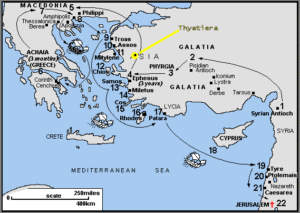
So far, we’ve looked at three of the seven letters that Jesus delivered to various first-century churches as recorded in the Biblical book of Revelation. The fourth of those letters was sent to the church that was located in the city of Thyatira. Although Thyatira was the smallest of these seven churches, their letter was the most extensive in terms of its length.

The city of Thyatira was located off a secondary road between the cities of Pergamum (whose church received the second letter from Jesus) and Sardis (whose letter appears in the following chapter). While there is evidence to show that there was some industrial and commercial activity in Thyatira at the time of this letter, it doesn’t seem as if Thyatira was a prominent city during that time.

Although Thyatira had it’s share of pagan religious worship and trade-guild activity like the city of Smyrna, it doesn’t appear that the Christians of that area received the same degree of religious persecution that the church at Smyrna experienced. But much like Jesus’ letters to the churches at Ephesus and Pergamum, His letter to the church at Thyatira reveals that it had a mixture of some good things and some not-so-good things…

“And to the angel of the church in Thyatira write, ‘These things says the Son of God, who has eyes like a flame of fire, and His feet like fine brass: I know your works, love, service, faith, and your patience; and as for your works, the last are more than the first” (Revelation 2:18-19).

The church at Thyatira had four outstanding qualities that Jesus mentions here within this passage: love, faith, service, and perseverance (or patient, cheerful endurance). While Jesus praised the Christians at Pergamum for their faith, and gave His approval to the church at Ephesus for their perseverance, the Christians in Thyatira possessed both those qualities- and they were increasing in them.

Unlike some of the other churches that received letters from Jesus in the book of Revelation, it certainly appears that the Christians in Thyatira had the right motivation, the right attitude, the right conduct, and the right character. The members of the Christian community at Thyatira were not motivated by an artificial religious commitment; in fact, Thyatira is the only church among the seven that Jesus praises for it’s love.

Unfortunately, it appears that some of that love may have been expressed in an inappropriate manner as we’ll see next.

Image Credit: File:CNM21-Pauls3rdJourney.gif. (2024, July 24). Wikimedia Commons. Retrieved 10:41, April 20, 2025 from Wikimedia Commons

XIX

“But I have this against you, that you tolerate that woman Jezebel, who calls herself a prophetess and is teaching and seducing my servants to practice sexual immorality and to eat food sacrificed to idols” (Revelation 2:20 ESV).

In the passage quoted above, Jesus uses the word “tolerate” or “allow” (NKJV) to identify a situation that required correction in the ancient church at Thyatira. In the original language of this verse, those words convey the following idea: “to allow one to do as he wishes, not to restrain, to let alone.(1) With this in mind, we can say that the Christians in Thyatira were not misled by what was taking place within their fellowship. Instead, they knowingly permitted these inappropriate actions to continue within the church.

Before we continue with our look at this subject, we should first be clear that “tolerance” is very important when speaking of things like freedom from bigotry or the ability to be patient and fair with others. The Bible supports this concept of tolerance in verses such as Titus 3:2 where we are told that Christians “…must not speak evil of anyone, nor quarrel, but be gentle and truly courteous to all” (TLB). We also find support for this idea in the following passage from the New Testament book of Ephesians: “Be completely humble and gentle; be patient, bearing with one another in love” (Ephesians 4:2 NIV).

The problem arises when we equate “tolerance” with a mandate to affirm or endorse any attitude, belief, or opinion that others may hold. That perspective fails to recognize the fact that genuine love necessitates an attitude of intolerance towards things that may bring harm to others. So even though the church in Thyatira had been commended for their love, that did not permit them to allow someone who claimed to speak for God to advocate for these unbiblical behaviors.

In this instance, it would have been far more appropriate to speak the truth with an attitude of love (Ephesians 4:15) by correcting the person who promoted these views instead of tolerating them and permitting them to continue.

At the core of this issue was an individual identified by Jesus as “Jezebel” in Revelation 2:20. That name may be familiar to readers of the Old Testament, for a dangerous woman bearing that name is referenced several times there. Whenever Jezebel is mentioned in the Scriptures, it seems that something bad inevitably follows- and we’ll look at one such example next.

Image Credit: Tolerance by Nick YoungsonCC BY-SA 3.0Pix4free.org

(1) G1439 – eao – Strong’s Greek Lexicon (kjv). (n.d.). Blue Letter Bible. https://www.blueletterbible.org/lexicon/g1439/kjv/tr/0-1/

XX

“Nevertheless I have a few things against you, because you allow that woman Jezebel, who calls herself a prophetess, to teach and seduce My servants to commit sexual immorality and eat things sacrificed to idols ” (Revelation 2:20 ESV).

Whenever Jezebel is mentioned in the Bible, it usually means something bad is about to follow. Here is one example from the Old Testament book of 1 Kings…

“Naboth, a man from Jezreel, had a vineyard on the outskirts of the city near King Ahab’s palace. One day the king talked to him about selling him this land. ‘I want it for a garden,’ the king explained, ‘because it’s so convenient to the palace.’ He offered cash or, if Naboth preferred, a piece of better land in trade.  But Naboth replied, ‘Not on your life! That land has been in my family for generations.’

So Ahab went back to the palace angry and sullen. He refused to eat and went to bed with his face to the wall!” What in the world is the matter?’ his wife, Jezebel, asked him. ‘Why aren’t you eating? What has made you so upset and angry?’

‘I asked Naboth to sell me his vineyard or to trade it, and he refused’ Ahab told her. ‘Are you the king of Israel or not?’ Jezebel demanded. ‘Get up and eat and don’t worry about it. I’ll get you Naboth’s vineyard!’ So she wrote letters in Ahab’s name, sealed them with his seal, and addressed them to the civic leaders of Jezreel, where Naboth lived.

In her letter she commanded: ‘Call the citizens together for fasting and prayer. Then summon Naboth, and find two scoundrels who will accuse him of cursing God and the king. Then take him out and execute him.’ The city fathers followed the queen’s instructions. They called the meeting and put Naboth on trial. Then two men who had no conscience accused him of cursing God and the king; and he was dragged outside the city and stoned to death.

The city officials then sent word to Jezebel that Naboth was dead. When Jezebel heard the news, she said to Ahab, ‘You know the vineyard Naboth wouldn’t sell you? Well, you can have it now! He’s dead!’ So Ahab went down to the vineyard to claim it” (1 Kings 21:1-16 TLB).

This incident undoubtedly ranks among the most ruthless and cold-blooded acts ever recorded in Scripture. This woman framed an innocent individual and then had him murdered- for a garden.

So here we have someone in the New Testament church at Thyatira who replicated the attitude of her Old Testament counterpart. She encouraged others to engage in acts of immorality and idolatry while claiming to be a spokesperson for God. But Jesus will deal with this so-called “prophet” as we’ll see in due course.

Image Credit: Harold Copping, Public domain, via Wikimedia Commons

XXI

“But I have this against you: You tolerate the woman Jezebel, who calls herself a prophetess and teaches and deceives my servants to commit sexual immorality and to eat meat sacrificed to idols” (Revelation 2:20 CSB).

It’s interesting to note the construction of this portion of Jesus’ letter to the ancient church of Thyatira. Notice that Jesus refers to this woman as someone “who calls herself a prophetess.” This indicates that she wasn’t a true prophet, but chose to call herself one anyway. This provides us with an opportunity to discuss the ministry of a genuine prophet.

A “prophet” is loosely defined as someone who possesses the unerring ability to offer God’s direction, or convey divinely inspired information regarding a specific situation or future event. This is a legitimate spiritual office, as evidenced by the many prophets who appear within the Old Testament Scriptures (like Isaiah and Ezekiel) and those who appear within the New Testament as well.

In the words of one source, “The ability to prophesy may involve predicting future events, but its main purpose is to communicate God’s message to people, providing insight, warning, correction, and encouragement.” (1) Today, we might best associate the use of a prophetic gift with the ability to bring a fresh application of Biblical truth as prompted by the Holy Spirit.

With these definitions in mind, we can say that Jezebel of Thyatira was not who she claimed to be. Since her teachings conflicted with the established Word of God, we know with certainty that she was not a genuine prophet. To illustrate this, let’s take the doctrines of this so-called “prophet” and test them to see how they measure up.

First, we’re told that this person misled others into the practice of immorality. This reference to “immorality” is derived from the ancient Greek word porneia. If “porneia” seems familiar, it may be due to the fact that it serves as the source word for our modern-day term “pornography.” This pertains to any type of physical relationship that occurs outside of a Biblically sanctioned marriage partnership. Since God’s Word repeatedly condemns immoral conduct, (2) we know with certainty that anyone who advocates for such behavior cannot speak for God.

So, this “prophet” failed the test because her message did not align with the Biblical Scriptures. While there may be many who claim to have “messages from God” today, God’s Word encourages us to put those individuals to the test as well: “Beloved, do not believe every spirit, but test the spirits, whether they are of God; because many false prophets have gone out into the world” (1 John 4:1).

Image Credit: Roman Ziomka, A Bible Standing on a Wooden Floor

(1) Life Application Study Bible Copyright © 1988, 1989, 1991, 1993, 1996, 2004 by Tyndale House Publishers Inc., all rights reserved. [1Corinthians 14:1]

(2) See Hebrews 13:4, Leviticus 18:20, Romans 1:26-27, 1 Corinthians 6:9, Ephesians 5:3, 1 Thessalonians 4:3-5, and Revelation 21:8 for some examples

XXII

“But I still have something against you because of that woman Jezebel. She calls herself a prophet, and you let her teach and mislead my servants to do immoral things and to eat food offered to idols” (Revelation 2:20 CEV).

Unlike the false teaching that was being peddled in Thyatira, a genuine message from God will never lead people away from the truth as found within the Biblical Scriptures. Of course, this requires us to know what the Bible teaches in order to distinguish between those who are promoting Biblical truth and those who are not. Therefore, we would do well to familiarize ourselves with God’s Word by reading a portion of it each day. This will enable us to measure the truth and accuracy of those ideas, beliefs, and opinions we encounter from others.

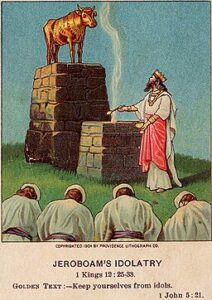
This passage also references the sin of idolatry. We can define an idol as anything that takes the place of God in someone’s life. Once something becomes more important than God in our lives, that thing (whatever it is) effectively becomes our “god.” For instance, the person for whom money is the most important thing in life is just as guilty of idolatry as the person who worshipped before a human-crafted statue in the Old Testament era.

Since idolatry violates God’s first commandment, those who spread such teachings in His name cannot be true prophets of God, no matter what they may assert for themselves. Taken together, these things lead us to conclude that the message promoted by Jezebel of Thyatira was wrong, for her “prophetic” doctrine conflicted with the established Word of God.

However, Jesus was now about to deal with this so-called prophet…

“And I gave her time to repent of her sexual immorality, and she did not repent” (Revelation 2:21).

When God exercises patience with people who engage in Biblically inappropriate behaviors (such as we see here), those who are involved in such things may think, “There must be nothing wrong with my conduct. God must not be concerned with this area of my life because nothing bad has happened to me.” Others may believe that just because God hasn’t acted in a situation, it means that He is incapable of doing so.

Then there are those who freely indulge their sinful inclinations because they’ve convinced themselves that God doesn’t really exist. In fact, the Bible speaks about these attitudes when it says, “Because God does not punish sinners instantly, people feel it is safe to do wrong” (Ecclesiastes 8:11 TLB). That is a dangerous presumption, as we’ll learn next.

Image Credits: Free Clip Art, CC BY-SA 4.0, via Wikimedia Commons, and the Providence Lithograph Company, Public domain, via Wikimedia Commons

XXIII

“I gave her time to repent, but she refuses to repent of her sexual immorality” (Revelation 2:21 ESV).

When God demonstrates patience towards those who engage in various forms of immoral conduct (as we see in our text from Revelation 2:21), those individuals may believe they have successfully evaded the consequences of their actions. However, God may be providing them with a gracious opportunity to repent from those behaviors and change their ways.

The Biblical book of Romans expands on this concept with a heartfelt expression of concern…

“Don’t you see how wonderfully kind, tolerant, and patient God is with you? Does this mean nothing to you? Can’t you see that his kindness is intended to turn you from your sin? But because you are stubborn and refuse to turn from your sin, you are storing up terrible punishment for yourself. For a day of anger is coming, when God’s righteous judgment will be revealed” (Romans 2:4-5 NLT).

You see, no one ever completely “gets away” with sinful activity. In this instance, Jesus provided Jezebel of Thyatira with an opportunity to repent of her behavior, but she declined to accept it. That unfortunate decision will lead to serious consequences…

“Indeed I will cast her into a sickbed, and those who commit adultery with her into great tribulation, unless they repent of their deeds” (Revelation 2:22).

The idea is that this person will continue to spend time in bed, but there will be no further immoral activity taking place there. Instead, it would become a bed of illness and suffering. We should also note the broader impact of this statement. Much like a stone that produces a ripple effect upon the surface of the water, those repercussions would eventually reach anyone who was involved with her as well.

This underscores the need to identify and reject those who promote false doctrines today. Nevertheless, we should notice that Jesus also allowed for reconciliation, provided those individuals were willing to repent, or change their attitude and behavior. That brings us to the next portion of this letter, and a message that surely ranks among the most shocking things Jesus ever said…

“and I will strike her children dead. And all the churches will know that I am he who searches mind and heart, and I will give to each of you according to your works” (Revelation 2:23 ESV).

When people align with those who promote immoral behaviors behind a façade of spirituality, that decision will inevitably lead to grave consequences. We’ll consider Jesus’ pledge to “strike her children dead” at greater length next.

XXIV

“I will strike her children dead. Then all the churches will know that I am he who searches hearts and minds, and I will repay each of you according to your deeds” (Revelation 2:23 NIV).

This reference to “her children” speaks of those in Thyatira who appeared to be church-going followers of Christ, but actually followed a morally compromised spiritual leader. That served to alienate those individuals from God’s family, for they were not His children, but her children. It also invited Jesus to exercise His prerogative to terminate their earthly lives as a result.

This presents an object lesson regarding those who seek to bring false teachings into Jesus’ church: “Then all the churches will know that I am he who searches hearts and minds, and I will repay each of you according to your deeds” (NIV).

Now before we conclude our look at this passage, some may wonder what became of Jezebel’s Old Testament counterpart. Her demise is recorded in the Biblical books of 1 Kings and 2 Kings. But be forewarned- her downfall is exceedingly gruesome.

“Now I say to the rest of you in Thyatira, to you who do not hold to her teaching and have not learned Satan’s so-called deep secrets, I will not impose any other burden on you, except to hold on to what you have until I come” (Revelation 2:24-25).

There are some secrets that are better left unknown. Consider this portion of Jesus’ message to the church at Thyatira, for example. Judging from what we read here in Revelation 2:24-25, it appears that some within the church were drawn by the attraction of “deeper spiritual truths” that had nothing to do with genuine Biblical truth. Then, as now, there are many who feel that the road to spiritual enlightenment involves a path that deviates from a study of God and His Word.

But those who seek to know Christ as He is revealed to us in the Biblical Scriptures have no need to pursue these “deeper truths.” The following excerpt from the New Testament book of 2 Peter brings an important perspective to this idea…

“God’s divine power has given us everything we need for life and for godliness. This power was given to us through knowledge of the one who called us by his own glory and integrity” (2 Peter 1:3 GW  emphasis added).

The epistle to the Colossians adds the following regarding Christ…

“Everything was created by him, everything in heaven and on earth, everything seen and unseen, including all forces and powers, and all rulers and authorities. All things were created by God’s Son, and everything was made for him” (Colossians 1:16 CEV).

This means that every human quest for truth will find its consummation in Christ. Apart from Him, any search for “deeper spiritual truths” will ultimately lead to a dead end.

Image Credit: Photo by Ben_White from Freerange Stock

XXV

“But I also have a message for the rest of you in Thyatira who have not followed this false teaching (‘deeper truths,’ as they call them–depths of Satan, actually). I will ask nothing more of you except that you hold tightly to what you have until I come” (Revelation 2:24-25 NLT).

Some members of the church at Thyatira had apparently embarked on a quest for “deeper spiritual truths.” However, Jesus identified where that excavation for truth was actually being performed: “…‘deeper truths,’ as they call them—depths of Satan, really” (TLB). When our quest for spiritual truth seeks illumination from the “father of lies” (to use Jesus’ characterization from John 8:44), we can only expect darkness to follow.

On the other hand, God’s Word tells us that every Christian has God’s Holy Spirit living within them (see John 14:16-17, Romans 8:9 and 1 Corinthians 3:16, 6:19). Jesus also promised that the Holy Spirit would guide His followers into all truth. Since the Holy Spirit is God (Acts 5:3-4), and God cannot lie (Numbers 23:19, Titus 1:2), it is impossible for Him to lead us into error like the misguided followers of Jezebel in the church of Thyatira.

In addition, God has some deeper truths of His own to share…

“No eye has seen, no ear has heard, no mind has conceived what God has prepared for those who love him”– but God has revealed it to us by his Spirit. The Spirit searches all things, even the deep things of God” (1 Corinthians 2:9-10 NIV).

God has many good things to share with us; things we never could have imagined unless He revealed them to us. Thus, we should ask God to illuminate our study of His Word, for real spiritual truth comes from God in accordance with His Word, as guided by His Spirit.

Since the Christians at Thyatira were already increasing in love, faith, service, and perseverance, Jesus had no negative admonitions for them. The only remaining necessities involved the need to avoid the influence of this so-called “prophet” and to continue to persevere in the good things they were already doing.

“To him who overcomes and does my will to the end, I will give authority over the nations– ‘He will rule them with an iron scepter; he will dash them to pieces like pottery’– just as I have received authority from my Father” (Revelation 2:26-27 NIV).

A recurring theme in Jesus’ letters to these seven churches involves a promise that is reserved for those who prevail, conquer, or “overcome.” We’ll consider some ways to do so in our concluding study of this chapter.

XXVI

“The one who conquers and who keeps my works until the end, to him I will give authority over the nations, and he will rule them with a rod of iron, as when earthen pots are broken in pieces, even as I myself have received authority from my Father” (Revelation 2:26-27 ESV).

Acts 2:42 identifies four spiritual disciplines that characterized the ancient church at Jerusalem: “They devoted themselves to the apostles’ teaching and to the fellowship, to the breaking of bread and to prayer” (NIV). With this in mind, we can highlight four key areas of focus in the early church: prayer, Bible study (the apostles’ teaching), communion (breaking of bread), and regular church attendance (the fellowship).

These four spiritual disciplines relate to our text from Revelation 2:26 in an important way. You see, these disciplines can help us overcome any spiritual obstacle and conquer the challenges that threaten to undermine our relationship with Christ. If we prayerfully seek God’s motivation in these four areas, we should be well equipped to avoid the spiritual trap that ensnared those who opted to follow a spiritual impostor in the church at Thyatira.

Jesus also ties His commands to a promise: “To him who overcomes and does my will to the end, I will give authority over the nations…” (NIV). This portion of Scripture points to a future where Jesus will exercise direct, personal authority over all things. When that time arrives, He will also establish positions of authority for those who are serious about following Him now. The knowledge that Jesus will entrust His followers with these responsibilities in the future should influence the way we live for Him in the present.

Nevertheless, there is a better reward waiting ahead: “I will also give him the morning star” (Revelation 2:28 NIV). This reference holds great significance, for Jesus will later refer to Himself as the “morning star” In Revelation 22:16. So Jesus will not only offer the gift of responsibility and authority; He will also give us the gift of Himself.

“He who has an ear, let him hear what the Spirit says to the churches” (Revelation 2:29 NIV).

These messages aren’t restricted to a few churches from the distant past; they are intended for anyone who is willing to listen and learn from them. For instance, we should not allow our love for God to grow cold like the church at Ephesus. We should not fear the reprisals of those who challenge us for our commitment to Christ, as we saw in Jesus’ letter to the church at Smyrna.

We must ensure that we do not permit false teachers to flourish within the church, as was the case with the church at Pergamum. Finally, we should not compromise and call it “tolerance” like the congregation at Thyatira. Instead, we should prayerfully consider Jesus’ messages to these churches and apply these lessons in our lives.

Revelation – Chapter One

About This Chapter: Revelation opens with the declaration that this book is the revelation of Jesus Christ, given to show His servants what must soon take place. This message was communicated to the apostle John while he was exiled on the island of Patmos for his testimony about Christ. After greeting the seven churches of Asia, John describes the vision he received while “in the Spirit on the Lord’s Day,” where he sees the risen and glorified Christ standing among the lampstands. This opening chapter establishes both the source of the revelation and the central focus of the chapter: the sovereign Lord who speaks to His church and commands John to write what he has seen.

Revelation 1:1–3 — Introduction and a Blessing Pronounced on Those Who Listen The Words of This Book and Obey Them
Revelation 1:4–8 — Greeting to the Seven Churches
Revelation 1:9–11 — John’s Commission on Patmos
Revelation 1:12–20 — The Vision of the Glorified Christ


Revelation 1:1–3 — Introduction and a Blessing Pronounced on Those Who Listen The Words of This Book and Obey Them

I

The Biblical book of Revelation was authored by a man named John, a person who identifies himself by name three times within this book (1:4, 1:9, 22:8). John is traditionally recognized as John the Apostle, the same man who produced the Gospel of John, along with the Biblical letters of 1st, 2nd, and 3rd John. The date of authorship was approximately 90-100 A.D. when John was probably ninety years of age.

Some Biblical translations refer to this book as the “Revelation of John.” However, it would be more accurate to view this book as the “Revelation of Jesus Christ” that was given to John. That’s because the word “revelation” refers to “an unveiling.” Here within the book of Revelation, God will remove the veil from a variety of things we couldn’t have known unless He revealed them to us.

While certain portions of the book of Revelation can be difficult to understand, it’s important to remember that difficult is not the same as impossible. In this respect, a good understanding of the book of Revelation is much like other good things that don’t come easily; we must be willing to study and work at understanding it.

Next, we should recognize that the book of Revelation devotes a great deal of content to the subject of heaven. Since there are certain aspects of heaven that are inexpressible, this book faces the unenviable task of expressing the inexpressible. This helps explain why we see a substantial amount of symbolic language in the book of Revelation.

Finally, the book of Revelation must communicate with an audience that has little or no frame of reference concerning the subjects it will discuss. We can illustrate that reality with a hypothetical example. Let’s say we have a farmer who is living in the 10th century A.D. Our farmer lives in the house where he was born, and has never left his village. The greatest technological advancement he has ever seen is a donkey pulling a cart.

Now let’s say that someone from the 21st century has traveled back to the 10th century to meet with our farmer. How could someone from the 21st century explain a mobile phone, a television, or a jet aircraft to a 10th century farmer who has no conception of such things? In some respects, we are much like our hypothetical farmer as we seek to grasp the book of Revelation.

However, we’ll soon find that Revelation chapter one will explain some of the symbolic language that will be used in the rest of the book.

Featured Imageba1969 (Billy Frank Alexander)

Image Credit: https://www.pickpik.com/revelation-bible-religion-god-holy-christianity-136321

II

“The revelation of Jesus Christ, which God gave him to show his servants what must soon take place. He made it known by sending his angel to his servant John, who testifies to everything he saw– that is, the word of God and the testimony of Jesus Christ. Blessed is the one who reads the words of this prophecy, and blessed are those who hear it and take to heart what is written in it, because the time is near (Revelation 1:1-3).

The first verse of the last book of the Bible identifies itself as “The revelation of Jesus Christ.” This (along with the rest of this opening paragraph), tells us that Revelation is a book from Jesus and about Jesus. However, this passage also says, “…which God gave him to show his servants what must soon take place.” This can be difficult to understand since the book of Revelation was written almost two thousand years ago and many of the events depicted within it have yet to occur. So how is it that these verses speak of things that “must soon take place“?

It’s interesting to note that the word “soon” referenced here in Revelation 1:1 is also translated “speedily” in Luke 18:8. So it is not as if the events in the book of Revelation must take place immediately. Instead, the pace of these events will quicken as they unfold. Much like a snowball rolling downhill, they will accelerate once they begin.

Verse three goes on to say, “Blessed is the one who reads aloud the words of this prophecy, and blessed are those who hear it and take to heart what is written in it, because the time is near” (NIV). This passage is important, for the book of Revelation was originally written at a time when much of the population could not read. In addition, it was difficult and costly to produce an adequate number of copies for everyone to have their own edition of this book.

Therefore, Revelation 1:3 offers a blessing that applies to everyone- those who can read the book of Revelation for themselves (like many over the last few hundred years), and those who can listen to it. But whether we listen to the book of Revelation or read it for ourselves, there is a condition attached: we must take to heart what is written here.

This echoes an important reminder from the New Testament book of James: “Do not merely listen to the word, and so deceive yourselves. Do what it says” (James 1:22).

Except as indicated, all Scriptural references taken from New King James Version®. Copyright © 1982 by Thomas Nelson.


Revelation 1:4–8 — Greeting to the Seven Churches

III

“John, to the seven churches which are in Asia: Grace to you and peace from Him who is and who was and who is to come, and from the seven Spirits who are before His throne” (Revelation 1:4).
One notable aspect of Revelation 1:4 involves the repetition of the number seven. This holds considerable significance, for the number seven recurs fifty-four times within the twenty-two chapters of Revelation.

You see, numbers often carry symbolic meaning in the Book of Revelation, just as they do in our contemporary world. For example, suppose one person said to another, “You’re number one!” This does not mean that someone is a number in a literal sense. Instead, the number one is used to identify a person who is first or best. In a similar manner, “take five” is a phrase we use to indicate a brief rest period that lasts about five minutes. In this instance, the number “five” symbolizes the approximate duration of that break.

The book of Revelation employs the number seven in a similar way. In addition to its numeric value, the number seven also holds significance as a link to the symbolic ideas of fulfillment, completion, and perfection. For instance, some commentators believe this reference to “the seven Spirits who are before His throne” speaks of the Holy Spirit in His complete fullness.

We should also note the original audience for this epistle: “the seven churches in the province of Asia” (GW). We’ll talk more about these churches as we move forward into Revelation chapters two and three. However, this reference to seven churches suggests that these messages have an intended audience that goes beyond a handful of first-century congregations. Instead, the author has something important to say to the entire Christian community.

“and from Jesus Christ, the faithful witness, the firstborn from the dead, and the ruler over the kings of the earth. To Him who loved us and washed us from our sins in His own blood” (Revelation 1:5).
Verse five identifies Jesus as the faithful witness. So who or what is the object of Jesus’ faithful witness? Well, Colossians 1:15 tells us that Jesus is the image of the invisible God. In fact, Jesus told the Apostle Philip, “….Have I been with you so long, and yet you have not known Me, Philip? He who has seen Me has seen the Father…” (John 14:9).

So when we speak of Jesus, we are not speaking of someone who merely resembles God, but of someone who is the exact counterpart or image of God. In Jesus, we witness the perfect visible expression and representation of the invisible God, like an image on a coin or a reflection in a mirror.

Image Credit Seven – Wallpaper By Phkoopz –  https://creativecommons.org/licenses/by-nc/3.0/

IV

“and from Jesus Christ the faithful witness, the firstborn of the dead, and the ruler of kings on earth. To him who loves us and has freed us from our sins by his blood and made us a kingdom, priests to his God and Father, to him be glory and dominion forever and ever. Amen” (Revelation 1:5-6 ESV).
Our text from Revelation 1:5 identifies Jesus as the “firstborn of the dead.” So, is it correct to say that Jesus was God’s initial creation, or “firstborn”? Such an interpretation would be erroneous, since the Scriptures clearly identify Jesus as God. If Jesus was “firstborn” in this sense, then He couldn’t be God, for God is eternal. So how are we to understand this reference?

In considering this passage, it’s important to recognize that “firstborn” doesn’t necessarily mean “born first.” Instead, firstborn can refer to priority in time, or supremacy in rank. (1) In Jesus’ case, both are true: as God, Jesus is before any created thing, and as God, Jesus is greater than any created thing. Thus, Jesus has a position of authority and superiority over everything. Firstborn “…of the dead” simply refers to His resurrection as a herald of things to come for God’s people.

“Behold, He is coming with clouds, and every eye will see Him, even they who pierced Him. And all the tribes of the earth will mourn because of Him. Even so, Amen” (Revelation 1:7).
The imagery of clouds in the company of God’s presence would have been a familiar element to the the early Christian community. In fact, the books of the Old Testament establish a historic link between the appearance of clouds and the visual manifestation of God’s presence. For instance, Moses (Exodus 24:12-18) and Solomon (1 Kings 8:10-13) each saw clouds in the presence of God. Later, the prophet Isaiah associated a “swift cloud” with the arrival of the Lord in Isaiah 19:1.

Some of Jesus’ disciples had a similar experience when a cloud overshadowed Peter, James, and John while they were together with Him on the Mount of Transfiguration (Mark 9:2-8). That was the place where the voice of God spoke to them from the cloud, saying, “This is my Son, whom I love. Listen to him!” (Mark 9:7 NIV).

While clouds often tend to obscure our view, the Biblical presence of these clouds serve to reflect or illuminate God’s power and glory. Thus, we should not be surprised to learn, “…He is coming with clouds, and every eye will see Him.”

(1) See discussion of prototokos from Colossians 1:15, the same word translated “firstborn” here in Revelation 1:5: Constable, Thomas. DD. Colossians. (n.d.). https://soniclight.com/tcon/notes/html/colossians/colossians.htm [1:15b]

V

“Look, he is coming with the clouds, and every eye will see him, even those who pierced him. And all the tribes of the earth will mourn over him. So it is to be. Amen” (Revelation 1:7 CSB).
We should note the significance of the phrase, “every eye will see him, even those who pierced him…” here in Revelation 1:7. This can only refer to the events that took place at Jesus’ crucifixion. This passage, along with its reference to those who will “mourn because of him” (NET), also carries a strong emotional component, for it conveys the image of those who wail and beat their chests to express their grief. (1)

“I am the Alpha and the Omega,” says the Lord God, “who is, and who was, and who is to come, the Almighty” (Revelation 1:8 NIV).
In the original language of this passage, Alpha and Omega function much like the letters A and Z, for they each represent the first and last letters of their respective alphabets. Thus, we can understand this reference to mean that Jesus is the first, the last, and the “A to Z” of everything. Therefore, our text from Revelation 1:8 establishes Jesus as the beginning and the end of all things.


Revelation 1:9–11 — John’s Commission on Patmos

“I, John, both your brother and companion in the tribulation and kingdom and patience of Jesus Christ, was on the island that is called Patmos for the word of God and for the testimony of Jesus Christ” (Revelation 1:9).
Patmos is a ten mile (16 km) long, six mile (10 km) wide island near the coast of the modern-day nation of Turkey. Church tradition tells us that John was exiled to Patmos for a period of eighteen months. One source discusses the role of the ancient Roman emperor Domitian to explain how and why John ended up on this island in the midst of the Aegean Sea…

“The emperor Domitian, who was naturally inclined to cruelty, first slew his brother, and then raised the second persecution against the Christians… Among the numerous martyrs that suffered during this persecution was Simeon, bishop of Jerusalem, who was crucified; and St. John, who was boiled in oil, and afterward banished to Patmos.” (1)
If Domitian or one of his subordinates attempted to kill John with boiling oil, then it seems reasonable to assume that God miraculously spared his life. If He had not done so, then John would have never had the opportunity to serve as the human author of the Biblical book of Revelation.

(1) G2875 – kopto – Strong’s Greek Lexicon (kjv). (n.d.). Blue Letter Bible. https://www.blueletterbible.org/lexicon/g2875/kjv/tr/0-1/

(2) John Foxe, The Project Gutenberg eBook of Fox’s Book Of Martyrs (n.d.). https://www.gutenberg.org/files/22400/22400-h/22400-h.htm [pg 20]

VI

“I was in the Spirit on the Lord’s Day, and I heard behind me a loud voice, as of a trumpet” (Revelation 1:10).
Trumpets served various purposes for the people of Old Testament Israel. For instance, trumpets were employed to gather an assembly, to signal an announcement, to summon military personnel, or to warn of an emergency. Modern-day societies continue to rely on various types of horns to signal an alert, an emergency, or a time of commemoration. These horns are effective because they command our attention, much like the voice John heard here in Revelation 1:10.

“saying, ‘I am the Alpha and the Omega, the First and the Last,’ and, ‘What you see, write in a book and send it to the seven churches which are in Asia: to Ephesus, to Smyrna, to Pergamos, to Thyatira, to Sardis, to Philadelphia, and to Laodicea’” (Revelation 1:11).
The seven churches discussed in this text were not symbolic representations; they were actual churches that existed in John’s era. In fact, one can embark on a tour of these church locations today. The distance between these congregations varied from approximately thirty to fifty miles (48 to 80 km), and a first-century messenger would likely distribute this book in the order mentioned here.

As mentioned earlier, the fact that seven churches are referenced in this passage should alert us to the possibility that there is something more to these messages. As we move into our exploration of Revelation chapters two and three, we’ll find that these churches also reflect various aspects of the historic Christian community and continue to do so today. Some of those characteristics are honorable and virtuous, while others are much less so.


Revelation 1:12–20 — The Vision of the Glorified Christ

“Then I turned to see the voice that spoke with me. And having turned I saw seven golden lampstands” (Revelation 1:12).
When John turned to see who was speaking to him, he witnessed seven golden lampstands. We don’t need to interpret the meaning of these lampstands, for Jesus will identify them for us in the closing verse of this chapter. There, we learn that these seven lampstands are the seven churches mentioned here in verse twelve. So what was the connection between these lampstands and the churches of verse eleven?

The answer to that question becomes easier when we consider the function of a lampstand. The purpose of a lampstand is to provide light to others. This correlates with Jesus’ message to His followers in Matthew 5:14: “You are the light of the world…” With this in mind, we can say that these lampstands represent the assemblies of God’s people who serve as the light of the world. But even more significant is the fact that Jesus is in the midst of these lights, as we’ll see next.

Image Credit: Jonadab Public domain, via Wikimedia Commons

VII

“and in the midst of the seven lampstands One like the Son of Man, clothed with a garment down to the feet and girded about the chest with a golden band” (Revelation 1:13).
Our text from Revelation 1:13 recalls Jesus’ message from the New Testament Gospel of Matthew: “For where two or three are gathered together in My name, I am there in the midst of them” (Matthew 18:20). However, we should notice that this passage identifies the speaker as someone who was “like unto the son of man” (KJV). Since “Son of Man” was one of Jesus’ favorite self-designations, why didn’t our author definitively identify Him as such?

We might find the answer to that question in the verses that follow…

“His head and hair were white like wool, as white as snow, and His eyes like a flame of fire; His feet were like fine brass, as if refined in a furnace, and His voice as the sound of many waters; He had in His right hand seven stars, out of His mouth went a sharp two-edged sword, and His countenance was like the sun shining in its strength” (Revelation 1:14-16).
Before we continue, let’s reflect on the qualities that define Jesus from this passage….

  • He had a golden sash around his chest.
  • His head and hair were white like wool, as white as snow.
  • His eyes were like blazing fire.
  • His feet were like bronze glowing in a furnace.
  • His voice was like the sound of rushing waters.
  • In his right hand, he held seven stars.
  • Out of his mouth came a sharp double-edged sword.
  • His face was like the sun “…shining in all its brilliance” (NIV).

This was Jesus, but He was not like the person who called John to serve as His disciple many decades earlier. This helps explain John’s use of a qualifier here in Revelation 1:13. He was like the Son of Man John once knew, but now, John saw Him as much, much more.

“And when I saw Him, I fell at His feet as dead. But He laid His right hand on me, saying to me, ‘Do not be afraid; I am the First and the Last. I am He who lives, and was dead, and behold, I am alive forevermore. Amen. And I have the keys of Hades and of Death” (Revelation 1:17-18).

While some erroneously consider Satan to be the “keeper” of death and Hades, this passage identifies the one who actually possesses those keys. Therefore, we would be well-advised to make our peace with Christ, for He is the one who says, “I hold in my hand the keys of death and the grave” (Phillips).

VIII

“Write, therefore, what you have seen, what is now and what will take place later. The mystery of the seven stars that you saw in my right hand and of the seven golden lampstands is this: The seven stars are the angels of the seven churches, and the seven lampstands are the seven churches” (Revelation 1:19-20 NIV).
These verses represent one of the most important passages in the book of Revelation. What we find in verse nineteen is a kind of “Table of Contents” for this book. Let’s take a closer look at this text, for it will help us navigate through many of the remaining chapters of this book.

This passage begins by saying, “Write, therefore, what you have seen…” In other words, John the Apostle was entrusted with the task of recording what he had witnessed up to that point. Next comes a reference to “…what is now. This serves to identify the things that were taking place within these churches at the time John received the Book of Revelation. Jesus will elaborate on many of those topics in chapters two and three, where He will personally address each of these seven churches.

Finally, He says, “Write, therefore… what will take place later.” This is where the Book of Revelation begins to talk about the future, or the things that will occur later. So to summarize this passage, we can say that it speaks of…

  • The past, or “what you have seen.”
  • The present, or “what is now.This reflects many of the subjects that will be discussed in chapters two and three.
  • The future, or “what will take place later.”

This should raise an important question for modern-day readers of Revelation: “Where do current-day audiences fit within this ‘Table Of Contents?” The answer to that question largely depends on how one views the end of verse nineteen and its reference to “what will take place later.” We can look to various translations of Revelation 1:19 for help in finding an answer. For instance,

  • If you are reading the GNT version, it says, “the things that will happen afterward.”
  • The NKJV it says, “after this.”
  • The KJV and ASV each use the word “hereafter.”
  • The NASB and NET have the words, “after these things.”
  • The NIV references “what will take place later.”

So, regardless of the translation, this portion of Scripture clearly points to future events. But how do we know when the future starts in the book of Revelation? We will address that question in the final installment of our look at this chapter next.

IX

“Therefore write what you have seen, what is, and what will take place after this. The mystery of the seven stars you saw in my right hand and of the seven golden lampstands is this: The seven stars are the angels of the seven churches, and the seven lampstands are the seven churches” (Revelation 1:19-20 CSB).

So Revelation 1:19 provides us with a reference to the past (“what you have seen“), the present (“what is“), and the future (“what will take place after this“), all within a single verse. That being said, how do we know when the future begins in the book of Revelation? How can we separate the present from the future within this book?

Well, as mentioned earlier, Revelation chapters two and three comprise letters to seven churches that appear in verse eleven…

“’…I am A and Z, the First and Last!’ And then I heard him say, ‘Write down everything you see, and send your letter to the seven churches in Turkey: to the church in Ephesus, the one in Smyrna, and those in Pergamos, Thyatira, Sardis, Philadelphia, and Laodicea’” (TLB).
But following the conclusion of chapter three, Revelation chapter four opens in an interesting manner. The first thing we read beginning in Revelation chapter four are the words, “After these things…” or “After this…” (ESV). We can paraphrase that transition as follows: “After these letters to the seven churches, here’s what happens next.”

Furthermore, the same words that are used to signify “what will take place after this” in Revelation 1:19 are the very same words that open Revelation chapter four in the original language of each passage. Those words are “meta tauta” or “after this.” So the end of Revelation chapter one aligns with the beginning of Revelation chapter four. In between are Jesus’ letters to the churches as detailed in chapters two and three.

With this in mind, we can zero in on the question that opened this study: how do we know when the future begins in the book of Revelation? If the “past” ends here in Revelation chapter one, but the future doesn’t begin until Revelation chapter four, where does that leave us in the present? The answer is that it leaves us with Jesus’ letters to the seven churches, as we’ll see in the following chapters.

Those letters identify and evaluate the positive and negative qualities exhibited by individuals and church congregations then and now. Therefore, we would do well to pay close attention when Jesus speaks to these churches. While those messages applied to them, they also apply to us as well.

Image Credit: Mlibre, CC0, via Wikimedia Commons

2 Peter – Chapter Three

About This Chapter: In the closing chapter of his letter, Peter reminds his audience of the words spoken by the prophets and apostles concerning the return of Christ. He warns that in the last days scoffers will question the promise of the Lord’s return, forgetting God’s past acts of judgment and His authority over creation. Peter explains that what appears to be delay is actually the patience of God, giving opportunity for repentance. The chapter concludes by calling us to live holy and faithful lives while awaiting the new heavens and new earth promised by God.

2 Peter 3:1–7 — Remembering the Words of the Apostles and Prophets
2 Peter 3:8–10 — The Patience of God and the Certainty of the Day of the Lord
2 Peter 3:11–14 — Holy Living in Light of the Future
2 Peter 3:15–18 — Guarding Against Error and Growing in Grace


2 Peter 3:1–7 — Remembering the Words of the Apostles and Prophets

I

The final chapter of the book of 2 Peter reveals our author’s deep affection for his readers. In fact, the word “beloved” appears five times in the eighteen verses that comprise this portion of Scripture. Within this chapter, the Apostle will encourage his audience to reflect on the past, consider the future, and seek guidance for the present in order to “…grow in the grace and knowledge of our Lord and Savior Jesus Christ” (2 Peter 3:18).

The opening verses of chapter three mark the beginning of that journey…

“Beloved, I now write to you this second epistle (in both of which I stir up your pure minds by way of reminder), that you may be mindful of the words which were spoken before by the holy prophets, and of the commandment of us, the apostles of the Lord and Savior” (2 Peter 3:1-2).

This reference to “my second letter” (NIV) likely refers to the Biblical book of 1 Peter. If so, this highlights Peter’s commitment to reinforce the sound doctrinal teachings he shared earlier. Furthermore, the last chapter of this letter (and Peter’s determination to stir up their pure minds “by way of reminder”) parallels a trio of similar commitments from the first chapter…

  • “I will not be negligent to remind you always of these things” (2 Peter 1:12).
  • “Yes, I think it is right …to stir you up by reminding you” (2 Peter 1:13).
  • “…I will be careful to ensure that you always have a reminder of these things…” (2 Peter 1:15).

So, Peter’s intent in authoring this letter was not merely instructional, but to serve as a reminder for his readers to apply what they had already learned. In light of this, Peter endeavored to stir his audience to action. Much as a homeowner might stir up the coals in a fireplace to bring warmth and light to a home, Peter sought to ignite their desire to grasp Jesus’ teachings and act on them. The same holds true for contemporary readers of this epistle as we reflect on the teachings of the Scriptures and seek to put them into practice.

Finally, we should note this reference to “…the words spoken in the past by the holy prophets and the command given by our Lord and Savior through your apostles” (NIV). This serves to establish an equal level of authority between the Old Testament prophets and New Testament apostles. Our author will revisit this topic again near the end of this chapter when he introduces us to a special guest.

Image Attribution: Rickyukon, CC BY-SA 4.0, via Wikimedia Commons

II

This is now the second letter that I am writing to you, beloved. In both of them I am stirring up your sincere mind by way of reminder, that you should remember the predictions of the holy prophets and the commandment of the Lord and Savior through your apostles” (2 Peter 3:1-2 ESV).

In addition to expressing the Apostle Peter’s deep affection for his readers, our text from 2 Peter 3:1 also makes reference to a “sincere mind” or “wholesome thinking(NIV). However, the passage quoted above defines sincerity in a way that transcends the ordinary definitions of honesty, earnestness, and candor.

Although sincerity is often associated with a lack of pretense, this word is rooted in the concept of “judging by sunlightin the original language of 2 Peter 3:1. While it may be difficult to see the correlation between these ideas, some background information can help establish a connection between these seemingly unrelated themes. To do so, let’s return to the scene of a first century marketplace to witness a prospective transaction between a buyer and a seller.

In ancient times, an unethical merchant might seek to market a defective earthenware vessel to an unsuspecting customer. To accomplish this, a dishonest vendor would camouflage the damaged portion of a container by carefully applying a thin layer of wax. Once painted, the final product looked as if it was in perfect condition- until the purchaser attempted to fill it with water and subsequently discovered the truth.

To avoid that problem, a knowledgeable consumer would inspect a potential purchase by holding it up to the sun and looking within. The resulting sunlight would instantly illuminate any damage that had been repaired in such a manner. Armed with that information, a prospective buyer could negotiate a better price or discard the damaged item in favor of an unbroken piece.

So how does this apply to contemporary readers of this passage? Well, this portion of Scripture reminds us of the need to maintain sincerity and authenticity in our thinking. Unlike those who avoid being honest with themselves, the Biblical Scriptures encourage us to cultivate a God-honoring thought life that is truthful and ethical. Then, if we are “brought into the light” and examined by others, it will be evident that we are sincere individuals who genuinely represent God, rather than hypocritical “cracked pots.”

This brief aside also encourages us to avoid the path chosen by the false teachers that Peter identified for us in the previous chapter. A person who displays a “pure mind” (NET) thus serves as an appropriate contrast to others who prefer “…carousing in their own deceptions” (2 Peter 2:13).

Image Credit: “A very old crack” by Unhindered by Talent is licensed under CC BY-SA 2.0.

III

“knowing this first: that scoffers will come in the last days, walking according to their own lusts” (2 Peter 3:3).

The word “first” can be used to mark the beginning of a numerical sequence or denote something of primary importance. The Apostle Peter has that second definition in view regarding the things he will say over the next few verses. Those things relate to blatant scoffers (NET), or mockers (Phillips) who will “…laugh at the truth” (TLB).

A “scoffer” is defined as someone who expresses derision or scorn for another person or thing. (1) The Biblical definition of this word serves to identify someone who derides another person. (2) While many of us are probably acquainted with those who exhibit such traits, “scoffing” actually has a lengthy history that dates back to the Garden of Eden.

For instance, Genesis 3: 1 tells us that the devil (in the form of a serpent) approached Eve with a seemingly harmless question: “Did God really say you must not eat the fruit from any of the trees in the garden?” (Genesis 3:1 NLT).

When Eve stated that consuming the fruit from the Tree of the Knowledge of Good and Evil would bring certain death, the serpent responded with a scoffer’s retort: “’…You will not surely die. For God knows that in the day you eat of it your eyes will be opened, and you will be like God, knowing good and evil’” (Genesis 3:4-5). This episode illuminates an unfortunate reality: those who choose to scoff at God’s Word in the last days are not unlike the one who scoffed at God’s Word in the first days.

That brings us to the difference between the “end times” and the “last days” mentioned here in 2 Peter 3:3. Although these terms are sometimes used interchangeably, the term “end times” commonly refers to the events that will unfold shortly before this era of human history concludes. In contrast, the “last days” began with Jesus’ ascension and will expire upon His return.

For instance, the Biblical book of Hebrews tells us, “…in these last days [God] has spoken to us by his Son, whom he appointed the heir of all things, through whom also he created the world” (Hebrews 1:2 ESV). So this reference to the “last days” pertains to the current period of human history, an era where God has spoken to us through His Son.

So while scoffers have been present in every era, we can expect them to increase in number as we approach the end of this chapter in human history.

(1) scoffer. (n.d.) American Heritage® Dictionary of the English Language, Fifth Edition. (2011). Retrieved August 26 2024 from https://www.thefreedictionary.com/scoffer

(2) G1703 – empaiktes – Strong’s Greek Lexicon (kjv). (n.d.). Blue Letter Bible. https://www.blueletterbible.org/lexicon/g1703/kjv/tr/0-1/

IV

“Knowing this first, that there shall come in the last days scoffers, walking after their own lusts” (2 Peter 3:3 KJV).

Our author has repeatedly addressed the risks associated with an attitude of lust over the course of this epistle. For example, the word “lust” (in its various forms) appears four times in the three chapters of this letter. 2 Peter 3:3 serves as one such example in describing those who walk after their own lusts.

In a general sense, “lust” is a characteristic that is found among those who seek to exploit others in various ways. It may also involve a desire to possess or control someone (or something) that belongs to someone else. Whenever we engage is such behaviors, we effectively strip others of their humanity and objectify them for use in gratifying our needs or desires. One translation of this passage helps communicate this idea in speaking of those “…whose only guide in life is what they want for themselves” (Phillips).

Since lust is typically distinguished by selfishness (Colossians 3:5 and 1 Thessalonians 4:4-5), it is incompatible with the God who is love (1 John 4:8, 1 Corinthians 13:4-7). In the words of one source, “Those who give way to their own lusts will always mock at any incentive to noble living.” (1) This behavior will signify a growing trend as we approach the end of days.

This characteristic is also associated with the act of “walking” in our text from 2 Peter 3:3. “Walking” is a Biblical idiom that refers to our conduct, disposition, and/or manner of life. 2 Corinthians 5:7 employs this idea in a positive sense when it tells us that God’s people are those who “…walk by faith, not by sight.” We find a similar example in Colossians 2:6: “As you therefore have received Christ Jesus the Lord, so walk in Him.”

However, the scoffers mentioned here in 2 Peter 3:3 are those who travel a different path. Thus, it is important to recognize that this type of conduct is not a mistake, an accident, a momentary indiscretion, or an isolated lapse in judgment. Instead, “lustfulness” represents an ingrained pattern of behavior, or a characteristic quality that serves to distinguish these individuals.

The following Biblical commentator shares several insights on this passage that are well worth our attention…

“False teachers who know not the truth and know not God have nothing to restrain their lusts. They particularly mock the second coming of Jesus Christ because they want to pursue impure sexual pleasure without consequence, or without having to face divine retribution. They want an eschatology that fits their conduct (cf. 1Jn 2:28, 29; 3:2, 3).” (2)

Image Credit: Cheapthrill, Public domain, via Wikimedia Commons

(1) Wheaton, David H. “2 Peter.” In The New Bible Commentary, Revised. Third edition. Edited by Donald Guthrie and J. A. Motyer. Downers Grove, Ill.: InterVarsity Press, 1970. p. 1257. Quoted in Notes on 2 Peter 2024 Edition, Dr. Thomas L. Constable https://www.planobiblechapel.org/tcon/notes/html/nt/2peter/2peter.htm

(2) John F. MacArthur Jr., The MacArthur Study Bible: New American Standard Bible. (Nashville, TN: Thomas Nelson Publishers, 2006), 2 Pe 3:3.

V

“and saying, ‘Where is the promise of His coming? For since the fathers fell asleep, all things continue as they were from the beginning of creation’” (2 Peter 3:4).

It is often easy to associate false teachers or heretical doctrines with cultic organizations or strange religious sects. However, false teachings aren’t limited to such groups- they can come from a variety of other sources as well. You see, false teachers may also exist among the irreligious or the spiritually indifferent. For instance, 2 Peter 3:4 offers a Biblical example of a false teaching that came packaged as something else.

This passage gives us insight into the skepticism of those who dismissed the notion of Jesus’ return by pointing to the lengthy period that has elapsed since His crucifixion and resurrection. Unfortunately, that view is diametrically opposed to the Biblical teaching regarding Jesus’ second advent. We can thus associate this secular mindset with a false teaching, for such individuals operate under the mistaken belief that “…everything has remained the same since the world was first created” (NLT).

While the question posed in 2 Peter 3:4 may represent an honest question for some, it also represents an attitude of presumptuous skepticism for many others. Those who fall into that latter category comprise the mockers or “scoffers” mentioned earlier in verse three. Such questions aren’t based on a genuine desire to learn or understand. Instead, their intent is to ridicule.

This pretentious viewpoint assumes that nothing has changed in the past, and nothing is likely to change in the foreseeable future as well. That represents an opinion that the Apostle Peter will address over the next few verses. In the meantime, we can say that the more frequently we observe these types of behaviors, the closer we are to Christ’s return. As one source reminds us…

“Peter, like Paul (1Th 5:1f.; 2Th 2:1f. ), preached about the second coming (1:16; Ac 3:20f. ), as Jesus himself did repeatedly (Mt 24:34 ) and as the angels promised at the Ascension (Ac 1:11 ). Both Jesus and Paul (2Th 2:1f. ) were misunderstood on the subject of the time and the parables of Jesus urged readiness and forbade setting dates for his coming.” (1)

In contrast to those who choose to disregard the Biblical teachings related to Jesus’ second advent, it is important to live in anticipation of His return. Whether Christ returns for someone at the end of his or her life (whenever that occurs) or whether He returns to begin a new era of history, our responsibility is to be ready whenever He appears.

(1) 2 Peter 3 – Robertson’s Word Pictures in the New Testament – Bible Commentaries – StudyLight.org. (n.d.). StudyLight.org. https://www.studylight.org/commentaries/eng/rwp/2-peter-3.html

VI

“They will say, ‘Where is the promise of his coming? For ever since the fathers fell asleep, all things are continuing as they were from the beginning of creation” (2 Peter 3:4 ESV).

2 Peter 3:4 and its reference to the “fathers [who] fell asleep” is an interesting and descriptive expression that deserves a closer look.

You see, the Scriptures occasionally employ the word “sleep” as a figurative reference to death. Mark 5:22-53 offers one such example in relating the account of a local religious leader whose daughter had fallen ill. Although Jesus graciously agreed to heal her, the young girl tragically succumbed to her illness prior to Jesus’ arrival at her home. Jesus thus arrived at a house that was populated by mourners and others who had gathered to express their condolences.

In response, Jesus answered by saying, “Why all this commotion and weeping? The child isn’t dead; she’s only asleep” (NLT). Those who heard this message reacted with laughter, scorn, and ridicule to that assessment. However, they stopped laughing after Jesus put them out of the house and returned the little girl alive to her parents.

The “fathers” mentioned here in 2 Peter 3:4 likely allude to the ancestral generations of many years ago. The idea is that the circle of life begins at conception and ends at death. While civilizations, technologies, and individual lives come and go, the treadmill of life goes on, according to this perspective.

However, that view has two fatal flaws. The first looks forward into the future and the second looks backward into the past. The first flawed assumption involves an indisputable truth: anything that can’t go on forever, won’t go on forever. (1) In other words, the supposed absence of change in the past does not mean things can’t or won’t change in the future. The world in its present form cannot go on forever, and even if it does continue past our lifetimes, we are still left with the prospect of confronting an unknown eternity after a few brief decades of life (at best). So this approach is not only flawed, but depressing as well.

The other flawed assumption is that things have remained unchanged in the past. The Apostle Peter will address that view in the following verse, but for now, we should not permit the routine of daily life to lull us into the false assumption that tomorrow will be the same as yesterday, or the days that preceded it. Instead, we would do well to adapt Jesus’ cautionary message from Luke 12:40…

“Therefore you also be ready, for the Son of Man is coming at an hour you do not expect.”

Image Credit: Larry D. Moore, CC BY 4.0, via Wikimedia Commons

(1) Sometimes referred to as “Stein’s Law.” See Quoteresearch. (2018, April 28). If Something Cannot Go On Forever It Will Stop – Quote Investigator®. https://quoteinvestigator.com/2018/04/28/go-on/Accessed 3 September, 2024

VII

“This will be their line of argument: ‘So Jesus promised to come back, did he? Then where is he? He’ll never come! Why, as far back as anyone can remember, everything has remained exactly as it was since the first day of creation’” (2 Peter 3:4 NLT).

The assertion that “the world remains unchanged” here in 2 Peter 3:4 predates a contemporary theory regarding the processes that have helped shape our present world. That theory asserts that “the present is the key to the past.” The following commentators discuss its relevance to our text from this passage…

“This argument against the second coming of Christ is based on the theory of uniformitarianism, which says that all natural phenomena have operated uniformly since the beginning of the earth. The false teachers were also implying that God is absent from earth affairs.

In effect, they were teaching that, ‘There will not be a great cataclysmic judgmental event at the end of history, because that is not how the universe works. There never has been such a judgment, so why should we expect one in the future? Instead, everything in the universe is stable, closed, fixed, and governed by never varying patterns and principles of evolution. Nothing catastrophic has ever happened in the past, so nothing catastrophic ever will happen in the future. There will be no divine invasion, no supernatural judgment on mankind.’” (1)

“Their conclusion is based on the careless hypothesis that ‘since the fathers fell asleep, all things continue as they were from the beginning of creation.’ They say that nature invariably follows uniform laws, that there are no supernatural interventions, that there is a natural explanation for everything. They believe in the law of uniformitarianism. This law states that existing processes in nature have always acted in the same manner and with essentially the same intensity as at present, and that these processes are sufficient to account for all the changes that have taken place.” (2)

By studying the processes of the present, we can often gain valuable insight into the past. However, it is hazardous to presume that all such processes are solely the result of natural causes. The Scriptures tell us that God has previously intervened in world history in a significant manner and will do so again in the future. Our final source guides us toward a better understanding of this concept…

“A valid application of the principle that ‘the present is the key to the past’ is that ‘the kinds of causes known to produce certain kinds of effects in the present can be assumed to produce similar kinds of effects in the past.’ But… this principle does not rule out a credible belief in past miracles, even if no such miracles exist in the present. This use misapplies the principle.” (3)

Image Credit: Larry D. Moore, CC BY 4.0, via Wikimedia Commons

(1) John F. MacArthur Jr., The MacArthur Study Bible: New American Standard Bible. (Nashville, TN: Thomas Nelson Publishers, 2006), 2 Pe 3:4.

(2) William Macdonald, Believer’s Bible Commentary Edited by Arthur Farstad, Thomas Nelson Publishers [note on 2 Peter 3:4]

(3) Geisler, N. L. 1999. Baker Encyclopedia of Christian Apologetics. Baker reference library. Baker Books: Grand Rapids, Mich. See Troeltsch, Ernst

VIII

“For this they willfully forget: that by the word of God the heavens were of old, and the earth standing out of water and in the water, by which the world that then existed perished, being flooded with water” (2 Peter 3:5-6).

The prominent lyricist Paul Simon once observed that, “…a man hears what he wants to hear and disregards the rest.(1) That poetic observance aptly describes 2 Peter 3:5 and its reference to those who “willfully forget.” This serves to identify someone who makes a volitional choice to ignore God’s past intervention into the affairs of His creation.

Today, we might associate this approach with the 21st century concept of “plausible deniability.” This involves an attempt to disavow any knowledge or responsibility for the actions taken by others. While that strategy may succeed with limited human beings, we cannot hide behind the cloak of plausible deniability when facing an omniscient God who knows our every thought and deed.

One translation underscores this attitude of willful neglect in stating that God’s involvement in the affairs of human history “…escapes their notice” (NASB). This does not refer to a minor detail or an insignificant item that might be overlooked. Instead, several commentators highlight the deliberate and intentional nature of that mindset…

“A more precise translation would be, ‘They persistently (Greek progressive present) ignore one obvious fact.’” (2)

“It was a culpable ignorance.” (3)

“This term has the connotation of forgetting something or hiding something; therefore, an intent of purposefulness is contained in the term (cf. 2 Pet. 1:9; 3:5,8).” (4)

“‘Escapes their notice’ in the Greek means forgets purposely by disregarding information.” (5)

“[T]hey do not wish to know. Their ignorance is voluntary.” (6)

So those who adopt this mentality purposely forget that things are not the same as they ever were. God is not like the proverbial watchmaker who “wound up the universe” and then left it to run on its own. In fact, the reality is quite the reverse- God has intervened throughout the course of history, as seen most notably in the example of Noah’s flood.

Thus, the world as we know it has not always existed as it does today. There have been cataclysmic occurrences in the past, and such things will occur again in the future, as the Apostle Peter will remind us over the next few verses of this chapter. While such things may have escaped others’ notice, we should take care to ensure they do not escape our notice. (7)

(1) The Boxer. © 1968 Words and Music by Paul Simon

(2) Edward E. Hindson and Woodrow Michael Kroll, eds., KJV Bible Commentary (Nashville: Thomas Nelson, 1994), 2625.

(3) Kenneth S. Wuest, Word Studies in the Greek New Testament (note on 2 Peter 3:8) Copyright © 1942-55 by Wm. B. Eerdmans Publishing Co.

(4) Dr. Bob Utley. Free Bible Commentary, Copyright © 2014 Bible Lessons International 2 Peter 3. (n.d.). http://www.freebiblecommentary.org/new_testament_studies/VOL02/VOL02B_09.html

(5) Constable, Thomas. DD. “Commentary on 2 Peter 3”. “Dr. Constable’s Expository Notes”. https://www.studylight.org/commentaries/eng/dcc/2-peter-3.html. 2012.

(6) Jamieson-Fausset-Brown Commentary: Second Peter. (n.d.). https://www.ccel.org/j/jfb/jfb/JFB61.htm

(7) Ibid.

IX

“They purposely ignore the fact that long ago God gave a command, and the heavens and earth were created. The earth was formed out of water and by water, and it was also by water, the water of the flood, that the old world was destroyed” (2 Peter 3:5-6 GNB).

2 Peter 3:5 draws our attention to God’s sovereign act of creation in establishing the heavens and the earth. Unlike those who believe that the universe is a product of random chance, this passage tells us, “…God gave a command, and the heavens and earth were created.” Nevertheless, the “random chance” theory of origin is one that merits further investigation.

For instance, many believe that the universe came into existence through an arbitrary process. This idea suggests that the universe could have formed by chance if given a sufficient amount of time. But let’s consider this premise for a moment. In this context, the word “chance” conveys the statistical probability that something will occur. However, this explanation fails if we apply it to the notion that the universe came into existence through random chance.

The problem is that chance by itself is powerless. For example, let’s consider a scenario where two individuals are engaged in a card game. Person one shuffles the deck of cards and then deals a random selection of cards to person two. With this in mind, let’s ask a few relevant questions…

  • Did random chance manipulate or control the cards person two received?
  • Can “the power of chance” direct specific cards to player two?
  • Does “chance” possess the ability to ensure that person two received a pre-determined sequence of cards?

The answer to these questions is obviously no. In this context, chance simply describes the statistical likelihood that one type of card will be dealt instead of another. This illustration helps explain why “random chance” cannot be responsible for the existence of the universe. Chance doesn’t make things happen; it only describes the probability that something will happen.

Here’s another way to demonstrate this idea. Let’s imagine that someone flips a coin in the air. If we flip a coin in the air, the chance that it will land on “heads” is 50%. (1) However, “chance” doesn’t make a coin land that way. Instead, that outcome will depend on several variables. Those variables include the size, shape, and weight of the coin. Other contributing factors include the number of revolutions the coin makes, the environmental conditions, and the surface upon which the coin lands.

The point is that “chance” will not make a coin land on heads or tails- that will be determined by other factors. Chance only describes the statistical probability that a coin will land in a certain manner. In the same way, the idea that “random chance” brought the universe into existence is unsustainable because chance has no ability to “do” anything.

Image Credit: “Dice 04” by Thomas Dippel is licensed under CC BY 2.0.

(1) For the purpose of this illustration, we will discount the nominal possibility that a coin will land on its edge after it is flipped.

X

“But they deliberately forget that long ago by God’s word the heavens came into being and the earth was formed out of water and by water. By these waters also the world of that time was deluged and destroyed” (2 Peter 3:5-6).

This description of the earth’s formation draws our attention to the creation account of Genesis chapter one…

“Now the earth was formless and empty, darkness was over the surface of the deep, and the Spirit of God was hovering over the waters” (Genesis 1:2 NIV).

Other translations of Genesis 1:2 tell us that the earth was “…without form and void…” (ESV) or “…a shapeless, chaotic mass…” (TLB) at this stage in its development. This lends support to the idea that God first established the components that later became the universe as we know it (Genesis 1:1). For instance, we might interpret this passage to mean that the constituent elements of creation were suspended in a formless, fluid state during this phase. Yet, Earth seems to have been separate and distinct almost from the moment of creation.

One source offers some insight into what likely occurred during that process…

“In the first stage of creation, after the second day, the earth material was surrounded by vast waters above the firmament and suspended in other waters under the firmament {Ge 1:7). The waters beneath the ‘firmament’ (the ‘expanse’ of the troposphere) later were either formed into seas or confined in a ‘great deep’ beneath the earth’s crust. This regime apparently continued until the time of the great flood when they all came together again. Until then the earth was ‘standing’ (Greek sunistemi- that is, being ‘sustained’) in and by the waters.” (1)

This also corresponds to what we read later in Genesis 7:10-12. That portion of Scripture tells us “…all the underground waters erupted from the earth” (NLT) at the time of Noah’s flood. The sudden emergence of those underground pockets of water would have led to the catastrophic results associated with the flood.

So it wasn’t just the falling rain that produced Noah’s flood. Instead, it was the torrential downpour from above, coupled with the corresponding surge from the water table below.

So while life on this planet cannot survive without the presence of water, it is a curious irony to note how God employed that same element as a catalyst for the destruction of the ancient world along with the wickedness of its inhabitants. Thus, “…it was by means of these the world that then existed was deluged with water and perished” (ESV).

Image Credit: James St. John, CC BY 2.0, via Wikimedia Commons

(1) Institute for Creation Research, New Defender’s Study Bible Notes [2 Peter 3:5] https://www.icr.org/bible/2Pet/3/5/ Accessed 02 September, 2024

XI

“But the heavens and the earth which are now preserved by the same word, are reserved for fire until the day of judgment and perdition of ungodly men” (2 Peter 3:7).

If we were to subtitle our look at this portion of Scripture, we might do so with the following caption: “That was then, this is now.”

The preceding verse introduced the “then” portion of our fictional subtitle when we were told, “…the world that then existed was deluged with water and perished” (2 Peter 3:6 ESV). The “now” portion references the fact that “…heaven and earth are now held in reserve for fire, kept for the Judgment Day and destruction of ungodly people” (CEB).

Although this cataclysmic end-time event tends to command the most attention, there is another aspect of this passage that also reveals a great display of power: “…the heavens and the earth that now exist are being preserved by the same command of God” (GNT). So just as God spoke creation into existence through His word, this verse tells us that He continues to sustain His creation in a similar manner.

Nevertheless, that sustaining effort will continue only as long as God sees fit. When God ceases to maintain the current form of the heavens and earth, He will use fire as His chosen element of dissolution. This imagery should be familiar to readers of the Old and New Testaments alike. For example, the book of the Old Testament prophet Nahum alludes to the fiery presence of God…

“In his presence the mountains quake, and the hills melt away; the earth trembles, and its people are destroyed. Who can stand before his fierce anger? Who can survive his burning fury? His rage blazes forth like fire, and the mountains crumble to dust in his presence” (Nahum 1:5-6 NLT).

A similar image appears in the New Testament epistle of 2 Thessalonians…

“And so I would say to you who are suffering, God will give you rest along with us when the Lord Jesus appears suddenly from heaven in flaming fire with his mighty angels, bringing judgment on those who do not wish to know God and who refuse to accept his plan to save them through our Lord Jesus Christ” (2 Thessalonians 1:7-8 TLB).

Finally, this catastrophic act of destruction is more than just an event that is destined to occur in the remote future. Instead, the Apostle Peter is building towards a present-day application that he will bring to our attention shortly in verse eleven.

Image Credit: flaming gold” by paloetic is licensed under CC BY 2.0.


2 Peter 3:8–10 — The Patience of God and the Certainty of the Day of the Lord

XII

“But, beloved, do not forget this one thing, that with the Lord one day is as a thousand years, and a thousand years as one day” (2 Peter 3:8).

In midst of the fiery images that precede and follow this passage, the Apostle Peter was quick to reassure his readers that they were among God’s beloved. Yet, this passage also includes a reminder that provides us with an opportunity to consider the nature of time, a familiar commodity that is often difficult to define.

For instance, we can kill time, buy time, or pass the time. Musicians keep time and athletes call time out. Some have time on their hands, while others never seem to have enough. Employees and others can spend time or steal time. Time can be free or expensive, good or bad, wasted or invested, and lost or found. So we can view time in different ways, but what is it?

Well, the notion of “time” encompasses more than just the measurement of hours and days. Time is a “continuous, measurable quantity in which events occur in a sequence proceeding from the past through the present to the future.(1) But here in 2 Peter 3:8, we’re reminded that God exists outside the constraints of time. Since God is timeless, He does not experience sequential events that proceed from the past through the present to the future as we do.

There are several other factors that highlight the contrast between our experience of time and that of God. For example, things like mass, acceleration, and gravity may affect our measurement of time. Our perception of time may also differ, for time may seem to pass slowly for those who are involved in an unpleasant task, but rapidly for those who are engaged in something they enjoy. So, if finite human beings experience these variations in relation to time, we should not be surprised to learn that the Creator of time also relates differently to it.

To illustrate this, Peter reached back to the Old Testament to bring forth a related reference: “For a thousand years in Your sight Are like yesterday when it is past, And like a watch in the night” (Psalm 90:4). Thus, a seemingly long delay for us may be just be a moment for God. This reminds us that we should not adopt the attitude of a scoffer who assumes “…everything goes on as it has since the beginning of creation” as mentioned earlier in verse three. In the words of one source, “To Him the hours pass away, neither more slowly, nor more quickly, than befits His economy.” (2)

Image Credit: “Time” by Nick J Webb is licensed under CC BY 2.0.

(1) time. (n.d.) American Heritage® Dictionary of the English Language, Fifth Edition. (2011). Retrieved September 13 2024 from https://www.thefreedictionary.com/time

(2) Jamieson-Fausset-Brown commentary: Second Peter. (n.d.). [verse 8] https://www.ccel.org/j/jfb/jfb/JFB61.htm#Chapter3

XIII

“The Lord is not slack concerning His promise, as some count slackness, but is longsuffering toward us, not willing that any should perish but that all should come to repentance” (2 Peter 3:9).

Earlier in verse three, Peter the Apostle addressed a question from scoffers who ridiculed those who were awaiting Jesus’ return: “Where is the promise of His coming? For since the fathers fell asleep, all things continue as they were from the beginning of creation.” One commentary highlights the distinction between those who adopt that dismissive attitude and others who raise valid concerns about the perceived delay in Jesus’ return…

“There is considerable difference between the question ‘where is the promise of His coming?’ and ‘when is the Lord coming?’ The former is of the unbeliever and the latter is of a perplexed believer.” (1)

With this in mind, we should recognize that it is neither wrong nor inappropriate to ask questions regarding this subject. For instance, the following commentator defines this reference to “slackness”: “The word implies, besides delay, the idea of lateness with reference to an appointed time.” (2) If we are similarly puzzled by this apparent delay, then perhaps we may benefit from a change of perspective.

If we desire to know why Jesus has not returned in the centuries that have elapsed since His death and resurrection, we need look no further than 2 Peter 3:9 for the answer. As seen in the passage quoted above, “…he is patient with you, not wanting anyone to perish, but everyone to come to repentance” (NIV). This directs our attention to an important point. Instead of focusing on the apparent delay in Christ’s return, we may do better to set our sights on what He seeks to accomplish during this interim period.

One source highlights the beneficial nature of this approach…

“The point of 2 Peter 3 is that, no matter how long it takes, God will keep His word—’the Lord is not slow in keeping his promises’ (verse 8)—specifically, He will return one day to judge the world and rescue His people. The fact that it has not happened yet is absolutely no indication that He will not do it.” (3)

While it may seem as if Jesus’ second advent is taking longer than expected, we can be confident that there is a justifiable reason for any apparent delay. We can be certain that Christ will fulfill His promise to return, for we have His personal assurance in this regard…

“And after I go and prepare a place for you, I will come back and take you to myself, so that you will be where I am” (John 14:3 GNT).

(1) Earl D. Radmacher, Ronald Barclay Allen, and H. Wayne House, Nelson’s New Illustrated Bible Commentary (Nashville: T. Nelson Publishers, 1999), 1700.

(2) Vincent, Marvin R. DD. “Commentary on 2 Peter 3”. “Vincent’s Word Studies in the New Testament”. https://www.studylight.org/commentaries/eng/vnt/2-peter-3.html. [verse 9[ Charles Schribner’s Sons. New York, USA. 1887.

(3) GotQuestions.org. (2022, September 19). GotQuestions.org. https://www.gotquestions.org/2-Peter-3-8-thousand-years-day.html

XIV

“The Lord is not slow to fulfill his promise as some count slowness, but is patient toward you, not wishing that any should perish, but that all should reach repentance” (2 Peter 3:9).

While this passage is notable for the controversy it stirs with regard to the relationship between God’s sovereignty and human responsibility, there is another aspect of this verse that may go virtually unnoticed from a 21st century perspective.

Among the heretical teachers of the first century, there were undoubtedly some who viewed the acquisition of “secret knowledge” as the key to spiritual enlightenment. However, 2 Peter 3:9 tells us that God does not hide His plan of salvation from a larger audience in favor of a select few. Instead, God’s call to salvation through Christ is open to all who will accept it.

Thankfully, God is patient with the members of the human family and not willing that any should perish, as we are told in the passage quoted above. For instance, we can illustrate the depth of God’s patience with a look at His attitude toward the people of Old Testament Israel. Consider the following lament as expressed through the pen of the Biblical prophet Isaiah: “But concerning Israel he says, ‘All day long I have held out my hands to a disobedient and obstinate people’” (Isaiah 65:2 NIV).

With unparalleled patience, God continues to extend His hands to us through Christ. But let’s approach this gracious gesture from a human point of view and reflect upon our own relationships with others. If one person extends his or her hand to another in a gesture of friendship, it would be highly offensive to ignore or reject it. If such is the case among human beings in their relationships with one another, how much more insulting is it for the Creator of humanity to be rejected in a similar manner?

Furthermore, we should note that God stretches forth His hands in an offer of friendship even to those who are obstinate and disobedient. One pastoral commentator adds the following insight…

“We understand that God is not willing that any should perish not in the sense of a divine decree, as if God has declared that no sinners will perish. Rather, Peter’s statement reflects God’s heart of love for the world (John 3:16), and His compassionate sorrow even in the righteous judgment of the wicked. It is the same thought as expressed in Ezekiel 33:11: As I live, says the Lord GOD, I have no pleasure in the death of the wicked, but that the wicked turn from his way and live.” (1)

(1) Enduring Word. (2022, July 13). Enduring Word Bible Commentary 2 Peter Chapter 3. https://enduringword.com/bible-commentary/2-peter-3/

XV

“The Lord is not slow concerning his promise, as some regard slowness, but is being patient toward you, because he does not wish for any to perish but for all to come to repentance” (2 Peter 3:9 NET).

We can work through several challenging aspects of this passage with the help of various commentators. Our first source sets an appropriate foundation for our look at this verse…

“[The Lord] can’t be waiting for everyone to be saved, since the emphasis is that He will destroy the world and the ungodly. Those who do perish and go to hell, go because they are depraved and worthy only of hell and have rejected the only remedy, Jesus Christ, not because they were created for hell and predetermined to go there. The path to damnation is the path of a non-repentant heart; it is the path of one who rejects the person and provision of Jesus Christ and holds on to sin (cf. Is 55:1; Jer 13:17; Eze 18:32; Mt 11:28; 23:37; Lk 13:3; Jn 3:16; 8:21, 24; 1Ti 2:3, 4; Rev 22:17).” (1)

Another commentary directs our attention to the tension between God’s desire (or His desiderative will), and what He decrees (or His decretive will)…

“Unless God’s will is viewed on the two planes of his desiderative and decretive will (what he desires and what he decrees), hopeless confusion will result. The scriptures amply illustrate both that God sometimes decrees things that he does not desire and desires things that he does not decree. It is not that his will can be thwarted, nor that he has limited his sovereignty. But the mystery of God’s dealings with humanity is best seen if this tension is preserved. Otherwise, either God will be perceived as good but impotent or as a sovereign taskmaster. Here the idea that God does not wish for any to perish speaks only of God’s desiderative will, without comment on his decretive will.” (2)

Our final commentator addresses this reference to “those who perish” in response to an age-old question: “How can a good God send people to hell?

“This question assumes that God sends people to hell against their will. But this is not the case. God desires everyone to be saved (see 2 Peter 3:9). Those who are not saved do not will to be saved. Jesus said, ‘O Jerusalem, Jerusalem, you who kill the prophets and stone those sent to you, how often I have longed to gather your children together, as a hen gathers her chicks under her wings, but you were not willing’ (Matthew 23:37). As C. S. Lewis put it, ‘The door of hell is locked on the inside.’ All who go there choose to do so. Lewis added: ‘There are only two kinds of people in the end: those who say to God, ‘Thy will be done,’ and those to whom God says, in the end,’ Thy will be done.’ All that are in hell, choose it.’” (3)

(1) John F. MacArthur Jr., The MacArthur Study Bible: New American Standard Bible. (Nashville, TN: Thomas Nelson Publishers, 2006), 2 Pe 3:9.

(2) NET Bible notes on 2 Peter 3:9 https://netbible.org/bible/2+Peter+3

(3) Zacharias, R., & Geisler, N. L. (2003). Who Made God?: And Answers to Over 100 Other Tough Questions of Faith. Zondervan. [pg. 30]


XVI

“But the day of the Lord will come as a thief in the night, in which the heavens will pass away with a great noise, and the elements will melt with fervent heat; both the earth and the works that are in it will be burned up” (2 Peter 3:10).

Considering how often the “day of the Lord” appears within the Scriptures, this term is one that warrants careful consideration. For instance, this phrase appears in both the Old and New Testaments to describe God’s wrath (Isaiah 13:9), God’s judgment (1 Thessalonians 5:3), a time of destruction (Joel 1:15), and a day of reprisal for those who have committed transgressions (Obadiah 1:15).

The prophet Joel depicted the day of the Lord as a “great and very terrible” event (Joel 2:11). Several other Biblical authors shared that characterization, including the Old Testament prophets Ezekiel, Amos, Zephaniah, and Malachi. Those writers associated the “day of the Lord” with corresponding descriptions such as, “doom,” “darkness,” “trouble and distress,” and “dreadful.”

In the New Testament epistle of 1 Thessalonians, the day of the Lord is linked with the events that will accompany Jesus’ return (1 Thessalonians 4:13-5:2). Three commentators add their insights into this important Biblical concept…

“The prominent idea associated with that Day in the Old Testament, and in this passage as well, is that of ‘judgment’ and destruction upon the enemies of God. This stands in striking contrast to the previous passage (4:13–18), where the emphasis was hope and resurrection. The difference of course is one of focus; it depends upon whether believers or unbelievers are in view.” (1)

“In the OT the writers saw two ages, an evil age and a coming age of righteousness, the age of the Spirit. God would intervene in history through His Messiah to set up this new age. This event was known as the ‘Day of the Lord.’ Notice that NT writers attribute this to Christ. His first coming, the Incarnation, was foretold in many OT texts. The Jews did not expect a divine person, just a divine intervention. The two comings of the Messiah, one as suffering servant and savior, one as Judge and Lord, were not obvious to OT people.” (2)

“Christ has already passed through the judgment of the day of the Lord for believers, so they need not fear His return (Heb. 9:27, 28). Unbelievers, however, will feel the wrath of God when the day of the Lord is consummated at the second coming of Christ.” (3)

Portions of this study originally appeared here.

(1) Hindson, E. E., & Kroll, W. M. (Eds.). (1994). KJV Bible Commentary (p. 2480). Nashville: Thomas Nelson.

(2) Dr. Bob Utley. Free Bible Commentary, 1 Thessalonians 5:2 Copyright © 2014 Bible Lessons International http://www.freebiblecommentary.org/new_testament_studies/VOL07/VOL07B_05.html

(3) Sproul, R. C. (Ed.). (2015). The Reformation Study Bible: English Standard Version (2015 Edition) (p. 2138). Orlando, FL: Reformation Trust.

XVII

“But the day of the Lord will come like a thief. The heavens will disappear with a roar; the elements will be destroyed by fire, and the earth and everything done in it will be laid bare” (2 Peter 3:10 NIV).

In the context of this passage from 2 Peter 3:10, the “day of the Lord” signifies the future dissolution of the universe, or “space” as we know it today. We find similar expressions of this idea in the book of the Old Testament prophet Isaiah (Isaiah 65:17), as well as the New Testament book of Revelation (Revelation 21:1). The Biblical book of Colossians also touches upon this subject in speaking of Jesus in the following manner: “He is before all things, and by Him all things hold together” (Colossians 1:17).

So Jesus is not only the executor of creation, He is the one who holds creation together. Colossians 1:17 thus provides us with an insight of astonishing proportions: Jesus personally sustains everything that exists in the material realm. This striking reality brings an important perspective to our text from 2 Peter 3:10. If Jesus were to refrain from holding everything together, it would surely generate the result described here in 2 Peter.

While it may be unsettling to contemplate a future that ends with universal destruction, this should not lead to hopelessness or despair. God has better things in store, as we’ll learn shortly. Instead, these future realities should motivate us to act proactively and make choices that honor God today. To illustrate this, our author will pose a question in the following verse and then proceed to answer it himself…

“Since everything will be destroyed in this way, what kind of people ought you to be? You ought to live holy and godly lives” (2 Peter 3:11 NIV).

We’ll return to this verse from 2 Peter 3:11 shortly. But for now, we can also approach this reference to the day of the Lord from a different perspective. You see, “the day of the Lord” also arrives in a multitude of human lives each day. In this sense, the day of the Lord occurs whenever someone departs from this earthly life and enters the realm of eternity.

For some, that day arrives “like a thief” in the form of a sudden or untimely death. Thus, the day of the Lord did not represent a distant event in the far-off future for those who pass in this manner. Instead, it became the day when someone was abruptly summoned to face his or her Creator with no further opportunity to reverse the choices and decisions of life.

Since every material possession we own will eventually dissolve, those who act upon this message from 2 Peter 3:10-11 will be well prepared to answer that call to eternity whenever it arrives.

Image Credit: The countdown clock struck zero and the launch happened and” by G0SUB is licensed under CC BY-SA 2.0.

XVIII

“The day of the Lord will come like a thief. On that day heaven will pass away with a roaring sound. Everything that makes up the universe will burn and be destroyed. The earth and everything that people have done on it will be exposed” (2 Peter 3:10 GW).

The twenty-fourth chapter of the gospel of Matthew is dedicated exclusively to the subject of end-time events. That portion of Scripture also records a message from Jesus to His disciples regarding the importance of being prepared for His eventual return. A closer look at that message reveals an analogy followed by a warning…

“But know this, that if the master of the house had known what hour the thief would come, he would have watched and not allowed his house to be broken into. Therefore you also be ready, for the Son of Man is coming at an hour you do not expect” (Luke 12:39-40).

The Apostle Peter drew upon this imagery of an unexpected thief here in 2 Peter 3:10. As mentioned earlier, Paul the Apostle made use of a similar illustration in the New Testament epistle of 1 Thessalonians, as did the Apostle John in the book of Revelation. These references serve to remind us that we should live in anticipation of Jesus’ return whenever it might take place. As one source observes, “Knowing how to live in preparation for the Lord’s return is more important than knowing the timing of His return (Acts 1:6–7).“ (1)

Here in 2 Peter 3:10, we’re told that the constituent elements that make up the physical universe will dissolve when that day arrives. This reference to “Everything that makes up the universe…” pertains to the elemental components of physical matter. This probably alludes to some type of dissolution in the atomic structure of material things.

Finally, two sensory events will accompany this cataclysmic event: fire and sound. Taken together, this seems to reflect an event of tremendous explosive power, one that will be seen, heard, (and likely) felt. As with our earlier reference to an unexpected thief, there are other Biblical allusions to this event in the Old Testaments books of Haggai (2:6-7), Isaiah (13:13), and the New Testament epistle to the Hebrews.

2 Peter 3:10 thus completes a quartet of four Biblical witnesses who testify to the reality of this all-encompassing, catastrophic event. Therefore, these passages should inform our thinking regarding the investments we make today with respect to our time, our relationships, our finances, our material possessions, and other aspects of our daily lives.

(1) Barry, J. D., Mangum, D., Brown, D. R., Heiser, M. S., Custis, M., Ritzema, E., … Bomar, D. (2012, 2016). Faithlife Study Bible (1 Th 5:1). Bellingham, WA: Lexham Press.

XIX

“But the Day of the Lord will come like a thief; on that day the heavens will pass away with a loud noise, the elements will burn and be dissolved, and the earth and the works on it will be disclosed” (2 Peter 3:10 HCSB).

While this verse describes the dissolution of the material universe, there is another aspect of this passage that should not escape our attention. When the elements of this universe are dissolved in this manner, they will take every aspect of human society (both ancient and modern) with them when they go.

As human civilizations have developed, it’s worth considering the remarkable achievements of humanity. From the metropolises of the world and their architectural wonders, to the technological advancements of modern-day society, we can look upon the extraordinary breadth of human achievement with great admiration.

For instance, there are talented and gifted human beings who have made outstanding contributions to music, culture, and the arts. Current and former athletes are widely recognized and admired for their exceptional abilities. Learned scientists and amateur inventors have contributed to technological breakthroughs of every sort. Skillful medical practitioners continue to rescue others from the ravages of disease. These achievements are rightly celebrated and should inspire us to express our thankfulness to the God who has blessed us with men and women who possess these exceptional capabilities.

Yet, in the words of Jesus, “Heaven and earth will pass away, but my words will never pass away” (Matthew 24:35 CSB). Thus, every material achievement of humanity will pass away with the heavens and earth when they dissolved. But Jesus’ teachings, and the works inspired by them, will live on. With this in mind, Jesus’ counsel from Matthew 6:19-21 bears repeating…

“Do not lay up for yourselves treasures on earth, where moth and rust destroy and where thieves break in and steal; but lay up for yourselves treasures in heaven, where neither moth nor rust destroys and where thieves do not break in and steal. For where your treasure is, there your heart will be also” (Matthew 6:19-21).

Our text from 2 Peter 3:10 reminds us that the best investments are the ones that are made in view of eternity. We should thus prioritize our business endeavors, our finances, and our material possessions in light of these things. As we read in another portion of Scripture…

“Let them do good, that they be rich in good works, ready to give, willing to share, storing up for themselves a good foundation for the time to come, that they may lay hold on eternal life” (1 Timothy 6:18-19).

Image Credit: Investments by Nick Youngson CC BY-SA 3.0 Alpha Stock Images


2 Peter 3:11–14 — Holy Living in Light of the Future

XX

“Therefore, since all these things will be dissolved, what manner of persons ought you to be in holy conduct and godliness” (2 Peter 3:11).

The apocalyptic images described earlier in 2 Peter 3:10 lay the foundation for the practical application given to us here in 2 Peter 3:11. Since all our material possessions will eventually dissolve, our author brings forth a thought-provoking question: “What kind of people ought you to be?” He then provides the answer himself: “You ought to live holy and godly lives.

Unlike those who choose to disregard the Biblical teachings on this subject, it is important to live with these realities in mind. Consider the following warning from Jesus in the form of this parable from the Gospel of Luke…

“Be dressed ready for service and keep your lamps burning, like men waiting for their master to return from a wedding banquet, so that when he comes and knocks they can immediately open the door for him. It will be good for those servants whose master finds them watching when he comes. I tell you the truth, he will dress himself to serve, will have them recline at the table and will come and wait on them. It will be good for those servants whose master finds them ready, even if he comes in the second or third watch of the night.

But understand this: If the owner of the house had known at what hour the thief was coming, he would not have let his house be broken into. You also must be ready, because the Son of Man will come at an hour when you do not expect him.

Peter asked, ‘Lord, are you telling this parable to us, or to everyone?’ The Lord answered, ‘Who then is the faithful and wise manager, whom the master puts in charge of his servants to give them their food allowance at the proper time? It will be good for that servant whom the master finds doing so when he returns. I tell you the truth, he will put him in charge of all his possessions.

But suppose the servant says to himself, ‘My master is taking a long time in coming,’ and he then begins to beat the menservants and maidservants and to eat and drink and get drunk. The master of that servant will come on a day when he does not expect him and at an hour he is not aware of. He will cut him to pieces and assign him a place with the unbelievers” (Luke 12:35-46 NIV).

This parable, along with our text from 2 Peter 3:11, reminds us of the need to live in “holy conduct and godliness” (CSB) with a view towards eternity.

XXI

“looking for and hastening the coming of the day of God, because of which the heavens will be dissolved, being on fire, and the elements will melt with fervent heat?” (2 Peter 3:12).

There are several ways we can approach the various themes within this passage. The first is relatively simple and clear: God’s people should look for Christ’s return in advance of this coming day of God. However, this does not mean we should seek to associate a date with Jesus’ return. As Jesus told His disciples in Matthew 24:36, Now concerning that day and hour no one knows–neither the angels in heaven, nor the Son–except the Father only” (HCSB). Instead, every generation should wait expectantly for Jesus’ second advent.

Next, we have this reference to “…hastening the coming of the day of God.” “Hastening” conveys several related ideas including “to urge on,” “impel,” or “to be eager for the arrival” of something. (1) While some may view this approaching day of God with a sense of dread, Jesus’ followers should eagerly embrace its arrival. For instance, Jesus once explained the underlying differences between those mindsets…

“…everyone practicing evil hates the light and does not come to the light, lest his deeds should be exposed. But he who does the truth comes to the light, that his deeds may be clearly seen, that they have been done in God” (John 3:20-21).

We can also view this reference to “hastening” from a different perspective. As we’ve already seen, the word “hasten” is used to describe an attempt to expedite an action or activity. In light of this, our text from 2 Peter 3:12 underscores the need to avoid a passive mindset in anticipation of that day. Instead, we should actively employ the talents, skills, abilities, gifts, and opportunities that God has graciously given us for use in His service today.

As one source observes, “…[Its] not that God’s eternal appointment of the time is changeable, but God appoints us as instruments of accomplishing those events which must be first before the day of God can come.” (2)

Finally, this reference to “the day of God” invites a comparison to Jesus’ experience in the Garden of Gethsemane. When Jesus was seized in Gethsemane, He said to those who came to arrest Him, …Have you come out, as against a robber, with swords and clubs? When I was with you daily in the temple, you did not try to seize Me. But this is your hour, and the power of darkness” (Luke 22:52-53). So even though Jesus’ enemies had their hour in the waning days of His earthly life, 2 Peter 3:12 tells us that God will have His day in the future.

Image Credit: Opportunity by Nick Youngson CC BY-SA 3.0Alpha Stock Images

(1) G4692 speudo. Mounce Concise Greek-English Dictionary of the New Testament https://www.billmounce.com/greek-dictionary/speudo

(2) Jamieson, F. &. B. (2000, February 19). Commentary on 2 Peter 3. Blue Letter Bible. https://www.blueletterbible.org/Comm/jfb/2Pe/2Pe_003.cfm

XXII

“Nevertheless we, according to His promise, look for new heavens and a new earth in which righteousness dwells” (2 Peter 3:13).

Matthew Henry, the great 17th century commentator, posed a thought-provoking question regarding this passage: “What will become of us, if we set our affections on this earth, and make it our portion, seeing all these things shall be burned up? Therefore make sure of happiness beyond this visible world.” (1) Since God promises to establish a new heavens and a new earth in which righteousness dwells, we would do well to prepare for that future today.

However, 2 Peter 3:13 is not the only Biblical passage that speaks of this future reality. For instance, the book of the Old Testament prophet Isaiah (Isaiah 65:17, Isaiah 66:22) and the New Testament book of Revelation (Revelation 21:1) also reference this promise of a new heavens and earth as well. This word “new” does not simply refer to the latest or most recent version of something. Instead, this word expresses the idea of something fresh and unworn.

So, unlike the unscrupulous advertiser who markets a “new” product that is little more than an old product dressed up in a different package, the new heavens and new earth will be pristine and unspoiled. If we were to employ some technical jargon to describe this future event, we might say that God will not simply “power off” the current universe and “reboot” it. Instead, He will completely rewrite its operating system.

Since these new heavens and earth will be a place where righteousness dwells, it will be completely uncorrupted by anything that is wrong, dirty, or impure. The Biblical book of Romans contrasts our present reality with this future reality in the following manner: “Against its will, all creation was subjected to God’s curse. But with eager hope, the creation looks forward to the day when it will join God’s children in glorious freedom from death and decay” (Romans 8:20-21 NLT). Thus, we can look forward to a time when God will make all things as they should be once again.

Finally, two commentators remind us of the need to maintain the right perspective regarding Biblical passages (such as 2 Peter 3:13) that reference future events…

“Christians need to remember the ultimate, ‘bottom-line,’ purpose of biblical eschatology [the study of future end times things]: to make us better Christians here and now.” [a]

“The purpose of prophetic truth is not speculation but motivation…” [b] (2)

Image Credit: Neji, CC BY-SA 3.0, via Wikimedia Commons

(1) Matthew Henry: Matthew Henry’s Concise Commentary on the Bible – Christian Classics Ethereal Library. (n.d.). https://ccel.org/ccel/henry/mhcc/mhcc.liii.iii.html

(2) [a] Douglas J. Moo, 2 Peter and Jude, p. 202. [b] Warren W. Wiersbe, The Bible Exposition Commentary, 2:466. Quoted in Notes on 2 Peter 2024 Edition, Dr. Thomas L. Constable https://soniclight.com/tcon/notes/html/2peter/2peter.htm

XXIII

“But in keeping with his promise we are looking forward to a new heaven and a new earth, where righteousness dwells” (2 Peter 3:13 NIV).

In Matthew 5:6, Jesus offered the following assurance: “Blessed are those who hunger and thirst for righteousness, for they shall be satisfied” (ESV). Those who will inhabit the new heavens and earth referenced here in 2 Peter 3:13 can thus look forward to the fulfillment of that promise from the Gospel of Matthew. However, our text from 2 Peter also presents us with a contemporary application as well.

When this world is eventually replaced by “…a new heaven and a new earth, where righteousness dwells,” the wisdom that characterizes our world is destined to crumble alongside it. For instance, our world places great value on the things we possess. If a person has great athletic ability, physical attractiveness, or financial wealth (to name a few examples), then society often views that person as someone who possesses worth.

However, 2 Peter 3:13 tells us that the value system of the new heavens and earth will be very different. There, the focus will be on who we are and not on what we possess. Those who choose to build their lives on the moral philosophies of this “adulterous and sinful generation” (to use Jesus’ terminology from Mark 8:38) will thus be left with no recourse.

As long as this world remains in its current state, there are sure to be many who view its wisdom as something practical, sensible, and expedient. But when this world is succeeded by “…a world filled with God’s righteousness” (NLT), the wisdom that reflects the priorities of our world will collapse as well. Therefore, those who live for Christ and follow His example today will be blessed and satisfied with the world He will establish then.

While the reasoning of this world presents a semblance of wisdom, that type of wisdom often fails to account for the eternal consequences of our decisions. One commentary addresses this shortcoming in the context of our passage from 2 Peter 3:13…

“The old cosmic system will then give way to a new heaven and a new earth and this is what believers are looking forward to (cf. 2Pe_3:12, 2Pe_3:14), not to the earth’s destruction. The new heaven and new earth, given by the promise of God, will finally be the home or dwelling place of righteousness (lit., ‘in which righteousness dwells permanently’). It will be the home of righteousness because the Righteous One will be there (Jer_23:5-7; Jer_33:16; Dan_9:24; Rev_21:1, Rev_21:8, Rev_21:27). What a contrast this will be to the world’s unrighteousness.” (2)

(1) John F. Walvoord and Roy B. Zuck, Bible Knowledge Commentary, note on 2 Peter 3:13

XXIV

“Therefore, beloved, looking forward to these things, be diligent to be found by Him in peace, without spot and blameless” (2 Peter 3:14).

The New Testament book of Hebrews points us to another contemporary application of our text from 2 Peter chapter three: “For here we have no lasting city, but we seek the city that is to come” (Hebrews 13:14 ESV). So much like a traveler who sees the end of his or her journey in the distance, these passages encourage us to focus upon our eternal destination as we live for Christ in this transitory world.

In addition to what we read in Hebrews 13:14, the Biblical book of Philippians offers a similar reminder:

“…our citizenship is in heaven, from which we also eagerly wait for the Savior, the Lord Jesus Christ” (Philippians 3:20).

As we seek to represent Jesus faithfully in the course of our daily lives, we should live with the recognition that God’s people are sojourners (1 Peter 2:11) on the road to another destination. In view of the fact that our citizenship resides in heaven, we should conduct ourselves in a manner that exemplifies the ideals and principles of our true home. Thus, we should “…make every effort to be found living peaceful lives that are pure and blameless in his sight” (NLT).

Since the world we inhabit now is not like the world that lies ahead, this passage reminds us of the need to prioritize our relationships, occupations, material possessions, and other affairs of life with a view towards eternity. Consider the following counsel from the Biblical book of 1 Timothy…

“Let them do good, that they be rich in good works, ready to give, willing to share, storing up for themselves a good foundation for the time to come, that they may lay hold on eternal life” (1 Timothy 6:18-19).

Finally, we have a descriptive turn of phrase that closes this verse: “without spot and blameless.” This serves to highlight the attributes that should characterize the people of God. Unlike the false teachers of the previous chapter (who were neither spotless nor blameless), our author encouraged his readers to pursue these qualities with diligence. 1 Peter 1:19 made use of a similar phrase in reference to Jesus, and thus recalls the words of Matthew 10:24-25…

“The student is not above the teacher, nor a servant above his master. It is enough for students to be like their teachers, and servants like their masters…” (NIV).


2 Peter 3:15–18 — Guarding Against Error and Growing in Grace

XXV

“and consider that the longsuffering of our Lord is salvation–as also our beloved brother Paul, according to the wisdom given to him, has written to you” (2 Peter 3:15).

A look at the original language of this passage defines “longsuffering” in the following manner: “Longsuffering is that quality of self restraint in the face of provocation which does not hastily retaliate or promptly punish; it is the opposite of anger, and is associated with mercy, and is used of God…” (1) On those difficult days when we long to see God bring forth “…a new heavens and a new earth in which righteousness dwells,” it is comforting to know that longsuffering is an emotional quality that God shares with His people.

Nevertheless, the Apostle Peter tells us that God’s longsuffering has a purpose: “the longsuffering of our Lord is salvation.” The following commentary brings an important perspective to this idea…

“The imperative of verse 15, account that the long-suffering of our Lord is salvation, encourages believers to recognize the fact that just because God’s day hasn’t come yet, they shouldn’t follow the false teachers in believing that it’s not going to come; they should think of it in God’s way: the longer He delays it, the more people can be saved.” (2)

This passage then moves on to a subject that will occupy our attention for much of our remaining time in this chapter. That subject involves the man who is better known to us today as the Apostle Paul. Peter’s depiction of Paul here in 2 Peter 3:15 serves to establish an important foundation for many of the observations that will follow.

Notice that Peter identified Paul as a “beloved brother” in this verse. This signals the absence of a competitive rivalry between these two great apostles. Instead, Peter publicly recognized Paul’s calling, as well as “…the wisdom given to him.” This may also account for the sudden shift in focus to a discussion of Paul’s writings in this passage.

You see, Paul echoed a similar sentiment regarding the purpose behind God’s longsuffering in the Biblical book of Romans. In one portion of that epistle, Paul asked the following question…

“Or do you despise the riches of His goodness, forbearance, and longsuffering, not knowing that the goodness of God leads you to repentance?” (Romans 2:4).

However, we’re about to find that there is considerably more to this verse (and those that follow) as we continue our exploration of this passage.

(1) makrothumia (G3115) Vine’s Complete Expository Dictionary of Old and New Testament Words with Topical Index, W.E. Vine, © 1996, Thomas Nelson, Nashville, Tennessee. All rights reserved.

(2) Edward E. Hindson and Woodrow Michael Kroll, eds., KJV Bible Commentary (Nashville: Thomas Nelson, 1994), 2627.

XXVI

“as also in all his epistles, speaking in them of these things, in which are some things hard to understand, which untaught and unstable people twist to their own destruction, as they do also the rest of the Scriptures” (2 Peter 3:16).

We can begin our look at this passage by highlighting a few important observations. First, we can say that the Apostle Peter recognized and validated the divine origin of Paul the Apostle’s Biblical letters. Peter affirmed the God-inspired of nature those epistles when he acknowledged “…our dear brother Paul [who] also wrote you with the wisdom that God gave him” (NIV) earlier in verse fifteen.

But Peter was not simply aware of those texts; either he had read those letters himself or he possessed enough knowledge about them to assert with confidence that Paul wrote “using the wisdom God gave him” (GW). Next, Peter associated those letters with “…the rest of the Scriptures” in the passage quoted above. This detail offers some insight into the origin of the New Testament canon of Scripture.

This word “canon” means “rule” or “rod of measurement.” Over time, this term came to represent the assembly of Biblical texts that were acknowledged to possess divine authority. For example, Biblical authors like Peter and Paul communicated by writing letters to a specific church or person, or for general distribution among many churches. Those recipients saved the letters they received and copied them for circulation among other churches. In fact, Paul endorsed this practice in one of his epistles when he said, “After this letter has been read to you, see that it is also read in the church of the Laodiceans and that you in turn read the letter from Laodicea” (Colossians 4:16).

We can also take comfort in Peter’s acknowledgment that Paul’s letters contained some things that were difficult to understand. This does not mean that Peter had difficulty understanding Paul’s epistles. However, he recognized the fact that it was no easy task to comprehend some of the spiritual truths contained within those letters. Of course, Peter understood such challenges all too well, for there were multiple instances when he and his fellow disciples struggled to grasp the meaning of Jesus’ teachings (see Mark 8:13-21, Mark 9:30-32, and John 16:16-18 for some examples).

Nevertheless, “hard to understand” is not the same as “impossible to understand.” We should not be deterred by the challenging nature of the some of the truths we encounter in the Scriptures, but instead seek God’s help in understanding and appropriating those truths in our lives.

XXVII

“He writes the same way in all his letters, speaking in them of these matters. His letters contain some things that are hard to understand, which ignorant and unstable people distort, as they do the other Scriptures, to their own destruction” (2 Peter 3:16 NIV).

By highlighting some of the challenging aspects of Paul the Apostle’s Biblical letters, Peter directs our attention to a practical application from this passage. For example, some may justify their reluctance to read the Bible by claiming that it is too difficult to understand. But today’s age of technological advancement has made it increasingly difficult to rationalize that argument.

For instance, there are Biblical translations that cater to readers of all levels. Audio Bibles with skilled voiceover artists are widely accessible, with some online versions available at no charge. These advancements can help virtually anyone gain access to God’s Word in a manner that he or she can understand, remember, and apply.

So if we eliminate this objection, we may be left with a brutally honest truth: we don’t engage with God’s Word because we choose to prioritize other things. Some may not wish to invest the effort it takes to grasp and apply certain Biblical truths. Others may be hesitant to embrace the lifestyle changes that might accompany a better understanding of the Scriptures. In the alleged words of American humorist Mark Twain, “Some people are troubled by things in the Bible they can’t understand. What troubles me are the things I can understand.”

In such instances, honesty is the best policy. This means acknowledging our reluctance to read the Scriptures and humbly asking God to cultivate that desire within us. Good things in life rarely come easily, and our text from 2 Peter 3:16 alludes to the fact that we are likely to encounter Scriptural truths are are difficult to grasp. Nevertheless, God will surely reward the diligent student who faithfully attends to His Word.

A prayerful effort to understand God’s Word will yield several other important benefits. First, we will be well positioned to understand what we believe and why. A familiarity with the Bible will also help us identify and avoid the false teachers Peter discussed earlier in chapter two. Finally, we have an opportunity to discover fresh spiritual truths or new applications of familiar truths whenever we open the Scriptures.

Thus, in the wise words of one commentator, “…let us seek to have our minds prepared for receiving things hard to be understood, by putting in practice things which are more easy to be understood.” (1)

Image Credit: Pete unseth, CC BY-SA 3.0, via Wikimedia Commons

(1) Matthew Henry: Matthew Henry’s Concise Commentary on the Bible – Christian Classics Ethereal Library. (n.d.). https://ccel.org/ccel/henry/mhcc/mhcc.liii.iii.html

XXVIII

“as he does in all his letters when he speaks in them of these matters. There are some things in them that are hard to understand, which the ignorant and unstable twist to their own destruction, as they do the other Scriptures” (2 Peter 3:16 ESV).

2 Peter 3:16 focuses on another important concern- the “…ignorant and unstable [who] have twisted [Paul’s] letters to mean something quite different, just as they do with other parts of Scripture” (NLT). This reference to “the ignorant” doesn’t necessarily refer to those who are uneducated. Instead, this designation implies that those individuals opted to rely on their own Biblical interpretations rather than seek God’s guidance in understanding His Word. That led to a distorted perception of the Scriptures that skewed their meaning and application.

One source identifies this second reference to the “unstable” in the following manner: “The ‘unstable’ (Gr. asteriktoi) are those who were not always consistent in their allegiance to God or the world, namely, double-minded, fence-straddling compromisers. These types of people misunderstood and, in some cases, deliberately misrepresented the meaning of Paul’s writings. However, this only added to their own guilt before God.” (1)

This also reminds us that context is important whenever we encounter those who seek to use a Biblical text to support their views. The word “context” refers to “the part of a text or statement that surrounds a particular word or passage and determines its meaning.(2) In other words, the chapters and verses that surround a Biblical text help determine the meaning of that text. When verses are quoted outside their context, it is sometimes possible to make the Bible say some very unbiblical things.

For instance, it is possible to take an isolated portion of Scripture and quote it in a manner that makes it appear to support an erroneous position. Much like the false teachers chronicled here in 2 Peter chapter two, cultic organizations that claim an affinity with Christianity are widely recognized for this approach. Our text from 2 Peter 3:16 thus serves as a cautionary message, for those who intentionally follow that path are headed for certain destruction.

Finally, it’s important to recognize that this passage does not address various non-essential elements of the Christian faith. For instance, there are many areas where Christians of good conscience may reach different (but Biblically valid) conclusions on secondary aspects of belief and practice. Instead, this warning is directed toward those who deliberately twist, wrest (KJV), or distort (GW) Biblical truth. We’ll explore what it means to corrupt the truth in such a manner next.

Image Credit: Brett Jordan, Hermeneutical basics Context, context, context https://www.flickr.com/photos/x1brett/page97 https://creativecommons.org/licenses/by/2.0/

(1) Dr. Thomas L. Constable, Notes on 2 Peter 2024 Edition. https://soniclight.com/tcon/notes/html/2peter/2peter.htm

(2) context. (n.d.) American Heritage® Dictionary of the English Language, Fifth Edition. (2011). Retrieved October 4 2024 from https://www.thefreedictionary.com/context

XXIX

“As also in all his epistles, speaking in them of these things; in which are some things hard to be understood, which they that are unlearned and unstable wrest, as they do also the other scriptures, unto their own destruction” (2 Peter 3:16 KJV).

This reference to “wresting” or “twisting” the Scriptures contains an illustrative word-picture that sheds light on the efforts of those who intentionally distort Biblical truth. In the original language of this passage, this word conveys the following idea: “to distort the limbs on a rack… to wrench, distort, pervert.” (1) So much like a sinister henchman who wrenched the limbs of a prisoner on a medieval torture rack, there are some who attempt to twist the Scriptures in a similar manner.

For his part, Paul the Apostle was clearly familiar with such efforts. In fact, Paul likely faced numerous attempts to distort his teachings from those who sought to discredit him. The Biblical books of Romans and Galatians appear to document several of those attempts…

“Why not say, then, ‘Let us do evil so that good may come’? Some people, indeed, have insulted me by accusing me of saying this very thing! They will be condemned, as they should be” (Romans 3:8 GNT).

“Well then, shall we keep on sinning so that God can keep on showing us more and more kindness and forgiveness?” (Romans 6:1 TLB).

“What does all this mean? Does it mean we are free to sin, because we are ruled by God’s wonderful kindness and not by the Law? Certainly not!” (Romans 6:15 CEV).

“But if, while we seek to be justified by Christ, we ourselves also are found sinners, is Christ therefore a minister of sin? Certainly not!” (Galatians 2:17).

Paul addressed those efforts with reasoned responses in each instance (see Romans 3:7-26, Romans 6:1-11, Romans 6:15-23, and Galatians 2:18-21).It seems that Peter was similarly aware of those who adopted this approach, and that apparently led him to issue this cautionary message. This has brought one commentary to the following conclusion…

“The false teachers intentionally misused Paul’s writings by distorting them to condone lawlessness. No doubt this made the teachers popular, because people always like to have their favorite sins justified, but the net effect was to totally destroy Paul’s message. Paul may have been thinking of teachers like these when he wrote in Rom_6:15: ‘Since God’s grace has set us free from the law, does that mean we can go on sinning? Of course not!’ …the better we know Jesus, the less attractive false teaching will be.” (2)

(1) G4761 strebloo. Mounce Concise Greek-English Dictionary of the New Testament. https://www.billmounce.com/greek-dictionary/strebloo

(2) Life Application Study Bible [2 Peter 3:15-18] Copyright © 1988, 1989, 1991, 1993, 1996, 2004 by Tyndale House Publishers Inc., all rights reserved.

XXX

“speaking of these things in all his letters. Some things in these letters are hard to understand, things the ignorant and unstable twist to their own destruction, as they also do to the rest of the scriptures” (2 Peter 3:16 NET).

Despite the understated nature of this passage, our text from 2 Peter 3:16 contains a pivotal statement regarding the Word Of God. We can begin unpacking that statement with a definition of the word “scriptures” as it appears within this verse…

“The word translated ‘Scriptures’ here is graphe, a word that occurs fifty-one times in the New Testament and that refers to the Old Testament Scriptures in every one of those occurrences. Thus the word Scripture was a technical term for the New Testament authors, and it was used only of those writings that were thought to be God’s words and therefore part of the canon of Scripture. But in this verse, Peter classifies Paul’s writings with the ‘other Scriptures’ (meaning the Old Testament Scriptures). Paul’s writings are therefore considered by Peter also to be worthy of the title ‘Scripture’ and thus worthy of inclusion in the canon.” (1)

This tells us that Peter the Apostle recognized Paul the Apostle’s New Testament letters as “Scripture” right from their inception. Of course, Paul recognized the God-inspired nature of those messages as well…

“For this reason we also thank God without ceasing, because when you received the word of God which you heard from us, you welcomed it not as the word of men, but as it is in truth, the word of God, which also effectively works in you who believe” (2 Thessalonians 2:13).

What’s more, “Peter thus puts Paul’s Epistles on the same plane with the O.T., which was also misused (Mt 5:21-44; 15:3-6; 19:3-10 ).” (2) This has led one source to make the following statement…

“It is also very significant that Peter refers to Paul’s letters and groups them with ‘the rest of the Scriptures’ (2 Pet 3:16), and Paul quotes a passage from the Gospel of Luke, introducing it with the phrase, ‘For the Scripture says’ (1 Tim 5: 18). It is abundantly clear, therefore, that most, if not all, the NT writers claimed divine authority for themselves and their writings, sometimes even authenticating each others’ writings as such. What can explain this except their being convinced that Jesus had promised them the supernatural guidance of the Holy Spirit, so that their teachings-both verbal and written-would be divinely inspired?” (3)

(1) Grudem, W. A. (2020). Systematic Theology, Second Edition: An Introduction to Biblical Doctrine. (Grand Rapids, MI: Zondervan Academic). pg.17

(2) 2 Peter 3 – Robertson’s Word Pictures in the New Testament – Bible Commentaries – StudyLight.org. (n.d.). StudyLight.org. https://www.studylight.org/commentaries/eng/rwp/2-peter-3.html

(3) Cowan, S. B., & Wilder, T. L. (2013). In Defense of the Bible: A Comprehensive Apologetic for the Authority of Scripture. B&H Publishing Group. pg 459

XXXI

“He speaks about these things in all his letters in which there are some matters that are hard to understand. The untaught and unstable twist them to their own destruction, as they also do with the rest of the Scriptures” (2 Peter 3:16 HCSB).

The New Testament letter of 1 John highlights the need to evaluate the spiritual ideas and beliefs we encounter when it tells us, “Dear friends, do not believe every spirit, but test the spirits to see whether they are from God, because many false prophets have gone out into the world” (1 John 4:1 NIV). That portion of Scripture reminds us that many spiritual teachings, experiences, or supposed displays of supernatural power may not come from God.

This applies to both groups and individuals, for there are ample opportunities for the “ill-informed and unbalanced” (Phillips) to twist good spiritual doctrine into something else. Those who distort the Scriptures in that manner do so to their own destruction, and may carry others in their wake. By remembering these admonitions, we can adapt and apply Jesus’ message from Mark 13:5:: “…Watch out that no one deceives you” (NIV).

For instance, those who present an alternative version of Jesus that is not supported by the Scriptures do not convey the truth about Him. Thus, we would do well to follow the example of the people of Berea as chronicled in Acts 17:10-11…

“Immediately when night came, the believers sent Paul and Silas to the city of Berea. When Paul and Silas arrived in the city of Berea, they entered the synagogue. The people of Berea were more open-minded than the people of Thessalonica. They were very willing to receive God’s message, and every day they carefully examined the Scriptures to see if what Paul said was true” (GW).

With these things in mind, it’s important to remember a few critical points from earlier in our study of 2 Peter…

  • False teachers will always exist (2 Peter 2:1).
  • False teachers don’t tell the truth about Christ (2 Peter 2:1).
  • False teachers often take advantage of others and manipulate them for personal gain (2 Peter 2:3).

Finally, it is worth reiterating that the New Testament book of 1 Thessalonians provides an effective method of guarding against spiritual deception: “Test all things; hold fast what is good” (1 Thessalonians 5:21). If we test a spiritual teaching or belief against God’s Word, we can then say along with the Psalmist, “Your word is a lamp to walk by, and a light to illumine my path” (Psalm 119:105 NET).

Image Credit: Photo by KATRIN BOLOVTSOVA: https://www.pexels.com/photo/a-golden-balance-scale-beside-a-laptop-6077797/

XXXII

“You therefore, beloved, since you know this beforehand, beware lest you also fall from your own steadfastness, being led away with the error of the wicked” (2 Peter 3:17).

As we approach the end of this great Biblical epistle, 2 Peter 3:17 offers a final admonition regarding heretical ministers and their teachings: since you have been alerted to the presence of those who twist and distort the Scriptures, you must remain vigilant and alert. That message is as timely today as it was when it was first written, for if false teachers were active in the Apostle Peter’s era, how much greater is their activity today?

Then, as now, there are no shortages of those who seek to take advantage of the spiritually naïve. Thus, we have Peter’s encouragement to remain steadfast. One commentary underscores the need for diligence in this area with a closer look at this reference to being “led” or “carried” away…

“The verb ‘carried away’ (synapachthentes; trans. “led astray” in Gal_2:13) emphasizes a group or corporate movement. False teachers are not satisfied with ambushing one or two, now and then, here and there; they want to sweep large groups of people away from the correct doctrine of Christ. Those who keep company with such people are in danger of being led astray (referred to as ‘falling’; cf. 2Pe_1:10; Gal_5:4).” (1)

We should also note the descriptive phrase that closes this verse: “the error of the wicked.” This serves to remind us that heretical teachers are not mistaken, confused, or misguided. Instead, this passage describes such individuals as wicked…

“The term ‘wicked’ here means ‘unsettled’ or ‘lawless.’ These men were “unlearned and unstable” (3:16) in the Scriptures, and so were leading others astray with their twisting of God’s Word to fit their own opinions. There are many such teachers today as well, so ‘beware.’” (2)

Once again, this passage highlights the importance of reading God’s Word regularly, for those who are unfamiliar with Biblical teachings may be susceptible to various forms of deception. From erroneous spiritual beliefs that are not what they seem, to charismatic spiritual leaders who take advantage of those who don’t know any better, we can avoid many forms of deception simply by making a prayerful commitment to read the Scriptures each day.

Since God has warned us of such things through the inspired pen of the Apostle Peter, we should be diligent to ensure that we are not “…led away with the error of the wicked.”

Image Credit: Florent Darrault from Paris, France, CC BY-SA 2.0, via Wikimedia Commons

(1) John F. Walvoord and Roy B. Zuck, Bible Knowledge Commentary [2 Peter 3:17]

(2) Institute for Creation Research, New Defender’s Study Bible Notes [2 Peter 3:17] https://www.icr.org/bible/2Pet/3/17/ Accessed 04 October, 2024

XXXIII

“but grow in the grace and knowledge of our Lord and Savior Jesus Christ. To Him be the glory both now and forever. Amen” (2 Peter 3:18).

Epilogue

“Peter concludes this brief letter as he began, urging his readers to grow in the grace and knowledge of the Lord and Savior Jesus Christ; that is, they were to get to know him better and better. This is the best way to discern false teaching. No matter where we are in our spiritual journey, no matter how mature we are in our faith, the sinful world will always challenge our faith. We still have much room for growth. Every day we need to draw closer to Christ so that we will be prepared to stand for truth in any and all circumstances.” (1)

“Peter ends this letter with a summary statement of the same instruction with which he began it (1:2–11). Pursuing Christian maturity and a deepening knowledge of the Lord Jesus Christ will lead to doctrinal stability and prevent a Christian from being led astray.” (2)

“Having been instructed in the dangers of false teaching by this epistle, we now have no excuse if we are carried away by the errors of libertinism, the denial of the return of Christ, or any other view opposed to the sound doctrine given in the Scriptures. Therefore, we must be willing to turn away from false teaching anytime it is presented to us.” (3)

“Brothers and sisters, I urge you to watch out for those people who create divisions and who make others fall away from the Christian faith by teaching doctrine that is not the same as you have learned. Stay away from them. People like these are not serving Christ our Lord. They are serving their own desires. By their smooth talk and flattering words they deceive unsuspecting people” (Romans 16:17-18 GW).

“Beware of false prophets, who come to you in sheep’s clothing, but inwardly they are ravenous wolves. You will know them by their fruits. Do men gather grapes from thornbushes or figs from thistles? Even so, every good tree bears good fruit, but a bad tree bears bad fruit. A good tree cannot bear bad fruit, nor can a bad tree bear good fruit. Every tree that does not bear good fruit is cut down and thrown into the fire. Therefore by their fruits you will know them” (Matthew 7:15-20).

(1) Life Application Study Bible [2 Peter 3:18] Copyright © 1988, 1989, 1991, 1993, 1996, 2004 by Tyndale House Publishers Inc., all rights reserved.

(2) John F. MacArthur Jr., The MacArthur Study Bible: New American Standard Bible. (Nashville, TN: Thomas Nelson Publishers, 2006), 2 Pe 3:18.

(3) Grace and Knowledge (n.d.). Ligonier Ministries. https://www.ligonier.org/learn/devotionals/grace-and-knowledge

2 Peter – Chapter Two

About This Chapter: Peter warns the church about the dangers posed by false teachers who arise from within the Christian community. These teachers secretly introduce destructive doctrines, appeal to human desires, and lead many away from the truth. Peter exposes their character, recalls examples of God’s past judgments, and assures believers that the Lord will both rescue the faithful and judge those who corrupt the truth. 

2 Peter 2:1–3 — The Rise of False Teachers
2 Peter 2:4–6 — Examples of Divine Judgment
2 Peter 2:7–9 — The Lord Knows How to Rescue the Righteous
2 Peter 2:10–14 — The Arrogance and Moral Corruption of False Teachers
2 Peter 2:15–16 — The Example of Balaam
2 Peter 2:17–19 — Empty Promises and False Freedom
2 Peter 2:20–22 — The Tragic End of Apostasy


2 Peter 2:1–3 — The Rise of False Teachers

I

Earlier in chapter one of this epistle, the Apostle Peter shared one of his objectives in writing this letter: “I know that I shall soon put off this mortal body, as our Lord Jesus Christ plainly told me. I will do my best, then, to provide a way for you to remember these matters at all times after my death” (2 Peter 1:12-15 GNT). One of “these matters” involves the subject of 2 Peter chapter two: false teachers.

Having assured his readers that his testimony regarding Christ was no myth or fable (2 Peter 1:16), Peter next moved to affirm the reliability of God’s Word (2 Peter 1:20-21). Now, he will turn his attention to the characteristics and methods associated with false teachers, thus equipping his readers (both ancient and modern) with the tools to identify them.

As we move through this chapter and its portrait of false teachers, we will find several broad applications. For instance, this portion of Scripture tells us that false teachers…

  • Will always exist.
  • Secretly introduce destructive heresies.
  • Deny the one true God in some way.
  • Will draw many followers.
  • Misrepresent the God of the Scriptures, thus providing an opportunity for others to blaspheme and reject Him.
  • Seek to exploit others.
  • Act deceptively.
  • Are sensual, rather than spiritual.
  • Exhibit greed.
  • Despise authority.
  • Act presumptuously.
  • Are self-willed.
  • Speak evil of things they don’t understand.
  • Are driven by their lower natures.
  • Prioritize the pursuit of pleasure in a brazen manner.
  • Subvert the gatherings of God’s people.
  • Prey upon unstable individuals.
  • Are sexually immoral.
  • Are eloquent and well-spoken.
  • Promise much, but deliver little.

Therefore, it is vital to recognize that these individuals are not simply misguided members of God’s church. Unlike the Biblical example of Apollos, an accurate and eloquent preacher whose knowledge of God’s work was simply incomplete, the teachers mentioned here in 2 Peter chapter two are heretics. In light of this, it is important to make a critical distinction…

“While there is some doctrinal diversity among all Christian churches and denominations, true Christianity will always be unified on the essential doctrines of the Christian faith – particularly on the message of salvation by grace through faith and the fundamental nature, attributes, and identity of God. A cult of Christianity, however, will usually look Christian to the casual observer. They will self-identify as Christian and may be composed of good people doing good works and using Christian vocabulary. Nevertheless, a theological cult of Christianity will depart from one or more of the essential doctrines of the faith.” (1)

(1) Walker, James K. “Patterns in the Cults.” Watchman Fellowship Profile. Accessed June 21, 2024. https://www.watchman.org/ProfilePatterns.pdf.

II

“But there were also false prophets among the people, even as there will be false teachers among you, who will secretly bring in destructive heresies, even denying the Lord who bought them, and bring on themselves swift destruction” (2 Peter 2:1).

God’s Word offers a great deal of insight into many of the spiritual dangers we may encounter. Our text from 2 Peter 2:1 serves as a case in point, for It highlights the deceptive nature of those who present themselves as spiritual leaders, but are not what they seem.

You see, a dynamic or charismatic speaker may sound convincing, but convincing speakers aren’t always sincere or Biblically accurate. Because of this, it’s important to measure such teachings against the Scriptures.

2 Peter chapter two offers a wealth of information that can help us in that effort. The first bit of information is straightforward: “there were also false prophets among the people, even as there will be false teachers among you.” Just as false prophets emerged in the Old Testament era, false teachers also arose in the New Testament era and persist to this day.

Much like the New Testament letter of 2 Peter,  the Old Testament book of the prophet Jeremiah highlights the characteristics and methods employed by spiritual hucksters. According to Jeremiah 23:16-40, those qualities included…

  • Messages that devalued their listeners (Jeremiah 23:16).
  • “Prophetic messages” that were conceived in the prophet’s own mind (Jeremiah 23:16).
  • Messages that falsely proclaimed peace and safety to those in spiritual danger (Jeremiah 23:17).
  • “Prophecies” from those who had not been called by God (Jeremiah 23:21).
  • Lying in God’s name (Jeremiah 23:25).
  • Deceitfulness (Jeremiah 23:26).
  • False teachings that were accepted and propagated by others (Jeremiah 23:27).
  • Speaking falsely in God’s name (Jeremiah 23:31).
  • Recklessness (Jeremiah 23:32).
  • Pronouncements offered no spiritual value and led others into error (Jeremiah 23:32).
  • Perversions of God’s Word (Jeremiah 23:36 [see also Deuteronomy 13:1-5, Deuteronomy 18:20-22, and Micah 3:5-11]).

Another indictment is found in the book of the prophet Isaiah…

“But they also have erred through wine, And through intoxicating drink are out of the way; The priest and the prophet have erred through intoxicating drink, They are swallowed up by wine, They are out of the way through intoxicating drink; They err in vision, they stumble in judgment. For all tables are full of vomit and filth; No place is clean” (Isaiah 28:7-8).

Therefore, we should not be content to simply accept those who sound “religious” and quote verses from the Bible. In the words of one commentator, “History, the apostle says, is going to repeat itself. Just as the Mosaic dispensation had its false prophets, you will have your false teachers – those who inculcate false doctrines.” (1)

(1) Bruce Oberst, Letters From Peter. College Press, Joplin, Missouri, Copyright 1962 pg. 159

III

“But false prophets arose among the people, just as there will be false teachers among you. These false teachers will infiltrate your midst with destructive heresies, even to the point of denying the Master who bought them. As a result, they will bring swift destruction on themselves. (2 Peter 2:1 NET).

Our text from 2 Peter 2:1 speaks of false teachers “…who will subtly introduce dangerous heresies” (Phillips). A “heresy” is a belief or teaching that does not correspond with Biblical doctrine. For example, God may not be depicted as an eternal, all-powerful Being. Instead, He may be portrayed as an entity who has achieved a higher state of consciousness. Other aberrant teachings characterize God as a life-force or a spirit that encompasses everything and everyone.

In addition, heretical teachings often give greater (or equal authority) to a revelation or a book other than the Bible. This is reflective of groups such as the Jehovah’s Witnesses, Christian Scientists, or the various branches of Mormonism. Each of these groups self-identify as “Christian” but base many of their teachings on other religious texts.

Finally, heresies often represent Jesus as someone other than who He is. For instance, He may be seen as a created being or someone who has attained the so-called “Christ consciousness.” Or perhaps He is simply viewed as another messianic figure among many. A key characteristic of many heretical teachings is a denial of Jesus’ divinity.

Much like a stealth fighter jet, those who promote such teachings deploy them secretly. It’s not that these aberrant teachings remain hidden; on the contrary, those who hold such beliefs often do so openly. The issue is that their destructive nature is frequently disguised by a religious façade. Such heresies misrepresent the truth about God and circumvent our ability to establish a relationship with Him in Christ.

The Scriptures consistently warn us regarding such things. In addition to what we read here in the book of 2 Peter, a portion of the Biblical book of Romans offers another example…

“Brothers and sisters, I urge you to watch out for those people who create divisions and who make others fall away from the Christian faith by teaching doctrine that is not the same as you have learned. Stay away from them. People like these are not serving Christ our Lord. They are serving their own desires. By their smooth talk and flattering words they deceive unsuspecting people” (Romans 16:17-18 GW).

As another commentary observes…

“Even a broken clock is correct twice a day, or so the saying goes. False teaching is particularly dangerous because rarely will false teachers speak no truth at all. That truth is spoken on occasion, however, does not make one approved by God, for even the vilest of sinners have the capability to know and teach true things because they bear the image of the One who is Truth. Remember to take into account the motivations of your teachers as well as the words they speak.”(1)

(1) “Gain From Wrongdoing.” Tabletalk, August 4, 2005. https://www.ligonier.org/learn/devotionals/gain-wrongdoing.

IV

“But false prophets also arose among the people, just as there will be false teachers among you, who will secretly bring in destructive heresies, even denying the Master who bought them, bringing upon themselves swift destruction” (2 Peter 2:1 ESV).

This passage and its reference to those who “secretly bring in destructive heresies” helps unveil a strategy employed by heretical teachers. But unlike their first-century counterparts, modern-day false teachers can easily reach countless numbers of individuals through the use of 21st century technology.

Social media, broadcast media, and streaming media represent some of the more prominent transmission paths for such teachings. Other, traditional forms of communication include books, magazines, and face-to-face interaction. Then, as now, these methods permit false teachers to “subtly introduce dangerous heresies” (Phillips). The difference is that such teachers now have the ability to exploit modern technology to market and deliver such messages with greater effectiveness.

Thus, it is important to read the Scriptures regularly in order to fulfill the principle given to us in 2 Timothy 2:15: “Study to show yourself approved by God, a workman who need not be ashamed, rightly dividing the word of truth” (MEV). If we neglect to engage regularly with God’s Word, the risk of being ensnared by such teachers becomes even greater.

That brings us to a lengthy excerpt from the following source that merits close attention. While the author’s definition of “false teaching” occasionally strays into the realm of subjective opinion in secondary areas where others may hold different (but valid) doctrinal beliefs, the following observations are on point…

“One of the most common contributors to the spread of false teaching in the church is a general lack of Bible knowledge and discernment among the people. It might seem counterintuitive to say that students should be able to correct teachers when they bring falsehood into the church, but that is exactly what the Bible teaches us. When Paul was in Berea, his teaching was not merely accepted on his own authority, but his listeners examined it daily by the Scriptures to see whether it was true (Acts 17:11). For this, they were praised by Luke as being ‘more noble.’

All believers must read the Scriptures for themselves and compare what is being taught to the Scriptures. This does not require a radical skepticism, but it does mean that believers are not to unhesitatingly trust every word of mere men. They are to trust only the Scriptures in such a way. A problem arises when believers do not have the willingness or the ability to search the Scriptures for themselves. This leads to a dependence on human authority and allows false teaching to take root and spread. The educational goal of the church should be not just to transmit knowledge of the Bible but also to transmit a love for the Bible and an eagerness to study it.” (1)

(1) The Origin and Presence of False Teaching | Tabletalk. (2022, March 5). Tabletalk. https://tabletalkmagazine.com/article/2018/04/origin-presence-false-teaching/

V

“But there were also false prophets among the people, just as there will be false teachers among you. They will secretly bring in destructive heresies, even denying the Master who bought them, and will bring swift destruction on themselves” (2 Peter 2:1).

2 Peter 2:1 identifies another characteristic of false teachers: they deny the sovereign Lord who bought them. In a general sense, this tells us that such teachers do not teach the truth about Christ. This leads us to a simple and effective method to help identify false teachers. One of the fastest ways to uncover what someone truly believes about Christianity is to simply ask, “Who is Jesus?

For instance, there are self-proclaimed Christian organizations that believe Jesus was “a” God. While that belief may seem unobjectionable at first glance, it does not correspond with what we read in the Scriptures. You see, Jesus isn’t simply a god, He is the God (John 1:1, Romans 9:5, Titus 2:13). This reiterates an important point from an earlier study: a key characteristic of many heretical teachings is the denial of Jesus’ divinity.

The heretical teachers of 2 Peter 2:1 professed to be Christians in word but denied the Lord who bought them in deed. While this portion of Scripture does not specify the doctrines these teachers denied, it clearly involved one or more aspects of Jesus’ life and ministry. In other words, their doctrine and conduct revealed their profession of faith in Christ to be fraudulent. Perhaps we might say that He bought them, but they never bought Him.

This portion of Scripture also refers to the fact that these teachers will “bring swift destruction on themselves.” The word rendered “swift” in this passage is tachinos in the original language of this verse. Other forms of this word are translated “soon” in Revelation 1:1 and “speedily” in Luke 18:8. This word also forms the basis for our modern-day word “tachometer.”

A tachometer is a gauge that monitors the revolutions per minute (or “RPM”) in an internal combustion engine. This suggests that the destruction of these heretical teachers may not take place immediately. But once that judgment begins, it will gather momentum rapidly, just like a tachometer measures the escalating speed of an engine. Thus, in the words of one source, “Man brings upon himself the vengeance which God brings upon him.(1)

Finally, we should remember that Peter once denied Jesus three times at an earlier point in his life. Therefore, he speaks with the voice of experience in counseling his readers to beware of such individuals.

(1) Jamieson, F. a. B. (2000, February 19). Commentary on 2 Peter 2. Blue Letter Bible. https://www.blueletterbible.org/Comm/jfb/2Pe/2Pe_002.cfm

VI

“And many will follow their destructive ways, because of whom the way of truth will be blasphemed” (2 Peter 2:2).

As fallible human beings, it is often difficult to see things as they are, and not as we wish them to be. For instance, spiritual leaders who are popular, eloquent, or personable may naturally garner our respect and admiration. As a result, we may be inclined to overlook doctrinal heresies in their messages because we want to believe they are well-intentioned individuals who are simply mistaken in certain areas. However, such teachings are inherently destructive, no matter how much we’d like to believe otherwise.

Consider Jesus’ cautionary message regarding the narrow gate that leads to eternal life and the warning that immediately follows…

“Enter by the narrow gate; for wide is the gate and broad is the way that leads to destruction, and there are many who go in by it. Because narrow is the gate and difficult is the way which leads to life, and there are few who find it.

Beware of false prophets, who come to you in sheep’s clothing, but inwardly they are ravenous wolves” (Matthew 7:13-15).

The Apostle Peter tells us that many will elect to follow the destructive ways of such “ravenous wolves.” Unfortunately, a decision to follow that path impacts others as well. 2 Peter 2:2 highlights one such effect when it tells us that false teachers and their followers will “… bring discredit on the way of truth” (Phillips).

While the world has changed since Peter first wrote this epistle, one thing remains the same: people judge Christ by those who claim to represent Him. False teachers give genuine Christianity a bad name, for they not only spread destructive heresies among naïve or uniformed Christians, but may lead those outside the Christian community to dishonor (GW), slander (CEB), or blaspheme (ESV) the way of truth.

You see, those outside the church may look upon the conduct of such teachers and find an excuse to malign the God they claim to represent. Paul the Apostle addressed a similar issue in his epistle to the Romans when he said, “You are so proud of knowing God’s laws, but you dishonor him by breaking them. No wonder the Scriptures say that the world speaks evil of God because of you” (Romans 2:23-24 TLB).

Non-Christians are often highly skilled in identifying religious leaders who are not what they appear to be. With this in mind, we would do well to take an outsider’s perspective in evaluating spiritual teachers (as well as ourselves) for areas where others might legitimately find fault.

VII

“By covetousness they will exploit you with deceptive words; for a long time their judgment has not been idle, and their destruction does not slumber” (2 Peter 2:3).

Our text from 2 Peter 2:3 references “covetousness” as a representative characteristic of false teachers. This word encompasses a wide variety of inappropriate desires and is often associated with its presence within the Ten Commandments: “You shall not covet your neighbor’s house. You shall not covet your neighbor’s wife, or his manservant or maidservant, his ox or donkey, or anything that belongs to your neighbor” (Exodus 20:17).

Many translations of this passage employ the word “greed” to convey the idea behind this term. You see, “covetousness” refers to a self-indulgent desire to obtain more of something we already possess. It may also encompass a desire to possess something (or someone) that belongs to someone else. This word is thus used to identify one who is eager to have more, especially what belongs to others. (1)

The New Testament book of Hebrews cautions us against developing an attitude of covetousness when it tells us, “Let your conduct be without covetousness; be content with such things as you have. For He Himself has said, “I will never leave you nor forsake you’” (Hebrews 13:5). Paul the Apostle issued a corresponding reminder to the church at Ephesus when he said, “For this you know, that no… covetous man, who is an idolater, has any inheritance in the kingdom of Christ and God” (Ephesians 5:5).

Jesus also provided us with a warning regarding covetousness, one that revealed the misguided ambitions of those who are driven to accumulate financial wealth and/or material possessions: “…He said to them, ‘Take heed and beware of covetousness, for one’s life does not consist in the abundance of the things he possesses’” (Luke 12:15).

The Biblical letter of 2 Corinthians echoes a similar message from Paul regarding those who pursue financial gain under the guise of religion…

“You see, we are not like the many hucksters who preach for personal profit. We preach the word of God with sincerity and with Christ’s authority, knowing that God is watching us” (2 Corinthians 2:17 NLT).

So, these false teachers took advantage of their followers in order to enrich themselves. (2) The same is true among their modern-day counterparts. A genuine Biblical leader will always point others towards Christ. If a leader’s primary focus is on money or something else, then we must exercise caution to ensure we do not fall prey to various forms of exploitation.

(1) G4123 – pleonektes – Strong’s Greek Lexicon (kjv). (n.d.). Blue Letter Bible. https://www.blueletterbible.org/lexicon/g4123/kjv/tr/0-1/

(2) See Earl D. Radmacher, Ronald Barclay Allen, and H. Wayne House, Nelson’s New Illustrated Bible Commentary (Nashville: T. Nelson Publishers, 1999), 1696.

VIII

“And in their greed they will exploit you with false words. Their condemnation from long ago is not idle, and their destruction is not asleep” (2 Peter 2:3 ESV).

The word “exploit” refers to the act of taking advantage of others in a selfish or unethical manner. The Biblical definition of this word relates to those who use a person or a thing for personal gain. (1) As a result, this passage associates false teachers with those who victimize others instead of fulfilling their responsibility to minister to those who have been entrusted to their care.

This portion of Scripture thus alerts us to the manipulative nature of these individuals. That warning was echoed by others within the ancient church who wrestled with such teachers as well. For example, Ignatius, the bishop of the ancient city of Antioch, is said to have delivered a message to the church of Smyrna that remains relevant to this day…

“Now note well those who hold heretical opinions about the grace of Jesus Christ which came to us; note how contrary they are to the mind of God. They have no concern for love, none for the widow, none for the orphan, none for the oppressed, none for the prisoner or the one released, none for the hungry or thirsty… Therefore, those who deny the good gift of God perish in their contentiousness…

It is proper therefore, to avoid such people and not to speak about them either privately or publicly. Do pay attention, however to the prophets and especially to the gospel, in which the Passion has been made clear to us and the resurrection has been accomplished. Flee from divisions, as the beginning of evils.” (2)

In light of these things, our text from 2 Peter 2:3 tells us that such teachers fail to acknowledge the inherent dignity of human beings who are created in the image of God. As a result, they feel free to conduct themselves in an exploitative manner. But the following excerpt from the book of the Old Testament prophet Micah reveals God’s attitude towards those who travel that path…

“What sorrow awaits you who lie awake at night, thinking up evil plans. You rise at dawn and hurry to carry them out, simply because you have the power to do so. When you want a piece of land, you find a way to seize it. When you want someone’s house, you take it by fraud and violence. You cheat a man of his property, stealing his family’s inheritance. But this is what the Lord says: ‘I will reward your evil with evil; you won’t be able to pull your neck out of the noose. You will no longer walk around proudly, for it will be a terrible time’” (Micah 2:1-3 NLT).

Therefore, we can be assured that those who abuse their influence or authority to exploit others under the guise of religion will answer to God for their actions.

(1) G1710 – emporeuomai – Strong’s Greek Lexicon (kjv). (n.d.). Blue Letter Bible. https://www.blueletterbible.org/lexicon/g1710/kjv/tr/0-1/

(2) Holmes, M. W. (2007). The Apostolic Fathers. Baker Academic. pp. 255, 257


2 Peter 2:4–6 — Examples of Divine Judgment

IX

The Apostle Peter concluded verse three by assuring his readers of God’s judgment upon false teachers. Now he will back that statement with several examples beginning in verse four…

“For if God did not spare the angels who sinned, but cast them down to hell and delivered them into chains of darkness, to be reserved for judgment” (2 Peter 2:4).

This passage implies that certain demonic entities have been confined to imprisonment until the time of their final sentence. That leads us to the following conclusion: if God intends to punish sinful angels who surpass human beings in power and ability, then false teachers will not evade such consequences, either.

This brings us to an interesting aspect of this passage. You see, most Biblical references to “hell” are derived from the word Gehenna in the original language of the New Testament. Gehenna is the Greek form of a Hebrew word that means “the valley of Hinnom.” In Israel, the Hinnom Valley once served as the place where the ancient Israelites sacrificed their infant children to a pagan deity named Molech. (1)

In the New Testament era, the Hinnom Valley was used as a designated landfill for the city of Jerusalem. All the refuse generated by the city eventually found its way to that location. It also functioned as a place of final disposal for dead animals, the bodies of executed criminals, and the human waste generated by the residents of the city. Fires burned continuously within the valley in order to consume that tremendous amount of daily refuse. Taken together, these elements made the Hinnom Valley suitable for use as an illustration of hell. All that is unfit for heaven will eventually find its way there.

However, the word translated “hell” here in 2 Peter 2:4 is unique to this passage. That word is tartarus, a word borrowed from Greek mythology. Tartarus was depicted in ancient literature as a realm that was far below Hades, the abode of those who had passed from this life. It was there within the depths of Tartarus that the most vile and wicked beings received eternal punishment for their deeds.

Tartarus was portrayed as a dark abyss, a place of torment, incarceration, and eternal darkness. Under the inspiration of the Holy Spirit, this is the word-picture that Peter associated with the ultimate fate of false teachers. Though God takes no pleasure in the death of the wicked (Ezekiel 33:11), His justice (2 Thessalonians 1:5–9) requires punishment for false teaching- and 2 Peter 2:4 illustrates the severity of that penalty.

(1) See Leviticus 20:1-5, 2 Chronicles 28:1-3, and 2 Kings 23:10 for references to this practice.

X

“In their greed they will make up clever lies to get hold of your money. But God condemned them long ago, and their destruction will not be delayed” (2 Peter 2:3 NLT).

In a world where modern technology is widely used to create artificial, human-like interactions, this reference to those who invent “fabricated stories(NIV) may seem all too familiar. This reference is derived from the word plastos in the original language of this passage and serves as the foundation for our modern-day word “plastic.” Thus, we can say that such teachers employ “plastic words” as a tool to ensnare their followers.

In addition to the word “fabricated,” other translations of this passage incorporate the words “deceptive” (NET), “made-up” (CSB), or “feigned” (KJV) to communicate this idea. One source offers a brief, but thorough, analysis of this concept…

“The word translated ‘feigned’ is plastos, from which our word plastic is derived. It properly signifies moulded, [or] formed (as from clay, wax, or stone), From this came the idea of what was formed (in the mind) and related as if true; hence, invented, fabricated, counterfeited, delusive. Feigned words, then, are words which are manufactured by the speaker (or writer) to deceive. They are seemingly useful and profitable (to the unenlightened mind) but they are hollow and useless.” (1)

This has led several commentators to observe that such teachers may use genuine Christian vocabulary, but they don’t use the same dictionary. In other words, false teachers often redefine familiar concepts like “God” or “Christ” in ways that differ from the Biblical definitions of those words. Therefore, a simple question such as “What do you mean by that? can help uncover such deceptions when speaking with others.

Another author makes use of a courtroom scenario to emphasize this point…

“When attorneys find themselves trying to defend something untrue, they either (1) make a claim that isn’t supported by the evidence, (2) errantly redefine key terms to conform to their argument, or (3) make claims that are logically inconsistent. Listen for these three characteristics… and be ready to point out their errors with gentleness and respect.” (2)

Finally, this verse explains the why such teachers act in this manner: “to get hold of your money.” That desire might be expressed in an effort to sell merchandise, build an audience, or commercialize their endeavors in various ways. While it is good and appropriate for ministries to make their financial needs known in a respectful, God-honoring manner, there is no place for greed, coercion, or manipulation in the pursuit of financial support.

(1) Bruce Oberst, Letters From Peter. College Press, Joplin, Missouri, Copyright 1962 pg. 162

(2) Wallace, J. W. (2017). Forensic Faith. pg. 187

XI

“and did not spare the ancient world, but saved Noah, one of eight people, a preacher of righteousness, bringing in the flood on the world of the ungodly” (2 Peter 2:5).

2 Peter 2:5 offers another illustration of the fate that awaits false teachers: God did not spare the wicked inhabitants of the ancient world, but saved Noah, a preacher of righteousness, along with seven others.

The Old Testament book of Genesis tells us that humanity had reached an unprecedented level of wickedness in the period leading up to Noah’s flood. For instance, Genesis 6:5 tells us, “…the Lord saw that the wickedness of man was great in the earth, and that every intent of the thoughts of his heart was only evil continually.” God was so grieved by this relentless display of evil that He resolved to eliminate the entire human population by means of a catastrophic flood.

Genesis 6:17 records that decision: “I am going to bring floodwaters on the earth to destroy all life under the heavens, every creature that has the breath of life in it. Everything on earth will perish.” The only exception was …Noah [who] found favor in the eyes of the LORD” (Genesis 6:8). So the idea is this: if God punished the ancient world with such severity, there is no reason to believe that He would spare these false teachers from a similar fate.

Much like the angelic illustration given to us in the previous verse, the account of Noah’s flood serves as a precedent. It illustrates the fate of those who distort God’s Word to suit their preferences or amass financial and material wealth. This adds to the significance of Jesus’ message from Matthew 24:38-39….

“For as in the days before the flood, they were eating and drinking, marrying and giving in marriage, until the day that Noah entered the ark, and did not know until the flood came and took them all away…”

Even though 2 Peter 2:5 identifies Noah as a “preacher of righteousness,” the people of his day were indifferent to his message. Instead, they went about the normal affairs of daily life without consideration for God or His will for their lives. As a result, they never saw His judgment coming until it was too late. Thus, we are reminded of a important cautionary message from the Old Testament book of Ecclesiastes…

“Remember your Creator while you are young, before the bad times come–before the years come when you say, ‘I have wasted my life’” (Ecclesiastes 12:1 ERV).

XII

“and turning the cities of Sodom and Gomorrah into ashes, condemned them to destruction, making them an example to those who afterward would live ungodly” (2 Peter 2:6).

2 Peter 2:4-8 references the ancient cities of Sodom and Gomorrah as our third historical example of God’s judgment upon the unjust. This begins the first of three sub-studies that will explore some of the significant people and events mentioned here in 2 Peter chapter two. Our journey begins in Genesis 13:12-13 where we are introduced to the great Old Testament patriarch Abram (later to be known as Abraham), and his nephew Lot…

“Abram dwelt in the land of Canaan, and Lot dwelt in the cities of the plain and pitched his tent even as far as Sodom. But the men of Sodom were exceedingly wicked and sinful against the LORD.”

That sets the stage for what follows…

“The LORD appeared to Abraham near the great trees of Mamre while he was sitting at the entrance to his tent in the heat of the day. Abraham looked up and saw three men standing nearby. When he saw them, he hurried from the entrance of his tent to meet them and bowed low to the ground” (Genesis 18:1-2 NIV).

Our narrative continues in Genesis 18:20-21…

“Then the LORD said, ‘The outcry against Sodom and Gomorrah is so great and their sin so grievous that I will go down and see if what they have done is as bad as the outcry that has reached me. If not, I will know’” (NIV).

Like many legal cases today, this proceeding began with the investigation of a complaint: “There are terrible accusations against Sodom and Gomorrah, and their sin is very great. I must go down to find out whether or not the accusations which I have heard are true” (GNB). Genesis 18:22 then follows by telling us, “The men turned away and went toward Sodom, but Abraham remained standing before the LORD” (NIV).

That marked the opening stage of this investigation. However, Abraham had something to ask his divine Visitor before that inquiry proceeded any further…

“Then Abraham approached him and said: ‘Will you sweep away the righteous with the wicked? What if there are fifty righteous people in the city? Will you really sweep it away and not spare the place for the sake of the fifty righteous people in it?’” (Genesis 18:23-24 NIV).

Abraham’s response to this investigation tells us something important. First, it implies that he was aware of God’s holy character. It also implies that Abraham knew what life was like in Sodom. It seems that Abraham knew enough about God and enough about Sodom to predict what would happen when that investigation ended.

And as we’ll see, he was right to be concerned.

XIII

“and if he turned to ashes the cities of Sodom and Gomorrah when he condemned them to destruction, having appointed them to serve as an example to future generations of the ungodly” (2 Peter 2:6 ESV).

So God dispatched two angelic investigators to conduct a reconnaissance mission into the ancient cities of Sodom and Gomorrah. It was then that Abraham began to mediate on behalf of any righteous individuals who may have lived within that area. Since God assured Abraham that He would not bring destruction upon the righteous along with the wicked, Abraham turned his attention to negotiating the numbers.

Those negotiations culminated in the following promise from God: “’For the sake of 10 good people,’ the Lord told him, ‘I still won’t destroy the city’” (Genesis 18:32 CEV). The following chapter reveals whether those residents fulfilled that minimum threshold…

“Now the two angels came to Sodom in the evening, and Lot was sitting in the gate of Sodom. When Lot saw them, he rose to meet them, and he bowed himself with his face toward the ground. And he said, ‘Here now, my lords, please turn in to your servant’s house and spend the night, and wash your feet; then you may rise early and go on your way.’

And they said, ‘No, but we will spend the night in the open square.’ But he insisted strongly; so they turned in to him and entered his house. Then he made them a feast, and baked unleavened bread, and they ate” (Genesis 19:1-3).

So God’s celestial operatives, disguised as ordinary human beings, entered the city where they encountered Abram’s nephew Lot. Evidently, there were no lodgings available, so these visitors arranged to stay outside in the public square. But Lot apparently had strong reservations about that idea- and we’ll soon discover why…

“Before they had gone to bed, all the men from every part of the city of Sodom—both young and old—surrounded the house. They called to Lot, ‘Where are the men who came to you tonight? Bring them out to us so that we can have sex with them’” (Genesis 19:4-5 NIV).

As it turned out, these angels didn’t need to spend the night outside in order to complete their assessment. Instead, these citizens took it upon themselves to demonstrate their character. From the youngest to the oldest, these men sought to engage in a homosexual assault against these angelic beings. That brought an immediate response from Lot…

“Lot went outside to meet them and shut the door behind him and said, ‘No, my friends. Don’t do this wicked thing’” (Genesis 19:6-7 NIV).

Lot first tried to adopt a neighborly approach in referring to these individuals as “my friends.” He also appealed to their moral consciences by saying, “…don’t do such a wicked thing!” (GNB). Lot then made a counter-proposal that is almost beyond belief. We’ll look at that proposal next.

XIV

“Later, God condemned the cities of Sodom and Gomorrah and turned them into heaps of ashes. He made them an example of what will happen to ungodly people” (2 Peter 2:6 NLT).

Following his attempt to reason with a group of sexual predators who were encamped outside his home, Lot made an offer that is nearly inconceivable…

“Look, I have two daughters who have never slept with a man. Let me bring them out to you, and you can do what you like with them. But don’t do anything to these men, for they have come under the protection of my roof” (Genesis 19:8 NIV).

How could Lot suggest something as horrific as this? Well, it’s possible that Lot’s prolonged stay in Sodom may have distorted his thinking to the point where he genuinely believed this offer was better than the alternative. Or perhaps Lot was so fearful that he said the first thing that came to mind without considering the unspeakable nature of this suggestion. It’s also possible that Lot had already discerned the true identity of his angelic visitors and felt compelled to protect them at any cost, even if it meant sacrificing his own daughters.

Nevertheless, Lot’s suggestion was clearly wrong and there is no way to justify or rationalize it. But as it turned out, these men rejected his offer anyway…

“‘Get out of our way,’ they replied. And they said, ‘This fellow came here as an alien, and now he wants to play the judge! We’ll treat you worse than them.’ They kept bringing pressure on Lot and moved forward to break down the door” (Genesis 19:9 NIV).

The passage conveys a sense of violent intensity. These individuals essentially said to Lot, “Get out of our way so we can gang-rape your two houseguests. And when we get done with them, we’re going to do the same to you- only worse.” So Lot’s attempt to calm this situation was clearly not going well. Fortunately, a rescue party was close at hand…

“But the men reached out their hands and pulled Lot into the house with them, and shut the door. And they struck the men who were at the doorway of the house with blindness, both small and great, so that they became weary trying to find the door” (Genesis 19:10-11).

To this point, the only action taken by these angels against the residents of Sodom involved this defensive act of self-protection. This was obviously necessary because the men of Sodom persisted in their efforts to find Lot’s door even after they lost their sight. This highlights the tenacity of these individuals as they sought to fulfill their insatiable lusts.

XV

“God condemned the cities of Sodom and Gomorrah and destroyed them by burning them to ashes. He made those cities an example to ungodly people of what is going to happen to them” (2 Peter 2:6 GNB).

Genesis 19:4-11 chronicles an incident in which men from the town of Sodom attempted to commit a sexual assault against two angelic visitors who were conducting an investigative mission. That attempt (along with Sodom’s history of other criminal complaints) provided those angels with an opportunity to confirm the charges against the city and led to the following action…

“The two men said to Lot, ‘Do you have anyone else here–sons-in-law, sons or daughters, or anyone else in the city who belongs to you? Get them out of here, because we are going to destroy this place. The outcry to the LORD against its people is so great that he has sent us to destroy it.’

So Lot went out and spoke to his sons-in-law, who were pledged to marry his daughters. He said, ‘Hurry and get out of this place, because the LORD is about to destroy the city!’ But his sons-in-law thought he was joking” (Genesis 19:12-14 NIV).

Unfortunately, Lot’s sons-in-law paid little attention to that message. Despite Lot’s efforts to warn them about their need to take God seriously, they opted to dismiss his warning as if it was a joke. But there was nothing funny about the events that were about to occur…

“With the coming of dawn, the angels urged Lot, saying, ‘Hurry! Take your wife and your two daughters who are here, or you will be swept away when the city is punished.’ When he hesitated, the men grasped his hand and the hands of his wife and of his two daughters and led them safely out of the city, for the LORD was merciful to them” (Genesis 19:15-16 NIV).

Despite everything that had taken place, these angels had to take the members of Lot’s family by their hands and physically escort them out of town. Even though Sodom was about to become a giant smoking crater in the ground, it seems that Lot’s family had grown so attached to the city that they had trouble leaving it behind.

“As soon as they had brought them out, one of them said, ‘Flee for your lives! Don’t look back, and don’t stop anywhere in the plain! Flee to the mountains or you will be swept away!’” (Genesis 19:17-20 NIV).

So these angelic beings rushed Lot and his family out of town and left them with a specific directive: “Run for your lives or you’re going to get wiped out.

XVI

“and if He reduced the cities of Sodom and Gomorrah to ashes and condemned them to ruin, making them an example to those who were going to be ungodly” (2 Peter 2:6 HCSB).

Instead of fleeing the pending destruction of the ancient cities of Sodom and Gomorrah by heading to the mountains as he was told, Lot persuaded God’s angelic messengers to allow him to escape to a little town called Zoar instead…

“By the time Lot reached Zoar, the sun had risen over the land. Then the LORD rained down burning sulfur on Sodom and Gomorrah–from the LORD out of the heavens. Thus he overthrew those cities and the entire plain, including all those living in the cities–and also the vegetation in the land” (Genesis 19:23-25 NIV).

“Rained down” implies that fiery objects came from the sky and devastated everything in that area. That brings us to one of the most interesting verses in the Bible…

“But Lot’s wife looked back, and she became a pillar of salt” (Genesis 19:26 NIV).

Remember that God’s angelic investigators sent Lot and his family out of the city with specific instructions: “Run for your lives! Don’t even look back. And don’t stop in the valley. Run to the hills, where you’ll be safe” (Genesis 19:17 CEV). Yet, despite that clear and simple warning, Lot’s wife chose to disregard it.

Perhaps Mrs. Lot simply looked back at the city to see what had happened. However, one source tells us, “The word (for) ‘looked back’ has the connotation of ‘looking intently.’ It might possibly be rendered ‘lagged back,’ or maybe even ‘returned back.’” (1) So Lot’s wife may have done more than cast a quick glance over her shoulder as she left the city. It’s possible that she actually stopped running or even began to return to Sodom.

While some may look at Mrs. Lot’s experience as nothing more than an interesting detail, Jesus used that historic event to illustrate one of His teachings…

“It was the same in the days of Lot. People were eating and drinking, buying and selling, planting and building. But the day Lot left Sodom, fire and sulfur rained down from heaven and destroyed them all. It will be just like this on the day the Son of Man is revealed. On that day no one who is on the roof of his house, with his goods inside, should go down to get them. Likewise, no one in the field should go back for anything. Remember Lot’s wife!” (Luke 17:28-32).

It’s possible that the culture, society, and way of life in Sodom had become so intertwined with Mrs. Lot’s identity that she struggled to leave it behind. Perhaps Lot’s wife was so deeply entrenched in the godless culture of Sodom that she simply could not bear to part with it- and she paid for that decision with her life.

(1) Morris, H. M. (1976). The Genesis Record: A Scientific and Devotional Commentary on the Book of Beginnings. [pp 355-356]

XVII

“And turning the cities of Sodom and Gomorrha into ashes condemned them with an overthrow, making them an ensample unto those that after should live ungodly” (2 Peter 2:6 KJV).

Genesis 19:27-28 serves as an epilogue that will close our look at God’s judgment on the ancient cites of Sodom and Gomorrah…

“Early the next morning Abraham got up and returned to the place where he had stood before the LORD. He looked down toward Sodom and Gomorrah, toward all the land of the plain, and he saw dense smoke rising from the land, like smoke from a furnace” (Genesis 19:27-28).

So, the outcry against Sodom and Gomorrah was so great that God decided to eradicate those cities after verifying the charges against them. But what was the sin that generated the outcry against those cities? Certainly, the attempted sexual assault of God’s angelic investigators served to reflect the city’s moral climate. However, the book of the Old Testament prophet Ezekiel offers another perspective to consider…

“‘Now this was the sin of your sister Sodom: She and her daughters were arrogant, overfed and unconcerned; they did not help the poor and needy. They were haughty and did detestable things before me. Therefore I did away with them as you have seen” (Ezekiel 16:49-50).

Arrogance. Gluttony. Unconcern for those who are less fortunate. Pride. Conceit. Self-indulgence. Those were the internal attitudes that contributed to the action taken against the cities of Sodom and Gomorrah- and they are the same internal attitudes we must guard against today.

This brings us to a conclusion drawn from our text in 2 Peter 2:4-6

  • If God has shown that He will imprison wicked angelic beings.
  • If God has demonstrated that He will punish untold multitudes of sinful individuals in the form of a catastrophic flood.
  • If God has proven that He will destroy entire cities in view of their moral corruption.

…then false teachers are facing a similar judgment from which they cannot escape unless they repent.

The next two verses will provide us with an opportunity to consider what happened to Lot after he left Sodom. But before we move on from our look at the cities of Sodom and Gomorrah, one commentary leaves us with something to think about…

“Peter asks us to consider Sodom and Gomorrah, which God did not spare (2 Pet. 2:6; Gen. 19:24). This and fifty other biblical references to those twin cities make two things clear: they could have been saved in spite of their evil, and God wants future generations like ours to avoid their mistakes.” (1)

(1) Word in Life Study Bible, electronic ed. (Nashville, TN: Thomas Nelson, 1996), 2 Pe 2:6–9.


2 Peter 2:7–9 — The Lord Knows How to Rescue the Righteous

XVIII

“and delivered righteous Lot, who was oppressed by the filthy conduct of the wicked” (2 Peter 2:7).

The focus of our next sub-study in 2 Peter chapter two involves Abraham’s nephew, Lot. We’ve already noted Lot’s prominent role in the account of Sodom and Gomorrah, for he was one of only three people to escape God’s judgment upon those areas. So how did Lot manage to survive that catastrophic destruction?

Well, it certainly wasn’t because Lot was eager to leave. In fact, God’s angelic representatives practically had to drag Lot and his family out of town because they hesitated to depart from the city. Instead, Genesis 19:29 explains the reason behind Lot’s narrow escape from Sodom: “When God destroyed the cities of the valley where Lot lived, he remembered his promise to Abraham and saved Lot from the terrible destruction” (CEV).

This tells us that Lot’s survival was linked (at least partially) to his uncle Abraham’s intercession for him. Thus, we should never underestimate the impact of our prayers on behalf of others. As we’re reminded in the Biblical book of James, “The prayer of a righteous person is powerful and effective” (James 5:16 NIV).

The following verse then goes on to summarize Lot’s journey after he left the city.

“Lot and his two daughters left Zoar and settled in the mountains, for he was afraid to stay in Zoar. He and his two daughters lived in a cave” (Genesis 19:30 NIV).

So even though Lot (and the remaining members of his family) escaped to an obscure little village named Zoar, they apparently didn’t stay very long. Our text from Genesis 19:30 offers an explanation for their hasty departure: “Lot left Zoar because he was afraid to stay there” (GW). To better understand Lot’s fearfulness, let’s consider his arrival in Zoar from the perspective of those who lived there.

For instance, how do you think the citizens of Zoar felt when they discovered Lot was the only person (aside from his daughters) to survive the cataclysmic disaster that just destroyed their neighboring towns? Imagine if you were a superstitious resident of Zoar, or someone who lived in fear of provoking the “gods.” Would you welcome Lot as a new resident, or would you be more inclined to say, “You are followed by a curse. Take your misfortune elsewhere and leave.”

If Lot was afraid to stay in Zoar, then it probably means that his new neighbors were not very hospitable. That would explain why Lot and his daughters had to leave town in favor of living in a cave. This event thus serves to illustrate an important Scriptural truth: “…everything that was written in the past was written to teach us…” (Romans 15:4 NIV).

To make the most of that lesson, our next study will focus on the events that led to Lot’s change of address before we transition to the sordid events that followed.

XIX

“and if he rescued righteous Lot, greatly distressed by the sensual conduct of the wicked” (2 Peter 2:7 ESV).

The Biblical account of Lot presents us with an informative character profile. At an earlier stage in life, Lot traveled with his uncle Abraham as he lived the nomadic life of a shepherd. However, disputes eventually arose between Lot’s herdsmen and Abraham’s herdsmen as they competed for the same limited resources. Abraham then offered Lot his choice of pastureland and Lot readily accepted…

“Lot looked up and saw the entire Jordan Valley. All of it was well irrigated, like the garden of the Lord, like the land of Egypt, as far as Zoar (this was before the Lord destroyed Sodom and Gomorrah). So Lot chose for himself the entire Jordan Valley. Lot set out toward the east, and they separated from each other” (Genesis 13:10-11 CEB).

Genesis 13:12 continues by saying, “…Lot moved his tents to a place near Sodom and settled among the cities of the plain” (NLT). So this passage tells us that Lot initially lived near Sodom after he departed from Abraham. However, the following chapter informs us that Lot was “…living in Sodom” (Genesis 14:12 NIV) some time later.

That brings us to Genesis chapter nineteen. When God’s angelic detectives arrived in Sodom to investigate the city, they were met by Lot, who was “…sitting at the city gate” (Genesis 19:1 GNT). While “sitting at the gate” may sound insignificant, this position held great importance and influence in the Old Testament era.

As you might expect, the “city gate” served as the primary thoroughfare through the fortified walls of an ancient city. The city gate was typically constructed as an arched entryway with room for seating within the arch. It was there that many of the legal, social, and commercial activities of the city took place. For instance, the city gate functioned as a public forum, a place where people could gather to discuss the news of the day.

It also served as a marketplace where vendors could display their wares. The gate was a hub for official business and public announcements, as well as a place where magistrates rendered judicial decisions and local authorities (or “elders“) gathered to witness legal transactions.

So it seems that Lot’s involvement with this city grew over time. First, he lived on the outskirts of Sodom. Then he moved into the city. Finally, he assumed a leadership role at the city gate. Thus, it appears that Lot was more than just an ordinary citizen who lived in Sodom; he had become a significant figure within that community.

XX

“and if he rescued Lot, a righteous man, who was distressed by the depraved conduct of the lawless” (2 Peter 2:7 NIV).

It’s relatively easy to trace Lot’s path as he ascended to a leadership role within the city of Sodom. Nevertheless, Lot was eventually reduced to living in a cave, along with the last two surviving members of his family. So what led to that dramatic fall? Well, the immediate answer to that question involves God’s destruction of Sodom. However, we can also say that Lot’s undoing resulted from a series of small decisions that ultimately led to some tragic results.

But those negative repercussions were far from over, for we’re about to see an example of the family values that Lot’s daughters acquired while living in Sodom…

“Later the older daughter said to the younger, ‘Our father is old, and there is no man in the country to sleep with us, the way everyone does’” (Genesis 19:31 NET).

So it seems that life inside a cave prompted Lot’s oldest daughter to conclude that her prospects for marriage were limited at best. Unfortunately, it also appears that Lot’s daughter never thought to seek God or ask for His provision to solve her dilemma. That led to a decision that clearly reflected her exposure to Sodom’s cultural influence…

“‘Come, let’s get him drunk with wine, and then we will have sex with him. That way we will preserve our family line through our father.’ So that night they got him drunk with wine, and the older daughter went in and had intercourse with her father. He was unaware of her lying down or getting up again” (Genesis 19:31-33 NLT).

Before we continue, we should remember that Lot and his daughters had suffered the loss of their home and possessions. While we might assume that this family was left with virtually nothing, that assumption isn’t entirely accurate. While their resources may have been limited, it seems they did have enough alcohol on hand to get one of them drunk. That may be indicative of the poor quality of the local water, or it may offer a glimpse into their priorities and what they deemed important.

Nevertheless, the fact that Lot’s daughter had to get him intoxicated implies that she knew he would never willingly consent to a sexual encounter with her. Even though the prohibition against incestuous relationships didn’t come into effect until later, Lot was apparently aware that such relationships were wrong before God.

As for Lot’s daughter, her conduct can be attributed to the moral values that were instilled in her during her formative years in Sodom. Perhaps this is why the New Testament book of 1 Corinthians reminds us, “Do not be misled: ‘Bad company corrupts good character’” (1 Corinthians 15:33).

XXI

“and if he rescued Lot, a righteous man in anguish over the debauched lifestyle of lawless men, (for while he lived among them day after day, that righteous man was tormented in his righteous soul by the lawless deeds he saw and heard)” (2 Peter 2:7 NET).

The Biblical book of Genesis continues with the scandalous account of Lot and his daughters in the aftermath of their escape from the city of Sodom…

“The next morning the older daughter said to her younger sister, ‘I had sex with our father last night. Let’s get him drunk with wine again tonight, and you go in and have sex with him. That way we will preserve our family line through our father.’ So that night they got him drunk with wine again, and the younger daughter went in and had intercourse with him. As before, he was unaware of her lying down or getting up again.

As a result, both of Lot’s daughters became pregnant by their own father. When the older daughter gave birth to a son, she named him Moab. He became the ancestor of the nation now known as the Moabites. When the younger daughter gave birth to a son, she named him Ben-ammi. He became the ancestor of the nation now known as the Ammonites” (Genesis 19:34-38 NLT).

The descendants of Moab and Ben-Ammi (the Moabites and the Ammonites mentioned above) eventually grew to become enemies of Abraham’s descendants, the Israelites. Nevertheless, God, in His sovereignty, brought some positive outcomes from these encounters between Lot and his daughters.

You see, the Old Testament book of Ruth tells us that Ruth was a descendant of the Moabites (Ruth 1:4). She later married a man named Boaz. Their relationship produced a son who became an ancestor of Israel’s king David and eventually, Jesus Himself (see Ruth 4:13-22). In addition, Israel’s King Solomon married a woman from Ammon (2 Chronicles 12:13). She had a son named Rehoboam who was also in Jesus’ ancestral lineage (see Matthew 1:7-16). So, despite the highly inappropriate nature of these interactions, God demonstrated His ability to orchestrate several positive outcomes.

As we consider this passage from 2 Peter 2:7-8 and contrast it with the events of Lot’s life, it becomes clear that he was a righteous individual who failed to anticipate the consequences of his decisions. That produced a chain of events that led to the loss of his wife, most of his family, and everything he worked to achieve. It also impacted his surviving children and their subsequent moral decisions.

One commentator summarizes these realities and prepares us for a look at some concluding applications from Lot’s life…

“It is to Lot’s credit that his conscience was not seared and his heart was not hardened by his surroundings. It seems, however, that his daughters and wife were not ‘distressed’ by their surroundings. Rather, they were influenced toward wrong by those wicked inhabitants.” (1)

(1) Bruce Oberst, Letters From Peter. College Press, Joplin, Missouri, Copyright 1962 pg. 167

XXII

“(for that righteous man, dwelling among them, tormented his righteous soul from day to day by seeing and hearing their lawless deeds)” (2 Peter 2:8).

Our text from 2 Peter 2:7-8 mentions Lot’s personal righteousness three times over the course of two verses. Lot’s Biblical record shows that he was a just man who was deeply distressed by the lawless conduct of those around him. Lot bravely sought to defend two strangers from a mob of sexual predators who subsequently threatened him as well. He heeded the warning he received from God’s messengers and urged others to do the same. Finally, Lot followed their directions in sharp contrast to his wife’s example.

However, Lot was also something of a weak and vacillating individual. For instance, Lot made several questionable decisions with no apparent desire to seek God’s direction or input. He also made an unconscionable offer to sacrifice his virgin daughters to those who would abuse them. In addition, we should note that Lot was hesitant in the face of a clear directive from God’s messengers and wavered in his compliance (see Genesis 19).

Finally, Lot underestimated (or disregarded) the detrimental influence of Sodom’s godless culture on his family, particularly his children. Their immersion in that immoral society clearly impacted their choices and decisions. Despite Lot’s personal integrity, the people of Sodom successfully instilled their values in his children, leaving him powerless to counteract their influence in his daughters’ lives.

Lot’s example should prompt us to consider the cultural influences that are imposed upon our families and respond accordingly. This may mean establishing a family devotional time, prioritizing church attendance, or removal of our children from academic structures that serve as a detriment to their spiritual lives. These are important considerations, and the example of Sodom’s cultural influence on Lot’s family should motivate us to take action in these and other areas.

We will close our look at this portion of Scripture with some final observations from Lot’s life…

“If we had only the OT account of Lot, we might not think him a true believer at all. In the Genesis account, he almost appears as a status-seeking opportunist, willing to put up with sin and corruption in order to make a place and name for himself in the world. But Peter, writing by inspiration, tells us that he was a righteous man who was oppressed by the filthy conduct of the wicked.

God saw that Lot had genuine faith, and that he loved righteousness and hated sin. To emphasize that Lot really was a righteous man in spite of appearances to the contrary, Peter repeats that his soul was tormented daily by the things he heard and saw in Sodom. The vile immorality of the people caused him deep suffering.” (1)

(1) William Macdonald, Believer’s Bible Commentary Edited by Arthur Farstad, Thomas Nelson Publishers [pg. 2297]


2 Peter 2:10–14 — The Arrogance and Moral Corruption of False Teachers

XXIII

“then the Lord knows how to deliver the godly out of temptations and to reserve the unjust under punishment for the day of judgment, and especially those who walk according to the flesh in the lust of uncleanness and despise authority. They are presumptuous, self-willed. They are not afraid to speak evil of dignitaries” (2 Peter 2:9-10).

2 Peter 2:9 is an oft-quoted portion of Scripture that has offered great reassurance to God’s people in the midst of their adversities: “…the Lord knows how to rescue godly people from their trials” (NLT). This encouraging message has been a source of comfort to countless individuals throughout the years. Nevertheless, we would do well to consider this passage carefully to avoid reading something into this verse that isn’t there.

For instance, this passage tells us that the Lord knows how to rescue the godly from their trials; it does not say He will do so in every instance. In fact, history is filled with examples of God-honoring individuals who persevered through many different trials. It is also worth noting that Peter touched upon this reality in his first epistle as well.

Instead, this portion of Scripture serves to reassure us that the godly will not suffer the punishment that is reserved for the unjust. As one source observes, “We can trust in God’s deliverance of the godly because it is just as certain as His judgment of the ungodly.” (1)

From here, our author will resume his description of false teachers over the remaining verses of this chapter. That narrative continues in verse ten with a list of characteristic qualities that are commonly associated with such leaders. The “the lust of uncleanness” is listed first among those attributes, and represents a subject that has occupied Peter’s attention on more than one occasion.

Another characteristic of these individuals is their disdain for authority. While any institution populated by fallible human beings will likely feature some who mishandle their authority, that does not serve as a justification that permits us to dismiss authority in general. Unlike the false teachers referenced here in 2 Peter 2:10, we are not to be authorities unto ourselves.

Christ leads by example in this area. While the relationship between God the Father and God the Son is one of complete equality, the Son is willingly subordinate to the Father and freely submits to His authority. As Jesus Himself once said, “I have come down from heaven not to do my will but to do the will of him who sent me” (John 6:3 NIV). So those who demonstrate “…nothing but contempt for authority” (Phillips) fail to follow Christ’s example in this area.

(1) Enduring Word Bible Commentary 2 Peter Chapter 2. (2022, July 13). Enduring Word. https://enduringword.com/bible-commentary/2-peter-2/


2 Peter 2:15–16 — The Example of Balaam

XXIV

“They have forsaken the right way and gone astray, following the way of Balaam the son of Beor, who loved the wages of unrighteousness; but he was rebuked for his iniquity: a dumb donkey speaking with a man’s voice restrained the madness of the prophet” (2 Peter 2:15-16).

A cursory reading through the Scriptures reveals an amazing number of Biblical personalities who displayed some genuine character issues. One such individual was a prophet named Balaam. He will complete our final character sub-study here in 2 Peter chapter two. In looking at the events of Balaam’s life, we should find encouragement to apply the words of 1 Corinthians 10:11: “These things happened to them as a warning to us. All this was written in the Scriptures to teach us who live in these last days” (CEV).

Balaam’s account begins in chapter twenty-two of the Old Testament book of Numbers. At that point in Biblical history, the nation of Israel had already defeated two Amorite kings along with their armies. The next monarch destined to be overthrown was a Moabite king named Balak. As you might expect, Balak was anxious about being the next in line to face elimination, as is evident from the following passage…

“Balak son of Zippor, the Moabite king, had seen everything the Israelites did to the Amorites. And when the people of Moab saw how many Israelites there were, they were terrified. The king of Moab said to the elders of Midian, ‘This mob will devour everything in sight, like an ox devours grass in the field!’”

“So Balak, king of Moab, sent messengers to call Balaam son of Beor, who was living in his native land of Pethor near the Euphrates River. His message said: ‘Look, a vast horde of people has arrived from Egypt. They cover the face of the earth and are threatening me. Please come and curse these people for me because they are too powerful for me. Then perhaps I will be able to conquer them and drive them from the land. I know that blessings fall on any people you bless, and curses fall on people you curse.’”

“Balak’s messengers, who were elders of Moab and Midian, set out with money to pay Balaam to place a curse upon Israel. They went to Balaam and delivered Balak’s message to him” (Numbers 22:2-7 NLT and following).

So Balak sent some of his top ambassadors to a prophet named Balaam to request his assistance. We’ll look at Balaam’s response to that request next.

XXV

“They have left the straight way and wandered off to follow the way of Balaam son of Bezer, who loved the wages of wickedness. But he was rebuked for his wrongdoing by a donkey–an animal without speech–who spoke with a human voice and restrained the prophet’s madness” (2 Peter 2:15-16 NIV).

After meeting with the emissaries of a Moabite king named Balak, the prophet Balaam weighed their offer to hire him to curse the people of Israel. Balaam then responded by saying, “‘Stay here overnight,’ Balaam said. ‘In the morning I will tell you whatever the Lord directs me to say.’ So the officials from Moab stayed there with Balaam” (Numbers 22:8).

The following verses continue by saying…

“That night God came to Balaam and asked him, ‘Who are these men visiting you?’ Balaam said to God, ‘Balak son of Zippor, king of Moab, has sent me this message: ‘Look, a vast horde of people has arrived from Egypt, and they cover the face of the earth. Come and curse these people for me. Then perhaps I will be able to stand up to them and drive them from the land.’

But God told Balaam, ‘Do not go with them. You are not to curse these people, for they have been blessed!’ The next morning Balaam got up and told Balak’s officials, ‘Go on home! The Lord will not let me go with you’” (Numbers 22:9-13).

But that saga was far from over…

“Then Balak tried again. This time he sent a larger number of even more distinguished officials than those he had sent the first time. They went to Balaam and delivered this message to him: ‘This is what Balak son of Zippor says: Please don’t let anything stop you from coming to help me. I will pay you very well and do whatever you tell me. Just come and curse these people for me!’

But Balaam responded to Balak’s messengers, ‘Even if Balak were to give me his palace filled with silver and gold, I would be powerless to do anything against the will of the Lord my God. But stay here one more night, and I will see if the Lord has anything else to say to me’

That night God came to Balaam and told him, “Since these men have come for you, get up and go with them. But do only what I tell you to do’” (Numbers 22:15-20).

Perhaps Balaam was a little too eager to meet with a king who was willing to pay him to curse the same people God wanted to bless. That (and the lure of some easy money) may explain what happened next.

XXVI

“They have wandered off the right road and followed the footsteps of Balaam son of Beor, who loved to earn money by doing wrong. But Balaam was stopped from his mad course when his donkey rebuked him with a human voice” (2 Peter 2:15-16 NLT).

While it’s hard to make a definitive statement, it appears God qualified His permission to allow the prophet Balaam to accompany a delegation of Moabites who approached him with a proposal to curse the Israelites. We find that qualification in Numbers 22:20: “If the men come to call you, rise and go with them…” (NKJV). However, the following verse tells us that Balaam rose the next morning and departed with the Moabite ambassadors seemingly of his own accord.

Balaam’s apparent readiness to act on an invitation to curse those whom God sought to bless may shed light on the events that followed…

“But God was angry that Balaam was going, so he sent the angel of the Lord to stand in the road to block his way. As Balaam and two servants were riding along, Balaam’s donkey saw the angel of the Lord standing in the road with a drawn sword in his hand. The donkey bolted off the road into a field, but Balaam beat it and turned it back onto the road.

Then the angel of the Lord stood at a place where the road narrowed between two vineyard walls. When the donkey saw the angel of the Lord, it tried to squeeze by and crushed Balaam’s foot against the wall. So Balaam beat the donkey again. Then the angel of the Lord moved farther down the road and stood in a place too narrow for the donkey to get by at all.

“This time when the donkey saw the angel, it lay down under Balaam. In a fit of rage Balaam beat the animal again with his staff. Then the Lord gave the donkey the ability to speak. ‘What have I done to you that deserves your beating me three times?’ it asked Balaam. ‘You have made me look like a fool!’ Balaam shouted. ‘If I had a sword with me, I would kill you!’” (Numbers 22:22-29).

The most noteworthy incident in this passage is open to debate. Was it the fact that God caused a donkey to speak a human language, or the fact that Balaam engaged in a conversation with a talking donkey as though there was nothing out of the ordinary?

Either way, Balaam’s donkey responded to him with a perfectly logical question…

“’But I am the same donkey you have ridden all your life,’ the donkey answered. ‘Have I ever done anything like this before?’ ‘No,’ Balaam admitted” (Numbers 22: 30).

So far, Balaam’s donkey has demonstrated greater composure than Balaam himself. But then again, Balaam’s donkey knew something he didn’t, as we’ll see next.

XXVII

“They have gone off the road and become lost like Balaam, the son of Beor, who fell in love with the money he could make by doing wrong; but Balaam was stopped from his mad course when his donkey spoke to him with a human voice, scolding and rebuking him” (2 Peter 2:15-16 TLB).

The Biblical book of Numbers relates the account of the prophet Balaam and his journey to visit a king who offered to hire him to curse the people of Israel. But unbeknownst to Balaam, the donkey he was riding refused to pass the angel of the Lord who stood before them. That led to the following encounter…

“Then the Lord opened Balaam’s eyes, and he saw the angel of the Lord standing in the roadway with a drawn sword in his hand. Balaam bowed his head and fell face down on the ground before him. ‘Why did you beat your donkey those three times?’ the angel of the Lord demanded. ‘Look, I have come to block your way because you are stubbornly resisting me. Three times the donkey saw me and shied away; otherwise, I would certainly have killed you by now and spared the donkey.’

Then Balaam confessed to the angel of the Lord, ‘I have sinned. I didn’t realize you were standing in the road to block my way. I will return home if you are against my going.’ But the angel of the Lord told Balaam, ‘Go with these men, but say only what I tell you to say.’ So Balaam went on with Balak’s officials” (Numbers 22:31-35 NLT).

Upon his arrival, Balaam was taken to a place where he could curse the nation of Israel encamped below. But God instead gave him a blessing to invoke upon the people. That prompted an immediate response from Balak, the king who sought to hire him: “…’What have you done to me? I brought you to curse my enemies. Instead, you have blessed them!’ But Balaam replied, ‘I will speak only the message that the Lord puts in my mouth’” (Numbers 23:11-12 NLT).

The king then escorted Balaam to another location where he could curse the Israelites. But once again, Balaam spoke a blessing upon the people. That led to the following exchange: “Then Balak said to Balaam, ‘Fine, but if you won’t curse them, at least don’t bless them!’ But Balaam replied to Balak, ‘Didn’t I tell you that I can do only what the Lord tells me?’” (Numbers 23:25-26 NLT).

The following verse tells us, “Then King Balak said to Balaam, ‘Come, I will take you to one more place. Perhaps it will please God to let you curse them from there” (Numbers 23:27 NLT). However, Balaam pronounced another blessing that ended with an echo of God’s promise to Abraham, the Old Testament patriarch: “Blessed is everyone who blesses you, O Israel, and cursed is everyone who curses you’” (Numbers 24:9)

And, as we’ll see, that’s when Balak really became enraged.

XXVIII

“Forsaking the right way, they have gone astray. They have followed the way of Balaam, the son of Beor, who loved gain from wrongdoing, but was rebuked for his own transgression; a speechless donkey spoke with human voice and restrained the prophet’s madness” (2 Peter 2:15-16 ESV).

Balak, a Moabite king, sought to enlist the prophet Balaam’s help in cursing the people of Israel; however, his efforts produced the opposite effect. The prophet he sought to hire to curse the Israelites responded with three blessings instead. That led to what happened next…

“King Balak flew into a rage against Balaam. He angrily clapped his hands and shouted, ‘I called you to curse my enemies! Instead, you have blessed them three times. Now get out of here! Go back home! I promised to reward you richly, but the Lord has kept you from your reward.’

Balaam told Balak, ‘Don’t you remember what I told your messengers? I said, ‘Even if Balak were to give me his palace filled with silver and gold, I would be powerless to do anything against the will of the Lord.’ I told you that I could say only what the Lord says!’” (Numbers 24:10-13).

If the Biblical account of Balaam’s life ended there, we might struggle to grasp the significance of this reference to “the prophet’s madness” here in 2 Peter chapter two. Unfortunately, the story of Balaam’s life didn’t end with that passage. By piecing together various portions of Scripture, it becomes apparent that Balaam’s interest in Balak’s money was greater than it seemed.

For example, the Biblical book of Deuteronomy conveys the following information regarding the Moabites and another Old Testament people group known as the Ammonites…

”…they hired against you Balaam the son of Beor from Pethor of Mesopotamia, to curse you. Nevertheless the Lord your God would not listen to Balaam, but the Lord your God turned the curse into a blessing for you, because the Lord your God loves you” (Deuteronomy 23:4-5).

So it seems that Balaam asked God to curse the people of Israel, but He refused to do so. Then there is Jesus’ message to the church community in the ancient city of Pergamos…

“But I have a few complaints against you. You tolerate some among you whose teaching is like that of Balaam, who showed Balak how to trip up the people of Israel. He taught them to sin by eating food offered to idols and by committing sexual sin” (Revelation 2:14 NLT).

Based on this information, it appears Balaam concluded he couldn’t curse Israel directly. So he devised an alternate plan. This portion of Scripture tells us that Balaam guided Balak towards an indirect means of destruction by leading the people of Israel into idolatry and sexual immorality. Not coincidentally, that is exactly what took place after Balaam departed from Balak, as we’ll see in the last installment of our sub-study into Balaam’s life.

XXIX

“These false teachers have left the straight path and wandered off to follow the path of Balaam, son of Beor. Balaam loved what his wrongdoing earned him. But he was convicted for his evil. A donkey, which normally can’t talk, spoke with a human voice and wouldn’t allow the prophet to continue his insanity” (2 Peter 2:15-16 GW).

After failing to place a curse upon the people of Israel, here is what took place immediately after the prophet Balaam left the Moabite king Balak….

“While Israel was staying in the Acacia Grove, the people began to prostitute themselves with the women of Moab. The women invited them to the sacrifices for their gods, and the people ate and bowed in worship to their gods. So Israel aligned itself with Baal of Peor, and the Lord’s anger burned against Israel” (Numbers 25:1-3 CSB).

So Balaam could not collect on Balak’s promise of a payment to curse the people of Israel, at least not initially. However, it appears Balaam devised a trap that involved seducing the people of Israel into acts of idolatry and sexual immorality. Balaam’s strategy was apparently this: “If I can’t get God to harm the people, perhaps I can get the people to harm themselves.” Unfortunately, that’s exactly what happened according to the opening verses of Numbers chapter twenty-five.

So what do we have in Balaam? Well, a few potential applications come to mind…

  • Balaam serves as an example of a spiritual leader who is “only in it for the money.”
  • He was someone who appeared religious, but actually had a hidden agenda.
  • In Balaam, we have someone who was willing to sell others out for the right price.
  • Finally, Balaam merchandised a God-given gift for personal gain. In the words of 2 Peter 2:15, Balaam was someone “…who loved the wages of unrighteousness.”

Now, before we conclude our look at Balaam’s life, we should take note of one final detail. That detail involves Balaam’s demise, as recorded for us in Numbers 31:8. During a battle against the people of Midian, that portion of Scripture tells us that the people of Israel defeated five Midianite kings. And then, almost as an aside, we read this: “They also killed Balaam son of Beor with the sword.”

Balaam’s death reminds us that judgment eventually comes to all. Like Balaam, we may disguise our true intentions from others, but we can never hide them from our Creator. Thus, we should remember Balaam’s example along with the words of Romans 2:6: “[God] will render to each one according to his deeds.”


2 Peter 2:17–19 — Empty Promises and False Freedom

XXX

“These are wells without water, clouds carried by a tempest, for whom is reserved the blackness of darkness forever” (2 Peter 2:17).

There are few emotions more painful than disappointment. For instance, let’s consider the plight of a thirsty traveler in an ancient culture where access to water from a well was crucial for survival. Imagine the hope and encouragement that would accompany the sight of a water well in the distance. Now imagine the intense disappointment our traveler would experience if he or she found that well to be dry. In that scenario, we might argue that it would have been better if our fictional traveler never came across that well at all.

That little drama serves to illustrate the word-picture given to us here in 2 Peter 2:17. False teachers are like spiritual wells without water, which is worse than no well at all. If you’re dying of thirst, it would be better to have no well than a dry well, since the presence of a well naturally raises the expectation of finding water. When it comes to false teachers, the situation is quite similar – you approach with the hopeful anticipation of receiving something valuable from God’s Word, only to be disappointed when you leave empty-handed.

Peter builds upon this analogy with a subsequent reference to “…clouds blown by a windstorm” (CEV). To better understand this reference, it helps to remember that ancient farmers didn’t have access to modern irrigation methods to supply water for their fields. Instead, farmers often had to rely on steady rains to help their crops develop. A cloud that held the promise of rain but failed to deliver might be a matter of life or death for a farmer and those who depended on him.

This stands in contrast to Jesus, who once said, “If anyone is thirsty, let him come to me and drink. Whoever believes in me, as the Scripture has said, streams of living water will flow from within him” (John 7:37-38). He also said, “‘…whoever drinks the water I give him will never thirst. Indeed, the water I give him will become in him a spring of water welling up to eternal life’” (John 4:10-14 NIV).

Finally, the indictments leveled against these false teachers went beyond their failure to deliver on their promises, for this passage ends on an ominous note: “…their fate will be the black night of utter darkness” (Phillips). Thus, it is important to familiarize ourselves with the Christ of the Scriptures. As Jesus Himself reminded us, “I am the light of the world. He who follows Me shall not walk in darkness, but have the light of life” (John 8:12).

XXXI

“For when they speak great swelling words of emptiness, they allure through the lusts of the flesh, through lewdness, the ones who have actually escaped from those who live in error” (2 Peter 2:18).

In 1946, the British Institution of Electrical Engineers documented a previously unknown mechanical device called the “Turbo Encabulator.” That device was previously unknown for a good reason- it was a fictitious machine that was created for the amusement of the engineers who invented it. The product documentation for the Turbo Encabulator was thus infused with a humorous maze of techno babble, mechanical gibberish, and imaginative descriptions of fictional components.


Engineers at the General Electric corporation later built upon that work with the publication of a data sheet for the Turboencabulator. This bulletin was similar to the documentation created for other devices manufactured by General Electric, but contained the same ridiculous technical jargon. An excerpt from that publication offers an amusing sample of this pseudo-technical language…


“Based on the principle of power generation by the modial interaction of magnetoreluctance and capacitive directance, the Turboencabulator negates the relative motion of conventional conductors and fluxes… In addition, whenever a barescent skor motion is required, it may be employed with a reciprocating dingle arm to reduce the sinusoidal depleneration in nofer trunnions.”

An instructional video for the Turbo Encabulator was later created that mimicked the industrial training films of the 1960’s with the same entertaining results.

While the Turbo Encabulator was invented to make us laugh, there was nothing funny about the heretical teachers of the first century, or those who carry on their work today. Much like the imaginary Turbo Encabulator, such teachers hide false doctrines and religious platitudes inside “great swelling words of emptiness.” These void and empty teachings thus masquerade as penetrating insights, but actually deliver little or nothing of spiritual value.

We can often identify the presence of such teaching with the following question: “How much Scripture does this person use in his or her teachings?” Religious books, messages, or presentations that routinely feature little or no Biblical text should thus serve as warnings. Spiritual teachings that are not supported by the text or context of a Biblical passage should also be viewed with great suspicion.

The insight offered by one source is one that bears repeating in this regard…

“…There are various ways to use the word of God deceitfully, or to tamper with it. Using a Bible text to preach a ‘sermon’ that has little or nothing to do with the Bible is one of the common ways of doing it.” (1)

Image Credit: Engineers at General Electric’s Instrument Department, Public domain, via Wikimedia Commons https://commons.wikimedia.org/w/index.php?search=Turboencabulator&title=Special:MediaSearch&go=Go&type=image

(1) Paul T. Butler. The Bible Study Textbook Series, Studies In Second Corinthians (College Press) [p. 93] Copyright © 1988 College Press Publishing Company https://archive.org/stream/BibleStudyTextbookSeriesSecondCorinthians/132Corinthians-Butler_djvu.txt

XXXII

“While they promise them liberty, they themselves are slaves of corruption; for by whom a person is overcome, by him also he is brought into bondage” (2 Peter 2:19).

Our journey through 2 Peter chapter two has brought us face to face with a sobering reality: false teachers take advantage of those who are seeking freedom from things like guilt, anxiety, emotional distress, or the adverse effects of an immoral lifestyle. Our text from verse nineteen alerts us to the underlying motive that drives those individuals- they are enslaved by a corrupt mindset.

Much like an unethical salesperson who offers the promise of a superior product but delivers something else, these teachers promise “freedom” but deliver bondage. Perhaps the best-known Biblical statement on the subject of genuine freedom comes from a portion of Jesus’ teaching in the Gospel of John…

“…’If you abide in My word, you are My disciples indeed. And you shall know the truth, and the truth shall make you free… Most assuredly, I say to you, whoever commits sin is a slave of sin. And a slave does not abide in the house forever, but a son abides forever. Therefore if the Son makes you free, you shall be free indeed’” (John 8:31-32, 34-36).

Unfortunately, the heretical teachers of 2 Peter 2:19 advertised another kind of “freedom” that failed to align with Jesus’ message from that passage. That alternative view of freedom often meant liberty from any form of moral constraint. But those who act on that definition of freedom are inevitably enslaved by their own immorality. The following source offers a further explanation along with a warning…

“We read in verses 18–19 that the message of these teachers included promises of freedom. These promises likely included freedom from moral restraint and freedom from accountability to God, since these teachers encouraged licentious behavior and denied final judgment (2:14; 3:4). However, far from resulting in true freedom, these teachings actually made the false teachers slaves of their own corruption.

Alarmingly, these teachers targeted those who were ‘barely escaping’ from error (v. 18). False teaching has a greater potential to influence those new to the faith, and so we must do what we can to protect new converts, otherwise they might fall back into old patterns of sin.” (1)

We experience freedom in Christ because we are no longer driven to engage in destructive behaviors that bring harm to ourselves and others. As another source rightly observes, “The false teachers can’t deliver the freedom they promise, because they themselves are enslaved to the very corruption which people are trying to escape.” (2)

(1) Tabletalk magazine. Slaves of Corruption. https://www.ligonier.org/learn/devotionals/slaves-corruption Retrieved 12 August, 2024

(2) John F. MacArthur Jr., The MacArthur Study Bible: New American Standard Bible. (Nashville, TN: Thomas Nelson Publishers, 2006), 2 Pe 2:19.


2 Peter 2:20–22 — The Tragic End of Apostasy

XXXIII

“For if, after they have escaped the pollutions of the world through the knowledge of the Lord and Savior Jesus Christ, they are again entangled in them and overcome, the latter end is worse for them than the beginning” (2 Peter 2:20).

2 Peter 2:20 is a complex passage that will benefit from a careful and thoughtful analysis. We can begin by saying that those who know Jesus but have yet to fully embrace Him in faith are at a heightened risk of falling prey to heretical teachers. This brings us to a point that bears repeating: it is of utmost importance to read the Biblical Scriptures, for it enables us to familiarize ourselves with the person of Christ. Those Scriptures also demonstrate why He is worthy of our trust.

Next, we should consider the nature of the word “knowledge” as used here in 2 Peter 2:20. That word is epignosis in the original language of this passage. This implies a depth of understanding regarding Christ that goes beyond a superficial awareness. Instead, this word highlights the accuracy and precision of that understanding. This hypothetical scenario from 2 Peter 2:20 thus involves those who have an accurate knowledge of Christ but have not yet placed their trust in Him.

One Biblical scholar helps clarify these distinctions…

“…they are not saved, only professing Christians. They are said to have had a knowledge of the Lord Jesus. It is one thing to know Him personally, as a believer does, and another to know of Him, namely, the facts about Him, and to give a mental acquiescence to these, as an unbeliever does. Such a knowledge resulted in their escaping the pollutions of the world.” (1)

Another source adds, “The implication is not that these people necessarily knew the Lord (in the sense of being saved), but that they were in the circle of those who had embraced Christ as Lord and Savior.” (2) The point is this: those who fail to act on their knowledge of Christ by placing their faith in Him are in a precarious position. If they should fall back into the entanglements of a world that has abandoned its Creator, they will find themselves in a worse condition than they were before.

How might that place someone in a worse condition? Well, Jesus answered that question in the following excerpt from His parable of the faithful and evil servants: “Much is required from those to whom much is given, for their responsibility is greater” (Luke 12:48 TLB). This carries important implications, and we’ll examine some of those implications next.

(1) Kenneth S. Wuest, Word Studies in the Greek New Testament [note on 2 Peter 2:20-21] Copyright © 1942-55 by Wm. B. Eerdmans Publishing Co.

(2) NET Bible notes on 2 Peter 2:20 https://classic.net.bible.org/bible.php?book=2Pet&chapter=2&mode=print

XXXIV

“For it would have been better for them not to have known the way of righteousness, than having known it, to turn from the holy commandment delivered to them” (2 Peter 2:21).

Knowledge and responsibility are two elements that go hand in hand. Those who have been made aware of the salvation that is available through faith in Christ but fail to act upon that knowledge are exposed to a significant degree of risk. For instance, consider the cautionary messages that are presented to us in the Biblical book of Hebrews…

“For it is impossible to bring back to repentance those who were once enlightened— those who have experienced the good things of heaven and shared in the Holy Spirit, who have tasted the goodness of the word of God and the power of the age to come— and who then turn away from God. It is impossible to bring such people back to repentance; by rejecting the Son of God, they themselves are nailing him to the cross once again and holding him up to public shame” (Hebrews 6:4-6 NLT).

“Dear friends, if we deliberately continue sinning after we have received knowledge of the truth, there is no longer any sacrifice that will cover these sins. There is only the terrible expectation of God’s judgment and the raging fire that will consume his enemies. For anyone who refused to obey the law of Moses was put to death without mercy on the testimony of two or three witnesses. Just think how much worse the punishment will be for those who have trampled on the Son of God, and have treated the blood of the covenant, which made us holy, as if it were common and unholy, and have insulted and disdained the Holy Spirit who brings God’s mercy to us. For we know the one who said, ‘I will take revenge. I will pay them back.’ He also said, ‘The Lord will judge his own people.’ It is a terrible thing to fall into the hands of the living God” (Hebrews 10:26-31 NLT).

These are difficult and challenging portions of Scripture. Yet it is important to understand that genuine Christianity encompasses more than an acknowledgement of certain religious truths. It involves trust in Christ. One commentator puts these insights into perspective…

“If a man has never known the right way, he cannot be condemned for not following it. But, if he has known it and then deliberately taken the other way, he sins against the light; and it were better for him that he had never known the truth, for his knowledge of the truth has become his condemnation. A man should never forget the responsibility which knowledge brings.” (1)

(1) Barclay, William. “Commentary on 2 Peter 2”. “William Barclay’s Daily Study Bible”. https://www.studylight.org/commentaries/eng/dsb/2-peter-1.html. 1956-1959.

XXXV

“For it would have been better for them never to have known the way of righteousness than after knowing it to turn back from the holy commandment delivered to them” (2 Peter 2:21 ESV).

2 Peter 2:21 is a portion of Scripture that challenges us in several respects. By analyzing this text with the aid of the following commentators, we can gain a better understanding of this complex passage. We can begin with this reference to “it would have been better…”

“Peter’s comment here reflects the severity of the situation. The false teachers have experienced Christ’s work enough to understand the basic principles of following Him, but they resist coming to repentance … The cost of losing these false teachers to their own devices—which will ultimately result in their perishing, if they still do not repent—does not outweigh the harm they cause in leading others away from Christ and inhibiting God’s work within the community.” (1)

Next comes the phrase, “never to have known the way of righteousness…”

“The phrase ‘to have known the way’ refers to an intellectual knowledge of the ethical teachings and mode of life characteristic of Christians (note the phrase ‘holy commandment’). Perhaps the nature of their knowledge and faith are analogous to that of the demons who ‘believe and shudder’ (James 2:19). This verse indicates that the conversion of the false teachers was illusory.” (2)

This is followed by a description of those who “turn back…”

“Rather than turning to God, the false teachers have turned back to their own ways. The idea here is that the original knowledge of Jesus gave these leaders an opportunity to repent, but instead they exploited it to lead others astray.” (3)

That brings us to a warning, as well as an application from this passage…

“The entire canon makes it clear that those who apostasize can, at least for a time, give many signs that they have been converted (Matt. 13:1–9, 18–23). But for those who apostasize, this knowledge of Christ never involved a saving trust in the Lord (John 6:22–71). Because apostates have seen the light of the Gospel and rejected it, Peter reminds us that their condemnation will be worse than if they had never known of the Gospel in the first place (2 Peter 2:21).” (4)

Our final commentator offers an important consideration for those who profess to be Christians…

“I’m not sure that Peter is saying that if you go back to the world that you’ll never come back to Jesus. I think that may be the case sometimes. But he is saying that if you go back to the world, you will find your life worse than it ever was before you knew Jesus. Why? Because you now know what it’s like to be clean. And you’re miserable.” (5)

(1) John D. Barry et al., Faithlife Study Bible (Bellingham, WA: Lexham Press, 2012, 2016), 2 Pe 2:21.

(2) R. C. Sproul, ed., The Reformation Study Bible: English Standard Version (2015 Edition) (Orlando, FL: Reformation Trust, 2015), 2259.

(3) John D. Barry et al., Faithlife Study Bible (Bellingham, WA: Lexham Press, 2012, 2016), 2 Pe 2:21.

(4) Entangled Again. Ligonier.org. (n.d.). Ligonier Ministries. Accessed 17 August, 2024 from https://www.ligonier.org/learn/devotionals/entangled-again.

(5) Rich Cathers, 2Peter 1-3. (n.d.). Accessed 17 August, 2024 from https://bstudy2.calvaryfullerton.org/61%202Pe/2001/612Pe01-03.htm.

XXXVI

“But it has happened to them according to the true proverb: ‘a dog returns to his own vomit,’ and, ‘a sow, having washed, to her wallowing in the mire’ (2 Peter 2:22).

While dogs in the New Testament era were occasionally kept as pets, they were frequently regarded as scavengers and pests. Because of this, people often used the word “dog” in a derogatory manner to describe an offensive individual. Those characteristics thus served as fitting analogies for the false teachers of 2 Peter chapter two. That comparison draws upon the imagery of Proverbs 26:11, where this same word-picture is used to depict the actions of a foolish individual.

Our second illustration (which portrays a pig returning to the mud), is an extra-Biblical adage. Pigs were unclean animals according to the Old Testament law, and that made them ideal stand-ins for these heretical teachers as well. However, there may be more to these analogies than meets the eye.

For instance, a dog returns to the internal impurities it has expelled from inside. A pig returns to the external impurities it finds outside. In our first example, these internal impurities emerge from within, and are comparable to those who are internally enslaved to corruption (2 Peter 2:19). Our second example highlights the external impurities associated with those who “who walk according to the flesh in the lust of uncleanness” (2 Peter 2:10).

So, the external behaviors of these animals reflect their internal natures, just as the corrupt behaviors of these false teachers reflect their immoral character. That leads us to an important takeaway from this chapter…

“There is no suggestion in the proverb that they had experienced any change in their natures. They were unclean before they were delivered from the vomit and the mud, and they were still unclean when they returned to them. So it is with the people of whom Peter wrote. They had undergone a moral reformation but they had never received a new nature…

This passage should not be used to teach that true believers may fall from grace and be lost. These people never were true believers. They never received a new nature. They demonstrated by their last state that their nature was still unclean and evil. The lesson is, of course, that reformation alone is not only insufficient, but is positively dangerous, because it can lull a person into a false security. Man can receive a new nature only by being born again. He is born again through repentance toward God and faith in our Lord Jesus Christ.” (1)

(1) William Macdonald, Believer’s Bible Commentary. Edited by Arthur Farstad, Thomas Nelson Publishers [2 Peter 2:1-22]

XXXVII

“What happened to them shows that the proverbs are true: ‘A dog goes back to what it has vomited’ and ‘A pig that has been washed goes back to roll in the mud’” (2 Peter 2:22).

Given the information presented to us in 2 Peter chapter two, what measures can we take to detect and defend against the threats posed by false teachers? Well, we can turn to a variety of strategies to help address that question…

Test all things against the Scriptures.

A good way to start is by prayerfully studying the God’s Word to ensure that a message or doctrine aligns with the Scriptures. The mere presence of the word “Christian” on a building, ministry, or teaching doesn’t guarantee its authenticity. Therefore, we should remember the counsel given to us in 1 Thessalonians 5:21-22: “Test everything. Hold on to the good. Avoid every kind of evil” (NIV).

Remember that false teachers are often untruthful.

Consider the following warning from the New Testament epistle of 1 Timothy…

“The Spirit clearly says that in later times some will abandon the faith and follow deceiving spirits and things taught by demons. Such teachings come through hypocritical liars, whose consciences have been seared as with a hot iron” (1 Timothy 4:1-2 NIV).

These verses remind us that false teachers are skilled in the art of deception. In light of this, we would do well to familiarize ourselves with God’s Word to avoid being misled.

False teachers are aggressive recruiters.

The Biblical book of 2 Timothy offers the following assessment of such teachers…

“For of this sort are those who creep into households and make captives of gullible women loaded down with sins, led away by various lusts, always learning and never able to come to the knowledge of the truth” (2 Timothy 3:6-7).

This passage alerts us to some of the strategies employed by false teachers. In fact, today’s false teachers hold many advantages over their first-century counterparts…

  • Today, a deceptive religious teacher can easily reach countless households with video presentations in high-definition quality.
  • Access to a global audience is now made possible by the power of the internet.
  • The availability of podcasts, streaming media, and other forms of digital content allows for the widespread distribution of false teachings in a variety of formats.
  • Traditional broadcast mediums continue as a reliable and effective means of communication for such teachings.

As it was in the days of the first century, false teachers still work their way into homes and “…mislead whole families by teaching for dishonest gain what ought not to be taught” (Titus 1:11 NET). The difference is that present-day false teachers now possess the ability to leverage 21st century technology to market and present their teachings in a far more effective manner.

XXXVIII

“They prove the truth of this proverb: ‘A dog returns to its vomit.’ And another says, ‘A washed pig returns to the mud’” (2 Peter 2:22 NLT).

We continue with a short list of strategies that can help us recognize and guard against the risks presented by false teachers. For example…

The “Jesus” proclaimed by some religious organizations may vary from the Jesus we find in the Bible.

Some groups that self-identify as “Christian” believe that Jesus was merely “a” God. But Jesus isn’t simply a god; He is the God according to the following Biblical passages…

“Jesus said to them, ‘Most assuredly, I say to you, before Abraham was, I AM’” (John 8:58 [compare with Exodus 3:14]).

“In the beginning was the Word, and the Word was with God, and the Word was God” (John 1:1).

“looking for the blessed hope and glorious appearing of our great God and Savior Jesus Christ” (Titus 2:13).

“Thomas answered and said to [Jesus], ‘My Lord and my God!’” (John 20:28).

False teachers often have an unbiblical concept of the Deity.

For example, the Scriptures tell us that there is one God (1 Timothy 2:5). This God has always existed and has always been God (Habakkuk 1:12, Isaiah 44:6). God can never make a mistake and never changes (Psalm 18:30, Malachi 3:6). The God of the Scriptures is a God of love (1 John 4:8) who is holy in all His ways. In other words, God is morally perfect and completely separate from anything that may be dirty or impure (Isaiah 5:16).

God is all-knowing and all-powerful (Psalm 147:5, Deuteronomy 32:39). He is good, merciful, and righteous in His judgments (Psalm 100:5, Psalm 103:8, Psalm 96:13). The God of the Scriptures has no equal anywhere (Isaiah 46:9). Teachings or beliefs that do not align with these characteristics are inconsistent with the Biblical definition of God.

Jesus warned us of the need to guard against false and misleading teachers.

Consider the following portion of Jesus’ message from His Olivet Discourse: “Jesus began to say to them, ‘Watch out that no one misleads you. Many will come in my name, saying, ‘I am he,’ and they will mislead many’” (Mark 13:5-6 NET). This brief but powerful message serves to remind us of our need to take responsibility in measuring the ideas and beliefs we encounter against the teachings of the Scriptures to verify their truthfulness and accuracy.

This holds true even if someone assigns the label “Christian” to those beliefs, for “Many will come in [appropriating to themselves] the name [of Messiah] which belongs to Me [basing their claims on the use of My name], saying, I am [He]! And they will mislead many” (AMP).

XXXIX

“They are illustrations of this true proverb: ‘A dog returns to its own vomit,’ and ‘A sow, after washing herself, wallows in the mire’” (2 Peter 2:22 NET).

We will close our look at 2 Peter chapter two with some final observations regarding false teachers…

The Scriptures tell us that many false prophets have gone out into the world.

The New Testament epistle of 1 John underscores the need to assess the spiritual concepts and beliefs we encounter…

“Dear friends, do not believe every spirit, but test the spirits to see whether they are from God, because many false prophets have gone out into the world” (1 John 4:1 NIV).

This serves to remind us that God may not be the motivating force behind every spiritual encounter or apparent display of supernatural ability. The same concept applies to spiritual leaders as well, for a person who claims to be a spiritual leader may not be someone who accurately conveys spiritual truth. A teacher who presents an alternate Jesus, or a “Jesus” who is inconsistent with the person who appears in the Biblical Scriptures, is someone who is peddling a falsehood. This important Biblical admonition can help us follow Jesus’ guidance from Mark 13:5: “…Take heed that no one deceives you.”

The Book of Acts provides us with a good example.

We can learn much from the positive example set by the inhabitants of the town of Berea as chronicled in the Biblical book of Acts…

“Immediately when night came, the believers sent Paul and Silas to the city of Berea. When Paul and Silas arrived in the city of Berea, they entered the synagogue. The people of Berea were more open-minded than the people of Thessalonica. They were very willing to receive God’s message, and every day they carefully examined the Scriptures to see if what Paul said was true” (Acts 17:10-11 GW).

With these things in mind, it’s important to remember some key points from our study of 2 Peter 2…

  • False teachers will always exist.
  • False teachers don’t tell the truth about Christ.
  • The “Jesus” that some religious groups speak of may not be the same Jesus we see within the pages of the Scriptures.
  • False teachers often take advantage of others and manipulate them for personal gain.
  • False teachers often have an unbiblical concept of God.
  • Its easy to be deceived by false teachers if we aren’t diligent to study the Scriptures.

Finally, the New Testament book of 1 Thessalonians gives us an effective method of guarding against spiritual deception: “Test all things; hold fast what is good” (1 Thessalonians 5:21).

2 Peter – Chapter One

About This Chapter: In 2 Peter 1, the apostle Peter calls upon his readers to grow in God-honoring character while establishing the authority of Scripture as the standard for life and practice. He emphasizes that his message is not based on myth but on eyewitness testimony and divinely inspired prophecy. He offers us a reminder of these things, even as he faces the shadow of his impending death.  

2 Peter 1:1–4 — Greetings to God’s Faithful
2 Peter 1:5–11 — Developing a Fruitful Spiritual Life
2 Peter 1:12–15 — Making the Best Use of The Time That Remains
2 Peter 1:16–21 — A Dependable Prophetic Message


2 Peter 1:1–4 — Greetings to God’s Faithful

I

“Simon Peter, a bondservant and apostle of Jesus Christ…” (2 Peter 1:1).

Among all the books of the Bible, the New Testament epistle of 2 Peter stands as one of the most contentious entries in the Biblical canon. While this letter begins with an author’s reference in the very first words of this epistle, we’ll later see that many dispute that claim.

However, this identifying reference allows us to make some observations regarding this letter and where it fits in the Biblical timeline. Perhaps the easiest way to establish that timeline is to start at the end of the Apostle Peter’s life and work back from there. We can begin with the traditional belief that Peter was martyred during the reign of the Roman Emperor Nero in or around A.D. 67-68.

We can refine that chronology with a look at 2 Peter 3:1. That portion of Scripture references an earlier letter that apparently relates to the Biblical epistle of 1 Peter. If we accept that 1 Peter was authored around A.D. 65, then 2 Peter was likely written sometime within the 36-month period between A.D. 66 – A.D. 68.

1 Peter 5:13 also suggests that “Babylon” served as the point of origin for that earlier letter. Despite the cryptic nature of that reference, many associate “Babylon” with the ancient city of Rome. Therefore, we can reasonably assume that 2 Peter was also written in Rome, the place where Peter was likely imprisoned before his execution.

As to the intended audience for this letter, it appears that our author directed his message to those who had also received his first letter: “…God’s chosen people who are temporary residents in the world and are scattered throughout the provinces of Pontus, Galatia, Cappadocia, Asia, and Bithynia” (1 Peter 1:1 GW).

Thus, we can classify the book of 2 Peter as a general epistle since it was intended for a collection of regional churches rather than one specific congregation. This regional area, formerly known as Asia Minor, served as home to several New Testament-era churches, including the seven churches mentioned in Revelation chapters two and three.

Finally, 2 Peter 1:13-15 clarifies an important motive behind this letter…

“I think it only right for me to stir up your memory of these matters as long as I am still alive. I know that I shall soon put off this mortal body, as our Lord Jesus Christ plainly told me. I will do my best, then, to provide a way for you to remember these matters at all times after my death” (GNT).

The specter of imminent death thus compelled our author to memorialize the points he will share with us.

II

So what are the key elements that our author sought to memorialize here in the book of 2 Peter? Well, there are two points of emphasis in this letter that we can summarize as follows…

  • The danger posed by heretical teachings and those who endorse them.
  • The importance of acquiring authentic Biblical knowledge.

One pastoral commentator takes a holistic approach to these twin areas of concern…

“In 1 Peter, he emphasized suffering and the hope of heaven. In this letter, he addressed the apostasy and heresy that was growing in the church and that would be increasing in the future. The defense against this false teaching was to be a strong adherent to the inspired Word of God. He referred often to knowledge and learning. This emphasis on the Word of God bears a striking similarity to Paul’s emphasis in his last book, 2 Timothy. Both men, in their final books, drove home the point that studying the Word of God, and teaching the Word of God, is the only way to continue to grow to be who God wants us to be.” (1)

Another source adds, “The word, ‘knowledge,’ appears in some form 16 times in these 3 short chapters. It is not too much to say that Peter’s primary solution to false teaching is knowledge of true doctrine.” (2) While the book of 2 Peter does not specify the aberrant teachings in question, that ambiguity works to our advantage in certain respects. Since false ideologies are present in every generation, these warnings remind us to stay vigilant, no matter how those doctrines come packaged.

Nevertheless, we can make an educated guess about the concerns that may have prompted this letter. For instance, several New Testament-era churches were dealing with a form of Gnosticism that had made inroads into the church at large. One scholar offers a concise overview that highlights the two primary forms of that doctrine…

“There were two types of Gnostic false teachers: (1) salvation is through secret knowledge and, therefore, it does not matter how you live (antinomian libertines) and (2) salvation through secret knowledge plus a very restricted lifestyle (legalists).” (3)

The teachers mentioned in the epistle of 2 Peter seem to belong to the former category, for “Evidently they believed grace made them ‘free’ to do whatever they pleased (2:19). Accordingly, they exercised their ‘freedom’ in immoral behavior and ridiculed those who did not follow their example (perhaps labeling them prudish or legalistic).” (4)

(1) Chuck Smith, The Word For Today Bible, “Introduction To The Second Epistle Of Peter” pg. 1649

(2) John F. MacArthur Jr., The MacArthur Study Bible: New American Standard Bible. (Nashville, TN: Thomas Nelson Publishers, 2006).

(3) Dr. Bob Utley, Free Bible Commentary, Colossians 2 [2:16-23] Copyright © 2014 Bible Lessons International http://www.freebiblecommentary.org/new_testament_studies/VOL08/VOL08A_02.html

(4) Kendall, David W. “IV. Occasion” In Asbury Bible Commentary. 1199. Grand Rapids: Zondervan, © 1992.

III

Nearly every book in the New Testament has its share of critics who question the authenticity and divinely inspired nature of that book. The Biblical epistle of 2 Peter is no exception. Nevertheless, the book of 2 Peter has sparked a substantial debate among New Testament scholars, one that surpasses that of many other books in the Biblical canon.

While various ancient authors quoted or alluded to the book of 2 Peter, the first explicit reference to this epistle did not appear until the third century A.D. The dissimilarities in style, content, and vocabulary that exist between the books of 1 and 2 Peter have also raised concerns regarding Peter’s authorship. In seeking to address those objections, we can begin with a look at what this letter claims for itself…

  • First, the author claims to be Peter in the opening verse of this letter (2 Peter 1:1).
  • The author alludes to Jesus’ prediction of his death (2 Peter 1:14, compare with John 21:18-19).
  • 2 Peter chapter one refers to Jesus’ transfiguration and makes the following claim: “…we witnessed his majesty with our own eyes” (2 Peter 1:16 GW).
  • The closing chapter of this letter references an earlier epistle that presumably refers to the Biblical book of 1 Peter (2 Peter 3:1).

With this in mind, how can we reconcile these differences between the epistles of 1 and 2 Peter? We might explain some of those variations if we consider the possibility that Peter employed an amanuensis (or secretary) to compose his previous letter (see 1 Peter 5:12). On the other hand, the book of 2 Peter might have been authored by Peter himself, or a different secretary under his guidance.

Furthermore, these letters differ in terms of their subject matter. Just as dissimilarities can arise between two books on different subjects by the same author, it is important to note the topical differences that exist between the letters of 1 and 2 Peter. The dominant theme of 1 Peter involves the importance of honoring God in responding to the trials and sufferings we experience in life. 2 Peter tackles the issue of false teachers and the need to adhere to sound doctrine.

Finally, it’s hard to believe that an unknown author would fabricate a cautionary letter on the subject of false teaching while falsely claiming to be Peter. Furthermore, 2 Peter 1:16 states, “When we told you about the power and the return of our Lord Jesus Christ, we were not telling clever stories someone had made up…” (CEV). If 2 Peter was written by a spurious author, then the book itself would be a “clever story someone had made up.”

Therefore, it seems best to accept the author of 2 Peter for who he claims to be.

IV

Our introduction to the book of 2 Peter will conclude with a look at the similarities that exist between certain portions of this letter and the Biblical book of Jude. For example, 2 Peter 2:4-3:3 and Jude 1:6-18 explore similar themes and, in certain instances, contain nearly identical wording. The subjects covered in these passages feature several parallels, including…

  • Demonic beings and their future judgment (2 Peter 2:4 – Jude 1:6).
  • The Old Testament cities of Sodom and Gomorrah (2 Peter 2:6 – Jude 1:7).
  • Disrespect for authority figures (2 Peter 2:10 – Jude 1:8).
  • Angelic beings and their refusal to bring reviling accusations (2 Peter 2:11 – Jude 1:9).
  • A reference to Balaam, the Old Testament figure who collaborated with a rival king and devised a strategy to ensure Israel’s downfall (2 Peter 2:15 – Jude 1:11).
  • False teachers and others who speak great swelling words of emptiness (2 Peter 2:18 – Jude 1:16).
  • Scoffers or mockers who walk according to their own lusts (2 Peter 3:3 – Jude 1:18).

One Biblical scholar discusses these similarities along with their implications…

“Some relationship between 2 Peter and Jude is virtually certain. Although verbatim agreement is rare (2:17; cf. Jude 13), they have similar ideas, words, OT illustrations, and order of text (2:1–18; cf. Jude 4–16). Several explanations are possible. Either 2 Peter used Jude (the scholarly consensus), or Jude used 2 Peter, or there was a common source unknown to us.

None of these possibilities regarding the direction of dependence between 2 Peter and Jude (or even a lost shared source) is problematic for the apostolic authority of this epistle. There is no reason why an apostle could not choose to make use of other documents in his writing as long as these documents teach the truth.” (1)

So, armed with this background information, we will set out on a journey through the Biblical book of 2 Peter. Much like the practice sessions that help prepare a student, athlete, or musician, the book of 2 Peter functions in much the same manner. Rather than solely instructing us, the book of 2 Peter reminds us to practice the things we have already learned.

Finally, we should remember Jesus’ poignant exchange with Simon Peter just prior to His ascension: “…’Simon, son of Jonah, do you love Me? …Feed My sheep’” (John 21:17). Now, as Peter’s imminent death draws ever closer, he will take the opportunity to share some final words with those whom Jesus entrusted to him so many years earlier.

(1) R. C. Sproul, ed., The Reformation Study Bible: English Standard Version (2015 Edition) (Orlando, FL: Reformation Trust, 2015), 2254.

V

“Simon Peter, a bondservant and apostle of Jesus Christ, To those who have obtained like precious faith with us by the righteousness of our God and Savior Jesus Christ” (2 Peter 1:1).

A first-century author customarily signed a letter at the beginning of his or her correspondence and not at the end, as we typically do today. In keeping with that custom, the first sentence of this letter reveals our author’s identity: “Simon Peter.” While this “signature” may seem unremarkable, Peter may have had a reason to identify himself in this manner.

You see, “Simon” was Peter’s birth name. But much like the great Old Testament patriarchs Abraham and Jacob, Peter also received a new name. That name was given to him by none other than Jesus Himself…

“…I will call you Peter, which means ‘a rock.’ On this rock I will build my church, and death itself will not have any power over it” (Matthew 16:18 CEV).

Since this letter was likely written to a diverse, multi-national audience, a name with Jewish roots (like Simon) and a Greek name like Peter would appeal to a variety of cultural backgrounds. If Peter had this in mind, we might draw a parallel to Paul the Apostle’s approach to ministry: “I have, in short, been all things to all sorts of men that by every possible means I might win some to God” (1 Corinthians 9:22 Phillips).

It’s also interesting to note Peter’s self-description at the beginning of this letter: “a bondservant and apostle of Jesus Christ.” While a typical servant might seize an opportunity for freedom, a bondservant was someone who willingly accepted a servant’s position. In fact, Peter was just one of many New Testament leaders to adopt that title, a list that included Paul (Romans 1:1), Epaphras (Colossians 4:12), James (James 1:1), and Jude (Jude 1:1).

This brings us to Peter’s other self-designation: apostle. In a Biblical context, the word “apostle” refers to an individual who fulfills the role of a commissioned representative, much like an ambassador or spokesperson. We’ll consider this title at greater length in our next study, but for now, we should note the sequence Peter uses to open this epistle: Peter chose to identify himself as a servant first, and apostle second. That did not diminish Peter’s apostolic authority, but it does serve to illustrate his priorities.

One author reflects on these self-designations, highlighting the qualities of humility and dignity that we should seek to emulate…

“Peter identifies himself with a balance of humility and dignity. As a servant, he was on equal basis with other Christians—an obedient slave of Christ. As an apostle, he was unique, divinely called, and commissioned as an eyewitness to the resurrection of Christ.” (1)

(1) John F. MacArthur Jr., The MacArthur Study Bible: New American Standard Bible. (Nashville, TN: Thomas Nelson Publishers, 2006), 2 Pe 1:1.

VI

“Simeon Peter, a servant and apostle of Jesus Christ, To those who have obtained a faith of equal standing with ours by the righteousness of our God and Savior Jesus Christ” (2 Peter 1:1 ESV).

The Gospel of Luke details an episode from Jesus’ life that relates to our text from 2 Peter 1:1…

“Now it came to pass in those days that [Jesus] went out to the mountain to pray, and continued all night in prayer to God. And when it was day, He called His disciples to Himself; and from them He chose twelve whom He also named apostles” (Luke 6:12-13).

The following verse identifies Peter as the first among those who were chosen by Jesus to serve in this capacity. One source defines the word “apostle”  in the context of these passages…

“The word apostle is the translation of apostolos, a Greek word made up of apo ‘from’ and stello ‘to send,’ thus referring to the act of sending someone on a commission to represent the sender. It was used of a messenger or an envoy who was provided with credentials. Our word ambassador would be a good translation.” (1)

As noted earlier, an apostle serves as a commissioned representative, much like an emissary who represents a person or a nation. As a Biblical apostle, Peter served as an ambassador for Christ. In other words, Peter represented the one who had appointed him to that ministry. Although every follower of Jesus represents Him as well, the Biblical apostles possessed distinct qualifications that distinguished them from anyone else who might adopt that title. For example…

  • Jesus personally appointed these twelve men to serve as Apostles during His earthly ministry (Matthew 10:1-4, Acts 9:10-16).
  • They were firsthand eyewitnesses who saw Jesus following His resurrection (1 Corinthians 9:1).
  • God endowed them with the ability to perform miraculous works (Acts 2:43).

Thus, it is important to keep these qualifications in mind if we should encounter those who self-identify as apostles today. While the title of “apostle” is no longer conferred upon anyone today as it was in the Biblical era, we can still fulfill our role as “ambassadors for Christ” in a similar manner.

Finally, we should not overlook the message Jesus conveyed to the church at Ephesus from the book of Revelation: “…you have tested those who say they are apostles and are not, and have found them liars” (Revelation 2:2). If fraudulent apostles existed in the Biblical era, then we must be equally watchful for their presence today.

(1) Kenneth S. Wuest, Word Studies in the Greek New Testament (note on Galatians 1:1) Copyright © 1942-55 by Wm. B. Eerdmans Publishing Co.

VII

“From Simeon Peter, a slave and apostle of Jesus Christ, to those who through the righteousness of our God and Savior, Jesus Christ, have been granted a faith just as precious as ours” (2 Peter 1:1 NET).

While some may seek to bestow an elevated position upon the Apostle Peter, this passage references the commonality of the faith Peter shared with every other follower of Christ. Several translations of this passage underscore the equal nature that faith. Those translations include the following examples…

  • “To those who have obtained a faith of equal privilege with ours through the righteousness of our God and Savior Jesus Christ” (HCSB).
  • “To those who received a faith equal to ours through the justice of our God and savior Jesus Christ” (CEB).
  • “To those who have obtained a faith of equal standing with ours by the righteousness of our God and Savior Jesus Christ” (ESV).

This is followed by an important statement regarding Jesus’ divine nature in speaking of  “our God and Savior, Jesus Christ.” As one Biblical scholar explains, “Since one definite article governs both nouns in the Greek (lit. ‘the God of us and Savior’), this phrase ascribes deity to Jesus.” (1) This reminds us that Jesus isn’t simply a god, He is the God.

2 Peter 1:1 represents one of several direct references to Jesus’ deity within the Biblical Scriptures. That list also includes John 1:1, John 20:26-28, Romans 9:5, Titus 2:13, and Hebrews 1:8. In addition to those direct references, the Bible also features a variety of indirect references to Jesus’ divine nature. Perhaps the best known among those examples comes through the Biblical prophet Isaiah via the Gospel of Matthew: “‘Behold, the virgin shall be with child, and bear a Son, and they shall call His name Immanuel,’ which is translated, ‘God with us’” (Matthew 1:23).

We also have Jesus’ response to the religious leaders of His day as recorded in John 8:58: “Jesus said to them, ‘Most assuredly, I say to you, before Abraham was, I AM.’” Jesus’ use of the term “I AM” is a direct, unmistakable, and intentional claim to deity in light of God’s corresponding self-identification in Exodus 3:14.

Finally, the New Testament book of Acts touches upon this subject with the following guidance to church leaders: “…shepherd the church of God which He purchased with His own blood” (Acts 20:28, emphasis added). This reference to “His own blood” is a clear allusion to Christ’s sacrificial work on the cross. Thus, the Scriptures provide us with several direct and indirect confirmations of Jesus’ deity.

(1) R. C. Sproul, ed., The Reformation Study Bible: English Standard Version (2015 Edition) (Orlando, FL: Reformation Trust, 2015), 2256.

VIII

“Grace and peace be multiplied to you in the knowledge of God and of Jesus our Lord” (2 Peter 1:2).

The word “knowledge” appears seven times in the book of 2 Peter, and our text from 2 Peter 1:2 features the first of those appearances. One source lays the groundwork for our look at this term with the aid of a timely reminder…

“In our day we are rightly warned about the danger of a sterile faith, of a ‘head’ knowledge that never touches the heart. But we need equally to be careful of a ‘heart’ knowledge that never touches the head! Too many Christians know too little about their faith; we are therefore often unprepared to explain how our ‘God’ differs from the ‘God’ of Mormonism or of the Jehovah’s Witnesses.” (1)

With this in mind, it is important to remember that several New Testament-era churches were struggling with various forms of false doctrine at the time this letter was written. In the formative years of the early church, a group known as the Gnostics embraced one such doctrine. The Gnostics comprised a loosely affiliated group of individuals who believed that salvation was only attainable through the acquisition of special knowledge or insight.

Gnosticism took its name from the Greek word gnosis (meaning “knowledge” or “to know”). Some forms of Gnosticism taught that a transcendent spiritual being granted “secret knowledge” to select individuals that enabled them to escape the corruption of this world. Others understood salvation as a revelation that reawakened their divine identity. (2)

However, the word translated “knowledge” here in 2 Peter 1:2 is epignosis. This refers to a specific type of knowledge that is both precise and correct. (3) It also emphasizes the kind of knowledge that is full or thorough. (4) The following author discusses the relationship between gnosis and epignosis, as well as its significance within this passage…

“[Epignosis] is a strengthened form of ‘knowledge’ implying a larger, more thorough, and intimate knowledge. The Christian’s precious faith is built on knowing the truth about God (cf. v. 3). Christianity is not a mystical religion, but is based in objective, historical, revealed, rational truth from God and intended to be understood and believed. The deeper and wider that knowledge of the Lord, the more ‘grace and peace’ are multiplied.” (5)

This sets genuine Christianity apart from belief systems that limit salvation to the privileged few who possess access to hidden spiritual wisdom. As Peter will tell us in the following verse, “God’s divine power has given us everything we need for life and for godliness” (GW). Because of this, we can find assurance, peace, and security, knowing that we have access to all we need in Christ.

(1) Moo, Douglas J. 2 Peter and Jude. The NIV Application Commentary series. Grand Rapids: Zondervan Publishing House, 1996. p. 39. Quoted in Notes on 2 Peter 2023 Edition, Dr. Thomas L. Constable https://www.planobiblechapel.org/tcon/notes/html/nt/2peter/2peter.htm

(2) See Williams, Michael. “gnosticism”. Encyclopedia Britannica, 19 Apr. 2024, https://www.britannica.com/topic/gnosticism. Accessed 16 May 2024.

(3) G1922 epignosis Thayer’s Greek Definitions https://www.blueletterbible.org/lexicon/g1922/kjv/tr/0-1/

(4) G1922 epignosis Vines Expository Dictionary of New Testament Words https://www.blueletterbible.org/search/Dictionary/viewTopic.cfm?topic=VT0001579

(5) John F. MacArthur Jr., The MacArthur Study Bible: New American Standard Bible. (Nashville, TN: Thomas Nelson Publishers, 2006), 2 Pe 1:2.

IX

“as His divine power has given to us all things that pertain to life and godliness, through the knowledge of Him who called us by glory and virtue” (2 Peter 1:3).

If we were to conduct a survey of our lives, what needs would that survey uncover? Perhaps those needs might include wisdom, finances, health, employment, reassurance, or guidance for our lives. But no matter how we choose to answer that hypothetical survey, 2 Peter 1:3 offers the comforting assurance that God’s divine power has supplied everything we need for life and godliness.

Other New Testament passages echo this theme as well. James 1:5-6 is perhaps the best-known among those passages…

“If any of you lacks wisdom, you should ask God, who gives generously to all without finding fault, and it will be given to you. But when you ask, you must believe and not doubt, because the one who doubts is like a wave of the sea, blown and tossed by the wind” (NIV).

In addition, Romans 11:33 tells us that God is rich in wisdom and knowledge. Ephesians 2:4 says that God is rich in mercy. 1 Timothy 6:17 says that God richly provides us with everything for our enjoyment. Philippians 4:19 also provides us with the following promise: “…God will meet all your needs according to his glorious riches in Christ Jesus” (NIV).

God’s provision for us is endless, limitless, and inexhaustible. Thus, we have no need to seek a  mystical teaching, “deeper truth,” or “higher plane of spirituality,” no matter how those beliefs come packaged.

From another perspective, this passage reminds us to exercise caution with those who promote the latest “spiritual revelation” or alleged “move of God.” Once again,  our text from 2 Peter reminds us that “God’s divine power has given us everything we need for life and for godliness…” (GW). The following author elaborates on this idea in a forthright manner…

“All the necessities both for handling life and for manifesting righteousness, or godliness – godlikeness – in this world are ours. That means that everyone who has genuinely come to Jesus Christ, without exception, has all that it takes to handle all that life can throw at him. Do you believe that? A lot of people do not; they are always looking for something more – some new experience, some different reaction, some further revelation, some outstanding feeling of some kind – and they think that without these things they can never be the kind of Christian they ought to be. But do you see how flatly Peter denies this?” (1)

(1) Excerpted with permission from 2 Peter: In the Face of Falsehood © 1968 by Ray Stedman Ministries. All rights reserved. Visit www.RayStedman.org for the complete library of Ray Stedman material. Please direct any questions to [email protected] | https://www.raystedman.org/bible-overview/adventuring/2-peter-in-the-face-of-falsehood

X

“His divine power has granted to us all things that pertain to life and godliness, through the knowledge of him who called us to his own glory and excellence” (2 Peter 1:3 ESV).

If our concept of God is shaped by the societal and cultural influences we encounter online and in the media, we are likely to end up with a God who bears little or no resemblance to the one revealed in the Biblical Scriptures. For example, this reference to “…him who called us to his own glory” offers some important insight into God’s true character and nature.

This reference to “glory” is derived from the word doxa in the original language of this passage. Broadly speaking, this relates to the value we attribute to a person or an object. The corresponding Old Testament term is kabod, a word that conveys a sense of weight, substance, or heaviness. While these words may be unfamiliar, we often make use of those concepts in our modern world.

For instance, let’s consider the example of a person who exerts minimal effort to assist other members of a team. We might describe that person as someone who “doesn’t carry his or her own weight.” There is no glory for such a person, for other team members devalue his or her performance. Or let’s take the example of a group of scholars who view another scholar as an academic “lightweight.” In that scenario, the word “lightweight” conveys the lack of substance behind that person’s scholarship.

In contrast to those examples, this passage links God’s glory with the characteristic qualities of excellence (ESV), goodness (CSB), integrity (GW), and virtue (KJV). Those qualities define Jesus’ life and ministry, and they attract others to Him in a world that is often lacking in them. Thus, if we are looking for genuine substance and value in a world that is often devoid of both, we will discover them in Christ.

One source explains how these concepts should shape and influence our lives…

“God has a glory that surpasses the glory of anything else in existence because He is of infinite value and worth. So, when we are ascribing glory to God, we are ascribing worth to Him. We are telling others of His value and unsurpassed worth. This, in turn, should shape what we do in and for Him. Our worship should evidence great beauty and reverence, for the most worthy being deserves that kind of worship.” (1)

(1) Ligonier Ministries, The Eternal Weight of Glory. ©2024 Ligonier Ministries. Accessed 20 May 2024 from https://www.ligonier.org/learn/devotionals/eternal-weight-of-glory

XI

“by which have been given to us exceedingly great and precious promises, that through these you may be partakers of the divine nature, having escaped the corruption that is in the world through lust” (2 Peter 1:4).

We can build upon the reference to God’s glory and excellence given to us earlier in verse three to gain a better understanding of what it means to partake in the divine nature. We will explore that concept over our next three studies, beginning with a look at the “great and precious promises” mentioned here. There is a strong correlation between several of those Biblical promises and our opportunity to share in God’s divine nature. For example…

“Come to Me, all you who labor and are heavy laden, and I will give you rest. Take My yoke upon you and learn from Me, for I am gentle and lowly in heart, and you will find rest for your souls” (Matthew 11:28–29).

“My sheep hear My voice, and I know them, and they follow Me. And I give them eternal life, and they shall never perish; neither shall anyone snatch them out of My hand. My Father, who has given them to Me, is greater than all; and no one is able to snatch them out of My Father’s hand” (John 10:27-28).

“For this is the will of my Father, that everyone who looks on the Son and believes in him should have eternal life, and I will raise him up on the last day” (John 6:40 ESV).

“Let not your heart be troubled; you believe in God, believe also in Me. In My Father’s house are many mansions; if it were not so, I would have told you. I go to prepare a place for you. And if I go and prepare a place for you, I will come again and receive you to Myself; that where I am, there you may be also” (John 14:1-3).

“And it shall come to pass That whoever calls on the name of the Lord Shall be saved” (Acts 2:21).

“Therefore, having been justified by faith, we have peace with God through our Lord Jesus Christ” (Romans 5:1).

“If you are reproached for the name of Christ, blessed are you, for the Spirit of glory and of God rests upon you. On their part He is blasphemed, but on your part He is glorified” (1 Peter 4:14).

Thus, as one commentary reminds us, “The implication is that through inheriting and acting on these promises the believers will increasingly become partakers of the divine nature.” (1)

(1) NET Bible notes on 2 Peter 1:4 https://classic.net.bible.org/bible.php?book=2Pet&chapter=1&mode=print

XII

“Through these things he has bestowed on us his precious and most magnificent promises, so that by means of what was promised you may become partakers of the divine nature, after escaping the worldly corruption that is produced by evil desire. (2 Peter 1:4 NET).

To better understand what it means to “become partakers of the divine nature,” it helps to take a corresponding look at what that phrase does not entail.

First, to become a partaker of the divine nature does not imply that we will become divine beings. For instance, some cultic organizations teach that a human being can ascend to the status of a deity. In fact, that belief finds its origin in the Garden of Eden…

“…the woman said to the serpent, ‘We may eat the fruit of the trees of the garden; but of the fruit of the tree which is in the midst of the garden, God has said, ‘You shall not eat it, nor shall you touch it, lest you die.’ Then the serpent said to the woman, ‘You will not surely die. For God knows that in the day you eat of it your eyes will be opened, and you will be like God, knowing good and evil’” (Genesis 3:2-5).

In contrast, those who receive Christ are welcomed into the family of God as His sons and daughters. The Gospel of John addresses this aspect of our relationship with God when it tells us, “…as many as received Him, to them He gave the right to become children of God, to those who believe in His name” (John 1:12). So much like a child who shares in the nature of a parent, the same can be said of those who are born of their heavenly Father.

The New Testament book of Romans further explains what it means to partake in the divine nature when it says, “As we have worn the likeness of the man who was made from the dust of the earth, we will also wear the likeness of the man who came from heaven” (1 Corinthians 15:49 GW).

In addition, the qualities of holiness, justice, righteousness, honor, grace, and love characterize God’s nature. Thus, we will partake of God’s divine nature in the sense expressed by 1 John 3:2: “Beloved, now we are children of God; and it has not yet been revealed what we shall be, but we know that when He is revealed, we shall be like Him, for we shall see Him as He is.”

XIII

“by which he has granted to us his precious and very great promises, so that through them you may become partakers of the divine nature, having escaped from the corruption that is in the world because of sinful desire” (2 Peter 1:4 ESV).

Another potential misinterpretation arises from this reference to “partakers of the divine nature” here in 2 Peter 1:4: partaking in the divine nature does not mean individual human identities will be absorbed into the divine.

Some eastern religions seek to achieve human oneness with an eternal “Universal Soul,” much like a raindrop becomes one with the ocean. (1) However, those who partake of the divine nature in Christ do not forfeit their individual identities. Perhaps the clearest support for this idea comes from Peter’s own experience as he witnessed Jesus’ transfiguration…

“After six days Jesus took with him Peter, James and John the brother of James, and led them up a high mountain by themselves. There he was transfigured before them. His face shone like the sun, and his clothes became as white as the light. Just then there appeared before them Moses and Elijah, talking with Jesus. Peter said to Jesus, ‘Lord, it is good for us to be here. If you wish, I will put up three shelters– one for you, one for Moses and one for Elijah’” (Matthew 17:1-4 NIV).

While the focus of this passage centers on the revelation of Jesus’ divine glory, there is one aspect of this encounter that relates to our discussion of 2 Peter 1:4. That aspect involves the appearance of Moses and Elijah. Notice that Moses and Elijah were visually distinguishable during their interaction with Jesus. We can see other such examples in the accounts of Abraham (Luke 16:19-31) and Samuel (1 Samuel 28:7-19) as well.

Jesus also affirmed that individuals like Abraham, Isaac, and Jacob continued to retain their personal identities in the afterlife (Mark 12:26-27). Because of this, we should have confidence that those who partake of the divine nature through Christ will also maintain their individual identities when they pass from this life.

So this reference to partaking of the divine nature aptly describes those who become new creations in Christ and reflect the attributes of God’s divine nature. As the Biblical epistle of 1 John tells us, “Those who are children of God do not continue to sin, for God’s very nature is in them; and because God is their Father, they cannot continue to sin” (1 John 3:9 GNT).

(1) See Ferguson, Sinclair B, Wright, David F. New Dictionary of Theology, “Buddhism And Christianity” © Universities and Colleges Christian Fellowship, Leicester, England, 1988 [pg.112]

2 Peter 1:5–11 — Developing a Fruitful Spiritual Life

XIV

“But also for this very reason, giving all diligence, add to your faith virtue, to virtue knowledge” (2 Peter 1:5).

This passage from 2 Peter 1:5 introduces a series of seven key attributes of the Christian life that continue through verse seven. Those attributes are…

  • Virtue.
  • Knowledge.
  • Self-control.
  • Perseverance.
  • Godliness.
  • Brotherly kindness.
  • Love.

While it is possible to view these characteristics as building blocks that measure our growth and maturity in Christ, it is probably best to see them as qualities that personify those who partake of the divine nature mentioned earlier. One source emphasizes the human element that exists within this passage…

“The divine nature is not an automatic self-propelling machine that will turn out a Christian life for the believer irrespective of what that believer does or the attitude he takes to the salvation which God has provided. The divine nature will always produce a change in the life of the sinner who receives the Lord Jesus as Saviour. But it works at its best efficiency when the believer cooperates with it in not only determining to live a life pleasing to God, but definitely stepping out in faith and living that life in dependence upon the new life which God has implanted in him.” (1)

Another commentator adds…

“Peter insists that genuine faith should express itself in decisive ways. Faith must shape what we are (character), what we know or think (knowledge), what we do (self-control), and how we do it (steadfastness, godliness, brotherly kindness, and love). A growing faith that is decisive in these ways will help Christians to live productive lives.” (2)

So even though we are partakers of this divine nature, that conviction alone is not enough. Instead, we should demonstrate that conviction in dynamic ways. Some of those expressions are given to us here in 2 Peter 1:5-7. Similar examples appear in other lists of God-honoring characteristics that we find in Galatians 5:22-23, and 1 Timothy 6:11.

Finally, it is important to maintain a Biblical perspective that strikes a proper balance when considering this passage…

“Each believer is responsible before God for his conduct and spiritual growth, yet that growth could not take place without God’s prior work and constant enabling. We must not neglect our responsibility, yet the enabling and the credit is God’s. Paul says the same thing: ‘Continue working out your salvation with humility and dependence, for the one bringing forth in you both the desire and the effort…is God’” (Phi_2:12-13). (3)

(1) Kenneth S. Wuest, Word Studies in the Greek New Testament [2 Peter 1:5-7] Copyright © 1942-55 by Wm. B. Eerdmans Publishing Co.

(2) Kendall, David W. “II. The Resources For Growth In Grace (1:3-11)” In Asbury Bible Commentary. 1200. Grand Rapids: Zondervan, © 1992.

(3) NET Bible notes on 2 Peter 1:7 https://classic.net.bible.org/bible.php?book=2Pet&chapter=1&mode=print

XV

“For this very reason, make every effort to add to your faith goodness and to goodness, knowledge” (2 Peter 1:5 NIV).

Beginning here in verse five, the Apostle Peter discusses the addition of various elements to our faith. In fact, Peter even specifies the “construction materials” we should use for this purpose. The first building product on that list can be translated goodness (NIV), virtue (KJV), or moral excellence (NASB). The primary idea behind that phrase expresses the qualities of integrity, purity, and honorable character.

A relationship with God in Christ offers two compelling reasons to conduct ourselves in this manner. The first begins with God’s love for us, for as we are told in 1 John 4:19, “We love because he first loved us.” Thus, God’s love for us should inspire us to reciprocate His love, for “…the love of Christ compels us” (2 Corinthians 5:14).

The corresponding incentive to avoid doing wrong (even when it appears that we can escape the consequences), arises from the knowledge that a just and holy Creator will hold us accountable for our actions. The New Testament book of Romans addresses this idea when it says, “…each of us will give an account of himself to God” (Romans 14:12).

Therefore, our relationship with God in Christ and the reality of eternal life should influence our judgments in various areas of life. These twin motivations -love and accountability- help enable us to make wise choices and good decisions.

However, “goodness” carries a secondary meaning as well. That meaning encompasses the qualities of valor (1), power, strength, (2) or uprightness (3). Another source links this word with the God-given ability to perform heroic deeds in classical Greek usage. (4) This passage thus highlights the importance of this inner quality along with its corresponding external behaviors.

The next characteristic is knowledge, a word that relates to the information we possess on a given subject. We can also associate knowledge with an awareness or perception of the facts. Nevertheless, it is important to consider the relationship between knowledge and wisdom, for it is possible to be knowledgeable, but not very wise.

Wisdom is the quality that allows us to exercise good judgment and select an appropriate course of action. Simply put, wisdom involves knowing what to do with the knowledge we possess. A well-known passage from 2 Timothy 2:15 underlines the spiritual aspect of that knowledge-wisdom relationship: “Do your best to present yourself to God as one approved, a workman who does not need to be ashamed and who correctly handles the word of truth.”

(1) G703 arete Strong’s Hebrew and Greek Dictionaries https://www.blueletterbible.org/lexicon/g703/kjv/tr/0-1/

(2) &quot Virtue&quot Nelson’s New Illustrated Bible Dictionary General Editor, Ronald F. Youngblood. Copyright © 1986, 1995 by Thomas Nelson Publishers.

(3) G703 arete Mounce Concise Greek-English Dictionary of the New Testament https://www.billmounce.com/greek-dictionary/arete

(4) See John F. MacArthur Jr., The MacArthur Study Bible: New American Standard Bible. (Nashville, TN: Thomas Nelson Publishers, 2006), 2 Pe 1:5.

XVI

“to knowledge self-control, to self-control perseverance, to perseverance godliness” (2 Peter 1:6).

Our next entry in this list of virtuous characteristics from 2 Peter 1:5-7 is self-control. Self-control involves the ability to manage our emotions or physical appetites instead of allowing those things to dictate our behaviors. Those who possess the God-given quality of self-control are less likely to suffer the negative repercussions that often follow a loss of composure.

From an external perspective, this might relate to a prayerful and conscious refusal to act on an inappropriate desire. It might also include a commitment to honor God with grace and poise when responding to careless remarks, insensitive comments, or deliberate provocations. From an internal perspective, self-control might involve relying on God’s empowerment to exercise discipline over unhealthy emotions like worry, fear, or anxiety.

Another way to exhibit self-control is by practicing discretion in our interactions with others, particularly when expressing our opinions or viewpoints. In contrast to those who share their views in an impulsive, indiscriminate, or undisciplined manner, we should reflect on the potential impact of our words before we post or convey them in a way that we may later regret.

While self-control is a representative quality of God’s Spirit (Galatians 5:22-23), the importance of this characteristic is emphasized in the Old Testament book of Proverbs as well. For instance…

“He who is slow to anger is better than the mighty, And he who rules his spirit than he who takes a city” (Proverbs 16:32).

“Whoever has no rule over his own spirit Is like a city broken down, without walls” (Proverbs 25:28).

“A fool vents all his feelings, But a wise man holds them back” (Proverbs 29:11).

One author combines these ideas in a unified manner…

“In Peter’s day, self-control was used of athletes who were to be self-restrained and self-disciplined. Thus, a Christian is to control the flesh, the passions, and the bodily desires, rather than allowing himself to be controlled by them (cf. 1Co 9:27 Gal 5:23). Moral excellence, guided by knowledge, disciplines desire and makes it the servant, not the master, of one’s life.” (1)

Finally, the Scriptures tell us that a lack of self control will be a characteristic of the end times (2 Timothy 3:2-5). Thus, we should seek to grow in our knowledge of God’s Word and follow the exhortation of Romans 12:2…

“…do not be conformed to this world, but be transformed by the renewing of your mind, that you may prove what is that good and acceptable and perfect will of God.”

(1) John F. MacArthur Jr., The MacArthur Study Bible: New American Standard Bible. (Nashville, TN: Thomas Nelson Publishers, 2006), 2 Pe 1:6.

XVII

“and to knowledge, self-control and to self-control, perseverance and to perseverance, godliness” (2 Peter 1:6).

Along with the characteristic qualities of virtue, knowledge, and self-control, 2 Peter 1:6 introduces another essential attribute: perseverance. Perseverance is a word that expresses the qualities of steadfastness, constancy, and endurance. As a result, perseverance involves our determination to pursue God’s will in the face of challenging circumstances.

Perseverance (or patience) is a character trait that is listed among the God-honoring qualities that appear in the Biblical books of 1 Timothy (1 Timothy 6:11), 2 Thessalonians (2 Thessalonians 1:3-4), and 2 Corinthians (2 Corinthians 6:3-5). The following commentator offers some historical background on this word that is worthy of a lengthy except…

“To this self-control must be added steadfastness. The word is hupomone (G5281). Chrysostom called hupomone ‘The Queen of the Virtues.’ In the King James Version it is usually translated patience but patience is too passive a word. Hupomone, has always a background or courage. Cicero defines patientia, its Latin equivalent, as: ‘The voluntary and daily suffering of hard and difficult things, for the sake of honour and usefulness.’

Didymus of Alexandria writes on the temper of Job: ‘It is not that the righteous man must be without feeling, although he must patiently bear the things which afflict him but it is true virtue when a man deeply feels the things he toils against, but nevertheless despises sorrows for the sake of God.’ Hupomone does not simply accept and endure there is always a forward look in it.

It is said of Jesus, by the writer to the Hebrews, that for the joy that was set before him, he endured the Cross, despising the shame (Heb_12:2). That is hupomone, Christian steadfastness. It is the courageous acceptance of everything that life can do to us and the transmuting of even the worst event into another step on the upward way.” (1)

This passage then concludes with a reference to godliness, or God-honoring character. As such, godliness is a quality that should guide and influence the decisions of everyday life. This may include our business practices, recreational pursuits, moral choices, family relationships, financial investments, or the way we handle sensitive information, just to name a few examples.

We cannot divorce godliness from the daily pursuits of life, for it compels us to embrace the good and shun that which is wrong in God’s sight. This does not mean that we will lead lives of sinless perfection, but it does mean that we should seek to emulate God’s character in our conduct and manner of life.

(1) Barclay, William. “Commentary on 2 Peter 1” . “William Barclay’s Daily Study Bible” . https://www.studylight.org/commentaries/eng/dsb/2-peter-1.html. 1956-1959.

XVIII

“to godliness brotherly kindness, and to brotherly kindness love” (2 Peter 1:7).

As we approach the end of our list of Christian virtues from 2 Peter 1:5-7, we now come to ” brotherly kindness.” This phrase is expressed by the word philadelphia in the original language of this passage, “Philadelphia” is subsequently derived from the ancient Greek word phileo, a word that conveys a sense of approval and friendliness. (1)

Thus, we can understand this idea to refer to the familial love and affection that should exist among God’s people. However, this also means that our church families may sometimes resemble our biological or adoptive families in certain respects. While there may be occasions when our relationships within the family of God are not as harmonious as we desire, this underlying sense of “mutual affection” (NIV) must continue to guide those interactions.

The New Testament Scriptures offer several ways to convey these qualities. For instance…

“Be kindly affectionate to one another with brotherly love, in honor giving preference to one another” (Romans 12:10).

“…there should be no schism in the body, but that the members should have the same care for one another” (1 Corinthians 12:25).

“Let nothing be done through selfish ambition or conceit, but in lowliness of mind let each esteem others better than himself” (Philippians 2:3).

“…all of you be of one mind, having compassion for one another love as brothers, be tenderhearted, be courteous not returning evil for evil or reviling for reviling, but on the contrary blessing, knowing that you were called to this, that you may inherit a blessing” (1 Peter 3:8-9).

“Likewise you younger people, submit yourselves to your elders. Yes, all of you be submissive to one another, and be clothed with humility, for ‘God resists the proud, But gives grace to the humble’” (1 Peter 5:5).

That brings us to the final characteristic mentioned here: love. This word derives from the ancient Greek word agape and appears more than one hundred times in the New Testament Scriptures. It is also found in every New Testament book except the Gospel of Mark and the book of Acts.

In contrast to other forms of love, agape love is not based on an emotional feeling. Instead, this type of love stems from a deliberate act of the will. It is characterized by a determination to love and a commitment to act in the best interest of others, even in the absence of an emotional feeling. Because of this, agape represents the type of love that endures, even if it is not reciprocated. We’ll continue our look at this form of love (and what it represents) in our next study.

(1) G5368 phileo Thayer’s Greek Definitions https://www.blueletterbible.org/lexicon/g5368/kjv/tr/0-1/

XIX

“and godliness with brotherly affection, and brotherly affection with love” (2 Peter 1:7 ESV).

In the original language of the New Testament Scriptures, the word agape is the most commonly used term for “love.” According to one source, “It involves deep respect for a person, recognizing the value and interests of that person, and caring for him or her as a person of genuine worth.” (1) This is the type of love referenced here in 2 Peter 1:7.

Agape love is not necessarily reflected by a feeling, emotion, or external display of affection. Instead, it is distinguished by a willingness to love and a commitment to prioritize the well-being of others, even in the absence of an emotional attachment. Nevertheless, it would be a mistake to assume that this type of love is entirely devoid of emotion.

You see, this word also incorporates the idea of affection, good will, and benevolence, (2) as well as the qualities of generosity, kindly concern, and devotedness. (3) This represents a selfless type of love that does not ask for anything in return. It involves a commitment to love someone and promote that person’s well-being, even if he or she declines to respond in a similar manner.

Those who demonstrate love in this fashion do so from their own volition. In contrast to a relationship where one partner is willing to “love” as long as that love is reciprocated, this type of love endures even if there is a lack of an emotional response.

Nevertheless, it is crucial to remember that “love” should never be mistaken for naivety or gullibility. Love does not prohibit us from being realistic about others, nor does it obligate us to tolerate any sort of behavior. Instead, genuine love accepts the truth about others (even if that truth is painful) and prayerfully seeks God’s mercy, grace, and correction for their lives.

While the circumstances may differ for each individual, the following question can help identify a loving response:: “What is in the best interest of others from God’s perspective?” Unfortunately, the answer to that question may lead to some hard decisions. Nevertheless, love is willing to set aside an emotional preference in favor of what is best for someone else.

This response is far removed from the shallow view of love that is often promoted through various memes and social media posts. A person who is prayerfully motivated by God’s love for us is someone who can fulfill the mandate given to us in this passage. These realities should guide, direct, and inform our expressions of love for others.

(1) Institute For Creation Research, Defenders Bible Notes 2 Peter 1:7 https://www.icr.org/bible/2Pet/1/7/

(2) G26 agape Strong’s Hebrew and Greek Dictionaries https://www.blueletterbible.org/lexicon/g26/kjv/tr/0-1/

(3) G26 agape Mounce Concise Greek-English Dictionary of the New Testament https://www.billmounce.com/greek-dictionary/agape
XX

“For if these things are yours and abound, you will be neither barren nor unfruitful in the knowledge of our Lord Jesus Christ” (2 Peter 1:8).

2 Peter 1:5-7 presents us with a catalog of Godly virtues that serve to produce the results given to us here in verse eight. Those virtues consist of moral excellence, knowledge, self-control, perseverance, godliness, brotherly affection, and unselfish love. A follower of Jesus who possesses these qualities and prayerfully seeks to cultivate them is someone who is sure to lead a meaningful and purposeful life.

You see, these attributes will prohibit us from living the kind of life that is useless (AMP), complacent (Phillips), ineffective (NET), or unfruitful (CEB) according to the passage quoted above. This Biblical reference to fruitfulness also illustrates a cause-and-effect relationship. When used in this context, the words “fruit” and “result” are virtually synonymous.

Just as we can identify a tree by the type of fruit it bears, we can learn much about the character of others by observing the outcomes that arise from their choices and behaviors. Those who prayerfully seek to develop these qualities will surely demonstrate these characteristics to an increasing degree. Such is the fruit that grows from a life that reflects these God-honoring traits.

One version of this passage renders this idea in a positive fashion: “If you have these qualities and they are increasing, it demonstrates that your knowledge about our Lord Jesus Christ is living and productive” (GW). However, these qualities are not only good; they’re also necessary. If we do not move forward and grow in these characteristics, we will effectively fall behind.

Here’s why: Each new day offers a fresh opportunity to learn, develop, and allow ourselves to be used by God. With this in mind, let’s consider the following question: who is likely to have a greater opportunity to be productive in God’s service? Is it likely to be the person who is steadily growing in these God-honoring qualities, or someone who is lacking in these virtues? The obvious answer is the person in our first example.

If we are diligently working to add these characteristics to our faith, God may present us with greater avenues of service, thus preventing us from living wasted, unproductive lives. Jesus’ explanation regarding His use of parables as a teaching method is also relevant to this discussion: “Whoever has will be given more, and he will have an abundance. Whoever does not have, even what he has will be taken from him” (Matthew 13:12 NIV).

We’ll consider this concept at greater length in our next study.

XXI

“For if these qualities are yours and are increasing, they will keep you from being useless or unfruitful in the knowledge of our Lord Jesus Christ” (2 Peter 1:8 HCSB).

Gene Roddenberry was a prolific television screenwriter who is best known as the creator of Star Trek, the multi-media franchise that has attracted untold numbers of devotees throughout the world. As Roddenberry transitioned from a career in law enforcement to his new profession as a full-time screenwriter, he exchanged a series of letters with a friend named Erle Stanley Gardner.

Gardner had gained widespread recognition as the creator of Perry Mason, the renowned fictional attorney, and served as a mentor for the aspiring dramatist. In one of his letters to Gardner, Roddenberry accurately captured the aspirations of many in life: “He talked of the important things in life — ‘freedom to create, explore, travel, plus a comfortable income and some [professional] challenge.’” (1)

Undoubtedly, those ambitions are all that many seek to achieve in life. But any such objective that neglects to factor God into the daily equation of life may hold little or no significance beyond the confines of our earthly existence.

These considerations are important, for no reasonable person seeks to live a meaningless life. The quest for a meaningful and purposeful life is something that resonates with virtually everyone, for every rational person wants his or her life to count for something. No sensible person wants to approach the end of his or her life with the following thought: “I’ve accomplished nothing with my life- I’ve done nothing that has produced anything of lasting value.”

That sentiment was held by Phillip III, king of France, who allegedly said at the end of his life, “What an account I shall have to give to God! How I should like to live otherwise than I have lived.” This reminds us that we can choose from among many ideologies and philosophies that allow us to entertain the illusory belief that we are pursuing “the important things in life.” But apart from Christianity, those avenues never really get us anywhere. In fact, the Bible devotes an entire book to that very subject.

So how can we ensure that our lives have lasting significance? One way to achieve that goal is by working to develop the characteristic qualities outlined in 2 Peter 1:5-7: knowledge, self-control, perseverance, godliness, brotherly kindness, and love. The more we do so, “…the more productive and useful you will be in your knowledge of our Lord Jesus Christ” (NLT).

(1) Cushman, Marc. These Are the Voyages -TOS: Season One  ©2013 Marc Cushman, Jacobs/Brown Press [pg. 8]

XXII

“For he who lacks these things is shortsighted, even to blindness, and has forgotten that he was cleansed from his old sins” (2 Peter 1:9).

Shortsightedness (or myopeia) is a common eye condition that causes distant objects to appear blurry or indistinct. Those who suffer from this condition have difficulty viewing signs, landmarks, or similar items at a distance because their eyes do not focus such images properly. Corrective lenses can often help those individuals gain better vision by refocusing faraway images at a correct point within the eye.

However, this word has an alternate definition that is unrelated to any physical ailment. You see, “shortsightedness” can also refer to “a lack of prudence and care by someone in the management of resources.(1) Each of these definitions are relevant to our text from 2 Peter 1:9.

We can begin by noting that this verse describes a person whose spiritual vision is limited, or compromised. Much like a person with a visual impairment, a spiritually shortsighted person fails to focus on the truths that were given to us earlier in this letter…

“By His divine power, God has given us everything we need for living a godly life… And because of His glory and excellence, He has given us great and precious promises. These are the promises that enable you to share His divine nature and escape the world’s corruption caused by human desires” (2 Peter 1:3-4).

Our second definition prompts us to adopt a long-term perspective, for it highlights the need to prioritize our choices with eternity in mind. If we place our focus on the acquisition of temporal things (such as material wealth, social status, or financial acquisitions), we may lose sight of the vast eternity that lies in the distance. Since a spiritually shortsighted person does not “see” eternity, that individual must leave those investments behind when he or she departs from this earthly life.

In contrast, a person with good spiritual vision is someone who embraces Jesus’ message from Matthew 6:19-21…

“Do not store up for yourselves treasures on earth, where moth and rust destroy, and where thieves break in and steal. But store up for yourselves treasures in heaven, where moth and rust do not destroy, and where thieves do not break in and steal. For where your treasure is, there your heart will be also” (NIV).

Thus, we can view the Biblical Scriptures as a set of “corrective lenses” that enable us to see the world before us and the distant future with genuine clarity.

(1) shortsightedness. (n.d.) American Heritage® Dictionary of the English Language, Fifth Edition. (2011). Retrieved June 3 2024 from https://www.thefreedictionary.com/shortsightedness

XXIII

“Therefore, brethren, be even more diligent to make your call and election sure, for if you do these things you will never stumble” (2 Peter 1:10).

The word “therefore” signifies a transition from teaching or idea to a corresponding action or behavior whenever it appears within the Scriptures. In this instance, our author is about to conclude his discourse on the subject of Godly virtues with a plan of action for implementing them. This leads us to a highly contested portion of this letter: “be even more diligent to make your call and election sure.”

We can open our look at this passage by turning to the Biblical letter to the Ephesians for help in defining “election”…

“For he chose us in Christ before the foundation of the world that we should be holy and blameless before him in love. He did this by predestining us to adoption as his legal heirs through Jesus Christ, according to the pleasure of his will” (Ephesians 1:4-5 NET).

With this in mind, a few observations from the following sources help bring clarity to this passage…

“The author is not saying that virtue and holiness produce salvation, but that virtue and holiness are the evidence of salvation.” (1)

“What ‘make certain about His calling and choosing you’ does mean, is that by pursuing Christian growth, we give evidence that He really did call and choose us. The uncalled and unchosen have no desire to become useful and fruitful by growing in the true knowledge of our Lord Jesus Christ (v. 8).” (2)

“Assurance of God’s call comes through the evidence of the Holy Spirit’s influence in our lives as it produces good works (Gal. 5:22–24; 1 John 3:10, 14), in conjunction with the internal testimony of the Spirit in our hearts (Rom. 8:16; Gal. 4:6). We grow in our assurance of our election and salvation as we see spiritual fruit in our lives.” (3)

“How can we be sure that we are called by God unto salvation, that we are His elect? By doing these things spoken of in verses 5-7; by conforming our lives to His life; by entering into that process whereby we are conformed to the image of His Son (Romans 8:29).” (4)

Thus, we can make our call and election sure in the sense given to us in the following excerpt from the New Testament book of 1 John…

“Dear children, do not let anyone lead you astray. The one who does what is right is righteous, just as he is righteous” (1 John 3:7 NIV).

(1) NET Bible notes on 2 Peter 1:10 https://classic.net.bible.org/bible.php?book=2Pet&chapter=1&mode=print

(2) Constable, Thomas. DD. “Notes on 2 Peter 2024 Edition” (1:10) Expository Notes of Dr. Thomas Constable. https://www.planobiblechapel.org/tcon/notes/html/nt/2peter/2peter.htm

(3) R. C. Sproul, ed., The Reformation Study Bible: English Standard Version (2015 Edition) (Orlando, FL: Reformation Trust, 2015), 2256.

(4) See Guzik, Dave, 2 Peter 1 – The Sure Christian Life https://enduringword.com/bible-commentary/2-peter-1/

XXIV

“Therefore, brothers and sisters, make every effort to be sure of your calling and election. For by doing this you will never stumble into sin” (2 Peter 1:10 NET).

The following author lists a series of questions that can help us “make every effort to confirm [our] calling and election” (CSB)

“…[W]hat will serve as evidence of genuine conversion? What can give real assurance to a real believer? We can list three categories of questions that a person could ask of himself or herself.

1. Do I Have a Present Trust in Christ for Salvation?

“…[A] person should ask himself or herself, ‘Do I today have trust in Christ to forgive my sins and take me without blame into heaven forever? Do I have confidence in my heart that he has saved me? If I were to die tonight and stand before God’s judgment seat, and if he were to ask me why he should let me into heaven, would I begin to think of my good deeds and depend on them, or would I without hesitation say that I am depending on the merits of Christ and am confident that he is a sufficient Savior?…”

2. Is There Current Evidence of a Regenerating Work of the Holy Spirit in My Heart?

“…[I]f the Holy Spirit is genuinely at work in our lives, he will be producing the kind of… character traits that Paul calls ‘the fruit of the Spirit’ (Gal. 5:22). He lists several attitudes and character traits that are produced by the Holy Spirit: ‘love, joy, peace, patience, kindness, goodness, faithfulness, gentleness, self-control’ (Gal. 5:22-23). Of course, the question is not ‘Do I perfectly exemplify all of these characteristics in my life?’ but rather ‘Are these things a general characteristic of my life?…’”

3. Do I See a Long-Term Pattern of Growth in My Christian Life?

“…But Peter gives one more kind of test that we can use to ask whether we are genuinely believers. He tells us that there are some character traits which, if we keep on increasing in them, will guarantee that we will ‘never fall’ (2 Peter 1:10). He tells his readers to add to their faith ‘virtue . . . knowledge . . . self-control . . . steadfastness … godliness … brotherly affection … love’ (2 Peter 1 :5-7).”

“…The way that we confirm our call and election, then, is to continue to grow in ‘these qualities.’ This implies that our assurance of salvation can be something that increases over time in our lives. Every year that we add to these character traits in our lives, we gain greater and greater assurance of our salvation.” (1)

(1) Excerpted from Wayne Grudem, Systematic Theology: An Introduction to Biblical Doctrine, Second Edition. (Grand Rapids, Ml: Zondervan Academic, 2020).[pp. 33-38]

XXV

“for so an entrance will be supplied to you abundantly into the everlasting kingdom of our Lord and Savior Jesus Christ” (2 Peter 1:11).

While the characteristic qualities described in 2 Peter 1:5-7 are important, we cannot gain access to heaven based on those attributes. Our only path to salvation lies in placing our faith in Christ alone (2 Corinthians 5:21). However, these qualities help reflect the authenticity of our faith and serve to assure us that we “…will receive a rich welcome into the eternal kingdom of our Lord and Savior Jesus Christ” (NIV).

One commentary offers a helpful summary of this idea: “Peter refers here not to the fact of our entry but to the manner of it. The only basis of admission to the heavenly kingdom is faith in the Lord Jesus Christ. But some will have a more abundant entrance than others.” (1) So those who diligently pursue these qualities receive an eternal reward, along with the temporal benefits of a good reputation and the satisfaction that accompanies a God-honoring life.

“For this reason I will not be negligent to remind you always of these things, though you know and are established in the present truth” (2 Peter 1:12).

Almost every student, musician, or athlete is familiar with the Apostle Peter’s methodology in this passage. You see, Peter did not furnish any new instructions to the recipients of this letter. Instead, he reminded his readers of their need to act on the things they already knew. Peter thus assumed the role of a teacher or coach who guides others in practicing the skills they’ve already learned.

Much like a musician who plays scales, a student who memorizes key facts, or an athlete who warms up before a contest, this is a necessary discipline. It is not a matter of learning how to do something, but a matter of practicing what we already know. This also underscores the importance of reading a portion of God’s Word each day. Even though we may be familiar with various Biblical passages, it’s helpful to reacquaint ourselves with those truths to ensure that we continue to apply them.

This is consistent with the directive given to us in Romans 12:2, a well-known portion of Scripture that is enhanced by the following translation…

“Don’t let the world around you squeeze you into its own mould, but let God re-mould your minds from within, so that you may prove in practice that the plan of God for you is good, meets all his demands and moves towards the goal of true maturity” (Romans 12:2 Phillips).

(1) William Macdonald, Believer’s Bible Commentary Edited by Arthur Farstad, Thomas Nelson Publishers [pg. 2288]

2 Peter 1:12–15 — Making the Best Use of The Time That Remains

XXVI

“Therefore I intend always to remind you of these qualities, though you know them and are established in the truth that you have” (2 Peter 1:12).

Vince Lombardi was an American Football coach who led his teams to seven championships over the course of his head coaching career. Lombardi’s first step in installing a new offensive play was to ensure that his players thoroughly understood the underlying concept behind it. He meticulously diagrammed each play on a chalkboard to provide his team with a visual representation of his objective. He then detailed each player’s responsibility and articulated what would happen if the player failed to execute his assignment.

Lombardi then moved his players to the practice field. Once his players mastered the fundamentals of a play in practice, they often heard the legendary coach bark out the following command: “Run it again.” Each player then lined up to run the play again. They would continue to do so until they executed the play so well, it was virtually unstoppable.

In one sense, the Apostle Peter will run “the same play again” with his readers beginning here in 2 Peter 1:12. For instance, we will encounter the following affirmations over the course of the next few verses…

  • “I will not be negligent to remind you always of these things” (verse twelve).
  • Yes, I think it is right …to stir you up by reminding you” (verse thirteen).
  • “…I will be careful to ensure that you always have a reminder of these things…” (verse fifteen).

Peter felt a strong sense of responsibility concerning the importance of these things. In fact, Peter feared he might be guilty of negligence if he failed to remind his readers of them. This brings us to another point regarding Vince Lombardi’s coaching philosophy. You see, Coach Lombardi’s play designs held little value as long as they remained on a chalkboard. To fulfill their purpose, those plays had to be practiced on the field and executed successfully against a real opponent in game action.

In a similar manner, this portion of Scripture reminds us of the need to act upon the Biblical truths we learn. Paul the Apostle echoed a similar theme in two of his New Testament epistles…

“…I have been bold enough to write about some of these points, knowing that all you need is this reminder” (Romans 15:15 NLT).

“It’s no trouble for me to repeat the same things to you because they will help keep you on track” (Philippians 3:1 CEB).

Thus, we should seek to become well acquainted with the Biblical Scriptures and act upon them in the contest of life.

Image Credit: LearningLark, CC BY 2.0, via Wikimedia Commons

XXVII

“Yes, I think it is right, as long as I am in this tent, to stir you up by reminding you, knowing that shortly I must put off my tent, just as our Lord Jesus Christ showed me” (2 Peter 1:13-14).

The Apostle Peter used the word “tent” in an unconventional manner here in 2 Peter 1:13. To better understand why he used that terminology, it may be helpful to consider the subject of Biblical typology. You see, “typology” refers to the study of a figure, representation, or symbol of something else. It involves the use of patterns or metaphors where one thing is used to represent another.

With this in mind, let’s consider the customary function of a tent. A tent is a kind of portable shelter that can be taken down, moved, and reestablished somewhere else. Thus, the use of a tent serves as a good illustration of a physical human body. The process of erecting our “tent” begins at the moment of conception. It then endures throughout our temporal lives and gradually deteriorates over time. Finally, we “fold up our tent” and relocate to our eternal dwelling (wherever that may be) when we depart from this earthly life.

So just as a tent shelters those who dwell within it, each physical tent (or body) serves as a type of shelter for the “you” inside. Paul the Apostle made use of a similar idea in the Biblical book of 2 Corinthians…

“While we live in this earthly tent, we groan with a feeling of oppression; it is not that we want to get rid of our earthly body, but that we want to have the heavenly one put on over us, so that what is mortal will be transformed by life” (2 Corinthians 5:4 GNT).

This has important implications for today, for our beliefs about the future influence our choices and decisions in the present. For instance, a person who believes that physical death marks the end of our existence is likely to make choices that are guided by the mantra, “you only live once.” However, those who share Peter’s conviction that life transcends our physical existence will undoubtedly make different choices as they seek to honor God with their lives.

For Peter, those choices may have been influenced (at least in part) by Jesus’ prophetic statement regarding the manner of his death (John 21:18-19). So as the shadow of Peter’s physical death drew ever closer, he urged his readers to internalize and apply these final instructions.

XXVIII

“Moreover I will be careful to ensure that you always have a reminder of these things after my decease” (2 Peter 1:15).

Despite our natural reluctance to entertain the subject of death, it is important to consider what it represents. You see, “death” relates to the idea of “separation” in a physical or spiritual context. Physical death occurs when a person’s spirit separates from his or her physical body, for “…the body without the spirit is dead…” (James 2:26). The Biblical book of Revelation defines spiritual death as the second death that results in eternal separation from God (Revelation 21:7-8).

We can also use sleep as another analogy to help explain this idea. Consider the example of someone who falls asleep at night and later awakes to the dawn of a new day. In this instance, the act of going to sleep involves a transition from one day to another. In a similar manner, death (like sleep) is a transitional state. Just as sundown or midnight separates one day from another, death involves our transition from this temporary, physical life to our eternal destination.

Thus, we can view death as a departure from one kind of life to another. Admittedly, this is a fearsome prospect for many. The idea of an afterlife is frightening to countless individuals as they contemplate their fate beyond this life. Yet, Christians should have little fear of death, for if we know Christ, then we know someone who has experienced death and has returned to tell us about what lays ahead (see 1 Corinthians 15:3-8, Revelation 1:18).

For instance, Jesus tells us about what we can expect when we arrive at our eternal destination…

“Let not your hearts be troubled. You are trusting God, now trust in me. There are many homes up there where my Father lives, and I am going to prepare them for your coming. When everything is ready, I will come and get you, so that you can always be with me where I am. If this weren’t so, I would tell you plainly” (John 14:1-3).

In Matthew 16:26, Jesus was also quoted as saying, “What profit is there if you gain the whole world– and lose eternal life? What can be compared with the value of eternal life?” (TLB). Thus, it is important to remember that life is short when balanced on the scales of eternity. The opportunities we have to invest our lives for Christ are limited, and this may help to explain why the Apostle Peter found it necessary to leave these instructions in advance of his departure.

2 Peter 1:16–21 — A Dependable Prophetic Message

XXIX

“For we did not follow cunningly devised fables when we made known to you the power and coming of our Lord Jesus Christ, but were eyewitnesses of His majesty” (2 Peter 1:16).

Myths and legends are interesting things, for there is a seemingly boundless array of mythological events that transcend virtually every culture and society. Of course, the problem with myths and legends (whether they be ancient myths or contemporary urban legends) is that the events they describe never took place. That’s why they’re called mythologies and not histories.

In the context of this passage, a “cunningly devised fable” refers to a legendary account or a fabricated religious story. This must have been a recurring issue in the early church, for Paul the Apostle addressed this topic on several occasions…

“When I left for Macedonia, I urged you to stay there in Ephesus and stop those whose teaching is contrary to the truth. Don’t let them waste their time in endless discussion of myths and spiritual pedigrees. These things only lead to meaningless speculations, which don’t help people live a life of faith in God” (1 Timothy 1:3-4 NLT).

“A time will come when people will not listen to accurate teachings. Instead, they will follow their own desires and surround themselves with teachers who tell them what they want to hear. People will refuse to listen to the truth and turn to myths” (2 Timothy 4:3-4 GW).

“…you must be severe when you rebuke those who have followed this false teaching, so that they will come to be sound in their trust and no longer pay attention to Judaistic myths or to the commands of people who reject the truth” (Titus 1:13-14 CJB).

This passage thus clarifies the difference between truth and myth, as the Apostle Peter carefully distinguishes between falsehood and reality: “When we told you about the power and the return of our Lord Jesus Christ, we were not telling clever stories someone had made up. But with our own eyes we saw his true greatness” (CEV). This also previews the condemnation of false teachers that will follow shortly in chapter two

“Peter assures his audience that, in contrast to the lies of false teachers that he will discuss later in the letter, the teaching about Jesus’ return he has passed on is authentic and reliable. Peter’s preaching is not based on something he made up, but on both his firsthand experience of Jesus and the truth of Scripture. Therefore, his readers can be confident of its accuracy.” (1)

(1) John D. Barry, Douglas Mangum, Derek R. Brown, et al., Faithlife Study Bible (Bellingham, WA: Lexham Press, 2012, 2016), 2 Pe 1:16–21.

XXX

“For He received from God the Father honor and glory when such a voice came to Him from the Excellent Glory: ‘This is My beloved Son, in whom I am well pleased.’ And we heard this voice which came from heaven when we were with Him on the holy mountain” (2 Peter 1:17-18).

The Gospel of Mark records the event mentioned here in 2 Peter 1:17-18…

“After six days Jesus took Peter, James, and John and led them up a high mountain by themselves to be alone. He was transfigured in front of them, and his clothes became dazzling—extremely white as no launderer on earth could whiten them. Elijah appeared to them with Moses, and they were talking with Jesus. Peter said to Jesus, ‘Rabbi, it’s good for us to be here. Let’s set up three shelters: one for you, one for Moses, and one for Elijah’— because he did not know what to say, since they were terrified.

A cloud appeared, overshadowing them, and a voice came from the cloud: ‘This is my beloved Son; listen to him!’ Suddenly, looking around, they no longer saw anyone with them except Jesus. As they were coming down the mountain, he ordered them to tell no one what they had seen until the Son of Man had risen from the dead” (Mark 9:2-9 CSB).

This experience revealed a dimension of Jesus’ nature that Peter and his fellow disciples had never encountered before, for it was then that “…His clothes became dazzling white, whiter than anyone in the world could bleach them” (NIV).

In ancient times, people sometimes brought their clothes to a professional launderer known as a “fuller.” These fullers blended lye, an alkaline mineral, with oil to form a type of detergent. After a thorough cleaning with this solution, the fuller would treat the clothing with vinegar to neutralize the alkalinic properties of the lye. The freshly laundered clothes then received a final rinse and were ready to be worn again.

While this method was effective, it was also very harsh. For example, we commonly use lye to clear blockages in modern-day plumbing systems. The point is that Jesus’ clothes were whiter than even that process could make them.

In addition, the word that describes what took place in this passage is a form of the word “metamorphosis.” This word conveys the idea of a transformation and not a simple change in appearance. Unlike a spotlight that illuminated Jesus from afar, this overwhelming brilliance proceeded from Him. Thus, Peter, James, and John were eyewitnesses to the glorious countenance that Jesus ordinarily kept hidden from view during His earthly ministry.

XXXI

“For we did not follow cleverly devised myths when we made known to you the power and coming of our Lord Jesus Christ, but we were eyewitnesses of his majesty” (2 Peter 1:16 ESV).

For those who were inclined to dismiss the report of Jesus’ transfiguration as a myth or legend, the Apostle Peter made certain to emphasize the historical nature of that event when he said, “…we did not follow cunningly devised fables when we made known to you the power and coming of our Lord Jesus Christ, but were eyewitnesses of His majesty” (NKJV).

Peter then reiterated his testimony in the following verse: “For example, we were eyewitnesses when he received honor and glory from God the Father and when the voice of our majestic God spoke these words to him: ‘This is my Son, whom I love and in whom I delight.’ We heard that voice speak to him from heaven when we were with him on the holy mountain” (2 Peter 1:17 GW).

It was that kind of testimony that prompted a contemporary law enforcement officer (now retired) to make the following observation…

“Growing up as a skeptic, I never thought of the biblical narrative as an eyewitness account. Instead, I saw it as something more akin to religious mythology -a series of stories designed to make a point. But when I read through the Gospels (and then the letters that followed them), it appeared clear that the writers of Scripture identified themselves as eyewitnesses and viewed their writings as testimony. Peter identified himself as a ‘witness of the sufferings of Christ’ (1Pet.5:1) and as one of many ‘eyewitnesses of His majesty’ (2 Pet. 1:16-17).” (1)

So this event was something that was clearly etched in Peter’s memory. You see, this vivid account of what took place on the mount of transfiguration reveals the profound impact of that experience upon Peter. He thus assured his readers that Jesus’ transfiguration was no story, myth, or legend. Peter was absolutely certain about what he saw and heard, and that led him to say in effect, “My statements regarding what happened are based on my personal experience, and I can attest to their accuracy.”

Much like Peter, James, and John on the mount of transfiguration, we may also discover that Jesus is greater than we expected. The miracle that Peter speaks of was not so much related to Jesus’ transfiguration. The real miracle lay in the fact that His power, glory, and majestic perfection had previously remained hidden from view.

(1) J Warner Wallace. Cold-Case Christianity : A Homicide Detective Investigates the Claims of the Gospels. Colorado Springs, Co, David C Cook, 2013. [pg. 80] https://coldcasechristianity.com/

XXXII

“And so we have the prophetic word confirmed, which you do well to heed as a light that shines in a dark place, until the day dawns and the morning star rises in your hearts” (2 Peter 1:19).

Our text from 2 Peter 1:19 builds upon Peter’s earlier reference to Jesus’ transfiguration. A comparative look at some other translations of this passage can help us grasp the full meaning of this reference to “the prophetic word confirmed.” For instance, consider the following translations of 2 Peter 1:19…

“Moreover, we hold the prophetic word to be reliable…” (Mounce).

“Because of that experience, we have even greater confidence in the message proclaimed by the prophets…” (NLT).

“We also have the prophetic message as something completely reliable…” (NIV).

“So we regard the words of the prophets as confirmed beyond all doubt…” (GW).

This verse offers several additional aspects to consider when viewed in conjunction with the verses that precede it…

  • First, we have Peter’s eyewitness testimony regarding Jesus’ transfiguration.
  • We also have the presence of James and John, two other eyewitnesses.
  • Finally we have the voice of God who said, “This is my beloved Son, with whom I am well pleased” (2 Peter 1:17 ESV).

Thus, we are presented with the corroborative testimony of multiple witnesses to Jesus’ majesty. Nevertheless, Peter upholds the authority of Scripture over that experience here in 2 Peter 1:19. Two sources lend their insight to this critical distinction…

“As sure as Peter was of what he had seen and heard, this was only his own experience and could only be given as a personal testimony to others. Thus, he stressed that God’s written Word, available to all in the Holy Scriptures, was more sure than any personal experience that he or others might have. It is not in Peter or Paul as men, no matter how sincere or holy they may be, that we must trust, but in Christ as revealed in God’s written Word.” (1)

“This translation could indicate that the eyewitness account of Christ’s majesty at the Transfiguration confirmed the Scriptures. However, the Gr. word order is crucial in that it does not say that. It says, ‘And we have more sure the prophetic word.’ That original arrangement of the sentence supports the interpretation that Peter is ranking Scripture over experience. The prophetic word (Scripture) is more complete, more permanent, and more authoritative than the experience of anyone. More specifically, the Word of God is a more reliable verification of the teachings about the person, atonement, and second coming of Christ than even the genuine first hand experiences of the apostles themselves.” (2)

(1) Institute for Creation Research, New Defender’s Study Bible Notes [2 Peter 1:19] https://www.icr.org/bible/2Pet/1/19/ Accessed 17 June 2024

(2) John F. MacArthur Jr., The MacArthur Study Bible: New American Standard Bible. (Nashville, TN: Thomas Nelson Publishers, 2006), 2 Pe 1:19.

XXXIII

“We also have the prophetic message as something completely reliable, and you will do well to pay attention to it, as to a light shining in a dark place, until the day dawns and the morning star rises in your hearts” (2 Peter 1:19 NIV).

The Apostle Peter’s counsel to “pay attention” to the Biblical prophets is just as applicable today as it was when he first penned those words. However, this cautionary message held special significance for Peter’s original audience in light of the dangers posed by the false teachers of his era. Peter thus lays the foundation for the message he will deliver in the second chapter of this epistle. That foundation is twofold:

  1. Familiarity with God’s Word is critically important.
  2. We must pay attention to what the inspired prophets (and other Biblical authors) wrote.

Peter used an intriguing word picture to emphasize this idea by comparing these prophetic writings to a shining light in a place filled with darkness. For instance, it is unwise to descend upon the steps that lead to a darkened basement without some form of illumination. In a similar manner, the Word of God serves to illuminate our lives, as well as the world around us.

Jesus made use of a similar, self-descriptive analogy on several occasions…

“Then Jesus spoke to them again, saying, ‘I am the light of the world. He who follows Me shall not walk in darkness, but have the light of life’” (John 8:12).

“Then Jesus said to them, ‘A little while longer the light is with you. Walk while you have the light, lest darkness overtake you; he who walks in darkness does not know where he is going” (John 12:35).

“I have come as a light into the world, that whoever believes in Me should not abide in darkness” (John 12:46).

Nevertheless, this passage also reminds us that we have little need of illumination after the dawn breaks, for the light of day overcomes the darkness of night. That dawn is heralded by the morning star, a title that is fittingly applied to Jesus Himself (see Revelation 22:16). So, just as the emergence of the day dispels the darkness, the presence of Christ serves as a “…a light shining in a dark place.” Thus, we would do well to remember the message of John 1:4-5…

“In him was life, and the life was the light of men. The light shines in the darkness, and the darkness has not overcome it.”

XXXIV

“knowing this first, that no prophecy of Scripture is of any private interpretation, for prophecy never came by the will of man, but holy men of God spoke as they were moved by the Holy Spirit” (2 Peter 1:20-21).

One distinguishing characteristic of a genuine “prophet” is the ability to offer God’s unerring direction, as prompted by the Holy Spirit. We might also define a legitimate prophet as someone who communicates divinely inspired information concerning a specific situation or future event. One commentary builds upon these definitions with the following insight: “The ability to prophesy may involve predicting future events, but its main purpose is to communicate God’s message to people, providing insight, warning, correction, and encouragement.” (1)

These realities led the Apostle Peter to communicate an important message in our passage from 2 Peter 1:20-21: “…no prophecy of Scripture comes from someone’s own interpretation” (ESV). We can approach this portion of Scripture in two ways. First, we can view these verses from an external perspective in regard to the Biblical Scriptures. However, we can also view this passage from an internal perspective in regard to ourselves.

To start, it is important to recognize that the central theme of this passage revolves around the origin of God’s Word…

“The Gr. word for ‘interpretation’ has the idea of a ‘loosing,’ as if to say no Scripture is the result of any human being privately, ‘untying’ and ‘loosing’ the truth. Peter’s point is not so much about how to interpret Scripture, but rather how Scripture originated, and what its source was. The false prophets untied and loosed their own ideas. But no part of God’s revelation was unveiled or revealed from a human source or out of the prophet’s unaided understanding (see v. 21).” (2)

This brings us to this reference to “private interpretations.” In Peter’s era, there were those who filtered God’s Word through the lens of their individual preferences or opinions. The same is true today. Because of this, we must be careful to avoid the subtle inclination to manipulate, twist, add, or subtract from the Scriptures to suit our biases.

One source links these two ideas together…

“it is not to other Scriptures nor to other people that Peter would refer us, but to the Holy Spirit. Just as the biblical authors in the first place could not have written what they did but for the Holy Spirit’s activity in and through them, so no reader can properly interpret the OT prophecies without the Holy Spirit’s guidance.” (3)

(1) Life Application Study Bible [1 Corinthians 14:1] Copyright © 1988, 1989, 1991, 1993, 1996, 2004 by Tyndale House Publishers Inc., all rights reserved.

(2) John F. MacArthur Jr., The MacArthur Study Bible: New American Standard Bible. (Nashville, TN: Thomas Nelson Publishers, 2006), 2 Pe 1:20.

(3) New International Bible Commentary general editor G. C. D. Howley, consulting editors F. F. Bruce, H. L. Ellison. Copyright© 1979 by Pickering & Inglis Ltd [pp. 1566].

XXXV

“Above all, you must understand that no prophecy of Scripture came about by the prophet’s own interpretation. For prophecy never had its origin in the will of man, but men spoke from God as they were carried along by the Holy Spirit” (2 Peter 1:20-21 NIV).

2 Peter 1:20-21 offers a glimpse into the mechanics of Biblical inspiration and how that process took place. To gain a better understanding of this concept, let’s consider the example of a sailboat as it moves across a lake. Just as the wind fills the sails of a sailboat to move it over the surface of the water, so God also moved the Biblical authors in communicating His message.

The Apostle Peter used a nautical term that means “to move” or “be conveyed” (1) to illustrate that process. In other words, God propelled these Biblical authors so they went precisely where He wanted them to go, much like the wind propels a sailboat across the water. And just as a sailor remains active on a ship that is steered by the wind, these human authors were involved in communicating the Biblical Scriptures under the guidance and direction of God’s Spirit.

So, even though human beings played a role in recording God’s Word, their writings were “carried along” by the Holy Spirit. One author offers a useful summary that helps define that process…

“The Holy Spirit moved men to write. He allowed them to use their own styles, cultures, gifts, and character. He allowed them to use the results of their own study and research, write of their own experiences, and express what was in their minds. At the same time, the Holy Spirit did not allow error to influence their writings. He overruled in the expression of thought and in the choice of words. Thus, they recorded accurately all God wanted them to say and exactly how He wanted them to say it in their own character, styles, and languages.” (2)

For this reason, the Bible can rightfully claim to be authoritative (Exodus 4:30, 1 Thessalonians 2:13), eternal (Psalm 119:89, Matthew 24:35) and true (Psalm 119:142, John 17:17). We can also rely on Jesus’ testimony regarding this subject. According to Jesus, the Scriptures…

Jesus also promised His disciples that the Holy Spirit would guide them into all truth and remind them of the things He said and did (John 14:26, 15:26-27). This explains why Paul the Apostle (1 Corinthians 14:37) and Peter (speaking of Paul in 2 Peter 3:15-16) each referred to the God-inspired nature of these Biblical letters.

(1) G5342 – phero, Vine’s Expository Dictionary of Biblical Words © 1985, Thomas Nelson Publishers https://www.blueletterbible.org/search/Dictionary/viewTopic.cfm?topic=VT0001864 [A-6]

(2) Brian H. Edwards. Why Should We Believe in the Inerrancy of Scripture? Answers in Genesis. Retrieved 24 June, 2024 https://answersingenesis.org/is-the-bible-true/why-should-we-believe-in-the-inerrancy-of-scripture/

XXXVI

“knowing this first, that no prophecy of Scripture is of any private interpretation, for prophecy never came by the will of man, but holy men of God spoke as they were moved by the Holy Spirit” (2 Peter 1:20-21).

If God wished to convey a message to His creation through the written word, how could He authenticate that message to prove His authorship? One way He could do so involves an act that transcends the limits of human capability: foretelling future events with 100% accuracy before they occur. By examining the fulfillment of predictive prophecy, we can establish the Bible’s credibility as the Word of God.

The Apostle Peter thus affirmed the fact that these prophetic statements were not of human origin. These Biblical declarations were not the product of human thinking or imagination, nor did they emerge from the prophet’s own volition. Instead, these Scriptural prophecies found their origin in a message from God to each Biblical author, and He assumes responsibility for every word that appears in their original writings. This serves to explain the cautionary message given to us in Proverbs 30:6: “Do not add to His words, Lest He rebuke you, and you be found a liar.”

Next, we have a reference to “holy men of God.” This does not mean that the Biblical prophets were superior to other men and women of God. In fact, the New Testament book of James reveals that the great prophet Elijah was a man with a nature like ours (James 5:17). As such, he was susceptible to the same vulnerabilities and weaknesses as anyone else. In this context, the word “holy” conveys the idea of someone who is set apart for a specific office (like the role of a Biblical prophet).

The Biblical book of 2 Timothy offers further insight into this concept when it tells us, “All Scripture is God-breathed and is useful for teaching, rebuking, correcting and training in righteousness, so that the man of God may be thoroughly equipped for every good work” (2 Timothy 3:16-17 NIV). The idea is that God “breathed-out” the Scriptures using the Biblical writers as His agents. God is responsible for that content, and each Biblical author wrote what he received from Him.

Finally, one source concludes our look at 2 Peter chapter one with a recap of what we’ve discussed so far, as well as a look at the path that lies ahead…

“In these verses then Peter has made it possible… for his readers to recognize a false prophet when they see one. Now in chapter two he will become more blunt.” (1)

(1) Edward E. Hindson and Woodrow Michael Kroll, eds., KJV Bible Commentary (Nashville: Thomas Nelson, 1994), 2622.

1 Peter – Chapter Five

I

Here in the last chapter of this epistle, the Apostle Peter will close with a final address to various members of the Christian community. Those groups include…

  • Individual church leaders (verses one to four).
  • Youth (verse five).
  • The church as a whole (verses six to eleven).

Following those exhortations, our author will offer a few personal remarks and conclude with a benediction in verses twelve to fourteen. Much like the preceding chapter, 1 Peter chapter five is a concise portion of Scripture, comprising only fourteen verses. But good things often come in small packages, as the saying goes. Thus, we are sure to uncover a wealth of insight as we mine the resources that God has made available to us through this portion of Scripture.

Our chapter opens with an exhortation from the Apostle, one that rings with the voice of experience garnered from a life spent in service to Christ…

“The elders who are among you I exhort, I who am a fellow elder and a witness of the sufferings of Christ, and also a partaker of the glory that will be revealed” (1 Peter 5:1).

When we consider the prominent leaders in the Bible, we find they largely served as good (albeit imperfect) examples for others. Despite their flaws and shortcomings, these men and women of God did not live by the mantra, “do as I say, not as I do.” Instead, they sought to honor God in respect and humility. Our text from 1 Peter 5:1 exemplifies that reality.

As one of the first of Jesus’ twelve apostles and one of the select few who received a privileged invitation to view His miracles, Peter might have issued a series of commands. Instead, he chose to make a request (CEB), an urging (NET), or an appeal (NIV) to those who served as fellow leaders.

So why did Peter decline to issue a command? Perhaps it may have something to do with a statement he made earlier in this letter: “Finally, all of you be of one mind, having compassion for one another; love as brothers, be tenderhearted, be courteous” (1 Peter 3:8). With this in mind, we might say that Peter is building on his earlier teaching and demonstrating leadership by example.

So as we approach the end of this letter, we should notice that Peter didn’t attempt to force his audience into compliance; instead, he encouraged them. Essentially, Peter said to his readers, “I am a fellow elder just as you are and I am qualified to make this appeal because I was an eyewitness to Jesus’ work on your behalf.”

II

“So I exhort the elders among you, as a fellow elder and a witness of the sufferings of Christ, as well as a partaker in the glory that is going to be revealed: (1 Peter 5:1 ESV).

Peter’s message to the “elders” in his audience deserves a closer look. Earlier within this epistle, Peter referenced Jesus as, “…the Shepherd and Overseer of your souls” in 1 Peter 2:25. This distinguishes Jesus as the Chief Shepherd, with other church authorities serving in subordinate roles. The New Testament uses several related terms to identify those authorities. Those terms include…

These titles serve to identify a man who exercises spiritual care and authority over a local church congregation. Words like “ruler” and “overseer” are self-explanatory in this context, whereas “pastor” is is often associated with the image of a shepherd-like figure who offers spiritual guidance. However, the terms “bishop” and “elder” appear to be used interchangeably to designate a primary leadership position. Once source clarifies that usage…

“…presbuteros (G4245) described these leaders of the Church as they personally were. They were the elder men, the older and respected members of the community. Episkopos (G1985), on the other hand, described their function, which was to oversee the life and the work of the Church. The one word described the man; the other described his task.” (1)

Another source adds…

“In the church organization described in the New Testament, the words for bishop and elder are used interchangeably. This indicates that all elders were bishops and all bishops were elders. Pastor and elders carry out an ‘episcopal’ function of overseeing or supervising the people spiritually. Some churches organize ordained officers into levels of authority. All are overseers, but technically the term bishop refers to those with higher rank.” (2)

Finally, while these terms relate to local church authorities, it is important to recognize that everyone holds a leadership role in one form or another. As mentioned earlier, one does not need to possess a title in order to be a leader. We already hold leadership positions within our circle of influence, regardless of the size of that circle. May God enable us to serve as good ministers within that circle of influence under the authority of the Chief Shepherd.

(1) Barclay, William. “Commentary on 1 Timothy 3:1-16”. “William Barclay’s Daily Study Bible”. https://www.studylight.org/commentaries/dsb/1-timothy-3.html. 1956-1959.

(2) Sproul, R. C. (1994). Before the face of God: Book 4: A daily guide for living from Ephesians, Hebrews, and James (electronic ed.). Grand Rapids: Baker Book House; Ligonier Ministries.]

III

“So as your fellow elder and a witness of Christ’s sufferings and as one who shares in the glory that will be revealed, I urge the elders among you” (1 Peter 5:1 NET).

As one of Jesus’ first disciples, Peter gained personal insight into the miraculous aspects of Jesus’ earthly ministry. For instance, Peter was there to see Jesus create dozens of gallons of wine from nothing but water. Peter saw Jesus bring someone back to life on at least two separate occasions. Peter was in attendance when Jesus miraculously fed thousands of people with a few loaves of bread and some fish; not once, but twice.

Peter also witnessed Jesus’ transfiguration when “His clothes became shining, exceedingly white, like snow, such as no launderer on earth can whiten them” (Mark 9:3). Yet when it came to Jesus’ great emotional struggle in the Garden of Gethsemane, Peter was one of the disciples who fell asleep. And, of course, Peter was among the disciples who deserted Jesus and fled at the time of His arrest and crucifixion.

With these things in mind, Peter’s claim to have been a witness to Christ’s sufferings may be difficult to understand. We can address that issue if we consider Peter’s interaction with Jesus during the final hours of His life. Although Peter distanced Himself from Jesus at the time of His arrest, the Gospel of Luke tells us they had one last exchange during that period.

Following His last meal with His disciples, Jesus prophesied that Peter would deny Him three times. It was later during Jesus’ arraignment before the high council of Jewish leaders that Peter sought to warm himself near a fire in the courtyard of the High Priest. There were some who recognized Peter during that time and questioned him about his association with Jesus. Peter responded with a series of vehement denials– and that led to an emotionally wrenching sequence of events…

“At that moment the Lord turned and looked at Peter. Suddenly, the Lord’s words flashed through Peter’s mind: ‘Before the rooster crows tomorrow morning, you will deny three times that you even know me.’ And Peter left the courtyard, weeping bitterly” (Luke 22:61-62 NLT).

We can establish a connection between those events and Peter’s assertion of being an eyewitness to Christ’s sufferings in the following way…

“In that look Peter saw the suffering of the heart of a leader whose follower had failed him in the hour of his bitterest need. Of a truth Peter was a witness of the suffering that comes to Christ when men deny him; and that is why he was so eager that his people might be staunch in loyalty and faithful in service.” (1)

(1) Barclay, William. William Barclay’s Daily Study Bible, “Memories Of Jesus (1Pe_5:1-4 continued).”

IV

“Be shepherds of God’s flock that is under your care, watching over them–not because you must, but because you are willing, as God wants you to be; not pursuing dishonest gain, but eager to serve” (1 Peter 5:2 NIV).

It is worth noting that the Apostle Peter refers to the members of the Christian community as “God’s flock” within this passage. This serves as a helpful reminder for anyone who ministers in a position of spiritual leadership. Our text from 1 Peter 5:2 tells us that a congregational flock does not belong to the elders, but to God- and He has entrusted those leaders with the responsibility to serve His people as under shepherds.

Psalm 23:1 employs this metaphor for God as our Shepherd in a beloved and comforting portion of Scripture: “The Lord is my shepherd; I shall not want.” We also find some corresponding imagery in Psalm 100:3, where we are told, “Know that the Lord, He is God; It is He who has made us, and not we ourselves; We are His people and the sheep of His pasture.”

Jesus made a similar allusion to Himself in another passage that is widely known and cherished…

“Then Jesus said to them again, ‘Most assuredly, I say to you, I am the door of the sheep. All who ever came before Me are thieves and robbers, but the sheep did not hear them. I am the door. If anyone enters by Me, he will be saved, and will go in and out and find pasture. The thief does not come except to steal, and to kill, and to destroy. I have come that they may have life, and that they may have it more abundantly” (John 10:6-10).

Much like a field shepherd, a spiritual shepherd must care for God’s flock and watch for thieves or predators that may threaten a congregation. Peter was well-acquainted with these responsibilities, having received a personal calling from Jesus to “Feed My sheep” in John 21:15-17. Nevertheless, it is possible to overstep those responsibilities and take this analogy too far.

Human beings who bear the image of God are not like dull-witted sheep that must be driven by the shepherd and the sheepdogs that assist him. Instead, they should be guided by the shepherd’s example and corrected if necessary. In doing so, we can emulate Jesus’ attitude towards others…

“…when He saw the multitudes, He was moved with compassion for them, because they were weary and scattered, like sheep having no shepherd” (Matthew 9:36).

V

“Shepherd the flock of God which is among you, serving as overseers, not by compulsion but willingly, not for dishonest gain but eagerly” (1 Peter 5:2).

Despite its seemingly conventional appearance, 1 Peter 5:2-3 offers a wealth of practical wisdom in a concise package. In fact, this passage carries so many important implications that we will take an extended look at this portion of Scripture. For example, this passage can help church leaders approach their ministry in a God-honoring manner. It can also help God’s people identify virtuous leaders and avoid those who are less so.

These verses present us with three sets of contrasting behaviors that can help us make these determinations. Each set contains a negative (and undesirable) trait, followed by a positive and desirable example. For instance…

  • Verse two: do not serve by compulsion (negative). Instead, serve willingly (positive).
  • Verse two: do not use God’s work to facilitate dishonest gain (negative). Instead, serve eagerly (positive).
  • Verse three: do not lord your authority over others (negative). Instead, set the right example (positive).

These contrasts suggest that there were some leaders who exhibited these negative characteristics at the time this letter was originally written. If such was the case in Peter’s era, then we should be more alert to such possibilities today.

On the other hand, a bi-vocational minister who serves a congregation while holding a secular job offers a positive illustration. While many of us labor at jobs we wouldn’t do unless we received a paycheck, bi-vocational pastors selflessly persevere in their ministries, even in the absence of financial support from their congregations. Such leaders embody the spirit of 1 Peter 5:2, for they willingly serve in response to God’s calling, not because they receive payment. (1)

We’ll consider this aspect of 1 Peter 5:2 at greater length in a future study. But for now, this passage offers an important consideration for ministers and those contemplating a ministry opportunity. If the burden of a leadership position has become unbearable, then it may be time to reassess our role in that work. While it is normal to experience periods of weariness or discouragement in ministry, there is cause for concern when a ministry position becomes overwhelmingly burdensome. Equally concerning is a circumstance where we accept a ministry position in order to fulfill someone else’s desire or expectation.

1 Peter 5:2 tells us that we should serve “…willingly in order to please God, and not simply because you think you must” (CEV). If we are serving God from some other motive, then we should prayerfully consider the possibility that God is leading us toward another avenue of ministry.

(1) See here for a discussion regarding the legitimacy of vocational (or “full-time”) ministry.

VI

“Shepherd God’s flock among you, not overseeing out of compulsion but freely, according to God’s will; not for the money but eagerly” (1 Peter 5:2 HCSB).

A “shepherd” is someone who tends a flock of sheep, or other form of livestock. Those responsibilities form a natural association with pastoral ministers, for both types of shepherds share many of the same characteristics in several respects. For instance…

  • Shepherds feed their flocks. A pastoral minister feeds the flock of God by teaching the Scriptures in a way that others can understand, remember, and apply.
  • A shepherd leads the flock. A local church congregation is not likely to be more spiritually mature than the shepherds who lead it.
  • Shepherds tend the flock. Among other responsibilities, a pastoral leader tends the flock by ministering to the home-bound, those who are hospitalized or incarcerated, or those who are mourning the passing of a loved one.
  • A shepherd guards the flock. A field shepherd guards the flock by protecting it from predatory animals. Church shepherds guard the flock by protecting it from the destructive influences of false teachers or others who might inflict spiritual injury.
  • Shepherds guide their flocks. Pastoral ministers guide the members of a flock by providing Biblical counsel on a host of concerns.

A God-honoring pastoral leader is also mindful of God’s fearsome rebuke to another group of spiritual shepherds and diligently seeks to avoid their example….

“Then this message came to me from the Lord: ‘Son of man, prophesy against the shepherds, the leaders of Israel. Give them this message from the Sovereign Lord: What sorrow awaits you shepherds who feed yourselves instead of your flocks. Shouldn’t shepherds feed their sheep? You drink the milk, wear the wool, and butcher the best animals, but you let your flocks starve. You have not taken care of the weak. You have not tended the sick or bound up the injured. You have not gone looking for those who have wandered away and are lost. Instead, you have ruled them with harshness and cruelty…

Therefore, you shepherds, hear the word of the Lord: As surely as I live, says the Sovereign Lord, you abandoned my flock and left them to be attacked by every wild animal. And though you were my shepherds, you didn’t search for my sheep when they were lost. You took care of yourselves and left the sheep to starve.

Therefore, you shepherds, hear the word of the Lord. This is what the Sovereign Lord says: I now consider these shepherds my enemies, and I will hold them responsible for what has happened to my flock. I will take away their right to feed the flock, and I will stop them from feeding themselves. I will rescue my flock from their mouths; the sheep will no longer be their prey’” (Ezekiel 34:1-4, 7-10 NLT).

VII

“…be shepherds of the flock that God gave you and to take care of it willingly, as God wants you to, and not unwillingly. Do your work, not for mere pay, but from a real desire to serve” (1 Peter 5:2 GNB).

The Apostle Peter encouraged the leaders within his audience to “Shepherd the flock of God which is among you” here within this passage. But what does that directive involve? Well, contrary to the stereotypical image of a pastoral minister who only works on Sundays, that responsibility involves a significant amount of work and effort. The nature of that work is often difficult, exhausting, and demanding.

For instance, the Biblical epistle of 1 Timothy outlines several qualifications for overseers (see 1 Timothy 3:1-7). Those qualifications relate to our text from 1 Peter 5:2 in several important ways…

  • The first qualification calls for someone who leads a life that is free of valid criticism. In other words, a congregational leader’s behavior should not be open to a legitimate accusation of misconduct. A discerning shepherd thus lives with the understanding that a momentary lapse in judgment may tarnish years of productive ministry.
  • A church leader’s character should reflect the qualities of loyalty, dedication, and faithfulness to his spouse.
  • He must reject anything that might hinder or cloud his judgment.
  • In addition, elders should be hospitable and possess the qualities of discipline, propriety, and composure in leading God’s people.
  • Shepherds of God’s flock must be skilled in communicating the Biblical Scriptures.
  • An overseer must possess the ability to manage conflict in a way that reflects well upon Christ. He must conduct himself in a manner that is not quarrelsome, opinionated, argumentative, or unnecessarily confrontational, especially with those who exhibit such behaviors.
  • He cannot be a person who is driven by a covetous desire to accumulate financial wealth.
  • He must display a Godly, stable home life, with children who are respectful and reverent. He must be discerning enough to avoid neglecting his family, thus creating a destructive leadership vacuum in the lives of his children. While no parent is perfect, a person who struggles in this area will likely face difficulty leading the church.
  • Finally, a man who fills the role of a congregational overseer should be recognized as a reputable person by those outside the Christian community.

Thus, we have the following exhortation from Acts 20:28…

“Therefore take heed to yourselves and to all the flock, among which the Holy Spirit has made you overseers, to shepherd the church of God which He purchased with His own blood.”

VIII

“Be shepherds over the flock God has entrusted to you. Watch over it as God does: Don’t do this because you have to, but because you want to. Don’t do it out of greed, but out of a desire to serve” (1 Peter 5:2 GW).

Modern translations of 1 Peter 5:2 encourage pastoral leaders to avoid the characteristic qualities of greed (CSB), “shameful profit” (NET), or “dishonest gain” (NKJV). However, the King James Version of this passage employs an archaic (but highly illustrative) phrase to express that idea. That phrase is “filthy lucre.” This word-picture helps convey the sordid nature of an attitude that compels someone to enter a position of ministry for the sake of financial gain.

While most pastoral ministers undoubtedly recoil from the slightest hint of a profit motive, this idea is worth exploring in a modern-day context. For instance, virtually every minister seeks to reach a wider audience in pursuit of the Great Commission. From the Apostle Paul’s first-century missionary journeys to contemporary video presentations, every reputable shepherd desires to take the ministry of God’s Word as far as He will permit. Nevertheless, there are two factors that warrant closer scrutiny in this regard: motives and tactics.

For example, a ministerial leader must guard against the impulse to monetize or commercialize his area of ministry. Such abuses are most evident in ministries that employ overt fundraising tactics and prioritize financial solicitations. We can find similar expressions in religious organizations that offer some object of alleged spiritual value in return for a financial donation. Anyone who is not seeking to peddle the Word of God for profit (2 Corinthians 2:17) will reject such tactics.

That being said, there is a difference between marketing techniques that honor God and those that do not. You see, it is good and appropriate for ministries to make their financial needs known in a respectful and God-honoring manner. The same is true for chargeable resources, for “…the laborer is worthy of his wages” (Luke 10:7). However, there is no place for coercion, manipulation, or compulsion in these areas. Leaders who follow that path risk violating the Scriptural tenet we find here in 1 Peter 5:2.

A good general guideline involves an appraisal of what a church or ministry charges for and what it does not. Many trustworthy ministries offer a selection of resources that are freely accessible. Additional materials are then made available for purchase, or to those who desire to invest in that ministry. This approach can help us identify those who exploit the work of the ministry for profit and those who have higher aspirations.

IX

“nor as being lords over those entrusted to you, but being examples to the flock;” (1 Peter 5:3).

The Gospel of Mark records an interaction between Jesus and His disciples that relates to our passage from 1 Peter 5:3…

“So Jesus called them together and said, ‘You know that the rulers in this world lord it over their people, and officials flaunt their authority over those under them. But among you it will be different. Whoever wants to be a leader among you must be your servant’” (Mark 10:42-43 NLT).

1 Peter 5:3 calls our attention to Jesus’ counsel from this passage and the alternative mindset that should exist for leaders within His church. In a secular world where it is not unusual to encounter those who lead by threat, coercion, or intimidation, God-honoring ministers should not lord over those who have been entrusted to their care. For instance, the New Testament epistle of 3 John provides us with an example to avoid…

“I wrote to the church, but Diotrephes, who loves to be first, will have nothing to do with us. So if I come, I will call attention to what he is doing, gossiping maliciously about us. Not satisfied with that, he refuses to welcome the brothers. He also stops those who want to do so and puts them out of the church. Dear friend, do not imitate what is evil but what is good. Anyone who does what is good is from God. Anyone who does what is evil has not seen God” (3 John 1:9-11 NIV).

So it seems that Diotrephes held a position of authority within the church, as evidenced by his ability to excommunicate those who disagreed with him. In addition, it appears that he was a rather controlling person. We can also say that Diotrephes sought to be acknowledged as a prominent figure within his fellowship, since we are told that he loved to be first among others.

Unfortunately, Diotrephes added to that list of negative characteristics by spreading malicious gossip. And if that wasn’t enough to manipulate others into compliance, he was not above leveraging his position to enforce his agenda: “…He not only refuses to welcome fellow believers, but he even stops those who want to do so and expels them from the church” (CEB).

In light of this, we would be wise to watch for these character traits and avoid those leaders who adopt them. As one commentator observes, “If a man considers the church as his own, then he is indeed likely to rule in an improper manner.” (1)

(1) E. M. Zerr, Bible Commentary, 1 Peter (Marion, Indiana: Cogdill Foundation, 1954), p. 266. Quoted in Coffman, James Burton. “Commentary on 1 Peter 4”. “Coffman’s Commentaries on the Bible”. https://www.studylight.org/commentaries/eng/bcc/1-peter-5.html. Abilene Christian University Press, Abilene, Texas, USA. 1983-1999.

X

“not domineering over those in your charge, but being examples to the flock” (1 Peter 5:3).

A closer look at the word “example” offers some additional insight into Peter’s counsel from this passage. In the original language of this verse, the word translated “example” refers to an impact that creates an impression upon something else. (1) It can also refer to a pattern or model for making copies. So just as a machine tool leaves an impression upon a piece of leather or metal, a good pastoral leader should make the right kind of imprint for Christ.

Of course, the same is true for anyone who follows Jesus. Nevertheless, it’s important to remember that there will likely be some who reject our good example, no matter how closely we seek to align with Christ. This should not be surprising, for there were some who responded to Jesus in a similar manner…

“At this point many of [Jesus’] disciples turned away and deserted him. Then Jesus turned to the Twelve and asked, ‘Are you also going to leave?’ Simon Peter replied, ‘Lord, to whom would we go? You have the words that give eternal life. We believe, and we know you are the Holy One of God’” (John 6:66-69 NLT).

Therefore, we should seek God’s empowerment to set the right example as we trust Him to bring positive fruit from our influence in others’ lives. Paul the Apostle referenced this idea in several of his Biblical epistles, and one of the best-known of those references comes to us from the book of 1 Corinthians….

“Therefore, whether you eat or drink, or whatever you do, do all to the glory of God. Give no offense, either to the Jews or to the Greeks or to the church of God, just as I also please all men in all things, not seeking my own profit, but the profit of many, that they may be saved. Imitate me, just as I also imitate Christ” (1 Corinthians 10:31-11:1).

As imperfect human beings, we often provide others with examples to follow as well as examples to avoid. The following collage of Paul’s teachings on this subject should encourage us to persevere in setting the right example for others…

“…be an example to the believers in word, in conduct, in love, in spirit, in faith, in purity… in all things showing yourself to be a pattern of good works; in doctrine showing integrity, reverence, incorruptibility… The things which you learned and received and heard and saw in me, these do, and the God of peace will be with you” (1 Timothy 4:12, Titus 2:7, Philippians 4:9).

(1) G5179 tupos Strong’s Hebrew and Greek Dictionaries https://www.blueletterbible.org/lang/lexicon/lexicon.cfm?t=kjv&strongs=g5179

XI

“and when the Chief Shepherd appears, you will receive the crown of glory that does not fade away” (1 Peter 5:4).

Unlike the royal crown of a monarch, the crown referenced in 1 Peter 5:4 is one that was bestowed upon a first-century athlete. Thus, the “crown” mentioned here is synonymous with “...the wreath or garland which was given as a prize to victors in public games. (1)

The garlands awarded to the winners of these ancient athletic contests varied in style and design depending on the region. In some areas, these wreaths were crafted from evergreens such as pine. Other regions used olive, laurel, grape, and apple leaves, or even herbs such as parsley. But no matter what materials composed these ancient crowns, they all had something in common- they eventually faded away.

One source compares these temporal rewards with the crown of glory mentioned here in 1 Peter 5:4…

“The Greek word translated ‘crown’ referred to a crown of victory in the Greek athletic games, a crown given for military valor, or a festal garland worn at marriage feasts. Here it is the reward given to faithful shepherds of the flock of God… The crown given to victors in either athletics or war was made of oak or ivy leaves, the festal garlands of the marriage feast, of flowers. These would wither and fade. But the victor’s crown which the Lord Jesus will give His faithful under-shepherds will never wither or fade.” (2)

In addition to the crown referenced here in 1 Peter 5:4, the Scriptures identify several other crowns that are associated with the rewards of heaven. These include…

  • An imperishable crown. This crown is distributed to those who exhibit the God-honoring qualities of temperance, discipline, or self-control (1 Corinthians 9:25, compare with Galatians 5:23).
  • A crown of rejoicing. This crown is given to those who introduce Christ to others and nurture their spiritual growth (1 Thessalonians 2:19-20).
  • A crown of righteousness. The crown of righteousness is distributed to “…all who eagerly look forward to his appearing” (2 Timothy 4:8 NLT).
  • A crown of life. Those who patiently endure through the temptations and trials of life are the recipients of the crown of life (James 1:12, Revelation.2:10).

Another commentary completes our look at this passage in the context of pastoral ministry…

“An elder’s work involves a tremendous expenditure of physical and emotional energy. He must sympathize, counsel, reprove, rebuke, teach, discipline, and warn. At times it may seem a thankless task. But a special reward is promised to the faithful elder. When the Chief Shepherd appears, he will receive an unfading crown of glory.” (3)

(1) G4735 stephanos Thayer’s Greek Definitions https://www.blueletterbible.org/lexicon/g4735/kjv/tr/0-1/

(2) Kenneth S. Wuest, Word Studies in the Greek New Testament “The Responsibilities of Elders (1Pe_5:1-5a)” Copyright © 1942-55 by Wm. B. Eerdmans Publishing Co.

(3) William Macdonald, Believer’s Bible Commentary Edited by Arthur Farstad, Thomas Nelson Publishers [pg. 2280]

XII

“Likewise you younger people, submit yourselves to your elders. Yes, all of you be submissive to one another, and be clothed with humility, for ‘God resists the proud, But gives grace to the humble’” (1 Peter 5:5).

A quick examination of this passage reveals a noticeable similarity between this portion of Scripture and another Biblical epistle. For instance, compare our text from 1 Peter 5:5 with the following passage from James 4:6-7…

“…Yes, all of you be submissive to one another, and be clothed with humility, for ‘God resists the proud, But gives grace to the humble.’ …Be sober, be vigilant; because your adversary the devil walks about like a roaring lion, seeking whom he may devour. Resist him, steadfast in the faith…” (1 Peter 5:5, 8-9).

“But He gives more grace. Therefore He says: ‘God resists the proud, But gives grace to the humble.’ Therefore submit to God. Resist the devil and he will flee from you” (James 4:6-7).

When two divinely inspired authors use similar imagery in their letters (as we see in the passages quoted above), we would do well to pay attention to their guidance.

So, having already addressed pastoral leaders in the opening verses of this chapter, the Apostle Peter turned his attention to other members of the Christian community here in verse five. Just as congregational leaders are accountable for their actions, individual church members are also entrusted with a responsibility: “be submissive to one another, and be clothed with humility.”

It’s also interesting to note that Peter targeted the youth demographic in this exhortation. While the gift of youth offers many opportunities, those opportunities often present many hidden risks. Matthew Henry, a prominent commentator from the 18th century, acknowledged this reality in his era when he wrote, “…many young people, when setting out in the world, think of nothing but prosperity and pleasure, and never dream of trouble.” (1)

We should also remember that there are many individuals who might try to exploit young people in various ways. However, a youth who accepts this counsel from 1 Peter 5:5 and submits to a more-experienced elder may avoid such dangers.

Finally, this passage highlights an attitude of mutual submission that should exist among the members of God’s household. If the elders of the church are called to maintain an attitude of submission, then the same is equally true of others within a congregation. Thus, an attitude of humility and respectful submission should characterize our interactions with one another.

(1) Henry, Matthew. “Concise Commentary on Genesis 37”. “Henry’s Concise Commentary on the Whole Bible”. https://www.studylight.org/ commentaries/ eng/ mhn/ genesis-37.html.1706.

XIII

“Likewise, you who are younger, be subject to the elders. Clothe yourselves, all of you, with humility toward one another, for ‘God opposes the proud but gives grace to the humble’” (1 Peter 5:5 ESV).

The following definitions can help us understand and apply this reference to humility from 1 Peter 5:5. For instance, humility can be defined as…

  1. The quality or condition of being humble. (1)
  2. A freedom from arrogance that grows out of the recognition that all that we have and are comes from God. (2)

In considering these definitions, it’s important to recognize that the Biblical concept of humility differs from that of humiliation. Humiliation involves an action that elicits a sense of shame, disgrace, or dishonor, particularly when witnessed by others. On the other hand, humility is a positive personal characteristic that involves courtesy, respect, and a modest self-opinion.

Humility embodies an attitude that stands in contrast to such negative qualities as conceit, arrogance, and pride. For example, a humble person is someone who refrains from bragging about his or her identity or accomplishments. Instead, he or she understands that every talent, skill, ability, and possession represents a divine gift from God.

We should also consider this unusual reference to “clothing ourselves” with humility. This descriptive phrase encourages us to “put on” the virtue of humility as part of our daily lives, much as a modern-day server might put on an apron. Jesus was someone who led by example in this area as we see in the following excerpt from the Gospel of John…

“Jesus knew that the Father had given him authority over everything and that he had come from God and would return to God. So he got up from the table, took off his robe, wrapped a towel around his waist, and poured water into a basin. Then he began to wash the disciples’ feet and to wipe them with the towel he had around him” (John 13:3-5 NLT).

This helped lead Paul the Apostle to the following conclusion from the Biblical book of Philippians…

“In your lives you must think and act like Christ Jesus. Christ himself was like God in everything. But he did not think that being equal with God was something to be used for his own benefit. But he gave up his place with God and made himself nothing. He was born as a man and became like a servant. And when he was living as a man, he humbled himself and was fully obedient to God, even when that caused his death—death on a cross” (Philippians 2:5-8 NCV).

(1) “Humility.” The American Heritage® Dictionary of the English Language, Fifth Edition copyright ©2022 by HarperCollins Publishers. All rights reserved. Accessed 12 April, 2024 from https://www.ahdictionary.com/word/search.html?q=humility

(2) “Humility.” Nelson’s New Illustrated Bible Dictionary. General Editor Ronald F. Youngblood, Copyright © 1986, 1995 by Thomas Nelson Publishers.

XIV

“In the same way, you who are younger, be subject to the elders. And all of you, clothe yourselves with humility toward one another, because God opposes the proud but gives grace to the humble. (1 Peter 5:5 NET).

 “Pride” is a word that carries a positive or negative connotation depending on its context. For instance, “pride” may refer to the sense of fulfillment and satisfaction that accompanies a job well done. However, the destructive form of pride referenced here involves those who possess an inflated self-opinion or those who look down upon others, often with contempt. This form of pride may also reflect the egotistical bragging and empty bravado that characterizes a sense of arrogance, self-importance, and condescension.

The Amplified Bible offers an instructive and revealing translation of this passage…

“For God sets Himself against the proud (the insolent, the overbearing, the disdainful, the presumptuous, the boastful)—[and He opposes, frustrates, and defeats them], but gives grace (favor, blessing) to the humble.”

People often have a negative view of those who exhibit these characteristics because they are frequently perceived as dismissive, patronizing, or condescending. But the insight given to us here in 1 Peter 5:5 is even more disconcerting, for we are told that God resists (CSB), or opposes (ESV) the proud. Proverbs 3:34 and James 4:6 offer similar warnings. Therefore, it is extremely unwise to adopt an attitude that sets us in opposition to God Himself.

Since pride reflects a presumptuous sense of self-worth, it is diametrically opposed to God’s grace. For instance, Proverbs 25:27 tells us: “Just as it is harmful to eat too much honey, so also it is bad for men to think about all the honors they deserve!” (TLB). In addition to that passage, the Biblical books of Psalms and Proverbs have more to say regarding this characteristic…

“Pride leads to arguments; be humble, take advice, and become wise” (Proverbs 13:10 TLB).

“Everyone proud in heart is an abomination to the Lord; Though they join forces, none will go unpunished” (Proverbs 16:5).

“I will not tolerate anyone who secretly slanders his neighbors; I will not permit conceit and pride” (Psalms 101:5 TLB).

Another expression of pride also appears in a Biblical list of seven things God hates…

“These six things the Lord hates, Yes, seven are an abomination to Him: A proud look, A lying tongue, Hands that shed innocent blood, A heart that devises wicked plans, Feet that are swift in running to evil, A false witness who speaks lies, And one who sows discord among brethren” (Proverbs 6:16-19).

In light of these admonitions, we should be diligent to guard against this destructive characteristic.

XV

“Therefore humble yourselves under the mighty hand of God, that He may exalt you in due time” (1 Peter 5:6).

In commenting on this passage, one source encourages us to adopt a vertical perspective in our engagements with others…

“We often worry about our position and status, hoping to get proper recognition for what we do. But Peter advises us to remember that God’s recognition counts more than human praise. God is able and willing to bless us according to his timing. Humbly obey God regardless of present circumstances, and in his good time-either in this life or in the next-he will honor you” (1)

As we might expect, this reference to “…the mighty hand of God” offers a symbolic representation of God’s power and authority. The following author analyzes this descriptive imagery and provides a contemporary application…

“The phrase the mighty hand of God is common in the Old Testament; and it is most often used in connection with the deliverance which God wrought for his people when he brought them out of Egypt. ‘With a strong hand,’ said Moses, ‘the Lord has brought you out of Egypt’ (Exo_13:9). ‘Thou hast only begun to show thy servant thy greatness, and thy mighty hand’ (Deu_3:24). God brought his people forth out of Egypt with a mighty hand (Deu_9:26).

The idea is that God’s mighty hand is on the destiny of his people, if they will humbly and faithfully accept his guidance. After all the varied experiences of life, Joseph could say to the brothers who had once sought to eliminate him: ‘As for you, you meant evil against me; but God meant it for good’ (Gen_50:20). The Christian never resents the experiences of life and never rebels against them, because he knows that the mighty hand of God is on the tiller of his life and that he has a destiny for him.” (2)

Those who willingly accept the humbling experiences God sends their way can rest in this assurance: the same mighty hand that allowed those circumstances will exalt them in due time as well. This passage also draws our attention to the Apostle Paul’s counsel in Romans 12:3…

“For by the grace given me I say to every one of you: Do not think of yourself more highly than you ought, but rather think of yourself with sober judgment, in accordance with the measure of faith God has given you” (NIV).

This portion of Scripture encourages us to maintain a humble, yet accurate perspective of ourselves, neither underestimating nor overestimating our God-given abilities. Instead, we should prayerfully assess our lives in a sober manner, acknowledging and giving thanks to God for the talents, skills, abilities, and opportunities He has graciously provided.

(1) Life Application Study Bible NKJV [1 Peter 5:6] Copyright © 1988, 1989, 1991, 1993, 1996, 2004 by Tyndale House Publishers Inc., all rights reserved.

(1) Barclay, William. William Barclay’s Daily Study Bible, The Laws Of The Christian Life (1) (1Pe_5:6-11).


XVI

“So humble yourselves under the mighty power of God, and at the right time He will lift you up in honor” (1 Peter 5:6 NLT).

The Bible records many instances of hubris, a descriptive word that deserves greater exposure in our contemporary world. One source defines hubris as, “An ancient Greek word meaning pride or arrogance, used particularly to mean the kind of excessive pride or conceit that often brings about someone’s downfall.” (1)

We can find one Biblical example of that attitude in the experience of Nebuchadnezzar, the ancient king of Babylon. The Old Testament book of Daniel tells us, “…as [Nebuchadnezzar] was walking on the roof of the royal palace in Babylon, the king exclaimed, ‘Is this not Babylon the Great that I have built by my vast power to be a royal residence and to display my majestic glory?’” (Daniel 4:29-30). That display of hubris earned Nebuchadnezzar a swift rebuke, along with ramifications that lasted until he learned to adopt a more appropriate attitude towards God (see Daniel, chapter four).

King Uzziah of Judah serves as another Biblical illustration. The book of 2 Chronicles tells us. “…when King Uzziah became strong, he grew arrogant, and that led to his downfall. He defied the Lord his God by going into the Temple to burn incense on the altar of incense” (2 Chronicles 26:16 GNT). That decision did not end well for Uzziah.

In the New Testament, we have the experience of King Herod Agrippa I. During an address to a group of people who were seeking to win his favor, Herod’s speech was repeatedly interrupted with cries of, “This is the voice of a god, not of a man” (Acts 12:22 NIV). Herod apparently did not restrain the crowd from expressing those sentiments, nor did he give God the honor He rightfully deserved. That oversight eventually led to his gruesome death as a result.

Even those who strive to honor God can suffer lapses in this area. Judah’s King Hezekiah offers one such example. Hezekiah was a good king who enacted several positive reforms. In fact, 2 Chronicles 31:20 tells us, “Everything Hezekiah did while he was king of Judah, including what he did for the temple in Jerusalem, was right and good. He was a successful king, because he obeyed the Lord God with all his heart” (CEV).

However, there was a point in Hezekiah’s life where we are told, “…Hezekiah did not repay according to the favor shown him, for his heart was lifted up; therefore wrath was looming over him and over Judah and Jerusalem” (see 2 Chronicles 32:24-26). These examples should prompt us to remember the message of 1 Peter 5:6, for “Pride comes before destruction, and an arrogant spirit before a fall” (Proverbs 16:18 CSB).

(1) hubris. (n.d.) Collins English Dictionary – Complete and Unabridged, 12th Edition 2014. (1991, 1994, 1998, 2000, 2003, 2006, 2007, 2009, 2011, 2014). Retrieved April 9 2024 from https://www.thefreedictionary.com/hubris

XVII

“casting all your care upon Him, for He cares for you” (1 Peter 5:7).

1 Peter 5:7 is a familiar verse that has long provided comfort and encouragement to God’s people in times of pain or trouble. Although we often view this passage in isolation, it actually marks the end of a three-verse reflection on humility that started in 1 Peter 5:5. That discussion began with the following admonition: “God resists the proud, But gives grace to the humble.”

In verse six, we were next reminded to humbly submit to God’s will so He might exalt us at the appropriate time. This section now ends with a call to action here in 1 Peter 5:7: we humble ourselves before God by casting our cares upon Him.

In the New Testament era, this reference to “casting” typically involved a saddle blanket that was placed upon a horse or donkey. Today, we might evoke a comparable image whenever we cast a similar covering across a bed or couch. These illustrations help provide us with a clearer understanding of what it means to act upon this verse.

In another sense, we might view this passage as the final destination of a three-part journey. That journey begins with any situation that might provoke feelings of worry or anxiety. The challenge for us is this: how do we get from that starting point to the destination where we “cast all our cares upon Him”? The best way to answer that question is to begin by seeking God’s empowerment to follow these Biblical directives…

“Be anxious for nothing, but in everything by prayer and supplication, with thanksgiving, let your requests be made known to God; and the peace of God, which surpasses all understanding, will guard your hearts and minds through Christ Jesus” (Philippians 4:6-7).

“…be strong and courageous! Do not be afraid and do not panic before them. For the Lord your God will personally go ahead of you. He will neither fail you nor abandon you” (Deuteronomy 31:6 NLT).

“And we know that in all things God works for the good of those who love him, who have been called according to his purpose” (Romans 8:28 NIV).

Therefore, as a commentator from an earlier generation reminds us…

“Cast ‘all you care;’ personal cares, family cares, cares for the present, and cares for the future, for yourselves, for others, for the church, on God. These are burdensome, and often very sinful, when they arise from unbelief and distrust, when they torture and distract the mind, unfit us for duties, and hinder our delight in the service of God.” (1)

(1) Henry, Matthew. “Complete Commentary on 1 Peter 5”. “Henry’s Complete Commentary on the Whole Bible”. https://www.studylight.org/commentaries/eng/mhm/1-peter-5.html. 1706.

XVIII

“casting all your anxieties on him, because he cares for you” (1 Peter 5:7 ESV).

In his second letter to the Thessalonian church, Paul the Apostle sought to respond to those who had misapplied certain aspects of his teachings. 2 Thessalonians 2:1-2 offers one such example…

“Now regarding the arrival of our Lord Jesus Christ and our being gathered to be with him, we ask you, brothers and sisters, not to be easily shaken from your composure or disturbed by any kind of spirit or message or letter allegedly from us, to the effect that the day of the Lord is already here” (2 Thessalonians 2:1-2 NET).

So it appears that certain members of the Thessalonian church were troubled about the subject of Jesus’ return. That state of apprehension apparently stemmed from various sources that were less than trustworthy. Because of this, it might be said that the Thessalonians had fallen into a state of anxiety because they shifted their focus from someone (that being Jesus), to something (the topic of His return in this instance).

In a similar manner, that passage also draws a parallel to a famous event from the Apostle Peter’s life. That event took place when Jesus approached His disciples while walking upon the surface of the water. When Peter left the safety of his boat to accompany Jesus, he reached a point where he began to sink. So just as Peter started to fall beneath the waves when he took his focus off Jesus, these portions of Scripture remind us that it is easy to fall into a state of anxiety if we don’t stay focused on Christ.

In addition to what we read here in 1 Peter 5:7, God’s Word offers several other verses to remember whenever we face those circumstances that might promote a sense of anxiety…

“Come to me, all you who are weary and burdened, and I will give you rest” (Matthew 11:28 NIV).

“For God has not given us a spirit of fear, but of power and of love and of a sound mind” (2 Timothy 1:7).

“Peace I leave with you; my peace I give you. I do not give to you as the world gives. Do not let your hearts be troubled and do not be afraid” (John 14:27 NIV).

“I have told you these things, so that in me you may have peace. In this world you will have trouble. But take heart! I have overcome the world” (John 16:33 NIV).

These passages should thus lead us to an important conclusion: “God is not indifferent about His people’s misfortunes. In the present, He will bear the anxiety; in the future, He will abundantly recompense.” (1)

(1) New International Bible Commentary general editor G. C. D. Howley, consulting editors F. F. Bruce, H. L. Ellison. Copyright© 1979 by Pickering & Inglis Ltd [p. 1562].

XIX

“Give all your worries and cares to God, for He cares about you” (1 Peter 5:7 NLT).

Most of us probably know someone who is easily distressed. In an age where every potential catastrophe (real or imagined) is echoed and magnified, it is not unusual to encounter those who live in a perpetual state of apprehension. In fact, that mindset fits the very definition of anxiety: “A state of uneasiness and apprehension, as about future uncertainties.” (1)

When it comes to things like anxiety, it is not unusual to hear others say, “I can’t help the way I feel.” While that is a fair assessment, is it also true to say that human beings have no control over their emotional feelings? In other words, do we control our thoughts, or do we allow our feelings to dictate our thoughts? While it is one thing to devote our attention to a legitimate area of concern, it is something quite different to live in a continual state of anxiety.

In the absence of a diagnosed medical condition that requires a physician’s care, these questions should turn our attention to a portion of Scripture quoted earlier…

“Do not be anxious about anything, but in everything, by prayer and petition, with thanksgiving, present your requests to God. And the peace of God, which transcends all understanding, will guard your hearts and your minds in Christ Jesus” (Philippians 4:6-7).

As we continue to place our focus on God by communicating our anxieties to Him, we are sure to find that they will eventually find their proper place. Since any problem is small in comparison to a God who possesses infinite resources, this should prompt us to recognize that God is greater than our feelings. Thus, He can help us overcome unhealthy emotions like anxiety. In fact, this is precisely what the Scriptures tell us in 1 John 3:20: “…if our heart condemns us, God is greater than our heart, and knows all things.”

We can also work to overcome fear, anxiety, and other such emotions by prayerfully reading a portion of God’s Word each day. A daily commitment to reading the Scriptures offers an opportunity for God to speak to us through His Word and address those circumstances that may trigger a sense of anxiety. As we seek God’s help in concentrating on those things we can thank Him for now, we will surely fulfill the important Biblical mandate from Romans 12:2…

“Do not conform any longer to the pattern of this world, but be transformed by the renewing of your mind” (NIV).

(1) anxiety. (n.d.) American Heritage ® Dictionary of the English Language, Fifth Edition. (2011). Retrieved April 17 2024 from https://www.thefreedictionary.com/anxiety

XX

“Be sober, be vigilant; because your adversary the devil walks about like a roaring lion, seeking whom he may devour” (1 Peter 5:8).

Our text from 1 Peter 5:8 contains another familiar portion of this epistle. Much like a military briefing that outlines the objectives of an enemy, this passage alerts us to the tactics employed by our spiritual adversary. For this reason, we will set aside some time to begin a brief mini-series that will allow us to explore this verse in greater detail.

We can start by recognizing that this passage offers more than just some useful information. This portion of Scripture also offers a means of counteracting the enemy’s objectives for those who listen and act upon this verse. The first counteraction involves a sober mindset, a quality that describes someone who is composed and clearheaded.

Just as a hidden trap may readily ensnare an unsuspecting victim, the easiest way to fall prey to an enemy involves underestimating the presence of a threat. To borrow a phrase from the famous author C.S. Lewis, those who underestimate the danger posed by the devil will likely embark on a quiet and comfortable journey to his eternal destination. (1)

This explains why 1 Peter 5:8 exhorts us to be serious and self-controlled. These characteristics involve the qualities of watchfulness, seriousness, and self-discipline. This marked a notable transformation in Peter’s attitude, especially when we consider the fact that he had earlier fallen asleep at two pivotal moments in Jesus’ life.

The next quality is vigilance. This attribute embodies the characteristics of watchfulness and attention. If we fail to remain spiritually vigilant, we may fall victim to the dangerous enemy described in this passage. Peter has continually stressed the importance of this quality at various points throughout this letter, and it aligns with the teachings given to us in several other New Testament epistles…

“A further reason for forgiveness is to keep from being outsmarted by Satan, for we know what he is trying to do” (2 Corinthians 2:11 TLB).

“So humble yourselves before God. Resist the devil, and he will flee from you” (James 4:7 NLT).

“If you get angry, do not sin; do not allow the sun to go down on your anger and do not give an opportunity to the devil” (Ephesians 4:26-27 Mounce).

“But you be watchful in all things, endure afflictions, do the work of an evangelist, fulfill your ministry” (2 Timothy 4:5).

“So then, let us not be like others, who are asleep, but let us be awake and sober” (1 Thessalonians 5:6 NIV).

“Be on your guard; stand firm in the faith; be courageous; be strong” (1 Corinthians 16:13 NIV).

(1) See C.S. Lewis, The Screwtape Letters, Copyright© MCMXC by Barbour and Company, Inc. [pg. 57]

XXI

“Be sober and alert. Your enemy the devil, like a roaring lion, is on the prowl looking for someone to devour” (1 Peter 5:8 NET).

Many of us are familiar with wildlife documentaries that explore the lives of untamed animals in their natural habitats. Such films often include sequences that capture the interaction between predatory animals and their unsuspecting prey. These scenes build dramatic tension as each predator carefully stalks its next meal with calculated precision.

1 Peter 5:8 evokes this imagery in comparing our spiritual adversary to a predatory animal who “…prowls around like a roaring lion looking for someone to devour (NIV). As one commentary reminds us, “Someone besides God has an eye on the Christian’s progress.(1)

This metaphor is important for another reason. You see, the devil is commonly portrayed as a comic individual with a red suit, horns, and a pitchfork. However, those who are “sober and alert” know that the Biblical portrait of this enemy is far removed from the caricature of a cartoonish troublemaker. For instance, the Scriptures identify the devil as an intelligent, deceptive, and relentless entity. He can also assume different forms as needed (2 Corinthians 11:14). In fact, 1 John 5:19 tells us,“…the whole world is under the control of the wicked one” (NIV).

In addition, the Biblical Scriptures refer to the devil as…

Therefore, this passage encourages us to remain alert, and self controlled. These concepts should not be foreign to us, for a dedicated student, athlete, or business person must often take a similar approach in his or her profession. Those who act in this manner are usually well-positioned for success, and the same idea is true spiritually as well.

We can implement these important qualities when we seek to read and internalize the Scriptures each day. In addition, we should prayerfully seek to adopt the following attitudes to circumvent the strategies employed by our spiritual adversary…

  • Be forgiving: “A further reason for forgiveness is to keep from being outsmarted by Satan, for we know what he is trying to do” (2 Corinthians 2:11 TLB).
  • Be humble: “So humble yourselves before God. Resist the devil, and he will flee from you” (James 4:7 NLT).
  • Exercise self-restraint: “If you get angry, do not sin; do not allow the sun to go down on your anger and do not give an opportunity to the devil” (Ephesians 4:26-27 Mounce).

Image Credit: Male lion” by Arno Meintjes Wildlife is licensed under CC BY-NC-SA 2.0.

(1) New International Bible Commentary general editor G. C. D. Howley, consulting editors F. F. Bruce, H. L. Ellison. Copyright© 1979 by Pickering & Inglis Ltd [p. 1562].

XXII

“Be alert and of sober mind. Your enemy the devil prowls around like a roaring lion looking for someone to devour” (1 Peter 5:8 NIV).

The Gospel of Luke records a conversation between Jesus and the Apostle Peter that helps shape our understanding of this passage…

“And the Lord said, ‘Simon, Simon! Indeed, Satan has asked for you, that he may sift you as wheat. But I have prayed for you, that your faith should not fail; and when you have returned to Me, strengthen your brethren” (Luke 22:31-32).

This sifting process describes the use of a sieve-like device that is designed to separate larger objects (or particles) from smaller ones. However, one source offers an ominous definition that aligns more closely with Satan’s actual request: “to try one’s faith to the verge of overthrow by inward agitation.” (1)

This may account for Peter’s inspired observation here in verse eight, at least in part. As one commentator puts it. “The Saviour himself warned Peter of Satan’s ‘sifting him’; and from this it is clear that Peter got the message.” (2) Thus we can say that Peter never made the mistake of underestimating the enemy again.

The Biblical book of Job also sheds light on this passage. After a brief introduction, Job’s narrative begins with an account of Satan’s activities: “One day when the sons of God came to stand in front of the Lord, Satan the Accuser came along with them” (Job 1:6 GW). That led to the following exchange: “‘Where have you come from?’ the Lord asked Satan. Satan answered the Lord, ‘I have been patrolling the earth, watching everything that’s going on’” (Job 1:7 NLT).

Lest we get the impression that Satan’s activities were merely observational, Peter alerts us to his real agenda: “Your enemy, the devil, is like a roaring lion, sneaking around to find someone to attack” (CEV). This warning takes on additional urgency when we consider the origin of the word “devil.” This term is rooted in a word that signifies a false accuser. It also serves to identify one who is prone to slander. (3) The name “Satan” means “adversary,” a word that denotes an opponent or enemy. (4)

These data points lead us to an important summary regarding our spiritual adversary…

“Peter ends his exhortations by placing his readers’ situation in a broader, cosmic perspective. Christians must understand who the real enemy is: the Devil who assaults God indirectly by assaulting his people wherever they are found in the world.” (5)

(1) G4617 siniazo Thayer’s Greek Definitions https://www.blueletterbible.org/lexicon/g4617/kjv/tr/0-1/

(2) Coffman, James Burton. “Commentary on 1 Peter 4”. “Coffman’s Commentaries on the Bible”. https://www.studylight.org/commentaries/eng/bcc/1-peter-4.html. Abilene Christian University Press, Abilene, Texas,

(3) G1228 diabolos Strong’s Hebrew and Greek Dictionaries https://www.blueletterbible.org/lexicon/g1228/kjv/tr/0-1/

(4) H7854 satan Strong’s Hebrew and Greek Dictionaries https://www.blueletterbible.org/lexicon/h7854/kjv/wlc/0-1/

(5) Kendall, David W. “3. In resisting evil (5:8-11)” In Asbury Bible Commentary. 1196. Grand Rapids: Zondervan, © 1992.

XXIII

“Keep your mind clear, and be alert. Your opponent the devil is prowling around like a roaring lion as he looks for someone to devour” (1 Peter 5:8 GW).

An apex predator (also known as an alpha predator), is an animal that occupies the highest position in a food chain. As a result, these dangerous animals have few, if any, predators of their own. To a limited extent, we might also view the devil, our spiritual adversary, as a type of apex predator who possesses no other enemies, except One. This passage thus utilizes the imagery of a roaring lion to illustrate the violent, aggressive nature of this foe.

While the devil may employ various strategies (like stealth, camouflage, or entrapment) to achieve his objectives, 1 Peter 5:8 portrays this formidable enemy in his natural state: a ferocious, predatory animal that seeks to terrorize potential victims with a fearsome roar. With this in mind, it’s interesting to note that the Scriptures also link Satan to another formidable creature…

“So the great dragon was cast out, that serpent of old, called the Devil and Satan, who deceives the whole world; he was cast to the earth, and his angels were cast out with him” (Revelation 12:9).

When taken together, these images portray a vicious, savage adversary that seeks to devour potential victims. Thus, we have Jesus’ characterization of the devil from John 8:44: “…He was a murderer from the beginning, and does not stand in the truth, because there is no truth in him. When he speaks a lie, he speaks from his own resources, for he is a liar and the father of it.”

However, this menacing enemy has an opponent who is even greater in power. The Biblical epistle of 1 John identifies that adversary and highlights His objective…

“For this purpose the Son of God was revealed: to destroy the works of the devil” (1 John 3:8 NET).

Jesus further defined His “seek and destroy” mission with the aid of a parable…

“No one can break into a strong man’s house and take away his belongings unless he first ties up the strong man; then he can plunder his house” (Mark 3:27 GNT).

Satan represents the strong man within that parable, while Jesus represents the one who binds him and seizes his possessions. Jesus began plundering the enemy’s possessions through His earthly ministry and substitutionary death- and He will ultimately conclude that work on a permanent basis (Revelation 20:10).

XXIV

“Resist him, steadfast in the faith, knowing that the same sufferings are experienced by your brotherhood in the world” (1 Peter 5:9).

The word “resist” carries a variety of meanings. For instance, this word can mean…

  • “to set one’s self against.”
  • “to withstand.”
  • “to oppose.” (1)

Contrary to the beliefs of some, we do not resist our spiritual adversary through the use of a prayer formula or specialized sequence of words. The Scriptures record the experience of one group of individuals who took that sort of approach with disastrous results…

“Some Jews who went around driving out evil spirits tried to invoke the name of the Lord Jesus over those who were demon-possessed. They would say, ‘In the name of the Jesus whom Paul preaches, I command you to come out.’ Seven sons of Sceva, a Jewish chief priest, were doing this.

One day the evil spirit answered them, ‘Jesus I know, and Paul I know about, but who are you?’ Then the man who had the evil spirit jumped on them and overpowered them all. He gave them such a beating that they ran out of the house naked and bleeding. When this became known to the Jews and Greeks living in Ephesus, they were all seized with fear, and the name of the Lord Jesus was held in high honor” (Acts 19:13-17 NIV).

With this in mind, let’s consider Jesus’ characterization of the devil once again…

“You are of your father the devil, and the desires of your father you want to do. He was a murderer from the beginning, and does not stand in the truth, because there is no truth in him. When he speaks a lie, he speaks from his own resources, for he is a liar and the father of it” (John 8:44).

This offers some additional insight into Peter’s admonition from earlier in this epistle: “But let none of you suffer as a murderer, a thief, an evildoer, or as a busybody in other people’s matters” (1 Peter 4:15). We cannot resist the devil if we choose to replicate his behavior patterns. Instead, we can effectively resist the devil when we adopt the honorable qualities of belief in God and adherence to His Word (John 5:24), truth (Colossians 3:9), righteousness (1 John 3:10), and integrity (Titus 2:7-8).

Finally, Jesus offered an A-B comparison that presents us with a stark contrast as we seek to resist this dangerous spiritual adversary…

“The thief does not come except to steal, and to kill, and to destroy. I have come that they may have life, and that they may have it more abundantly” (John 10:10).

(1) G436 anthistemi Thayer’s Greek Definitions https://www.blueletterbible.org/lexicon/g436/kjv/tr/0-1/

XXV

“And after you have suffered a little while, the God of all grace, who has called you to his eternal glory in Christ, will himself restore, confirm, strengthen, and establish you” (1 Peter 5:10 ESV).

Although it may be unpleasant to contemplate, this passage reminds us that God may sometimes orchestrate a season of hardship within our lives. In other words, God may call us to endure a period of suffering that is likely to be painful or discomforting. Those seasons may prove challenging for those who struggle to understand why a benevolent God would permit His followers to endure these periods of difficulty.

For instance, some might say, “If  God is good, then why has  He allowed me to suffer through a painful experience?” In considering that response, it’s important to recognize it begins with a faulty assumption. You see, that response wrongly assumes that all pain is inherently bad. Hebrews 12:11 serves as a case in point, for that passage alerts us to one of God’s objectives in allowing painful events to enter our lives…

“Now obviously no ‘chastening’ seems pleasant at the time: it is in fact most unpleasant. Yet when it is all over we can see that is has quietly produced the fruit of real goodness in the characters of those who have accepted it in the right spirit” (Phillips).

While it is sometimes difficult to understand why God permits suffering in our lives, we can make some general observations. We considered several of those possibilities in our earlier look at 1 Peter chapter four and they bear repeating here.

For example, God might allow such things to strengthen us (2 Corinthians 12:10) or build our trust in Him (Psalm 50:14-15). God may also use suffering as a tool to establish patience and endurance in our lives (Romans 5:3-5, Hebrews 10:35-38). He might use those trials as a model for others, showing them the right way to navigate through the challenges and hardships of life (2 Thessalonians 1:4). Furthermore, suffering can act as a catalyst that leads us into a deeper relationship with God (Hebrews 5:7-8).

While these hardships are undoubtedly painful, they also play a role in cultivating humility (2 Corinthians 12:7-10). In addition, they create a shared foundation for ministry to others (2 Corinthians 1:3-4). Finally, suffering can deepen our understanding and our gratitude for Jesus’ sacrificial death on our behalf (Philippians 3:10).

So those who journey through a period of suffering can take comfort in knowing that it will not continue indefinitely. God will ultimately restore us and strengthen us, just as we are told here in 1 Peter 5:10.

XXVI

“But may the God of all grace, who called [b]us to His eternal glory by Christ Jesus, after you have suffered a while, perfect, establish, strengthen, and settle you” (1 Peter 5:10).

The observations made by the following commentator shed valuable light on the periods of suffering that God may ordain for our lives: “The word “called” in its Greek usage means more than an invitation. It is a divine summons.” (1) Thus, it is often easier to endure a period of suffering if we acknowledge God’s call in that circumstance or situation.

Nevertheless, the focus of this passage is not on the transitory suffering we may experience as part of God’s plan for us, but the glorious destiny that lies ahead. This is the eighth and final reference to the word “glory” here in 1 Peter, a recurring theme that weaves through several chapters in this epistle.

As mentioned in our look at the opening chapter of this epistle, the New Testament often links the word “glory” with the concept of dignity. It also refers to a positive opinion that brings recognition and honor to the individual in question. (2) A contemporary definition of “glory” continues in a similar vein: “very great praise, honor, or distinction bestowed by common consent; renown.” (3)

In keeping with those definitions, our author highlights four positive actions that God will undertake for us after we “have borne these sufferings a very little while” (Phillips)

  • Perfect. “[This] brings the double thought of providing all that is needful to get them through the trials and of repairing the damage received in action.” (4)
  • Establish. This word conveys the idea of something that is steadfast, much like the mortar that anchors a series of bricks.
  • Strengthen. Just as the application of heat tempers a piece of steel to enhance its strength, the trials of life strengthen our resilience and fortify us for the glory that lies ahead.
  • Settle. “This verb is related to the word ‘foundation’ in the original. God wants every believer to be firmly planted in a secure place in His Son and in His word” (5)

One source reinforces those elements with the following insight…

“Suffering of body and sorrow of heart do one of two things to a man. They either make him collapse or they leave him with a solidity of character which he could never have gained anywhere else. If he meets them with continuing trust in Christ, he emerges like toughened steel that has been tempered in the fire.” (6)

(1) Kenneth S. Wuest, Word Studies in the Greek New Testament (1 Peter 5:10) Copyright © 1942-55 by Wm. B. Eerdmans Publishing Co.

(2) G1391 doxa https://www.blueletterbible.org/lexicon/g1391/kjv/tr/0-1/

(3) “Glory” Dictionary.com, Retrieved 1 June 2020 from https://www.dictionary.com/browse/glory

(4) New International Bible Commentary general editor G. C. D. Howley, consulting editors F. F. Bruce, H. L. Ellison. Copyright© 1979 by Pickering &Inglis Ltd [p. 1562].

(5) William Macdonald, Believer’s Bible Commentary Edited by Arthur Farstad, Thomas Nelson Publishers [1 Peter 5:10]

(6) Barclay, William. William Barclay’s Daily Study Bible, “The Laws Of The Christian Life (2) (1Pe_5:6-11 continued).”

XXVII

“To Him be the glory and the dominion forever and ever. Amen” (1 Peter 5:11).

The Apostle Peter has already covered a range of subjects in rapid succession throughout the closing chapter of this epistle. He first exhorted church leaders to shepherd those who were entrusted to their care. He then encouraged younger generations to show respect and deference by submitting to their elders. Following this, Peter touched on three important topics: a call to humility, an essential reminder concerning the devil, and an encouraging look at God’s response to those who endure suffering for His sake.

Now, as Peter approaches the end of this letter, he will close with a benediction for his beloved audience. The word “benediction” is derived from two ancient Latin words: bene (or “well”) and dicere (“to speak”). A contemporary form of benediction consists of a brief invocation that typically concludes a worship service or public ceremony. Much like our text from 1 Peter 5:11, a benediction serves to exalt God, and typically seeks His blessing upon a church fellowship, a newly married couple, or a general assembly of people.

As we might expect, this benedictory reference to “dominion” conveys the attributes of force, strength, and “manifested power.” (1) This passage thus reminds us that God empowers us to accomplish the work He has given us to do. Therefore, we should ensure that He receives the honor for anything we might accomplish in life and ministry.

That brings us to the word that concludes this verse: “amen.” Despite some common misconceptions, the word “amen” does not mean “my prayer has now concluded.” Instead, this word means “surely, absolutely, or ‘so be it.’” In this way, “amen” serves as an affirmation of agreement and support, for it is through Christ that God has called us to His eternal glory.

“Through Silvanus, whom I know to be a faithful brother, I have written to you briefly, in order to encourage you and testify that this is the true grace of God. Stand fast in it” (1 Peter 5:12 NET).

This passage likely implies one of two possibilities. The first is that Silvanus transcribed this letter as Peter dictated it to him. The other possibility is that Silvanus carried this letter to its various destinations. In the first instance, Silvanus may have fulfilled the role of secretary, or amanuensis. If that was the case, then verse twelve likely functioned as a brief postscript in Peter’s own handwriting to validate his message. In the second instance, Peter entrusted Silvanus with the safe delivery of this letter to its intended audience.

(1) G2904 kratos Vine’s Expository Dictionary of New Testament Words https://www.studylight.org/dictionaries/ved/d/dominion.html

XXVIII

“By Silvanus, our faithful brother as I consider him, I have written to you briefly, exhorting and testifying that this is the true grace of God in which you stand” (1 Peter 5:12).

Silvanus (also known as Silas) was a well-known minister within the early Christian community. For instance, Acts 15:22 identifies him as a “leading man” among the members of the first-century church in Jerusalem. Acts 15:32 further identifies him as a prophet, and 2 Corinthians 1:19 recognized him as a preacher as well.

Interestingly, it seems that Peter (along with Paul the Apostle) preferred to use the name Silvanus (the Roman form of his name) instead of “Silas” as he is known throughout the Biblical book of Acts (see Acts 17:1-9). Like Paul, Silvanus was a Roman citizen, and may have used that citizenship to a similar advantage.

It appears that Silvanus spent several years with the Apostle Paul during a missionary journey that is chronicled for us in Acts chapter sixteen. It also seems clear that Paul and Silvanus enjoyed a close relationship. For instance, we know that Paul and Silvanus traveled to the city of Antioch together (Acts 15). They were also imprisoned together in the town of Philippi (Acts 16:19-24). Finally, Paul and Silvanus were caught up together in a riot that occurred in the city of Thessalonica (Acts 17:1-9).

With these things in mind, it should not be surprising to learn that Peter acknowledged Silvanus as someone “…who is, in my opinion, a very faithful brother” (TLB). But how did Silvanus end up assisting Peter after so many years of ministry with the Apostle Paul? One commentary offers a potential answer: “It has been supposed that Paul, then a prisoner at Rome, had sent Silvanus to Peter.” (1)

Another commentator directs our attention to an important lesson from Silvanus’ life and ministry…

“Silvanus was one of those men the Church can never do without. He was content to take the second place and to serve almost in the background so long as God’s work was done. It was enough for him that he was Paul’s assistant, even if Paul for ever overshadowed him. It was enough for him to be Peter’s penman, even if it meant only a bare mention of his name at the end of the letter… The Church always has need of people like Silvanus and many who cannot be Peters or Pauls can still assist the Peters and Pauls to do their work.” (2)

(1) Johnson, B. W., The People’s New Testament [1 Peter 5:12-14]. Public Domain https://ccel.org/ccel/johnson_bw/pnt/pnt.pnt2105.html

(2) Barclay, William. William Barclay’s Daily Study Bible, “A Faithful Henchman Of The Apostles (1Pe_5:12).”

XXIX

“She who is in Babylon, elect together with you, greets you; and so does Mark my son.” (1 Peter 5:13).

This reference to “Babylon” offers some interesting possibilities that add to the depth of our understanding of this epistle. You see, this passage may offer a clue that identifies its place of origin. While “Babylon” may seem to be a straightforward reference, the location and identity of that place is a subject of great debate.

For instance, some associate this reference to “She who is in Babylon” with Peter’s wife. Since 1 Corinthians 9:5 indicates that Peter’s wife was involved in his ministry, it’s possible that Peter conveyed her greetings as part of this letter. However, many believe that “Babylon” represents a specific location or a coded reference to another place.

The following commentator summarizes these latter possibilities…

“There is some question as to where Peter was when he wrote this letter. He offers greetings from the church in Babylon (1 Pet. 5:13), but we aren’t sure what he meant by Babylon. There are those who suggest that this is literal Babylon, which was in present-day Iraq. There are others who say that Peter was actually in Rome at this time and was using Babylon as a code word for Rome. This is probably the majority opinion among scholars. (Revelation 1:7 is another passage of Scripture that seems to refer to Rome as Babylon).” (1)

So why would Peter adopt a code word to refer to the city of Rome? Two possibilities emerge in answer to that question. First, Rome was known for its pervasive immortality. Therefore, it was natural to associate Rome with ancient Babylon, a place with a similarly immoral reputation. Next, it’s important to remember that Roman mail delivery was highly insecure, and Roman government officials could open any piece of mail that aroused their suspicion.

That brings us to the emerging political climate of that era. For example, Acts 18:2 recounts the expulsion of the Jewish people from Rome during the reign of the Roman Emperor Claudius. Since the ancient church largely consisted of Jewish men and women, it was unwise to draw attention to their presence there. In addition, state-sponsored persecution also represented a growing concern during the latter part of the first century.

Thus, it was inadvisable to alert the Roman authorities to the existence of a Christian community within their capital city. These realities may explain why Peter may have coded this reference within his letter.

(1) Chuck Smith, The Word For Today Bible, “Introduction To The First Epistle Of Peter” [pg. 1640]

XXX

“She who is at Babylon, who is likewise chosen, sends you greetings, and so does Mark, my son” (1 Peter 5:13 ESV).

In the Biblical book of 1 Timothy, Paul the Apostle opened that epistle by addressing Timothy as “my true son in the faith (1 Timothy 1:2 CSB). Just as Timothy was much like a son to Paul, our passage from 1 Peter 5:13 tells us that the Apostle Peter shared a similar relationship with a man named Mark. This reference to Mark as “my son” suggests that Peter may have played a crucial role in Mark’s spiritual life.

Mark’s name appears frequently within the pages of the New Testament, including the account of a missionary journey with Paul and another leader named Barnabas that ended poorly. Later on, Paul and Barnabas had the following exchange…

“…Paul said to Barnabas, ‘Let us go back and visit the brothers in all the towns where we preached the word of the Lord and see how they are doing.’ Barnabas wanted to take John, also called Mark, with them, but Paul did not think it wise to take him, because he had deserted them in Pamphylia and had not continued with them in the work. They had such a sharp disagreement that they parted company. Barnabas took Mark and sailed for Cyprus” (Acts 15:36-39).

However, that incident did not spell the end of Paul’s relationship with Mark. As Paul neared the end of his life, he said to Timothy, “Get Mark and bring him with you, because he is helpful to me in my ministry” (2 Timothy 4:11 NIV). Mark was also with Paul during one of Paul’s imprisonments, according to Colossians 4:10.

This leads us to the traditional and enduring legacy of Peter’s “father and son” relationship with Mark- the Gospel of Mark itself…

“Tradition has always closely connected Peter with Mark, and has handed down the story that he was intimately involved with Mark’s gospel. Papias, who lived towards the end of the second century and was a great collector of early traditions, describes Mark’s gospel in this way: ‘Mark, who was Peter’s interpreter, wrote down accurately though not in order, all that he recollected of what Christ had said or done.’

…According to Papias, Mark’s gospel is nothing other than the preaching material of Peter. In similar vein Irenaeus says that after the death of Peter and Paul at Rome, ‘Mark, the disciple and interpreter of Peter, also handed down to us in writing what had been preached by Peter.’ It is the consistent story of tradition that Mark, the evangelist, was indeed a son to Peter, and all the likelihood is that these greetings are from him. (1)

(1) Barclay, William. William Barclay’s Daily Study Bible, “Greeting (1Pe_5:13).”

XXXI

“Greet one another with a kiss of love. Peace to you all who are in Christ Jesus. Amen” (1 Peter 5:14).

In addition to this reference to “a kiss of love“ here in 1 Peter 5:14, this type of greeting also appears in the Biblical books of Romans, 1 Corinthians, 2 Corinthians, and 1 Thessalonians as well. This represented a customary form of greeting in the Biblical era and remains popular among many cultures today.

Although this may seem to be little more than a cordial way to end this letter, it actually provides us with an opportunity to reflect upon the important concept of “principle and practice.” For instance, let’s consider the modern-day implications of this verse. If current social or cultural norms prevent us from greeting each other in this manner, do we violate this Biblical guideline as a result? In responding to that question, one scholar offers the following perspective…

“…there is a difference between command and culture. The commands of Scripture are absolute—culture is relative. For example, few believe that Jesus’ command to His disciples not to have an extra pair of sandals with them while on an evangelistic tour applies today. And most Christians do not literally ‘Greet all the brethren with a holy kiss’ anymore (1 Thes. 5:26). Nor do they believe that ‘lifting up holy hands in prayer’ is essential to public prayer (1 Tim. 2:8).

There is a principle behind all these commands that is absolute, but the practice is not. What Christians must do is absolute, but how they do it is culturally relative. For example, Christians must greet one another (the what), but how they greet each other will be relative to their respective cultures. In some cultures, as in the NT, it will be with a kiss, in others with a hug, and in still others with a handshake.” (1)

So this form of greeting conveyed warmth, approval, and a sense of belonging in the cultural context of Peter’s era. Today, there may be different (and more suitable) means of demonstrating those qualities depending on the culture or the individual. Since the Biblical book of Romans advises us to “give preference to one another in honor” (Romans 12:10), we would do well to consider these factors in our interactions with others.

Ultimately, it is better to demonstrate respect and affection in a gracious, considerate, and culturally appropriate manner, for that holds greater significance than the mere display of physical affection.

(1) When Critics Ask: A Popular Handbook on Bible Difficulties (Wheaton, Ill.: Victor Books, 1992). © 2014 Norman Geisler and Thomas Howe. All rights reserved

XXXII

“Greet one another with a kiss of love. Peace to all of you who are in Christ” (1 Peter 5:14 HCSB).

“Peace” is commonly characterized as a state of contentment and/or well-being. This might include the absence of external hostilities (ranging from armed conflicts to personal disagreements) to internal struggles with things like anxiety or insecurity. Therefore, a person who is free from internal or external discord is someone who is likely to be “at peace.”

The problem is that peace can often be difficult to attain. In fact, the quest for peace can be so elusive that some abandon it entirely. For instance, there are those who seek to anesthetize their lack of peace through alcohol abuse, drug use (prescription or illicit), or materialism. Others may experiment with self-help strategies that seem promising but fail to address the underlying issues.

The root cause of those underlying issues (whatever they may be) is ultimately traceable to the conflict that exists between human beings and their Creator. Thus, the road to genuine peace begins with faith in Christ (Romans 5:1).

We should also recognize that “peace” and “happiness” are two different things. You see, happiness often comes from getting what we want. Unfortunately,  acquisitions like financial wealth or possessions may quickly disappear, thus destroying the peace of those who invest in such things. The problem is that “things” cannot ensure lasting peace, for the source of genuine peace is not something but Someone– God Himself. Since peace is a characteristic quality of the Spirit of God (Galatians 5:22), we should look to Him for lasting peace in an ever-changing world.

This peace is available to us through Jesus’ sacrificial death on the cross, for as Jesus told His disciples, “I am leaving you with a gift– peace of mind and heart! And the peace I give isn’t fragile like the peace the world gives. So don’t be troubled or afraid” (John 14:27 TLB).

With that, we will close our look at the Biblical epistle of 1 Peter with an insight that is just as valid today as it was in the New Testament era…

“Peter’s object in this Letter was to assure the believers of the Dispersion that the Christian faith which they held was the true faith-or, as he calls it, the true grace of God. Perhaps in the heat of persecution, they might be tempted to wonder if they had been right to embrace Christianity. Peter declares that they were right. They had found God’s truth and should stand fast in it.” (1)

(1) William Macdonald, Believer’s Bible Commentary “C. Exhortations and Salutations (5:1-14)” Edited by Arthur Farstad, Thomas Nelson Publishers.

1 Peter – Chapter Four

I

“Therefore, since Christ suffered for us in the flesh, arm yourselves also with the same mind, for he who has suffered in the flesh has ceased from sin” (1 Peter 4:1).

At just nineteen verses, 1 Peter chapter four is a relatively brief chapter. However, anyone who seeks to live a God-honoring life will benefit from the many practical insights that are contained within this portion of Scripture. For instance, verse one of 1 Peter chapter four begins by saying, “Therefore, since Christ suffered in his body, arm yourselves also with the same attitude.”

As we’ve already noted, the use of the word “therefore” links a previous teaching or idea to an associated action, consequence, or behavior. In this instance, 1 Peter 4:1 encourages us to adopt the same attitude that Jesus exhibited in following God’s will for His life. This is especially true whenever we face difficult or painful circumstances.

Jesus expressed that mindset in the following statement that is recorded for us in the Gospel of John: “I have come down from heaven not to do my will but to do the will of him who sent me” ( John 6:3 NIV). We can find another example in the Gospel of Luke where Jesus is quoted as saying, “…not my will, but yours be done.” (Luke 22:42 NIV).

So this passage counsels us to look to Jesus for an example of how to respond when we encounter the challenges of life. Since Christ suffered in the flesh, He serves as our model. Because of this, we should arm ourselves with the same attitude and accept God’s will in those areas that may lead us to suffer. Peter will expand on this theme later in this chapter with some important qualifications. But for now, the following commentator summarizes the idea behind this verse…

“The Apostle urges the disciples to make a clean break with sin. As our Lord’s grave lay between Him and His earlier life, so there should be a clean break between our life as believers and the earth-bound life, which was dominated by lawless passions.” (1)

Finally, we should note the imagery associated with the expression “arm yourselves.” This tells us that God’s people should approach unjust suffering with the mindset as a well-armed soldier who is prepared to endure a military conflict. Thus, as we read in the New Testament book of Philemon, “Let Christ himself be your example as to what your attitude should be” (Philemon 2:5 Phillips).

(1) Meyer, Frederick Brotherton. “Commentary on 1 Peter 2”. “F. B. Meyer’s ‘Through the Bible’ Commentary“. https://www.studylight.org/commentaries/eng/fbm/1-peter-2.html. 1914.

II

“Since therefore Christ suffered in the flesh, arm yourselves with the same way of thinking, for whoever has suffered in the flesh has ceased from sin” (1 Peter 4:1 ESV).

Before we move forward in our study of 1 Peter chapter four, we should note what the latter portion of this verse says, as well as what it fails to mention.

For example, we can interpret this reference to “whoever has suffered in the flesh has ceased from sin” in the following manner: when we arm ourselves with Jesus’ attitude towards suffering, we offer proof to show that we have renounced sin. Therefore, those who prayerfully seek to adopt Jesus’ mindset are done (NIV) or finished (CEB) with sin in this sense.

However, this does not mean that we will achieve a life of sinless perfection if we “arm [ourselves] with the same way of thinking.” For instance, the Scriptures tell us that it is impossible to live a sin-free life. The Biblical book 1 John offers one such example: “If we say that we have no sin, we deceive ourselves, and the truth is not in us” (1 John 1:8 KJV).

In addition, the book of Romans tells us, “…all have sinned and fall short of the glory of God” (Romans 3:23 NIV). The Old Testament book of Ecclesiastes acknowledges this reality as well: “There is no one on earth who does what is right all the time and never makes a mistake” (Ecclesiastes 7:20 GNB).

So, while it is impossible to live sinlessly, the lifestyle of a professing Christian should not be characterized by a recurring pattern of sinful behavior. A person who claims to follow Christ but lives in a manner that is inconsistent with that claim is someone who should consider the message of 1 John 3:6: “No one who lives in him keeps on sinning. No one who continues to sin has either seen him or known him” (NIV).

The following commentators offer a quick succession of insights that can help us apply this reference to those who have “ceased from sin“…

“The world directs its persecution against those who are living lives of obedience to God, thus those who have ceased from sin.” (1)

“When a believer deliberately chooses to suffer persecution as a Christian rather than to continue in a life of sin, he has ceased from sin.” (2)

“…[this] passage speaks of believers’ desire not to sin because of their real identification with Christ, which gives them power and motivation not to sin.” (1)

(1) Kenneth S. Wuest, Word Studies in the Greek New Testament [1 Peter 4:1-11] Copyright © 1942-55 by Wm. B. Eerdmans Publishing Co.

(2) William Macdonald, Believer’s Bible Commentary Edited by Arthur Farstad, Thomas Nelson Publishers [1 Peter 4:1]

(3) R. C. Sproul, ed., The Reformation Study Bible: English Standard Version (2015 Edition) (Orlando, FL: Reformation Trust, 2015), 2248.

III

“that he no longer should live the rest of his time in the flesh for the lusts of men, but for the will of God” (1 Peter 4:2).

The Apostle Peter offers another mark of a God-honoring attitude in our text from 1 Peter 4:2. We can turn to the following translations to enhance our understanding of this passage…

“…you should not therefore spend the rest of your time here on earth indulging your physical nature, but in doing the will of God” (Phillips).

“…you must live the rest of your earthly lives controlled by God’s will and not by human desires” (GNT).

“As a result, they don’t live the rest of their human lives in ways determined by human desires but in ways determined by God’s will” (CEB).

These allusions to our earthly lives offer an opportunity to reflect upon an intriguing, yet familiar element: time. You see, time is an interesting commodity. We can spend it or steal it. We can buy it or sell it. We can waste it or invest it. But once it’s gone, we can never recover it. This portion of Scripture thus encourages us to prioritize God’s will in the time He has allotted to us.

The following verses can help us identify God’s will as we face the choices and decisions of life. For instance, some examples of God’s will for us include…

When we align ourselves with God’s will in these aspects of life, we become better equipped to make decisions that honor Him in other aspects of life as well. However, the following verse identifies a number of “sinful human desires” (GW) to avoid…

“For we have spent enough of our past lifetime in doing the will of the Gentiles–when we walked in lewdness, lusts, drunkenness, revelries, drinking parties, and abominable idolatries” (1 Peter 4:3).

This reference to “our past lifetime“ has nothing to do with the nonbiblical concept of reincarnation or the belief in a continuous cycle of past and future lives (see Hebrews 9:27).Instead, this phrase references the interval that preceded our regeneration and spiritual rebirth (2 Corinthians 5:17). Therefore, the negative qualities that characterized our lives prior to Christ should not carry over into our new lives with Him.

One source illustrates the meaning behind this idea by saying, “You never should have lived this way at all, but whatever time you spent was too much…” (1)

(1) Ice, Rhoderick D. “Commentary on 1 Peter 4”. “The Bible Study New Testament”. https://www.studylight.org/commentaries/eng/ice/1-peter-4.html. College Press, Joplin, MO. 1974.

IV

“For we have spent enough of our past lifetime in doing the will of the Gentiles–when we walked in lewdness, lusts, drunkenness, revelries, drinking parties, and abominable idolatries” (1 Peter 4:3).

When used in this context, the word “walk” is a figure of speech that symbolizes our conduct and behavior. We might substitute the word “lifestyle” to express this concept as well. This reference to “the Gentiles” served as a concise means of identifying those who were outside the family of God. Taken together, the overall message is this: “The amount of time you previously spent leading a life that dishonored God was more than sufficient.”

To emphasize that point, the Apostle Peter then followed with a catalog of behaviors that characterize “…the evil things that godless people enjoy” (NLT). The first among those behaviors was “debauchery” (NET, NIV) or “lewdness” (NKJV).

“Debauchery” is a word that is rarely heard in modern-day conversations. This word was once used to identify unmarried individuals who embraced a promiscuous lifestyle. Today, we might use words like “immoral” or “wanton” to describe such behavior. One characteristic quality of debauchery is a lack of moral restraint, especially in the area of sexual indulgence. One source adds, “This term implies a total lack of self control, a determined violation of social norms…” (1)

The next characteristic is “lusts.” As mentioned earlier, this involves “a longing, especially for something that is forbidden. (2) In a general sense, “lust” is a characteristic that is found among those who seek to exploit others in various ways. It may also entail a desire to possess or control someone (or something) that belongs to someone else.

Whenever we engage is such behaviors, we effectively dehumanize others and objectify them for use in gratifying our needs or desires. Since lust often involves things like exploitation and selfishness (see Colossians 3:5 and 1 Thessalonians 4:4-5), it is incompatible with the God who is love (1 John 4:8, 1 Corinthians 13:4-7). Therefore, this passage underscores the need to distinguish between human beings who bear God’s divine image and objects for our use.

It is also worth noting that lustful individuals are rarely content with the things they possess. Much like a smoldering ember that grows into a fire that consumes a forest, lust has a tendency to grow into a similarly destructive force. We should thus take heed to this passage to protect ourselves and others from being consumed in such a manner.

(1) Dr. Bob Utley. Free Bible Commentary – 1 Peter 4, Copyright © 2014 Bible Lessons International http://www.freebiblecommentary.org/new_testament_studies/VOL02/VOL02B_04.html

(2) G1939 epithumia Strong’s Hebrew and Greek Dictionaries https://www.blueletterbible.org/lexicon/g1939/kjv/tr/0-1/

V

“For the time that is past suffices for doing what the Gentiles want to do, living in sensuality, passions, drunkenness, orgies, drinking parties, and lawless idolatry” (1 Peter 4:3 ESV).

The next entry in our catalog of sinful behaviors from 1 Peter 4:3 is drunkenness. One commentator defines this word in the original language of this passage and offers some cultural insights: “[Drunkeness] is a compound term, found only here in the NT of ‘wine’ (oinos) and ‘bubble over’ (phluo). The ancient world drank wine regularly, as did Jesus (cf. Matt. 11:18-19) and the early church. It is the excess that is condemned (cf. Pro. 23:29-35; Rom. 13:13; Gal. 5:21).(1)

In addition to what we read here in 1 Peter 4:3, the Biblical Scriptures offer numerous warnings regarding alcohol abuse. Such observations and admonitions are just as applicable to modern-day audiences as they were in the Biblical era…

“Show me people who drink too much, who have to try out fancy drinks, and I will show you people who are miserable and sorry for themselves, always causing trouble and always complaining. Their eyes are bloodshot, and they have bruises that could have been avoided. Don’t let wine tempt you, even though it is rich red, and it sparkles in the cup, and it goes down smoothly. The next morning you will feel as if you had been bitten by a poisonous snake. Weird sights will appear before your eyes, and you will not be able to think or speak clearly. You will feel as if you were out on the ocean, seasick, swinging high up in the rigging of a tossing ship. ‘I must have been hit,’ you will say; ‘I must have been beaten up, but I don’t remember it. Why can’t I wake up? I need another drink’” (Proverbs 23:29-35 GNT).

“Woe to those who are heroes at drinking wine, who are champions at pouring beer” (Isaiah 5:22 CSB).

“Woe to him who gives drink to his neighbors, pouring it from the wineskin till they are drunk, so that he can gaze on their naked bodies. You will be filled with shame instead of glory. Now it is your turn! Drink and be exposed! The cup from the LORD’s right hand is coming around to you, and disgrace will cover your glory” (Habakkuk 2:15-16 NIV).

“What sorrow for those who get up early in the morning looking for a drink of alcohol and spend long evenings drinking wine to make themselves flaming drunk. They furnish wine and lovely music at their grand parties— lyre and harp, tambourine and flute—but they never think about the Lord or notice what he is doing” (Isaiah 5:11-12 NLT).

(1) Dr. Bob Utley. Free Bible Commentary – 1 Peter 4, Copyright © 2014 Bible Lessons International http://www.freebiblecommentary.org/new_testament_studies/VOL02/VOL02B_04.html

VI

“For the time that has passed was sufficient for you to do what the non-Christians desire. You lived then in debauchery, evil desires, drunkenness, carousing, drinking bouts, and wanton idolatries” (1 Peter 4:3 NET).

1 Peter 4:3 highlights some additional behaviors that should not characterize those who claim to follow Christ. That list includes revelries (NKJV)carousing (AMP), or “wild parties” (GW). These activities allude to loud, drunken celebrations, or the type of rowdy, late-night partying that might draw the scrutiny of law-enforcement.

We can revisit the observations of the following commentator who offers insight into the word “carousing” from the original language of this passage: “This term kōmos is related to the Greek term for village, kōmē. It implies a large community-wide festive party involving excess of eating, drinking, and unrestrained sexual activity (cf. Rom. 13:13; Gal. 5:21).” (1)

In addition to what we read here in 1 Peter, we can find similar cautionary messages in the Apostle Paul’s Biblical letters. For example, Paul’s letter to the church in Rome and his letter to the churches of Galatia each contain the following admonitions…

“Let us walk properly, as in the day, not in revelry and drunkenness, not in lewdness and lust, not in strife and envy” (Romans 13:13).

“Now the works of the flesh are evident, which are:  … envy, murders, drunkenness, revelries, and the like; of which I tell you beforehand, just as I also told you in time past, that those who practice such things will not inherit the kingdom of God” ( Galatians 5:19, 21).

Jesus delivered a similar warning regarding such behaviors in discussing the events that would unfold during the end times….

“Be careful, or your hearts will be weighed down with carousing, drunkenness and the anxieties of life, and that day will close on you suddenly like a trap” (Luke 21:34 NIV).

Finally, several translations of 1 Peter 4:3 (such as the CSBESV, and NIV) make reference to “orgies” among these behaviors. Unlike today, the primary meaning behind that term was not sexual in nature (although it did not preclude such conduct). Instead, it referred to the actions of a riotous crowd at night. Then, as now, such activities might result in drunken brawls, physical injuries, and widespread property damage.

Today, we might refer to these destructive behaviors as an “orgy of violence.” These word pictures thus illustrate the type of warning that Peter issues to us under the inspiration of the Holy Spirit.

(1) Dr. Bob Utley. Free Bible Commentary – 1 Peter 4, Copyright © 2014 Bible Lessons International http://www.freebiblecommentary.org/new_testament_studies/VOL02/VOL02B_04.html

VII

“For there has already been enough time spent in doing what the pagans choose to do: carrying on in unrestrained behavior, evil desires, drunkenness, orgies, carousing, and lawless idolatry” (1 Peter 4:3 HCSB).

This catalog of inappropriate behaviors from 1 Peter 4:3 concludes with a reference to idolatry. In speaking of the lawless nature of this conduct, one source tells us, “The Greek word… means ‘contrary to law and justice, illicit, criminal.’ These idolatries were forbidden by Roman law. They must have been pretty bad.” (1)

Indeed, such behaviors were pretty bad, but not simply because they violated ancient Roman law. You see, it was the act of idolatry itself that made them bad. While idolatry may take many forms, we can identify an idol as anything we love, fear, or depend on more than God. When something takes the place of God in our lives, that thing (whatever it is) effectively becomes an idol.

Here’s why: if God does not occupy the highest position of love and affection in our lives, then we must substitute something (or someone) else as the ultimate object of such things. For instance, there are modern-day examples of those who have crafted an idol from a physical possession, a financial asset, or a person.

Let’s take the case of an individual who prioritizes the accumulation of financial wealth above all else. The person who values money above everything else is as guilty of idolatry as someone who bowed before a human-crafted statue in the Old Testament era, for both have relinquished God’s rightful place in their lives to something else. The same is true of anything that takes God’s place in our lives.

In light of this, we may consider anything that displaces the love and devotion that rightfully belongs to our Creator as an idol. This explains why the Scriptures repeatedly warn against engaging in such behaviors. For example…

“Be careful not to forget the covenant of the LORD your God that he made with you; do not make for yourselves an idol in the form of anything the LORD your God has forbidden” (Deuteronomy 4:23).

“Therefore, my beloved, flee from idolatry…” (1 Corinthians 10:14).

“…a greedy person is really an idol worshiper– he loves and worships the good things of this life more than God” (Ephesians 5:5 TLB).

Therefore, we can say that everything must take second place to God in our lives. Anything that fails to assume that position becomes an idol. As Jesus also reminded us in Luke 12:15, “…Take heed and beware of covetousness, for one’s life does not consist in the abundance of the things he possesses.”

(1) Kenneth S. Wuest, Word Studies in the Greek New Testament [1 Peter 4:3] Copyright © 1942-55 by Wm. B. Eerdmans Publishing Co.

VIII

“You have spent enough time in the past doing what the heathen like to do. Your lives were spent in indecency, lust, drunkenness, orgies, drinking parties, and the disgusting worship of idols” (1 Peter 4:3 GNB).

This reference to idolatry is one of many such warnings throughout the Old and New Testament Scriptures. For instance, God once addressed this subject through the Old Testament prophet Isaiah with a series of common-sense observations that warrant a lengthy excerpt. While these admonishments targeted idolatrous statues, they have broader implications that encompass all forms of idolatry, past and present…

“Who but a fool would make his own god—an idol that cannot help him one bit? All who worship idols will be disgraced along with all these craftsmen—mere humans—who claim they can make a god. They may all stand together, but they will stand in terror and shame.

The blacksmith stands at his forge to make a sharp tool, pounding and shaping it with all his might. His work makes him hungry and weak. It makes him thirsty and faint. Then the wood-carver measures a block of wood and draws a pattern on it. He works with chisel and plane and carves it into a human figure. He gives it human beauty and puts it in a little shrine.

He cuts down cedars; he selects the cypress and the oak; he plants the pine in the forest to be nourished by the rain. Then he uses part of the wood to make a fire. With it he warms himself and bakes his bread. Then—yes, it’s true—he takes the rest of it and makes himself a god to worship! He makes an idol and bows down in front of it!

He burns part of the tree to roast his meat and to keep himself warm. He says, ‘Ah, that fire feels good.’ Then he takes what’s left and makes his god: a carved idol! He falls down in front of it, worshiping and praying to it. ‘Rescue me!’ he says. ‘You are my god!’

Such stupidity and ignorance! Their eyes are closed, and they cannot see. Their minds are shut, and they cannot think. The person who made the idol never stops to reflect, ‘Why, it’s just a block of wood! I burned half of it for heat and used it to bake my bread and roast my meat. How can the rest of it be a god? Should I bow down to worship a piece of wood?’

The poor, deluded fool feeds on ashes. He trusts something that can’t help him at all. Yet he cannot bring himself to ask, ‘Is this idol that I’m holding in my hand a lie?’” (Isaiah 44:10-20 NLT).

IX

“In regard to these, they think it strange that you do not run with them in the same flood of dissipation, speaking evil of you” (1 Peter 4:4).

Those who are content to live their lives apart from God may find it difficult to understand why others seek to honor Him. Thus, we have the following reminder from 1 Peter 4:4: “Of course, your former friends are surprised when you no longer plunge into the flood of wild and destructive things they do. So they slander you” (NLT).

A person who makes his or her life choices without regard for God or the afterlife often finds it hard to comprehend why anyone might pursue a different set of values. While some may dismiss those who seek to honor God (often with an attitude of amusement or indifference), others may feel compelled to “heap abuse on you” (NIV). Thus, we should be prepared for the fact that some will mock or ridicule those who are genuinely committed to living a God-honoring life.

It’s been said that people tend to belittle things they don’t understand, and it’s fair to say that such responses may arise from a lack of understanding. For instance, many people find pleasure in a lifestyle that revolves around drinking and partying. It might be difficult for those individuals to fathom how anyone could lead a satisfying life without immersing themselves in a similar culture.

These realities present us with a choice: do we opt for cultural conformity with others, or focus on a life that is pleasing to God regardless of what others think? Before we address that question, it’s helpful to remember that no one in popular culture ever sacrificed their lives for us, as Christ did. No one in popular culture rivals Jesus as a model of love and humility. No one in popular culture has ever stood up to the members of a corrupt establishment as fearlessly as Jesus did. No one in popular culture comes close to living up to Jesus’ example.

Thus, we should ask if we will live our lives to please God (who is worthy of our devotion) or please others (who often provide the wrong example). And if our spiritual lives do not prompt non-Christians to question our choices, then we should take the opportunity to question ourselves. If our lifestyles are indistinguishable from those who have no interest in Christ, then something is likely to be amiss in our relationship with Him. We’ll explore this theme at greater length in our next study.

X

“With respect to this they are surprised when you do not join them in the same flood of debauchery, and they malign you” (1 Peter 4:4 ESV).

The choices and decisions that stem from a Christian’s relationship with Jesus may puzzle those who don’t follow Christ. However, there are others who may respond in a far more aggressive fashion: “…they criticize and abuse and ridicule you and make fun of your values” (AMP). That type of response contains elements that are easy to understand, yet difficult to comprehend.

The easy part relates to the preferences of those who are disinterested in Christianity. When we distance ourselves from activities and behaviors that dishonor God, there are sure to be some who take offense. Those individuals might respond in the following manner:

  • Co-workers and acquaintances might say, “What’s wrong with us?
  • Friends may ask, “Do you think you are better than we are?
  • Family members might respond, “Isn’t our religion good enough?

Some may be hurt by a decision to no longer run with them in their “wild and reckless living” (GNT). Others might be indignant. However, a percentage of those same individuals are likely to experience a sense of conviction regarding their choices. A God-honoring lifestyle may serve as an affront to those with other priorities- and some are likely to take it personally.

Thus, we can reasonably expect such individuals to malign us. One commentary helps explain that response…

“People whose lives change radically at conversion may experience contempt from old friends. They may be scorned not only because they refuse to participate in certain activities but also because their priorities have changed and they are now heading in the opposite direction. Their lives incriminate their friends’ sinful activities.” (1)

Another commentator adds, “No one is any more unpopular at a drinking party than a teetotaler; and the same is true of all abstainers from popular sins.” (2)

Nevertheless, that response is also difficult to comprehend, especially with regard to those whose lives once followed a path of self-destruction prior to salvation. One source elaborates on the strange dichotomy that may develop when Christ transforms those who once pursued “…the same flood of unrestrained wickedness” (CEB)

“Unsaved people do not understand the radical change that their friends experience when they trust Christ and become children of God. They do not think it strange when people wreck their bodies, destroy their homes, and ruin their lives by running from one sin to another! But let a drunkard become sober, or an immoral person pure, and the family thinks he has lost his mind!” (3)

(1) Life Application Study Bible NKJV [1 Peter 4:3-4] Copyright © 1988, 1989, 1991, 1993, 1996, 2004 by Tyndale House Publishers Inc., all rights reserved.

(2) Coffman, James Burton. “Commentary on 1 Peter 4”. “Coffman’s Commentaries on the Bible”. https://www.studylight.org/commentaries/eng/bcc/1-peter-4.html. Abilene Christian University Press, Abilene, Texas,

(3) Wiersbe, Warren W. The Bible Exposition Commentary. 2 vols. Wheaton: Scripture Press Publications, Victor Books, 1989. [2:420] Quoted in Notes on 1 Peter 2023 Edition, [4:4] Dr. Thomas L. Constable https://www.planobiblechapel.org/tcon/notes/html/nt/1peter/1peter.htm

XI

“They will give an account to Him who is ready to judge the living and the dead” (1 Peter 4:5).

The Apostle Peter acknowledged the fact that others may disparage those who seek to live God-honoring lives. However, he was quick to assure his readers that such individuals will be held to account as well.

This portion of Scripture reminds us that human beings will answer to God for their conduct in life. For instance, some may feel as if they can dishonor God with impunity under the mistaken assumption that He is indifferent to their choices. Then there are those who seem to believe they can ignore this portion of Scripture and adopt an attitude of disrespect towards God without repercussion.

While some may seemingly evade responsibility for their misconduct, no one escapes those consequences forever. As we’re reminded in Romans 2:6, God “…will give to each person according to what he has done” (Mounce). God’s justice will inevitably catch up with us- it’s only a matter of when. The Gospel of John echoes this theme as well…

“This is the verdict: Light has come into the world, but men loved darkness instead of light because their deeds were evil. Everyone who does evil hates the light, and will not come into the light for fear that his deeds will be exposed. But whoever lives by the truth comes into the light, so that it may be seen plainly that what he has done has been done through God” (John 3:19-21 NIV).

While Jesus is the light of the world, there are some who prefer to stay in the dark. Those who embrace a God-honoring lifestyle will inevitably shed light upon others who find comfort in the shadows. But as Jesus Himself warned us, “There is nothing hidden that will not be revealed. There is nothing kept secret that will not come to light” (Mark 4:22 GW).

Although some may be sophisticated in disguising their actions or motives, nothing is hidden from God. Therefore, we would do well to contemplate the sobering message given to us in the Biblical book of Hebrews: “Nothing in all creation is hidden from God’s sight. Everything is uncovered and laid bare before the eyes of him to whom we must give account” (Hebrews 4:13 NIV).

In light of these things, the New Testament book of 1 Corinthians offers the following counsel…

“…do not judge anything before the time. Wait until the Lord comes. He will bring to light the hidden things of darkness and reveal the motives of hearts. Then each will receive recognition from God” (1 Corinthians 4:5 NET).

XII

“They will give an account to the One who stands ready to judge the living and the dead” (1 Peter 4:5).

It’s not always easy to understand why some people choose to behave destructively. It’s difficult to explain the actions of those who resort to lying, cheating, or stealing, especially when they have no clear incentive to do so. It’s troubling to consider the number of individuals who feel free to act unethically, abuse their authority, or purposefully engage in actions that bring harm to others.

While there may be many contributing factors to those behaviors, there is one overriding answer to explain each of them: such individuals really don’t believe in a God who will hold them accountable for the choices and decisions they make today. While some may acknowledge the existence of a “higher intelligence” or supernatural being, that acknowledgment often exerts little real influence in their daily lives.

So while many accept the existence of “God,” some of those same individuals also choose to live as if He did not exist and conduct themselves accordingly. Nevertheless, the Scriptures remind us that we will be held to account before a Creator who sees our choices and their underlying motives as well. 2 Corinthians 5:10 references one aspect of that accountability…

“For we must all appear before the judgment seat of Christ, so that each one may receive what is due for what he has done in the body, whether good or evil” (ESV).

These passages remind us that we live in the presence of a righteous Creator to whom we are answerable. Peter the Apostle thus reminded his readers that God would judge those who sought to engage in that same “flood of unrestrained wickedness” (1 Peter 4:4 CEB) mentioned earlier. Since those individuals were facing God’s judgment, Peter cautioned his readers to avoid following their example regardless of how much they were criticized, abused, ridiculed, or maligned for doing so.

One commentator closes our look at this passage with a capsule summary of Biblical teaching on the subject of judgment…

“Judgment is an unpleasant subject, but a recurrent theme in the Bible. It is based on several bedrock biblical truths.

  1. This is a moral universe created by an ethical God (we reap what we sow, cf. Gal. 6:7).
  2. Humanity is fallen; we have rebelled.
  3. This is not the world God intended it to be.
  4. All conscious creations (angels and humans) will give an accounting to their Creator for the gift of life. We are stewards.
  5. Eternity will be permanently determined by our actions and choices made in this life.” (1)

(1) Dr. Bob Utley. Free Bible Commentary – 1 Peter 4 [4:5] Copyright © 2014 Bible Lessons International https://www.freebiblecommentary.org/new_testament_studies/VOL02/VOL02B_04.html

XIII

“For this reason the gospel was preached also to those who are dead, that they might be judged according to men in the flesh, but live according to God in the spirit” (1 Peter 4:6).

1 Peter 4:6 introduces us to another challenging passage that can help us develop good analytical skills in our study of God’s Word. As mentioned earlier, these passages should motivate us to prayerfully seek God’s help in understanding and applying His Word. As we explore the different interpretations of this verse, we can identify those views that are Biblically valid, and thus promote our spiritual growth.

Several theories exist concerning this reference to “the gospel [that] was preached also to those who are dead.” For instance, some interpret this verse as an opportunity for the unrighteous dead to find salvation. This perspective allows for a second chance at eternal life for those who lived prior to the New Testament era. However, this view negates another portion of Scripture given to us in Hebrews 9:27: “…each person is destined to die once and after that comes judgment” (NLT). Thus, we can safely discard this approach.

Another interpretation of this passage alludes to 1 Peter 3:19-20 and its reference to those disobedient spirits who have been imprisoned. This view incorporates Jesus’ proclamation of victory over sin and death to a group of demonic entities who were active during Noah’s era. However, this approach seems doubtful in light of 1 Peter 4:6 and its reference to a gospel proclamation. In addition, the malevolent spirits mentioned in 1 Peter 3 are still very much alive and await their final judgment. Therefore, we would do well to continue our search for a more appropriate alternative.

A better option links this text with the righteous dead who departed from this life in the Old Testament era. Those who placed their faith in God during that period were patiently awaiting the fulfillment of His plan of salvation (Ephesians 4:8-10). Hence, Jesus proclaimed freedom and deliverance to those who were awaiting His work as the Messiah on their behalf. That sacrificial work granted freedom to those who had patiently waited for Him within the abode of the righteous dead.

In contrast to those who see this reference as a second chance for eternal life, this view interprets this verse as the fulfillment of God’s promise to those who were faithful to Him with their first chance. While this is a Biblically valid approach, there is another view of this passage that may provide a more likely explanation for this enigmatic verse. We’ll consider that view next.

XIV

“For this is why the gospel was preached even to those who are dead, that though judged in the flesh the way people are, they might live in the spirit the way God does” (1 Peter 4:6 ESV).

Our text from 1 Peter 4:6 likely associates this reference to “the dead” with the deceased members of Peter’s original audience for this epistle. Those individuals heard the gospel message and embraced Christ in faith. Thus, they moved from a state of spiritual death to eternal life in Christ before they passed away. While the world may have spoken evil of them in their judgments, they were now enjoying everlasting life in the presence of God. The same is true for the readers of this epistle as well.

One source offers a concise explanation of this view…

“Peter had in mind believers who had heard and accepted the gospel of Christ when they were still alive, but who had died by the time Peter wrote this letter. Some of them, perhaps, had been martyred for their faith. Though these were dead physically, they were triumphantly alive in their spirits (cf. Heb 12:23). All their judgment had been fully accomplished while they were alive in this world (‘in the flesh’), so they will live forever in God’s presence.” (1)

Another commentator adds…

“‘The dead’ here are exactly the same as the dead in the previous verse, i.e., all who had lived on earth and had died previously from the time of Peter’s words, there being, it seems, a particular reference to Christians who had recently died and who were the object of certain anxieties on the part of their Christian relatives.

Paul, it will be remembered, addressed the Thessalonians on the same subject. Barnes spoke of this thus: It was natural in such a connection to speak of those who had died in the faith, and to show for their encouragement that, though they had been put to death, yet they still lived to God. [a] Significantly, the dead mentioned here ‘were dead at the time of Peter’s writing, but were not dead when the gospel was preached to them.’” [b] (2)

Thus, it has been said that our departed loved ones are like friends who have embarked on a long journey. While we look forward to reuniting with them in the future, there may be sorrow at the realization that our reunion might be delayed. Nevertheless, we should not “…grieve over them and be like people who don’t have any hope” (1 Thessalonians 4:13 CEV). This message undoubtedly brought comfort to the members of Peter’s original audience and continues to do so today.

(1) John F. MacArthur Jr., The MacArthur Study Bible: New American Standard Bible. (Nashville, TN: Thomas Nelson Publishers, 2006), 1 Pe 4:6.

(2) [a] Albert Barnes, Barnes’ Notes on the New Testament (Grand Rapids, Michigan: Baker Book House, 1953), p. 191. [b] Raymond C. Kelcy, The Letters of Peter and Jude (Austin, Texas: R.B. Sweet Company, 1972), p. 86. Quoted in Coffman, James Burton. “Commentary on 1 Peter 4”. “Coffman’s Commentaries on the Bible”. https://www.studylight.org/commentaries/eng/bcc/1-peter-4.html. Abilene Christian University Press, Abilene, Texas, USA. 1983-1999.

XV

“But the end of all things is at hand; therefore be serious and watchful in your prayers” (1 Peter 4:7).

1 Peter 4:7 begins a series of exhortations to Godly living that continue to the end of this chapter. To introduce this portion of his letter, the Apostle used a phrase that may be unsettling, but is just as relevant today as it was when this epistle was originally written: “The end of all things is near…” (NIV).

This cautionary message is one that we must take seriously, especially in regard to this need to be “serious and watchful in your prayers.” While the online world may be filled with a multitude of self-proclaimed end-times experts, there are likely to be far fewer of us who are serious and watchful in our prayers.

For instance, let’s consider this exhortation from 1 Peter 4:7 in light of the Biblical references to Jesus’ return. In Revelation 3:11, Jesus is quoted as saying, “I am coming soon…” (NIV). Given the millennia that have passed since the book of Revelation was originally written, we might question the validity of Jesus’ claim to return soon.

To address that question, a closer look at the language that was originally used to author this portion of Scripture may be helpful. You see, the word translated “soon” or “quickly” in Revelation 3:11 can mean “without delay.” However, it can also mean “by surprise” or “suddenly” as well. (1) So when Jesus says He is coming soon, we might understand His meaning to be, “I will return without warning.”

Jesus also addressed the need to be serious and watchful in the following excerpt from the Gospel of Luke, a portion of Scripture that helps tie these passages together…

“Constantly be on your guard so that your hearts will not be loaded down with self-indulgence, drunkenness, and the worries of this life, or that day will take you by surprise like a trap, because it will come on everyone who lives on the face of the earth” (Luke 21:34-35 ISV).

This highlights two human tendencies that may emerge when facing the issues of daily life. The first represents an attempt to escape from such pressures, and the second involves a preoccupation with them. Those responses make it easy to forget that our lives extend beyond the problems and concerns of today. So whether Jesus suddenly returns to start a new chapter in human history or simply returns for us at the end of our lives (whenever that may be), we would do well to be serious and watchful in our prayers.

(1) NT:5035 taxu/ tachu (takh-oo’); neuter singular of NT:5036 (as adverb); shortly, i.e. without delay, soon, or (by surprise) suddenly, or (by implication, of ease) readily: Biblesoft’s New Exhaustive Strong’s Numbers and Concordance with Expanded Greek-Hebrew Dictionary. Copyright © 1994, 2003, 2006 Biblesoft, Inc. and International Bible Translators, Inc.

XVI

“The end of all things is at hand; therefore be self-controlled and sober-minded for the sake of your prayers” (1 Peter 4:7 ESV).

Despite the discomforting nature of the phrase, “The end of all things is at hand,” the following author confronts us with a reality that deserves careful consideration…

“The simple fact is that behind this there is one inescapable and most personal truth. For every one of us the time is near. The one thing which can be said of every man is that he will die. For every one of us the Lord is at hand. We cannot tell the day and the hour when we shall go to meet him; and, therefore, all life is lived in the shadow of eternity.

‘The end of all things is near,’ said Peter. The early thinkers may have been wrong if they thought that the end of the world was round the corner, but they have left us with the warning that for every one of us personally the end is near; and that warning is as valid today as ever it was.” (1)

In addition to what we read here in 1 Peter 4:7, the New Testament Scriptures reiterate this concept in several additional passages. This portion of Scripture should thus guide the investments we make with our time, our financial assets, our business transactions, and other resources.

This counsel stands in stark contrast to the behavioral characteristics that appeared earlier in 1 Peter 4:3. It also recalls the Apostle Peter’s admonition from chapter one of this epistle: “Therefore, preparing your minds for action, and being sober-minded, set your hope fully on the grace that will be brought to you at the revelation of Jesus Christ” (1 Peter 1:13 ESV).

As mentioned earlier, that reference to “being sober-minded” encompasses more than just freedom from intoxication. It also incorporates other important elements such as discipline, vigilance, and discretion. These definitions should prompt us to be disciplined in our thinking and alert to anything that might cause us to stumble. In a world where “fails” of various types are recorded for the amusement of an audience, we would be wise to to think twice before we disregard this guidance.

This does not mean we cannot have fun, enjoy pleasurable activities, or take calculated risks. As we’re told in the Old Testament book of Ecclesiastes, “Nothing is better for a man than that he should eat and drink, and that his soul should enjoy good in his labor. This also, I saw, was from the hand of God” (Ecclesiastes 2:24). However, it’s important to recognize the finite nature of our physical lives. That underlying awareness should encourage us to remain “self-controlled and sober-minded.”

(1) Barclay, William. William Barclay’s Daily Study Bible, “The Approaching End (1Pe_4:7 a).”

XVII

“And above all things have fervent love for one another, for ‘love will cover a multitude of sins’” (1 Peter 4:8).

As mentioned previously in our look at 1 Peter chapter one, the word “fervent” is often associated with a sense of emotional passion. While it may seem natural to attribute that quality to our text from 1 Peter 4:8, this word embodies the characteristics of earnestness and intensity. In contrast to those who are insensitive or disinterested, this passage conveys the idea of an athlete who stretches to his or her limit in pursuit of a goal.

This definition reminds us that “fervent love” may not correlate with the outward display of emotional affection. For example, the type of love referenced here stems from a volitional choice. There would be little need to stretch ourselves to the limit in our love for one another if everyone shared the same mutual affection for each other. One source expands upon this idea with the following insight…

Christian love, whether exercised toward the brethren, or toward men generally, is not an impulse from the feelings, it does not always run with the natural inclinations, nor does it spend itself only upon those for whom some affinity is discovered. Love seeks the welfare of all, Rom_15:2, and works no ill to any, Rom_13:8-10; love seeks opportunity to do good to ‘all men, and especially toward them that are of the household of the faith’” (1)

This type of love involves a muscular, Christ-oriented commitment to act in the best interests of others, even in the absence of an emotional feeling. For example, genuine love seeks to determine what is best for everyone in a given situation from a Biblical perspective. That determination may lead us to take an unpopular stand, act in humility, engage in forthright conversations, minimize our interaction with the unrepentant, or defend others from those who seek to inflict harm or misfortune upon them.

Genuine love may require us to allow others to face the consequences of their choices (1 Timothy 1:19-20, Mark 10:21-22). It may involve corrective or disciplinary measures (Revelation 3:19, Hebrews 12:5-11). It might require us to exercise wisdom and discretion as we interact with one another (Ecclesiastes 3:5). These responses often run counter to the shallow, syrupy view of love that often prevails in various forms of media. Thus, an accurate, mature perspective regarding the nature of genuine love can help us fulfill this mandate from 1 Peter 4:8.

(1) W.E. Vine with C.F. Hogg, Vine’s Expository Commentary On 1 & 2 Thessalonians, Copyright © 1997, Pg.79-80. See https://archive.org/details/vinesexpositoryc00vine/mode/2up

XVIII

“Above all, keep loving one another earnestly, since love covers a multitude of sins” (1 Peter 4:8 ESV).

There are few things that cause more harm to the family of God than strife and division among its members. In addition, we set a poor example for those outside the church when we ignore the guidance given to us here in 1 Peter 4:8. But what does this reference to “covering a multitude of sins” really mean?

To gain a better understanding of this phrase, it can help to break this verse down into its individual elements. We can start by noting that the predominant term for “love” in the original language of the New Testament Scriptures is the word agape. It is also the word translated “love” in the passage quoted above. This form of love conveys the idea of affection, goodwill, and benevolence. (1) It also encompasses the qualities of generosity, kindly concern, and devotedness. (2)

Agape represents the type of selfless love that doesn’t ask for anything in return. It involves a commitment to love someone and prioritize that person’s well-being, even if that love is not reciprocated.

The word “cover” is next. One source offers a vivid definition of this word: “[to] throw a veil of oblivion over.(3) This involves the act of shielding another person’s deficiencies from public view and preventing their disclosure to anyone else.

The word “multitude” then follows. Not surprisingly, this word refers to a great numerical value of persons or things. Finally, we have the word “sins.” While “sin” encompasses the inappropriate behaviors we typically associate with that word, it primarily means “to miss the mark or target.” We should note that the person in question may be unaware that he or she has missed the target of God-honoring behavior in certain instances. That factor is one to consider as we seek to apply this verse.

This passage should thus prompt us to think carefully before we publicize the faults, idiosyncrasies, and shortcomings of others within the family of God. This does not mean we should deny the truth about others. Nor does it mean that we are obligated to remain silent regarding behaviors that are illegal, immoral, or unethical. Instead, this type of love accepts others in Christ and refrains from exposing their flaws and imperfections in a way that damages their reputation. As we’re told in the Old Testament book of Proverbs, “Hatred stirs up strife, But love covers all sins” (Proverbs 10:12).

This attitude also aligns with the spirit of Jesus’ message from Matthew 18:21-22…

“Then Peter approached him with the question, ‘Master, how many times can my brother wrong me and I must forgive him? Would seven times be enough?’ ‘No,’ replied Jesus, ‘not seven times, but seventy times seven!’” (Phillips).

(1) G26 agape Strong’s Hebrew and Greek Dictionaries https://www.blueletterbible.org/lang/lexicon/lexicon.cfm?t=kjv&strongs=g26

(2) G26 agape Mounce Concise Greek-English Dictionary of the New Testament https://www.billmounce.com/greek-dictionary/agape

(3) G2572 kalypto Mounce Concise Greek-English Dictionary of the New Testament https://www.billmounce.com/greek-dictionary/kalypto

XIX

“Above everything, love one another earnestly, because love covers over many sins” (1 Peter 4:8 GNB).

As we consider this passage and its reference to “sins,” it is important to distinguish between a behavior that may be subject to remediation and one that is not. We can ask several questions that can help us make that determination. For instance…

  • Is the issue related to a matter of personal taste or preference?
  • Are the concerns related to personality clashes or differences in opinion on secondary matters?
  • If one party is insistent, can we apply Romans 12:10 and “Give preference to one another in honor” (NASB)?
  • Is the matter relatively insignificant or manageable?

In such instances, we might do well to overlook (or cover) such things to help maintain unity and fellowship with other men and women of God. Yet even though “…love covers a multitude of sins” (ESV), this does not justify silence in matters that may be illegal, immoral, unethical, or potentially life-threatening. Those matters might include instances of theft, battery, sexual misconduct, talk of a potential suicide, or other such examples.

In addition, 1 Peter 4:3 outlined a range of sinful behaviors that would lead to disciplinary action in any church that seeks to honor God. 1 Corinthians 6:9-10 and 1 Timothy 1:9-10 offer several others. These examples present us with a responsibility to engage the relevant authorities, including pastoral ministers who can offer guidance, direction, and support.

1 Timothy 5:13 and 2 Thessalonians 3:6-12 also highlight some less prominent (but highly destructive) behaviors that relate to this discussion. Jesus provided us with the appropriate response for indiscretions that fall within those boundaries…

“If another believer sins against you, go privately and point out the offense. If the other person listens and confesses it, you have won that person back. But if you are unsuccessful, take one or two others with you and go back again, so that everything you say may be confirmed by two or three witnesses. If the person still refuses to listen, take your case to the church. Then if he or she won’t accept the church’s decision, treat that person as a pagan or a corrupt tax collector” (Matthew 18:15-17 NLT).

Finally, it would befit us to adopt the following guideline from the Biblical book of Galatians in our relationships with others within the family of God: “…if a Christian is overcome by some sin, you who are godly should gently and humbly help him back onto the right path, remembering that next time it might be one of you who is in the wrong” (Galatians 6:1 TLB).

XX

“Be hospitable to one another without grumbling” (1 Peter 4:9).

When we think of modern-day expressions of hospitality, we may envision the act of entertaining guests or sending an invitation to friends to join us for an evening in our home. However, this reference to hospitality in 1 Peter 4:9 held greater significance for the first-century audience of this epistle.

Since many members of the early Christian community lost their homes and livelihoods through persecution, the concept of hospitality encompassed more than just a social gathering. When traveling ministers and persecuted Christians sought refuge, they often had to rely on the generosity of Godly men and women who lived in the towns where they stopped for the night.

From our modern-day perspective, we might ask why those individuals didn’t look for an inn or other lodging place for an overnight stay. The answer is two-fold. The first issue involved the cost of those accommodations. Next, we should remember that the options for lodging were limited, and mostly unsuitable during that era.

Unlike the professionally managed inns of today, the inns of the first century were often undesirable places to stay. As one source explains, “Well-to-do Romans avoided inns if possible, and either set up their own tents or stayed with friends. Roman writers… uniformly criticized inns for their adulterated wine, filthy sleeping quarters, extortionate innkeepers, gamblers, thieves, and prostitutes.” (1)

The following commentator offers a further explanation…

“The word ‘hospitality’ is the translation of a Greek word meaning literally ‘friendly to strangers.’ Thus the thought in the mind of the apostle is not that of hospitality shown to one’s friends who do not need it, but to Christians who in their travels for the Lord Jesus, or for whatever other reason, may be in need of food and shelter. The persecutions which some of these Christians were enduring deprived them often of the necessities of life, and such an exhortation as this was needed.” (2)

Finally, one source notes the far-ranging effect of this directive…

“Not only did the missionaries need hospitality; the local churches also needed it. For two hundred years there was no such thing as a church building. The church was compelled to meet in the houses of those who had bigger rooms and were prepared to lend them for the services of the congregation. Thus we read of the church which was in the house of Aquila and Priscilla (Rom_16:5; 1Co_16:19), and of the church which was in the house of Philemon (Phm_1:2 ). Without those who were prepared to open their homes, the early church could not have met for worship at all.” (3)

(1) Edwin M. Yamauchi, “On the Road with Paul,” Christian History magazine, Issue 47 “Paul and His Times.”

(2) Kenneth S. Wuest, Word Studies in the Greek New Testament [1 Peter 4:1-11] Copyright © 1942-55 by Wm. B. Eerdmans Publishing Co.

(3) Barclay, William. William Barclay’s Daily Study Bible, “Christian Responsibility (1Pe_4:9-10)”

XXI

“As each one has received a gift, minister it to one another, as good stewards of the manifold grace of God” (1 Peter 4:10).

While some portions of 1 Peter have been challenging to interpret and apply, our text from 1 Peter 4:10 is significantly easier. We can begin our look at this portion of Scripture with a definition of the word “gift” as offered by the following commentator…

“The term gift (charisma) is from the root for ‘grace’ (charis). These gifts are undeserved, unmerited love gifts for ministry. Every believer has a spiritual gift, given by God at salvation, for the purpose of ministry to and for the Church (cf. Rom. 12:6-8; 1 Cor. 12:7,11,18; Eph. 4:7). These gifts may be natural talents, but if so, they are supernaturally energized for the glory of Christ! The practical aspect of this NT truth is that every believer is a full-time, called, gifted minister of Christ (cf. Eph. 4:12).” (1)

Thus, the talents, skills, opportunities, assets, and resources we possess are not meant solely for our benefit. Instead, 1 Peter 4:10 tells us that such gifts are to be used for the purpose of ministering to one another. The essence of that ministry involves sharing with others by serving them according to God’s provision. In other words, we can view these gifts as resources that God has given us to invest.

Our passage from 1 Peter uses the image of a steward to convey this idea. A modern-day equivalent of a steward might include someone who serves as a manager, supervisor, administrator, or director. As another source explains, “A steward… was a servant whom his master entrusted with the administration of his business or property. His job was to devote his time, talents, and energy to executing his master’s interests, not his own.” (2)

This brings to mind the example set by the servants who appear in Jesus’ parable of the talents. That parable relates the account of a person who was entrusted with a valuable possession but neglected to invest it properly. That possession was later taken from him and given to another servant who demonstrated better resource management.

Much like those servants, we have a similar duty to invest our God-given gifts in a manner that honors Him. Jesus’ sobering conclusion to that parable identifies the loss we may suffer if we neglect to fulfill our responsibility to use the gifts He has given us: “…to everyone who has, more will be given, and he will have abundance; but from him who does not have, even what he has will be taken away” (Matthew 25:29).

(1) Dr. Bob Utley. Free Bible Commentary – 1 Peter 4, [4:10] Copyright © 2014 Bible Lessons International http://www.freebiblecommentary.org/new_testament_studies/VOL02/VOL02B_04.html

(2) J. B. Lightfoot, Notes on the Epistles of St Paul, p. 197. Quoted in Notes on 1 Corinthians 2023 Edition Dr. Thomas L. Constable [4:21] https://www.planobiblechapel.org/tcon/notes/html/nt/1corinthians/1corinthians.htm

XXII

“As each has received a gift, use it to serve one another, as good stewards of God’s varied grace” (1 Peter 4:10 ESV).

At the risk of over-dramatizing this passage, this portion of Scripture conveys two ideas that could have a transformative effect upon our lives if we were to act upon them. The first is that God has endowed every Christian with a gift in the form of a talent, skill, ability, or enablement. The second is that these gifts are designed to fulfill a specific objective: to serve and benefit others.

Another translation of this passage renders 1 Peter 4:10 in the following manner: “Each one should use whatever gift he has received to serve others, faithfully administering God’s grace in its various forms” (NIV). This “gift allowance” applies to every member of God’s family without exception, for we are told, Each one should use whatever gift he has received…” This means that God has blessed His people with one or more gifts that are exclusive to each person.

The New Testament book of Romans offers some valuable guidance on this subject along with several examples…

“So we are to use our different gifts in accordance with the grace that God has given us. If our gift is to speak God’s message, we should do it according to the faith that we have; if it is to serve, we should serve; if it is to teach, we should teach; if it is to encourage others, we should do so. Whoever shares with others should do it generously; whoever has authority should work hard; whoever shows kindness to others should do it cheerfully” (Romans 12:6-8 GNT).

The Biblical book of Ephesians adds…

“Now these are the gifts Christ gave to the church: the apostles, the prophets, the evangelists, and the pastors and teachers. Their responsibility is to equip God’s people to do his work and build up the church, the body of Christ” (Ephesians 4:11-12 NLT, see also 1 Corinthians 12:8-11).

Therefore, it is crucial to identify our individual gifts and use them in service to others within the Body of Christ. Each new day brings a fresh opportunity to do something good and productive for God; and a person who uses a gift of God in His service will undoubtedly enjoy a sense of fulfillment and satisfaction in ministering to others. Those who recognize and utilize the spiritual gifts that God has bestowed upon them are the ones who will be best equipped to make the most of their opportunities.

XXIII

“If anyone speaks, let him speak as the oracles of God. If anyone ministers, let him do it as with the ability which God supplies, that in all things God may be glorified through Jesus Christ, to whom belong the glory and the dominion forever and ever. Amen” (1 Peter 4:11).

For some, the word “oracle” evokes the image of a mythic realm that is reminiscent of the enchanted worlds of medieval lore. But despite these mystical undertones, the context of this word in 1 Peter 4:11 is quite different..

“The Greek word ‘oracles’ was used in classical Greek of the oracular utterances of heathen deities. In the Christian system it refers to divine utterances or revelations.” (1)

Thus, the phrase, “If anyone speaks, let him speak as the oracles of God” is more significant than its brevity might suggest. First, it reminds us that a good speaker should faithfully proclaim God’s Word. It also implies that those who seek to communicate God’s Word must do so in a way that elicits respect for Him.

For instance, a speaker who neglects this idea may leave spiritual and/or emotional wounds in the lives of others. In fact, the Scriptures mention some who ignored this guidance and led others astray for their own personal gain. Every person who purports to speak for God should be mindful of the accountability that accompanies that role, for  “…we who teach will be judged more strictly” (James 3:1 NIV).

Another source alerts us to a more subtle aspect of this passage: “Speakers, therefore, are not free to advance their own opinions, but must speak the words of God (Gk. logion, ‘divinely authoritative communication’…”). (2) In light of this, we should be cautious of those who prioritize their interests or preferences above the study of God’s Word. Paul the Apostle offered a similar admonition in his letters to the churches at Corinth and Colossae…

“Our message is not about ourselves. It is about Jesus Christ as the Lord. We are your servants for his sake” (2 Corinthians 4:5 GW).

“We proclaim Him, warning and teaching everyone with all wisdom, so that we may present everyone mature in Christ” (Colossians 1:28 HCSB).

While every message reflects the minister to some extent, we should be alert to those who promote their views or interests at the expense of the Scriptures. Good leaders are those who faithfully instruct others in God’s Word. Thus, “If anyone speaks, they should do so as one who speaks the very words of God” (NIV).

(1) Kenneth S. Wuest, Word Studies in the Greek New Testament [1 Peter 4:1-11] Copyright © 1942-55 by Wm. B. Eerdmans Publishing Co.

(2) New International Bible Commentary general editor G. C. D. Howley, consulting editors F. F. Bruce, H. L. Ellison. Copyright© 1979 by Pickering & Inglis Ltd [p. 1561].

XXIV

“whoever speaks, as one who speaks oracles of God; whoever serves, as one who serves by the strength that God supplies–in order that in everything God may be glorified through Jesus Christ. To him belong glory and dominion forever and ever. Amen” (1 Peter 4:11 ESV).

The Biblical book of 1 Corinthians tells us about Paul the Apostle’s efforts to resolve an issue that had arisen within the early church…

“…some …have informed me that there are quarrels among you. What I mean is this: One of you says, ‘I follow Paul’; another, ‘I follow Apollos’; another, ‘I follow Cephas’; still another, ‘I follow Christ’” (1 Corinthians 1:10-12 NIV).

Much like the ancient church at Corinth, it is not uncommon for some modern-day church members to favor one member of a pastoral staff over another. Or perhaps we might demonstrate a preference for another person who occupies a prominent ministry position. While it is certainly not wrong to favor one minister’s communication style over another, it is definitely wrong to create factions and divisions based on such preferences.

This relates to a portion of our text from 1 Peter 4:11: “Whoever serves must serve with the strength God supplies…” (GW). Given the diverse range of personal, cultural, and emotional differences among Jesus’ followers, it is virtually impossible for one individual to serve everyone effectively. Thus, God, in His wisdom, has bestowed different strengths upon each of His ministers. Those individual strengths will naturally appeal to some more than others.

Therefore, we should afford God-honoring leaders with an opportunity to serve with “…with the ability which God supplies” (NKJV). These divine enablements are geared towards an ultimate objective: “that in everything God may be glorified through Jesus Christ.” So this reminds us that an honorable minister is one who seeks to glorify God through Christ. If the center of attention is on the speaker (or something else), there should be cause for concern, for God will not share His glory with another.

This represents an important consideration, especially in an era where we have an unparalleled opportunity to amplify our thoughts, opinions, and ideas through a wide range of media platforms. While we have the freedom to express our views and feelings through these channels, we may wish to reflect on how those engagements align with this message from 1 Peter 4:11. As Jesus Himself instructed us, “Let your good deeds shine out for all to see, so that everyone will praise your heavenly Father” (Matthew 5:16).

XXV

“Beloved, do not think it strange concerning the fiery trial which is to try you, as though some strange thing happened to you” (1 Peter 4:12).

As mentioned earlier in our introduction to the Biblical book of 1 Peter, this epistle repeatedly directs our attention to the proper way to handle the sufferings, difficulties, persecutions, and negative circumstances we encounter in life. For instance, consider this passage from 1 Peter 4:12 and its reference to fiery trials. Unlike the questionable ethics of a modern-day salesperson who promises one thing but delivers something else, the Biblical Scriptures are clear regarding the potential sacrifices and responsibilities involved in following Christ.

That brings us to an expression that people sometimes use when talking about spiritual topics: “God loves you and He has a wonderful plan for your life.” That statement is accurate, for God does love us and He certainly has a wonderful plan for our lives. But while we may be quick to focus on the good things that a statement like that implies, there is another aspect to consider.

For example, 1 Peter 4:12 compels us to acknowledge the possibility that God’s plan might involve hardships and challenges that are difficult to understand. This aspect of Christianity is frequently disregarded, unintentionally or otherwise. Thus, we should accept the fact that a commitment to follow Christ will undoubtedly lead to conflict with those who hold other priorities.

We should also note the role God plays in leading us into these “fiery ordeals” (Phillips). As the author of Hebrews tells us, “The Lord corrects the people he loves and disciplines those he calls his own” (Hebrews 12:6 CEV). Revelation 3:19 adds, “Those whom I love I rebuke and discipline…” (NIV). We even have the example of Jesus Himself, for we are told that the Holy Spirit “…compelled Jesus to go into the wilderness” to be tempted by the devil in Mark 1:12 (NLT).

If we begin with an awareness that trials and difficulties are an inherent aspect of genuine Christianity, we will be better prepared to handle them when they occur. Paul the Apostle prepared the Thessalonian church in this regard by saying, “We didn’t want any of you to be discouraged by all these troubles. You knew we would have to suffer, because when we were with you, we told you this would happen. And we did suffer, as you well know” (1 Thessalonians 3:3-4 CEV).

Yet as Paul also encouraged the church at Corinth…

“For our light affliction, which is but for a moment, is working for us a far more exceeding and eternal weight of glory” (2 Corinthians 4:17).

XXVI

“Dear friends, don’t be surprised when the fiery ordeal comes among you to test you as if something unusual were happening to you” (1 Peter 4:12 HCSB).

Our look at this passage now brings us to the valuable insights offered by the following group of commentators…

“All of us want to be liked, but Jesus tells us that Christians sometimes will be hated. When I hear this I think of the prophet Jeremiah. Every time he spoke God’s Word he was drowned out by a chorus of false prophets. The difference between Jeremiah and the false prophets was that they only told the people what they wanted to hear, while Jeremiah told them what they needed to hear. Jeremiah’s message heralded doom, so the false prophets won all the popularity contests. Bear in mind that Jeremiah was a human being. He was indeed anointed by the Holy Spirit to his task, but the hatred of his fellow citizens wounded him deeply.” (1)

“The natural attitude for a Christian is to look on persecution as strange and abnormal. We are surprised when we have to suffer. But Peter tells us that we should consider it as normal Christian experience. We have no right to expect better treatment from the world than our Savior received. All who desire to live a godly life in Christ Jesus will be persecuted (2Ti 3:12).” (2)

“Some Christians feel ‘surprised’ when other people misunderstand, dislike, insult, and treat them harshly as they seek to carry out God’s will. Peter reminded his readers that this reaction against them is not a ‘strange thing,’ but normal Christian experience. Their persecutions were ‘fiery (burning) ordeals,’ in the sense that they were part of God’s refining process and were uncomfortable (cf. 2:11). It was for their ‘testing’ (Gr. pairasmos, proving), to manifest their faith, that God allowed their sufferings (cf. James 1:2-4).” (3)

Since it is always easier to “go with the flow” of a world that holds little interest in God, a person who seeks to follow Christ is bound to meet with resistance to that decision. As our final commentator observes…

“Christians should not be surprised when they suffer. It is the nature of Christian life that it leads to conflict with the non-Christian world (1:6). The suffering that ensues, however, has redemptive value (see 1:6-7) and for that reason becomes a cause for joy. Such suffering confirms that Christians are in the succession of Christ and will receive glory as Christ did (4:13-14).” (4)

(1) Sproul, R. C. (1993). Before the face of God: Book 2: A daily guide for living from the Gospel of Luke (electronic ed.). Grand Rapids: Baker Book House; Ligonier Ministries.

(2) William Macdonald, Believer’s Bible Commentary Edited by Arthur Farstad, Thomas Nelson Publishers. Pg 2278.

(3) Constable, Thomas. DD, Notes on 1 Peter 2023 Edition “Suffering and glory 4:12-14” [4:12] https://www.planobiblechapel.org/tcon/notes/html/nt/1peter/1peter.htm

(4) Kendall, David W. “1. In response to hostilities (4:12-19)” In Asbury Bible Commentary. 1195. Grand Rapids: Zondervan, © 1992.

XXVII

“Dear friends, do not be astonished that a trial by fire is occurring among you, as though something strange were happening to you” (1 Peter 4:12 NET).

Since many instances of suffering seem to be devoid of meaning or purpose, we may struggle to make sense of painful events that appear to make little sense. As we face the trials and difficulties we encounter, we might question why God would allow us to experience such adversities. Answering these questions is often difficult, for there may be one reason, multiple reasons, or no apparent reason to explain the hardships we experience in life.

Yet even though it may be impossible to determine God’s purpose behind our afflictions, that does not imply the absence of a purpose. Because God is sovereign and has our best interests in mind, we can say that valid reasons for suffering always exist, even if we don’t fully understand them. With this in mind, we can make some general observations from the Scriptures that can help us grasp why God might allow “fiery trials” to enter our lives.

First, God might allow such things to strengthen us (2 Corinthians 12:10) or build our trust in Him (Psalm 50:14-15). God may also use suffering as a tool to build our patience or endurance (Romans 5:3-5, Hebrews 10:35-38). He might also use such trials to serve as a model for others, showing them the right way to navigate through the challenges and hardships of life (2 Thessalonians 1:4).

Suffering can serve as a catalyst that leads us into a deeper relationship with God (Hebrews 5:7-8). While such trials are undoubtedly painful, they also play a role in cultivating humility (2 Corinthians 12:7-10). In addition, they create a shared foundation for ministry to others (2 Corinthians 1:3-4). Finally, suffering can deepen our understanding and gratitude for the magnitude of Jesus’ sacrifice on our behalf (Philippians 3:10).

While suffering may be a product of life in a sinful, fallen world, we can take comfort knowing that there is a benevolent Creator who has our well-being in mind, even if we struggle to understand why things happen as they do. Remember that Proverbs 3:5 tells us, “Trust in the LORD with all your heart and lean not on your own understanding” (NIV). While God does not prevent us from trying to make sense of things we don’t understand, neither does He promise to explain His reasoning behind those life events that make little sense to us.

No matter what the situation, we should place our trust in God through Christ, for as the verse that follows Proverbs 3:5 concludes, “In all your ways acknowledge Him, And He shall direct your paths.”

XXVIII

“but rejoice to the extent that you partake of Christ’s sufferings, that when His glory is revealed, you may also be glad with exceeding joy” (1 Peter 4:13).

In one sense, our text from 1 Peter 4:13 is easy to grasp, for it reflects a familiar aspect of the human experience.

For instance, let’s consider the example of a student who would rather do almost anything but study. Nevertheless, the satisfaction and approval that accompanies a good grade is often enough to motivate that student to endure the tedious rigors of academic study. A musician may find little joy in lengthy rehearsals or the monotonous task of playing scales. Yet, the musician willingly invests in such things in order to master a challenging piece. An athlete may not enjoy the repetitive drills and exercises that are essential to success in his or her sport. However, the athlete looks forward to the triumph that can only emerge from a steadfast commitment to those fundamentals.

In a similar manner, those who participate in the sufferings of Christ now will “…be glad with exceeding joy” when His glory is revealed. Jesus touched upon this subject in the Biblical book of Revelation when He said, “To him who overcomes, I will give the right to sit with me on my throne, just as I overcame and sat down with my Father on his throne” (Revelation 3:21).

Thus, as the following verse in 1 Peter chapter four will go on to remind us, “If you are reproached for the name of Christ, blessed are you…” Since it is impossible to please God without faith (Hebrews 11:6), these instances offer an opportunity to demonstrate our trust in Him. 2 Corinthians 4:17 provides us with a further incentive: “…our light and momentary troubles are achieving for us an eternal glory that far outweighs them all” (NIV).

Then, as now, Jesus’ followers should be willing to accompany Him in that place of suffering wherever it may be. As Jesus Himself once said to His followers…

“Students are not greater than their teacher, and slaves are not greater than their master. Students are to be like their teacher, and slaves are to be like their master. And since I, the master of the household, have been called the prince of demons, the members of my household will be called by even worse names! But don’t be afraid of those who threaten you. For the time is coming when everything that is covered will be revealed, and all that is secret will be made known to all” (Matthew 10:24-26 NLT).

XXIX

“But rejoice insofar as you share Christ’s sufferings, that you may also rejoice and be glad when his glory is revealed” (1 Peter 4:13 ESV).

One scholar directs our attention to an important aspect of this passage and its reference to “…sharing Christ’s sufferings” (GNT): “Christians share in Christ’s sufferings not by contributing to Christ’s finished work of atonement for sin, but by experiencing similar mistreatment because they are identified with and united to Christ…” (1)

Another commentator adds…

“Christ’s death on the Cross is sufficient for our salvation. The Bible makes this emphatically clear. Anticipating the Cross, Jesus said to His Father, ‘I have finished the work which You have given Me to do’ (John 17:4). On the cross He cried out, ‘It is finished!’ (John 19:30). The Book of Hebrews declares unequivocally that ‘by one offering [on the cross] He has perfected forever those who are being sanctified’ (Heb. 10:14). And this He did ‘by Himself’ (Heb. 1:3), with no help from anyone else.” (2)

Therefore, our sufferings do not add to Jesus’ sacrificial work on the cross. Instead, they enable us to identify with His experience of suffering for the sake of righteousness. The Apostle Paul expressed a similar thought in Philippians 3:10 when he said, “My goal is to know him and the power of his resurrection and the fellowship of his sufferings, being conformed to his death” (CSB).

So Paul was not simply interested in knowing about Jesus- he wanted to identify with Him and share in “…the fellowship of His sufferings.” This is reminiscent of the camaraderie that often develops among those who have a mutual background of shared experiences. The same is true among those who are “…partakers of Christ’s sufferings” (KJV) as well.

Our first commentator closes our look at this passage with the following thought…

“This kind of response is required of all of us because the Christian life is about the imitation of Christ (1 Cor. 11:1). We are being molded into His image, so we are to strive to live as He lived. Our Lord was slandered and falsely accused of all kinds of offenses, but He opened not His mouth in protest (Isa. 53:7). Like a lamb, He accepted these vitriolic attacks, and, in the very moment of His passion, He prayed for the forgiveness of those who were attacking Him (Luke 23:34). This is how we are called to react to our enemies (1 Peter 4:13). Therefore, every false accusation, every slander, every ill word spoken about me is an opportunity for me to grow in my sanctification.” (3)

(1) R. C. Sproul, ed., The Reformation Study Bible: English Standard Version (2015 Edition) (Orlando, FL: Reformation Trust, 2015), 2249.

(2) Geisler, N. L., & Howe, T. A. (1992). When critics ask : a popular handbook on Bible difficulties (pp. 486–487). Wheaton, Ill.: Victor Books.

(3) R.C. Sproul, “A Charitable Reaction” Tabletalk Magazine, January, 2013 [pg. 5]

XXX

“If you are reproached for the name of Christ, blessed are you, for the Spirit of glory and of God rests upon you. On their part He is blasphemed, but on your part He is glorified” (1 Peter 4:14).

This passage highlights a word that has faded from use in many modern day vocabularies: “reproached.” A contemporary thesaurus would link this word to things like criticism, condemnation, or reprimand. Another source offers a definition of this word in the original language of this verse, along with several Biblical examples to illustrate its use…

  • to censure, inveigh against, Mat_11:20; Mar_16:14;
  • to reproach or revile, Jas_1:5;
  • to revile, insult with insulting language, Mat_5:11. (1)

While no reasonable person would deliberately try to elicit those responses from others, conflicts are inevitable between those who follow a value system that does not acknowledge the God of the Scriptures and those who place Him at the forefront of their priorities. Therefore, this passage reminds us that those who live for Christ and follow His example are blessed in a world that is filled with those who have little use for Him.

This brings us to a quotation from our look at 1 Peter chapter three that bears repeating…

“We should not expect those at enmity with God to be friendly toward his apologists. Jesus made this clear when he warned, ‘If the world hates you, know that it has hated me before it hated you’ (John 15:18). Paul later confirms the veracity of the Lord’s words, both in his own experience and in the conclusion drawn therefrom: ‘Indeed, all who desire to live a godly life in Christ Jesus will be persecuted’ (2 Tim. 3:12). Yet Paul’s admonition, like Peter’s, is that we ‘bless those who persecute [us]; bless and do not curse them’ (Rom. 12:14).” (2)

In these instances, we can find comfort and encouragement in our text from 1 Peter and its affirmation that the Spirit of glory and of God rests upon us when such things take place.

Depending on its context, this word “glory” can take on several different meanings. In the original language of the Old Testament, this word communicated the idea of heaviness, weight, and/or substance. (3) In the New Testament, “glory” refers to a good opinion that results in praise and honor for the person under consideration. (4) Thus, we can be assured of God’s praiseworthy and honorable presence whenever we are reproached for the name of Christ.

(1) G3679 oneidizo Mounce Concise Greek-English Dictionary of the New Testament https://www.billmounce.com/greek-dictionary/oneidizo

(2) Baucham, V., Jr. (2015). Expository Apologetics: Answering Objections with the Power of the Word. Wheaton, IL: Crossway. Page 19.

(3) See H3513 – kabad https://www.blueletterbible.org/lang/lexicon/lexicon.cfm?Strongs=H3513

(4) See G1391 – doxa https://www.blueletterbible.org/lang/lexicon/lexicon.cfm?t=kjv&strongs=g1391

XXXI

“If you are reproached for the name of Christ, blessed are you, for the Spirit of glory and of God rests upon you. On their part He is blasphemed, but on your part He is glorified” (1 Peter 4:14).

The second half of 1 Peter 4:14 references the concept of “blasphemy.” The word blasphemy is associated with “…those who speak contemptuously of God or of sacred things.” (1) It may also encompass an attitude of disrespect for God in our speech or behavior. Therefore, we can characterize a blasphemous person as someone who communicates disdain for God through his or her words and/or actions.

Unfortunately, blasphemy has become so widespread and ingrained within our contemporary culture that it often goes unrecognized or overlooked. For instance, one common form of blasphemy takes place whenever someone employs Jesus’ name as a profanity or an expletive. Another occurs whenever we casually refer to God in a thoughtless, flippant, irreverent, or frivolous manner. Some examples might include the term “ohmigod,” “OMG,” or other similar expressions.

These terms are blasphemous because they exhibit a lack of respect and reverence for God. They also reveal the presence of a presumptive mindset that assumes that God’s name is not worthy to be taken seriously. Furthermore, they disregard a clear directive from the Scripture: “You shall not misuse the name of the LORD your God, for the LORD will not hold anyone guiltless who misuses his name” (Exodus 20:7 NIV). Those who abuse the Lord’s name in such a manner will eventually be held to account for their behavior.

The specific form of blasphemy mentioned here in 1 Peter 4:14 means to “defame, revile, [or] slander. (2) Slander refers to the act of intentionally spreading false information in order to harm someone’s reputation. Today, we might refer to such conduct as “character assassination.” This word thus conveys a contemptuous or disrespectful attitude towards toward someone else. It also recalls Jesus’ cautionary message from Matthew 5:21-22…

“You have heard that our ancestors were told, ‘You must not murder. If you commit murder, you are subject to judgment.’ But I say, if you are even angry with someone, you are subject to judgment! If you call someone an idiot, you are in danger of being brought before the court. And if you curse someone, you are in danger of the fires of hell” (Matthew 5:21-22 NLT).

These warnings should prompt us to carefully consider our assessments of other human beings who are made in God’s image.

(1) G987 blasphemeo Vine’s Expository Dictionary of New Testament Words https://www.studylight.org/dictionaries/eng/ved/b/blaspheme-blasphemy-blasphemer-blasphemous.html

(2) G987 blasphemeo Mounce Concise Greek-English Dictionary of the New Testament https://www.billmounce.com/greek-dictionary/blasphemeo-0

XXXII

“But let none of you suffer as a murderer, a thief, an evildoer, or as a busybody in other people’s matters” (1 Peter 4:15).

Earlier in 1 Peter 3:14, the Apostle encouraged his readers with the following message: “…even if you should suffer for righteousness’ sake, you are blessed.” But here in the following chapter, he issues an important caveat: “If you suffer, it must not be because you are a murderer or a thief or a criminal or a meddler in other people’s affairs” (GNT). In fact, this cautionary message builds upon a theme that has already appeared twice within this letter (see 1 Peter 2:20 and 1 Peter 3:17)

If our chosen life path is one that honors God in Christ, then it is commendable in God’s sight, even in the midst of suffering. Of course, there are several alternative paths that may lead to suffering as well, and Peter mentions a few of them here. The first among those examples is murder. Murder is defined as “the unlawful killing of one human being by another… (1) Murder, in any form, constitutes the illegal act of terminating another person’s life and transgresses the sixth Commandment.

The next item on this list is thievery. A thief can be defined as someone who unlawfully takes property that belongs to another. Although we typically associate this concept with a person who steals from someone else, we might expand this idea to include those who engage in dishonest business practices, a company that withholds wages from its employees, or anyone who acts in a similarly unjust manner.

Our short list of inappropriate behaviors then continues with a reference to “…an evildoer” (ESV). This is a more inclusive term that encompasses both criminal conduct and other forms of impropriety. In the Biblical book of 1 Corinthians, Paul the Apostle offered a list of similar characteristics that we might use to illustrate an “evildoer” here in 1 Peter 4:15…

“When I wrote to you before, I told you not to associate with people who indulge in sexual sin. But I wasn’t talking about unbelievers who indulge in sexual sin, or are greedy, or cheat people, or worship idols. You would have to leave this world to avoid people like that. I meant that you are not to associate with anyone who claims to be a believer yet indulges in sexual sin, or is greedy, or worships idols, or is abusive, or is a drunkard, or cheats people. Don’t even eat with such people” (1 Corinthians 5:9-11 NLT).

Our final reference to a “busybody” merits an extended study and we will turn our attention to that characteristic next.

(1) “Murder” The American Heritage Dictionary of the English Language, Fourth Edition Copyright ® 2006 by Houghton Mifflin Company.

XXXIII

“But let none of you suffer as a murderer or a thief or an evildoer or as a meddler” (1 Peter 4:15 ESV).

The first two entries on our list of transgressions involve criminal offenses. The second two behaviors encompass a wider range of inappropriate conduct. Therefore, we shouldn’t automatically link the trials we encounter in life with the experience of sharing in Christ’s sufferings. Sometimes we simply get what we deserve…

“This does not mean that all suffering is the result of good Christian conduct. Peter says to distinguish between suffering for being a believer and suffering for doing wrong things. For example, a Christian may think he is being picked on for his faith when it is obvious to everyone else that his own unpleasant behavior is the cause of his problems. It may take careful thought or wise counsel to determine the real cause of our suffering. We can be assured, however, that whenever we suffer because of our loyalty to Christ, he will be with us all the way.” (1)

A person who serves as a meddlerbusybody (CEV), or troublemaker (NET) offers one such example. However, various sources highlight the challenges involved in defining this sort of behavior. For instance, different commentators attribute this type of conduct to someone who is a “concealer of stolen goods,” “spy,” “informer,” “agitator,” (2) or a “revolutionary,” “defrauder,” or “embezzler.” (3)

Perhaps the best definition is offered by a source who associates this idea with someone who is “a self-appointed overseer in other men’s matters.” (4) Considering the surplus of self-appointed “supervisors” that exist in our world today, this passage offers some valuable guidance. That guidance is applicable to ourselves as well as others who might seek to assume similar roles in our lives.

This may require us to exercise restraint (perhaps considerable restraint), before we intrude into the affairs of others. This is especially true in debatable matters. While it is Biblically appropriate to admonish one another for sinful conduct (Matthew 18:15-17), this passage reminds us of the need to be mindful of our own affairs and avoid interfering in areas where others have legitimate perspectives that differ from our own. It might also involve politely reminding others to respect those boundaries with regard to our lives as well.

Nevertheless, it is always appropriate to pray for others and ask God to provide wisdom, discernment, guidance, and direction in their decision-making process. In this way, we can honor God and establish a good reputation with others.

(1) Life Application Study Bible NKJV [1 Peter 4:14-16] Copyright © 1988, 1989, 1991, 1993, 1996, 2004 by Tyndale House Publishers Inc., all rights reserved.

(2) New International Bible Commentary general editor G. C. D. Howley, consulting editors F. F. Bruce, H. L. Ellison. Copyright© 1979 by Pickering &Inglis Ltd [p. 1561].

(3) NET Bible notes on 1 Peter 4:15 https://classic.net.bible.org/bible.php?book=1Pet&chapter=4&mode=print

(4) Kenneth S. Wuest, Word Studies in the Greek New Testament [1 Peter 4:12-19] Copyright © 1942-55 by Wm. B. Eerdmans Publishing Co.

XXXIV

“Don’t let me hear of your suffering for murdering or stealing or making trouble or being a busybody and prying into other people’s affairs” (1 Peter 4:15 TLB).

To paraphrase an old saying, bad news travels halfway around the world before good news has a chance to put its boots on. There was some bad news spreading about the church in the first century town of Thessalonica according to 2 Thessalonians 3:11: “… we hear that some of you are living in laziness, refusing to work, and wasting your time in gossiping.”

The Bible uses two words to describe those who waste their time in this manner. Those words are “gossips” (as we see here in 2 Thessalonians) and “busybodies” (as mentioned in our passage from 1 Peter quoted above). Although these words describe similar behaviors, each has its own nuanced meaning.

A ‘gossip’ is someone who frequently talks about others. Gossips are notorious for spreading rumors and circulating falsehoods regarding other people. A “busybody” is a person who persistently intrudes and interferes in the affairs of others. If given the opportunity, a busybody is someone who will attempt to run another person’s life. A few synonyms for “busybody” might include nosy, intrusive, or meddlesome.

For instance, there are some who simply cannot wait to share information about others. Then there are those who are highly preoccupied with the affairs of someone else’s life. These behaviors are highly destructive and the Scriptures offer some valuable insight into the risks they pose….

“A gossip betrays a confidence; so avoid anyone who talks too much” (Proverbs 20:19 NIV).

One version of Proverbs 20:19 renders this verse in a very direct manner: “Don’t tell your secrets to a gossip unless you want them broadcast to the world” (TLB). This portion of Scripture draws our attention to an unfortunate reality: if someone shares gossip about others, we can be certain that he or she is gossiping to others about us as well.

“No one who gossips can be trusted with a secret, but you can put confidence in someone who is trustworthy” (Proverbs 11:13 GNT).

We can help eradicate gossip if we refrain from participating in it. Instead, Jesus gave us the right example to follow when dealing with those circumstance that might promote gossip…

“If one of my followers sins against you, go and point out what was wrong. But do it in private, just between the two of you…” (CEV).

The Bible provides us with some additional counsel in this regard and we’ll consider those passages next.

XXXV

“None of you, however, should suffer as a murderer, a thief, an evildoer, or a meddler” (1 Peter 4:15 HCSB).

The Biblical books of Psalms and Proverbs offer a wealth of practical insight regarding 1 Peter 4:15 and those who assume the role of “…a troublesome meddler interfering in the affairs of others (AMP)

“Gossip is spread by wicked people; they stir up trouble and break up friendships” (Proverbs 16:28 GW).

“The words of a whisperer or slanderer are like dainty morsels or words of sport [to some, but to others are like deadly wounds]; and they go down into the innermost parts of the body [or of the victim’s nature]” (Proverbs 26:22 AMPC).

“Anyone who spreads gossip will be silenced, and no one who is conceited will be my friend” (Psalm 101:5 CEV).

Proverbs 26:20 adopts a fitting word picture to convey a similar warning…

“Where there is no fuel a fire goes out; where there is no gossip arguments come to an end” (CEV).

This illustration highlights our text from 1 Peter 4:15, especially when we consider the essentials that are necessary to light a fire. Those constituent elements are oxygen, fuel, and an ignition source. With these things in mind, we can easily link the elements of gossip with the components that are necessary to ignite a fire…

  • The first element of gossip is information (or speculation). This assumes the role of oxygen in our analogy.
  • A busybody with access to that information serves as the potential fuel source.
  • Gossip then ignites when the person who possesses the information relays it to others.

The fastest way to quell the flames of a fire is to deprive it of fuel or oxygen. In like manner, the fastest way to extinguish gossip involves a similar approach: don’t take part in gossip and don’t encourage others to do so.

Finally, we can differentiate between legitimate information-sharing and gossip with a few important questions…

  • Is the information gratuitous?
  • Is the information helpful?
  • Will the information be shared with a legitimate spiritual authority who can provide Biblical counsel?
  • Will the information serve to tear another person down or build that person up?

These questions can help us follow Jesus’ warning from the Gospel of Matthew…

“A good person produces good things from the treasury of a good heart, and an evil person produces evil things from the treasury of an evil heart. And I tell you this, you must give an account on judgment day for every idle word you speak. The words you say will either acquit you or condemn you” (Matthew 12:35-37 NLT).

XXXVI

“Yet if anyone suffers as a Christian, let him not be ashamed, but let him glorify God in this matter” (1 Peter 4:16).

Other than its presence here in 1 Peter 4:16, the word “Christian” appears in only two other Biblical passages…

“Then Barnabas departed for Tarsus to seek Saul. And when he had found him, he brought him to Antioch. So it was that for a whole year they assembled with the church and taught a great many people. And the disciples were first called Christians in Antioch” (Acts 11:25-26).

“Then Agrippa said to Paul, ‘You almost persuade me to become a Christian.’ And Paul said, ‘I would to God that not only you, but also all who hear me today, might become both almost and altogether such as I am, except for these chains’” (Acts 26:28-29).

One source clarifies the significance of the word “Christian” in the lives of Jesus’ followers…

“What does the term mean? The answer is found in the -ian ending. Among the ancients, the -ian ending meant ‘belonging to the party of.’ Herodians, then, belonged to the party of Herod. Caesarians belonged to the party of Caesar. Christians belonged to Christ. And Christians were loyal to Christ, just as the Herodians were loyal to Herod and Caesarians were loyal to Caesar.

The significance of the name Christian was that these followers of Jesus were recognized as a distinct group. They were seen as distinct from Judaism and from all other religions of the ancient world. We might loosely translate the term Christian to mean ‘one who belongs to Christ,’ ‘a Christ-one,’ or perhaps ‘Christ-follower.’ Christians are people who believe in Christ and have a personal relationship with Him.

You might find it helpful to ponder what one resident of Antioch might have said to another regarding these committed followers of Jesus: ‘Who are these people?’ The other person would answer, ‘Oh, these are the people who are always talking about Christ — they are the Christ-people, or the Christians.’

Those who have studied the culture of Antioch have noted that the Antiochans were well known for making fun of people. It may be that the early followers of Jesus were initially called Christians by local residents as a term of derision or ridicule. History reveals that by the second century, Christians adopted the title as a badge of honor. They took pride (in a healthy kind of way) in following Jesus. They had a genuine relationship with the living, resurrected Christ and they were utterly faithful to Him, even in the face of death.” (1)

(1) Ron Rhodes, The Complete Book Of Bible Answers, Copyright © 1997 Harvest House Publishers Eugene, Oregon [pg. 183]

XXXVII

“For the time has come for judgment to begin at the house of God; and if it begins with us first, what will be the end of those who do not obey the gospel of God?” (1 Peter 4:17).

1 Peter 4:17 introduces an unsettling truth that has far-reaching implications. At the risk of over-dramatizing this passage, the judgment referenced here ultimately serves as the destination point for all who choose to follow the broad spiritual road that leads to destruction. Our ability to endure that judgment is contingent upon whether we have sought shelter in Christ, or if we have opted to confront it alone.

But that judicial process lies in the future. The preceding verse from this chapter outlines our responsibility for today: “…if anyone suffers as a Christian, let him not be ashamed, but let him glorify God in this matter” (1 Peter 4:16). No matter how difficult things become, the sufferings, trials, and difficulties we face today will be the worst we will endure for eternity. Therefore, we should view those hardships as opportunities to glorify God.

Nevertheless, if God’s people must confront such trials and difficulties now, what will be the fate of those who reject Him? How could those individuals ever hope to stand before a morally flawless, all-knowing, and all-powerful Creator? That is the question posed by our text from 1 Peter 4:17.

Unfortunately, some may believe that the act of going to church will be enough to deflect such scrutiny. But this portion of Scripture tells us that judgment begins at the house of God. The confines of a church building offer no refuge from such judgment, regardless of whether our attendance is in person or remote.

Thus, 1 Peter 4:17 presents a sobering portion of Scripture that merits serious attention. In one sense, God’s judgment awaits in the future. Yet we also face God’s judgment today as well. For instance, how do we handle the trials we experience today? If it has become necessary to suffer as a Christian, have we sought to glorify God in that matter?

Are we suffering for any of the negative characteristics described earlier for us in 1 Peter 4:15? Are we being reproached for the name of Christ as mentioned previously in verse fourteen? This passage tells us that judgment among the members of the house of God has begun in a very real sense- and it is taking place at this moment. In light of this, we would do well to consider the verdict that might be rendered upon our lives at the end of today.

XXXVIII

“For it is time for judgment to begin at the household of God; and if it begins with us, what will be the outcome for those who do not obey the gospel of God? (1 Peter 4:17 ESV).

We typically associate “judgment” with an act of punishment or correction. One of the more notable instances of that type of judgment occurs in the Biblical book of the prophet Daniel. Daniel chapter five records the account of a lavish banquet hosted by the Babylonian king Belshazzar. It was during that feast that the king made a fateful decision…

“While they were drinking, Belshazzar gave orders to bring in the gold and silver cups and bowls which his father Nebuchadnezzar had carried off from the Temple in Jerusalem. The king sent for them so that he, his noblemen, his wives, and his concubines could drink out of them. At once the gold cups and bowls were brought in, and they all drank wine out of them and praised gods made of gold, silver, bronze, iron, wood, and stone” (Daniel 5:2-4 GNT).

At that moment, a disembodied hand materialized to inscribe the following words on a wall of the palace: “Mene, Mene, Tekel, Upharsin” (Daniel 5:25). The king was gripped by fear and summoned Daniel to decipher the message. Daniel then proceeded to give the following interpretation:

“This is what these words mean:
Mene means ‘numbered’—God has numbered the days of your reign and has brought it to an end.
Tekel means ‘weighed’—you have been weighed on the balances and have not measured up.
Parsin means ‘divided’—your kingdom has been divided and given to the Medes and Persians” (Daniel 5:26-28 NLT).

The closing verses of that chapter reveal that the judgment referenced in that inscription was executed that very night (see Daniel 5:1-31).

Yet even though the word “judgment” often carries the negative overtones associated with Belshazzar’s experience, there is a different type of judgment that is far removed from what we witness in Daniel chapter five. For instance, consider the following portion of Jesus’ conversation with Nicodemus from John 3:21…

“…those who do what is true come to the light in order that the light may show that what they did was in obedience to God” (GNT).

1 John 1:5-6 provides the contextual framework for interpreting that passage: “…God is light and in Him is no darkness at all. If we say that we have fellowship with Him, and walk in darkness, we lie and do not practice the truth.” Therefore, we can be at peace with the fact that judgment begins in the house of God if we honor Him and walk in the light today. One source summarizes this concept with a valuable insight…

“Judgment does not always imply condemnation in Scripture. When used in relation to Christians, it consistently refers to the evaluation of a believer’s works for the purpose of reward (1 Cor. 3:10–15).” (1)

(1) Earl D. Radmacher, Ronald Barclay Allen, and H. Wayne House, Nelson’s New Illustrated Bible Commentary (Nashville: T. Nelson Publishers, 1999), 1688.

XXXIX

“Now ‘If the righteous one is scarcely saved, Where will the ungodly and the sinner appear?’” (1 Peter 4:18).

It is often difficult to maintain clarity when we are in the midst of an affliction or distressing situation. The pain of our experience may sometimes cloud our ability to look beyond our circumstances to see God’s objective in allowing such things. Knowing that the path of salvation is often difficult, we should pray and seek God’s empowerment to meet those challenges in a way that honors Him.

With this in mind, the Apostle Peter makes an allusion to Proverbs 11:31 in the penultimate verse of this chapter. While we might naturally expect the “…ungodly and the sinner” to be recompensed for their actions, this passage reminds us that God does not exempt His own people from trial and suffering, either. The following commentator unpacks these concepts for us…

“In this verse, Peter contrasted the intensity of the two experiences of suffering, by disciples now and by unbelievers in the future. It is ‘with difficulty’ that righteous people pass through this phase of our existence into the next phase, because this phase involves suffering for us. ‘Saved’ (Gr. sozetai) here means ‘delivered,’ in the sense of being delivered from this life into the next. Yet it will be even more difficult (‘What will become of …?’) for godless people to pass from this phase of their lives to the next, because they will have to undergo God’s wrath. Their future sufferings will be far more intense than our present sufferings.

The purpose of Peter’s quoting Proverbs 11:31 (loosely) was to show that the Old Testament also taught that both the righteous and the wicked will receive from the Lord. The point in the proverb is that: since God rewards the righteous on earth, how much more can we count on His rewarding wicked sinners! If God disciplines His own children, how much more severely will He deal with those who are not His children?! Our sufferings are light compared with those the ungodly will experience in the future.” (1)

Thus, the trials and persecutions we encounter serve a dual purpose. In a positive sense, they produce a purifying effect upon our lives and provide demonstrable evidence of our faith. From a negative perspective, they illustrate God’s righteousness in judging those who are “…godless and sinful” (CEB). So our response to life’s challenges serves to reveal our true nature and identity, no matter what form those challenges take. This holds true for those who are God’s people, as well as those who are not.

(1) Constable, Thomas. DD, Notes on 1 Peter 2023 Edition “2. Suffering as Christians 4:15-19” [4:18] https://www.planobiblechapel.org/tcon/notes/html/nt/1peter/1peter.htm

XL

“Therefore let those who suffer according to the will of God commit their souls to Him in doing good, as to a faithful Creator” (1 Peter 4:19).

The word “therefore” fulfills its customary role as a call to action here in the final verse of this chapter. In fact, this entire chapter has functioned as a call to action in various forms. Thus, it should not be surprising to note that 1 Peter chapter four opens with the word “therefore” and closes with that same word as well.

So what are the practical applications or key lessons to be learned from this portion of Scripture? Well, a brief survey of 1 Peter chapter four offers several insights…

Verse one: Since Christ suffered for us, we must arm ourselves with that same mind.

Verse two: We should not invest what remains of our lives in the pursuit of various lusts. Instead, we should devote ourselves to fulfilling God’s will.

Verse three: Whatever time we formerly spent in pursuit of an ungodly lifestyle has already been too much.

Verse four: Some may not understand (or respect) our decision to honor God with our lives.

Verse five: Those who reject God will answer to Him for their choices.

Verse six: A person who embraces Christ in faith has transitioned from a state of spiritual death to eternal life. Those who have passed away in Christ are now enjoying everlasting life in the presence of God, even though the world may have spoken evil of them.

Verse seven: Life is short; thus, we should be serious and watchful in our prayers.

Verses eight to nine: Accept others in Christ and refrain from exposing their flaws and imperfections in a way that damages their reputation. Practice hospitality by helping to meet each other’s needs.

Verses ten to eleven: We should make good use of the gifts God has given us.

Verses twelve to fourteen: Be prepared for the possibility of persecution. We should view such things as an opportunity to honor and glorify God.

Verses fifteen to sixteen: We should exercise caution before we automatically associate the trials we face with the experience of sharing in Christ’s sufferings. Sometimes we simply get what we deserve for inappropriate behaviors.

Verses seventeen to eighteen: The mere act of going to church does not insulate us from God’s scrutiny, for “…the time has come for judgment to begin at the house of God; and if it begins with us first, what will be the end of those who do not obey the gospel of God?”

We’ll consider the Apostle Peter’s final action item from this chapter in the last installment of our look at 1 Peter chapter four.

XLI

“Therefore let those who suffer according to God’s will entrust their souls to a faithful Creator while doing good” (1 Peter 4:19).

Most of us are familiar with the concept of trust, a word we can define as the “assured reliance on the character, strength, or truth of someone or something.(1) However, this passage makes use of a related word: “entrust.” This conveys the idea of an active investment or commitment to something as a trust. (2) These definitions reflect the exhortation given to us in the closing verse of 1 Peter chapter four.

Much like a valuable asset that has been entrusted to a respected financial institution for safekeeping, this portion of Scripture encourages us to actively maintain our assured reliance on our faithful Creator. Nevertheless,  our souls are far more valuable than any financial resource, and our faithful Creator is far more trustworthy than any bank vault.

As mentioned earlier, the soul is that which constitutes a human being as an individual personality. The soul represents the “you” inside your body. This is the element that distinguishes one human being from every other human being who has ever lived, or ever will live. In the words of one source, “If men could be relied on to guard possessions, much more can God be depended on to protect the souls of His people.” (3)

Finally, the act of doing good is a characteristic that goes hand-in-hand with this active, assured reliance. This might encompass the characteristic qualities of virtue, integrity, and similar attributes that honor God, especially in the midst of adversity. Thus, we can find encouragement knowing that God looks upon us with favor as we honor Him amidst the trials of life. This should inspire us to continue to entrust ourselves to a faithful Creator who never fails to honor His commitments.

The following commentator brings our look at this chapter to a close with a brief review…

“Peter brought together four reasons for suffering in this section. First, God allows us to suffer to demonstrate our character (v. 12). Second, those who identify themselves with Jesus Christ will share in the sufferings of our Savior (v. 13; cf. Phil. 3:10). Third, our sufferings will be an occasion of God blessing us (v. 14). In addition, fourth, our suffering will glorify God (v. 16).

Peter then redirected our perspective on suffering by reminding us of the time and intensity of our sufferings, compared with that of unbelievers (vv. 17-18). Finally, he concluded with an exhortation to trust God and do right (v. 19). Peter thus encouraged his readers by revealing God’s perspective on their sufferings.” (4)

(1) “Trust.” Merriam-Webster Dictionary, Copyright © 2001 by Merriam-Webster, Inc.

(2) See “Entrust” Merriam-Webster Dictionary, Copyright © 2001 by Merriam-Webster, Inc.

(3) New International Bible Commentary general editor G. C. D. Howley, consulting editors F. F. Bruce, H. L. Ellison. Copyright© 1979 by Pickering &Inglis Ltd [p. 1561].

(4) Constable, Thomas. DD, Notes on 1 Peter 2023 Edition “2. Suffering as Christians 4:15-19” [4:19] https://www.planobiblechapel.org/tcon/notes/html/nt/1peter/1peter.htm

1 Peter – Chapter Three

I

Earlier in chapter two, the Apostle Peter discussed the importance of pursuing a God-honoring life in four specific areas. Those areas related to…

  • Our personal lives (2:11-12, 2:16).
  • Our relationship to the state (2:13-14).
  • Our relationships with others (2:17).
  • Our attitudes and behaviors in the workplace (2:18-20).

Our author will now continue his exploration of that theme as we transition into chapter three.

This chapter will introduce two additional areas of emphasis: home and family life, and the qualities that should characterize our interaction with the people of God. Finally, Peter will conclude this portion of his letter with a reference to a historical event that poses a significant interpretive challenge. But first, our divinely inspired author will offer some marital counsel to the wives among the members of his audience…

“Wives, likewise, be submissive to your own husbands, that even if some do not obey the word, they, without a word, may be won by the conduct of their wives, when they observe your chaste conduct accompanied by fear” (1 Peter 3:1-2).

There are some aspects of these verses that are certain to irritate contemporary audiences. First among those irritants is likely to be, “Wives… be submissive to your own husbands.” But before we impose our personal ideologies and opinions upon this reference to “submission,” let’s consider a more advantageous approach. To better understand and apply this portion of Scripture, let’s focus on the word “submissive” in the original language of 1 Peter 3:1.

For instance, one source defines this word in the following manner: “to obey, [or] be subject [to].” It then continues with some additional insight…

“[This word derives from] A Greek military term meaning to arrange [troop divisions] in a military fashion under the command of a leader. In non-military use, it was a voluntary attitude of giving in, cooperating, assuming responsibility, and carrying a burden.” (1)

Thus, we can start by acknowledging that this reference to “submission” does not imply inferiority of any kind. Furthermore, this passage does not oblige a wife to adopt a servile position within the marriage relationship. Instead, this passage highlights a willingness to embrace a subordinate role. Ideally, that willingness should reflect an attitude of voluntary cooperation that harmonizes with God’s stated intent from Genesis 2:18…

“And the Lord God said, ‘It is not good that man should be alone; I will make him a helper comparable to him.’”

We’ll continue our review of this passage with a look at some applications from this verse next.

G5293 Hupotasso https://www.blueletterbible.org/lexicon/g5293/kjv/tr/0-1/

II

“Likewise, wives, be subject to your own husbands, so that even if some do not obey the word, they may be won without a word by the conduct of their wives, when they see your respectful and pure conduct” (1 Peter 3:1-2 ESV).

As we seek to interpret and apply this portion of Scripture, it may be helpful to view this passage in terms of responsibility. For instance, 1 Peter 3:1-2 highlights one such area of responsibility in advising wives to defer to their husbands within the marital relationship. Nevertheless, we should view this counsel in parallel with another passage from the Biblical book of Ephesians…

“Submit to one another out of reverence for Christ” (Ephesians 5:21 NIV).

This directive to “submit to one another” implies there may be times when it is proper for a man to submit to a woman within the marriage relationship. For example, let’s consider a hypothetical husband and wife couple. Like most couples, each partner in our hypothetical relationship possesses various strengths and weaknesses.

A wise couple will recognize those strengths and weaknesses and willingly submit to one another in those areas where one partner demonstrates greater skill. In this way, both partners show “reverence for Christ” (the One who has blessed them with their individual gifts, skills, talents, and abilities), as well as respect for one other.

To illustrate this approach in the lives of our hypothetical couple, let’s say that a wife is highly gifted in the area of financial management. However, her husband is only marginally skilled in that area. In this instance, a wise husband will recognize his wife’s financial savvy and defer to her judgment in matters of budget, savings, retirement planning, etc.

While each partner may assume a leadership role in his or area of expertise, those differences do not make them unequal. Nevertheless, some may ask “who ultimately wins?” in an area of marital disagreement. While this may seem to be an appropriate question, it starts with a questionable premise. Since a husband and wife have become “one flesh” (Mark 10:6-9), if one partner “loses,” then both lose.

If there are strong disagreements in a marriage relationship, there are a few steps that couples can take to help find the right answer. Those steps include praying together (Matthew 18:20, James 1:5), as well as seeking guidance from trusted and mature men and women of God (Proverbs 1:5). While a husband must ultimately take responsibility to lead in an area of disagreement, he should do so in recognition of the counsel given to us in Ephesians 5:33:

“… each one of you also must love his wife as he loves himself, and the wife must respect her husband” (NIV).

III

“In the same way, wives, be subject to your own husbands. Then, even if some are disobedient to the word, they will be won over without a word by the way you live, when they see your pure and reverent conduct” (1 Peter 3:1-2 NET).

As we close our look at this passage, we should note that this verse applies to women and their “own husbands.” Thus, our text does not impose a universal obligation upon women to submit to men, with the exception of their husbands.

These verses also recognize the general truth behind the adage, “actions speak louder than words.” For example, consider the following translation of this passage: “Some husbands may not obey God’s word. Their wives could win these men for Christ by the way they live without saying anything” (GW). In making this statement, 1 Peter 3:1-2 offers a strategy that God-honoring wives might employ for the benefit of their non-Christian husbands.

While our words are undoubtedly important, our character and God-honoring behaviors often exert a greater influence upon others than anything we might say. One Biblical commentator summarizes this idea in light of the cultural framework that underscored this passage…

“In ancient Roman culture, the wife was expected to adopt the religion of her husband, and some of the Christian women in the Asian churches apparently had unbelieving spouses. Peter urges these Christian wives to avoid insubordinate behavior even as they remained believers in the Savior. Rather, their gentle responsiveness will commend the gospel to their unbelieving spouses. The enduring principle involved in this statement is not strict verbal silence (v. 15), but a submissive demeanor and sensitivity to the concerns of the unbelieving husband (see v. 2) so that the gospel may be presented in the best light.” (1)

Finally, we have this seemingly unusual reference to “chaste conduct accompanied by fear” (NKJV). As mentioned in our earlier look at 1 Peter 1:17, the word “fear” often communicates an attitude of respect when used in a Biblical context. Thus, a wife who adopts an attitude of reverence for God’s Word in this matter may prompt a reciprocal attitude of respect from her husband.

However, we might approach this verse from another perspective. For instance, this passage may address wives who are fearful of what their husbands might demand if they were to put this verse into practice. In such instances, it may be helpful to recall another old adage: “If we fear God, we need fear nothing else.”

(1) R. C. Sproul, ed., The Reformation Study Bible: English Standard Version (2015 Edition) (Orlando, FL: Reformation Trust, 2015), 2246.

IV

“Do not let your adornment be merely outward–arranging the hair, wearing gold, or putting on fine apparel–rather let it be the hidden person of the heart, with the incorruptible beauty of a gentle and quiet spirit, which is very precious in the sight of God” (1 Peter 3:3-4).

Our text from 1 Peter 3:3-4 now leads into a discussion regarding the comparative worth of internal and external beauty. Since a physically attractive person may still be an ugly individual, this passage reminds us that genuine beauty starts from the inside out. The Old Testament book of Proverbs draws our attention to this reality when it tells us, “Charm is deceitful and beauty is passing, But a woman who fears the Lord, she shall be praised” (Proverbs 31:30).

Despite this, many societies and cultures tend to prioritize external beauty above all else. For example, “looking good” is always a fashionable quality, while “being good” is much less so. Nevertheless, this does not mean it’s wrong to try to look our best. As one author observes, “Peter was not here condemning all outward adornment. His condemnation is for incessant preoccupation with the outward to the disregard of one’s character (v. 4; cf. 1Ti 2:9, 10).” (1)

Our passage from 1 Peter 3:3-4 emphasizes this point, as does the Biblical letter of 1 Timothy…

“And I want the women to make themselves attractive in the right way. Their clothes should be sensible and appropriate. They should not draw attention to themselves with fancy hairstyles or gold jewelry or pearls or expensive clothes. But they should make themselves attractive by the good things they do. That is more appropriate for women who say they are devoted to God” (1 Timothy 2:9-10 ERV).

Finally, it’s interesting to note that the word translated “adornment” is “kosmos” in the original language of this passage. This is the word from which we derive our modern-day word “cosmetics.” As one commentator explains…

“The word ‘adornment’ is the translation of the Greek word Kosmos which was used in classical Greek to refer to the adornment or the ornaments worn by women. The word in itself refers to an ordered system, namely, a system where order prevails…

Here the word refers to the adornment of the woman, and the genius of the word speaks of the fact that that adornment should be that which is fitting, congruous, not diverse from one’s character. That is, the adornment of the Christian woman should be in keeping with what she is as a Christian. She should not be a Christian at heart and her adornment be that of a person of the world.” (2)

(1) John F. MacArthur Jr., The MacArthur Study Bible: New American Standard Bible. (Nashville, TN: Thomas Nelson Publishers, 2006), 1 Pe 3:3.

(2) Kenneth S. Wuest, Word Studies in the Greek New Testament [1 Peter 3:3] Copyright © 1942-55 by Wm. B. Eerdmans Publishing Co.

V

“Your beauty should not consist of outward things like elaborate hairstyles and the wearing of gold ornaments or fine clothes. Instead, it should consist of what is inside the heart with the imperishable quality of a gentle and quiet spirit, which is very valuable in God’s eyes” (1 Peter 3:3-4 HCSB).

Genuine beauty starts from within, and our external appearance often serves to reflect our internal character. Thus, our internal relationship with God in Christ should be evident in our outward appearance. That brings us to the hairstyles mentioned here in 1 Peter 3:3-4.

An affluent woman of that era often sought to adorn herself in a manner that highlighted her jewelry and accessories. Elaborate hairstyles embellished with golden bands, pearls, or other forms of jewelry typically crowned those adornments. One source amusingly describes those hairstyles as an “…excess of mountainous coiffures with terraces of braids, which were popular in ancient Rome.” (1)

Thus, we can say that this verse does not contain a universal prohibition against the use of cosmetics, braided hairstyles, jewelry, or fashionable clothing. With this in mind, it’s important to distinguish between “attractiveness” and “drawing attention to oneself.” It is that latter distinction that our author takes issue with. Although our text is devoted to women, this concept applies to everyone: a Godly attitude should govern our appearance.

One author expands upon this idea by highlighting other gratuitous or self-promotional forms of expression…

“Christians are to spend more time developing their inner character than attempting to make themselves look beautiful on the outside (1 Sam. 16:7). Peter is not condemning women who wear jewelry. He is emphasizing the importance of a woman’s character. We can spend most of our lives on things that are transitory rather than on things that are permanent—such as what clothes or jewelry we wear, or the car we drive. It is not wrong to be involved in temporal things, but we must put special effort into the development of inner character (compare 1 Tim. 2:9, 10).” (2)

Thus, we should ask if our appearance lends dignity to our relationship with Christ. Of course, the answer to that question will often vary according to our activities. For instance, a person who is running a weekend errand, a person who is relaxing at home, and a person who is attending a formal event will each answer that question differently. Nevertheless, we should avoid an unhealthy emphasis on our external appearance at the expense of our internal character wherever we happen to be.

(1) William Macdonald, Believer’s Bible Commentary Edited by Arthur Farstad, Thomas Nelson Publishers [pg. 2267]

(2) Earl D. Radmacher, Ronald Barclay Allen, and H. Wayne House, Nelson’s New Illustrated Bible Commentary (Nashville: T. Nelson Publishers, 1999), 1683.

VI

“Your beauty should not come from outward adornment, such as elaborate hairstyles and the wearing of gold jewelry or fine clothes. Rather, it should be that of your inner self, the unfading beauty of a gentle and quiet spirit, which is of great worth in God’s sight” (1 Peter 3:3-4 NIV).

This passage offers an opportunity to discuss a Biblical approach that can benefit anyone who seeks to cultivate a God-honoring worldview. While the Greco-Roman culture that prompted these instructions has long since faded into history, these verses present us with underlying principles that are relevant to any era.

We can begin with the acknowledgment that certain Biblical standards are immutable, or unchanging.  However, the manner in which we observe those standards may vary from age to age or culture to culture. This simple principle is one that can help us interpret and apply God’s Word in a changing culture.

The following observations on this topic are worthy of our attention…

“…there is a difference between command and culture. The commands of Scripture are absolute—culture is relative. For example, few believe that Jesus’ command to His disciples not to have an extra pair of sandals with them while on an evangelistic tour applies today. And most Christians do not literally ‘Greet all the brethren with a holy kiss’ anymore (1 Thes. 5:26). Nor do they believe that ‘lifting up holy hands in prayer’ is essential to public prayer (1 Tim. 2:8).

There is a principle behind all these commands that is absolute, but the practice is not. What Christians must do is absolute, but how they do it is culturally relative. For example, Christians must greet one another (the what), but how they greet each other will be relative to their respective cultures. In some cultures, as in the NT, it will be with a kiss, in others with a hug, and in still others with a handshake.” (1)

With this in mind, we can draw several practical applications from this passage…

  • We should seek to dress in a manner that reflects well upon our relationship with God.
  • We should avoid dressing in a way that seeks to occupy  the attention of others. Instead, our need for approval, acceptance, and attention should find its fulfillment in Christ.
  • If God should bestow us with financial or material prosperity, we must be discerning and refrain from showing off such things in our appearance.

So this passage reminds us that a Godly attitude should govern our appearance. This principle is just as valid today as it was for those who lived in the Biblical era.

(1) Geisler, N. L., & Howe, T. A. (1992). When critics ask : a popular handbook on Bible difficulties (pp. 459–460). Wheaton, Ill.: Victor Books.

VII

“For in this manner, in former times, the holy women who trusted in God also adorned themselves, being submissive to their own husbands, as Sarah obeyed Abraham, calling him lord, whose daughters you are if you do good and are not afraid with any terror” (1 Peter 3:5-6).

Throughout his letter, the Apostle Peter has touched upon the concept of submission in various contexts. Those contexts involved our relationships with civil authorities, our workplace relationships, and our spousal relationships. Jesus serves as our example in this regard, for He willingly submitted to God’s plan for human redemption (1 Peter 2:21-25).

Here in verse six, Peter revisits that topic in the person of Sarah, the great Old Testament matriarch. Sarah was first known as Sarai, a name meaning “princess” (Genesis 11:29). Sarai was known by that name until God changed it to “Sarah” (or “noblewoman”) in Genesis 17:15. She was married to Abraham, the father of all who call upon God in faith. Sarah once had a memorable encounter that Peter referenced in this passage in order to make an important point…

“And [God] said [to Abraham], ‘I will certainly return to you according to the time of life, and behold, Sarah your wife shall have a son.’ (Sarah was listening in the tent door which was behind him.) Now Abraham and Sarah were old, well advanced in age; and Sarah had passed the age of childbearing. Therefore Sarah laughed within herself, saying, ‘After I have grown old, shall I have pleasure, my lord being old also?’” (Genesis 18:10-12).

Although Sarah’s reference to her husband as “lord” is undoubtedly discomfiting to some contemporary audiences, this word actually has several meanings. For instance, the word “lord” may translate to “God,” “owner,” “mister,” or “sir,” depending on the context. In this instance, the latter two designations (“sir,” or “mister”) are in view.

This tells us that Sarah employed this title as an expression of respect for Abraham. As one source adds, “In the patriarchal period, it was a polite way to address someone of higher authority or one to whose status one wished to defer…” (1) However, that element of respect worked both ways in their marriage relationship. For instance, we’re told that Abraham deferred to Sarah on at least one occasion, a response that God later affirmed (see Genesis 21:1-12).

Thus, Peter reminded his audience that Sarah treated Abraham with the same respect she desired in return. In setting that example, Sarah lived out a principle that Jesus would later codify: “Do to others as you would have them do to you” (Luke 6:31 NIV).

(1) Craig S. Keener, The IVP Bible Background Commentary [1 Peter 3:6].

VIII

“For this is how the holy women who hoped in God used to adorn themselves, by submitting to their own husbands, as Sarah obeyed Abraham, calling him lord. And you are her children, if you do good and do not fear anything that is frightening” (1 Peter 3:5-6 ESV).

While it may be natural to focus upon this reference to “…Sarah obeyed Abraham, calling him lord” in this passage, one source reminds us that Sarah also displayed a remarkable depth of character…

“In holding up Sarah as a model, Peter emphasized her good works and courageous faith (compare Heb. 11:11). She followed Abraham into some risky situations where courage and righteous living were required (Gen. 12:15; 20:2).” (1)

So how might we emulate Sarah and follow her example? There are several areas where a God-honoring woman may put these verses into practice. To assist in identifying such areas, here are some questions we might ask…

  • Do I invest in my personal spiritual growth by prayerfully reading the Scriptures each day and allowing God to speak to me directly from His Word? (Hebrews 4:12).
  • Do I seek God regularly for the wisdom, perception, and discernment necessary to address the challenges of everyday life? (James 1:5).
  • Have I worked to develop the God-given talents, skills, abilities, and opportunities I possess? (Proverbs 31:10-31)
  • Does my appearance honor God, my husband, my family, and myself? (1 Peter 3:3–5).
  • Have there been areas where I have permitted the desire referenced in Genesis 3:16 to grow into an unhealthy effort to control various aspects of my marital relationship?
  • What value do I place upon my husband? Where do his needs appear upon my scale of priorities? (1 Corinthians 11:3).
  • A woman of discretion knows that her private conversations and intimate knowledge of her husband’s vulnerabilities and shortcomings should not be shared with others. Has that been the case in my life? (Proverbs 31:11).
  • Consider the counsel offered to women in the New Testament book of Titus. Have I slandered others in my conversations, abused alcohol, or lived irreverently? (Titus 2:3).
  • Continuing in the book of Titus, have I taken responsibility to teach younger generations of women and set the right example for them? If I have had many years of marital life, do I “…urge the younger women to love their husbands and children?” Or, if I am a young, unmarried woman, have I offered the right example for young girls to follow? (Titus 2:4-5).

Answers to these questions can help women of God follow Sarah’s good example in their lives.

(1) Earl D. Radmacher, Ronald Barclay Allen, and H. Wayne House, Nelson’s New Illustrated Bible Commentary (Nashville: T. Nelson Publishers, 1999), 1684.

IX

“For this is the way the holy women of the past who put their hope in God used to adorn themselves. They submitted themselves to their own husbands, like Sarah, who obeyed Abraham and called him her lord. You are her daughters if you do what is right and do not give way to fear” (1 Peter 3:5-6 NIV).

This reference to “…do what is right and do not give way to fear ” offers a chance to consider one of life’s greatest immaterial fears: the fear of what might happen. We often encapsulate that fear in a phrase that represents one of the most helpful or destructive questions we can ask: “What if…

On one hand, the phrase “what if” can lead us to devise innovative solutions for challenging problems. On the other hand, “what if” questions might lead us to dwell upon a myriad of negative possibilities that may come to pass. That often leads to undue stress, apprehension, and/or worry; things that God would have us avoid.

You see, the person who fixates on every negative outcome that might occur is someone who takes the focus of attention off the God who has promised to care for our needs. Two Old Testament books -the book of Psalms and the book of Proverbs- each address this subject…

“Have no fear of sudden disaster or of the ruin that overtakes the wicked, for the Lord will be at your side and will keep your foot from being snared” (Proverbs 3:25-26 NIV).

“The fear of man brings a snare, But whoever trusts in the Lord shall be safe” (Proverbs 29:25).

“Even though I walk through the darkest valley, I will fear no evil, for you are with me; your rod and your staff, they comfort me” (Psalm 23:4 NIV).

“The Lord is my light and my salvation— whom shall I fear? The Lord is the stronghold of my life— of whom shall I be afraid?” (Psalm 27:1 NIV).

To this, Jesus added the following reminder in the Gospel of Luke…

“I tell you, my friends, do not be afraid of those who kill the body and after that can do no more. But I will show you whom you should fear: Fear him who, after your body has been killed, has authority to throw you into hell. Yes, I tell you, fear him” (Luke 12:4-5 NIV).

Thus, as one commentator reminds us, “True submission, full of faith in God, has no room for fear or terror – it does good and leaves the result to God, not man.” (1)

(1) Guzik, David, 1 Peter 3 – Submission And Suffering © Copyright – Enduring Word https://enduringword.com/bible-commentary/1-peter-3/

X

“Husbands, likewise, dwell with them with understanding, giving honor to the wife, as to the weaker vessel, and as being heirs together of the grace of life, that your prayers may not be hindered” (1 Peter 3:7).

Just as wives assume a God-given role within a marriage relationship, the same is true for husbands. 1 Peter 3:7 highlights some of those responsibilities beginning with the qualities of honor, understanding, and a recognition of the couple’s joint status as “…heirs together of the grace of life.” For instance, this passage tells us that a God-honoring husband should not expect his wife to exceed her physical capabilities. He also recognizes that his failure to act upon these directives will negatively impact his own relationship with God.

For example, the husband must take the lead in identifying and meeting his wife’s needs to ensure that she is loved, honored, and secure within their relationship. He must also be mindful that his wife is a daughter of the God he serves. Therefore, he must interact with her in an appropriate and considerate manner that honors Christ.

In fact, many of the attributes of a God honoring wife apply to a God-honoring husband as well. For instance, a husband might ask the following questions of himself…

  • Do I invest in my personal spiritual growth by prayerfully reading the Scriptures each day and allowing God to speak to me directly from His Word?
  • Do I seek God regularly for wisdom (knowing how to respond to the variables of daily life), perception (a truthful and accurate assessment of a given situation), and discernment (the ability to see things as they really are)?
  • Have I worked to develop the God-given talents, skills, abilities, and opportunities I possess?
  • Does my appearance honor God, my wife, my family, and myself?
  • Have I sought to rule over my wife (Genesis 3:16) instead of dwelling with her with understanding as we’re told here in 1 Peter 3:7?
  • What value do I place upon my wife? Where does she appear on my priority list?
  • 1 Peter 4:8 will later tell us, “…love covers a multitude of sins” (ESV). Have I ensured that my knowledge of my wife’s faults and vulnerabilities remains confidential?

Finally, we should expect sinful human beings to exhibit their shortcomings in a marriage relationship. We should not deny the existence of those faults, no matter how much we may wish to believe otherwise. When our spouses demonstrate their failings, we must accept their reality and respond in a God-honoring manner. A caring spouse will seek to help his or her partner overcome such things by implementing these instructions from 1 Peter 3:1-7.

XI

“Finally, all of you be of one mind, having compassion for one another; love as brothers, be tenderhearted, be courteous” (1 Peter 3:8).

1 Peter 3:8 leads us into a practical discussion concerning the qualities that help identify a life that honors God. These qualities are relevant to everyone, as indicated by Peter’s opening address to “all of you.” This passage also covers five distinct areas:

  • be of one mind, a phrase that implies the need to work toward a shared result. One such result involves the development of Christ-like character in our relationships with one another. That commitment is manifested in the following qualities…
  • having compassion for one another, a statement that evokes an attitude of kindness and benevolence towards other members of the household of faith.
  • love as brothers, an expression that encourages us to pursue the type of loving relationships that typically exist among close family members.
  • be tenderhearted. This represents a mindset that is 180 degrees removed from the one given to us in the New Testament epistle of James: “Suppose you see a brother or sister who has no food or clothing, and you say, ‘Good-bye and have a good day; stay warm and eat well’—but then you don’t give that person any food or clothing. What good does that do?” (James 2:15-16 NLT).
  • be courteous, a behavior that is associated with the characteristics of graciousness and respect.

These five characteristics help set God’s people apart in a world that is often cold and despondent. This doesn’t mean that every Christian will enjoy a harmonious relationship with every other Christian, but we should strive to exhibit these qualities in our relationships with others through God’s empowerment. In the words of one commentary…

“It is not expected that Christians will see eye-to-eye on everything. That would be uniformity, not unity. The best formula is contained in the well-known expression: In fundamentals, unity; in non-essentials, liberty; in everything, love.” (1)

In one sense, these instructions build upon our author’s earlier encouragement to “…love one another fervently with a pure heart” (1 Peter 1:22). Thus, it is helpful to remember that “love” is not necessarily synonymous with the external display of emotional affection. Instead, genuine love is something that originates in the will. If we always felt naturally affectionate towards one another, there would be little need for the instructions we find here in 1 Peter 3:8.

We’ll continue our exploration of this topic with a closer look at this mandate to “love as brothers” next.

(1) William Macdonald, Believer’s Bible Commentary Edited by Arthur Farstad, Thomas Nelson Publishers [pg. 2361]

XII

“Finally, all of you, have unity of mind, sympathy, brotherly love, a tender heart, and a humble mind” (1 Peter 3:8 ESV).

Virtually everyone recognizes the importance of family loyalty. For instance, business professionals typically help their sons and daughters begin their careers. Politicians assist their relatives. Parents leave an inheritance for their children. Nevertheless, this emphasis upon family loyalty extends beyond biological or adoptive bonds.

For instance, sports teams, enthusiast groups, and alumni associations often share a family-like connection. Even mobsters and gang members look upon fellow members as “brothers.” If these associations are valid for those individuals, then the same should hold true among the members of the Christian community as well.

However, even the closest of family members will surely encounter differences from time to time. Those differences have the potential to occur within a church family as well. For instance, we may live with an irritating family member. The same may occur within a church family, too. Some family members may disagree with an authority figure within their family. That may also happen among the members of a church family.

For better or worse, biological families and church communities often share the same family dynamics. For example, some members of our church family might interact with us in unexpected ways. We might draw an unanticipated response from those whose experience differs from our own. There may be generational differences in communication styles. Some may be more or less mature, and others may hold attitudes or viewpoints that differ from our own. However, these realities do not negate our responsibility to maintain brotherly love and work to get along with one another in Christ.

The Biblical book of Romans tells us, “Be devoted to one another in brotherly love. Honor one another above yourselves” (Romans 12:10 NIV). This passage reminds us that we must sometimes subordinate our interests for the benefit of others. There may even be times when wisdom requires us to minimize our interaction with certain individuals in order to maintain the best possible relationship (see Acts 15:36-41 for an example).

However, we should remember that love always seeks another person’s highest good from a Biblical perspective. As we’re told in the New Testament epistle of 1 John…

“If someone says, ‘I love God,’ but hates a fellow believer, that person is a liar; for if we don’t love people we can see, how can we love God, whom we cannot see? And he has given us this command: Those who love God must also love their fellow believers.” (1 John 4:20-21 NLT).

XIII

“not returning evil for evil or reviling for reviling, but on the contrary blessing, knowing that you were called to this, that you may inherit a blessing” (1 Peter 3:9).

It seems that cinematic vigilantes who seek punish evil are never in short supply. These movie characters are sometimes portrayed as men of few words who take the law into their own hands. They are often brooding loners and anti-heroes who are quick to solve problems with their fists or guns. They are men of violent action who serve as judge, jury, and executioner- and there are millions of movie-watchers who undoubtedly wish they could solve their problems in a similar manner, if only for a day.

These images stand in stark contrast to the counsel given to us here in 1 Peter 3:9: “Don’t pay back evil for evil or insult for insult…” (CEB). This represents one of the more challenging aspects of the Christian life, for it is often difficult to avoid the urge to strike back at who injure us. But such retaliatory measures often produce a negative cycle: someone hurts us, so we hurt that person back. The second person hurts us again in return, and the cycle continues.

To break that cycle, we must implement the teaching given to us here in 1 Peter 3:9: “Do not repay evil for evil or reviling for reviling, but on the contrary, bless, for to this you were called, that you may obtain a blessing” (ESV). This aligns with Jesus’ teaching from the Sermon on the Mount…

“You have heard that it was said, ‘You shall love your neighbor and hate your enemy.’ But I say to you, love your enemies, bless those who curse you, do good to those who hate you, and pray for those who spitefully use you and persecute you, that you may be sons of your Father in heaven; for He makes His sun rise on the evil and on the good, and sends rain on the just and on the unjust” (Matthew 5:43-45).

The Gospel of Luke adds…

“Love your enemies! Do good to them. Lend to them without expecting to be repaid. Then your reward from heaven will be very great, and you will truly be acting as children of the Most High, for he is kind to those who are unthankful and wicked. You must be compassionate, just as your Father is compassionate” (Luke 6:35-36 NLT).

We’ll continue with a further look at these passages in the context of 1 Peter 3:9 next.

XIV

“Do not return evil for evil or insult for insult, but instead bless others because you were called to inherit a blessing” (1 Peter 3:9 NET).

Our text from 1 Peter 3:9 echoes a portion of Jesus’ teaching from the Beatitudes…

“You have heard that it was said, ‘You shall love your neighbor and hate your enemy.’ But I say to you, love your enemies, bless those who curse you, do good to those who hate you, and pray for those who spitefully use you and persecute you, that you may be sons of your Father in heaven; for He makes His sun rise on the evil and on the good, and sends rain on the just and on the unjust.

For if you love those who love you, what reward have you? Do not even the tax collectors do the same? And if you greet your brethren only, what do you do more than others? Do not even the tax collectors do so?” (Matthew 5:43-47).

That brings us to the characteristics of love as described in 1 Corinthians 13:4-8…

“Love suffers long and is kind; love does not envy; love does not parade itself, is not puffed up; does not behave rudely, does not seek its own, is not provoked, thinks no evil; does not rejoice in iniquity, but rejoices in the truth; bears all things, believes all things, hopes all things, endures all things. Love never fails…”

So Jesus encouraged us to “love your enemies.” This, of course, assumes that we will encounter enemies in our lives, or at least those who fail to get along with us. Jesus taught us to respond to those individuals in love, but why? Why should we avoid returning evil for evil or insult for insult? Well, the answer is hiding in plain sight within our text from Matthew 5:45: “that you may be sons of your Father in heaven. He causes his sun to rise on the evil and the good, and sends rain on the righteous and the unrighteous.”

1 John 4:7-11 summarizes that counsel for us in the following manner…

“Dear friends, let us love one another, for love comes from God. Everyone who loves has been born of God and knows God. Whoever does not love does not know God, because God is love. This is how God showed his love among us: He sent his one and only Son into the world that we might live through him. This is love: not that we loved God, but that he loved us and sent his Son as an atoning sacrifice for our sins. Dear friends, since God so loved us, we also ought to love one another” (NIV).

XV

“For ‘He who would love life And see good days, Let him refrain his tongue from evil, And his lips from speaking deceit. Let him turn away from evil and do good; Let him seek peace and pursue it’” (1 Peter 3:10-11).

The Apostle Peter will quote extensively from Psalm 34:12-16 in verses ten to twelve. Within these verses, we find a few simple directions for getting along with others in life. Not surprisingly, those directives largely involve watching the things we say. Perhaps the greatest Biblical discourse on this subject appears in the New Testament book of James…

“Look also at ships: although they are so large and are driven by fierce winds, they are turned by a very small rudder wherever the pilot desires. Even so the tongue is a little member and boasts great things… For every kind of beast and bird, of reptile and creature of the sea, is tamed and has been tamed by mankind. But no man can tame the tongue. It is an unruly evil, full of deadly poison” (James 3: 4-5, 7-8).

A person on a ship without the control of a rudder is likely to end up in a bad place. The same can be said for the self-destructive words of a person who cannot control his or her tongue. But a person like that doesn’t live in isolation, for his or her words have an effect upon others as well. For instance, how many individuals have suffered injury because someone foolishly said the wrong thing at the wrong time? How many fights, misunderstandings, and disagreements have occurred because someone could not control his or her tongue?

Remember that Jesus said, “…out of the overflow of the heart the mouth speaks. The good man brings good things out of the good stored up in him, and the evil man brings evil things out of the evil stored up in him” (Matthew 12:34-35). Those who cannot control their tongues are like rudderless ships that eventually bring shipwreck to others.

The Biblical books of Proverbs and Ecclesiastes offer several reminders on this subject…

“The wicked are trapped by their own words, but the godly escape such trouble” (Proverbs 12:13 NLT).

“Smart people keep quiet about what they know, but stupid people advertise their ignorance” (Proverbs 12:23 GNB).

“A wise person’s heart controls his speech, and what he says helps others learn” (Proverbs 16:23 GW).

“The words of a wise person win him favor, but the words of a fool are self-destructive” (Ecclesiastes 10:12 NET).

To this, we might add one additional reminder: “Too much talk leads to sin. Be sensible and keep your mouth shut” (Proverbs 10:19 NLT).

XVI

“For the eyes of the Lord are on the righteous, And His ears are open to their prayers; But the face of the Lord is against those who do evil. And who is he who will harm you if you become followers of what is good?” (1 Peter 3:12-13)

Finite human beings often struggle to comprehend the person and nature of God. One way to enrich our understanding of God’s relationship to humanity involves the use of a literary tool known as an anthropomorphism. An anthropomorphism refers to a figure of speech in which human abilities (such as vision or hearing) or human emotion (such as anger or jealousy) are attributed to God.

These familiar terms can help us better comprehend and understand our Creator. The passage quoted above exemplifies this by ascribing the physical attributes of eyesight and hearing to the Lord. One Biblical scholar ties these references together in the larger context of 1 Peter chapter three…

“The Apostle Peter quotes Psalm 34 to affirm that ‘the eyes of the lord are on the righteous, and his ears are open to their prayer’ (1 Peter 3:12). Since the previous verses encourage good conduct in everyday life, in things such as refraining from speaking evil and turning away from evil and doing right, Peter is saying that God readily hears the prayers of those who live lives of obedience to him.” (1)

Peter continues with another literary device in the following verse: “Who will harm you if you are zealous for good?” (CEB). This example showcases the use of a rhetorical question as a literary tool. A rhetorical question features an obvious answer that serves to emphasize a point or validate an opinion. Unlike other types of questions, a rhetorical question does not seek to elicit information. Instead, the answer to a rhetorical question is self-evident.

The rhetorical question in 1 Peter 3:13 makes several points in light of the preceding verses. First, no one is likely to harm us if we bless others and do not return “evil for evil or reviling for reviling” (verse nine). Others are not likely to hurt us if we refrain from evil and deceitful speech (verse ten). People are unlikely to injure us if we turn from evil, do good, seek peace, and pursue it (verse eleven). Nevertheless, as one commentator observes, “Doing good will not harm anyone, but one may suffer for so doing.” (2)

Finally, we would not normally expect to find such tools in the literary toolbox of someone like Peter, a man who formerly served as a humble fisherman. Thus, this passage reminds us of what Jesus can accomplish in the lives of those who follow Him.

(1) Wayne Grudem, Systematic Theology: An Introduction to Biblical Doctrine, Second Edition (Grand Rapids, Ml: Zondervan Academic, 2020).

(2) Charles Caldwell Ryrie, Ryrie Study Bible: New American Standard Bible, 1995 Update, Expanded ed. (Chicago: Moody Press, 1995), 1981.

XVII

“But even if you should suffer for righteousness’ sake, you are blessed. ‘And do not be afraid of their threats, nor be troubled’” (1 Peter 3:14).

While no one is likely to hurt us if we bless others and do not return “evil for evil or reviling for reviling” (1 Peter 3:9), that does not represent an absolute guarantee. Unfortunately, human life often seems filled with such ironies, as mentioned earlier. For instance, those who give their best effort may go unrewarded. Those who act honorably are sometimes mocked for it. A person who attempts to do what is right may see his or her efforts go horribly wrong.

To be fair,  such results may occur if we fail to pray and seek God’s direction in advance. On other occasions, we may have attempted to pursue a work that fell beyond the scope of God’s plan for our lives. Nevertheless, we should account for the possibility we are simply called to “…suffer for doing what is right” (NET) in certain instances. That has been the experience of many prominent men and women of God within the Scriptures and throughout history.

Our text from 1 Peter 3:14 assures us that we are blessed in such instances. However, Jesus also reminded us of an opposing truth as well: “Woe to you when all people speak well of you, for this is the way their ancestors used to treat the false prophets” (Luke 6:26 CSB). A modern paraphrase of this verse accentuates that contrast for contemporary audiences: “…what sadness is ahead for those praised by the crowds—for false prophets have always been praised” (TLB).

1 Peter 3:14 then continues with an image drawn from the book of the Old Testament prophet Isaiah: “…do not be afraid of their threats, nor be troubled.” A closer look at that reference from Isaiah demonstrates its value in a modern-day world marked by conspiracy theorists of every sort…

“Do not call conspiracy everything this people calls a conspiracy; do not fear what they fear, and do not dread it. The Lord Almighty is the one you are to regard as holy, he is the one you are to fear, he is the one you are to dread” (Isaiah 8:12-13 NIV).

One source illuminates the background of this passage from Isaiah and its application to Peter’s argument…

“In context, Isaiah was encouraging the Jews in light of an impending invasion by the Assyrian armies, along with a hostile confederacy uniting Syria and the Northern Kingdom of Israel against Judah. Peter appropriated God’s promise as applying also to the Christians of any period who might be facing persecution.” (1)

(1) Institute for Creation Research, New Defender’s Study Bible Notes, 1 Peter 3:14 https://www.icr.org/bible/1Peter/3/14/

XVIII

“But sanctify the Lord God in your hearts, and always be ready to give a defense to everyone who asks you a reason for the hope that is in you, with meekness and fear” (1 Peter 3:15).

While every Biblical passage is important, some verses carry greater significance. 1 Peter 3:15 is one such verse. Given the importance of this passage, we will work our way slowly and methodically through this verse in order to grasp its meaning and application.

While this exhortation to “give a defense to everyone who asks you a reason for the hope that is in you” typically draws the most attention, it is important to ensure that we do not overlook the preceding portion of this verse. To illustrate, the Apostle Peter employed two key words as he urged his readers to “…sanctify the Lord God in your hearts.

The first word is “sanctify.” Among the synonyms for “sanctify” are words like “consecrate,” “hallow,” or “separate.” This word signifies a place or object that is set apart for God. It also conveys the idea of something that is completely devoid of impurity. The second word is “heart.” This word is represented by the word kardia in the original language of this passage. It also forms the basis for our modern-day word “cardiac.” Kardia refers to our innermost being in a physical, spiritual, or emotional sense.

This passage thus presents us with an important application: those who sanctify the Lord God in their hearts are well-positioned to defend what they believe and why. That brings us to our second point: fulfilling the mandate of 1 Peter 3:15 does not require an exhaustive degree of Biblical knowledge. Remember that there are sixty-six books, eleven-hundred and eighty-nine chapters, and over thirty-one thousand verses in a standard Bible. It is unlikely that anyone has perfectly memorized each of those verses. Nor is it possible for any one person to provide a comprehensive answer to every spiritual question that others may raise.

If we encounter a Biblical question we can’t answer, we can view that inquiry as an opportunity to add to the Biblical knowledge we already possess. Then, as we seek good answers to sincere questions, we can build upon that foundation for the benefit of all. Biblical scholars have thoroughly explored and answered the majority of difficult spiritual questions throughout the centuries- and access to those answers is now easier than ever in today’s information age. A delayed (but well-researched) response to a good spiritual question is always better than a hasty and ill-considered reply.

XIX

“…regard Christ the Lord as holy in your hearts. Whenever anyone asks you to speak of your hope, be ready to defend it” (1 Peter 3:15 CEB).

In light of this exhortation to provide an answer to those with questions regarding Christianity, this study will begin a brief four-part survey on apologetics that will draw upon the insights of various commentators. We can start with some important definitions…

“Peter used an interesting word here when he told these believers to ‘give an answer.’ The word in Greek is apologia… It means something akin to ‘giving a well-reasoned reply’ or ‘providing a thoughtful response to a question offered.’ Apologia has nothing to do with being remorseful or apologetic. Instead, it simply describes our duty to ‘make the case’ for what we believe. The word is used (in one form or another) seventeen times in the New Testament (Luke 12:11; 21:14; Acts 19:33; 22:1; 24:10; 25:8; 25:15; 26:1-2, 24; Romans 2:1 5; 1 Corinthians 9:3; 2 Corinthians 7:11; 12:19; Philippians 1:7; 1:17; and 2 Timothy 4:1).

Apologia is used most often in the context of some form of persecution on the part of believers (as Peter used it here when addressing Christ followers who had been dispersed in to regions filled with hostile nonbelievers). Peter was unequivocal in his directive to these Christ followers. Unlike Paul, who clearly said not everyone is an evangelist, Peter made a point to say everyone must be a case maker, particularly when living in a hostile environment. Peter’s words apply to all of us. It’s time for each and every one of us to accept our duty and calling as Christian case makers.” (1)

“This is the Greek term apologia, which is a compound of apo (from) and logos (word). It refers to a legal defense in a courtroom setting (cf. Acts 19:33; 22:1; 25:16; 26:1,2,24). This text is often used to encourage believers to be an evangelistic witness, which is surely needed, but in context this probably refers to official trials or interrogations. Notice that it is important for all believers to have a prepared, logical presentation of their faith in Christ, whether for a court or for a neighbor. Every believer should be ready to be a verbal witness!” (2)

“Despite popular opinion, apologetics is not a discipline for elite Christians. Nor is the practice of apologetics limited to formal debate. Apologetics is as practical as anything in the Christian life. Every believer is required and expected to be an apologist (1 Pet. 3:15). As such, every believer is required and expected to think and prepare like an apologist. Of course, if apologetics is the highly philosophical, formal process we have come to expect, this sounds like an impossible task for most Christians. However, if apologetics is as simple as knowing what we believe and why we believe it, and being able to communicate that to others in a humble, winsome, biblical manner, that’s a horse of a different color!” (3)

(1) J. Warner Wallace, Forensic Faith, First Edition (Colorado Springs, CO, David C Cook, 2017) [pg.58]

(2) Dr. Bob Utley. Free Bible Commentary – 1 Peter 3, Copyright © 2014 Bible Lessons International http://www.freebiblecommentary.org/new_testament_studies/VOL02/VOL02B_03.html

(3) Baucham, V., Jr. (2015). Expository Apologetics: Answering Objections with the Power of the Word. Wheaton, IL: Crossway. Page 5

XX

“But dedicate your lives to Christ as Lord. Always be ready to defend your confidence in God when anyone asks you to explain it. However, make your defense with gentleness and respect” (1 Peter 3:15 GW).

Having defined apologetics in our previous study, we will now take some time to establish what apologetics is not with the help of the following authors…

“We view apologetics as primarily a philosophical endeavor to be employed only by those with quick, keen, nimble minds and specialized training. We also believe you have to be a bit of a jerk to be any good at it, since the primary goal, as we understand it, is to vanquish our foe and stand triumphantly atop his lifeless intellect with face lifted toward the heavens and chest swollen with pride. As a result, the average Christian not only believes he or she is intellectually inadequate to engage in apologetics but also has an aversion to the attitude associated with the practice….

I am convinced that when we understand Peter’s teaching on apologetics we will see that (1) his admonition is for every Christian, (2) it has nothing to do with creating an elite, special forces brand of Christian, (3) it is rooted in the context of humility, holiness, and suffering, and (4) it ought to be a natural part of our Christian walk.”  (1)

Thus, apologetics serves (or should serve) a critical function in the life of a Christian as illustrated by the following commentator…

“It is one of the tragedies of the modern situation that there are so many Church members who, if they were asked what they believe, could not tell, and who, if they were asked why they believe it, would be equally helpless. The Christian must go through the mental and spiritual toil of thinking out his faith, so that he can tell what he believes and why.” (2)

Another source makes a similar argument in a more direct fashion…

“…contrary to popular opinion, Christians are not supposed to ‘just have faith.’ Christians are commanded to know what they believe and why they believe it. They are commanded to give answers to those who ask (1 Pet. 3:15), and to demolish arguments against the Christian faith (2 Cor. 10:4-5). Since God is reasonable (Isa. 1:18) and wants us to use our reason, Christians don’t get brownie points for being stupid.” (3)

We’ll continue with our “apologetic for apologetics” with a look at some challenges to Christian parents and Christian leaders in our next study.

(1) Baucham, V., Jr. (2015). Expository Apologetics: Answering Objections with the Power of the Word. Wheaton, IL: Crossway. Page 16

(2) Barclay, William. William Barclay’s Daily Study Bible, “The Christian Argument For Christ (1Pe_3:15 b-16)”

(3) Norman L. Geisler and Frank Turek, I Don’t Have Enough Faith to Be an Atheist Wheaton, IL: Crossway. Page 29

XXI

“But sanctify the Lord God in your hearts: and be ready always to give an answer to every man that asketh you a reason of the hope that is in you with meekness and fear” (1 Peter 3:15 KJV).

Our brief mini-series on the subject of apologetics from 1 Peter 3:15 continues with some insights from a commentator who addresses the importance of apologetics from a parental perspective…

“…we need to pass on the good reasons that should lead to our kids’ trust in Jesus. Otherwise, they’re just borrowing our own trust without knowing the justification for it. That’s a faith that’s waiting to crumble as soon as it’s significantly challenged. It’s worth a side note here that parents shouldn’t assume a well-lived Christian faith is even desirable to their kids.

There are numerous kids who grow up in loving Christian homes, with parents who truly ‘walk the walk,’ but abandon their faith. Why? Those kids might admire the sincerity of their parents’ convictions, but feel no desire to ‘catch’ that same faith because they don’t believe it’s built on good reason. Once again, this points back to the need to pass on the reasons for the hope we have (1 Peter 3:15), not simply our own trust.” (1)

Our next source issues an important challenge to Christian leaders…

“The Bible makes it clear that as Christians we are to ‘always be prepared to give an answer’ for our faith (1 Pet. 3:15, NIV). Such an answer may take a variety of forms and styles, and it may involve a host of different issues. Nevertheless, the ability to give reasons for faith -solid, rational, and powerful reasons- should be part and parcel of the follower of Jesus Christ.” (2)

“Since all Christians are called and commanded to have a reason for the hope within them (1 Pet. 3:15), Christian teachers, pastors, mentors, and educators of all kinds are remiss if they avoid, denigrate, or minimize the importance of apologetics to biblical living and Christian witness. The commonly heard canard, ‘No one comes to Christ through arguments,’ is patently false. Many people, such as the apologists C. S. Lewis and John Warwick Montgomery, were drawn to the gospel through apologetic arguments… Not all Christian teachers are equally gifted in apologetics, and some will emphasize this discipline more than others; but none should minimize the necessity of apologetics or preach around it when the biblical text requires otherwise.” (3)

(1) Natasha Crain, The Idea That Faith Is Caught And Not Taught Is False… And It’s Hurting The Next Generation October 8, 2019, https://crossexamined.org/the-idea-that-faith-is-caught-and-not-taught-is-falseand-its-hurting-the-next-generation/ Accessed 27 December 2023.

(2) Norman L. Geisler and Chad V. Meister, Reasons for Faith, Wheaton, IL: Crossway. [Preface].

(3) Ibid , p. 405

XXII

“but in your hearts honor Christ the Lord as holy, always being prepared to make a defense to anyone who asks you for a reason for the hope that is in you; yet do it with gentleness and respect” (1 Peter 3:15 ESV).

We will conclude our short commentary series on the subject of apologetics from 1 Peter 3:15 with some closing thoughts on this passage…

In the discipline of apologetics, we endeavor to make a case for why we believe what we believe as Christians. This we do in fulfillment of 1 Peter 3:15, which tells us to be always ‘prepared to make a defense to anyone who asks you for a reason for the hope that is in you.’ Typically, Christian apologists—those who practice apologetics—focus on intellectual challenges that skeptics pose concerning God’s existence, the reliability of the Bible, and similar issues.

This is important work, but seasoned apologists testify that it is never intellectual issues alone that keep people from believing in Christ. What prevents people from trusting in Jesus is the fact that they know trusting Him as Savior means following Him as Lord, and they just do not want to give up their sin and perceived autonomy.” (1)

“Faith and reason are not mutually exclusive. A person should not believe in something without first inquiring whether it is a worthy object of belief. For example, few people would undergo a serious medical operation by a totally unknown person whom they had no reason to believe was anything but a quack. Likewise, God does not call on us to exercise blind faith. Since God is a God of reason (Isa. 1:18), and since He has made us rational creatures in His image (Gen. 1:27; Col. 3:10), He wants us to look before we leap. No rational person should step into an elevator without first looking to see if there is a floor. Likewise, God wants us to take a step of faith in the light of the evidence, but not a leap of faith into the dark. ” (2)

“The unique claims of Christianity are offensive to the unbelieving mind. ‘The message of the cross is foolishness to those who are perishing, but to us who are being saved it is the power of God’ (1 Cor 1:18). Nonetheless, the offended critic deserves an answer” (Col. 4:5–6 ; 1 Pet. 3:15). (3)

(1) R.C. Sproul, “What Do You Do With Your Guilt?” Tabletalk Magazine, May, 2014 [pg. 55]

(2) Norman L. Geisler and Thomas A. Howe, When Critics Ask : A Popular Handbook on Bible Difficulties (Wheaton, Ill.: Victor Books, 1992), 165.

(3) Geisler, N. L. 1999. Baker Encyclopedia of Christian Apologetics. Baker Reference Library. Baker Books: Grand Rapids, Mich.

XXIII

“but sanctify in your hearts Christ as Lord: being ready always to give answer to every man that asketh you a reason concerning the hope that is in you, yet with meekness and fear” (1 Peter 3:15 ASV).

“Meekness” is a characteristic that is closely associated with “…a humble opinion of one’s self, a deep sense of one’s (moral) littleness, modesty, lowliness of mind.” (1) Although meekness is commonly (and mistakenly) equated with weakness, it is more accurately defined as “power under control.” Thus, it describes those who willingly defer to others instead of asserting their preferences.

Another source defines this attribute as, “…that temper of spirit in which we accept [God’s] dealings with us as good, and therefore without disputing or resisting; it is closely linked with the word… humility…” (2) So, the positive qualities of graciousness, courtesy, and restraint serve to distinguish someone who exhibits this characteristic.

Not surprisingly, Jesus was someone who personified this quality, for He, “…being in very nature God, did not consider equality with God something to be used to his own advantage; rather, he made himself nothing by taking the very nature of a servant, being made in human likeness. And being found in appearance as a man, he humbled himself by becoming obedient to death- even death on a cross!” (Philippians 2:6-9 NIV).

Therefore, this passage encourages us to communicate Biblical truths to others in the same way we would like them to interact with us. As another source observes, “There are many people who state their beliefs with a kind of arrogant belligerence. Their attitude is that anyone who does not agree with them is either a fool or a knave and they seek to ram their beliefs down other people’s throats. The case for Christianity must be presented with winsomeness and with love…” (3)

However, the following author reminds us that others may not respond in a similar manner…

“This gives us a glimpse into the context wherein apologetics takes place. We should not expect those at enmity with God to be friendly toward his apologists. Jesus made this clear when he warned, ‘If the world hates you, know that it has hated me before it hated you’ (John 15:18). Paul later confirms the veracity of the Lord’s words, both in his own experience and in the conclusion drawn therefrom: ‘Indeed, all who desire to live a godly life in Christ Jesus will be persecuted’ (2 Tim. 3:12). Yet Paul’s admonition, like Peter’s, is that we ‘bless those who persecute [us]; bless and do not curse them’ (Rom. 12:14).” (4)

(1) Youngblood, R. F., Bruce, F. F., & Harrison, R. K., Thomas Nelson Publishers (Eds.). (1995). In Nelson’s new illustrated Bible dictionary. Nashville, TN: Thomas Nelson, Inc.

(2) G4240 prautes Vine’s Complete Expository Dictionary of New Testament Words. See https://www.blueletterbible.org/lexicon/g4240/kjv/tr/0-1/

(3) Barclay, William. William Barclay’s Daily Study Bible, “The Christian Argument For Christ (1Pe_3:15 b-16)”

(4) Baucham, V., Jr. (2015). Expository Apologetics: Answering Objections with the Power of the Word. Wheaton, IL: Crossway. Page 19.

XXIV

“having a good conscience, that when they defame you as evildoers, those who revile your good conduct in Christ may be ashamed” (1 Peter 3:16).

The following definition can help enhance our understanding of the word “conscience” in the context of 1 Peter 3:16…

Conscience (noun) 1. the internal sense of what is right and wrong that governs somebody’s thoughts and actions, urging him or her to do right rather than wrong.
2. behavior in compliance with what your internal sense of right and wrong tells you is right.
(1)

To this, we can add the following definition from the original language of this passage: “the soul as distinguishing between what is morally good and bad, prompting to do the former and shun the latter, commending one, condemning the other.” (2) So, much like an umpire, judge, or referee, our consciences arbitrate the differences between right and wrong.

Another commentator expands upon these definitions in a practical manner…

“Paul uses this term twice in his trials in Acts (cf. Acts 23:1 and 24:16). It refers to his sense that he had not knowingly violated any expected duties toward God (cf. 1 Cor. 4:4). Conscience is a developing understanding of believers’ motives and actions based on 1. a biblical worldview 2. an indwelling Spirit 3. a knowledge of the word of God 4. the personal reception of the gospel. Peter has used this expression three times, 1 Pet. 2:19; 3:16 and 21. This is exactly what religious legalism could not provide, but the gospel can.” (3)

This idea also builds upon a foundation that the Apostle Peter established in an earlier portion of this letter: “having your conduct honorable among the Gentiles, that when they speak against you as evildoers, they may, by your good works which they observe, glorify God in the day of visitation” (1 Peter 2:12). The correlation is this: we can maintain a clear conscience if the suffering we encounter stems from our allegiance to Christ rather than misconduct on our part.

Finally, we should note that our consciences are not infallible arbiters of moral behavior. For instance, it is possible for two people to act in good conscience while pursuing different courses of action. As Paul the Apostle said to the Corinthian church, “My conscience is clear, but that does not make me innocent. It is the Lord who judges me” (1 Corinthians 4:4 NIV). Nevertheless, our consciences can serve as excellent guides whenever they are led and informed by God’s Word.

(1) “Conscience” Encarta® World English Dictionary © 1999 Microsoft Corporation. p.403

(2) G4893 syneidesis https://www.blueletterbible.org/lexicon/g4893/kjv/tr/0-1/

(3) Dr. Bob Utley. Free Bible Commentary – 1 Peter 3, Copyright © 2014 Bible Lessons International http://www.freebiblecommentary.org/new_testament_studies/VOL02/VOL02B_03.html

XXV

“For it is better, if it is the will of God, to suffer for doing good than for doing evil” (1 Peter 3:17).

Although this verse begins one of the most challenging portions of the New Testament, it starts with a concept that is easy to grasp: if it is necessary to endure suffering, it is preferable to suffer for doing good than doing wrong. In the words of one commentator…

“…if it is God’s ‘will’ for us to suffer misunderstanding, abuse, or bullying, ‘it is better’ that that suffering be for good conduct (‘doing … right’ than for bad (‘doing … wrong’; cf. Rom. 8:28). Peter probably meant these words as assurance rather than as admonition. He meant that we are much better off, when we suffer, than the evildoers are who oppress us.” (1)

As mentioned earlier, this passage reminds us that God’s Word does not deny the existence of genuine suffering. Instead, the Scriptures acknowledge the fact that we may endure conditions that are unethical, discriminatory, inequitable, wrong, and/or unfair. We can illustrate this passage by returning to a scene from the life of Jacob, the great Old Testament patriarch, and his devious father-in-law Laban.

Whenever Laban saw an opportunity to serve his best interests, he seized that opportunity with no apparent concern for anyone who might be negatively affected by his actions. For instance, Laban once tricked Jacob into marrying both his daughters in exchange for fourteen years’ worth of free labor.

Jacob and Laban later entered a business arrangement,  but Laban repeatedly attempted to change the terms of their agreement to benefit himself. Unfortunately, Jacob’s experience with Laban was not unusual, even today, for it is not uncommon to find employers who follow Laban’s example. The New Testament book of James also makes reference to those who acted in a similarly inappropriate manner…

“Listen! Hear the cries of the wages of your field hands. These are the wages you stole from those who harvested your fields. The cries of the harvesters have reached the ears of the Lord of heavenly forces” (James 5:4 CEB).

If we find ourselves in a similar condition, we can learn something important from Jacob’s experience with Laban. Jacob did not grumble or complain about the inequity of Laban’s treatment. Instead, he worked hard and patiently waited for God to address the situation. Then he remembered to honor God for His provision. Thus, Jacob lived out the words of Psalm 118:6 before they were written: “The Lord is on my side; I will not fear. What can man do to me?”

(1) J. Ramsey Michaels, 1 Peter, p. 192. Quoted in Notes on 1 Peter 2023 Edition, Dr. Thomas L. Constable https://www.planobiblechapel.org/tcon/notes/html/nt/1peter/1peter.htm

XXVI

“For Christ also suffered once for sins, the just for the unjust, that He might bring us to God, being put to death in the flesh but made alive by the Spirit” (1 Peter 3:18).

1 Peter 3:18 represents a difficult to interpret passage that begins with a statement that is far less controversial: “For Christ also suffered once for sins…” This portion of Scripture thus serves to invalidate those belief systems that teach  we can get right with God through doing (or not doing) certain things. Such “do’s and don’ts” might include praying at specified times, abstaining from certain foods, chanting mantras, taking part in ceremonies, or doing certain good deeds to ensure God’s favor.

Instead, this passage tells us that Christ suffered once for sins, the just for the unjust, to bring us to God. The New Testament epistle to the Hebrews also underscores the finality of this “once for all” sacrifice when it tells us, “…when Christ had offered for all time a single sacrifice for sins, he sat down at the right hand of God, waiting from that time until his enemies should be made a footstool for his feet” (Hebrews 10:12-13 ESV).

So, unlike the Old Testament offerings that had to be presented over and over, Jesus suffered once for sins. In the words of one source, “…Christ’s one sacrifice for sins was of such perpetual validity that it was sufficient for all and would never need to be repeated.” (1)

We should also note the purpose behind Jesus’ sacrificial death: “…that He might bring us to God.” No other elements (such as human effort) were necessary to bring us to God other than Jesus’ work on the cross. That vicarious sacrifice was offered by the One who was “just” (or guiltless) on behalf of those who were “unjust” (or guilty).

The result was that He might bring us “…into the presence of God” (CEB). So those who seek to be accepted into God’s presence must approach Him through the mediator He has established. That mediator is Christ, for “…there is one God and one Mediator between God and men, the Man Christ Jesus…” (1 Timothy 3:16).

Jesus accepted the death penalty associated with our sin and opened the way that enables us to approach God and establish a relationship with Him. Thus, as Jesus Himself said, “I am the way and the truth and the life. No one comes to the Father except through me” (John 14:6).

(1) John F. MacArthur Jr., The MacArthur Study Bible: New American Standard Bible. (Nashville, TN: Thomas Nelson Publishers, 2006), 1 Pe 3:18.

XXVII

“For Christ also suffered once for sins, the righteous for the unrighteous, to bring you to God. He was put to death in the body but made alive in the Spirit” (1 Peter 3:18 NIV).

This reference to Christ “being put to death in the flesh but made alive in the spirit” represents one of the more interpretively challenging passages in this epistle. Perhaps the most straightforward treatment of this verse has been offered by the following author…

“The statement that Christ was ‘made alive in the Spirit,’ therefore, means simply that he was raised from the dead, not as a spirit, but bodily (as resurrection always is in the NT), and in a sphere in which the Spirit and power of God are displayed without hindrance or human limitation (cf. 1:21).” (1)

Another Biblical scholar addresses the cultic interpretations of this passage that erroneously claim that Jesus’ resurrected body was not flesh, but “spirit” (or immaterial)…

“To interpret this as proof of a spiritual, rather than a physical resurrection, is neither necessary nor consistent with the context of this passage and the rest of Scripture. The passage is best translated, ‘He was put to death in the body but made alive by the [Holy] Spirit’ (NIV). The passage is translated with this same understanding by the New King James Version and others. God did not raise Jesus a spirit but raised him by his Spirit.

The parallel between death and being made alive normally refers to the resurrection of the body in the New Testament. For example, Paul declared that Christ died and rose and lived again (Rom. 14:9), and ‘He was crucified in weakness, yet he lives by the power of God’ (2 Cor. 13:4a NIV). The context of 1 Peter 3:18 refers to the event as ‘the resurrection of Jesus Christ’ (3:21). This is everywhere in the New Testament understood as a bodily resurrection (Acts 4:33; Rom. 1:4; 1 Cor. 15:21; 1 Peter 1:3; Rev. 20:5)…

We must also keep in mind that however we interpret 1 Peter 3:18, it must be consistent with what other verses say about the resurrected Christ. In Luke 24:39 the resurrected Christ said, ‘See My hands and My feet, that it is I Myself; touch Me and see, for a spirit does not have flesh and bones as you see that I have’ (Luke 24:39 NIV). The resurrected Christ testifies in this verse that he is not a spirit and that his resurrection body is made up of flesh and bones…

The resurrected Christ also ate physical food on four different occasions to prove he had a real physical body (Luke 24:30; 24:42–43; John 21:12–13; Acts 1:4). It would have been deception on Jesus’ part to have offered his ability to eat physical food as a proof of his bodily resurrection if he had not been resurrected in a physical body.” (2)

(1) E. G. Selwyn, The First Epistle of Peter, p. 197. Quoted in Notes on 1 Peter 2023 Edition, Dr. Thomas L. Constable. https://www.planobiblechapel.org/tcon/notes/html/nt/1peter/1peter.htm

(2) Norman L. Giesler and Ron Rhodes, When Cultists Ask A Popular Handbook on Cultic Misinterpretations [note on 1 Peter 3:18]. Baker Books, 1997

XXVIII

“by whom also He went and preached to the spirits in prison, who formerly were disobedient, when once the Divine longsuffering waited in the days of Noah, while the ark was being prepared, in which a few, that is, eight souls, were saved through water” (1 Peter 3:19-20).

Our text from 1 Peter 3:19-20 presents us with several difficult questions…

  • First, this reference to “He” pertains to Jesus, as inferred from the previous verse. What was the subject of the message He preached?
  • Who were these spirits that comprised the audience for that message?
  • When did Jesus deliver that proclamation?
  • Why were these spirits imprisoned? What was the nature of their transgression?

These questions require prayerful forethought and careful study in order to develop an accurate understanding of this passage. Yet despite the difficulties posed by this text, this portion of Scripture serves a purpose that may not be readily apparent.

You see, these verses help explain why God does not simply present His Word in an abbreviated “question and answer” format. Difficult passages such as 1 Peter 3:19-20 compel us to seek God for the meaning and application of His Word. They also encourage us to seek insight from God-honoring leaders or Biblically based commentators who work to help us understand, remember, and apply God’s Word.

These difficult passages thus prompt us to develop a relationship with the Author of these texts. If the Bible was structured as a collection of answers to a series of frequently asked questions, such a relationship might not develop. While it may have been more convenient if God had organized His Word differently, convenience may not represent what’s best for us.

So while these passages are certainly challenging, they provide us with an excellent path to spiritual growth. With this in mind, we can best address this enigmatic passage if we take an inductive approach. The inductive Bible study model involves the use of three foundational tools: observation, interpretation, and application:

  • Observation: what does this portion of Scripture say?
  • Interpretation: what does this portion of Scripture mean?
  • Application: how should I apply this portion of Scripture?

If we begin with our first tool of inductive Bible study, we can observe the following…

  • Jesus went to a place of incarceration and preached a message.
  • His audience consisted of “spirits in prison who formerly were disobedient.
  • Their disobedience has a chronological link to Noah, the famous Old Testament personality.

We’ll begin our interpretative journey of discovery regarding this passage next.

XXIX

“by whom also He went and preached to the spirits in prison, who formerly were disobedient, when once the Divine longsuffering waited in the days of Noah, while the ark was being prepared, in which a few, that is, eight souls, were saved through water” (1 Peter 3:19-20).

One important step on the road to understanding this passage begins with a definition of the word “preached.” This word carries the following definitions in the original language of this passage…

to be a herald, to officiate as a herald.
1a) to proclaim after the manner of a herald.
1b) always with the suggestion of formality, gravity and an authority which must be listened to and obeyed.
2) to publish, proclaim openly: something which has been done.
3) used of the public proclamation of the gospel and matters pertaining to it, made by John the Baptist, by Jesus, by the apostles and other Christian teachers.
(1)

To this, one Biblical scholar adds, “The Greek word for ‘preached’ here is not the word for ‘preached the gospel’ (eyaggelizo) as in 1 Peter 1:12,25; 4:6, but rather kerusso, which means ‘proclaimed’ (Lk 12:3) or ‘published’ (Lk 8:39).” (2) This seems to eliminate the possibility of an offer of salvation for these imprisoned spirits.

A well-known portion of Scripture from the New Testament book of Hebrews also supports this conclusion: “People are destined to die once and then face judgment” (Hebrews 9:27 CEB). While the idea of a second chance at salvation after death is undoubtedly appealing to many, the Scriptures do not allow for that possibility. Thus, as we’re told in the Biblical book of 2 Corinthians, “…the ‘right time’ is now. Today is the day of salvation” (2 Corinthians 6:2 NLT).

This brings us to one of the more ambiguous portions of this text: who are these imprisoned spirits? Unlike the word “preached” discussed earlier, a look at the word “spirits” in the original language of this verse offers little help. You see, this reference to “spirits” may be associated with human beings, angelic beings, or demonic beings. (3) Therefore, it is difficult to identify these individuals based on the language that is used to describe them.

With this in mind, we would do well to stay with the facts as we know them until we reach the next stage of our inquiry: “We know three things for sure about the spirits mentioned in 1 Peter 3:19. They are incorporeal, they are imprisoned, and their sin was committed before the Flood. Their relation to Jesus and the nature of His announcement to them are open to speculation.” (4)

(1) G2784 kerysso Strong’s Greek Lexicon https://www.blueletterbible.org/lexicon/g2784/kjv/tr/0-1/

(2) Kenneth S. Wuest, Word Studies in the Greek New Testament [1 Peter 3:19] Copyright © 1942-55 by Wm. B. Eerdmans Publishing Co.

(3) G4151 pneuma Strong’s Greek Lexicon https://www.blueletterbible.org/lexicon/g4151/kjv/tr/0-1/

(4) GotQuestions.org, “Who were the spirits in prison?” Retrieved 05 January, 2024 from https://www.gotquestions.org/spirits-in-prison.html

XXX

“in which he went and proclaimed to the spirits in prison, because they formerly did not obey, when God’s patience waited in the days of Noah, while the ark was being prepared, in which a few, that is, eight persons, were brought safely through water” (1 Peter 3:19-20 ESV).

The next stop in our investigation of this passage brings us to the “prison” mentioned here. In this instance, the word “prison” means exactly what it says: “…a place where captives are kept.” (1) This allows us to build upon the foundation we have established thus far in our study of these verses: Jesus issued a proclamation to a group of spirits during their period of incarceration.

The reason for their imprisonment is stated next: “because they formerly did not obey.” If we were to approach this passage from the perspective of a professional investigator, this information serves to narrow the identity of these spirits to two groups: the spirits of human beings who have departed this life or demonic beings. With these things in mind, let’s consider our first option: these verses are speaking of human beings who have departed this life.

In this view, the place of confinement mentioned here is traditionally linked to Hades, or its Old Testament counterpart, Sheol. This was a realm that served as the abode of the dead. It was also said to have featured two separate areas, each very different from the other. The first was inhabited by the righteous dead, or those who had placed their faith in God during their earthly lives. Jesus may have alluded to this place in speaking of “Paradise” in Luke 23:43 or “Abraham’s Bosom” in Luke 16:22. Thus, it was associated with a place of comfort and rest for the righteous men and women who had passed from this life.

The other portion of Hades represented the destination point for the unrighteous upon their entrance to the afterlife. This was said to be a place of suffering and punishment. A great chasm separated the righteous dead from the unrighteous dead, making it impossible for anyone to cross from one side to the other. Jesus described these characteristics in His account of a man named Lazarus and his experience with a wealthy (but indifferent) individual in Luke 16:19-31.

While some may argue that Jesus’ account of Lazarus was nothing more than a fictional story that conveyed a moral lesson, we should note that Jesus’ parables typically referenced real-life events and circumstances. So even if Lazarus was a fictitious character, the events portrayed within his narrative undoubtedly pointed to something real.

(1) G5438 phylake Strong’s Greek Lexicon https://www.blueletterbible.org/lexicon/g5438/kjv/tr/0-1/

XXXI

“After being made alive, he went and made proclamation to the imprisoned spirits– to those who were disobedient long ago when God waited patiently in the days of Noah while the ark was being built. In it only a few people, eight in all, were saved through water” (1 Peter 3:19-20 NIV).

Some hold the view that the the imprisoned spirits of 1 Peter 3:19 are associated with the wicked human beings of Noah’s day who perished in the great flood of Genesis chapter six. That represented a time “When the Lord saw that human wickedness was widespread on the earth and that every inclination of the human mind was nothing but evil all the time” (Genesis 6:5 CSB).

If this is accurate, then we are left with two possibilities that emerge from this view. The first is that the preincarnate Christ preached to these individuals through Noah and faithfully testified to the godless of his day. Another (and perhaps more likely) possibility is that Jesus issued a proclamation to those unrighteous individuals following their passing from this life.

In this view, Jesus’ proclamation took place at some point during the interval between His death on the cross and subsequent resurrection. His audience is thus identified as “spirits” because they had passed from their earthly lives and had become inhabitants of the realm of the dead. Since this text informs us that these imprisoned spirits were formerly disobedient, the content of that proclamation likely involved an announcement of Jesus’ triumph over sin and death, or a message of condemnation.

Finally, these is another aspect of this view that involves Jesus’ declaration of salvation to the righteous who had passed from this life. We’ll consider this view more thoroughly when we reach 1 Peter chapter four.

The second possibility regarding the identity of these disobedient spirits involves fallen angels or demonic entities. One commentator offers a summary of this perspective that we will examine in greater detail in our next study. In this view, these demons have been imprisoned…

“…since the time of Noah, and who were sent there because they severely overstepped the bounds of God’s tolerance with their wickedness.

The demons of Noah’s day were running riot through the earth, filling the world with their wicked, vile, anti-God activity, including sexual sin, so that even 120 years of Noah’s preaching, while the ark was being built, could not convince any of the human race beyond the 8 people in Noah’s family to believe in God… Thus God bound these demons permanently in the abyss until their final sentencing.” (1)

(1) John F. MacArthur Jr., The MacArthur Study Bible: New American Standard Bible. (Nashville, TN: Thomas Nelson Publishers, 2006), 1 Pe 3:20.

XXXII

“in which He also went and preached to the spirits now in prison, who once were disobedient, when the great patience of God was waiting in the days of Noah, during the building of the ark, in which a few, that is, eight persons [Noah’s family], were brought safely through the water” (1 Peter 3:19-20 AMP).

One interpretation of 1 Peter 3:20 associates these incarcerated spirits with the demonic entities who promoted the moral corruption that characterized the world prior to Noah’s flood. One source offers a helpful synopsis of this view: “Christ’s announcement of his victory over evil to the fallen angels who await judgment for their role in leading the Noahic generation into sin; this proclamation occurred sometime between Christ’s death and ascension.” (1)

This suggests that a select group of fallen angels has been imprisoned, while others maintain a degree of freedom. The following exchange between Jesus and a group of malevolent spiritual entities may serve to identify that prison: “…they begged [Jesus] that He would not command them to go out into the abyss” (Luke 8:31).

The Scriptures associate this abyss with “the abode of demons,” a place so deep that it defies measurement. In fact, the word “abussos” in the original language of that passage means “bottomless.” (2) The Abyss seems to be a place of incarceration for some exceptionally wicked demons. Revelation chapter nine also identifies this abyss as the departure point for a menacing group of creatures that tormented those who had rejected God. Thus, it appears to be a terrifying place, and the demonic entities of Luke 8:31 acknowledged Jesus’ power and authority to send them there.

The New Testament book of Jude also appears to shed light on this place of imprisonment when it speaks of “…the angels who did not keep their proper domain, but left their own abode, He has reserved in everlasting chains under darkness for the judgment of the great day” (Jude 1:6). Peter himself will make a similar declaration in the Biblical book we know today as 2 Peter…

“God didn’t spare the angels when they sinned but cast them into the lowest level of the underworld and committed them to chains of darkness, keeping them there until the judgment” (2 Peter 2:4 CEB).

Thus, it is possible that Jesus entered this “penal institution” following His crucifixion to proclaim His triumphant victory over sin as well as judgment upon these members of the demonic realm. We will close our extended look at these verses with some concluding thoughts next.

(1) NET Bible notes on 1 Peter 3:19 https://classic.net.bible.org/bible.php?book=1Pet&chapter=3&mode=print

(2) “Abyss” The International Standard Bible Encyclopedia James Orr, M.A., D.D., General Editor

XXXIII

“And it was by the Spirit that he went to preach to the spirits in prison. In the past, these spirits were disobedient—when God patiently waited during the time of Noah. Noah built an ark in which a few (that is, eight) lives were rescued through water” (1 Peter 3:19-20 CEB).

As we’ve already seen, there are several opinions regarding this reference to these spirits who were disobedient. In considering those views, it seems likely that this text depicts Jesus’ declaration of victory over sin and death to a group of demonic spirits who were active during Noah’s era. That proclamation was not evangelistic in nature. Instead, it appears that Jesus delivered a victorious message to some exceptionally wicked entities who had been sentenced to prison.

The Biblical book of Colossians may offer some insight into this view when it tells us, “Having disarmed principalities and powers, He made a public spectacle of them, triumphing over them in it” (Colossians 2:15). That triumphant declaration may represent the message Jesus proclaimed to these imprisoned spirits.

A related topic concerns Jesus’ location during the period between His physical death on the cross and His resurrection. The Apostle Peter himself provides us with insight into this question in a quotation from David, the great Old Testament king…

“David saw what God was going to do in the future, and so he spoke about the resurrection of the Messiah when he said, ‘He was not abandoned in the world of the dead; his body did not rot in the grave’” (Acts 2:31 GNT).

In speaking of Jesus, the book of Ephesians adds the following…

“But grace was given to each one of us according to the measure of Christ’s gift. Therefore it says, ‘When he ascended on high he led a host of captives, and he gave gifts to men.’ (In saying, ‘He ascended,’ what does it mean but that he had also descended into the lower regions, the earth? He who descended is the one who also ascended far above all the heavens, that he might fill all things)” (Ephesians 4:7-10 ESV).

While interpretations vary on this subject, the idea is that Jesus undertook two missions in the period between His crucifixion and resurrection:

  • He effectuated the transfer of the Old Testament righteous dead from Sheol to heaven. We can infer this from a piece of information contained within Matthew 27:52. That portion of Scripture tells us, “…the bodies of many holy people who had died were raised to life” (NIV) upon Jesus’ death on the cross.
  • He proclaimed His triumphant victory as detailed above.

Thus, in the words of one commentator, “The point… is that just as Jesus was vindicated, so will Christians be vindicated.” (1)

(1) R. C. Sproul, ed., The Reformation Study Bible: English Standard Version (2015 Edition) (Orlando, FL: Reformation Trust, 2015), 2247.

XXXIV

“There is also an antitype which now saves us–baptism (not the removal of the filth of the flesh, but the answer of a good conscience toward God), through the resurrection of Jesus Christ” (1 Peter 3:21).

1 Peter 3:20 closed with a reference to “…the days of Noah, while the ark was being prepared, in which a few, that is, eight souls, were saved through water.” 1 Peter 3:21 now follows with an uncommon word that makes a connection between Noah’s flood and the sacrament of baptism. That word is “antitype.”

An “antitype” is something that corresponds to something else. Today, we might use words like “example,” “symbol,” or “counterpart” to express this idea. (1) The following sources explore the relationship between the Biblical account of Noah and the great flood of Genesis 6-8 in the context of our text from 1 Peter 3:21…

“Baptism symbolizes judgment on sin in the death of Christ and then also renewal of life (Rom. 6:4). The floodwaters were a judgment on the wicked, and at the same time physical salvation for Noah and his family.” (2)

“Peter says that Noah’s salvation from the Flood symbolized baptism, a ceremony involving water. In baptism we identify with Jesus Christ, who separates us from the lost and gives us new life. It is not the ceremony that saves us; instead, the ceremony is evidence of our faith in Christ’s death and resurrection. Baptism is a symbol of the cleansing that happens in the hearts of those who believe (Rom_6:3-5; Gal_3:27; Col_2:12). By identifying themselves with Christ through baptism, Peter’s readers could resist turning back, even under the pressure of persecution. Public baptism would keep them from the temptation to renounce their faith” (3)

While there are several viewpoints associated with the meaning and significance of baptism, it is perhaps best seen as an outward expression of Jesus’ inner work within our lives. Baptism serves (or should serve) as our visible identification with Jesus Christ and a reflection of the inner spiritual change that has taken place in the lives of those who have accepted Him.

One Biblical translation offers a vivid illustration of this idea in its rendering of Colossians 2:12: “…you were placed in the tomb with Christ through baptism. In baptism you were also brought back to life with Christ through faith in the power of God, who brought him back to life” (GW). Therefore, the act of baptism symbolizes the death and burial of our old lives and our “resurrection” to a new life in Christ.

The act of baptism does not make anyone right with God. However, it serves to represent Jesus’ death, burial, and resurrection and our identification with Him.

(1) See G499 antitupon https://www.blueletterbible.org/lexicon/g499/kjv/tr/0-1/

(2) R. C. Sproul, ed., The Reformation Study Bible: English Standard Version (2015 Edition) (Orlando, FL: Reformation Trust, 2015), 2248.

(3) Life Application Study Bible NKJV [1 Peter 3:21] Copyright © 1988, 1989, 1991, 1993, 1996, 2004 by Tyndale House Publishers Inc., all rights reserved.

XXXV

“who has gone into heaven and is at the right hand of God, angels and authorities and powers having been made subject to Him” (1 Peter 3:22).

The Biblical Scriptures often employ the imagery of one’s right hand to symbolize power, authority, or favor. That image derives from an ancient, cross-cultural symbol of leadership and dominion. Since most human beings are right-handed, the right hand (or right arm) served as a metaphor that depicted skill, strength, and power to the peoples of the ancient world.

This eventually led to a further association with the concepts of privilege, influence, virtue, approval, and supremacy. In fact, we continue to employ this ancient imagery whenever we use the term “right hand” to refer to someone who supports and assists a person in a position of authority. The idea is that such a person is as valuable to a leader as his or her own right hand.

This imagery reappears periodically in the pages of the New Testament, perhaps most prominently in the Biblical book of Hebrews…

“…when he had by himself purged our sins, sat down on the right hand of the Majesty on high” (Hebrews 1:3 KJV).

“But to which of the angels has He ever said: ‘Sit at My right hand, Till I make Your enemies Your footstool’?” (Hebrews 1:13).

“Now this is the main point of the things we are saying: We have such a High Priest, who is seated at the right hand of the throne of the Majesty in the heavens” (Hebrews 8:1).

“…after He had offered one sacrifice for sins forever, sat down at the right hand of God” (Hebrews 10:12).

Thus, for Christ to be seated at the right hand of God tells us that He occupies the place of highest privilege and authority. That place is one that is above all “…angels and authorities and powers.” The following commentator will close our look at 1 Peter chapter three with a practical application from this passage…

“After Jesus accomplished His cross work and was raised from the dead, He was exalted to the place of prominence, honor, majesty, authority, and power (cf. Ro 8:34; Eph 1:20, 21; Php 2:9–11; Heb 1:3–9; 6:20; 8:1; 12:2). The point of application to Peter’s readers is that suffering can be the context for one’s greatest triumph, as seen in the example of the Lord Jesus.” (1)

This reference to suffering and triumph prepares us for entry into 1 Peter chapter four, where the great Apostle will counsel his audience on how to deal with adversity in light of Christ’s example.

(1) John F. MacArthur Jr., The MacArthur Study Bible: New American Standard Bible. (Nashville, TN: Thomas Nelson Publishers, 2006), 1 Pe 3:22.

1 Peter – Chapter Two

I

The Apostle Peter touched upon several important topics in the first chapter of this epistle. For example, our author began the opening portion of this letter with a number of key insights, including…

  • “…you also are to be holy in all your conduct; for it is written, Be holy, because I am holy” (verses 15-16).
  • “[You have been redeemed] with the precious blood of Christ, a lamb without blemish or defect” (verse 19).
  • …you have purified your souls in obeying the truth through the Spirit” (verse 22).
  • “…the word of the Lord endures forever” (verse 25).

Peter will now build upon that foundation as he identifies several negative character traits that should not define our lives, or shape our interactions with the world…

“Therefore, laying aside all malice, all deceit, hypocrisy, envy, and all evil speaking” (1 Peter 2:1).

The opening verse of this chapter begins with the familiar word “therefore.” It thus provides us with an opportunity to revisit an important point from our earlier look at 1 Peter chapter one. As mentioned previously, the word “therefore” signals a transition from an earlier teaching or idea to an associated action, consequence, or behavior. In short, this word tells us that a Biblical author is about to shift from instruction to application. Therefore, the word “therefore” should encourage us to listen carefully whenever it appears.

Much like similar lists that appear in other portions of the New Testament. this transition draws our attention to a list of behaviors that should not characterize our conduct. This portion of Scripture thus builds upon the list of positive behaviors given to us earlier in chapter one. The first chapter told us what we should do. The second chapter opens with a list of things we shouldn’t do.

Peter presents these characteristics along with an encouragement to “lay aside” such conduct. This often requires tenacity, discipline, and a deliberate decision to avoid these behaviors as we seek God’s empowerment to make good choices. One source looks at this phrase in the original language of this passage and draws the following conclusion…

“This is from apothesthai, ‘which is the word for stripping off one’s clothes.’ The child of God must denounce and turn away from all manner of wickedness, just as one might strip off filthy clothing.” (1)

Later in our study of 1 Peter chapter two, we’ll discuss strategies that can help us choose the right path when our will to do so isn’t there. But first, we’ll take a closer look at the five negative characteristics that are given to us here in 1 Peter 2:1.

(1) William Barclay, The Letters of James and Peter (Philadelphia: The Westminster Press, 1976), p. 189. Quoted in Coffman, James Burton. “Commentary on 1 Peter 2”. “Coffman’s Commentaries on the Bible”. https://www.studylight.org/ commentaries/ eng/ bcc/ 1-peter-2.html. Abilene Christian University Press, Abilene, Texas, USA. 1983-1999. [verse 1]

II

“So put away all malice and all deceit and hypocrisy and envy and all slander” (1 Peter 2:1 ESV).

The first characteristic given to us in this list of attitudes and behaviors is “malice.” This word describes a sense of ill-will towards one or more individuals. It also conveys a desire to see another person suffer. A person with malice toward another individual is someone who is resentful when he or she succeeds, and pleased when that person meets trouble. While malice is a quality that is often visible to others, there are some who are highly skilled in concealing it behind a veneer of seemingly respectful conduct.

We express a contemporary form of malice with the modern-day word schadenfreude. Schadenfreude is a word that has found increasing use over the years to describe the pleasure one feels when others suffer pain. According to one source…

“Schadenfreude is a combination of the German nouns Schaden, meaning ‘damage; or ‘harm,’ and Freude, meaning ‘joy.’ So it makes sense that schadenfreude means joy over some harm or misfortune suffered by another.” (1)

Since many of us do not wish to be associated with a negative characteristic like malice, schadenfreude offers a better (and more socially acceptable) way to express our delight when negative events overtake those we dislike. The Scriptures admonish us against this attitude (no matter what we choose to call it) because it is incompatible with genuine love. A person who loves is someone who is displeased when others meet adversity, even when they appear to deserve it.

Nevertheless, we should recognize that those who habitually engage in inappropriate behaviors will eventually reap the consequences of those behaviors. We should also recognize that God may choose to discipline those who injure us, and perhaps bring them to repentance. Therefore, the Old Testament book of Proverbs offers a practical reason to avoid malice…

“Do not rejoice when your enemy meets trouble. Let there be no gladness when he falls— for the Lord may be displeased with you and stop punishing him!” (Proverbs 24:17-18 TLB).

The next characteristic on our list from 1 Peter 1:1 is “deceit” or “guile.” While it is possible to use deception in a good way (such as when planning a surprise for a friend or loved one), the type of deceit mentioned here in 1 Peter 2:1 “…is the translation of a word which in its verb form means ‘to catch with bait,’ and in the noun which Peter uses means ‘craftiness.’” (2) We might also use words like “crooked,” “underhanded,” or “fraudulent,” as synonyms to describe this sort of conduct.

Like malice, deceit is a characteristic that involves the intent to injure someone, and should not be found among those who profess to follow Christ.

(1) See “Schadenfreude” Merriam-Webster.com Dictionary, https://www.merriam-webster.com/dictionary/schadenfreude Accessed 6 October, 2023.

(2) Kenneth S. Wuest, Word Studies in the Greek New Testament [1 Peter 2:1-5] Copyright © 1942-55 by Wm. B. Eerdmans Publishing Co.

III

“So get rid of all evil and all deceit and hypocrisy and envy and all slander” (1 Peter 2:1 NET).

Hypocrisy is the third characteristic listed for us here in 1 Peter 2:1. A “hypocrite” is someone who pretends to be someone (or something) he or she is not. In the New Testament era, a hypocrite was synonymous with “one who wears a mask.” This term described a professional actor who employed a mask to portray different emotions. That led to a natural association with those who differed from what they seemed to be.

A hypocrite, therefore, is not someone who makes an error or struggles to do the right thing. A hypocrite is really a “mask-wearer,” or someone who knowingly and intentionally differs from what he or she claims to be. One source offers a technical analysis of this word that helps expand upon these differences…

“The word ‘hypocrisies’ is the transliteration of the Greek word hupokriseis which means literally ‘to judge under,’ as a person giving off his judgment from behind a screen or mask. The true identity of the person is covered up. It refers to acts of impersonation or deception. It was used of an actor on the Greek stage. Taken over into the New Testament, it referred to a person we call a hypocrite, one who assumes the mannerisms, speech, and character of someone else, thus hiding his true identity.” (1)

The New Testament Scriptures clearly denounce hypocrisy, beginning with the following quotes from Jesus Himself…

“Beware of practicing your righteousness before other people in order to be seen by them, for then you will have no reward from your Father who is in heaven… And when you pray, you must not be like the hypocrites. For they love to stand and pray in the synagogues and at the street corners, that they may be seen by others. Truly, I say to you, they have received their reward” (Matthew 6:1, 5).

“Woe to you, experts in the law and you Pharisees, hypocrites! You are like whitewashed tombs that look beautiful on the outside but inside are full of the bones of the dead and of everything unclean. In the same way, on the outside you look righteous to people, but inside you are full of hypocrisy and lawlessness” (Matthew 23:27-28 NET).

Finally, the Apostle Paul offers a sobering reminder concerning hypocrisy in his New Testament letter to the church in Rome…

“Do you suppose, O man—you who judge those who practice such things and yet do them yourself—that you will escape the judgment of God?” (Romans 2:3).

(1) Kenneth S. Wuest, Word Studies in the Greek New Testament [1 Peter 2:1-5] Copyright © 1942-55 by Wm. B. Eerdmans Publishing Co.

IV

“Therefore, rid yourselves of all malice and all deceit, hypocrisy, envy, and slander of every kind” (1 Peter 2:1 NIV).

“Envy” is an emotion that produces a sense of discontent and/or resentment when others are blessed or successful. One source associates “envy” with “…the feeling of displeasure produced by witnessing or hearing of the advantage or prosperity of others.” (1) If an envious person cannot secure the talents, qualities, assets, or accomplishments that others possess, he or she may seek to belittle or ridicule such things. While malice and envy are loosely related, malice incorporates an active desire to hurt someone else.

Envy is a longing that compels us to pursue something that is superior or more desirable than what others possess. We can often identify the presence of envy by taking an honest and objective assessment of our attitudes towards others. For instance, are we displeased with those who possess more than we do? Do we resent their achievements? Do we feel as if we are more deserving of the success they enjoy?

These characteristics (and others like them) are inconsistent with a God-honoring mindset…

“But if you harbor bitter envy and selfish ambition in your hearts, do not boast about it or deny the truth. Such ‘wisdom’ does not come down from heaven but is earthly, unspiritual, of the devil. For where you have envy and selfish ambition, there you find disorder and every evil practice” (James 3:14-16).

In fact, the Biblical Scriptures devote a surprising amount of content to this subtle (and often hidden) characteristic. A look at the verses below reveals the extent to which envy can work its way into our lives…

“Then I observed that most people are motivated to success because they envy their neighbors. But this, too, is meaningless—like chasing the wind” (Ecclesiastes 4:4 NLT).

“A tranquil mind gives health to the body, but envy rots the bones” (Proverbs 14:30 CJB).

“Once we, too, were foolish and disobedient; we were misled by others and became slaves to many evil pleasures and wicked desires. Our lives were full of resentment and envy. We hated others and they hated us” (Titus 3:3 TLB).

Finally, we should note the role that false teaching plays in promoting envy…

“If anyone teaches false doctrine and does not agree with the sound teaching of our Lord Jesus Christ and with the teaching that promotes godliness, he is conceited and understands nothing, but has an unhealthy interest in disputes and arguments over words. From these come envy, quarreling, slander, evil suspicions, and constant disagreement among people whose minds are depraved and deprived of the truth, who imagine that godliness is a way to material gain” (1 Timothy 6:3-5 CSB).

(1) Vines, W. E., M. A. Entry for ‘Envy, Envying’. Vine’s Expository Dictionary of NT Words. https://www.studylight.org/?dictionaries/?eng/?ved/?e/envy-envying.html. 1940.

V

“So rid yourselves of all malice, all deceit, hypocrisy, envy, and all slander” (1 Peter 2:1 HCSB).

Have you ever had someone lie about you behind your back? Have you ever encountered a situation in which someone appeared friendly but secretly tried to undermine you? Have you ever had someone speak to you in a courteous manner but talk very differently about you when they were engaged with others? These examples all represent various forms of slander.

Slander involves the intentional communication of a false statement that is designed to injure another person’s reputation. It signals an attitude of contempt and/or disrespect for someone else. Slander is the oldest form of character defamation and traces its origin back to the Garden of Eden. Consider the serpent’s interaction with Eve concerning the forbidden fruit in Genesis chapter three…

“…the woman said to the serpent, ‘We may eat the fruit of the trees of the garden; but of the fruit of the tree which is in the midst of the garden, God has said, ‘You shall not eat it, nor shall you touch it, lest you die.’” Then the serpent said to the woman, ‘You will not surely die. For God knows that in the day you eat of it your eyes will be opened, and you will be like God…’” (Genesis 3:2-5).

That represented a false statement that was intended to damage God’s reputation, for it implied that He had not been truthful in His earlier warning.

From there, we move from the first book of the Bible to the last book of the Bible to consider Jesus’ letter to the ancient church at Smyrna. In Revelation chapter two, we learn that the Christians in the town of Smyrna were suffering from the slanderous opposition of others. In His message to the church there, Jesus assured His followers that He was aware of the situation and identified the root cause as well…

“I also know the slander against you by those who call themselves Jews and really are not, but are a synagogue of Satan” (Revelation 2:9b NET).

Unfortunately, the individuals who were slandering the Christians in Smyrna were people who appeared to be spiritual, but actually had more in common with the devil than with God. That brings us to the following observation…

“There is a sense in which slander is the most cruel of all sins. If a man’s goods are stolen, he can set to and build up his fortunes again; but if his good name is taken away, irreparable damage has been done.” (1)

(1) Barclay, William. William Barclay’s Daily Study Bible, “The Qualities Of Godlessness (2Ti_3:2-5 continued)”

VI

Although it doesn’t serve as a popular topic of discussion, the Biblical book of 1 Peter repeatedly directs our attention the proper way to handle the sufferings, difficulties, persecutions, and negative circumstances we encounter in life. In fact, every chapter of this brief epistle dedicates at least one portion of its content to a discussion of that subject. For instance…

“In this you rejoice, though now for a little while, if necessary, you have been grieved by various trials, so that the tested genuineness of your faith—more precious than gold that perishes though it is tested by fire—may be found to result in praise and glory and honor at the revelation of Jesus Christ” (1 Peter 1:6-7 ESV).

“…maintain good conduct among the non-Christians, so that though they now malign you as wrongdoers, they may see your good deeds and glorify God when he appears” (1 Peter 2:12 NET).

“Can anyone really harm you for being eager to do good deeds? Even if you have to suffer for doing good things, God will bless you. So stop being afraid and don’t worry about what people might do” (1 Peter 3:13-14 CEV).

“Instead, rejoice as you share in the sufferings of Christ, so that you may also rejoice with great joy when his glory is revealed” (1 Peter 4:13 CSB).

“Humble yourselves, therefore, under God’s mighty hand, that he may lift you up in due time. Cast all your anxiety on him because he cares for you” (1 Peter 5:6-7 NIV).

These passages remind us that God’s Word does not deny the existence of genuine suffering. Instead, the Scriptures acknowledge the fact that we may endure conditions that are unethical, discriminatory, inequitable, wrong, and/or unfair. However, we face a choice when confronting those circumstances. We can allow them to generate a negative response, or we can view them as opportunities to exercise the kind of faith that is pleasing to God.

One commentary addresses these challenges in an honest and forthright assessment of this epistle…

“Returning good for evil sounds noble, and Christians agree that it is the right thing to do; however, in the midst of trials and persecutions, showing kindness to our persecutors can be extremely difficult. The Christians of Asia Minor who received this letter from Peter had discovered this. They had found that a life lived for God is often a life of many difficulties. Some of their troubles came from their neighbors, while some came from government authorities. Peter wrote to these Christians to encourage them, to explain to them why suffering occurs, and to remind them of their eternal reward at the end of this earthly life.” (1),

(1) Earl D. Radmacher, Ronald Barclay Allen, and H. Wayne House, Nelson’s New Illustrated Bible Commentary (Nashville: T. Nelson Publishers, 1999), 1674.

VII

“as newborn babes, desire the pure milk of the word, that you may grow thereby, if indeed you have tasted that the Lord is gracious” (1 Peter 2:2-3).

This passage offers the first of several analogies (or comparisons) that appear here in 1 Peter chapter two. The first of these analogies serves to encourage us to develop an appetite for the Word of God. Just as milk is essential to the growth and development of an infant, the consumption of God’s Word is essential in nourishing our spiritual development.

However, we should also note the reference to purity within this passage. Milk that is tainted or diluted cannot nourish us properly. In the same way, we should recognize that books, videos, or messages pertaining to spiritual matters should never serve as a substitute for God’s Word, no matter how helpful they seem.

This offers several important considerations for today. For instance…

  • Spiritual messages that consistently revolve around the speaker’s subject of interest cannot (and should not) substitute for the verse-by-verse study of God’s Word.
  • A ministry that specializes in a specific area of Biblical doctrine should not regard their area of expertise as the only valid measure of legitimate spiritual belief. Such expertise does not negate the validity of other Biblically-grounded perspectives.
  • A book, video, or spiritual message that simply purports to help us live happier or more successful lives may fail to represent the “…pure milk of the word” as quoted above.

These considerations should lead us to ask some important questions:

  • Do we spend more time engaging with books, videos, or messages that explore various spiritual themes rather than the Bible itself?
  • Do our devotional readings primarily consist of topical messages that are supplemented with a small selection of Bible verses?
  • Are the sermons at my place of worship devoid of Biblical content, or feature minimal references to the Scriptures?

Devotional studies and the acquisition of spiritual knowledge are valuable and necessary pursuits. But if we follow those pursuits to the exclusion of the Scriptures (or carefully selected commentaries that help us understand the Scriptures better), we ultimately do ourselves a disservice. It is crucial to have a working knowledge of God’s Word in order to interpret it correctly. For this reason, we should seek to read and study the Biblical Scriptures for ourselves.

While some Biblical texts may seem dull or repetitive, those portions of Scripture are comparable to the meals we might consume over the course of a week. Even though we may not recall the specifics of those meals, they still provided us with nourishment. The same is true of the Word of God in our spiritual lives.

VIII

“Coming to Him as to a living stone, rejected indeed by men, but chosen by God and precious” (1 Peter 2:4).

The construction of a new building generally starts with an idea in the mind of an architect. The architect then transfers that concept to a set of design prints for review, approval, and construction. That process also serves to illustrate God’s personal building program as described over the next few verses of 1 Peter chapter two.

Here in verse four, our author will return to the archives of God’s building department, so to speak. Those archives are embodied in the Old Testament Scriptures and serve to facilitate our understanding of God’s building program. For instance, every new building rests upon a foundation. In a similar manner, this verse identifies the foundation of God’s building program: “You are coming to Christ, the living stone…” (GW).

In searching through the Old Testament archives of God’s building department, we also find a reference that describes the characteristic quality of that foundation…

“Therefore, this is what the Sovereign Lord says: ‘Look! I am placing a foundation stone in Jerusalem, a firm and tested stone. It is a precious cornerstone that is safe to build on. Whoever believes need never be shaken’” (Isaiah 28:16).

However, those archives also contain some references to certain building contractors as well…

“The stone the builders rejected has become the cornerstone” (Psalm 118:22).

“God will become a sanctuary— but he will be a stone to trip over and a rock to stumble on for the two houses of Israel; a trap and a snare for those living in Jerusalem. Many of them will stumble and fall, and be broken, snared, and captured” (Isaiah 8:14-15 CEB).

Jesus made use of those Scriptures in speaking of Himself in a parable that is recorded for us in Luke 20:9-19. Unfortunately, a portion of Jesus’ audience for that parable consisted of those who exemplified the individuals who appear in these excerpts from the Book of Psalms and the prophet Isaiah. Those who heard Jesus’ message had an opportunity to respond by making the necessary changes that would bring them into alignment with God’s design. Instead, they chose to respond in a different manner…

“The legal experts and chief priests wanted to arrest him right then because they knew he had told this parable against them. But they feared the people” (Luke 20:19 CEB).

In light of these things, one source leaves us with an important reminder…

“If we are going to be used in God’s building program we must come to Christ. Our only suitability to be building materials is derived from our identification with Him.” (1)

(1) William Macdonald, Believer’s Bible Commentary Edited by Arthur Farstad, Thomas Nelson Publishers [pg. 2258]

IX

“As you come to him, a living stone rejected by men but in the sight of God chosen and precious” (1 Peter 2:4).

It seems that life is full of ironies. For example, the race isn’t always won by the fastest runner, recognition doesn’t always come to the most talented person, and the best team doesn’t always win the championship. In Romans chapter nine, Paul the Apostle noted another irony that relates to our text from 1 Peter 2:4: God had been found by those who weren’t looking for Him, while God’s chosen people had largely failed to recognize Him (see Romans 9:30-32).

How did such a thing occur? Well, Paul provides us with that answer…

“…they were trying to get right with God by keeping the law instead of by trusting in him. They stumbled over the great rock in their path. God warned them of this in the Scriptures when he said, ‘I am placing a stone in Jerusalem that makes people stumble, a rock that makes them fall. But anyone who trusts in him will never be disgraced’” (Romans 9:32-33 NLT).

So the message of salvation by grace through faith in Christ impeded those who sought to approach God through their own efforts. Those who preferred to approach God on their own terms thus rejected God’s plan for their salvation. Then there were others who dismissed Jesus for other reasons…

“Since God in his wisdom saw to it that the world would never know him through human wisdom, he has used our foolish preaching to save those who believe. It is foolish to the Jews, who ask for signs from heaven. And it is foolish to the Greeks, who seek human wisdom. So when we preach that Christ was crucified, the Jews are offended and the Gentiles say it’s all nonsense” (1 Corinthians 1:21-23 NLT).

Therefore, the Scriptures offer some important counsel for those who build their foundation upon the living, chosen, precious stone that is Christ…

“…no one can lay any foundation other than the one we already have—Jesus Christ. Anyone who builds on that foundation may use a variety of materials—gold, silver, jewels, wood, hay, or straw. But on the judgment day, fire will reveal what kind of work each builder has done. The fire will show if a person’s work has any value. If the work survives, that builder will receive a reward. But if the work is burned up, the builder will suffer great loss. The builder will be saved, but like someone barely escaping through a wall of flames” (1 Corinthians 3:11–15 NLT).

X

“you also, as living stones, are being built up a spiritual house, a holy priesthood, to offer up spiritual sacrifices acceptable to God through Jesus Christ” (1 Peter 2:5).

The work of a stonemason often serves as a critical element in the building construction process. For instance, various forms of stonework serve a decorative function that brings beauty and character to an office or residence. In other instances, a stonemason or bricklayer is responsible for establishing a wall or foundation that supports other portions of a building.

With this in mind, let’s consider the work that involves the construction of a brick wall. This process does not involve a terribly complicated procedure; the mason adds a layer of brick, secures it with mortar, checks to ensure that the layer is plumb and level, and then repeats the process with another layer. This procedure lacks complexity because bricks are inanimate objects that generally stay where we put them, sometimes for centuries.

But what if the contractor in our illustration is working with living stones? In other words, what if our stonemason is dealing with bricks that interact with the other bricks that are placed above, below, or alongside? In that instance, the work of our mason becomes much more complex. The same is true of the relationship of every stone to every other stone within the building.

This serves to describe those who are “…being built up into a spiritual house” (AMP) as we’re told here in 1 Peter 2:5. Fortunately, the foundation for these living stones is a cornerstone that has been rejected by the world but is chosen and honored by God. That cornerstone of our “spiritual house” is Christ. He serves as our foundation and the example for our relationship with the other living stones that comprise the household of God

Therefore, we must determine how we will integrate with these other living stones as we look to Christ as our example. Since a house divided against itself cannot stand, we should ensure that we are not the cause of such division.

Nevertheless, we should not be surprised if God chooses to position us near other living stones who challenge us in different ways. Some of those living stones may help us develop the qualities of patience, charity, or graciousness. Others serve to grind down the rough edges of our personalities. We may serve similar purposes in the lives of others as well. Thus, we have an encouraging reminder from Colossians 3:13…

“Make allowance for each other’s faults, and forgive anyone who offends you. Remember, the Lord forgave you, so you must forgive others” (Colossians 3:12-13 NLT).

XI

“Therefore, to you who believe, He is precious; but to those who are disobedient, ‘The stone which the builders rejected Has become the chief cornerstone,’ and ‘A stone of stumbling And a rock of offense’…” (1 Peter 2:6-8).

It should hardly come as a surprise to find that Peter turned to the idea of “Christ as a cornerstone” here within this passage. After all, this is not the first time Peter has used this imagery.

For instance, Acts chapter three relates the account of a disabled man who looked to Peter and the Apostle John for a charitable offering. In response. Peter said, “…’Silver and gold I do not have, but what I do have I give you: In the name of Jesus Christ of Nazareth, rise up and walk’” (Acts 3:6). Following that miraculous healing, the local religious authorities took Peter and John into custody. When those authorities questioned the Apostles over what had taken place, Peter responded in the following manner…

“If we this day are judged for a good deed done to a helpless man, by what means he has been made well, let it be known to you all, and to all the people of Israel, that by the name of Jesus Christ of Nazareth, whom you crucified, whom God raised from the dead, by Him this man stands here before you whole. This is the ‘stone which was rejected by you builders, which has become the chief cornerstone.’ Nor is there salvation in any other, for there is no other name under heaven given among men by which we must be saved” (Acts 4:9-12).

If Peter thought enough of this word-picture to use it in his sermons and writings, then we should take the time to study and apply it as well. For example, a cornerstone serves many functions. Just as the name implies, the work of a cornerstone often involves joining two walls together. In this respect, Jesus is the cornerstone of all who place their faith in Him. He is the one who joins us all together, no matter where we come from.

On the other hand, Jesus had also became “A stone of stumbling and a rock of offense” for the religious authorities who arrested Peter and John in Acts chapter three. The same holds true for many today. This stands in stark contrast to those who accept Christ in faith, for they “…are no longer foreigners and outsiders but citizens together with God’s people and members of God’s family. You are built on the foundation of the apostles and prophets. Christ Jesus himself is the cornerstone” (Ephesians 2:19-20 GW).

XII

“For it stands in Scripture: ‘Behold, I am laying in Zion a stone, a cornerstone chosen and precious, and whoever believes in him will not be put to shame.’ So the honor is for you who believe, but for those who do not believe, ‘The stone that the builders rejected has become the cornerstone,’ and ‘A stone of stumbling, and a rock of offense’…” (1 Peter 2:6-8 ESV).

In addition to its use as a stone that joins two walls together, a cornerstone may also serve as the foundation stone of a building project. The following commentators explain the function of a cornerstone in this regard…

“A cornerstone is the visible support on which the rest of the building relies for strength and stability. Believers trust in Christ much as a building rests on its cornerstone.” (1)

The ‘corner stone’ refers to the main stone on which the building rests. It does not refer to a modern ‘cornerstone,’ or to the last stone the mason put at the top of the building, the ‘keystone’ (Isa. 28:16; cf. Eph. 2:20). In view of this, it seems that the rock (Gr. petra, a large stone), to which Jesus referred in Matthew 16:18, was not Peter (Gr. Petros, a small stone), but Himself. Jesus, not Peter, much less Judaism, is the Foundation upon which God has promised to build the church (cf. 1 Cor. 3:11).” (2)

Construction workers in the Biblical era also made use of a cornerstone as an alignment tool to position other stones in a building structure. Today, a 21st century building contractor has an array of electronic tools to ensure that a new building project adheres to an architect’s specification or local building code. But in Peter’s day, a carefully hewn cornerstone was used to measure and adjust the dimensional aspects of a building during the construction process.

That function leads to an easy application from our text here in 1 Peter 2:6-8. Just as the fixed point of an ancient cornerstone served to align the parameters of a newly constructed building, Jesus serves a similar role in our lives. As we prayerfully look to Jesus’ example in the Scriptures, we find the right standard for the choices and decisions we have to make over the course of our daily lives.

It is in this manner that we can “…set an example for the believers in speech, in conduct, in love, in faith, and in purity” (1 Timothy 4:12 CSB).

(1) John F. Walvoord and Roy B. Zuck, Bible Knowledge Commentary, note on 1 Peter 2:6 pg. 845

(2) Constable, Thomas. DD, Notes on 1 Peter 2023 Edition “3. Building on Christ 2:6-8” [2:6] https://www.planobiblechapel.org/tcon/notes/html/nt/1peter/1peter.htm

XIII

 “…They stumble, being disobedient to the word, to which they also were appointed” (1 Peter 2:8).

This portion of 1 Peter 2:8 requires us to approach this passage with care in order to avoid reaching a conclusion that is not supported by the text or the Biblical Scriptures as a whole. We can begin our examination of this portion of Scripture with a look at this reference to “stumbling.”

As anyone who has ever fallen over a tripping hazard knows from personal experience, this word describes “those who strike against a stone or other obstacle in the path.” (1) Christ is the “obstacle” in this instance, and the tripping hazard is salvation through faith in Him alone. That represents a stumbling block to anyone who seeks to relate to God based on their individual efforts.

The next characteristic given to us is “disobedience to the word.” One source informs us that the literal rendering of “disobedient” in this passage conveys the image of someone who is “non-persuasable.”(2) Since Jesus’ sinless life, miraculous works, and resurrection from the dead were proofs of His messianic credentials, those who rejected them clearly fell into the “non-persuasable” category.

One source illustrates this idea with two scenes from Jesus’ life…

“When news of the Messiah’s arrival came to the magi in the East, they determined to bring Him gold, frankincense, and myrrh. But when that same news came to King Herod in Jerusalem, his response was to attempt to kill Him.” (3)

Nevertheless, it is possible to read this passage and conclude that God appointed such individuals to stumble in this manner. However, a careful reading of this text identifies the actual cause: they were appointed to stumble because they were disobedient to God’s Word. The first action (disobedience to the Word) led to their corresponding appointment. Our final commentator clarifies this idea for us…

“God appoints those who stumble to stumble, because they do not believe. Their disobedience is not what God has ordained, but the penalty of their disobedience (‘stumbling’) is (cf. Acts 2:23; Rom. 11:8, 11, 30-32).” (4)

This same concept also holds true for us today. Therefore, a person who follows (or presents) a “Jesus” who differs from the Jesus of the Biblical Scriptures is someone who faces a dangerous appointment. In light of this, we must align our view of Christ with the Jesus of the Bible, lest we stumble when we discover Him to be someone who differs from from our perception of Him.

(1) G4350 Proskopto https://www.blueletterbible.org/lexicon/g4350/kjv/tr/0-1/

(2) Kenneth S. Wuest, Word Studies in the Greek New Testament [1 Peter 2:6-10] Copyright © 1942-55 by Wm. B. Eerdmans Publishing Co.

(3) GotQuestions.org, “What does it mean that Jesus Christ is the cornerstone?” Retrieved 20 October, 2023 from https://www.gotquestions.org/Jesus-Christ-cornerstone.html

(4) J. N. Darby, Synopsis of the Books of the Bible, 5:436; Bigg, p. 133; Marshall, p. 73. Quoted in Notes on 1 Peter 2023 Edition, Dr. Thomas L. Constable https://www.planobiblechapel.org/tcon/notes/html/nt/1peter/1peter.htm

XIV

“But you are a chosen generation, a royal priesthood, a holy nation, His own special people, that you may proclaim the praises of Him who called you out of darkness into His marvelous light” (1 Peter 2:9).

In keeping with his practice throughout this portion of his letter, the Apostle Peter alludes to an Old Testament passage here in verse nine…

“‘Now therefore, if you will indeed obey My voice and keep My covenant, then you shall be a special treasure to Me above all people; for all the earth is Mine. And you shall be to Me a kingdom of priests and a holy nation.’ These are the words which you shall speak to the children of Israel” (Exodus 19:5-6).

Consider how God describes His people within these passages: a chosen generation, a kingdom of priests, and a holy nation. Perhaps we have never thought of ourselves as royalty, but that is how God views His people. Thus, “All that God said of His ancient people may be realized by us in and through Christ.” (1)

Another source frames this passage in a manner that is highly accessible to modern-day audiences…

“People often base their self-concept on their accomplishments. But our relationship with Christ is far more important than our jobs, successes, wealth, or knowledge. We have been chosen by God as his very own, and we have been called to represent him to others. Remember that your value comes from being one of God’s children, not from what you can achieve. You have worth because of what God does, not because of what you do.” (2)

To build upon this idea, let’s envision the various exhibits that one might encounter in a museum…

“It frequently happens that the value of a thing lies in the fact that someone has possessed it. A very ordinary thing acquires a new value, if it has been possessed by some famous person. In any museum we find quite ordinary things–clothes, a walking-stick, a pen, books, pieces of furniture–which are of value only because they were once possessed by some great person. It is so with the Christian. The Christian may be a very ordinary person but he acquires a new value because he belongs to God.” (3)

In a similar manner, our value is linked to the God who willingly sacrificed the life of His Son and calls us into a royal priesthood. We’ll continue our look at this concept next.

(1) Meyer, Frederick Brotherton. “Commentary on 1 Peter 2”. “F. B. Meyer’s ‘Through the Bible’ Commentary”. https://www.studylight.org/commentaries/eng/fbm/1-peter-2.html. 1914.

(2) Life Application Study Bible [1 Peter 2:9-10] Copyright © 1988, 1989, 1991, 1993, 1996, 2004 by Tyndale House Publishers Inc., all rights reserved.

(3) Barclay, William. William Barclay’s Daily Study Bible, “1 Peter 2:1-25, (3) The Glory Of The Church.”

XV

“But you are a chosen race, a royal priesthood, a holy nation, a people of his own, so that you may proclaim the virtues of the one who called you out of darkness into his marvelous light” (1 Peter 2:9 NET).

Human value is not limited exclusively to those external qualities that others find good or desirable. Instead, the concept of human value is (or should be) based upon the idea of inherent human worth. As human beings who are created in the image of God, every member of the human family is a person who possesses worth and value based on his or her status as God’s image-bearer. It is that same God who subsequently calls us to become “…a chosen race, a royal priesthood, a holy nation, [and] a people of his own…”

Yet, if we’re honest with ourselves, we must admit that we rarely feel much like royalty. Since God’s people inhabit a world that is populated by many who choose to live as if God did not exist, we often face pressure to become “just like everyone else.” Since it is always easier to “go with the flow” of a world that rejects God, a person who seeks to follow Christ is bound to meet resistance in various forms.

In these instances, we can find encouragement in Jesus’ message from the Beatitudes…

“Blessed are those who are persecuted because of righteousness, for theirs is the kingdom of heaven. Blessed are you when people insult you, persecute you and falsely say all kinds of evil against you because of me. Rejoice and be glad, because great is your reward in heaven” (Matthew 5:10-12 NIV).

This reminds us that the economy of heaven will be far different from what we know today. Those who live for Christ and follow His example in a world that has little use for Him have a substantial reward waiting in eternity. These passages are important to remember whenever we are tempted with the desire to join with a world that has no use for God, or quit when things become difficult.

In those instances, we must focus upon our calling as members of a chosen people, a royal priesthood, a holy nation, and a people of God’s own. As Jesus promised from the Book of Revelation…

“He who overcomes shall be clothed in white garments, and I will not blot out his name from the Book of Life; but I will confess his name before My Father and before His angels” (Revelation 3:5, see also John 6:37-39, John 10:27-28, and Romans 8:33-39).


XVI

“But you are a chosen generation, a royal priesthood, a holy nation, His own special people, that you may proclaim the praises of Him who called you out of darkness into His marvelous light; who once were not a people but are now the people of God, who had not obtained mercy but now have obtained mercy” (1 Peter 2:9-10).

The brief New Testament epistle of 1 John offers two insights that pertain to our look at this portion of Scripture. The first of those insights involves God’s nature, and the second involves our relationship to God’s nature…

“This is the message which we have heard from Him and declare to you, that God is light and in Him is no darkness at all. If we say that we have fellowship with Him, and walk in darkness, we lie and do not practice the truth” (1 John 1:5-6).

In this context, “light” is synonymous with the qualities of truth, goodness, and integrity. “Darkness” conveys the characteristic attributes of falsehood, evil, and corruption. These references are easy to grasp in view of the fact that we continue to employ these descriptive phrases in various ways today.

To illustrate this concept, let’s consider the example of Count Dracula, the well-known fictional character. Dracula is often characterized as the “Prince of Darkness” for his ability to bring human beings under his control and condemn them to a bleak and predatory future as members of the undead. In one sense, Dracula typifies Satan, for as 1 John 5:19 tells us, “…the whole world is under the control of the evil one” (GW).

So in contrast to the God of light, the Scriptures associate Satan and his affiliated behaviors with the concept of darkness. Thus, we can say that our text from 1 Peter identifies what we have been called from (darkness) and what we have been called to (light). The purpose of that calling is identified as well: “…so that you may proclaim the excellencies [the wonderful deeds and virtues and perfections] of Him who called you” (AMP).

This passage also features another Old Testament allusion in referencing those “…who once were not a people but are now the people of God.” That concept finds its origin in the book of the prophet Hosea and serves to demonstrate the value associated with a good working knowledge of the Scriptures. Under the inspiration of the Holy Spirit, Peter used this Old Testament imagery to make an important spiritual connection. In a similar manner, we can facilitate our spiritual growth under the guidance of the Holy Spirit when we prayerfully read God’s Word each day.

XVII

“Beloved, I beg you as sojourners and pilgrims, abstain from fleshly lusts which war against the soul” (1 Peter 2:11).

One commentator offers a brief overview that helps us navigate from our starting point in the Biblical letter of 1 Peter to the next stage of our journey through this epistle: “Peter now turns to address the conduct of Christians as God’s people in the world (2:11-4:11). If they are God’s people (1:3-12; 1:13-2:10), they must act as God’s people.” (1)

It is also interesting to note the Apostle Peter’s approach as he begins this new section of his letter. While Peter could have sought to compel his audience to act by virtue of his apostolic authority, he chose to encourage and exhort them instead. Much like the Apostle Paul writing to the members of the Corinthian church in 2 Corinthians 1:24, Peter had no dictatorial aspirations. Instead, he sought to urge (CSB), encourage (GW), or beseech (KJV) his readers to do what was right.

That exhortation grew from their status as “sojourners [or strangers] and pilgrims. Peter laid the groundwork for that appeal right in the very first sentence of this epistle as he referred to his readers as “…temporary residents in the world” (GW). Here now in chapter two, Peter returns to that idea by referencing those who are passing through this life on the way to another place.

Two additional commentators expand upon the meaning and application of this concept…

“The word ‘stranger’ is the translation of a Greek word meaning ‘to have one’s home alongside of,’ thus a ‘sojourner.’ ‘Pilgrims’ is from a word which literally means ‘to settle down alongside of pagans.’ The two words describe the Christian in his position in this world. He has made his home alongside of the unsaved and settled down amongst them, a sojourner and one that is a stranger to them in that he is different from them.” (2)

“As sojourners, Christians must exemplify the values and standards of their permanent home, heaven. Paul reiterates that theme in Philippians 3:20, reminding the church that ‘our citizenship is in heaven.’ We are sojourners here, ambassadors for our Father, the King (2 Corinthians 5:20). This world is not our home. The knowledge that we are sojourners on this earth keeps us from setting our hearts on its treasures.

Christians don’t pour their hearts and passions into things that won’t last. The wise Christian is one who lives every day with bags packed, ready to move on when God directs and eager to vacate this world when our Father calls us home.” (3)

(1) Kendall, David W. “B. Act as God’s People (2:11-4:11)” In Asbury Bible Commentary. 1190. Grand Rapids: Zondervan, © 1992.

(2) Kenneth S. Wuest, Word Studies in the Greek New Testament [1 Peter 2:11-17] Copyright © 1942-55 by Wm. B. Eerdmans Publishing Co.

(3) GotQuestions.org, “What is a sojourner in the Bible?” Retrieved 27 October, 2023 from https://www.gotquestions.org/sojourner-in-the-Bible.html

XVIII

“Dearly beloved, I beseech you as strangers and pilgrims, abstain from fleshly lusts, which war against the soul” (1 Peter 2:11 KJV).

This reference to “lust” in 1 Peter 2:11 involves “a longing, especially for something that is forbidden.” (1) In a general sense, “lust” is a characteristic that is found among those who seek to exploit others in various ways. It may also involve an urge to possess (or control) someone or something that belongs to someone else. “Fleshly lusts” typically involve those physical appetites that prompt us to dehumanize others and use them for our gratification. They may also include various forms of overindulgence.

While there are some who undoubtedly view “lust” and “love” as interchangeable qualities, we should note that there are important differences between the two. For instance, love is characterized by selflessness and benevolence (see 1 Corinthians 13:4-7). On the other hand, lust involves a range of inappropriate behaviors (see Colossians 3:5 and 1 Thessalonians 4:4-5). Since God is love (1 John 4:8), lust is incompatible with His character.

Although we can often document the physical afflictions that appear in the lives of those who indulge in fleshly lusts, the way those indulgences taint our view of others may be less visible. For example…

  • We may begin to view other human beings as objects to be used in various ways.
  • We might begin to make choices and decisions that serve our needs without regard for the effect of those choices upon those around us (Philippians 2:4).
  • We may begin to see others through a prism of what they can do for us and value them accordingly.

These underlying ideologies are things that change us as we yield to them. Those changes may be subtle at first, but typically grow to become more obvious over time. Much like an armed conflict between two rival factions, fleshly lusts thus wage war against the soul. Romans 8:13 identifies the stakes involved in that war: “…if you live according to the flesh, you will die; but if by the Spirit you put to death the misdeeds of the body, you will live” (NIV).

Whenever we expose ourselves to practices that promote fleshly lusts, we are sure to be negatively influenced by them. Those influences may take the form of videos, music, movies, friendships, or anything else that serves to elevate “sinful desires” (NIV). Therefore, we would do well to consider our choices in those areas and ask for God’s help in enabling us to “…keep clear of the desires of your lower natures, for they are always at war with your souls” (Phillips).

(1) G1939 epithumia Strong’s Hebrew and Greek Dictionaries https://www.blueletterbible.org/lexicon/g1939/kjv/tr/0-1/

XIX

“having your conduct honorable among the Gentiles, that when they speak against you as evildoers, they may, by your good works which they observe, glorify God in the day of visitation” (1 Peter 2:12).

As we’ve seen in other passages throughout this chapter, 1 Peter 2:12 is closely aligned with a similar Biblical teaching from Paul the Apostle. Consider the “same, yet different” aspect of our text from 1 Peter in comparison with the following verse from 2 Corinthians: “We live in such a way that no one will stumble because of us, and no one will find fault with our ministry” (2 Corinthians 6:3 NLT).

These passages convey the importance of living a God-honoring lifestyle. They also draw our attention to the positive response that often accompanies that commitment. Nevertheless, we should take a moment to make an important observation: even if we strive to conduct ourselves honorably and love others in a way that will not cause them to stumble, that does not necessarily mean that we will earn their respect.

To underscore that point, we can look no further than the only sinless human being who ever lived. There were many who treated that person disrespectfully and later inflicted the ultimate indignity upon Him in the form of the cross. His example serves to remind us that what is deemed as honorable in the sight of God may be contemptible in the eyes of others.

1 Peter 2:12 touches upon this unfortunate reality with the following admonition: “Always let others see you behaving properly, even though they may still accuse you of doing wrong” (CEV). In the New Testament era, such accusations took the form of sedition (Luke 23:2), unlawful activity (Acts 16:20-21), and incitement to riot (Acts 19:21-41). Today, similar allegations may come from those who accuse God’s people of holding “dangerous,” “phobic,” or “intolerant” ideas or beliefs.

As one commentator observes, the best way to answer such charges is to live them down. (1) Therefore, these portions of Scripture remind us that others are evaluating our choices and forming opinions based on what they see. We can return to another of Paul the Apostle’s New Testament letters to highlight this idea: “…I urge you to live a life worthy of the calling you have received” (Ephesians 4:1 NIV).

If we conduct ourselves in a manner that is worthy of the calling we have received, then friends, family members, co-workers, classmates, and others will have an opportunity to observe our good works and glorify God.

(1) Johnson, B. W., The People’s New Testament [1 Peter 2:11,12]. Public Domain https://ccel.org/ccel/johnson_bw/pnt/pnt.pnt2102.html

XX

“Conduct yourselves honorably among the Gentiles, so that in a case where they speak against you as those who do what is evil, they will, by observing your good works, glorify God on the day of visitation” (1 Peter 2:12 HCSB).

If the Apostle’s Peter’s counsel from this passage sounds familiar, then it may relate to the fact that he heard a similar message from Jesus in His Sermon on the Mount…

“You are the light of the world. A city set on a hill cannot be hidden. Nor do people light a lamp and put it under a basket, but on a stand, and it gives light to all in the house. In the same way, let your light shine before others, so that they may see your good works and give glory to your Father who is in heaven” (Matthew 5:14-16 ESV).

Much like today, the members of the original audience for this epistle lived among those who were disinclined to accept the message of salvation through Christ. Some of those individuals may have acted to spread rumors, distortions, or deliberate misinformation to help obscure that message. The remedy to those efforts was (and is) a God-honoring lifestyle that undercuts and neutralizes such things, at least among those who will accept the truth.

Ultimately, those who follow this counsel will find vindication “on the day of visitation.” There are several ways in which we might understand this reference. For instance, this phrase might to refer to the time when God inspects our lives and works at the final judgment. When that moment comes, any attempt to present an alternative to the truth regarding our conduct will dissipate. Only the reality of our efforts to honor God with our choices will remain.

Another possibility might involve any life circumstance where God elects to intervene on our behalf. One such intervention took place in the lives of Jacob, the great Old Testament patriarch, and his devious father-in-law Laban (Genesis 31:22-24). Laban’s malicious intent towards Jacob quickly changed when God appeared to him in a dream. That served to constrain Laban and prevent him from escaping his obligation to acknowledge and honor God’s will.

One source builds upon this idea with the following observation…

“[This denotes] a time when God intervenes directly in human affairs, either for blessing (Luk_1:68; Luk_1:78; Luk_7:16; Luk_19:44) or for judgment (Isa_10:3; Jer_6:15). This phrase may be a quotation from Isa_10:3, in which case judgment is in view here. But blessing seems to be the point, since part of the motive for good behavior is winning the non-Christian over to the faith (as in 1Pe_3:1; also apparently in 1Pe_3:15; cf. Mat_5:16).” (1)

(1) NET Bible notes on 1 Peter 2:12 https://classic.net.bible.org/bible.php?book=1Pet&chapter=2&mode=print

XXI

“Therefore submit yourselves to every ordinance of man for the Lord’s sake, whether to the king as supreme, or to governors, as to those who are sent by him for the punishment of evildoers and for the praise of those who do good” (1 Peter 2:13-14).

1 Peter 2:13-14 introduces us to the first of two controversial subjects within this chapter. One involves our relationship to governing authorities (as we see in the passage quoted above) and the other addresses slavery (as we’ll see later in verse eighteen). We will take an extended look at these topics (beginning with our relationship to government) as we work through these subjects from a Biblical perspective.

As noted previously, the word “therefore” acts like a bridge that connects one portion of Scripture to a preceding section. In this instance, verses eleven and twelve set the foundation for what follows here in verses thirteen and fourteen…

  • As sojourners and pilgrims, we should abstain from fleshly lusts that war against the soul (verse eleven).
  • We should conduct ourselves honorably before those who do not have a relationship with God (verse twelve).

In light of these things, we should submit ourselves “…to every human institution for the Lord’s sake” (NET). The imagery behind this passage depicts a contingent of soldiers being arranged under the leadership of a commanding officer. (1) This directive thus applies to local jurisdictions, state or provincial governments, and/or national authorities (as represented by this reference to “the king as supreme“).

These verses also identify the motivation behind this admonition: “for the Lord’s sake.” If it seems difficult to submit to these human institutions for our own sake, then perhaps we may find it easier to do so for the Lord’s sake. Since every governmental entity is led by one or more flawed human beings, we would do well to maintain this perspective in our relationship with them.

Finally, it is worth noting that the infamous Roman Emperor Nero was the head of state when this epistle was originally authored. In commenting on Nero, Foxe’s Book of Martyrs tells us: “So prodigious a monster of nature was he (more like a beast, yea, rather a devil than a man) that he seemed to be born to the destruction of man.” (2)

History remembers Nero as a ruthless leader who subjected Christians to death in a variety of ways. Some were attacked by ravenous dogs. Others were thrown to lions. Then there were those were incinerated to death while serving as torches to light Nero’s gardens. These shocking historical realities should bring our efforts to submit to modern-day human ordinances into perspective.

(1) G5293 hypotasso https://www.blueletterbible.org/lexicon/g5293/kjv/tr/0-1/

(2) John Foxe, Foxe’s Book Of Martyrs [pg. 5] © 1981 by Whitaker House https://archive.org/details/foxesbookofmarty00foxe_1/mode/2up

XXII

“Be subject for the Lord’s sake to every human institution, whether it be to the emperor as supreme, or to governors as sent by him to punish those who do evil and to praise those who do good” (1 Peter 2:13-14 ESV).

The Apostle Peter’s counsel from this passage is reminiscent of a similar portion of Scripture from the Biblical book of Romans. That verse provides us an opportunity to consider our relationship to governmental leaders…

“Everyone must submit himself to the governing authorities, for there is no authority except that which God has established. The authorities that exist have been established by God” (Romans 13:1 NIV).

We can begin our review of these passages by considering the various forms of government that human beings have implemented throughout history. Those governmental structures include monarchies, dictatorships, and democracies, among many others. While some governmental models are clearly better than others, each was (and is) far from perfect. The late British Prime Minister Winston Churchill illustrated that reality when he reportedly observed, “Democracy is the worst form of government — except for all the others.”

But before we proceed with that discussion, we should first consider God’s relationship to human government. You see, Romans 13:1 tells us that God has established every governmental authority in existence. This also suggests that an accountability structure exists as well: citizens are subject to the governing authorities of their nation, while the governing authorities are subject to God who grants them authority.

Jesus illustrated that structure during His arraignment before the Roman governor, Pontius Pilate. When Jesus declined to answer Pilate’s judicial inquiries, Pilate responded with the following statement…

“‘Do you refuse to speak to me?’ Pilate said. ‘Don’t you realize I have power either to free you or to crucify you?’

Jesus answered, ‘You would have no power over me if it were not given to you from above. Therefore the one who handed me over to you is guilty of a greater sin’” (John 19:6-11 NIV).

Although Pilate failed to recognize his subjection to God’s authority, Jesus reminded him that he was subject to that authority whether or not he recognized (or accepted) it.

Finally, while the failures and shortcomings of human government are often subjected to various criticisms and complaints, one commentator invites us to consider the alternative…

“A regime might be very unchristian or even anti-christian, but any government is better than no government at all. The absence of government is anarchy, and people cannot survive for long under anarchy.” (1)

(1) Believer’s Bible Commentary, William MacDonald, edited by Arthur Farstad. Thomas Nelson Publishers Nashville pg. 2142

XXIII

“Be subject to every human institution for the Lord’s sake, whether to a king as supreme or to governors as those he commissions to punish wrongdoers and praise those who do good” (1 Peter 2:13-14 NET).

We can elaborate on the principle behind this portion of Scripture in the following manner: when we obey the law, we are obeying God indirectly, for it is God who establishes human government and provides that government with the power to enact such laws. For additional insight on this subject, we can turn to the inspired pen of Israel’s King Solomon in the Old Testament book of Ecclesiastes…

“Obey the king since you vowed to God that you would. Don’t try to avoid doing your duty, and don’t stand with those who plot evil, for the king can do whatever he wants. His command is backed by great power. No one can resist or question it. Those who obey him will not be punished.

Those who are wise will find a time and a way to do what is right, for there is a time and a way for everything, even when a person is in trouble” (Ecclesiastes 8:2-6 NLT).

These passages remind us that we do not follow governmental edicts out of loyalty to the government. We do so out of loyalty to God: “…Keep the king’s commandment for the sake of your oath to God.” In another portion of Ecclesiastes, Solomon tells us, “Never make light of the king, even in your thoughts. And don’t make fun of the powerful, even in your own bedroom. For a little bird might deliver your message and tell them what you said” (Ecclesiastes 10:20 NLT).

Thus, we should demonstrate respect in our relationships with those who hold positions of governmental leadership or others who possess similar authority. As we’re told in the New Testament book of Romans, “Give everyone what you owe him: If you owe taxes, pay taxes; if revenue, then revenue; if respect, then respect; if honor, then honor” (Romans 13:7 NIV).

In addition, the Biblical book of Titus tells us, “Remind your people to obey the rulers and authorities and not to be rebellious. They must always be ready to do something helpful” (Titus 3:1 CEV). While the person who holds a position of governmental leadership may not be worthy of our respect, the office that he or she holds is.

With these things in mind, we might question God’s relationship to dictatorial, tyrannical, oppressive, or totalitarian forms of human government. What is God’s purpose in permitting the existence of such regimes? We’ll consider the answer to that question next.

XXIV

“For the sake of the Lord submit yourselves to every human authority: to the Emperor, who is the supreme authority, and to the governors, who have been appointed by him to punish the evildoers and to praise those who do good” (1 Peter 2:13-14 GNB).

In addressing the relationship between God and unjust forms of human government, the 17th century commentator Matthew Henry once observed, “God… hath appointed the ordinance of magistracy, so that all civil power is derived from him… The usurpation (or wrongful exercise) of power and the abuse of power are not of God, for he is not the author of sin; but the power itself is.” (1)

This represents an important distinction. While God establishes the authority of human government, that is not to say He approves of those who abuse such power or exercise it inappropriately. When a government engages in practices that are Biblically unjust or declines to protect the individual right to acknowledge and follow God, that government (in whatever form it takes) exceeds its authority.

While Christians are responsible to obey the laws of their nation, our ultimate responsibility rests with the highest authority- God Himself. The Biblical book of Acts records an incident that illustrates this concept in action. That incident involved the Apostles Peter and John and their appearance before a group of judges known as the Sanhedrin.

After a period of testimony regarding Peter and John’s involvement in the healing of a disabled man, Acts 4:18 records the following interaction…

“Then they called them in again and commanded them not to speak or teach at all in the name of Jesus. But Peter and John replied, ‘Judge for yourselves whether it is right in God’s sight to obey you rather than God. For we cannot help speaking about what we have seen and heard’” (NIV).

We find another important exchange between the Apostles and the Sanhedrin in the following chapter of Acts…

“Having brought the apostles, they made them appear before the Sanhedrin to be questioned by the high priest. ‘We gave you strict orders not to teach in this name,’ he said. ‘Yet you have filled Jerusalem with your teaching and are determined to make us guilty of this man’s blood.’ Peter and the other apostles replied: ‘We must obey God rather than men!’” (Acts 5:27-29 NIV).

Much like these Apostles in the Biblical book of Acts, we are similarly responsible to “obey God rather than men,” even if doing so results in civil noncompliance.

(1) Matthew Henry, Matthew Henry’s Commentary https://www.biblegateway.com/resources/matthew-henry/Rom.13.1-Rom.13.6

XXV

“Submit to every human authority because of the Lord, whether to the Emperor as the supreme authority or to governors as those sent out by him to punish those who do what is evil and to praise those who do what is good” (1 Peter 2:13-14 HCSB).

While this passage from 1 Peter outlines our relationship to human government, the Biblical Scriptures are realistic concerning the challenges that often accompany that relationship.

For instance, Israel’s King Solomon once remarked, “Don’t be surprised when you see that the government oppresses the poor and denies them justice and their rights” (Ecclesiastes 5:8 GNB). This observation still rings true today. When faced with the challenge of navigating through layers of civil bureaucracy, municipal corruption, and/or administrative incompetence, those who are financially disadvantaged are often the ones who suffer most.

Solomon also offered a brutally honest assessment regarding the extortionary nature of some who hold positions of governmental authority: “One officer is cheated by a higher officer who in turn is cheated by even higher officers. The wealth of the country is divided up among them all” (Ecclesiastes 5:8 NCV).

These negative characteristics bring us to the question of civil disobedience in its various forms. Are such acts justified in light of our text from 1 Peter 2:13-14? Well. we have already examined one justification for civil disobedience. That justification involves governmental ordinances that conflict with clear Biblical teaching. In such instances, our ultimate responsibility rests with the highest authority, that being God Himself.

In addressing this question, 1 Peter 2:13-14 alerts us to an important aspect of God’s intent for human government: such governments are appointed “…for the punishment of evildoers and for the praise of those who do good.” When a government declines to punish criminal activity (or criminalizes Biblically appropriate behaviors), then civil resistance may represent an appropriate response.

In addition, the following questions may factor into a decision to engage in acts of civil disobedience:

1) Does the government seek to prohibit (or inhibit) the free exercise of religious beliefs?
2) Has the government mandated an action that clearly violates Scriptural tenets or conscience?
3) Is the government promoting or endorsing policies that are clearly unbiblical?

Finally, it is important to seek Godly counsel and address these questions with prayerful forethought before we initiate such action, even if that response seems Biblically justifiable. To borrow another cautionary message from the Old Testament book of Ecclesiastes, “…remember that you must give an account to God for everything you do” (Ecclesiastes 11:9 NLT).

XXVI

“Place yourselves under the authority of human governments to please the Lord. Obey the emperor. He holds the highest position of authority. Also obey governors. They are people the emperor has sent to punish those who do wrong and to praise those who do right” (1 Peter 2:13-14 GW).

Before we leave the subject of our relationship to human government, let’s consider the counsel offered by Paul the Apostle to Timothy, the young pastor of the first-century church that met in the town of Ephesus. In 1 Timothy 2:1-3, we read the following…

“I urge, then, first of all, that requests, prayers, intercession and thanksgiving be made for everyone– for kings and all those in authority, that we may live peaceful and quiet lives in all godliness and holiness. This is good, and pleases God our Savior” (NIV).

While there may be many who complain about their government, how many of those same individuals are willing to pray for their governmental leaders? For instance, we might ask God to provide judicial leaders with the wisdom and courage to adjudicate wisely. We might pray that God would grant wisdom to elected and appointed officials so they will govern appropriately.

Legislators can also benefit from those who will pray that the laws they enact are good and acceptable in God’s sight. We can pray for the salvation of governmental ministers and ask God to furnish them with advisors who will offer them good counsel. To draw upon a phrase from 1 Timothy 2:3, “This is good, and pleases God our Savior…”

In addition. this call to prayer highlights the need to pray for all who hold positions of governmental authority, regardless of their competence or lack thereof. No matter how effective or ineffective they may be, the desired result remains unchanged: “…that we may live a peaceful and quiet life in all godliness and dignity” (AMP).

Finally, in an instance where we must live under governmental leaders who are unprincipled, dishonest, or hostile, we may respectfully approach God with the following question from His Word: “Will you permit a corrupt government to rule under your protection—a government permitting wrong to defeat right?” (Psalms 94:20 TLB).

Any governmental institution that is populated by fallible human beings is one that can benefit from those who pray for them. While it may be easy to criticize the failings of those who hold such leadership positions, we should not neglect our responsibility to pray for them.

XXVII

“For this is the will of God, that by doing good you may put to silence the ignorance of foolish men–” (1 Peter 2:15).

Anyone who seeks to follow God will inevitably wrestle with the following question: “What is God’s will for my life?” In seeking to answer that question, we might first look to those areas where God has already revealed his will. In addition to our text from 1 Peter 2:15, we can find other expressions of God’s will for our lives in Micah 6:8 and 1 Thessalonians 5:18.

In this instance, the will of God involves the act of silencing the ignorance of foolish people by doing good. One source illuminates this passage with a look at the original language of this verse…

“The words ‘put to silence’ are the translation of a Greek word which means ‘to close the mouth with a muzzle.’ It was used of the muzzling of an ox (1Co 9:9). It means here, ‘to reduce to silence.’ Matthew uses it (Mat 22:34) of our Lord putting the Sadducees to silence, and Mark, of stilling the storm on the Sea of Galilee (Mar 4:39).” (1)

We should also note the intersection of ignorance and foolishness within this portion of Scripture. Since Psalm 14:1 tells us, “The fool says in his heart, ‘There is no God’…” (ESV), those who embrace that belief will inevitably demonstrate those characteristics, no matter how knowledgeable or cultured they seem.

We can find a similar example in those who express an interest in Biblical spirituality but have little intent to act upon it. The Gospel of Mark and its revealing portrait of King Herod’s interaction with John the Baptist offers one such illustration…

“…Herod feared John, knowing that he was a just and holy man, and he protected him. And when he heard him, he did many things, and heard him gladly” (Mark 6:20).

Although Herod listened to John, he never allowed John’s message to influence his conduct. Unfortunately, Herod’s wife later seized the opportunity presented by his foolish behavior to orchestrate John’s death. If Herod had chosen to act upon what he heard from John, things might have been different. Instead, he opted to sanction the horrifying murder of a great man of God for the sake of his reputation.

It often takes prayer, wisdom, humility, grace, sensitivity, and discernment to engage with those described here in 1 Peter 2:15. Perhaps this is why 2 Timothy 2:24-25 offers the following counsel…

“A servant of the Lord must not quarrel but must be kind to everyone, be able to teach, and be patient with difficult people. Gently instruct those who oppose the truth. Perhaps God will change those people’s hearts, and they will learn the truth” (NLT).

(2) Kenneth S. Wuest, Word Studies in the Greek New Testament [1 Peter 2:15] Copyright © 1942-55 by Wm. B. Eerdmans Publishing Co.

XXVIII

“You are free, but still you are God’s servants, and you must not use your freedom as an excuse for doing wrong” (1 Peter 2:16 CEV).

While there are a variety of ways to express “freedom,” this word carries a rather simple definition: freedom represents the ability to choose between alternatives and the liberty to act upon those choices.

Although some may prefer to associate freedom with the ability to do whatever they like, there is an issue with defining freedom in that manner. To illustrate that issue, we can turn to an oft-quoted question among many commentators: “Can you flap your arms and fly to Jupiter?” While that idea sounds laughable, it serves to illustrate our point. We may desire to flap our arms and fly to Jupiter, but we are not free to do so.

Perhaps the best-known Biblical statement on the subject of true freedom can be found in Jesus’ message from the Gospel of John…

“…’If you abide in My word, you are My disciples indeed. And you shall know the truth, and the truth shall make you free… Most assuredly, I say to you, whoever commits sin is a slave of sin. And a slave does not abide in the house forever, but a son abides forever. Therefore if the Son makes you free, you shall be free indeed’” (John 8:31-32, 34-36).

1 Peter 2:16 also underscores our need to accept personal responsibility in those areas where we are free to choose between alternatives: “Live as free people, but do not use your freedom as a cover-up for evil…” (NIV). This cautionary message resurfaces whenever we uncover instances where people have privately engaged in inappropriate behaviors that contradict their public image.

Nevertheless, any effort to conceal such behaviors is merely a temporary measure at best. 1 Timothy 5:24 alerts us to the futility of using our liberty as a cover-up for evil when it tells us, “Some people’s sins are obvious, preceding them to judgment, but the sins of others surface later” (CSB). As we’re also reminded in Romans 2:6, God “…will repay each person according to what they have done” (NIV).

We can find a far more encouraging motivation in Jesus’ teaching from Matthew 5:8: “Blessed are the pure in heart, For they shall see God.” Therefore, we would do well to discard any cloak for vice we are wearing today to help ensure that we will meet God with a pure heart later.

XXIX

“Live as people who are free, not using your freedom as a cover-up for evil, but living as servants of God” (1 Peter 2:16 ESV).

1 Peter 2:16 employs the word “servants” to identify those who devote themselves to the interests of others, even to the detriment of their personal interests. (1) This definition offers an important perspective to consider for servants of God as they face the challenge of choosing between different courses of action. The following directives from the New Testament epistle of 1 Corinthians provide further insight into that challenge…

“You say, ‘I am allowed to do anything.’ But I reply, ‘Not everything is good for you.’ And even though ‘I am allowed to do anything,’ I must not become a slave to anything” (1 Corinthians 6:12 NLT).

“You say, ‘I am allowed to do anything’–but not everything is helpful. You say, ‘I am allowed to do anything’–but not everything is beneficial” (1 Corinthians 10:23 NLT).

Although we may have the liberty to pursue a particular course of action, the real question is, should we take that course of action? There are several test questions that can help us make good decisions as we encounter these waypoints on the road of life…

  • From a Biblical perspective, is anything good likely to emerge from a particular decision? While God can certainly bring good from a poor decision, that does not bestow us with a license to make inappropriate choices. If nothing good is likely to come from a particular course of action, then we would do well to consider an alternate path.
  • Will this course of action set a good example for others? If we are headed in a direction that sets a poor example for others to follow, we would be wise to change course.
  • Finally, we should consider how our choices may reflect upon Christ. If the path we are considering leads to a place that reflects poorly upon Jesus, then we should seek an alternate route.

As one source observes, “Christian freedom does not mean being free to do as we like; it means being free to do as we ought.” (2) Therefore, it’s important to remember that others will often judge Christ by those who claim to represent Him. Since people typically associate Jesus with the actions of those who claim to follow Him, it’s important to consider how our choices and decisions will ultimately reflect upon Him.

As we’re reminded in the New Testament book of Colossians, “Be wise in the way you act toward outsiders; make the most of every opportunity” (Colossians 4:5 NIV, see also 1 Thessalonians 4:11-12).

(1) G1401 doulos https://www.blueletterbible.org/lexicon/g1401/kjv/tr/0-1/

(2) Barclay, William. William Barclay’s Daily Study Bible, “The Duty Of The Christian-In Society” (1Pe_2:16).

XXX

“Honor all people. Love the brotherhood. Fear God. Honor the king” (1 Peter 2:17).

1 Peter 2:17 presents us with a four-point summary of Christian duty. (1) Each point is worthy of a deeper analysis, beginning with the first directive listed above…

1.) Honor all people. Since human beings are created in the image of God, we possess the ability to interact meaningfully with our Creator. This also means that every human being possesses an inalienable value that is worthy of respect. If we fail to recognize the inherent worth of other human persons who have been made in God’s image, we are also likely to fail in our efforts to honor all people.

In addition, we have several other directives from Jesus Himself in this regard…

“Love your neighbor as yourself” (Mark 12:31).

“In everything, treat others as you would want them to treat you…” (Matthew 7:12 NET).

“You have heard that it was said, ‘You shall love your neighbor and hate your enemy.’ But I say to you, love your enemies, bless those who curse you, do good to those who hate you, and pray for those who spitefully use you and persecute you, that you may be sons of your Father in heaven; for He makes His sun rise on the evil and on the good, and sends rain on the just and on the unjust” (Matthew 5:43-45).

A mindset that rejects the inherent worth of other human beings who have been made in God’s image will inevitably produce various forms of injustice. On the other hand, genuine Christianity offers the best solution to the iniquities of racism, prejudice, inequality, and other such injustices, for it attacks the root and branch of such things.

Authentic Christianity first addresses the root issue: “Therefore, if anyone is in Christ, he is a new creation. The old has passed away; behold, the new has come. All this is from God, who through Christ reconciled us to himself and gave us the ministry of reconciliation” (2 Corinthians 5:17-18 ESV). The Apostle Paul is perhaps the greatest example of the change that accompanies that spiritual rebirth; 1 Corinthians 6:9-11 offers several others.

From there, Galatians 3:28 guides our interpersonal relationships: “There is neither Jew nor Greek, there is neither slave nor free, there is neither male nor female; for you are all one in Christ Jesus.” With this in mind, we cannot act unjustly towards those who are one with us in Christ, or anyone else (as noted in Jesus’ teachings quoted above). In this way, we can observe this directive from our text in 1 Peter 2:17: “Honor all people.”

(1) See Barclay, William. William Barclay’s Daily Study Bible, “Summary Of Christian Duty (1Pe_2:17).”

XXXI

“Honor everyone. Love the brotherhood. Fear God. Honor the emperor” (1 Peter 2:17 ESV).

The second item in our four-point summary of Christian duty from 1 Peter 2:17 is “Love the brotherhood.” This passage draws our attention to the nature of love as defined in 1 Corinthians 13:4-7…

“Love suffers long and is kind; love does not envy; love does not parade itself, is not puffed up; does not behave rudely, does not seek its own, is not provoked, thinks no evil; does not rejoice in iniquity, but rejoices in the truth; bears all things, believes all things, hopes all things, endures all things” (1 Corinthians 13:4-7).

This portion of Scripture tells us that genuine love is not “self-seeking” (NIV) or “self-serving” (NET). In other words, love does not prioritize its interests at the expense of others. Instead, love considers the needs of others and seeks to respond appropriately.

For example, genuine love seeks to determine what is best for everyone in a given situation and willingly defers to others when appropriate. While circumstances may change from person to person, we can often identify a loving response with the following question: “What is in the best interest of those who are involved in this situation from a Biblical perspective?”

Paul the Apostle also expanded upon this idea in his Biblical epistle to the Philippian church…

“Instead of being motivated by selfish ambition or vanity, each of you should, in humility, be moved to treat one another as more important than yourself. Each of you should be concerned not only about your own interests, but about the interests of others as well” (Philippians 2:3-4 NET).

The New Testament book of Ephesians ties these elements together in the following manner: “Be humble and gentle. Be patient with each other, making allowance for each other’s faults because of your love. Try always to be led along together by the Holy Spirit and so be at peace with one another” (Ephesians 4:2-3 TLB).

It has often been said that we can choose our friends but we can’t choose our families. This brings us back to Peter’s exhortation from earlier in this epistle: “…love one another fervently with a pure heart” (1 Peter 1:22). As mentioned previously, the word “fervently” conveys the image of an athlete who stretches to his or her limit in competition. While “fervent love” is not necessarily synonymous with emotional affection, we must also be willing to stretch ourselves to the limit in our efforts to “Love the family of believers” (CEB).

XXXII

“Honor all people, love the family of believers, fear God, honor the king” (1 Peter 2:17 NET).

In modern-day usage, the word “fear” often serves to communicate a sense of apprehension, or a state of being afraid. The New Testament book of Hebrews highlights this idea when it tells us, “It is a fearful thing to fall into the hands of the living God” (Hebrews 10:31). But here in 1 Peter 2:17, this word is associated with the qualities of reverence, honor, or respect. Therefore, our responsibility to “fear God” means that we should maintain an attitude of respect and reverence for Him.

For instance, Proverbs 9:10 tells us, “The fear of the LORD is the beginning of wisdom, And the knowledge of the Holy One is understanding.” Thus, a healthy fear of God can help restrain our inclination to engage in behaviors that are inappropriate and displeasing to Him. Ideally, that fear should be anchored in a loving relationship with God in Christ, rather than a desire to appease Him and avoid the corrective measures He might impose on us.

One scholar clarifies these differences in his analysis of 1 John 4:18, a passage that tells us, “…perfect love casts out fear”

1 JOHN 4:18—If love casts out all fear, why are we told to fear God?

PROBLEM: John affirms here that “perfect love casts out all fear.” Yet we are told that the “fear of the Lord is the beginning of knowledge” (Prov. 1:7) and that we should “serve the Lord with fear” (Ps. 2:11). Indeed, Paul said, “knowing … the terror [fear] of the Lord, we persuade men” (2 Cor. 5:11).

SOLUTION: Fear is being used in different senses. Fear in the good sense is a reverential trust in God. In the bad sense it is a sense of recoiling torment in the face of God. While proper fear brings a healthy respect for God, unwholesome fear engenders an unhealthy sense that He is out to get us. Perfect love casts out this kind of “torment.” When one properly understands that “God is love” (1 John 4:16), he can no longer fear Him in this unhealthy sense. For “he who fears has not been made perfect in love” (1 John 4:18). Nonetheless, at no time does proper love for God ever show disrespect for Him. Rather, it is perfectly compatible with a reverential awe for Him, which is what the Bible means by “fearing God” in the good sense (cf. 2 Cor. 7:1; 1 Peter 2:17). (1)

(1) Norman L. Geisler and Thomas A. Howe, When Critics Ask : A Popular Handbook on Bible Difficulties (Wheaton, Ill.: Victor Books, 1992), 540.

e, Thomas. DD. “Notes on 1 Peter 2023 Edition” (1:10-11) Expository Notes of Dr. Thomas Constable. https://planobiblechapel.org/tcon/notes/pdf/1peter.pdf

XXXIII

“Show respect for all people [treat them honorably], love the brotherhood [of believers], fear God, honor the king” (1 Peter 2:17 AMP).

As we close our look at these four points of duty from 1 Peter 2:17, we now come to this final admonition to “honor the king.” In considering this directive, we should note the difference between “respect” and “honor.” While many government officials may not merit our respect, it is appropriate to honor those individuals in recognition of the offices they hold.

One commentator expands upon this difference with the following observations…

“Respect is not the same as ‘honor.’ We may not respect someone, but we can and should still honor him or her… Similarly, we may not be able to respect certain government officials because of their personal behavior or beliefs. Still, we can and should ‘honor’ them, because they occupy an office that places them in a position of authority over us. We honor them because they occupy the office; we do not just honor the office.

Peter commanded us to honor the king and all who are in authority over us, not just the offices they occupy. We may not respect someone, but we can and should honor them by treating them with respect. Respecting people and treating them with respect are two different things. Feeling respect for someone is different than showing respect for someone. Honoring others is our responsibility; earning our respect is theirs. This is especially difficult when those in authority are persecuting us.” (1)

Thus, we honor God when we demonstrate respect for governmental leaders. As we saw in our earlier look at Romans 13:1, “Everyone must submit to governing authorities. For all authority comes from God, and those in positions of authority have been placed there by God” (NLT).

Finally, another source helps us apply this directive to “honor the king” in a political structure that does not incorporate a monarch…

“When there is no exact modern equivalent to some aspect of a command (such as, ‘honor the emperor’ in 1 Peter 2:17), then we are still obligated to obey the command, but we do so by applying it to situations that are essentially similar to the one found in the NT. Therefore, ‘honor the emperor’ is applied to honoring the president or the prime minister.

In fact, in several such cases the immediate context contains pointers to broader applications (such as 1 Peter 2:13–14, which mentions being subject to ‘every human institution’ including the ’emperor’ and ‘governors’ as specific examples).” (2)

(1) Constable, Thomas. DD, Notes on 1 Peter 2023 Edition “1. Respect for everyone 2:13-17” [2:17] https://www.planobiblechapel.org/tcon/notes/html/nt/1peter/1peter.htm

(2) Wayne Grudem, “Review Article: Should We Move Beyond the New Testament to a Better Ethic?” Journal of the Evangelical Theological Society 47, 2 (June 2004), 302–303. Quoted in, Sola Scriptura: The Protestant Position on the Bible © 2009 by Ligonier Ministries, Reformation Trust Publishing [pg. 64].

XXXIV

“Servants, be submissive to your masters with all fear, not only to the good and gentle, but also to the harsh” (1 Peter 2:18).

As noted earlier in our introduction to this section of 1 Peter chapter two, the latter portion of this chapter addresses two controversial subjects. The first involved our relationship to governing authorities. The second topic -slavery- will occupy the focus of our attention beginning here in verse eighteen. Before we approach this subject from a historical perspective, let’s first consider how we might apply these teachings in a contemporary setting where the institution of slavery no longer exists.

First, we should acknowledge that modern-day societies have clearly moved beyond this first-century model for working relationships. Although the shameful practice of human trafficking still persists in our 21st century world, the master-slave relationship model no longer exists as a cultural norm for virtually everyone. Thus, we must choose an alternate approach in seeking to understand and apply our text from 1 Peter 2:18.

In this instance, we can adapt the Biblical teaching on this subject to the next closest working arrangement that exists in a typical modern-day society. That working arrangement involves the relationship that exists between an employer and an employee. This approach allows us to observe the principle that is given to us within this passage and adapt it to the needs of modern-day society.

The foundational principle that undergirds this portion of Scripture tells us that God’s people must demonstrate respect for their employers, managers, and/or supervisors. This principle applies to all societies, both ancient and modern, and is adaptable to meet the needs of various working relationships.

However, there is a qualification that accompanies this approach. You see, it is important to recognize that “adapt” or “modify” does not mean “change” or “alter.” In other words, we do not change this Biblical principle to reflect our preferences. Instead, we should use (or adapt) this Biblical principle to inform our thinking on the leader-subordinate relationships that currently exist.

This offers a good way to address changing societal needs and apply Scriptures like the one we find here in 1 Peter 2:18. Nevertheless, it’s important to recognize that our text from 1 Peter 2:18 presents some challenging questions. For example, how could this passage advise slaves to “…be submissive to your masters with all fear” when a master/slave relationship between two human beings is clearly immoral and wrong? We’ll address that question, beginning with a look at some historical context, next.

XXXV

“Slaves, in reverent fear of God submit yourselves to your masters, not only to those who are good and considerate, but also to those who are harsh” (1 Peter 2:18 NIV).

As we consider the Biblical teachings that touch upon the subject of slavery, we should first note that people throughout much of human history did not perceive slavery as an immoral institution. Unfortunately, a great moral wrong like slavery has an opportunity to take root and flourish as a cultural norm whenever a society fails to recognize the God of the Scriptures. Jesus illustrated this unfortunate reality when He observed, “You know that in this world kings are tyrants and officials lord it over the people beneath them” (Matthew 20:25 NLT).

In light of this, any society that truly seeks to honor God will reject the master/slave relationship model. A society that acknowledges the fact that a just and fair Creator will eventually hold human beings accountable for their actions will renounce such relationships. Nevertheless, Jesus made another observation that relates to our topic: “I tell you the truth, everyone who sins is a slave to sin” (John 8:34 NIV). With this in mind, we shouldn’t be surprised to find historical instances of physical enslavement among those who were spiritually enslaved.

This brings us to the historical background for this passage. You see, the Roman Empire (which controlled most of the known world at the time of this letter) accepted the institution of slavery as part of it’s national economy. There were approximately sixty million human beings who were under the yoke of slavery during that era, a number that may have comprised up to half the population of the Roman Empire.

Slaves within the Roman Empire were recognized as the property of their owners and were viewed no differently than we might view a household appliance today. As one commentator observes, ” The dominant fact in the life of a slave was that, even if he was well treated, he remained a thing. He did not possess even the elementary rights of a person and for him justice did not even exist.” (1)

So, just as we would dismiss the concept of justice for a mistreated automobile or home appliance, the same was true of a first-century slave. The ancient Greek philosopher Aristotle summarized this reality with the following observation: “…a slave is a living tool, just as a tool is an inanimate slave.” (2)

These realities thus provide us with some historical context for these remarks. But while some may view this passage as an expression of support for slavery, we’ll identify the key element that served to undermine the master/slave relationship model next.

(1) Barclay, William. William Barclay’s Daily Study Bible, “The Duty Of The Christian As A Servant (1Pe_2:18-25).”

(2) Nicomachean Ethics

XXXVI

“Servants, be subject to your masters with all respect, not only to the good and gentle but also to the unjust” (1 Peter 2:18 ESV).

The idea that one human being can be made to serve as the property of another human being is properly viewed by every modern society as a violation of human rights. We can also say that most contemporary societies rightly agree that the concept of “slavery” is morally repugnant. Yet in addition to what we read here in 1 Peter 2:18, the New Testament Scriptures offer the following admonitions…

“Slaves, obey your earthly masters with respect and fear, and with sincerity of heart, just as you would obey Christ” (Ephesians 6:5 NIV).

“Slaves, obey your earthly masters in everything; and do it, not only when their eye is on you and to win their favor, but with sincerity of heart and reverence for the Lord” (Colossians 3:22 NIV).

“All who are under the yoke as slaves should regard their own masters as worthy of all respect, so that God’s name and his teaching will not be blasphemed” (1 Timothy 6:1 CSB).

“Slaves are to submit themselves to their masters and please them in all things. They must not talk back to them or steal from them. Instead, they must show that they are always good and faithful, so as to bring credit to the teaching about God our Savior in all they do” (Titus 2:9-10 GNT).

While these passages seem difficult to reconcile with the unjust practice of slavery, the mere existence of an immoral institution (such as slavery) does not automatically mean that God endorses it. For instance, God accommodated certain types of human interaction in recognition of human sin. Those relational behaviors did not reflect God’s preference for His creation, but the fact that He permitted and regulated them did not necessarily signal His approval.

As mentioned earlier, every human person has been created in God’s image and thus possesses an inalienable value that is worthy of respect. In addition, Galatians 3:28 tells us that “We are no longer Jews or Greeks or slaves or free men or even merely men or women, but we are all the same-we are Christians; we are one in Christ Jesus” (TLB).

This was a revolutionary concept in the context of first-century Roman culture: everyone is equal in Christ regardless of his or her social position. Over time, this idea began to fracture the master/slave paradigm and paved the way for a new standard of business and interpersonal relationships. We’ll examine how this important New Testament concept served to undermine the master/slave relationship model next.

XXXVII

“You servants must submit yourselves to your masters and show them complete respect, not only to those who are kind and considerate, but also to those who are harsh” (1 Peter 2:18 GNB).

Instead of launching a frontal assault upon the institution of slavery by directing slaves to rebel against their servitude, God employed a subtle and effective means of eradicating that practice. First, this passage directed slaves to submit to their owners. They were also instructed to adopt a respectful, God-honoring work ethic (see Ephesians 6:5).

In contrast, slave owners were commanded to treat slaves in a dignified manner. For instance, slave owners were forbidden to threaten their slaves (Ephesians 6:9). They also had to ensure that slaves were treated equitably: “Masters, give your bondservants what is just and fair, knowing that you also have a Master in heaven” (Colossians 4:1).

These instructions, along with Jesus’ directive to “…treat people the same way you want them to treat you” (Matthew 7:12 NASB), meant that every Christian shared a collective responsibility to uphold the values of mutual respect and dignity in their interactions with others. These principles slowly began to erode the slave/owner paradigm and influenced a gradual move away from the master/slave model of working relationships. One source identifies why…

“For society at large, slaves were not full persons and thus did not have moral responsibility. For the church, slaves were full and equal persons, and thus quite appropriately addressed as such.” (1)

These new realities also impacted social relationships on a congregational level as well. For instance, consider the situation that might unfold between a Christian master and a Christian slave in the New Testament era. Since the Scriptures tell us that human beings are one in Christ, it was possible for a slave to hold a position of spiritual authority within the church. That might lead to a scenario where a master would look to a slave for spiritual guidance, further undermining support for the practice of slavery.

So those who look to Scriptures such as 1 Peter 2:13 and find support for the institution of slavery take a shallow and inaccurate view of this passage. Instead of promoting the master/slave model of working relationships, these teachings actually produced the opposite effect. In the words of one commentator, “It was Christ’s purpose to change the world, but not with dynamite…” (2) The Biblical concept that slaves and masters were equal in God’s sight established the foundation that helped eliminate the once common practice of slavery and continues to do so today.

(1) Constable, Thomas. DD, Notes on 1 Peter 2023 Edition “2. Slaves’ respect for their masters 2:18-25” https://www.planobiblechapel.org/tcon/notes/html/nt/1peter/1peter.htm

(2) Coffman, James Burton. “Commentary on 1 Peter 2”. “Coffman’s Commentaries on the Bible”. https://www.studylight.org/commentaries/eng/bcc/1-peter-2.html Abilene Christian University Press, Abilene, Texas, USA. 1983-1999. [verse 18]

XXXVIII

“For this is commendable, if because of conscience toward God one endures grief, suffering wrongfully” (1 Peter 2:19).

The hallmark of an exceptional athlete is often reflected in his or her ability to overcome adversity. Such athletes frequently exhibit a strong work ethic, along with the mental toughness and commitment to excellence that serves to elevate the play of those around them. They take responsibility for their performance and accept defeat without making excuses as they work to overcome the challenges they encounter.

In a similar vein, we typically hold great admiration for those who persevere through difficult situations. Those who choose to stand firm and never give up are those who often earn our greatest respect. If we seek to emulate those qualities in our spiritual lives, we may be called upon to endure unjust treatment as a result. Thus, it is commendable in God’s sight to endure undeserved suffering as we pursue His will for our lives.

That recognition enables us to persevere when others treat us in an unfair, unjust, or unwarranted manner. If we honor God in response to such treatment, our conduct will be honorable in His sight, even if others don’t see it that way.

This passage also furnishes the right motive for responding in this manner: “because of conscience toward God.” In God’s view, it is commendable to act in accordance with our conscience, even if our understanding of His will is limited. For example, some may respond in a retaliatory or vindictive manner when others mistreat them. But if we rely upon God’s empowerment to demonstrate the qualities of patience and self-control in those situations, our conduct becomes virtuous in His sight.

In addition, we should also recognize that nothing goes to waste in God’s economy, including the unjust treatment we receive from others. The New Testament book of 2 Corinthians provides us with an encouraging reminder in that regard: “For our present troubles are small and won’t last very long. Yet they produce for us a glory that vastly outweighs them and will last forever!” (2 Corinthians 4:17 TLB).

The following commentator thus provides us with a summary application of these concepts for modern-day readers of this epistle…

“Favor with God is found when an employee, treated unjustly, accepts his poor treatment with faith in God’s sovereign care, rather than responding in anger, hostility, discontent, pride, or rebellion (cf. Mt 5:11).” (1)

(1) John F. MacArthur Jr., The MacArthur Study Bible: New American Standard Bible. (Nashville, TN: Thomas Nelson Publishers, 2006), 1 Pe 2:19.

XXXIX

“For this finds God’s favor, if because of conscience toward God someone endures hardships in suffering unjustly” (1 Peter 2:19).

1 Peter 2:19 directs our attention to the significant role of our consciences in our decision-making processes. You see, the word “conscience” can be defined as, “…that moral inner sense of what is appropriate or inappropriate…” (1) Much like an umpire, judge, or referee, the conscience functions as an arbitrator in distinguishing right from wrong. The main issue involves the “rule book” our consciences employ to govern our decisions.

When our decisions are not guided by a conscience that honors God, it is often difficult to distinguish between choices that seem right, but are really something else. For instance, it is possible for two individuals to act in good conscience while each pursues a different course of action. These concerns take on greater importance when we reflect upon the cautionary message given to us in the Biblical book of 1 Timothy…

The Spirit says clearly that some people will abandon the faith in later times; they will obey lying spirits and follow the teachings of demons. Such teachings are spread by deceitful liars, whose consciences are dead, as if burnt with a hot iron” (1 Timothy 4:1-2 GNT).

We can avoid that path if we begin with the recognition that Jesus identified the Scriptures as the Word of God (John 10:34-35) and the command of God (Matthew 15:3-4). He also stated that God’s Word is truth (John 17:17). These acknowledgements should thus inform our consciences based upon the authority of Christ. While our consciences are not infallible, they can serve as trustworthy guides if they are aligned with sound Biblical teaching.

Knowing this, we should prayerfully refrain from violating our consciences by knowingly doing wrong. Much like the calluses that develop on the hands of a hard-working laborer, our consciences may become hardened if we repeatedly ignore them. If we disengage our consciences in this manner, it becomes more difficult to resist the allure of unhealthy and self-destructive behaviors.

One of the more common methods of bypassing our consciences involves the process of rationalization. We can define “rationalization” as “a way of describing, interpreting, or explaining something (such as bad behavior) that makes it seem proper, more attractive, etc. (2) This offers an attractive (but ultimately futile) way to justify Biblically inappropriate behaviors and alleviate feelings of guilt or remorse.

Therefore, we should seek to engage with God’s Word each day. While study aids and commentaries (including this one), have their place, only God’s Word can identify and counteract the justifications, excuses, and/or rationalizations we sometimes use to bypass our consciences.

(1) Dr. Bob Utley, 2 Corinthians 1 [1:12] http://www.freebiblecommentary.org/new_testament_studies/VOL06/VOL06B_01.html Copyright © 2014 Bible Lessons International. All rights reserved.

(2) “Rationalization.” Merriam-Webster.com Dictionary, Merriam-Webster, https://www.merriam-webster.com/dictionary/rationalization. Accessed 1 Mar. 2021.

XL

“For what credit is it if, when you are beaten for your faults, you take it patiently? But when you do good and suffer, if you take it patiently, this is commendable before God” (1 Peter 2:20).

A piñata is a festive container that traces its origin back to the indigenous peoples of Mexico. Today, piñatas serve as a popular fixture at children’s birthday celebrations throughout Latin America. Piñatas are typically crafted from light cardboard or paper-like materials that take the form of an animal or brightly colored character. Assorted treats are placed inside and the piñata is suspended in mid-air.

Children then gather around the piñata as they eagerly take turns swinging a stick at the colorful figure until it bursts open to spill the treats hidden inside. This offers great fun for small children, and not surprisingly, this celebratory pastime has spread to other areas of the world.

While this fun activity may not seem relevant to our text from 1 Peter 2:20, it actually serves as a fitting analogy for this passage. You see, a piñata has one job, so to speak. The duty of a piñata is to endure being struck until it has fulfilled its purpose and successfully distributed treats to an eager group of children. In a similar manner, this passage tells us that there may be occasions when God calls us to serve in the role of a “piñata” in the affairs of life.

1 Peter 2:20 alerts us to this possibility in saying, “…when you do good and suffer, if you take it patiently, this is commendable before God.” However, this passage also presents us with an alternate scenario through the use of a rhetorical question: “…what credit is it if you sin and are mistreated and endure it?” (NET).

This common-sense observation reminds us that there is nothing credible about getting what we deserve, especially when we do something wrong. However, God finds it commendable if we respond in a manner that honors Him whenever we are punished for righteousness’ sake. Jesus addressed this circumstance in the following excerpt from the Gospel of Matthew…

“Blessed are you when they revile and persecute you, and say all kinds of evil against you falsely for My sake. Rejoice and be exceedingly glad, for great is your reward in heaven, for so they persecuted the prophets who were before you” (Matthew 5:11-12).

So much like the piñata in our illustration, the knowledge that God commends our behavior when we suffer for doing good provides us with the right mindset to overcome such challenges.

Image Credit: Keyla Torruco, CC BY-SA 4.0, via Wikimedia Commons

XLI

“For what credit is there if you sin and are punished, and you endure it? But when you do what is good and suffer, if you endure it, this brings favor with God” (1 Peter 2:20)

In comparison to some other Biblical subjects, suffering is not a topic that tends to elicit widespread enthusiasm. Nevertheless, virtually everyone faces some degree of suffering at various points in life. Therefore, we would do well to consider the counsel given to us in the passage quoted above.

While it is natural to avoid unnecessary suffering, there may be occasions in life where we are compelled to endure suffering in order to honor God or fulfill His will for our lives. Jesus serves as our example in this regard, for He “…endured a cross and thought nothing of its shame because of the joy he knew would follow his suffering; and he is now seated at the right hand of God’s throne” (Hebrews 12:2 Phillips).

This characteristic quality is one that finds favor with God according to our text from 1 Peter 2:20. Of course, it is often difficult to endure suffering in light of our natural desire to retaliate against those who make us suffer. But as 1 Thessalonians 5:15 reminds us, “Make sure that nobody pays back wrong for wrong, but always try to be kind to each other and to everyone else” (NIV).

Jesus also encouraged His followers to embrace that mindset in a well-known portion of Scripture from the Gospel of Matthew…

“But I say: Love your enemies! Pray for those who persecute you! In that way you will be acting as true sons of your Father in heaven. For he gives his sunlight to both the evil and the good, and sends rain on the just and on the unjust too” (Matthew 5:44-45 TLB).

Finally, this passage stresses the importance of patient endurance in the midst of adversity. For instance, it is relatively easy to engage in discussions on secondary aspects of the Christian faith or exchange our views regarding prophetic events that are yet to come. However, it is much more challenging to display patient endurance in those areas where we must suffer to do what is right.

One commentary challenges us on this subject with a thought-provoking observation: “In parts of Christendom today, great emphasis is placed upon so-called miracles, such as speaking in tongues, healing the sick, and similar sensational acts. But there is a greater miracle than all of these in the age in which we live: A child of God suffering patiently and thanking God in the midst of the trial!” (1)

(1) William Macdonald, Believer’s Bible Commentary Edited by Arthur Farstad Thomas Nelson Publishers p.1991

XLII

“For to this you were called, because Christ also suffered for us, leaving us an example, that you should follow His steps” (1 Peter 2:21).

In the midst of life’s challenges, it is reassuring to know that Jesus faced many difficult confrontations over the course of His earthly life. His example serves to encourage us whenever we encounter the injustices of life as well. Paul the Apostle also touched upon this subject in his Biblical letter to the Galatian churches…

“And let us not grow weary while doing good, for in due season we shall reap if we do not lose heart” (Galatians 6:9).

The Scriptures openly acknowledge our need to emulate Jesus’ example in periods of adversity. In fact, these references appear repeatedly throughout the New Testament Scriptures as evidenced below…

“Remember the word that I said to you, ‘A servant is not greater than his master.’ If they persecuted Me, they will also persecute you. If they kept My word, they will keep yours also” (John 15:20).

“Students are not greater than their teacher, and slaves are not greater than their master. Students are to be like their teacher, and slaves are to be like their master. And since I, the master of the household, have been called the prince of demons, the members of my household will be called by even worse names!” (Matthew 10:24-25 NLT).

“…We must through many tribulations enter the kingdom of God” (Acts 14:22).

“…no one should be shaken by these afflictions; for you yourselves know that we are appointed to this” (1 Thessalonians 3:3).

“The Spirit Himself bears witness with our spirit that we are children of God, and if children, then heirs—heirs of God and joint heirs with Christ, if indeed we suffer with Him, that we may also be glorified together. For I consider that the sufferings of this present time are not worthy to be compared with the glory which shall be revealed in us” (Romans 8:16-18).

“Yes, and all who desire to live godly in Christ Jesus will suffer persecution” (2 Timothy 3:12).

“For consider Him who endured such hostility from sinners against Himself, lest you become weary and discouraged in your souls” (Hebrews 12:3).

It is also helpful to remember that patient endurance is a quality exhibited by God Himself who “…is longsuffering toward us, not willing that any should perish but that all should come to repentance” (2 Peter 3:9). While this virtue may not come naturally to us, God can help us develop this characteristic as we depend upon Him to navigate the trials we experience in life.

XLIII

“For God called you to do good, even if it means suffering, just as Christ suffered for you. He is your example, and you must follow in His steps” (1 Peter 2:21 NLT).

Our journey through this passage now ends with a brief look at Jesus’ role in setting an example for His followers. 1 Peter 2:21 presents that role in a manner that is easily accessible, even to young children.

When a small child first learns to write the letters of the alphabet, he or she often will begin with a pencil and a sheet of tracing paper. As the child places the tracing paper over the alphabet and begins to reproduce the shape of each letter, he or she effectively learns the art of writing. This, in fact, is precisely what the word “example” means in the original language of this passage. (1)

One commentator offers some additional insight into this analogy…

“Just as a child slowly, with painstaking effort and close application, follows the shape of the letters of his teacher and thus learns to write, so saints should with like painstaking effort and by close application, endeavor to be like the Lord Jesus in their own personal lives. Or, as a small child endeavors to walk in the footprints made by his father’s feet in the snow, so we are to follow in the path which our Lord took.” (2)

Peter learned this truth directly from Jesus Himself in a rather painful manner…

“And [Jesus] began to teach them that the Son of Man must suffer many things, and be rejected by the elders and chief priests and scribes, and be killed, and after three days rise again. He spoke this word openly. Then Peter took Him aside and began to rebuke Him. But when He had turned around and looked at His disciples, He rebuked Peter, saying, ‘Get behind Me, Satan! For you are not mindful of the things of God, but the things of men’” (Mark 8:31-33 and following).

Through the use of the phrase, “Get behind me Satan,” Jesus revealed to Peter that he had inadvertently played into the hands of his spiritual adversary. In this instance, Peter had deviated from God’s agenda- and much like the devil before him, Peter sought to persuade Jesus to follow a plan that served a different objective. That led to a painful rebuke, and Peter made certain to ensure that his readers understood the gravity of that message.

(1) See G5261 hupogrammos https://www.blueletterbible.org/lexicon/g5261/kjv/tr/0-1/

(2) Kenneth S. Wuest, Word Studies in the Greek New Testament [1 Peter 2:21] Copyright © 1942-55 by Wm. B. Eerdmans Publishing Co.

XLIV

“Who committed no sin, Nor was deceit found in His mouth; who, when He was reviled, did not revile in return; when He suffered, He did not threaten, but committed Himself to Him who judges righteously” (1 Peter 2:22-23).

One of the most remarkable aspects of Jesus’ earthly life is the fact that He was completely without sin. Three lines of witness testimony offer Biblical evidence to support that conclusion. Those individual lines of testimony were offered by…

  • Witnesses who were hostile to Jesus.
  • Witnesses who were supportive of Jesus.
  • The secular and religious authorities of His era.

The Testimony Of Hostile Witnesses

  • Demonic Entities: “Now there was a man in their synagogue with an unclean spirit. And he cried out, saying, ‘Let us alone! What have we to do with You, Jesus of Nazareth? Did You come to destroy us? I know who You are—the Holy One of God!’” (Mark 1:23-24).
  • Judas: “Then Judas, His betrayer, seeing that He had been condemned, was remorseful and brought back the thirty pieces of silver to the chief priests and elders, saying, ‘I have sinned by betraying innocent blood’” (Matthew 27:3-4).

The Testimony Of Supportive Witnesses

  • Paul the Apostle: “Christ was without sin, but for our sake God made him share our sin in order that in union with him we might share the righteousness of God” (2 Corinthians 5:21 GNT).
  • Author of Hebrews: “For we do not have a high priest who is unable to empathize with our weaknesses, but we have one who has been tempted in every way, just as we are—yet he did not sin” (Hebrews 4:15).
  • Jesus Himself: “Can any of you convict me of committing a sin?…” (John 8:46 GNB).

Secular And Religious Authorities

  • Pontius Pilate: “…I don’t find this man guilty of anything!” (John 18:38 CEV).
  • The Roman military officer who oversaw Jesus’ execution: “Now when the centurion saw what was done, he glorified God, saying, Certainly this was a righteous man” (Luke 23:47 KJV).
  • The Religious High Court: “Now the chief priests and all the council sought testimony against Jesus to put Him to death, but found none” (Mark 14:55).

Peter was a man who spent three years of his life in close proximity to Jesus as he viewed Jesus’ conduct in a variety of circumstances. With that firsthand experience in mind, it’s significant to note that Peter adapted a passage from the prophet Isaiah without reservation concerning Him: “He committed no sin nor was deceit found in his mouth” (NET).

XLV

“When he was reviled, he did not revile in return; when he suffered, he did not threaten, but continued entrusting himself to him who judges justly” (1 Peter 2:23 ESV).

The word “revile” in this passage is synonymous with the idea of verbal abuse. A “reviler” therefore, is someone who is vocally malicious towards other human beings. When others treat us in this manner, we should look to Jesus as our example, for He “…never answered back when insulted; when he suffered he did not threaten to get even; he left his case in the hands of God who always judges fairly” (TLB).

For instance, consider the level of self-restraint that Jesus demonstrated at the time of His arrest in the Garden of Gethsemane…

“Suddenly one of Jesus’ disciples drew his sword, slashed at the High Priest’s servant and cut off his ear. At this Jesus said to him, ‘Put your sword back into its proper place. All those who take the sword die by the sword. Do you imagine that I could not appeal to my Father, and he would at once send more than twelve legions of angels to defend me? But then, how would the scriptures be fulfilled which say that all this must take place?’” (Matthew 26:51-54 Phillips).

As the Biblical book of Hebrews adds, “…consider Him who endured such hostility from sinners against Himself, so that you won’t grow weary and lose heart” (Hebrews 12:3 HCSB).

So what should be our response when others revile us? Romans 12:19 provides us with that answer: “Dear friends, never take revenge. Leave that to the righteous anger of God. For the Scriptures say, ‘I will take revenge; I will pay them back,’ says the Lord” (NLT). The following verses then go on to say…

“…feed your enemy if he is hungry. If he is thirsty give him something to drink and you will be ‘heaping coals of fire on his head.’ In other words, he will feel ashamed of himself for what he has done to you. Don’t let evil get the upper hand, but conquer evil by doing good” (Romans 12:20-21 TLB).

So, we would do well is to seek God in prayer for the wisdom to respond appropriately in such instances. In the words of one commentator…

“Jesus is our example. He suffered wrongfully at the hands of man. We should follow in His steps. He didn’t pour out guile from His mouth when they were doing these things. In fact, what did He say as they were nailing Him to the tree? He said, ‘Father, forgive them, they know not what they do’ (Luke 23:34). That’s your example. ‘Pray for those,’ Jesus said, ‘who despitefully use you’ (Matthew 5:44).” (1)

(1) Chuck Smith, Verse by Verse Study on 1 Peter 1-2 https://www.blueletterbible.org/Comm/smith_chuck/c2000_1Pe/1Pe_001.cfm

XLVI

“who Himself bore our sins in His own body on the tree, that we, having died to sins, might live for righteousness–by whose stripes you were healed” (1 Peter 2:24).

Although the word “sin” is typically associated with immoral conduct, the Biblical meaning of this word goes beyond that definition to convey the idea of “missing the target.” Sin arises from our inability to meet the perfect standard that God established when He brought the very first human beings into existence. In other words, “sin” involves falling short of God’s purpose for humanity.

It’s probably fair to say that most of us perceive ourselves to be “good people” who have done little or nothing to offend our Creator. While this is undoubtedly true in the sense that most people aren’t intentionally malevolent,  the issue involves God’s standard of perfection for humanity. God maintains this standard of perfection because it is consistent with His nature and His design for the human family (see Genesis 1:31).

This brings us to an uncomfortable reality. God, as the all-knowing Creator, has witnessed every secret thought, every hidden motive, and every wrong we’ve ever committed, no matter how small or seemingly insignificant. This is critical, for as we’re told in the Old Testament book of Ecclesiastes, “…God will judge us for everything we do, including every hidden thing, good or bad” (Ecclesiastes 12:14 TLB). The Biblical book of James adds, “…the person who keeps every law of God but makes one little slip is just as guilty as the person who has broken every law there is” (James 2:10 TLB).

Fortunately, God has provided a remedy in the substitutionary death of Christ. Jesus’ sacrificial death on the cross reconciles God’s perfection with our imperfection and rescues humanity from eternal death and separation from God. Through His death on the cross, Jesus satisfied the death penalty against humanity, thus enabling us to establish a relationship with our Creator.

As we’re told here in 1 Peter 2:24, “He personally carried our sins in his body on the cross so that we can be dead to sin and live for what is right. By his wounds you are healed” (NLT). Thus, we have the following double-edged message from the New Testament Gospel of John…

“…God did not send His Son into the world to condemn the world, but to save the world through Him. Whoever believes in Him is not condemned, but whoever does not believe stands condemned already because he has not believed in the name of God’s one and only Son” (John 3:17-18 NIV).

XLVII

“He himself bore our sins in his body on the tree, that we might die to sin and live to righteousness. By his wounds you have been healed. For you were straying like sheep, but have now returned to the Shepherd and Overseer of your souls” (1 Peter 2:24-25 ESV).

This portion of Scripture presents us with a statement that merits careful attention: “…by [His] stripes you were healed” (NKJV). This passage can be traced back to the Biblical book of Isaiah in speaking of God’s future Messiah. One source offers some additional background commentary regarding this reference to “stripes”…

“The word ‘stripes’ in the Greek presents a picture of our Lord’s lacerated back after the scourging He endured at the hands of the Roman soldier. The Romans used a scourge of cords or thongs to which latter were attached pieces of lead or brass, or small, sharp-pointed bones. Criminals condemned to crucifixion were ordinarily scourged before being executed. The victim was stripped to the waist and bound in a stooping position, with the hands behind the back, to a post or pillar. The suffering under the lash was intense.” (1)

So this passage highlights Jesus’ substitutionary atonement, the act by which He removed our sins through His sacrificial death. That brings us to the factors related to the word “healing” in this passage…

“In the New Testament, there are several instances in which Scripture seems to promise healing. One verse often cited is 1 Peter 2:24: Who Himself bore our sins in His own body on the tree, that we, having died to sins, might live for righteousness – by whose stripes you were healed. With this verse many claim healing from God based upon the suffering of Christ on the cross. In context, however, this verse refers to healing from sin, not disease. It does not promise immediate healing from disease.” (2)

Therefore, we should exercise caution before we associate this passage with physical healing. While God will heal His people of their maladies, that healing will ultimately take place at our resurrection, if not before. As we are told in the New Testament epistle of 1 Corinthians…

“…our dying bodies must be transformed into bodies that will never die; our mortal bodies must be transformed into immortal bodies. Then, when our dying bodies have been transformed into bodies that will never die, this Scripture will be fulfilled: ‘Death is swallowed up in victory. O death, where is your victory? O death, where is your sting?’” (1 Corinthians 15:50-55 NLT).

(1) Kenneth S. Wuest, Word Studies in the Greek New Testament [1 Peter 2:24] Copyright © 1942-55 by Wm. B. Eerdmans Publishing Co.

(2) Don Stewart, What about Verses That Seem to Promise Healing? Retrieved 02 December 2023 from https://www.blueletterbible.org/faq/don_stewart/don_stewart_467.cfm

1 Peter – Chapter One

I

The Gospel of John introduces us to the Apostle Peter near the end of John chapter one. It is there where we are told that Peter’s brother Andrew heard John the Baptist refer to Jesus as “…the Lamb of God.” After spending the rest of the day with Jesus, Andrew later went to find Peter and told him, “We have found the Messiah…” (see John 1:35-41).

That led to Peter’s initial meeting with Jesus: “[Andrew] brought him to Jesus. Jesus looked at him and said, ‘You are Simon the son of John; you shall be called Cephas’ (which is translated Peter)” (John 1:42). From that point, the name “Peter” (meaning “stone” or “rock”) became his primary designation. Later, Jesus called Peter and Andrew to a dedicated student-teacher relationship…

Now as Jesus was walking by the Sea of Galilee, He saw two brothers, Simon who was called Peter, and Andrew his brother, casting a net into the sea; for they were fishermen. And He said to them, ‘Follow Me, and I will make you fishers of men.’ Immediately they left their nets and followed Him” (Matthew 4:18-20 ).

Whenever the Scriptures mention Jesus’ twelve disciples, Peter is always listed first. This should not be surprising, because Peter was also involved in several other “firsts” as recorded for us within the Gospel accounts of Jesus’ life. For instance, Peter and Andrew were the first to leave their secular occupation to follow Jesus, as noted above. Peter was also the first among the disciples to receive God’s revelation concerning Jesus as the Messiah ( Matthew 16:13-17).

Peter and John were also the first of the apostles to arrive at Jesus’ empty tomb following His resurrection. Finally, it appears that Peter was also the first person to see Jesus following His death and resurrection (1 Corinthians 15:3-5).

Peter was also privileged to hold a place within Jesus’ “inner circle” of disciples. Whenever Jesus chose a small group to accompany Him, he often selected Peter, James, and John. For instance, these men were present when Jesus healed the daughter of the synagogue ruler. Peter, James, and John also witnessed Jesus’ transfiguration where “…His face shone like the sun, and His clothes became as white as the light.”

Finally, Peter was someone who always seemed ready for action. For example, it was Peter who drew a sword to protect Jesus in the garden of Gethsemane (John 18:10). He was also the man who walked on water with Jesus as we’re told in Matthew 14:28-32. Yet despite these successes, Peter’s relationship with Jesus was not without controversy as we’ll see next.

II

Despite his privileged position among Jesus’ inner circle of disciples, Peter’s relationship with Jesus was not without its challenges. For example, Jesus once publicly reprimanded Peter when Peter tried to discourage Him from going to the cross (Matthew 16:21-23). Peter is also widely known as the disciple who denied Jesus three times prior to His crucifixion.

In addition, Jesus confronted Peter with some difficult questions before His ascension, along with an ominous forewarning regarding his future (John 21:15-19). Yet despite these things, God used Peter to help establish the early church and his work continues to inspire Christians today through the Biblical books that bear his name.

Peter was clearly one of the more prominent Apostles in the years immediately following Jesus’ death and resurrection. His Pentecost sermon in response to the work of the Holy Spirit was the catalyst for a significant move of God among the people of various nations (see Acts chapter two). The first half of the Biblical book of Acts also highlights Peter’s early ministry, along with the many notable miracles that God gave him to perform.

Peter also worked to communicate the Gospel to those who lived in the region of Samaria, as well as others who were outside the Jewish community. Later, he was arrested several times and beaten for proclaiming Christ (Acts 5:12-40). Those encounters undoubtedly served to help Peter empathize with the members of his original audience who had been persecuted for their faith in Christ.

That being said, Peter’s Biblical presence grew less visible in his later years. His final appearance in the Book of Acts takes place in Acts 15:6-29, where he addressed a conference of apostles and elders. We also learn from Galatians 2:11-14 that Paul issued a public rebuke to Peter regarding his treatment of Gentile Christians in the city of Antioch. These references, along with the epistles of 1 and 2 Peter, are the only Biblical accounts of the latter portion of Peter’s life.

Church tradition tells us that Peter was ministering in the city of Rome when the Roman Empire began the first large scale governmental action against those who identified as Christians. During that period, it is said that Peter’s wife (who is historically known as Concordia or Perpetua) was martyred while Peter was made to witness her death. Nevertheless, tradition also holds that Peter encouraged her to remember the Lord as she faced execution.

We’ll consider the circumstances that may have surrounded Peter’s death next.

III

The circumstances surrounding the Apostle Peter’s death have been the subject of speculation and debate down through the centuries. The traditional view of Peter’s death places him in the city of Rome in or around A.D. 67. It was there that Roman authorities allegedly seized Peter as part of a governmental action targeting Christians under the Roman Emperor Nero.

As Peter faced martyrdom during that time, it is said that he requested to be crucified upside down, as he felt unworthy to die in the same manner as Jesus did. If this is true, then the book of 1 Peter was likely written around A.D. 65. In addition, there is a passage near the end of this epistle that may offer a clue regarding its place of origin: “She who is in Babylon, elect together with you, greets you…” (1 Peter 5:13).

One Biblical scholar lays out the various options are associated with this reference to “Babylon”…

“According to 5:13, Peter was in ‘Babylon’ when he wrote the epistle. Various identifications of the location have been suggested, among them (1) a military outpost in Egypt, (2) the ancient Mesopotamian city itself, and (3) Rome.

Several lines of evidence favor the last proposal. Mark, who was with Peter when he wrote (5:13), is known to have been with Paul in Rome (Col. 4:10; Philem. 24). Rome is often referred to as ‘Babylon’ in the book of Revelation (Rev. 17:5, 9).

In Peter’s day, Rome was the pagan power under which God’s ‘exiles’ in the provinces of Asia Minor lived as their inheritance awaited them in heaven (1:1, 4), just as in the days of Jeremiah and Daniel, pagan Babylon had conquered Judah and carried captives far from the Promised Land. This interpretation has been generally accepted since the second century. The uniform testimony of early church history is that Peter was in Rome at the end of his life.” (1)

Another source offers a practical explanation for the use of the word “Babylon” as a substitute designation for Rome…

“In times of persecution, writers exercised unusual care not to endanger Christians by identifying them. Peter, according to some traditions, followed James and Paul and died as a martyr near Rome about two years after he wrote this letter, thus he had written this epistle near the end of his life, probably while staying in the imperial city. He did not want the letter to be found and the church to be persecuted, so he may have hidden its location under the code word, ‘Babylon,’ which aptly fit because of the city’s idolatry (cf. Rev 17, 18).” (2)

(1) R. C. Sproul, ed., The Reformation Study Bible: English Standard Version (2015 Edition) (Orlando, FL: Reformation Trust, 2015), 2237.

(2) John F. MacArthur Jr., The MacArthur Study Bible: New American Standard Bible. (Nashville, TN: Thomas Nelson Publishers, 2006).

IV

Another intriguing aspect concerning the Biblical epistle of 1 Peter involves the recipients of this letter. Those recipients are identified in the very first verse of this epistle: “To God’s chosen people who are temporary residents in the world and are scattered throughout the provinces of Pontus, Galatia, Cappadocia, Asia, and Bithynia” (1 Peter 1:1).

We’ll take a closer look at this reference to those who are “…temporary residents in the world” in a future study. For now, let’s consider the regional areas that are mentioned here in the opening verse of this letter. Much like the New Testament epistle of James, 1 Peter was designed to be distributed over a wide geographic area and shared among many congregations.

Those provincial areas were located in what was then known as Asia Minor, a region that roughly corresponded with the modern-day country of Turkey. Asia Minor also served as a home to several other New Testament-era churches, such as Colossae, and the seven churches mentioned in Revelation chapters two and three. One commentary details the regional characteristics of that area, as well as its political climate…

“To reach the centers of the provinces of ancient Asia Minor (present-day Turkey) to which Peter was writing, his letter had to travel many hundreds of miles over rugged terrain and treacherous seas. The bearer of the letter would have encountered Jews and Gentiles, Christians and pagans, free citizens and slaves.

Some of the places in which the letter was read were cosmopolitan trade centers that were links between the Middle East and Europe. Other places were isolated villages. Yet throughout Asia Minor, small groups of Christians of a wide variety of social, ethnic, and cultural backgrounds would gather to hear God’s word, to praise God, and to encourage one another in the faith.

Although cultural progress may not have touched many of the cities in which Christians lived, hostility to the gospel and to Christians themselves was there. Christians were targets of attack because they no longer participated in pagan religious practices. Since they were the ones who abandoned the so-called gods of the people, Christians were blamed for everything from natural disasters to economic downturns. They were even more vulnerable because they were often strangers in a city, having been driven out of other cities by persecution or having come from a Jewish background.

These early Christians often had little security, low social status (many were slaves), and little recourse to government protection. Peter wrote to encourage them. They were pilgrims in this world heading to their glorious home in heaven.” (1)

(1) Earl D. Radmacher, Ronald Barclay Allen, and H. Wayne House, Nelson’s New Illustrated Bible Commentary (Nashville: T. Nelson Publishers, 1999),

V

The city of Rome was ravaged by a catastrophic fire that occurred in July, A.D. 64. That event is historically known as “The Great Fire Of Rome,” and it plunged Roman leadership into a politically difficult position. To help deflect responsibility for the devastating impact of that fire, the Roman Emperor Nero attributed blame to the members of the Christian church. That led to “The Neronian Persecutions,” the first large scale governmental action ever taken against the Christian community.

That climate of increasing hostility against the early church had the potential to spread beyond its origin in Rome to the outlying provinces of the Roman Empire. In fact, it may have already done so by the time of Peter’s first epistle, at least to some degree. Therefore, the letter of 1 Peter served to encourage those who were persecuted for their beliefs…

“Nero’s Persecution of Christians, A.D. 64–67, was very severe in and around Rome, but not general over the Empire. However, the example of the Emperor encouraged the enemies of Christians everywhere to take advantage of the slightest pretext to persecute. It was a trying time. The Church was about 35 years old. It had suffered persecutions in various localities at the hands of local authorities. But now Imperial Rome, which had hitherto been indifferent, even in some cases friendly, had accused the Church of a terrible crime, and was undertaking to punish it…” (1)

However, we can also approach this epistle from a perspective that is applicable to men and women of God from every generation…

“It is apparent from the letter that the readers were suffering persecution for their faith (1:6, 7; 3:13–17; 4:12–19; 5:8, 9). But nothing in the letter indicates official, legislative persecution or requires a date of composition later than the 60s. Their sufferings were the trials common to first-century Christians, and included insults (4:4, 14) and slanderous accusations of wrongdoing (2:12; 3:16). Beatings (2:20), social ostracism, sporadic mob violence, and local police action may have been involved as well.

Yet the epistle is addressed to Christians scattered across six Roman provinces in Asia Minor, and churches and individual believers may have been encountering different degrees of reception or resistance in different places. Peter’s qualification ‘if it should be God’s will’ (3:17) implies that his original audience may have been persecuted in some regions and not in others. The purpose of the letter was for the hearers to ‘stand firm’ in faith in the midst of trials and persecutions (5:1; cf. 1:7–9; 2:18–23; 3:13–17; 4:12–19).” (2)

(1) Henry H. Halley, Halley’s Bible Handbook, 1 Peter, Occasion of Writing [pg. 663] Copyright © 2000, 2007 by Halley’s Bible Handbook, Inc.

(2) R. C. Sproul, ed., The Reformation Study Bible: English Standard Version (2015 Edition) (Orlando, FL: Reformation Trust, 2015), 2237.

VI

Although it doesn’t serve as a popular topic of discussion, the Biblical book of 1 Peter repeatedly directs our attention the proper way to handle the sufferings, difficulties, persecutions, and negative circumstances we encounter in life. In fact, every chapter of this brief epistle dedicates at least one portion of its content to a discussion of that subject. For instance…

“In this you rejoice, though now for a little while, if necessary, you have been grieved by various trials, so that the tested genuineness of your faith—more precious than gold that perishes though it is tested by fire—may be found to result in praise and glory and honor at the revelation of Jesus Christ” (1 Peter 1:6-7 ESV).

“…maintain good conduct among the non-Christians, so that though they now malign you as wrongdoers, they may see your good deeds and glorify God when he appears” (1 Peter 2:12 NET).

“Can anyone really harm you for being eager to do good deeds? Even if you have to suffer for doing good things, God will bless you. So stop being afraid and don’t worry about what people might do” (1 Peter 3:13-14 CEV).

“Instead, rejoice as you share in the sufferings of Christ, so that you may also rejoice with great joy when his glory is revealed” (1 Peter 4:13 CSB).

“Humble yourselves, therefore, under God’s mighty hand, that he may lift you up in due time. Cast all your anxiety on him because he cares for you” (1 Peter 5:6-7 NIV).

These passages remind us that God’s Word does not deny the existence of genuine suffering. Instead, the Scriptures acknowledge the fact that we may endure conditions that are unethical, discriminatory, inequitable, wrong, and/or unfair. However, we face a choice when confronting those circumstances. We can allow them to generate a negative response, or we can view them as opportunities to exercise the kind of faith that is pleasing to God.

One commentary addresses these challenges in an honest and forthright assessment of this epistle…

“Returning good for evil sounds noble, and Christians agree that it is the right thing to do; however, in the midst of trials and persecutions, showing kindness to our persecutors can be extremely difficult. The Christians of Asia Minor who received this letter from Peter had discovered this. They had found that a life lived for God is often a life of many difficulties. Some of their troubles came from their neighbors, while some came from government authorities. Peter wrote to these Christians to encourage them, to explain to them why suffering occurs, and to remind them of their eternal reward at the end of this earthly life.” (1),

(1) Earl D. Radmacher, Ronald Barclay Allen, and H. Wayne House, Nelson’s New Illustrated Bible Commentary (Nashville: T. Nelson Publishers, 1999), 1674.

VII

Dick Woodward (1930-2014) was a minister who served in pastoral leadership for several decades. When a degenerative spinal condition confined him to a wheelchair and later restricted him to bed as a quadriplegic, Woodward shifted his primary focus from pastoral ministry to the development of a Bible study curriculum he entitled, “The Mini Bible College.”

In his New Testament Survey and New Testament Handbook for The Mini Bible College, Woodward offered some intriguing observations regarding the Apostle Peter. Woodward’s study of Peter’s life led him to conclude that we meet three distinct Peters over the course of the New Testament. The first is the Peter we meet in the Gospels. The second is the Peter we meet in the book of Acts. The third and final Peter is the one we meet here in Biblical letters of 1 and 2 Peter.

The Gospel accounts of Jesus’ life identify the first Peter as someone who went through a series of spiritual highs and lows. However, the second Peter we meet in the book of Acts is someone who was spiritually stable. When we come to Peter’s Biblical epistles, we meet a third Peter who differs from the Peter of the Gospels and the Peter of Acts. He is different because he is older, wiser, and has had many years of experience.

The Peter we meet in the book of 1 Peter was probably not a scholarly person, but he did possess a lifetime’s worth of experience that helped make him a highly educated individual in the things of God. Unlike the highly theological books of Romans and Hebrews, this Peter did not write about the great doctrines of the faith in his two Biblical letters. Instead, he shared from his heart and his wealth of experience as guided by the Holy Spirit.

Therefore, we should view Peter’s letters as pastoral theology and approach them in the same manner we approach other Biblical letters such as James and 1, 2, and 3 John. (1) So as we end our introduction to the book of 1 Peter, we will close with an insight from a theologian who surveyed Peter’s life and offered the following observation…

“It is a tribute to God’s grace that the apostle who once dared to rebuke his Master over the prospect of the Messiah’s sufferings (Matt. 16:22, 23) and who flinched in fear when identification with Jesus became risky (Matt. 26:69–75) is in this epistle the Holy Spirit’s spokesman to declare the necessity both of Christ’s unique sacrificial suffering and of Christians’ suffering for His name. (2)

(1) Condensed and adapted from Mini Bible College Study Booklet #15 [pg.14] and Mini Bible College New Testament Handbook [pp 463-465] See https://mbc.icm.org/

(2) R. C. Sproul, ed., The Reformation Study Bible: English Standard Version (2015 Edition) (Orlando, FL: Reformation Trust, 2015), 2239.

VIII

“Peter, an apostle of Jesus Christ, To the pilgrims of the Dispersion in Pontus, Galatia, Cappadocia, Asia, and Bithynia” (1 Peter 1:1).

Many authors typically place their names near the end of a written message in most forms of modern-day correspondence. However, first-century authors generally reversed that practice. So, in keeping with that custom, Peter identified himself as the author of this letter at the beginning of his epistle. This brief introduction also provides us with an opportunity to examine some intriguing aspects of Peter’s name, a name that was given to him by Jesus Himself.

In responding to Peter’s confession of His deity, Jesus said to him, “And I also say to you that you are Peter, and on this rock I will build My church, and the gates of Hades shall not prevail against it” (Matthew 16:18). That message to Peter features some wordplay that sheds light upon his calling.

In the original language of this passage, Peter’s name is Petros, a word that refers to a rock or stone. However, the reference to this rock” features a different word (petra) that is associated with a large rocky mass. In light of this, we can say that Peter is a stone that is set upon the rock that is Christ…

“It is as if Jesus said to Peter: ‘Peter, you are the first man to grasp who I am; you are therefore the first stone, the foundation stone, the very beginning of the Church which I am founding.’ And in ages to come, everyone who makes the same discovery as Peter is another stone added into the edifice of the Church of Christ.” (1)

Having thus identified himself to his audience, Peter next established his authority by virtue of his title: “…an apostle of Jesus Christ.” The term “apostle” designates someone who is a “commissioned representative,” much like an ambassador or spokesperson. While every follower of Jesus is an “apostle” in the sense that he or she is an ambassador for Christ, the Biblical apostles held several important qualifications that set them apart from everyone else. For example…

These qualifications are important to remember if we should encounter those who self-identify as apostles today. Finally, we should also consider Jesus’ message to the church at Ephesus in Revelation 2:2: “…you have tested those who say they are apostles and are not, and have found them liars.” If counterfeit apostles were active in the Biblical era, then we should be equally alert to their presence today.

(1) Barclay, William. “Commentary on Matthew 16”. “William Barclay’s Daily Study Bible”. https://www.studylight.org/commentaries/eng/dsb/matthew-16.html. 1956-1959.

IX

“Peter, an apostle of Jesus Christ: To those chosen, living as exiles dispersed abroad in Pontus, Galatia, Cappadocia, Asia, and Bithynia…” (1 Peter 1:1 CSB).

This reference to “exiles” becomes easier to grasp once we identify some important background information from the Biblical book of 1 John. In 1 John 5:19 we’re told, “…the whole world is under the control of the evil one” (1 John 5:19). That reference to the “evil one” is an allusion to Satan, a being Jesus identified as “the enemy” in Matthew 13:39.

In light of that influence, the Bible uses the term “world” to represent the attitudes, values, and belief systems that reject the one true God (see John 8:23 and James 4:4 for some examples). Therefore, we can say that a world that is under the spiritual influence of God’s enemy is certain to exhibit varying degrees of hostility towards God, along with anyone who follows Him.

This also means that those who seek to follow Christ will inevitably feel like strangers or outsiders within this world. That helps explain why the epistle of 1 Peter begins with an address to those who are, “…God’s chosen people who are living as foreigners” (NLT). This passage should also prompt us to ask an important question: “Do I feel at home in this world, or do I feel as if I am a stranger in a world that is hostile or indifferent to Christ?”

Before we answer that question, we should first think about what “home” represents. While there are many home environments that are broken, dysfunctional, or less than ideal, let’s consider what a home should be for the purpose of this illustration. For instance, when we think about the characteristics of a place called “home,” there are a few things that likely come to mind…

  • Home is a place where we are accepted.
  • Home is a place where we belong.
  • Home is a place where we feel most comfortable.
  • Home is the place where we seek to return whenever we’ve been away.
  • Home is a familiar place, a place where we spend much of our time.
  • Home is the place where we can relax with our friends and family members.
  • Home is the place where we often find the people and things we love the most.

With these qualities in mind, let’s take those characteristics and replace the word “home” with “the world.” We’ll take a look at that comparison next.

X

“From Peter, an apostle of Jesus Christ, to those temporarily residing abroad (in Pontus, Galatia, Cappadocia, the province of Asia, and Bithynia) who are chosen (1 Peter 1:1 NET).

Having considered the characteristics of “home” in our previous study, let’s now substitute the word “home” for “the world” in the following list and see how well we measure up…

  • The world is a place where we are accepted.
  • The world is a place where we belong.
  • The world is a place where we feel most comfortable.
  • The world is the place where we seek to return whenever we’ve been away.
  • The world is a familiar place, a place where we spend much of our time.
  • The world is the place where we relax with our friends.
  • The world is the place where we find the people and things we love the most.

Given Peter’s description of his audience as those who were “…strangers in the world” (NIRV), it seems likely that they would have scored relatively low on the list given to us above. It also seems likely that the members of Peter’s original audience understood that those who are serious about Christ will never completely fit in with others in this world.

This should not be surprising, for Jesus wasn’t always popular or well-liked during the period of His earthly ministry, nor did He always fit in well with others. He remains that way among many today. In fact, Jesus once addressed this circumstance in speaking with His disciples…

“If the world hates you, keep in mind that it hated me first. If you belonged to the world, it would love you as its own. As it is, you do not belong to the world, but I have chosen you out of the world. That is why the world hates you. Remember the words I spoke to you: ‘No servant is greater than his master.’ If they persecuted me, they will persecute you also. If they obeyed my teaching, they will obey yours also” (John 15:18-20 NIV).

Those who seek to honor God will never completely fit in with a world that has little interest or use for the God of the Scriptures. Thus, as we are told in the New Testament epistle of James, “…do you not know that friendship with the world is hostility toward God? Therefore whoever wishes to be a friend of the world makes himself an enemy of God” (James 4:4 NAS).

XI

“From Peter, apostle of Jesus Christ— To God’s chosen people who live as refugees scattered throughout the provinces of Pontus, Galatia, Cappadocia, Asia, and Bithynia” (1 Peter 1:1 GNB).

The Biblical book of Acts relates the account of Saul of Tarsus, a man who “…made havoc of the church, entering every house, and dragging off men and women, committing them to prison” (Acts 8:3). Of course, Saul of Tarsus is better known to us today as Paul the Apostle. However, Paul’s campaign to incarcerate first-century Christians (and the efforts of others like him) is of greater interest in our study of 1 Peter.

The effect of those efforts is described for us in Acts 8:4: “Therefore those who were scattered went everywhere preaching the word.” Undoubtedly, there were some (or perhaps many) of these dispersed individuals living in the regions mentioned here in 1 Peter 1:1. Thus, this reference to sojourners (ASV), pilgrims (NKJV), or exiles (AMP) represented a spiritual and political reality for the members of Peter’s original audience.

In this respect, these readers were not unlike other members of God’s family who faced similar realities. For instance, the people of Israel were sojourners in the Sinai wilderness following their departure from the land of Egypt (Numbers 32:13). The Biblical patriarch Abraham was a self-described foreigner and a stranger in his relationship to the native people of Canaan as well (Genesis 23).

Abraham’s grandson, Jacob, referred to the “years of his pilgrimage” on earth in speaking with Pharaoh (Genesis 47:9). Later, Joseph, Mary, and the infant Jesus sojourned for a time in the nation of Egypt in the interval following Jesus’ birth (Matthew 2:13–15). So those who similarly feel as if they are sojourners, pilgrims, or exiles in our modern-day world find themselves in good company.

Nevertheless, we should guard against the tendency to feel as if we are doing little more than passing through this earthly life…

“…this does not mean withdrawal from the world; but it does mean that the Christian sees all things in the light of eternity and life as a journey towards God. It is this which decides the importance which he attaches to anything; it is this which dictates his conduct. It is the touchstone and the dynamic of his life.  …It would be wrong to think that this makes the Christian a bad citizen of the land in which he lives. It is because he sees all things in the light of eternity that he is the best of all citizens, for it is only in the light of eternity that the true values of things can be seen.” (1)

(1) Barclay, William. “Commentary on 1 Peter 1”. “William Barclay’s Daily Study Bible”. https://www.studylight.org/commentaries/eng/dsb/1-peter-1.html. 1956-1959.

XII

“From Peter, an apostle of Jesus Christ. To God’s chosen people who are temporary residents in the world and are scattered throughout the provinces of Pontus, Galatia, Cappadocia, Asia, and Bithynia” (1 Peter 1:1 GW).

The list of provinces given to us here in 1 Peter 1:1 may offer a clue regarding the first-century distribution of this letter. For instance, a courier who was tasked with the responsibility to deliver this epistle might begin in the northern region of Pontus and then proceed in a clockwise direction through the remaining provinces in the order given to us here. As the letter carrier traveled through these regional areas, each group of recipients had an opportunity to copy this letter for later reference before sending the messenger on his way to the next destination.

It is also interesting to note that three of these locations are specifically mentioned in Acts chapter two. That portion of Scripture records the events that transpired on the day of Pentecost following Jesus’ ascension. It was during that time when the residents of these areas (along with several others) heard the magnificent works of God declared in their native languages through the power of the Holy Spirit.

Peter then followed with a dynamic sermon that made a significant impact upon those who heard it…

“Now when they heard this, they were cut to the heart, and said to Peter and the rest of the apostles, ‘Men and brethren, what shall we do?’ Then Peter said to them, ‘Repent, and let every one of you be baptized in the name of Jesus Christ for the remission of sins; and you shall receive the gift of the Holy Spirit. For the promise is to you and to your children, and to all who are afar off, as many as the Lord our God will call” (Acts 4:37-39).

In light of this, we can say that Peter’s ministry had now come full circle. Even though the members of his audience were now dispersed abroad, this letter served to continue his work among those he first addressed in Acts chapter two. In addition, Paul the Apostle had also conducted several evangelistic tours through these regions. Thus, it seems that God was willing to make a significant investment in the spiritual lives of these regional populations through the work of these prominent Apostles.

Those investments should also prompt us to consider the investment that God is making in us today through the ministry of His Word and encourage us to make the best use of that investment in our daily lives.

Image Credit: Ilya Yakubovich, CC BY-SA 4.0, via Wikimedia Commons

XIII

“elect according to the foreknowledge of God the Father, in sanctification of the Spirit, for obedience and sprinkling of the blood of Jesus Christ: Grace to you and peace be multiplied” (1 Peter 1:2).

Peter began this letter by addressing it to those who are “elect according to the foreknowledge of God the Father.” In this context, “elect” means to select or choose. For those who were the recipients of this letter, “The implication is that God has purposely placed these Christians in their respective communities to serve Him; they are selected temporary residents who are representatives of God.” (1)

In a larger sense, the subject of election has probably led to more discussion and debate than any other doctrine down throughout the centuries. The issue arises from the apparent conflict that exists between God’s sovereignty in choosing (or electing) individual human beings to salvation and human responsibility in accepting or rejecting His offer of salvation.

We can turn to the following sources for some helpful insight into this topic, beginning with a definition of this term…

“The doctrine of election teaches that God chose certain people in Christ before the foundation of the world (Eph_1:4). It does not teach that He chose some to be damned. If men are finally lost, it is because of their own sin and unbelief. The same Bible that teaches election also teaches human responsibility or man’s free choice. God makes a bona fide offer of salvation to all people everywhere. Whoever comes to Christ will find a warm welcome.

These two doctrines, election and freedom of choice, create an irreconcilable conflict in the human mind. But the Bible teaches both and so we should believe both even if we can’t harmonize them.” (2)

Another commentary offers several Biblical references that support the doctrines of divine election and human responsibility while acknowledging the difficulty in reconciling them…

From the word translated chosen (ekloge) comes the English ‘election.’ That God has chosen to bless some individuals with eternal life is clearly taught in many places in both the Old and New Testaments (e.g., Deu_4:37; Deu_7:6-7; Isa_44:1-2; Rom_9:1-33; Eph_1:4-6, Eph_1:11; Col_3:12; 2Th_2:13).

Equally clear is the fact that God holds each individual personally responsible for his decision to trust or not to trust in Jesus Christ (cf. Joh_3:1-36; Rom_5:1-21). The difficulty in putting divine election and human responsibility together is understanding how both can be true. That both are true is taught in the Bible. How both can be true is apparently incomprehensible to finite human minds; no one has ever been able to explain this antinomy satisfactorily.” (3)

Portions of this message originally appeared here

(1) Edward E. Hindson and Woodrow Michael Kroll, eds., KJV Bible Commentary (Nashville: Thomas Nelson, 1994), 2600.

(2) William Macdonald, Believer’s Bible Commentary (p.2024) Edited by Arthur Farstad Thomas Nelson Publishers

(3) John F. Walvoord and Roy B. Zuck, Bible Knowledge Commentary, note on 1 Thessalonians 1:4 pg. 691

XIV

“according to the foreknowledge of God the Father, in the sanctification of the Spirit, for obedience to Jesus Christ and for sprinkling with his blood: May grace and peace be multiplied to you.” (1 Peter 1:2 ESV).

1 Peter 1:2 continues with a reference to another important theological term: foreknowledge. When we say that God has foreknowledge, we mean God has a perfect understanding of all things, past, present, and future. God is not limited by the need to wait and see what our response will be in any given situation. Instead, He is already aware of our response by virtue of His foreknowledge.

This brings us to the word “sanctification,” a concept that involves separation from sin and dedication to God. Sanctification is defined as, “the act or process by which people or things are cleansed and dedicated to God…” (1) One commentator expands on that definition with the following illustration…

“Suppose one were living in the time of Christ and wanted to make a gift to the temple. He would bring his gift of gold coins and lay them on the altar. What happened to those gold coins? The moment they were given to God they became sanctified. They were set apart for holy use. The sanctification did not change the character of the gold coins, but it did change their use and the purpose for which they were directed. So, every true Christian has been set apart as holy to God, even though he falls short of perfection.” (2)

Jesus also made an important declaration on this subject in speaking with the religious leaders of His day: “…why do you say that I’m dishonoring God because I said, ‘I’m the Son of God’? God set me apart for this holy purpose and has sent me into the world” (John 10:36 GW). So, just as Jesus was set apart for God’s purpose, those who are in Christ are set apart as well.

The Biblical letter of Ephesians offers a further illustration: “God chose us in Christ to be holy and blameless in God’s presence before the creation of the world” (Ephesians 1:3-4 NIV). Thus, we can say that sanctification is a work of God through Christ. However, it is also accurate to say that Christians are involved in this process of sanctification as well.

For instance, 1 Thessalonians 4:3-4 tells us, “For this is the will of God— your sanctification: that you abstain from sexual immorality, that each of you learn how to maintain control over his own ‘vessel’ in holiness and honor” (Mounce). This points us toward the need to seek God’s empowerment as we participate in this process of sanctification.

Portions of this message originally appeared here

(1) New Dictionary of Theology, (Leicester/ Downers Grove: Inter-Varsity, 1988) pg. 613

(2) John F. Walvoord, The Rapture Question, pp. 34-35. Quoted in Notes on 1 Thessalonians 2020 Edition, Dr. Thomas L. Constable https://www.planobiblechapel.org/tcon/notes/html/nt/1thessalonians/1thessalonians.htm#_ftn131

XV

“according to the foreknowledge of God the Father by being set apart by the Spirit for obedience and for sprinkling with Jesus Christ’s blood. May grace and peace be yours in full measure! (1 Peter 1:2 NET).

Our text from 1 Peter 1:2 references an image taken from the Old Testament sacrificial system to illustrate a New Testament idea. In this instance, “sprinkling with the blood of Jesus Christ” (HCSB) reflects three practices that were associated with the Law of Moses. The first of those practices is mentioned in Exodus 24:7-8…

“Then [Moses] took the Book of the Covenant and read in the hearing of the people. And they said, ‘All that the Lord has said we will do, and be obedient.’ And Moses took the blood, sprinkled it on the people, and said, ‘This is the blood of the covenant which the Lord has made with you according to all these words.’”

So this first act involved the establishment of a covenant between God and His people. We find the next instance in Exodus 29:21…

“And you shall take some of the blood that is on the altar, and some of the anointing oil, and sprinkle it on Aaron and on his garments, on his sons and on the garments of his sons with him; and he and his garments shall be hallowed, and his sons and his sons’ garments with him.”

This passage speaks of consecration and dedication to God. Finally, we have the following reference from the book of Leviticus regarding those who had been healed of leprosy

“[The priest] will sprinkle the blood seven times on the one to be cleansed and will declare that person clean…” (Leviticus 14:7 GW).

Our last example points us toward an act of cleansing and restoration. Thus, we have three Old Testament practices and three corresponding New Testament fulfillments in Christ…

  • We have entered into a New Covenant with God through Jesus’ sacrifice on our behalf.
  • We are consecrated and set apart to God in Christ.
  • We have been cleansed from sin through Jesus’ sacrificial offering.

Therefore, this passage offers several potential applications for those who are willing to consider and apply the references that underlie this portion of Scripture. As one commentator concludes…

“In the Old Testament there are three occasions when sprinkling with blood is mentioned. It may well be that all three were present in Peter’s mind and that all three have something to contribute to the thought behind these words.” (1)

(1) Barclay, William. William Barclay’s Daily Study Bible, “The Three Great Facts Of The Christian Life (1Pe_1:1-2 continued).”


XVI

“Blessed be the God and Father of our Lord Jesus Christ! According to his great mercy, he has caused us to be born again to a living hope through the resurrection of Jesus Christ from the dead” (1 Peter 1:3 ESV).

The phrase “born again” (as found here in 1 Peter 1:3) may be one of the most abused and misconstrued terms in all Christianity. Nevertheless, this concept was introduced by Jesus Himself, and the spiritual truths that underpin this idea are essential to a correct understanding of our relationship to God in Christ. For this reason, the reference to this phrase here in 1 Peter 1:3 is much too important to ignore or disregard.

We can begin our consideration of this subject with a look at an after-dark meeting between Jesus and a prominent religious leader…

“There was a man of the Pharisees named Nicodemus, a ruler of the Jews. This man came to Jesus by night…” (John 3:1-2a).

Nicodemus was a member of the Sanhedrin, or “ruling council,” the highest governing body among the Jewish people of that time. That council served as the final authority in all spiritual and administrative affairs, as long as the Roman government deemed their rulings acceptable. Since Nicodemus was a member of this governing body, we can identify him as someone who was religious, educated, and highly influential.

So why did Nicodemus choose to visit Jesus after dark? One possible answer is that Nicodemus arranged this night-time visit to minimize the potential for interruption. However, there is a second possibility that seems more likely given the prevailing attitude towards Jesus among the members of the religious establishment.

You see, Jesus was quite unpopular among the religious authorities of His era. At one point later in Jesus’ life, these religious leaders issued a directive that instructed anyone who knew of His whereabouts to report Him for arrest (see John 11:57). At other stages of Jesus’ ministry, these authorities also engaged in various acts of character assassination, attempted legal entrapments, and assassination plots.

In light of this, it seems far more probable that Nicodemus was afraid of what others might say if he was publicly seen with Jesus. So it seems likely that Nicodemus wanted to see Jesus, but also wanted to avoid being seen with Him. But to Nicodemus’ credit, it appears that he was the only one among his peers who was willing to interview Jesus in person and decide for himself. We’ll continue our look at Nicodemus’ encounter with Jesus next.

XVII

“Blessed be the God and Father of our Lord Jesus Christ, who according to His abundant mercy has begotten us again to a living hope through the resurrection of Jesus Christ from the dead” (1 Peter 1:3).

Our look at the term “born again” from 1 Peter 1:3 now takes us to the Gospel of John and Jesus’ encounter with Nicodemus, a member of the ruling council. This man opened his interview with Jesus with the following admission…

“‘…Rabbi, we know that You are a teacher come from God; for no one can do these signs that You do unless God is with him.’ Jesus answered and said to him, ‘Most assuredly, I say to you, unless one is born again, he cannot see the kingdom of God.’

Nicodemus said to Him, ‘How can a man be born when he is old? Can he enter a second time into his mother’s womb and be born?’

Jesus answered, ‘Most assuredly, I say to you, unless one is born of water and the Spirit, he cannot enter the kingdom of God. That which is born of the flesh is flesh, and that which is born of the Spirit is spirit. Do not marvel that I said to you, ‘You must be born again.’ The wind blows where it wishes, and you hear the sound of it, but cannot tell where it comes from and where it goes. So is everyone who is born of the Spirit’” (John 3:2b-8).

So just as human beings must undergo a physical birth process, so we must also undergo a process of spiritual birth as well. That rebirth is necessary in light of the fact that human beings are spiritually separated from God. Therefore, we must be “born again” to a new life with God in Christ. This explains why Jesus told Nicodemus, “I can guarantee this truth: No one can see the kingdom of God without being born from above” (GW).

This portion of Scripture also tells us that this act of spiritual rebirth is a prerequisite to our reconciliation to God. Thus, as we’re told in the following passages…

“Everyone who believes that Jesus is the Christ has been born of God…” (1 John 5:1 CSB).

“Therefore, if anyone is in Christ, he is a new creation. The old has passed away; behold, the new has come” (2 Corinthians 5:17 ESV).

So, a person who is “born again” is someone who is spiritually reborn into a life that is alive to God through Jesus Christ.

XVIII

“Praise be to the God and Father of our Lord Jesus Christ! In his great mercy he has given us new birth into a living hope through the resurrection of Jesus Christ from the dead” (1 Peter 1:3).

This passage from 1 Peter 1:3 contains an expression that may be easily overlooked. That expression is “living hope.” When we examine the words that comprise this phrase in their original language, we discover the following…

  • In a metaphorical context, the word “living” means “to be in full vigour.” It points to something that is fresh, strong, efficient, active, powerful, and/or efficacious. (1)
  • In a Christian sense, the word “hope” is associated with the joyful and confident expectation of eternal salvation. (2)

Much like the elements that comprise a Venn diagram, these ideas intersect with faith in certain respects. Just as faith involves the confident expectation that God is who He says He is, and will do what He says He’ll do, this “living hope” speaks of a confident assurance that is based upon Jesus’ historical resurrection from the dead.

One source catalogs the differences between the type of hope referenced here 1 Peter 1:3 and the word “hope” as we commonly use it today…

“We should note that the word hope is used in the Bible with the distinctive meaning ‘confident expectation.’ Today, of course, hope means merely to ‘want’ something to happen, without having any real assurance that it will happen, as in the sentence, ‘I hope tomorrow will be a sunny day.’ The resurrection is the central hope of Christianity; it is not merely something that we want to happen, but an assurance we have.” (3)

This living hope stands in contrast to a person who lives his or life without the acknowledgement or recognition of God. Those who choose to live as if God does not exist may hope that all will be well when they pass from this earthly life. But that kind of “hope” certainly does not inspire confidence. Instead,“… biblical hope has reference to something that is certain but not yet fully seen or experienced. ‘Living’ indicates the undying and permanent character of this hope.” (4)

So, living hope instills a living confidence through a living Savior in those who respond affirmatively to Jesus’ question from the Gospel of John…

“…I am the resurrection and the life. He who believes in Me, though he may die, he shall live. And whoever lives and believes in Me shall never die. Do you believe this?” (John 11:25-26).

Image Credit: User:Verycurve, CC BY-SA 3.0, via Wikimedia Commons

(1) G2198 zao https://www.blueletterbible.org/lexicon/g2198/kjv/tr/0-1/

(2) G1680 elpis https://www.blueletterbible.org/lexicon/g1680/kjv/tr/0-1/

(3) Edward E. Hindson and Woodrow Michael Kroll, eds., KJV Bible Commentary (Nashville: Thomas Nelson, 1994), 2601.

(4) R. C. Sproul, ed., The Reformation Study Bible: English Standard Version (2015 Edition) (Orlando, FL: Reformation Trust, 2015), 2242.

XIX

“to an inheritance incorruptible and undefiled and that does not fade away, reserved in heaven for you” (1 Peter 1:4).

We sometimes associate the idea of an “inheritance” with the money or property that belongs to the heir of an estate. Or perhaps we might look to the physical attributes, natural talents, athletic abilities, or other genetic traits that pass from a parent to a child. However, these things pale in comparison to the inheritance mentioned here in 1 Peter 1:4.

While the Biblical book of Revelation is known for its apocalyptic imagery, it also provides us with a glimpse into the inheritance that awaits God’s people…

“I heard a loud shout from the throne, saying, ‘Look, God’s home is now among his people! He will live with them, and they will be his people. God himself will be with them” (Revelation 21:3 NLT).

“He will wipe all tears from their eyes, and there will be no more death, suffering, crying, or pain. These things of the past are gone forever. Then the one sitting on the throne said: I am making everything new. Write down what I have said. My words are true and can be trusted” (Revelation 21:4-5 CEV).

“Those who are victorious will inherit all this, and I will be their God and they will be my children” (Revelation 21:7 NIV).

Therefore. as Jesus reminded us…

“Do not lay up for yourselves treasures on earth, where moth and rust destroy and where thieves break in and steal; but lay up for yourselves treasures in heaven, where neither moth nor rust destroys and where thieves do not break in and steal. For where your treasure is, there your heart will be also” (Matthew 6:19-21).

The following commentators encourage us to maintain a similar perspective…

“For some of us this spiritual inheritance is the only one we will ever have, but its description as incorruptible, undefiled, and unfading, evokes from us the greatest possible praise to God. This inheritance is more lasting than any earthly inheritance could be. Every stone of earth will crumble, every column will fall, every arch will collapse. Diamonds chip, gold wears away, but this inheritance of ours is a truly ‘imperishable’ commodity.” (1)

“Earthly inheritances are uncertain at best. Sometimes the value of an estate drops sharply because of market declines. Sometimes wills are successfully contested by parties not mentioned in them. Sometimes people are deprived of an inheritance because of legal technicalities. But this divine inheritance is not subject to any of the changes of time, and there are no loopholes in the believer’s title to it. It is kept in the safety-vault of heaven for the child of God.” (2)

(1) Edward E. Hindson and Woodrow Michael Kroll, eds., KJV Bible Commentary (Nashville: Thomas Nelson, 1994), 2601

(2) William Macdonald, Believer’s Bible Commentary (p.2251) Edited by Arthur Farstad Thomas Nelson Publishers

XX

“to an inheritance that is imperishable, undefiled, and unfading, kept in heaven for you” (1 Peter 1:4 ESV).

1 Peter 1:4 speaks of an inheritance that is reserved for us in heaven. But what is heaven? Well, the Biblical word “heaven” possesses several meanings that depend upon the way this word is used. For instance, heaven can refer to the area within earth’s atmosphere, the realm where birds fly from place to place throughout the sky. It may also to refer to outer space, the expanse where the sun, the moon, and the stars reside (Psalm 19:1).

But here in the context of1 Peter 1:4, “heaven” identifies the place where God dwells (Matthew 6:9) along with the angels (Mark 13:32). Heaven is a place that Jesus described as “paradise” in Luke 23:43. Heaven is where we see God (1 Corinthians 13:12) and enjoy eternal life with Him. However, “eternal life” does not simply mean unending life; it also encompasses life in all its fullness without the sinful limitations or restrictions we experience today.

The Scriptures tell us that we will worship God in heaven (Revelation 19:1). In heaven, we will have a perfect understanding of God’s love and perfection, unlike now when we know relatively little, along with the tendency to sin. Since God reigns in heaven, it also possesses the characteristics of His kingdom: love, joy, peace, and righteousness.

Interestingly, there are several Biblical references to feasting in heaven as well (see Matthew 8:11, Luke 22:30, and Revelation 19:9). We also have this intriguing promise from Jesus Himself…

“Let not your heart be troubled; you believe in God, believe also in Me. In My Father’s house are many mansions; if it were not so, I would have told you. I go to prepare a place for you. And if I go and prepare a place for you, I will come again and receive you to Myself; that where I am, there you may be also” (John 14:1-3).

The word translated “mansions” in the passage quoted above refers to a dwelling, or a place to stay. Thus, heaven will satisfy the desire of everyone who seeks the comfort and acceptance of a permanent home. Jesus has gone to prepare such a place for us, even as He prepares us to inhabit that place.

Finally, heaven is a place where God will grant us leadership responsibilities in some respect. Jesus offered a preview of that future in His Parable of The Talents

Well done, good and faithful servant; you were faithful over a few things, I will make you ruler over many things. Enter into the joy of your lord” (Matthew 25:21).

XXI

“who are kept by the power of God through faith for salvation ready to be revealed in the last time” (1 Peter 1:5).

This portion of Scripture, and its reference to those “who are kept by the power of God through faith” presents us with two important dynamics that should impact our understanding of the relationship we enjoy with God through Christ. The first dynamic involves God’s role in preserving our relationship with Him. The following passages highlight Jesus’ personal assurance in this regard…

“This is the will of the Father who sent Me, that of all He has given Me I should lose nothing, but should raise it up at the last day. And this is the will of Him who sent Me, that everyone who sees the Son and believes in Him may have everlasting life; and I will raise him up at the last day” (John 6:39-40).

“My sheep hear My voice, and I know them, and they follow Me. And I give them eternal life, and they shall never perish; neither shall anyone snatch them out of My hand. My Father, who has given them to Me, is greater than all; and no one is able to snatch them out of My Father’s hand” (John 10:27-29).

Paul the Apostle also addressed this subject in the New Testament book of Romans…

“For I am persuaded that neither death nor life, nor angels nor principalities nor powers, nor things present nor things to come, nor height nor depth, nor any other created thing, shall be able to separate us from the love of God which is in Christ Jesus our Lord” (Romans 8:38–39).

So our relationship with God, and our eternal inheritance are each under the personal protection of God himself. Since there is no force or entity that exceeds the power of the omnipotent Creator of everything, those who trust in Christ can rest in the knowledge that their eternal lives are in safe hands.

While our feelings are transient and changeable, the assurance offered to us through these passages remains unchanged. Should there come a time when we are tempted to doubt God’s eternal, providential care for us, we should call these Scriptures to mind. Then we can say along with Paul the Apostle, “…I know the one in whom I trust, and I am sure that he is able to guard what I have entrusted to him until the day of his return” (2 Timothy 1:12 NLT). Paul knew what he believed, but more importantly, he knew whom he believed.

XXII

“who by God’s power are being guarded through faith for a salvation ready to be revealed in the last time” (1 Peter 1:5 ESV).

The second important dynamic given to us in 1 Peter 1:5 is faith. One Biblical dictionary defines faith as “A belief in or confident attitude toward God, involving commitment to His will for one’s life.” (1) However, the New Testament book of Hebrews offers the best definition of faith…

“Now faith is the assurance (title deed, confirmation) of things hoped for (divinely guaranteed), and the evidence of things not seen [the conviction of their reality—faith comprehends as fact what cannot be experienced by the physical senses].” (Hebrews 11:1-3 AMP).

Faith involves the confident expectation that God will act in a trustworthy manner to fulfill His promises, even when external appearances may seem to suggest otherwise. This kind of faith serves as a defining quality of a God-honoring life, for as Romans 1:17 tells us, “…it is written: ‘The righteous will live by faith’” (NIV). This makes faith something we possess, as well as a lifestyle that should characterize those who seek to honor God.

One theologian analyzes the tension that exists within this passage as we are kept by God’s power through faith…

“While Scripture repeatedly emphasizes that those who are truly born again will persevere to the end and will certainly have eternal life in heaven with God, there are other passages that speak of the necessity of continuing in faith throughout life. They make us realize that what Peter said in 1 Peter 1:5 is true, namely, that God does not guard us apart from our faith but only by working through our faith so that he enables us to continue to believe in him. In this way, those who continue to trust in Christ gain assurance that God is working in them and guarding them.

One example of this kind of passage is John 8:31-32: “Jesus said to the Jews who had believed him, ‘If you abide in my word, you are truly my disciples, and you will know the truth, and the truth will set you free.’” Jesus is here giving a warning that one evidence of genuine faith is continuing in his word, that is, continuing to believe what he says and living a life of obedience to his commands. Similarly, Jesus says, “The one who endures to the end will be saved” (Matt. 10:22), as a means of warning people not to fall away in times of persecution.” (2)

(1) “Faith” Nelson’s Illustrated Bible Dictionary, Copyright © 1986, Thomas Nelson Publishers

(2) Wayne Grudem, Systematic Theology: An Introduction to Biblical Doctrine, Second Edition. (Grand Rapids, MI: Zondervan Academic, 2020), 975.

XXIII

“who by God’s power are protected through faith for a salvation ready to be revealed in the last time” (1 Peter 1:5 NET).

1 Peter 1:5 provides us with an opportunity to consider another important Biblical doctrine: salvation. We can obtain a better grasp of this Biblical tenet by conceptualizing this idea as a series of steps…

  • The word “salvation” is synonymous with the concept of “deliverance” when used in a spiritual sense.
  • That deliverance involves God’s liberation of human beings from their state of separation from Him.
  • That state of separation exists because “…all have sinned; all fall short of God’s glorious standard” (Romans 3:23 NLT).

Unfortunately, everyone has failed to live up to the standard of perfection that God established when He created the very first human couple. As the Biblical book of James reminds us, “…the person who keeps every law of God but makes one little slip is just as guilty as the person who has broken every law there is” (James 2:10 TLB).

This is why Jesus Christ -who was perfect- accepted that death penalty on our behalf through His sinless life and atoning, sacrificial death on the cross. Those who accept Jesus by faith receive salvation (or deliverance) from an eternity of separation and punishment from their Creator. One paraphrase of John 3:17-18 summarizes this idea in the following manner…

“God did not send his Son into the world to condemn it, but to save it. There is no eternal doom awaiting those who trust him to save them. But those who don’t trust him have already been tried and condemned for not believing in the only Son of God” (TLB).

Finally, the concept of salvation also incorporates the aspects of preservation and safety as well. Jesus expressed His unwavering commitment to ensure our eternal safety in the following excerpt from the Gospel of John…

“Everyone whom my Father gives me will come to me. I will never turn away anyone who comes to me, because I have come down from heaven to do not my own will but the will of him who sent me. And it is the will of him who sent me that I should not lose any of all those he has given me, but that I should raise them all to life on the last day. For what my Father wants is that all who see the Son and believe in him should have eternal life. And I will raise them to life on the last day” (John 6:37-40 GNT).

XXIV

“In this you greatly rejoice, though now for a little while, if need be, you have been grieved by various trials” (1 Peter 1:6).

It is sometimes difficult to know how to respond when we are in the midst of a harrowing trial. However, 1 Peter 1:6 gives us several insights that can help us navigate such challenges whenever we encounter them.

We can begin by examining the phrase “if need be.” As difficult as it may be to acknowledge, these trials (and the grief they produce) may form a necessary component of God’s agenda for our lives. In some instances, it is relatively easy to see why it may be needful to “…go through many hard trials” (CEV). For example, if we have chosen to engage in a Biblically inappropriate behavior, we should not be surprised to discover that God has allowed a corrective action to enter our lives.

On the other hand, God may allow such trials for no discernable reason. Job, the famous Biblical personality, may represent the best example of that difficult reality. Job was oblivious to the spiritual drama that initiated the sufferings he endured. Nevertheless, God had a purpose in his life experience, even if Job was unaware of it at the time.

So while it is sometimes difficult to determine why we may be required to “struggle in various trials” (HCSB), 1 Peter 1:6 assures us that such things are ultimately necessary. Thus, we may assume that God has good reasons to permit us to endure them. Paul the Apostle echoed a similar theme in his epistle to the Philippian church…

“For to you it has been granted on behalf of Christ, not only to believe in Him, but also to suffer for His sake, having the same conflict which you saw in me and now hear is in me” (Philippians 1:29-30).

Paul clearly knew what it meant to suffer (see 2 Corinthians 11:25-27 for some examples). But Paul also looked upon those experiences as opportunities to share in what Jesus endured for him. Every trial had an ultimate objective, and Paul was able to derive value from those trials as he trusted in the God who had a purpose behind them. Therefore, as we are reminded in the Biblical book of Hebrews…

“…My child, don’t make light of the Lord’s discipline, and don’t give up when he corrects you. For the Lord disciplines those he loves, and he punishes each one he accepts as his child… No discipline is enjoyable while it is happening—it’s painful! But afterward there will be a peaceful harvest of right living for those who are trained in this way” (Hebrews 12: 5-6, 11 TLB).

XXV

“You rejoice in this, though now for a short time you have had to struggle in various trials (1 Peter 1:6 HCSB).

In addition to what we read here in 1 Peter 1:6, the New Testament book of 2 Corinthians encourages us to adopt a constructive attitude toward the hardships and afflictions we face in life…

“For our light affliction, which is but for a moment, is working for us a far more exceeding and eternal weight of glory, while we do not look at the things which are seen, but at the things which are not seen. For the things which are seen are temporary, but the things which are not seen are eternal” (2 Corinthians 4:17-18).

We can view the problems and troubles we experience as “light and momentary afflictions” if we seek to view them from an eternal perspective. If we weigh those trials on the scale of eternity and measure them against the future that God has prepared for us, can find value and comfort in the midst of our circumstances. The sufferings, persecutions, indignities, and hardships we endure for Christ now are relatively insignificant when compared to the eternal glory to follow.

Thus, we should focus our attention upon the eternal life that awaits us, even as we endure the trials that accompany our lives today. To borrow a phrase from the New Testament epistle of James, such things are like “…a vapor that appears for a little time and then vanishes away” (James 4:14) when viewed in the light of eternity.

We’ll consider this aspect of 1 Peter 1:6 at greater length in our next study. But before we continue, let’s first define the nature of a “trial” as Peter uses it here in the passage quoted above. This reference to “various trials” involves “a putting to the proof” in the original language of this passage. (1) When used in this context, a trial refers to the act of putting someone to the test in a manner that demonstrates the existence of things like virtue, integrity, the validity of one’s faith, and other, similar qualities.

Such trials may take the form of a physical ailment, a financial concern, an interpersonal difficulty, an act of persecution, or any number of other things. God, in His sovereignty, may permit these things to enter our lives “if need be (KJV), and in the words of one commentary, “One need not invite or lay a cross on himself, but only ‘take up’ the cross which God imposes.” (2)

(1) G3986 peirasmos https://www.billmounce.com/greek-dictionary/peirasmos

(2) Jamieson, Robert, D.D.; Fausset, A. R.; Brown, David. “Commentary on 1 Peter 1”. “Commentary Critical and Explanatory on the Whole Bible”. https://www.studylight.org/commentaries/eng/jfb/1-peter-1.html. 1871-8.

XXVI

“In this you rejoice, though now for a little while, if necessary, you have been grieved by various trials” (1 Peter 1:6 ESV).

How can we rejoice in the midst of various trials? One commentator helps us do so by encouraging us to view our trials from the perspective of eternity…

“…how can an all-powerful, all-loving God allow evil to persist? An ancient form of the problem is sometimes attributed to Epicurus: ‘Is God willing to prevent evil, but not able? Then he is not omnipotent. Is he able, but not willing? Then he is malevolent. Is he both able and willing? Then whence cometh evil? Is he neither able nor willing? Then why call him God?’

…One important consideration we must consider when evaluating the potentially exculpatory nature of evil is the nature of life, particularly if, as Christians believe, life extends beyond the grave.

Evil and suffering are typically experienced and understood within the context of one’s life. For thirty-five years an atheist, I thought of my life as a ‘line segment’ spanning two points: my birth and my death. I hoped for a life (a ‘line segment’) of approximately ninety years. In the context of this span of time, if I had developed cancer in my forties, I would have been angered by the amount of time stolen from me as I battled the disease. In fact, if I had been diagnosed with a terminal disease at that age, I would have been outraged to be deprived of fifty percent of the life I expected.

If theism is true, however, and we are more than mere material beings, life is not a line segment. Life is, instead, a ray stretching from the point of our birth, passing through the point of our physical death, and extending to an eternal life beyond the grave.

Now consider any experience of evil, pain or suffering in the context of an eternal life… Our experience and understanding of pain and evil must be contextualized within eternity, not within our temporality. Whatever our experience here in our earthly life, no matter how difficult or painful it may be, must be seen through the lens of forever. As our eternal experience stretches beyond our struggles in this life, our temporal suffering will become an ever-shrinking percentage of our consciousness. The anguish we may have experienced on earth will be long outdistanced by the bliss we’ll experience in eternity…

If the Christian worldview is true, evil must be assessed through the lens of eternity, not through the limited perspective of our mortal lives. And eternity changes everything.” (1)

(1) J. Warner Wallace, Can An Understanding of Eternal Life Change the Way We See Evil? Retrieved 28 August 2023 from https://coldcasechristianity.com/writings/can-an-understanding-of-eternal-life-change-the-way-we-see-evil/

XXVII

“that the genuineness of your faith, being much more precious than gold that perishes, though it is tested by fire, may be found to praise, honor, and glory at the revelation of Jesus Christ” (1 Peter 1:7).

This reference to “gold tested by fire” finds its origin in several Old Testament passages. The Apostle Peter adapted this imagery to highlight the purifying effect that often accompanies the trials and afflictions we encounter in life. However, we also see this principle at work in other areas of life as well.

For instance, a self-cleaning oven operates at high levels of heat in order to melt away impurities. A similar means of purifying metal involves heating a metallic ore until it reaches a liquid state. Once that ore has been brought to a sufficient temperature, any impurities typically rise to the top. These impurities may then be skimmed away and discarded. The result is a purified metal that offers greater strength and durability than one that had not been treated in this manner.

The heat of a personal trial or affliction also serves to produce a similar effect. This helps explain why the New Testament epistle of James offers the following counsel…

“Consider it pure joy, my brothers, whenever you face trials of many kinds, because you know that the testing of your faith develops perseverance. Perseverance must finish its work so that you may be mature and complete, not lacking anything” (James 1:2-4).

James 1:12 later continues by saying, “Blessed is the one who perseveres under trial because, having stood the test, that person will receive the crown of life that the Lord has promised to those who love him” (NIV). These difficulties often prove useful as an incubator for spiritual growth. They may also serve as the means by which God polishes our character to help us better reflect the image of Christ.

The following commentator ties these concepts together with the idea of being “tested by fire“…

“As someone has well pointed out, fire will destroy what it cannot purify, but it purifies what it cannot destroy… We are passing through the fire which is designed either to destroy that which can be destroyed, or to purify that which can never be destroyed …God is leading us through these trials and through the difficulties of our day, in order that we may learn to cry with old Job, back there in the oldest book of the Bible, ‘He knoweth the way that I take, when he has tried me I shall come forth as gold,’ (Job 23:10 KJV).” (1)

(1) Excerpted with permission from Never Give Up © 1965 by Ray Stedman Ministries. All rights reserved. Visit www.RayStedman.org for the complete library of Ray Stedman material. Please direct any questions to webmaster@RayStedman.org

XXVIII

“so that the tested genuineness of your faith–more precious than gold that perishes though it is tested by fire–may be found to result in praise and glory and honor at the revelation of Jesus Christ” (1 Peter 1:7 ESV).

The word “glory” as it appears in our text from 1 Peter 1:7 is a Biblical word that is frequently undefined or misunderstood. In the original language of the Old Testament, this word is translated from the term kabad. This ancient Hebrew word conveys the idea of heaviness, weight, and/or substance. (1) Those who are familiar with the history of Old Testament Israel may recognize a form of this word in the name Ichabod, a name that means, “there is no glory.” (2)

That name reflected the depressing circumstances that accompanied the loss of the ark of the covenant, as recorded in 1 Samuel chapter four. It was later adapted as a designation for the literary character Ichabod Crane by the 19th century author Washington Irving in his short story, The Legend Of Sleepy Hollow. Crane was aptly named, given the circumstances of his apparent demise within the story.

On a more positive note, the word “glory” is closely associated with the concept of dignity in the New Testament. It also refers to a good opinion that results in praise and honor for the person under consideration. (3) A more contemporary definition of “glory” is similarly descriptive: “very great praise, honor, or distinction bestowed by common consent; renown. (4)

One source expands on these definitions with some helpful observations…

“The word glory in Hebrew, kabod, derives from a root word meaning ‘weight.’ For example, the value of a gold coin was determined by its weight. To have weight, therefore, is to have value or worth.

The Greek word for glory, doxa, originally meant ‘opinion.’ This word refers to the worth or value which we, in our opinion, assign to someone or something. The Hebrew idea speaks of what is inherent in God—His intrinsic value or worth; the Greek idea speaks of the response of intelligent and moral beings to the value or worth they see manifested by God’s Word and works.” (5)

For those who are seeking real substance in a shallow world that often seems filled with banalities, platitudes, and trivialities, 1 Peter 1:7 assures us that “…genuine faith will result in praise, glory, and honor for you when Jesus Christ is revealed” (CEB).

(1) H3513 kabad https://www.blueletterbible.org/lang/lexicon/lexicon.cfm?Strongs=H3513

(2) H350 ichabod https://www.blueletterbible.org/lexicon/h350/kjv/wlc/0-1/

(3) G1391 doxa https://www.blueletterbible.org/lang/lexicon/lexicon.cfm?t=kjv&strongs=g1391

(4) “Glory” Dictionary.com, Retrieved 1 June 2020 from https://www.dictionary.com/browse/glory

(5) Joel R. Beeke, Living for God’s Glory: An Introduction to Calvinism © 2008 146-147

XXIX

“whom having not seen you love. Though now you do not see Him, yet believing, you rejoice with joy inexpressible and full of glory” (1 Peter 1:8).

The gospels record several instances where Jesus interacted with His core group of disciples following His death and resurrection. However, Jesus’ best known post-resurrection appearance may have occurred with the disciple who is widely known today as “Doubting Thomas.” Their encounter serves to parallel our text from 1 Peter 1:8…

“Now Thomas, called the Twin, one of the twelve, was not with them when Jesus came. The other disciples therefore said to him, ‘We have seen the Lord.’
So he said to them, ‘Unless I see in His hands the print of the nails, and put my finger into the print of the nails, and put my hand into His side, I will not believe.’

And after eight days His disciples were again inside, and Thomas with them. Jesus came, the doors being shut, and stood in the midst, and said, ‘Peace to you!’ Then He said to Thomas, ‘Reach your finger here, and look at My hands; and reach your hand here, and put it into My side. Do not be unbelieving, but believing.’

And Thomas answered and said to Him, ‘My Lord and my God!’ Jesus said to him, ‘Thomas, because you have seen Me, you have believed. Blessed are those who have not seen and yet have believed’” (John 20:24-29).

In hindsight, it may be easy to criticize Thomas and his refusal to believe the other disciples regarding Jesus’ resurrection. Nevertheless, we might argue that Thomas actually made a wise choice in one sense. You see, Thomas was unwilling to let others tell him what he should believe concerning Jesus. Instead, he was determined to validate the truth for himself. We can follow that example today by reading the Biblical Scriptures for ourselves to verify the truth concerning Jesus, as well as the claims that others make regarding Him.

That brings us to Jesus’ summary statement: “…The people who have faith in me without seeing me are the ones who are really blessed!” (CEV). While there are many who believe that “seeing is believing,” the opposite is often true when it comes to the work of Christ is our lives. First we believe, and then we see.

This involves an element of faith, for “…without faith it is impossible to please God” (Hebrews 11:6 CEB). Since the Word of God also tells us, “the just shall live by faith,” we should not be surprised if God permits us to enter various life circumstances that require us to exercise it.

XXX

“receiving the end of your faith–the salvation of your souls” (1 Peter 1:9).

While 1 Peter 1:9 reaffirms the doctrine of salvation mentioned earlier in verse five, the other components of this brief passage (such as these references to the “soul” and “the end of your faith”) may be less familiar.

For instance, “the end of your faith” is not like the end of a road or the finale of a movie presentation. Instead, this passage associates the salvation of our souls with the result (or outcome) of our faith. That end result involves our deliverance from divine judgment, as well as the eternal life that God offers through Christ.

In the original language of this passage, the word translated “soul” is “psuche.” This word survives today as the root of such modern-day words as psychology and psychoanalysis. In addition to our passage here in 1 Peter 1:9, this word also appears in 1 Peter 2:11 and 1 Peter 4:19…

“Beloved, I beg you as sojourners and pilgrims, abstain from fleshly lusts which war against the soul.”

“Therefore let those who suffer according to the will of God commit their souls to Him in doing good, as to a faithful Creator.”

In this context, the soul refers to the human being as an individual personality. It also conveys an emotional component that encompasses the things we love, hate, or feel indifferent about. The soul is the element of our being that embodies our talents, skills, and abilities. This includes our inherited traits and characteristics, as well as those qualities we have worked to develop.

In addition, the human soul incorporates our will, intellect, and everything that serves to distinguish one human being from every other human being who has ever lived, or ever will live. Therefore, we can associate the soul with the “you” inside your body.

This helps explain why men and women are more than just human machines. Unlike a piece of software that is written and programmed to perform certain tasks, the soul represents the distinctive element that uniquely identifies every individual human person. Thus, it enables every member of the human family to enjoy an exclusive relationship with his or her Creator that differs from any other human being.

So, while our physical bodies are temporal, the “you” inside your body will continue beyond your physical death. Thus, we can take comfort in this verse, for “The reward for trusting him will be the salvation of your souls” (NLT).

XXXI

“Of this salvation the prophets have inquired and searched carefully, who prophesied of the grace that would come to you” (1 Peter 1:10).

The Gospel of Luke records the following statement from Jesus…

“…all things have been committed to me by my Father. No one knows who the Son is except the Father, and no one knows who the Father is except the Son and those to whom the Son chooses to reveal him.’ Then he turned to his disciples and said privately, ‘Blessed are the eyes that see what you see. For I tell you that many prophets and kings wanted to see what you see but did not see it, and to hear what you hear but did not hear it’” (Luke 10:22-24 NIV).

1 Peter 1:10 offers insight into that passage as it describes the efforts of the Old Testament prophets to better understand the revelations they received from God. These messengers faithfully conveyed those prophetic truths; however, they struggled to understand how their messages formed a comprehensive picture. The following commentary offers two such examples…

“These prophets, realizing that the Spirit signified more by their words than they themselves could appreciate, scrutinized their writings for the deeper significance. Dan. 8: 15; 9: 2 f., is one example of this process in operation, while Isa. 53, quoted in 2: 22-25, is an instance of the type of prophesying in mind.” (1)

So while the Old Testament prophets spoke of the Messiah’s suffering (Isaiah 53) as well as His triumph (Isaiah 11), they labored to understand the relationship between those two aspects of God’s redemptive plan. Their experience illustrates the common bond we share with these ancient prophets whenever we struggle to ascertain God’s purpose behind the circumstances we experience.

If we are ever challenged with the task of deciphering God’s will for our lives, we can take comfort in the fact that these Old Testament prophets endured a similar struggle as well. Another source ties those experiences together for our benefit…

“Peter’s point in verses 10-12 seems to be that his readers could rejoice in their sufferings, even though they could not see exactly how or when their present trials would end. The readers should find encouragement by looking at the prophets’ limited understanding of their own prophecies dealing with the suffering and glorification of Messiah. God would bring their own experiences to a glorious completion, just as surely as He would Messiah’s, though in both cases the details of fulfillment were not yet clear.” (2)

(1) New International Bible Commentary general editor G. C. D. Howley, consulting editors F. F. Bruce, H. L. Ellison. Copyright© 1979 by Pickering & Inglis Ltd [pp. 1553].

(2) Constable, Thomas. DD. “Notes on 1 Peter 2023 Edition” (1:12) Expository Notes of Dr. Thomas Constable. https://planobiblechapel.org/tcon/notes/pdf/1peter.pdf

XXXII

“searching what, or what manner of time, the Spirit of Christ who was in them was indicating when He testified beforehand the sufferings of Christ and the glories that would follow” (1 Peter 1:11).

1 Peter 1:11 continues an exposition concerning the Old Testament prophets and their struggle to understand their messages concerning God’s Messiah. This passage thus presents a useful application: if these Old Testament prophets did not fully comprehend the meaning of the things God spoke through them, we should not be surprised if we struggle to fully comprehend God’s purpose behind our life experiences as well.

Nevertheless, we can say that there are definite reasons behind the events that God allows to enter our lives, even if we fail to grasp His motive behind them. We can turn to several examples from our current age of technology to better appreciate this truth. For instance, let’s take the example of an automobile, a piece of software, or a complex electronic device that has performed consistently and reliably.

One does not need to have a comprehensive understanding of these advancements in order to place his or her trust in them. If we can place such faith in these imperfect technologies, we should have a greater degree of faith in the all-powerful God of the Scriptures, even when we don’t have a comprehensive understanding of His motives.

We should also consider this reference to “the sufferings of Christ” here in 1 Peter 1:11. There were many within the Jewish community of Jesus’ era who looked forward to the arrival of a conquering Savior who would liberate Israel from the oppressive Roman government. Since the Messiah was viewed as a person of strength and power, those who expected Jesus to be an all-conquering deliverer were sure to be disillusioned by His crucifixion and death.

Thus, the problem was not with God’s plan: the problem involved their perception of that plan. One oft-quoted way to illustrate that misperception is to visualize two mountain peaks. One peak represents the suffering endured by the Messiah for our sakes; the other represents His triumphant reign. It is only within our present age (as represented by the valley that lies between those peaks) that we can see these aspects of Jesus’ life and ministry with clarity.

Finally, one source highlights an intriguing observation regarding Peter, the human author of this passage…

“He [Peter], who wanted to hear nothing of it [Christ’s sufferings] during the lifetime of Jesus, made Jesus’ suffering and death the very centre of his explanation of Jesus’ earthly work.” (1)

(1) Cullman, Oscar. The Christology of the New Testament [p. 74] quoted in Constable, Thomas. DD. “Notes on 1 Peter 2023 Edition” (1:10-11) Expository Notes of Dr. Thomas Constable. https://planobiblechapel.org/tcon/notes/pdf/1peter.pdf

XXXIII

“Concerning this salvation, the prophets, who spoke of the grace that was to come to you, searched intently and with the greatest care, trying to find out the time and circumstances to which the Spirit of Christ in them was pointing when he predicted the sufferings of Christ and the glories that would follow. It was revealed to them that they were not serving themselves but you, when they spoke of the things that have now been told you…” (1 Peter 1:10-12 NIV).

Our text from 1 Peter 1:10-12 explains why God’s prophets failed to grasp the full meaning of His revelation concerning the Messiah: their work involved service to a future generation.

For instance, consider the following excerpt from the book of the Biblical prophet Daniel. After Daniel received a prophetic vision of the future, the angel Gabriel was sent to provide him with a further explanation. Yet despite the additional detail offered by God’s angelic messenger, Daniel chapter eight closes with the following words…

“‘The vision of the evenings and mornings that has been given you is true, but seal up the vision, for it concerns the distant future.’ I, Daniel, was exhausted and lay ill for several days. Then I got up and went about the king’s business. I was appalled by the vision; it was beyond understanding” (Daniel 8:26-27 NIV).

These passages hold implications that should not escape our attention. Here in 1 Peter 1:11-12, the great apostle tells us that the Old Testament prophets did not grasp the full significance of what God had spoken to them. Much like the prophet Daniel, “It was then disclosed to them that the services they were rendering were not meant for themselves and their period of time, but for you” (1 Peter 1:12 AMPC).

In a sense, what was true of these prophets is also true of us: our lives serve future generations as well. You see, the prophets are long gone, but their words continue to speak to us today. Their lives served future generations, just as the lives of those who preceded us served our generation. That service was rendered to us by parents, ministers, teachers, and mentors, along with a multitude of others who have played a role in shaping our lives.

Those individuals served us by investing in us, for better or worse. This portion of Scripture should thus prompt us to consider the investments we are making in others with the limited time we have now. We’ll continue our consideration of this idea next.

XXXIV

“This salvation was something even the prophets wanted to know more about when they prophesied about this gracious salvation prepared for you. They wondered what time or situation the Spirit of Christ within them was talking about when he told them in advance about Christ’s suffering and his great glory afterward. They were told that their messages were not for themselves, but for you…” (1 Peter 1:10-12 NLT).

Much like the prophets of old, our lives serve the generations to follow. To use the analogy of a relay race, those who have invested in our lives have handed the baton to us, so to speak. We, in turn, will hand something off to the generation that succeeds us. The question is, will we hand them something good, or will we hand them something else?

At the risk of sounding pedantic, every new generation replaces their predecessors. These older generations trust that the investments they have made in these younger generations will continue to bear fruit long after they are gone. But much like an assembly line, each new generation invests in the generation that follows.

No one escapes this responsibility, for whatever we do (or don’t do) will impact those who follow, perhaps for generations to come. In fact, we might even say that everyone, no matter who they are or where they come from, holds a leadership position from this perspective.

You see, one does not need to possess a leadership title in order to be a leader, for we are already leaders in certain respects. Everyone has a circle of influence, even if it is only among a few select individuals. For instance, we may be in a position to influence friends, classmates, or co-workers. Our words and actions will influence teammates, roommates, family members, or others. In today’s worldwide social media age, we possess the ability to influence those we’ve never met in person.

So how can we serve and lead the generations to follow? We can do so by applying Paul the Apostle’s counsel to a young church leader named Timothy: “…set an example for the believers in speech, in life, in love, in faith and in purity” (1 Timothy 4:12 NIV). With this in mind, we should remember that everyone teaches and instructs others through the example of their lives. Some teach others what to do, while some teach others what not to do.

We can honor God and serve those who follow when we set the right example for others in speech, in life, in love, in faith and in purity.

XXXV

“To them it was revealed that, not to themselves, but to us they were ministering the things which now have been reported to you through those who have preached the gospel to you by the Holy Spirit sent from heaven–things which angels desire to look into” (1 Peter 1:12).

In the midst of this discussion regarding God’s messages to His prophets, 1 Peter 1:12 offers an interesting aside: “These are things which even the angels would like to understand” (GNT).

While the word “angel” is generally associated with a supernatural being today, this word carries the idea of a messenger in the original Biblical languages. Thus, we can say that these angelic beings serve as emissaries, representatives, or agents for God. Although angels possess capabilities that far exceed those of ordinary human beings, 1 Peter 1:12 tells us that they have something in common with these ancient prophets: they each failed to grasp the scope of God’s plan for humanity.

That plan thus serves as a subject of interest among the members of the angelic realm. This likely includes fallen angels, as well as those angels who continue to serve God. One group undoubtedly seeks insight into God’s plan as a means of honoring the One whom they serve. The other may be seeking actionable intelligence in an attempt to counter God’s agenda.

This passage also tells us that angels are not passively interested in God’s plan for humanity, as if one were listening to the broadcast of a sporting event while performing some other task. Instead, these celestial beings hold a great degree of interest in God’s redemptive plan. (1) One source offers a wide-ranging perspective on this subject…

“…Scripture indicates there is a sense in which all angels may be considered celestial spectators of planet earth. Indeed, 1 Peter 1:12 tells us that all the angels ‘long to look into’ things related to God’s redemption of humankind. This is a topic of great fascination for the entire angelic realm. [a]

We must remember that angels have been observing earth from the very beginning. They were present when man was first created. They witnessed the temptation and fall of Adam and Eve in the Garden of Eden. Throughout the Old Testament era they witnessed one prophet after another speak forth words regarding the Redeemer who would be born in Bethlehem. They witnessed the incarnation and watched as Christ -the One they had served since their creation- took on human flesh. They also witnessed His cruel execution on the cross of Calvary and His glorious resurrection from the dead.

In short, the angels -from the very start- have been celestial spectators of the unfolding drama of human redemption being played out on planet earth.” (2)

(1) See G3879 parakupto https://www.blueletterbible.org/lexicon/g3879/kjv/tr/0-1/

(2) [a] See Louis A. Barbieri, First and Second Peter (Chicago: Moody Press, 1979), p. 40. Quoted in Rhodes, Ron, Angels Among Us Copyright © 1994 by Harvest House Publishers [p. 129]

XXXVI

“Therefore gird up the loins of your mind, be sober, and rest your hope fully upon the grace that is to be brought to you at the revelation of Jesus Christ” (1 Peter 1:13).

One of the more frequently overlooked words in the Bible is the word “therefore.” Once we train ourselves to look for this word within the Scriptures, a wide variety of applications open up for us. You see, the word “therefore” signals a transition from an earlier teaching or idea to an associated action, consequence, or behavior.

“Therefore” tells us that a Biblical author is about to present us with an application that is based upon a previously established concept. This word should thus prompt us to listen carefully whenever it appears within the Scriptures. 1 Peter 1:13 presents us with a good illustration of this idea in action, for the next few verses will alert us to six personal applications based on what we have already read within this epistle…

  • Gird up the loins of your mind (verse 13).
  • Be sober (verse 13).
  • Rest your hope fully upon the grace that is to be brought to you at the revelation of Jesus Christ (verse 13).
  • Be obedient to God and do not allow your lives to be shaped by the inappropriate desires of the past (verse 14).
  • Be holy in your conduct (verses 15-16).
  • Live in respect (or fear) of God (verse 17).

The first action given to us is “gird up the loins of your mind.” This obscure reference is easier to understand when we remember that people typically wore long, robe-type garments in the New Testament era. If someone needed to move quickly, that person might take up the lower portion of that garment and tuck it inside a belt. That would allow sufficient freedom of movement for running, working, or other tasks.

Some Biblical translations have adapted this concept for contemporary audiences through the use of the phrase “prepare your minds for action” (AMP). (1) The idea is that we should prepare to face the challenges of daily life in an active (rather than passive) fashion. One of the best ways to meet those challenges involves familiarizing ourselves with the Biblical Scriptures by reading them each day. This will enable us to implement the following counsel from the Biblical book of Romans: “Do not be conformed to this world, but be transformed by the renewing of your mind…” (Romans 12:2).

We’ll consider some strategies to implement these directives from 1 Peter 1:13 and Romans 12:2 next.

(1) Also see the CSB, ESV, and NLT translations of this passage, among others.

XXXVII

“Therefore, preparing your minds for action, and being sober-minded, set your hope fully on the grace that will be brought to you at the revelation of Jesus Christ. (1 Peter 1:13 ESV).

This reference to “being sober-minded” encompasses more than freedom from intoxication. It also includes the elements of discipline (or temperance) and discretion (or circumspection) as well. (1) This concept will reappear later in 1 Peter 4:7 where it will be rendered “watchful.” Taken together, these definitions should prompt us to be disciplined in our thinking and alert to anything that might make us fall.

So just as we might gather a long coat that presents a tripping hazard as we descend upon a staircase, this verse encourages us to pull in the loose ends of our thinking. (2) This is important, for if we are undisciplined in our thoughts and attitudes, it is only a matter of time before we engage in behaviors that are likely to trip us up.

God’s warning through the prophet Jeremiah illustrates this idea via the use of an instructive word-picture…

“Hear, O earth! Behold, I will certainly bring calamity on this people— The fruit of their thoughts, Because they have not heeded My words Nor My law, but rejected it” (Jeremiah 6:19).

We can help ensure that the “fruit of our thoughts” produces a good harvest by prayerfully acting upon the following Scriptural guidance…

“Set your mind on things above, not on things on the earth” (Colossians 3:2).

“…take every thought captive so that it is obedient to Christ” (2 Corinthians 10:5 GW).

Jesus also spoke about the importance of this idea in the context of His return…

“Take care that your hearts aren’t dulled by drinking parties, drunkenness, and the anxieties of day-to-day life. Don’t let that day fall upon you unexpectedly, like a trap. It will come upon everyone who lives on the face of the whole earth” (Luke 21:34-35 CEB).

Finally, we can implement this directive from 1 Peter 1:13 by asking some of the following questions as we face the daily decisions of life…

  • Is this thought or act appropriate from God’s perspective?”
  • “Am I making the best use of the talents, skills, and abilities that God has given me in this situation?”
  • “Am I handling these circumstances in a God-honoring manner?”

To borrow a phrase from our text in 1 Peter 1: 13, these questions provide us with a vertical perspective that can help us prepare our minds for action.

(1) G3525 nepho https://www.blueletterbible.org/lexicon/g3525/kjv/tr/0-1/

(2) See John F. MacArthur Jr., The MacArthur Study Bible: New American Standard Bible. (Nashville, TN: Thomas Nelson Publishers, 2006), 1 Pe 1:13.

XXXVIII

“Therefore, get your minds ready for action by being fully sober, and set your hope completely on the grace that will be brought to you when Jesus Christ is revealed” (1 Peter 1:13 NET).

The word “hope” in 1 Peter 1:14 conveys the positive assurance that God will extend His unmerited favor to us upon the revelation of Christ. While that assurance carries implications for the future, it also carries implications for the present…

“When we ‘fix [our] hope completely on the grace to be brought to [us],’ present trials will not deflect us from obeying God faithfully now. In other words, Peter urged his readers to face their daily trials with a specific attitude clearly and constantly in mind. We should remember that what God will give us soon, as a reward for our faithful commitment to Him, is worth any sacrifice now (cf. Rom. 8:18).” (1)

So what we believe about Christ (and His future return) will undoubtedly impact our choices for today. For instance, the following passage from the Old Testament book of Ecclesiastes characterizes one type of mindset…

“Because God does not punish sinners instantly, people feel it is safe to do wrong” (Ecclesiastes 8:11 TLB).

However, the New Testament epistle of 1 John presents us with a different way of thinking…

“Everyone who has this hope in Christ keeps himself pure, just as Christ is pure” (1 John 3:3 GNT).

Therefore, those who place their hope in Christ should demonstrate that hope in the daily choices of life. Hebrews 9:28 serves to reinforce that mindset with the following promise…

“…Christ died only once as an offering for the sins of many people; and he will come again, but not to deal again with our sins. This time he will come bringing salvation to all those who are eagerly and patiently waiting for him” (TLB).

Finally, Jesus left us with a contrast that relates to this passage in some of His final recorded words…

“Look, I am coming soon! My reward is with me, and I will give to each person according to what they have done. I am the Alpha and the Omega, the First and the Last, the Beginning and the End. Blessed are those who wash their robes, that they may have the right to the tree of life and may go through the gates into the city. Outside are the dogs, those who practice magic arts, the sexually immoral, the murderers, the idolaters and everyone who loves and practices falsehood” (Revelation 22:12-15).

(1) Constable, Thomas. DD, Notes on 1 Peter 2023 Edition ” 1. A life of holiness 1:13-16″ [1:13] https://www.planobiblechapel.org/tcon/notes/html/nt/1peter/1peter.htm

XXXIX

“as obedient children, not conforming yourselves to the former lusts, as in your ignorance” (1 Peter 1:14).

“Obedience” is a difficult concept in many respects. On one hand, we often have little difficulty in obeying those rules that pertain to something we enjoy. In addition, many of us are perfectly willing to live in obedience to a regulation or directive that benefits us in some way. However, it is more difficult to live in obedience to an authority figure, a rule that inconveniences us, or ultimately, to God Himself.

This may explain the enduring popularity of fictional accounts that feature heroic characters who overcome the forces of oppression. Those forces are often associated with an attitude of insolence, arrogance, and hubris- and since it is always gratifying to see arrogance humbled, it’s easy to see why such narratives remain so popular.

It is not uncommon to find similar attitudes among human authorities as well. However, it would be a mistake to assume that our negative experiences with self-important authority figures also apply to Christ. You see, Jesus sets a very different precedent in this area…

“So Jesus went back with them to Nazareth, where he was obedient to [Mary and Joseph]…” (Luke 2:51 GNT).

“For I have come down from heaven, not to do My own will, but the will of Him who sent Me” (John 6:38).

“…being found in appearance as a man, He humbled Himself and became obedient to the point of death, even the death of the cross” (Philippians 2:8).

We should also consider Jesus’ attitude of humility as demonstrated at the Last Supper…

“So (Jesus) got up from the table and took off his robes. Picking up a linen towel, he tied it around his waist. Then he poured water into a washbasin and began to wash the disciples’ feet, drying them with the towel he was wearing…

After he washed the disciples’ feet, he put on his robes and returned to his place at the table. He said to them, ‘Do you know what I’ve done for you? You call me ‘Teacher’ and ‘Lord,’ and you speak correctly, because I am. If I, your Lord and teacher, have washed your feet, you too must wash each other’s feet. I have given you an example: Just as I have done, you also must do’” (John 13:4-5, 12-15 CEB).

So if we chafe at this directive from 1 Peter 1:14 and its admonition to act “as obedient children,” we should remember that Jesus is the one who leads by example in this area.

XL

“As obedient children, do not be conformed to the passions of your former ignorance” (1 Peter 1:14 ESV).

As mentioned previously, the word “obey” often generates a sense of internal resistance. Yet there are several Biblical instances where God ordains a commitment to obedience in our relationships with others. Colossians 3:20 offers one such example: “Children, obey your parents in all things, for this is well pleasing to the Lord” (Colossians 3:20).

We find another example in the New Testament epistle of Titus: “Remind them to be subject to rulers and authorities, to obey, to be ready for every good work” (Titus 3:1). We also have the following counsel regarding church leadership from the epistle to the Hebrews: “Obey those who rule over you, and be submissive, for they watch out for your souls, as those who must give account. Let them do so with joy and not with grief, for that would be unprofitable for you” (Hebrews 13:17).

If we struggle to fulfill these initiatives, it may help to think of them as duties or responsibilities that have been entrusted to us. We can honor God by acting on these directives, for in doing so, we are indirectly acting in obedience to Him. We can follow that path willingly, or unwillingly as illustrated by the following excerpt from the Biblical book of Psalms…

“The Lord says, ‘I will guide you along the best pathway for your life. I will advise you and watch over you. Do not be like a senseless horse or mule that needs a bit and bridle to keep it under control’” (Psalm 32:-9 NLT).

In addition, we should remember that virtually everyone is required to demonstrate obedience in one form or another. Just as one authority figure must act in obedience to those with higher levels of authority, no one escapes this responsibility. Nevertheless, we must balance that commitment with the acknowledgement that human obedience ultimately lies with the highest authority, God Himself.

That recognition should prompt us to reject those authorities who seek to compel us to act illegally, immorally, or unethically. Authorities who demand obedience in violation of clear Biblical standards are those who justify an exception to this general rule. As the Apostle Peter himself once said, “We ought to obey God rather than men” (Acts 5:29).

We will consider this responsibility in greater detail in later portions of our look at the Epistle of 1 Peter. But for now, we can say that if we are faced with such a choice, we, like Peter, we ought to obey God rather than men.

XLI

“but as He who called you is holy, you also be holy in all your conduct, because it is written, ‘Be holy, for I am holy’” (1 Peter 1:15-16).

Unfortunately, the word “holy” is a word that people often seem to use with little concern for its meaning. For instance, it’s not unusual to hear the word “holy” employed as an exclamation or expression of surprise. Nevertheless, those who use the word “holy” in a careless or disrespectful manner should reconsider doing so, especially if they know and respect the One who is most closely associated with that term.

You see, the word “holy” expresses the qualities of moral purity and ethical perfection. This is especially true when used in relation to God. This word can also describe a person or thing that has been consecrated or “set apart” in a spiritual sense. When used appropriately, “holiness” conveys God’s moral perfection and complete separation from anything that is wrong, corrupt, immoral, or impure.

The Biblical book of Revelation also associates holiness with Jesus Himself. As Jesus stated in His own words…

“Write this letter to the angel of the church in Philadelphia. This is the message from the one who is holy and true. He is the one who has the key of David. He opens doors, and no one can shut them; he shuts doors, and no one can open them” (Revelation 3:7 NLT).

Of course, some may readily acknowledge Jesus’ holiness while struggling to apply this directive from 1 Peter 1:16: “Be holy, for I am holy.” As fallible human beings, the qualities of moral purity and ethical perfection may seem to be unattainable goals. Yet even though human beings are imperfect, we do possess the ability to exhibit holy, God-honoring character.

For instance, we can interact with others in a respectable and morally pure manner. We can prayerfully seek to consecrate ourselves and avoid those things that are wrong, corrupt, immoral, or impure. This does not mean that we can lead lives of sinless perfection, but it does mean that we should seek to emulate God’s character in our conduct and manner of life.

One commentator summarizes God’s agenda within this call to holiness…

“God’s will has always been that His children reflect His character (cf. Titus 2:14). The goal of Christianity is not only heaven when we die, but Christlikeness now (cf. Rom. 8:29-30; 2 Cor. 3:18; 7:1; Gal. 4:19; Eph. 1:4; 2:10; 4:13; 1 Thess. 3:13; 4:3,7; 5:23). Jesus’ task was not only remission of sin, but the restoration of the image of God in fallen mankind.” (1)

(1) Dr. Bob Utley. Free Bible Commentary, Copyright © 2014 Bible Lessons International https://www.freebiblecommentary.org/new_testament_studies/VOL02/VOL02B_01.html

XLII

“The scripture says, ‘Be holy because I am holy’” (1 Peter 1:16 GNT).

The portion of Scripture referenced here in 1 Peter 1:16 is taken from the Old Testament book of Leviticus (see Leviticus 11:44). In fact, the phrase “be holy” appears seventeen times in the New King James translation of Leviticus. This represents the most appearances of that phrase in any Biblical book by a wide margin. Thus, it is useful to consider the various applications that are associated with this Biblical mandate.

For instance, the book of Leviticus employs the phrase “be holy” in relation to the following…

  • Offerings made unto God (Leviticus 6:18, 27).
  • Defilement (in the context of inappropriate contact with various types of insect species- Leviticus 11:41-45).
  • Family relationships, idolatry, occultic practices, social responsibility, business relationships, environmental responsibility, and a host of other human behaviors (Leviticus 19:2 and following).
  • Spiritual leadership (Leviticus 21:6-8).
  • Human freedom and responsibility (in the context of the year of Jubilee – see Leviticus 25:12 and other related directives from that chapter).

So this concept did not suddenly appear within the Biblical epistle of 1 Peter without prior context. Instead, the Old Testament Scriptures repeatedly referenced this idea. This was true of the book of Leviticus in addition to other Biblical books such as Exodus, Numbers, and Deuteronomy.

Peter thus reminded his readers (both ancient and modern) that holiness is an unchanging attribute of God’s nature. Furthermore, God seeks to shape our lives in a manner that will enable us to adopt that characteristic. The following commentators lend their insights to this important concept…

“Fulfilling God’s call to holiness requires that we, like obedient children, break off with the lifestyle of the world (characterized by lusts and ignorance) …The primary idea behind holiness is not moral purity (though the idea includes moral purity), but it is the idea of apartness – that God is separate, different from His creation, both in His essential nature and in the perfection of His attributes. Instead of building a wall around His apartness, God calls us to come to Him and share His apartness – to Be holy, for I am holy.” (1)

“Holiness essentially defines the Christian’s new nature and conduct in contrast with his pre-salvation lifestyle. The reason for practicing a holy manner of living is that Christians are associated with the holy God and must treat Him and His Word with respect and reverence.” (2)

(1) Guzik, David, 1 Peter 1 – (13-17) The conduct of those who are saved © Copyright – Enduring Word https://enduringword.com/bible-commentary/1-peter-1/

(2) John F. MacArthur Jr., The MacArthur Study Bible: New American Standard Bible. (Nashville, TN: Thomas Nelson Publishers, 2006), 1 Pe 1:15.

XLIII

“And if you call on the Father, who without partiality judges according to each one’s work, conduct yourselves throughout the time of your stay here in fear” (1 Peter 1:17).

If we were to borrow a computer software programming term, we might say that 1 Peter 1:17 presents us with a “conditional statement.” This describes a type of cause-and-effect relationship: if a condition is met, then an action is performed.

The grammar of this passage assumes that the first part of that conditional statement (“if you call on the Father“) has already been fulfilled. (1) So, in view of that fulfilled condition, this passage urges us to take action as a result: “…conduct yourselves throughout the time of your stay here in fear.”

That brings us to the word “fear.” Our modern-day use of this word usually invokes a sense of apprehension or the state of being afraid. However, the word “fear” is also is used to convey the qualities of reverence, honor, and respect. Consider how Jesus employed this word in the Gospel of Luke…

“And I say to you, My friends, do not be afraid of those who kill the body, and after that have no more that they can do. But I will show you whom you should fear: Fear Him who, after He has killed, has power to cast into hell; yes, I say to you, fear Him!” (Luke 12:4-5).

When we speak of our responsibility to “fear God” in this manner, it means that we should honor and respect Him above all else. This attitude of honor, respect, and reverence serves as the basis for what we read here in 1 Peter 1:17. Yet, even though the word “fear” communicates an attitude of honor and respect in this context, we should avoid the mistake of thinking that we have nothing to be afraid of regarding God.

While God is loving, slow to become angry, kind, gracious, and compassionate, He is also to be respected and honored. He is not to be treated lightly, for “It is a fearful thing to fall into the hands of the living God” as we are told in Hebrews 10:31.

Nevertheless, we have no reason to be fearful of God when we approach Him through Christ, for it is there where we will find love and acceptance through His sacrifice on our behalf. Thus, we can experience freedom without fearfulness in our relationship with God, for everything that might strike terror within us regarding our Creator has been eliminated through Jesus’ atoning sacrifice.

(1) “The ‘if’ does not introduce an hypothesis but a fulfilled condition. ‘Since,’ or ‘in view of the fact,’ is the idea in the word…The idea in the Greek is, ‘in view of the fact that you call on as Father.’” (Kenneth S. Wuest, Word Studies in the Greek New Testament (1 Peter 1:17-21) Copyright © 1942-55 by Wm. B. Eerdmans Publishing Co.

XLIV

“And if you address as Father the one who impartially judges according to each one’s work, live out the time of your temporary residence here in reverence” (1 Peter 1:17 NET).

Most of us have probably interacted with others who have exhibited some form of bias. Perhaps it was someone who benefited from his or her relationship with an important or influential person. It may have been a leader who worked to ensure that a son or daughter received a favorable position over those who were better qualified. Maybe it was someone who failed to receive justice because the guilty party had a patron in a position of authority.

These unfortunate realities are summarized by the following maxim: “It’s not what you know, but who you know.” While it is often easy to see that principle at work in the various circumstances of life, our text from 1 Peter 1:17 offers a different perspective. For instance, consider this reference to “…the one who impartially judges according to each one’s work” in the passage quoted above. This portion of Scripture reminds us that God does not “grade on the curve” so to speak.

In other words, God does not adjust His view of our behavior based on what others may (or may not) be doing. Unlike those who seek to normalize a standard or behavior simply because “everyone else is doing it,” God is a completely impartial judge. On one hand, this can be a great comfort, for it tells us that God will account for every influence upon the decisions we make. This includes those extenuating circumstances that might exonerate us. We can always count on God to render an impartial and fair verdict- and those who are quietly doing His will under adverse circumstances can be assured that no detail of their service will go unnoticed.

On the other hand, those who are forgiven of their sins in Christ do not have a license to take advantage of their heavenly Father’s graciousness. Unlike an earthly father who demonstrates unwarranted favor toward a son or daughter who engages in inappropriate behaviors, 1 Peter 1:17 tells us that we should not expect a similar response from our heavenly Father.

Because we are beloved by God in Christ, we should therefore consider the impact of our choices and decisions. Just as we are fearful of hurting those whom we love, our love for God should prompt us to conduct ourselves accordingly. The prospect of facing God’s impartial judgment thus serves as a useful guardrail that helps keep us accountable and encourages us to stay on the right path.

XLV

“And if ye call on the Father, who without respect of persons judgeth according to every man’s work, pass the time of your sojourning here in fear” (1 Peter 1:17 KJV).

The singular reference to “work” here in 1 Peter 1:17 represents an important detail that might easily escape our attention. You see, this word serves to identify a person’s “business, employment, [or] that which any one is occupied.” (1) With that definition in mind, let’s compare this verse to Jesus’ message from Matthew 16:27….

“For the Son of Man will come in the glory of His Father with His angels, and then He will reward each according to his works.”

While these references to “work” and “works” may appear similar, they are not the same. In Matthew 16:27, Jesus used a word that speaks of our deeds, practices, and behaviors. (2) Taken together, this tells us that God will judge our individual actions (as Jesus says in Matthew 16:27), as well as the “business” of our lives, as we’re told here in 1 Peter 1:17.

That “business” reflects the character of our lives, the qualities that distinguish us, or the things we are known for. So these passages tell us that God will examine what we are as well as what we do. In light of this, we should pay close attention to those things that occupy our lives. A simple question such as, “What am I known for?” can help us in that self-assessment.

We should also note this reference to the word “sojourning” in 1 Peter 1:17. This word is synonymous with the idea of a traveler or a person on a journey. A sojourner is someone who may live for an extended period in one place, but is not a citizen of that area. Today, we might use the term “resident alien” or “foreign national” to describe such a person.

This passage thus serves to remind us that God’s people are passing through this life on the way to another place. That knowledge should encourage us to honor God as we journey through the various stages of life. In light of these things, we should demonstrate respect for God in our economic activities, governmental interactions, and personal relationships as we pass the time of our sojourning here.

If we view the days and years of our earthly existence as a pilgrimage on the way to an eternal destination, it should help us make good choices as we conduct the business of our lives.

(1) G2041 ergon https://www.blueletterbible.org/lexicon/g2041/kjv/tr/0-1/

(2) G4234 praxis https://www.billmounce.com/greek-dictionary/praxis

XLVI

“knowing that you were not redeemed with corruptible things, like silver or gold, from your aimless conduct received by tradition from your fathers, but with the precious blood of Christ, as of a lamb without blemish and without spot” (1 Peter 1:18-19).

While the concept of “redemption” may be familiar to airline travelers, retail shoppers, and others who participate in various consumer loyalty programs, the Biblical concept of redemption is one that stretches back into the Old Testament era. For instance, let’s consider the related concept of a “kinsman-redeemer” as it appears within the pages of the Old Testament.

Although the role of a kinsman-redeemer may be largely unfamiliar to contemporary audiences, it is an important Biblical concept that holds significant interest for those who follow Christ. A kinsman-redeemer was someone who held the power to act on behalf of a family member in several ways…

  • He possessed the ability to re-purchase family property.
  • He could redeem another family member who had been sold into slavery.
  • A kinsman-redeemer could punish those who injured a relative.
  • He could assume responsibility for continuing the lineage of a deceased male relative.

These responsibilities are most clearly defined in the Biblical book of Ruth. As we consider these duties, it should be easy to apply them to our relationship with Christ. For example, Jesus serves as our kinsman-redeemer in several respects…

  • He is related to us through our common humanity.
  • His death on the cross served as the purchase price to redeem us from our estrangement from God.
  • He then cares for us, protects us, provides for us, and gives eternal life to those who accept and follow Him.

The following commentary offers some further insight into Jesus’ act of redemption on our behalf…

“The word redeemed (Gr lytroō) refers to the payment of a required price to release one from an obligation. This is one of the most important words in the Bible since it succinctly describes the atonement of Jesus Christ and the reason for His death on the cross. Peter refers to the fact that his readers, like all Christians, have been released from empty and meaningless lives by a payment made on their behalf.

The value of the payment that was made was far greater than silver or gold in any amount; it was the blood of Christ, meaning His death on the cross, which paid the price of release from traditional, pagan conduct. The command to live holy lives for our brief sojourn on the earth, in the interim, as we wait for the consummation of our salvation, is based upon the great price paid by Jesus Christ.” (1)

(1) Edward E. Hindson and Woodrow Michael Kroll, eds., KJV Bible Commentary (Nashville: Thomas Nelson, 1994), 2604.

XLVII

“knowing that you were ransomed from the futile ways inherited from your forefathers, not with perishable things such as silver or gold, but with the precious blood of Christ, like that of a lamb without blemish or spot” (1 Peter 1:18-19 ESV).

Virtually everyone is familiar with the Biblical account of Adam and Eve-  and 1 Peter 1:18 focuses our attention on the lingering effects of their decision to transgress God’s command in the Garden of Eden. For instance, this reference to “…the empty way of life handed down to you from your forefathers” (NIV) traces its origin directly back to the events of Genesis chapter three.

Let’s consider Adam, the first human being. Adam’s act of disobedience in the Garden of Eden severed the fellowship with God he previously enjoyed. However, the effect of that decision also carried over to his descendants as well. Since it is impossible to give others something we do not possess, Adam’s loss of fellowship with God meant that he had nothing to pass to his descendants other than the example of his disobedience. Adam’s offspring thus grew to be like him, even to this day.

This helps explain this reference to our redemption from “…from the empty way of life handed down to you from your ancestors” (NIV). A life lived apart from a relationship with the Creator ultimately leads to futility, but we have been redeemed from that kind of life through Christ.

In addition, we can also approach this passage from the perspective of the traditional observances that others added to the Old Testament Law. The Gospel of Mark identified some of those elements…

“…The Pharisees and all the Jews do not eat unless they give their hands a ceremonial washing, holding to the tradition of the elders… they observe many other traditions, such as the washing of cups, pitchers and kettles…” (Mark 7:3-4 NIV).

Those rules did nothing to facilitate a genuine relationship with God. Jesus noted the futility of those practices with the following observation…

“So the Pharisees and the teachers of the Law asked Jesus, ‘Why is it that your disciples do not follow the teaching handed down by our ancestors, but instead eat with ritually unclean hands?’ Jesus answered them, ‘How right Isaiah was when he prophesied about you! You are hypocrites, just as he wrote:

‘These people, says God, honor me with their words, but their heart is really far away from me. It is no use for them to worship me, because they teach human rules as though they were my laws!’ ‘You put aside God’s command and obey human teachings’” (Mark 7:5-8 GNT).

1 Peter 1:18 thus offers the encouraging reminder that we have been redeemed from such things.

XLVIII

“He indeed was foreordained before the foundation of the world, but was manifest in these last times for you” (1 Peter 1:20).

We can draw comfort from our text in 1 Peter 1:20, for it tells us that Jesus’ sacrificial death did not serve as God’s contingency plan in response to human sin. Instead, God foreordained a plan for human redemption before the world began.

You see, God knew how the first human couple would respond when they were tempted with the forbidden fruit from the tree of the knowledge of good and evil- and He addressed their response “before the foundation of the world.” In addition to what we read here in 1 Peter 1:20, several other Biblical passages touch upon the subject of God’s foreordination as well…

“this Jesus, delivered up according to the definite plan and foreknowledge of God, you crucified and killed by the hands of lawless men” (Acts 2:23 ESV).

“Here in Jerusalem, Herod and Pontius Pilate got together with the Gentiles and the people of Israel. Then they turned against your holy Servant Jesus, your chosen Messiah. They did what you in your power and wisdom had already decided would happen” (Acts 4:27-28 CEV).

“For God saved us and called us to live a holy life. He did this, not because we deserved it, but because that was his plan from before the beginning of time—to show us his grace through Christ Jesus (2 Timothy 1:9 NLT).

Thus, in the words of one commentator, 1 Peter 1:10 presents us with a God who served as the Redeemer before He was the Creator. (1) That truth has now been made visible (or “manifest”) to those who are living in “these last times.” That period began with the Apostle Peter’s generation and continues into this day. In light of this, we should take care to distinguish between the “last times” and the “end times.”

The phrase “end times” generally refers to the events that will occur just prior to the close of the current chapter of human history. In contrast, “these last times” began with Jesus’ ascension and will conclude upon His return. One source illustrates the relationship between these ideas with the imagery of a roadway that runs alongside a mountainous cliff….

“History is not, and has not, been rushing towards a distant brink that would end this current order; even in apostolic times, history had reached that brink – and has run parallel to it since.” (2)

(1) See Barclay, William. William Barclay’s Daily Study Bible, “The Christless Life And The Christ-Filled Life (1Pe_1:14-25).”

(2) Guzik, Dave, 1 Timothy 4 – God’s Man Of Truth And Integrity (4:1) https://enduringword.com/bible-commentary/1-timothy-4/

XLIX

“who through Him believe in God, who raised Him from the dead and gave Him glory, so that your faith and hope are in God. Since you have purified your souls in obeying the truth through the Spirit in sincere love of the brethren, love one another fervently with a pure heart” (1 Peter 1:21-22).

In our earlier look at 1 Peter 1:9, we noted that this reference to the “soul” is derived from the word “psuche” in the original language of this passage. In this context, the soul refers to the human being as an individual personality. We can thus associate the soul with the “you” inside your body.

Here in 1 Peter 1:22, we have an intriguing reference to those who have purified their souls in obeying the truth through the Spirit in sincere love of the brethren. This thought-provoking idea is one that can benefit from a deeper analysis.

For instance, let’s consider this reference to purification. The word “purified” is linked to the act of “cleansing from defilement” in a moral or ceremonial sense. (1) That cleansing is actualized as we obey the truth through the Spirit. As we act in accord with the truth of God’s Word through the internal prompting of the Holy Spirit, we experience greater purity in thought, word, and deed.

A sincere love for other men and women of God subsequently reflects that growth in inner purity. Such love is “genuine” (CEB), “unfeigned” (KJV), and “real” (TLB). If we prayerfully seek to purify our souls in obeying the truth through the Spirit, we will naturally put the following behaviors into practice…

“Make allowance for each other’s faults, and forgive anyone who offends you. Remember, the Lord forgave you, so you must forgive others” (NLT).

“Be humble and gentle in every way. Be patient with each other and lovingly accept each other. Through the peace that ties you together, do your best to maintain the unity that the Spirit gives” (Ephesians 4:2-3 GW).

“Never act from motives of rivalry or personal vanity, but in humility think more of each other than you do of yourselves” (Philippians 2:3 Phillips).

In addition, we will also follow the Biblical directive from Romans 12:10: “Be devoted to one another in brotherly love. Honor one another above yourselves” (Romans 12:10 NIV). Taken together, this should prompt us to love one another fervently, as we’re told here in 1 Peter 1:22. We will explore what “fervently” means (and what it doesn’t mean) next.

(1) G48 hagnizo Vine’s Expository Dictionary of Biblical Words, Copyright © 1985, Thomas Nelson Publishers

L

“Since you have purified your souls in obeying the truth through the Spirit in sincere love of the brethren, love one another fervently with a pure heart”
(1 Peter 1:22)

The word “fervently” is often associated with a sense of emotional passion. While it may be natural to ascribe that quality to our text from 1 Peter 1:22, this word better identifies the characteristics of earnestness and intensity. (1) Unlike those who are indifferent or apathetic, this passage conveys the idea of an athlete who is stretched to his or her limit in pursuit of a goal.

This reminds us that “fervent love” is not necessarily synonymous with the external display of emotional affection. For example, the type of love referenced in the passage quoted above is a love that originates in the will. If we always felt naturally affectionate toward one another, there would be no need to demonstrate the type of fervent love that requires us to stretch ourselves to the limit. Instead, “…the idea suggested is that of not relaxing in effort, or acting in a right spirit.(2)

While a sense of warmth and affection might grow easily and spontaneously among those of similar temperament, it’s important to remember that there are wide varieties of personal, cultural, and emotional differences among Jesus’ followers. In other words, there are other genuine followers of Jesus who differ from us in terms of personality, background, and maturity.

While we should expect to find love and affirmation among Jesus’ followers, we must also recognize that there may be instances where we struggle to get along with one another (see Acts 15:36-41 for an example). This may explain why the New Testament book of Romans reminds us to, “Be devoted to one another in brotherly love. Honor one another above yourselves” (Romans 12:10 NIV).

So the fervent love mentioned here should incorporate the qualities of longsuffering, kindness, and an attitude that enables us to rejoice in the welfare of others without envy or jealously. (3) Although there may be some (or perhaps many) who require us to “stretch ourselves to the limit” in our love for them, one commentator leaves us with some helpful conclusions…

“That he commands them to love one another already implies that love has essentially to do with one’s will and disposition rather than one’s emotions. Love is active goodwill or acting for the highest good of another person. Of course, ‘the highest good’ must be understood in light of the good revealed by God in Christ. It is in this sense that Peter commands Christians to love one another.” (4)

(1) G1619 ektenos https://www.blueletterbible.org/lexicon/g1619/kjv/tr/0-1/
(2) Vine’s Expository Dictionary of Biblical Words, Copyright © 1985, Thomas Nelson Publishers. See https://www.blueletterbible.org/search/Dictionary/viewTopic.cfm?topic=VT0000847 [C-1]
(3) See Kenneth S. Wuest, Word Studies in the Greek New Testament [1 Peter 1:22-25] Copyright © 1942-55 by Wm. B. Eerdmans Publishing Co.
(4) Kendall, David W. “2. Love (1:22-2:3)” In Asbury Bible Commentary. 1189. Grand Rapids: Zondervan, © 1992.

LI

“having been born again, not of corruptible seed but incorruptible, through the word of God which lives and abides forever” (1 Peter 1:23).

Many of us have probably heard the phrase “born again” used in various ways. While that expression often means different things to different people, we can find its true meaning by looking to Jesus and His use of that term. For instance, the Gospel of John records an after-hours meeting between Jesus and a man named Nicodemus in which they held the following exchange…

“[Nicodemus] came to Jesus by night and said to Him, ‘Rabbi, we know that You are a teacher come from God; for no one can do these signs that You do unless God is with him.’ Jesus answered and said to him, ‘Most assuredly, I say to you, unless one is born again, he cannot see the kingdom of God.’

Nicodemus said to Him, ‘How can a man be born when he is old? Can he enter a second time into his mother’s womb and be born?’ Jesus answered, ‘Most assuredly, I say to you, unless one is born of water and the Spirit, he cannot enter the kingdom of God. That which is born of the flesh is flesh, and that which is born of the Spirit is spirit.

Do not marvel that I said to you, ‘You must be born again.’ The wind blows where it wishes, and you hear the sound of it, but cannot tell where it comes from and where it goes. So is everyone who is born of the Spirit.’” (John 3:2-8).

If we take the time to read Jesus’ explanation in this passage, we’ll find there is very little complexity behind this idea. Just as every human being must undergo a physical birth to emerge as a child of his or her parents, so we must also be born spiritually (or “born again”) in order to become a child of God. A paraphrase of 1 Peter 1:23 explains that concept in the following manner…

“…you have a new life. It was not passed on to you from your parents, for the life they gave you will fade away. This new one will last forever, for it comes from Christ…” (TLB).

So while people may hold different views on the meaning of the phrase “born again,” the only valid definition is the one Jesus gave it. Our first birth is physical; our second birth is spiritual, just as we see in the Gospel of John. Through this second birth, we are adopted into God’s family and receive the blessings He bestows upon His sons and daughters.

LII

“since you have been born again, not of perishable seed but of imperishable, through the living and abiding word of God” (1 Peter 1:23 ESV).

Just as we must undergo a physical birth that is necessary to enter the world around us, so we must also undergo a spiritual birth that is necessary to enter heaven. The need for this act of rebirth is grounded in the fact that human beings are spiritually alienated from God. Therefore, we must be “born again” in order to enter a relationship with Him. This explains why Jesus tells us, “…I can guarantee this truth: No one can see the kingdom of God without being born from above” (GW) in John 3::3.

So being “born again” means we are reborn from a state of spiritual separation from God to a life that is alive to God through Christ. The Spirit of God directs that rebirth, and it takes place when we accept Jesus’ sacrificial death on our behalf.

For instance, the Scriptures tell us, “Whoever believes that Jesus is the Christ is born of God” (1 John 5:1 NKJV). We’re also told, “If anyone is in Christ, he is a new creation…” (NIV) in 2 Corinthians 5:17. So, unlike the mortal life that we inherit from our human parents (or the “perishable seed mentioned here in 1 Peter 1:23), those who are born again are redeemed by the sacrifice of the imperishable Christ.

Thus, we can say that this act of spiritual rebirth is a necessary prerequisite in our reconciliation to God. One source closes our look at this important topic with the following insights…

“It was Jesus who first declared that spiritual rebirth was an absolute necessity for entering the kingdom of God. He declared to Nicodemus, ‘Most assuredly, I say to you, unless one is born again, he cannot see the kingdom of God’ (John 3:3). The word unless in Jesus’ teaching signals a universally necessary condition for seeing and entering the kingdom of God.

Rebirth, then, is an essential part of Christianity; without it, entrance into God’s kingdom is impossible. Regeneration is the theological term used to describe rebirth. It refers to a new generating, a new genesis, a new beginning. It is more than ‘turning over a new leaf’; it marks the beginning of a new life in a radically renewed person. Peter speaks of believers ‘having been born again, not of corruptible seed but incorruptible, through the word of God which lives and abides forever’” (1 Peter 1:23). (1)

(1) Sproul, R. C. (1992). Essential truths of the Christian faith. Wheaton, IL: Tyndale House. Page 171.

LIII

“For, ‘All people are like grass, and all their glory is like the flowers of the field; the grass withers and the flowers fall, but the word of the Lord endures forever.’ And this is the word that was preached to you” (1 Peter 1:24-25).

It sometimes seems as if the world is filled with those who live as if they never expect to die. Then when a friend, family member, or celebrity passes away (sometimes unexpectedly), we are suddenly reminded that our physical lives are far from permanent. While the closing verses of 1 Peter chapter one offer an island of hope in the midst of that unfortunate truth, we must first wade through several grim realities before we reach it.

For instance, the Old Testament book of Ecclesiastes tells us, “No one remembers the former generations, and even those yet to come will not be remembered by those who follow them” (Ecclesiastes 1:11). To illustrate the truth of that passage, let’s take a moment to consider the generations who have preceded us. While some may know little or nothing of their family history, others can often provide many details concerning parents, grandparents, or other family members.

For those who know of their family’s history, let’s consider our great-grandparents, the parents of our grandparents. How many of us are familiar with their generation? Now let’s step back one generation further to the parents of our great-grandparents. How many of us even know their names? Unless we’ve done some genealogical research, there’s a good chance that many of us know very little about these family members who preceded us just decades ago.

Unfortunately, the sights, sounds, and experiences of their daily lives are now lost to us. They live on today only in our scattered memories or perhaps a few old documents, photographs, or recordings. From our perspective, it is almost as though they never existed. But that sad reality applies not only to those who preceded us, for what is true of their generation now will likely be true of us as well.

While today’s age of social media may allow us to document our lives at great length, eventually there will be no one left to speak of our lives from their own personal experience. 1 Peter 1:24 expresses that unfortunate reality with a quotation from Isaiah 40:6-8: “all people are like grass, and all their glory is like the flowers of the field; the grass withers and the flowers fall…

However, these depressing realities need not be true of us, as we’ll see in the final installment of our look at 1 Peter chapter one.

LIV

“for ‘All flesh is like grass and all its glory like the flower of grass. The grass withers, and the flower falls, but the word of the Lord remains forever.’ And this word is the good news that was preached to you” (1 Peter 1:24-25 ESV).

The final verses of 1 Peter chapter one remind us that life can pass very quickly. Perhaps this is why Psalm 39:4 tells us, “Show me, O LORD, my life’s end and the number of my days; let me know how fleeting is my life…” In addition, Psalm 144:4 later tells us, “Man is like a breath; his days are like a fleeting shadow.”

The New Testament book of James echoes that thought with a pointed observation: “What do you know about tomorrow? How can you be so sure about your life? It is nothing more than mist that appears for only a little while before it disappears” (James 4:14 CEV). As one paraphrase of our text from 1 Peter 1:24 puts it, “…our natural lives will fade as grass does when it becomes all brown and dry. All our greatness is like a flower that droops and falls” (TLB).

While we may have a reasonable expectation of a long life, there are certainly no guarantees. While this may be a depressing reality, we can find encouragement in the fact that the choices we make today will influence the events of tomorrow. Therefore, the investments we make with our resources  hold great relevance for ourselves and others.

In light of this, we would do well to take an eternal perspective regarding this passage, one that recognizes that our true significance lies in our eternal relationship with Christ. Jesus spoke of that eternal perspective when He said, “Store up for yourselves treasures in heaven, where moth and rust do not destroy, and where thieves do not break in and steal” (Matthew 6:20).

A person who invests in the material things of today must leave those things behind when he or she passes from this life. But those who have accepted Christ can secure things of real, eternal value with the following investments…

“They are to do good, to be rich in good works, to be generous and ready to share, thus storing up treasure for themselves as a good foundation for the future, so that they may take hold of that which is truly life” (1 Timothy 6:18-19 ESV).

Peter will go on to address the practical effect of that eternal mindset in the opening verses of 1 Peter chapter two.


Scroll to Top