
Hebrews Chapter Twelve

I

“Therefore we also, since we are surrounded by so great a cloud of witnesses, let us lay aside every weight, and the sin which so easily ensnares us, and let us run with endurance the race that is set before us” (Hebrews 12:1).

After providing us with an extensive list of faithful individuals in the previous chapter, the author of Hebrews will now follow with some important conclusions here in chapter twelve…

“Chapter 12 contains three resources that encourage and enable us to run the Christian race with endurance. They are: the example of Jesus (vv. 1- 4), the assurance of the Father’s love (vv. 5-13), and the enablement of God’s grace (help; vv. 14-29).” (1)

So this chapter opens with a reference to those “heroes of the faith” who comprise this gathering of witnesses. In this context, the word “cloud” conveys the image of a great multitude. The “witnesses” are those who provide testimony regarding the things they’ve seen or experienced. This word-picture thus portrays a large contingent of faithful individuals who serve to inspire and motivate God’s people today.

One question that often arises from this passage is this: “Can this cloud of witnesses view events on earth today much like a group of spectators in a stadium?” Two sources address that question from opposing perspectives…

“The fact that Hebrews 12:1 says, ‘We are surrounded by so great a cloud of witnesses,’ just after an entire chapter spent on the discussion of the faith of Old Testament saints who had died (Heb. 11) and the fact that the author encourages us to run the race of life with perseverance because we are surrounded by this great cloud of witnesses both suggest that those who have died and gone before have some awareness of what is going on in the earth. Scripture says very little about this, probably because it does not want us to pray to those who have died or to contact them in any way (note Saul’s great sin in 1 Sam. 28 :7-25). Nonetheless, Hebrews 12:1-2 does give us this slight hint, probably as an encouragement to us to continue also to be faithful to God as were those who have died and gone to heaven before us.” (2)

“The deceased people of chap. 11 give witness to the value and blessing of living by faith. …The great crowd is not comprised of spectators but rather is comprised of ones whose past life of faith encourages others to live that way (cf. 11:2, 4, 5, 33, 39).” (3)

(1) Constable, Thomas. DD, Notes on Hebrews 2023 Edition “3. The consequences of apostasy 12:25-29” [12:28-29] https://www.planobiblechapel.org/tcon/notes/html/nt/hebrews/hebrews.htm

(2) Wayne Grudem, Systematic Theology: An Introduction to Biblical Doctrine, Second Edition. (Grand Rapids, Ml: Zondervan Academic, 2020)

(3) John F. MacArthur Jr., The MacArthur Study Bible: New American Standard Bible. (Nashville, TN: Thomas Nelson Publishers, 2006), Heb 12:1

II

“Therefore, since we are surrounded by so great a cloud of witnesses, let us also lay aside every weight, and sin which clings so closely, and let us run with endurance the race that is set before us” (Hebrews 12:1 ESV).

On one level, we might associate this passage with the image of a stadium that is filled with heroes of the faith who cheer us on as we run “…the race that God has planned for us” (NLV). However, we should also consider the possibility that these examples are given to us for a different purpose.

For example, if a reckless, alpha-male (Samson), a frightened, reluctant warrior (Gideon), a prostitute (Rahab), a son of a prostitute (Jephthah), and two men who were guilty of pre-meditated murder (Moses and David) can be counted among these members of the “faith hall of fame,” then we can as well. As one source observes, “It is not so much they who look at us as we who look to them- for encouragement. They have borne witness to the faithfulness of God…” (1)

In light of this, we are encouraged to …throw off everything that hinders and the sin that so easily entangles… [and] run with perseverance the race marked out for us” (NIV). This illustration was just as familiar to ancient audiences as it should be to modern-day readers of this epistle. Just as today’s professional athletes train with weighed equipment, runners of the first century also trained with weighted attachments that were removed prior to competition.

This athletic imagery should prompt us to consider those spiritual weights that may restrict our growth in Christ today. While such hindrances might take the obvious form of sinful behavior, there may be other possibilities as well. For instance, something that is ordinarily good might easily devolve into something bad if it prevents us from moving forward on God’s agenda for our lives. Jesus provided us with a few such examples in His parable of the sower…

“…they are the ones who hear the word, and the cares of this world, the deceitfulness of riches, and the desires for other things entering in choke the word, and it becomes unfruitful” (Mark 4:18-19).

Therefore. “‘The Christian runner must rid himself even of innocent things which might retard him. And all that does not help, hinders. It is by running he learns what these things are. So long as he stands he does not feel that they are burdensome and hampering.’” (a) Thus, the word ‘weight’ has the idea of ‘encumbrance.’” (2)

(1) The New International Commentary On The New Testament – The Epistle To The Hebrews, F. F. Bruce, General Editor © Copyright 1964, Wm. B. Eerdmans Publishing Co. Grand Rapids, Michigan [pg. 346]

(2) (a) Nicoll, William Robertson, M.A., L.L.D. “Commentary on Hebrews 12”. The Expositor’s Greek Testament [Hebrews 12:1]. Quoted in, Kenneth S. Wuest, Word Studies in the Greek New Testament (Hebrews 11:1) Copyright © 1942-55 by Wm. B. Eerdmans Publishing Co. [Hebrews 12:1]

III

“Therefore, since we are surrounded by such a great cloud of witnesses, we must get rid of every weight and the sin that clings so closely, and run with endurance the race set out for us” (Hebrews 12:1 NET).

Our look at Hebrews 12:1 continues with an analysis of the weights or encumbrances mentioned in this verse…

“The weight (Gr ogkos—used only here) refers to that which impedes or burdens by weighing one down. For a runner it could either refer to clothing or his own excessive body weight (Hughes, pp. 519–520). Obviously, for the Christian it would involve not wicked but weighty things. It would include anything that could hinder his effectiveness for service.

These are not things which are inherently wrong, but for the diligent runner or the faithful Christian they are an impediment that must be removed. The Christian is not allowed to be selective regarding these weights; he will remove them. He must put off every weight. Whatever does not aid in the race is a weight and must be cast aside.” (1)

Another source adds, “It may well be that what is a hindrance to one entrant in this spiritual contest is not a hindrance to another; each must learn for himself what in his case is a weight or impediment.” (2)

This brings us to the reference to “sin” within this passage. It’s probably safe to say that most people associate the word “sin” with something bad or wrong. However, the Biblical definition of sin also conveys the image of “missing the target,” much like an archer who fails to hit a designated mark. As mentioned earlier in our look at Hebrews chapter nine, sin involves a failure to live up to the perfect standard that God established when He created humanity.
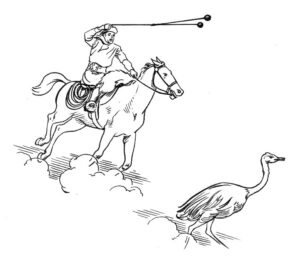
Hebrews 12:1 reminds us that sin is capable of “easily entangling” those who engage in it. We can illustrate this idea with the image of a bola, a weapon used by the indigenous peoples of North and South America. A bola served as a hunter’s weapon and comprised two or more lengths of cord that were tied together. Each cord was then secured with a weight on the other end. A hunter used a bola by throwing it to entangle the legs of his prey and immobilize it.

In one sense, sin is like a bola, for it serves to entangle and incapacitate its victim. Thus, we are encouraged to “…strip off anything that slows us down or holds us back, and especially those sins that wrap themselves so tightly around our feet and trip us up” (TLB).

Image Credit: Pearson Scott Foresman, Public domain, via Wikimedia Commons

(1) Edward E. Hindson and Woodrow Michael Kroll, eds., KJV Bible Commentary (Nashville: Thomas Nelson, 1994), 2575.

(2) The New International Commentary On The New Testament – The Epistle To The Hebrews, F. F. Bruce, General Editor © Copyright 1964, Wm. B. Eerdmans Publishing Co. Grand Rapids, Michigan [pg. 349]

IV

“Therefore, since we also have such a large cloud of witnesses surrounding us, let us lay aside every weight and the sin that so easily ensnares us. Let us run with endurance the race that lies before us” (Hebrews 12:1 HCSB).

While our natural, God-given talents and abilities are good and beneficial, we should always be alert to the potential influence of sin in those areas. Just as a cross-country runner must be attentive to the obstacles that lay ahead, we should humbly acknowledge our personal strengths and prayerfully assess the vulnerabilities they may present.

Those who come to Christ later in life should also be alert to the presence of detrimental thoughts, attitudes, memories, and/or behavior patterns that may have developed earlier. Since Hebrews 12:1 associates the Christian life with a race (as opposed to a sprint), this passage reminds us that an attitude of patient endurance may be required to overcome such things in Christ.

Finally, we should recognize our potential faults and weaknesses and their potential to allow sinful behaviors to gain a foothold in our lives. Just as a tenacious weed may exploit a fissure in the surface of a rocky cliff to germinate and grow, sin may also exploit those faults that may exist within our character. Israel’s king David touched upon this concern in Psalm 139…

“Search me, O God, and know my heart; Try me, and know my anxieties; And see if there is any wicked way in me, And lead me in the way everlasting” (Psalm 139:23-24).

These prayerful self-evaluations may be challenging, for they often compel us to face difficult and unpleasant truths about ourselves. However, we should note that professional athletes, business executives, and those from other walks of life must also engage in various types of self-assessments in order to grow and improve. Therefore, we would do well to take the initiative in following David’s example in this passage from Psalm 139.

This approach also finds Biblical support in the New Testament book of 1 Corinthians…

“But if we evaluated and judged ourselves honestly [recognizing our shortcomings and correcting our behavior], we would not be judged. But when we [fall short and] are judged by the Lord, we are disciplined [by undergoing His correction] so that we will not be condemned [to eternal punishment] along with the world” (1 Corinthians 11:31-32 AMP).

Hebrews 12:1 thus prepares us to approach the subject of God’s discipline that occurs later in this chapter. Therefore, we would be well-advised to consider the following admonition…

“Each of us has habitual ‘besetting sins’ we find it hard to imagine living without. Such sins are idols. We shall strive against such sins throughout life on earth, but they are the individual sin-challenges that God puts before each of us. Working on your besetting sin is the particular project God has given you.” (1)

(1) Sproul, R. C. (1994). Before the face of God: Book 4: A daily guide for living from Ephesians, Hebrews, and James (electronic ed.). Grand Rapids: Baker Book House; Ligonier Ministries.

V

“Therefore, since we are surrounded by such a great cloud of witnesses, let us throw off everything that hinders and the sin that so easily entangles. And let us run with perseverance the race marked out for us” (Hebrews 12:1 NIV).

As we close our look at Hebrews 12:1, we will take a moment to consider this reference to “…the race marked out for us. This terminology implies that every individual Christian follows a personalized spiritual course that is specifically designed for him or her. While there may be similarities in our individual courses, every race is held on a different track, so to speak.

We can gain further insight into this concept with a brief survey of Jesus’ parable of the Laborers in the Vineyard. That parable relates the account of a landowner who went out very early in the morning to hire laborers for his vineyard. He then hired additional laborers at 9am, noon, 3pm, and 5pm. When evening came, the landowner instructed his manager to pay the laborers for their work. He then provided a day’s wage to each worker, even those who were hired late in the day.

The workers who were hired first then began complain about their compensation. However, the landowner was ready with his response…

“…’Friend, I am not treating you unfairly. Didn’t you agree with me to work for the standard wage? Take what is yours and go. I want to give to this last man the same as I gave to you. Am I not permitted to do what I want with what belongs to me? Or are you envious because I am generous?’” (Matthew 20:13-15 NET).

For application purposes, we might say that our personal vineyard is comprised of the life and work that God has given us. The tools of our trade include the talents, skills, abilities, and/or opportunities that God has provided. Just as every human being is different, so is the type and volume of work that God has given us in our individual vineyards.

Because of this, we may be tempted to look at others’ vineyards to offer suggestions, criticisms, ideas, or opinions regarding what they ought to do. To be fair, this may be appropriate if God has placed us in a supervisory capacity, or if we encounter a teaching or behavior that is clearly misaligned with God’s Word. Nevertheless, it is usually best to focus upon our own “vineyard” and the work that God has given us. (1)

It is often difficult to produce quality work for Christ when we are focused on the work of others. Since God has marked out an individual plan for every man and woman of God (as implied here in Hebrews 12:1). we would do well to concentrate upon those areas of responsibility He has assigned to us.

(1) Also see Paul the Apostle’s comment to the Corinthian church in 2 Corinthians 10:13

VI

“looking unto Jesus, the author and finisher of our faith, who for the joy that was set before Him endured the cross, despising the shame, and has sat down at the right hand of the throne of God” (Hebrews 12:2).

The Biblical “heroes of the faith” mentioned earlier in Hebrews chapter eleven serve to challenge, inspire, and motivate us to follow God’s path for our lives. Undoubtedly, there are some who choose to approach the challenges they encounter along that path with a determination to simply “do better” in those areas where they may be falling short. But much like a New Year’s resolution that falls by the wayside, that approach is destined to fail.

The solution is to look unto Jesus, the author and the finisher of our faith, as we’re told here in Hebrews 12:2. Just as the ancient Magi fixed their gaze upon the Star of Bethlehem to guide them to their destination, we can stay the course of God’s direction for our lives if we continually focus upon Christ.

While the faithful men and women of Hebrews chapter eleven encourage us to live a life of faith, Jesus enables us to live a life of faith. Since Jesus is one upon whom “…our faith depends from beginning to end” (GNB), we are empowered to live faithfully as we look to Him. The Apostle Peter once discovered the importance of this truth in a dramatic fashion.

After feeding thousands of people with two fish and five loaves of bread, Jesus sent His disciples across the Sea of Galilee on the way to their next destination while He dismissed the crowds. It was later that night when Jesus walked across the surface of the water and approached the disciples as they struggled to navigate against a boisterous wind. The disciples were understandably terrified at this sight, but Jesus moved quickly to reassure them: “Don’t worry! It’s me! Don’t be afraid” (Matthew 14:27 ERV).

That led Peter to make a request: “Lord, if it is You, command me to come to You on the water” (Matthew 14:28). Jesus granted Peter’s request, but shortly after Peter left the boat, he began to sink beneath the waves as he grew fearful of the tumultuous winds. It was then that “…Jesus stretched out His hand and caught him, and said to him, ‘O you of little faith, why did you doubt?” (Matthew 14:31).

Peter’s experience thus serves as an object lesson that should encourage us to “…focus on Jesus, the source and goal of our faith” (GW).

VII

“Looking unto Jesus the author and finisher of our faith; who for the joy that was set before him endured the cross, despising the shame, and is set down at the right hand of the throne of God” (Hebrews 12:2 KJV).

One Biblical scholar draws our attention to the significance of the word “author” in this passage…

“The word ‘author’ is the translation of archegon… The word is made up of ago ‘to lead,’ and arche, ‘the first.’ The compound word means ‘the chief leader, one that takes the lead in anything and thus furnishes the example.’” (1)

Thus, we can say that Jesus stands at the starting line as we begin the course of faith that God has set before us and awaits us as we reach the finish line. As a merciful and faithful high priest who has been made like His brothers and sisters in every way, we can look to Him for strength and encouragement as we traverse the curves, obstacles, and hazards we encounter over the course of our lives.

This passage also offers insight into Jesus’ mindset during the period of His earthly ministry: “He endured the cross, ignoring the shame, for the sake of the joy that was laid out in front of him…” (CEB). So Jesus viewed His crucifixion as more than just a sacrificial offering; instead, He endured the shame of the cross with an eye towards the joy that awaited Him.

However, that joy was not for Jesus’ benefit alone…

“It is not difficult to trace an affinity between the joy of which our author speaks here and the joy to which Jesus Himself makes repeated reference in the upper room discourses of the Fourth Gospel. He tells His disciples there of His desire that His joy may be in them, so that their joy may be complete (John 15: 11; cf. 16:20, 21, 22, 24); and in His high-priestly prayer He asks the Father ‘that they may have my joy made full in themselves’ (John 17: 13).

So here, ‘the joy that was set before him’ is not something for Himself alone, but something to be shared with those for whom He died as sacrifice and lives as high priest.” (2)

So “the author and finisher of our faith” endured the cross for the joy of others, as well as Himself. Finally, Jesus emphasized the practical aspect of His work on the cross in some of His last words to His disciples…

“Most assuredly, I say to you, unless a grain of wheat falls into the ground and dies, it remains alone; but if it dies, it produces much grain” (John 12:24).

(1) Kenneth S. Wuest, Word Studies in the Greek New Testament (Hebrews 12:2) Copyright © 1942-55 by Wm. B. Eerdmans Publishing Co.

(2) The New International Commentary On The New Testament – The Epistle To The Hebrews, F. F. Bruce, General Editor © Copyright 1964, Wm. B. Eerdmans Publishing Co. Grand Rapids, Michigan [pg. 353]

VIII

“looking to Jesus, the founder and perfecter of our faith, who for the joy that was set before him endured the cross, despising the shame, and is seated at the right hand of the throne of God” (Hebrews 12:2 ESV).

Although crosses are often sold as various forms of jewelry in many areas of the world, some who display crosses in this manner may be unfamiliar with the shame that accompanied the act of crucifixion. In Jesus’ case, the humiliation inflicted upon Him began long before He reached the site of His crucifixion…

“Then the soldiers led Him away into the hall called Praetorium, and they called together the whole garrison. And they clothed Him with purple; and they twisted a crown of thorns, put it on His head, and began to salute Him, ‘Hail, King of the Jews!’ Then they struck Him on the head with a reed and spat on Him; and bowing the knee, they worshiped Him” (Mark 15:16-19).

The Praetorium served as the place of residence for the Roman troops in that area. It was there that the soldiers in charge of Jesus mocked His kingship by spitting upon Him and dressing Him in purple, the color of royalty. These men created a crown made from thorns in a caricature of sovereign authority and gave Him a cane to serve as a kind of “royal scepter.” An entire garrison of soldiers witnessed this humiliating scene.

“They took Jesus therefore, and He went out bearing His own cross, to the place called the Place of a Skull, which is called in Hebrew, Golgotha” (John 19:17 RSV).

Regarding the act of crucifixion, one source makes the following observation: “Although the Romans did not invent crucifixion, they perfected it as a form of torture and capital punishment that was designed to produce a slow death with maximum pain and suffering. It was one of the most disgraceful and cruel methods of execution and usually was reserved only for slaves, foreigners, revolutionaries, and the vilest of criminals.” (1)

Yet now we’re told, Jesus “…is seated in the place of honor beside God’s throne” (NLT). One source explains this imagery behind this reference…

“…the idea being that He, after His work of providing a salvation was finished, sat down, and remains seated. He need never arise and repeat His work on the Cross for sinners. It is a finished work. He is not only seated, but He occupies the position of preeminence, at the right hand of God.” (2)

(1) “Christ Died Quickly On The Cross” William D. Edwards, quoted in “The Book Of Jesus” edited by Calvin Miller pg 388

(2) Kenneth S. Wuest, Word Studies in the Greek New Testament (Hebrews 12:2) Copyright © 1942-55 by Wm. B. Eerdmans Publishing Co.

IX

“For consider Him who endured such hostility from sinners against Himself, lest you become weary and discouraged in your souls” (Hebrews 12:3).

Like any good leader, Jesus is someone who leads by example. For instance, we would do well to consider the various acts of hostility that were inflicted upon Jesus whenever we face conflict with others. Those examples run like a thread throughout the New Testament gospel of John…

“Therefore the Jews sought all the more to kill Him, because He not only broke the Sabbath, but also said that God was His Father, making Himself equal with God” (John 5:18).

“After these things Jesus walked in Galilee; for He did not want to walk in Judea, because the Jews sought to kill Him” (John 7:1).

“[Jesus said] I know that you are Abraham’s descendants, but you seek to kill Me, because My word has no place in you” (john 8:37).

“Then they took up stones to throw at Him; but Jesus hid Himself and went out of the temple, going through the midst of them, and so passed by” (John 8:59).

“Then the Jews took up stones again to stone Him. Jesus answered them, ‘Many good works I have shown you from My Father. For which of those works do you stone Me?’ The Jews answered Him, saying, ‘For a good work we do not stone You, but for blasphemy, and because You, being a Man, make Yourself God’” (John 10:31-33).

“The Jews answered [Pontius Pilate], ‘We have a law, and according to our law He ought to die, because He made Himself the Son of God’” (John 19:7).

Some of our conflicts may grow out of relationships with disagreeable spouses, antagonistic co-workers, unreasonable employers. disruptive neighbors, or contentious family members. Others must deal with the hostilities imposed by government entities, business organizations, religious movements, or groups that are averse to Christianity.

When such things occur, we would be wise to “Think about the one who endured such opposition from sinners so that you won’t be discouraged and you won’t give up” (CEB). We might also consider Jesus’ cautionary message from John 15:20: “Do you remember what I said to you, ‘The servant is not greater than his master’? If they have persecuted me, they will persecute you as well, but if they have followed my teaching, they will also follow yours” (Phillips).

Thus, as one source concludes, “…if we would look to Christ’s example instead of looking at our own afflictions, we would not become so weary or fainthearted. Are you unhappy over your sacrifice? Take a new look at His!” (1)

(1) Edward E. Hindson and Woodrow Michael Kroll, eds., KJV Bible Commentary (Nashville: Thomas Nelson, 1994), 2576.

X

“For consider Him who endured such hostility from sinners against Himself, so that you won’t grow weary and lose heart” (Hebrews 12:3 HCSB).

No matter how difficult life becomes, we can be secure in knowing  that Jesus is familiar with the problems and issues we face. For instance, what if we were to compare the pressures of our lives to Jesus’ experience in the Garden of Gethsemane? Remember that it was there where His perspiration became like drops of blood as he prayed and contemplated the immediate future that awaited Him. Thus, it seems unlikely that our challenges exceed the struggles Jesus faced in respect to His approaching crucifixion.

A few minutes spent with a work such as Foxe’s Book Of Martyrs may also bring a fresh perspective to our view of the stresses we experience in life. This is important when we consider the natural human tendency to magnify the intensity of our personal struggles. The standard we use to measure their severity influences the accuracy of our perception.

This is not to say that our challenges are insignificant, or illusionary. Nor does it mean that we should ignore the problems we experience in life, or pretend they don’t exist. Instead, we can ensure that we accurately assess such things when we measure them against the example Jesus set for us.

The New Testament epistle of 1 Peter approaches this idea from a different perspective…

“For what credit is it if you sin and are mistreated and endure it? But if you do good and suffer and so endure, this finds favor with God. For to this you were called, since Christ also suffered for you, leaving an example for you to follow in his steps” (1 Peter 2:20-21 NET).

Much like a weary athlete who continues to press on towards the finish line, the knowledge that Jesus has set an example for us helps provide us with the proper mindset. The Apostle Paul also touched upon this idea in his letter to the Galatian church: “And let us not grow weary while doing good, for in due season we shall reap if we do not lose heart” (Galatians 6:9).

Paul echoed a similar theme in his letters to the churches at Corinth and Thessalonica as well…

“Therefore, my beloved brethren, be steadfast, immovable, always abounding in the work of the Lord, knowing that your labor is not in vain in the Lord” (1 Corinthians 15:58).

“But as for you, brethren, do not grow weary in doing good” (2 Thessalonians 3:13).

Therefore, we can find strength in the counsel given to us here in Hebrews 12:3 whenever we grow weary of the trials and oppositions we encounter.

XI

“You have not yet resisted to bloodshed, striving against sin” (Hebrews 12:4).

The members of the original audience for the Biblical book of Hebrews had undoubtedly suffered for their decision to follow Christ. Yet none had “…resisted to the point of bloodshed” (NET). The implication carried over from the previous verse is clear: “If you are becoming weary and discouraged, consider what Jesus endured. You have not yet suffered bloodshed, as He suffered on our behalf.”

So, the author of Hebrews encouraged the members of his original audience (and modern-day readers by extension) to expand their perspective beyond their personal hardships and discouragements. In the words of one Biblical scholar, “The readers have known persecution, but nothing as serious as what Jesus suffered, or indeed, what has been cataloged in 11:35–38. It is not time for them to think of giving up.” (1)

The following excerpt from the New Testament Gospel of Mark details a portion of Jesus’ experience that can help us put our afflictions in the proper perspective…

“Pilate wanted to please the crowd, so he set Barabbas free. Then he ordered his soldiers to beat Jesus with a whip and nail him to a cross” (Mark 15:15 CEV).

With Pilate’s authorization, the Roman military personnel in charge of Jesus whipped Him repeatedly in advance of His crucifixion. Roman soldiers generally administered this beating (variously referred to as a scourging, or flogging depending on the translation), as part of a criminal sentence.

A “scourge” was a type of whip that was comprised of a wooden handle with multiple lashes or strips of leather. Sharp-edged pieces of bone, metal, and/or lead were commonly attached to these lashes. During this process, the condemned prisoner was first stripped of his clothes. His hands were then tied above his head to a support column. Two soldiers (called lichtors) then positioned themselves on either side of the prisoner and took alternate turns whipping the victim. In doing so, the embedded objects within the scourge slowly tore into the prisoner’s body, removing small bits of flesh with every strike.

The act of scourging a convicted criminal was primarily designed to eliminate his ability to resist the act of crucifixion. This horrific form of punishment continued until the prisoner was close to death. While the Jewish people were limited to thirty-nine lashes in scourging a prisoner, (2) the only condition placed upon a Roman lichtor was that the prisoner had to be kept alive to carry his cross to his place of execution.

(1) R. C. Sproul, ed., The Reformation Study Bible: English Standard Version (2015 Edition) (Orlando, FL: Reformation Trust, 2015), 2218.

(2) See the historical reference in 2 Corinthians 11:24

XII

“In your struggle against sin you have not yet resisted to the point of shedding your blood” (Hebrews 12:4 ESV).

Hebrews 12:4 draws a comparison between the sufferings inflicted upon the members of the original audience for this epistle and those that were inflicted upon Jesus. The Gospel of Mark offers an account of the suffering Jesus endured before He reached the cross…

They put a purple cloak on him and after braiding a crown of thorns, they put it on him. They began to salute him: ‘Hail, king of the Jews!’ Again and again they struck him on the head with a staff and spit on him. Then they knelt down and paid homage to him” (Mark 15:17-19 NET).

In a grotesque parody of a golden crown worn by a king, the soldiers guarding Jesus placed a crown made from the branches of a sharp thorny plant upon His head prior to His crucifixion. Mark’s Gospel also tells us that the Roman soldiers struck Jesus repeatedly on the head during this time. This act was certain to produce severe bleeding as the crown of thorns was driven into His scalp.

Although the Gospels do not provide us with an extensive physical description of Jesus’ condition during this time, that may be due to the fact that this information was detailed prophetically in advance…

“I gave My back to those who struck Me, And My cheeks to those who plucked out the beard; I did not hide My face from shame and spitting” (Isaiah 50:6).

“…His visage was marred more than any man, And His form more than the sons of men” (Isaiah 52:14).

But these things were just a prelude to Jesus’ actual crucifixion…

“And when they crucified Him, they divided His garments, casting lots for them to determine what every man should take” (Mark 15:24).

A condemned prisoner was typically stripped of his clothing upon arrival at the site of his crucifixion. He was then bound with ropes or nailed to the crossbar (or “patibulum”) he carried to his execution. Those who were nailed to their crosses (as Jesus was), were typically secured with large spikes that were approximately seven inches (18 cm) long, and 1/3 inch (.75 cm) wide at the head. These spikes were likely driven into the wrist area at the base of the hand. After this, the crossbar was fastened onto a vertical pole (or “stipe”). Finally, the victim’s feet were nailed into the vertical portion of his cross.

While these descriptions are painful to read, the author of Hebrews encourages us to bring these facts to our remembrance to help in maintaining the right perspective on the sufferings we endure.

XIII

“In your struggle against sin, you have not yet resisted to the point of shedding your blood” (Hebrews 12:4).

In context, this reference to “shedding your blood” refers to the account of Jesus’ crucifixion. We can find an echo of that awful form of death in the modern-day word “excruciating.” This word is used to describe an exceedingly painful condition and finds its origin in a word that means “of the cross.” (1)

Despite our natural reluctance to engage this difficult topic, a comparative look at Jesus’ death can help us measure the true severity of our own life experiences. For instance, consider the fact that a crucified prisoner had to push himself up against the nail that held his feet in order to breathe as he hung upon his cross. If he failed to do so, death by suffocation would result. Crucified victims also experienced severe thirst and muscular cramping. Blood loss was extensive, and the nails used in securing the victim generated severe pain from severed or irritated nerve endings.

One medical commentator makes some additional observations regarding the act of crucifixion…

“When the cross was erected upright, there was tremendous strain put on the wrists, arms and shoulders, resulting in a dislocation of the shoulder and elbow joints… The arms, being held up and outward, held the rib cage in a fixed end inspiratory position which made it extremely difficult to exhale, and impossible to take a full breath.

The victim would only be able to take very shallow breaths (This may explain why Jesus made very short statements while on the cross). As time passed, the muscles, from the loss of blood, last of oxygen and the fixed position of the body, would undergo severe cramps and spasmodic contractions.” (2)

This is how the crucified spent their final hours of life. As another commentator bluntly observed, “Romans were grimly efficient about executions. Victims did not escape with their lives.” (3)

However, the Gospel of John adds an additional detail related to Jesus’ crucifixion: “…one of the soldiers pierced His side with a spear, bringing a sudden flow of blood and water” (John 19:32). One source alerts us to the significance of this detail…

“Clearly, the weight of historical and medical evidence indicates that Jesus was dead before the wound to his side was inflicted and supports the traditional view that the spear, thrust between his right ribs, probably perforated not only the right lung but also the pericardium and heart and thereby ensured his death.” (4)

(1) See “Excruciating.” Merriam-Webster.com Dictionary, Merriam-Webster, https://www.merriam-webster.com/dictionary/excruciating. Accessed 11 Apr. 2023.

(2) Terasaka, David M.D. Medical Aspects of the Crucifixion of Jesus Christ http://www.blueletterbible.org/Comm/terasaka_david/misc/crucify.cfm Accessed 12 Apr. 2023.

(3) Paul L. Maier, In the Fullness of Time: A Historian Looks at Christmas, Easter, and the Early Church [pg. 195]

(4) Edwards, William & Gabel, W & Hosmer, F. (1986). On the Physical Death of Jesus Christ. JAMA : the journal of the American Medical Association. 255. 1455-63. 10.1001/jama.1986.03370110077025. https://www.researchgate.net/publication/19648788_On_the_Physical_Death_of_Jesus_Christ Accessed 11 Apr. 2023.

XIV

“And have you completely forgotten this word of encouragement that addresses you as a father addresses his son? It says, ‘My son, do not make light of the Lord’s discipline, and do not lose heart when he rebukes you, because the Lord disciplines the one he loves, and he chastens everyone he accepts as his son’” (Hebrews 12:5-6 NIV).

If this passage from Hebrews 12:5-6 seems familiar, it may be due to the fact that a similar concept appears in the Biblical books of Job and Proverbs…

“Behold, happy is the man whom God corrects; Therefore do not despise the chastening of the Almighty” (Job 5:17).

“My son, do not despise the chastening of the Lord, Nor detest His correction; For whom the Lord loves He corrects, Just as a father the son in whom he delights” Proverbs 3:11-12).

These references serve to prepare us for the next point of emphasis in the book of Hebrews…

“In the next section (5-24) the writer explains the meaning of suffering and hardship as the discipline (not ‘chastisement’ or ‘punishment’) of a loving Father (cf. 6), whose purpose in it is to educate (Gk. paideuein) his child. Thus in the case of the Christian, suffering is God’s educational process by which he is fitted to share God’s holiness (10).

It is a necessary element in the Father-child relationship as the writer establishes from his book of proofs- the OT (Prov. 3: 11 f.), and from the analogy of human parenthood (8-9). If you are not being educated you are not a legitimate son (8).” (1)

With these things in mind, this portion of Scripture encourages us to exercise discernment in respect to the difficult events that enter our lives. For instance, God may permit such experiences as a means of identifying an attitude or behavior that requires attention. Or perhaps He may allow the circumstances we encounter to assist us in developing character and perseverance. He might also use those developments to prepare us for the future.

Thus, it is important to recognize that every Christian is (or should be) enrolled as an apprentice in the “School of Christ.” Each grade level in this academic institution features a curriculum that is tailored to every individual student. While Jesus used this student-teacher analogy in addressing His followers on several occasions, there is a strong familial element that is present here in our passage from Hebrews. We’ll explore that aspect of our relationship with the Lord in greater detail next.

(1) New International Bible Commentary general editor G. C. D. Howley, consulting editors F. F. Bruce, H. L. Ellison. Copyright© 1979 by Pickering & Inglis Ltd [pg. 1529].

XV

“Have you forgotten the encouraging words which God speaks to you as his children? ‘My child, pay attention when the Lord corrects you, and do not be discouraged when he rebukes you. Because the Lord corrects everyone he loves, and punishes everyone he accepts as a child’” (Hebrews 12:5-6 GNB).

One source defines this reference to discipline (CSB), or chastening (GNV) with a look at the original language of this passage…

“The latter word is paideia, which was used of the whole training and education of children. It speaks also of whatever in adults cultivates the soul, especially by correcting mistakes and curbing the passions. It speaks also of instruction which aims at the increase of virtue. The word does not have in it the idea of punishment, but of corrective measures which will eliminate evil in the life and encourage the good.” (1)

Unlike some who ascribe the negative events of life to the unpredictable elements of “luck,” “fate,” “chance,” or “karma,” there is no need for despair amid those circumstances. Instead, we can gain insight from these conditions by asking some important questions such as…

  • What may God be seeking to teach me through this circumstance?
  • What does my response to this situation tell me about myself?
  • How can I apply this experience in the future?

However, there is another aspect of this passage that warrants our attention. You see, it is appropriate to consider any role we may have played in eliciting God’s correction in our lives. In other words, we should consider the possibility that our behaviors have prompted God to engage in an act of loving discipline. The Scriptures offer several admonitions in this regard…

“Some of the redeemed had been sitting in darkness and deep gloom; they were prisoners suffering in chains because they had disobeyed God’s instructions and rejected the Most High’s plans. So God humbled them with hard work. They stumbled, and there was no one to help them… Some of the redeemed were fools because of their sinful ways. They suffered because of their wickedness” (Psalm 107:10-12, 17 CEB).

“An evil man is held captive by his own sins; they are ropes that catch and hold him” (Proverbs 5:22 NLT).

“Have you not brought this on yourselves by forsaking the Lord your God when he led you in the way?… Your wickedness will punish you; your backsliding will rebuke you” (Jeremiah 2:17, 19 NIV).

So while the Lord chastens and corrects us, we should prayerfully seek to ensure that we have not deliberately prompted those corrective measures. As 1 Corinthians 11:32 reminds us, “…when we are judged, we are chastened by the Lord, that we may not be condemned with the world.”

(1) Kenneth S. Wuest, Word Studies in the Greek New Testament (Hebrews 12:5-6) Copyright © 1942-55 by Wm. B. Eerdmans Publishing

XVI

“And have you forgotten the encouraging words God spoke to you as His children? He said, “My child, don’t make light of the LORD’s discipline, and don’t give up when He corrects you. For the LORD disciplines those He loves, and He punishes each one He accepts as His child” (Hebrews 12:5-6 NLT).

While the concept of “God’s discipline” may evoke any number of inferences, it’s important to consider the purpose behind the type of discipline mentioned in the passage quoted above. For instance, these disciplinary measures are designed to be corrective, not punitive. They are not motivated by a sense of retribution, but a sense of love and concern for the best interests of God’s children.

As mentioned in our previous study, these actions serve a specific purpose: “…we are judged and punished by the Lord, so that we shall not be condemned together with the world” (1 Corinthians 11:32). We should also note that Jesus made use of a related concept in John 15:1-5…

“I am the true vine, and my Father is the gardener. He cuts off every branch in me that bears no fruit, while every branch that does bear fruit he prunes so that it will be even more fruitful. You are already clean because of the word I have spoken to you. Remain in me, as I also remain in you.

No branch can bear fruit by itself; it must remain in the vine. Neither can you bear fruit unless you remain in me. I am the vine; you are the branches. If you remain in me and I in you, you will bear much fruit; apart from me you can do nothing” (NIV).

A good horticulturist knows that various trees or flowering plants must be pruned occasionally to ensure they remain strong and healthy. This process helps protect such plants from overgrowth and minimizes the potential for damage caused by insects or diseases. It also enables the plant to product higher quality fruit or flowers in greater abundance.

A familiar passage from the Biblical book of Galatians serves to identify the type of fruit God seeks to develop through this approach…

“But the fruit of the Spirit is love, joy, peace, patience, kindness, goodness, faithfulness, gentleness and self-control. Against such things there is no law” (Galatians 5:22-23 NIV).

Therefore, we can find comfort, and encouragement whenever we experience God’s discipline in our lives. As Jesus reminded the New Testament-era church of Laodicea, “I am the one who corrects and disciplines everyone I love…” (Revelation 3:19 NLT).

XVII

“And have you forgotten the exhortation that addresses you as sons? ‘My son, do not regard lightly the discipline of the Lord, nor be weary when reproved by him. For the Lord disciplines the one he loves, and chastises every son whom he receives’” (Hebrews 12:5-6 ESV).

As the author of Hebrews continues his exposition of Proverbs 3:11-12, we should note an important point of emphasis within this passage. Unlike a servant who lacks the familial bond that unites the other members of a household, this portion of Scripture employs the word “son” to identify those who are subject to the Lord’s discipline.

Jesus identified those members of God’s family in the Gospel of Luke…

“And it was told Him by some, who said, ‘Your mother and Your brothers are standing outside, desiring to see You.’ But He answered and said to them, ‘My mother and My brothers are these who hear the word of God and do it’” (Luke 8:20-21).

This brings us to something that warrants careful consideration: a person who can engage in sinful behaviors without any apparent repercussion is someone who should be greatly concerned. For instance, a father does not typically discipline a child who belongs to someone else. Therefore, anyone who can engage in Biblically inappropriate behaviors without apparent consequence might question his or her status as a legitimate son or daughter of God.

On the other hand, God may choose to discipline His sons and daughters to help facilitate their growth. We’ll discuss this topic at greater length in an upcoming study, but for now, let’s consider the circumstances that God might use for this purpose and how those circumstances may deepen our fellowship with Him.

For example, we may have experience with others who have been unfaithful to us in various ways. God has been through that experience as well. Perhaps we have graciously provided for those who were unappreciative of our efforts. God knows that feeling, too. Maybe we’ve been hurt by individuals who abandoned us when they had no further need for us. God is also familiar with that response.

Perhaps we know the weariness of interacting with those who will not do what they should unless they are given a specific set of rules to follow along with consequences for breaking those rules. God had to take that approach with His people as well. Finally, we may know the pain of a betrayal committed by someone who was once close to us. Jesus is all too familiar with that experience.

Deep camaraderie between individuals can only develop among those who have lived through shared experiences. Thus, we should recognize that God may have this objective in mind whenever we encounter His disciplinary efforts within our lives.

XVIII

“If you endure chastening, God deals with you as with sons; for what son is there whom a father does not chasten? But if you are without chastening, of which all have become partakers, then you are illegitimate and not sons” (Hebrews 12:7-8).

It is often difficult to receive discipline and correction, and even more difficult to endure the circumstances that accompany them. As our author will observe later in this chapter, “No discipline seems enjoyable at the time, but painful….” (Hebrews 12:11 CSB). But rather than view the subject of God’s discipline through the horizontal lens of our experience, what if we were to consider this matter from God’s perspective?

For example, the book of the Old Testament prophet Hosea directs our attention to the emotional component of God’s relationship with His people. Unlike those who view God as an impersonal authority figure, the following passage of Scripture characterizes Him as a gracious parent whose children were less than appreciative of His provision for their needs…

“The Lord says, ‘When Israel was a child, I loved him and called him out of Egypt as my son. But the more I called to him, the more he turned away from me. My people sacrificed to Baal; they burned incense to idols.

Yet I was the one who taught Israel to walk. I took my people up in my arms, but they did not acknowledge that I took care of them. I drew them to me with affection and love. I picked them up and held them to my cheek; I bent down to them and fed them’” (Hosea 11:1-4 GNT).

This passage reminds us that our view of God’s discipline should be tempered by our recognition of His love as a Father to His children. Those who seek to avoid the pain associated with the corrective circumstances that God allows to enter our lives may fail to acknowledge the loving motivation behind them. If we attempt to circumvent those lessons now, we may find that God will later enroll us in a far more rigorous course of study in the School of Christ.

These actions also reflect God’s investment in His children. While everyone is subject to the common trials that are typical of the human experience, some are open to the lessons that God seeks to communicate through such things while others reject them. With this in mind, we can say that a legitimate son or daughter of God looks for evidence of God’s tutelage in the circumstances of life as he or she seeks to grow in the grace and knowledge of Christ.

XIX

“Furthermore, we have had human fathers who corrected us, and we paid them respect. Shall we not much more readily be in subjection to the Father of spirits and live?” (Hebrews 12:9).

This common-sense observation from Hebrew 12:9 is hardly new. In fact, the importance of loving discipline in the life of a child is a topic that stretches back to the Old Testament book of Proverbs…

“Those who spare the rod of discipline hate their children. Those who love their children care enough to discipline them” (Proverbs 13:24 NLT).

“Discipline your children while they are young enough to learn. If you don’t, you are helping them destroy themselves” (Proverbs 19:18 GNT).

“To discipline a child produces wisdom, but a mother is disgraced by an undisciplined child” (Proverbs 29:15 NLT).

“If you correct your children, they will bring you peace and happiness” (Proverbs 29:17 CEV).

So if God’s Word promotes loving parental discipline in the life of a child, it should not surprise us when God adopts this approach in the lives of His people as well.  For instance, an undisciplined child often reflects poorly upon his or her parents. Just as we respect a parent who properly administers loving discipline in the life of a son or daughter, so we should also respect the God who does so in the lives of His children.

That leads us to this reference to “…the Father of spirits” from this passage. This phrase appears here in Hebrews 12:9 but nowhere else within the New Testament Scriptures. As mentioned previously, the word “spirit” finds its origin in the word “pneuma” in the original language of this passage. A remnant of this word exists today in regard to a pneumatic tire, air tool, or gas. In a larger sense, this word is used to express the idea of a breeze, a gust of wind, an air current, or the act of breathing.

Much like the movement of air through various places, the spirit is also invisible and immaterial. Therefore, the word “spirit” is used to represent the intangible part of every human being that continues following the death of his or her physical body. Once that physical separation takes place, the Biblical book of Ecclesiastes tells us, “…your spirit will return to God who gave it” (Ecclesiastes 12:7-8 NCV).

This passage thus serves to contrast our biological parents (who have disciplined and corrected us on a limited basis), with our heavenly father who always disciplines us with our best interests in mind. The following verse will explore that aspect of God’s discipline in greater detail.

XX

“For they indeed for a few days chastened us as seemed best to them, but He for our profit, that we may be partakers of His holiness” (Hebrews 12:10).

A child who has enjoyed the privilege of growing up in a home with a loving father often looks back fondly at that experience. Yet even the most loving human father is an imperfect father.

You see, a good parent rarely has all the information necessary to provide perfect guidance for a child. For example, there may be extenuating circumstances, or other factors that are beyond a parent’s knowledge. In fact, a child may sometimes exploit that lack of information to his or her advantage.

Parents are also limited by time. As children grow and mature, a good parent must constantly adapt to the changing needs of the child. He or she must account for the child’s growing knowledge (or lack of it), the child’s experience (or lack of it), his or her emotional characteristics, and any potential vulnerabilities the child may possess. As the child grows towards adulthood, a parent must then assume less of a supervisory role and more of a mentorship position in the child’s life.

Finally, a parent is also limited by his or her own fallibility. For example, a parent may find it difficult to separate his or her emotional involvement in a disciplinary situation. A good parent might also suffer from fatigue, various forms of stress, or other variables that may affect his or her capacity to discipline a child properly. These limitations help explain why the New Testament book of Galatians offers the following word of encouragement…

“Fathers, do not provoke your children to anger by the way you treat them. Rather, bring them up with the discipline and instruction that comes from the Lord” (Galatians 6:4 NLT).

We can contrast these limitations with the infinite wisdom of our spiritual Father. Unlike an imperfect human being, God’s discipline is always perfect. It is never more or less than we need, and is perfectly tailored to the situation at hand. And while an earthly parent may have something less than a child’s best disciplinary interest in mind, God always “…disciplines us for our good, that we may share his holiness” (ESV).

Thus, we can distill this passage into one summary observation…

“Our earthly fathers may sometimes have been mistaken in their estimate of the discipline that we needed; our heavenly Father, in the perfection of His wisdom and love, can be relied upon never to impose any discipline on us that is not for our good. The supreme good that He has in view for His children is this, that they should share His holiness.” (1)

(1) The New International Commentary On The New Testament – The Epistle To The Hebrews, F. F. Bruce, General Editor © Copyright 1964, Wm. B. Eerdmans Publishing Co. Grand Rapids, Michigan [pg. 359]

XXI

“Now no chastening seems to be joyful for the present, but painful; nevertheless, afterward it yields the peaceable fruit of righteousness to those who have been trained by it” (Hebrews 12:11).

A good athlete, student, or musician knows that proficiency and achievement in those areas isn’t always easy. A person who seeks to excel in those areas must be willing to accept the challenges associated with instruction, study, practice, and correction. At best, a person who rejects those disciplines may fail to perform during a game, test, or concert. At worst, they may embarrass themselves (and others) when their lack of discipline is revealed.

The point is that a good athlete, student, or performer understands the importance of discipline and correction. The same holds true for our spiritual lives as well. However, there is another perspective to consider regarding this subject.

Imagine if you had a coach or a teacher who never trained, instructed, or corrected you. Think about the prospects for a student, athlete, or musician under the leadership of a coach or teacher who didn’t care enough to discipline those individuals to be their best. With this in mind, we can reasonably conclude that coaches and teachers who fail to instruct, train, and discipline the people who are entrusted to their care will not remain in their positions for very long.

A good teacher or coach will work to motivate, correct, and discipline a student or athlete to be the best he or she can be. The passage quoted above tells us that God does much the same in our spiritual lives as well. But just as an athlete or musician does not look forward to the prospect of a grueling practice session, the process of spiritual correction and discipline is rarely easy. Nevertheless, we can often see the positive changes God produces in us when He has completed that work.

We can turn to the Old Testament book of Proverbs once again to find support for this New Testament idea…

“To learn, you must love discipline; it is stupid to hate correction” (Proverbs 12:1 NLT).

“If you reject discipline, you only harm yourself; but if you listen to correction, you grow in understanding” (Proverbs 15:32 NLT).

“Whoever stubbornly refuses to accept criticism will suddenly be destroyed beyond recovery” (Proverbs 29:1 NLT).

As our author reminded us earlier in Hebrews 10:38. “…the just shall live by faith.” Therefore, we should faithfully trust that God has a purpose behind those periods of spiritual discipline we experience and will ultimately bring something beneficial from them.

XXII

“Therefore strengthen the hands which hang down, and the feeble knees, and make straight paths for your feet, so that what is lame may not be dislocated, but rather be healed” (Hebrews 12:12-13).

In keeping with the author’s practice throughout his letter to the Hebrews, this portion of Scripture contains an allusion to an important Old Testament idea. For instance, the call to action given to us in the passage quoted above draws upon an image that would have been familiar to the original audience for this epistle…

“Surely you have instructed many, And you have strengthened weak hands. Your words have upheld him who was stumbling, And you have strengthened the feeble knees” (Job 4:3-4).

“Strengthen the weak hands, and make firm the feeble knees. Say to those who have an anxious heart, ‘Be strong; fear not! Behold, your God will come with vengeance, with the recompense of God. He will come and save you’” (Isaiah 35:3-4 ESV).

Thus, the author of Hebrews made use of this imagery for the benefit of his readers, both ancient and modern: “Strengthen your listless hands and your weak knees refers to the readers’ need for renewed resolve and fresh strength in their struggles (cf. Heb 10:36-39; Heb 12:1-3).” (1)

So, much like an athlete who battles fatigue as he or she nears the end of a long-distance race, this passage encourages us to renew our commitment to finish the course that God has set for us. We can finish that course by continually looking to Jesus, the author and finisher of our faith, as mentioned earlier in Hebrews 12:1-2. There, we will find the inspirational motivation that we need to address the challenges associated with a life of faith and make a straight path for others to follow.

We’ll explore the significance of this imagery in greater detail in our next study. But for now, we can say that those who follow this counsel, “…understand that the circumstances of their lives are dictated by God who directs their destinies through His unfailing omniscience, and whose all-loving nature actively promotes their highest welfare” (2) We can also draw fresh encouragement from Paul the Apostle’s common-sense guidance to the members of the ancient church at Philippi…

“…I am still not all I should be, but I am bringing all my energies to bear on this one thing: Forgetting the past and looking forward to what lies ahead, I strain to reach the end of the race and receive the prize for which God is calling us up to heaven because of what Christ Jesus did for us” (Philippians 3:13-14 TLB).

(1) NET Bible notes on Hebrews 12:12 https://classic.net.bible.org/bible.php?book=Heb&chapter=12&mode=print

(2) New International Bible Commentary general editor G. C. D. Howley, consulting editors F. F. Bruce, H. L. Ellison. Copyright© 1979 by Pickering & Inglis Ltd [pg. 1529]

XXIII

“Mark out a straight path for your feet so that those who are weak and lame will not fall but become strong” (Hebrews 12:13 NLT).

Much like a mineworker who extracts valuable ore from a productive mine, the author of Hebrews has consistently returned to the Old Testament (and the book of Proverbs in particular) to unearth important spiritual truths for his audience. In this instance, Proverbs 4:26 provides the underlying imagery for the “straight path” referenced here in Hebrews 12:13: “Carefully walk a straight path, and all your ways will be secure” (GW).

In a spiritual sense, we can “mark out a straight path” by prayerfully removing those obstacles that might cause us to deviate from God’s course for our lives. Those who do so receive a dual benefit. First, this approach minimizes the possibility that we might stumble as we travel the road that God has prepared for us. Next, it serves to protect the weaker or more vulnerable areas of our lives from injury (as represented by the word “lame” in the passage quoted above).

While “making a straight path” is relatively straightforward in theory, it is likely to be much more difficult in practice. For instance, this might require us to re-evaluate the relationships, activities, entertainment choices, or other pursuits that restrict our ability to follow God’s path.

In a larger sense, there are three primary obstacles that often inhibit our ability to follow this counsel. The first obstacle involves the pressures that are exerted upon us by a modern-day world that functions as if God did not exist.

We find the second obstacle in our own natural tendency to think and act in ways that are misaligned with God’s intent for us. The third obstacle lies in the form of a powerful, unseen spiritual enemy who seeks to overthrow the Creator and subjugate His creation. Taken together, these three obstacles are commonly known as “the world, the flesh, and the devil.”

The difficulties we encounter as a result of these common obstacles are often little more than variations in the time, place, and method of obstruction. Whenever we face such challenges, we would do well to remember the future that God has prepared for those who love Him. We should also remember Jesus’ own message of encouragement from John 16:33…

“These things I have spoken to you, that in Me you may have peace. In the world you will have tribulation; but be of good cheer, I have overcome the world.”

XXIV

“Make every effort to live in peace with everyone and to be holy; without holiness no one will see the Lord” (Hebrews 12:14 NIV).

While this verse implies that it may be impossible to live in peace with everyone, that should not prevent us from attempting to do so. For example, “living in peace with everyone” may sometimes require us to overlook faults, ignore slights (intentional or unintentional), and pardon others, even in those circumstances where they are clearly wrong.

You see, a God-honoring person who has been wronged must weigh their options in choosing how to respond. For instance, we may choose to retaliate against those who are responsible for our injuries. Or we can accept the fact that we have been wronged and prayerfully move forward. In other words, we can choose to forgive, or we can choose to pursue a different course. We can choose to reflect God’s mercy towards us in Christ, or we can seek to enforce our rights without regard for the way that choice might reflect upon Christ.

It has been said that it takes two to keep the peace, but a man or woman of God must not be the one who is responsible for breaking it. In certain situations, we might be well advised to simply “…put up with injustice” (HCSB) as we’re told in 1 Corinthians 6:7. Sometimes, it may be preferable to simply accept the loss (whether real or perceived) and move on.

The book of Romans offers another perspective to consider…

“Do not take revenge, my dear friends, but leave room for God’s wrath, for it is written: ‘It is mine to avenge; I will repay,’ says the Lord” (Romans 12:19 NIV).

If we have been treated unfairly, this passage tells us that God will come to our defense if we permit Him do so in His own time and way. Of course, the challenge involved in taking this approach is that it often requires us to exercise (or develop) the qualities of patience, humility, and perseverance. This may explain why God sometimes chooses to allow such circumstances to enter our lives.

As one commentator concludes, “Thus in the case of the Christian, suffering is God’s educational process by which he is fitted to share God’s holiness.” (1) As Jesus also reminded us in the New Testament Gospel of Matthew, “Blessed are the peacemakers, For they shall be called sons of God” (Matthew 5:9).

(1) New International Bible Commentary general editor G. C. D. Howley, consulting editors F. F. Bruce, H. L. Ellison. Copyright© 1979 by Pickering & Inglis Ltd [pg. 1529]

XXV

“Pursue peace with all people, and holiness, without which no one will see the Lord” (Hebrews 12:14).

As we continue our look at the subject of peace from Hebrews 12:14, we can turn once again to the Biblical book of Proverbs for guidance. The book of Proverbs contains a wealth of practical counsel that can help us manage conflict in a way that honors God. In fact, a look through this Old Testament book of wisdom reveals a surprising amount of content that is devoted to this subject.

For instance, consider the following passages and the insight they offer as we seek to “Pursue peace with all people“…

“A patient person shows great understanding, but a quick-tempered one promotes foolishness” (Proverbs 14:29 HCSB).

“A gentle answer deflects anger, but harsh words make tempers flare” (Proverbs 15:1 NLT).

“Hot tempers cause arguments, but patience brings peace” (Proverbs 15:18 GNT).

“When a man’s ways please the Lord, he makes even his enemies to be at peace with him” (Proverbs 16:7 ESV).

“Better to be slow to anger than to be a mighty warrior, and one who controls his temper is better than one who captures a city” (Proverbs 16:32 NET).

“Starting a quarrel is like opening a floodgate, so stop before the argument gets out of control” (Proverbs 17:14 GW).

“Sensible people control their temper; they earn respect by overlooking wrongs” (Proverbs 19:11 NLT).

“Honor belongs to the person who ends a dispute, but any fool can get himself into a quarrel” (Proverbs 20:3 CSB).

“Patience and gentle talk can convince a ruler and overcome any problem” (Proverbs 25:15 CEV).

In addition, the New Testament book of James adds some additional insight: “But the wisdom that is from above is first pure, then peaceable, gentle, willing to yield, full of mercy and good fruits, without partiality and without hypocrisy. Now the fruit of righteousness is sown in peace by those who make peace” (James 3:17-18). Thus, we are reminded of an important reality: if our vertical relationship with God is right, our horizontal relationships with others will benefit as well.

This does not mean that we are obligated to avoid conflict at all costs, or seek “peace at any price.” Nevertheless, we will be well on our way to a proper application of this verse if we consider what will make for peace in our relationships with others. While there may be any number of things that provoke irritation, annoyance, or hostility towards others, such feelings must defer to the counsel given to us in Colossians 3:15: “Let the peace that Christ gives control your thinking” (ERV).

XXVI

“Strive for peace with everyone, and for the holiness without which no one will see the Lord” (Hebrews 12:14 ESV).

The author of Hebrews has already issued several cautionary messages over the course of this letter. Now, as we approach the end of this great Biblical epistle, he issues one final warning: “…without holiness no one will see the Lord.” Unfortunately, the word “holy” is one that people often seem to use without concern for its meaning.

For instance, some use the word “holy” as part of an exclamation or expression of surprise. Nevertheless, those who use this phrase in a careless or disrespectful manner might be more hesitant to do so if they were aware of its true meaning.

You see, the word “holy” expresses the qualities of moral purity and ethical perfection, especially in relation to God. It also describes a person or thing that has been consecrated or set apart in a spiritual sense. When used appropriately, the word “holiness” conveys God’s moral perfection and complete separation from anything that is wrong, corrupt, immoral, or impure.

In light of this, a person who uses the word “holy” in a way that dishonors God’s sacred character is someone who should carefully weigh this admonition. However, this idea also encompasses other aspects of our spiritual lives as well…

“…we should remind ourselves that holiness is used of believers in at least three different ways in the NT. First of all, the believer becomes positionally holy at the time of his conversion he is set apart to God from the world (1Co 1:2 1Co 6:11). By virtue of his union with Christ, he is sanctified forever…

Then there is a practical sanctification (1Th 4:3 1Th 5:23). This is what we should be day by day. We should separate ourselves from every form of evil. This holiness should be progressive, that is, we should be growing more and more like the Lord Jesus all the time.

Finally, there is complete or perfect sanctification. This takes place when a believer goes to heaven. Then he is forever free from sin. His old nature is removed, and his state perfectly corresponds to his standing.

Now which holiness are we to pursue? Obviously it is practical sanctification that is in view. We do not strive after positional sanctification it is ours automatically when we are born again. And we do not strive after the perfect sanctification that will be ours when we see His face. But practical or progressive sanctification is something that involves our obedience and cooperation we must cultivate this holiness continually. The fact that we must follow it is proof that we do not fully attain it in this life.” (1)

(1) William Macdonald, Believer’s Bible Commentary Edited by Arthur Farstad, Thomas Nelson Publishers [pg. 2286]

XXVII

“Pursue peace with everyone, and holiness, for without it no one will see the Lord” (Hebrews 12:14 NET).

We have already seen a form of the word “holiness” earlier in Hebrews 10:10 where a related word was translated “sanctification.” In fact, there are several Biblical versions of Hebrews 12:14 that use the word “sanctification” in their translations of this passage. This provides us with an opportunity to revisit this important spiritual concept.

You see, the word “sanctification” conveys the idea of separation from sin and dedication to God. This is reflected in the following definition of this word: “the act or process by which people or things are cleansed and dedicated to God…” (1) Thus, the word “sanctification” and the related word “holiness” each serve to emphasize the qualities of devotion and consecration unto God.

These concepts are more important than they may appear at first glance. For instance, Romans 6:19 draws our attention to the real-life implications of these ideas: “…Just as you used to offer yourselves as slaves to impurity and to ever-increasing wickedness, so now offer yourselves as slaves to righteousness leading to holiness” (NIV). So much like a stone tossed into a lake, these characteristics should produce a ripple effect that influences other areas of our lives.

As we examine our financial transactions, leisure activities, personal interactions, entertainment choices, online activities, and other endeavors of daily life, we might consider how closely those preferences are governed by these teachings from Hebrews 12:14 and Romans 6:19. Ideally, our internal separation and dedication to God in Christ should guide our external choices as we live in the midst of a fallen world.

Jesus also emphasized this internal-external relationship in a teaching from the Gospel of Luke…

“The good man brings good things out of the good stored up in his heart, and the evil man brings evil things out of the evil stored up in his heart. For out of the overflow of his heart his mouth speaks” (Luke 6:45 NIV).

However, Jesus also reserved some of His strongest criticisms for those whose “holiness” was merely outward…

“Woe to you, experts in the law and you Pharisees, hypocrites! You are like whitewashed tombs that look beautiful on the outside but inside are full of the bones of the dead and of everything unclean. In the same way, on the outside you look righteous to people, but inside you are full of hypocrisy and lawlessness” (Matthew 23:27-28 NET).

So Hebrews 12:14 offers an important (and practical) reminder that will benefit us today and in the future, for “…without holiness no one will see the Lord” (NIV).

(1) New Dictionary of Theology, (Leicester/ Downers Grove: Inter-Varsity, 1988) pg. 613

XXVIII

looking carefully lest anyone fall short of the grace of God lest any root of bitterness springing up cause trouble, and by this many become defiled” (Hebrews 12:15).

As we saw earlier in our look at Hebrews chapter four, “grace” involves God’s unmerited favor towards undeserving members of the human family. It represents God’s favor towards us without regard to our talents, skills, capabilities, possessions, and/or social standing. Since grace involves God’s unmerited favor, we cannot earn it by performing good deeds or adhering to a set of external rules or regulations.

In one sense, Hebrews 12:15 restates our author’s earlier concern regarding those who might draw back from a life of faith in Christ (see Hebrews 10:38). Paul the Apostle voiced a similar concern in the Biblical book of 2 Corinthians when he wrote, We then, as workers together with Him also plead with you not to receive the grace of God in vain” (2 Corinthians 6:1).

One commentator draws our attention to the sobering nature of these verses with some additional background information regarding this reference to “falling short”: “…[this implies] ‘a falling away from something previously possessed’ (cf. Heb. 6:4-6 10:23,38-39 12:25). Apostasy was a real possibility in this cultural situation… The warnings are serious, challenging, and real.” (1)

Since we cannot earn our way to a right standing with God through our efforts, God’s grace towards us in Christ enables us to enter a genuine, personal relationship with Him. However, we may fall short of that grace if we presume upon it to condone or dismiss Biblically inappropriate behaviors. In other words, God’s grace does not bestow us with a license to sin without impunity.

Paul addressed this subject in the Biblical book of Romans by way of a rhetorical question: “What shall we say, then? Shall we go on sinning so that grace may increase?” (Romans 6:1). His response to that question was direct and to the point: That’s unthinkable! As far as sin is concerned, we have died. So how can we still live under sin’s influence?” (Romans 6:2 GW).

If we seek to continue in sin so that grace might increase, then “grace” becomes little more than an exploitation of God’s unmerited favor. Those who desire to test God in that manner might benefit from the following reminder: “Do not be deceived. God will not be made a fool. For a person will reap what he sows” (Galatians 6:7 NET). Therefore, we must see that we respond appropriately to the grace that God extends to us in Christ to ensure that we do not fall short of it.

(1) Dr. Bob Utley, Free Bible Commentary Hebrews 12 [12:15] Copyright ©2014 by Bible Lessons International http://www.freebiblecommentary.org/new_testament_studies/VOL10/VOL10_12.html

XXIX

See to it that no one fails to obtain the grace of God that no ‘root of bitterness’ springs up and causes trouble, and by it many become defiled” (Hebrews 12:15 ESV).

While the original language of the New Testament contains many nuanced words that may benefit from a closer analysis, the word translated “bitterness” in the passage quoted above is not one of them. Instead, this word is defined exactly as we might expect: “acridity (especially poison), literally or figuratively(1) In addition to what we read here in Hebrews 12:15, the Old Testament book of Deuteronomy made use of this idea as well…

Make sure that no man, woman, family, or tribe standing here today turns from the Lord our God to worship the gods of other nations. This would be like a root that grows to be a bitter and poisonous plant” (Deuteronomy 29:18 GNT).

These passages illustrate an important principle: cultivating an intimate knowledge of God through His Word serves to align our thoughts and behaviors. As we draw closer to God through the Biblical Scriptures, we will surely find it to be “…alive and active. Sharper than any double-edged sword, it penetrates even to dividing soul and spirit, joints and marrow it judges the thoughts and attitudes of the heart” (NIV) as we read earlier in Hebrews 4:12.

In this instance, the penetrating nature of the Scriptures can help us identify some common roots of bitterness before we sow them. Some examples might include…

  • Excessive negativity towards others.
  • A sense of disapproval when others are blessed or successful.
  • Holding grudges against others.
  • Viewing the circumstances of life through a prism of the things we feel we deserve, but haven’t received.
  • An overly defensive attitude.
  • Recruiting others to sympathize, justify, and reinforce our bitter feelings.
  • Gossip.
  • A desire to hold on to our sense of resentment instead of making changes that might help resolve the issues involved.

When faced with these rooted behaviors in our lives, we may prefer to rationalize or justify them. However, the corrective nature of the Scriptures will not permit us to take that course of action, for Hebrews 12:15 reminds us that such attitudes “…cause trouble and defile many” (NIV). If we do not wish to become a source of defilement for others, we will work to identify these behaviors (and others like them) as we prayerfully seek God’s help in addressing them.

As one source reminds us, Bitterness is a characteristic of the ungodly (Ro 3:14) but should never characterize Christians (Ep 4:31-32 Jam 3:14-15).” (2)

(1) G4088 pikria Strong’s Hebrew and Greek Dictionaries https://www.blueletterbible.org/lexicon/g4088/kjv/tr/0-1/

(2) Institute for Creation Research, New Defender’s Study Bible Notes Hebrews 12:15 https://www.icr.org/bible/Hebrews/12/15/

XXX

Make sure that no one falls short of the grace of God and that no root of bitterness springs up, causing trouble and by it, defiling many” (Hebrews 12:15 HCSB).

Have you ever tried to eliminate a weed by attempting to mow it down? While it may seem as if we have destroyed a weed through the act of mowing, most weeds are likely to reappear again after doing so. This annoying characteristic reminds us that we must destroy the roots of a weed in order to eliminate the weed itself.

Hebrews 12:15 uses the term “bitter root” to describe those weed-like attitudes that are sinful, unhealthy, and/or destructive. Just as bitter roots produce bitter fruit, such attitudes produce sinful, unhealthy, and destructive behaviors if left unchecked. For example, Ephesians 4:26-27 identifies one particular type of bitter root and the trouble that springs from it…

If you are angry, don’t sin by nursing your grudge. Don’t let the sun go down with you still angry– get over it quickly for when you are angry, you give a mighty foothold to the devil” (Ephesians 4:26-27 TLB).

So anger represents a seed that might grow into a bitter root if we fail to deal with it properly. For instance, a God-honoring person knows that anger is an appropriate response if we are confronted with injustices that have been perpetrated against others. As we are told in another Biblical passage on the subject of anger, “Be angry, and do not sin. Meditate within your heart on your bed, and be still” (Psalm 4:4).

Nevertheless, righteous anger can grow into sin unless we take the steps that are necessary to manage it properly. Our passage from Ephesians tells us that the right way to handle anger is to deal with it quickly before it has an opportunity to grow into an outburst of uncontrolled aggression. We can start that process by seeking God in prayer regarding the individuals or circumstances that anger us.

In doing so, we can approach God with complete honesty, secure in knowing that He is fully aware of our situation and the way we feel about it. God sees our circumstances with complete clarity, and He can help us deal with those circumstances constructively. But if we fail to take those steps, anger may produce a bitter root “…which is not only bad in itself but can also poison the lives of many others” (Phillips).

We should also recognize that bitter roots come in several varieties. The author of Hebrews will illustrate some of those varieties by re-introducing a Biblical personality from earlier within this epistle next.

XXXI

“lest there be any fornicator or profane person like Esau, who for one morsel of food sold his birthright” (Hebrews 12:16).

Hebrews 12:16 presents us with two behavioral characteristics that are unsuitable for those who claim to follow God in Christ. The first reference involves “fornication,” a word that largely seems to have fallen out of use among contemporary audiences.

The word “fornicator” is translated from the word pornos in the original language of this passage. As you might suspect, pornos is a form of the word from which we derive our modern-day word “pornography.” In a general sense, this word refers to sexual activity that takes place outside a Biblical marriage covenant. Here in Hebrews 12:16, it specifically addresses two unmarried persons who are engaged in a physical relationship with one another.

With this in mind, it may be difficult to see how this characteristic exemplified Esau, a man who appeared to be legally married (Genesis 26:34). To address that question, we should note that Esau’s wives were members of a people group known as the Hittites. As mentioned earlier, the Hittites were a tribal society that worshiped several different pagan gods during the Old Testament era.

Unfortunately, there is no indication that Esau had any interest in the moral character or spiritual beliefs held by these women before he married them. In light of this, it should not surprise us to learn that Esau’s wives made life miserable for his parents (Genesis 26:35). So while Esau may not have been guilty of physical immorality, we might say that he displayed a type of spiritual immorality. Unlike the positive example set by his grandfather Abraham, Esau demonstrated his spiritual indifference through his choice of marriage partners.

Esau also neglected the spiritual inheritance he possessed as the eldest son, for he sold his birthright for a morsel of food. Nevertheless, Esau’s irreligious attitude did not stop him from pursuing the material blessings that God made available through that inheritance. When Esau finally realized what he had lost in treating that heritage so carelessly, he expressed remorse, but did not acknowledge his need to repent.

In this respect, Esau fits the profile of someone who practices fornication. Much like those who seek the advantage of a sexual relationship without the encumbrance of a marriage commitment, Esau wanted the blessings God could offer without the commitment of a relationship with Him. Since “morality” describes what we ought to do, Esau’s spiritual immorality provides us with an example to avoid.

XXXII

“Lest there be any fornicator, or profane person, as Esau, who for one morsel of meat sold his birthright” (Hebrews 12:16 KJV).

In addition to this reference to Esau as a fornicator, Hebrews 12:17 also describes him as a “profane” individual. This word describes an irreligious person who holds little concern for his or her Creator and is disinterested in the things of God. While “profanity” is typically associated with inappropriate language, the word “profane” identifies someone like Esau, a man who conducted his life as if God did not exist.

The Amplified Bible uses the words “godless” and “sacrilegious” to add context to this description. The following commentary provides us with some additional insight into this passage…

“Beware of the profane person. This profanity (Gr bebelos) involves far more than one’s speech. It is a quality of one’s life. The author sees that quality exemplified within Esau, even though Esau was not a vile man. In fact, he was less of a crook than his brother Jacob. The author accurately focuses upon the one area that revealed Esau as profane—the selling of his birthright.

To profane is to regard something as unhallowed, to make something sacred to be common. Esau took that which God considered sacred and made it common. Being so totally concerned with his temporary and material needs, he gave them priority over his rights as the first-born son and his responsibilities as heir to the blessing of the Abrahamic covenant (Gen 25:29–34).

Every Christian must beware lest he count as unimportant what God considers sacred. The result in Esau’s life was that afterward, when he wanted that blessing, he was rejected. He repented with tears, but the situation was irrevocable.” (1)

In light of these things, we should remember Jesus’ counsel from Matthew 6:33 as we prioritize the choices and decisions of life: “…seek first the kingdom of God and His righteousness, and all these things shall be added to you.” Judging from his decision to sell his birthright for a bowl of stew, we can say that Esau’s thought process was likely driven by questions like these…

  • Does this seem right to me at this moment?
  • How does this align with what I want?
  • Does this meet my immediate need?

If we follow a similar decision-making process, we will surely imitate Esau’s poor example. As another commentator observes, “Esau is the biblical example of a profane person who forfeited the grace and blessing of God, an attitude common to hedonistic humanity even today (see Ge 25:29-34).” (2)

(1) Edward E. Hindson and Woodrow Michael Kroll, eds., KJV Bible Commentary (Nashville: Thomas Nelson, 1994), 2578.

(2) Walters, John. “VII. Sixth Point: “Do Not Lose Heart” (12:3-13:19)” In Asbury Bible Commentary. 1166. Grand Rapids: Zondervan, © 1992.

XXXIII

“For you know that afterward, when he desired to inherit the blessing, he was rejected, for he found no chance to repent, though he sought it with tears” (Hebrews 12:17 ESV).

We often think we know what’s good or best for us in life. But let’s consider those concepts for a moment. Things like “good” or “best” are only as reliable as the information they are based on. If more information becomes available later, then our idea of what is “good” or “best” may radically change. This explains why people are often heard to say, “If I only knew then what I know now…” after they’ve made a poor decision.

Esau likely expressed that sentiment as he endured the consequences that arose from the sale of his birthright. However, Esau was not the only person who was affected by that decision. The late author and apologist Norman Geisler alerts us to several important considerations regarding this verse and its reference to repentance…

“There are two important things to observe about this passage. First, the statement ‘no place for repentance’ may refer to his father’s inability to change his mind about giving the inheritance to Jacob, and not to Esau’s change of mind. At any rate, the circumstances did not afford Esau the opportunity to reverse the situation and get the blessing.

Second, tears are not a sure sign that a person has genuinely repented. One can also have tears of regret and remorse that fall short of true repentance or change of mind (cf. Judas, Matt. 27:3). Finally, this text is not talking about spiritual blessing (salvation), but earthly blessing (inheritance). God always honors the sincere repentance of sinners and grants them salvation (Acts 10:35; Heb. 11:6).” (1)

Much like an unrepentant thief who laments the fact that he or she got caught, Esau was deeply saddened by the loss of his inheritance. However, Esau’s sorrow did not prompt him to change his mind or behavior. Indeed, we’re later told that Esau comforted himself with the thought of killing his brother for what he had done. So even though Esau could not reverse the sale of his birthright, he never sought to learn from that decision by committing to honor God in his future choices.

We can thus conclude that Esau did not demonstrate the type of genuine repentance that is characterized by a change in mind that leads to a corresponding change in behavior. Another source ties these ideas together with an important application: “The author uses this as a warning to the recipients of the letter. He wants them to make a decision for Christ now while there is time and then to persevere in that new relationship with Christ because there is no second chance (cf. Heb. 6:6; 10:26).” (2)

(1) When Critics Ask: A Popular Handbook on Bible Difficulties [Hebrews 12:17] (Wheaton, Ill.: Victor Books, 1992). © 2014 Norman Geisler and Thomas Howe.

(2) Dr. Bob Utley, Hebrews 12 [12:17] Copyright © 2014 Bible Lessons International http://www.freebiblecommentary.org/new_testament_studies/VOL10/VOL10_12.html

XXXIV

“For you know that later when he wanted to inherit the blessing, he was rejected, for he found no opportunity for repentance, although he sought the blessing with tears” (Hebrews 12:17).

Esau was the type of person who made decisions based on what seemed right at the moment. However, Esau’s example reminds us that what seems right may not be right. If our decisions are not informed by a God-honoring conscience, it may be difficult to distinguish between something that appears to be right, but is really something else.

For instance, Esau took advantage of the opportunity to exchange his birthright for a bowl of stew. But let’s look at the account of another Biblical personality who was given an opportunity that seemed even better. That incident occurred during a period when Israel’s King Saul was pursuing Israel’s future King David through the countryside in an attempt to end David’s life…

“At the place where the road passes some sheepfolds, Saul went into a cave to relieve himself. But as it happened, David and his men were hiding farther back in that very cave! ‘Now’s your opportunity!’ David’s men whispered to him. ‘Today the Lord is telling you, ‘I will certainly put your enemy into your power, to do with as you wish.’’

So David crept forward and cut off a piece of the hem of Saul’s robe. But then David’s conscience began bothering him because he had cut Saul’s robe. He said to his men, ‘The Lord forbid that I should do this to my lord the king. I shouldn’t attack the Lord’s anointed one, for the Lord himself has chosen him.’ So David restrained his men and did not let them kill Saul…” (1 Samuel 24:3-7 NLT).

David could have easily taken advantage of the opportunity to eliminate the man who was seeking to kill him. In fact, there were many who encouraged David to take that very course of action. But unlike Esau, David did not make his decision based on what seemed best at the moment. Instead, his God-honoring conscience prevented him from taking Saul’s life when he had the chance to do so.

Therefore, we would do well to remember the following counsel from the Biblical book of Proverbs: “There is a path before each person that seems right, but it ends in death” (Proverbs 14:12 NLT). If we prayerfully seek to honor God and His Word as we consider our options, we can avoid choices that seem right at the moment, but later give us cause for regret.

XXXV

“For you have not come to what may be touched, a blazing fire and darkness and gloom and a tempest and the sound of a trumpet and a voice whose words made the hearers beg that no further messages be spoken to them” (Hebrews 12:18-19 ESV).

Just as we have seen throughout the Biblical book of Hebrews, our passage from Hebrews 12:18-19 carries a great deal of Old Testament symbolism. In this instance, our text from this passage chronicles God’s engagement with the people of Israel as He presented them with the Old Testament Law at Mount Sinai…

“On the morning of the third day, thunder roared and lightning flashed, and a dense cloud came down on the mountain. There was a long, loud blast from a ram’s horn, and all the people trembled. Moses led them out from the camp to meet with God, and they stood at the foot of the mountain. All of Mount Sinai was covered with smoke because the Lord had descended on it in the form of fire. The smoke billowed into the sky like smoke from a brick kiln, and the whole mountain shook violently” (Exodus 19:16-18 NLT).

This imagery was undoubtedly familiar to the members of our author’s first-century audience. It also forms the basis for a comparison that will follow later in verse twenty-two. But for now, we can say that this awe-inspiring scene had a profound effect upon the people of Israel …

“When the people heard the thunder and the loud blast of the ram’s horn, and when they saw the flashes of lightning and the smoke billowing from the mountain, they stood at a distance, trembling with fear. And they said to Moses, ‘You speak to us, and we will listen. But don’t let God speak directly to us, or we will die!’” (Exodus 20:18-19 NLT).

Moses subsequently explained God’s purpose behind His appearance to the people in this manner: “…God has come in this way to test you, and so that your fear of him will keep you from sinning!” (Exodus 20:20 NLT). While the fear of God will certainly help keep us from sin, one type of fear is emotionally affirming while another type of fear serves a different purpose.

The first type of fear grows from our love and respect for Jesus and intimacy with God through His Word. Just as we are fearful of hurting those whom we love, our love for Christ should prompt us to fear those actions or behaviors that bring Him pain. The other type of fear grows from our reverence and recognition of God’s holiness and His position as the all-powerful, sovereign Creator who holds our lives in His hands. We’ll explore this latter aspect in greater detail next.

XXXVI

“For they heard an awesome trumpet blast and a voice so terrible that they begged God to stop speaking. They staggered back under God’s command: ‘If even an animal touches the mountain, it must be stoned to death.’ Moses Himself was so frightened at the sight that he said, ‘I am terrified and trembling’ (Hebrews 12:19-21 NLT).

The Old Testament book of Exodus tells us that God’s descent upon Mount Sinai was accompanied by billowing smoke, fire, and a violent earthquake (Exodus 19:16-18). This was nothing like the elaborate pyrotechnic display that one might see at a concert, sporting event, or theatre presentation. Instead, this was terrifyingly real, and it had a profound effect upon those who witnessed it…

“When the people saw the thunder and lightning and heard the trumpet and saw the mountain in smoke, they trembled with fear. They stayed at a distance and said to Moses, ‘Speak to us yourself and we will listen. But do not have God speak to us or we will die.’ Moses said to the people, ‘Do not be afraid. God has come to test you, so that the fear of God will be with you to keep you from sinning.’ The people remained at a distance, while Moses approached the thick darkness where God was” (Exodus 20:18-21 NIV).

To grasp the significance of this event, let’s consider the effect of that experience upon the senses of those who were in attendance….

  • The people could see the lightning.
  • They could smell the smoke.
  • They could feel the earthquake.
  • They could hear the thunder and the sound of the horn.

Those sensory experiences clearly had a deep emotional impact upon those who were there. Nevertheless, the context of Hebrews 12:18-21 emphasizes the temporal nature of that experience. This reference to Mount Sinai serves to express that idea, for while Mount Sinai may be large and foreboding, it will eventually meet its end, just like the covenant it represents.

Another important aspect of this passage is its emphasis upon fear. While fear can help us develop a reverent attitude toward God, it should prompt us to respond to Him with love and respect in recognition of His holiness. Unfortunately, the people of Israel had need of a different motivation…

“In Exo_20:18-21, when God had given the Ten Commandments, the people were afraid of God’s awesome holiness. They wanted Moses to mediate for them, fearing that if God spoke to them directly, they would die (Exo_20:19; Deu_5:25-27), for he came as a consuming fire (Deu_4:24; Deu_5:24-25). But God’s purpose was to scare enough sense into them to get them to stop sinning (Exo_20:20).” (1)

(1) Craig S. Keener, The IVP Bible Background Commentary [Hebrews 12:19]

XXXVII

“the blast of a trumpet, and the sound of a voice. When the people heard the voice, they begged not to hear another word, because they could not bear the order which said, ‘If even an animal touches the mountain, it must be stoned to death.’ The sight was so terrifying that Moses said, ‘I am trembling and afraid!’ (Hebrews 12:19-21 GNB).

The restrictions that accompanied God’s descent upon Mount Sinai even included the animals that inhabited that area. Any contact with the mountain in the midst of God’s presence meant certain death for the person or creature that did so. This produced a highly instructive response in the hearts and minds of the ancient Israelites…

“God had been very severe in His restrictions regarding even the slightest touching of Mount Sinai (Ex 20:18–21). If even a beast should touch the mountain, they were forbidden to touch the beast, but must rather immediately stone it or shoot it with an arrow.

Such stringent regulations did not produce a proper, positive response in the hearts of the Israelites. Rather, they entreated God to call the whole thing off; and instead, they spoke to Moses privately. The verb (Gr paraiteomai) could also be translated to require or to beg. More significantly, it can also mean to refuse, which is its translation only several verses later: See that ye refuse not him that speaketh (vs. 25).” (1)

When confronted with the reality of God’s presence, it appears there were some among the Israelites who preferred to maintain their distance from Him. It also prompted them to approach Moses to act as an intermediary on their behalf. However, Moses was facing a concern of his own: “Moses himself was so frightened at the sight that he said, ‘I am terrified and trembling’” (NLT).

So Moses received a privileged invitation to approach God on Mount Sinai. Yet even though God’s presence was veiled by billowing clouds of heavy smoke, Moses was still afraid. This brings us to an important question: if Moses trembled at the prospect of approaching God on Mount Sinai, how much more shall it be for those who are unprepared to meet Him?

This passage thus illustrates the privilege we enjoy under the New Covenant. As the author of Hebrews reminded us earlier…

“…since we have a great high priest who has ascended into heaven, Jesus the Son of God, let us hold firmly to the faith we profess… Let us then approach God’s throne of grace with confidence, so that we may receive mercy and find grace to help us in our time of need” (Hebrews 4:14, 16 NIV).

(1) Edward E. Hindson and Woodrow Michael Kroll, eds., KJV Bible Commentary (Nashville: Thomas Nelson, 1994), 2578–2579

XXXVIII

“By faith Joseph, when he was dying, made mention of the departure of the children of Israel, and gave instructions concerning his bones” (Hebrews 11:22).

The Old Testament account of Joseph is fairly well-known, even to many who are unfamiliar with the Scriptures. For instance, some may know about the injustice that was inflicted upon Joseph when he was sold into slavery. Others may be acquainted with the account of Joseph’s ascendance to a prominent position within the Egyptian government. Perhaps some may be familiar with Joseph’s coat of many colors, or how he was determined to honor God despite the seductive advances of his employer’s wife, a decision that eventually sent him to prison on false charges.

Despite these well-known aspects of Joseph’s life, his final act of faith may be less familiar. That account is easy to find because it is the very last thing we read in the Biblical book of Genesis…

“‘Soon I will die,’ Joseph told his brothers, ‘but God will surely come and get you, and bring you out of this land of Egypt and take you back to the land he promised to the descendants of Abraham, Isaac and Jacob.’ Then Joseph made his brothers promise with an oath that they would take his body back with them when they returned to Canaan. So Joseph died at the age of 110, and they embalmed him, and his body was placed in a coffin in Egypt” (Genesis 50:24-26 TLB).

This portion of Scripture tells us that Joseph never received a final burial following his death in Egypt. Instead, his coffin remained there for approximately four hundred years until the nation of Israel carried it out with them when they departed from that area…

“Moses took the bones of Joseph with him because Joseph had made the sons of Israel swear an oath. He had said, ‘God will surely come to your aid, and then you must carry my bones up with you from this place’” (Exodus 13:19 NIV).

So how did Joseph know this exodus would occur? Well, the answer is given to us here in Hebrews 11:22: Joseph believed the words God had spoken to his great grandfather Abraham by faith…

“Know for certain that your descendants will be strangers in a country not their own, and they will be enslaved and mistreated four hundred years. But I will punish the nation they serve as slaves, and afterward they will come out with great possessions… In the fourth generation your descendants will come back here…” (Genesis 15:13-14, 16 NIV).

XXXIX

“But you have come to Mount Zion and to the city of the living God, the heavenly Jerusalem, and to innumerable angels in festal gathering” (Hebrews 12:22 ESV).

To the author of Hebrews, Mount Zion was more than just a physical location. Just as Mount Sinai serves to represent the Old Covenant, Mount Zion serves to represent the New Covenant, the realm of heaven, and the kingdom of God. The Old Testament book of Psalms directs our attention to the use of Mount Zion in this sense…

“Remember Your congregation, which You have purchased of old, The tribe of Your inheritance, which You have redeemed— This Mount Zion where You have dwelt” (Psalm 74:2).

“Those who trust in the Lord Are like Mount Zion, Which cannot be moved, but abides forever” (Psalm 125:10).

“For the Lord has chosen Zion; He has desired it for His dwelling place: ‘This is My resting place forever; Here I will dwell, for I have desired it’” (Psalm 132:13-14).

More significantly, the New Testament epistle of 1 Peter cites the Old Testament prophet Isaiah in relating Mount Zion to Jesus, the cornerstone of our faith…

“For in Scripture it says: ‘See, I lay a stone in Zion, a chosen and precious cornerstone, and the one who trusts in him will never be put to shame’” (1 Peter 2:6 NIV).

So while Zion represents a physical location, it also symbolizes “the city of the living God.” And unlike the fearsome specter of God’s presence on Mount Sinai, Mount Zion is populated with “…countless thousands of angels in a joyful gathering” (NLT). One author builds upon that contrast with the following observation…

“As opposed to Mt. Sinai, where God gave the Mosaic law which was foreboding and terrifying, Mt. Zion here is not the earthly one in Jerusalem, but God’s heavenly abode, which is inviting and gracious. No one could please God on Sinai’s terms, which was perfect fulfillment of the law (Gal 3:10–12). Zion, however, is accessible to all who come to God through Jesus Christ (cf. Ps 132:13, 14; Is 46:13; Zec 2:10; Gal 4:21–31).” (1)

Finally, we should also note our author’s use of the phrase, “…you have come” to Mount Zion. In other words, those who place their trust in Christ have already arrived in the city of the living God through Jesus’ sacrifice on their behalf. In light of this, the author of Hebrews encourages us “…not to go back to the First Testament, to Sinai, and judgment, and exhorts them to go on to the New Testament and join this vast multitude composing this festal gathering.” (2)

(1) John F. MacArthur Jr., The MacArthur Study Bible: New American Standard Bible. (Nashville, TN: Thomas Nelson Publishers, 2006), Heb 12:22.

(2) Kenneth S. Wuest, Word Studies in the Greek New Testament (Hebrews 12:22-24) Copyright © 1942-55 by Wm. B. Eerdmans Publishing Co.

XL

“to the general assembly and church of the firstborn who are registered in heaven, to God the Judge of all, to the spirits of just men made perfect” (Hebrews 12:23).

This passage returns to the use of a concept that made an earlier appearance in chapter one of this epistle: “firstborn.” In the culture of that era, the eldest son (or firstborn) typically held a privileged position among his other family members. In a similar manner, the word “firstborn” conveys the idea of a favored or elevated position when used in this context. Here, the “church of the firstborn” identifies the assembly of those who share in the spiritual inheritance of Christ.

This passage also reminds us that “firstborn” is not necessarily synonymous with “born first.” The rights of a firstborn son were transferable, as was the case with Joseph’s son Ephraim (Genesis chapter 48), Israel’s King David (Psalm 89:27), and Isaac’s son Jacob, whose experience with Esau was referenced earlier in this chapter.

One Biblical scholar thus reminds us that the term firstborn “…must be understood from the background of first-century Jewish culture. From this vantage point we can see that the term firstborn refers to Christ’s exalted status as the heir of the Father. Just as the firstborn son usually received the patriarchal inheritance, so Jesus as the divine Son receives the Father’s kingdom as His inheritance…” (1)

Another author presents this concept in very practical terms…

“Notice that the following description, written to believers alive on Earth, is in the present perfect (not future) tense, which expresses a completed action: ‘You have come to Mount Zion, to the heavenly Jerusalem, the city of the living God. You have come to thousands upon thousands of angels in joyful assembly, to the church of the firstborn, whose names are written in heaven. You have come to God, the judge of all men, to the spirits of righteous men made perfect’ (Hebrews 12:22-23).

In a metaphysical sense, we’ve already entered Heaven’s community. By seeing ourselves as part of the heavenly society, we can learn to rejoice now in what Heaven’s residents rejoice in… Heaven, then, isn’t only our future home. It’s our home already, waiting over the next hill. If we really grasp this truth, it will have a profound effect on our holiness. A man who sees himself seated with Christ in Heaven, in the very presence of a God to whom the angels cry out, ‘Holy, holy, holy,’ won’t spend his evenings viewing Internet pornography.” (2)

(1) Sproul, R. C. (1992). Essential truths of the Christian faith. Wheaton, IL: Tyndale House p.53

(2) Randy Alcorn, Heaven, Copyright © 2004 Eternal Perspective Ministries [pp. 192-193]

XLI

“to Jesus the Mediator of the new covenant, and to the blood of sprinkling that speaks better things than that of Abel” (Hebrews 12:24).

Hebrews 12:24 represents the third and final reference to Jesus’ role as a mediator within this epistle. These passages are important to contemporary readers of this letter, especially when we consider the variety of opinions that others hold regarding Jesus. For instance, let’s consider a question that seems relatively simple: “Who is Jesus?” That question might elicit many different answers, each with varying degrees of accuracy.

For example, some might acknowledge Jesus as a teacher, leader, mentor, or social reformer, but nothing more. Others may recognize Jesus as a great man of God, or believe that He showed us the way to live a better life. Finally, there are those who believe that Jesus was simply one person in a long line of others who attained a higher transcendental state.

With these beliefs in mind, we can say that our opinions of Jesus may spring from many sources. Some of those sources may be accurate, while others are less so. We must also contend with the natural human tendency to focus our view of Jesus through the lens of our personal experience.

The problem is that our opinion of Jesus may say little or nothing about the person He truly is. However, it does say much about who we are. Therefore, it is important to build our image of Christ upon the right foundation, lest He become a projection of our desires, influences, or opinions.

That foundation is the Jesus we encounter in the Biblical Scriptures. If our image of Jesus is based on something other than the Biblical record, then there may come a time when we are surprised to learn that He is someone who is very different from the person we expected.

This portion of Scripture thus reminds us that anyone who seeks to be accepted by God must approach Him through the mediator He has established. That mediator is Christ, as we’re told here in Hebrews 12:24. The Biblical epistle of 1 Peter explains how that mediation took place: “Christ also has suffered once for sins, the just for the unjust, that He might bring us to God” (1 Peter 3:18).

Jesus accepted the death penalty associated with our sin and opened the way that enables us to approach God and establish a relationship with Him. As Jesus Himself once said, “I am the way and the truth and the life. No one comes to the Father except through me” (John 14:6).

XLII

“and to Jesus, the mediator of a new covenant, and to the sprinkled blood that speaks a better word than the blood of Abel” (Hebrews 12:24 ESV).

Hebrews 12:24 presents us with a comparison between Jesus and Abel, the man who was slain by his brother, Cain. In making this comparison, we can say that both men offered sacrifices that were acceptable to God. Each man was also subjected to an unjust execution. Yet one man’s death cried out for retribution while the other Man’s death facilitated our reconciliation to God.

We surveyed the account of Abel and his brother Cain earlier in our look at Hebrews chapter eleven. In Hebrews 11:4, we were told, “Faith led Abel to offer God a better sacrifice than Cain’s sacrifice. Through his faith Abel received God’s approval, since God accepted his sacrifices. Through his faith Abel still speaks, even though he is dead” (GW).

While Abel’s act of faith speaks to us today, God’s response to Cain regarding his brother’s murder also speaks to us as well: “Why have you done this terrible thing? Your brother’s blood is crying out to me from the ground, like a voice calling for revenge” (Genesis 4:10 GNT). In this context, ‘blood” is a reference to the injustice committed against Abel, an act that provoked a call for retribution. However, there are some important differences between Abel’s murder and the death that Jesus suffered…

“Although Abel’s blood cried loudly and clearly, it spoke insufficiently. The New Testament tells us, however, that the blood of Christ speaks a better word than the blood of Abel (Heb. 12:24). While Abel’s blood cried out for revenge and retribution, the blood of Christ cries out for redemption. When the blood of Jesus hit the ground, it cried not for revenge but for the redemption of the world.” (1)

Another source adds…

“Abel’s sacrifice was pleasing to God because it was offered in faith and obedience (cf. 11:4), but it had no atoning power. Jesus’ blood alone was sufficient to cleanse sin (cf. 1Jn 1:7). The sacrifice of Christ brought redemption (9:12), forgiveness (9:26), and complete salvation (10:10, 14).” (2)

So while Biblical passages such as Ephesians 1:7, Colossians 1:13-14, 1 Peter 1:18-19, and Revelation 5:9 emphasize the redemptive qualities of Jesus’ sacrifice, we should not neglect this aspect of His death. While the injustice committed against Abel cried out for vengeance, Jesus’ unjust death spoke something very different. We can illustrate that difference with a look at some of Jesus’ final words from the cross: “…Father, forgive them; for they know not what they do” (Luke 23:34 KJV).

(1) Carter, Anthony J, Blood Work: How the Blood of Christ Accomplishes Our Salvation © 2013 by Anthony J. Carter, Reformation Trust [pg. 9]

(2) John F. MacArthur Jr., The MacArthur Study Bible: New American Standard Bible. (Nashville, TN: Thomas Nelson Publishers, 2006), Heb 12:24

XLIII

“See that you do not refuse Him who speaks. For if they did not escape who refused Him who spoke on earth, much more shall we not escape if we turn away from Him who speaks from heaven” (Hebrews 12:25).

We may gain a deeper appreciation for this passage if we view this portion of Scripture from the perspective of our relationships with others. For instance, imagine a scenario where one person extends his or her hand to another person in an expression of greeting, friendship, or acceptance. If the second individual in our illustration dismisses that gesture, the first person is likely to be insulted by such disrespect.

In a sense, God has “extended His hand” to humanity in a gesture of reconciliation through Jesus’ sacrificial death on our behalf. In light of this, it is important that we respond appropriately to that gracious act of propitiation. To encourage his readers in this regard, the author of Hebrews returned to Israel’s experience at Mount Sinai for use as an illustration.

If thunder, lightning, an earthquake, and billowing clouds of thick smoke accompanied the Old Covenant when it was presented to the people of Israel, we must pay greater attention to the New Covenant that has been delivered by the One who speaks from heaven. This brings us back to the passage that opened the book of Hebrews…

“God, who at various times and in various ways spoke in time past to the fathers by the prophets, has in these last days spoken to us by His Son, whom He has appointed heir of all things, through whom also He made the worlds…” (Hebrews 1:1-2).

So God continues to speak to us today through His Son; therefore, we must ensure that we do not refuse Him. Hebrews 12:15 underscores the critical nature of this directive with the expression, “See to it…” (NIV), a phrase that presents us with an imperative action. This represents more than just a suggestion or a good idea; it implies a mandatory response by the reader.

The author of Hebrews further emphasizes the crucial nature of that response with this reference to an escape. Our author will expand on this idea in the final verses of this chapter, but for now, we might ask, “escape from what?” The Gospel of John presents us with the answer to that question: “He who believes in the Son has eternal life; but he who does not obey the Son shall not see life, but the wrath of God abides on him” (John 3:36).

XLIV

“Take care not to refuse the one who is speaking! For if they did not escape when they refused the one who warned them on earth, how much less shall we, if we reject the one who warns from heaven?” (Hebrews 12:25 NET).

In light of Israel’s failure to heed God’s direction following their departure from Egypt, the author of Hebrews encouraged his readers to avoid replicating their poor example. This recalls our author’s historic reference from earlier in this epistle…

“Therefore, as the Holy Spirit says, ‘Oh, that today you would listen as he speaks! “‘Do not harden your hearts as in the rebellion, in the day of testing in the wilderness. There your fathers tested me and tried me, and they saw my works for forty years’” (Hebrews 3:7-9 NET).

The example set by the ancient Israelites thus provides us with an object lesson that directs us toward a universal truth: choices lead to consequences. The people of Israel made the wrong choice in refusing the One who spoke to them during that period. That choice led to some painful and irreversible consequences…

“…Then the Lord said ‘…not one of these people will ever enter that land. They have all seen my glorious presence and the miraculous signs I performed both in Egypt and in the wilderness, but again and again they have tested me by refusing to listen to my voice. They will never even see the land I swore to give their ancestors. None of those who have treated me with contempt will ever see it… The only exceptions will be Caleb son of Jephunneh and Joshua son of Nun.’” (Numbers 14: 22-23, 30 NLT).

This passage also reinforces a cautionary message that appeared in Hebrews chapter ten…

“…anyone who refused to obey the law of Moses was put to death without mercy on the testimony of two or three witnesses. Just think how much worse the punishment will be for those who have trampled on the Son of God, and have treated the blood of the covenant, which made us holy, as if it were common and unholy, and have insulted and disdained the Holy Spirit who brings God’s mercy to us. For we know the one who said, ‘I will take revenge. I will pay them back.’ He also said, ‘The Lord will judge his own people.’” (Hebrews 10:28-30 NLT).

Therefore. we would do well to remember these historical lessons to help avoid repeating them. In the words of one author, “God’s voice speaking the gospel must be heard with even greater attention and faith than the law spoken at Sinai (2:1–4; 3:1–5; 10:28, 29).” (1)

(1) R. C. Sproul, ed., The Reformation Study Bible: English Standard Version (2015 Edition) (Orlando, FL: Reformation Trust, 2015), 2220

XLV

“whose voice then shook the earth; but now He has promised, saying, ‘Yet once more I shake not only the earth, but also heaven.’ Now this, ‘Yet once more,’ indicates the removal of those things that are being shaken, as of things that are made, that the things which cannot be shaken may remain” (Hebrews 12:26-27).

The passage quoted above calls upon an image from one of Israel’s less prominent (but equally authoritative) prophets…

“For thus says the Lord of hosts: Yet once more, in a little while, I will shake the heavens and the earth and the sea and the dry land. And I will shake all nations, so that the treasures of all nations shall come in, and I will fill this house with glory, says the Lord of hosts” (Haggai 2:6-7 ESV).

However, the Old Testament prophet Haggai was not the only prophetic voice to employ this imagery…

“Therefore I will make the heavens tremble, and the earth will be shaken out of its place, at the wrath of the Lord of hosts in the day of his fierce anger” (Isaiah 13:13).

The New Testament epistle of 2 Peter also expresses a similar idea in an apocalyptic framework…

“The day of the Lord will come like a thief. On that day heaven will pass away with a roaring sound. Everything that makes up the universe will burn and be destroyed. The earth and everything that people have done on it will be exposed. All these things will be destroyed in this way. So think of the kind of holy and godly lives you must live as you look forward to the day of God and eagerly wait for it to come. When that day comes, heaven will be on fire and will be destroyed. Everything that makes up the universe will burn and melt” (2 Peter 3:10-12 GW).

Thus, we have four Biblical witnesses who testify to the approach of this all-encompassing, catastrophic event. That event will ultimately lead to the complete dissolution of the universe, along with every material thing we know today. To borrow an illustration from our text in Hebrews 12:27, everything that can be shaken, will be shaken during that time.

Nevertheless, that future reality should not provoke a sense of dread, fear, or apprehension among God’s people. Instead, we should join in the triumphal declaration of 2 Peter 3:13: “But, according to his promise, we are waiting for new heavens and a new earth, in which righteousness truly resides” (NET).

XLVI

“At that time his voice shook the earth, but now he has promised, ‘Yet once more I will shake not only the earth but also the heavens.’ This phrase, ‘Yet once more,’ indicates the removal of things that are shaken–that is, things that have been made–in order that the things that cannot be shaken may remain” (Hebrews 12:26-27 ESV).

Our text from Hebrews 12:26-27 represents good news or bad news, depending on your perspective. For instance, let’s consider this passage from an analytic viewpoint…

“Scientifically, the end of the world must be viewed as a foregone certainty. Whether from the failure of its energies when the sun is at last burned out, or by the cataclysmic engulfment of the earth by the sun, one or the other being certain to come eventually, the earth must be viewed as having a terminator at the end of its course. There can be no scientific projection of an eternity for our earth.” (1)

While that clinical outlook is rather bleak, we can take no solace from an overview of history either…

“What does this world depend upon? Governments, politics, administration, education, legislation? These things are the fundamentals of history – the things men reckoned on, rested on, and counted on to keep human life going – but every one of them is something that can be shaken.” (2)

The same may be said of our political institutions….

“Men want to make the world safe, but no man can make this world safe, nor can any world organization such as the United Nations make it safe. It is not even safe for me to walk at night down the street on which I live.” (3)

The good news is that eternity will be far different from these assessments of our world today. Instead, the value system of eternity will exemplify the virtues of “…a new heaven and a new earth, where righteousness dwells” (2 Peter 3:13). This echoes Jesus’ encouraging message from Matthew 5:6: “Blessed are those who hunger and thirst for righteousness, for they will be satisfied” (NET).

So in view of God’s promise to “shake not only the earth but also the heavens,” we would do well to adopt the spiritual perspective reflected in our passage from Hebrews 12:26-27…

“According to Haggai 2:5-7, all things in the world will be ‘shaken’ in the coming judgment period, but the things which cannot be shaken will remain -that is, God’s kingdom (12:28), His salvation (Is 51:6), Christ’s words (Ma 24:35), and those who do God’s will (1 Jo 2:17).” (4)

(1) Coffman, James Burton. “Commentary on Hebrews 12”. “Coffman’s Commentaries on the Bible”. https://www.studylight.org/commentaries/eng/bcc/hebrews-12.html. Abilene Christian University Press, Abilene, Texas, USA. 1983-1999. [verse 27]

(2) Ray C. Stedman and James D. Denney, Adventuring through the Bible: A Comprehensive Guide to the Entire Bible (Discovery House, 1997).

(3) J. Vernon McGee, Thru The Bible with J. Vernon McGee, “Hebrews 12:15-29  Danger Signal: The Peril Of Denying” Copyright 1981 by J. Vernon McGee

(4) Institute for Creation Research, New Defender’s Study Bible Notes Hebrews 12:27 https://www.icr.org/bible/Hebrews/12/27/

XLVII

“Therefore, since we are receiving a kingdom which cannot be shaken, let us have grace, by which we may serve God acceptably with reverence and godly fear” (Hebrews 12:28).

This reference to a kingdom that “cannot be shaken” calls our attention to Jesus’ parable of the two builders from the Gospel of Matthew…

“Therefore whoever hears these sayings of Mine, and does them, I will liken him to a wise man who built his house on the rock: and the rain descended, the floods came, and the winds blew and beat on that house; and it did not fall, for it was founded on the rock.

But everyone who hears these sayings of Mine, and does not do them, will be like a foolish man who built his house on the sand: and the rain descended, the floods came, and the winds blew and beat on that house; and it fell. And great was its fall” (Matthew 7:24-27).

We considered this parable briefly in our earlier look at Hebrews chapter eleven, but there are certain other elements that relate to our text from Hebrews 12:28. For instance, this parable clearly points to something other than bad weather and sensible construction principles. So what do these builders, their houses, the foundations they built on, and the bad weather represent?

Well, we can apply this parable by placing ourselves in the role of these builders. Their homes represent our lives. We “build” those lives through the choices and decisions we make. The solid rock foundation represents Jesus and His teachings from the Scriptures. As we’re told in 1 Corinthians 3:11, “…no one can ever lay any other real foundation than that one we already have– Jesus Christ” (TLB).

Those who build their lives on God’s Word are building on a solid foundation, both now and in eternity. To use our terminology from Hebrews 12:28, that foundation is one that cannot be shaken. The sand foundation represents a life that is built on something other than Jesus and His teachings. Those who hear these teachings but decline to act upon them are like a shortsighted contractor who builds a home on the sand without a sound foundation.

That second home may look good on the outside and endure for a while. But much like a structure that has not been built upon a reliable base, it is certain to collapse when its foundation is shaken. In light of this, our text from Hebrews 12:28 encourages us to “…be grateful and worship God in a way that will please him, with reverence and awe” (GNT).

XLVIII

“Therefore let us be grateful for receiving a kingdom that cannot be shaken, and thus let us offer to God acceptable worship, with reverence and awe, (Hebrews 12:28 ESV).

The fleeting nature of life is a realization that often catches up with us over time. For instance, we can see the transitory character of life in the rise and fall of nations throughout history. We can see it in the neighborhoods and landscapes that have changed over the years. We can see it in the machinery and appliances that break down, wear out, or become obsolete. Then there are the personal and emotional challenges that come with the prospect of life without a friend, mentor, or loved one who has passed away.

We may awake one day to find that musical tastes have changed, the language of the next generation is different, or the familiar landmarks of youth have ceased to exist. As cultures change and new generations rise up to replace the old ones, we may eventually come to feel as if we are living in a world that has become increasingly remote and unfamiliar.

For some, these hard realities may prompt a desire to return to a past where life was supposedly better. But as appealing as that may seem, the Old Testament book of Ecclesiastes offers an important word of advice: “Don’t long for ‘the good old days.’ This is not wise” (Ecclesiastes 7:10 NLT). Those words were composed almost three millennia ago, and they are still relevant today.

Even if the “good old days” were better in certain respects, they were still populated by fallible human beings who acted in accord with their fallen natures. Because of this, the “good old days” were probably not as good as we remember. Thus, we may seek to return to a history that never really existed in our desire to turn back the clock. In the words of Ecclesiastes 7:10, that is not wise.

This, along with our text from Hebrews 12:28, should encourage us to look forward and not back. While there is a place for nostalgia and pleasant memories of days gone by, this passage should encourage us to adopt a far more beneficial mindset…

‘”Let us be thankful,’ he says, ‘that the kingdom which we receive is unshakable; and in that spirit of thankfulness let us offer acceptable worship to God.’ To the grace of God the proper response is a grateful heart, and the words and actions that flow from a grateful heart are the sacrifices in which God takes delight.” (1)

(1) The New International Commentary On The New Testament – The Epistle To The Hebrews, F. F. Bruce, General Editor © Copyright 1964, Wm. B. Eerdmans Publishing Co. Grand Rapids, Michigan [pg. 384]

XLIX

“For our God is a consuming fire” (Hebrews 12:29).

Earlier in Hebrews 4:13, our author shared an important truth: “…no creature is hidden from God, but everything is naked and exposed to the eyes of him to whom we must render an account” (NET). He then followed with an encouraging message for those who have accepted Christ: “Let us therefore come boldly to the throne of grace, that we may obtain mercy and find grace to help in time of need” (Hebrews 4:16).

That bold confidence allows us to enter a loving, trusting relationship with our Creator, secure in knowing that we are approved by Him in Christ. Nevertheless, our author will not permit us to adopt a shallow, syrupy view of that relationship. Thus, Hebrews 12:29 establishes an important balance that should temper of view of the sovereign God who is a “consuming fire.

Consider the following insight from the pen of the well-known author C. S. Lewis…

“God is the only comfort, He is also the supreme terror: the thing we most need and the thing we most want to hide from. He is our only possible ally, and we have made ourselves His enemies. Some people talk as if meeting the gaze of absolute goodness would be fun. They need to think again. They are still only playing with religion. Goodness is either the great safety or the great danger—according to the way you react to it. And we have reacted the wrong way.” (1)

Thus, we should recognize that our relationship with our heavenly Father is held in tension….

  • We must recognize the truth that underscores Isaiah 53:6: “All we like sheep have gone astray; We have turned, every one, to his own way; And the Lord has laid on Him the iniquity of us all.” To adopt Lewis’ terminology, we have reacted the wrong way and the Lord laid our punishment upon Christ.
  • We also recognize the truth of Romans 8:15: “…you have not received a spirit that makes you fearful slaves. Instead, you received God’s Spirit when he adopted you as his own children. Now we call him, ‘Abba, Father.’” (NLT).

So while the Scriptures teach us to adopt a childlike faith, there is a difference between “childlike” and “childish.” Therefore, in the words of Hebrews 12:28, “Let us be grateful and worship God in a way that will please him, with reverence and awe” (GNT). That mindset reflects “…a wholesome regard for a holy God and His standards and requirements, which if a person violates, he must suffer the consequences.” (2)

(1) C S Lewis, Mere Christianity New York : MacMillan Pub. Co., 1952. [p 38]

(2) Kenneth S. Wuest, Word Studies in the Greek New Testament (Hebrews 12:27-29 ) Copyright © 1942-55 by Wm. B. Eerdmans Publishing Co.

L

“For our God is indeed a devouring fire” (Hebrews 12:29 NET).

In addition to what we read here in Hebrews 12:29, this reference to a consuming (or devouring) fire also appears in several Old Testament passages (see Deuteronomy 4:24, Deuteronomy 9:3, and Exodus 24:17 for some examples).

The New Testament epistle of 1 Peter presents us with a similar idea: “In all this you greatly rejoice, though now for a little while you may have had to suffer grief in all kinds of trials. These have come so that the proven genuineness of your faith—of greater worth than gold, which perishes even though refined by fire—may result in praise, glory and honor when Jesus Christ is revealed” (1 Peter 1:6-7 NIV).

These trials and afflictions exert a purifying effect, one that is mirrored in other areas of life. For example, a self-cleaning oven operates at high levels of heat in order to melt away impurities. In a similar manner, we sometimes heat metals to a liquid state to refine and purify them. Impurities that rise to the top of these liquefied metals are then skimmed away and discarded.

The heat of a trial or affliction serves to produce a similar effect. This helps explain why the New Testament epistle of James offers the following counsel…

“Consider it pure joy, my brothers, whenever you face trials of many kinds, because you know that the testing of your faith develops perseverance. Perseverance must finish its work so that you may be mature and complete, not lacking anything” (James 1:2-4).

James 1:12 later continues by saying, “Blessed is the man who perseveres under trial, because when he has stood the test, he will receive the crown of life that God has promised to those who love him.” Such difficulties may serve as an incubator for spiritual growth or the means by which God polishes our character to help us reflect the image of Christ.

The following commentator ties these ideas together with our passage from Hebrews 12:29…

“As someone has well pointed out, fire will destroy what it cannot purify, but it purifies what it cannot destroy… We are passing through the fire which is designed either to destroy that which can be destroyed, or to purify that which can never be destroyed …God is leading us through these trials and through the difficulties of our day, in order that we may learn to cry with old Job, back there in the oldest book of the Bible, ‘He knoweth the way that I take, when he has tried me I shall come forth as gold,’ (Job 23:10 KJV).” (1)

(1) Excerpted with permission from Never Give Up © 1965 by Ray Stedman Ministries. All rights reserved. Visit www.RayStedman.org for the complete library of Ray Stedman material. Please direct any questions to webmaster@RayStedman.org

Hebrews Chapter Eleven

I

Who were your heroes as you were growing up? Perhaps it was an athlete, a musician, a celebrity, or a family member you sought to emulate. While the supply of heroes never quite seems to meet the demand for them in our modern-day world, we can find some genuine heroes within the pages of Hebrews chapter eleven. This portion of Scripture has often been referred to as the Bible’s “Faith Hall Of Fame” for its list of heroic individuals who stood for God in the midst of tremendous obstacles.

As we consider the experiences of these men and women, we can learn much about God’s character and His ability to work within our lives. But before we begin our look at this chapter, we must start by acknowledging that the people we will meet here were faithful individuals, not perfect individuals. These include…

  • A man who once got drunk and passed out naked (Noah).
  • A person who lied about his wife to protect himself (Abraham).
  • A woman who laughed at God’s stated intent (Sarah).
  • A man who tried to circumvent God’s will (Isaac).
  • A deceptive cheater (Jacob).
  • A murderer (Moses).
  • A fearful individual who felt inadequate to fulfill God’s call upon his life (Gideon).
  • A prostitute (Rahab).
  • A violent, uncontrollable alpha-male (Samson).
  • A man who was an illegitimate child (Jepthah).
  • A king who once sent a man to his death so he could marry his wife (David).
  • A God-honoring man whose sons were wicked and dishonorable (Samuel).

Nevertheless, these faithful individuals received God’s approval, despite their obvious shortcomings. Therein lies an important lesson for readers of this epistle. While it is often natural to focus upon our personal faults and deficiencies (and those of others), this chapter reminds us that we must weigh such assessments against the premium that God places upon faith.

Hebrews chapter eleven also benefits us in another way. You see, this chapter should relieve us of the notion that God only employs the best and the brightest human beings to accomplish His will. Instead, this portion of Scripture will demonstrate the fact that God doesn’t always select the most talented, popular, smartest, wealthiest, or physically capable individuals to fulfill His purposes. Instead, He may choose to work through ordinary people to accomplish extraordinary things through them.

This was true of many of those we will meet in Hebrews chapter eleven. The same may also be true of us as we place our faith in Christ to fulfill His purposes for our lives.

II

Before we begin our look at the heroes of the faith from Hebrews chapter eleven, let’s see what made them special…

“What is faith? It is the confident assurance that something we want is going to happen. It is the certainty that what we hope for is waiting for us, even though we cannot see it up ahead” (Hebrews 11:1 TLB).

“Faith” represents “a belief in or confident attitude toward God, involving commitment to His will for one’s life.(1) Faith involves the confident expectation that God is who He says He is, and will do what He says He’ll do, even in those instances when we don’t understand why things have transpired as they have within our lives.

In the Scripture quoted above, we’re told that “faith is… certain of what we do not see.” This makes good sense, for there is little need for faith in regard to the things we can see. Faith is necessary for those things we can’t see.

This brings us to the word “substance.” This word conveys the image of a foundation or structural component. Just as we ordinarily cannot see the framework that provides for the structural integrity of a home or building, faith is the unseen substance that undergirds our trust in the God who possesses the ability to make “…all things work together for good to those who love God, to those who are the called according to His purpose” (Romans 828).

One Biblical scholar adds to our understanding of this concept by dissecting this word in the original language of this passage…

“The word ‘substance’ deserves careful treatment. It is hupostasis, made up of stasis ‘to stand,’ and hupo ‘under,’ thus ‘that which stands under, a foundation.’ Thus it speaks of the ground on which one builds a hope.” (1)

Another commentator offers a familiar analogy to help communicate this idea…

“When faith is biblical faith, the object of your faith is unseen, but there is evidence that supports the conviction that the unseen object is there. It is like the aroma of a favorite meal that you have not yet seen, but the aroma is evidence that the meal is about to be served. Therefore, a good definition of faith might be: ‘Faith is an act of belief in something, or Someone, you cannot see, which is based on evidence.’” (2)

These definitions will assume greater importance in our next study. There, we will examine the difference between “faith” and “blind faith” in the context of Hebrews chapter eleven.

(1) “Faith” Nelson’s Illustrated Bible Dictionary, Copyright © 1986, Thomas Nelson Publishers

(2) Kenneth S. Wuest, Word Studies in the Greek New Testament (Hebrews 11:1) Copyright © 1942-55 by Wm. B. Eerdmans Publishing Co.

(2) Dick Woodward, Mini Bible College Study Booklet #15 Hebrews, James, I and II Peter, I, II, III John, Jude and The Revelation [pg.6] https://mbc.icm.org/

III

“Now faith is the substance of things hoped for, the evidence of things not seen. For by it the elders obtained a good testimony” (Hebrews 11:1-2).

We can add to our understanding of genuine Biblical faith by examining what it is not. For instance, some think that faith involves belief without evidence. We might associate that view with “blind faith,” a phrase that describes the kind of faith that has no basis in reality. However, we should not mistake genuine Biblical faith for blind faith. Former homicide detective and Christian case-maker J. Warner Wallace addresses that difference in the following manner…

“Blind Faith: Believing in something WITHOUT any evidence. We hold a blind faith when we accept something even though there is no evidence to support our beliefs. We don’t search for ANY evidence that either supports or refutes what we are determined to believe.

Reasonable Faith: Believing in something BECAUSE of the evidence. We hold a reasonable faith when we believe in something because it is the most reasonable conclusion from the evidence that exists

The Bible repeatedly makes evidential claims. It offers eyewitness accounts of historical events that can be verified archeologically, prophetically and even scientifically. We, as Christians are called to hold a reasonable faith that is grounded in this way.” (1)

Faith is also not a tool that we might use to get something we want. While some may promote “faith” as the pathway to greater financial wealth or material possessions, the New Testament epistle of James explains the problem with that kind of “faith”…

“…You covet but you cannot get what you want, so you quarrel and fight. You do not have because you do not ask God. When you ask, you do not receive, because you ask with wrong motives, that you may spend what you get on your pleasures” (James 4:2-3 NIV).

Finally, genuine Biblical faith is not faith in the amount of faith we possess. We might refer to this as “faith in our faith.” That ideology serves to prioritize the measure of our faith rather than the God who serves as the object of our faith. Real Biblical faith is not an end to itself; instead, it puts the focus upon the Person in whom we place our faith. As Jesus once said…

“‘…Truly I tell you, if you have faith as small as a mustard seed, you can say to this mountain, ‘Move from here to there,’ and it will move. Nothing will be impossible for you’” (Matthew 17:20 NIV).

(1) J. Warner Wallace, Is the Christian Faith Evidentially Reasonable? Retrieved 5 December 2022 from https://coldcasechristianity.com/writings/is-the-christian-faith-evidentially-reasonable/

IV

“By faith we understand that the worlds were framed by the word of God, so that the things which are seen were not made of things which are visible” (Hebrews 11:3).

Although Hebrews chapter eleven will largely focus upon the “Heroes of the Faith,” it is significant to note that our author begins this chapter by speaking of something rather than someone. That “something” involves the physical universe: “By faith we understand that the universe was created by the word of God, so that what is seen was made from things that are not visible” (CSB).

There were no scientific means of validating that statement when the Biblical book of Hebrews was originally written. But today we know that everything we see is comprised of an unseen atomic structure, thus affirming the legitimacy of this teaching. Nevertheless, this reference to the “…things that are not visible” (CSB) raises a question that takes several forms.

For instance, what if the universe is just an illusion? What if “reality” is nothing more than a dream? How do we know that everything we experience isn’t just the product of an unseen fantasy, mirage, or simulation?

We can address those objections by first defining an illusion as a false perception of reality. With that in mind, let’s consider the following question: “Is my existence real?” If the answer is no, then we should note that a person must actually exist in order to question his or her existence. Just as a desert mirage cannot offer water to a thirsty traveler, a non-existent being does not possess the ability to question its own existence. Therefore, this objection fails because the question is self-defeating.

We can also address these objections from a skeptic’s perspective. Let’s take the example of someone who doubts that everything is real. In that scenario, what is the one thing that a skeptic cannot doubt? Well, the one thing that a skeptic cannot doubt is the fact that he or she is doubting. In other words, one cannot be skeptical about his or her doubt- that has to be real.

That leads us to the following progression…

  • If our doubt is real, then our thoughts must be real because we must have the ability to think before we can doubt.
  • If our thoughts are real, than our minds must exist because one cannot think without a mind.
  • If our minds exist, then we must really exist because one cannot have a mind that thinks without a brain.
  • Therefore, our existence must be real.

In summary, we might respond to those who say, “Everything is an illusion” by asking, “Is that thought an illusion?” If such a thought is real, then everything cannot be an illusion. This approach was first developed by the seventeenth- century philosopher Rene Descartes who formulated the famous precept, “I think, therefore, I am.” Therefore, it cannot be true that “everything is an illusion” because some things are demonstrably real.

V

“By faith we understand that the universe was created by the word of God, so that what is seen was not made out of things that are visible” (Hebrews 11:3 ESV).

A common objection to passages such as Hebrews 11:3 is found in the following question: “Isn’t it possible that the universe came into existence through random chance?” This objection finds its origin in the belief that the universe might have come into existence through an arbitrary (or random) process. But this premise runs into trouble if we stop to examine it closely.

In this context, the word “chance” describes the likelihood that something will occur. In other words, “chance” conveys the statistical probability that something will take place. While these definitions have many valid applications, the issue is that “chance” cannot do anything. This creates a problem when we try to apply this theory to the creation of the universe.

To illustrate that problem, let’s say that two people are engaged in a card game. Player number one shuffles the deck of cards and then deals several cards to player number two. Given this scenario, let’s ask some questions: did “random chance” influence the cards that player two received? Did “random chance” manipulate, change, or alter that card sequence? Did “random chance” have the power to ensure that player number two received one card over another?

Well, the answer to those questions is no. “Chance” simply describes the statistical probability that player two will receive one type of card instead of another. This helps to explain why “random chance” cannot be responsible for the existence of the universe. Chance doesn’t make things happen- it only describes the probability that something will happen.

Here’s another way to demonstrate this concept. Let’s say that someone flips a coin into the air. In this instance, the chance that a coin will land on “heads” is 50%. (1) However, “chance” doesn’t make a coin land on heads. Instead, that outcome will depend on several different variables.

For instance, the size, shape, and weight of the coin will affect the end result. The number of revolutions that a coin makes before it lands will also influence that outcome. Environmental conditions represent another contributing factor, along with the surface upon which the coin lands. It will also be affected by the decision to catch the coin in midair or let it fall to the ground.

The point is that “chance” does not make a coin land on heads or tails- that result is determined by many different factors. Chance only describes the statistical probability that a coin will land in a particular way. In a similar manner, the belief that “random chance” brought the universe into existence cannot be accurate because chance has no power to “do” anything.

(1) For the purpose of this illustration, we will discount the nominal possibility that a coin will land on its edge after it is flipped.

VI

Some may be familiar with the quote from the 19th century author Henry David Thoreau, who poetically observed, “If a man does not keep pace with his companions, perhaps it is because he hears a different drummer.” (1) Hebrews 11:4 begins our introduction to a group of individuals who kept pace with a drumbeat that differed from that of the rest of the world. In doing so, they served as living examples of God-honoring faith…

“By faith Abel offered to God a more excellent sacrifice than Cain, through which he obtained witness that he was righteous, God testifying of his gifts; and through it he being dead still speaks” (Hebrews 11:4)

While the Biblical account of Cain and Abel is fairly well known, there is more to their story than Cain’s famous question, “Am I my brother’s keeper?”

Cain and Abel’s Scriptural record begins in Genesis chapter four. Following Adam and Eve’s dismissal from the Garden of Eden, Eve gave birth to a son named Cain. Later, she gave birth to another son named Abel (Genesis 4:1-2). We’re also told that Cain and Abel went on to pursue two different occupations: “Now Abel was a keeper of sheep, but Cain was a tiller of the ground.”

So Abel became a rancher and managed the family’s livestock. Cain became a farmer and helped produce food for his family. But while these men were moving in different occupational directions, they were also moving in different spiritual directions as well…

“And in the process of time it came to pass that Cain brought an offering of the fruit of the ground to the Lord. Abel also brought of the firstborn of his flock and of their fat. And the Lord respected Abel and his offering, but He did not respect Cain and his offering. And Cain was very angry, and his countenance fell” (Genesis 4:3-5).

Now, before we continue, let’s consider this passage more closely. Cain and Abel each brought their offerings to God. Cain brought some of his farm produce and Abel made an offering to God from among his animals. However, God approved of Abel’s gift but did not have respect for Cain’s offering. The question is, why?

We can find one potential answer by paying close attention to the description of each offering. For instance, notice that we’re told, “Cain brought an offering…” but the following verse tells us, “Abel also brought of the firstborn of his flock and of their fat.” This is significant, for the fat portion was considered to be the best part of the animal- that was the portion Abel presented to God.

We’ll consider the effect of those decisions next.

(1) Thoreau, Henry David, Walden, chapter 18, p. 430 (1966). Originally published in 1854.

VII

“Cain and Abel both offered sacrifices to God. But Abel offered a better sacrifice to God because he had faith. God said he was pleased with what Abel offered. And so God called him a good man because he had faith. Abel died, but through his faith he is still speaking” (Hebrews 11:4 ESV).

In addition to the fat portion that comprised Abel’s offering, we’re also told that Abel’s gift came from among the firstborn of his flock in Genesis 4:3-5. As a result, we can say that Abel offered his best to God. In other words, Abel offered God something that was worthy of Him.

However, Cain’s offering was different. Unlike Abel, Cain did not necessarily give his first and best to God; we’re simply told that he brought some fruits of the soil as an offering. The difference was that Cain brought “some” to God while Abel offered his first and best. Therefore, these gifts tell us something important about each of these men and their respective attitudes towards God.

The author of Hebrews highlighted those differences in the passage quoted above: “It was by faith that Abel brought a more acceptable offering to God than Cain did. Abel’s offering gave evidence that he was a righteous man, and God showed his approval of his gifts. Although Abel is long dead, he still speaks to us by his example of faith” (Hebrews 11:4 NIV).

We should not rush past this statement, for there may be no higher compliment than to say that God looks upon someone with respect or approval. Abel’s external offering provided evidence to support the existence of his internal righteousness. Unfortunately, Cain’s offering (and his subsequent response) said something very different.

When God rejected Cain’s offering, Cain could have said, “God did not respect my offering. I need to reconsider this so I can bring God something that is acceptable to Him.” Unfortunately, Cain did not take that approach. Instead, Cain’s response is chronicled in the second part of Genesis 4:5: “So Cain was very angry, and his face was downcast.”

In the original language of Genesis chapter four, the word translated “angry” means, “to be hot, furious, [to] burn.(1) This tells us that Cain was more than simply troubled about this situation; his internal fury was visibly reflected in his face. This tells us a lot about Cain’s internal attitude towards God- and that internal attitude would soon lead to a tragic result.

(1) H2734 charah, Thayer’s Greek Definitions, https://www.blueletterbible.org/lexicon/h2734/kjv/wlc/0-1/

VIII

“By faith Abel brought God a better offering than Cain did. By faith he was commended as righteous, when God spoke well of his offerings. And by faith Abel still speaks, even though he is dead” (Hebrews 11:4 NIV).

To illustrate the internal issue with Cain’s offering to God, let’s set up a hypothetical example. Let’s say that you bring a gift to someone you love, but he or she rejects your gift. In that scenario, how would you likely feel? Would you feel sorrow? Disappointment? Sadness? Confusion? Regret? Perhaps a combination of those emotions? Well, those are the responses we would normally expect to see in a person whose gift is rejected by a loved one.

Now, let’s take a different scenario. Let’s say that we are interacting with someone we dislike. If that person rejects our gift, how are we likely to respond? Well, in that situation, we are likely to respond with indifference, apathy, or anger. In other words, our internal dislike for someone who rejects our gift will provoke a different response than the person in our first example.

In both instances, our internal attitude towards someone will influence our response. The same was true of Cain as well. When Cain became angry over the fact that God did not look favorably upon his gift, his emotional response demonstrated the truth regarding his internal attitude toward God.

“So the Lord said to Cain, ‘Why are you angry? And why has your countenance fallen? If you do well, will you not be accepted? And if you do not do well, sin lies at the door. And its desire is for you, but you should rule over it’” (Genesis 4:6-7).

In a similar manner, God’s response to Cain tells us something important about Him as well. For instance, notice that God did not react toward Cain in the same way Cain reacted towards God. The Scriptural record does not say that God became angry at Cain. It does not say that God responded to Cain by saying, “Why can’t you be more like your brother?” Instead, God responded graciously to him.

We can paraphrase that gracious response in the following manner: “If you do what is right, then everything will be OK between us.” However, God also issued a warning: “…if you refuse to do what is right, then watch out! Sin is crouching at the door, eager to control you. But you must subdue it and be its master” (Genesis 4:7 NLT).

“Sin” can be defined as, “a path, a life-style, or act deviating from that which God has marked out.(1) So, God warned Cain about the potential danger that was lurking just outside his door, so to speak. Unfortunately, we’re about to find that Cain chose to neglect that warning.

(1) Vine’s Expository Dictionary of Biblical Words, Copyright © 1985, Thomas Nelson Publishers [pg 364]

IX

“By faith Abel offered to God a better sacritfice than Cain did. By faith he was approved as a righteous man, because God approved his gifts, and even though he is dead, he still speaks through his faith” (Hebrews 11:4)

Genesis 4:8 tells us how Cain ultimately expressed his anger over the fact that God did not respect his offering…

“Now Cain talked with Abel his brother; and it came to pass, when they were in the field that Cain rose up against Abel his brother and killed him” (Genesis 4:8).

Jesus provided us with some insight into that spiritual mindset when He said…

“…the things that come out of the mouth come from the heart, and these make a man ‘unclean.’ For out of the heart come evil thoughts, murder, adultery, sexual immorality, theft, false testimony, slander. These are what make a man ‘unclean’…” (Mathew 15:18-20).

God warned Cain about the consequences that would follow his choices by saying, “…if you do not do what is right, sin is crouching at your door; it desires to have you, but you must master it” earlier in Genesis 4:6-7. Unfortunately, Cain chose to disregard that warning. In one sense, God continues to repeat this admonition to us through the pages of His Word. In addition to what we read here in Hebrews 11:4, the Biblical book of Galatians tells us…

“When you follow the desires of your sinful nature, the results are very clear: sexual immorality, impurity, lustful pleasures, idolatry, sorcery, hostility, quarreling, jealousy, outbursts of anger, selfish ambition, dissension, division, envy, drunkenness, wild parties, and other sins like these. Let me tell you again, as I have before, that anyone living that sort of life will not inherit the Kingdom of God” (Galatians 5:19-21 NLT).

Cain’s example reminds us that consequences are sure to follow our spiritual choices. While it may be easy to assume that those consequences are limited to the person making those choices, the truth is that they often affect others as well.

For instance, Abel’s death undoubtedly had an effect upon his parents, Adam and Eve. Remember that Cain and Abel were the first two children born to them. Now one of their children was gone. Thus, Adam and Eve knew the pain felt by a parent who outlives a son or daughter.

We should also remember that Cain was Adam and Eve’s first child. Like any good set of parents, they surely had great hopes for him. Unfortunately, Cain left a dreadful legacy, for the first person born in the history of humanity also became the first criminal in human history.

X

“Faith led Abel to offer God a better sacrifice than Cain’s sacrifice. Through his faith Abel received God’s approval, since God accepted his sacrifices. Through his faith Abel still speaks, even though he is dead” (Hebrews 11:4 GW).

Perhaps Cain felt that the remote site of his brother’s murder would cover the criminal act he had committed against him (see Genesis 4:8). However, Cain was about to find that nothing can ever be hidden from God…

“Then the Lord said to Cain, ‘Where is Abel your brother?’ He said, ‘I do not know. Am I my brother’s keeper?’” (Genesis 4:9).

We should note that God did not begin His conversation with Cain by making an accusation. Instead, He asked a simple question: “Where is your brother Abel?” (CSB). However, that question may prompt a question of our own: “If God knows everything, then why did He question Cain about the whereabouts of his brother? Didn’t God already know what Cain had done to Abel?”

In response, we should remember that questions are often designed for different purposes. In this instance, God’s question did not represent a request for information. Instead, this question presented Cain with a choice. He could choose to be honest with God about what he had done, or he could choose to respond in some other manner. Unfortunately, Cain made a poor decision in choosing his response.

Instead of responding to God in a manner that demonstrated respect for his Creator, Cain issued a sarcastic reply: “…’How should I know?’ Cain retorted. ‘Am I supposed to keep track of him wherever he goes?’” (Genesis 4:9 TLB). Once again, we can say that Cain’s disrespectful attitude toward God was reflected in his arrogant response.

“And He said, ‘What have you done? The voice of your brother’s blood cries out to Me from the ground. So now you are cursed from the earth, which has opened its mouth to receive your brother’s blood from your hand. When you till the ground, it shall no longer yield its strength to you. A fugitive and a vagabond you shall be on the earth” (Genesis 4:10-12).

So, Cain was condemned to a bitter future- a future of drifting from region to region, looking for a place of his own, but never quite finding that place.

“And Cain said to the Lord, ‘My punishment is greater than I can bear!” (Genesis 4:13).

Cain’s reply offers another insight into his attitude toward God. One translation of Genesis 4:13 tells us that Cain responded to God’s judgment by saying, “This punishment is too hard!” (CEV). In other words, Cain didn’t feel bad about the fact that he did something wrong- he felt bad about the punishment he received for what he had done.

XI

“It was by faith that Abel brought a more acceptable offering to God than Cain did. Abel’s offering gave evidence that he was a righteous man, and God showed His approval of his gifts. Although Abel is long dead, he still speaks to us by his example of faith” (Hebrews 11:4 NLT).

We can end our look at the Biblical account of Cain and Abel by noting Cain’s response to the sentence he received for murdering his brother. Genesis 4:13-14 tells us that Cain did not express contrition, remorse, or sorrow for his act of homicide. Instead, he lamented the fact that he was made to suffer the consequences for what he had done.

The Old Testament book of Proverbs characterizes that response by reminding us, “He who covers his sins will not prosper, But whoever confesses and forsakes them will have mercy” (Proverbs 28:13). Cain also serves as a living example of 2 Corinthians 7:10: “…godly sorrow produces repentance leading to salvation, not to be regretted; but the sorrow of the world produces death.”

In addition, Cain’s experience reminds us that our choices and decisions give birth to real consequences. For instance, God warned Cain that he was heading for trouble but Cain refused to listen. In a similar manner, we also make real choices that lead to real consequences that carry a real eternal impact. The Biblical book of James touches upon this subject, as does the book of Ephesians…

“Be very careful, then, how you live-not as unwise but as wise, making the most of every opportunity, because the days are evil. Therefore do not be foolish, but understand what the Lord’s will is” (Ephesians 5:15-17 NIV).

Those choices and decisions contribute to the history of our lives and influence others for better or worse. Cain thus offers an object lesson in this cause-and-effect relationship. If Cain’s attitude toward God had been right, then the offering that ultimately led him on the path to his brother’s murder would have been right as well. This explains why the New Testament book of 1 John tells us…

“Do not be like Cain, who belonged to the evil one and murdered his brother. And why did he murder him? Because his own actions were evil and his brother’s were righteous” (1 John 3:12 NIV).

This has also led one commentator to observe…

“Moffatt finely comments: ‘Death is never the last word in the life of a righteous man.’ When a man leaves this world, he leaves something in it. He may leave something which will grow and spread like a canker; or he may leave something fine which blossoms and flourishes without end. He leaves an influence of good or ill; every one when he dies still speaks. May God grant to us to leave behind not a germ of evil but a lovely thing in which the lives of those who come afterwards will find blessing.” (1)

(1) Barclay, William. William Barclay’s Daily Study Bible, “The Faith Of The Acceptable Offering (Heb_11:4)”

XII

“By faith Enoch was taken away so that he did not see death, ‘and was not found, because God had taken him’; for before he was taken he had this testimony, that he pleased God’” (Hebrews 11:5).

Enoch is a man of great mystery. Outside of his appearance here in Hebrews 11, virtually everything we know about Enoch is derived from one Biblical chapter: Genesis chapter five. For instance, Genesis 5:18 tells us that Enoch’s father was 162 years old when he was born. A little later in that chapter, we also read the following…

“When Enoch had lived 65 years, he became the father of Methuselah. And after he became the father of Methuselah, Enoch walked with God 300 years and had other sons and daughters. Altogether, Enoch lived 365 years. Enoch walked with God; then he was no more, because God took him away” (Genesis 5:21-24 NIV).

Of all the people who have found their way into the Biblical record, only Enoch and the prophet Elijah departed their earthly lives in this manner. So why would God take this action in Enoch’s life? Well, the Genesis account simply tells us that “…Enoch walked with God.

We can draw one application from this passage in saying that Enoch steadily moved forward in his relationship with the Lord, just as one does when he or she is walking. In other words, Enoch did not sprint, nor did he lag behind. He did not choose an alternate path for himself, nor did he stop and start- he simply walked with God. This is analogous to something we read in the Old Testament book of Micah…

“…O people, the LORD has already told you what is good, and this is what He requires: to do what is right, to love mercy, and to walk humbly with your God” (Micah 6:8 NLT).

Hebrews 11:5 also tells us that Enoch was known as someone who pleased God before he was taken away. Therefore, we can say that those who seek to please God must faithfully walk the road God travels. The features of that path include righteousness, mercy, and humility, just as we see in the passage quoted from Micah 6:8 above.

So, Enoch walked with God by faith and received the privilege of departing this life in an extraordinary manner. Thus, we leave this account of Enoch’s life with the encouraging message of 1 Thessalonians 4:1…

“Finally, then, brothers, we ask and urge you in the Lord Jesus, that as you received from us how you ought to walk and to please God, just as you are doing, that you do so more and more” (NIV).

XIII

“But without faith it is impossible to please Him, for he who comes to God must believe that He is, and that He is a rewarder of those who diligently seek Him” (Hebrews 11:6).

“Acceptance” is something that is often difficult to find. For instance, people often fail to gain acceptance within a social group because they lack the qualities that other individuals possess. But such distinctions are irrelevant when it comes to faith. After all, we need not be talented, athletic, popular, wealthy, or intellectually gifted in order to exercise faith.

In light of this, Hebrews 11:6 reminds us that every circumstance of life offers an opportunity to exercise faith. Consider the following message from Paul the Apostle as recorded in the New Testament book of 1 Timothy…

“I give thanks to Christ Jesus our Lord who has strengthened me, because he considered me faithful, appointing me to the ministry” (1 Timothy 1:12 CSB).

While it may be easy to overlook Paul’s brief expression of thankfulness, this portion of Scripture highlights our passage from Hebrews in an important way. For instance, Paul did not say that Jesus found him to be good-looking, talented, athletic, wealthy, or popular with others. Instead, He considered Paul to be faithful and appointed him to the ministry.

Paul’s example thus provides us with a pattern to follow. For instance, if we are faithfully executing the responsibilities associated with our current station in life, then perhaps God will enable us to move forward into greater areas of responsibility. And even if He chooses not to do so, at least we can be secure in knowing that our faithfulness is pleasing to Him, just as we see here in Hebrews 11:6.

However, if we are not faithful in the things that God has already given us, then why He would entrust us with anything further? Jesus’ teaching from Luke 16:10 is both sobering and instructive in this regard…

“If you are faithful in little things, you will be faithful in large ones. But if you are dishonest in little things, you won’t be honest with greater responsibilities” (NLT).

So, if we truly believe that God is a rewarder of those who diligently seek Him, then we should live our lives in faithful recognition of that belief. Such faith does not simply believe that a divine being or “higher power” exists. Instead, genuine Biblical faith exemplifies confidence in the God who is reflected in the pages of the Biblical record.

XIV

“By faith Noah, being divinely warned of things not yet seen, moved with godly fear, prepared an ark for the saving of his household, by which he condemned the world and became heir of the righteousness which is according to faith” (Hebrews 11:7).

We can illustrate the idea of genuine Biblical faith by turning to the example of a superior athlete. You see, a person of great athletic talent does not need to inform others of his or her athletic ability. Instead, an outstanding athlete confirms the reality of those talents by demonstrating them on the field, on the court, or in the rink. In a similar manner, genuine faith is something that we should demonstrate through our actions.

Noah, the well-known Biblical personality, offers another good example. In Genesis 6:13-14, God gave the following message to Noah: “…’I am going to put an end to all people, for the earth is filled with violence because of them. I am surely going to destroy both them and the earth. So make yourself an ark of cypress wood; make rooms in it and coat it with pitch inside and out’” (NIV).

If we continue reading that account, we find that Noah faithfully acted upon God’s instructions. Thus, we can say that Noah’s faith in God moved him to act upon God’s directive, even though his decision may have seemed pointless or foolish to others. Because of this, Noah was ready when God’s Word came to pass, just as He said it would.

However, we would be remiss if we did not mention a less auspicious event from Noah’s life…

“And Noah began to be a farmer, and he planted a vineyard. Then he drank of the wine and was drunk, and became uncovered in his tent” (Genesis 9:20-21).

Today, Noah is rightfully viewed as a great man of God. In addition to his appearance here in the Hebrews 11 “Faith Hall Of Fame,” the Biblical book of 2 Peter also identifies him as a preacher of righteousness (2 Peter 2:5). Nevertheless, the passage quoted above reminds us that faithful, God-honoring people can still fail very badly. In this instance, alcohol abuse led to this unfortunate event in Noah’s life.

Modern-day medical professionals recognize alcohol’s role as a depressant. As such, alcohol serves to depress one’s capacity for self-control, good judgment, and wise decision-making. This (along with Noah’s experience from Genesis chapter nine), serves to confirm the Biblical counsel regarding alcohol abuse from the book of Ephesians: “And don’t get drunk with wine, which leads to reckless actions, but be filled by the Spirit” (Ephesians 5:18 HCSB).

XV

“By faith Abraham obeyed when he was called to go out to the place which he would receive as an inheritance. And he went out, not knowing where he was going” (Hebrews 11:8).

Hebrews 11:8 marks the emergence of Abraham, one of the more prominent Biblical figures in the Hebrews 11 “Faith Hall Of Fame.” However, this is not Abraham’s first appearance in the Biblical book of Hebrews. For instance, the author of Hebrews highlighted God’s promises to Abraham earlier in Hebrews chapter six when he wrote the following…

“For when God made a promise to Abraham, because He could swear by no one greater, He swore by Himself, saying, ‘Surely blessing I will bless you, and multiplying I will multiply you’” (Hebrews 6:13-14).

Here in Hebrews 11, the focus will shift from God’s promises to Abraham to Abraham’s faithful decision to act upon those promises. In the words of one commentator, “Abraham’s faith was so great, that he was not particularly concerned as to what the nature of the country was. His faith displaced all worry as to his future in that country. He did not trouble to think upon the matter.” (1)

The book of Genesis tells us that Abraham (then known as Abram), accepted those promises, took God at His word, and “…departed as the Lord instructed him…” He continued on that lengthy journey until he finally reached the land of Canaan (Genesis 12:4-8). The following verses of Hebrews chapter eleven pick up Abraham’s account from there…

“By faith he dwelt in the land of promise as in a foreign country, dwelling in tents with Isaac and Jacob, the heirs with him of the same promise; for he waited for the city which has foundations, whose builder and maker is God” (Hebrews 11:9-10).

Although Abram was quite wealthy by the time he arrived in Canaan (Genesis 13:2), he was an aged man in an unfamiliar environment with relatively few friends and many prospective enemies. Those enemies included several potentially hostile neighbors, including the Canaanites and another local people group known as the Perizzites (Genesis 13:7).

So, other than his servants, his possessions, and a nephew named Lot (who would later make an ill-fated decision to leave his uncle and establish a new residence near Sodom), Abraham had little more than a promise from God- a promise that he accepted and believed by faith. Because of this, Genesis 15:6 tells us that “(Abraham) believed the LORD, and he credited it to him as righteousness” (NIV).

(1) Kenneth S. Wuest, Word Studies in the Greek New Testament [Hebrews 11:8] Copyright © 1942-55 by Wm. B. Eerdmans Publishing Co.

XVI

“By faith [Abraham] went to live in the land of promise, as in a foreign land, living in tents with Isaac and Jacob, heirs with him of the same promise. For he was looking forward to the city that has foundations, whose designer and builder is God” (Hebrews 11:9-10).

Some Biblical translations (such as the King James Version, among others) use the word “sojourned” to describe Abraham’s experience in the land of Canaan. This word identifies someone who lives as a temporary resident in a foreign location.

Today, we might use the term “resident alien” or “foreign national” to describe Abraham’s status in Canaan; he lived in the land of Canaan, but he was not a citizen of that land. In light of this, we might say that Abraham was “from” Canaan, but he was not “of” Canaan. In other words, his real citizenship was held elsewhere.

Abraham’s experience as a sojourner in Canaan is rich in applications that are worthy of our consideration. For instance…

  • God placed Abraham in Canaan according to His sovereign will (Genesis 12:1-3).
  • Abraham accepted and believed God’s promise of a permanent, future home (Genesis 13:14-15, Hebrews 11:10).
  • Abraham conducted himself as a God-honoring citizen as he made legal arrangements with governmental leaders and working to resolve local issues during his temporary residence in Canaan (Genesis 21:22-34).
  • The resident people groups of Canaan recognized Abraham and held him in high regard (Genesis 23:1-6).
  • Abraham was forthright in his economic dealings with the people of that area (Genesis 23:7-20).
  • However, Abraham had no illusions regarding the moral deficiencies of his Canaanite neighbors (Genesis 24:1-4).

The first two points highlight Abraham’s vertical relationship with God. The remaining points apply to the horizontal relationships that Abraham developed with others during his residence in that area. Thus, we can say that Abraham’s vertical relationship with God influenced his horizontal relationships as he sojourned in the land of Canaan.

So, God placed Abraham in Canaan and Abraham responded by living a God-honoring (albeit imperfect) life. Much like Abraham’s experience in Canaan, God has also placed His people as sojourners in a place that is not their permanent home (Philippians 3:20). And like Abraham, we also have the promise of a permanent, future home (John 14:1-3).

Therefore, we should follow Abraham’s good example as we live and work as representatives of Christ during our earthly sojourn. We should seek to maintain good relationships among others as much as possible, and seek to honor God in our economic activities and governmental interactions. Finally, we should recognize the secular moral and spiritual climate that pervades every generation, and thus live in a way that accurately and effectively communicates the Good News of salvation in Christ.

XVII

“By faith Sarah herself also received strength to conceive seed, and she bore a child when she was past the age, because she judged Him faithful who had promised. Therefore from one man, and him as good as dead, were born as many as the stars of the sky in multitude–innumerable as the sand which is by the seashore” (Hebrews 11:11-12).

Abraham’s wife Sarah presents us with a character study that offers several potential applications for modern-day readers of this epistle. We can begin our look at Sarah’s experience by first considering God’s promise to make Abraham into a “great nation” as described in Genesis 12:1-2. Genesis chapter fifteen then follows by documenting God’s oath to provide Abraham with a biological son to serve as his heir (Genesis 15:1-4).

Nevertheless, Abraham was still waiting upon God to fulfill those promises by the time we reach Genesis chapter eighteen. That brings us to Sarah’s experience as it relates to our passage from Hebrews 11:11-12…

“The LORD appeared to Abraham near the great trees of Mamre while he was sitting at the entrance to his tent in the heat of the day. Abraham looked up and saw three men standing nearby. When he saw them, he hurried from the entrance of his tent to meet them and bowed low to the ground…

‘Where is your wife Sarah?’ they asked him. ‘There, in the tent,’ he said. Then the LORD said, ‘I will surely return to you about this time next year, and Sarah your wife will have a son.’ Now Sarah was listening at the entrance to the tent, which was behind him. Abraham and Sarah were already old and well advanced in years, and Sarah was past the age of childbearing” (Genesis 18:1-2, 9-11).

Before we continue, it is helpful to consider what God’s promise meant for Abraham and Sarah. First, the opportunity to have a child of their own was something they deeply desired. Then there was the lengthy period they had already spent in waiting for God to fulfill the promise of a child. It’s also easy to imagine the pain they must have felt as they watched other couples have children of their own.

Finally, we should consider the fact that God had earlier changed Abraham’s name from Abram (or “exalted father”) (1) to “Abraham,” a name that meant “father of a multitude.” (2) It certainly must have been difficult for Abraham to spend those years with a name that meant “father of a multitude” while he and his wife remained childless.

Yet God approached Abraham in Genesis chapter eighteen and essentially said, “I will give you a son around this time next year.” We’ll see Sarah’s response to that promise next.

(1) H87 “abram” Thayer’s Greek Lexicon https://www.blueletterbible.org/lexicon/h87/kjv/wlc/0-1/

(2) H85 “abraham” Thayer’s Greek Lexicon https://www.blueletterbible.org/lexicon/h85/kjv/wlc/0-1/

XVIII

“By faith Sarah herself received power to conceive, even when she was past the age, since she considered him faithful who had promised. Therefore from one man, and him as good as dead, were born descendants as many as the stars of heaven and as many as the innumerable grains of sand by the seashore” (Hebrews 11:11-12 ESV).

So, here is how Abraham’s wife Sarah responded to God’s announcement from Genesis 18:10: “I will surely return to you about this time next year, and Sarah your wife shall have a son” (ESV)

“Therefore Sarah laughed within herself, saying, ‘After I have grown old, shall I have pleasure, my lord being old also?’” (Genesis 18:12).

Notice this passage tells us that Sarah “…laughed to herself” (NIV). In other words, Sarah laughed silently as she considered God’s promise to her husband. Thus it appears that Sarah believed no one could hear her- or so she thought…

“Then the LORD said to Abraham, ‘Why did Sarah laugh and say, ‘Will I really have a child, now that I am old?’ Is anything too hard for the LORD? I will return to you at the appointed time next year and Sarah will have a son’” (Genesis 18:13-14).

While it is sometimes possible to ascertain the thoughts of others by examining their facial expressions, body language, tone of voice, or other subtle clues, our internal thoughts are generally imperceptible. Because of this, it is often possible to say one thing while thinking something very different. But even though we may be able to shield those internal thoughts from others, we can never conceal them from our Creator. God clearly ascertains such things- and He knew exactly what Sarah was thinking when no one else did.

That led God to issue an important reminder: “Is anything too difficult for the Lord?” (CEB). Unfortunately, Sarah answered this question in a way that people sometimes do when they are unexpectedly confronted; she decided to lie…

“Sarah was afraid, so she lied and said, ‘I did not laugh.’ But he said, ‘Yes, you did laugh’” (Genesis 18:15 NIV).

While it may be possible to fool our friends, our spiritual leaders, our family members, and others, Sarah’s experience reminds us that it is never possible to fool God. Therefore, we would do well to adopt a policy of complete honesty with God, especially since He already knows the truth about our feelings. If we fail to do so, He may call us to account for our lack of sincerity, just as He did with Sarah.

XIX

“These all died in faith, not having received the promises, but having seen them afar off were assured of them, embraced them and confessed that they were strangers and pilgrims on the earth” (Hebrews 11:13).

Like any good writer, the author of Hebrews moderated his approach to help capture and engage his readers’ attention. Here in Hebrews 11:13, our author took a brief pause to summarize what we have read so far: “All these people were still living by faith when they died. They did not receive the things promised…” (NIV).

So what are the promises referenced here? Well, those promises would include the arrival of God’s Savior, the One who would open the way to true fellowship with Him. Our author then went on to say, “…they only saw (those promises) and welcomed them from a distance” (NIV).

Jesus verified that statement in speaking of Abraham with the religious leaders of His day. Abraham is a prominent figure within this epistle, and Jesus offered the following insight regarding his faith in God…

” [Jesus said] ‘I tell you the truth, if anyone keeps my word, he will never see death’.

At this the Jews exclaimed, ‘Now we know that you are demon-possessed! Abraham died and so did the prophets, yet you say that if anyone keeps your word, he will never taste death. Are you greater than our father Abraham? He died, and so did the prophets. Who do you think you are?’

Jesus replied, ‘If I glorify myself, my glory means nothing. My Father, whom you claim as your God, is the one who glorifies me. Though you do not know him, I know him. If I said I did not, I would be a liar like you, but I do know him and keep his word. Your father Abraham rejoiced at the thought of seeing my day; he saw it and was glad.’

‘You are not yet fifty years old,’ the Jews said to him, ‘and you have seen Abraham!’ ‘I tell you the truth,’ Jesus answered, ‘before Abraham was born, I am!’ At this, they picked up stones to stone him, but Jesus hid himself, slipping away from the temple grounds” (John 8:51-59 (NIV).

Although there is much to learn from this exchange, we can focus our attention on Abraham’s faith in the context of Hebrews 11:13. Even though the fulfillment of God’s promises were far distant, Abraham accepted them in recognition of the God who made them. In addition, Abraham could have returned to his country of origin (as our author will allude to next), but his faith in the God who made those promises helped motivate him to follow God’s path for his life.

XX

“For people who speak thus make it clear that they are seeking a homeland. If they had been thinking of that land from which they had gone out, they would have had opportunity to return. But as it is, they desire a better country, that is, a heavenly one. Therefore God is not ashamed to be called their God, for he has prepared for them a city” (Hebrews 11:14-16 ESV).

This passage reminds us that the future reality of heaven is something that should influence our daily lives. The individuals we have already met in Hebrews chapter 11 recognized that truth as expressed in the Living Bible paraphrase of this passage…

“If they had wanted to, they could have gone back to the good things of this world. But they didn’t want to. They were living for heaven. And now God is not ashamed to be called their God, for he has made a heavenly city for them.”

These verses thus serve as a fitting conclusion that connects our author’s earlier reference to God’s people as “…strangers with no permanent home on earth” (Hebrews 11:13 GW).

It also provides an important reminder to those who are seeking to find their place within this world. If we are not careful to maintain an eternal mindset, it is possible to discover that the opposite has occurred. The well-known author C. S. Lewis alerted us to this danger in observing that, “Prosperity knits a man to the World. He feels that he is ‘finding his place in it’, while really it is finding its place in him.” (1)

Therefore, we would do well to remember that life is short, eternity is long, and that Christ has gone to prepare an eternal home for His people. The individuals who appear in Hebrews chapter eleven could have turned back from following God in faith. However, they believed that God held a better place for them and were content to live with that future promise during their earthly sojourn.

Thus, as Hebrews 11:6 concludes, “…God is not ashamed to be called their God.” The same is true of those who similarly walk in faith. As one source observes, “They realized that this world was not their final home. They were content to be strangers and pilgrims, refusing the urge to nestle to make themselves comfortable. Their desire was to pass through the world without taking any of its character upon themselves.” (2)

Nevertheless, this passage also presents us with a question: “How could a person living in the Old Testament era find salvation since he or she never exercised explicit faith in Christ?” We find the answer to that question in Hebrews 11:14-16. In the words of one commentary, “Saints in the OT looked forward to the messianic hope and believed in God’s promises, which pointed to the future Messiah, Jesus.” (3)

(1) Lewis, C.S., The Screwtape Letters Copyright© MCMXC by Barbour and Company, Inc. [pg. 143]

(2) William Macdonald, Believer’s Bible Commentary Edited by Arthur Farstad, Thomas Nelson Publishers [pg. 2197].

(3) Ted Cabal et al., The Apologetics Study Bible: Real Questions, Straight Answers, Stronger Faith (Nashville, TN: Holman Bible Publishers, 2007), 1835.

XXI

“By faith Abraham, when he was tested, offered up Isaac, and he who had received the promises offered up his only begotten son, of whom it was said, ‘In Isaac your seed shall be called,’ concluding that God was able to raise him up, even from the dead, from which he also received him in a figurative sense” (Hebrews 11:17-19).

As we saw earlier in Hebrews chapter six, this portion of Scripture refers to a historic event that took place in the life of Abraham, the famous Biblical patriarch. That event involved a son who had been born to Abraham according to God’s promise (see Genesis 15:1-6). That son’s name was Isaac, and he represented the fulfillment of God’s commitment to provide Abraham with a biological heir.

However, there came a time when Isaac was involved in a significant test of Abraham’s faith…

“Then God said, ‘Take your son, your only son, whom you love–Isaac–and go to the region of Moriah. Sacrifice him there as a burnt offering on a mountain I will show you’

…When they reached the place God had told him about, Abraham built an altar there and arranged the wood on it. He bound his son Isaac and laid him on the altar, on top of the wood. Then he reached out his hand and took the knife to slay his son.

But the angel of the LORD called out to him from heaven, ‘Abraham! Abraham!’ ‘Here I am,’ he replied. ‘Do not lay a hand on the boy,’ he said. ‘Do not do anything to him. Now I know that you fear God, because you have not withheld from me your son, your only son’” (Genesis 22:2, 9-12 NIV).

This overview forms the basis for our passage from Hebrews 11:17-19 and God’s response to Abraham’s act of faith…

“‘…By Myself I have sworn, says the Lord, because you have done this thing, and have not withheld your son, your only son— blessing I will bless you, and multiplying I will multiply your descendants as the stars of the heaven and as the sand which is on the seashore; and your descendants shall possess the gate of their enemies. In your seed all the nations of the earth shall be blessed, because you have obeyed My voice’” (Genesis 22:16-18).

Thus, we have God’s encouraging message through the prophet Isaiah for those of every generation…

“If you want to do right and obey the Lord, follow Abraham’s example. He was the rock from which you were chipped. God chose Abraham and Sarah to be your ancestors. The Lord blessed Abraham, and from that one man came many descendants” (Isaiah 51:1-2 CEV).

XXII

“By faith Abraham, when he was tested, offered up Isaac. He had received the promises, yet he was ready to offer up his only son. God had told him, ‘Through Isaac descendants will carry on your name,’ and he reasoned that God could even raise him from the dead, and in a sense he received him back from there” (Hebrews 11:17-19).

Abraham’s faithful response to Isaac’s would-be sacrifice in Genesis 22:1-19 is worthy of a closer look.

First, we should notice the way God issued His directive regarding Isaac’s sacrifice in Genesis 22:2. That portion of Scripture quotes God’s decree as follows: “…Take now your son, your only son Isaac, whom you love, and go to the land of Moriah, and offer him there as a burnt offering…” Those phrases seems purposely designed to highlight the emotional cost to Abraham in fulfilling God’s commandment.

We should also consider what that sacrifice involved. First, Abraham had to pack for a trip that would end with the death of his son. Next, he personally split the firewood that he would use to present his beloved son as a burnt offering. Finally, we should note that God’s command did not permit Abraham to execute his son quickly. Instead, the travel time associated with God’s directive provided three long days for Abraham to think it over (see Genesis 22:3-4).

If that wasn’t enough, Isaac began to question what was taking place…

“…As they walked along together, Isaac spoke up, ‘Father!’ He answered, ‘Yes, my son?’ Isaac asked, ‘I see that you have the coals and the wood, but where is the lamb for the sacrifice?’” (Genesis 22:6-7 GW).

Isaac’s question should prompt us to meditate upon the human element that underlies this drama. For instance, consider how any loving parent in Abraham’s position might feel if confronted with a similar question. This makes Abraham’s response highly instructive, for he did not become emotionally distraught or angered in his reply to Isaac. He did not disparage God, lament his fate, or deny the reality of the situation. Instead, Abraham responded in a faithful, God-honoring manner…

“Abraham answered, ‘God Himself will provide the lamb for the burnt offering, my son.’ Then the two of them walked on together” (Genesis 22:8 HCSB).

While Abraham’s response served to reflect his deep and abiding faith in God, the inspired author of Hebrews also provides us with a glimpse into his internal thought process as well: “Abraham reasoned that if Isaac died, God was able to bring him back to life again. And in a sense, Abraham did receive his son back from the dead” (NLT).

XXIII

“By faith Abraham, when he was tested, offered up Isaac, and he who had received the promises was in the act of offering up his only son, of whom it was said, “Through Isaac shall your offspring be named.” He considered that God was able even to raise him from the dead, from which, figuratively speaking, he did receive him back” (Hebrews 11:17-19).

Much like the steel and concrete understructure of a bridge or roadway, Abraham’s faith in God served as the foundation for his belief that God would keep His promise to provide him with an heir. In fact, Abraham’s faith led him to conclude that God would uphold that promise,  even if it meant bringing that heir back from the dead. This is the kind of faith that truly honors God, for as we are told in Romans 1:17, “…it is written: ‘The righteous will live by faith’” (NIV).

In light of this, we can say that genuine Biblical faith is focused upon the God “…who is able to do exceedingly abundantly above all that we ask or think…” (Ephesians 3:20 NKJV). That brings us to several important insights offered by the following commentator…

“Our author’s statement that Abraham believed in God’s ability to raise the dead is not a gratuitous reading into the narrative of something that is not there. When Abraham left his servants behind while he and Isaac went to the place of sacrifice, he said to them: ‘The boy and I will go on there and worship, and we will come back to you’ (Gen. 22: 5).

The plain meaning of the text is that Abraham expected to come back with Isaac. But how could he come back with Isaac, if Isaac was to be offered up as a burnt-offering? Only if Isaac was to be raised from the dead after being sacrificed. Abraham reckoned, says our author, that since the fulfillment of the promises depended on Isaac’s survival, then God was bound (as He certainly was able) to restore Isaac’s life if his life had to be taken.

And in fact, so far as Abraham’s resolution was concerned, Isaac was as good as dead, and it was practically from the dead that he received him back when his hand was arrested in mid-air and the heavenly voice forbade him to proceed further.” (1)

So, this episode from the lives of Abraham and Isaac serves as a living parable that points the way to authentic, God-honoring faith. In the words of author and Christian apologist Josh McDowell, “The Christian faith is faith in Christ. Its value or worth is not in the one believing, but in the one believed… it doesn’t matter how much faith you have, but rather who is the object of your faith…” (2)

(1) The New International Commentary On The New Testament – The Epistle To The Hebrews, F. F. Bruce, General Editor © Copyright 1964, Wm. B. Eerdmans Publishing Co. Grand Rapids, Michigan [pg. 311]

(2) McDowell, Josh. Evidence That Demands A Verdict Volume I. Here’s Life Publishers, Inc. © 1972, 1979 Campus Crusade For Christ, Inc. [pg. 4]

XXIV

“By faith Isaac blessed Jacob and Esau concerning things to come” (Hebrews 11:20).

While Hebrews 11:20 is one of the shortest verses in the Epistle to the Hebrews, the Biblical account behind this passage offers several fascinating character studies. Therefore, we will take an extended look at these Biblical personalities in order to learn from their examples. But before we begin this mini-series, it’s important to understand that the account of Isaac, Jacob, and Esau referenced above is one that is filled with a great deal of family drama.

As we read about the things that take place within the lives of these individuals, we will see examples where…

  • One family member lies to another family member.
  • Two family members form an alliance to plot against a third family member.
  • One person successfully executes an elaborate plan conceived by a second family member to deceive a third family member.
  • One member of the family makes plans to murder another family member.

The motivating force behind these behaviors is not difficult to explain. As we’ll see, each family member wanted to have his or her own way without any input, guidance, or direction from God. No one within this family drama sought to pray, talk about their concerns, or ask an important question: “Am I really acting the way God would have me to act in this situation?” Therefore, it is important to pay close attention to their examples so we can identify and avoid similar mistakes.

Nevertheless, this may lead us to question how this account found its way into the Hebrews 11 “Faith Hall Of Fame.” We can address that question with a passage from the Biblical book of 1 Corinthians: “…all these things happened to them as examples, and they were written for our admonition…” (1 Corinthians 10:11). Thus, the account of Isaac, Jacob, and Esau here in Hebrews 11 offers a dual benefit: it teaches us to replicate the element of faith that is present within their example while also teaching us what not to do.

Our look at this passage begins in Genesis chapter twenty-five, where we are told that Isaac’s wife Rebekah had become pregnant with twin boys. During her pregnancy, God told Rebekah that her first-born child would eventually serve the child who was born later (Genesis 25:21-23). When the time of their birth arrived, Rebekah’s first child was born with so much hair on his body that his parents named him Esau (a word that literally meant “hairy”).

The second child quickly followed his brother by grasping on to Esau’s foot during his birth. That second child was named “Jacob” (or “heel-catcher”), a name that is associated with a fast-talking, deceptive type of person. These children would later go on to become the other two players in this family drama.

XXV

“By faith Isaac invoked future blessings on Jacob and Esau” (Hebrews 11:20 ESV).

Hebrews 11:20 references an event that is recorded in Genesis chapter twenty-seven…

“One day when Isaac was old and turning blind, he called for Esau, his older son, and said, ‘My son.’ ‘Yes, Father?’ Esau replied. ‘I am an old man now,’ Isaac said, ‘and I don’t know when I may die.’ Take your bow and a quiver full of arrows, and go out into the open country to hunt some wild game for me. Prepare my favorite dish, and bring it here for me to eat. Then I will pronounce the blessing that belongs to you, my firstborn son, before I die” (Genesis 27:1-4 NLT and following).

Isaac was about 137 years old at the time of these events in Genesis chapter twenty-seven. And while Isaac would eventually go on to live for another 40 years, the act of putting his affairs in order certainly seemed like a reasonable thing for a man of his age to do. Isaac sought to accomplish that by pronouncing a blessing upon his oldest son, Esau.

While that blessing included the eldest son’s share of his father’s money and property, it also included the rights to the promises that Isaac had received from his father Abraham. Abraham received those promises directly from God, who told him, “‘…your own son shall be your heir… Look toward heaven, and number the stars, if you are able to number them… So shall your descendants be’” (Genesis 15:4, 5 RSV).

God later confirmed those promises to Isaac when He said, “…to you and your descendants I will give all these lands and will confirm the oath I swore to your father Abraham. I will make your descendants as numerous as the stars in the sky and will give them all these lands, and through your offspring all nations on earth will be blessed” (Genesis 26:3-4). These were the blessings that Isaac sought to pass down to Esau.

However, there was a problem with what Isaac wanted to do. In giving that blessing to Esau, Isaac wanted to follow the normal practice of ceding all authority to the first-born son in the family. The issue was that God had already spoken to his wife Rebekah and told her that her younger son (Jacob) would have authority over her older son, according to Genesis 25:21-23.

That should have told Isaac that God had a different plan in mind for his family. But there were some other warning signs that Isaac should have noticed as well. We’ll identify some of those warning signs next.

XXVI

“By faith also Isaac blessed Jacob and Esau concerning the future” (Hebrews 11:20 NET).

Genesis chapter twenty-seven records Isaac’s effort to grant a patriarchal blessing to his eldest son, Esau. In his attempt to impart that blessing, Isaac sought to follow the customary practice of that era by granting leadership authority to his first-born son. However, there were several warning signs that should have alerted Isaac to the fact that Esau was not God’s choice to carry on the covenantal agreement that God initiated with his father Abraham.

One issue that bears repeating is the fact that God had earlier spoken to Isaac’s wife Rebekah regarding her sons Esau and Jacob…

“‘…The sons in your womb will become two nations. From the very beginning, the two nations will be rivals. One nation will be stronger than the other; and your older son will serve your younger son’” (Genesis 25:23 NLT).

This should have told Isaac that God had a different plan in mind for his family. However, there were some other problems with Isaac’s plan to extend this blessing to Esau.

For instance, Esau had earlier chosen to sell his birthright as detailed in Genesis 25:29-34. In this instance, that birthright included more than just money or property; it also included the spiritual inheritance mentioned earlier. Although Esau didn’t seem to care very much about his birthright. it appears that his brother Jacob saw things differently and arranged to purchase it from him in exchange for a bowl of stew.

Genesis chapter twenty-six then tells us how Esau decided to marry two women who were members of a local people group known as the Hittites. The Hittites were an ancient tribal society that worshiped several different pagan gods. Unfortunately, there is no indication that Esau expressed any concern regarding the moral character or spiritual beliefs held by these women before he married them. Therefore, it should not be surprising to learn that “…Esau’s wives made life miserable for Isaac and Rebekah” according to Genesis 26:35 (NLT).

So, in addition to his lack of interest in the leadership position that was available to him as the eldest son, it also seems that Esau was a spiritually unconcerned person in regard to his personal relationships. These things should have told Isaac that Esau was not the person who God had chosen to carry His spiritual covenant forward into the next generation.

Nevertheless, Isaac chose to disregard those spiritual warning signs. That decision led to a chain of negative events that were soon to follow.

XXVII

“Isaac had faith, and he promised blessings to Jacob and Esau” (Hebrews 11:20 CEV).

In view of Esau’s spiritual indifference, we may question why his father Isaac attempted to grant his patriarchal blessing to him. We might find one answer in the fact that Isaac simply liked Esau more than he liked his younger son, Jacob. For instance, Genesis 25:27-28 tells us that Esau was an outdoorsman and Isaac enjoyed eating what Esau brought back from his hunting trips. That may explain why Isaac issued the following directive…

“…get your equipment—your quiver and bow—and go out to the open country to hunt some wild game for me. Prepare me the kind of tasty food I like and bring it to me to eat, so that I may give you my blessing before I die” (Genesis 27:3-4 NIV).

Unfortunately, it seems that Isaac was willing to grant his family’s spiritual heritage to a son who didn’t really deserve it in exchange for a good meal. But what Isaac didn’t know was that a quick thinking counter-agent was monitoring that conversation. That person was now ready to make her own contribution to this family drama…

“But Rebekah overheard what Isaac had said to his son Esau. So when Esau left to hunt for the wild game, she said to her son Jacob, ‘Listen. I overheard your father say to Esau, ‘Bring me some wild game and prepare me a delicious meal. Then I will bless you in the Lord’s presence before I die.’

Now, my son, listen to me. Do exactly as I tell you. Go out to the flocks, and bring me two fine young goats. I’ll use them to prepare your father’s favorite dish. Then take the food to your father so he can eat it and bless you before he dies’” (Genesis 27:5-10 NLT).

Now, Isaac’s wife Rebekah could have reminded Esau and Isaac of what God told her while she was pregnant with Esau and his fraternal twin, Jacob. She could have told Esau that he no longer possessed his birthright as the oldest son because he earlier sold it to Jacob. But even if Rebekah didn’t want to confront them together, she could have stopped Esau before he left and spoken to Isaac privately.

Unfortunately, it appears that Rebekah was unwilling to communicate directly with Isaac and/or Esau in a truthful, loving manner. So, instead of speaking the truth in love and trusting God to handle the situation, Rebekah immediately launched a covert operation as soon as she heard what Isaac had in mind. However, we’ll soon see that Rebekah’s decision to undertake this stealth mission will actually make things worse.

XXVIII

“By faith Isaac blessed Jacob and Esau concerning things to come” (Hebrews 11:20 KJV).

People who respect one another do not engage in plots and schemes like the one that unfolded between Isaac, Rebekah, Esau, and Jacob in Genesis chapter twenty-seven. You see, Rebekah immediately contacted her son Jacob after hearing of Isaac’s plan to bless Esau and said, “…listen to me as I command you” (Genesis 27:8 NASB).

Although Jacob will go on to become a willing participant in what follows, this tells us that Rebekah exercised her parental authority in an inappropriate manner by recruiting Jacob to carry out her plan to trick her elderly, blind husband. That plan to deceive Isaac involved taking some of the family’s livestock and turning it into a meal that was as good as anything her son Esau could hunt down on his own.

But even though Isaac was blind, he still maintained his other senses- and Jacob immediately brought that fact to Rebekah’s attention…

“‘But look,’ Jacob replied to Rebekah, ‘my brother, Esau, is a hairy man, and my skin is smooth. What if my father touches me? He’ll see that I’m trying to trick him, and then he’ll curse me instead of blessing me’” (Genesis 27:11-12 NLT).

It’s important to look carefully at Jacob’s response in these verses. When Rebekah told Jacob about her plan to deceive Isaac, Jacob did not respond by saying, “Is that approach just, right, or fair?” Thus, it appears that Jacob held little concern for the ethics of this plan; instead, his only concern seemed to be, “What if I get caught?”

Now, before we continue, let’s take a moment to assess the players in this family drama…

  • First, we have Isaac, the family patriarch. Isaac sought to override God’s intent for his family’s spiritual heritage for one primary reason: “Isaac loved Esau because he enjoyed eating the wild game Esau brought home…” (Genesis 25:28 NLT).
  • Next was Isaac’s son Esau. His lifestyle indicated that he was indifferent to the things of God. He was also willing to accept the benefits and privileges that went along with his status as the eldest son, even though he had earlier sold those rights for a bowl of stew.
  • Then there was Rebekah, Isaac’s wife. She was the mastermind behind this plot to cut Esau out of the traditional share of the family inheritance by deceiving her husband.
  • Finally, there was Jacob, Isaac’s other son. Jacob didn’t seem concerned about the morality of his actions as long as he could escape the negative consequences that might be associated with them.

Unfortunately, it appears that no one within this family sought to honor God or trust one another, thus leading to these negative family dynamics. However, there is another Person in this narrative who was seemingly forgotten by everyone else. We’ll meet that Person next.

XXIX

“By faith Isaac blessed Jacob and Esau concerning things to come. (Hebrews 11:20 HCSB).

Hebrews 11:20 offers an opportunity to consider the relationship that developed between Isaac, Rebekah, Esau, and Jacob as recorded in Genesis chapter twenty-seven. That portion of Scripture details a plot that was designed to divert Isaac’s inheritance from one son to another. However, there was a fifth Person who was present behind the scenes of that family drama, one who had been silently observing all that had taken place among these individuals. That fifth Person was God.

In seeking to engineer their preferred outcomes, each of these family members seem to have forgotten something important: if it wasn’t for God, there wouldn’t be any inheritance. Although everyone seemed to believe that “Isaac’s blessing” conferred some sort of irrevocable benefit, that did not obligate God to do anything. The reality is that Isaac could have granted his blessing to Esau (or anyone else), and it would have meant nothing if he or she was not God’s choice to receive it.

So, while each of these family members were busy pursuing their agendas, they were the ones who should have sought to get on board with God’s plan- and they were forfeiting their opportunity to honor God and fulfill His desire for their lives. We can illustrate this unfortunate reality with a look at Rebekah’s response to Jacob’s concern that his father might curse him for his role in this drama…

“But his mother replied, ‘Then let the curse fall on me, my son! Just do what I tell you…’” (Genesis 27:13 NLT).

If we were to rephrase Rebekah’s answer in contemporary terms, we might understand her meaning to be this: “If your father figures out what’s going on and decides to put a curse on you, I’ll take that curse upon myself.” Unfortunately for Rebekah, that will turn out to be a very unwise vow.

That leads us to the next part of this scheme…

“So Jacob went out and got the young goats for his mother. Rebekah took them and prepared a delicious meal, just the way Isaac liked it. Then she took Esau’s favorite clothes, which were there in the house, and gave them to her younger son, Jacob. She covered his arms and the smooth part of his neck with the skin of the young goats. Then she gave Jacob the delicious meal, including freshly baked bread” (Genesis 27:14-17 NLT).

If we stop to consider everything Rebekah did to execute this strategy, it seems clear that she came up with a very skillful plan. We’ll see just how ingenious her plan was next.

XXX

“Faith led Isaac to bless Jacob and Esau” (Hebrews 11:20 GW).

To illustrate the cleverness of Rebekah’s plan to deceive her husband Isaac, let’s consider the five senses that human beings possess: sight, hearing, smell, taste, and touch. In order to fool Isaac into blessing her son Jacob, Rebekah knew she would have to deliver some counterfeit information to those senses. Since Isaac was no longer able to visually identify his sons, that left four other senses to contend with.

First, Rebekah knew Isaac could pick up the outdoor scent of Esau’s clothes. She eliminated that problem by putting Esau’s clothes on Jacob. Then there was the meal she prepared- that would take care of the taste part. The goatskins on Jacob’s arms and neck would address Isaac’s sense of touch. The only potential weakness in her plan involved her inability to disguise the sound of Jacob’s voice- but perhaps that would be enough to trick Isaac into doing something he didn’t want to do…

“So Jacob took the food to his father. ‘My father?’ he said. ‘Yes, my son,’ Isaac answered. ‘Who are you—Esau or Jacob?’ Jacob replied, ‘It’s Esau, your firstborn son. I’ve done as you told me. Here is the wild game. Now sit up and eat it so you can give me your blessing.’ Isaac asked, ‘How did you find it so quickly, my son?’ ‘The Lord your God put it in my path!’ Jacob replied.

Then Isaac said to Jacob, ‘Come closer so I can touch you and make sure that you really are Esau.’ So Jacob went closer to his father, and Isaac touched him. ‘The voice is Jacob’s, but the hands are Esau’s,’ Isaac said. But he did not recognize Jacob, because Jacob’s hands felt hairy just like Esau’s. So Isaac prepared to bless Jacob.

‘But are you really my son Esau?’ he asked. ‘Yes, I am,’ Jacob replied” (Genesis 27:18-24 NLT).

There are an astonishing number of lies contained within this brief exchange. First, Jacob began by falsely identifying himself as Esau- that’s lie #1. Then he said to his father, “I’ve done as you told me…” which, of course, was another lie because Isaac didn’t tell Jacob to do anything.

Isaac then asked, “How did you find it so quickly, my son?” and Jacob responded with lie #3: “The LORD your God helped me find it” (GNB). So it wasn’t enough for Jacob to deceive his father- he had to bring God into his deception as well. But Isaac still wasn’t convinced, so he asked once more: “‘Are you really my son Esau?’ ‘Yes, I am,’ Jacob answered” (CEV). That false representation was lie #4.

As we’ll see,  Jacob will eventually secure the blessing he sought through this act of deception. However,  he will also learn the truth of the following Biblical admonition: “Make no mistake, God is not mocked. A person will harvest what they plant” (Galatians 6:7 CEB).

XXXI

“It was faith that made Isaac promise blessings for the future to Jacob and Esau” (Hebrews 11:20 GNB).

Although Jacob had managed to persuade his elderly, blind father Isaac into the belief that he was actually his brother Esau, Jacob still had some additional tests to complete…

“Isaac said, ‘Bring some of the wild game for me to eat, my son. Then I will bless you.’ So Jacob brought it to him, and he ate it. He also brought him wine, and Isaac drank. Then his father Isaac said to him, ‘Come here and kiss me, my son.’ So Jacob went over and kissed him. When Isaac caught the scent of his clothing, he blessed him, saying, ‘Yes, my son smells like the scent of an open field which the Lord has blessed’” (Genesis 27:25-27 NET).

Unfortunately, Isaac was about to base this decision to bless his son entirely upon what he could touch, smell, and taste. That leads us to an important application from this narrative. While it is true that there is a basic reliability to sense perception, it is also possible to be fooled by what our senses tell us, just as Isaac was fooled in this instance.

The problem was that Isaac never prayed or asked God to verify the truth of what his senses told him. Neither did he seek God’s guidance before making this decision to pronounce a blessing upon his son. Isaac might have avoided this deceptive trap by asking God to help him detect the truth about what was going on, but he neglected to do so.

So why did Isaac take this approach? Well, it appears that Isaac was aware of what God wanted to do, but he didn’t want to follow God’s direction in this instance. You see, Isaac was determined to give this inheritance to Esau, even though God had earlier told his wife that Jacob was the one who was to receive it. Since Esau was Isaac’s favorite son, passing that inheritance to Jacob was probably not something Isaac wanted to do. So, it’s possible that Isaac didn’t ask for God’s help because he knew (or at least suspected) that God might tell him something he didn’t want to hear.

Unfortunately, Isaac didn’t realize that it was his responsibility to bring himself into alignment with God’s plan, not the other way around. That would explain why he was vulnerable to this act of deception. And since Isaac was convinced that he was speaking to Esau (even though he wasn’t), this great Biblical patriarch was about to do something he really didn’t want to do.

XXXII

“It was by faith that Isaac knew God would give future blessings to his two sons, Jacob and Esau” (Hebrews 11:20 TLB).

Since Isaac was convinced that he was speaking to his son Esau (who was actually Jacob in disguise), he unknowingly pronounced a great blessing upon Jacob in Genesis chapter twenty-seven…

“Therefore may God give you Of the dew of heaven, Of the fatness of the earth, And plenty of grain and wine. Let peoples serve you, And nations bow down to you. Be master over your brethren, And let your mother’s sons bow down to you. Cursed be everyone who curses you, And blessed be those who bless you!” (Genesis 27:28-29).

Isaac clearly wanted to ensure that Esau received “the best of the best” in this blessing. Not only did this blessing provide him with a family leadership position, it also bestowed a global leadership position as well: “May many nations become your servants, and may they bow down to you. May you be the master over your brothers, and may your mother’s sons bow down to you. All who curse you will be cursed, and all who bless you will be blessed” (AMP).

So, everything worked out well from Isaac’s perspective. He enjoyed a good meal, he extended a blessing to his favorite son, and he fulfilled his responsibility to convey the inheritance he received from his father Abraham, who received it from God. However, Isaac was about to learn that things had not worked out the way he planned…

“Now it happened, as soon as Isaac had finished blessing Jacob, and Jacob had scarcely gone out from the presence of Isaac his father, that Esau his brother came in from his hunting. He also had made savory food, and brought it to his father, and said to his father, ‘Let my father arise and eat of his son’s game, that your soul may bless me.’

And his father Isaac said to him, ‘Who are you?’ So he said, ‘I am your son, your firstborn, Esau’” (Genesis 27:30-32).

Isaac must have been feeling pretty good about the way things transpired- at least until Esau showed up to receive the blessing he had unknowingly given to Jacob. Now that he had been tricked into giving that blessing to someone else, Isaac began to grasp the reality of what he had done…

“Then Isaac trembled exceedingly, and said, ‘Who? Where is the one who hunted game and brought it to me? I ate all of it before you came, and I have blessed him — and indeed he shall be blessed’” (Genesis 27:33).

Isaac had an interesting response to this revelation; instead of becoming angry, we’re told that he “trembled exceedingly.” So why did Isaac become so traumatized by this news? That question will be answered next.

XXXIII

“It was by faith that Isaac promised blessings for the future to his sons, Jacob and Esau” (Hebrews 11:20 NLT).

While we might have expected Isaac to become angry over the sequence of events that took place in Genesis 27:1-29, that portion of Scripture tells us that his response was quite different from what we would normally expect…

“Isaac began to tremble uncontrollably. ‘Who was it then,’ he said, ‘who hunted game and brought it to me? I ate it all before you came in, and I blessed him. Indeed, he will be blessed!’” (Genesis 27:33 CSB).

So, why did Isaac become so traumatized that he “began to tremble and shake all over” (GNT)? Well, Isaac specifically arranged this meeting with his favorite son, Esau in order to confer his blessing upon him. But in seeking to implement his preference, Isaac chose to ignore God’s preference- and he got caught. Even though Isaac tried to manipulate these circumstances to suit his agenda, his work served to fulfill God’s purpose anyway.

The recognition of what he had done (and the ease with which his attempt was negated), must have affected Isaac to the point where he lost the ability to physically control his emotions. But while Isaac may have been emotionally shaken by what transpired, Esau had some feelings of his own…

“When Esau heard the words of his father, he cried with an exceedingly great and bitter cry, and said to his father, ‘Bless me — me also, O my father!’” (Genesis 27:34).

We have already noted that Esau’s disregard for his spiritual heritage (as well as his questionable marriage partnerships) revealed something important about him. These behaviors tell us that Esau did not prioritize his relationship with God in the way it deserved. However, when it came time to receive this blessing and its associated inheritance, things were very different.

Unfortunately, Esau lost his opportunity to receive that blessing in light of his negligence to the things of God. This is one reason why the following paraphrase of Hebrews 12:16-17 will later go on to tell us…

“Watch out that no one becomes involved in sexual sin or becomes careless about God as Esau did: he traded his rights as the oldest son for a single meal. And afterwards, when he wanted those rights back again, it was too late, even though he wept bitter tears of repentance. So remember, and be careful” (TLB).

So Esau lost the blessing that his father sought to give him. But as we’ll see, it didn’t take Isaac long to identify the culprit.

XXXIV

“By faith Isaac blessed Jacob and Esau in regard to their future” (Hebrews 11:20 NIV).

It didn’t take Isaac very long to identify the perpetrator in the plot to trick him into blessing someone he did not intend to bless…

“…[Isaac] said, ‘Your brother came with deceit and has taken away your blessing.’ And Esau said, ‘Is he not rightly named Jacob? For he has supplanted me these two times. He took away my birthright, and now look, he has taken away my blessing!” And he said, ‘Have you not reserved a blessing for me?’” (Genesis 27:35-36).

So, Esau responded to Isaac’s disclosure by sharing his negative opinion of Jacob’s character: “When you named my brother ‘Jacob’ (meaning ‘deceiver’), you certainly picked the right name. This is the second time he has cheated me- first he took my birthright and now he has my blessing as well.” Of course, Esau conveniently overlooked one important detail from that version of events: he was the one who willingly sold his birthright for a bowl of stew. Nevertheless, that did not stop Esau from blaming Jacob for the fact that he made a poor bargain.

But even though Esau had now lost everything his father sought to give him, he decided to make one last attempt to obtain some sort of blessing- and Isaac did his best to bless Esau with what was left…

“Then Isaac answered and said to Esau, ‘Indeed I have made [Jacob] your master, and all his brethren I have given to him as servants; with grain and wine I have sustained him. What shall I do now for you, my son?’ And Esau said to his father, ‘Have you only one blessing, my father? Bless me — me also, O my father!’ And Esau lifted up his voice and wept.

Then Isaac his father answered and said to him: ‘Behold, your dwelling shall be of the fatness of the earth, And of the dew of heaven from above. By your sword you shall live, And you shall serve your brother; And it shall come to pass, when you become restless, That you shall break his yoke from your neck’” (Genesis 27:37-40).

This was certainly not the kind of blessing Esau had originally sought from his father. Unfortunately, there really wasn’t very much left since Isaac had essentially given Jacob everything he could offer. However, we’ll see that the “secondary blessing” referenced in this passage from Genesis twenty-seven eventually came to pass in our final installment of this mini-series.

XXXV

“By faith Isaac also blessed Jacob and Esau concerning their future” (Hebrews 11:20 CEB).

As we conclude our look at Genesis chapter 27 in the context of Hebrews 11:20, we find that the “secondary blessing” Esau received from his father Isaac eventually came to pass. You see, Esau’s descendants were known as the Edomites, a name that was derived from Esau’s nickname Edom (see Genesis 25:30 and 36:9).

The Edomites eventually populated some of the wilderness portions of that area and thus fulfilled Isaac’s prediction: “Your dwelling will be away from the earth’s richness…” (Genesis 27:39 NIV). The Scriptures also tell us that Esau’s descendants eventually came to oppose and revolt against the Israelites, the descendants of his brother Jacob.

For example, the Edomites once mobilized their armed forces with a threat to kill the people of Israel when Israel asked for permission to pass through a land area that was under their control (Numbers 20:14-21). Later, the people of Edom succeeded in breaking away from Jacob’s descendants and established their own government, just as Isaac predicted (see 2 Kings 8:20-22).

So, in the end, it’s clear that these family members mentioned in Genesis 27 made several mistakes. First, there was Isaac. His plan to circumvent God’s will failed miserably. Then there was Rebekah, Isaac’s wife. She was the mastermind behind this plot to deceive her husband. Even though her plan succeeded, Rebekah was shown to be a person of devious character, and she never saw her favorite son Jacob again following this incident.

Next was Esau. He lost his inheritance because he had little interest or concern about the things of God. When he realized his mistake, it was too late to regain what he had lost. Finally, there was Jacob. He got what he wanted- but at a price. You see, Jacob eventually left his home to stay with another family member named Laban. Unfortunately for Jacob, he would soon learn just how cunning, manipulative, and deceitful Laban really was.

With these things in mind, we might be tempted to look at our text from Hebrews 11:20 and struggle to identify the act of faith mentioned here. The answer is this: when Isaac discovered he had actually blessed the son God had chosen instead of his preferred son, he recognized by faith that God easily accomplished His will despite his attempts to the contrary.

So, the events of Genesis chapter twenty-seven remind us to ask God to grant us the desire to make choices that align with His will and to seek Him for His direction. As we’re told in the Biblical book of Proverbs, “In everything you do, put God first, and he will direct you and crown your efforts with success” (Proverbs 3:6 TLB). Those who follow that path can avoid the pitfalls which  befell this family.

XXXVI

“By faith Jacob, when he was dying, blessed each of the sons of Joseph, and worshiped, leaning on the top of his staff” (Hebrews 11:21).

A substantial amount of time has passed in Jacob’s life between the events referenced in Hebrews 11:20 and the one mentioned here in Hebrews 11:21. Jacob was now approaching the end of his life when his son Joseph (accompanied by his sons Ephraim and Manasseh) met with him for the last time. It was during that final meeting that Jacob declared by faith that Ephraim and Manasseh would numbered among the national tribes of Israel.

Genesis chapter forty-eight provides us with that account…

“Now then, your two sons born to you in Egypt before I came to you here will be reckoned as mine; Ephraim and Manasseh will be mine, just as Reuben and Simeon are mine” (Genesis 48:5).

Reuben and Simeon were the first sons born to Jacob. So in making this statement, Jacob essentially said to Joseph, “Your two sons will receive the same recognition that my first two sons receive.” In doing so, Jacob “adopted” Ephraim and Manasseh and assigned them a portion of his inheritance along with the rest of his biological sons. This included a share in the covenantal blessings that Jacob received from his father Isaac, who inherited them from Jacob’s grandfather Abraham, who received them from God.

Jacob’s twelve sons (along with Ephraim and Manasseh) eventually became the progenitors of the people groups known as “the twelve tribes of Israel.” However, Jacob’s adoption of Ephraim and Manasseh explains why those twelve tribes are often listed in different combinations. While the addition of Ephraim and Manasseh creates fourteen people groups, they are always collectively identified as “twelve tribes” within the Scriptures.

Before we leave Hebrews 11:21, we should also take note of something unusual that occurred as Jacob was preparing to bless Ephraim and Manasseh…

“And Joseph took both of them, Ephraim on his right toward Israel’s left hand and Manasseh on his left toward Israel’s right hand, and brought them close to him. But Israel reached out his right hand and put it on Ephraim’s head, though he was the younger, and crossing his arms, he put his left hand on Manasseh’s head, even though Manasseh was the firstborn” (Genesis 48:13-14 NIV).

The Biblical Scriptures employ the imagery of the “right hand” as a symbolic representation of power, authority, or favor. The eldest son generally received the blessing associated with that position at his father’s right hand. However, Jacob reversed that process in this instance. While Jacob’s physical body may have been frail and weak with age, we’ll soon see that his spiritual insight was undiminished.

XXXVII

“By faith Jacob, when dying, blessed each of the sons of Joseph, bowing in worship over the head of his staff” (Hebrews 11:21 ESV).

In blessing Joseph’s sons, Genesis 48:13-14 tells us that Jacob set aside the common practice of blessing the eldest son at his right hand in favor of Joseph’s younger son Ephraim. Of course, this was not the first time something like that had occurred, as Jacob himself was well aware.

Although God had given Joseph a gift that enabled him to discern the meaning of dreams and their interpretations, he failed to recognize the spiritual significance behind his father’s decision to bless his younger son Ephraim instead of his older son Manasseh….

“When Joseph saw his father placing his right hand on Ephraim’s head he was displeased; so he took hold of his father’s hand to move it from Ephraim’s head to Manasseh’s head. Joseph said to him, ‘No, my father, this one is the firstborn; put your right hand on his head.’

But his father refused and said, ‘I know, my son, I know. He too will become a people, and he too will become great. Nevertheless, his younger brother will be greater than he, and his descendants will become a group of nations.’

He blessed them that day and said, ‘In your name will Israel pronounce this blessing: ‘May God make you like Ephraim and Manasseh.’ So he put Ephraim ahead of Manasseh” (Genesis 48:17-20 NIV).

Despite his father’s apparent mistake (at least from Joseph’s perspective), Jacob’s words eventually came to pass. According to one source, “This was fulfilled in Israel’s history. Both tribes were blessed, but Ephraim was greater as a tribe, even to the point where the name ‘Ephraim’ was used to refer to the whole northern nation of Israel.” (1)

However, there is another perspective to consider regarding Ephraim and Manasseh. You see, it is important to remember that this meeting between Jacob and Joseph took place while they were living in Egypt, the greatest nation on earth during that period. Joseph was also the second most powerful government official in Egypt at that time.

In light of this, Ephraim and Manasseh could have chosen to remain in Egypt and taken advantage of the benefits and social amenities that were available to them as sons of a high-ranking government official. Instead, they willingly chose to accept their grandfather’s adoption and join with their uncles to form what would become the nation of Israel. Therefore, we can say that each of Joseph’s sons also acted in faith, for they willingly gave up the privileges of Egypt to follow God’s destiny for their lives.

(1) Guzik, David, Genesis 48 – Jacob Blesses Joseph’s Sons https://enduringword.com/bible-commentary/genesis-48/

XXXVIII

“By faith Joseph, when he was dying, made mention of the departure of the children of Israel, and gave instructions concerning his bones” (Hebrews 11:22).

The Old Testament account of Joseph is fairly well-known, even to many who are unfamiliar with the Scriptures. For instance, some may know about the injustice that was inflicted upon Joseph when he was sold into slavery. Others may be acquainted with the account of Joseph’s ascendance to a prominent position within the Egyptian government. Perhaps some may be familiar with Joseph’s coat of many colors, or how he was determined to honor God despite the seductive advances of his employer’s wife, a decision that eventually sent him to prison on false charges.

Despite these well-known aspects of Joseph’s life, his final act of faith may be less familiar. That account is easy to find because it is the very last thing we read in the Biblical book of Genesis…

“‘Soon I will die,’ Joseph told his brothers, ‘but God will surely come and get you, and bring you out of this land of Egypt and take you back to the land he promised to the descendants of Abraham, Isaac and Jacob.’ Then Joseph made his brothers promise with an oath that they would take his body back with them when they returned to Canaan. So Joseph died at the age of 110, and they embalmed him, and his body was placed in a coffin in Egypt” (Genesis 50:24-26 TLB).

This portion of Scripture tells us that Joseph never received a final burial following his death in Egypt. Instead, his coffin remained there for approximately four hundred years until the nation of Israel carried it out with them when they departed from that area…

“Moses took the bones of Joseph with him because Joseph had made the sons of Israel swear an oath. He had said, ‘God will surely come to your aid, and then you must carry my bones up with you from this place’” (Exodus 13:19 NIV).

So how did Joseph know this exodus would occur? Well, the answer is given to us here in Hebrews 11:22: Joseph believed the words God had spoken to his great grandfather Abraham by faith…

“Know for certain that your descendants will be strangers in a country not their own, and they will be enslaved and mistreated four hundred years. But I will punish the nation they serve as slaves, and afterward they will come out with great possessions… In the fourth generation your descendants will come back here…” (Genesis 15:13-14, 16 NIV).

XXXIX

“By faith Joseph, at the end of his life, made mention of the exodus of the Israelites and gave directions concerning his bones” (Hebrews 11:22 ESV).

Even though God enabled Joseph to save his family from starvation by relocating them to the nation of Egypt, Joseph also knew that Egypt was not their permanent home. You see, Joseph was aware of the promises God made to his father Jacob, his grandfather Isaac, and his great-grandfather Abraham regarding a homeland for their descendants. Because of this, Joseph knew they would eventually return to the place where he was born- the land his father left to join him in Egypt.

When the time arrived for that future generation to return to their ancestral homeland, Joseph wanted to ensure that he was a part of that journey. This explains why “…Joseph made his brothers promise with an oath that they would take his body back with them when they returned to Canaan” (Genesis 50:25 TLB).

Thus, Joseph’s example provides us with some important considerations today. Even though Joseph lived for decades among the highest ranking members of Egyptian society, he never lost sight of where he began. And even though Joseph’s travels had taken him far away to a foreign land, he always knew where he really belonged.

What does this example mean for contemporary readers of Hebrews 11:22? Well, let’s consider that question in light of the problems and difficulties we often encounter. For instance, there are some who struggle to trust God and patiently endure through the challenges of life as Joseph did. Some may be reluctant to stand against the mockery of professors, co-workers, business associates, authority figures, or others who learn of their belief in the God of the Scriptures.

Then there are those who seek the comfort of conformity to a culture that finds Jesus irrelevant. Others may be negatively influenced through relationships with men and women who don’t have a spiritual foundation in Christ. Finally, there are those who may be pressured to leave their convictions and abandon the supposedly primitive idea of faith in God.

A person who succumbs to these various influences may eventually move so far away from genuine Christianity that there is little or nothing left to distinguish him or her from anyone else. Should that time arrive in our lives, the message behind Joseph’s final act of faith will point the way back home for those who have wandered away. We’ll consider that “message behind the message” next.

XL

“By faith Joseph, at the end of his life, mentioned the exodus of the sons of Israel and gave instructions about his burial” (Hebrews 11:22 NET).

Some four thousand years ago, a dying man made his final request. That request (and the reason behind it) serves as a kind of beacon from the distant past, quietly transmitting the coordinates that guide the way back for those who have journeyed far from home…

“‘Soon I will die,’ Joseph told his brothers, ‘but God will surely come to help you and lead you out of this land of Egypt. He will bring you back to the land he solemnly promised to give to Abraham, to Isaac, and to Jacob.’ Then Joseph made the sons of Israel swear an oath, and he said, ‘When God comes to help you and lead you back, you must take my bones with you’” (Genesis 50:24-25 NLT).

Perhaps we may awake one day to find that our lives no longer have any meaning, relevance, purpose, or direction. We might find that we have gained everything we ever wanted and come to the realization that it isn’t enough. Maybe we have sacrificed our lives to support an organization, only to find that the organization never regarded us as anything more than just a number.

Perhaps we will see the wreckage that resulted from a friend or family member’s unprincipled decision. Or maybe our lives have been negatively impacted by the decisions and mistakes of others, or events that were out of our control. If we ever reach those points in our lives, we would do well to listen to the message that has been quietly broadcasting through the words of Genesis 50:24-25. That message is simple: return home.

You see, Joseph was a long way from where he started. He was far from the place where God had spoken to his ancestors. He had been immersed in a culture that had no use for the God of the Scriptures. But Joseph never forgot where he came from, and his last request expressed a desire to return home.

If the journey of life takes us far from Christ, it would serve us well to remember where we came from. Maybe we’ve traveled to a place where we shouldn’t have gone. Perhaps our life story has not unfolded as we thought it would. We may be far from the place where we first met God; but like Joseph, we can go home again. Joseph knew where he ultimately belonged- his place was among the people who believed in, and followed, the one true God. That is where we belong as well.

XLI

“By faith Moses, when he was born, was hidden three months by his parents, because they saw he was a beautiful child; and they were not afraid of the king’s command” (Hebrews 11:23).

As we continue our tour through the Hebrews 11 “Faith Hall Of Fame,” we now stop to look at a person who is surely one of the most important and influential individuals within the Biblical record. That person is Moses. While the miraculous events of Moses’ life often draw the most attention, it’s important to note that Moses’ life and ministry grew out of events that transpired long before he was born.

In previous studies, we briefly examined the life of Joseph from the Biblical book of Genesis. We saw how Joseph rose to a prominent position of leadership within the ancient Egyptian government and how he resettled his family in Egypt to save them from the effects of a devastating famine. Unfortunately, things changed over time, and a new leader arose who did not hold the same respect for Joseph, or the people of Israel…

“And Joseph died, all his brothers, and all that generation. But the children of Israel were fruitful and increased abundantly, multiplied and grew exceedingly mighty; and the land was filled with them.

Now there arose a new king over Egypt, who did not know Joseph. And he said to his people, ‘Look, the people of the children of Israel are more and mightier than we; come, let us deal shrewdly with them, lest they multiply, and it happen, in the event of war, that they also join our enemies and fight against us, and so go up out of the land.’

Therefore they set taskmasters over them to afflict them with their burdens. And they built for Pharaoh supply cities, Pithom and Raamses” (Exodus 1:6-11).

However, that plan failed to produce the desired result…

“But the more they afflicted them, the more they multiplied and grew. And they were in dread of the children of Israel” (Exodus 1:12).

Since Pharaoh, the Egyptian king, was not in the habit of giving up easily (as he would demonstrate later), he came up with a scheme that was even more ruthless…

“Then the king of Egypt spoke to the Hebrew midwives, of whom the name of one was Shiphrah and the name of the other Puah; and he said, ‘When you do the duties of a midwife for the Hebrew women, and see them on the birthstools, if it is a son, then you shall kill him; but if it is a daughter, then she shall live’” (Exodus 1:15-16).

So Pharaoh’s solution was to eliminate the source of this “problem” by simply murdering every male child born to a Hebrew mother. This may have seemed like the perfect solution to Pharaoh, but as we’ll see, there was one critical detail he overlooked.

XLII

“By faith Moses, when he was born, was hidden for three months by his parents, because they saw that the child was beautiful, and they were not afraid of the king’s edict” (Hebrews 11:23 ESV).

To eliminate the perceived threat posed by Israel’s growing population, the Biblical book of Exodus tells us that Pharaoh, the Egyptian king, authorized the murder of every male infant born to a Hebrew mother. However, there was an unanticipated obstacle in Pharaoh’s plan…

“But because the midwives feared God, they refused to obey the king’s orders. They allowed the boys to live, too. So the king of Egypt called for the midwives. ‘Why have you done this?’ he demanded. ‘Why have you allowed the boys to live?’

‘The Hebrew women are not like the Egyptian women,’ the midwives replied. ‘They are more vigorous and have their babies so quickly that we cannot get there in time.’ So God was good to the midwives, and the Israelites continued to multiply, growing more and more powerful” (Exodus 1:17-20 NLT).

Nevertheless, Pharaoh was undeterred by this setback…

“Then Pharaoh gave an order to all his people: ‘Throw every baby boy born to the Hebrews into the Nile River, but you can let all the girls live’” (Exodus 1:22 CEB).

Since Pharaoh could not depend upon these midwives to execute his plan, he simply enlisted the aid of every Egyptian citizen. That was the political environment that surrounded Moses at the time of his birth…

“About this time, a man and woman from the tribe of Levi got married. The woman became pregnant and gave birth to a son. She saw that he was a special baby and kept him hidden for three months. But when she could no longer hide him, she got a basket made of papyrus reeds and waterproofed it with tar and pitch. She put the baby in the basket and laid it among the reeds along the bank of the Nile River. The baby’s sister then stood at a distance, watching to see what would happen to him.

Soon Pharaoh’s daughter came down to bathe in the river, and her attendants walked along the riverbank. When the princess saw the basket among the reeds, she sent her maid to get it for her. When the princess opened it, she saw the baby. The little boy was crying, and she felt sorry for him. ‘This must be one of the Hebrew children,’ she said.

Then the baby’s sister approached the princess. ‘Should I go and find one of the Hebrew women to nurse the baby for you?’ she asked. ‘Yes, do!’ the princess replied. So the girl went and called the baby’s mother. ‘Take this baby and nurse him for me,’ the princess told the baby’s mother. ‘I will pay you for your help.’ So the woman took her baby home and nursed him” (Exodus 2:1-9 NLT).

We’ll continue with our look at this portion of Moses’ life next.

XLIII

“By faith, when Moses was born, his parents hid him for three months, because they saw the child was beautiful and they were not afraid of the king’s edict” (Hebrews 11:23 NET).

In an effort to save her newborn son from Pharaoh’s murderous decree, Moses’ birth mother placed him in a waterproof basket and set it afloat on the Nile River. That basket was eventually found by Pharaoh’s daughter, who opened it to find Moses inside. The Egyptian princess felt sorry for the helpless infant and granted temporary custody of the child to a Hebrew woman (who was actually Moses’ birth mother) who nursed him for a period of time.

Exodus 2:10 continues our narrative from that point…

“When the child grew older, she took him to Pharaoh’s daughter and he became her son. She named him Moses, saying, ‘I drew him out of the water’” (NIV).

So Exodus 2:1-10 presents us with an account that concludes with a positive ending (at least for the moment). However, it may be difficult to identify the act of faith that justifies the appearance of this narrative here in the “Faith Hall Of Fame.” We can address that difficulty if we stop to consider some important aspects of this passage.

First, Moses’ mother demonstrated faith in God through the act of placing him in a basket and setting it afloat on the Nile River. Instead of following Pharaoh’s unjust edict, she chose to follow a more righteous path. Her example thus reminds us that it takes faith to trust God and do what is right when others direct us to do what is wrong.

Next, we should remember that Moses’ birth mother could do nothing else for him once he drifted away into the Nile River. Instead, she had to place her trust in God for his protection. In a similar manner, it takes faith to trust in God to provide for others when we are no longer do so ourselves.

The following verse of Hebrews chapter eleven continues with another lesson in faith from Moses’ life…

“By faith Moses, when he became of age, refused to be called the son of Pharaoh’s daughter, choosing rather to suffer affliction with the people of God than to enjoy the passing pleasures of sin” (Hebrews 11:24-25).

Moses faithfully aligned himself with the people of God instead of taking the easy road of earthly status and luxury. As a member of the Egyptian royal family, Moses could have enjoyed a position of wealth and privilege if that’s what he desired. Instead, he chose to abandon those things to follow God’s path for his life.

XLIV

“By faith Moses, when he had grown up, refused to be called the son of Pharaoh’s daughter and chose to suffer with the people of God rather than to enjoy the short-lived pleasure of sin” (Hebrews 11:24-25 HCSB).

Moses’ decision to leave the security and privilege of Egyptian royalty led to several consequences. For instance, the Biblical account of Moses’ life reveals that he was a man who suffered a great deal. In Moses, we also find someone who was clearly apprehensive about following God’s direction at one point in his life.

In addition, Moses repeatedly faced large groups of unappreciative people who turned against his leadership. Even after Moses stood against Pharaoh, the most powerful political authority of his day and worked to lead the people out of Egyptian servitude, many of them responded in the following manner…

“They also complained to Moses, ‘Wasn’t there enough room in Egypt to bury us? Is that why you brought us out here to die in the desert? Why did you bring us out of Egypt anyway? While we were there, didn’t we tell you to leave us alone? We’d rather be slaves in Egypt than die in this desert!’” (Exodus 14:11-12 CEV, see also Exodus 16:1-3, Exodus 17:1-2, Numbers 14:1-4, Numbers 16:1-3, Numbers 16:41, Numbers 20:1-5, and Numbers 21:4-5).

Nevertheless, Hebrews 11:24-25 tells us that Moses faithfully accepted mistreatment along with the people of God and renounced the fleeting pleasure that sin might bring for a while. Moses could have taken an easier road, but he chose to follow God by faith instead. Because of this, God has honored Moses with a place among the other heroes of the faith mentioned here in Hebrews chapter eleven.

This has led one source to make the following observation…

“In his adult years [Moses] made his choice; he would not hide his true nationality to win a few short years of earthly fame. The result? Instead of occupying a line or two of hieroglyphics on some obscure tomb, he is memorialized in God’s eternal Book. Instead of being found in a museum as an Egyptian mummy, he is famous as a man of God.” (1)

We will complete our look at this passage by starting where we began this portion of our study. From a human perspective, none of these events from Moses’ life would have occurred if his birth mother had not made the faithful decision to trust God for his protection when she set him afloat in the Nile River as an infant. That decision led to a series of positive consequences that continue to this day.

Moses’ birth mother saw him as someone worth saving. Thus, her example should prompt us to prayerfully consider what God might do with the investments we make in others today.

(1) William Macdonald, Believer’s Bible Commentary Edited by Arthur Farstad, Thomas Nelson Publishers [pg. 2199].

XLV

“esteeming the reproach of Christ greater riches than the treasures in Egypt; for he looked to the reward” (Hebrews 11:26).

A cursory look at Hebrews 11:26 should prompt an immediate question: “How could Moses regard ‘disgrace for the sake of Christ to be of greater value than all the riches in Egypt’ when Jesus had not yet been born?”

We can address this question when we consider the passage that precedes this verse: “[Moses] chose to be mistreated along with the people of God rather than to enjoy the fleeting pleasures of sin” (Hebrews 11:25 NIV). When we take these verses together, we find that Moses elected to exchange the temporary mistreatment he experienced during his earthly life for something better in the future.

That mistreatment represented “abuse suffered on behalf of the Messiah” (CJB) in the following sense: whenever someone is mistreated for a decision to follow God in faith, he or she follows the ultimate example set by Christ. For Moses, that meant looking forward to Jesus’ example. For us, it means looking back.

For example, consider the following excerpt from Jesus’ Sermon On The Mount…

“Blessed are you when they revile and persecute you, and say all kinds of evil against you falsely for My sake. Rejoice and be exceedingly glad, for great is your reward in heaven, for so they persecuted the prophets who were before you” (Matthew 5:11-12).

While contemporary audiences can benefit from this principle, the heart of Jesus’ message is also reflected in the lives of Old Testament saints like Moses, as well as many of the other individuals we meet in Hebrews chapter eleven. They were often reviled, mistreated, and persecuted, along with other notable Old Testament personalities such as Jeremiah, Ezekiel, and Daniel, among others.

One Biblical scholar expands on this idea with the following insight…

“This is a text that shows that Moses himself was conscious of the coming of the Messiah and of the Messiah’s own ‘reproach,’ with which Moses was willing to identify in an anticipatory manner. It may be that Moses to some degree saw his suffering and the suffering of his people… as a typological foreshadowing of the ultimate suffering of God’s Son who also would come out of Egypt (Matt. 2:15, quoting Hos. 11:1).” (1)

Finally, it is significant to note that Moses (along with Elijah) spoke with Jesus at the time of His transfiguration in Mark 9:2-10. Just as Moses suffered “…disgrace for the sake of Christ” (NIV), so also was he honored with the privilege of an audience with the Messiah during His glorious transfiguration.

(1) R. C. Sproul, ed., The Reformation Study Bible: English Standard Version (2015 Edition) (Orlando, FL: Reformation Trust, 2015), 2217.

XLVI

“By faith [Moses] forsook Egypt, not fearing the wrath of the king; for he endured as seeing Him who is invisible. By faith he kept the Passover and the sprinkling of blood, lest he who destroyed the firstborn should touch them” (Hebrews 11:27-28).

Pharaoh, the king of Egypt, was viewed as a god among the people of his kingdom. As such, he was the single most powerful figure within Egyptian society during the period of Israel’s captivity. In theory, Pharaoh could have executed Moses without repercussion if he desired. Yet Moses was not alarmed by that possibility, for his faith in the One who is unseen enabled him to overcome any potential fear of the king’s wrath.

Moses expressed that same faith in keeping the Passover as well. The Feast of Passover was (and is) a commemorative event that memorializes Israel’s deliverance from Egypt (see Exodus chapter twelve). This annual observance commemorates the time when God “passed over” every home that carried an identifying mark of lamb’s blood on its exterior door frame. The firstborn in every other home was put to death…

“I will pass through the land of Egypt on that night and strike every firstborn male in the land of Egypt, both people and animals. I am the Lord; I will execute judgments against all the gods of Egypt. The blood on the houses where you are staying will be a distinguishing mark for you; when I see the blood, I will pass over you. No plague will be among you to destroy you when I strike the land of Egypt” (Exodus 12:12-13 CSB).

Although the Passover is widely celebrated among the members of the Jewish community today, the events that led up to that first Passover may be less familiar. A look at the Biblical record reveals that the Passover referenced here in Hebrews 11:28 was the culmination of a series of events involving Pharaoh and others under his leadership. Those events are known today as the Ten Plagues of Egypt.

However, we can trace the Passover’s origin even further back to Moses’ first interaction with God. At the time of their initial meeting, the Lord issued the following directive to Moses: “…you and the elders are to go to the king of Egypt and say to him, ‘The Lord, the God of the Hebrews, has met with us. Let us take a three-day journey into the wilderness to offer sacrifices to the Lord our God’” (Exodus 3:18 NIV).

God then followed with a piece of divine foresight: “I know that the king of Egypt will not let you go unless he is forced to do so. But I will use my power and will punish Egypt by doing terrifying things there. After that he will let you go” (Exodus 3:19-20 GNT). Thus, it was Pharaoh who initiated the chain of events that ultimately led to the establishment of the Passover.

XLVII

“It was by faith that Moses commanded the people of Israel to keep the Passover and to sprinkle blood on the doorposts so that the angel of death would not kill their firstborn sons” (Hebrews 11:28 NLT).

When Moses approached Pharaoh to request a national three day leave-of-absence to offer sacrifices to the Lord, the Egyptian monarch responded just as God predicted: ”’Who is the Lord?’ the king demanded. ‘Why should I listen to him and let Israel go? I do not know the Lord; and I will not let Israel go’” (Exodus 5:2 GNT). Although Pharaoh did not realize it, this represented the beginning of the end of Israel’s servitude in Egypt…

“Then the Lord said to Moses, ‘Now you will see what I will do to Pharaoh. I will use my great power against him, and he will let my people go. He will be so ready for them to leave that he will force them to go’” (Exodus 6:1 ERV).

That led to a series of ten judgments that were designed to compel Pharaoh into obedience. Those judgments took the form of the following plagues…

  • All the waters of Egypt, including the beloved Nile River, turned to blood.
  • Frogs overran the land.
  • Gnats (or lice) infested the land of Egypt to the point where they “…covered everyone, people and animals alike” Exodus 8:18 NLT). This brought Pharaoh’s occultic advisors to the following conclusion: “…’This is something only God could do!’”(Exodus 8:19 CEB).
  • Swarms of flies descended upon the homes of the Egyptians, including Pharaoh’s residence. But no flies entered the region of Goshen where the people of Israel dwelled.
  • A severe pestilence decimated the nation’s livestock, including their cattle, horses, donkeys, camels, oxen, and sheep.
  • Boils and sores broke out on the people and the remaining animals.
  • Hailstones destroyed Egypt’s agricultural production, along with whatever replacement livestock the Egyptians had been able to procure. Nevertheless, God graciously offered the following counsel in advance: “‘Tomorrow at this time I’ll cause the heaviest hail to fall on Egypt that has ever fallen from the day Egypt was founded until now. So bring under shelter your livestock and all that belongs to you that is out in the open. Every person or animal that is out in the open field and isn’t brought inside will die when the hail rains down on them.’ Some of Pharaoh’s officials who took the Lord’s word seriously rushed to bring their servants and livestock inside for shelter. Others who didn’t take the Lord’s word to heart left their servants and livestock out in the open field” (Exodus 9:18-21 CEB).
  • Any plant that wasn’t completely annihilated by the hail was subsequently devoured by locusts.
  • Thick darkness then covered the land for three days.

The final plague -the deaths of all firstborn- was directly associated with the Passover referenced here in Hebrews 11:28 and facilitated Israel’s subsequent departure from Egypt.

XLVIII

“It was faith that made [Moses] establish the Passover and order the blood to be sprinkled on the doors, so that the Angel of Death would not kill the first-born sons of the Israelites” (Hebrews 11:28 GNT).

The seventh to twelfth chapters of the Biblical book of Exodus detail a series of disastrous plagues that were imposed upon the nation of Egypt. Those afflictions culminated in the most devastating plague of all: the death of every firstborn son who was outside a dwelling under God’s protection.

One source offers a valuable synopsis of that final event and its relationship to our text from Hebrews 11:28…

“Moses was warned in detail about the fatal tenth plague, and he prepared the Hebrew people so they could protect themselves from it. At midnight, the Lord would sweep over Egypt, killing the firstborn of every living thing, man and beast, except for those who were protected. That protection was afforded by the sacrifice of a spotless lamb. Each family was to sacrifice such a lamb and to sprinkle its blood on the doorposts. The blood, symbol of God’s protective power, would cause the angel of death to pass over.

Thus was instituted what is still one of the most holy Jewish holidays, the Passover. When Jesus Christ came, his followers realized the further significance of the Passover rites: they foreshadow the sacrifice of Jesus Christ as the true Passover Lamb. His blood shed on the cross is the true blood of atonement and protection, and God’s judgment on sin ‘passes over’ those who have been protected by that blood.

Pharaoh heard the cry of grief and mourning throughout his land. His household, too, had been affected: his firstborn son was dead, and now he was ready to give up the fight. The God of Israel was too powerful for him. Relenting from his stubbornness, he summoned Moses and Aaron and permitted them to lead the people, with all their possessions, out from the land of Goshen in Egypt and to their God in the wilderness. Not until after the last one did Pharaoh finally agree to let the people leave Egypt.” (1)

As another commentator observes, “It took faith to believe that the blood of a lamb on the doorpost would save a household from the terror of the angel of death; but Moses had that faith, and led the nation in observance of Passover.” (2) These insights should lead us to a greater appreciation for this historical narrative and its appearance here within the Hebrews 11 “Faith Hall Of Fame.”

(1) McDowell, J. (1997). Josh McDowell’s Handbook On Apologetics (electronic ed.). Nashville, TN: Thomas Nelson. Page 29.

(2) David Guzik Hebrews 11 – Examples Of Faith To Help The Discouraged © Copyright – Enduring Word https://enduringword.com/bible-commentary/hebrews-11/

XLIX

“By faith they passed through the Red Sea as by dry land, whereas the Egyptians, attempting to do so, were drowned” (Hebrews 11:29).

Genesis 15:13-14 records a scene from the life of the Biblical patriarch Abraham that relates to our text from Hebrews 11:29…

“The Lord said to [Abraham], ‘Your descendants will be strangers in a foreign land; they will be slaves there and will be treated cruelly for four hundred years. But I will punish the nation that enslaves them, and when they leave that foreign land, they will take great wealth with them…” (GNT).

That prophetic message was fulfilled upon Israel’s departure from Egypt…

“The Israelites had already done what Moses had told them to do. They had gone to their Egyptian neighbors and asked for gold and silver and for clothes. The Lord had made the Egyptians friendly toward the people of Israel, and they gave them whatever they asked for. In this way they carried away the wealth of the Egyptians when they left Egypt” (Exodus 12:35-36 CEV).

This led to one of the greatest miraculous events in Biblical history- the parting of the Red Sea…

“When the king of Egypt was told that the people had fled, Pharaoh and his officials changed their minds about the people and said, ‘What have we done? We have released Israel from serving us.’ So he got his chariot ready and took his troops with him… The Egyptians—all Pharaoh’s horses and chariots, his horsemen, and his army—chased after them and caught up with them as they camped by the sea…

But Moses said to the people, ‘Don’t be afraid. Stand firm and see the Lord’s salvation that he will accomplish for you today; for the Egyptians you see today, you will never see again.’

…Then Moses stretched out his hand over the sea. The Lord drove the sea back with a powerful east wind all that night and turned the sea into dry land. So the waters were divided, and the Israelites went through the sea on dry ground, with the waters like a wall to them on their right and their left. The Egyptians set out in pursuit… and went into the sea after them…

Then the Lord said to Moses, ‘Stretch out your hand over the sea so that the water may come back on the Egyptians, on their chariots and horsemen.’ So Moses stretched out his hand over the sea, and at daybreak the sea returned to its normal depth… The water came back and covered the chariots and horsemen, plus the entire army of Pharaoh that had gone after them into the sea. Not even one of them survived” (Exodus 14:5-6, 9, 13, 21-23, 26-28 CSB).

Thus, as one author concludes, “The difference between the Israelites crossing the Red Sea and the Egyptians who followed them was not courage, but faith. The Egyptians had as much (or more) courage than the Israelites, but not the same faith – and they each had different fates.” (1)

(1) David Guzik Hebrews 11 – Examples Of Faith To Help The Discouraged © Copyright – Enduring Word https://enduringword.com/bible-commentary/hebrews-11/

L

The next stop on our tour through the Hebrews chapter eleven “Faith Hall Of Fame” takes us to another notable event- the fall of Jericho…

“By faith the walls of Jericho fell down after they were encircled for seven days” (Hebrews 11:30).

Many have undoubtedly heard the account of Jericho’s demise after the people of Israel followed God’s directive to march around the city for seven days. While the record of Jericho’s fall may be familiar, there are some important things we can learn about faith when we stop to examine what took place there.

For example, the account of Jericho’s downfall began long before the Israelites ever reached the city…

“After the death of Moses the servant of the LORD, the LORD said to Joshua son of Nun, Moses’ aide: ‘Moses my servant is dead. Now then, you and all these people, get ready to cross the Jordan River into the land I am about to give to them– to the Israelites. I will give you every place where you set your foot, as I promised Moses’” (Joshua 1:1 NIV).

The person God chose to replace Moses was a man named Joshua, Moses’ former assistant (Numbers 27:15-23). Following Moses’ death, the Lord spoke to Joshua saying, “I will give you every place where you set your foot, as I promised Moses” (Joshua 1:3 NIV). Since Jericho was the first city Israel encountered after they entered the Promised Land, it thus represented Joshua’s first opportunity to act upon God’s promise by faith. That brings us to our first observation from this passage: the leaders changed, but their faith in God remained the same.

Although Jericho was a residential community, it seems as if it was built more like a high-security military installation than a city. From what we know of the city today, it appears that Jericho was more than a quarter-mile wide in diameter (about .50 km). It was also built on an elevated location -a definite advantage against those who might seek to conquer the city.

It also appears that there were three different walls that surrounded the city to protect it from intruders. The first wall circled the exterior border and was 15 feet (5 m) high, and six feet (2 m) thick. Behind this perimeter wall was a second wall that was 25 feet (8 m) high, and six feet (2 m) thick. Finally, a third 25-foot (8 m) tall, six-foot (2 m) thick wall was situated behind the outer walls. These features combined to make Jericho extremely difficult to invade.

It’s also clear that Joshua and his army were dealing with a city that was filled with people who were highly motivated to keep them out. We’ll see why next.

LI

“By faith the walls of Jericho fell down after they had been encircled for seven days” (Hebrews 11:30 ESV).

Although Jericho was the first city the people of Israel encountered upon their entrance into the Promised Land, it appears their reputation preceded their arrival in that area.

You see, Joshua 2:9-10 tells us that the residents of Jericho knew God had parted the Red Sea for the Israelites decades earlier. They were also aware of Israel’s successful military engagements with the nation-states they encountered prior to their arrival in that area. These reports made the people of Jericho very concerned about Israel- so much so that Joshua 6:1 tells us that the city was locked up tight in an effort to keep them out.

With that, let’s look at God’s plan to conquer this seemingly indestructible fortress…

“The Lord said to Joshua, I am about to hand Jericho, its king, and its warriors over to you. All the soldiers will march around the city once a day for six days. Seven priests will carry rams’ horns ahead of the ark. But on the seventh day you must march around the city seven times while the priests blow their horns. When you hear a long blast on the horn, all the troops must shout very loudly. The wall around the city will collapse. Then the troops must charge straight ahead into the city” (Joshua 6:2-5 GW).

We can derive several important lessons regarding faith from this passage. For instance, no credible military strategist would ever endorse an invasion plan that involved marching around a metropolitan area for a week. Yet, that was the tactical plan God issued to the people of Israel. Thus, faith recognizes that God may choose to fulfill His purposes in unusual ways.

We can also say that faith sometimes requires patience. Remember that the walls of Jericho didn’t fall immediately; and the people of Israel had to exercise patience in order to see the result God intended for them.

Joshua 6:20 identifies something else we can learn from this example: faith acts on what God has promised…

“So the troops shouted very loudly when they heard the blast of the rams’ horns, and the wall collapsed. The troops charged straight ahead and captured the city” (GW).

So the people of Israel acted upon God’s directive first. Then they saw Him fulfill His promises on their behalf. This is a characteristic of faith that is often repeated throughout Hebrews chapter eleven.

So the walls of Jericho came down, but not everyone perished in the city’s destruction…

“Joshua said to the two men who had scouted the land, ‘Go to the prostitute’s house and bring the woman out of there, and all who are with her, just as you swore to her’” (Joshua 6:22 CSB).

That portion of Scripture will lead us into our look at the next hero of the faith from Hebrews chapter eleven.

LII

While Hebrews 11:30 describes the faith displayed by those who conquered the ancient city of Jericho, there was one group of residents who were spared from death when the walls of that great metropolis went down. The Old Testament book of Joshua provides us with that account…

“Joshua spoke to the two men who had scouted out the land. ‘Go to the prostitute’s house. Bring out the woman from there, along with everyone related to her, exactly as you pledged to her’” (Joshua 6:22 CEB).

Hebrews chapter eleven references that portion of Israel’s history, along with an emphasis on the faith displayed by this prostitute named Rahab…

“By faith the harlot Rahab did not perish with those who did not believe, when she had received the spies with peace” (Hebrews 11:31).

So how did Rahab the harlot find a place among these members of the Hebrews 11 “Faith Hall Of Fame”? To answer that question, we must return to the period when Joshua dispatched a two-man reconnaissance team to explore the city of Jericho along with its surrounding areas. We find that account in Joshua chapter two…

“Joshua chose two men as spies and sent them from their camp at Acacia with these instructions: ‘Go across the river and find out as much as you can about the whole region, especially about the town of Jericho.’ The two spies left the Israelite camp at Acacia and went to Jericho, where they decided to spend the night at the house of a prostitute named Rahab.

But someone found out about them and told the king of Jericho, ‘Some Israelite men came here tonight, and they are spies.’ So the king sent soldiers to Rahab’s house to arrest the spies. Meanwhile, Rahab had taken the men up to the flat roof of her house and had hidden them under some piles of flax plants that she had put there to dry.

The soldiers came to her door and demanded, ‘Let us have the men who are staying at your house. They are spies.’ She answered, ‘Some men did come to my house, but I didn’t know where they had come from. They left about sunset, just before it was time to close the town gate. I don’t know where they were going, but if you hurry, maybe you can catch them” (Joshua 2:1-7 CEV).

We’ll continue our look at this passage and examine Rahab’s justification for this taking this action next.

LIII

“By faith Rahab the prostitute did not perish with those who were disobedient, because she had given a friendly welcome to the spies” (Hebrews 11:31 ESV).

We continue with Rahab’s account from Joshua chapter two as she explained her rationale for hiding the Israelite spies who had been conducting a reconnaissance mission within her city…

“Before the spies settled down for the night, Rahab went up on the roof and said to them, ‘I know that the Lord has given you this land. Everyone in the country is terrified of you. We have heard how the Lord dried up the Red Sea in front of you when you were leaving Egypt. We have also heard how you killed Sihon and Og, the two Amorite kings east of the Jordan. We were afraid as soon as we heard about it; we have all lost our courage because of you.

The Lord your God is God in heaven above and here on earth. Now swear by him that you will treat my family as kindly as I have treated you, and give me some sign that I can trust you. Promise me that you will save my father and mother, my brothers and sisters, and all their families! Don’t let us be killed!’

The men said to her, ‘May God take our lives if we don’t do as we say! If you do not tell anyone what we have been doing, we promise you that when the Lord gives us this land, we will treat you well.’

Rahab lived in a house built into the city wall, so she let the men down from the window by a rope. ‘Go into the hill country,’ she said, ‘or the king’s men will find you. Hide there for three days until they come back. After that, you can go on your way.’

The men said to her, ‘We will keep the promise that you have made us give. This is what you must do. When we invade your land, tie this red cord to the window you let us down from. Get your father and mother, your brothers, and all your father’s family together in your house. If anyone goes out of the house, his death will be his own fault, and we will not be responsible; but if anyone in the house with you is harmed, then we will be responsible. However, if you tell anyone what we have been doing, then we will not have to keep our promise which you have made us give you.”

She agreed and sent them away. When they had gone, she tied the red cord to the window” (Joshua 2:1-21 GW).

Once again, it’s important to note that the residents of Jericho were aware of God’s presence and power, even going back decades earlier to His parting of the Red Sea. But only one of the city’s inhabitants -Rahab- proved willing to act on that knowledge by faith.

LIV

“By faith Rahab the prostitute escaped the destruction of the disobedient, because she welcomed the spies in peace” (Hebrews 11:31 NET).

So how did Rahab the prostitute enter the Hebrews 11 “Faith Hall Of Fame”? Well, Rahab entered this portion of Scripture by virtue of her authentic, God-honoring faith. For instance, Rahab’s faith was clearly aligned with the definition of faith given to us earlier in Hebrews 11:1: “…faith is being sure of what we hope for, being convinced of what we do not see” (ESV).

Next, we can say that Rahab clearly believed in God’s existence. That belief led her to risk her life in hiding the members of the Israelite reconnaissance team who entered the city of Jericho. Thus, Rahab expressed the kind of faith we read about earlier in Hebrews 11:6…

“You can never please God without faith, without depending on him. Anyone who wants to come to God must believe that there is a God and that he rewards those who sincerely look for him” (TLB).

Rahab also demonstrated the fact that she took God and His word seriously. She believed God could save her from the coming destruction of the city. She also trusted Him to ensure that the people of Israel followed through on their commitment to spare her life when they conquered the city. Thus, Rahab’s example reveals a great deal about genuine Biblical faith and how that faith should influence our actions.

Because of this, God has chosen to honor Rahab with a place in the Biblical Faith Hall Of Fame. This has also led one commentator to the following conclusion…

“[This] is a tremendous revelation of the fact that God did not arbitrarily destroy the city of Jericho. You see, for forty years word had been filtering into Jericho about a people who crossed the Red Sea. In other words, Rahab said, ‘It was forty years ago when we heard about that. And I for one believed. Others believed the facts, but they did not believe in God. They never trusted the living God.’

Later on, they heard how God was leading Israel and that He had given them victory on the other side of the Jordan against the Amorites. Jericho should have profited from that information. Finally Israel miraculously crossed the Jordan River and parked right outside the door of Jericho. What had God been doing? He had been giving the city an opportunity to believe in Him, to trust Him, and to turn to Him.” (1)

(1) J. Vernon McGee, Thru The Bible with J. Vernon McGee, “Hebrews 11:31 The Faith Of Rahab” Copyright 1981 by J. Vernon McGee

LV

“By faith Rahab the prostitute received the spies in peace and didn’t perish with those who disobeyed” (Hebrews 11:31 HCSB).

As we close our look at Rahab’s place in the Hebrews 11 “Faith Hall Of Fame,” one question remains: “Why has Rahab received this honor in view of her character?”

The immediate answer to that question involves the agreement Rahab made with the members of the Israelite reconnaissance team. In return for hiding them from Jericho’s police force, Rahab secured their promise to protect her household when the people of Israel conquered the city. The spies agreed to those terms on two conditions…

  1. Rahab had to place a scarlet cord in her window.
  2. Everyone remained within her home during the invasion (see Joshua 2:12-24).

Rahab fulfilled those terms and thus entered this portion of Scripture on the basis of her faith, not on her former life as a prostitute.

Another question regarding Rahab is this: “How could God commend Rahab when she lied to protect the spies who entered Jericho?” To address that question, we should first consider the fact that Rahab was a not an Israelite. She had heard of Israel’s God and was aware of His power and ability, but she did not know Him.

Although we can say that Rahab’s conscience should have told her it was wrong to lie, it is also true that she did not have access to that prohibition in the Mosaic Law. Rahab also did not have access to the other standards of right and wrong that God established for the people of Israel.

We should also recognize that Rahab may have faced an insurmountable problem. You see, it may not have been possible to hide the spies and tell the truth to Jericho’s police force at the same time.

In addition, it’s important to note that Rahab risked her life in choosing to hide the Israelite spies. If Rahab was found to be harboring those men as criminal fugitives, she undoubtedly would have paid with her life. These things do not excuse Rahab for lying (which was wrong) but it did save the Israelite spies from death (which represented a greater wrong).

So, even though Rahab lied to protect the spies, the act of giving them up to Jericho’s authorities would have promoted something worse. We find other examples of lying to prevent a greater wrong in Exodus 1:15-21 and Jeremiah 38:24-27. Again, this does not excuse lying (which is wrong), but it is also clear that the Bible allows for the consideration of extenuating circumstances if they exist.

Finally, we should remember that the Bible does not say that Rahab was honored for lying. On the contrary, Rahab demonstrated her faith in the one true God. She believed God was going to give Jericho to the people of Israel and acted on that belief by hiding the spies. So Rahab wasn’t praised for lying, but she was honored for her faith.

LVI

“And what more shall I say? For the time would fail me to tell of Gideon and Barak and Samson and Jephthah, also of David and Samuel and the prophets” (Hebrews 11:32).

Although the author of Hebrews could have added to names given to us here in chapter eleven, the constraints of time limited him from continuing with a list of other heroes of the faith who were equally worthy of recognition. As one source wryly observes, “He has not run out of examples, but only out of time.” (1)

Thus, the final stops on our tour through the Hebrews 11 “Faith Hall Of Fame” takes us to visit with six well-known (and not so well-known) examples of genuine Biblical faith. The first four individuals mentioned in Hebrews 11:32 (Gideon, Barak, Samson, and Jephthah) all lived during the Old Testament period chronicled in the Biblical book of Judges. Samuel and David also lived near the end of that period and shortly thereafter.

While some of these names may be more recognizable than others, each of these individuals can tell us something important about what it means to live a life that honors God in faith. That becomes especially clear when we look at the first person mentioned in Hebrews 11:32, a man named Gideon.

We find Gideon’s account beginning in the sixth chapter of the book of Judges. But before we get to Gideon, we’ll begin with some important background information from the opening verses of Judges chapter six…

“Then once again the Israelites started disobeying the Lord, so he let the nation of Midian control Israel for seven years. The Midianites were so cruel that many Israelites ran to the mountains and hid in caves.

Every time the Israelites planted crops, the Midianites invaded Israel together with the Amalekites and other eastern nations. They rode in on their camels, set up their tents, and then let their livestock eat the crops as far as the town of Gaza. The Midianites stole food, sheep, cattle, and donkeys. Like a swarm of locusts, they could not be counted, and they ruined the land wherever they went.

The Midianites took almost everything that belonged to the Israelites, and the Israelites begged the Lord for help. Then the Lord sent a prophet to them with this message:

I am the Lord God of Israel, so listen to what I say. You were slaves in Egypt, but I set you free and led you out of Egypt into this land. And when nations here made life miserable for you, I rescued you and helped you get rid of them and take their land. I am your God, and I told you not to worship Amorite gods, even though you are living in the land of the Amorites. But you refused to listen” (Judges 6:1-10 CEV).

This sets the stage for Gideon’s entry into our narrative next.

(1) William Macdonald, Believer’s Bible Commentary Edited by Arthur Farstad, Thomas Nelson Publishers [pg. 2200].

LVII

“What else can I say? There isn’t enough time to tell about Gideon, Barak, Samson, Jephthah, David, Samuel, and the prophets” (Hebrews 11:32 CEV).

The Old Testament book of Judges contains the following admonition from the Lord to the people of Israel: “I told you, ‘I am the Lord your God; you must not worship the gods of the Amorites, in whose land you are living.’ But you have not obeyed me” (Judges 6:10 CEV). This passage is worthy of our attention, for we may leave ourselves open to a similar admonition whenever we choose to neglect our relationship with God.

This recalls the cautionary message given to us earlier in Hebrews 2:1: “We ought, therefore, to pay the greatest attention to the truth that we have heard and not allow ourselves to drift away from it” (Phillips). If we drift from our relationship with Christ in such a manner, it may only be a matter of time before we begin to make bad decisions that lead to painful repercussions. The nation of Israel repeatedly engaged in that type of behavior throughout the Biblical book of Judges and suffered the consequences as a result.

One way to avoid that negative example involves a few simple practices that are given to us in the New Testament book of Acts. You see, Acts 2:42 identifies four important spiritual disciplines observed by the early church: “They devoted themselves to the apostles’ teaching and to the fellowship, to the breaking of bread and to prayer” (NIV).

We can understand this to mean that the early church focused on four specific areas: prayer, Bible study (the apostles’ teaching), communion (breaking of bread), and regular church attendance (the fellowship). These four spiritual disciplines can help us maintain the priority relationship with God that He deserves and avoid the circumstances that led to Gideon’s introduction in Judges chapter six…

“The angel of the Lord came and sat down under the oak in Ophrah that belonged to Joash the Abiezrite, where his son Gideon was threshing wheat in a winepress to keep it from the Midianites. When the angel of the Lord appeared to Gideon, he said, ‘The Lord is with you, mighty warrior.’

‘Pardon me, my lord,’ Gideon replied, ‘but if the Lord is with us, why has all this happened to us? Where are all his wonders that our ancestors told us about when they said, ‘Did not the Lord bring us up out of Egypt?’ But now the Lord has abandoned us and given us into the hand of Midian.’

The Lord turned to him and said, ‘Go in the strength you have and save Israel out of Midian’s hand. Am I not sending you?’” (Judges 6:11-14 NIV).

We’ll continue with a look at Gideon’s response next.

LVIII

“And what more shall I say? For time would fail me to tell of Gideon, Barak, Samson, Jephthah, of David and Samuel and the prophets” (Hebrews 11:32 ESV).

Our review of Gideon’s life from the Biblical book of Judges continues with the record of his interaction with the angel of the Lord…

“But again Gideon said to him, ‘With all due respect, my Lord, how can I rescue Israel? My clan is the weakest in Manasseh, and I’m the youngest in my household.’ The Lord replied, ‘Because I’m with you, you’ll defeat the Midianites as if they were just one person.’

Then Gideon said to him, ‘If I’ve gained your approval, please show me a sign that it’s really you speaking with me. Don’t leave here until I return, bring out my offering, and set it in front of you.’ The Lord replied, ‘I’ll stay until you return.’ So Gideon went and prepared a young goat and used an ephah of flour for unleavened bread. He put the meat in a basket and the broth in a pot and brought them out to him under the oak and presented them.

Then God’s messenger said to him, ‘Take the meat and the unleavened bread and set them on this rock, then pour out the broth.’ And he did so. The Lord’s messenger reached out the tip of the staff that was in his hand and touched the meat and the unleavened bread. Fire came up from the rock and devoured the meat and the unleavened bread; and the Lord’s messenger vanished before his eyes.

Then Gideon realized that it had been the Lord’s messenger. Gideon exclaimed, ‘Oh no, Lord God! I have seen the Lord’s messenger face-to-face!’ But the Lord said to him, ‘Peace! Don’t be afraid! You won’t die.’ So Gideon built an altar there to the Lord and called it ‘The Lord makes peace.’ It still stands today in Ophrah of the Abiezrites” (Judges 6:15-24 CEB).

Now that we’ve met Gideon, what kind of person did he seem to be? Was he a heroic man? Did he project an image of confidence? Was he a person of bravery, courage, and fearlessness? Not at all. Gideon was clearly someone who was frightened, confused, and unsure of himself. However, Gideon was not the only Biblical personality to exhibit these characteristics in response to God’s calling.

For instance, let’s reconsider Moses’ example from earlier in this chapter. When God called Moses to lead the Israelites out of Egypt, Exodus 4:13 records his response: “My Lord, I beg you to send someone else, not me” (ERV). We also have the example of the great prophet Jeremiah. When God called Jeremiah to be His spokesperson, Jeremiah responded by saying, “‘O Sovereign Lord… I can’t speak for you! I’m too young!’” (Jeremiah 1:6 NLT).

We’ll consider twelve similar examples from the New Testament next.

LIX

“Should I go on? There isn’t enough time for me to speak of Gideon, Barak, Samson, Jephthah, David, Samuel, and the prophets” (Hebrews 11:32 GNB).

In addition to Gideon’s example from Judges chapter six, let’s consider the men whom Jesus chose to be His disciples. Among those individuals were four fishermen (James, John, Peter, and Andrew), a tax collector (Matthew, also known as Levi), a skeptic (Thomas), a political extremist (Simon the Zealot), and four nobodies (everyone else).

It’s probably safe to say that most people would not have chosen these candidates if they were in Jesus’ position. Nevertheless, these were the men Jesus chose. Therefore, we should be thankful that God follows a different protocol with regard to His work in our lives. As it has often been said, “God does not necessarily call those who are qualified; instead, He qualifies those whom He has called.”

We can illustrate this truth when we consider the various aspects of God’s message to Gideon…

  • “The LORD is with you, mighty warrior” (Judges 6:12 NIV).
  • “‘Go with the strength you have, and rescue Israel from the Midianites. I am sending you!’” (Judges 6:14 NLT).
  • “‘You can do it because I will help you. You will crush the Midianites as easily as if they were only one man’” (Judges 6:16 GNT).

How could the Lord make these statements to a man who was hiding from the people he was called to defeat? We find the answer in Judges 6:16: “The LORD answered, ‘I will be with you…’” (NIV). If God is with us, we can accomplish anything He calls us to do. Of course, this is not only true for Old Testament personalities like Gideon; we can find similar examples in the New Testament as well…

“When they saw the courage of Peter and John and realized that they were unschooled, ordinary men, they were astonished and they took note that these men had been with Jesus” (Acts 4:13 NIV).

These examples tell us that God doesn’t necessarily use those who seemingly have the most to offer. This explains how a frightened and uncertain man like Gideon ended up as a successful military leader- and it wasn’t long before Gideon was given his first opportunity to engage the enemy…

“Soon afterward the armies of Midian, Amalek, and other neighboring nations united in one vast alliance against Israel. They crossed the Jordan and camped in the valley of Jezreel. Then the Spirit of the Lord came upon Gideon, and he blew a trumpet as a call to arms, and the men of Abiezer came to him. He also sent messengers throughout Manasseh, Asher, Zebulun, and Naphtali, summoning their fighting forces, and all of them responded” (Judges 6: 33-35 TLB).

Nevertheless, we’ll soon see that Gideon will require some additional persuasion before entering into battle.

LX

“What more should I say? I don’t have enough time to tell you about Gideon, Barak, Samson, Jephthah, David, Samuel, and the prophets” (Hebrews 11:32 GW).

Even though Gideon is a member of the Faith Hall Of Fame, it’s clear that he was someone who felt the need to confirm God’s direction more than once…

“Then Gideon said to God, ‘If you will save Israel by my hand, as you have said, behold, I am laying a fleece of wool on the threshing floor. If there is dew on the fleece alone, and it is dry on all the ground, then I shall know that you will save Israel by my hand, as you have said.’ And it was so. When he rose early next morning and squeezed the fleece, he wrung enough dew from the fleece to fill a bowl with water.

Then Gideon said to God, ‘Let not your anger burn against me; let me speak just once more. Please let me test just once more with the fleece. Please let it be dry on the fleece only, and on all the ground let there be dew.’ And God did so that night; and it was dry on the fleece only, and on all the ground there was dew” (Judges 6:36-40 ESV).

Gideon’s example should thus encourage us whenever we feel unsure of God’s direction. His response tells us we can ask God to confirm His will for our lives if we do so with a similar attitude of respect.

With that, let’s continue with the account of Gideon’s life from Judges chapter seven…

“Jerubbaal (that is, Gideon) and all the troops with him got up early and camped above En Harod. Midian’s camp was north of him at the hill of Moreh in the valley. The Lord said to Gideon, ‘You have too many men with you for me to hand Midian over to you. Israel might brag and say, ‘We saved ourselves.’ Announce to the troops, ‘Whoever is scared or frightened should leave Mount Gilead and go back home.’ ” So 22,000 men went back home, and 10,000 were left.

The Lord said to Gideon, ‘There are still too many men. Bring them down to the water, and I will test them for you there. If I say to you, ‘This one will go with you,’ he must go with you. And if I say to you, ‘This one won’t go with you,’ he must not go.”

So Gideon took the men down to the water. The Lord said to him, ‘Separate those who lap water with their tongues like dogs from those who kneel down to drink.’ Three hundred men lapped water with their hands to their mouths. All the rest of the men knelt down to drink water” (Judges 7:1-6 GNT).

We’ll consider a theory that may explain why God separated Gideon’s infantry in this manner next.

LXI

 “And what more can I say? Time is too short for me to tell about Gideon, Barak, Samson, Jephthah, David, Samuel, and the prophets” (Hebrews 11:32 HCSB).

After instructing Gideon to redeploy his troops to an area where they could obtain drinking water, God proceeded to separate the members of Gideon’s army in an unusual manner…

“‘…the Lord told him, ‘Watch how each man gets a drink of water. Then divide them into two groups—those who lap the water like a dog and those who kneel down to drink. Three hundred men scooped up water in their hands and lapped it, and the rest knelt to get a drink.

”The Lord said, ‘Gideon, your army will be made up of everyone who lapped the water from their hands. Send the others home. I’m going to rescue Israel by helping you and your army of 300 defeat the Midianites’” (Judges 7:5-7 CEV).

So why would God make this kind of selection? One answer was given to us earlier within the Biblical text: “The Lord said to Gideon, ‘You have too many warriors with you. If I let all of you fight the Midianites, the Israelites will boast to me that they saved themselves by their own strength’” (Judges 7:2 NLT). However, there may have been another contributing factor.

You see, a soldier who drinks while kneeling down to face a water source is at a disadvantage. For instance, an enemy combatant might sneak up from behind, push that soldier’s face into the water, and hold it there until he drowned. However, the soldiers who brought water to their mouths maintained their situational awareness and avoided that danger. So even though they were fewer in number, these soldiers may have been better prepared to fulfill their mission objective…

“So Gideon sent the rest of the Israelites home but kept the three hundred, who took over the provisions and trumpets of the others. Now the camp of Midian lay below him in the valley.

During that night the Lord said to Gideon, ‘Get up, go down against the camp, because I am going to give it into your hands. If you are afraid to attack, go down to the camp with your servant Purah and listen to what they are saying. Afterward, you will be encouraged to attack the camp.’ So he and Purah his servant went down to the outposts of the camp.

The Midianites, the Amalekites and all the other eastern peoples had settled in the valley, thick as locusts. Their camels could no more be counted than the sand on the seashore. Gideon arrived just as a man was telling a friend his dream…” (Judges 7:8-13 NIV).

We’ll look at this dream (and its interpretation by Israel’s enemies) next.

LXII

 “And what shall I more say? for the time would fail me to tell of Gedeon, and of Barak, and of Samson, and of Jephthae; of David also, and Samuel, and of the prophets” (Hebrews 11:32 KJV).

After God invited Gideon to approach the enemy encampment of the Midianites, the Biblical book of Judges records what happened next…

“…So Gideon took Purah and went down to the edge of the enemy camp. The armies of Midian, Amalek, and the people of the east had settled in the valley like a swarm of locusts. Their camels were like grains of sand on the seashore—too many to count! Gideon crept up just as a man was telling his companion about a dream.

The man said, ‘I had this dream, and in my dream a loaf of barley bread came tumbling down into the Midianite camp. It hit a tent, turned it over, and knocked it flat!’ His companion answered, ‘Your dream can mean only one thing—God has given Gideon son of Joash, the Israelite, victory over Midian and all its allies!’

When Gideon heard the dream and its interpretation, he bowed in worship before the Lord. Then he returned to the Israelite camp and shouted, ‘Get up! For the Lord has given you victory over the Midianite hordes!’” (Judges 7:11-15 NLT).

This portion of Scripture illustrates God’s grace and patience as He encouraged Gideon to face the seemingly insurmountable odds that lay before him. It also demonstrates how the Lord continued to support and reassure Gideon in the midst of his uncertainty. Those efforts helped transform Gideon from a frightened, reluctant farmer to a bold, confident man of God.

In fact, the Old Testament book of Psalms describes many similar attributes of God that serve to comfort and encourage us as we face the challenges of life. For instance…

“But You, O Lord, are a God full of compassion, and gracious, Longsuffering and abundant in mercy and truth” (Psalm 86:15).

“The Lord is merciful and gracious, Slow to anger, and abounding in mercy” (Psalm 103:8).

“The Lord is gracious and full of compassion, Slow to anger and great in mercy” (Psalm 145:8).

Thus, we have the Biblical encouragement to emulate these characteristics within our lives…

“Since God chose you to be the holy people he loves, you must clothe yourselves with tenderhearted mercy, kindness, humility, gentleness, and patience. Make allowance for each other’s faults, and forgive anyone who offends you. Remember, the Lord forgave you, so you must forgive others” (Colossians 3:12-13 NLT).

LXIII

 “And what more shall I say? For time will fail me if I tell of Gideon, Barak, Samson, Jephthah, of David and Samuel and the prophets” (Hebrews 11:32 NET).

We continue with the account of Gideon’s attack upon a group of enemy soldiers as chronicled in the Biblical book of Judges…

“[Gideon] divided the three hundred men into three units and equipped every man with a trumpet and an empty jar, with a torch inside each jar. ‘Now watch me,’ he ordered them, ‘and do what I do. When I get to the outpost of the camp, do just what I do. When I blow the trumpet, along with all who are with me, then you blow the trumpets, all of you surrounding the whole camp. And then shout, ‘For the Lord and for Gideon!’

Gideon and one hundred of his men moved to the outpost of the camp at the middle watch of the night, when they had just changed the guards. Then they blew the trumpets and smashed the jars that were in their hands. So the three units blew their trumpets and broke their jars, holding the torches with their left hands and blowing the trumpets in their right hands. And they called out, ‘A sword for the Lord and for Gideon!’

Each man stood fast in his position around the camp, and the entire camp took off running, shouting, and fleeing. When the three hundred trumpets sounded, the Lord turned the swords of fellow soldiers against each other throughout the whole camp. The camp fled as far as Beth-shittah toward Zererah, to the border of Abel-meholah, beside Tabbath” (Judges 7:16-22 CEB).

So this narrative reminds us that it is not how we start, but how we finish that counts. You see, Gideon may have begun as a frightened and insecure individual, but God transformed him into a person of leadership and courage. Gideon responded to God’s call with honesty, humility, and respect, and the Lord responded by enabling him to overcome his initial reluctance. Thus, God empowered Gideon to fulfill his calling.

The good news is that this is just as true for us as it was for Gideon. If God could help a person like Gideon overcome His fearfulness, then He can certainly do the same for us as well. God has the ability to write Gideon’s story in each of our lives- and if He could do this for Gideon, He can do so for us.

Unfortunately, Gideon’s account did not end there, and we will examine a far less encouraging episode from Gideon’s life next.

LXIV

 “And what more shall I say? I do not have time to tell about Gideon, Barak, Samson and Jephthah, about David and Samuel and the prophets” (Hebrews 11:32 NIV).

Unfortunately, Gideon’s account does not end with the Biblical record of his victory over the Midianites. You see, the Old Testament book of Judges continues with a subsequent portion of Gideon’s life…

“The Israelites said to Gideon, ‘Rule over us—you, your son and your grandson—because you have saved us from the hand of Midian.’ But Gideon told them, ‘I will not rule over you, nor will my son rule over you. The Lord will rule over you’” (Judges 8:22-23 NIV).

When the people of Israel offered to serve as Gideon’s royal subjects, Gideon countered with the proper response: “…’I’m not the one who will rule over you, and my son won’t rule over you either. The Lord rules over you’” (CEB). If Gideon had only stopped there, things might not have taken a turn for the worse…

“And he said, ‘I do have one request, that each of you give me an earring from your share of the plunder.’ (It was the custom of the Ishmaelites to wear gold earrings.) They answered, ‘We’ll be glad to give them.’ So they spread out a garment, and each man threw a ring from his plunder onto it.

The weight of the gold rings he asked for came to seventeen hundred shekels, not counting the ornaments, the pendants and the purple garments worn by the kings of Midian or the chains that were on their camels’ necks. Gideon made the gold into an ephod, which he placed in Ophrah, his town. All Israel prostituted themselves by worshiping it there, and it became a snare to Gideon and his family” (Judges 8:24-27 NIV).

So the interval following Gideon’s great victory over the Midianites turned into a period where he fell into a grave spiritual error. In like manner, we should also be alert to the tests and temptations that follow a significant victory in our lives. If we fail to remain spiritually vigilant, we may find ourselves in a similar situation.

Seventeen hundred shekels of gold represented about fifty pounds (23.7 kg) in weight. If that amount of gold was to find its way to a modern-day currency exchange, the resulting value would equate to hundreds of thousands of dollars. We’re then told that Gideon used that reward to create an ephod that he subsequently erected in his hometown.

An ephod was a garment that was typically worn by a priest. As mentioned earlier in our look at Hebrews, one of the primary responsibilities of a priest involved the act of representing others before God. A priest was also responsible for presenting the sacrificial offerings that were necessary to atone for the sins of the people. So why did Gideon choose to create this symbol of spiritual leadership? Therein lies an important spiritual lesson that we’ll consider next.

LXV

 “What more can I say, then? I’ve run out of time to tell you about Gideon, Barak, Samson, Jephthah, David, Samuel and the prophets” Hebrews 11:32 NTE).

After Gideon received some of the gold that the men of Israel plundered in their victory over the Midianites, Judges 8:27 tells us what he did with it: “Gideon made a sacred ephod from the gold and put it in Ophrah, his hometown. But soon all the Israelites prostituted themselves by worshiping it, and it became a trap for Gideon and his family” (NLT).

It is difficult to find fault with Gideon’s initial request for financial recognition. However, it’s clear that Gideon used those assets inappropriately. Remember that Gideon was a farmer and military leader who received God’s call to deliver Israel from the Midianites. But in creating an ephod (a symbol of spiritual leadership), Gideon clearly moved outside God’s call upon his life. Not surprisingly, the results were disastrous.

Paul the Apostle’s message to the Corinthian church is instructive at this point…

“We will not boast about things done outside our area of authority. We will boast only about what has happened within the boundaries of the work God has given us, which includes our working with you” (2 Corinthians 10:13 NLT).

Unlike Paul the Apostle. Gideon did not observe the God-ordained boundaries of his work when he chose to create this ephod. He also demonstrated an alarming lack of discernment in creating this image, especially when we consider Israel’s long-standing bias towards idolatry. In light of this, 2 Corinthians 10:13 (along with Gideon’s example) reminds us of the need to “stay in our lanes,” lest we venture outside God’s agenda for our lives.

To be clear, this does not mean we cannot move forward in a venture of faith when a need or opportunity exists. However, there is no benefit to stepping outside our “comfort zones” if we seek to enter an arena where we do not belong. While it is true that we sometimes learn the boundaries of God’s calling when we experience failure in an area of work or ministry, that was not the case with Gideon, for he was clearly not called to a position of priestly leadership.

This ill-advised decision hurt Gideon, his family, and many others because he took it upon himself to do something that God had not called him to do. Thus, we can avoid causing spiritual injury to ourselves and others if we seek to “…stay within the limits of the work which God has set for us” (2 Corinthians 10:13 GNT).

LXVI

 “How much more do I need to say? It would take too long to recount the stories of the faith of Gideon, Barak, Samson, Jephthah, David, Samuel, and all the prophets” (Hebrews 11:32 NLT).

So far, our tour through the Hebrews 11 “Faith Hall Of Fame” has stopped to look at some familiar Biblical personalities (such as Moses and Noah) as well as some lesser-known figures (such as Enoch and Rahab). In this study, we will turn our attention to one of the more obscure individuals in this chapter, a man named Barak.

Barak was an Israelite who lived during the period that is recorded for us in the Biblical book of Judges. The Israelites of that era had suffered for decades under the oppressive rule of a man named Jabin (Judges 4:3). Jabin held a leadership position among the Canaanites, a people group who formerly possessed the land that Israel conquered following their departure from Egypt.

God had earlier decided to remove the Canaanites and several other tribal societies from that area due to their sinful misconduct. However, many remained there despite God’s call to eradicate them (Deuteronomy 20:16-18). Not surprisingly, this led to a great deal of conflict between the Israelites and the Canaanites throughout the ensuing years.

In Barak’s time, Jabin enforced his rule over Israel through a military leader named Sisera. Sisera led an army that included nine hundred iron chariots (Judges 4:3), an impressive display of force that helped the Canaanites maintain control over that region. Unfortunately for Jabin and Sisera, they would soon learn an important lesson concerning the error of trusting in military strength alone…

“Deborah, the wife of Lappidoth, was a prophet who was judging Israel at that time. She would sit under the Palm of Deborah, between Ramah and Bethel in the hill country of Ephraim, and the Israelites would go to her for judgment. 

One day she sent for Barak son of Abinoam, who lived in Kedesh in the land of Naphtali. She said to him, ‘This is what the Lord, the God of Israel, commands you: Call out 10,000 warriors from the tribes of Naphtali and Zebulun at Mount Tabor. And I will call out Sisera, commander of Jabin’s army, along with his chariots and warriors, to the Kishon River. There I will give you victory over him.’

Barak told her, ‘I will go, but only if you go with me.’ ‘Very well,’ she replied, ‘I will go with you. But you will receive no honor in this venture, for the Lord’s victory over Sisera will be at the hands of a woman.’ So Deborah went with Barak to Kedesh” (Judges 4:4-9).

This less-than-auspicious start will lead to a more favorable conclusion next.

LXVII

 “And what shall I more say? for the time will fail me if I tell of Gideon, Barak, Samson, Jephthah; of David and Samuel and the prophets” (Hebrews 11:32 RV).

Judges 4:8 records Barak’s response to the prophetess Deborah and God’s call to rescue the people of Israel from the Canaanites: “‘I’m not going unless you go!’ Barak told her” (CEV). In light of that response, we may question how Barak ended up among these other members of the “Faith Hall Of Fame.”

The following passage from the Biblical book of Judges provides us with the answer….

“Then Deborah said to Barak, ‘Go! The Lord is leading you! Today he has given you victory over Sisera.’ So Barak went down from Mount Tabor with his ten thousand men. When Barak attacked with his army, the Lord threw Sisera into confusion together with all his chariots and men. Sisera got down from his chariot and fled on foot” (Judges 4:14-15 GNT). 

So despite his initial hesitation, Barak faithfully acted on God’s command as given through His prophet. Consider the sequence of events that took place after Deborah and Barak departed to engage Sisera’s army…

  • Deborah told Barak, “The Lord says go.”
  • Barak moved forward on God’s directive.
  • We’re then told, “At Barak’s advance, the LORD routed Sisera…” (Judges 4:15 NIV).

Once Barak demonstrated his faith by acting upon God’s call, God subsequently fulfilled His promise to deliver the people of Israel. In one respect, this account is reminiscent of Joshua’s experience with the city of Jericho. Like Joshua, Barak followed God’s directive and witnessed the fulfillment of His promise as a result. That expression of faith thus led to his recognition here in Hebrews 11.

As for Sisera, Judges chapter four records the gruesome account of his demise…

“Meanwhile, Sisera had fled on foot to the tent of Jael, the wife of Heber the Kenite, because there was peace between Hazor’s King Jabin and the family of Heber the Kenite… Then he said to her, ‘Stand at the entrance to the tent. That way, if someone comes and asks you, ‘Is there a man here?’ you can say, ‘No.’”

But Jael, Heber’s wife, picked up a tent stake and a hammer. While Sisera was sound asleep from exhaustion, she tiptoed to him. She drove the stake through his head and down into the ground, and he died. Just then, Barak arrived after chasing Sisera. Jael went out to meet him and said, ‘Come and I’ll show you the man you’re after.’ 

So he went in with her, and there was Sisera, lying dead, with the stake through his head. So on that day God brought down Canaan’s King Jabin before the Israelites. And the power of the Israelites grew greater and greater over Canaan’s King Jabin until they defeated him completely” (Judges 4:17, 20-24 CEB).

LXVIII

 “Well, how much more do I need to say? It would take too long to recount the stories of the faith of Gideon and Barak and Samson and Jephthah and David and Samuel and all the other prophets” (Hebrews 11:32 TLB).

Our next member of the Hebrews 11 “Faith Hall Of Fame” is Samson, a man whose life story begins in Judges chapter thirteen. Unlike some of the other individuals mentioned in Hebrews chapter eleven, Samson is a name that is probably familiar to most, even those who are unfamiliar with the Biblical Scriptures.

While many are undoubtedly aware of Samson’s great physical strength, a closer look at his life tells us that he demonstrated that strength in a variety of ways. For example, Samson once defeated a thousand enemy fighters with nothing more than a jawbone (Judges 15:15). Samson also killed a lion with his bare hands (Judges 14:5-6), and could easily split ropes that were used to tie him (Judges 16:12). In light of these feats, it’s not surprising to learn that Samson served as Israel’s leader for twenty years (Judges 15:20).

Unfortunately, Samson entered into some personal relationships that were very bad for him. We can find the best-known example of that tendency in Judges 16:4-21. That portion of Scripture relates the account of a woman named Delilah, and how she convinced Samson to share the secret of his strength. Once she persuaded Samson to reveal his secret, she immediately betrayed him to his enemies.

Following Delilah’s betrayal, the Scriptures tell us that Samson’s enemies captured him, dug out his eyes, tied him up with bronze chains, imprisoned him, and set him to work milling grain. So how could someone like Samson, a man who was set apart by God and served as Israel’s national leader for twenty years, end up in that state?

Well, the unfortunate truth is Samson made several bad choices that ultimately led to disastrous consequences. Thus, he serves as a living embodiment of the cautionary message given to us in Galatians 6:7: “Do not deceive yourselves; no one makes a fool of God. You will reap exactly what you plant” (GNT).

Nevertheless, Samson’s experience finds an unlikely parallel in the life of Gideon, another member of the “Faith Hall Of Fame.” Much like Gideon, Samson’s example reminds us that it is not necessarily how we start, but how we finish that counts. After a life of recklessness and imprudence that ultimately led to imprisonment at the hands of his enemies, Samson turned to God in faith. We’ll examine that portion of Samson’s life next.

LXIX

 “And what more shall I say? For time will fail me if I tell of Gideon, Barak, Samson, Jephthah, of David and Samuel and the prophets” (Hebrews 11:32 AMP).

After Samson foolishly shared the secret of his physical strength with a woman who deceived him, his Philistine enemies subsequently captured him. Samson’s captors mercilessly gouged out his eyes, imprisoned him, and set him to work at the grinding mill. Yet even though Samson was guilty of making some less-than-exemplary choices, the final act of his life served to demonstrate his faith…

“Now the rulers of the Philistines assembled to offer a great sacrifice to Dagon their god and to celebrate, saying, ‘Our god has delivered Samson, our enemy, into our hands.’ When the people saw him, they praised their god, saying, ‘Our god has delivered our enemy into our hands, the one who laid waste our land and multiplied our slain.’

While they were in high spirits, they shouted, ‘Bring out Samson to entertain us.’ So they called Samson out of the prison, and he performed for them. When they stood him among the pillars, Samson said to the servant who held his hand, ‘Put me where I can feel the pillars that support the temple, so that I may lean against them.’

Now the temple was crowded with men and women; all the rulers of the Philistines were there, and on the roof were about three thousand men and women watching Samson perform. Then Samson prayed to the LORD, ‘O Sovereign LORD, remember me. O God, please strengthen me just once more, and let me with one blow get revenge on the Philistines for my two eyes.’

Then Samson reached toward the two central pillars on which the temple stood. Bracing himself against them, his right hand on the one and his left hand on the other, Samson said, ‘Let me die with the Philistines!’ Then he pushed with all his might, and down came the temple on the rulers and all the people in it. Thus he killed many more when he died than while he lived” (Judges 16:23-30 NIV).

So despite his judgmental errors, Samson turned to God in faith in his final moments. Thus, he secured a place among these other members of the Hebrews 11 “Faith Hall Of Fame.”

Nevertheless, some critics may have difficulty reconciling this act of faith with the horrific deaths of three thousand human beings. In addressing this objection, we should note that those who perished had “…assembled to offer a great sacrifice to Dagon their god.” If they had not taken part in that idolatrous celebration, they would not have lost their lives. It also fails to recognize the fact that our Creator may require our lives at any moment. Therefore, we should carefully consider the state of our lives and the message of Corinthians 6:2…

“I tell you, now is the time of God’s favor, now is the day of salvation” (NIV).

LXX

 “What more can I say? I would run out of time if I told you about Gideon, Barak, Samson, Jephthah, David, Samuel, and the prophets” (Hebrews 11:32 CEB).

As we move towards the end of our journey through Hebrews chapter eleven, we now pause to examine the life of a highly obscure member of the “Faith Hall Of Fame.” That individual is Jephthah, and we find the details of his life beginning in Judges chapter eleven.

Unlike Samson, it’s probably safe to say that many have never heard of Jephthah. Therefore, we might benefit from an introduction to this little-known member of the Hebrews “Hall of Fame.” Here is Jephthah’s Scriptural debut as given to us in Judges 11:1-2…

“Jephthah the Gileadite was a mighty warrior. His father was Gilead; his mother was a prostitute. Gilead’s wife also bore him sons, and when they were grown up, they drove Jephthah away. ‘You are not going to get any inheritance in our family,’ they said, ‘because you are the son of another woman’” (NIV).

This was certainly not an auspicious beginning for a hero of the faith. Here we have a man who was born out of wedlock as the son of a prostitute, and rejected by his siblings. Those negative family dynamics eventually led Jephthah to seek a change of address…

“So Jephthah fled from his father’s home and lived in the land of Tob. Soon he had quite a band of malcontents as his followers, living off the land as bandits. It was about this time that the Ammonites began their war against Israel.

“The leaders of Gilead sent for Jephthah, begging him to come and lead their army against the Ammonites. But Jephthah said to them, ‘Why do you come to me when you hate me and have driven me out of my father’s house? Why come now when you’re in trouble?’

“‘Because we need you,” they replied. ‘If you will be our commander-in-chief against the Ammonites, we will make you the king of Gilead.’

“‘Sure!’ Jephthah exclaimed. ‘Do you expect me to believe that?’ ‘We swear it,’ they replied. ‘We promise with a solemn oath’” (Judges 11:3-10 TLB).

If we read further into this narrative, we find that Jephthah first tried to talk things over with the Ammonites (see Judges 11:12-28). Unfortunately, the Ammonites didn’t seem very interested in talking. That was an unwise decision, for the Spirit of the Lord subsequently came upon Jephthah and he began a successful military campaign against Israel’s enemies (Judges 11:32).

However, Jephthah also made a tragic decision that we’ll read about next.

LXXI

 “Do I need to give you more examples? I don’t have enough time to tell you about Gideon, Barak, Samson, Jephthah, David, Samuel, and the prophets” (Hebrews 11:32 ERV).

Prior to his military advance against the Ammonites, Judges 11:30-31 tells us that Jephthah offered the following pledge…

“And Jephthah made a vow to the Lord, and said, ‘If You will indeed deliver the people of Ammon into my hands, then it will be that whatever comes out of the doors of my house to meet me, when I return in peace from the people of Ammon, shall surely be the Lord’s, and I will offer it up as a burnt offering.’”

This was a terrible mistake, for when Jephthah returned home from his victory over the Ammonites, here’s what happened next…

“When Jephthah came to his house at Mizpah, there was his daughter, coming out to meet him with timbrels and dancing; and she was his only child. Besides her he had neither son nor daughter” (Judges 11:34).

Jephthah’s triumph over Israel’s enemies should have been cause for a joyous celebration, but his foolish vow turned it into an occasion of incredible sorrow. So after a short time to mourn her fate, Judges 11:39 tells us that Jephthah’s daughter then “returned to her father and he did to her as he had vowed” (NIV).

Hebrew and Christian scholars debate as to whether Jephthah actually presented his daughter as a sacrificial offering or simply committed her to a life of consecrated service and celibacy. While a definitive answer may be impossible, one commentator from an earlier generation reminds us to focus upon what’s most important…

“Concerning this and some other such passages in the sacred history, about which learned men are divided and in doubt, we need not perplex ourselves; what is necessary to our salvation, thanks be to God, is plain enough.” (1)

Nevertheless, it’s clear that Jephthah could have avoided this awful situation if he had not taken this foolish vow. Perhaps this is why Proverbs 20:25 tells us, “It is foolish and rash to make a promise to the Lord before counting the cost” (TLB). The Old Testament book of Ecclesiastes adds, “Don’t talk before you think or make promises to God without thinking them through. God is in heaven, and you are on earth, so don’t talk too much” (Ecclesiastes 5:2 CEV).

Unfortunately, there are many who continue to follow this poor example in various ways. We’ll consider some practical applications that can help us avoid that mistake next.

(1) Matthew Henry, Matthew Henry’s Commentary [Judges 11:29] https://bibleapps.com/mhc/judges/11.htm

LXXII

 “And what more shall I say? For time would fail me to tell of Gideon, Barak, Samson, Jephthah, of David and Samuel and the prophets” (Hebrews 11:32 MEV).

Although God enabled Jephthah to secure a resounding victory over one of Israel’s great historic enemies, his foolish vow brought great sorrow in the midst of his triumph. Unfortunately, there are many who continue to follow this example through vows and oaths of their own. For instance, how often have we heard statements like these while engaged in casual conversation…

  • “So help me God…”
  • “I swear, I’m going to…”
  • “As God is my witness…”

Unfortunately, it often seems as if people give little thought to statements like these. However, Jesus issued a solemn warning to those who would take such oaths…

“But I say to you, do not swear at all: neither by heaven, for it is God’s throne; nor by the earth, for it is His footstool; nor by Jerusalem, for it is the city of the great King. Nor shall you swear by your head, because you cannot make one hair white or black. But let your ‘Yes’ be ‘Yes,’ and your ‘No,’ ‘No.’ For whatever is more than these is from the evil one” (Matthew 5:34-37).

It is important to remember that the term, “I swear…” equates to a vow, even when used informally. In addition to Jesus’ warning from the Gospel of Matthew, we also have the following counsel from the New Testament epistle of James…

“But most of all, my brothers and sisters, never take an oath, by heaven or earth or anything else. Just say a simple yes or no so that you will not sin and be condemned for it” (James 5:12 NLT).

So what does Jephthah’s experience tell us? Well, there are several lessons we can glean from Jephthah’s life…

  • First, Jephthah’s example tells us that anyone can have a “hall of fame” type of faith, regardless of his or her family origin.
  • Next, we should remember that the people of Jephthah’s hometown were content to exile him to a foreign land. But that changed when they needed him to help defeat their enemies. Nevertheless, Jephthah did not hold that slight against them. Instead, he accepted their leadership offer, and God used him to deliver the people from their adversaries.
  • Finally, Jephthah’s example reminds us that bad choices often bring terrible consequences. But even a foolish decision (like the one Jephthah made) will not necessarily keep someone from entering God’s Faith Hall Of Fame.

LXXIII

 “And what other examples shall I give? There is simply not time to continue by telling the stories of Gideon, Barak, Samson and Jeptha; of David, Samuel and the prophets” (Hebrews 11:32 Phillips).

Our next “Hall Of Fame” member is David, the former king of Israel. Although David is far better known to contemporary audiences, he was a man much like Jephthah in certain respects. For example, David was someone who faced rejection from his family, much like Jephthah (see 1 Samuel 17:12-29). In a similar manner, David also became the leader of a group of malcontents, rebels, and anti-establishment types, just like Jephthah (1 Samuel 22:1-2).

David and Jephthah were also successful military leaders (1 Samuel 18:13-14), and both had faith in God (1 Samuel 17:45-46). Finally, David and Jephthah each made at least one unwise choice. Jephthah’s decision involved a foolish oath that committed him to sacrifice whatever emerged from his home following his successful military campaign against Israel’s enemies. David’s choice involved his sexual affair with Bathsheba, a woman who was married to another man.

When Bathsheba was found to be pregnant as a result of their encounter, David responded by summoning her husband Uriah from the battlefield. After two failed attempts to encourage Uriah to sleep with his wife, David sent him back to the war zone with specific orders for his deployment. David instructed his commanding officer to send Uriah to the hottest part of the battlefront, while the other members of his military unit withdrew. Uriah, along with some others, subsequently perished in combat.

Following a period of mourning, David took the occasion of Uriah’s death to marry Bathsheba, his widow. However, that portion of the account of David’s life ends with the ominous words of 2 Samuel 11:27: “…But the thing that David had done displeased the Lord.” Although David ultimately confessed his sin with Bathsheba and received forgiveness, his rule was subsequently plagued by tragedies and setbacks from that point forward.

Yet despite these things, the Scriptures tell us that David was a man after God’s own heart (Acts 13:22) and we cannot overlook his genuine love for God. Today, David is rightfully honored for his faith and Hebrews chapter eleven places him alongside these other members of the Biblical “Hall of Fame.” So just as we saw in our earlier look at the life of Jephthah, David’s experience tells us that a grievous mistake is not necessarily enough to keep one from entering God’s “Faith Hall Of Fame.”

LXXIV

 “And what more shall I say? For time will fail me if I tell of Gideon, Barak, Samson, Jephthah, of David and Samuel and the prophets” (Hebrews 11:32 NASB).

The final example of genuine Biblical faith from Hebrews chapter eleven involves the prophet Samuel. The Old Testament account of Samuel’s life tells us that he was a man who was dedicated to the Lord from his earliest youth (1 Samuel chapter one). He later went on to represent God before a wide variety of people. That list included the members of Israel’s general population, other priests, and the king of Israel himself. Samuel also served as a trusted confidant, political leader, and traveling magistrate at various points throughout his life as well.

The Biblical account of Samuel’s life (found mostly within the first twenty chapters of 1 Samuel), identifies him as someone who led an exemplary life of faith and service before God. In fact, Jeremiah 15:1 characterizes Samuel (along with Moses) as someone who clearly occupied a favored position with God. However, there is one aspect of Samuel’s life that speaks to the challenges involved in raising children who seek to honor God…

“As Samuel grew old, he appointed his sons to be judges over Israel. Joel and Abijah, his oldest sons, held court in Beersheba. But they were not like their father, for they were greedy for money. They accepted bribes and perverted justice” (1 Samuel 8:1-3 NLT).

It may be said that no one lead a more praiseworthy Old Testament life than Samuel. But somehow, his children did not follow his good example. While the Scriptural record does not tell us how or why this happened, it appears that Samuel somehow failed to convey his personal love and respect for God to his sons.

This unfortunate example links the great prophet Samuel with those parents who have worked to instill Biblical values in their children only to see them abandon those values in adulthood. These parents understand the heartbreak involved in watching a child suffer the repercussions that are often associated with unbiblical choices despite their efforts to help their child make decisions that honor God. For a man like Samuel, the conduct of his sons must have been something that brought him a great deal of pain.

However, there is more to this account of Samuel’s life. The behavior of Samuel’s children prompted Israel’s leaders to ask Samuel to appoint a monarch, much like the other nations that surrounded their country. We’ll close our brief look at Samuel’s life by examining that sequence of events next.

LXXV

 “And what more shall I say? For time would fail me to tell of Gideon, Barak, Samson, Jephthah, of David and Samuel and the prophets” (Hebrews 11:32 RSV).

The Biblical book of 1 Samuel relates the account of the prophet Samuel and the dishonorable conduct of his sons, Joel and Abijah. Although Samuel’s children held positions of power and influence as judges over Israel, they leveraged those positions for personal gain. According to 1 Samuel 8:3, these men “…were greedy for money. They accepted bribes and were very corrupt in the administration of justice” (TLB).

This unfortunate situation deteriorated to the point where Israel’s national leadership felt the need to take action. However, the change they had in mind served to expose their misguided priorities…

“Finally, all the elders of Israel met at Ramah to discuss the matter with Samuel. ‘Look,’ they told him, ‘you are now old, and your sons are not like you. Give us a king to judge us like all the other nations have’” (1 Samuel 8:4-5).

That led God to respond to Samuel in the following manner…

“‘Do everything they say to you,’ the Lord replied, ‘for they are rejecting me, not you. They don’t want me to be their king any longer. Ever since I brought them from Egypt they have continually abandoned me and followed other gods. And now they are giving you the same treatment’” (1 Samuel 8:7-8 NLT).

God then told Samuel to warn the people about the consequences they would suffer under a king (1 Samuel 8:10-17). But that warning made no difference to Samuel’s audience…

“‘When that day comes, you will beg for relief from this king you are demanding, but then the Lord will not help you.’ But the people refused to listen to Samuel’s warning. ‘Even so, we still want a king,’ they said” (1 Samuel 8:18-19 NLT).

This sequence presents us with some interesting dynamics, none of which were good. First, the dishonorable conduct of Samuel’s sons led the elders of Israel to seek a change in judicial leadership. If Samuel’s two sons had chosen to follow their father’s God-honoring example, it’s likely that no one would have sought to make a change. But in asking for a king, the leaders of Israel exploited this situation as a means to pursue their rejection of God.

For Samuel, it must have been difficult to watch the people make this request, especially knowing that his sons provided the motivation for that demand. In circumstances like this, it takes genuine, Biblical faith to maintain the confident expectation that God will bring something good from a bad situation. Thus, we are reminded of Jesus’ message from the New Testament Gospel of Matthew: “…with God, everything is possible” (Matthew 19:26).

LXXVI

 “who through faith subdued kingdoms, worked righteousness, obtained promises, stopped the mouths of lions” (Hebrews 11:33).

Having spent much of this chapter extolling those who exemplified genuine faith, verses 33-40 will end this portion of our author’s letter with a list of their accomplishments. Nevertheless, we should not limit our view of this passage to those who appear here in Hebrews chapter eleven. Instead, these closing verses also pertain to others, as implied in the opening verse of the following chapter. While many of those individuals may be unknown to history, they are certainly well-known to God.

In looking at this passage, we can cite several Biblical personalities who fit the parameters given to us in this verse. For instance, the first characteristic quality listed in verse thirty-three is this: “Through faith they conquered kingdoms…” (CEB). While Joshua and David are undoubtedly the best-known examples of those who conquered kingdoms, we could add Hezekiah to that list as well (2 Kings 18:1-8).

In addition, the Old Testament book of 2 Chronicles mentions another leader named Uzziah who was highly successful in subduing the kingdoms held by several ancient enemies of God’s people. However, Uzziah’s life serves as a better illustration of our need to honor God in humility no matter how successful we become (see 2 Chronicles 26).

Then we have a reference to those who “worked righteousness.” In this context, “righteousness” refers to the quality of being right or just. (1) There are several Biblical examples we can follow in this respect. They include such exemplary Biblical characters as Jacob’s son Joseph and John the Baptist. Israel’s King Hezekiah also deserves mention here in light of his extensive spiritual reforms.

With respect to those who “obtained promises,” we can look to several of those who have already been mentioned throughout this chapter, including Abraham, Moses, and David. Joshua and Caleb would fit this category as well.

Finally, we have those who “stopped the mouths of lions.” The unquestioned leader among those who fit this description is the prophet Daniel. God’s gracious act of providence in allowing Daniel to emerge unscathed from an overnight stay in a lion’s den (as detailed in Daniel chapter six) is widely familiar to the religious and secular alike. However, there were some other “heroes of the faith” who also accomplished this feat, including Samson and David.

The following verse continues with this list of positive qualities, and we’ll consider several of them next.

(1) G1343 dikaiosune https://www.blueletterbible.org/lexicon/g1343/kjv/tr/0-1/

LXXVII

 “quenched the violence of fire, escaped the edge of the sword, out of weakness were made strong, became valiant in battle, turned to flight the armies of the aliens” (Hebrews 11:34).

When it comes to those who “quenched the violence of fire,” we need look no further than the example given to us by Shadrach, Meshach, and Abednego in the Biblical book of Daniel. Daniel chapter three relates the account of the Babylonian king Nebuchadnezzar and his decision to erect an enormous gold statue. He then issued the following mandate to his subjects…

“Trumpets, flutes, harps, and all other kinds of musical instruments will soon start playing. When you hear the music, you must bow down and worship the statue that King Nebuchadnezzar has set up. Anyone who refuses will at once be thrown into a flaming furnace” (Daniel 3:5-6 CEV).

That decree met with widespread compliance among the members of Nebuchadnezzar’s kingdom. However, there were three individuals who declined to follow the king’s edict- and their decision did not escape the notice of others who promptly reported them to the king: “…Shadrach, Meshach, and Abednego, refuse to worship your gods and the statue you have set up” (Daniel 3:12 CEV).

That led to the following exchange between Shadrach, Meshach, Abednego and the king…

“[Nebuchadnezzar said,] ‘I hear that you refuse to worship my gods and the gold statue I have set up. Now I am going to give you one more chance. If you bow down and worship the statue when you hear the music, everything will be all right. But if you don’t, you will at once be thrown into a flaming furnace. No god can save you from me.”

The three men replied, ‘Your Majesty, we don’t need to defend ourselves. The God we worship can save us from you and your flaming furnace. But even if he doesn’t, we still won’t worship your gods and the gold statue you have set up’” (Daniel 3:14-18 CEV).

This made Nebuchadnezzar so furious that he raised the furnace temperature to a level that was seven times hotter than normal. He then ordered his strongest soldiers to bind the three young men and toss them into the fire (Daniel 3:19-23). Here’s what happened next..

“Suddenly the king jumped up and shouted, ‘Weren’t only three men tied up and thrown into the fire?’ ‘Yes, Your Majesty,’ his officers answered.
‘But I see four men walking around in the fire,’ the king replied. ‘None of them is tied up or harmed, and the fourth one looks like a god’” (Daniel 3:24-26 CEV).

So by trusting God to protect them by faith in the midst of their fiery ordeal, Shadrach, Meshach, and Abednego personified the message of Hebrews 11:34.

LXXVIII

 “quenched the power of fire, escaped the edge of the sword, were made strong out of weakness, became mighty in war, put foreign armies to flight” (Hebrews 11:34 ESV).

The ancient figure of a sword is often used to represent the concept of power and authority. For instance, the New Testament book of Romans makes use of this imagery in speaking of our relationship to human government…

“For rulers are not a terror to good works, but to evil. Do you want to be unafraid of the authority? Do what is good, and you will have praise from the same. For he is God’s minister to you for good. But if you do evil, be afraid; for he does not bear the sword in vain; for he is God’s minister, an avenger to execute wrath on him who practices evil” (Romans 13:3-4).

While the book of Romans employs this concept in a figurative sense, we can point to several Biblical examples of those who “escaped the edge of the sword” in a literal manner. Some of those individuals include…

  • Moses. Moses escaped the sword of Pharaoh, the leader of the world’s most powerful nation during his lifetime (Exodus 2:15).
  • David. He escaped the sword of Goliath as well as Israel’s king Saul (1 Samuel 17:1-58, 1 Samuel 19:9-10).
  • Elijah. Elijah escaped a death threat issued by the infamous Queen Jezebel (1 Kings 19:1-3).

Then there is a reference to those who “were made strong out of weakness” here in Hebrews 11:34. Gideon serves as an obvious example of this quality, in addition to other Biblical personalities such as Moses, Sarah, Esther, and Samson as well. This characteristic also recalls another passage from the Biblical book of Romans…

“Who are you to judge the servants of someone else? It is their own Master who will decide whether they succeed or fail. And they will succeed, because the Lord is able to make them succeed” (Romans 14:4 GNT).

Finally, we have a reference to those who “became valiant in battle” (NKJV) within this passage. Hebrews chapter eleven provides us with several individuals who fit this description, including Abraham, Joshua, Barak, Jephthah, and David.

Yet even though this passage emphasizes the victorious nature of God’s provision, the following verses will also provide us with an important counterbalance. You see, many Godly men and women escaped the edge of the sword, but some did not. This reminds us to take an objective view of this passage and acknowledge that faith does not guarantee our success in every situation.

LXXIX

 “Women received their dead raised to life again. Others were tortured, not accepting deliverance, that they might obtain a better resurrection” (Hebrews 11:35).

Two of the more prominent Biblical examples of women who “received their loved ones back from death” (CEV) are found in the Old Testament books of 1 and 2 Kings. In our first example, God directed the prophet Elijah to go to a town called Zarephath where He had arranged for someone to provide for his needs.

Upon his arrival in Zarephath, Elijah encountered a widow who had been gathering sticks to build a fire. She intended to use that fire to prepare a final meal with the last of the flour and oil she possessed. However, Elijah asked her to provide him with a small loaf of bread in advance, and assured her that her supplies would not run out. 1 Kings 17:15 then goes on to tell us, “…she went away and did according to the word of Elijah; and she and he and her household ate for many days.”

Unfortunately, we’re also told that this widow’s son later died from an illness. Elijah sought the Lord on her behalf, and 1 Kings 17:22 records God’s response: “…the Lord heard the voice of Elijah; and the soul of the child came back to him, and he revived.” That prompted the following acknowledgment from the widow of Zarephath: “…’Now by this I know that you are a man of God, and that the word of the Lord in your mouth is the truth’” (1 Kings 17:22).

In our second example, a kindly woman from the town of Shunem took it upon herself to prepare a meal for the prophet Elisha whenever he traveled through her area. She even furnished a guest room for his personal use whenever he was passing through. One day, while Elisha was partaking of her hospitality, he told the woman that she would give birth to a son in the following year. That prophetic statement eventually came to pass, just as he promised.

Unfortunately, the child succumbed to an apparent cerebral injury some time later. His mother rushed to inform Elisha, and he returned to Shunem at her insistence. When the curative action taken by his servant failed to revive the child, Elisha intervened and God miraculously restored the life of her son (see 2 Kings 4:8-37 for the complete account).

Thus, the examples set by these women serve to remind us of our author’s message from earlier in Hebrews chapter eleven: “But without faith it is impossible to please Him, for he who comes to God must believe that He is, and that He is a rewarder of those who diligently seek Him” (Hebrews 11:6).

LXXX

 “Women received back their dead, raised to life again. There were others who were tortured, refusing to be released so that they might gain an even better resurrection” (Hebrews 11:35 NIV).

The closing portion of Hebrews 11:35 speaks of “others were tortured [to death], refusing to accept release [offered on the condition of denying their faith], so that they would be resurrected to a better life” (AMP). While these individuals might have sought to escape that terrible fate, they clearly preferred the eternal value of an honorable death before God.

As mentioned earlier, this passage serves to remind us that faith does not guarantee our deliverance in every instance. The Biblical letter of 1 Peter builds upon that reminder and helps us maintain the right perspective…

“Dear friends, do not be surprised at the fiery ordeal that has come on you to test you, as though something strange were happening to you. But rejoice inasmuch as you participate in the sufferings of Christ, so that you may be overjoyed when his glory is revealed” (1 Peter 4:12-13 NIV).

We can also gain insight into this portion of Hebrews with a look at one of Jesus’ parables…

“Therefore whoever hears these sayings of Mine, and does them, I will liken him to a wise man who built his house on the rock: and the rain descended, the floods came, and the winds blew and beat on that house; and it did not fall, for it was founded on the rock.

But everyone who hears these sayings of Mine, and does not do them, will be like a foolish man who built his house on the sand: and the rain descended, the floods came, and the winds blew and beat on that house; and it fell. And great was its fall” (Matthew 7:24:27).

It’s important to note that the same storm descended upon each of these homes. This implies that a life that is built upon the foundation of Christ is not necessarily immune from the common storms of life.

For instance, consider a scenario where God’s people never suffered through a financial issue, a physical ailment, an employment problem, or a business reversal. What would happen if a follower of Christ never wrecked an automobile, failed at school, or lost a loved one? Under those circumstances, Christianity would undoubtedly hold a far greater appeal for many. That appeal would have little or nothing to do with Jesus, but would simply serve as a vehicle to secure an easier life.

However, a life built on the secure foundation of Christ can stand against the storms of life and thus serves to encourage those who seek “…to deserve a more honourable resurrection in the world to come” (Phillips).

LXXXI

 “Still others had trial of mockings and scourgings, yes, and of chains and imprisonment” (Hebrews 11:36).

We can look to an event that took place during Jesus’ earthly ministry for insight on how to respond whenever we experience the type of mockery described here in Hebrews 11:36…

“Then one of the synagogue leaders, named Jairus, came, and when he saw Jesus, he fell at his feet. He pleaded earnestly with him, ‘My little daughter is dying. Please come and put your hands on her so that she will be healed and live.’ So Jesus went with him” (Mark 5:22-24 NIV).

But prior to their arrival at Jairus’ home, “…some people came from the house of Jairus, the synagogue leader. ‘Your daughter is dead,’ they said. ‘Why bother the teacher anymore?’” (Mark 5:34-35 NIV). That led to Jesus’ response…

“Overhearing what they said, Jesus told him, ‘Don’t be afraid; just believe.’ …When they came to the home of the synagogue leader, Jesus saw a commotion, with people crying and wailing loudly. He went in and said to them, ‘Why all this commotion and wailing? The child is not dead but asleep.’ But they laughed at him” (Mark 5:36, 38-40 NIV).

So the weeping and crying among this group of mourners turned to mockery and ridicule as they “…laughed [Jesus] to scorn” (KJV). Nevertheless, Mark 5:40 tells us, “…After he put them all out, he took the child’s father and mother and the disciples who were with him, and went in where the child was” (NIV).

We should notice that Jesus did not attempt to strike back at those who mocked Him, nor did He insult them in return. Instead, He “…sent them all out of the house” (CEV) and took control of the situation…

“Then He took the child by the hand, and said to her, ‘Talitha, cumi,’ which is translated, ‘Little girl, I say to you, arise.’ Immediately the girl arose and walked, for she was twelve years of age. And they were overcome with great amazement. But He commanded them strictly that no one should know it, and said that something should be given her to eat” (Mark 5:40-43).

So those who mocked Jesus were dismissed from His presence. But those who put their faith and trust in Him received an opportunity to see His miraculous work in this child’s life. Thus, as we are reminded in the New Testament epistle of 1 Peter…

“If you are reproached for the name of Christ, blessed are you, for the Spirit of glory and of God rests upon you. On their part He is blasphemed, but on your part He is glorified” (1 Peter 4:14).

LXXXII

 “Others suffered mocking and flogging, and even chains and imprisonment. They were stoned, they were sawn in two, they were killed with the sword. They went about in skins of sheep and goats, destitute, afflicted, mistreated–” (Hebrews 11:36-37 ESV).

One source offers further insight into this reference to “chains and imprisonment” here in Hebrews 11:36: “[This refers] broadly to many within Israel’s history who experienced inhumane treatment at the hands of others (Jer 37:4–21; 20:1–2; 2 Chr 16:7–10; 1 Kgs 22:26–27; 4 Macc 12:2). The price of remaining faithful to God was often suffering, pain, and prison.” (1)

In addition, this passage reminds us that other faithful individuals were stoned to death, such as a prophet named Zechariah. Then we are presented with the horrific image of those who were “sawn asunder.” The Biblical prophet Isaiah may be the person who is most associated with this fate…

“Traditionally, Isaiah suffered death at King Manasseh’s hand by being ‘sawn in two.’ [a] ‘According to … mutually complementary rabbinic sources, Manasseh, enraged because Isaiah had prophesied the destruction of the Temple, ordered his arrest. Isaiah fled to the hill country and hid in the trunk of a cedar tree. He was discovered when the king ordered the tree cut down. Isaiah was tortured with a saw because he had taken refuge in the trunk of a tree…” [b] (2)

Hebrews 11:37 continues this brutal imagery with a reference to those who were “slain with the sword.” A third source brings us face-to-face with this cold-blooded, historic reality…

“Some through faith, we have been told, ‘escaped the edge of the sword’, but some through faith ‘were slain with the sword’. Elijah escaped Jezebel’s vengeance, but other prophets of the Lord were ‘slain … with the sword’ at that time (I Kings 19: 10).

If Jeremiah was delivered from Jehoiakim when that king sought his life, his fellow-prophet Uriah was not so fortunate; he foretold the doom of Judah and Jerusalem in similar terms to Jeremiah, and when he fled to Egypt he was extradited from there and brought before Jehoiakim, ‘who slew him with the sword, and cast his dead body into the grave of the common people’ (Jer. 26:23).

By faith one lived, and by faith the other died. So too in the apostolic age Herod Agrippa I ‘killed James the brother of John with the sword’ (Acts 12: 2); but when he tried to do the same to Peter, Peter escaped his hands.” (3)

Thus, as this same source concludes…

“Faith in God carries with it no guarantee of comfort in this world: this was no doubt one of the lessons which our author wished his readers to learn. But it does carry with it great ‘recompense of reward’ in the only world that ultimately matters.” (4)

(1) John D. Barry et al., Faithlife Study Bible (Bellingham, WA: Lexham Press, 2012, 2016), Heb 11:36.

(2) [a] The Martyrdom of Isaiah 5:1-14, [b] William L. Lane, Hebrews 9—13, p. 390. Quoted in Constable, Thomas. DD., Notes on Hebrews 2023 Edition, [11:35b-38] https://www.planobiblechapel.org/tcon/notes/html/nt/hebrews/hebrews.htm

(3) The New International Commentary On The New Testament – The Epistle To The Hebrews, F. F. Bruce, General Editor © Copyright 1964, Wm. B. Eerdmans Publishing Co. Grand Rapids, Michigan [pg. 341]

(4) Ibid , p. 342

LXXXIII

 “They were stoned, they were sawn in two, they were killed with the sword. They went about in skins of sheep and goats, destitute, afflicted, mistreated–of whom the world was not worthy–wandering about in deserts and mountains, and in dens and caves of the earth” (Hebrews 11:37-38).

The best-known Old Testament example of a God-honoring person who “went about in skins of sheep and goats” is undoubtedly Elijah, the famous Biblical prophet. In fact, it appears that Elijah’s clothing made him instantly recognizable to others of his era. For instance, the Biblical book of 2 Kings relates the account of an injury suffered by Israel’s king Ahaziah. When Ahaziah sent messengers to “… inquire of Baal-Zebub, the god of Ekron”(2 Kings 1:2) regarding his recovery, they were stopped by a man who gave them the following message…

“…’Is it because there is no God in Israel that you are going to inquire of Baal-Zebub, the god of Ekron?’ Now therefore, thus says the Lord: ‘You shall not come down from the bed to which you have gone up, but you shall surely die’” (2 Kings 1:3-4).

When the king’s messengers returned with this report, Ahaziah asked where they had gotten their information. While these emissaries could not identify the source of their information, the king knew exactly who was involved…

“Then he said to them, ‘What kind of man was it who came up to meet you and told you these words?’ So they answered him, ‘A hairy man wearing a leather belt around his waist.’ And he said, ‘It is Elijah the Tishbite’” (2 Kings 1:7-8).

Although Ahaziah later attempted to arrest Elijah (a decision that cost the lives of two army captains and one hundred soldiers), he eventually “…died according to the word of the Lord which Elijah had spoken” (see 2 Kings 1:9-17). Nevertheless, we should remember that it was inherently dangerous to confront an influential leader in this manner- and others who did so were not so fortunate. (1) Therefore, we should not be surprised to learn that some among God’s followers were “destitute, afflicted, [and] mistreated” as mentioned here in Hebrews 11:37.

Then there were others (like Israel’s king David) who were forced to hide in caves from those who sought to arrest them. The same was true of those who lived during Gideon’s era, for that was a time when “…the children of Israel made for themselves the dens, the caves, and the strongholds which are in the mountains” to protect themselves from the destruction inflicted upon them by the neighboring people of Midian (Judges 6:1-6).

So, unlike those who sought to find their place in this world, these “heroes of the faith” ultimately found that this world was unworthy of their place within it.

(1) As illustrated by Elijah’s New Testament counterpart, John the Baptist.

LXXXIV

 “And all these, having obtained a good testimony through faith, did not receive the promise” (Hebrews 11:39).

It is difficult to resolve the tension between the faith of those mentioned here in Hebrews chapter eleven and the terrible events that befell some of them. When tragic events occur to God’s faithful today, we can draw strength from the encouraging message found in Romans 8:28: “…all things work together for good to those who love God, to those who are the called according to His purpose.”

Whenever we face uncertainty regarding the way things have transpired in our lives, we can say that God has a definite purpose behind those events, even if we struggle to understand that purpose. When God allows us to experience those troubles and hardships, it helps to remember that He always has reasons for doing so.

For example, God may allow difficult times to enter our lives to strengthen us (2 Corinthians 12:10) and to increase our trust in Him (Psalm 50:14-15). We can also say that God uses such difficulties to help us develop patience (Romans 5:3-5) and endurance (as we read earlier in Hebrews 10:35-38). God may take the circumstances of our lives and use them as an example to others and demonstrate the proper way to handle trials and problems (2 Thessalonians 1:4). Finally, God may allow difficulties to enter our lives for the purpose of helping others who will later go through similar experiences (2 Corinthians 1:3-4).

With these things in mind, it helps to remember that tests do not always take the form of an exam or essay. Instead, the person who can view his or her problems as opportunities to exercise the kind of faith that pleases God is someone who can develop the spiritual endurance that our author will discuss later in the opening verse of the following chapter.

There would be no need for faith if God never allowed us to enter a circumstance that required us to exercise it. Moreover, there are options available to us whenever we face situations that challenge our faith. We can say, “Why did God allow this to happen to me?” Or we can say, “This is an opportunity to exercise the kind of faith that is pleasing to God.” As one commentator has observed, “The OT figures mentioned in ch. 11 did not experience the salvation of Christ’s new covenant during their lifetimes (9:15). Rather, they saw the promise from afar and eagerly awaited its fulfillment (vv. 13, 16).” (1)

(1) John D. Barry et al., Faithlife Study Bible (Bellingham, WA: Lexham Press, 2012, 2016), Heb 11:39.

LXXXV

 “God having provided something better for us, that they should not be made perfect apart from us” (Hebrews 11:40).

Our lengthy journey through Hebrews chapter eleven has now come to an end here in verse forty. As we close our look at this portion of Scripture and prepare for our entry into Hebrews chapter twelve, the examples set by these “heroes of the faith” offer an opportunity to reflect upon Jesus’ message from the Gospel of Matthew…

“Therefore do not worry, saying, ‘What shall we eat?’ or ‘What shall we drink?’ or ‘What shall we wear?’ For after all these things the Gentiles seek. For your heavenly Father knows that you need all these things. But seek first the kingdom of God and His righteousness, and all these things shall be added to you. Therefore do not worry about tomorrow, for tomorrow will worry about its own things. Sufficient for the day is its own trouble” (Matthew 6:31-34).

Finally, several commentators lend some important closing thoughts to this final verse…

“The faith of OT saints looked forward to the promised salvation, whereas the faith of those after Christ looks back to the fulfillment of the promise. Both groups are characterized by genuine faith and are saved by Christ’s atoning work on the cross (cf. Eph 2:8, 9).” (1)

“The Greek phrasing emphasizes this point by negating the opposite: ‘so that they would not be made perfect without us.’” (2)

“Hebrews 11 has been called faith’s hall of fame. No doubt the author surprised his readers by this conclusion: These mighty Jewish heroes did not receive all that God had promised because they died before Christ came. In God’s plan, they and the Christian believers (who were also enduring much testing) would be rewarded together.” (3)

“In the end he says a great thing. All these died before the final unfolding of God’s promise and the coming of his Messiah into the world. It was as if God had so arranged things that the full blaze of his glory should not be revealed until we and they can enjoy it together. The writer to the Hebrews is saving: ‘See! the glory of God has come. But see what it cost to enable it to come! That is the faith which gave you your religion. What can you do but be true to a heritage like that?’” (4)

“Verses 39-40 summarize the chapter by relating the list of exemplary witnesses to the audience’s experience, and they provide a transition to the argument of 12:1-13.” (5)

(1) John F. MacArthur Jr., The MacArthur Study Bible: New American Standard Bible. (Nashville, TN: Thomas Nelson Publishers, 2006), Heb 11:40

(2) NET Bible notes on Hebrews 11:40 https://classic.net.bible.org/bible.php?book=Heb&chapter=11&mode=print

(3) Life Application Study Bible [Hebrews 11:39-40] Copyright © 1988, 1989, 1991, 1993, 1996, 2004 by Tyndale House Publishers Inc., all rights reserved.

(4) Barclay, William. William Barclay’s Daily Study Bible, “The Defiance Of Suffering (Heb_11:35-40).”

(5) Constable, Thomas. DD., Notes on Hebrews 2023 Edition, [11:39-40] https://www.planobiblechapel.org/tcon/notes/html/nt/hebrews/hebrews.htm


Hebrews Chapter Ten

I

One thing that should be clear from our study of the Biblical book of Hebrews is that the Old Covenant sacrificial system involved an astonishing amount of death- more than we might typically imagine. For instance, if we consider the millions of ancient Israelites who brought sacrificial offerings over dozens of generations, the total number of Old Covenant sacrifices is truly incalculable.

The immeasurable amount of blood that was shed under the Old Covenant might lead us to assume that the people of Old Testament Israel understood the solemn nature of those offerings. Unfortunately, that was not the case. That attitude eventually led to God’s message through the prophet Isaiah…

“…Listen, you leaders of Israel, you men of Sodom and Gomorrah, as I call you now. Listen to the Lord. Hear what he is telling you! I am sick of your sacrifices. Don’t bring me any more of them. I don’t want your fat rams; I don’t want to see the blood from your offerings. Who wants your sacrifices when you have no sorrow for your sins?

The incense you bring me is a stench in my nostrils. Your holy celebrations of the new moon and the Sabbath, and your special days for fasting– even your most pious meetings– all are frauds! I want nothing more to do with them. I hate them all; I can’t stand the sight of them. From now on, when you pray with your hands stretched out to heaven, I won’t look or listen. Even though you make many prayers, I will not hear, for your hands are those of murderers; they are covered with the blood of your innocent victims.

Oh, wash yourselves! Be clean! Let me no longer see you doing all these wicked things; quit your evil ways. Learn to do good, to be fair and to help the poor, the fatherless, and widows. Come, let’s talk this over! says the Lord; no matter how deep the stain of your sins, I can take it out and make you as clean as freshly fallen snow. Even if you are stained as red as crimson, I can make you white as wool!

If you will only let me help you, if you will only obey, then I will make you rich! But if you keep on turning your backs and refusing to listen to me, you will be killed by your enemies; I, the Lord, have spoken” (Isaiah 1:10-20 TLB)

That devastating rebuke serves as an appropriate backdrop for our look at the opening verses of Hebrews chapter ten.

II

“For the law, having a shadow of the good things to come, and not the very image of the things, can never with these same sacrifices, which they offer continually year by year, make those who approach perfect” (Hebrews 10:1).

Many of us enjoy (or have enjoyed) the pastime of model-building. For some, the act of building a scale model aircraft, boat, or automobile represents a pleasant childhood memory. Others go on to develop their model-building skills and turn those skills into full-time occupations. But no matter what level of experience we may possess in this area, anyone who creates a model knows that it only serves as a representational image of something else.

This illustrates an important concept behind our passage from Hebrews 10:1. Much like a representative model, we can associate the Old Covenant Law with a shadow that alerts us to the presence of someone (or something) else. Just as we can understand something about the reality of a person or object by the shadow it creates, the Old Covenant foreshadowed the New Covenant that was yet to come.

This idea is not unique to the Biblical book of Hebrews…

“Therefore do not let anyone judge you by what you eat or drink, or with regard to a religious festival, a New Moon celebration or a Sabbath day. These are a shadow of the things that were to come; the reality, however, is found in Christ” (Colossians 2:16-17 NIV).

Jesus also touched upon this subject in a contentious exchange with the religious leaders of His day…

“You study the Scriptures diligently because you think that in them you have eternal life. These are the very Scriptures that testify about me” (John 5:39 NIV).

While models and shadows may offer greater or lesser detail, they cannot provide us with an opportunity to enter a relationship with the images they portray. This is one of the primary differences between the Old and New Covenants; the New Covenant offers us a relationship with God in Christ that is only foreshadowed under the Old Covenant.

This also explains how we can find value in studying the books of the Old Testament. Since the books of the Old Testament foreshadow the work of Christ, we can obtain valuable insights into Jesus’ life and work whenever we read them.

Finally, one commentator offers a useful summary of these ideas…

“Just as a man’s shadow would reveal far less information about him than a three-dimensional color photograph; just so, the shadow of the heavenly things as revealed in the law is far inferior to the knowledge of God and his divine fellowship available in the new covenant.” (1)

(1) Coffman, James Burton. “Commentary on Hebrews 10”. “Coffman’s Commentaries on the Bible”. https://www.studylight.org/commentaries/eng/bcc/hebrews-10.html. Abilene Christian University Press, Abilene, Texas, USA. 1983-1999. [verse 1]

III

“For since the law has but a shadow of the good things to come instead of the true form of these realities, it can never, by the same sacrifices that are continually offered every year, make perfect those who draw near” (Hebrews 10:1 ESV).

Hebrews 10:1 speaks of “the good things” that were foreshadowed under the Old Covenant. But what were those “good things”? Well, we can find a list of some of those things in the Old Testament book of Deuteronomy.

As mentioned earlier, Deuteronomy 28:1-14 provides us with a summary list of blessings that God made available to the people of Old Testament Israel. Those benefits foreshadowed the greater blessings that God graciously provides under the New Covenant…

“The Lord will establish you as a holy people to Himself, just as He has sworn to you, if you keep the commandments of the Lord your God and walk in His ways. Then all peoples of the earth shall see that you are called by the name of the Lord, and they shall be afraid of you. And the Lord will grant you plenty of goods, in the fruit of your body, in the increase of your livestock, and in the produce of your ground, in the land of which the Lord swore to your fathers to give you.

The Lord will open to you His good treasure, the heavens, to give the rain to your land in its season, and to bless all the work of your hand. You shall lend to many nations, but you shall not borrow. And the Lord will make you the head and not the tail; you shall be above only, and not be beneath, if you heed the commandments of the Lord your God, which I command you today, and are careful to observe them” (Deuteronomy 28:9-13).

Nevertheless, we should note that each of these Old Covenant blessings were external (or material) in nature. The missing element was the blessing of an internal mindset that was good and acceptable before God.

The continuous nature of those Old Covenant sacrifices provided a reminder of the distance that remained between God and His people. Since the Old Testament Law failed to change the internal attitudes of those who brought these sacrificial offerings, the people lingered at a distance from God despite the external blessings He graciously provided.

The following verse will explore this aspect of the Law in greater detail. In the meantime, we can say that God now offers the additional blessing of intimate fellowship and camaraderie with Him through Jesus’ sacrificial work on our behalf.

IV

“For then would they not have ceased to be offered? For the worshipers, once purified, would have had no more consciousness of sins. But in those sacrifices there is a reminder of sins every year” (Hebrews 10:2-3).

The epistle to the Hebrews was originally written to an audience of individuals who were familiar with the policies and procedures of the Mosaic Law. For contemporary readers with a different cultural background, the Biblical book of Leviticus details the procedure by which the people of Old Testament Israel obtained forgiveness for their sins…

“Now the Lord called to Moses, and spoke to him from the tabernacle of meeting, saying, ‘Speak to the children of Israel, and say to them: ‘When any one of you brings an offering to the Lord, you shall bring your offering of the livestock—of the herd and of the flock. ‘If his offering is a burnt sacrifice of the herd, let him offer a male without blemish; he shall offer it of his own free will at the door of the tabernacle of meeting before the Lord. Then he shall put his hand on the head of the burnt offering, and it will be accepted on his behalf to make atonement for him” (Leviticus 1:1-4).

One commentator makes an important observation related to this passage in the context of Hebrews 10:2-3…

“The offerer’s laying or pressing his hand on the head of the sacrifice symbolized his complete identification with the animal as his substitute. [The word] atonement …may mean ‘to wipe off’; i.e., to wipe clean, or ‘to cover’; i.e., to blot out sin from God’s sight. Nothing is said about the need for faith, for this atonement did not result in eternal life (Rom. 3:20; Heb. 10:1–4) but in righting one’s relationship to the theocracy (the government ruled by God under which Israel lived” (1)

The book of Hebrews thus offers a powerful argument regarding the inadequacies of these sacrificial offerings. We can distill that argument into one essential point: “If an Old Covenant sacrifice offered complete cleansing from sin, it would have cleansed the internal conscience of the person who offered it without the need for additional sacrifices.” 

This inadequacy is critically important, for the conscious knowledge of sin disrupts our fellowship with God and explains why we must appropriate the promise of 1 John 1:9: “If we confess our sins, He is faithful and just to forgive us our sins and to cleanse us from all unrighteousness.”

(1) Ryrie, Charles Caldwell, Ryrie Study Notes [Leviticus 1:4] © 1986, 1995 by The Moody Bible Institute of Chicago. Database © 2004 WORDsearch Corp

V

“For otherwise would they not have ceased to be offered, since the worshipers would have been purified once for all and so have no further consciousness of sin? But in those sacrifices there is a reminder of sins year after year” (Hebrews 10:2-3).

As he has done throughout this epistle, the author of Hebrews now returns to emphasize a point he made earlier. Here in Hebrews 10:2-3, our author builds upon a teaching from the previous chapter regarding the Old Testament sacrificial system: “…the gifts and sacrifices being offered were not able to clear the conscience of the worshiper” (Hebrews 9:9 NIV). One commentator applies this idea for the benefit of a modern-day audience…

“It is possible to fulfill all the outward obligations of religion and still have a conscience that is not right with God… This is one of the tragic inadequacies of religion that does not involve relationship with God.” (1)

Another source adds…

“The OT sacrifices not only could not remove sin, but their constant repetition was a constant reminder of that deficiency. The promise of the New Covenant was that the sin would be removed and even God would ‘remember’ their sins ‘no more’ (8:12, quoting Jer 31:34).” (2)

Nevertheless, it’s important to refrain from extending this concept beyond its proper Biblical parameters…

“This must not be misconstrued to suggest that once one has been born again he will have no remembrance or consciousness of sin in his life. What is true is that the Christian knows peace with God (Rom 5:1) and peace from the guilt of sin. He must still deal with daily sin (1 Jn 1:6–10)… Thus, the guilt of sin is removed for all time for the New Testament saint. For the Old Testament saint that guilt had to be removed yearly.” (3)

These verses thus harken back to a passage from the Old Testament prophet Jeremiah, one that our author has previously quoted and one that he will reference again later in this chapter: “I will forgive their iniquity, and their sin I will remember no more” (Jeremiah 31:34).

Under the old covenant, it took many sacrifices to cover the sins of every person. But the New Covenant serves to erase those sins through Jesus’ one-time sacrificial offering. As Hebrews 9:28 will later remind us, Christ accomplished this “…once for all when He offered up Himself.” In the words of one Biblical scholar, “‘once for all’ …is used of that which is so done as to be of perpetual validity, and never needs repetition.” (4)

(1) Constable, Thomas. DD, Notes on Hebrews 2022 Edition “The heavenly sanctuary 9:1-10” [9:6-10] https://www.planobiblechapel.org/tcon/notes/html/nt/hebrews/hebrews.htm

(2) MacArthur, J. F., Jr. (2006). The MacArthur study Bible: New American Standard Bible. (Heb 10:3). Nashville, TN: Thomas Nelson Publishers.

(3) Hindson, E. E., & Kroll, W. M. (Eds.). (1994). KJV Bible Commentary (p. 2563). Nashville: Thomas Nelson.

(4) Kenneth S. Wuest, Word Studies in the Greek New Testament [Hebrews 6:4] Copyright © 1942-55 by Wm. B. Eerdmans Publishing Co.

VI

“For it is not possible that the blood of bulls and goats could take away sins” (Hebrews 10:4).

While the people of Old Testament Israel received genuine forgiveness through their sacrificial offerings, there were two inherent deficiencies in the Old Covenant system. The first is mentioned in the passage quoted above: the blood of bulls, goats, and other sacrificial animals could not remove sins. The second issue is one we have mentioned previously: those sacrificial offerings did nothing to change the internal attitudes and motivations of those who brought them.

This leads us to an important theological concept: “atonement.” This word can be defined as “the act by which God restores a relationship of harmony and unity between Himself and human beings.” (1) While the Old Covenant sacrificial system was distinguished by several different types of offerings, it primarily involved the death of an animal that served to atone for the sin of the person who brought it.

These offerings were governed by several provisions. First, the person seeking atonement had to provide an acceptable animal for sacrifice. The animal chosen for sacrifice also had to be free of blemish or defect. Finally, the person offering the sacrifice had to personally identify with the sin that was about to result in that animal’s death.

The following commentators lend their insights to the limitations of this system and the need for something better in the form of the New Covenant..

“Moral defilement cannot be removed by material means… The writer to the Hebrews was not the first man to appreciate this; the truth had been grasped centuries earlier, as by the penitent psalmist who prayed: ‘Create in me a clean heart, O God; And renew a right spirit within me …. For thou delightest not in sacrifice; else would I give it: Thou hast no pleasure in burnt-offering. The sacrifices of God are a broken spirit: A broken and a contrite heart, O God, thou wilt not despise’ [Ps.51:10,16f].” (2)

“Not the least of the reasons why animal sacrifices could be of no avail lies in the fact that animals never belonged to man in the first place. ‘For every beast of the forest is mine, and the cattle upon a thousand hills, saith the Lord (Ps. 50:10). It was thus manifestly erroneous for man to think that by sacrificing some of his fellow creatures of a lower order than himself, and which like himself were the property of God, he could make any true expiation for his sins.” (3)

(1) “Atonement” Nelson’s New Illustrated Bible Dictionary. General Editor Ronald F. Youngblood, Copyright © 1986, 1995 by Thomas Nelson Publishers.

(2) The New International Commentary On The New Testament – The Epistle To The Hebrews, F. F. Bruce, General Editor © Copyright 1964, Wm. B. Eerdmans Publishing Co. Grand Rapids, Michigan [pg. 229]

(3) Coffman, James Burton. “Commentary on Hebrews 10”. “Coffman’s Commentaries on the Bible”. https://www.studylight.org/commentaries/eng/bcc/hebrews-10.html. Abilene Christian University Press, Abilene, Texas, USA. 1983-1999.

VII

“For it is impossible for the blood of bulls and goats to take away sins” (Hebrews 10:4 ESV).

Human beings approach “sin” in a variety of ways. For instance, some view sin as a nonsensical concept, while others choose to ignore it. Then there are those who acknowledge their need to address sinful behaviors but never seem to do so, preferring instead to pursue other, seemingly more important priorities. But much like the irritating presence of a pebble in a shoe, we sometimes encounter an uncomfortable reminder of sin in the form of our consciences.

If we are truly honest with ourselves, we must admit that human beings are not everything they should be. For example, we know it is wrong to lie, cheat, steal, or treat other people like objects. We know these things are wrong because we acknowledge the injustice of such behaviors when others do such things to us. Unfortunately, virtually every human being has engaged in such behaviors to a greater or lesser extent.

The problem is that we inherently recognize that one who steals is a thief, and those who lie are liars. When faced with these uncomfortable behaviors in our lives, we may prefer to rationalize or justify them by saying, “I’m not as bad as other people” or “I had an excuse.” But if we’ve lied or stolen something, that makes us guilty- and people don’t like to think about what happens to the guilty.

Some try to ease that sense of guilt through a series of good works. Others seek relief through the use of recreational drugs, alcohol consumption, or various forms of amusement. Then there are those who discretely engage in self-punishing behaviors, subconsciously or otherwise. These are the individuals who sabotage their best interests through a variety of destructive behaviors. Nevertheless, the presence of guilt remains undiminished, despite any such attempts to suppress it through layers of justifications, rationalizations, or means of escape.

This is why Jesus’ sacrificial death matters. Jesus received genuine punishment for actual wrongdoing- ours, not His. Those who accept His substitutionary, atoning death are freed from the grasp of sinful behaviors and liberated to face our Creator without guilt…

“Christ himself suffered on account of sins, once for all, the righteous one on behalf of the unrighteous. He did this in order to bring you into the presence of God. Christ was put to death as a human, but made alive by the Spirit” (1 Peter 3:18 CEB).

VIII

“Therefore, when He came into the world, He said: ‘Sacrifice and offering You did not desire, But a body You have prepared for Me’” (Hebrews 10:5).

Hebrews 10:5 offers an opportunity to revisit an important, but potentially overlooked consideration from earlier within this epistle. That point involved the word “therefore.” Although some may look upon this word as little more than a bridge from one thought to another, the word “therefore” should alert us to the need to pay careful attention whenever we encounter it within the Scriptures.

You see, this word signals a transition from a teaching or idea to an associated action or behavior. It typically indicates that a Biblical author is about to summarize a teaching or concept from a preceding section and conclude with an application or action plan. Therefore, this word should prompt us to watch and listen carefully whenever it appears within the Biblical record.

In this instance, “therefore” introduces a quotation from the Old Testament book of Psalms…

“Sacrifice and offering You did not desire; My ears You have opened. Burnt offering and sin offering You did not require. Then I said, ‘Behold, I come; In the scroll of the book it is written of me. I delight to do Your will, O my God, And Your law is within my heart’” (Psalm 40:6-8).

This passage offers a clue that helps identify a critical deficiency within the Old Testament sacrificial system. Even though God mandated these sacrifices and offerings, He found them undesirable because they were lacking something important. That “something” involved an internal attitude that sought to do His will. As a result, those sacrifices tended to devolve into ritualistic observances that held little meaning when it came to living a life that truly honored God.

The following commentary summarizes God’s intent for these sacrificial offerings in the lives of the ancient Israelites…

“Animal sacrifices could not take away sins; they provided only a temporary way to deal with sin until Jesus came to deal with sin permanently. How, then, were people forgiven in Old Testament times? Because Old Testament believers were following God’s command to offer sacrifices, he graciously forgave them when, by faith, they made their sacrifices.

But that practice looked forward to Christ’s perfect sacrifice. Christ’s way was superior to the Old Testament way because the old way only pointed to what Christ would do to take away sins.” (1)

(1) Life Application Study Bible [Hebrews 10:4] Copyright © 1988, 1989, 1991, 1993, 1996, 2004 by Tyndale House Publishers Inc., all rights reserved.

IX

“So when he came into the world, he said, ‘Sacrifice and offering you did not desire, but a body you prepared for me’” (Hebrews 10:5-6).

This passage features a quotation of Psalm 40:6 from an ancient translation known as the Septuagint. This translation is sometimes abbreviated as LXX (the Roman numeral for seventy) when it is referenced within a contemporary Biblical translation. The Septuagint is a Jewish translation of the Old Testament Scriptures from Hebrew and Aramaic into Greek that predated the life of Christ by about 200 years. It gets its name from the traditional belief that seventy scholars took part in its translation.

However, some significant differences emerge when we compare this reference to the Hebrew text from the Book Of Psalms. The following sources identify those issues and help provide us with an explanation…

“Psalm 40:6 cites the Messiah as saying ‘My ears You have opened,’ but the writer of Hebrews quotes it as ‘a body You have prepared for Me’ (10:5). There is no similarity whatsoever in these quotations. The NT seems to totally distort this OT passage…

The solution may lie in the fact that Hebrews is a loose rendition, and Psalms is a more literal translation of the same idea, namely ‘You have fitted me for obedient service.’” (1)

“The Hb. text of Ps. 40:6 reads, ‘God has opened my ear’ (cf. Is. 50:5). Hebrews follows the Septuagint, which speaks of the readiness of the whole person (‘the body’) and not only a representative part (the ears). Thus, Hebrews understands the ‘ears’ of the Hb. text to be a part of the body that represents the whole body, which is a typical Hb. figure of speech called ‘synecdoche.’ The ‘body … prepared for me’ is the humanity assumed by Christ in the course of His full obedience to the Father (2:14; 5:8).” (2)

“Psalm 40:6 reads, ‘My ears you have opened.’ This does not represent a significant alteration in the meaning of the psalm, as indicated by the fact that the writer quoted the LXX version of the Heb. idiom, which was an accurate representation for Greek readers. The Greek translators regarded the Heb. words as a figure of speech, in which a part of something signified the whole, i.e., the hollowing out of ears was part of the total work of fashioning a human body.” (3)

These explanations thus allow us to focus upon the essence of this passage: God has provided a sacrifice in the form of His Son, a sacrifice that is both well-pleasing and acceptable to Him (Romans 8:32, Ephesians 5:2-2).

(1) Geisler, N. L., & Howe, T. A. (1992). When critics ask : a popular handbook on Bible difficulties (p. 521). Wheaton, Ill.: Victor Books.

(2) Sproul, R. C. (Ed.). (2015). The Reformation Study Bible: English Standard Version (2015 Edition) (p. 2213). Orlando, FL: Reformation Trust.

(3) MacArthur, J. F., Jr. (2006). The MacArthur study Bible: New American Standard Bible. (Heb 10:5). Nashville, TN: Thomas Nelson Publishers

X

“In burnt offerings and sacrifices for sin You had no pleasure. Then I said, ‘Behold, I have come— In the volume of the book it is written of Me— To do Your will, O God’” (Hebrews 10:6-7).

The Gospel of John records several instances where Jesus signaled His intent to fulfill God’s will in accord with this passage…

“Jesus said to them, ‘My food is to do the will of Him who sent Me, and to finish His work’” (John 4:34).

“I can of Myself do nothing. As I hear, I judge; and My judgment is righteous, because I do not seek My own will but the will of the Father who sent Me” (John 5:30).

“For I have come down from heaven, not to do My own will, but the will of Him who sent Me” (John 6:38).

However, Luke’s Gospel may contain the greatest expression of that commitment…

“So [Jesus] came to Nazareth, where He had been brought up. And as His custom was, He went into the synagogue on the Sabbath day, and stood up to read.

And He was handed the book of the prophet Isaiah. And when He had opened the book, He found the place where it was written: ‘The Spirit of the Lord is upon Me, Because He has anointed Me To preach the gospel to the poor; He has sent Me to heal the brokenhearted, To proclaim liberty to the captives And recovery of sight to the blind, To set at liberty those who are oppressed; To proclaim the acceptable year of the Lord.’

Then He closed the book, and gave it back to the attendant and sat down. And the eyes of all who were in the synagogue were fixed on Him. And He began to say to them, ‘Today this Scripture is fulfilled in your hearing’” (Luke 4:16-21).

In referencing this Old Testament quote from our passage from Hebrews,  one source observes, “The OT prophets had warned the Israelites that sacrifices alone would not please God. He desired obedience as well (Ps. 51:16, 17; Is. 1:13–17; Mark 12:33). This messianic psalm indicates that Jesus’ obedience to God the Father was one of the reasons His sacrifice was better than the OT sacrifices.” (1)

Another commentator adds…

“God’s will was a new covenant with all humanity established by Jesus’ death and resurrection (cf. Mark 10:45; 2 Cor. 5:21; Heb. 10:9). When animals died in sacrificial offerings they had no choice. Jesus willingly laid down His own life (cf. John 10:17-18).” (2)

(1) Radmacher, E. D., Allen, R. B., & House, H. W. (1999). Nelson’s new illustrated Bible commentary (p. 1650). Nashville: T. Nelson Publishers.

(2) Dr. Bob Utley, Hebrews 10 [10:7] Copyright © 2014 Bible Lessons International http://www.freebiblecommentary.org/new_testament_studies/VOL10/VOL10_10.html

XI

“Previously saying, ‘Sacrifice and offering, burnt offerings, and offerings for sin You did not desire, nor had pleasure in them’ (which are offered according to the law), then He said, ‘Behold, I have come to do Your will, O God.’ He takes away the first that He may establish the second” (Hebrews 10:8-9).

Hebrews 10:8-9 provides us with a brief description of the offerings associated with the Old Covenant sacrificial system. Those sacrificial offerings from the Biblical book of Leviticus included…

Yet despite the fact that these offerings are painstakingly described over multiple chapters of God’s Word, our passage from Hebrews reminds us that, “…the Levitical system by itself was not the means willed by God to remove His people’s sin permanently; rather, it was given to point people to the only effectual sacrifice for sin—Jesus Christ.” (1)

Hebrews 10:9 couples that idea with Jesus’ willingness to accept this sacrificial responsibility: “Behold, I have come to do Your will, O God.” In fact, Jesus expressed that sentiment on several occasions as He led  by example…

“For I have come down from heaven, not to do My own will, but the will of Him who sent Me. This is the will of the Father who sent Me, that of all He has given Me I should lose nothing, but should raise it up at the last day” (John 6:38-39)

“…He knelt down and prayed, saying, ‘Father, if it is Your will, take this cup away from Me; nevertheless not My will, but Yours, be done’” (Luke 22:41-42).

“Therefore My Father loves Me, because I lay down My life that I may take it again. No one takes it from Me, but I lay it down of Myself. I have power to lay it down, and I have power to take it again. This command I have received from My Father” (John 10:17-18).

“While He was still talking to the multitudes, behold, His mother and brothers stood outside, seeking to speak with Him. Then one said to Him, ‘Look, Your mother and Your brothers are standing outside, seeking to speak with You.’ But He answered and said to the one who told Him, ‘Who is My mother and who are My brothers?’ And He stretched out His hand toward His disciples and said, ‘Here are My mother and My brothers! For whoever does the will of My Father in heaven is My brother and sister and mother’” (Matthew 12:46-50).

(1) Sproul, R. C. (Ed.). (2015). The Reformation Study Bible: English Standard Version (2015 Edition) (p. 2213). Orlando, FL: Reformation Trust.

XII

“By that will we have been sanctified through the offering of the body of Jesus Christ once for all” (Hebrews 10:10).

One potentially overlooked aspect of this passage involves Jesus’ will to accomplish God’s objective for His life. Perhaps the clearest expression of that commitment is recorded in a passage from the Gospel of Matthew. That portion of Scripture describes Jesus’ interaction with His disciples at the time of His arrest in the Garden of Gethsemane…

“…Don’t you realize that I could ask my Father for thousands of angels to protect us, and he would send them instantly? But if I did, how would the Scriptures be fulfilled that describe what must happen now?” (Matthew 26:53-54 NLT).

Even though Jesus possessed the ability to escape the events that were about to befall Him, He declined that option in accordance with the Scriptures and God’s desire for His life. He thus provides us with an example to follow as we seek to align ourselves with God’s will in our own lives.

Hebrews 10:10 also references another important Biblical term: sanctification. This word conveys the idea of separation from sin and dedication to God. A person or object that is “sanctified” is something that has been set apart for God’s use. The following source offers additional clarity in defining sanctification as, “the act or process by which people or things are cleansed and dedicated to God…” (1)

Because God has brought us into union with Christ, Jesus has thus “…become for us wisdom from God—that is, our righteousness, holiness and redemption” (NIV) according to 1 Corinthians 1:30. Therefore, we can say that our text from Hebrews 10:10 also addresses our positional sanctification in Christ…

“‘Sanctify’ means to ‘make holy,’ to be set apart from sin for God (cf. 1Th 4:3). When Christ fulfilled the will of God, He provided for the believer a continuing, permanent condition of holiness (Eph 4:24; 1Th 3:13). This is the believer’s positional sanctification as opposed to the progressive sanctification that results from daily walking by the will of God” (2)

Nevertheless, this reference to progressive sanctification in the quotation above reminds us that every man and woman of God is also involved in this process of sanctification. A portion of the New Testament epistle of 1 Thessalonians serves to illustrate this idea: “For this is the will of God— your sanctification: that you abstain from sexual immorality, that each of you learn how to maintain control over his own ‘vessel’ in holiness and honor” (1 Thessalonians 4:3-4 Mounce).

In light of this, we can say that God’s people are responsible to learn, grow, and participate in this practice of sanctification as well.

(1) New Dictionary of Theology, (Leicester/ Downers Grove: Inter-Varsity, 1988) pg. 613

(2) MacArthur, J. F., Jr. (2006). The MacArthur study Bible: New American Standard Bible. (Heb 10:10). Nashville, TN: Thomas Nelson Publishers.

XIII

“And every priest stands ministering daily and offering repeatedly the same sacrifices, which can never take away sins. But this Man, after He had offered one sacrifice for sins forever, sat down at the right hand of God, from that time waiting till His enemies are made His footstool” (Hebrews 10:11-13).

Much like a teacher who seeks to reinforce a lesson in the minds of his or her students, the author of Hebrews returned to supplement an earlier teaching in the passage quoted above. Consider this excerpt from Hebrews 10:12: “…after He had offered one sacrifice for sins forever, sat down at the right hand of God.” Unlike an Old Testament priest who stood to conduct the various sacrificial offerings, Jesus finished His sacrificial work as evidenced by His seated position at the right hand of God.

We find this same imagery in several other portions of this epistle…

“…when he had by himself purged our sins, sat down on the right hand of the Majesty on high” (Hebrews 1:3 KJV).

“But to which of the angels has He ever said: ‘Sit at My right hand, Till I make Your enemies Your footstool’?” (Hebrews 1:13).

“Now this is the main point of the things we are saying: We have such a High Priest, who is seated at the right hand of the throne of the Majesty in the heavens” (Hebrews 8:1).

These passages convey the idea of Jesus’ completed work, as well as His exalted position. In fact, this word-picture is so important that our author will return to it once again in Hebrews 12:2. The following commentary prompts us to consider the significance of this imagery and helps explain why our author has returned to it so often…

“Christ’s work is contrasted with the work of the Jewish priests. The priests’ work was never finished, so they had to stand day after day and offer sacrifices; Christ’s sacrifice (dying in our place) is finished, so he is seated. The priests repeated the sacrifices often; Christ sacrificed once for all. The sacrifice system couldn’t completely remove sin; Christ’s sacrifice effectively cleansed us.” (1)

Another source adds a practical application in reminding us that we can do nothing to secure God’s favor apart from what Christ has done on our behalf: “If you feel like you’re in a rut, doing the same things every day to try to impress God, you’re under the old system. And like the priests of old, your work is never done.” (2)

(1) Life Application Study Bible NKJV [Hebrews 10:11-12] Copyright © 1988, 1989, 1991, 1993, 1996, 2004 by Tyndale House Publishers Inc., all rights reserved.

(2) Courson, J. (2003). Jon Courson’s Application Commentary (p. 1489). Nashville, TN: Thomas Nelson.

XIV

“But when Christ had offered for all time a single sacrifice for sins, he sat down at the right hand of God, waiting from that time until his enemies should be made a footstool for his feet” (Hebrews 10:12-13 ESV).

This reference to the “right hand of God” in Hebrews 1:12 represents another image that periodically reappears over the course of this epistle. This passage finds our author quoting once again from one of his favorite Old Testament resources, Psalm 110:1: “The Lord said to my Lord, ‘Sit at My right hand, Till I make Your enemies Your footstool.’” We saw this same imagery earlier in Hebrews 1:3, Hebrews 1:13, and Hebrews 8:1. This word-picture will also make one final appearance later in Hebrews 12:2.

As mentioned previously, the symbolism associated with the “right hand of God” is important, for it finds its origin in an ancient, cross-cultural symbol of authority and power. Since the right hand serves as the dominant hand for most people, the right hand (or right arm) eventually came to be associated with the greatest degree of skill and strength in the ancient world.

This eventually led to a further identification with the concepts of favor, importance, righteousness, blessing, and sovereignty. In fact, we continue to acknowledge this ancient imagery today whenever we refer to a person who serves as the “right hand” of someone in authority. Other New Testament authors employ this imagery as well, further attesting to the powerful nature of this metaphor..

In a similar manner, this reference to a footstool conveys an image of complete subjugation of one’s enemies. Today, we might use the analogy of a combatant who places his foot on the neck of a vanquished opponent to communicate a similar idea. However, there are some other aspects to this idea that we would do well to contemplate…

“Isaiah 66:1 records the Lord as saying, ‘Heaven is my throne, and the earth is my footstool.’ God used this metaphor to help us comprehend how great He is and how insignificant we are by comparison. If our entire planet is nothing but a footstool to our Creator, how small are we in the grand scheme of things?

…A footstool in the Bible is a symbol of lowliness, humility, and unimportance. It signifies that the one using the footstool is far superior to the footstool itself. It’s amazing that, while God calls the earth His footstool, He still humbled Himself and took on human flesh to become One who lived on that footstool. And He requires that kind of meekness and humility in each of His followers (Philippians 2:5–11).” (1)

(1) GotQuestions.org, “What is the significance of a footstool in the Bible?” Retrieved 18 October, 2022 from https://www.gotquestions.org/footstool-in-the-Bible.html

XV

“For by one offering He has perfected forever those who are being sanctified” (Hebrews 10:14).

It may be easy to associate the word “perfected” with the quality of flawlessness. However, we should be careful to note that this passage does not communicate the idea of sinless perfection. The Biblical book of 1 John prohibits that interpretation when it tells us, “If we say that we have not sinned, we make Him a liar, and His word is not in us” (1 John 1:10).

Instead, Hebrews 10:14 uses this word to convey a sense of full development or maturation. In other words, those who accept Christ obtain a position of perfect standing with God. Since Jesus has perfectly atoned for our sins through His sacrificial death, we receive forgiveness and liberation from the shame of a guilty conscience before God.

One Biblical scholar provides us with a detailed explanation of this important idea…

“The word ‘perfected’ is the translation of teleioo which means ‘to bring to a state of completion.’ Here, the completeness of the state of salvation of the believer is in view. Everything essential to the salvation of the individual is included in the gift of salvation which the sinner receives by faith in Messiah’s sacrifice. The words ‘for ever’ here are to be construed with ‘perfected.’ It is a permanent state of completeness in salvation to which reference is made.” (1)

Thus, we can say along with Paul the Apostle in his Biblical letter to the Philippian church…

“I don’t mean to say I am perfect. I haven’t learned all I should even yet, but I keep working toward that day when I will finally be all that Christ saved me for and wants me to be. No, dear brothers, I am still not all I should be, but I am bringing all my energies to bear on this one thing: Forgetting the past and looking forward to what lies ahead, I strain to reach the end of the race and receive the prize for which God is calling us up to heaven because of what Christ Jesus did for us” (Philippians 3:12-14 TLB).

Finally, this passage also serves to refute the idea of purgatory, or a place of temporary punishment where one is cleansed (or purged) from sin before entering heaven. Since Hebrews 10:14 tells us, “…by a single offering he has perfected for all time those who are being sanctified” (ESV), no further purging is necessary. Instead, Jesus completed the work of redemption on our behalf in saying, “It is finished” (John 19:30) from the cross.

(1) Kenneth S. Wuest, Word Studies in the Greek New Testament (Hebrews 10:13-14) Copyright © 1942-55 by Wm. B. Eerdmans Publishing Co.

XVI

“But the Holy Spirit also witnesses to us; for after He had said before, ‘This is the covenant that I will make with them after those days, says the Lord…’” (Hebrews 10:15-16).

While Jeremiah the prophet served as the human author of the quotation in the passage above, we should not overlook this attribution to the Holy Spirit here in Hebrews 10:16. This is not the only portion of Scripture to feature this type of acknowledgement…

“Notice a number of places in the New Testament where portions of the Old Testament that were written by various men are assigned to the Holy Spirit as the author. The only way to account for this phenomenon is to recognize a dual authorship (see Mark 12:36, where the Spirit is said to be the author of what David wrote in Ps. 110; Acts 1:16 and 4:24–25, where Ps. 41 and Ps. 2 are ascribed to the Holy Spirit; and Heb. 3:7; 10:15–16).” (1)

The following passage from the Biblical epistle of 1 Peter helps us understand how this “dual authorship” took place…

“Above all, you must understand that no prophecy of Scripture came about by the prophet’s own interpretation. For prophecy never had its origin in the will of man, but men spoke from God as they were carried along by the Holy Spirit” (2 Peter 1:20-21 NIV).

The Apostle Peter described this process with a nautical term that means “to move or be conveyed” in the original language of these verses. (2) We can illustrate the that means of conveyance with the image of a sailboat on a lake. Just as a sailboat is moved by the wind that fills its sails, the Holy Spirit carried these Old and New Testament authors along, so they went exactly where the Spirit wanted them to go in their Biblical works.

These human authors were active in writing the words of the Scriptures as God’s Spirit carried them along, just as sailors are active on a ship that is moved by the wind. Thus, an important observation made earlier in our study of the book of Hebrews is one that bears repeating…

“This is attributing the inspiration of the OT to the Holy Spirit (cf. Acts 28:25; Heb. 10:15). In context this is very significant because Scripture is attributed to the Father in Heb. 1:5,13; 2:6,11; 4:3,4; 10:9; 13:5. Therefore, this is a strong passage on the deity and personality of the Spirit (cf. Heb. 9:8; 10:15). (3)

(1) Charles Caldwell Ryrie, Ryrie Study Bible: New American Standard Bible, 1995 Update, Expanded ed. (Chicago: Moody Press, 1995), 2080.

(2) See G5342 phero Thayer’s Greek Lexicon https://www.blueletterbible.org/lexicon/g5342/kjv/tr/0-1/

(3) Dr. Bob Utley. Free Bible Commentary, [Hebrews 3:7] Copyright © 2014 Bible Lessons International http://www.freebiblecommentary.org/new_testament_studies/VOL10/VOL10_03.html

XVII

“The Holy Spirit also testifies to us about this. First he says: ‘This is the covenant I will make with them after that time, says the Lord. I will put my laws in their hearts, and I will write them on their minds…’” (Hebrews 10:15-16 NIV).

This reference to the Biblical testimony of the Holy Spirit in Hebrews 10:15 offers an opportunity to examine a related passage from the New Testament epistle of 2 Timothy…

“All Scripture is given by inspiration of God, and is profitable for doctrine, for reproof, for correction, for instruction in righteousness” (2 Timothy 3:16).

This process of inspiration finds its origin in the word theopneustos (or, “God- breathed”) in the original language of 2 Timothy 3:16. Much like the act of human exhalation, this portion of Scripture tells us that God “breathed-out” His Word through each Biblical author. It is this unique two-part authorship that makes the Bible different from any other book.

First, we can say that God is fully responsible for the content of the Scriptures. This explains why the Bible claims to be authoritative (Exodus 4:30, 1 Thessalonians 2:13), eternal (Psalm 119:89, Matthew 24:35), and true (Psalm 119:142, John 17:17). However, the doctrine of Biblical inspiration does not mean that these Biblical authors functioned as human word processors, copy machines, or stenographers.

Instead, God used the personality, cultural background, vocabulary, and writing style of each human writer to communicate the Scriptures in a precise and errorless manner. For example, the Scriptures display the humanity of each human author through such things as human research (Luke 1:1-4), human emotion (Nehemiah 13:25), and even human memories that were fragmentary and incomplete (1 Corinthians 1:15-16).

Therefore, as one commentator observes…

“With these two acts of God—breathing out His Word and carrying the writers along by the Spirit—we can come to a definition of inspiration: The Holy Spirit moved men to write. He allowed them to use their own styles, cultures, gifts, and character. He allowed them to use the results of their own study and research, write of their own experiences, and express what was in their minds.

At the same time, the Holy Spirit did not allow error to influence their writings. He overruled in the expression of thought and in the choice of words. Thus, they recorded accurately all God wanted them to say and exactly how He wanted them to say it in their own character, styles, and languages.” (1)

(1) Brian H. Edwards, Why Should We Believe in the Inerrancy of Scripture? Answers in Genesis https://answersingenesis.org/is-the-bible-true/why-should-we-believe-in-the-inerrancy-of-scripture/ Retrieved 28 October 2022

XVIII

“‘…I will put My laws into their hearts, and in their minds I will write them,’ then He adds, ‘Their sins and their lawless deeds I will remember no more’” (Hebrews 10:16-17).

Earlier in chapter eight, the author of Hebrews began an extended discussion of the New Covenant based on a portion of Scripture from the book of Jeremiah. Now. our author will close that discussion with a reference to that same passage from Jeremiah 31:31-34.

You see, one primary aspect of Hebrews 8:8 to 10:17 involves a focus upon God’s internal work within us under the New Covenant. However, we can also find many examples of the Holy Spirit’s work in the lives of other individuals throughout the Old Testament period as well. Some of those Biblical personalities included…

So how do we reconcile God’s Old Covenant work in the lives of these individuals in light of the New Covenant? We find the answer in something that they all held in common. In each of these examples, we’re told that the Spirit of God “came upon” those men to equip them for a specific work or ministry. Unlike the internal work of the Holy Spirit under the New Covenant, the Spirit came upon them in a manner that empowered them to complete a specific task  (or tasks).

This represents an important difference between the Old and New Covenants. The difference is that we are not simply empowered to perform a work for God under the New Covenant. Instead, those who accept Christ by faith are recipients of a new internal nature according to the promise given to us in Jeremiah 31:31-34. That new, God-honoring internal nature serves to influence and empower our internal decisions and external actions each day.

The following passage from the New Testament epistle of Galatians underscores this idea…

“I have been crucified with Christ; it is no longer I who live, but Christ lives in me; and the life which I now live in the flesh I live by faith in the Son of God, who loved me and gave Himself for me” (Galatians 2:20).

XIX

“then he adds, ‘I will remember their sins and their lawless deeds no more’” (Hebrews 10:17 ESV).

While the Biblical definition of “sin” encompasses the inappropriate behaviors we generally associate with that word, it primarily means “to miss the mark.” In other words, sin involves our failure to live up to the perfect standard that God established when He created the first human beings. Although this definition may seem relatively mild, we should note that sin is coupled with a reference to “lawless deeds” in the passage quoted above.

“Lawless deeds” can be defined as, “contempt and violation of law, iniquity, [and] wickedness.” (1) The fact that these ideas are joined together in Hebrews 10:17 is significant. Much as we saw earlier in our look at Hebrews 8:12, this conveys more than just a failure to live up to God’s standards; it involves a willful neglect of God’s intent or purpose.

For instance, consider Jesus’ teaching on this subject from the Gospel of Matthew…

“Not everyone who says to Me, ‘Lord, Lord,’ shall enter the kingdom of heaven, but he who does the will of My Father in heaven. Many will say to Me in that day, ‘Lord, Lord, have we not prophesied in Your name, cast out demons in Your name, and done many wonders in Your name?’ And then I will declare to them, ‘I never knew you; depart from Me, you who practice lawlessness!’” (Matthew 7:21-23).

While these individuals were seemingly engaged in practices that honored God, their lawless deeds were clearly evident to Jesus. In fact, Paul the Apostle acknowledged that the “mystery of lawlessness” was already at work in his day according to 2 Thessalonians 2:7. Sadly, such acts of lawlessness run like a thread through the course of human history extending as far back as our first human ancestors.

1 John 3:4-6 serves to further our understanding of this idea in a more positive manner by speaking of Christ and His work in our lives…

“Everyone who sins breaks the law; in fact, sin is lawlessness. But you know that he appeared so that he might take away our sins. And in him is no sin. No one who lives in him keeps on sinning. No one who continues to sin has either seen him or known him” (NIV).

Thus, we can be encouraged by the fact that God works within us…to will and to do His good pleasure” (Philippians 2:13). We can also be thankful that He no longer remembers our “sins and lawless deeds” through Christ’s sacrificial work on our behalf.

(1) G458 anomia https://www.blueletterbible.org/lang/lexicon/lexicon.cfm?t=kjv&strongs=g458

XX

“then he says, ‘Their sins and their lawless deeds I will remember no longer’” (Hebrews 10:17 NET).

A person who prayerfully applies this passage from Hebrews 10:17 is someone who can find refuge from the nagging sense of regret that often accompanies the inappropriate behaviors of the past. One commentary on this passage offers an encouraging perspective in respect to this passage..

“The statement that God ‘will remember … sins … no more’ (v. 17) means that He will no longer call them back to memory, with a view to condemning the sinner (cf. Rom. 8:1). Since God is omniscient, He remembers everything, but He does not hold the forgiven sinner’s sins against him or her. Hebrews 10:17 has been a great help to many sinners who have found it hard to believe that God really has forgiven them (cf. 1 John 2:2).” (1)

Philippians 3:13-14 also provides us with some helpful counsel in this regard: “…I focus on this one thing: Forgetting the past and looking forward to what lies ahead, I press on to reach the end of the race and receive the heavenly prize for which God, through Christ Jesus, is calling us” (NLT).

This does not mean that we should deny, excuse, or ignore the mistakes of the past. Nor does it mean that we will automatically evade the negative consequences associated with our choices and decisions. However, it does mean that God has provided a way to permanently eradicate our past failures through Jesus’ sacrificial death. As we’re reminded in the Biblical book of Romans, “We know that the person we used to be was crucified with him to put an end to sin in our bodies. Because of this we are no longer slaves to sin. The person who has died has been freed from sin” (Romans 6:6-7 GW).

1 John 1:9 adds the following exhortation: “For if our heart condemns us, God is greater than our heart, and knows all things.” Thus, Hebrews 10:17 provides us with an encouraging reminder: we need not allow the mistakes, poor decisions, or shameful things from the past to prevent us from enjoying God’s best in the present.

Finally, one source makes use of this passage in preparing for our eventual entry into the next chapter of Hebrews: “There is a remarkable illustration of this divine ‘loss of memory’ in the next chapter, Hebrews 11. This chapter recounts the great works of faith of Noah, Abraham, Moses, David, Samson, and many others, but never mentions any of their sins.” (2)

(1) Dr. Thomas L. Constable, Notes on Hebrews 2022 Edition [10:15-18] https://www.planobiblechapel.org/tcon/notes/html/nt/hebrews/hebrews.htm

(2) Institute for Creation Research, New Defender’s Study Bible Notes Hebrews 10:17 https://www.icr.org/bible/Hebrews/10/17/

XXI

“Now where there is remission of these, there is no longer an offering for sin” (Hebrews 10:18).

Hebrews 10:18 marks the conclusion of the doctrinal portion of this letter that began earlier in chapter seven. The author of Hebrews has built towards this conclusion with several key observations over the past few chapters. For instance…

  • The priests who served under the Old Testament Law were subject to the death process, just like any other human being. Thus, their ministries were limited and temporary (Hebrews 7:23-25).
  • The Levitical priests were fallible human beings who had to atone for their own sins before they were permitted to minister to others (Hebrews 7:26-27).
  • The Old Covenant Law featured several inadequacies that established the need for a superior covenant (Hebrews 8:6-7).
  • Thus, the priesthood held by Aaron and his successors under the Old Testament Law was deficient (Hebrews 9:6-10, 10:1-4).
  • The Old Testament Scriptures anticipated the advent of a New Covenant and Jesus’ superior priestly ministry (Hebrews 10:5-9).

These foundational observations lead us to the final passage of this section: “When sins are forgiven, there is no more need to offer sacrifices” (CEV). That fundamental truth explains why Christianity has no further need of sacrificial offerings of any kind. This refers not only to the animal sacrifices of long ago; it also includes any work we might seek to do in order to get right with God today. When the issue of sin has been addressed permanently (as it has through Jesus’ once-for-all atoning sacrifice), no such offerings are necessary.

Thus, Hebrews 10:18 reminds us that Christianity is not based on what we can do for God, but on what God has done for us through Christ. As we’re told in Acts 4:12, “There is salvation in no one else. Under all heaven there is no other name for men to call upon to save them” (TLB).

The following commentator brings closure to this lengthy portion of Scripture…

“Priestly ministry was such an important part of old Israelite worship that the writer gave it lengthy attention here. The writer showed that Jesus is a superior priest compared with the Levitical priests, and that His priesthood supersedes (has replaced) the Levitical priesthood. He also pointed out that Jesus serves under the New Covenant that is superior to the Old Covenant.

Furthermore, His sacrifice is superior to the animal sacrifices of the Old Covenant. Finally, Jesus’ priesthood brings the believer into full acceptance with God, something the former priesthood could not do. Therefore the readers would be foolish to abandon Christianity to return to Judaism. Contemporary believers are also foolish to turn away from Christ and the gospel.” (1)

(1) Dr. Thomas L. Constable, Notes on Hebrews 2022 Edition [10:15-18] Retrieved 01 November, 2022 from https://www.planobiblechapel.org/tcon/notes/html/nt/hebrews/hebrews.htm

XXII

“Therefore, brethren, having boldness to enter the Holiest by the blood of Jesus, by a new and living way which He consecrated for us, through the veil, that is, His flesh” (Hebrews 10:19-20).

Having built a case for Jesus’ New Covenant ministry over the previous chapters of this epistle, these verses transition us from the doctrinal portion of Hebrews to a series of applications and illustrations.

Earlier in our study of Hebrews, we saw that human beings were generally prohibited from entering the Old Testament-era Tabernacle (and later, the Temple). The only individuals who could enter these structures were the priests. However, the priests were also restricted from entering the innermost portion of the Tabernacle known as the Most Holy Place. The only exception was the High Priest, and even then, he could only enter that area once a year under a complex set of rules (see Leviticus chapter 16).

This was a serious matter, for Leviticus 16:2 tells us that the High Priest was not permitted “…to enter into the Holy Place behind the veil, where the Ark and the place of mercy are, just whenever he chooses. The penalty for intrusion is death” (TLB). Therefore, a person who approached God in this manner had to ensure that he did so as if his life depended on it, for it literally did.

This offers a stark contrast to the access to God we now enjoy under the New Covenant…

  • There is no longer any reason to fear God when we approach Him through Christ.
  • We can now approach God with confidence whenever we desire and not just once a year on a particular day.
  • When we approach God through Christ, we can expect to find love and acceptance as a result of His sacrifice on our behalf.

Thus, we can experience freedom without fear in our relationship with God, for every barrier to fellowship with our Creator has been eliminated through Jesus’ atoning sacrifice. Since Christ has now opened the way to fellowship with God, Hebrews 10:19 encourages us to take advantage of that access with boldness.

The New Testament book of Ephesians also speaks of this confidence when it tells us, “In union with Christ and through our faith in him we have the boldness to go into God’s presence with all confidence” (GNT). Nevertheless, we should not equate confidence and assurance with carelessness, nonchalance, or a casual demeanor. Instead. the privilege of access to God should be accompanied by an attitude of humility, respect, and appreciation for His willingness to receive us whenever we come to Him through Christ.

XXIII

“Therefore, brothers, since we have confidence to enter the holy places by the blood of Jesus, by the new and living way that he opened for us through the curtain, that is, through his flesh” (Hebrews 10:19-20 ESV).

The contributions made by the following sources provide us with some valuable insight into the passage quoted above. As we conclude our brief look at Hebrews 10:19-20, we will dedicate this portion of our study to the observations made by a few select authors who help advance our understanding of these important verses…

“The first exhortation urges the Christian to take full advantage of the privilege of worship -of drawing near… Here ‘confidence’ (Gk. parrhesia, lit. ‘outspokenness’, ‘openness’) conveys the idea of an exulting boldness, a vivid sense of freedom from all fear when it comes to entering the sacred area of God’s presence.” (1)

“On this earth, most of us do not have immediate access to a president or monarch. But through Christ’s blood, we have perpetual access to God Himself.” (2)

“Jesus is the High Priest over God’s house in the heavens. As we have seen so often, the function of the priest was to build a bridge between man and God. This means that Jesus not only shows us the way to God but also when we get there introduces us to his very presence. A man might be able to direct an enquirer to Buckingham Palace and yet be very far from having the right to take him into the presence of the Queen; but Jesus can take us the whole way.” (3)

“God has no special place where only a special caste of men may approach Him. Instead, all believers may come into His presence by faith at any time and from any place on earth.” (4)

“We do not just come into God’s presence as strangers, visitors, or laypersons but as priests- as people who belong in the temple and have a right and even a duty to be in the most sacred places in the temple. Using imagery from the ceremony for ordination of priests (see Ex. 29:4, 21), the author of Hebrews pictures all believers as having been ordained as priests to God and thus able to enter into his presence, for he says that we draw near ‘with our hearts sprinkled clean from an evil conscience and our bodies washed with pure water’” (Heb. 10:22 ; cf. 1 Peter 2:9). (5)

(1) New International Bible Commentary general editor G. C. D. Howley, consulting editors F. F. Bruce, H. L. Ellison. Copyright© 1979 by Pickering & Inglis Ltd [pg. 1525].

(2) Radmacher, E. D., Allen, R. B., & House, H. W. (1999). Nelson’s new illustrated Bible commentary (p. 1651). Nashville: T. Nelson Publishers.

(3) Barclay, William. William Barclay’s Daily Study Bible, “The Meaning Of Christ For Us (Heb_10:19-25).”

(4) William Macdonald, Believer’s Bible Commentary Edited by Arthur Farstad, Thomas Nelson Publishers (Hebrews 10:19-39).

(5) Wayne Grudem, Systematic Theology: An Introduction to Biblical Doctrine, Second Edition. (Grand Rapids, Ml: Zondervan Academic, 2020) [pg 870].

XXIV

“let us draw near with a true heart in full assurance of faith, having our hearts sprinkled from an evil conscience and our bodies washed with pure water” (Hebrews 10:22).

A careful reading of Hebrews 10:22 reveals several essential attributes for drawing near to God in Christ. As we examine these attributes in greater detail, we are sure to find that they are more important than they may initially seem to appear.

The first attribute given to us here within this verse is a “true heart.” When we say that something is “true,” we’re saying that it corresponds (or “goes along”) with reality. In other words, “truth” means that we are talking about things the way they really are. One source clarifies this definition for us: “{true is] opposite to what is fictitious, counterfeit, imaginary, simulated or pretended.” (1)

That brings us to the word “heart.” As mentioned in a previous study, the word “heart” is represented by the word kardia in the original language of this passage. It also forms the basis for our modern-day word “cardiac.” Kardia refers to our innermost being in a physical, spiritual, or emotional sense. So when taken together, these definitions encourage us to draw near to God in Christ with an internal attitude of sincerity, honesty, and authenticity.

Ordinarily, the idea of drawing near to God with a true heart would be impossible for any fallible human being. To quote the prophet Jeremiah (one of the author of Hebrews’ favorite Old Testament sources), “The human heart is the most deceitful of all things, and desperately wicked. Who really knows how bad it is?” (Jeremiah 17:9 NLT).

Jesus also made a similar observation regarding the heart…

“…the words that come out of your mouth come from your heart. And they are what make you unfit to worship God. Out of your heart come evil thoughts, murder, unfaithfulness in marriage, vulgar deeds, stealing, telling lies, and insulting others. These are what make you unclean…” (Matthew 15:18-20 CEV).

Therefore, it is helpful to remember a key that was given to us earlier in this chapter: “And so, dear brothers and sisters, we can boldly enter heaven’s Most Holy Place because of the blood of Jesus” (Hebrews 10:19 NLT). This illustrates why we need an internally heart-changing relationship with Christ, for we can only enter God’s presence with true hearts through what He has done for us. As Jesus also reminded us in His Sermon On The Mount…

“Blessed are the pure in heart, For they shall see God” (Matthew 5:8).

(1) G228 alethinos Thayer’s Greek Definitions https://www.blueletterbible.org/lexicon/g228/nlt/mgnt/0-1/

XXV

“let us draw near with a true heart in full assurance of faith, our hearts sprinkled clean from an evil conscience and our bodies washed in pure water” (Hebrews 10:22 HCSB).

As we consider the characteristic qualities of Hebrews 10:22, we next come to an attribute that will soon become a focus of greater attention: “full assurance of faith.” One Biblical scholar offers a foundation for understanding this concept with a look at the original language of this passage…

“Plerophoria, ‘full assurance,’ is an expression which occurs more than once in the writings of the Apostle Paul. He speaks of plerophoria suneseos, ‘the full assurance of understanding’ (Col. 2:2); plerophoria tes elpidos, ‘the full assurance of hope’ (Heb. 6:11); and plerophoria pisteos, ‘the full assurance of faith’ (Heb. 10:22). According to its etymology, this word denotes ‘a carrying with full sail’; the metaphor being taken, probably, from ships when their sails are filled with favourable gales. Thus it may here signify the vehement inclination of the mind, impelled by the Holy Spirit, towards an assent to the truth perceived.” (1)

Thus, this reference to a “full assurance of faith” previews the famous “Faith Hall Of Fame” that is to come in the following chapter.

A more obscure reference then follows this phrase: “having our hearts sprinkled and purified from a guilty (evil) conscience” (AMPC). This terminology becomes easier to understand if we stop to consider the negative effects of a guilty conscience.

You see, virtually everyone knows what it is like to live with a guilty conscience. It was the prolific 17th century commentator Matthew Henry who once observed that “A guilty conscience needs no accuser or tormentor but itself.” (2) Whenever we treat others inappropriately, we must live with the guilt of such behavior. This often leads to emotional distance and loss of intimacy with others. The same may be said of our relationship with God as well.

This is why a passage from earlier in Hebrews chapter ten is so important for those who place their faith in Christ: ‘Their sins and their lawless deeds I will remember no longer’” (Hebrews 10:17 NET). The knowledge that God no longer remembers our sinful thoughts and behaviors frees us from the shackles of a guilty conscience before Him.

Therefore, as we are told in the New Testament epistle of 1 John, “Dear friends, if our conscience does not condemn us, we have confidence in the presence of God” (1 John 3:21 NET).

(1) Herman Witsius, Sacred Dissertations on What Is Commonly Called the Apostles’ Creed, trans. Donald Fraser, 2 vols. (1823; reprint, Phillipsburg, N.J.: P & R, 1993), 1:42–43. Quoted in R.C. Sproul, Faith Alone: The Evangelical Doctrine of Justification, electronic ed. (Grand Rapids: Baker Books, 2000), 80.

(2) Matthew Henry, Exposition of the Old and New Testament, Volume 3

XXVI

“Let us hold fast the confession of our hope without wavering, for He who promised is faithful” (Hebrews 10:23).

A careful reading of Hebrews 10:23 reveals two distinct portions of this passage. If we refer to the original language of this verse, we might render the first portion of Hebrews 10:23 in the following manner: “Let us keep firm possession of what we profess, as we remain firm and unmoved, in the joyful and confident expectation of eternal salvation…”

While this exhortation was originally directed toward an audience of those who were unsettled in their faith, it is just as relevant for contemporary audiences as well. In fact, this exhortation was (and is) so important that our author affirmed this idea in several earlier portions of this this letter…

“But Christ, as the Son, is in charge of God’s entire house. And we are God’s house, if we keep our courage and remain confident in our hope in Christ” (Hebrews 3:6 NLT).

“And we desire each one of you to show the same earnestness to have the full assurance of hope until the end” (Hebrews 6:11 ESV).

“So God has given both his promise and his oath. These two things are unchangeable because it is impossible for God to lie. Therefore, we who have fled to him for refuge can have great confidence as we hold to the hope that lies before us” (Hebrews 6:18 NLT).

The second half of Hebrews 10:23 draws our attention to an important attribute of Christ: faithfulness. When others prove unworthy of our trust, Jesus remains faithful. In fact, Jesus’ faithfulness is an intrinsic part of His character, for as we are told in 2 Timothy 2:13, “…he always remains faithful. He cannot deny his own nature” (2 Timothy 2:13 Phillips).

Unlike those who are less than trustworthy, we can always rely upon Christ to demonstrate His faithfulness towards us. As one source observes, “This is a wonderful affirmation of assurance that although we are called to endure and be faithful, salvation does not rest ultimately on our faithfulness, but upon the perfect faithfulness of Christ.” (1)

Thus, Jesus is faithful to keep His promises to us. The Gospel of John records one of the most significant of those promises…

“There are many rooms in my Father’s house, and I am going to prepare a place for you. I would not tell you this if it were not so. And after I go and prepare a place for you, I will come back and take you to myself, so that you will be where I am” (John 14:2-3 GNT).

(1) Sproul, R. C. (Ed.). (2015). The Reformation Study Bible: English Standard Version (2015 Edition) (p. 2172). Orlando, FL: Reformation Trust.

XXVII

“And let us consider one another in order to stir up love and good works” (Hebrews 10:24).

One of the more challenging aspects of our relationship with other members of the Christian community often involves our responsibility to implement the directive given to us in the passage quoted above.

For instance, notice the word “consider” here in Hebrews 10:24. This word conveys an image of thoughtful reflection as we contemplate the things that will cultivate another person’s highest good from a Biblical perspective. It should also reflect a prayerful commitment to act in the best interests of others, even when their actions warrant a different response. Much like a baker who stirs up the ingredients of a cake or pastry, this requires effort on our part.

Next comes a reference to love. In the original language of this passage, “love” incorporates the idea of affection, good will, and benevolence. (1) It also encompasses the qualities of generosity, kindly concern, and devotedness. (2) Thus, we can say that a portion of our “job description” includes an effort to help others become all that God created them to be in Christ.

In part, this involves encouraging others to use their God-given talents, skills, opportunities, and abilities to honor God. For example, some may be unaware of such gifts, even when they are clearly visible to others. Then there are some who could benefit from the encouragement to step out in faith in regard to a ministry opportunity. We can exert a positive influence upon such individuals if we take a careful inventory of their strengths, weaknesses, and evidence of God’s call upon their lives.

This does not mean that we should pressure or leverage others into service simply because a need exists. Instead, this passage speaks of the forethought that is necessary to help “…motivate one another to acts of love and good works” (NLT). As one commentator wisely observes, “It is easy to stir up hate and godless deeds; it takes much more to stir up another to love and good works.” (3)

We can also stir up love and good works if we seek to lead by example. In other words, we should seek to offer a positive example for others to follow in our speech, appearance, and ministry efforts. As Paul the Apostle encouraged the church in the town of Corinth, “Imitate me, just as I also imitate Christ” (1 Corinthians 11:1).

The following verse offers an excellent path that can guide us in putting this exhortation into practice. We’ll consider that path in greater detail next.

(1) G26 agape Strong’s Hebrew and Greek Dictionaries https://www.blueletterbible.org/lang/lexicon/lexicon.cfm?t=kjv&strongs=g26

(2) G26 agape Mounce Concise Greek-English Dictionary of the New Testament https://www.billmounce.com/greek-dictionary/agape

(3) Hindson, E. E., & Kroll, W. M. (Eds.). (1994). KJV Bible Commentary (p. 2566). Nashville: Thomas Nelson

XXVIII

“not forsaking the assembling of ourselves together, as is the manner of some, but exhorting one another, and so much the more as you see the Day approaching” (Hebrews 10:25).

“As much as He done for us, is it so hard for us to wake up for church?
Don’t forsake the gathering. We can learn together, we can pray together.”
(1)

While the multitude of stars in the sky may exceed the grains of sand on Earth, the number of reasons that people devise to avoid going to church may be more numerous than both.

For example, some may find church boring. Others believe that going to church isn’t really necessary. Some choose to prioritize other events or activities over church attendance. Then there are those who avoid going to church because there are “too many hypocrites” there. Whatever the reason, one thing is certain: people have developed a seemingly endless array of reasons to avoid going to church.

So why is church important and why should Christians attend church regularly? We can answer those questions with a look at this passage from Hebrews 10:25. We can begin by noting that the word “church” is derived from a word that refers to a public assembly, especially one of a religious nature. While “the church” is sometimes used to identify the global Christian community, it is most often used to describe a local congregation that meets in a specific location.

In the New Testament era, this generally involved a group of Christians who met together for worship and teaching in a local home. That residence served as the host building for the “church” in that neighborhood. We can find evidence for this arrangement in the Biblical book of 1 Corinthians: “The churches in the province of Asia send you greetings. Aquila and Priscilla greet you warmly in the Lord, and so does the church that meets at their house” (1 Corinthians 16:19 NIV).

We should also recognize that the concept of “church” was established by Jesus Himself. For example, Jesus used the term “my church” in the Gospel of Matthew. (Matthew 16:18). The New Testament book of Colossians also refers to Jesus as the head of the church (Colossians 1:18). Finally, the book of 1 Timothy refers to the church as “God’s church” in 1 Timothy 3:5 and even as “God’s household” in 1 Timothy 3:15.

With these things in mind, we can say that the church is an institution that has been established by God and is ultimately led by Christ. Therefore, we should not be surprised to read the exhortation given to us here in Hebrews 10:25.

(1) Cam, Raindrop (feat. Kadence), “The Platform” 2008 Doulos Records https://www.youtube.com/watch?v=GhcpzL6VQys

XXIX

“not neglecting to meet together, as is the habit of some, but encouraging one another, and all the more as you see the Day drawing near” (Hebrews 10:25 ESV).

Hebrews 10:25 is important to remember when considering the justifications offered by those who wish to abstain from church attendance. For example, some claim there are too many hypocrites in church.” But there is a flaw within that objection when we stop to consider it.

For instance, we can find hypocrisy in every avenue of human life. Do we avoid going to school, taking part in athletic activities, or going to work simply because hypocrisy exists within those institutions? Of course, this does not justify hypocritical behavior (especially among those who claim to be Christians), but it does illustrate the double-standard that exists behind that objection.

Another excuse for avoiding church is this: “I don’t want to get up early for church- I’d rather sleep late.” This objection is highly appealing, especially when we consider the fact that many would prefer to sleep in on a weekend morning . Nevertheless, there is a reason why most churches hold their primary services on Sunday mornings.

A Sunday morning church service demonstrates respect for God by setting aside the first part of the first day of the week to worship Him and learn from His Word. God’s people have followed this arrangement for centuries, and it finds Biblical support in passages such as Acts 20:7 and 1 Corinthians 16:2. So rather than viewing church attendance as an inconvenience, we should see it as a means of honoring God by putting Him first on the first day of the week.

While today’s age of online access may also encourage us to watch church services remotely from home, we should note that this passage references “…the assembling of ourselves together” (KJV). This refers to a physical assembly in the original context of this passage. Since one cannot physically assemble with others in an online environment, this means that we should make an effort to attend church in person when possible.

Finally, some may find church services to be dull and uninteresting. While some churches may not feature the most gifted ministers, it is the message and not the messenger that is most important. As Paul the Apostle wrote to the members of the Corinthian church…

“…my preaching was very plain, not with a lot of oratory and human wisdom, but the Holy Spirit’s power was in my words, proving to those who heard them that the message was from God. I did this because I wanted your faith to stand firmly upon God, not on man’s great ideas” (1 Corinthians 2:4-5 TLB).

XXX

“not abandoning our own meetings, as some are in the habit of doing, but encouraging each other, and even more so because you see the day drawing near” (Hebrews 10:25 NET).

A minister who teaches through God’s Word offers another benefit to those who attend church regularly. You see, there will always be something valuable in the message of a leader who teaches through the Biblical Scriptures in an expository manner. As God Himself said through the prophet Isaiah…

“As the rain and snow come down from heaven and stay upon the ground to water the earth, and cause the grain to grow and to produce seed for the farmer and bread for the hungry, so also is my Word. I send it out, and it always produces fruit. It shall accomplish all I want it to and prosper everywhere I send it” (Isaiah 55:10-11 TLB).

We should also consider the positive human relationships that often develop through regular church attendance. In a sense, every church member is like a member of our personal family, since every Christian is related to every other Christian through Christ (see Romans 12:4-5). Because of this, we can say that a local church fellowship should be a place where we can join with other members of the body of Christ for mutual edification. It also provides an environment where we can learn, grow, and use our God-given abilities to serve and help others.

However, there are other aspects of church attendance that are important to consider as well. For instance, the New Testament epistle of 1 Corinthians tells us, “Now you are the body of Christ, and individual members of it” (CSB, see 1 Corinthians 12:12-27). This reference to “corporate individuality” reminds us that conformity to the image of Christ does not necessarily imply uniformity among the members of God’s family.

For example, there are wide varieties of personal, cultural, and emotional differences among Jesus’ followers. These members of God’s family may not think, act, or communicate in ways that are similar to our own. They may process information in an unfamiliar manner. Others may be more or less mature, and some may hold attitudes or opinions that differ from ours.

So, while church is a place where we should expect to find love and affirmation, we must also recognize that there may be instances where we struggle to get along with one another (see Acts 15:36-41 for an example). This may explain why the New Testament book of Romans reminds us to, “Be devoted to one another in brotherly love. Honor one another above yourselves” (Romans 12:10 NIV). We’ll examine those facets of church attendance next.

XXXI

“And let us not neglect our meeting together, as some people do, but encourage one another, especially now that the day of His return is drawing near” (Hebrews 10:25 NLT).

Hebrews 10:25 provides us with an opportunity to make a practical comparison. That comparison involves the similarities that often exist between one’s church family and one’s biological family.

You see, many of the dynamics that exist within our genetic or adoptive families may also be present within our church family as well. To illustrate those similarities, let’s consider the following examples…

  • Some biological family members encourage us, support us, and love us. The same should be true of our church family too.
  • There may be some family members who do not get along together. The same may occur within our church family as well.
  • Generous family members are often willing to assist other family members in times of need. This should be a characteristic of our church family too.
  • On the other hand, some family members may prove to be undependable. Sadly, the same may be true of some within our church family.
  • Finally, it is not unusual for family members to have disagreements. The same is true of our church family as well.

While we should not excuse these negative characteristics, it is important to recognize how they may contribute to our spiritual development. For example, when members of our church family act insensitively, we must decide if we will put the teaching from Colossians 3:13 into practice: “Make allowance for each other’s faults, and forgive anyone who offends you. Remember, the Lord forgave you, so you must forgive others” (NLT).

This may require us to prayerfully overlook these negative qualities for Jesus’ sake. As Proverbs 17:9 reminds us, “Whoever covers an offense seeks love, but he who repeats a matter separates close friends” (ESV). In some instances, we might quietly “cover an offense” by reflecting upon the example set by Joseph, the husband of Mary. Consider Joseph’s initial response when he learned of Mary’s pregnancy…

“…[Jesus’] mother, Mary, was engaged to be married to Joseph. But before the marriage took place, while she was still a virgin, she became pregnant through the power of the Holy Spirit. Joseph, to whom she was engaged, was a righteous man and did not want to disgrace her publicly, so he decided to break the engagement quietly” (Matthew 1:18-19 NLT).

If Joseph had not received further instruction from God’s angelic messenger, his God-honoring attitude would have led him to separate quietly from Mary to protect her. Thus, we might carefully consider his example in deciding how to interact with those who hurt or offend us.

XXXII

“We should not stop gathering together with other believers, as some of you are doing. Instead, we must continue to encourage each other even more as we see the day of the Lord coming” (Hebrews 10:25 GW).

As we close our look at this important portion of Scripture, we will pause briefly to consider the distinguishing marks of a good church. For example, the Biblical book of 1 Timothy identifies an important cornerstone that helps identify a healthy church fellowship: “Until I come, devote yourself to the public reading of Scripture, to exhortation, to teaching” (1 Timothy 4:13 ESV).

This passage identifies three elements that should exist whenever God’s people assemble to worship Him: reading, exhortation, and teaching. These elements involve…

  • Communicating God’s Word in a public setting.
  • Encouragement to act upon it.
  • Accurate instruction in sound Biblical doctrine.

Therefore, we can say that a good church fellowship is one that helps its members understand, remember, and apply God’s Word. With these things in mind, we would be wise to seek out a church with leaders who are committed to helping others to understand and apply the Biblical Scriptures. One source adds the following insight…

“There is no doubt that it is wise to be selective in which church body we choose to attend. This may require attending different churches for a while so that we can best decide which church home God may be calling us to. The goal is to find a church that teaches that the Bible is the inerrant Word of God and affirms all of the essentials of the Christian faith. This may take some time and might technically be called church-hopping. However, after having found a solid church, we must commit to remaining there.” (1)

Another author adds…

“God’s Word admonishes us not to forsake ‘the assembling of ourselves together…’ (Hebrews 10:25). Several logs bum brightly together, but put one aside on the cold hearth and the fire goes out. So it is with your relationship with other Christians. If you do not belong to a church, do not wait to be invited. Take the initiative; call the pastor of a nearby church where Christ is honored and His Word is preached. Start this week, and make plans to attend regularly.” (2)

Finally, and most importantly, those who fail to attend church regularly lose an opportunity to spend quality time with Christ. As Jesus taught in the New Testament Gospel of Matthew, “For where two or three gather together as my followers, I am there among them” (Matthew 18:20 NLT).

(1) GotQuestions.org, What does the Bible say about church-hopping? Retrieved 14 November, 2022 from https://www.gotquestions.org/church-hopping.html

(2) Josh McDowell and Bill Wilson, He Walked Among Us : Evidence For The Historical Jesus. Here’s Life Publishers, Inc. © 1988, Josh McDowell and Bill Wilson [pg. 339]

XXXIII

“For if we sin willfully after we have received the knowledge of the truth, there no longer remains a sacrifice for sins, but a certain fearful expectation of judgment, and fiery indignation which will devour the adversaries” (Hebrews 10:26-27).

In commenting on these verses, one source offers an understatement of monumental proportions: “This passage was destined to have repercussions in Christian history beyond what our author could have foreseen.” (1) This is an undeniably truthful statement, as many teachers, ministers, and Biblical counselors will undoubtedly attest.

Much like a similar warning given to us earlier in Hebrews chapter six, this passage serves as a cautionary reminder that draws our attention to the fact that choices have consequences. Nevertheless, it is important to consider the context of these verses so we can apply that reminder in an appropriate manner.

For instance, it is possible to isolate this verse and assume that a Christian who engages in a willful or deliberate sin is immediately subject to “…divine judgment and the fury of burning wrath and indignation…” (AMPC). While it is important to avoid minimizing or dismissing the potential consequences associated with intentional sin, we would do well to consider the framework of this passage before we reach that conclusion.

When approaching this passage, we should consider the fact that the Epistle to the Hebrews is very much what its name implies. In other words, the Biblical book of Hebrews is a letter that was originally written to a group of Jewish Christians. Some members of that original audience were tempted to return to the sacrificial offerings of the Old Covenant. For those who were contemplating such a retreat, this passage serves as a reminder: Jesus’ sacrificial death provides the only real atonement for sins. No other sacrifice is sufficient.

Contemporary readers should also consider Jesus’ statement from John 14:6: “…’I am the way and the truth and the life. No one comes to the Father except through me’” (NIV). Those who reject Jesus’ sacrificial death on the cross thus reject the only path that leads to God, for “…There is one God and one Mediator who can reconcile God and humanity—the man Christ Jesus” (1 Timothy 2:5 NLT).

Finally, one source ties these ideas together for the benefit of everyone: “Since God has set aside the Levitical system of animal sacrifices (v. 9), those who abandon their confession of trust in Christ have nowhere to turn for forgiveness.” (2)

(1) The New International Commentary On The New Testament – The Epistle To The Hebrews, F. F. Bruce, General Editor © Copyright 1964, Wm. B. Eerdmans Publishing Co. Grand Rapids, Michigan [pg. 258]

(2) Sproul, R. C. (Ed.). (2015). The Reformation Study Bible: English Standard Version (2015 Edition) (p. 2214). Orlando, FL: Reformation Trust

XXXIV

“For if we go on sinning deliberately after receiving the knowledge of the truth, there no longer remains a sacrifice for sins, but a fearful expectation of judgment, and a fury of fire that will consume the adversaries” (Hebrews 10:26-27 ESV).

This reference to willful or deliberate sin represents another aspect of this passage that is worthy of exploration. In one sense, we can say that all sinful behaviors are willful, for “All have turned away from God; they have all gone wrong; no one does what is right, not even one” (Romans 3:12 GW). In a similar manner, the New Testament epistle of 1 John tells us, “If we claim to be without sin, we deceive ourselves and the truth is not in us” (1 John 1:8 NIV).

Nevertheless, this passage has undoubtedly created a great deal of anxiety among those who have willfully engaged in sinful behaviors during moments of temptation or weakness. For those who fall into this category, the observations made by the following commentators may prove helpful…

“The tense of the word indicates immediately that this is not a single act of folly or weakness. This is not something one can stumble into suddenly. It is not the normal falterings of a Christian who is still learning how to walk in the Spirit. None of these is in view at all. The continuous present tense of this word, ‘sin deliberately,’ marks a long-continued attitude of resistance.” (1)

“The willful sin here referred to does not consist in isolated acts, but in a determined course of action, persisted in until the very desire for a better life wanes and dies out of the soul.” (2)

“Sinning willfully carries with it the idea of sinning continually and deliberately. Such a person does not sin because of ignorance, nor is he carried away by momentary temptations he is too weak to resist. The willful sinner sins because of an established way of thinking and acting which he has no desire to give up.” (3)

“This passage is not teaching that true Christians can lose their salvation; rather, it is a warning for believers to persevere and for those who profess faith without possessing it to trust in Christ alone (cf. Heb. 6:4–12 and notes; 10:32).” (4)

We will find some identifying features of deliberate sin later in Hebrews 10:29. But before we get to that portion of Scripture, we will next take a look at someone who served as a living embodiment of this warning concerning those who “…go on sinning deliberately after receiving the knowledge of the truth.”

(1) Excerpted with permission from Triumph or Tragedy © 1965 by Ray Stedman Ministries. All rights reserved. Visit www.RayStedman.org for the complete library of Ray Stedman material. Please direct any questions to webmaster@RayStedman.org

(2) Meyer, Frederick Brotherton. “Commentary on Hebrews 10”. “F. B. Meyer’s ‘Through the Bible’ Commentary”. https://www.studylight.org/commentaries/eng/fbm/hebrews-10.html. 1914.

(3) GotQuestions.org, What significance is there to sinning willfully (Hebrews 10:26)? Retrieved 14 November, 2022 from https://www.gotquestions.org/sinning-willfully.html

(4) Sproul, R. C. (Ed.). (2015). The Reformation Study Bible: English Standard Version (2015 Edition) (p. 2214). Orlando, FL: Reformation Trust.

XXXV

“Dear friends, if we deliberately continue sinning after we have received knowledge of the truth, there is no longer any sacrifice that will cover these sins. There is only the terrible expectation of God’s judgment and the raging fire that will consume His enemies” (Hebrews 10:26-27 NLT).

The Biblical account of Judas Iscariot serves to illustrate the warning given to us here in Hebrews 10:26-27. Judas, of course, is well-known as the disciple who betrayed Jesus as recorded in Mark 14:10-11: “Then Judas Iscariot, one of the twelve, went to the chief priests to betray Him to them. And when they heard it, they were glad, and promised to give him money. So he sought how he might conveniently betray Him.”

What may be less well-known is the fact that Judas was not an ethical individual. A look at an incident from the Gospel of John offers a clue that may shed light on his decision to betray Jesus…

“Then Mary took a pound of very costly oil of spikenard, anointed the feet of Jesus, and wiped His feet with her hair. And the house was filled with the fragrance of the oil. But one of His disciples, Judas Iscariot, Simon’s son, who would betray Him, said, ‘Why was this fragrant oil not sold for three hundred denarii and given to the poor?’ This he said, not that he cared for the poor, but because he was a thief, and had the money box; and he used to take what was put in it” (John 12:3-6).

Although Judas spent a considerable amount of time with Jesus, it doesn’t appear that he listened to Jesus’ teachings concerning the proper use of money (see Luke 12:15, 33-34, and 16:13-15). As a result, it seems that Judas might have allowed his financial ambition to become more important than following Christ. In fact, Judas leveraged his position as Jesus’ disciple in negotiating the price of His betrayal…

“Then one of the twelve, called Judas Iscariot, went to the chief priests and said, ‘What are you willing to give me if I deliver Him to you?’ And they counted out to him thirty pieces of silver. So from that time he sought opportunity to betray Him” (Matthew 26:14-16).

So it appears that this incident with the fragrant oil ultimately led to Judas’ decision to sell Jesus out. This was not a momentary indiscretion on his part. Instead, it was an intentional, willful, and premeditated act of sin. Thus, he serves as an object example that illustrates the warning given to us here in Hebrews 10:26-27.

XXXVI

“Anyone who has rejected Moses’ law dies without mercy on the testimony of two or three witnesses. Of how much worse punishment, do you suppose, will he be thought worthy who has trampled the Son of God underfoot, counted the blood of the covenant by which he was sanctified a common thing, and insulted the Spirit of grace?” (Hebrews 10:28-29).

Hebrews 10:28-29 alludes to those legislative portions of the Old Testament Law that mandated a death sentence in the case of certain transgressions. Those violations included…

However, the Law also protected those who might fall victim to a malicious or unfounded attempt to enforce those penalties…

“One witness is not enough to convict someone of a crime; at least two witnesses are necessary to prove that someone is guilty. If any of you try to harm another by false accusations, both of you are to go to the one place of worship and be judged by the priests and judges who are then in office.

The judges will investigate the case thoroughly; and if you have made a false accusation, you are to receive the punishment the accused would have received. In this way your nation will get rid of this evil” (Deuteronomy 19:15-19 GNT).

The author of Hebrews used these edicts to make an important spiritual point…

“Under the Old Covenant, if an Israelite spurned the Mosaic Law and at least two or three witnesses verified his actions, he was put to death. This being true, the author then argued from the lesser to the greater. If defiance of an inferior covenant could bring such retribution, what about defiance of the New Covenant which, as he had made clear, is far superior? The answer can only be that the punishment would be substantially greater in such a case.” (1)

Remember that our author has already established that “… the Law has only a shadow [just a pale representation] of the good things to come—not the very image of those things…” (AMP) in Hebrews 10:1. If the Old Covenant Law prescribed the death penalty in these instances, how much worse will the retribution be for those who transgress against the One who annulled “…the first covenant in order to put the second into effect” (Hebrews 10:9 NLT)?

(1) John F. Walvoord and Roy B. Zuck, Bible Knowledge Commentary. David C Cook, 1983 [p. 805]

XXXVII

“How much worse punishment, do you think, will be deserved by the one who has trampled underfoot the Son of God, and has profaned the blood of the covenant by which he was sanctified, and has outraged the Spirit of grace?” (Hebrews 10:29).

This passage draws our attention to the emotionally charged language that our author uses to identify those who defiantly reject the Son of God. For example, the word-picture behind the phrase “trampled underfoot” involves the act of rejecting with disdain. (1) It also evokes a sense of insulting neglect in respect to Jesus’ sacrificial death. (2)

However, one does not need to be not openly disdainful of Christ to fall within this category. Much as an undiscerning person might unknowingly cause substantial damage without realizing it, an irreligious person who cares little for the things of God may just as easily be someone who carelessly “…walks all over God’s Son” (CEB).

For instance, we can find one such example in the attitude of someone who uses Jesus’ name as an exclamation or an expletive. Then there are those who refer to Jesus in a trivial, frivolous, or dismissive manner. At a minimum, these expressions flow from an attitude of indifference or disrespect for Christ. At worst, they reveal a sense of contempt for Him whether or not the speaker realizes it.

Another example involves someone who has “…counted the blood of the covenant by which he was sanctified a common thing” (NKJV). One Biblical scholar shares an important nuance behind this passage: “The word ‘counted’ in the Greek text refers to a conscious judgment resting on deliberate weighing of the facts. Here it implies a deliberate, contemptuous rejection of the Messianic sacrifice of the Son of God.” (3)

In light of these things, we can say that such individuals profane “the blood of the covenant” in assuming that Jesus’ death is no more important than the passing of anyone else. Thus, those who engage in such practices have “…insulted and disdained the Holy Spirit who brings God’s mercy to us” (NLT). In other words, they demonstrate a lack of respect and reverence for the God who secured our salvation at the cost of His Son’s life.

Although we may not intentionally seek to insult the Holy Spirit in such a manner, we effectively do so when we reject Christ, for “Salvation is to be found through him alone; in all the world there is no one else whom God has given who can save us” (Acts 4:12 GNT).

(1) G2662 katapateo, Strong’s Hebrew and Greek Dictionaries https://www.blueletterbible.org/lexicon/g2662/kjv/tr/0-1/

(2) Ibid, Thayer’s Greek Lexicon

(3) Kenneth S. Wuest, Word Studies in the Greek New Testament (Hebrews 10:29) Copyright © 1942-55 by Wm. B. Eerdmans Publishing Co.

XXXVIII

“For we know Him who said, ‘Vengeance is Mine, I will repay,’ says the Lord. And again, ‘The Lord will judge His people’” (Hebrews 10:30).

Earlier in Hebrews 10:26, the author of Hebrews wrote, “…if we deliberately persist in sin after receiving the knowledge of the truth, there is no longer any sacrifice for sins” (Mounce). To support that premise, our author sets an example that we would do well to follow: he appealed to the Biblical Scriptures to validate his message.

The first supporting passage is taken from Deuteronomy 32:35: “Vengeance belongs to Me; I will repay…” (HCSB). The second quote is adapted from the following verse in Deuteronomy 32:36 as well as Psalm 135:14.

For some, this reference to “vengeance” conveys the image of a vigilante who takes the law into his or her own hands to right an alleged wrong. However, these verses do not express a sense of vindictive retribution. Instead, they communicate God’s intent to lawfully administer justice in response to an injustice that has taken place.

The second portion of Hebrews 10:30 serves to remind us that God’s people are subject to judgment as well. In fact, this reference communicates the idea of someone who is “…summoned to trial that one’s case may be examined and judgment passed upon it.” (1) In view of this, it is important to remember that those who receive God’s Word are responsible for acting upon what they have received.

The New Testament book of Galatians expresses this idea in a positive and negative sense…

“Do not be deceived, God is not mocked; for whatever a man sows, that he will also reap. For he who sows to his flesh will of the flesh reap corruption, but he who sows to the Spirit will of the Spirit reap everlasting life.

And let us not grow weary while doing good, for in due season we shall reap if we do not lose heart. Therefore, as we have opportunity, let us do good to all, especially to those who are of the household of faith” (Galatians 6:7-10).

Thus, we are reminded of an important passage from the Biblical book of 1 Peter quoted earlier

“Each one should use whatever gift he has received to serve others, faithfully administering God’s grace in its various forms. If anyone speaks, he should do it as one speaking the very words of God. If anyone serves, he should do it with the strength God provides, so that in all things God may be praised through Jesus Christ. To him be the glory and the power for ever and ever. Amen” (1 Peter 4:10-11 NIV).

(1) G2919 krino, Thayer’s Greek Lexicon https://www.blueletterbible.org/lexicon/g2919/kjv/tr/0-1/

XXXIX

“It is a fearful thing to fall into the hands of the living God” (Hebrews 10:31).

Our modern-day use of the word “fear” usually invokes a sense of apprehension, or the state of being afraid. However, the word “fear” may also convey the qualities of reverence, honor, and respect. Consider how Jesus made use of this word in the Gospel of Luke…

And I say to you, My friends, do not be afraid of those who kill the body, and after that have no more that they can do. But I will show you whom you should fear: Fear Him who, after He has killed, has power to cast into hell; yes, I say to you, fear Him!” (Luke 12:4-5).

When we read about our responsibility to “fear God” in this context, it means that we should honor and respect Him above all else. Perhaps this is why Proverbs 9:10 tells us, “The fear of the LORD is the beginning of wisdom, And the knowledge of the Holy One is understanding.” A person who acknowledges the God of the Biblical Scriptures with an attitude of honor and respect is someone who begins with the right foundation for good decision-making. Furthermore, there can be no greater wisdom than that which is offered by “…Jesus [who] has become our wisdom sent from God” (1 Corinthians 1:30 GW).

Yet even though the word “fear” communicates an attitude of honor and respect in this context, it is important to avoid the mistake of thinking that we have nothing to be afraid of in relation to God. If we consider the experiences of those who encountered God within the pages of the Scriptures, we often find responses that are best characterized by a sense of dread, terror, or distress (see Isaiah 6:1-5, Matthew 17:4-6, and Exodus 3:1-6 for some examples).

While God is loving, slow to become angry, kind, gracious, and compassionate. He is also to be respected and honored. He is not to be treated lightly, for “It is a fearful thing to fall into the hands of the living God.” The late Biblical scholar Norman Geisler clarifies these ideas for us…

“The Hebrews passage speaks of those who, far from being repentant, had sinned ‘willfully’ after having ‘received the knowledge of the truth’ (v. 26).In brief, whether it is fearful or not will depend on the condition of the person who falls into God’s hands.

IT IS FEARFUL FOR: IT IS NOT FEARFUL FOR:
The sinner. The righteous.
The unrepentant. The repentant.
The unfaithful. The faithful. (1)

(1) Geisler, N. L., & Howe, T. A. (1992). When critics ask : a popular handbook on Bible difficulties (p. 159). Wheaton, Ill.: Victor Books.

XL

“But recall the former days in which, after you were illuminated, you endured a great struggle with sufferings: partly while you were made a spectacle both by reproaches and tribulations, and partly while you became companions of those who were so treated; for you had compassion on me in my chains, and joyfully accepted the plundering of your goods, knowing that you have a better and an enduring possession for yourselves in heaven” (Hebrews 10:32-34).

Many of us have enjoyed the experience of reliving the memory of a great victory, a successful endeavor, or an extraordinary life event. We often remember where were were, who accompanied us, and our emotional response to those occasions with great fondness.

However, there are other life events that may not evoke the same kind of positive response. When faced with such memories, we can find a practical (and beneficial) application in the message of Hebrews 10:32-34. You see, this passage tells us that we can recall the negative experiences of our past and learn from them in a way that benefits us today. For instance, we might prayerfully ask the following questions when faced with the memory of a negative incident…

  • What did my response to that event tell me about myself? Did I respond appropriately or inappropriately?
  • If I had to go back and relive that experience, what would I have done differently?
  • Did I replicate the negative behavior pattern of a youthful authority figure during that incident?
  • Will I press on and learn from that experience or allow it to negatively impact my future?

Even if some our past experiences have nothing positive to teach, we can always learn what not to do in the future. In a sense, these “debriefing questions” are similar to what the author of Hebrews presented to the members of his audience in the passage quoted above. While our challenges may not involve similar adversities, they offer a corresponding opportunity to grow in Christ.

For example, God may allow difficulties to enter our lives to strengthen us (2 Corinthians 12:10) or increase our trust in Him (Psalm 50:14-15). He might use such experiences to help us develop patience (Romans 5:3-5) and endurance (as we’ll see in the following verses of Hebrews chapter ten). Finally, God may allow trials to enter our lives to help others who will experience similar things (2 Corinthians 1:3-4).

Thus, as we are reminded in the New Testament epistle of James…

“Dear brothers and sisters, whenever trouble comes your way, let it be an opportunity for joy. For when your faith is tested, your endurance has a chance to grow. So let it grow, for when your endurance is fully developed, you will be strong in character and ready for anything” (James 1:2-4 NLT).

XLI

“At times you were publicly exposed to abuse and afflictions, and at other times you came to share with others who were treated in that way. For in fact you shared the sufferings of those in prison, and you accepted the confiscation of your belongings with joy, because you knew that you certainly had a better and lasting possession” (Hebrews 10:33-34 ESV).

The author of Hebrews built the foundation for this passage in the previous verse when he spoke of the “…great conflict of sufferings” (AMP) his readers previously endured. Much like a prizefighter who absorbs the punishment inflicted by a powerful opponent, these Hebrew Christians suffered for their decision to follow Christ.

At a minimum, it’s likely that many of these Christians had been ostracized for their commitment to Christ. In the tightly knit Jewish communities of that era, that decision could have also resulted in economic hardship. So, in addition to the persecution mentioned in the passage quoted above, these members of the Jewish Christian community undoubtedly faced family banishment and social marginalization.

This brings to mind some other well-known Biblical personalities who endured periods of great suffering as they fulfilled God’s will for their lives. For instance…

  • Job: Job suffered financial devastation along with the loss of his children, his personal possessions, and his physical health for no discernable reason.
  • John the Baptist: John was beheaded for telling a political leader that it was wrong for him to engage in a sexual relationship with his sister-in-law (see Mark 6:17-29).
  • The Apostle Peter: Peter is said to have been crucified upside down during the persecution of Christians under the Roman emperor Nero.
  • Stephen the Martyr: This man was stoned to death for preaching about Christ (Acts 7:55-58).
  • Paul the Apostle: Paul was shipwrecked, whipped, and thrown into prison on multiple occasions. Church tradition tells us that Paul was beheaded around A.D. 68.

We will meet many more faithful individuals in the following chapter of Hebrews. Nevertheless, we should be aware of the spiritual danger facing those who are not subject to these kinds of persecution. One source identifies those dangers for us…

“Having endured under persecution, they must not now let down in the hum-drum of every day activities. The normal routine of life, uninterrupted by persecution, is often the real test of genuineness of one’s Christian experience, for the very absence of trials and difficulties tends to promote spiritual drifting (2: 1), moral sluggishness and lethargy (5: 11), the slow imperceptible hardening of attitude (3: 13).” (1)

(1) New International Bible Commentary general editor G. C. D. Howley, consulting editors F. F. Bruce, H. L. Ellison. Copyright© 1979 by Pickering & Inglis Ltd [pg. 1526]

XLII

“You suffered along with those in prison and joyfully accepted the confiscation of your property, because you knew that you yourselves had better and lasting possessions” (Hebrews 10:34 NIV).

The penitentiaries of the New Testament era were not like the prisons that exist in many modern-day societies. A prison of that time did not typically serve as a place of incarceration as we understand it today. Instead, a first-century prison was generally used to confine an accused criminal before he was executed or put on trial.

These penal institutions were usually cold, damp, and dirty. In addition, there were no beds, toilets, showers, or meals offered in such prisons. This meant that prisoners who had no external means of support often faced starvation unless someone provided for their needs. The observations made by the following commentary provide us with some additional insight into these conditions as well as this passage from Hebrews 10:34…

“Prisoners who had no means of their own were liable to starve unless their friends brought them food and whatever other form of help they required; throughout the whole age of imperial persecution of the Church the visiting of their friends who were in prison was a regular, though dangerous, duty of Christian charity.” (1)

It was hazardous to be recognized as a known associate of a prisoner during that time. Therefore, these Hebrew Christians took a substantial risk in visiting those who had been incarcerated. According to Hebrews 10:34, some (or all) of those individuals paid for that decision with the confiscation of their possessions. As another commentary adds, “In the first-century AD Roman Empire, authorities sometimes seized the property of accused criminals, and people sometimes looted homes after homeowners were imprisoned (according to first-century AD writer Philo, Against Flaccus 10, 56).” (2)

In response to this expression of faith, our author encouraged these Hebrew Christians to maintain that attitude in light of their current situation. This offers a valuable lesson for today. Much like some members of this first-century audience, we may not require additional instruction in the things of God. Instead, we may simply need to be reminded to act on what we already know.

Thus, we can say that these individuals took Jesus’ teaching from the Sermon On The Mount seriously…

“Do not lay up for yourselves treasures on earth, where moth and rust destroy and where thieves break in and steal; but lay up for yourselves treasures in heaven, where neither moth nor rust destroys and where thieves do not break in and steal. For where your treasure is, there your heart will be also” (Matthew 6:19-21).

(1) The New International Commentary On The New Testament – The Epistle To The Hebrews, F. F. Bruce, General Editor © Copyright 1964, Wm. B. Eerdmans Publishing Co. Grand Rapids, Michigan [pg. 270]

(2) Barry, J. D., Mangum, D., Brown, D. R., Heiser, M. S., Custis, M., Ritzema, E., … Bomar, D. (2012, 2016). Faithlife Study Bible (Heb 10:34). Bellingham, WA: Lexham Press.

XLIII

“Therefore do not cast away your confidence, which has great reward. For you have need of endurance, so that after you have done the will of God, you may receive the promise” (Hebrews 10:35-36).

When faced with a trial or affliction, it often helps to understand the reason behind that hardship. Since many adversities appear to be devoid of meaning or purpose, we are often challenged to make sense of painful events that seem to make little sense. Although it is impossible to identify the cause of suffering in every instance, we can say that valid reasons for suffering always exist, even if we don’t fully comprehend them.

The author of Hebrews provided one such reason in the passage quoted above: “You need endurance so that after you have done what God wants you to do, you can receive what he has promised” (GW). Some members of the first-century audience for this letter had been tempted to withdraw from their relationship with Christ and return to the Old Testament sacrificial system in response to persecution. Therefore, their steadfast response in the face of such mistreatment would serve to build their spiritual endurance and demonstrate the reality of their faith.

Paul the Apostle offered another potential explanation behind the challenges and difficulties we experience in a letter to the first-century church at Corinth…

“…But this happened that we might not rely on ourselves but on God, who raises the dead. He has delivered us from such a deadly peril, and he will deliver us. On him we have set our hope that he will continue to deliver us, as you help us by your prayers. Then many will give thanks on our behalf for the gracious favor granted us in answer to the prayers of many” (2 Corinthians 1:9b-11 NIV).

In light of this, we can say that these challenges offer an opportunity to demonstrate the kind of faith that pleases God. That faith is not in ourselves or our ability to control (or escape) the circumstances we encounter. Instead, our confidence is in the God who is able to make “…all things work together for good to those who love God, to those who are the called according to His purpose” (Romans 8:28).

As Jesus reminded us in Matthew 6:33-34, “seek first his kingdom and his righteousness, and all these things will be given to you as well. Therefore do not worry about tomorrow, for tomorrow will worry about itself. Each day has enough trouble of its own” (NIV).

XLIV

“So don’t throw away your confidence, which has a great reward. For you need endurance, so that after you have done God’s will, you may receive what was promised” (Hebrews 10:35-36).

In the realm of popular music, there are many artists who have released one immensely popular song and then faded into obscurity. We commonly refer to those artists as “One-Hit Wonders” in recognition of their success with one popular song. But unlike a musical artist who rockets to stardom on the strength of a best-selling song and subsequently disappears, our passage from Hebrews 10:35-36 references a far more tenacious (and important) quality: endurance.

“Endurance” (or perseverance) is hardly a popular subject in today’s age of instant gratification. In the wry observation of one commentator, “Perseverance is one of the great unromantic virtues.” (1) However, this quality is one of the key substantiators of a healthy spiritual life. While endurance in the midst of a trial does not secure our salvation, it often serves as evidence of our faithful commitment to Christ.

One source offers food for thought in this regard: “…the victory of faith is not achieved by one brilliant campaign but a lifetime of patient and faithful service. It is not so much the glory of a promising start that the Lord desires as it is the glory of a faithful finish.” (2) Perhaps this is why the Biblical book of Ecclesiastes tells us, “Better is the end of a thing than the beginning thereof…” (Ecclesiastes 7:8 KJV).

For instance, the act of completing a task often requires important skills like dedication, hard work, discipline, and the ability to plan ahead. It also may require another important quality: perseverance, or the ability to endure through the difficult stages of a project or assignment. Whether that characteristic is expressed in the face of active persecution or the wearisome routines of daily life, we should not seek to escape such things by denying Christ as some members of the original audience for this epistle apparently sought to do.

This passage thus reveals important spiritual truth: patient endurance in seeking to fulfill God’s will in this life serves to prepare us to “…receive all that he has promised” (NLT). Therefore, we can find encouragement in the following passage from the New Testament epistle of James…

“Blessed are those who endure when they are tested. When they pass the test, they will receive the crown of life that God has promised to those who love him” (James 1:12 GW).

Image Attribution: “One Hit Wonders Night” by Princeton Public Library, NJ is licensed under CC BY-NC 2.0. Image cropped.

(1) Barclay, William. William Barclay’s Daily Study Bible, “The Danger Of Drift (Heb 10:32-39)”

(2) Coffman, James Burton. “Commentary on Hebrews 10”. “Coffman’s Commentaries on the Bible”. https://www.studylight.org/commentaries/eng/bcc/hebrews-10.html. Abilene Christian University Press, Abilene, Texas, USA. 1983-1999.

XLV

“For yet a little while, And He who is coming will come and will not tarry. Now the just shall live by faith; But if anyone draws back, My soul has no pleasure in him” (Hebrews 10:37-38).

Hebrews 10:38 marks the final New Testament reference to a famous quotation from the Old Testament prophet Habakkuk: “…the just shall live by his faith” (Habakkuk 2:4). The following excerpt introduces us to Habakkuk and the environment that served as the backdrop to this important Biblical concept…

“Habakkuk was a prophet with a troubled spirit. He ministered to the Jewish people during one of their darkest hours, when God was using pagan nations to punish his own people. That greatly upset the prophet.

Chapter 1 of Habakkuk is one of the most graphic, grueling, and certain records of what would soon come to pass upon Israel. He struggled with it, and he went before God, saying ‘God, how can you let these things happen? You are too holy even to behold iniquity, and yet it seems you have turned your back on your people and have let wickedness prevail in our midst. How can these things be?’

Have you ever struggled with that question yourself? Have you ever come before God in the midst of a difficult or horrible situation and said, ‘Lord, how can these things be?’ It was in that context when doubt had pushed the prophet to the brink of despair, that the Word of God proclaimed: ‘The just shall live by faith.’

It is as though, in the midst of the situation, God did not have the time to give a lengthy explanation of the intricacies of what he was doing through his sovereignty in world history, and so he simply said to his prophet: ‘Trust me.’ Trusting God is the opposite of trusting yourself—being ‘puffed up’ as the verse says. There comes a time in every Christian’s life when it seems the only answer from heaven is, ‘Trust me.’ But it is enough.” (1)

Much like the prophet Habakkuk, we may find it difficult to discern God’s purpose behind the events that occur in our lives. When we are challenged by things we cannot easily explain, we would do well to remember that “the just shall live by faith.” As we’re told in a beloved and well-known portion of the Biblical book of Proverbs…

“Trust in the LORD with all your heart and lean not on your own understanding; in all your ways acknowledge him, and he will make your paths straight” (Proverbs 3:5-6 NIV).

(1) Sproul, R. C. (1992). Before the face of God: Book 1: A daily guide for living from the book of Romans (electronic ed.). Grand Rapids: Baker Book House; Ligonier Ministries. Page 69

XLVI

“But My righteous one will live by faith; and if he draws back, I have no pleasure in him” (Hebrews 10:38 HCSB).

The penultimate verse of Hebrews chapter ten contains an inspirational truth that has been adapted and repurposed in many different forms. That dynamic truth involves the honorable characteristic of perseverance in the midst of a difficult situation.

One of the better-known adaptations of this idea appeared in a portion of a speech given by Theodore Roosevelt, the 25th President of the United States…

“It is not the critic who counts; not the man who points out how the strong man stumbles, or where the doer of deeds could have done them better.

The credit belongs to the man who is actually in the arena, whose face is marred by dust and sweat and blood; who strives valiantly; who errs, who comes short again and again, because there is no effort without error and shortcoming; but who does actually strive to do the deeds; who knows great enthusiasms, the great devotions; who spends himself in a worthy cause; who at the best knows in the end the triumph of high achievement, and who at the worst, if he fails, at least fails while daring greatly, so that his place shall never be with those cold and timid souls who neither know victory nor defeat.” (1)

Politicians, military figures, athletes, and others have similarly adopted the noble character of this ideal for various purposes throughout the course of human history. Nevertheless, a discerning individual might ask, “Why? Why should I exhibit the qualities of perseverance, endurance, or diligence in the midst of a difficult situation when it is often safer or easier to simply give up or give in?”

God Himself provides us with the answer to that question here in Hebrews 10:38: “…I take no pleasure in the one who shrinks back” (NIV). While there may be many reasons to persevere when we find ourselves in a challenging situation, we do so primarily because faithful endurance is a characteristic that pleases God. Since is impossible to please God without faith (as we’ll discover in the following chapter of Hebrews), the alternative involves “shrinking back,” an act that brings God no pleasure.

Much like a sailor who confidently turns a seafaring vessel towards an oncoming wave, we can exhibit the kind of faith that is pleasing to God when we place our trust in Him to navigate the challenges and difficulties of life.

(1) Roosevelt, Theodore, “Man In The Arena” from “Citizenship in a Republic” the Sorbonne, Paris, France. 23 April, 1910. See https://www.theodorerooseveltcenter.org/Learn-About-TR/TR-Encyclopedia/Culture-and-Society/Man-in-the-Arena.aspx

XLVII

“But we are not of those who draw back to perdition, but of those who believe to the saving of the soul” (Hebrews 10:39).

Hebrews chapter ten ends on a positive note, as the author of this letter expressed his belief that his original readers were not among those who might shrink back from trusting God. In doing so, our author uses a word that rarely appears in modern-day usage: perdition.

“Perdition” conveys the general idea of waste, ruin, or the loss of well-being. (1) One source defines this word as “the destruction which consists of eternal misery in hell.(2) Thus we have a fitting incentive to take this counsel seriously. We  also see this idea personified in the life of someone who is described in the Biblical book of 2 Thessalonians…

“Let no one deceive you by any means; for that Day will not come unless the falling away comes first, and the man of sin is revealed, the son of perdition, who opposes and exalts himself above all that is called God or that is worshiped, so that he sits as God in the temple of God, showing himself that he is God” (2 Thessalonians 2:3-4).

This future individual will serve as the ultimate personification of the mindset described for us in the New Testament epistle of 1 John: “Who is a liar but he who denies that Jesus is the Christ? He is antichrist who denies the Father and the Son” (1 John 2:22). Those who are familiar with the gospel accounts of Jesus’ life may also recognize the word “perdition” from Jesus’ characterization of Judas Iscariot…

“While I was with them in the world, I kept them in Your name. Those whom You gave Me I have kept; and none of them is lost except the son of perdition, that the Scripture might be fulfilled” (John 17:12).

Earlier in Hebrews chapter ten, our author encouraged us to place our trust in God by saying, “Let us hold on firmly to the hope we profess, because we can trust God to keep his promise” (Hebrews 10:23 GNT). But if that encouragement proves to be insufficient, perhaps we might find greater motivation in seeking to avoid being numbered among “those who draw back to perdition.”

Thus, we end our look at Hebrews chapter ten and enter Hebrews chapter eleven with the words of the following commentator…

“With this mention of faith (‘believe’ and ‘faith’ are the same root word in Greek), the groundwork is laid for a fuller discussion of the life that pleases God. The illustrious eleventh chapter follows quite naturally at this point.” (3)

(1) See G684 apoleia Strong’s Hebrew and Greek Dictionaries and Vine’s Expository Dictionary of Biblical Words © 1985, Thomas Nelson Publishers, https://biblehub.com/greek/684.htm

(2) G684 apoleia Thayer’s Greek Definitions https://www.blueletterbible.org/lang/lexicon/lexicon.cfm?t=kjv&strongs=g684

(3) William Macdonald, Believer’s Bible Commentary Edited by Arthur Farstad Thomas Nelson Publishers (2 Corinthians 5:10) p.2274

Hebrews Chapter Nine

I

“Then indeed, even the first covenant had ordinances of divine service and the earthly sanctuary” (Hebrews 9:1).

We can view our journey through the Biblical book of Hebrews much like a road trip that winds its way through a variety of landscapes. The current leg of our journey began in chapter eight and will continue into chapter ten, where the scene will change once again. But first, the author of Hebrews will guide us into the heart of the discussion he began in the previous chapter.

That conversation involved the Old and New Covenants, the Levitical priesthood, Jesus’ priestly ministry, and the earthbound Tabernacle that imitated the genuine article in heaven. Our author will advance that discussion here in chapter nine with a summary of the Tabernacle, as well as a few of the services that were performed there.

While the Old Testament Scriptures go into great detail regarding the Tabernacle and its ordinances, there are limits to our ability to analyze those subjects. This is something our author freely admits (Hebrews 9:5). Nevertheless, he will address certain aspects of those topics that allow him to make his point: “…[Jesus] has appeared once and for all, to remove sin through the sacrifice of himself” (Hebrews 9:26 GNT).

Hebrews chapter nine also makes use of two words that are closely related: tabernacle and sanctuary. The word “tabernacle” appears fifteen times in the New King James Version of the New Testament and forty percent of those instances occur here in Hebrews chapter nine. Therefore, it is well worth the effort to familiarize ourselves with this important Biblical subject.

The tabernacle referenced in Hebrews chapter nine refers to the tent-like structure that served as God’s dwelling place following Israel’s departure from the nation of Egypt. Later in Israel’s history, this movable structure was replaced by Temple buildings that were far more permanent.

The word “sanctuary” identifies an area that is “set apart for God, to be as it were, exclusively his.(1) While the word “sanctuary” may refer to the Tabernacle as a whole, it probably best applied to a specific portion of the Tabernacle. Our author will provide us with a descriptive analysis of that area later in this chapter.

Finally, the Old Covenant mandated a substantial number of regulations (CSB), ordinances (KJV), and rules (GW) in regard to the Tabernacle. Our author will discuss some of those directives here in chapter nine as he continues to build his case for Christ as our great High Priest.

(1) G39 hagion Thayer’s Greek Definitions https://www.blueletterbible.org/lexicon/g39/kjv/tr/0-1/

II

“The first covenant had rules for worship and a place made for worship as well” (Hebrews 9:1 GNB).

Our modern-day word “worship” is derived from the ancient phrase “worth-ship.” That expression was used to describe “a condition of being worthy.” (1) One core component of “worship” thus involves the attribution of worth to someone or something. This is important, for it means that the concept of worship extends far beyond the bounds of religious expression.

You see, virtually everyone holds a set of priorities that fulfills the “condition of being worthy.” At the top of that hierarchy is the thing we value most in life. To put it another way, we attribute the highest worth to anything we love, fear, or respect the most. That leads us to a vital conclusion: the thing that occupies that highest position of worth in our lives serves as the ultimate object of our worship.

Whenever someone chooses to dismiss the existence of God, he or she must exchange Him with something else as the object of highest worth in life. That “something” doesn’t have to be a spiritual concept or belief. Instead, it might be a person, a thing, an idea, or even ourselves. The Biblical Scriptures refer to this as “idolatry.”

Once something becomes more important than God in one’s life, that something (whatever it is) effectively becomes his or her idol. To illustrate this, let’s take the example of someone who views the accumulation of financial wealth as the highest priority in life. In reality, that person is just as idolatrous as someone who bowed before a pagan statue in the Old Testament era.

In the original language of the New Testament, the definition of worship conveys the image of kissing one’s hand, much as one might do in the presence of royalty today. (2) Therefore, a similar attitude of reverence should characterize those who claim to worship God, for “God is spirit, and his worshipers must worship in spirit and in truth” (John 4:24 NIV).

“Worship” should also encompass a lifestyle that demonstrates respect for God in our thoughts, words, and actions. With this in mind, we can say that worship involves more than just music and song; it means honoring God with the position of highest worth in every area of life. As we’re told in the New Testament book of 1 Corinthians…

“According to some people, there are a great many gods, both in heaven and on earth. But we know that there is only one God, the Father, who created all things and made us to be his own; and one Lord Jesus Christ, who made everything and gives us life” (1 Corinthians 8:5-6 TLB).

(1) Oxford English Dictionary, “Worthship” Retrieved 26 December, 2024 from https://www.oed.com/search/dictionary/?scope=Entries&q=worthship

(2) G4352 proskuneo Thayer’s Greek Definitions https://www.blueletterbible.org/lexicon/g4352/kjv/tr/0-1/

III

“For a tabernacle was prepared: the first part, in which was the lampstand, the table, and the showbread, which is called the sanctuary” (Hebrews 9:2).

The Old Covenant Tabernacle mentioned in Hebrews 9:2 began with God’s command to Moses, as recorded in the Biblical book of Exodus:

“Speak to the children of Israel, that they bring Me an offering. From everyone who gives it willingly with his heart you shall take My offering… And let them make Me a sanctuary, that I may dwell among them. According to all that I show you, that is, the pattern of the tabernacle and the pattern of all its furnishings, just so you shall make it” (Exodus 25:8-9).

One source offers a brief but thorough description of the Tabernacle along with its surrounding environment…

“The tabernacle was a tentlike structure in which God dwelt among the Israelites from the time of their encampment at Mount Sinai to the building of the temple. The area around the tabernacle was called the outer court. It was enclosed by a fence consisting of a series of bronze posts with linen cloth stretched between them. As the Israelite entered the tabernacle court through the gate at the east, he came to the altar of burnt offering, where the sacrificial animals were slain and burned; then to the laver, a large bronze stand containing water, in which the priests washed their hands and feet.

The tabernacle itself measured about 45 feet long, 15 feet wide, and 15 feet high. It was divided into two compartments. The first, the Holy Place, was 30 feet long and the second, the Most Holy Place, was 15 feet long.

The tent consisted of a wooden framework covered by goats’ hair curtains and weatherproof drapes of animal skins. These coverings formed the top, back, and sides of the tent. The front of the tabernacle was an embroidered veil.” (1)

So this imposing structure communicated something important to the people of Old Testament Israel: it said that God was present with His people, but not freely accessible. This becomes more evident as we examine the inner structure of the tabernacle and its contents. For instance, the first item inventoried here in Hebrews 9:2 is “the lampstand.”

This lampstand was constructed of gold and featured a middle stem with six branches, according to Exodus 25:31-40. This lamp provided the only source of light within the Tabernacle, and the Levitical priests were directed to attend to it regularly to prevent its light from being extinguished (Exodus 27:20–21). We’ll consider the other items mentioned in Hebrews 9:2 next.

(1) William Macdonald, Believer’s Bible Commentary Edited by Arthur Farstad Thomas Nelson Publishers (Hebrews 9:2) p.2260

IV

“For a tent was prepared, the first section, in which were the lampstand and the table and the bread of the Presence. It is called the Holy Place” (Hebrews 9:2).

As we continue our guided tour through the Old Testament Tabernacle here in Hebrews 9:2, we now come to some additional items that resided within the area known as “the Holy Place.” The Holy Place comprised a section that encompassed the outer portion of the Tabernacle interior. The table mentioned in this passage was constructed from acacia wood and overlaid with gold according to instructions given to Moses in the Biblical book of Exodus…

“You shall also make a table of acacia wood; two cubits shall be its length, a cubit its width, and a cubit and a half its height. And you shall overlay it with pure gold, and make a molding of gold all around” (Exodus 25:23-24).

A “cubit” represented an ancient unit of measurement that was roughly equal to the distance from a person’s elbow to the tip of his or her middle finger. The exact measurement varied throughout the Biblical era but likely represented an equivalent length of 18-24 inches (or 46-61 cm). Therefore, we can calculate the dimensions of this table to an approximate length of 3-4 feet (92-122 cm), a width of 1.5-2 feet (46-122 cm), and a height of 2.5-3 feet (69-91 cm).

The primary object residing on that table was known as the “Showbread” or the “Bread of the Presence” according to Exodus 25:30. We find a description of that bread in the Biblical book of Leviticus…

“Take fine flour and bake it into twelve loaves; each loaf is to be made with four quarts. Arrange them in two rows, six to a row, on the pure gold table before the Lord. Place pure frankincense near each row, so that it may serve as a memorial portion for the bread and a food offering to the Lord.

The bread is to be set out before the Lord every Sabbath day as a permanent covenant obligation on the part of the Israelites. It belongs to Aaron and his sons, who are to eat it in a holy place, for it is the holiest portion for him from the food offerings to the Lord; this is a permanent rule” (Leviticus 24:5-9 CSB).

This bread was significant for several reasons. We’ll examine what the Showbread meant for Old Testament Israel and see how Jesus used it as an object lesson in our next study.

V

“The first part of the tent was called the holy place, and a lampstand, a table, and the sacred loaves of bread were kept there” (Hebrews 9:2 CEV).

These “sacred loaves of bread” were also known as the “Showbread” or “Bread of the Presence” because they were set before God’s presence within the Old Testament tabernacle. These loaves (which we might associate with a type of flatbread today) were rotated on a weekly basis and then given to the priests to eat. There were twelve loaves of Showbread, a number that provided a ready association with the twelve tribes of Israel.

However, this bread meant something more, for Jesus once made use of an incident involving the Showbread to communicate an important spiritual lesson…

“Now it happened that He went through the grainfields on the Sabbath; and as they went His disciples began to pluck the heads of grain. And the Pharisees said to Him, “Look, why do they do what is not lawful on the Sabbath?”

“But He said to them, ‘Have you never read what David did when he was in need and hungry, he and those with him: how he went into the house of God in the days of Abiathar the high priest, and ate the showbread, which is not lawful to eat except for the priests, and also gave some to those who were with him?” (Mark 2:23-26).

By the first century A.D., Israel’s religious leadership had developed an extensive list of traditional observances associated with the Old Testament Law. One such tradition involved the act of picking individual kernels of grain and eating them on the Sabbath. Since this involved harvesting each kernel and separating the outer husk, Jesus’ disciples had engaged in “work” according to these religious leaders. The issue arose from the fact that labor was strictly prohibited during the Sabbath according to the Old Testament Law (see Exodus 34:21).

Jesus responded by using His knowledge of the Scriptures to identify an error in their accusation. He did so by referencing the account of David as chronicled in the Biblical book of 1 Samuel (see 1 Samuel 21:1-6). That passage of Scripture records some of David’s activities while he was being pursued by Israel’s king Saul. During that time, David met with a priest and requested something to eat. The priest had nothing to offer David except the Showbread and subsequently gave it to him.

While this account may not seem to hold a great deal of application to our passage from Hebrews, we’ll see how Jesus made use of this incident to provide an important spiritual application next.

VI

“There were two rooms in that Tabernacle. In the first room were a lampstand, a table, and sacred loaves of bread on the table. This room was called the Holy Place” (Hebrews 9:2 NLT).

An Old Testament priest was the only person who could lawfully eat the sacred loaves of bread mentioned here in Hebrews 9:2. Yet, Israel’s king David once ate such bread when nothing else was available, according to 1 Samuel 21:1-6. Many generations later, Jesus referenced that incident to illustrate an important spiritual principle.

Even though David breached the letter of the Old Testament Law in eating this bread, God did not condemn him for doing so. This tells us that human need represents a legitimate consideration whenever we are engaged in the spiritual decision- making process. In cases where genuine human need exists, David’s example indicates that God has allowed for that need to take precedence over traditional or ceremonial observances.

However, this does not mean that human need outweighs God’s Law in every instance. If that were the case, then we might escape any responsibility to obey God’s Word simply by characterizing something we want as “a need.” Instead, we can find a better guiding principle in the words of Hosea 6:6: “For I desire mercy, not sacrifice, and acknowledgment of God rather than burnt offerings” (NIV).

Since Jesus’ disciples had been accused of violating the law against working on the Sabbath, Jesus used David’s example to provide a correct understanding of the Sabbath’s function: “People were not made for the good of the Sabbath. The Sabbath was made for the good of people” (Mark 2:27 CEV). In other words, the Sabbath was created for the benefit of humanity and not the other way around. Unfortunately, the religious establishment of Jesus’ day had turned that beneficial directive into a burden through their erroneous interpretation.

In light of this, it’s important to remember a primary theme that runs through the Biblical book of Hebrews: Jesus’ dominion over all. Thus, it should not be surprising to find that Jesus exercised His prerogative to define appropriate conduct on the Sabbath. As He Himself said, “Therefore the Son of Man is also Lord of the Sabbath” (Mark 2:28). In this, and other judgment calls of life, all interpretations are ultimately subordinate to His.

One source completes our look at the Showbread from Hebrews 9:2 with the following insight…

“The Old Testament showbread placed on the table in the tabernacle provides a wonderful picture of Jesus, the Bread of Life. Jesus is holy before God, He provides true sustenance, and He is always present. ‘Jesus declared, ‘I am the bread of life. Whoever comes to me will never go hungry’” (John 6:35). (1)

(1) GotQuestions.org, What was the bread of the Presence (Exodus 25:30)? Retrieved 08 August, 2022 from https://www.gotquestions.org/bread-of-the-presence.html

VII

“and behind the second veil, the part of the tabernacle which is called the Holiest of All” (Hebrews 9:3).

The Old Testament Tabernacle featured two veiled entrances, one exterior and one interior. The first veil separated the interior portion of the Tabernacle (known as the Holy Place) from the exterior courtyard. The second veil separated the Holy Place from another interior area known as the Most Holy Place, the Holy of Holies, or the “Holiest of All” as referenced in the passage quoted above.

Beyond that interior veil was the place where God manifested His direct presence. The “Holiest of All” represented the dwelling place of God and one source provides us with a concise, but detailed portrait of that sacred location…

“The room known as the Holy of Holies was the innermost and most sacred area of the ancient tabernacle of Moses and temple of Jerusalem. The Holy of Holies was constructed as a perfect cube. It contained only the Ark of the Covenant, the symbol of Israel’s special relationship with God.

The Holy of Holies was accessible only to the Israelite high priest. Once a year, on Yom Kippur, the Day of Atonement, the high priest was permitted to enter the small, windowless enclosure to burn incense and sprinkle the blood of a sacrificial animal on the mercy seat of the Ark. By doing so, the high priest atoned for his own sins and those of the people.

The Holy of Holies was separated from the rest of the tabernacle/temple by the veil, a huge, heavy drape made of fine linen and blue, purple and scarlet yarn and embroidered with gold cherubim. God said that He would appear in the Holy of Holies (Leviticus 16:2); hence, the need for the veil…

The veil and the elaborate rituals undertaken by the priest were a reminder that man could not carelessly or irreverently enter God’s awesome presence. Before the high priest entered the Holy of Holies on the Day of Atonement, he had to wash himself, put on special clothing, bring burning incense to let the smoke cover his eyes from a direct view of God, and bring sacrificial blood with him to make atonement for sins (Exodus 28; Hebrews 9:7).” (1)

So, those who served God in this manner were responsible to approach Him with an attitude of utmost reverence and respect. Those who failed to do so made that choice at the cost of their lives (see Leviticus 16:2 and Leviticus 22:9). These passages thus remind us that we should also approach God in Christ with a similar attitude of esteem and reverence today.

(1) GotQuestions.org, What was the Holy of Holies? Retrieved 08 August, 2022 from https://www.gotquestions.org/Holy-of-Holies.html

VIII

“which had the golden censer and the ark of the covenant overlaid on all sides with gold, in which were the golden pot that had the manna, Aaron’s rod that budded, and the tablets of the covenant” (Hebrews 9:4).

Although the Scriptures do not provide us with a description of the golden censer mentioned here in Hebrews 9:4, the Old Testament book of Leviticus offers a look at its function…

“The Lord said to Moses: ‘Tell your brother Aaron that he is not to come whenever he chooses into the Most Holy Place behind the curtain in front of the atonement cover on the ark, or else he will die. For I will appear in the cloud over the atonement cover…

He is to take a censer full of burning coals from the altar before the Lord and two handfuls of finely ground fragrant incense and take them behind the curtain. He is to put the incense on the fire before the Lord, and the smoke of the incense will conceal the atonement cover above the tablets of the covenant law, so that he will not die’” (Leviticus 16:2, 12-13 NIV).

So, this cloud of fragrant incense shielded the officiating priest from a direct view of the almighty God on the Day of Atonement. We find the reason behind that precautionary measure in Exodus 33:20: “…you may not look directly at my face, for no one may see me and live” (NIV).

Nevertheless, there seems to be a question of whether the original language of this passage actually refers to the Tabernacle’s altar of incense. This altar stood outside the Most Holy Place according to Exodus 30:6 and not within it as we read here in Hebrews 9:4. If this passage is meant to refer to this altar, then we have several options available to reconcile this seeming inconsistency.

One approach views the altar of incense as an appendage of the Holy Place. This would be comparable to the exterior signage of a business. Even though a sign is located outside the building or storefront, it belongs to the business and not the street. (1) However, the best explanation is probably offered by the following commentary…

“Verse 4 says that the golden censer was also in the Most Holy Place. The Greek word translated censer can mean either the incense altar (mentioned in Exo 30:6 as being in the Holy Place) or the censer with which the high priest carried the incense. The best explanation is the latter. The writer regarded the censer as belonging to the Most Holy Place because the high priest carried it in from the incense altar into the Holiest Place on the Day of Atonement.” (2)

(1) See Coffman, James Burton. “Commentary on Hebrews 9”. “Coffman’s Commentaries on the Bible”. https://www.studylight.org/commentaries/eng/bcc/hebrews-9.html. Abilene Christian University Press, Abilene, Texas, USA. 1983-1999.

(2) William Macdonald, Believer’s Bible Commentary Edited by Arthur Farstad Thomas Nelson Publishers (2 Corinthians 5:10) p.2261

IX

“having the golden altar of incense and the ark of the covenant covered on all sides with gold, in which was a golden urn holding the manna, and Aaron’s staff that budded, and the tablets of the covenant” (Hebrews 9:4 ESV).

At the heart of the Holy of Holies stood the ark of the covenant. The ark was a chest that was constructed of acacia wood and overlaid with gold according to Exodus 25:10-22. The top (or lid) of the ark was known as the mercy seat (Exodus 25:17), a term that communicated the image of a sovereign authority who pardoned the sins of His people under the Old Covenant.

Two angelic beings known as cherubim were positioned above the ark at either end. Humanity first encountered these angelic cherubim when God stationed them “…east of the Garden of Eden, with a flaming sword to guard the entrance to the Tree of Life” (Genesis 3:24 TLB). The prophet Ezekiel also interacted with cherubim, as detailed in Ezekiel chapter ten.

The cherubim above the ark of the covenant faced one another with their wings stretched above the mercy seat (Exodus 25:18-20). It was there between these majestic angels that God manifested His divine presence. However, Hebrews 9:4 also draws our attention to the items that resided within the ark: “…a gold jar containing manna, Aaron’s rod that budded, and the stone tablets of the covenant” (CEB).

Although this passage summarizes the ark’s contents, it also appears that some items may have been added or deleted over time. For instance, Exodus 25:16 tells us that God directed Moses to “Place inside the Ark the stone tablets inscribed with the terms of the covenant, which I will give to you” (NLT). Later on we’re told, “…Aaron put the manna with the tablets of the covenant law, so that it might be preserved” (Exodus 16:34 NIV). Finally, God gave the following directive to Moses in Numbers 17:10: “‘Put back the staff of Aaron before the testimony…’” (ESV).

But by the time we reach the Old Testament book of 1 Kings, we’re told, “There was nothing in the ark except the two tablets of stone that Moses put there at Horeb, where the Lord made a covenant with the people of Israel, when they came out of the land of Egypt” (1 Kings 8:9 ESV). So it seems that the contents of the ark changed over the course of Israel’s history.

Thus, as one scholar concludes, “Originally, all three items (tables of stone, pot of manna, and Aaron’s rod) were in the ark (as Heb. 9:4 says). Subsequently, the last two were removed (Ex. 40:20).” (1)

(1) Norman L. Geisler and Thomas A. Howe, When Critics Ask : A Popular Handbook on Bible Difficulties (Wheaton, Ill.: Victor Books, 1992), [Hebrews 9:4].

X

“It contained the golden altar of incense and the ark of the covenant covered entirely with gold. In this ark were the golden urn containing the manna, Aaron’s rod that budded, and the stone tablets of the covenant” (Hebrews 9:4 NET).

In addition to the “…stone tablets with the commandments written on them” (GNT) and “Aaron’s staff that budded” (CSB), the ark of the covenant also contained a jar of manna. “Manna” was the food that God miraculously provided for the people of Israel following their departure from the land of Egypt. The Biblical book of Exodus provides us with a description of this supernatural, frost-like substance…

“…in the morning there was a layer of dew around the camp. When the dew was gone, thin flakes like frost on the ground appeared on the desert floor… when the sun grew hot, it melted away… The people of Israel called the bread manna. It was white like coriander seed and tasted like wafers made with honey” (Exodus 16:13-14, 21, 31 NIV).

Manna turned out to be a highly versatile ingredient and the people of Israel promptly began to bake it, boil it, grind it up, and make it into cakes (Exodus 16:23, Numbers 11:8). That was good- for a while, at least…

“Then the Egyptians who had come with them began to long for the good things of Egypt. This added to the discontent of the people of Israel and they wept, ‘Oh, for a few bites of meat! Oh, that we had some of the delicious fish we enjoyed so much in Egypt, and the wonderful cucumbers and melons, leeks, onions, and garlic! But now our strength is gone, and day after day we have to face this manna!’” (Numbers 11: 4-6 TLB).

As you might expect, that ungrateful demonstration did not end well. The book of Exodus also tells us how this jar of manna made its way into the ark of the covenant…

Then Moses gave them this further instruction from the Lord: they were to take two quarts of (manna) to be kept… so that later generations could see the bread the Lord had fed them with in the wilderness, when he brought them from Egypt. Moses told Aaron to get a container and put two quarts of manna in it and to keep it in a sacred place from generation to generation. Aaron did this, just as the Lord had instructed Moses, and eventually it was kept in the Ark in the Tabernacle” (Exodus 16:32-36 TLB).

So this jar of manna symbolized God’s gracious provision, as well as a reminder of the need to demonstrate respect and appreciation for His blessings in our lives.

XI

“and above it were the cherubim of glory overshadowing the mercy seat. Of these things we cannot now speak in detail” (Hebrews 9:5).

Many of us probably know someone who likes to digress into unrelated topics when conversing with others. That prospect seemed to concern the author of Hebrews as he reviewed the various items related to the Tabernacle here in chapter nine. While our author might have taken the opportunity to discuss those elements in greater detail, he was unwilling to divert his audience’s attention from the subject at hand.

In this instance, the subject at hand involved the symbolic aspects of the tabernacle and its furnishings as they related to Christ. One such item was the mercy seat mentioned earlier. While the mercy seat offered a powerful image of a sovereign authority who pardoned the sins of His people, the underlying significance of this term is even more important.

In the original language of Hebrews 9:5, the term “mercy seat” is associated with the word “propitiation.” This is an important Biblical concept that refers to the satisfaction of God’s justice and the appeasement of His righteous anger towards those who have broken His laws. It also conveys the idea of “paying the price” that was necessary to reconcile sinful human beings with the God who created them.

These definitions direct our attention to Jesus and His sacrificial work on our behalf. He was the one who willingly paid the price that secures eternal salvation for sinful human beings. The New Testament book of Romans discusses this key Biblical doctrine in a familiar portion of Scripture…

“for all have sinned and fall short of the glory of God, and are justified by his grace as a gift, through the redemption that is in Christ Jesus, whom God put forward as a propitiation by his blood, to be received by faith…” (Romans 3:23-25 ESV).

To this, the Biblical epistle of 1 John adds…

“In this is love, not that we loved God, but that He loved us and sent His Son to be the propitiation [that is, the atoning sacrifice, and the satisfying offering] for our sins [fulfilling God’s requirement for justice against sin and placating His wrath]” (1 John 4:10 AMP).

So, while it surely would have been fascinating to join our author in a detailed analysis of the tabernacle and its furnishings, our inspired author chose to stay on point in using those elements to illustrate the access to God that is available through Jesus’ atoning sacrifice.

XII

“These preparations having thus been made, the priests go regularly into the first section, performing their ritual duties” (Hebrews 9:6 ESV).

The Gospel of Luke contains an element from Jesus’ birth narrative that relates to our passage here in Hebrews 9:6. That portion of Scripture chronicles the experience of a priest named Zechariah…

“One day Zechariah was serving as a priest before God because his priestly division was on duty. Following the customs of priestly service, he was chosen by lottery to go into the Lord’s sanctuary and burn incense. All the people who gathered to worship were praying outside during this hour of incense offering” (Luke 1:8-10 CEB).

The following verses tell us that an angel appeared to Zechariah during that time to inform him that he and his wife would become parents of a son. In accord with that promise, Zechariah’s wife bore a son who is better known to us today as John the Baptist. However, the tasks associated with Zechariah’s priestly ministry are of greater interest to us as they relate to this portion of Scripture from Hebrews 9:6.

We can begin by noting that Zechariah was engaged in the “ritual duties” that our author references in verse nine. In this instance, Zechariah was given the responsibility of burning fragrant incense before the Lord in the area of the sanctuary known as The Holy Place. This took place twice each day, once in the morning, and again in the evening. Although it is not mentioned in Luke’s account, Zechariah would have also been responsible for tending the sanctuary’s lampstand during that time as well (see Exodus 30:7-9).

Another ritual duty involved replenishing the showbread once a week, as mentioned earlier. Taken together, these ministries constituted the “religious duties” (Phillips) performed by these Levitical priests. These priestly ministers were the only ones who held access to these areas; everyone else was strictly prohibited from entering.

Yet even though these priests had held lawful access to the sanctuary, the author of Hebrews will soon remind us that “free access” and “unlimited access” are not necessarily synonymous. You see, our author is about to reiterate the fact that there was only one person on earth who could enter the inner portion of the tabernacle (or the Most Holy Place), and then only once a year.

Those Old Covenant limitations provide us with an object lesson concerning access to God. That lesson proceeds directly from the Holy Spirit, and we’ll examine its meaning in greater detail over the course of the next few studies.

XIII

“but into the second only the high priest goes, and he but once a year, and not without taking blood, which he offers for himself and for the unintentional sins of the people” (Hebrews 9:7 ESV).

While it often seems tedious to engage with repetitive details, the act of doing so can help us retain important information. For instance, let’s take this passage from Hebrews 9:7 as an example. If a portion of this Scripture seems familiar, it may be related to the fact that this verse reiterates something mentioned earlier in chapters five and seven of this epistle…

“For every high priest taken from among men is appointed for men in things pertaining to God, that he may offer both gifts and sacrifices for sins. He can have compassion on those who are ignorant and going astray, since he himself is also subject to weakness. Because of this he is required as for the people, so also for himself, to offer sacrifices for sins” (Hebrews 5:1-3).

“For such a High Priest was fitting for us… who does not need daily, as those high priests, to offer up sacrifices, first for His own sins and then for the people’s, for this He did once for all when He offered up Himself” (Hebrews 7:26-27).

These passages remind us that the priests of the Old Testament era were fallible human beings, just like anyone else. This explains why the High Priest offered sacrifices for his sins as mentioned in the verses quoted above. It was only after the priest fulfilled these sacrificial requirements that he was permitted to minister on behalf of others. However, Jesus was sinless, and did not need to offer such sacrifices. Thus, He is uniquely qualified to serve as our High Priest.

Finally, Hebrews 9:7 mentions a sacrificial offering for the “…unintentional sins of the people.” We might associate this reference with the sinful acts that human beings commit in error. It might also include inadvertent sins that result from thoughtlessness, ignorance, or involuntary negligence. One source provides us with some further information regarding these types of sins…

“During the administration of God’s kingdom on earth before Christ, sacrifices for sin took away only sins ‘committed in ignorance.’ The Greek word in verse 7 corresponds to a Hebrew term in Leviticus 4, which deals with the sin offerings. That word may be translated ‘sin of inadvertency’ or ‘unintentional sin,’ but most precisely it refers to a ‘sin of wandering astray.’” (1)

(1) Sproul, R. C. (1994). Before the face of God: Book 4: A daily guide for living from Ephesians, Hebrews, and James (electronic ed.). Grand Rapids: Baker Book House; Ligonier Ministries.

XIV

“But into the second part the high priest went alone once a year, not without blood, which he offered for himself and for the people’s sins committed in ignorance” (Hebrews 9:7).

There is a symbolic element within this verse that undoubtedly held significance for the original audience of this epistle. For contemporary readers of this passage, some background information can help us develop a greater appreciation for the conclusions that our author will begin to draw in the following verse.

For instance, the “second part” of the tabernacle refers to the Most Holy Place mentioned earlier. The only period when a human being could lawfully enter God’s presence there occurred on the annual Day of Atonement. That human being was the High Priest and Leviticus chapter sixteen details his agenda for that day.

First, the High Priest was required to bathe and “…put on his linen tunic and the linen undergarments worn next to his body. He must tie the linen sash around his waist and put the linen turban on his head” (Leviticus 16:4 NLT). He had to sacrifice a young bull for his sins (and those within his household) as well as a ram for a burnt offering (Leviticus 16:5-6).

What happened next was rich with significance…

“From the Israelite community he is to take two male goats for a sin offering… Then he is to take the two goats and present them before the Lord at the entrance to the tent of meeting. He is to cast lots for the two goats—one lot for the Lord and the other for the scapegoat. Aaron shall bring the goat whose lot falls to the Lord and sacrifice it for a sin offering. But the goat chosen by lot as the scapegoat shall be presented alive before the Lord to be used for making atonement by sending it into the wilderness as a scapegoat.

…When Aaron has finished making atonement for the Most Holy Place, the tent of meeting and the altar, he shall bring forward the live goat. He is to lay both hands on the head of the live goat and confess over it all the wickedness and rebellion of the Israelites—all their sins—and put them on the goat’s head. He shall send the goat away into the wilderness in the care of someone appointed for the task. The goat will carry on itself all their sins to a remote place; and the man shall release it in the wilderness” (Leviticus 16:5, 7-10, 20-22 NIV).

The following verse will serve to explain why our author has focused on these offerings. We’ll take a closer look at those conclusions next.

XV

“By these regulations the Holy Spirit revealed that the entrance to the Most Holy Place was not freely open as long as the Tabernacle and the system it represented were still in use” (Hebrews 9:8 NLT).

In speaking with His disciples in John 15:26, Jesus identified the Holy Spirit as the parakletos in the original language of that passage. This word is used to describe someone who serves as an advocate who seeks to aid, counsel, and help others. (1) Jesus alluded to these aspects of the Holy Spirit’s ministry in other portions of the Gospel of John as well…

“And I will ask the Father, and he will give you another Counselor to be with you forever– the Spirit of truth. The world cannot accept him, because it neither sees him nor knows him. But you know him, for he lives with you and will be in you” (John 14:16 NIV).

“But the Helper, the Holy Spirit, whom the Father will send in My name, He will teach you all things, and bring to your remembrance all things that I said to you” (John 14:26).

In commenting on the Holy Spirit’s instructional role, Jesus also said, “…when he, the Spirit of truth, comes, he will guide you into all truth…” (John 16:13 NIV). These doctrinal truths prepare us to move into a discussion concerning the Old Testament sacrificial system and the Holy Spirit’s revelation to us here in Hebrews 9:8.

You see, the Holy Spirit uses the limitations placed upon the High Priest to teach us that free and open access to God was unobtainable under the Old Covenant. Three commentators lend their insights to this important revelation…

“The Levitical system did not provide any direct access into God’s presence for His people. Rather, it kept them away. Nearness had to be provided by another way (v. 12). This is the primary lesson which the Holy Spirit taught concerning the tabernacle. It teaches how inaccessible God is apart from the death of Jesus Christ.” (2)

“There were deep spiritual truths connected with this. The Holy Spirit was teaching that sin had created distance between man and God, that man must approach God through a mediator, and that the mediator could approach God only through the blood of a sacrificial victim. It was an object lesson to teach that the way into God’s presence was not yet opened for worshipers” (3)

“The veil that screened the Most Holy Place and forbade entrance, save once a year, taught that fellowship with God was not fully open. Ignorance, unbelief, unpreparedness of heart still weave a heavy veil which screens God from the soul’s gaze” (4)

(1) G3875 parakletos Strong’s Hebrew and Greek Dictionaries https://www.blueletterbible.org/lang/lexicon/lexicon.cfm?t=kjv&strongs=g3875

(2) John F. MacArthur Jr., The MacArthur Study Bible: New American Standard Bible. (Nashville, TN: Thomas Nelson Publishers, 2006), Heb 9:8.

(3) William Macdonald, Believer’s Bible Commentary Edited by Arthur Farstad Thomas Nelson Publishers (Hebrews 9:2) p.2261

(4) F. B. Meyer, B.A., Through the Bible Day by Day, Hebrews 9:1-10 The Imperfect Way Of Approach To God

XVI

“It was symbolic for the present time in which both gifts and sacrifices are offered which cannot make him who performed the service perfect in regard to the conscience–” (Hebrews 9:9).

One of the more prominent aspects of Jesus’ ministry involved His use of parables. A parable is a teaching method that uses a short story that serves to illustrate a spiritual truth or moral lesson. A parable works by taking a familiar custom from everyday life and using it to demonstrate a hidden spiritual reality. For example, Jesus’ parables used illustrations that were easy to understand and associate with Biblical truths that were more difficult to grasp.

This teaching method takes on greater significance when we examine the word “symbolic” (or “figure”) here in Hebrews 9:9. “Symbolic” is derived from the word parabole in the original language of this passage and forms the basis for our modern-day word “parable.” So just as Jesus’ parables point the way to deeper spiritual truths, the tabernacle (along with its offerings and furnishings) represents an object lesson as well.

We can draw several parabolic applications from the tabernacle and its associated practices. For instance, consider the work of the Levitical priests. Since the high priest was the only person who was permitted to enter the Holy of Holies (and then only once a year), his work demonstrated that access to God was highly restricted. The repetitive nature of those Levitical sacrifices tells us that an all-inclusive offering for sin was unavailable under the Old Covenant. Then there was the fact that the priests were required to offer sacrifices for their personal sins before they could minister to others.

In addition to these external examples, there is also the matter of our internal consciences. Under the New Covenant, we are told, “If we confess our sins, He is faithful and just to forgive us our sins and to cleanse us from all unrighteousness”(1 John 1:9). But our passage from Hebrews 9:9 reminds us that this was not the case under the Old Covenant: “…under the old system, gifts and sacrifices were offered, but these failed to cleanse the hearts of the people who brought them” (TLB). Those sacrifices had no effect upon the internal attitudes of those who offered them, but that will be a subject for discussion in our next study.

So, these Old Covenant practices served as living parables that illustrated the need for something better. As our author has reiterated throughout this epistle, Jesus is that better way.

XVII

“This has an important lesson for us today. For under the old system, gifts and sacrifices were offered, but these failed to cleanse the hearts of the people who brought them. (Hebrews 9:9 TLB).

The Biblical book of Romans contains a well-known and oft-quoted portion of Scripture: “…all have sinned and fall short of the glory of God” (Romans 3:23). This spiritual reality places every member of the human family in a desperate position, for there is nothing we can do on our own to escape that condition and get right with God.

Nevertheless, God has responded to this problem by offering a means of reconciliation. An extensive system of animal sacrifices served that purpose under the Old Covenant, as God graciously accepted the death of an animal on behalf of the sinner. The Old Testament book of Leviticus summarizes that arrangement for us: “For the life of a creature is in the blood, and I have given it to you to make atonement for yourselves on the altar; it is the blood that makes atonement for one’s life” (Leviticus 17:11 NIV).

The Mosaic Law also established standards for these sacrificial animals. For instance, there were animals that were clean and those that were unclean. Some animals were appropriate for sacrifice while others were not. A sacrificial animal also had to be free of any defect. Finally, those who brought these sacrificial offerings had to personally identify with their sacrifices.

Although the people of Israel received genuine forgiveness through these offerings, there were some flaws within this system. First, the blood of bulls, goats, and other sacrificial animals held no inherent worth with respect to sin and forgiveness. As the following chapter of Hebrews will go on to tell us, “…it is impossible for the blood of bulls and goats to take away sins” (Hebrews 10:4).

As mentioned earlier, these Old Covenant sacrifices also failed to cleanse the consciences of those who brought them. Much like the Biblical account of a man who fulfilled his religious commitments but struggled with a nagging sense of spiritual debt, we may fulfill a series of external religious obligations yet still maintain a sense of debt within our consciences.

Thus, the Old Testament sacrificial system was clearly incapable of serving as a permanent solution to humanity’s estrangement from God. Instead, it graphically illustrated the fact that sin results in death (Romans 6:23). Yet just as God Himself provided those Old Covenant sacrifices, so He also provided the New Covenant sacrifice in the Person of His Son.

XVIII

“concerned only with foods and drinks, various washings, and fleshly ordinances imposed until the time of reformation” (Hebrews 9:10).

Most of us are undoubtedly familiar with the concept of an expiration date. For instance, many grocery store items carry a “sell by” date that tells a consumer when it is safe to consume various food products. However, many other products, including batteries, medications, coupons, games, and contests, also carry expiration dates as well. Once those commodities exceed their date parameters, they often become spoiled, useless, or invalid.

In a similar manner, the Old Covenant means of relating to God carried an “expiration date” as well. That expiration date was reached when the Old Covenant was replaced by the New Covenant that was initiated through Jesus’ sacrificial death. The Gospel of Matthew records how Jesus established that Covenant at the Last Supper with His disciples…

“Then He took the cup, and gave thanks, and gave it to them, saying, ‘Drink from it, all of you. For this is My blood of the new covenant, which is shed for many for the remission of sins. But I say to you, I will not drink of this fruit of the vine from now on until that day when I drink it new with you in My Father’s kingdom’” (Matthew 26:27-29).

While the civil, ceremonial, and moral laws enacted under the Old Covenant have much to teach us, they lacked the transformative power necessary to change the hearts and cleanse the consciences of those who sought to approach God under them. Thus, the external regulations related to the Old Covenant were “imposed until the time of reformation.” That reformation occurred when Jesus invalidated the Old Covenant through His atoning death.

One Biblical scholar provides us with some additional insight into the word “reformation” as it is found here in Hebrews 9:10…

“The word translated ‘reformation’ is interesting and important. It is diorthosis, from the verb diorthoo. The word means in its physical sense the making straight, the restoring to its natural and normal condition, something which in some way protrudes or has gotten out of line, as for instance broken or misshapen limbs. It means ‘to set things to rights.’

…The word in its context here means ‘to bring matters to a satisfactory state.’ It refers to the introduction of the New Testament which latter displaces the First Testament. The First Testament never was satisfactory, so far as offering a sacrifice that could pay for sin was concerned. It could not actually in itself save the believer.” (1)

(1) Kenneth S. Wuest, Word Studies in the Greek New Testament [Hebrews 9:10] Copyright © 1942-55 by Wm. B. Eerdmans Publishing Co.

XIX

“But Christ came as High Priest of the good things to come, with the greater and more perfect tabernacle not made with hands, that is, not of this creation” (Hebrews 9:11).

Hebrews 9:11 marks an important transition, for it speaks of a “…greater and more perfect tabernacle not made with hands (that is, not of this creation)” (CSB).

You see, the author of Hebrews offered a description of the Mosaic tabernacle along with its furnishings and practices earlier within this chapter. For instance, he discussed the interior room divisions between the Holy Place and Most Holy Place. He addressed the veil (or curtain) that separated those two inner rooms. He spoke about the lampstand, the table, and the consecrated bread (or showbread). He talked about the altar of incense, the ark of the covenant, and the items that resided within the ark. Finally, our author discussed the cherubim that were placed above the ark of the covenant and the mercy seat itself.

But after completing that extensive inventory, our author then followed with a rather abrupt conclusion: “…now is not the time to discuss these things in detail” (Hebrews 9:5 CJB). With this in mind, we might ask why he chose to provide us with such a comprehensive list. The answer to that question is given to us here in Hebrews 9:11 and the verse that follows.

Having established this foundation related to the tabernacle and its furnishings, our author will now contrast those items to Jesus’ ministry within a greater tabernacle. Hebrews 9:11 opens that portion of our author’s discussion in saying that “…Christ does not serve in a place like the tent that those other priests served in. He serves in a better place. Unlike that tent, this one is perfect. It was not made by anyone here on earth. It does not belong to this world” (ERV).

When God communicated His design for the Old Covenant tabernacle and its accouterments, He said to Moses, “Make this tabernacle and all its furnishings exactly like the pattern I will show you” (Exodus 25:9 NIV). The tabernacle that was constructed under that design was an earthly representation of the place where God dwells, and Jesus ministers today.

So, while the Levitical high priest ministered within a tabernacle here on earth, Hebrews 9:11 tells us that Jesus serves in a superior sanctuary. In fact, the following verse will tell us that Jesus has entered the very throne room of God. Thus, He ministers in a place that is greater than anything a mere human being might construct.

XX

“Not with the blood of goats and calves, but with His own blood He entered the Most Holy Place once for all, having obtained eternal redemption” (Hebrews 9:12).

Hebrews 9:12 builds upon the previous verse is saying that Jesus offers eternal redemption, once for all, by his own blood. Because of this, we can say that Jesus’ sacrificial offering is efficacious for everyone, everywhere.

To illustrate this gracious act of redemption, consider the contrast that our author draws in this passage. For instance, the Levitical high priest was compelled to offer a sacrifice in order to enter the Most Holy Place under the Old Covenant Law. Jesus offered a sacrifice as well, but it wasn’t a sacrificial animal he brought. Instead, this passage tells us that Jesus …did not enter by means of the blood of goats and calves; but he entered the Most Holy Place once for all by his own blood.”

Furthermore, the Old Covenant allowed for the sacrificial death of an unblemished animal as a substitutionary offering. This foreshadowed Jesus’ own sacrificial death on our behalf. The following commentary sheds additional light on the sacrificial offerings associated with the annual Day of Atonement and allows us to contemplate how they prefigured Jesus’ atoning work…

“the author of Hebrews relies on the OT for the religious metaphors used to illustrate Jesus’ sacrificial death. Three sacrifices were associated with the offering on the Day of Atonement: a bull and two goats. The priest offered the bull on behalf of himself and his family (Lev 16:6, 11). One goat was presented alive as the scapegoat. The Israelites would then release the scapegoat into the wilderness in order to take away sins from Israel (Lev 16:10). The second goat would be slaughtered for a sin offering (Lev 16:15).” (1)

Finally, three additional commentators explain this somewhat perplexing reference to “his own blood” within this passage…

“Did Jesus take his blood into heaven and show it to God? No, Jesus’ blood was displayed on the cross. On the basis of that display, God opened heaven to him, making his ascension possible.” (2)

“The ‘with’ is more accurately rendered ‘through.’ It is not as though He took a bowl of blood. Rather, His shed blood was the channel of access” (3)

This is the great distinction between Christ as High Priest and all other high priests. They offer blood (verse 7), but he offered his own blood.” (4)

(1) John D. Barry, Douglas Mangum, Derek R. Brown, et al., Faithlife Study Bible (Bellingham, WA: Lexham Press, 2012, 2016), Heb 9:12.

(2) Sproul, R. C. (1994). Before the face of God: Book 4: A daily guide for living from Ephesians, Hebrews, and James (electronic ed.). Grand Rapids: Baker Book House; Ligonier Ministries.

(3) Earl D. Radmacher, Ronald Barclay Allen, and H. Wayne House, Nelson’s New Illustrated Bible Commentary (Nashville: T. Nelson Publishers, 1999), 1649

(4) A. T. Robertson, Word Pictures in the New Testament, 5:399, quoted in Constable, Thomas. DD., Notes on Hebrews 2022 Edition, [9:12]

XXI

“With His own blood–not the blood of goats and calves–He entered the Most Holy Place once for all time and secured our redemption forever” (Hebrews 9:12 NLT).

Many consumers are undoubtedly familiar with the various redemption plans offered by retailers and others. These programs typically furnish discounts, free products, and/or priority shipping incentives for those who enroll in them. In a similar manner, the idea of “redemption” represents a key Biblical concept, but one that is quite dissimilar to the redemption plans we may encounter today.

You see, the redemption plans offered by merchants, financial institutions, and business organizations generally center around the idea of an “exchange.” For instance, a consumer may agree to use a merchant’s preferred form of payment in exchange for a product or service discount. In this example, the buyer gives something, and the seller gives something back.

However, the Biblical concept of redemption referenced here in Hebrews 9:12 conveys something very different. Here, the word “redemption” is associated with the idea of deliverance, especially from the penalty of sin. (1) With this in mind, we can say that Jesus’ sacrificial death secured our redemption in the sense that He delivered us from the eternal death penalty that accompanies sin. As we’re told in the Biblical book of Galatians…

“But when the right time finally came, God sent his own Son. He came as the son of a human mother and lived under the Jewish Law, to redeem those who were under the Law, so that we might become God’s children” (Galatians 4:4-5 GNT).

In the words of another source, “The [Old Testament] High Priest obtained annual redemption; Christ obtained eternal redemption.” (2)

From another perspective, we can say that Jesus also fulfills the Biblical role of a “kinsman-redeemer.” A kinsman-redeemer was a family member who possessed the ability to redeem property, liberate a relative from servitude, continue the lineage of a deceased relative, or enforce the law upon those who killed or injured another family member.

A kinsman-redeemer had to meet three prerequisites to serve in that role:

  1. He had to be related to the person in question.
  2. He had to possess the ability to act.
  3. He had to be willing to do so.

Thus, it is easy to apply this concept to Christ. First, Jesus serves as our kinsman-redeemer in the sense that He is related to us through our common humanity. Next, His death on the cross redeemed us from our state of separation from God. Finally, Jesus willingly paid the price necessary to secure our deliverance.

(1) G3085 Lutrosis https://www.blueletterbible.org/lexicon/g3085/kjv/tr/0-1/

(2) Henry H. Halley, Halley’s Bible Handbook, Hebrews Chapter 9:1-14. Christ and the Tabernacle [pg. 653] Copyright © 2000, 2007 by Halley’s Bible Handbook, Inc.

XXII

“For if the blood of bulls and goats and the ashes of a heifer, sprinkling the unclean, sanctifies for the purifying of the flesh, how much more shall the blood of Christ, who through the eternal Spirit offered Himself without spot to God, cleanse your conscience from dead works to serve the living God?” (Hebrews 9:13-14).

These verses present us with a rhetorical question. A “rhetorical question” is a literary device that uses an obvious answer to emphasize a point or validate an opinion. For instance, Hebrews 9:13 tells us that these Old Covenant offerings provided external cleansing. With that in mind, we can ask a rhetorical question: how much more effective is Jesus’ sacrificial offering than those Old Testament precursors?

The answer to that question is easy: Jesus’ sacrifice is far more effective because it cleanses us internally as well. In a sense, those Old Testament sacrifices were much like the proverbial act of sweeping dirt under a rug. Even though we can no longer see the dirt after it has been swept under a rug, that doesn’t mean the dirt is gone.

On the other hand, Jesus’ sacrificial offering was far different. To continue with our analogy, Jesus did not sweep our sins under the rug, so to speak. Instead, He permanently swept them away through His sacrificial death. To borrow a phrase from Psalm 103:12, “He has removed our sins as far from us as the east is from the west” (NLT).

This means we can approach God with the knowledge that our sins have not merely been covered up but “swept clean” to God’s satisfaction in Christ as we follow the Biblical path outlined in 1 John 1:9…

“If we confess our sins, He is faithful and just to forgive us our sins and to cleanse us from all unrighteousness.”

We’ll talk more about the application of 1 John 1:9 in our next study. For now, we can say that this verse is the antidote for those feelings of separation from God that we may experience as a result of our sins. As we’re told in another portion of the Biblical book of 1 John, “…if our heart condemns us, God is greater than our heart, and knows all things” (1 John 3:20).

Thus, it is important to remember that God is greater than our hearts or our consciences. If we confess our sins according to 1 John 1:9, then God assures us that we are forgiven, no matter what our feelings may tell us.

XXIII

“how much more will the blood of Christ, who through the eternal Spirit offered himself without blemish to God, purify our conscience from dead works to serve the living God. (Hebrews 9:14 ESV).

Earlier in Hebrews 8:3 we read, “…since every high priest is required to offer gifts and sacrifices, our High Priest must make an offering, too” (NLT). So what priestly gift and sacrificial offering did Jesus present as our High Priest? Well, the author of Hebrews answers that question here in Hebrews 9:4: …the blood of Christ, who through the eternal Spirit offered himself unblemished to God, cleanse[s] our consciences from acts that lead to death, so that we may serve the living God!” (NIV).

These references to “the blood of Christ” and “cleansing our consciences” direct our attention to a subject that bears repeating. As mentioned earlier, the Biblical book of 1 John provides us with the right response to sinful behaviors: “If we confess our sins, he is faithful and just and will forgive us our sins and purify us from all unrighteousness” (1 John 1:9).

Whenever we recognize and admit to God that we have done something wrong, this passage tells us that God will forgive and cleanse us when we come to Him through Christ. This is not a mere opinion- this is God’s promised response from 1 John 1:9. Thus, it is important to remember this verse whenever we begin to experience a “guilty conscience” regarding a past event. If we have confessed it, then we can be assured that it is over and done with according to God’s Word.

But what if we’ve taken those steps and still don’t feel forgiven? Well, that provides us with an opportunity to revisit another passage that bears repeating: “For if our heart condemns us, God is greater than our heart, and knows all things” (1 John 3:20).

For instance, a person who acts upon 1 John 1:9 may say, “I know God has forgiven me, but I don’t feel forgiven” or, “I know God has forgiven me, but I can’t seem to forgive myself.” In those instances, we should remember that God is greater than our feelings or our consciences. If God says we are forgiven, then we are forgiven, no matter what our feelings may tell us.

Remember, “Christ offered himself through the eternal Spirit as a perfect sacrifice to God. His blood will make us completely clean from the evil we have done. It will give us clear consciences so that we can worship the living God” (ERV) as we’re told here in Hebrews 9:14.

XXIV

“how much more will the blood of the Messiah, who through the eternal Spirit offered Himself without blemish to God, cleanse our consciences from dead works to serve the living God?” (Hebrews 9:14 HCSB).

Much as he has done repeatedly throughout this epistle, the author of Hebrews now returns to a subject he discussed earlier within this letter. In this instance, the subject involves the “dead works” mentioned here in Hebrews 9:14. This passage thus builds upon a foundation that our author previously established: “Therefore let us leave the elementary doctrine of Christ and go on to maturity, not laying again a foundation of repentance from dead works and of faith toward God” (Hebrews 6:1 ESV).

These “dead works” serve to identify those religious beliefs, spiritual rituals, acts of piety, and other, similar observances that do nothing to make us acceptable before God. While there may be many who feel as if God will accept them on the basis of such things, Jesus identified a different standard in the following passage from the Gospel of Mark…

“…you shall love the Lord your God with all your heart and with all your soul and with all your mind and with all your strength” (Mark 12:30 ESV).

This represents an impossible benchmark for imperfect human beings. Thus, it illustrates our need for a Savior who can save us from our failure to fulfil this standard. In light of this, we can say that any attempt to relate to God apart from Christ is a “dead work.”

For the original readers of the book of Hebrews, the application was obvious…

“Dead works are the rituals of the Mosaic Law that could not give life (6:1). Placing faith and confidence in what has already served its purpose and has now passed away is useless. It is disobedience. The author of Hebrews commands his audience to free their conscience from regulations of Mosaic Law and instead cling to Christ for cleansing. In doing so, they could truly serve the living God and not dead works.” (1)

In contrast, modern-day audiences might associate a dead work with anything we may seek to do in establishing a relationship with God apart from Christ. No matter how virtuous those acts may seem, they cannot serve to make us right with God. Unfortunately, that did not deter certain individuals in the Old Testament and New Testament eras from making such attempts. We can avoid similar failings by learning from their negative examples.

(1) Earl D. Radmacher, Ronald Barclay Allen, and H. Wayne House, Nelson’s New Illustrated Bible Commentary (Nashville: T. Nelson Publishers, 1999), 1649.

XXV

“And for this reason He is the Mediator of the new covenant, by means of death, for the redemption of the transgressions under the first covenant, that those who are called may receive the promise of the eternal inheritance” (Hebrews 9:15).

If we seek to be accepted by God, it is crucial to approach Him in a manner that He approves. Since “Christ is the mediator of a new covenant” (NIV) as we read here in Hebrews 9:15, this passage reminds us that we must approach God through the mediator He has established.

Many of us are probably familiar with the role of a mediator as someone who arbitrates and reconciles the differences between two parties. However, Hebrews 9:15 tells us that Jesus’ intermediary role is exclusive and superior to that of any other purported mediator…

“The Greek word… (mesite, ‘mediator’) in this context does not imply that Jesus was a mediator in the contemporary sense of the word, i.e., he worked for compromise between opposing parties. Here the term describes his function as the one who was used by God to enact a new covenant which established a new relationship between God and his people, but entirely on God’s terms.” (1)

The New Testament book of 1 Timothy 2:5 also makes an unequivocal statement in this regard: “there is… one Mediator between God and men, the Man Christ Jesus.” This is important for those who seek to approach God through alternative means, such as the intercessory efforts of saints, ancestors, good works, and other types of religious activities.

Jesus is our mediator because He atoned for our sins through His sacrificial death. He accepted the death penalty associated with our sin and opened the way in which we might approach God and establish a relationship with Him. As Jesus Himself said, “I am the way and the truth and the life. No one comes to the Father except through me” (John 14:6).

The reference to “by means of death” also prepares us for the discussion that will follow in the next verse of Hebrews chapter nine. In that portion of Scripture, the author of Hebrews will use the example of a will to demonstrate how Jesus’ atoning death served as the vehicle to enact the New Covenant.

But first, we will take a closer look at this reference to “the transgressions committed under the first covenant” (CSB) in our next study. There, we will examine how Jesus’ sacrificial death and resurrection impacted the righteous individuals who passed from this life while living within the confines of the Old Covenant.

(1) NET Bible notes on Hebrews 9:15 https://classic.net.bible.org/verse.php?book=Heb&chapter=9&verse=15&mode=print

XXVI

“Therefore he is the mediator of a new covenant, so that those who are called may receive the promised eternal inheritance, since a death has occurred that redeems them from the transgressions committed under the first covenant” (Hebrews 9:15 ESV).

We can derive an important benefit from Hebrews 9:15 if we associate this reference to an eternal inheritance with the idea of salvation.

From a Biblical perspective, the word “salvation” relates to the concept of “deliverance.” It corresponds to God’s act of liberation in delivering sinful human beings from their state of separation from Him through Christ. However, this might prompt a question in light of Hebrews 9:15: how were the pre-New Testament saints delivered to their eternal inheritance prior to Jesus’ atoning death? Well, the answer is that they were delivered as we are today: by faith.

Consider the experience of Abraham, the great Old Testament patriarch. We have already referenced Abraham several times in our look at the epistle to the Hebrews and we will do so again at greater length in Hebrews chapter eleven. For the purpose of our discussion here in Hebrews 9:15, we can focus upon one aspect of Abraham’s experience with God…

“…[Abraham] believed the Lord, and the Lord counted him as righteous because of his faith” (Genesis 15:6 NLT).

Although Abraham’s life pre-dated the Old Testament sacrificial era, he still fulfilled God’s directive as later expressed through the pen of the Biblical prophet Habakkuk…

“Behold the proud, His soul is not upright in him; But the just shall live by his faith” (Habakkuk 2:4).

In addition, we can say that Abraham’s faith in God also encompassed his belief in a future Messiah. Indeed, as Jesus Himself once remarked to the religious leaders of His era, “Your father Abraham rejoiced to see my day: and he saw it, and was glad” (John 8:56). Thus, as the following scholars conclude…

“Sinners who were saved under the First Testament were actually saved, not by it or by any sacrifice offered under its jurisdiction, but through the atoning work of Messiah under the New Testament.” (1)

“What of those people of faith who lived under the old covenant (cf. 11: 8 ff., 13-16)? Are they left in their sins, since their institutions did not adequately cope with the sin-problem, removing it only ceremonially? The answer to this question is immediately forthcoming: the range of the effectiveness of Christ’s death is so vast as to set them free from the sins (done) under the first covenant (15). The death of Christ is retroactive (cf. Rom. 3: 25 f.).” (2)

(1) Kenneth S. Wuest, Word Studies in the Greek New Testament [Hebrews 9:15] Copyright © 1942-55 by Wm. B. Eerdmans Publishing Co.

(2) New International Bible Commentary general editor G. C. D. Howley, consulting editors F. F. Bruce, H. L. Ellison. Copyright© 1979 by Pickering & Inglis Ltd [pg. 1522]

XXVII

“For where there is a testament, there must also of necessity be the death of the testator. For a testament is in force after men are dead, since it has no power at all while the testator lives” (Hebrews 9:16-17).

There is a subtle, but interesting shift in the language of this passage from Hebrews 9:16-17. In it, we find a play on words that substantiates our author’s message from earlier within this chapter: “…with His own blood [Jesus] entered the Most Holy Place once for all, having obtained eternal redemption” (Hebrews 9:13). That word-play is involves our author’s use of the word “testament.”

You see, the author of Hebrews has expressed a preference for the word “covenant” in addressing God’s response to human sin. In fact, the word covenant has already appeared more than a dozen times thus far within the book of Hebrews.

As mentioned previously, a covenant is similar to other types of contractual arrangements in certain respects. For instance, a covenant resembles a modern-day contract in the sense that it conveys the responsibilities of each party. And like many other types of contractual arrangements, a covenant often contains a list of penalties to be assessed against those who fail to fulfill its terms.

However, a covenant differs from other types of agreements in one important respect: the terms of a covenant are non-negotiable. In other words, the language of a covenant cannot be deleted, modified, or amended to suit the desires of one party. Instead, a covenant must be accepted or rejected in its entirety without alteration. Furthermore, we should also remember that God always serves as the sole initiator of a Biblical covenant.

In light of this, we should note the abrupt transition from the use of the word covenant to the word testament here in Hebrews 9:16-17. In fact, this passage represents the first and last appearance of the word “testament” in the New King James Version of this epistle. One source sheds some additional light on the relationship between these words…

“’Covenant’ (NASB) can also be translated ‘testament’ (KJV) or ‘will’ (NIV, NRSV, TEV), and ancient writers often argued their points by plays on words. ‘Testaments’ were sealed documents, opened only on the testator’s death; ‘covenants’ were agreements between parties or imposed by a greater party on a lesser one.” (1)

Since the words “covenant” and “testament” originate from the same word in the original language of this passage, these observations should alert us to a specific intent behind this choice. We’ll explore that intent next.

(1) Craig S. Keener, The IVP Bible Background Commentary [Hebrews 9:16-17]

XXVIII

“For where there is a will, the death of the one who made it must be proven. For a will takes effect only at death, since it carries no force while the one who made it is alive” (Hebrews 9:16-17 NET).

A Last Will and Testament is an important legal document that is useful in managing the distribution of one’s assets following his or her death. This document acts as a set of instructions that serve to allocate the belongings and/or financial assets of someone who has passed away.

The person who creates a Last Will and Testament is known as a testator. A legal representative or individual who is charged with the responsibility to administer a Will is known as an executor. The executor’s primary responsibility involves acting on the testator’s instructions as expressed within his or her Will.

These definitions are important to our author’s argument here in Hebrews chapter nine. While it may not be obvious from the text, the words “covenant” and “will” find their origin in the same word (“diatheke”) in the original language of this passage. Having previously used the word “covenant” in reference to the Levitical sacrifices (“the Old Covenant”) and Jesus’ sacrificial death (“the New Covenant”), our author now shifts into the alternate definition of this word (“a will”) for a very important reason…

“The author now provides an explanation for the necessity of Jesus’ death. Diatheke in the Greek can mean ‘covenant,’ ‘testament,’ or ‘will.’ A last will and testament becomes operative only at death. Likewise, the divine covenant required a death in order to become operative. In the case of a will, the person who made it must die for it to take effect.

In the case of the covenant of Moses, provision was made for death to claim a substitute instead… The point is that Jesus brought a new will and final testament, and its provisions could not become operative until his own death as testator had occurred.” (1)

So, Jesus’ atoning death fulfills the definition of a will and a covenant. Thus we can identify it as both: a will here in Hebrews chapter nine and a covenant earlier in Hebrews chapter eight. (2) Just as the terms of a Last Will and Testament go into effect when the testator dies, Jesus’ death initiated the New Covenant on behalf of His beneficiaries. This clever word play by the inspired author of Hebrews thus serves to expand our understanding of Jesus’ sacrificial work on our behalf.

(1) Walters, John. “V. Fourth Point: “A New Covenant” (8:1-10:31)” In Asbury Bible Commentary. 1156. Grand Rapids: Zondervan, © 1992.

(2) See Edward E. Hindson and Woodrow Michael Kroll, eds., KJV Bible Commentary (Nashville: Thomas Nelson, 1994), 2561.

XXIX

“Therefore not even the first covenant was dedicated without blood. For when Moses had spoken every precept to all the people according to the law, he took the blood of calves and goats, with water, scarlet wool, and hyssop, and sprinkled both the book itself and all the people” (Hebrews 9:18-19).

Henry H. Halley (April 10, 1874–May 23, 1965) was an American author and minister who is best known for his influential work, Halley’s Bible Handbook. From its humble beginnings as a free sixteen page leaflet in 1924, Halley’s Bible Handbook has grown to encompass over two dozen printed editions with millions of copies sold.

Anyone who peruses the table of contents for Halley’s Bible Handbook will encounter the usual maps, charts, outlines, photos, illustrations, and notes that one might expect to find in a such a work. However, the 24th edition of Halley’s handbook also contains a rather curious entry. That entry (in all capital letters) is simply entitled, “MOST IMPORTANT THING IN THIS BOOK.”

So what did Halley consider to be the most important thing within his handbook? Well, a portion of that entry identified Halley’s top priority: “This simple suggestion: that each church have a congregational plan of Bible reading and that the pastor’s sermon be from the part of the Bible read the past week thus connecting the pastor’s preaching with the people’s Bible reading.” (1)

Halley’s recommendation relates to our passage from Hebrews 9:18-19 in an important way. While the members of the first-century audience for this epistle were familiar with the sacrificial offerings conducted by the Levitical priests, the author of Hebrews found it necessary to issue a reminder concerning those offerings: “…indeed we find that even the first agreement of God’s will was not put into force without the shedding of blood” (Phillips).

The point was this: just as a life was sacrificed in connection with an Old Covenant offering, Jesus’ sacrificial death put the New Covenant into effect as well. Unfortunately, some members of the original audience for this epistle had become neglectful in their attention to God’s Word. If they had been more attentive to the Scriptures and their teachings, they might have made this connection for themselves, thus making it unnecessary for our author to furnish this reminder.

So, even though it is important to join together regularly for the ministry of God’s Word, it is also important to prayerfully read and familiarize ourselves with the Biblical Scriptures on a daily basis so that God may speak to us directly from His Word.

(1) Henry H. Halley, Halley’s Bible Handbook, Copyright © 2000, 2007 by Halley’s Bible Handbook, Inc. [pg. 814]

XXX

“For when Moses had spoken every precept to all the people according to the law, he took the blood of calves and goats, with water, scarlet wool, and hyssop, and sprinkled both the book itself and all the people, saying, ‘This is the blood of the covenant which God has commanded you.’ Then likewise he sprinkled with blood both the tabernacle and all the vessels of the ministry” (Hebrews 9:19-21).

This reference to “every precept” here in Hebrews 9:19-21 refers to an authoritative command, directive, or injunction. Hebrews 9:19-21 provides us with a detailed description of these Old Testament precepts as they related to the purification of the tabernacle and its belongings. In this instance, the blood of a sacrificial animal was sprinkled upon these items in an act of ceremonial cleansing.

One author offers some further insight into these additional details…

“…whereas the Exodus narrative describes Moses as sprinkling nothing but blood, here the blood is accompanied by water, scarlet wool and hyssop. We have no evidence for the origin of these variations on the Exodus narrative; for them, as for some of the details of the tabernacle furniture in verse 4 (the position of the incense-altar and the contents of the ark) our author may well have drawn upon some source which is no longer extant” (1)

So this additional information provides us with a fuller, richer understanding of these practices. Another source addresses this topic and explains how it related to Israel’s relationship with God under the Old Covenant…

“In Exo 24:1-11, we read that Moses sprinkled the altar and the people; no mention is made of sprinkling the book, or of the water, scarlet wool, and hyssop. It is best to view both accounts as complementary. God, represented by the altar, and the people were the contracting parties. The book was the covenant. The sprinkled blood bound both parties to keep the terms of the covenant. The people promised to obey, and the Lord promised to bless them if they did.” [bbc]

Our final commentary ties these Old and New Covenant offerings together in the following manner…

“The whole sacrificial system is seen as a type in Hebrews 9:19-26. The articles of the ‘first testament’ were dedicated with the blood of sacrifice; these articles are called ‘the patterns of things in the heavens’ and ‘figures of the true’ (verses 23-24). This passage teaches that the Old Testament sacrifices typify Christ’s final sacrifice for the sins of the world.” (3)

(1) The New International Commentary On The New Testament – The Epistle To The Hebrews, F. F. Bruce, General Editor © Copyright 1964, Wm. B. Eerdmans Publishing Co. Grand Rapids, Michigan [pg. 215]

(2) William Macdonald, Believer’s Bible Commentary Edited by Arthur Farstad Thomas Nelson Publishers (Hebrews 9:19) p.2186

(3) GotQuestions.org, What is biblical typology? Retrieved 03 September, 2022 from https://www.gotquestions.org/typology-Biblical.html

XXXI

“And according to the law almost all things are purified with blood, and without shedding of blood there is no remission” (Hebrews 9:22).

In reading through the Biblical account of Old Testament Israel, it’s easy to underestimate the enormous number of animals that were sacrificed over the course of that nation’s history. To cite one example, 2 Chronicles 7:5 tells us that Israel’s King Solomon once offered a sacrifice of 22,000 bulls and 120,000 sheep on one ceremonial occasion.

To put this in perspective, imagine what it would be like to attend a ceremony where 142,000 animals were put to death. Consider the overwhelming amount of blood those deaths would generate. Then imagine the incalculable number of sacrificial animal deaths that occurred over the many centuries of Israel’s Old Testament existence.

These difficult realities serve to remind us that the Old Covenant sacrificial system produced an enormous amount of death. For this reason, some may have difficulty understanding how the Author of life could establish a system of reconciliation that was predicated on such widespread slaughter.

We can address that concern when we remember that sin carries a a heavy price. While the Biblical definition of sin encompasses all the inappropriate behaviors we generally associate with that word, it primarily means “to miss the mark.” In other words, sin involves a failure to live up to the perfect standard that God established when He created the first human beings.

We should also remember that the first appearance of “death” in the Scriptures took the form of an advance warning from the Creator to the very first human person…

“And the LORD God commanded the man, saying, ‘Of every tree of the garden you may freely eat; but of the tree of the knowledge of good and evil you shall not eat, for in the day that you eat of it you shall surely die’” (Genesis 2:16-17).

Unfortunately, the people who received that warning chose to disregard it, and death came about as a result. Every human being has since followed in the footsteps of that first human couple. The important thing to remember is that God’s warning is just as valid today as it was then. That resulting death penalty will claim the lives of the disobedient or it will claim the life of an innocent substitute.

The astonishing magnitude of animal sacrifices offered under the Old Covenant provide a stark contrast that illustrates the sole sufficiency of Jesus’ atoning death. Remember that Hebrews 9:22 tells us, “…without the shedding of blood there is no forgiveness” (NIV). There is no perfect forgiveness without a perfect sacrifice- and Jesus is that sacrifice.

XXXII

“Indeed, under the law almost everything is purified with blood, and without the shedding of blood there is no forgiveness of sins” (Hebrews 9:22 ESV).

The standard means of ceremonial cleansing under the Old Covenant involved an animal sacrifice. However, there were some exceptions to that rule. For instance, a person of limited financial means might bring an offering of fine flour according to Leviticus 5:11. Another exception involved spoils of war. Those items were cleansed through fire or water, depending on their composition.

One commentator summarizes this idea by observing, “…as a general principle, God required the ‘shedding of blood’ (death) for ‘forgiveness’ under the Mosaic Law. The Israelites saw this most clearly on the Day of Atonement, but every animal sacrifice reminded them of it.” (1) However, this sacrificial principle did not originate with the Old Covenant.

After the first human couple disobeyed God’s directive in the Garden of Eden, we’re told, “…the Lord God made clothing from animal skins for Adam and his wife” (Genesis 3:21 NLT). This indicates that an animal was made to sacrifice its life in order for Adam and Eve to be clothed. This aligns with the warning presented to Adam concerning the death penalty that would result if he chose to ignore God’s instructions (Genesis 2:16-17).

That penalty was further executed in the death of an innocent animal in order to cover the result of what that first human couple had done. Later came the death of an innocent Person that served to counteract what they (and all who followed them) had done.

While this bloody procession of sacrificial offerings is undoubtedly disturbing, they serve as a graphic depiction that illustrates the high cost of sin. So, while some may view good works, charitable giving, or other external efforts as a means of salvation, Hebrews 9:22 reminds us that “…without the shedding of blood there is neither release from sin and its guilt nor the remission of the due and merited punishment for sins” (AMPC).

Finally, one source closes our look at this verse from a different (but equally important) perspective…

“Why does forgiveness require the shedding of blood? This is no arbitrary decree on the part of a bloodthirsty God, as some have suggested. There is no greater symbol of life than blood; blood keeps us alive. Jesus shed his blood-gave his life-for our sins so that we wouldn’t have to experience spiritual death, eternal separation from God. Jesus is the source of life, not death.” (2)

(1) Constable, Thomas. DD, Notes on Hebrews 2021 Edition “The superior sacrifice for sin 9:16-28” [7:12] [pg. 161] See https://www.planobiblechapel.org/tcon/notes/html/nt/hebrews/hebrews.htm

(2) Life Application Study Bible [Hebrews 9:22] Copyright © 1988, 1989, 1991, 1993, 1996, 2004 by Tyndale House Publishers Inc., all rights reserved.

XXXIII

“Therefore it was necessary that the copies of the things in the heavens should be purified with these, but the heavenly things themselves with better sacrifices than these” (Hebrews 9:23).

Much as he has done throughout this epistle, the author of Hebrews will build upon a foundational thought in the passage quoted above. Our author established that foundation earlier in verses eleven and twelve…

“But Christ came as a chief priest of the good things that are now here. Christ went through a better, more perfect tent that was not made by human hands and that is not part of this created world. He used his own blood, not the blood of goats and bulls, for the sacrifice. He went into the most holy place and offered this sacrifice once and for all to free us forever” (GW).

We can turn to a section of Hebrews chapter eight to find another portion of the foundation that our author builds upon here in Hebrews 9:23. That passage is Hebrews 8:4-5. There within those verses, the author of Hebrews established that the earthbound tabernacle (along with the Temple that followed), served as a type, model, or replica of something else. That tabernacle, (and its associated furnishings), conveyed the heavenly reality of such things.

In like manner, the human priests of the Levitical era performed a real service. However, their work was just a shadow of the work that was performed by the Greater Priest who followed. Therefore, “The real High-Priest who offered the real sacrifice for sin serves in the real tabernacle. He is the complete fulfillment of the shadowy copies in the Levitical system.” (1)

So, while the people of Old Testament Israel received authentic cleansing through the animal sacrifices of the Mosaic era, those sacrifices would not suffice to enter the presence of God in heaven. Only the perfect, self-sacrificial offering of the Messiah could open the way into the Most Holy Place where God dwells.

Finally, one commentary addresses a question that may arise from this reference to the “…things in heaven [that] had to be purified with far better sacrifices” (NLT)

“It may seem surprising that the heavenly places needed to be purified. Perhaps a clue is found in Job 15:15, ‘the heavens are not pure in His sight.’ Doubtless this is because Satan committed the first act of sin in heaven (Isa 14:12-14), and because he still has access to the presence of God as the accuser of the brethren (Rev 12:10). (2)

(1) John F. MacArthur Jr., The MacArthur Study Bible: New American Standard Bible. (Nashville, TN: Thomas Nelson Publishers, 2006), Heb 9:23–28.

(2) William Macdonald, Believer’s Bible Commentary Edited by Arthur Farstad Thomas Nelson Publishers (Hebrews 9:23) p.2265

XXXIV

“For Christ has not entered the holy places made with hands, which are copies of the true, but into heaven itself, now to appear in the presence of God for us; not that He should offer Himself often, as the high priest enters the Most Holy Place every year with blood of another–” (Hebrews 9:24-25).

One of the more perceptive observations regarding the Biblical Scriptures is widely attributed to St Jerome: “The Scriptures are shallow enough for a babe to come and drink without fear of drowning and deep enough for a theologian to swim in without ever touching the bottom.” Hebrews 9:24-25 validates that conclusion for anyone who is willing to wade into the depths of these verses.

For instance, we find one interesting aspect of this passage hidden below the surface of the original language…

There are three different ‘appearings’ of Christ mentioned in this chapter, using three different Greek words. Hebrews 9:26 speaks of the past appearing, when ‘he appeared to put away sin by the sacrifice of himself.’ Hebrews 9:28 speaks of His future appearing, when He shall ‘appear the second time without sin unto salvation.’ His present appearance, however, is in ‘heaven itself,’ where He ‘ever liveth to make intercession for them’” (7:25). (1)

The “shallows” of Hebrews 9:24-25 reveal another important detail…

“The New Testament emphasis on the completion and finality of Christ’s sacrifice of himself for us has much practical application, because it assures us that there is no more penalty for sin left for us to pay. The penalty has entirely been paid by Christ, and we should have no remaining fear of condemnation or punishment.” (2)

To complete our analogy, this passage also alerts us to the flood of judgment facing those who reject Christ…

“Imperfect sacrifices must be repeated continually; a perfect sacrifice can be made once for all time, and genuinely put away sin (not just cover sin, as sacrifice under the Old Covenant). This is why Jesus’ acceptance of the Father’s wrath on our behalf did not need to be eternal, but once for all time and it was finished. This is also why God’s justice demands that the punishment of Hell be eternal; those in Hell cannot offer a perfect payment for their sin, so it must be continual – for all eternity. Just as much as we die once and face judgment, so Jesus only had to die once (not repeatedly, not continually) to bear our sins.” (3)

(1) Institute for Creation Research, New Defender’s Study Bible Notes (Hebrews 9:24) https://www.icr.org/bible/Hebrews/9/24/

(2) Wayne Grudem, Systematic Theology: An Introduction to Biblical Doctrine, Second Edition. (Grand Rapids, Ml: Zondervan Academic, 2020) [pg 25].

(3) Guzik, Dave, Hebrews 9 – The Old Covenant and the New Covenant Compared (23-28). See https://enduringword.com/bible-commentary/hebrews-9/

XXXV

“He then would have had to suffer often since the foundation of the world; but now, once at the end of the ages, He has appeared to put away sin by the sacrifice of Himself” (Hebrews 9:26).

The seventh month of each year marked a special interval on Israel’s national calendar. That period corresponded to September-October on a modern-day calendar and coincided with three national holidays: the Feast of Trumpets, the Day of Atonement, and the Feast of Tabernacles.

The Feast of Trumpets is also known as Rosh Hashanah and marks the beginning of the Jewish New Year. The Day of Atonement is also recognized as Yom Kippur. This represented the only day of the year when the High Priest was permitted to enter the innermost portion of the Tabernacle (or the Most Holy Place) to offer a sacrifice for the sins of the nation.

The Feast of Tabernacles (or Sukkot) commemorated the period that followed Israel’s release from Egyptian slavery. It marked the forty-year wilderness journey that ended when Israel entered the land of God’s promise. During that festival, the people of Israel constructed temporary shelters made from the branches of various leafy trees to commemorate the period when they lived in such dwellings following their departure from Egypt.

Hebrews 9:26 recalls the second of these national holidays- the Day of Atonement. The author of Hebrews has already established that Jesus served as the High Priest who officiated over that final atoning sacrifice, as well as the sacrifice itself. It is in this manner that “…he has appeared once and for all to abolish sin by the sacrifice of himself” (Phillips).

However, this principle of sacrifice did not end at the cross. Instead, Jesus also set a sacrificial example for us to follow…

“So the atonement of Jesus as our Great High Priest ended the Old Testament sacrificial system. However, it did not destroy the principle of sacrifice in the Christian life. We are still called to worship God and to give offerings to Him in that worship.

Paul wrote in Romans: I beseech you therefore, brethren, by the mercies of God, that you present your bodies a living sacrifice, holy, acceptable to God, which is your reasonable service. And do not be conformed to this world, but be transformed by the renewing of your mind, that you may prove what is that good and acceptable and perfect will of God. (Rom. 12:1–2)

We are to give ourselves to God as living sacrifices. This means we are to give our time, our energy, and our very selves to Him as acts of worship and gratitude. But we must always be aware that God has given us these and all things.” (1)

(1) Sproul, R.C., Five Things Every Christian Needs to Grow © 2008 by R.C. Sproul, Reformation Trust Publishing [pg. 112]

XXXVI

“He then would have had to suffer often since the foundation of the world; but now, once at the end of the ages, He has appeared to put away sin by the sacrifice of Himself” (Hebrews 9:26 NIV).

The following quote raises an important question related to Hebrews 9:26 and Jesus’ sacrificial death…

“John’s Gospel famously declares, ‘God loved the people of this world so much that he gave his only Son.’ How then, have we come to believe that at the cross this God of love suddenly decides to vent his anger and wrath on his own Son?” (1)

In considering this question, we should note the use of the word “suddenly.” In this context, “suddenly” conveys the image of a seemingly hasty and capricious Deity who subjects His Son to an agonizing death. However, the idea that God abruptly decided to vent His anger and wrath upon Jesus does not align with the message of 1 Peter 1:18-20…

“…you were not redeemed with corruptible things, like silver or gold, from your aimless conduct received by tradition from your fathers, but with the precious blood of Christ, as of a lamb without blemish and without spot. He indeed was foreordained before the foundation of the world, but was manifest in these last times for you” (see also Revelation 13:8).

A better approach to this question is one that acknowledges Jesus’ death as an act of penal substitution. The word penal is associated with the word “penalty” and carries the following definition: “of, relating to, or involving punishment, as for crimes or offenses. (2) When we combine this definition with the word “substitution,” we emerge with the following doctrine: God accepts Jesus’ sacrificial death in place of the death penalty incurred by those who have violated His laws.

As the author of Hebrews reiterated earlier in Hebrews 9:22, “…without the shedding of blood there is neither release from sin and its guilt nor the remission of the due and merited punishment for sins” (AMPC). Jesus thus serves as our judicial substitute. The Biblical book of 1 Peter summarizes this idea when it tells us, “…Christ also suffered once for sins, the just for the unjust, that He might bring us to God…” (1 Peter 3:18).

We also have Jesus’ personal testimony in this regard: “I am the good shepherd. The good shepherd gives His life for the sheep…” (John 10:11). Therefore, as one source concludes…

“Justification -being declared righteous or ‘not guilty’ before God- reflects the language of the courtroom (Rom. 3:24). It is the opposite of condemnation (Rom. 8:33-34). Jesus’ death was a matter of penal substitution, the just taking the punishment of the unjust upon himself.” (3)

(1) Steve Chalke and Alan Mann, The Lost Message of Jesus (Grand Rapids, MI: Zondervan, 2003), p. 182.

(2) “Penal” Dictionary.com, Retrieved 19 September 2022 from https://www.dictionary.com/browse/penal

(3) Copan, Paul. True For You, But Not For Me : Deflating The Slogans That Leave Christians Speechless Bethany House Publishers pg 158

XXXVII

“And as it is appointed for men to die once, but after this the judgment” (Hebrews 9:27).

There is a simple, five-word question that serves to occupy the minds of small children, elderly adults, and virtually everyone in between: “What happens after we die?”

One popular answer involves the doctrine of reincarnation. Those who believe in reincarnation hold that our personal, non-material essence (sometimes defined as the soul) migrates to another human (or nonhuman) entity after death. This view is closely associated with the idea of “karma,” or the belief that our good and bad deeds affect the positive/negative spiritual balance we accumulate in life. That positive or negative balance subsequently determines our fate in the next life.

Despite their popularity, the Biblical Scriptures reject these beliefs. In addition to the passage from Hebrews 9:27 quoted above, we should note something Jesus said to a criminal who was crucified alongside Him as He hung on the cross…

“Then [the criminal] said, ‘Jesus, remember me when you come into your kingdom.’ Jesus replied, ‘I assure you that today you will be with me in paradise’” (Luke 23:42-43 CEB).

Notice that Jesus did not present this man with an opportunity to absolve his debt through reincarnation or work off his negative karma. Instead, the repentant criminal went to be in the presence of Christ immediately following his death. There are several other Scriptures that stress the finality of our choices and decisions when we pass from this earthly life. Those passages include Matthew 16:27, Luke 12:4-5, Luke 16:19-31, John 5:28-29, 2 Corinthians 5:10, and Revelation 20:11-15 among others.

So, Hebrews 9:27, along with the other passages cited above, excludes the possibility of reincarnation and its related belief systems. Barring a miraculous intervention, the lives we live today are the only lives we will possess before we enter eternity. This has led one source to conclude…

“It is axiomatic that man dies once. Exceptions do exist: Enoch and Elijah of the Old Testament, the New Testament saints who will be alive at Christ’s return who will never die, or Lazarus and others who have been raised from the dead and died twice. But no exceptions concerning God’s judgment can be cited. There is no reincarnation; every person gets one chance to prepare for God’s judgment.” (1)

Therefore, we would do well to follow the counsel given to us in the New Testament book of Ephesians…

“Therefore consider carefully how you live—not as unwise but as wise, taking advantage of every opportunity, because the days are evil” (Ephesians 5:15-16 NET).

(1) Edward E. Hindson and Woodrow Michael Kroll, eds., KJV Bible Commentary (Nashville: Thomas Nelson, 1994), 2562

XXXVIII

“And just as it is appointed for man to die once, and after that comes judgment” (Hebrews 9:27 ESV).

The Scriptures identify two different judgments that will take place in the lives of every human being. One such judgment has come to be known as the “Great White Throne Judgment” of the unrighteous dead. That judgment is described for us in Revelation 20:11-15…

“Then I saw a great white throne and Him who sat on it, from whose face the earth and the heaven fled away. And there was found no place for them. And I saw the dead, small and great, standing before God, and books were opened. And another book was opened, which is the Book of Life. And the dead were judged according to their works, by the things which were written in the books.

The sea gave up the dead who were in it, and Death and Hades delivered up the dead who were in them. And they were judged, each one according to his works. Then Death and Hades were cast into the lake of fire. This is the second death. And anyone not found written in the Book of Life was cast into the lake of fire.”

Notice that “…the dead, both small and great” will be assessed in this judicial process. This tells us that the recognition, power, wealth, status, or influence we possess today will have no impact then. You see, who you are now will not matter in that eternal court – it’s what you are now that will be important then.

One commentator makes a disconcerting observation in this regard…

“It is sobering to realize that Scripture represents the state of unbelievers after death as a fixed state. There is no second chance (Ecclesiastes 11:3; Luke 16:19-31; John 8:21,24; 2 Peter 2:4,9; Jude 7,13). The Scriptures also reveal that the condemnation of unbelievers is determined by actions done during mortal life (especially the action of rejecting Christ)…” (1)

Another source adds a comment that is worthy of our attention…

“Judgment is not a popular theme today, but the Bible teaches that judgment is coming. Do you look forward to Christ’s return, or do you see it as a threat? As sure as death itself, judgment awaits. At God’s judgment there will be no higher court of appeal should the verdict not be to your liking. If you hope for a favorable verdict in this court, put your hope entirely on Jesus. Pray today-now if you haven’t before-for the freedom and pardon Jesus has won for you.” (2)

(1) Ron Rhodes, Heaven: The Undiscovered Country: Exploring the Wonder of the Afterlife pg.47

(2) Life Application Study Bible [Hebrews 9:27] Copyright © 1988, 1989, 1991, 1993, 1996, 2004 by Tyndale House Publishers Inc., all rights reserved.

XXXIX

“And just as people are appointed to die once, and then to face judgment” (Hebrews 9:27 NET).

Unlike the “Great White Throne Judgment” of the unrighteous dead (as detailed in Revelation 20:11-15), the future judgment of God’s people will follow a different protocol. Consider Jesus’ message from Revelation 3:5: “He who overcomes shall be clothed in white garments, and I will not blot out his name from the Book of Life; but I will confess his name before My Father and before His angels” (see also John 6:37-39, John 10:27-28,  and Romans 8:33-39).

In light of this, we can say that the future judgment of God’s people will not involve the question of salvation, for those who accept Jesus’ sacrificial death by faith are released from sin’s death penalty and restored to a right relationship with God through His atoning work. However, God’s people will be called to account for how they used the skills, talents, abilities, gifts, and opportunities He has provided for them. That assessment will take place before the “bema” (or judgment) seat of Christ, a phrase that was sure to evoke a familiar image in the minds of first-century readers.

You see, the bema seat was an elevated platform where Roman authorities gathered to render judicial decisions. A Roman leader would ascend to this platform to address an assembly, administer justice, or honor those who excelled in athletic competition. Paul the Apostle was personally familiar with this arrangement, for we are told in Acts 18:12, “…when Gallio was the deputy of Achaia, the Jews made insurrection with one accord against Paul, and brought him to the judgment seat” (KJV).

Every man or woman of God will undergo this evaluation, for we are told, “…Christ will judge each of us for the good or the bad that we do while living in these bodies” (CEV) in 2 Corinthians 5:10. As one source observes, “The judgment seat of Christ will reveal our lives of service for Christ exactly as they have been. Not only the amount of our service, but also its quality, and even the very motives that prompted it will be brought into review.” (1)

The New Testament epistle of 1 Corinthians adds the following…

“There is going to come a time of testing at Christ’s Judgment Day to see what kind of material each builder has used. Everyone’s work will be put through the fire so that all can see whether or not it keeps its value, and what was really accomplished” (1 Corinthians 3:13 TLB).

Several Biblical passages serve to illustrate the exhaustive nature of this judicial review and we’ll consider a few of them next.

(1) William Macdonald, Believer’s Bible Commentary Edited by Arthur Farstad Thomas Nelson Publishers (2 Corinthians 5:10) p.1839

XL

“And just as each person is destined to die once and after that comes judgment” (Hebrews 9:27 NLT).

Unlike an attorney who seeks to argue the facts of a case in a court of law, there will be no need for such deliberations in advance of the judgment referenced here in Hebrews 9:27. At that time, there will be no need to establish motives, reconstruct events, or work to create a sense of reasonable doubt regarding the events of our lives. These things will be unnecessary, for all such things are already known to the omniscient God of all. Instead, that judgment will reflect an accurate appraisal of our motives and subsequent actions.

In addition to this cautionary message from Hebrews 9:27, we might also consider the following portions of Scripture…

“Nothing in all creation is hidden from God’s sight. Everything is uncovered and laid bare before the eyes of him to whom we must give account” (Hebrews 4:13 NIV).

“For God will bring every deed into judgment, including every hidden thing, whether it is good or evil” (Ecclesiastes 12:14 NIV).

“You, then, why do you judge your brother? Or why do you look down on your brother? For we will all stand before God’s judgment seat” (Romans 14:10 NIV).

“For there is nothing covered that will not be revealed, nor hidden that will not be known. Therefore whatever you have spoken in the dark will be heard in the light, and what you have spoken in the ear in inner rooms will be proclaimed on the housetops” (Luke 12:2-3).

“For God is closely watching you, and he weighs carefully everything you do” (Proverbs 5:21 TLB).

In the words of one theologian, “… even believers will stand before God (cf. Rom_14:10; 1Co_3:10-17). Apparently, we will be judged/rewarded for our motives, availability, and use of spiritual gifts. Sin and sins have been completely dealt with in Christ’s substitutionary death, but discipleship is an issue.” (1)

Of course, it’s easy to understand why some may be reluctant to examine their motives in advance of this judgment. Since our true intentions are often difficult to discern, it may take a great deal of effort to uncover the reasons behind our actions. There is also the unpleasant possibility of discovering that our motives may be less noble or virtuous than we first believed if we stop to scrutinize them.

Nevertheless, the knowledge that God will judge such things should prompt us to prayerfully examine our motives now to avoid the potential for disappointment when He examines them later.

(1) Dr. Bob Utley, Free Bible Commentary 2 Corinthians [5:10] Copyright ©2014 by Bible Lessons International http://www.freebiblecommentary.org/new_testament_studies/VOL06/VOL06B_05.html

XLI

“Everyone must die once, and after that be judged by God” (Hebrews 9:27 GNT).

Hebrews 9:27 presents us with an opportunity to address another question related to the afterlife and the spiritual world: Do “ghosts” really exist? Considering the way television and movie studios churn out feature presentations related to that subject, it may be easy to think so.
In reality, many so-called “ghosts” are often traceable to pranks, shadows, natural occurrences, graphic technologies, or optical illusions. However, there are other instances where “ghosts” cannot be explained so easily. So what’s the answer? Well, let’s start by defining our terms.

A “ghost” refers to “the spirit of a dead person, especially one believed to appear in bodily likeness to living persons or to haunt former habitats.” (1) Since Hebrews 9:27 tells us that “…it is appointed for men to die once, but after this the judgment,” this eliminates the possibility of human beings coming back from the dead as ghosts.

The Old Testament book of 2 Samuel touches upon this subject as well. That portion of Scripture relates the account of Israel’s king David and the passing of his infant son. In response to that unfortunate event, David made a remorseful observation: “Can I bring him back again? I will go to him, but he will not return to me” (2 Samuel 12:23 NIV). This response indicates that David expected to see his son again in the afterlife, but not during his remaining time on earth.

Barring a miraculous concession from God, these passages tell us that our interaction with other human beings comes to an end when we pass from this earthly life. Therefore, we have a reasonable Scriptural basis to conclude that there are no such things as ghosts.

So how can we account for “ghosts” that cannot be easily explained? Well, the New Testament book of 2 Corinthians offers one potential explanation…

“…Even Satan can disguise himself to look like an angel of light! So it is no great thing if his servants disguise themselves to look like servants of righteousness….” (2 Corinthians 11:14-15 GNT).

2 Thessalonians 2:9 also reminds us that Satan is known for his “lying wonders.” Therefore, it is possible that some individuals who encounter “ghosts” are those who have come into contact with malevolent spiritual entities masquerading as human beings who have passed away. The media rush to sensationalize this topic further serves to harm those who are naïve or misguided regarding the true nature of such encounters. We’ll consider some Biblical admonitions against these interactions next.

Image Credit: Jeanmilost, CC BY-SA 4.0, via Wikimedia Commons

(1) “Ghost.” Retrieved 28 September 2022 from American Heritage Dictionary of the English Language, Fifth Edition. Copyright (c) 2011 by Houghton Mifflin Harcourt Publishing Company. Published by Houghton Mifflin Harcourt Publishing Company. All rights reserved.

XLII

“People are destined to die once and then face judgment” (Hebrews 9:27 CEB).

As we continue our look at ghosts and related spiritual entities in the context of Hebrews 9:27, we now stop to consider the Biblical warnings issued to those who seek to engage with these “spirits of the dead.” Perhaps the clearest admonition against this practice is found in the Biblical book of Deuteronomy…

“There shall not be found among you anyone who makes his son or his daughter pass through the fire, or one who practices witchcraft, or a soothsayer, or one who interprets omens, or a sorcerer, or one who conjures spells, or a medium, or a spiritist, or one who calls up the dead. For all who do these things are an abomination to the Lord, and because of these abominations the Lord your God drives them out from before you” (Deuteronomy 18:10-12).

Leviticus 20:6 adds the following…

“I will be your enemy if you go to someone who claims to speak with the dead, and I will destroy you from among my people” (CEV).

We find another example in 1 Chronicles 10:13-14. In that portion of Scripture, we learn that Israel’s king Saul lost his life because he visited a medium and made a request to bring the prophet Samuel back from the dead. The events that led to Saul’s death are instructive for anyone who seeks to learn from his unfortunate example.

Saul desperately sought to reach Samuel to seek his direction regarding an upcoming military campaign. Saul pursued that course of action because God refused to provide him with any further guidance in light of his earlier decisions. In this instance, God permitted Samuel to speak with Saul, but the message Saul received from Samuel was not the one he sought…

“Why ask me if the Lord has left you and has become your enemy? …All this has come upon you because you did not obey the Lord’s instructions… What’s more, the entire Israeli army will be routed and destroyed by the Philistines tomorrow, and you and your sons will be here with me” (1 Samuel 28:16, 18-19 TLB).

Finally, the book of the Old Testament prophet Isaiah offers some practical advice for anyone who might foolishly seek to consult the dead for their advice…

“When men tell you to consult mediums and spiritists, who whisper and mutter, should not a people inquire of their God? Why consult the dead on behalf of the living?” (Isaiah 8:19 NIV).

XLIII

“so Christ was offered once to bear the sins of many. To those who eagerly wait for Him He will appear a second time, apart from sin, for salvation” (Hebrews 9:28).

In addition to what we read here in Hebrews 9:28, 1 Thessalonians 1:10 offers another characteristic that reflects an authentic, God-honoring life: the anticipated return of “…[God’s] Son from heaven, whom He raised from the dead—Jesus, who rescues us from the coming wrath” (CSB). These passages thus describe the mindset of someone who lives in anticipation of Jesus’ second advent. This generally refers to Christ’s return in association with the culmination of this age.

Hebrews 9:28 expands on this idea by saying, “…Christ died only once as an offering for the sins of many people; and he will come again, but not to deal again with our sins. This time he will come bringing salvation to all those who are eagerly and patiently waiting for him” (TLB). Of course, there are many who dismiss the idea of Jesus’ return in light of the time that has passed since His crucifixion and resurrection.

The Biblical book of 2 Peter addresses that objection with this prophetic observance: “…scoffers will come in the last days, walking according to their own lusts, and saying, ‘Where is the promise of His coming? For since the fathers fell asleep, all things continue as they were from the beginning of creation’” (2 Peter 3:3-4).

Then there are others who find it difficult to understand why centuries have elapsed between Jesus’ first advent and His return. We can address that difficulty if we move forward a few verses in the book of 2 Peter where we find the following words of encouragement: “The Lord is not slow in keeping his promise, as some understand slowness. He is patient with you, not wanting anyone to perish, but everyone to come to repentance” (2 Peter 3:9 NIV).

While it may seem as if an inordinate amount of time has passed in light of Jesus’ promised return, we can be sure that a good reason exists for this apparent delay. That reason appears to be related to God’s patience in waiting for those who will come to repentance throughout these intervening generations. Therefore, we would wise to avoid disregarding these Biblical teachings related to Jesus’ return.

Our next study will continue our look at the concluding verse of Hebrews chapter nine with a parable from Jesus. That parable offers a warning for those who might be tempted to ignore these Biblical admonitions related to His return.

XLIV

“so Christ, having been offered once to bear the sins of many, will appear a second time, not to deal with sin but to save those who are eagerly waiting for him” (Hebrews 9:28 ESV).

In contrast to those who choose to disregard the Biblical teachings related to Jesus’ second advent, it is important to live in anticipation of His return. Whether Christ returns for someone at the end of his or her life (whenever that may be) or whether He returns to begin a new chapter of history, our responsibility is to be ready whenever He appears.

Consider this warning from Jesus in the form of the following parable…

“Be dressed ready for service and keep your lamps burning, like men waiting for their master to return from a wedding banquet, so that when he comes and knocks they can immediately open the door for him. It will be good for those servants whose master finds them watching when he comes.

I tell you the truth, he will dress himself to serve, will have them recline at the table and will come and wait on them. It will be good for those servants whose master finds them ready, even if he comes in the second or third watch of the night.

But understand this: If the owner of the house had known at what hour the thief was coming, he would not have let his house be broken into. You also must be ready, because the Son of Man will come at an hour when you do not expect him.

Peter asked, ‘Lord, are you telling this parable to us, or to everyone?’ The Lord answered, ‘Who then is the faithful and wise manager, whom the master puts in charge of his servants to give them their food allowance at the proper time? It will be good for that servant whom the master finds doing so when he returns. I tell you the truth, he will put him in charge of all his possessions.

But suppose the servant says to himself, ‘My master is taking a long time in coming,’ and he then begins to beat the menservants and maidservants and to eat and drink and get drunk. The master of that servant will come on a day when he does not expect him and at an hour he is not aware of. He will cut him to pieces and assign him a place with the unbelievers” (Luke 12:35-46 NIV).

This parable, along with our passage from Hebrews 9:28, illustrates the importance of living with the expectation of Christ’s return.

XLV

“so Christ was sacrificed once to take away the sins of many; and he will appear a second time, not to bear sin, but to bring salvation to those who are waiting for him” (Hebrews 9:28).

As we complete our look at Hebrews chapter nine, we will conclude by identifying an important aspect of our relationship with Christ from the verse quoted above: “…he will come bringing salvation to all those who are eagerly and patiently waiting for him” (TLB). This attribute appears repeatedly within the New Testament Scriptures. For instance…

“…we wait for the blessed hope—the appearing of the glory of our great God and Savior, Jesus Christ” (Titus 2:13).

“People tell us about what sort of welcome we had from you and how you turned to God from idols. As a result, you are serving the living and true God, and you are waiting for his Son from heaven. His Son is Jesus, who is the one he raised from the dead and who is the one who will rescue us from the coming wrath” (1 Thessalonians 1:9-10 CEB).

“But our citizenship is in heaven—and we also eagerly await a savior from there, the Lord Jesus Christ” (Philippians 3:20 NET).

“Finally, there is laid up for me the crown of righteousness, which the Lord, the righteous Judge, will give to me on that Day, and not to me only but also to all who have loved His appearing” (2 Timothy 4:8).

“My friends, be patient until the Lord returns. Think of farmers who wait patiently for the autumn and spring rains to make their valuable crops grow. 8 Be patient like those farmers and don’t give up. The Lord will soon be here!” (James 5:7-8 CEV).

While the context of Hebrews 9:28 encompasses Jesus second advent, there is another sense in which Christ will appear at the conclusion of our earthly lives, whenever that takes place. A person who looks forward to that appearance is someone who can say along with the Apostle Paul, “I desire to depart and be with Christ, which is better by far” (Philippians 1:23 NIV).

As one commentator explains, “Christ has already passed through the judgment of the day of the Lord for believers, so they need not fear His return.” (1) This passage thus encourages us to look confidently and expectantly for Christ’s return whenever it may occur. As we’re told in the New Testament epistle of 1 John…

“And now, little children, remain in relationship to Jesus, so that when he appears we can have confidence and not be ashamed in front of him when he comes” (1 John 2:28 CEB).

(1) Sproul, R. C. (Ed.). (2015). The Reformation Study Bible: English Standard Version (2015 Edition) (p. 2138). Orlando, FL: Reformation Trust.

Hebrews Chapter Eight

I

The author of Hebrews spent much of chapter seven identifying several deficiencies that were inherent within the Old Covenant. For instance, the Old Covenant was…

In contrast, Jesus is a sinless, eternal, perfect high priest who is “…able to save to the uttermost those who come to God through Him, since He always lives to make intercession for them” (Hebrews 7:25). This is in addition to Jesus’ demonstrated superiority over angelic beings (Hebrews 1:4-14) and leaders such as Moses (Hebrews 3:1-6) and Joshua (Hebrews 4:8-9).Thus, “As a result, Jesus has become the guarantee of a better covenant” (Hebrews 7:22 CEB).

Our author will begin a new thought here in Hebrews chapter eight by turning to one of Israel’s most famous prophets: Jeremiah. God spoke through the pen of this Old Testament prophet to foretell the advent of a new covenant, one that Jesus initiated through His sacrificial death. But first, our author will set the stage for that discussion by distilling his message into one summary point in verse one.

Therefore, we can view Hebrews chapter eight much like we view the concepts of past, present, and future. This brief chapter will reach back to the past in referencing the prophet Jeremiah. It will establish a link to the present with a practical summary of the author’s message in verse one. Finally, it will look forward in establishing a foundation for the important teachings that will follow in Hebrews chapters nine and ten.

The following commentator thus prepares us for our upcoming look at Hebrews chapter eight…

“The writer to the Hebrews has finished describing the priesthood after the order of Melchizedek in all its glory. He has described it as the priesthood which is for ever, without beginning and without end; the priesthood that God confirmed with an oath; the priesthood that is founded on personal greatness and not on any legal appointment or racial qualification; the priesthood which death cannot touch; the priesthood which is able to offer a sacrifice that never needs to be repeated; the priesthood which is so pure that it has no necessity to offer sacrifice for any sins of its own.

Now he makes and underlines his great claim. ‘It is.’ he says, ‘a priest precisely like that that we have in Jesus.’” (1)

(1) Barclay, William. William Barclay’s Daily Study Bible, “The Way To Reality (Heb_8:1-6)”

II

“Now the point in what we are saying is this: we have such a high priest, one who is seated at the right hand of the throne of the Majesty in heaven” (Hebrews 8:1 ESV).

It is not unusual for a student to attend a course of study that seems to have little or no relevance to anything that takes place in the outside world. This inevitably leads to a common student lament: “When will I ever actually use what I am learning in this course?” That question may also reflect the view of some who have followed along with the challenging arguments put forth thus far in the Biblical book of Hebrews.

For instance, the author of Hebrews has spoken extensively regarding the Old Testament priesthood in earlier sections of this book. Hebrews chapter five detailed the Levitical priest’s basic responsibilities while Hebrews chapter seven discussed the priesthood of Melchizedek at great length. Given the demanding nature of these topics, some readers might be tempted to ask, “What’s the point?

Our author may have had that question in mind here in the opening verse of Hebrews chapter eight. You see, these challenging subjects have been building to the conclusion we see here in Hebrews 8:1.

For example, the basic role of an Old Testament priest involved serving as God’s representative before the people and the people’s representative before God. Because of this, an average Israelite could not simply enter the tabernacle to offer a sacrifice. Instead, an authorized priest presented a sacrificial offering to God on his or her behalf.

With that foundation in place, the author of Hebrews transitions to a new thought by effectively stating, “here is a summary of everything we have said up to this point” in verse one. That summary is presented in a straightforward manner: in Christ, we have the ultimate priestly representative.

Unlike the Levitical priests, this priest is not someone who must offer a sacrifice for Himself before He can approach God on our behalf. Instead, we have a high priest who ministers for us in heaven from a position of authority “…at the right hand of the throne of the Majesty in heaven.” This priest will never commit a sin, can never die, and will always be there to intercede on our behalf.

This is the most important of all the points our author has made thus far. While the preceding arguments may have been difficult to follow, the summary is not: “Jesus, the ultimate priestly mediator, is interceding on our behalf.”

III

“Now the main point of what we are saying is this: We do have such a high priest, who sat down at the right hand of the throne of the Majesty in heaven” (Hebrews 8:1 NIV).

As with several of the teachings we have already encountered within the Biblical book of Hebrews, this passage reinforces a message from earlier within this epistle. In this instance, Hebrews 8:1 aligns with the following verse from the very first chapter of this book: “…when he had by himself purged our sins, sat down on the right hand of the Majesty on high” (Hebrews 1:3 KJV).

As mentioned previously, Jesus’ seated position “…at the right hand of the Majesty on high” (ESV) sheds some additional light on the finality of His sacrificial offering. While we might normally associate a seated position with a place of rest, this image conveys something very different. You see, unlike an Old Testament priest who stood to conduct the daily sacrificial offerings, Jesus’ sacrificial work is finished…

“The representation that Christ has ‘sat down’ is a testimony to the completed nature of his work. In the Jewish economy, the high priest did not sit down when he went into the Holy of Holies, there being no provision of a chair, testifying to the preparatory and temporal nature of the atonement that he made; but not so with Christ who having accomplished all things is seated at God’s right hand…” (1)

So this tells us that Jesus has assumed a place of supreme honor along with all the dignity and reverence that accompanies His exalted position. In fact, terms like “throne ” and “Majesty” convey the image of a sovereign, royal leader. Furthermore, the symbolism associated with the “right hand of God” is important, for it finds its origin in an ancient, cross-cultural symbol of authority and power.

Since the right hand serves as the dominant hand for the vast majority of people, the right hand (or right arm) eventually came to be associated with the greatest degree of skill and strength in the ancient world. This eventually led to a further identification with the concepts of favor, importance, righteousness, blessing, and sovereignty. In fact, we continue to acknowledge this ancient imagery today whenever we refer to a person who serves as the “right hand” of someone in authority.

This symbolic representation of Jesus’ preeminence is so important that Hebrews 8:1 represents the third time our author has referenced it within this epistle. Other New Testament authors employ this imagery as well, further attesting to the powerful nature of this metaphor.

(1) Coffman, James Burton. “Commentary on Hebrews 1”. “Coffman Commentaries on the Bible”. https://www.studylight.org/commentaries/eng/bcc/hebrews-1.htm. Abilene Christian University Press, Abilene, Texas, USA. 1983-1999.

IV

“a Minister of the sanctuary and of the true tabernacle which the Lord erected, and not man” (Hebrews 8:2).

The word “minister” is often applied to those who hold positions of spiritual authority. Therefore, it may be surprising to learn that the term “minister” is derived from a word that means “to serve” in the original language of this passage. With this in mind, we can define a minister as one who renders service. The term “ministry” subsequently denotes the minister’s area of service.

Hebrews 8:2 then follows with another descriptive word: sanctuary. In the context of this passage, the “sanctuary” refers to a place that is dedicated or set apart for God. For instance, Hebrews 8:1-2 references a heavenly sanctuary where Christ ministers (or serves) on our behalf. Those who are familiar with the Old Testament account of Israel’s exodus from Egypt may recognize the corresponding copy of this sanctuary that was erected during the Mosaic era. Each of these sanctuaries will be explored more thoroughly in the following chapter.

That brings us to this reference to the tabernacle, a word that is closely related to the idea of a sanctuary. The word “tabernacle” might refer to any tent, booth, or temporary dwelling. (1) However, we generally associate the Biblical tabernacle with “…that well known movable temple of God after the pattern of which the temple at Jerusalem was built.(2)

While many are undoubtedly aware that Moses received the Ten Commandments when he ascended Mount Sinai, we should note that God also provided him with detailed construction plans for building this earthly tabernacle during that time as well. Those plans are described in the Old Testament book of Exodus (see Exodus 25-27) and will serve as a subject of further discussion in Hebrews 8:5.

This tabernacle featured two sectional areas. The first was the known as the Holy Place. The second was the Holy of Holies, or Most Holy Place. It was there within the Most Holy Place that God manifested His presence during the Old Testament era.

However, the author of Hebrews is quick to differentiate between the human-constructed tabernacle of the Old Testament period and “the true tabernacle which the Lord erected” in this passage. Jesus serves within this true tabernacle, of which the earthly tabernacle was only a copy. Therefore, it is fitting that our author melds these images of a minister, the sanctuary, and the tabernacle in describing a place set apart for God where Jesus ministers on our behalf today.

(1) G4633 skene Mounce Concise Greek-English Dictionary of the New Testament https://www.billmounce.com/greek-dictionary/skene

(2) G4633 skene Thayer’s Greek Definitions https://www.blueletterbible.org/lexicon/g4633/kjv/tr/0-1/

V

“For every high priest is appointed to offer both gifts and sacrifices. Therefore it is necessary that this One also have something to offer” (Hebrews 8:3).

One aspect of a priest’s role involved offering gifts and sacrifices to God. With this in mind, Hebrews 8:3 presents us with an intriguing question: “What gifts would Jesus have to offer as our priestly representative?” One commentator provides us with an informative answer to that question…

“According to Hebrews 8:2, Jesus serves the Father in the heavenly tabernacle; 8:3 teaches us that he offers to the Father ‘gifts and sacrifices.’ This language requires some understanding of the sacrifices in Leviticus. We can divide the sacrifices of Leviticus into three groups.

First, gifts include the whole burnt offering and the cereal offering. Second, sacrifices refer to the communion offering. These sacrifices were basically gifts offered to God, though they were based on the atoning death of the animal slaughtered. The sacrifices that focused specifically on atonement, however, were the sin and trespass offerings, which are grouped as the third kind of sacrifice. Hebrews 9–10 will show that Jesus opened the gate of heaven for his people by being our sin and trespass offering.

Here in Hebrews 8:3, however, the focus seems to be slightly different. Jesus, as a Priest in heaven, needs gifts and sacrifices to offer to the Father. We are those offerings. We are the living sacrifices. We are the whole burnt offerings, the cereal offerings, and the communion offerings that Jesus presents to the Father who accepts us.” (1)

We can associate this reference to a “living sacrifice” with the heartfelt exhortation of Romans 12:1: “…I urge you, brothers and sisters, in view of God’s mercy, to offer your bodies as a living sacrifice, holy and pleasing to God—this is your true and proper worship” (NIV). As the Holy Spirit works internally within us to conform us to the image of Christ, we subsequently become better and more pleasing offerings to God through Christ

The author of Hebrews will expand upon this idea later in Hebrews chapter nine. However, this reference also previews the prophetic message that our author will present to us later in this chapter…

“For this is the covenant that I will make with the house of Israel after those days, says the Lord: I will put My laws in their mind and write them on their hearts; and I will be their God, and they shall be My people” (Hebrews 8:10).

(1) Sproul, R. C. (1994). Before the face of God: Book 4: A daily guide for living from Ephesians, Hebrews, and James (electronic ed.). Grand Rapids: Baker Book House; Ligonier Ministries.

VI

“For if He were on earth, He would not be a priest, since there are priests who offer the gifts according to the law” (Hebrews 8:4).

Hebrews 8:4 reminds us that Jesus was prohibited from serving as a priest during His earthly ministry. During that period, the Levitical priests were the only ones who could serve within the Tabernacle, as the author of Hebrews reminded us earlier within this epistle. That prohibition remained in effect throughout Jesus’ earthly life, thus precluding His entry into that service.

This echoes a point made earlier within this epistle: “…if the priesthood of Levi, on which the law was based, could have achieved the perfection God intended, why did God need to establish a different priesthood, with a priest in the order of Melchizedek instead of the order of Levi and Aaron?” (Hebrews 7:11 NLT).

Since a new High Priest from outside the Levitical priesthood had come as a result of God’s promise, there was a necessary change in the priestly order. In other words, the law had to be changed to accommodate this new (and better) High Priest. That allows us to revisit several important insights offered by the following commentators…

“As long as the Mosaic law was operative, the fact that Jesus was of the tribe of Judah created an insurmountable obstacle. The Law never honored or allowed one from that tribe to function as priest. Conversely, when King Uzziah, a Judahite, took that role to himself, God judged him with leprosy (2 Chr 26:16–21).

As long as the Law was functional, Jesus could not serve as priest. But the Law promised another priest, one after the order of Melchizedek, who would replace the insufficient levitical priesthood and its law.” (1)

However, we should also remember that these earthly priests served in a tabernacle that was constructed by mere human beings. That structure represented a copy or facsimile of the genuine article in heaven where Jesus now serves (Hebrews 8:2). Hebrews chapter nine will go on to address this topic at greater length.

So why bring this subject up again here in Hebrews 8:4? Well, the source quoted earlier provides us with one potential answer…

“The author seems to desire to squelch any notion that if Christ did not have a priestly office on earth, how could He have one in heaven. The author’s point is that another levitical priest was not needed. They have enough. In fact, He would not qualify according to that order. Jesus is part of God’s new, heavenly order.” (2)

(1) Edward E. Hindson and Woodrow Michael Kroll, eds., KJV Bible Commentary (Nashville: Thomas Nelson, 1994), 2554.

(2) Hindson, E. E., & Kroll, W. M., eds. (1994). KJV Bible Commentary (p. 2556). Thomas Nelson.

VII

“who serve the copy and shadow of the heavenly things, as Moses was divinely instructed when he was about to make the tabernacle. For He said, ‘See that you make all things according to the pattern shown you on the mountain’” (Hebrews 8:5).

This reference to Moses and the Old Testament tabernacle draws our attention to the use of Biblical typology. This literary device is one that can help us enjoy a fuller, richer understanding of some important Biblical concepts.

You see, typology refers to the study of a figure, representation, or symbol of something else. It involves the use of patterns or metaphors in which one thing is used to represent another. For example…

Here is Hebrews 8:5, the Old Testament tabernacle (as well as the Temple that followed), served as a type, model, or replica that conveyed the presence of something else. In this instance, that “something else” represented the heavenly reality of such things. One source offers a helpful explanation concerning the “copy” and the “shadow” mentioned here…

“The book of Hebrews tells us that the priests of the tabernacle ministered in a copy [hupodeigmati] and shadow [skia] of the heavenly things (Heb. 8:5; cf. 9:23). When the writer of this epistle says that the tabernacle was a copy and a shadow, he means that it was derived from something else. A copy is made from an original and a shadow is cast from something of substance.” (2)

Nevertheless, one author presents us with an important reminder that should help prevent us from taking this analogy too far…

“This does not mean that there are actual buildings in heaven which were copied in the tabernacle, but rather that the heavenly realities were adequately symbolized and represented in the earthly tabernacle model.” (3)

This also explains why the author of Hebrews quoted Exodus 25:40 within this passage. The Tabernacle that Moses constructed would not serve its symbolic purpose if it deviated from this heavenly design. So just as we can follow a shadow back to the object that created it, so we can also follow the “shadow” of the Old Testament tabernacle back to its heavenly origin.

(1) See “Type”, Nelson’s New Illustrated Bible Dictionary Copyright © 1986, 1995 by Thomas Nelson Publishers.

(2) Daniel R. Hyde, God in Our Midst: The Tabernacle and Our Relationship with God Reformation Trust Publishing [pg. 46]

(3) MacArthur, J. F., Jr. (2006). The MacArthur study Bible: New American Standard Bible. (Heb 8:5). Thomas Nelson Publishers.

VIII

“They serve a copy and shadow of the heavenly things. For when Moses was about to erect the tent, he was instructed by God, saying, ‘See that you make everything according to the pattern that was shown you on the mountain’” (Hebrews 8:5 ESV).

The Biblical epistle to the Hebrews is rightly viewed as a theologically challenging book. Yet even while it may occasionally prove difficult to follow our author’s inspired thought process, that should not preclude us from prayerfully seeking to understand and apply these teachings. Remember that God rewards the diligent student of His Word and the work we put into studying these passages is well worth the effort.

In this instance, the observations made by the following authors can assist us in this process. Our first commentator will complete our look at this reference to the “copy and shadow of the heavenly things” from our previous study…

“A shadow has no substance in itself. It has no independent existence. It merely is proof of the fact that there is a reality back of it. It is not itself solid or real. Just so, the earthly tabernacle gave proof of the fact that there was a real one, the heavenly one where God Himself dwelt, where Messiah officiates as High Priest. The Aaronic priests performed their priestly rites in the representation of the heavenly tabernacle” (1)

So while Jesus was prohibited from serving as a Levitical priest during His earthly ministry, it is also true that those priests ministered in a copy of the heavenly reality where Jesus now serves on our behalf. Our next commentator expands upon that point…

“…when he states that Christ as high priest is in heaven, he is doing more than merely telling his readers where Jesus is now. He is telling them that His ministry is a ‘real’ ministry because its sphere of operation is the real world-the sanctuary, the true tabernacle set up by the Lord, not by man (2, cf. vv. 5 f. for the scriptural proof for the existence of the heavenly sanctuary).

Thus His ministry, as His person (ch. 7), stands in distinct contrast to that of the levitical priests. Their ministry was earthbound. Hence They serve at a sanctuary that is a copy and shadow of what is in heaven (s). They and their service, too, are but shadows cast by the good things which were to come, and not the very realities themselves (c£ 10:1)…” (2)

Finally, one source draws our attention to a practical application from this passage…

“Before you start building, and while engaged in building, your life-work, see that your eyes are fixed on the divine ideal and pattern.” (3)

(1) Kenneth S. Wuest, Word Studies in the Greek New Testament (Hebrews 8:5) Copyright © 1942-55 by Wm. B. Eerdmans Publishing Co.

(2) New International Bible Commentary general editor G. C. D. Howley, consulting editors F. F. Bruce, H. L. Ellison. Copyright© 1979 by Pickering & Inglis Ltd [pg. 1520]

(3) F. B. Meyer, B.A., Through the Bible Day by Day, Hebrews 8:1-13 The Mediator Of The New Covenant

IX

“But now He has obtained a more excellent ministry, inasmuch as He is also Mediator of a better covenant, which was established on better promises” (Hebrews 8:6).

The Old Testament book of Deuteronomy contains a summary list of blessings that God graciously agreed to provide the citizens of Biblical Israel. For instance, here is a portion of God’s guarantee to those who fulfilled the terms of the Old Covenant…

“Now it shall come to pass, if you diligently obey the voice of the Lord your God, to observe carefully all His commandments which I command you today, that the Lord your God will set you high above all nations of the earth. And all these blessings shall come upon you and overtake you, because you obey the voice of the Lord your God” (Deuteronomy 28:1-2).

The following verses go on to provide a lengthy list containing the physical, political, material, and financial blessings that God agreed to provide to those who adhered to the terms of that covenant (see Deuteronomy 28:3-14). Nevertheless, it is important to note that all of those blessings (as undeniably good as they were) had one thing in common: they were all external in nature.

Unfortunately, the people of Old Testament Israel consistently failed to adhere to the terms of the old covenant. As a result of their failure to observe these external regulations, they lost the ability to secure the blessings that were promised to them in Deuteronomy chapter twenty-eight. Of course, this was not only true of Old Testament Israel, for the overwhelming testimony of human experience is that human beings are incapable of consistently carrying out the terms of any such arrangement with God.

There was another problem as well. As we’re later told in Hebrews 9:9, “…under the old system, gifts and sacrifices were offered, but these failed to cleanse the hearts of the people who brought them.” In other words, the animal sacrifices offered under the terms of the Old Covenant had no ability to change the internal attitudes that created the need to offer those sacrifices.

Clearly, something better was required- a new agreement (or a “New Covenant”) had to be established between God and humanity. This is why Hebrews 8:6 can speak of a better covenant that is established on better promises. The author of Hebrews will go on to detail the terms of that arrangement (as predicted by the Old Testament prophet Jeremiah) in the closing verses of this chapter.

X

“But now Jesus has obtained a superior ministry, since the covenant that he mediates is also better and is enacted on better promises” (Hebrews 8:6 NET).

A covenantal agreement may seem unfamiliar to modern-day audiences. Nevertheless, a covenant is not unlike certain other kinds of contractual arrangements in certain respects. For instance, a covenant resembles a modern-day contract in the sense that it identifies the responsibilities of those who enter it. And like many other types of contractual arrangements, a covenant often contains a list of penalties to be assessed against those who fail to fulfill its terms.

However, a covenant differs from other types of agreements in one important respect: the terms of a covenant are non-negotiable. In other words, the language contained within a covenant cannot be changed or revised to suit the desires of one party. Instead, a covenant must be accepted or rejected in its entirety without amendment. In the case of a Biblical covenant, God always initiates the terms.

While the covenant that God made with the people of Israel in Exodus 19:3-8 is in view here in Hebrews chapter eight, we should also note that God established several other covenantal agreements within the pages of the Scriptures. God instituted the first of those covenants with the very first human being…

“And the Lord God commanded the man, saying, ‘Of every tree of the garden you may freely eat; but of the tree of the knowledge of good and evil you shall not eat, for in the day that you eat of it you shall surely die’” (Genesis 2:16-17).

God also entered into a covenant with Noah as detailed in Genesis 9:11: Thus I establish My covenant with you: Never again shall all flesh be cut off by the waters of the flood; never again shall there be a flood to destroy the earth.” Some time later, God initiated another famous covenant with the Old Testament patriarch Abraham, a covenant that was later renewed with his son and grandson

“Then He brought him outside and said, ‘Look now toward heaven, and count the stars if you are able to number them.’ And He said to him, ‘So shall your descendants be’” (Genesis 15:5).

In a modern-day setting, we can look to the sacred vows of a matrimonial relationship to illustrate the idea of a covenant. In addition, certain types of treaties offer contemporary examples of covenantal arrangements. This background information will prove valuable, as the concept of a covenantal agreement will become a focus of greater attention as we continue through chapters eight and nine of the epistle to the Hebrews.

XI

“For if that first covenant had been faultless, then no place would have been sought for a second” (Hebrews 8:7).

What happens when “the old way of doing things” is no longer good enough? For those who were used to the ritualistic observances of the Old Covenant, the idea that Jesus’ atoning work had opened the way into God’s presence may have seemed much too radical. But what if a portion of the Old Covenant foretold of such a change? What if a significant Biblical prophet served as the vehicle for that announcement? What if the Old Covenant spoke of an inherent structural weakness that mandated its own demise?

You see, the author of Hebrews opened this portion of Scripture by directing his readers to the main point of his argument. Now he will will close it with a bit of undeniable logic: “If there had been nothing wrong with the first covenant, there would have been no need for a second one” (GNB). As it turns out, our author wasn’t the first to make that argument…

“Because finding fault with them, He says: ‘Behold, the days are coming, says the Lord, when I will make a new covenant with the house of Israel and with the house of Judah—’” (Hebrews 8:8).

Hebrews 8:8 through 8:12 form a extended quote from the Old Testament prophet Jeremiah. That quote is found in Jeremiah 31:31-34 and dates to approximately six hundred years before Christ. Therefore, we can say that this reference to a New Covenant (one that was inaugurated by Jesus’ death on the cross) was foretold long before His earthly ministry.

Our author first identified the source of the issue: “…God found fault with the people” (NLT). In other words, the blame did not lie with the Old Testament Law, for as we’re told in the New Testament book of 1 Timothy, “…the law is good if one uses it lawfully” (1 Timothy 1:8). The problem was not with the Old Covenant, but with those who were living under it.

Although the Old Testament Law was admittedly weak and unprofitable in helping the people adhere to its terms, we cannot blame the Old Covenant for the people’s failure to live up to it. To do so would be like blaming the sunlight for illuminating dust particles in the air. Instead, the fault was with those who neglected to observe its commandments. Ironically, that was part of God’s intent for the Old Covenant, for as we read in the book of Galatians, “…the law was our tutor to bring us to Christ, that we might be justified by faith” (Galatians 3:24).

XII

“But God found fault with the people and said: ‘The days are coming, declares the Lord, when I will make a new covenant with the people of Israel and with the people of Judah’” (Hebrews 8:8 NIV).

Charles Dillon (Casey) Stengel was a 20th century professional baseball player and manager. Although he was widely recognized for his tortured use of language, Stengel was a respectable ballplayer who once hit an inside the park home run to help win a game in the 1923 World Series.

When his playing career ended, Stengel turned to managing with considerably less success. Over the first nine years of his major league managerial career, Stengel’s teams never held a winning percentage above .500 with one exception- and that was only by two games. But after a five- year stint in the minor leagues, Stengel was named manager of the New York Yankees baseball club in 1949 and subsequently began what is perhaps the greatest managerial stretch in major league history.

Stengel’s Yankees won seven World Series championships in twelve years, including an unprecedented five in a row from 1949 to 1953. Nevertheless, he was relieved of his duties following a loss in the 1960 World Series. Stengel later resurfaced as manager of the New York Mets, a newly formed team that went on to lose more games in a single season than any major league baseball club in history.

In seeking to explain his successes and failures as a manager, Stengel was widely quoted as saying, “I was once asked what it takes to be a great manager… my response? Great players.” You see, Casey Stengel did not lose his managerial abilities when he transitioned from a perennial World Series contender to a team that lost more games than any team in major league history. The difference was in the athletes he had to work with. As one of his former players stated, “I’m probably the only guy who worked for (Casey) Stengel before and after he was a genius.” (1)

That brings us to the following observation regarding Hebrews 8:8…

“…the trouble was not with the first covenant itself: ‘the law is holy, and the commandment holy and just and good’ (Rom_7:12). The trouble was with the people to whom it was given; the law had poor raw materials to work with. This is stated here: Because finding fault with them… . He did not find fault with the covenant but with His covenant people.” (2)

Image Attribution: Unknown author, Public domain, via Wikimedia Commons

(1) Warren Spahn, quoted in Sports Illustrated, “Scorecard – They Said It” August 20, 1973, p12 https://vault.si.com/vault/1973/08/20/43209#&gid=ci0258beb2c00026ef&pid=43209—012—image Retrieved 22 July, 2022

(2) William Macdonald, Believer’s Bible Commentary Edited by Arthur Farstad Thomas Nelson Publishers p.2182

XIII

“For he finds fault with them when he says: ‘Behold, the days are coming, declares the Lord, when I will establish a new covenant with the house of Israel and with the house of Judah’” (Hebrews 8:8 ESV).

As mentioned earlier, a covenant differs from other types of agreements in one important respect: the terms of a covenant are non-negotiable. In the case of a Biblical covenant, God always initiates the terms, just as we see here: “I will establish a new covenant…”

This covenant does not represent an updated or modified version of an earlier agreement. Instead, the word used to describe this covenantal arrangement denotes “…that which is unaccustomed or unused, not ‘new’ in time, [or] recent, but ‘new’ as to form or quality, of different nature from what is contrasted as old.” (1)

We should also note that this covenant was established with “the house of Israel and the house of Judah.” This represents a poetic designation for the twelve sons of Jacob, the Old Testament patriarch, and their descendants (or “tribes”). Sometime around 922 BC, two of those tribes (Judah and Benjamin) broke away from the descendants of the other ten sons to form the house of Judah.

Nevertheless, God made certain to ensure that no one was excluded from this New Covenant- including those of non-Jewish heritage…

“You Gentiles by birth… remember what you were in the past. At that time you were apart from Christ. You were foreigners and did not belong to God’s chosen people. You had no part in the covenants, which were based on God’s promises to his people, and you lived in this world without hope and without God.

But now, in union with Christ Jesus you, who used to be far away, have been brought near by the blood of Christ… It is through Christ that all of us, Jews and Gentiles, are able to come in the one Spirit into the presence of the Father” (Ephesians 2:11-13, 18 GNT).

The following commentary explains the extent of this covenantal relationship…

“Though the New Covenant is specifically focused on Israel (cf. house of Israel and ‘house of Judah’ in Jer_31:31), it is clear that Christians of the present time also stand under its blessings (cf. Luk_22:20; 1Co_11:25; 2Co_3:6). This perception does not lead to an inappropriate confusion between Israel and the church. The New Covenant is God’s appointed vehicle for fulfilling the Abrahamic blessings to Israel. But the Abrahamic Covenant also promised universal blessing, so the New Covenant becomes as well God’s vehicle of salvation for believers since the Cross.” (2)

(1) G2537 kainos Vine’s Expository Dictionary of Biblical Words © 1985, Thomas Nelson Publishers https://www.blueletterbible.org/search/dictionary/viewtopic.cfm?topic=VT0001914

(2) William Macdonald, Believer’s Bible Commentary Edited by Arthur Farstad Thomas Nelson Publishers p.800

XIV

“not according to the covenant that I made with their fathers in the day when I took them by the hand to lead them out of the land of Egypt; because they did not continue in My covenant, and I disregarded them, says the Lord” (Hebrews 8:9).

Corporate organizations often speak of the need to build a performance-based culture. This usually involves a commitment to implement the strategies, practices, behaviors, processes, and values that help drive a preferred outcome. However, the emphasis on a performance-based mindset isn’t only limited to corporate business cultures. You see, that attitude permeates virtually every area of life and includes many diverse fields, such as athletics, finance, academics, physical health, and beyond.

Although we may not realize it, this mindset extends to our personal relationships as well. For instance, whenever we decide that a person is incapable of completing a task (consciously or otherwise), we apply a performance-based standard to that person. This approach can be wise and prudent if there are valid, objective reasons for making that choice. However, such assessments are inappropriate (not to mention unbiblical) if they are merely based upon outward appearances or some other arbitrary, external factor. Fortunately, God is able to uphold and use even the least accomplished person who genuinely seeks to be used by Him.

The point is that “performance” is so ingrained within the human experience that it is often difficult to abandon it, especially when it comes to the area of spirituality. Even when faced with humanity’s complete inability to fulfill just ten of God’s directives, many still feel the need to “do something” in regard to their salvation. This helps explain why it is often difficult to accept God’s New Covenant. It also explains why it is so necessary.

Since people generally act upon their internal beliefs, the best way to effect genuine change is to replace a performance-based relationship with God (such as the one that existed under the Old Covenant) with a New Covenant that is based upon a God-honoring internal mindset. Even Israel’s king David recognized the need to facilitate this internal change when he wrote, “Create a pure heart in me, O God, and put a new and loyal spirit in me” (Psalm 51:10 GNT).

That is precisely what God promised through the Old Testament prophet Jeremiah. While the Old Covenant was written externally, God’s New Covenant would be written internally. We’ll examine the covenant foretold through that great Biblical prophet in greater detail next.

XV

“For this is the covenant that I will make with the house of Israel after those days, says the Lord: I will put My laws in their mind and write them on their hearts; and I will be their God, and they shall be My people” (Hebrews 8:10).

The people of ancient Israel promised to prioritize God’s will for their lives on several occasions. For instance…

“…all the people answered together and said, ‘All that the LORD has spoken we will do.’ So Moses brought back the words of the people to the LORD” (Exodus 19:8).

“Then [Moses] took the Book of the Covenant and read in the hearing of the people. And they said, ‘All that the LORD has said we will do, and be obedient’” (Exodus 24:7).

“And the people said to Joshua, ‘The LORD our God we will serve, and His voice we will obey!’” (Joshua 24:24).

Unfortunately, those promises largely failed to materialize as evidenced by God’s message through the prophet Jeremiah…

“…this is what I commanded them, saying, ‘Obey My voice, and I will be your God, and you shall be My people. And walk in all the ways that I have commanded you, that it may be well with you.’ Yet they did not obey or incline their ear, but followed the counsels and the dictates of their evil hearts, and went backward and not forward” (Jeremiah 7:23-24).

To overcome this issue, God initiated a New Covenant foretold by the prophet Jeremiah. This New Covenant is one that internalizes God’s laws along with the desire to obey them. This echoes a similar promise made through the prophet Ezekiel…

“I will give them a desire to respect me completely, and I will put inside them a new way of thinking. I will take out the stubborn heart of stone from their bodies, and I will give them an obedient heart of flesh. Then they will live by my rules and obey my laws and keep them. They will be my people, and I will be their God” (Ezekiel 11:19-20 NCV).

Thus, as one commentator concludes…

“God once wrote his laws to his people, now he will write his laws in them; he will give them understanding to know and to believe his laws; he will give them memories to retain them; he will give them hearts to love them, courage to profess them, and power to put them in practice. This is the foundation of the covenant; and when this is laid, duty will be done wisely, sincerely, readily, easily, resolutely, constantly, and with comfort.” (1)

(1) Henry, Matthew. “Concise Commentary on Hebrews 8”. “Henry’s Concise Commentary on the Whole Bible”. https://www.studylight.org/commentaries/eng/mhn/hebrews-8.html. 1706.

XVI

“For this is the covenant that I will establish with the house of Israel after those days, says the Lord. I will put my laws in their minds and I will inscribe them on their hearts. And I will be their God and they will be my people” (Hebrews 8:10 NET).

Under the inspiration of the Holy Spirit, the Apostle Paul wrote the following words in the New Testament book of Galatians: “So the law was put in charge to lead us to Christ that we might be justified by faith” (Galatians 3:24). This tells us that God’s intent for the Old Covenant (at least in part) was that it should point us toward the new and better agreement foretold through the prophet Jeremiah and quoted here in Hebrews 8:10-12.

The Living Bible paraphrase of God’s promise through Jeremiah is presented in a form that is very accessible for contemporary audiences…

“‘The day will come,’ says the Lord, ‘when I will make a new contract with the people of Israel and Judah. It won’t be like the one I made with their fathers when I took them by the hand to bring them out of the land of Egypt– a contract they broke, forcing me to reject them,’ says the Lord.

‘But this is the new contract I will make with them: I will inscribe my laws upon their hearts, so that they shall want to honor me; then they shall truly be my people and I will be their God. At that time it will no longer be necessary to admonish one another to know the Lord. For everyone, both great and small, shall really know me then,’ says the Lord, ‘and I will forgive and forget their sins’” (Jeremiah 31:31-34 TLB).

This new contract (or New Covenant) was fulfilled through Jesus’ sacrificial death as detailed here in Hebrews chapter eight and again in chapter nine. One important aspect of the New Covenant is that it is not based on what people do for God. Instead, it is based upon what God has done for us in Christ.

The people of Old Testament Israel made several good-faith efforts to fulfill the Old Covenant as mentioned previously in Exodus 19:8, Exodus 24:7, Joshua 24:24, as well as Nehemiah 10:28-29. But unlike those well-intentioned efforts, this New Covenant will never fail, for it does not depend upon fallible human beings to fulfill its terms. As we were reminded earlier in Hebrews 7:25, “…(Jesus) is able to save completely those who come to God through him, because he always lives to intercede for them” (NIV).

XVII

“None of them shall teach his neighbor, and none his brother, saying, ‘Know the Lord,’ for all shall know Me, from the least of them to the greatest of them” (Hebrews 8:11).

As new students of the English language quickly learn, there are many words that assume different meanings depending on their context. For instance, words like fine, watch, ship, park, and bark are among the words that carry alternate meanings depending on the way they are used. The same can also be said of the word “know” as seen in the passage quoted above.

You see, the word “know” appears twice in the span of eight words in the New King James version of Hebrews 8:8. However, a closer look at the original language of this passage reveals that this word carries two distinct meanings…

“In the statement ‘know the Lord, for all shall know me,’ there are two different Greek words for know. The first word (ginosko) means ‘to come to know’ or ‘to know personally.’ It can designate ongoing, personal knowledge, which implies a relationship between the knower and the person who is known. The second word (oida) is derived from the Greek verb meaning ‘to see.’ Thus, oida means ‘to perceive’ or ‘to know absolutely.’ It suggests complete knowledge, while ginosko means a growing knowledge.” (1)

This passage should thus encourage us to pursue a deep, personal, and growing knowledge of God. In keeping with the overall theme of this book, it should not be surprising to find that Jesus is the source of such knowledge…

“My Father has entrusted everything to me. No one truly knows the Son except the Father, and no one truly knows the Father except the Son and those to whom the Son chooses to reveal him” (Matthew 11:27 NLT).

“Jesus told him, ‘I am the way, the truth, and the life. No one comes to the Father except through me. If you know me, you will also know my Father. From now on you do know him and have seen him’” (John 14:6-7 CSB).

“Righteous Father! The world does not know you, but I know you, and these [disciples] know that you sent me. I made you known to them, and I will continue to do so, in order that the love you have for me may be in them, and so that I also may be in them” (John 17:25-26 GNT).

God desires this kind of personal relationship with us- and this is the kind of relationship He offers under the New Covenant.

(1) Earl D. Radmacher, Ronald Barclay Allen, and H. Wayne House, Nelson’s New Illustrated Bible Commentary (Nashville: T. Nelson Publishers, 1999), 1648.

XVIII

“For I will be merciful to their unrighteousness, and their sins and their lawless deeds I will remember no more” (Hebrews 8:12).

While most people likely associate the word “sin” with something bad or wrong, there are those who may find it difficult to define “sin” with any degree of precision. Nevertheless, a good understanding of this word from Hebrews 8:12 can help us grow in respect and appreciation for what God has done for us in Christ.

You see, the Biblical concept of sin doesn’t simply refer to the act of doing wrong. Instead, this word conveys the idea of “missing the mark.” One way to illustrate the meaning of this word is to consider the image of an archer as he or she prepares to fire an arrow.

In this illustration, the archer releases the arrow and sends it on the way towards its intended destination. However, the arrow falls short in this instance and lands on the ground in front of the target. Thus, we can say that our archer has missed the mark. In other words, he or she has “sinned” by failing to hit the target that was set for him or her.

Much like the archer in our illustration, the Biblical definition of sin also involves “missing the mark.” It means failing to live up to everything that God created us to be. As the New Testament book of James tells us, “…the person who keeps every law of God but makes one little slip is just as guilty as the person who has broken every law there is” (James 2:10 TLB).

We should also note that sin is coupled with a reference to “lawless deeds” here in Hebrews 8:12. This conveys more than just a failure to live up to God’s standards; it also implies a willing disregard for God’s intent, purpose, and/or design for the human family. Thus, we can be encouraged by the fact that God works within us to make us what we should be (Hebrews 8:10) and no longer remembers our “sins and lawless deeds” through Christ’s sacrificial work on our behalf.

The following chapter will further underscore the importance of Jesus’ atoning death in regard to sin: “without the shedding of blood there is no forgiveness” (Hebrews 9:22). This is why 2 Corinthians 5:21 can say, “God made him who had no sin to be sin for us…” and also explains the Biblical references to Jesus’ death as both a “ransom” (Mark 10:25)” and a “redemption” (Ephesians 1:7).

XIX

“In that He says, ‘A new covenant,’” He has made the first obsolete. Now what is becoming obsolete and growing old is ready to vanish away” (Hebrews 8:13).

Much like an automobile, aircraft, or electronic device that has been superseded by something new and better, the Old Covenant became obsolete following Jesus’ death. Yet even though an obsolete device may continue to provide a useful function, there is a difference between a piece of antiquated  equipment and the Old Covenant sacrificial offerings. The difference is that the Old Testament sacrifices no longer serve a functional purpose in light of Jesus’ death and resurrection.

Thus, we can say that the Old Covenant has been completely displaced by the New Covenant. This may be difficult to appreciate in a world where there is very little that is truly “new.” The Old Testament book of Ecclesiastes highlights this reality by reminding us that, “History merely repeats itself. It has all been done before. Nothing under the sun is truly new” (Ecclesiastes 1:9 NLT).

Yet, unlike an advertiser who breathlessly promotes “new” versions of old products, the New Covenant completely invalided and abolished the Covenant that preceded it…

“From this it is clear that in the mind of the writer of Hebrews Jeremiah’s prediction of the new covenant now has found its fulfillment in the Christian era. He does not look forward to some future time when this will be true. It is true now. The laws of God are written on the Christians’ hearts (cf. Rom. 7: 22; 8: 4) and Christ is the perfect priest who makes it possible for God to forgive their wickedness, and to forget their sin (8: 12).” (1)

Finally, we should note the closing words of this chapter: “what is becoming obsolete and growing old is ready to vanish away.” This represented more than just a figurative statement, for it foreshadowed an actual historic event.

Beginning in AD 69 and continuing into AD 70, the ancient Roman army marched upon the city of Jerusalem with a military contingent of 30,000 soldiers. Their objective involved the elimination of all remaining pockets of resistance to the Roman Empire. The Romans subsequently began a siege of Jerusalem that leveled the city along with every major building structure, including the Temple.

That military action brought an end to the Old Covenant sacrificial system shortly after the Biblical epistle to the Hebrews was written. Thus, this passage foretold a literal fulfillment: “what is becoming obsolete and growing old is ready to vanish away.”

(1) New International Bible Commentary general editor G. C. D. Howley, consulting editors F. F. Bruce, H. L. Ellison. Copyright© 1979 by Pickering & Inglis Ltd [pg. 1521]

XX

“In speaking of a new covenant, he makes the first one obsolete. And what is becoming obsolete and growing old is ready to vanish away” (Hebrews 8:13).

We will conclude our look at Hebrews chapter eight with a general comparison between the Old and New Covenants. For instance, God’s Old Covenant commandments were written on tablets of stone. His New Covenant commandments are written within the hearts of those who follow Christ.

We should also note that God continually urged His people to maintain their relationship with Him under the Old Covenant. For example, consider the following Old Testament admonitions…

“Be careful not to forget the covenant of the LORD your God that he made with you; do not make for yourselves an idol in the form of anything the LORD your God has forbidden” (Deuteronomy 4:23).

“When you have eaten and are satisfied, praise the LORD your God for the good land he has given you. Be careful that you do not forget the LORD your God, failing to observe his commands, his laws and his decrees that I am giving you this day” (Deuteronomy 8:10-11 ).

“Do not forget the covenant I have made with you, and do not worship other gods. Rather, worship the LORD your God; it is he who will deliver you from the hand of all your enemies” (2 Kings 17:38-39 NIV).

Much like an authority figure who must externally motivate a student, athlete, or employee, God often had to take a similar approach with His Old Covenant people. On the other hand, the New Covenant governs our inner motives as we saw earlier in Hebrews 8:10: “This is the covenant I will make with the house of Israel after that time, declares the Lord. I will put my laws in their minds and write them on their hearts.

This New Covenant distinctive thus places the focus upon God’s internal work within our lives. While the Old Covenant emphasized the need to adhere to an external code of conduct, the New Covenant changes us from the inside out by internalizing God’s principles, standards, and morals within us.

Finally, the Old Covenant mandated a continual series of sacrificial offerings that followed a predictable pattern…

  • A person engaged in a sinful behavior.
  • A sacrifice was offered to cover his or her sin.
  • A person engaged in a sinful behavior.
  • The cycle continued.

In contrast, God sacrificed His Son once for all under the New Covenant. This aspect of the New Covenant is so important that our author will return to it again in chapters nine and ten of this epistle.

Hebrews Chapter Seven

I

The term “high priest” has already appeared eight times within the first six chapters of the Biblical book of Hebrews. This phrase will also go on to appear eight additional times over the final seven chapters of this letter. Therefore, we can say that this subject is one of primary importance- and Hebrews chapter seven serves as the center point in discussing Jesus’ role as our high priest.

Despite the gravity of this subject however, the author of Hebrews questioned whether his audience was ready to grasp its importance…

“Even though Jesus was God’s Son, He learned obedience from the things He suffered. In this way, God qualified Him as a perfect High Priest, and He became the source of eternal salvation for all those who obey Him. And God designated Him to be a High Priest in the order of Melchizedek. There is much more we would like to say about this, but it is difficult to explain, especially since you are spiritually dull and don’t seem to listen” (Hebrews 5:8-11 NLT).

In this respect, we may view the author of Hebrews in the same way we might view a faithful coach who pushes an athlete to exceed his or her limitations. Thus, our author will press forward in this important discussion with the beloved members of his audience here in chapter seven.

Nevertheless, there are several spiritual and intellectual concerns that might impact our view of Jesus as our High Priest. Our author will address those objections throughout this chapter with several counterpoints, including…

  • The priestly order to which Jesus belongs is superior to the priesthood held by Aaron and his successors under the Old Testament Law.
  • The Old Testament provided for the establishment of this superior priesthood.
  • There were certain inadequacies within the Law itself that brought about the need for something better.
  • The ministry held by priests who served under the Old Testament Law was limited or temporary.
  • Unlike the Levitical priests, Jesus did not need to atone for his sins before engaging in His ministry on behalf of others
  • Jesus’ ministry continues eternally.

Therefore, as one source concludes…

“Here begins the longest single expository passage in the epistle. Its very length suggests its importance. Its theme is the core theme of Hebrews. The real resource of the readership, in the midst of their pressures, is the high priesthood of Christ. They must realize the greatness of that priesthood, its superiority to the Levitical institutions, and the perfect access they have to it on the basis of Christ’s death.” (1)

(1) John F. Walvoord and Roy B. Zuck, Bible Knowledge Commentary, C. The greater Priest and His greater ministry (7:1-10:18)

II

Hebrews chapter seven picks up on a topical discussion that initially began in chapter five. At that time, our author was diverted by his audience’s inability to grasp anything more than the ABCs of Christianity. However, he is now ready to continue his review of Jesus’ role as our High Priest by turning to a mysterious, shadowy figure who first appeared in the Old Testament book of Genesis…

“For this Melchizedek, king of Salem, priest of the Most High God, who met Abraham returning from the slaughter of the kings and blessed him, to whom also Abraham gave a tenth part of all, first being translated ‘king of righteousness,’ and then also king of Salem, meaning ‘king of peace’” (Hebrews 7:1-2).

So who was Melchizedek? Well, other than what we read here in the book of Hebrews, all that is known of Melchizedek is found in two Old Testament passages. The first reference to Melchizedek occurred in Genesis 14:18-20 and the second came centuries later in Psalm 110:4. If it were not for the valuable teachings that are given to us here in Hebrews chapter seven, these references would likely serve as little more than obscure historic footnotes.

We can begin our consideration of this enigmatic figure with a look at the events that surrounded his initial appearance in Genesis 14:18-20. This period encompassed the life of the Biblical patriarch Abraham (then known as Abram). During that time, many Biblical lands were ruled by independent communities or “city-states.” Genesis chapter fourteen relates the account of five kings who ruled city-states in the region of Sodom and Gomorrah and chronicles their decision to revolt against a ruling coalition of four other city-states.

Genesis 14:4 tells us that the citizens of these five city-states had been subject to a man named Kedorlaomer. Kedorlaomer held dominion over these cities for twelve years and apparently served as the leader of the four-city confederacy. That decision to revolt effectively served as a declaration of war, and it’s easy to guess what happened next…

“Then the king of Sodom, the king of Gomorrah, the king of Admah, the king of Zeboiim and the king of Bela (that is, Zoar) marched out and drew up their battle lines in the Valley of Siddim against Kedorlaomer king of Elam, Tidal king of Goiim, Amraphel king of Shinar and Arioch king of Ellasar–four kings against five” (Genesis 14:8-9 NIV).

So what did these political alliances have to do with Abram and Melchizedek? Probably not much- that is, until one of Abram’s relatives became entangled in their dispute.

III

“For this Melchizedek, king of Salem, priest of the Most High God, met Abraham returning from the slaughter of the kings and blessed him, and to him Abraham apportioned a tenth part of everything. He is first, by translation of his name, king of righteousness, and then he is also king of Salem, that is, king of peace” (Hebrews 7:1-2 ESV).

Genesis chapter fourteen continues with some additional background information concerning this reference to Melchizedek in Hebrews chapter seven…

“Now the Valley of Siddim was full of asphalt pits; and the kings of Sodom and Gomorrah fled; some fell there, and the remainder fled to the mountains. Then they took all the goods of Sodom and Gomorrah, and all their provisions, and went their way. They also took Lot, Abram’s brother’s son who dwelt in Sodom, and his goods, and departed.

Then one who had escaped came and told Abram the Hebrew, for he dwelt by the terebinth trees of Mamre the Amorite, brother of Eshcol and brother of Aner; and they were allies with Abram. Now when Abram heard that his brother was taken captive, he armed his three hundred and eighteen trained servants who were born in his own house, and went in pursuit as far as Dan” (Genesis 14:10-14).

So Abram mobilized his 318-member army in order to execute this rescue mission…

“He divided his forces against them by night, and he and his servants attacked them and pursued them as far as Hobah, which is [d]north of Damascus. So he brought back all the goods, and also brought back his brother Lot and his goods, as well as the women and the people” (Genesis 14:15-16).

As a result of this great military victory, we’re told that a representative of the people who were liberated by Abram sought him out to express his appreciation. But someone else visited Abram as well- and that person turned out to be someone who far different than Abram’s first visitor…

“After Abram returned from defeating Kedorlaomer and the kings allied with him, the king of Sodom came out to meet him in the Valley of Shaveh (that is, the King’s Valley). Then Melchizedek king of Salem brought out bread and wine. He was priest of God Most High, and he blessed Abram, saying, ‘Blessed be Abram by God Most High, Creator of heaven and earth. And blessed be God Most High, who delivered your enemies into your hand.’ Then Abram gave him a tenth of everything” (Genesis 14:17-20).

We’ll continue with our look at these historic events next.

IV

“Now this Melchizedek, king of Salem, priest of the most high God, met Abraham as he was returning from defeating the kings and blessed him. To him also Abraham apportioned a tithe of everything. His name first means king of righteousness, then king of Salem, that is, king of peace” (Hebrews 7:1-2 NET).

Following his successful military campaign against a coalition of four city-states, Abraham (then known as Abram) received visits from two different people. The first visitor was the king of Sodom. While that visit is not relevant to this portion of Scripture, Abraham’s second visitor was critical to this discussion of Jesus’ priestly ministry. That second visitor’s name was Melchizedek.

As mentioned earlier, Melchizedek is something of a mysterious figure. In addition to his position as the king of Salem, he also served as a priest of the most high God. The Biblical book of Genesis mentions nothing concerning Melchizedek’s origin, why he came to visit Abraham, how he became a priest of God, or how Abraham knew him. We only know that Melchizedek was there with Abraham, he brought out bread and wine, and Abraham responded by giving Him ten percent of his plunder.

We’ll consider some potential answers to those mysteries as we move through our text from Hebrews chapter seven. But for now, let’s direct our attention to what we do know. First, we’re told that Melchizedek was the king of Salem. “Salem” is a word that means “peace,” and is thought to be the oldest name for the city of Jerusalem. (1) In light of this, we can say that Melchizedek was the “king of peace.”

The name Melchizedek means “king of righteousness.”(2) Thus, Melchizedek held the dual role of priest and king, a rare combination in any era. In addition, Melchizedek brought out bread and wine, two elements that achieved greater significance in the New Testament account of Jesus’ life (see 1 Corinthians 11:23-26).

This information makes it possible to draw several comparisons between Melchizedek in the Old Testament and Jesus in the New Testament. Those comparative qualities have led many to conclude that Melchizedek was a Christophany, or an Old Testament appearance of Christ prior to His physical birth. This seems unlikely, for Hebrews 7:3 will later tell us that Melchizedek was “…made like the Son of God.” Nevertheless, we can say that Melchizedek was a type (or symbol) of Christ at the very least.

We’ll take a closer look at these comparisons between Jesus and Melchizedek next.

(1) See “Salem” The Online Bible Thayer’s Greek Lexicon and Brown Driver & Briggs Hebrew Lexicon https://www.blueletterbible.org/lexicon/g4532/kjv/tr/0-1/

(2) “Melchizedek” Nelson’s Illustrated Bible Dictionary, Copyright © 1986, Thomas Nelson Publishers

V

“For this Melchizedek– King of Salem, priest of the Most High God, who met Abraham and blessed him as he returned from defeating the kings, and Abraham gave him a tenth of everything; first, his name means king of righteousness, then also, king of Salem, meaning king of peace” (Hebrews 7:1-2 HCSB).

There are several points of similarity between Melchizedek and Christ that are worthy of a closer look. For example…

  • Melchizedek was the king of Salem (a word that means “peace”). Romans 5:1 tells us, “…we have peace with God through our Lord Jesus Christ.”
  • The name Melchizedek means “king of righteousness.” 1 Corinthians 1:30 says Jesus “…has become… our righteousness.”
  • Melchizedek was a priest. As we read earlier in Hebrews 4:14, “we have a great high priest who has gone through the heavens, Jesus the Son of God.”
  • When the Roman governor Pontius Pilate asked Jesus, “Are you the king of the Jews?” Jesus replied, “It is as you say” (Matthew 27:11). So, like Melchizedek,  Jesus is both a priest and a king as well.
  • Melchizedek was a priest, but he fell outside the ancestral lineage of those who were called to serve God in that capacity. In a similar manner, Jesus’ human genealogy did not derive from the priestly tribe of Levi. The author of Hebrews will address that subject at greater length in verses 14-19.
  • As we’ll see in the following verse, Melchizedek is seemingly “…without father, without mother, without genealogy, having neither beginning of days nor end of life.” In much the same way, Jesus is the eternal Son of God who has no beginning of days nor end of life in regard to His divine nature.
  • In Hebrews 7:4, our author will invite us to consider how great Melchizedek was. Titus 2:13 similarly references “…the blessed hope and glorious appearing of our great God and Savior Jesus Christ.”
  • The following verse will also tell us that Melchizedek held a position that was superior to that of the famous Old Testament patriarch Abraham. This recalls the following exchange between Jesus and the religious leaders of His day: “Then the Jews said to Him… ‘Are You greater than our father Abraham, who is dead? And the prophets are dead. Who do You make Yourself out to be?’ …Jesus said to them, ‘Most assuredly, I say to you, before Abraham was, I AM’” (John 8:52-53, 58).

These comparative qualities will be helpful to remember as our author engages this subject throughout the rest of this chapter.

VI

“This Melchizedek was king of Salem and priest of God Most High. He met Abraham returning from the defeat of the kings and blessed him, and Abraham gave him a tenth of everything. First, the name Melchizedek means ‘king of righteousness’; then also, ‘king of Salem’ means ‘king of peace.’” (Hebrews 7:1-2 NIV)

Genesis 14:18 tells us how Melchizedek served bread and wine following Abraham’s military victory over a coalition that held his nephew as a prisoner of war. Those familiar elements served as a precursor to the events that took place at Jesus’ last supper with His disciples…

“While they were eating, Jesus took bread, gave thanks and broke it, and gave it to his disciples, saying, ‘Take and eat; this is my body.’ Then he took the cup, gave thanks and offered it to them, saying, ‘Drink from it, all of you. This is my blood of the covenant, which is poured out for many for the forgiveness of sins’” (Matthew 26:26-28).

One source examines these elements and makes the following observations…

“Further details link Melchizedek with Christ. When Melchizedek meets Abraham, he presents ‘bread and wine’ (Gen. 14:18). This anticipates the emblems of bread and wine that Jesus spoke of when he used them at his last Passover supper, saying that they represent his body and blood, broken and shed for us for the remission of sins. (Matt. 26:26-28) Presenting a sacrifice is a priestly role, and Melchizedek is also called ‘priest of God Most High’ (Gen. 14:18).” (1)

This portion of Scripture also mentions how Abraham gave Melchizedek “…a tenth of everything.” That ten percent portion is commonly defined as a “tithe.” Another commentary examines that offering in a contemporary framework…

“One of the first standards of giving found in the Bible is the tithe, a word which means ‘tenth.’ Abraham tithed in Gen 14:20 after returning from the daring rescue of his nephew Lot from four enemy kings. He encountered the priest Melchizedek and voluntarily surrendered to him one-tenth of all the spoils he had taken from his enemies. It’s often said that the tithe is Old Testament ‘legalism,’ but Abraham tithed some 430 years before the Law was given to Moses.

…Like every other facet of serving God, all giving (including the tithe) should be done with the right attitude. When giving is viewed as a rule and done out of a sense of duty, it becomes legalism. But it is not legalistic to give if we do so in thanksgiving to the Lord… we have plenty to be thankful for, including our ability to work.” (2)

(1) Josh McDowell, Sean McDowell, PhD, Evidence That Demands a Verdict, [pg. 214] © 2017 Josh McDowell Ministry

(2) Introduction – Tithing, Copyright © 1999 by Christian Financial Concepts. All rights reserved. https://www.crown.org/

VII

“without father, without mother, without genealogy, having neither beginning of days nor end of life, but made like the Son of God, remains a priest continually” (Hebrews 7:3).

Much like a skilled illusionist who suddenly appears in a puff of smoke, Melchizedek entered the Biblical record seemingly out of nowhere: “He is without father or mother or any family. He has no beginning or end of life…” (CEB). However, this account presents several challenges if we accept Melchizedek as an ordinary human being.

For instance, it seems unlikely that Melchizedek was a pre-incarnate appearance of Christ, given that he was “…made like the Son of God.” (1) This is important because human beings are finite- and any finite thing must have a cause to explain its existence. This is not only true of someone like Melchizedek; it is also true of every human being who has ever lived.

Neither can we say that Melchizedek caused his own existence. In order for Melchizedek to cause his own existence, it would have been necessary for him to exist before he existed. This is a logical impossibility, for something that has a beginning cannot exist before it exists. Therefore, we can dismiss the possibility that Melchizedek created himself.

While these observations may seem irrelevant to our discussion of Hebrews 7:3, they have an impact that far exceeds a simple investigation of Melchizedek’s life. For example, we can view these questions regarding Melchizedek’s lack of parentage as scaled-downed versions of a much larger question: “If everything needs a cause, then who or what caused God?”

The premise of that question requires careful attention before we attempt a response. You see, we’re not saying that everything needs a cause; we’re saying that every finite thing needs a cause. In other words, everything that begins to exist must have a cause for its existence. As an eternal (or non-finite) being, God is the self-existent, uncaused, first cause who explains the existence of every finite thing. Therefore, God is excluded from the premise of that question by necessity.

That leaves us with two options regarding Melchizedek’s origin: either he was a direct creation of God (which is unsupported by the text) or he had human parents. So why would Hebrews 7:3 make this kind of statement? We find the answer in the difference between Melchizedek’s priestly ministry and the priesthood held by the ancient tribe of Levi…

“…Melchizedek appears in history with no record of a genealogy or ancestral line, no record of his birth, and no record of his death. The point is, Melchizedek appears to transcend earthly existence; this makes him a type of Christ, who truly does transcend earthly existence as the eternal King-Priest who has no predecessor and no successor in His high office.” (2)

(1) We will address this possibility at greater length later in this series

(2) GotQuestions.org, What is the order of Melchizedek (Psalm 110:4; Hebrews 7:17)? Retrieved 06 June, 2022 from https://www.gotquestions.org/order-of-Melchizedek.html

VIII

“Without father, without mother, without genealogy, he has neither beginning of days nor end of life but is like the son of God, and he remains a priest for all time” (Hebrews 7:3).

The Old Testament book of Ezra chronicles the return of a group of Israelites who had been deported from their ancestral homes by the ancient Babylonians (see Ezra 1:1-3). However, one group of Israelites who made that return trip were prohibited from resuming their former duties…

“Three families of priests… also returned. …They searched for their names in the genealogical records, but they were not found, so they were disqualified from serving as priests” (Ezra 2:61-62 NLT).

This brief excerpt illustrates the importance of an ancestral registry in respect to the Old Testament priesthood. That priesthood was established in the Biblical book of Exodus based on God’s directive to Moses…

“Now take Aaron your brother, and his sons with him, from among the children of Israel, that he may minister to Me as priest, Aaron and Aaron’s sons: Nadab, Abihu, Eleazar, and Ithamar” (Exodus 28:1).

This is an important point in the context of Hebrews chapter seven. The Old Testament priesthood was limited exclusively to the descendants of Levi through the family of Aaron. Everyone else was excluded. On one occasion when someone who was not genetically linked to Aaron attempted to fulfill a priestly role, the results were disastrous (see 2 Chronicles 26:16-20).

Because of this, it is important to note that Melchizedek’s priesthood was based on a different order from the one held by those who were descendants of Aaron. Unlike the members of the Levitical priestly class, Melchizedek’s priesthood did not depend upon a specific genetic lineage. One source explains the nature of that priestly ministry…

“…it is the reverse of the rules which governed the Aaronic priesthood which depended entirely on descent. Under Jewish law a man could not under any circumstances become a priest unless he could produce a certificated pedigree going back to Aaron. Character and ability had nothing to do with it; the one essential was that pedigree.

…On the other hand, if a man could produce a pedigree reaching back to Aaron, apart only from certain specified physical blemishes nothing on earth could stop him being a priest. Genealogy was literally everything. So then, the first difference between the two priesthoods was this–the Aaronic priesthood depended on genealogical descent; the priesthood of Melchizedek depended on personal qualification alone. Melchizedek’s priesthood was based on what he was, not on what he had inherited.” (1)

(1) Barclay, William. William Barclay’s Daily Study Bible, “A Priest After The Order Of Melchizedek (Heb 7:1-28)”

IX

“And indeed those who are of the sons of Levi, who receive the priesthood, have a commandment to receive tithes from the people according to the law, that is, from their brethren, though they have come from the loins of Abraham” (Hebrews 7:5).

It often helps to consider where we began in order to determine where we are going. In the case of the Jewish Christians addressed here in the Biblical book of Hebrews, there was an incident that took place in the life of their ancestor Abraham that presented them with a proverbial fork in the road. One fork led back to the Levitical priesthood, and all it represented. At the other fork stood Melchizedek, the ancient priest-king of God Most High.

The Old Testament book of Numbers records the following directive from God concerning the people of ancient Israel: “I give to the Levites all the tithes in Israel as their inheritance in return for the work they do while serving at the Tent of Meeting” (Numbers 18:21 NIV). In light of this, it is interesting to consider the relationship between these members of the Old Testament tribe of Levi (who were descended from Abraham) and Melchizedek.

Even though Abraham served as the forefather of the Levitical priestly class, he did not receive a tithe from Melchizedek. Instead, it was the other way around- Abraham gave a tithe through Melchizedek. Now before we continue, we should remember that Abraham was no ordinary person. In fact, the New Testament book of James refers to him as “…the friend of God” (James 2:23). Yet Abraham acknowledged Melchizidek’s superiority through his decision to submit a tithe to God through him.

That brings us to the fork in the road mentioned earlier. When faced with a decision to pursue the Old Testament means of relating to God though the Levitical priesthood, or the New Testament means of relating to God through Christ, the question becomes, “which is better?” The author of Hebrews responds to that question with a bit of inductive reasoning here within this passage.

Even though the “…descendants of Levi who are priests are commanded by the Law to collect one tenth from the people of Israel” (GNT), there is a sense in which they paid tithes through their ancestor Abraham. Much like an Olympic athlete who represents his or her country, Abraham similarly represents those who follow him- including the members of the Levitical  priesthood.

So the fact that Abraham’s tithe passed through Melchizedek served to demonstrate his preeminence. Since Jesus is our High Priest according to the order of Melchizedek, that makes His priesthood superior to any other.

X

“Now consider how great this man was, to whom even the patriarch Abraham gave a tenth of the spoils” (Hebrews 7:4).

In Hebrews 7:4, the author of Hebrews will invite us to journey with him as he considers the priestly order of Melchizedek and Jesus’ superiority over the Levitical sacrificial system.

It is no coincidence that the first portion of that journey mentions “…the patriarch Abraham.” The word “patriarch” is comprised of the words patri (or “father”) and arche (meaning “first”) in the original language of this passage. This concept thus serves to distinguish Abraham as the “first father” of the Jewish people. It also means that Abraham’s interaction with Melchizedek held some critical implications.

You see, it is important to remember that Abraham’s relationship with Melchizedek predated the Levitical priesthood by several centuries. Yet, Abraham recognized Melchizedek’s authority as priest and king and responded by giving ten percent of his plunder to God through him. One theologian explains the significance of that act in a helpful and succinct manner…

Since Abraham paid a tithe to Melchizedek, and Melchizedek blessed Abraham, it is clear that Melchizedek was superior to Abraham. By extension, Abraham’s position in the Hebrew lineage made him greater than his son Isaac, and Isaac was greater than his son Jacob, and Jacob was greater than his sons, which included Levi.

So if Abraham was greater than Levi, and if Melchizedek was greater than Abraham, then obviously Melchizedek was greater than Levi. Therefore, if Jesus is a priest after the order of Melchizedek, His priesthood is not inferior to the Levitical priesthood but superior to it. That is how the author of Hebrews argues.” (1)

This helps explain why this reference to “a tenth of the spoils” has found its way into the Biblical record. It also leads us to the following conclusion: it would be wrong to return to the service of an earthly priest when the “first father” of those who seek God in faith recognized someone greater. The same is true of anyone who seeks to gain acceptance with God through their individual efforts today.

That also includes those who seek to gain favor or acceptance with God through a mediator other than Christ. As we are told in the Biblical books of 1 Timothy and Acts…

“For there is one God and one Mediator between God and men, the Man Christ Jesus” (1 Timothy 2:5).

“Salvation is found in no one else, for there is no other name under heaven given to mankind by which we must be saved” (Acts 4:12 NIV).

(1) Sproul, R. C. (2014). Everyone’s a Theologian: An Introduction to Systematic Theology. Reformation Trust Publishing. Page 116.

XI

“And indeed those who are of the sons of Levi, who receive the priesthood, have a commandment to receive tithes from the people according to the law, that is, from their brethren, though they have come from the loins of Abraham” (Hebrews 7:5).

It often helps to consider where we began in order to determine where we are going. In the case of the Jewish Christians addressed here in the Biblical book of Hebrews, there was an incident that took place in the life of their ancestor Abraham that presented them with a proverbial fork in the road. One fork led back to the Levitical priesthood, and all it represented. At the other fork stood Melchizedek, the ancient priest-king of God Most High.

The Old Testament book of Numbers records the following directive from God concerning the people of ancient Israel: “I give to the Levites all the tithes in Israel as their inheritance in return for the work they do while serving at the Tent of Meeting” (Numbers 18:21 NIV). In light of this, it is interesting to consider the relationship between these members of the Old Testament tribe of Levi (who were descended from Abraham) and Melchizedek.

Even though Abraham served as the forefather of the Levitical priestly class, he did not receive a tithe from Melchizedek. Instead, it was the other way around- Abraham gave a tithe through Melchizedek. Now before we continue, we should remember that Abraham was no ordinary person. In fact, the New Testament book of James refers to him as “…the friend of God” (James 2:23). Yet Abraham acknowledged Melchizidek’s superiority through his decision to submit a tithe to God through him.

That brings us to the fork in the road mentioned earlier. When faced with a decision to pursue the Old Testament means of relating to God though the Levitical priesthood, or the New Testament means of relating to God through Christ, the question becomes, “which is better?” The author of Hebrews responds to that question with a bit of inductive reasoning here within this passage.

Even though the “…descendants of Levi who are priests are commanded by the Law to collect one tenth from the people of Israel” (GNT), there is a sense in which they paid tithes through their ancestor Abraham. Much like an Olympic athlete who represents his or her country, Abraham similarly represents those who follow him- including the members of the Levitical  priesthood.

So the fact that Abraham’s tithe passed through Melchizedek served to demonstrate his preeminence. Since Jesus is our High Priest according to the order of Melchizedek, that makes His priesthood superior to any other.

XII

“But Melchizedek, who was not a descendant of Levi, collected a tenth from Abraham. And Melchizedek placed a blessing upon Abraham, the one who had already received the promises of God. And without question, the person who has the power to give a blessing is greater than the one who is blessed” (Hebrews 7:6-7 NLT).

The word “truth” can be defined as “that which corresponds (or conforms) to reality.” A “self-evident truth” is a truth that is so obvious and undeniable that it requires no further explanation or support other than itself. The author of Hebrews identifies one example of a self-evident truth when he says, “Without question, the less important person is blessed by the more important person” (CEB).

With this in mind, let’s reconsider what transpired between Abraham (then known as Abram) and Melchizedek upon Abraham’s return from a significant military victory…

“King Melchizedek of Salem brought out bread and wine. He was a priest of God Most High. He blessed Abram, and said, ‘Blessed is Abram by God Most High, maker of heaven and earth. Blessed is God Most High, who has handed your enemies over to you.’ Then Abram gave him a tenth of everything” (Genesis 14:18-20 GW).

Our author uses that historical event to reiterate the self-evident truth mentioned earlier: “…it is beyond all dispute that the one who blesses has higher status than the one who receives the blessing” (CJB). The following commentators identify several important repercussions that emerge from this passage…

“Now if Abraham is greater than Levi and Abraham subordinated himself to Melchizedek, then it means that the priest Melchizedek is greater than Levi and the entire line of Levi. The conclusion is clear. The priesthood of Melchizedek is a higher order of priesthood than the Levitical priesthood. This gives supreme dignity to the high priestly office of Christ.” (1)

“When one man blesses another man, it is understood that the superior blesses the inferior. This does not signify any personal or moral inferiority, of course, but simply an inferiority of position. As we read these arguments based on the OT, we should try to picture the reactions of the Hebrew readers. They had always revered Abraham as one of their greatest national heroes, and rightly so. But now they learn that Abraham acknowledged a non-Jewish priest as his superior. Just think! This was in their Bible all the time and they had never noticed it.” (2)

(1) Sproul, R. C. (1986). Chosen by God. Wheaton, IL: Tyndale House Publishers. Page 35-36.

(2) William Macdonald, Believer’s Bible Commentary Edited by Arthur Farstad Thomas Nelson Publishers (Hebrews 7:7)

XIII

“Here mortal men receive tithes, but there he receives them, of whom it is witnessed that he lives. Even Levi, who receives tithes, paid tithes through Abraham, so to speak, for he was still in the loins of his father when Melchizedek met him” (Hebrews 7:8-10).

The New Testament book of Hebrews contains a number of advanced spiritual teachings, and this portion of Scripture is no exception. However, we can gain a better understanding of this passage if we break it down into its constituent elements…

Here mortal men receive tithes. This refers to the generations of those who served as Old Testament priests and then passed from this earthly life. As our author will observe later in this chapter, “There were many priests under the old system, for death prevented them from remaining in office. But because Jesus lives forever, his priesthood lasts forever” (Hebrews 7:23-24 NLT).

but there he receives them, of whom it is witnessed that he lives. Unlike the members of the Levitical priesthood whose lives were reflected in a genealogical record, Melchizedek’s birth and death were never recorded. Thus, Melchizedek symbolically engages in a never-ending priesthood. This builds upon the description of Melchizedek given to us earlier in this chapter: “…having neither beginning of days nor end of life, but made like the Son of God, remains a priest continually” (Hebrews 7:3).

Even Levi, who receives tithes. The Biblical book of Numbers details the rules and responsibilities concerning tithes: “The Lord said to Aaron, ‘You will have no land or property of your own as the other Israelites will have. I am your possession and your property among the Israelites. ‘I am giving the Levites one-tenth of every Israelite’s income. This is in return for the work they do at the tent of meeting’” (Numbers 18:20-21 GW). The important thing to notice from this passage is that the Levites received tithes, not the other way around.

paid tithes through Abraham, so to speak. Like all Israelites, the Levites traced their ancestral history back to Abraham. When Abraham gave a tithe to Melchizedek, Levi did so as well in a sense. Our author will explain how he came to that conclusion next…

for he was still in the loins of his father when Melchizedek met him. Every member of Israel was genetically represented in Abraham. His decision to offer a tithe to God through Melchizedek established a relationship through which his descendants (including the Levitical priests) participated in that offering.

These observations will serve to prepare us for the conclusion that follows next.

XIV

“Therefore, if perfection were through the Levitical priesthood (for under it the people received the law), what further need was there that another priest should rise according to the order of Melchizedek, and not be called according to the order of Aaron?” (Hebrews 7:11).

On the timeline of Biblical history, there is a multi-century gap between Abraham’s encounter with Melchizedek and the next mention of Melchizedek’s name in Psalm 110. In between those references came the beginning of the Levitical priesthood. That leaves us with the following sequence of events…

  • Abraham meets Melchizedek and responds by giving him “…a tenth of everything” (Genesis 14:18-20).
  • The Old Testament Levitical priesthood begins (Exodus 28).
  • Psalm 110 makes the following statement regarding the Messiah: “The Lord has sworn And will not relent, ‘You are a priest forever According to the order of Melchizedek’” (Psalm 110:4).

The author of Hebrews uses this chronology to make an important point with a relatively simple question: “…if the priesthood of Levi, on which the law was based, could have achieved the perfection God intended, why did God need to establish a different priesthood, with a priest in the order of Melchizedek instead of the order of Levi and Aaron?” (NLT).

Jesus also touched upon the superior nature of that priestly order in an exchange with the religious leaders of His day. After successfully fielding several questions that were designed to entrap Him, Jesus responded with a question of His own from Psalm 110

“Then, surrounded by the Pharisees, Jesus asked them a question: ‘What do you think about the Messiah? Whose son is he?’ They replied, ‘He is the son of David.’

Jesus responded, ‘Then why does David, speaking under the inspiration of the Spirit, call the Messiah ‘my Lord’? For David said, ‘The Lord said to my Lord, Sit in the place of honor at my right hand until I humble your enemies beneath your feet.’ Since David called the Messiah ‘my Lord,’ how can the Messiah be his son?’

No one could answer him. And after that, no one dared to ask him any more questions” (Matthew 22:41-46 NLT).

So Jesus holds a position that is greater than any Levitical priest, but He also holds a position that exceeds the one held by Israel’s greatest political leader: David, the king of Israel. Because of this, we can say that Jesus overcomes the inadequacies that may exist within those religious or political orders that are led by mere human beings.

XV

“For the priesthood being changed, of necessity there is also a change of the law” (Hebrews 7:12).

In Romans 6:14 we read, “For sin shall not have dominion over you, for you are not under law but under grace.” Hebrews 7:12 clarifies that passage in helping to explain why we are no longer under the law.

To begin, we should recognize that there are three aspects to the Old Testament law: civil, ceremonial, and moral. The civil law defined lawful and unlawful activities and various types of contractual arrangements for the people of ancient Israel. The ceremonial law prescribed the manner in which sinful human beings could approach God under the Old Covenant sacrificial system. The moral law explained the difference between right and wrong.

In changing the arrangement through which human beings could approach their Creator, the ceremonial law had to be modified to accommodate that change. Since a new High Priest from outside the Levitical priesthood had come as a result of God’s promise, the priestly order also underwent a change. Under the old covenant, a human priest presided over the death of a sacrificial animal to atone for the sins of others. Under the new covenant, the High Priest sacrificed Himself to atone for the sins of others.

So what purpose did the Law serve? Well, the New Testament letter to the Galatians supplies the answer…

“Therefore the law was our tutor to bring us to Christ, that we might be justified by faith. But after faith has come, we are no longer under a tutor” (Galatians 3:24-25).

The Biblical book of Romans adds…

“For Christ is the end of the law for righteousness to everyone who believes” (Romans 10:4).

One source expands upon this idea as it relates to our passage from Hebrews 7:12…

“This verse is one of the clearest single statements in the New Testament indicating that God had terminated the Mosaic Law (Covenant; cf. Rom. 10:4)… Paul went on to say that Christians, therefore, are not under the Law (Rom. 6:14-15; Gal. 3:24-25; 5:1; 6:2; 2 Cor. 3:7- 11). That is, the Mosaic Covenant is not what God has given to regulate the lives of Christians.” (1)

Finally, it’s important to note that we still carry a moral obligation to honor God in our personal conduct, even though we are no longer under the civil and ceremonial requirements given to us in the Old Testament Law. Since the Law provides us with the knowledge of sin (Romans 3:20), the general moral principles we find there are just as valid today as they were when they were originally written.

(1) Constable, Thomas. DD, Notes on Hebrews 2022 Edition “The imperfection of the Levitical priesthood and the Mosaic Law 7:11-14” [7:12] https://www.planobiblechapel.org/tcon/notes/html/nt/hebrews/hebrews.htm

XVI

“For He of whom these things are spoken belongs to another tribe, from which no man has officiated at the altar. For it is evident that our Lord arose from Judah, of which tribe Moses spoke nothing concerning priesthood” (Hebrews 7:13-14).

Psalm 89:14 poetically describes two aspects of God’s character: “Righteousness and justice are the foundation of Your throne…” (NIV). When used in relation to God, these references tell us that God always does what is true, honest, good, and just. In addition, the Biblical Scriptures also use the word “holy” to describe God’s character. In other words, God is morally perfect and completely distinct from anything that may be wrong, corrupt, or impure (see Isaiah 6:1-5).

In light of these characteristic qualities, we can say that God never “breaks the rules” as He interacts with His creation. He consistently acts with integrity and always does what is ethical and right (Psalm 11:7). These attributes should guide our understanding of this passage from Hebrews 7:13-14.

You see, the fact that Jesus’ human lineage prevented Him from entering the Levitical priestly order was an issue that had to be addressed lawfully. Because of this, the Law had to be changed to accommodate this new (and better) High Priest. One commentary details the practical challenges associated with that change…

“As long as the Mosaic law was operative, the fact that Jesus was of the tribe of Judah created an insurmountable obstacle. The Law never honored or allowed one from that tribe to function as priest. Conversely, when King Uzziah, a Judahite, took that role to himself, God judged him with leprosy (2 Chr 26:16–21).

As long as the Law was functional, Jesus could not serve as priest. But the Law promised another priest, one after the order of Melchizedek, who would replace the insufficient levitical priesthood and its law.” (1)

Another source adds…

“It was from the tribe of Judah that our Lord was descended. The Mosaic legislation never authorized anyone from that tribe to be a priest. Yet Jesus is a Priest. How can that be? Because the law has been changed.” (2)

Finally, the Law itself provided for this amendment, as mentioned earlier. Therefore, God did not act capriciously in executing this change to a new and better priesthood. While the benefit of hindsight allows us to better understand that change, few could have anticipated the depth and breadth of God’s act of reconciliation in Christ before it took place.

(1) Edward E. Hindson and Woodrow Michael Kroll, eds., KJV Bible Commentary (Nashville: Thomas Nelson, 1994), 2554.

(2) William Macdonald, Believer’s Bible Commentary Edited by Arthur Farstad Thomas Nelson Publishers (2 Corinthians 5:10) p.2179

XVII

“And it is yet far more evident if, in the likeness of Melchizedek, there arises another priest who has come, not according to the law of a fleshly commandment, but according to the power of an endless life” (Hebrews 7:15-16).

We can build upon the foundation of this passage by returning to some questions from earlier in this chapter: “Why would God create a different priestly order? If the Levitical priesthood was adequate to meet human spiritual need, then why execute this change to a new priesthood in the likeness of Melchizedek?”

In response, we can say that the Levitical priesthood never served to perfect anyone in God’s sight. In this context, “perfection” refers to the ability to draw near to God and enjoy a perfect relationship of fellowship with Him. In other words, the old Levitical priestly order could never entirely remove the barrier of sin that stood between God and humanity. Therefore, a new kind of priesthood was necessary; a new order of priestly ministry represented by Melchizedek.

Unlike the members of the Levitical priesthood, Jesus’ priestly ministry was not tied to His birth into the “right” family. On the contrary, this passage from Hebrews 7:16 stresses the independent nature of Jesus’ priesthood apart from any ordinance related to his ancestry. In addition, one could never say that a Levitical priest held an endless priesthood. Every member of the Levitical priestly class served a limited term- and once he passed from this earthly life, another priest rose to take his place.

In contrast, Jesus’ priestly ministry is of an entirely different order. He serves according to the “…power that comes from a life that cannot be destroyed (GW) and “…not by meeting the physical requirement of belonging to the tribe of Levi” (NLT) as we’re told in the passage quoted above. One Biblical commentator expands upon this idea with the following insight…

“Jesus’ priestly authority does not rest in what tribe/family He descended from, but from His possession of eternal, indestructible life (i.e., Melchizedek’s parents are not named in Genesis 14 and the word “forever” is used in Ps. 104:4). Jesus has the endless life of God (as well as the oath and promise of God).” (1)

Therefore, as another source concludes, “God’s declaration that the Messiah belongs to another order of priesthood in Psalm 110:4 Jesus’ priesthood is not based upon law or heredity (a fleshly commandment), but upon the power of God’s endless life.” (2)

(1) Dr. Bob Utley, Hebrews 7 [7:16] Copyright © 2014 Bible Lessons International http://www.freebiblecommentary.org/new_testament_studies/VOL10/VOL10_07.html

(2) Guzik, Dave, Hebrews 7 – A Better Priesthood, A Better High Priest (15-17) https://enduringword.com/bible-commentary/hebrews-7/

XVIII

“For He testifies: ‘You are a priest forever According to the order of Melchizedek’” (Hebrews 7:17).

The word “order” can be defined in several ways. For instance, this word might take the form of a command or directive. It might refer to a pattern, sequence, or arrangement. Then there are computer scientists and mathematicians who use this word to identify structures and equations, while others might use it to describe business transactions with financial brokers.

Although the word “order” possesses several different meanings, Hebrews 7:17 uses this word in a very specific manner. In this context, “order” refers to…

  • The post, rank, or position that one holds in civic or other affairs. (1)
  • A distinctive class. (2)
  • The likeness or manner of something (3)

The Amplified Bible draws our attention to this definition in its translation of this verse: “…You are a Priest forever after the order (with the rank) of Melchizedek” (AMPC).

You see, the Levitical priests served within the limits of their order. For instance…

  • They were selected based on their genealogy.
  • They had to offer sacrifices to atone for their sins before they could minister on behalf of others.
  • They relinquished their roles as priests when they passed from this life.

On the other hand…

  • Jesus’ priesthood is associated with God’s oath (as we’ll see in Hebrews 7:20-21), not His human genealogy.
  • His sinless nature ensured that He never had to present a sacrifice for His sins (Hebrews 4:15, 7:26-27).
  • Jesus’ priestly ministry will never end, as we’re told in the passage quote above.

This has led one source to offer the following insight…

” In the book of Hebrews, Jesus is shown as a priest whose status is far greater than the Levitical priesthood (Hebrews 7:1-8:1). As a part of that presentation the passage cites Psalm 110, which declares Christ to be a “priest forever according to the order of Melchizedek” (Ps. 110:4; Heb. 7:17) In doing so, the author of Hebrews declares the Psalm passage to be a prophecy fulfilled in Christ.

He is not alone in citing this Messianic Psalm: Jesus quotes its first verse when he challenges the Pharisees to reflect on what they think about the Messiah, and Peter in his sermon at Pentecost quotes that verse as a credential for identifying Jesus as the promised Messiah (Matt. 22:41-46; Acts 2:32-36). The Psalm as a whole presents a king-priest of a very high order, acting on God ‘s authority, and its reference to Melchizedek, a king of righteousness and peace as well as a mysterious priest, shows an Old Testament type reaching far beyond its original historical context to a fulfillment in Christ.” (4)

(1) G5010 taxis Thayer’s Greek Definitions https://www.blueletterbible.org/lexicon/g5010/rsv/tr/0-1/

(2) G5010 taxis Mounce Concise Greek-English Dictionary of the New Testament https://www.billmounce.com/greek-dictionary/taxis

(3) “Order” International Standard Bible Encyclopedia, James Orr, M.A., D.D., General Editor

(4) Josh McDowell, Sean McDowell, PhD, Evidence That Demands a Verdict, [pg. 214] © 2017 Josh McDowell Ministry

XIX

“For on the one hand there is an annulling of the former commandment because of its weakness and unprofitableness” (Hebrews 7:18).

A toolbox usually holds a variety of tools that are designed to complete various tasks. The fact that a toolbox often holds many different tools reminds us that one tool is insufficient for every job. For instance, a tool that is perfectly adequate for one purpose may be woefully inadequate for another. This simple illustration offers some insight into our text from Hebrews 7:18.

You see, there is a troublesome question hidden away within this verse. Notice that this passage tells us that the Old Testament Law was annulled due to its “weakness and uselessness” (ESV). Yet what does that say about the God who gave us that Law? How could a good God enact a system that is characterized in such a manner?

We can address that question by noting that Hebrews 7:18 uses the term weakness (and not worthless) in describing the Law. Much like a tool in a toolbox, the Law is perfectly adequate when used to perform its intended task. The New Testament book of Galatians identifies that task for us…

“What, then, was the purpose of the Law? It was added in order to show what wrongdoing is, and it was meant to last until the coming of Abraham’s descendant, to whom the promise was made…” (Galatians 3:19 GNT).

If we are seeking to demonstrate that human beings cannot live without doing wrong, then there is no greater tool in the spiritual toolbox to accomplish that task than the Old Testament Law. But as good as the Law is in revealing sinful behavior, it can do nothing to change the internal hearts and attitudes of those who live under it. Thus, it is weak and unprofitable for that purpose.

One source offers some additional insight regarding this passage…

“The Levitical Law did its job well, pointing out the sinfulness of mankind and condemning us for it. But, as powerful as it was in that regard, it was powerless in another way. Hebrews 7:18–19 tells us that the old Law was set aside ‘because it was weak and useless (for the law made nothing perfect).’ The Law had no way of changing our sinful nature. We needed something better to accomplish that. In fact, Hebrews goes on to say that the Law was ‘only a shadow of the good things that are coming—not the realities themselves. For this reason it can never . . . make perfect those who draw near to worship’ (Hebrews 10:1).” (1)

We’ll continue with another perspective on this question next.

Image Credit: Toolbox_icon.jpg: Tanemoriderivative work: ויקיג’אנקי, CC BY 2.1 JP, via Wikimedia Commons

(1) GotQuestions.org, What was the purpose of the Levitical Law? Retrieved 25 June, 2022 from https://www.gotquestions.org/Levitical-Law.html

XX

“for the law made nothing perfect; on the other hand, there is the bringing in of a better hope, through which we draw near to God” (Hebrews 7:19).

When faced with a malfunctioning device, a substandard work product, or an incomprehensible set of operating instructions, it’s not unusual to hear people respond with the old saying, “Well, nothing’s perfect…” In one sense, this phrase is also true of the Old Testament Law.

As we continue with our look at the question of a perfect God who enacted an imperfect Old Testament Law, we now come to the insights offered by the following Biblical scholar…

HEBREWS 7:19—Was the Law of Moses perfect or imperfect?

PROBLEM: The psalmist declared that the ‘law of the Lord is perfect’ (Ps. 19:7). It reflects the very character of God (cf. Lev. 11:45). Yet the writer of Hebrews insists that ‘the law made nothing perfect’ (7:19), and thus God brought in a ‘better covenant’ (v. 22). This, he contends, would not have been necessary ‘if that first covenant had been faultless’ (Heb. 8:7). So, who is right? Is the law perfect or imperfect?

SOLUTION: The law was perfect in its nature, but imperfect in its results. It was a perfect expression of God’s righteousness, but an imperfect means of making man righteous. Of course, that is not the fault of the law itself or the purpose for which God gave it. For the law was never given to redeem sinners (Titus 3:5–6; Rom. 4:5), but to reveal sin. As a standard and means of revealing sin, the law was an impeccable norm and teacher. But it was only ‘our tutor to bring us to Christ, that we might be justified by faith’ (Gal. 3:24).

Like a mirror, the law was intended to reveal our imperfections as we look into it; but it, no more than the mirror, was intended to correct our imperfections. So the law is perfect in itself, as a rule and revealer of sin, but it is imperfect as a means of empowering us to overcome sin.” (1)

Therefore, we can close our look at this question by remembering that Jesus’ sacrificial offering did not simply cover sins in the same manner as a sacrificial offering administered by an Old Testament priest. Instead, He takes those sins away. The author of Hebrews will explore this work of Christ at greater length in chapters nine and ten. But first, he will return again to a familiar personality to reinforce his argument that Jesus’ ministry is superior to that of the Old Testament sacrificial system.

Image Credit: Mtunzini1, CC BY-SA 4.0, via Wikimedia Commons

(1) Norman L. Geisler and Thomas A. Howe, When Critics Ask : A Popular Handbook on Bible Difficulties (Wheaton, Ill.: Victor Books, 1992), 516.

XXI

“And inasmuch as He was not made priest without an oath (for they have become priests without an oath, but He with an oath by Him who said to Him: “The Lord has sworn And will not relent, ‘You are a priest forever According to the order of Melchizedek’”) (Hebrews 7:20-21).

An “oath” represents a solemn or official affirmation that validates a promise or statement. Of course, an oath is only as good as the person who makes it. That explains why witnesses are placed “under oath” when testifying in a court of law. While liars may not care about the damage to their reputation if they are found to be dishonest, the prospect of going to jail for lying under oath is often enough to motivate those individuals to tell the truth.

Yet, interestingly enough, the members of the Levitical priesthood were never sworn into their priestly offices. As mentioned previously within this chapter, the Levitical priests were selected on the basis of their genealogy. This makes Jesus’ priesthood superior in the sense that it is associated with an oath of God. In other words, the Levitical priests served according to their ancestry. Jesus served according to an oath taken by God Himself.

Unlike fallible human beings, God’s truthful and unchanging nature means He never needs to swear an oath. Nevertheless, “God also bound himself with an oath, so that those who received the promise could be perfectly sure that he would never change his mind” (NLT). Thus, God certified His oath by the greatest authority possible: Himself.

That being said, God’s affirmation of an oath does not mean that we should regularly engage in that practice. For instance, the New Testament letter of James says, “But most of all, my brothers and sisters, never take an oath, by heaven or earth or anything else. Just say a simple yes or no so that you will not sin and be condemned for it” (James 5:12 NLT). In fact, Jesus served as the source of that counsel…

“But I tell you, Do not swear at all… Just let your ‘Yes’ be a simple ‘Yes,’ and your ‘No’ a simple ‘No’; anything more than this has its origin in evil” (Matthew 5:33, 37 CJB).

As the Old Testament book of Ecclesiastes tells us, “It is better not to vow than to make a vow and not fulfill it” (Ecclesiastes 5:5 NIV). Therefore, we can take comfort in God’s sovereign decision to bind Himself with an oath while following this wise counsel regarding such oaths for ourselves.

XXII

“by so much more Jesus has become a surety of a better covenant” (Hebrews 7:22).

With the possible exception of those who serve within the banking and financial industries, the word “surety” may be an unfamiliar term for many. We can associate this word from Hebrews 7:22 with the idea of a “guarantee.” In fact, that is how “surety” is translated in many Biblical versions of this passage. Several commentators offer insights that help enrich our understanding of this concept…

“The Hebrew background is ‘a pledge put in the hand,’ which implies surety. It came to be used in Greek for collateral on a loan or a jail bond. Also, in Roman law it stood for that which was legally secured. Jesus is the Father’s surety of the effectiveness of the new covenant.” (1)

“The Greek word used here, engyos, was a legal term within the Graeco-Roman world, referring to someone who assumed an obligation in place of another. This expression parallels 8:6, which describes Jesus as the mediator of a better covenant.” (2)

“When sin is depicted as a debt, the New Testament calls Christ our Surety (Heb. 7:22). That’s an economic term, just as debt is an economic term. With this language, the Bible tells us that Christ is the One Who cosigns the note. He is the One Who stands there, backing up our indebtedness, taking on Himself the requirement of what must be paid.” (3)

Thus, Jesus serves as the personal guarantor of our salvation. That brings us to another important concept within this verse: the idea of a covenant. Much like the word “surety,” a covenantal agreement may seem unfamiliar to modern-day audiences. Nevertheless, a covenant it is not unlike certain other kinds of contractual arrangements in certain respects.

For instance, a covenant is like a modern-day contract in the sense that it serves to identify the responsibilities of those who enter it. And like many other types of contractual arrangements, a covenant often contains a list of penalties to be assessed against those who fail to fulfill its terms.

However, a covenant differs from other types of agreements in one important respect: the terms of a covenant are non-negotiable. In other words, the language contained within a covenant cannot be changed or revised to suit the desires of one party. Instead, a covenant must be accepted or rejected in its entirety without amendment. The specific covenant mentioned here in Hebrews 7:22 will go on to become a focus of greater attention as we continue through chapters eight and nine of this epistle.

(1) Dr. Bob Utley, Hebrews 7 [7:22] Copyright © 2014 Bible Lessons International http://www.freebiblecommentary.org/new_testament_studies/VOL10/VOL10_07.html

(2) John D. Barry, Douglas Mangum, et al., Faithlife Study Bible (Bellingham, WA: Lexham Press, 2012, 2016), Heb 7:22.

(3) Sproul, R.C., The Truth of the Cross © 2007 R.C. Sproul, Reformation Trust Publishing [pg. 42]

XXIII

“This makes Jesus the guarantor of a better covenant” (Hebrews 7:22 ESV).

One key aspect of the Old Covenant involves its dependence upon the ability of fallible human beings to fulfill its code of conduct. As the author of Hebrews will point out in the following chapter, even the Old Testament prophets recognized that such a system would eventually need to be replaced with something better. That “something better” is a New Covenant that is secured and validated by Jesus Himself.

One source details the differences between these two covenantal agreements in a manner that warrants a lengthy excerpt…

“Those who follow Christ enjoy the benefits of a ‘better hope’ (Heb. 7:19) and a ‘better covenant’ (7:22) than the Mosaic Law and the sacrificial system described in the Old Testament (7:11–12).

The Mosaic Law:

  • Came from God.
  • Prepared the way and pointed toward Christ (Matt. 5:17; Rom. 5:20; Gal. 3:19–25).
  • Set the standard for holiness in every area of life, not just religious dimensions (1 John 3:4). (For example, Lev. 17–26 and Ex. 21–23 are concentrated collections of what the entire Law teaches. They include laws regarding leaders, the army, criminal cases, property rights and crimes against property, humane treatment, personal and family rights, and social behavior.)
  • Helped people know of their need for God because it exposed their bondage to sin (Rom. 7:7, 12, 14–25).

The Levitical Priests:

  • Came from the tribe of Levi (Deut. 18:1).
  • Functioned to: administer the Law to Israel (Mal. 2:6–7); represent the people before God by offering sacrifices (Lev. 4:20, 26, 31); judge matters in the land as a supreme court (Deut. 17:8–13).
  • Preserved the Torah, copies of the Law (31:24–26).
  • Cared for the temple after it was built.
  • Foreshadowed the priesthood of Christ’s followers (1 Pet. 2:9).

The writer of Hebrews shows that Christ is superior to the Law and the Old Testament priests. He is God’s provision to unite people directly with God.
Christ:

  • Offers a better hope than the Law (Heb. 7:18–20, 22).
  • Is a permanent priest, no longer vulnerable to death (7:23–25).
  • Always makes intercession for us (7:25).
  • Is holy, harmless, undefiled, separate from sinners, and has become higher than the heavens (7:26).
  • Has offered the one, final sacrifice for sins on our behalf—Himself (7:27).

No wonder we are called to submit to Christ and follow Him (10:19–22). He is our priest and our sacrifice, restoring us to God as beloved children.” (1)

(1) Word in Life Study Bible, electronic ed. (Nashville, TN: Thomas Nelson, 1996), Heb 7:19–22

XXIV

“Also there were many priests, because they were prevented by death from continuing. But He, because He continues forever, has an unchangeable priesthood” (Hebrews 7:23-24).

The transient nature of life is something that should be familiar to virtually everyone. From a historical perspective, we can see it in the rise and fall of nations. On a personal level, we can see it in the neighborhoods and landscapes that change, decay, or cease to exist. In a functional sense, we can see it in the mechanisms that break down, wear out, or become obsolete. Yet even while these realities seem rather depressing, Hebrews 7:23-24 offers hope.

You see, this portion of Scripture reminds us that many individuals served as priests over the centuries. For instance, the first-century Jewish historian Flavius Josephus reported the number of high priests who had served up until that point…

“Whence it is a custom of our country, that no one should take the high priesthood of God but he who is of the blood of Aaron, while every one that is of another stock, though he were a king, can never obtain that high priesthood. Accordingly, the number of all the high priests from Aaron… was eighty- three…” (1)

So this priestly institution changed as its members passed away and others took their place. And just as you might expect when looking at a generational cross-section of imperfect human beings, some who served within that institution were less than honorable. The book of the Old Testament prophet Jeremiah (a book that will be quoted extensively in Hebrews chapter eight) provides us with a glimpse into that reality…

“Do you really think you can steal, murder, commit adultery, lie, and burn incense to Baal and all those other new gods of yours, and then come here and stand before me in my Temple and chant, ‘We are safe!’—only to go right back to all those evils again? Don’t you yourselves admit that this Temple, which bears my name, has become a den of thieves? Surely I see all the evil going on there. I, the Lord, have spoken!” (Jeremiah 7:9-11 NLT).

Unfortunately, Jesus would go on to quote that very passage in addressing the spiritual leaders of His day as well.

Nevertheless, this passage offers encouragement as it illustrates the superior nature of Jesus’ priestly ministry. Since Jesus is eternal by virtue of His deity, He never needs to be replaced like those members of the Levitical order. And as we’ll see near the close of this chapter, Jesus’ character is impeccable, unlike some who served within the Levitical priesthood. So, while people and things may change, Jesus doesn’t- and that’s good news for us.

(1) Flavius Josephus, Antiquities of the Jews, 20.10.1 [public domain] https://www.biblestudytools.com/history/flavius-josephus/antiquities-jews/book-20/chapter-10.html

XXV

“Therefore He is also able to save to the uttermost those who come to God through Him, since He always lives to make intercession for them” (Hebrews 7:25).

Jesus made an unequivocal statement in John 14:6: “”I am the way, the truth, and the life. No one comes to the Father except through Me.” This represents an important message for those who seek to approach God on their own merit or though the intercessory efforts of others.

Many are undoubtedly familiar with the role of a mediator as someone who arbitrates and reconciles the differences between two groups or opponents. However, Hebrews 7:25 tells us that Jesus’ intercessory work is superior to that of any other prospective mediator. You see, Jesus’ ministry of intercession did not end with His physical death. Instead, it continues to this very moment as He intercedes for those who come to God through faith in Him.

This passage thus offers a practical benefit for anyone who is attempting to reach God. Rather than seeking guidance or favor with God through other reputed intercessors, we should instead approach Him through Christ, the mediator He has established. This approach is further reinforced by a verse from the New Testament book of 1 Timothy: “…there is one God and one mediator between God and humanity, the man Christ Jesus” (1 Timothy 2:5 CSB).

Jesus thus serves as humanity’s mediator because He paid the penalty for human wrongdoing through His sacrificial death. In sacrificing His life on our behalf, Jesus opened the way in which we might approach God and enter a relationship with Him. As Jesus Himself said, “…those the Father has given me will come to me, and I will never reject them” (John 6:37 NLT).

So Jesus continues His intercessory efforts on our behalf today. For example, the Biblical book of Romans tells us, “Who is he who condemns? It is Christ who died, and furthermore is also risen, who is even at the right hand of God, who also makes intercession for us” (Romans 8:34). The epistle of 1 John adds, “My little children, these things I write to you, so that you may not sin. And if anyone sins, we have an Advocate with the Father, Jesus Christ the righteous” (1 John 2:1).

Because of this, we can “…come boldly to the throne of our gracious God. There we will receive his mercy, and we will find grace to help us when we need it most” (Hebrews 4:16 NLT).

XXVI

“For such a High Priest was fitting for us, who is holy, harmless, undefiled, separate from sinners, and has become higher than the heavens” (Hebrews 7:26).

The author of Hebrews has painstakingly demonstrated the superiority of Jesus’ priestly ministry throughout this chapter. Here in Hebrews 7:26, he now reminds us that Jesus is a person of superior character as well. Unlike other groups or individuals who claim to provide access to God, Jesus is someone who is holy, faultless (Phillips), incorrupt (CEB), set apart from sinners (NIV), and holds the highest place of honor in heaven (NLT).

These characteristic qualities are worthy of a closer look…

  • Holy. “Holiness” describes Jesus as someone who is morally perfect and free of anything that may be wrong, corrupt, or impure (see Isaiah 6:1-5).
  • Harmless. This indicates that Jesus is a person who holds no malicious intent. He is void of evil (1) and completely lacking in the negative characteristics of guile or fraud. (2)
  • Undefiled. This word conveys the idea of purity or something that is free of contamination. (3) Other words and concepts that define this quality include ” unstained,” ” unsoiled,” ” clean,” “faultless,” and ” untainted by evil.” (4)
  • Separate from sinners. This characteristic may seem difficult to reconcile with the Biblical description of Jesus as “…a friend of tax collectors and sinners” (Luke 7:34). It may also seem to conflict with the objection raised by the religious leadership of Jesus’ day: “This Man receives sinners and eats with them” (Luke 15:2). Yet even while Jesus spent time with sinful human beings, He did not condone, share, or encourage their sinful behavior. Perhaps the best response to this objection is found in Jesus’ commonsense observation from the Gospel of Mark: “Those who are well have no need of a physician, but those who are sick. I did not come to call the righteous, but sinners, to repentance” (Mark 2:17).
  • Higher than the heavens. In the words of one commentator, “Jesus, our great High Priest, has ‘ascended up far above all heavens’ (Ephesians 4:10). Yet the heavens seem to stretch out infinitely… The only one who could ever be ‘higher than the heavens’ is the One who created the heavens.” (5)

Finally, the New Testament epistle of 1 John integrates these characteristic qualities with a fitting description of Jesus’ priestly ministry: “Everyone who sins is breaking God’s law, for all sin is contrary to the law of God. And you know that Jesus came to take away our sins, and there is no sin in him” (1 John 3:4-5 NLT).

(1) G172 akakos Vine’s Expository Dictionary of Biblical Words © 1985, Thomas Nelson Publishers https://studybible.info/vines/Guileless%20(without%20Guile)
(2) G172 akakos Thayer’s Greek Definitions https://www.blueletterbible.org/lexicon/g172/kjv/tr/0-1/
(3) G283 amiantos Vine’s Expository Dictionary of Biblical Words © 1985, Thomas Nelson Publishers https://studybible.info/vines/Undefiled
(4) “Undefiled” Nelson’s New Illustrated Bible Dictionary General Editor Ronald F. Youngblood, Copyright © 1986, 1995 by Thomas Nelson Publishers.
(5) Institute for Creation Research, New Defender’s Study Bible Notes (Hebrews 7:26) https://www.icr.org/bible/Hebrews/7/26/

XXVII

“who does not need daily, as those high priests, to offer up sacrifices, first for His own sins and then for the people’s, for this He did once for all when He offered up Himself” (Hebrews 7:27).

Like several of the doctrines we have encountered in our study through the Biblical book of Hebrews, this verse previews a message that our author will develop later in this epistle. Although this verse merely touches upon the daily offerings administered by the priests of the Old Testament, we will find a more extensive discussion of those offerings (and their relationship to Christ) beginning in chapter nine and continuing into the following chapter.

For now, we can say that the Levitical priests engaged in a highly structured series of offerings. Those offerings served to atone for their sins, the sins of others, and the sins of national Israel. One source establishes the connection between these offerings and Jesus’ sacrificial work…

“A priest in the Old Testament was appointed by God to oversee the sacrifices that take away sin (Heb. 5:1, 4). But those sacrifices were temporary and required repetition; the author of Hebrews contrasts them with Jesus as a high priest who is “holy, innocent, unstained . . . perfect forever,” yet who “offered up himself” to death-and that once for all (Heb. 7:23-28 ESV).

In his first letter, Peter mentions both the suffering and the reign when he points out that the prophets did not understand who was meant by their prediction of “the sufferings of Christ and the glories that would follow,” but they wondered about them (1 Pet. 1:10-12). As priest, Jesus suffered by allowing himself to be the sacrificed; as priest and king he “continues forever” in glory. (Heb. 7:24, 25, 28; 8:1)” (1)

Another commentator contrasts the difference between Jesus’ work and the idea of “personal atonement”…

“There is an important difference between personal atonement (paying for your own sins) and vicarious atonement (having the penalty paid by another). The former is the law of karma, and the latter, the rule of grace. Since Christ was sinless (Heb. 4:15), His death was not necessary to pay for His own sin. Rather, His life was voluntarily (John 10:17–18) given to pay the penalty for the sins of others. ‘He made him who knew no sin to be sin on our behalf, that we might become the righteousness of God in Him’ (2 Cor. 5:21).” (2)

Thus, we can say that Jesus did more for sinful humanity through His sacrificial death than all the Levitical offerings combined.

(1) Josh McDowell, Sean McDowell, PhD, Evidence That Demands a Verdict, [pg. 215] © 2017 Josh McDowell Ministry

(2) Geisler, N. L., & Brooks, R. M. (1990). When skeptics ask. [pg 109] Wheaton, IL: Victor Books.

XXVIII

“For the law appoints as high priests men who have weakness, but the word of the oath, which came after the law, appoints the Son who has been perfected forever” (Hebrews 7:28).

As we close this chapter of the book of Hebrews, it seems fitting that this final verse ends with a comparison between Jesus’ priesthood and the Levitical priestly order. The next chapter will begin a new thought by summarizing the main idea behind this epistle. But first, our author will conclude with a final contrast between these respective priesthoods.

He begins by observing that the Levitical priests were men of human weakness. Now matter how dedicated, sincere, and earnest they were, no one among them was free of human frailty. That unfortunate reality is reminiscent of Jesus’ message to His disciples just prior to His crucifixion: “Watch and pray, lest you enter into temptation. The spirit indeed is willing, but the flesh is weak” (Matthew 26:41).

As mentioned previously, this explains why the high priest (the most exalted member of the Levitical priestly order) was made to offer a sacrifice for his sins before he could approach God on behalf of others. These priests also displayed a second area of human weakness we have already discussed: their ministry ended when they passed from this earthly life. This previews another important passage from later in this epistle: “…it is appointed for man to die once, and after that comes judgment” (Hebrews 9:27 ESV).

Finally, the last verse of Hebrews chapter seven touches upon something we read earlier in Hebrews 5:9: “And having been perfected, He became the author of eternal salvation to all who obey Him.” Thus, we are reminded again that Jesus was a perfect human being who added to His perfection through human experience. One commentator adds the following insight on that subject…

“…Jesus has entered into his office as High Priest forever, having been perfected in the sense that God has brought him to his divine destiny without his once becoming entangled in sin and without his leaving any aspect of his divinely appointed work unfinished.” (1)

Thus, we can end our look at this chapter with a summary statement that serves to prepare us for our introduction to Hebrews chapter eight: “In short, the sacrifice of Jesus is better than the Levitical sacrifices because Jesus’ sacrifice did what the Levitical sacrifices could never do—make forgiveness of sins possible, once and for all, with a sacrifice that is never to be repeated.” (2)

(1) Walters, John. “IV. Third Point: A Priest Forever (4:14-7:28)” In Asbury Bible Commentary. 1153. Grand Rapids: Zondervan, © 1992.

(2) GotQuestions.org, How was Jesus’ sacrifice better than the Levitical sacrifices? Retrieved 02 July, 2022 from https://www.gotquestions.org/Jesus-better-Levitical-sacrifices.html

Hebrews Chapter Six

I

“Therefore, leaving the discussion of the elementary principles of Christ, let us go on to perfection, not laying again the foundation of repentance from dead works and of faith toward God” (Hebrews 6:1).

The word “therefore” alerts us to the need to pay attention whenever it appears within the Scriptures. You see, this word signals a transition from a teaching or idea to an associated action or behavior.

As we’ll see over the next few chapters, the author of Hebrews will not permit his readers to use their immaturity as an excuse to avoid discussing some important spiritual topics. Instead, he will press forward even if they are not yet ready to grasp the subjects he is about to address. But first, Hebrews chapter six will serve as a transition into those advanced subjects.

Our author will begin this portion of Scripture with some of the “first principles” referenced earlier in Hebrews 5:12. He will then build upon those subjects on the way to his destination in Hebrews chapter seven. The opening verses of this chapter identify six of those basic teachings…

  • Repentance. This refers to a change of mind that leads to a change in behavior. Repentance involves more than just a feeling of remorse, sorrow, or regret (although it may incorporate those responses). Genuine repentance involves a prayerful decision to turn from inappropriate behaviors, much like a motor vehicle that stops traveling in the wrong direction by making a U-turn.
  • Faith. As we’ll later be told in Hebrews chapter eleven, “Now faith is confidence in what we hope for and assurance about what we do not see. This is what the ancients were commended for” (Hebrews 11:1-2 NIV).
  • Baptism. Baptism serves as a public association with Christ and an affirmation of the change that has taken place in the lives of those who have accepted Him as Savior. We’ll consider the various types of baptisms as we progress through this section.
  • Laying on of hands. This action is associated with God’s empowerment to fulfill His call upon our lives.
  • Resurrection of the dead. This reference addresses the future state that awaits the godly and the godless.
  • Eternal judgment. As Jesus told us in John 5:28-29 “…the time is coming when all the dead in their graves will hear the voice of God’s Son, and they will rise again. Those who have done good will rise to experience eternal life, and those who have continued in evil will rise to experience judgment” (NLT).

We’ll begin our consideration of these important topics next.

II

“Therefore let us leave the elementary doctrine of Christ and go on to maturity, not laying again a foundation of repentance from dead works and of faith toward God” (Hebrews 6:1 ESV).

Several Biblical translations feature the word “perfection” in their rendering of Hebrews 6:1. The King James Version of this passage offers one such example: “Therefore leaving the principles of the doctrine of Christ, let us go on unto perfection…” Although we often associate “perfection” with the quality of flawlessness, Hebrews 6:1 uses this word to convey a sense of maturation or full development.

Thus, we can say that Hebrews 6:1 describes a growth process- and the author of Hebrews is committed to initiating that process with his readers. The first step in that process involved the spiritual foundation they already possessed. Starting with a good foundation is important, for a foundation only needs to be established once if it is done correctly. (1)

Furthermore, we set a foundation for one reason: to build something upon it. That is exactly what the author of Hebrews will seek to do as we progress through this chapter. Hebrews 6:1 identifies that first foundational element as “repentance from dead works.” As mentioned earlier, repentance involves a change of mind that leads to a change in behavior. Therefore, it should not be surprising to find that repentance holds a prominent place in Jesus’ exhortation from Mark 1:15: “The time is fulfilled, and the kingdom of God is at hand. Repent, and believe in the gospel.”

The “dead works” referenced here serves to identify those religious beliefs, spiritual rituals, and similar observances that do nothing to make us acceptable before God. While there may be many who feel as if God will accept them on the basis of such things, Jesus identified a different standard in the following passage from the Gospel of Mark…

“…you shall love the Lord your God with all your heart and with all your soul and with all your mind and with all your strength” (Mark 12:30 ESV).

This represents an impossible task for imperfect human beings. Thus, any attempt to relate to God apart from Christ is a “dead work.” As another source explains…

“These works may be religious in nature, but they are ‘dead’ in that they cannot bring spiritual life. Such works may appear virtuous and even sincerely pious, but they are not rooted in faith in Christ or love of God and so are useless in terms of salvation and eternal life. Repenting of one’s own works is foundational to trusting Christ and is thus called an ‘elementary doctrine’ of Christ (Hebrews 6:1).” (2)

(1) See B. W. Johnson, The People’s New Testament [Hebrews 6:1,2]. Public Domain http://www.thebible.net/reference/pnt/PNT19-06.HTM

(2) GotQuestions.org, What is repentance from dead works in Hebrews 6:1? Retrieved 22 April, 2022 from https://www.gotquestions.org/repentance-from-dead-works.html

III

“Therefore let us leave the elementary doctrine of Christ and go on to maturity, not laying again a foundation of repentance from dead works and of faith toward God” (Hebrews 6:1 ESV).

The importance of faith toward God is a recurring theme throughout the Scriptures. One Biblical dictionary defines faith as “A belief in or confident attitude toward God, involving commitment to His will for one’s life.”(1) However, the book of Hebrews will later provide us with the best definition of faith…

“Now faith is the assurance (title deed, confirmation) of things hoped for (divinely guaranteed), and the evidence of things not seen [the conviction of their reality—faith comprehends as fact what cannot be experienced by the physical senses]” (Hebrews 11:1-3 AMP).
Because of this, we can say that genuine, Biblical faith reflects the assurance that God is who He says He is, and will do what He says He will do. It also involves the confident expectation that God will act in a trustworthy manner to fulfill His promises, even when external appearances seem to suggest otherwise. This type of faith serves as a defining quality of God-honoring life, for as Romans 1:17 tell us, “…’The righteous will live by faith’” (NIV). This makes faith something we possess, as well as a mindset that should characterize anyone who genuinely seeks to follow Christ.

We should also note that there is a difference between faith and blind faith. For instance, blind faith describes a type of faith that has no basis in reality. On the other hand, we can point to a reasonable basis for Biblical faith. For example, we have the opportunity to examine the Scriptures and note the Biblical prophecies that have been fulfilled. We can also find examples of God’s faithfulness in the lives of those Biblical personalities who placed their trust in Him. We will examine several of those examples later in Hebrews chapter eleven.

These things help provide a reasonable basis for faith in the God of the Scriptures. So, real Biblical faith is not blind faith- it involves a belief in a God who has already been proven faithful through the Scriptures and in the lives of those who sincerely follow Him. As we’ll later be told in Hebrews 11:6…

“You can never please God without faith, without depending on him. Anyone who wants to come to God must believe that there is a God and that he rewards those who sincerely look for him” (TLB).

(1) “Faith” Nelson’s Illustrated Bible Dictionary, Copyright © 1986, Thomas Nelson Publishers

IV

“of the doctrine of baptisms, of laying on of hands, of resurrection of the dead, and of eternal judgment” (Hebrews 6:2).

There is some question regarding the exact meaning of the word “baptisms” here in Hebrews 6:2. For instance, the original language of this passage conveys the idea of “washings.” One commentator offers the following clarification regarding the use of this word: “The Greek word translated ‘washings’ is baptismos, which refers to Jewish ceremonial washings whenever it occurs in the New Testament (Mark 7:4, 8; Heb. 9:10). A different Greek word (baptisma) describes Christian baptism.” (1)

If the author of Hebrews had these ceremonial washings in mind, we can say that the need for such things was fulfilled through Jesus’ sacrificial death. As Jesus Himself said, “Do not think that I have come to abolish the Law or the Prophets; I have not come to abolish them but to fulfill them” (Matthew 5:7 ESV).

Thus, we can say that our author is encouraging his readers to move forward from their elementary understanding of these Old Testament rituals and their fulfillment in Christ. To quote the source referenced earlier, “‘Purification by the blood of Christ has accomplished infinitely more than what Levitical washings did under the Old Covenant.’” (2)

On the other hand, it is possible that the author of Hebrews has something more than just these rituals in mind. If we expand this idea to include baptisms as well, then we might consider several other potential applications. For instance, this verse may reference the act of water baptism as recorded in the Gospels and referenced in the New Testament book of Acts (see also 1 Peter 3:21).

Another form of baptism is described in the Biblical book of Romans: “…do you not know that as many of us as were baptized into Christ Jesus were baptized into His death? Therefore we were buried with Him through baptism into death, that just as Christ was raised from the dead by the glory of the Father, even so we also should walk in newness of life” (Romans 6:3-4).

We also have the baptism of the Holy Spirit as identified by John the Baptist in Luke 3:16: “I indeed baptize you with water; but One mightier than I is coming, whose sandal strap I am not worthy to loose. He will baptize you with the Holy Spirit and fire.”

So while this passage may be open to interpretation, the basic application remains unchanged: “baptism” is a foundational doctrine that enables us to move forward into spiritual maturity.

(1) Constable, Thomas. DD, Notes on Hebrews 2022 Edition “2. The needed remedy 6:1-3” [6:2] https://www.planobiblechapel.org/tcon/notes/html/nt/hebrews/hebrews.htm

(2) J. Paul Tanner, “The Epistle to the Hebrews,” in The Grace New Testament Commentary, 2:1052, quoted in Constable, Thomas. DD., Notes on Hebrews 2022 Edition, [6:2] https://www.planobiblechapel.org/tcon/notes/html/nt/hebrews/hebrews.htm

V

“and of instruction about washings, the laying on of hands, the resurrection of the dead, and eternal judgment.” (Hebrews 6:2 ESV).

The next item on this list of elementary principles from Hebrews 6:2 involves “laying on of hands.” The origin of this practice dates back to the early Old Testament period as a symbolic act of blessing (see Genesis 48:8-20). It also appears as an element of the Old Testament sacrificial law…

“Now the Lord called to Moses, and spoke to him from the tabernacle of meeting, saying, ‘Speak to the children of Israel, and say to them: When any one of you brings an offering to the Lord, you shall bring your offering of the livestock—of the herd and of the flock. If his offering is a burnt sacrifice of the herd, let him offer a male without blemish; he shall offer it of his own free will at the door of the tabernacle of meeting before the Lord. Then he shall put his hand on the head of the burnt offering, and it will be accepted on his behalf to make atonement for him” (Leviticus 1:1-4).

This practice was later associated with the act of ordination to a position of authority as recorded in the Biblical book of Numbers…

“And the Lord said to Moses: ‘Take Joshua the son of Nun with you, a man in whom is the Spirit, and lay your hand on him; set him before Eleazar the priest and before all the congregation, and inaugurate him in their sight” (Numbers 27:18-19).

“Laying on of hands” also has several New Testament associations as well. These include…

Finally, we should also recognize Paul the Apostle’s counsel regarding this practice in the Biblical book of 1 Timothy: “Do not lay hands on anyone hastily, nor share in other people’s sins; keep yourself pure” (1 Timothy 5:22). We can associate this cautionary message with anyone who may be seeking ordination to a ministerial position.

That ordination process should involve a prayerful and detailed consideration of the candidate in question. If we fail to do so, we might prematurely ordain someone before that person is ready to assume the challenges associated with a ministry position.

So taken as a whole, Hebrews 6:2 tells us that this practice represents an elementary doctrine for a mature man or woman of God.

VI

“teaching about ritual washings, laying on of hands, the resurrection of the dead, and eternal judgment” (Hebrews 6:2 HCSB).

The next item on the list of elemental truths from Hebrews 6:1-2 involves the resurrection of the dead. This reference to the afterlife is mentioned in several Old Testament passages, including Isaiah 26:19, Job 19:25-27, and Psalm 17:15. Perhaps the clearest Old Testament expression of this doctrine appears in the book of the Biblical prophet Daniel…

“And many of those who sleep in the dust of the earth shall awake, Some to everlasting life, Some to shame and everlasting contempt” (Daniel 12:2).

In the New Testament, we see the resurrection of the dead referenced in John 11:24, Acts 24:15, and Romans 6:8-9. Paul the Apostle also addressed this subject at length in the book of 1 Corinthians…

“Now if Christ is preached that He has been raised from the dead, how do some among you say that there is no resurrection of the dead?… For since by man came death, by Man also came the resurrection of the dead. For as in Adam all die, even so in Christ all shall be made alive…

But someone will say, ‘How are the dead raised up? And with what body do they come?’ Foolish one, what you sow is not made alive unless it dies. And what you sow, you do not sow that body that shall be, but mere grain—perhaps wheat or some other grain. But God gives it a body as He pleases, and to each seed its own body” (1 Corinthians 15:12, 21-22, 35-38).

This analogy illustrates the resurrection of the dead in several ways. For instance…

  • A seed will not reach its final stage of development unless it is buried. Human beings generally conclude their physical lives with a similar burial process.
  • A seed planted in the ground will eventually produce something different from itself. The same is true of the resurrection of the dead: “…you are not planting the body which it will become” (NLV).
  • A plant and a seed are not the same, but there is a correlation between the two. In a similar manner, there is a one-to-one correlation between the physical body that dies and the body that will be resurrected.
  • Two seeds may initially appear similar but later produce different plants. This is true of the resurrected body as well: “…God gives it the new body He wants it to have. A different plant grows from each kind of seed” (NLT).

We’ll conclude our review of these “elementary principals of Christ” with a look at the subject of eternal judgment next.

VII

“And we shouldn’t need to keep teaching about baptisms or about the laying on of hands or about people being raised from death and the future judgment” (Hebrews 6:2 CEV).

The Scriptures identify two future judgments that will impact every human being. One has come to be known as the “Great White Throne Judgment” of the unrighteous dead, as described in Revelation 20:11-15…

“Then I saw a great white throne and Him who sat on it, from whose face the earth and the heaven fled away. And there was found no place for them. And I saw the dead, small and great, standing before God, and books were opened. And another book was opened, which is the Book of Life. And the dead were judged according to their works, by the things which were written in the books.

The sea gave up the dead who were in it, and Death and Hades delivered up the dead who were in them. And they were judged, each one according to his works. Then Death and Hades were cast into the lake of fire. This is the second death. And anyone not found written in the Book of Life was cast into the lake of fire.”

One commentator reaches a difficult conclusion regarding this judgment, but one that is worthy of careful consideration…

“It is sobering to realize that Scripture represents the state of unbelievers after death as a fixed state. There is no second chance (Ecclesiastes 11:3; Luke 16:19-31; John 8:21,24; 2 Peter 2:4,9; Jude 7,13). The Scriptures also reveal that the condemnation of unbelievers is determined by actions done during mortal life (especially the action of rejecting Christ), and that no good deed(s) done during the intermediate state can alter or soften this condemnation in any way.

Once a person has passed through the doorway of death, there are no further opportunities to repent and turn to Christ for salvation (Matthew 7:22-23; 10:32-33; 25:34-46). Woe unto those who reject Christ in this life.” (1)

However, the New Testament book of 2 Corinthians identifies a different type of judgment for the people of God: “…Christ will judge each of us for the good or the bad that we do while living in these bodies” (2 Corinthians 5:10 CEV). In the words of another commentator, “The judgment seat of Christ will reveal our lives of service for Christ exactly as they have been. Not only the amount of our service, but also its quality, and even the very motives that prompted it will be brought into review.” (2)

This should prompt us to prayerfully examine our choices and motives now, lest we suffer regret when we are called to account for them later.

(1) Ron Rhodes, Heaven: The Undiscovered Country: Exploring the Wonder of the Afterlife pg.47

(2) William Macdonald, Believer’s Bible Commentary Edited by Arthur Farstad Thomas Nelson Publishers (2 Corinthians 5:10) p.1839

VIII

“And this we will do if God permits” (Hebrews 6:3).

Hebrews 6:3 recalls a relevant passage from the Biblical book of James…

“Look here, you who say, ‘Today or tomorrow we are going to a certain town and will stay there a year. We will do business there and make a profit.’ How do you know what your life will be like tomorrow? Your life is like the morning fog—it’s here a little while, then it’s gone. What you ought to say is, ‘If the Lord wants us to, we will live and do this or that’” (James 4:13-15 NLT).

So, these verses remind us that everything we possess (even our capacity for spiritual growth) is contingent upon God’s gracious provision.

That brings us to a notable (and challenging) portion of Scripture…

“For it is impossible for those who were once enlightened, and have tasted the heavenly gift, and have become partakers of the Holy Spirit, and have tasted the good word of God and the powers of the age to come, if they fall away, to renew them again to repentance, since they crucify again for themselves the Son of God, and put Him to an open shame” (Hebrews 6:4-6)

The following excerpt will lay the foundation for our look at this passage…

“The reason why there is no point in laying the foundation over again is now stated: apostasy is irremediable. Once more our author emphasizes that continuance is the test of reality. In these verses he is not questioning the perseverance of the saints; we might say that rather he is insisting that those who persevere are the true saints. But in fact he is stating a practical truth that has verified itself repeatedly in the experience of the visible Church.

Those who have shared the covenant privileges of the people of God, and then deliberately renounce them, are the most difficult persons of all to reclaim for the faith. It is indeed impossible to reclaim them, says our author. We know, of course, that nothing of this sort is ultimately impossible for the grace of God, but as a matter of human experience the reclamation of such people is, practically speaking, impossible.

People are frequently immunized against a disease by being inoculated with a mild form of it, or with a related but milder disease. And in the spiritual realm experience suggests that it is possible to be ‘immunized’ against Christianity by being inoculated with something which, for the time being, looks so like the real thing that it is generally mistaken for it… It is a question of people who see clearly where the truth lies, and perhaps for a period conform to it, but then, for one reason or another, renounce it.” (1)

(1) The New International Commentary On The New Testament – The Epistle To The Hebrews, F. F. Bruce, General Editor © Copyright 1964, Wm. B. Eerdmans Publishing Co. Grand Rapids, Michigan [pg. 118]

IX

“For it is impossible, in the case of those who have once been enlightened, who have tasted the heavenly gift, and have shared in the Holy Spirit, and have tasted the goodness of the word of God and the powers of the age to come, and then have fallen away, to restore them again to repentance, since they are crucifying once again the Son of God to their own harm and holding him up to contempt” (Hebrews 6:4-6 ESV).

We can begin our discussion of these verses with a look at the various ways this passage has been interpreted over the years.

  • First, there are some who believe this portion of Scripture describes a genuine Christian who renounces faith in Christ and subsequently loses his or her salvation.
  • There are others who understand this passage as a reference to those who once professed to believe in Jesus, but later fell away. Much like the shallow plant in Jesus’ Parable of the Sower, this view describes a person who makes a nominal profession of faith in Christ and then forsakes it. Those who hold this position believe that such individuals were never really Christians from the beginning.
  • Then there are those who view this portion of Scripture from a hypothetical perspective. A person who holds this position sees this passage as a theoretical argument that identifies what would happen if it were possible for a genuine believer in Christ to abandon the faith.
  • Finally, there is another interpretation that associates this passage with spiritual growth and maturity. This approach uses the context of Hebrews 5:12-6:3 as a frame of reference to illustrate the potential danger facing those who “fall away” from growth and development in Christ. A person who fits this category might face disqualification from God’s service in a manner that echoes Paul the Apostle’s statement from 1 Corinthians 9:27: “I discipline my body like an athlete, training it to do what it should. Otherwise, I fear that after preaching to others I myself might be disqualified” (NLT).

While this portion of Scripture may be open to interpretation, it is important to understand that each of these views addresses the proper way to apply this passage, not the Scripture itself. As one commentator reminds us…

“In any event, there is no problem here with the inspiration of Scripture. It is simply an intramural question of interpretation of Scripture among Christians who share in common the belief that the Bible is the inspired Word of God in whatever it affirms.” (1)

(1) Norman L. Geisler and Thomas A. Howe, When Critics Ask : A Popular Handbook on Bible Difficulties (Wheaton, Ill.: Victor Books, 1992), [Hebrews 6:4-6].

X

“For it is impossible to renew to repentance those who were once enlightened, who tasted the heavenly gift, became companions with the Holy Spirit, tasted God’s good word and the powers of the coming age, and who have fallen away, because, to their own harm, they are recrucifying the Son of God and holding Him up to contempt” (Hebrews 6:4-6 HCSB).

Having encouraged his readers to join him in departing from a “..discussion of the elementary principles of Christ” (Hebrews 6:1), our author now arrives at his next destination here in Hebrews 6:4-6. Much like a road sign that provides direction for a traveler, this passage contains several markers that help identify the subjects of this passage. Those descriptions include…

  • those who have once been enlightened.” The word translated “enlightened” means “to illuminate” (1) or “render evident.” (2) In a spiritual context, this definition includes those who have been imbued with saving knowledge. (3) Thus, we can say this passage encompasses those who have clearly identified their need to get right with God through faith in Christ.
  • who have tasted the heavenly gift.” While the exact identity of this gift is open to interpretation, we can say that one Biblical gift is universally applicable in this respect: “For the wages of sin is death, but the gift of God is eternal life in Christ Jesus our Lord” (Romans 6:23).
  • partakers of the Holy Spirit.” A “partaker” refers to someone who is a partner, (4) or an associate (5) with the Holy Spirit. As we’ll see, what is not said concerning this relationship with the Holy Spirit is critical.
  • have tasted the good word of God.” This serves to identify those who have experienced the truth of God’s Word in some fashion.
  • the powers of the age to come.” We can associate this phrase with a poetic description of God’s supernatural power and ability.

One commentator summarizes these points with a general observation: “The meaning seems to be clear: they knew God on some level, but they rejected full faith in Christ.” (6)

So these definitions help direct us toward a proper application for this difficult and challenging portion of Scripture. Nevertheless, before we consider the identity of those who may be subject to this warning, we should first remember something of equal importance. One source identifies that “something” for us: “While the discussions of this passage have focused on who the writer was addressing, the more important issue is a warning about abandoning the truth about Christ for falsehood—no matter who you are.” (7)

(1) G5461 photizo Mounce Concise Greek-English Dictionary of the New Testament https://www.billmounce.com/greek-dictionary/photizo

(2) G5461 photizo Strong’s Concordance https://biblehub.com/greek/5461.htm

(3) G5461 photizo Thayer’s Greek Definitions https://www.blueletterbible.org/lexicon/g5461/kjv/tr/0-1/

(4) G3353 metochos Thayer’s Greek Definitions https://www.blueletterbible.org/lexicon/g3353/kjv/tr/0-1/

(5) G3353 metochos Mounce Concise Greek-English Dictionary of the New Testament https://www.billmounce.com/greek-dictionary/metochos

(6) Dr. Bob Utley, Hebrews 6 [6:4-6a] Copyright © 2014 Bible Lessons International http://www.freebiblecommentary.org/new_testament_studies/VOL10/VOL10_06.html

(7) Constable, Thomas. DD, Notes on Hebrews 2022 Edition [6:8] https://www.planobiblechapel.org/tcon/notes/html/nt/hebrews/hebrews.htm

XI

“For it is impossible in the case of those who have once been enlightened, tasted the heavenly gift, become partakers of the Holy Spirit, tasted the good word of God and the miracles of the coming age, and then have committed apostasy, to renew them again to repentance, since they are crucifying the Son of God for themselves all over again and holding him up to contempt” (Hebrews 6:4-6 NET).

In view of the description given to us here in Hebrews 6:4-6, it seems likely that our author is speaking directly to those who never had a genuine relationship with Christ. Much like the weeds growing with the grain in Jesus’ Parable of the Tares, these individuals had the appearance of a genuine relationship with Christ without the substance.

Three sources lend their insights to this conclusion…

“Who are these people? The answer is given in verses 4 and 5. In examining the great privileges which they enjoyed, it should be noticed that all these things could be true of the unsaved. It is never clearly stated that they had been born again. Neither is any mention made of such essentials as saving faith, redemption by His blood, or eternal life.” (1)

“Some New Testament warning passages are aimed at those who are part of the visible church but who do not truly know Christ. Such are the warnings in the epistle to the Hebrews. The author of Hebrews directs some of his statements to mere professors who are not actually saved (see Hebrews 6:4–6 and Hebrews 10:26). The target audience of these passages is unbelievers who are associated with the church and have been exposed to God’s redemptive truth—perhaps they’ve even made a profession of faith—but they have not exercised genuine saving faith. If they continue to reject Christ, they will be lost forever.” (2)

“Warnings such as this one in Hebrews are aimed at people who persist in a life of sin while claiming to have faith in Christ. Such people can expect to hear Jesus’ statement from Matt 7:23 that he never knew them. Just like OT Israel, they have been exposed to the reality of God’s existence and expectations, but they have confused outward obedience for internal transformation (see Isa 1:11–14; 1 Sam 15:22; Mic 6:8). Their knowledge of the truth leaves them without excuse for their unbelief (Rom 1:20). Just like the Israelites in the wilderness, they have witnessed God’s power and received his commands, but they have not responded in faith and obedience.” (3)

Finally, while this represents one possible conclusion, it is important to recognize that it is not the only possible conclusion. We must humbly acknowledge that God knows those who are His, even if or when we don’t.

(1) William Macdonald, Believer’s Bible Commentary Edited by Arthur Farstad Thomas Nelson Publishers p.2173

(2) GotQuestions.org, What is the purpose of the warning passages in Scripture? Retrieved 09 May, 2022 from https://www.gotquestions.org/warning-passages.html

(3) John D. Barry, Douglas Mangum, Derek R. Brown, et al., Faithlife Study Bible (Bellingham, WA: Lexham Press, 2012, 2016), Heb 6:4–8.

XII

“It is impossible for those who have once been enlightened, who have tasted the heavenly gift, who have shared in the Holy Spirit, who have tasted the goodness of the word of God and the powers of the coming age and who have fallen away, to be brought back to repentance. To their loss they are crucifying the Son of God all over again and subjecting him to public disgrace” (Hebrews 6:4-6 NIV).

The Scriptures provide us with a few examples of those who might fit the description given to us here in Hebrews 6:4-6. Some of those examples include…

Hymenaeus and Philetus (2 Timothy 2:17-18). In 1 Timothy 1:20, Paul the Apostle related his experience with a man named Hymenaeus and explained how he had to “…deliver him unto Satan in order that he may learn not to blaspheme.” Unfortunately, it seems that Paul’s corrective action did not achieve his desired effect, since Hymenaeus’ destructive influence apparently spread to another individual named Philetus.

One commentator explains the probable issue with these men: “These troublemakers… were probably teaching that the doctrine of the resurrection had only an allegorical or spiritual meaning. Gnostic teaching conceived of resurrection allegorically, as referring to acquaintance with truth and as occurring at baptism.” (1)

This passage thus serves to remind us of the potential impact of one’s beliefs. Like a disease-carrying agent, the heretical teachings brought by Hymenaeus and Philetus “…spread like cancer” (2 Timothy 2:17) and brought spiritual affliction upon others as a result.

Demas (2 Timothy 4:9-10) Demas is mentioned once in Paul’s epistle to the church at Colossae and again in his Biblical letter to Philemon. Since Paul offered greetings from Demas in those letters (and even identified him as “a fellow laborer“), he must have been a relatively close companion. Unfortunately, it also appears that Demas was someone who deserted Paul in favor of the attractions offered by the world of his day. Apparently, the lure of such things was more important to Demas than the God-honoring lifestyle modeled by Paul the Apostle.

So while “A credible profession of faith must be accepted as genuine, but ultimately it is only the Lord who knows those who are His,” (2) another commentator points us toward a difficult conclusion…

“While [the author of Hebrews] knew that true believers would not repudiate their Savior, the writer recognized the possibility that some among his readers might not be genuine Christians after all. Therefore, he shows that people may become a part of the visible body of Christ, participating in all of God’s wonderful benefits that are provided for the life of the church, but eventually turn their backs on everything they have experienced. There is no way to renew such people to a genuine profession of faith, he says, because there is only one true message—the very one they have rejected.” (3)

(1) Ryrie, Charles Caldwell, Ryrie Study Notes [2 Timothy 2:17] © 1986, 1995 by The Moody Bible Institute of Chicago. Database © 2004 WORDsearch Corp

(2) The New International Commentary On The New Testament – The Epistle To The Hebrews, F. F. Bruce, General Editor © Copyright 1964, Wm. B. Eerdmans Publishing Co. Grand Rapids, Michigan [pg. 122]

(3) Parsons, Burk, John Calvin: A Heart for Devotion, Doctrine, and Doxology © 2008 by Burk Parsons pg. 185-186

XIII

“For the earth which drinks in the rain that often comes upon it, and bears herbs useful for those by whom it is cultivated, receives blessing from God; but if it bears thorns and briers, it is rejected and near to being cursed, whose end is to be burned” (Hebrews 6:7-8).

The contrasting images of an uncultivated field that bears thorns and briers along with a fruitful and productive farmland are two elements that also appear within Jesus’ Parable Of The Sower…

“Listen! Behold, a sower went out to sow. And it happened, as he sowed, that some seed fell by the wayside; and the birds of the air came and devoured it. Some fell on stony ground, where it did not have much earth; and immediately it sprang up because it had no depth of earth. But when the sun was up it was scorched, and because it had no root it withered away.

And some seed fell among thorns; and the thorns grew up and choked it, and it yielded no crop. But other seed fell on good ground and yielded a crop that sprang up, increased and produced: some thirtyfold, some sixty, and some a hundred” (Mark 4:3-8).

One of the first things to note regarding this parable has little to do with the parable itself. Rather, it is Jesus’ opening admonition to listen, a word that encourages us to “consider what is or has been said” or, “to understand, perceive the sense of what is said.” (1) This small detail informs us that there is more to this narrative than a story about crop yields. Instead, there is a “message behind the message” for those who are willing to pay attention.

While this parable has come to be known as “The Parable of the Sower,” it is really more about the different types of soil the sower encountered. In light of this, we might ask why the farmer did not simply utilize the good soil and avoid the others. We can find an answer to that question in the farming methods of Jesus’ era.

You see, a modern-day farmer has the benefit of 21st century agricultural tools to help ensure the greatest production. In contrast, a first century farmer often had little more than an ox pulling a piece of metal in the ground to prepare a field for planting. When finished, the farmer was left with a field that seemed ready to produce a good crop. However, there were several other factors that might negatively affect the harvest. We’ll look at some of those factors next.

(1) G191 akouo Thayer’s Greek Definitions https://www.blueletterbible.org/lexicon/g191/mgnt/mgnt/54-1/

XIV

“For land that has drunk the rain that often falls on it, and produces a crop useful to those for whose sake it is cultivated, receives a blessing from God. But if it bears thorns and thistles, it is worthless and near to being cursed, and its end is to be burned” (Hebrews 6:7-8 ESV).

As we continue our look at Hebrews 6:6-7 in the context of Jesus’ Parable Of The Sower, we next stop to consider the unfavorable types of soil mentioned within that parable. For instance, a farmer who seeded a field by hand would find that the wind inevitably carried a portion of the seed over to the surrounding footpaths.  Any seed falling there was likely to be trampled or eaten by birds.

Another limiting factor included any underlying rock that existed below the surface. That would prevent the seed from establishing an effective root network and diminish its chance of survival. Finally, there was pressure from the surrounding vegetation. While a freshly plowed field produced a better environment for seed germination, it also provided a better environment for weed germination as well.

While any of these environmental conditions might affect the farmer’s harvest, we can also say that Jesus’ parable did not provide any information that an established first-century farmer didn’t already know.  However, we should note that Jesus opened this parable with an admonition to “Listen!” and closed it in a similar manner: “And He said to them, ‘He who has ears to hear, let him hear!’” (Mark 4:9).

To their credit, some of Jesus’ followers acted on that guidance: “…when He was alone, those around Him with the twelve asked Him about the parable” (Mark 4:10). Mark 4:13-15 goes on to provide us with Jesus’ reply…

“Then he said to them: ‘Don’t you understand this parable? How then will you understand all of the parables? The sower sows the word. Some are like the word sown on the path. When they hear, immediately Satan comes and takes away the word sown in them’” (CSB).

So in response to their request for additional information, Jesus began by identifying the seed as the Word of God and the sower as the person who communicates God’s Word. The first soil type represented those who never really got the message. Like the seed that falls upon the compacted soil of a footpath, there are many who fail to internalize the message of the Scriptures and are subsequently prompted by their spiritual enemy to disregard it.

We’ll continue with a look at the remaining soil types from this parable next.

XV

“Land that drinks in the rain often falling on it and that produces a crop useful to those for whom it is farmed receives the blessing of God. But land that produces thorns and thistles is worthless and is in danger of being cursed. In the end it will be burned” (Hebrews 6:7-8 NIV).

The persecutions and difficulties of life identify the next soil type in Jesus’ Parable Of The Sower

“The seed on the rocky soil represents those who hear the message and immediately receive it with joy. But since they don’t have deep roots, they don’t last long. They fall away as soon as they have problems or are persecuted for believing God’s word” (Mark 4:16-17 NLT).

The seed that falls upon the rocky soil represents those who initially accept the truth of God’s Word and begin to follow Christ. But when difficulties arise, or others start to criticize their spiritual commitment, things change. Like a young plant in shallow soil, those who fall into this category begin to wilt as soon as others bring the heat.

“Others are like the seed scattered among the thorny plants. These are the ones who have heard the word; but the worries of this life, the false appeal of wealth, and the desire for more things break in and choke the word, and it bears no fruit” (Mark 4:18-19).

We can associate the soil in this portion of Jesus’ parable with the “thorns and briers” mentioned here in Hebrews 6:7-8. This soil represents those who accept the Gospel, but later allow the desire for wealth and possessions to assume greater priority. Much like an aggressive thorn bush that chokes out a desirable plant, these individuals “… are fooled by the desire to get rich and to have all kinds of other things. So the message gets choked out, and they never produce anything” (Mark 4:19 CEV).

That brings us to the final soil type in Jesus’ parable…

“The seeds that fell on good ground are the people who hear and welcome the message. They produce thirty or sixty or even a hundred times as much as was planted” (Mark 4:20 CEV).

The “good soil” represents those who receive the Word of God and commit to it. These individuals then become farmers who introduce others to Jesus and His teachings. Such people “bear fruit” for God- up to a hundredfold in some cases.

In explaining this parable, Jesus advises us to, “Consider carefully what you hear…” (Mark 4:24). Those who fail to reflect upon this teaching will receive no benefit from it, and as Jesus also reminds us, “He who has ears to hear, let him hear” (Mark 4:9).

XVI

“For soil that drinks the rain which often falls on it and produces crops useful to those for whose benefit it is cultivated, receives a blessing from God; but if it persistently produces thorns and thistles, it is worthless and close to being cursed, and it ends up being burned” (Hebrews 6:7-8 AMP).

A land that enjoys abundant rainfall but fails to produce a harvest indicates that something is wrong. The same might be said of those who claim to have a relationship with Christ but display little or no corresponding growth.

On the other hand, a land that absorbs that same rainfall and produces a harvest is one that receives God’s blessing. This second example represents a man or woman of God who acts on what he or she believes. Those who do so produce the kind of life that serves to honor God.

We’ll close our look at this important passage with a few observations from the following commentators…

“Just as the seed of the Word of God takes permanent root only in good soil, rain only yields a crop when it falls on good soil. This image lends support to the idea that those who fall away were never actually saved to begin with. Like the seed that never takes lasting root in Jesus’ parable of the sower but might for a time seem to produce a healthy plant, those who do not have saving faith may show some apparent growth as they experience the ‘rain’ of God’s blessings. As in the parable in the sower, however, if the soil is not good, the growth will not be lasting.” (1)

“It should also be noticed that the illustration does not speak of a parcel of land that first produces and later becomes void of life; so it does not illustrate someone saved then lost. It speaks of two kinds of fields, one maturing unto blessing and the other degenerating unto cursing.” (2)

“Believers not only taste of the word of God, but they drink it in. And this fruitful field or garden receives the blessing. But the merely nominal Christian, continuing unfruitful under the means of grace, or producing nothing but deceit and selfishness, was near the awful state above described; and everlasting misery was the end reserved for him. Let us watch with humble caution and prayer as to ourselves.” (3)

Fortunately, it appears that some among those who received the Epistle to the Hebrews fell into the “good soil” category. Our author will address those individuals next.

(1) R. C. Sproul, ed., The Reformation Study Bible: English Standard Version (2015 Edition) (Orlando, FL: Reformation Trust, 2015), 2206.

(2) Edward E. Hindson and Woodrow Michael Kroll, eds., KJV Bible Commentary (Nashville: Thomas Nelson, 1994), 2550.

(3) Henry, Matthew. “Concise Commentary on Hebrews 6”. “Henry’s Concise Commentary on the Whole Bible”. https://www.studylight.org/commentaries/eng/mhn/hebrews-6.html. 1706.

XVII

“But, beloved, we are confident of better things concerning you, yes, things that accompany salvation, though we speak in this manner” (Hebrews 6:9).

One challenge facing the author of Hebrews involved the need to address an audience of people who fell into varying stages of spiritual development. This likely accounts for the shift from those who served as the focus of attention in Hebrews 5:12-6:8 to those mentioned here in Hebrews 6:9. In effect, our author is saying, “Unlike the others I just spoke about, I am confident of better things concerning you.”

This reference to the “beloved” members of his audience represents the only appearance of this expression in the Epistle to the Hebrews. This reassuring statement served to counterbalance the message contained within the previous verses. The following verse continues with some further encouragement and establishes the basis for our author’s confidence…

“For God is not unjust to forget your work and labor of love which you have shown toward His name, in that you have ministered to the saints, and do minister” (Hebrews 6:10).

This portion of Scripture offers a practical application, for it reminds us that those who follow Jesus have been entrusted with an opportunity to employ their God-given gifts, skills, talents, and abilities in ministering to others. Some of the original readers of this epistle led the way in that area, and we would do well to follow their good example.

Much like the account given to us in Acts 6:1-6, those ministry opportunities may take different forms. Nevertheless, this does not mean that we are responsible to meet every potential need that may arise, nor does it mean that we are obligated to do everything that may be asked of us. However, a person who sees a deficiency that others fail to notice or senses God’s call to action in an area of need might be the right person for that place of ministry.

Finally, the New Testament book of 1 Peter provides us with some important guidelines that should govern our ministry efforts…

“Each one should use whatever gift he has received to serve others, faithfully administering God’s grace in its various forms. If anyone speaks, he should do it as one speaking the very words of God. If anyone serves, he should do it with the strength God provides, so that in all things God may be praised through Jesus Christ. To him be the glory and the power for ever and ever. Amen” (1 Peter 4:10-11 NIV).

XVIII

“And we desire that each one of you show the same diligence to the full assurance of hope until the end, that you do not become sluggish, but imitate those who through faith and patience inherit the promises” (Hebrews 6:11-12).

This passage offers a subtle clue to indicate that our author was speaking to different members of his audience over the past few verses: “We want each of you to show this same diligence…” (NIV). This implies that there were some who did not show “diligence and full assurance of hope until the end.” Those individuals likely served as the target audience for Hebrews 5:12-6:8. Our author then followed by directing Hebrews 6:9-10 toward a different group, namely those who demonstrated a greater degree of spiritual maturity.

This reference to “diligence” conveys the attributes of perseverance, tenacity, persistence, and effort. Some of those who originally received this epistle had already exhibited those characteristics in their ministry to others. Now our author is prompting his readers to demonstrate those traits in emulating “…those who are going to inherit God’s promises because of their faith and endurance” (NLT). We’ll find several examples of such diligence later in Hebrews chapter eleven.

While these spiritual characteristics often involve demanding qualities such as patience and discipline, we are certainly well-acquainted with those values in other areas of life…

“…trusting in others and waiting for them to deliver is hardly foreign to us. Most of us face that every day in the workplace. We accept contracts for products and services weeks, months, or even years in advance of actual delivery. Are you asking God to deliver on your time schedule? God wants to grow you rather than just give to you. He cultivates faith and perseverance by doing His work in our lives in His way and in His time.” (1)

As another commentator observed regarding the original audience for this letter, “They had already become sluggish in their hearing (5:11); they must now be diligent, lest such sluggishness characterize their whole life.” (2)

Finally, this passage reminds us that it is important to guard against spiritual lethargy and indifference in a world that features a multitude of demands that compete for our attention. Thus, as we are reminded in the New Testament book of 1 Thessalonians, “Therefore let us not sleep, as others do, but let us watch and be sober” (1 Thessalonians 5:6). It is in this manner that we can be “…imitators of those who inherit the promises through faith and perseverance” (CSB).

(1) Word in Life Study Bible, electronic ed. (Nashville, TN: Thomas Nelson, 1996), Heb 6:12–15.

(2) Edward E. Hindson and Woodrow Michael Kroll, eds., KJV Bible Commentary (Nashville: Thomas Nelson, 1994), 2551.

XIX

“For when God made a promise to Abraham, because He could swear by no one greater, He swore by Himself, saying, ‘Surely blessing I will bless you, and multiplying I will multiply you’” (Hebrews 6:13-14).

In seeking to provide us with a good example to follow, the author of Hebrews turned to Abraham, the great Old Testament patriarch and man of faith.

Abraham lived approximately two thousand years before the birth of Christ, and Genesis chapters eleven through twenty-five detail the events of his life. That portion of Scripture tells us that God called Abram (as he was then known) at age seventy-five to leave his home and travel to another land that God would later reveal to him (see Genesis 12:1).

In addition, God told Abram, “I will make you into a great nation and I will bless you; I will make your name great, and you will be a blessing” (Genesis 12:2 NIV). Although Abram and his wife were well beyond normal child-bearing age, He took God at His word and “…departed as the Lord instructed him…” (Genesis 12:4).

Abram continued his long journey until he finally reached the land of Canaan (Genesis 12:4-8), an area that generally corresponds with the modern-day nation of Israel. Although Abram was quite wealthy by the time he arrived in Canaan (Genesis 13:2), he was an elderly man in an unfamiliar environment with few friends and many prospective enemies. Those enemies included several potentially hostile neighbors, such as the Canaanites and another local people group known as the Perizzites (Genesis 13:7).

So, other than his servants, his possessions, and a nephew named Lot (who would later make an ill-fated decision to leave his uncle and establish a new residence near Sodom), Abram had little more than a promise from God- a promise that he accepted and believed by faith. Because of this, Genesis 15:6 tells us that “(Abram) believed the LORD, and he credited it to him as righteousness” (NIV).

In time, God gave Abraham a son just as He promised (see Genesis 15:2-5, 17:19, and 21:1-7). As we’ll see in our next study, we’ll also find that Abraham was ready to present his beloved son as a sacrificial offering as a further demonstration of his faith (Genesis 22:1-19). In light of this, we can say that Abraham demonstrated the faith and perseverance referenced earlier in Hebrews 6:12 through his external actions. Thus, he represents a fitting example for the original readers of this epistle and contemporary audiences alike.

XX

“For when God made a promise to Abraham, since he had no one greater by whom to swear, he swore by himself, saying, ‘Surely I will bless you and multiply you’” (Hebrews 6:13-14 ESV).

This portion of Scripture refers to a historic event that took place in the life of Abraham, the well-known Biblical personality and man of faith. That account is chronicled for us in the Old Testament book of Genesis. It involves a son that had been born to Abraham as God promised earlier in Genesis 15:1-6. That son was named Isaac, and he represented the fulfillment of God’s promise to provide Abraham with an heir.

However, there came a time when Isaac was involved in a significant test of Abraham’s faith…

“Then God said, ‘Take your son, your only son, whom you love–Isaac–and go to the region of Moriah. Sacrifice him there as a burnt offering on a mountain I will show you’

…When they reached the place God had told him about, Abraham built an altar there and arranged the wood on it. He bound his son Isaac and laid him on the altar, on top of the wood. Then he reached out his hand and took the knife to slay his son.

But the angel of the LORD called out to him from heaven, ‘Abraham! Abraham!’ ‘Here I am,’ he replied. ‘Do not lay a hand on the boy,’ he said. ‘Do not do anything to him. Now I know that you fear God, because you have not withheld from me your son, your only son’” (Genesis 22:2, 9-12 NIV).

That event forms the basis for our passage from Hebrews 6:13-14 and God’s response to Abraham’s act of faith…

“‘…By Myself I have sworn, says the Lord, because you have done this thing, and have not withheld your son, your only son— blessing I will bless you, and multiplying I will multiply your descendants as the stars of the heaven and as the sand which is on the seashore; and your descendants shall possess the gate of their enemies. In your seed all the nations of the earth shall be blessed, because you have obeyed My voice’” (Genesis 22:16-18).

This has led one Biblical commentator to conclude, “God’s oaths and promises can be depended on (cf. Heb. 6:16-17). This is the theological thrust of the paragraph. Our hope is in the unchanging character of God (cf. Ps. 102:27; Mal. 3:6) and Jesus (cf. Heb. 13:8) and promises of God (cf. Isa. 40:8; 55:11).” (1)

(1) Dr. Bob Utley. Free Bible Commentary, [Hebrews 6:13] Copyright © 2014 Bible Lessons International http://www.freebiblecommentary.org/new_testament_studies/VOL10/VOL10_06.html

XXI

“For men indeed swear by the greater, and an oath for confirmation is for them an end of all dispute. Thus God, determining to show more abundantly to the heirs of promise the immutability of His counsel, confirmed it by an oath” (Hebrews 6:16-17).

The act of swearing an oath to verify the truth of a statement or commitment to a course of action is a practice that takes many forms. For instance, we place legal witnesses “under oath” when giving testimony in court. We also have the example of those government officials, law enforcement officers, and other formal authorities who are “sworn into” their various ranks of service. However, these contemporary oaths differ greatly from their ancient counterparts.

For example, some Old Testament contracts and legal agreements were formalized through a ceremony that involved the death of one or more animals. The parties involved in ratifying an agreement cut each animal in half and placed the halves opposite to one another on the ground. Both parties then proceeded to walk between the pieces of the sacrificed animals. We can find a detailed example of this type of oath in Genesis chapter fifteen.

While this practice may seem barbarous to modern-day audiences, it communicated something that is easy to understand. This ceremony declared that if either side failed to uphold the terms of their agreement, the guilty party would be subject to the same fate as the animal that had been sacrificed.

We can find another type of ancient oath in Genesis chapter 24…

“[Abraham] said to the chief servant in his household, the one in charge of all that he had, ‘Put your hand under my thigh. I want you to swear by the Lord, the God of heaven and the God of earth, that you will not get a wife for my son from the daughters of the Canaanites, among whom I am living, but will go to my country and my own relatives and get a wife for my son Isaac’” (Genesis 24:2-4).

Abraham was so determined to find the right marriage partner for Isaac that he told his servant, “Put your hand under my thigh… (and) swear…” It has been suggested that this action means, “May my descendants take action against you if you fail to fulfill this oath.”

Unlike fallible human beings, God’s truthful and unchanging nature means He has no need to swear an oath. Nevertheless, “God also bound himself with an oath, so that those who received the promise could be perfectly sure that he would never change his mind” (NLT). We’ll consider the immutability of that promise next.

XXII

“that by two immutable things, in which it is impossible for God to lie, we might have strong consolation, who have fled for refuge to lay hold of the hope set before us” (Hebrews 6:18).

As mentioned earlier in our look at Hebrews chapter one, Hebrews 6:18 involves the Biblical doctrine of God’s immutability. The word “immutable” can be defined as something that does not change. Thus, God’s promises to us are reliable, trustworthy, and unchanging. While there is little debate concerning the immutability of God’s promises, there is a variety of opinion regarding the exact nature of the “two immutable things” referenced here within this verse.

For example…

“The (1) death and resurrection of Christ and (2) His ascension and intercession for us are the two immutable things.” (1)

“The two immutable things are God’s Word and God’s oath. Since God does not lie and since He is all-powerful, He will fulfill all His promises. This unchanging nature of God is the believer’s consolation and encouragement.” (2)

“What are the ‘two things’? Calvin says the two things are, (1) what He says; and (2) what He swears is immutable. Some suggest the two things are: 1. The promise, 2. The oath. Others say two oaths are referred to. 1. The promise – the oath made to Abraham respecting a Son, the Messiah. 2. The second refers to Christ’s priesthood, recorded in Ps. 110:4: ‘Jehovah has sworn and will not repent. Thou art a priest forever after the order of Melchizedek.” (3)

Regardless of the differences between these views, one thing we can say is that God will certainly make good on all His promises. This offers hope and assurance as we seek to meet the challenges of daily life.

In another sense, our relationship with God in Christ is not unlike the cities of refuge that God established when the people of Old Testament Israel entered the land of Canaan. Hebrews 6:18 alludes to this idea in speaking of those “…who have fled to Him for refuge” (NLT).

The Biblical book of Joshua identified six cities where an accused criminal could find safety and protection while the accusations against him were examined and judged. In a similar manner, those who accept God’s offer of reconciliation through Christ have entered a place of safety and protection from the judgment that will ultimately fall upon those who reject their Creator. Thus, a person who comes to God through Christ serves to exemplify the words of Psalm 18:30…

“As for God, his way is perfect; the word of the LORD is flawless. He is a shield for all who take refuge in him” (NIV).

(1) J. Vernon McGee, Thru The Bible with J. Vernon McGee, “Hebrews 6:1-20” Copyright 1981 by J. Vernon McGee

(2) Earl D. Radmacher, Ronald Barclay Allen, and H. Wayne House, Nelson’s New Illustrated Bible Commentary (Nashville: T. Nelson Publishers, 1999), 1645.

(3) Boatman, Don Earl Helps from Hebrews, College Press, Joplin, Missouri p.197

XXIII

“so that by two unchangeable things, in which it is impossible for God to lie, we who have fled for refuge might have strong encouragement to hold fast to the hope set before us” (Hebrews 6:18 ESV).

Hebrews 6:18 offers an opportunity to address what some view as an inconsistency within the Scriptures and/or God’s nature. We can state that premise with two points and a conclusion:

  • Matthew 19:26 quotes Jesus as saying, “…everything is possible for God” (GW).
  • Hebrews 6:18 says, “it is impossible for God to lie” (see also Titus 1:2).
  • Therefore, God and/or the Biblical Scriptures are inconsistent.

One source offers a brief, but thorough analysis of that proposition…

“The answer lies in a proper understanding of God’s omnipotence. Omnipotence does not mean God cannot exercise self-limitation. The biblical God has limited Himself only to acts that are consistent with His righteous, loving character. Therefore, God’s power is self-restrained. He cannot do evil and He cannot do anything irrational. He cannot go back upon His Word. He is all-powerful when it comes to doing things that are right, but He has no power to do things wrong.

…being omnipotent means that God is able to do anything that is consistent with His holy character. Nothing can stop Him from doing whatever He decides to do. However, there are certain things which He cannot do. The Bible actually lists a number of specific things which God cannot do. For example, He is not able to lie. This means the God of the Bible always tells the truth. Lying is not something which He is capable of doing. Neither is God able to do anything sinful. He cannot personally sin. Again, Scripture says that committing a sin is impossible for God…

The fact that there are certain things which God cannot do does not limit His power. Indeed, the fact that He has certain self-limitations does not take away from His power and majesty. He can do everything that is holy and wise.” (1)

Another commentator adds…

“The context in Matthew indicates that Jesus is speaking of what is humanly impossible, whereas, Hebrews informs us that some things (e.g., lying) are actually impossible for God. Note that in the former passage, Jesus said, “with men this is impossible,” indicating that He was only speaking of what was humanly impossible, but not divinely impossible” (2)

We’ll continue our look at this topic by highlighting Mark 9:23 and Jesus’ promise that “…all things are possible to him who believes” next.

(1) Stewart, Don. If God Is All-Powerful, Then Does It Mean He Can Do Anything? Are There Any Limits To What God Can Do? Retrieved 26 May, 2022 from https://www.blueletterbible.org/Comm/stewart_don/faq/the-attributes-of-god-that-belong-to-him-alone/13-can-god-do-anything.cfm

(2) Norman L. Geisler and Thomas A. Howe, The Big Book of Bible Difficulties © 1992 [pg. 351]

XXIV

“so that we who have found refuge in him may find strong encouragement to hold fast to the hope set before us through two unchangeable things, since it is impossible for God to lie” (Hebrews 6:18 NET).

The Gospel of Mark presents us with the following statement from Jesus: “Jesus said to him, ‘If you can believe, all things are possible to him who believes’” (Mark 9:23).

For many, a statement like “…all things are possible to him who believes” may sound like a child’s fairy tale or an irrational response to the harsh realities of life. It might also sound like a substitute for intelligent, rational thought that exchanges reason and intellect for wishing and hoping. In fact, those who seek to use that statement against Jesus might do so in the following manner…

  • Jesus said that all things are possible to him who believes. Can I make a square circle if I only believe?
  • Could I create an irresistible force that could move an immovable object if I only believe?
  • Is it possible to make something true and false at the same time and in the same way if I only believe?

The short answer to each of these questions is “no.” To understand how and why that answer intersects with Jesus’ seemingly ironclad promise in Mark 9:23, we need to consider the nature of these questions.

For example, the question regarding a square circle conceals a logical error. The error is this: whenever we attempt to place a corner on a circle in order to make it a square, the circle immediately ceases to be a circle. Because of this, the question logically precludes any possibility of an answer.

The same is true when looking at the “irresistible force vs. the immovable object” question. This question assumes that two distinct entities possess the greatest power or ability. Since only one of those entities can be the “greatest,” this question reveals an internal inconsistency. It then attempts to increase the power of one of them through belief. This potentially introduces a third “greatest power.”

We can see a similar concept in the “true and false” question as well. This question creates a condition where something is true and not true at the same time and in the same way.

So, each of these questions contains an inherent contradiction. For this reason, we can confidently dismiss them in seeking to apply Jesus’ promise from Mark 9:23. Our next study will conclude our look at Hebrews 6:18 by addressing such objections in light of another familiar challenge: “Can God make a rock so big that He can’t move it?”

XXV

“So God has given both His promise and His oath. These two things are unchangeable because it is impossible for God to lie. Therefore, we who have fled to Him for refuge can have great confidence as we hold to the hope that lies before us” (Hebrews 6:18 NLT).

We can find a good example of a false argument as it relates to the existence of an omnipotent God in the form of the following question: “Can God make a rock so big that He can’t move it?” This question appears to present an insurmountable dilemma for those who seek to answer it. For example…

  • If God can make a rock so big that He can’t move it, then He is not all-powerful.
  • If God can’t make a rock so big that He can’t move it, then He is not all-powerful.

Since God is all-powerful by definition, this question seems to eliminate the possibility of an omnipotent Being. Thus, it appears to preclude the existence of an all-powerful God.

Although this may seem to be a reasonable question, a serious flaw emerges if we consider it more closely. For instance, how big a rock is necessary to prevent God from moving it? Well, a rock of that magnitude would have to surpass the infinite power of God. So, in essence, the questioner is asking if God can create a rock that is greater than His infinite ability to lift it. This creates a scenario where the following conditions exist:

  • A Being with infinite power (God).
  • An object possesses something greater than infinite power, at least in one respect (a rock).

In other words, this question encompasses a logical impossibility- a situation where God holds the most power but does not hold the most power at the same time. As mentioned in our previous study, this basic idea is sometimes rephrased in the following manner: “Can God move an immovable object?” The problem is that the ability of an immovable object to remain stationary must exceed God’s infinite power to move it. Since nothing exceeds infinite power, the question is inherently self-defeating. (1)

We should also remember that rocks are not infinitely heavy by nature. While we may debate the characteristics of a rock, an infinitely heavy rock would no longer be a rock; it would be something else. The same is true for any other material object we might choose to substitute for a rock.

So, these types of questions are internally self-destructive. Therefore, a person who asks them in seeking to eliminate the possibility of an omnipotent God should reconsider their self-defeating nature.

(1) We might attempt to escape this conclusion by redefining God as a Being with less-than-infinite power. However, such a being would no longer be God. He/she/it would then be a demigod, or a being with superhuman power or ability.

XXVI

“This hope we have as an anchor of the soul, both sure and steadfast, and which enters the Presence behind the veil, where the forerunner has entered for us, even Jesus, having become High Priest forever according to the order of Melchizedek” (Hebrews 6:19-20).

An anchor is a weighted device that enables a sailing vessel to remain stationary or maintain stability in rough sea conditions. Thus, it serves as an excellent illustration for this portion of Scripture.

Consider the word-picture behind this passage: “…an anchor of the soul.” If we drop an anchor from a sailing vessel, it falls to the bottom of the water and out of sight. In most instances, we can’t see the anchor below the surface, but we can gauge its effectiveness by the stability of the vessel to which it is attached.

This analogy applies to our spiritual lives as well. In this illustration, our lives are the sailing vessels and the sea represents the world in which we live. God is the unseen seabed below the surface of the water and the anchor is Christ. Thus, if the vessels of our lives are tossed like a ship at sea, we must prayerfully ensure that we are tethered to our Anchor.

This brings us to a practical discussion regarding this reference to the soul from Hebrews 6:19. As mentioned previously, the New Testament word for soul is psuche in the original language of this passage. This word survives today as the root of such modern-day words as psychology or psychoanalysis. In this context, the soul refers to the human being as an individual personality. It also conveys an emotional component that encompasses the things we love, hate, or feel indifferent about.

In light of this, we may further associate this illustration with the worries and anxieties of daily life. One of the best ways to anchor our lives in this regard involves Jesus’ counsel from Matthew 6:33-34…

But seek first his kingdom and his righteousness, and all these things will be given to you as well. Therefore do not worry about tomorrow, for tomorrow will worry about itself. Each day has enough trouble of its own” (NIV).

As one source concludes…

“Throughout history, anchors have served as a much-needed device for sailors. In the Bible, an anchor is used as a symbol of our hope in Jesus that gives us stability and steadfastness in life. In ancient days, the anchor was used in artwork and engravings as a symbol of Christianity. Anchors appear in the Roman catacombs on the tombs of Christians, showing the Christians’ steadfast hope in eternal life.” (1)

(1) GotQuestions.org, What is the significance of the anchor in the Bible? Retrieved 26 May, 2022 from https://www.gotquestions.org/anchor-in-the-Bible.html

XXVII

“We have this hope as an anchor for the soul, sure and steadfast, which reaches inside behind the curtain, where Jesus our forerunner entered on our behalf, since he became a priest forever in the order of Melchizedek” (Hebrews 6:19-20 NET).

This portion of Scripture references the “…the inner sanctuary behind the curtain, where Jesus, who went before us, has entered on our behalf” (NIV). The Gospel of Mark underscores the gravity of this statement with the account of an event that took place following Jesus’ crucifixion: “And Jesus cried out with a loud voice, and breathed His last. Then the veil of the temple was torn in two from top to bottom” (Mark 15:37-38).

We’ll discuss this subject at greater length when we reach Hebrews chapter nine. For now, we can say that one person was authorized to enter the innermost part of the temple known as the Most Holy Place. That person was the Jewish High Priest. He was permitted to enter this area once a year on the Day Of Atonement (also known as Yom Kippur), when a sacrifice was offered for the sins of the nation (see Leviticus chapter sixteen).

To access God’s direct presence within that room, the High Priest first had to pass through a great curtain that separated this area from the rest of the Temple. This curtain was said to be ninety feet (27m) tall, but Mark’s Gospel tells us that this enormous veil was immediately torn from top to bottom upon Jesus’ death. This detail is significant, for the fact that this curtain was torn in that direction indicates that God was responsible for orchestrating that event.

This action also served to demonstrate that access to God’s dwelling place was now freely available to all through Jesus’ sacrificial work on the cross. Unlike the limited access afforded to the High Priest exclusively through the Old Testament sacrificial system, anyone can now approach God and enter His direct presence through Christ. One Biblical scholar weaves these diverse threads together in the context of our passage from Hebrews…

“The anchor of the believer is, therefore, fastened within the veil of the Holy of Holies of heaven. We have some rich figures here. This present life is the sea; the soul, a ship; the hidden bottom of the sea, the hidden reality of the heavenly word. The soul is seen as storm-tossed on the troubled sea of life. The soul of the believer, as a tempest-tossed ship, is held by the anchor within the veil, fastened by faith to the blessed reality within the veil.” (1)

(1) Kenneth S. Wuest, Word Studies in the Greek New Testament [Hebrews 6:19] Copyright © 1942-55 by Wm. B. Eerdmans Publishing Co.

XXVIII

“We have this hope as an anchor for our lives, safe and secure. It enters the inner sanctuary behind the curtain. Jesus has entered there on our behalf as a forerunner, because He has become a high priest forever in the order of Melchizedek” (Hebrews 6:19-20 HCSB).

The word “forerunner” is commonly defined as “someone or something that comes before another.(1) However, one Biblical commentator offers an intriguing definition of this word as it relates to our text from Hebrews 6:20…

“The Greek word for forerunner was used in the second century A.D. of the smaller boats sent into the harbor by larger ships unable to enter due to the buffeting of the weather. These smaller boats carried the anchor through the breakers inside the harbor and dropped it there, securing the larger ship.

Forerunner presupposes that others will follow. Thus, Jesus is not only the believer’s anchor but He is like a runner boat that has taken our anchor into port and secured it there. There is thus no doubt as to whether this vessel is going into port. The only question, is whether it will go in with the sleekness of a well-trimmed sailing vessel or like a water-laden barge. Believers who have such a hope in the presence of God should come boldly before the throne of grace (4:14–16).” (2)

This notion of a high priest who interceded on behalf of others was undoubtedly familiar to first-century Jewish audiences. Nevertheless, the high priests of that era always entered the inner sanctuary (or Most Holy Place) alone. Therefore, the image of a high priest who could usher others into God’s direct presence was something completely new.

So, the idea that Christ opened the door for others to follow in this manner must have been a revolutionary concept to the members of our author’s original audience. The same may hold true for contemporary audiences as well…

“Christians too are to be brought into that same sacred area. This was indeed a startling statement, for though the ancient high priest was his people’s representative he was never their forerunner- they were never allowed to follow him within the curtain.

But the key-note of Hebrews is that the new high priest guarantees to every believer the privilege of confident access into this most holy place-the very presence of the living God, and it is summed up in one carefully chosen word: ‘forerunner’. Jesus has ‘gone that we may follow too.’” (3)

(1) “forerunner” Def. 1. The Britannica Dictionary Retrieved 31 May, 2022 from https://www.britannica.com/dictionary/forerunner

(2) Earl D. Radmacher, Ronald Barclay Allen, and H. Wayne House, Nelson’s New Illustrated Bible Commentary (Nashville: T. Nelson Publishers, 1999), 1645

(3) New International Bible Commentary general editor G. C. D. Howley, consulting editors F. F. Bruce, H. L. Ellison. Copyright© 1979 by Pickering & Inglis Ltd [pg. 1518]

XXIX

“We have this hope as an anchor for the soul, firm and secure. It enters the inner sanctuary behind the curtain, where our forerunner, Jesus, has entered on our behalf. He has become a high priest forever, in the order of Melchizedek” (Hebrews 6:19-20 NIV).

Much like an aircraft pilot who has been circling the runway upon which he or she wishes to land, the author of Hebrews has been edging toward a discussion concerning one particular individual since the end of chapter five. That individual is Melchizedek, the mysterious Old Testament king and priest.

You may recall that our author attempted to open that discussion earlier within this letter. But just as a tailwind often prohibits an aircraft from making direct approach to a runway,  an obstacle prevented him from bringing that subject in for a landing…

“[Jesus] was appointed by God to be a high priest according to the order of Melchizedek. We have a lot to say about this topic, and it’s difficult to explain, because you have been lazy and you haven’t been listening” (Hebrews 5:10-11 CEB).

While the original audience for this epistle may have preferred something less spiritually challenging than a dissertation on the subject of Melchizedek’s priesthood, that will not deter our author from addressing that subject in the following chapter. With this in mind, we can say that the author of Hebrews was clearly invested in the spiritual health and development of his audience. Thus, he will not be dissuaded from engaging in a discussion regarding this seemingly obscure figure.

In like manner, the Scriptures often present us with teachings that may be difficult to grasp and apply. While we may not agree on the meaning and application of these complex subjects, everyone can surely agree that spiritual immaturity is not a desirable option. Indeed, Jesus once rebuked His own disciples for their inability to grasp the deeper significance of His teachings. This is something we can largely avoid by dedicating ourselves to prayerfully studying the Biblical Scriptures and regularly attending a church where the Word of God is taught expositionally.

And with that, the following commentator prepares us to enter Hebrews chapter seven and the important teachings contained there…

“The writer of Hebrews was now ready to proceed to serve the ‘solid food’ he had mentioned previously, that he said his readers needed to eat (5:14—6:1). This spiritual meat was specifically the exposition concerning the present high priestly ministry of Jesus Christ” (1)

(1) Constable, Thomas. DD, Notes on Hebrews 2022 Edition “B. The Basis for Confidence and Steadfastness 6:13-20” [6:19-20] https://www.planobiblechapel.org/tcon/notes/html/nt/hebrews/hebrews.htm

Hebrews Chapter Five

I

The author of Hebrews has methodically built his case for Jesus’ preeminence throughout the opening chapters of this book. He began by first demonstrating Jesus’ supremacy over angelic beings (1:5-14). He then continued with a look at Jesus’ superiority over human leaders such as Moses (3:1-6), and Joshua (4:8-10).

Having laid that foundation, our author will now turn his attention to a theme that will serve as his primary focus over the next several chapters: Jesus, our High Priest…

“For every high priest taken from among men is appointed for men in things pertaining to God, that he may offer both gifts and sacrifices for sins” (Hebrews 5:1).

A Jewish priest in the Old Testament era served as God’s representative to the people and the people’s representative before God. For instance, an Israelite who sought to offer a sacrifice for his or her sins could not approach God directly during that period. Instead, a priest presented that offering on his or her behalf.

The “gifts and sacrifices” mentioned here pertain to different types of offerings. For instance, a “gift” referred to an offering of grain, drink, or incense that was burned in God’s presence. A “sacrifice” took the life of an animal and served to atone (or make up for) the sins of the person who brought it.

Hebrews 5:1 draws our attention to another important aspect of this Biblical priesthood- a priest received his commission by appointment. Only those who descended through the ancient tribe of Levi were authorized to serve as priests. Those priestly offices were held exclusively by the Levites who traced their lineage through Moses’ brother Aaron. Finally, the high priest alone was permitted to enter God’s presence once a year on the annual day of atonement for the nation of Israel.

While the author of Hebrews points out the seemingly obvious fact that “every high Priest is taken from among men…” (GNV), it’s important to note that this is true of Jesus as well. However, there are some important differences that set Jesus apart from the High Priests who served within the Old Testament sacrificial system. We’ll consider those differences over the next few studies, beginning with the following preview…

“In this and following verses, the author of Hebrews analyzes the high priesthood of Christ in such a manner as to prove that the Christians who had given up the priesthood of Aaron and his successors had, in Christ, received far more than they had lost. In every conceivable comparison, as to rank, character, quality of sacrifice, or whatsoever, the marvelous superiority of Christ is emphatically demonstrated.” (1)

(1) Coffman, James Burton. “Commentary on Hebrews 4”. “Coffman’s Commentaries on the Bible”. https://www.studylight.org/commentaries/eng/bcc/hebrews-5.html. Abilene Christian University Press, Abilene, Texas, USA. 1983-1999.

II

“He can have compassion on those who are ignorant and going astray, since he himself is also subject to weakness” (Hebrews 5:2).

Despite his lofty position, a Jewish High Priest was acquainted with the problems, shortcomings, and weaknesses associated with human life. This enabled him to serve with an attitude of compassion as he represented others before God. As Hebrews 5:2 puts it, “He is able to deal gently with the spiritually ignorant and misguided, since he is also subject to human weakness” (AMP).

We can gain additional insight into this passage through the work of a Biblical scholar who guides us through the definition of “compassion” in the original language of this verse…

“Metri-patheo means to be moderate or tender in judgment toward another’s errors. It speaks of a state of feeling toward the ignorant and the erring which is neither too severe nor too tolerant. The high priest must be careful lest he become irritated at sin and ignorance. He must also take care that he does not become weakly indulgent.” (1)

Another source adds, “This is the capacity to moderate one’s feelings to avoid the extremes of cold indifference and uncontrolled sadness.” (2)

Of course, these qualities were not exclusive to the members of the Old Testament priesthood. For example, the Biblical book of 1 Thessalonians offers a New Testament perspective on this characteristic: “…we urge you, brothers, admonish the idle, encourage the fainthearted, help the weak, be patient with them all” (1 Thessalonians 5:14 ESV).

Not surprisingly, Jesus serves as our example in this regard. For instance. Matthew 9:36 speaks of Jesus’ benevolence towards the multitudes who came to hear Him: “When he saw the crowds, he felt compassion for them, because they were distressed and dejected, like sheep without a shepherd” (CSB).

Nevertheless, Jesus’ compassion was balanced by His commitment to share the truth about the potential consequences that awaited those who came to hear Him. For instance, Jesus once used a current event to issue a straightforward message to His listeners…

“What about those 18 people who died when the tower at Siloam fell on them? Do you think that they were more sinful than other people living in Jerusalem? No! I can guarantee that they weren’t. But if you don’t turn to God and change the way you think and act, then you, too, will all die” (Luke 13:4-5 GW).

Therefore, we should pray for God’s help in discerning the best way to assist those who are “…ignorant and those who are misled” (CEB).

(1) Kenneth S. Wuest, Word Studies in the Greek New Testament (Hebrews 5:2) Copyright © 1942-55 by Wm. B. Eerdmans Publishing Co.

(2) John F. Walvoord and Roy B. Zuck, Bible Knowledge Commentary p. 791

III

“Because of this he is required as for the people, so also for himself, to offer sacrifices for sins” (Hebrews 5:3).

A Biblical priest had several important responsibilities. As mentioned earlier, an Old Testament priest served as an intermediary who represented God before the people of Israel and the people of Israel before God. In addition, priests were also responsible for…

  • Teaching the Old Testament Law. “…you are to teach the people of Israel all the statutes that the Lord has spoken to them by Moses” (Leviticus 10:11 ESV).
  • Ministering to the LORD. “From among the Israelites take your brother Aaron and his sons with him, that he may minister to Me in the priest’s office…” (Exodus 28:1 AMPC).
  • Exercising oversight. “Amariah the chief priest will be over you in any matter concerning the Lord, and Zebadiah son of Ishmael, the leader of the tribe of Judah, will be over you in any matter concerning the king, and the Levites will serve as officials before you” (2 Chronicles 19:11 NIV).
  • Seeking God’s direction. “When direction from the Lord is needed, Joshua will stand before Eleazar the priest, who will use the Urim—one of the sacred lots cast before the Lord—to determine his will. This is how Joshua and the rest of the community of Israel will determine everything they should do” (Numbers 27:21 NLT).

We can summarize these responsibilities with a verse that also applies to anyone who seeks to represent God in an honorable manner: “Moreover, as for me, far be it from me that I should sin against the Lord in ceasing to pray for you; but I will teach you the good and the right way” (1 Samuel 12:23).

Yet despite these things, a priest was a fallible human being, just like anyone else. This explains why the High Priest had to  offer sacrifices for his own sins as mentioned in the verse quoted above. Once the priest completed that atonement process, he was then permitted to minister on behalf of others.

Finally, this reference to “sacrifices for his own sins, as well as for the sins of the people…” (NIV) carried significance that extended to the High Priest’s clothing…

“This was shown forth in the very garments he wore when he offered the national atonement once a year. On the shoulder of the ephod (Exod. 28:10) were two onyx stones, on which were engraved the names of the twelve sons of Jacob, the representatives of all the tribes of Israel, of Levi the priestly tribe as well as the others. As he stood before the mercy-seat interceding, he bore all these names before the Lord.” (1)

(1) B. W. Johnson, The People’s New Testament [Hebrews 5:1-3]. Public Domain http://www.ccel.org/ccel/johnson_bw/pnt.html

IV

“And no man takes this honor to himself, but he who is called by God, just as Aaron was” (Hebrews 5:4).

Unlike political figures, celebrities,  corporate executives, or others who might aspire to a higher status, the office of an Old Testament priest was not an upwardly mobile position. The following commentator details the line of priestly succession beginning with Abraham, the great Old Testament man of faith…

“All the priests came from Jacob, Abraham’s grandson, whose name was changed to Israel. All the priests came from Levi, one of Israel’s thirteen sons. God set the tribe of Levi apart as a tribe committed to His service and as representatives of the whole nation (Exodus 13:2; Numbers 3:40-41).

Aaron’s family and their descendants made up the priests and the high priest, those able to serve in the tabernacle itself and to offer sacrifice to God. The high priest was generally the eldest son of Aaron, except if they disqualified themselves like Nadab and Abihu (Leviticus 10:1-3) or according to the regulations of Leviticus chapter 21.” (1)

Although the office of High Priest eventually devolved into a patronage position, (2) the author of Hebrews did not acknowledge that arrangement. Instead, he recognized the priestly ministry as an honor and responsibility that was bestowed upon these leaders by God Himself. That honor and responsibility has also been conferred upon those who follow Christ today…

“But you are a chosen generation, a royal priesthood, a holy nation, His own special people, that you may proclaim the praises of Him who called you out of darkness into His marvelous light” (1 Peter 2:9).

Much like the priests of the Old Testament who represented others before God, that important responsibility also extends to God’s people today. The New Testament book of 2 Corinthians addresses that privilege in the following manner…

“All this is from God, who reconciled us to himself through Christ and gave us the ministry of reconciliation: that God was reconciling the world to himself in Christ, not counting men’s sins against them. And he has committed to us the message of reconciliation. We are therefore Christ’s ambassadors, as though God were making his appeal through us. We implore you on Christ’s behalf: Be reconciled to God” (2 Corinthians 5:18-20 NIV).

So while modern-day Christians are far removed from the example of an Old Testament priest, each carries a similar responsibility. Therefore, we should fulfill that leadership role (in whatever form it takes) in serving as God’s ambassadors and ministers of reconciliation.

(1) Guzik, Dave, Hebrews 5 – Jesus, A Priest Forever https://enduringword.com/bible-commentary/hebrews-5/

(2) See Craig S. Keener, The IVP Bible Background Commentary [Hebrews 5:4]

V

“So also Christ did not glorify Himself to become High Priest, but it was He who said to Him: ‘You are My Son, Today I have begotten You’” (Hebrews 5:5).

As mentioned earlier, there were no legitimately self-appointed leaders among the members of the Old Testament priesthood. Instead, the Biblical priesthood was an institution that was established by God, with leaders who were ordained for their positions. This was true of the Levitical High Priest but it is also true of Jesus as well…

“Christ did not call Himself to the office of High Priest; the Father called Him to the honor. Both Psa. 2:7 and 110:4 are cited to prove this fact. Psalm 2:7 is also quoted in 1:5 to prove Christ’s superiority to the angels, and now the writer uses the quote to prove Jesus’ special relationship with God the Father. The quote from Ps. 110:4 highlights the eternal nature of Jesus’ priesthood. He will be Mediator between God and us forever.” (1)

Another scholar adds…

“The writer is careful to let the reader see that it was no personal ambition on Messiah’s part that resulted in His becoming a high priest, but rather the fact that God called Him to that position, and that the call to priesthood was based upon the fact that the Messiah was God s Son.” (2)

Since a High Priest of the Biblical era was chosen from among the descendants of Aaron, the Old Testament patriarch, the idea that “Christ did not glorify Himself to become High Priest” would have been difficult for many first-century Jewish audiences to accept. As another commentator explains: “It was easy to see why the priesthood of Jesus would be difficult for early Jewish Christians to grasp. He was not from the lineage of Aaron. He claimed nor practiced no special ministry in the temple; He confronted the religious structure instead of joining it.” (3)

Hebrews 5:5 addresses that objection by noting that Jesus’ priestly calling stems from His unique position as the Son of God (see Matthew 3:16-17). In addition, Jesus fulfils another qualification for the office of a High Priest that our author has previously established: He is a human being with a compassionate nature who serves an intermediary in representing God to others and others before God.

We’ll consider these aspects of Jesus’ priestly ministry shortly,  but first we’ll address a potentially troublesome question: what does this passage mean when it says regarding Christ, “…Today I have begotten You”?

(1) Earl D. Radmacher, Ronald Barclay Allen, and H. Wayne House, Nelson’s New Illustrated Bible Commentary (Nashville: T. Nelson Publishers, 1999), 1642.

(2) Kenneth S. Wuest, Word Studies in the Greek New Testament (Hebrews 5:5) Copyright © 1942-55 by Wm. B. Eerdmans Publishing Co.

(3) Guzik, Dave, Hebrews 5 – Jesus, A Priest Forever https://enduringword.com/bible-commentary/hebrews-5/

VI

“So also Christ did not exalt himself to be made a high priest, but was appointed by him who said to him, ‘You are my Son, today I have begotten you’ (Hebrews 5:5 ESV).

Hidden away behind this passage are some questions that require careful thought. One such question is this: “if Jesus is God from all eternity, then how can Hebrews 5:5 say concerning Him, ‘…today I have begotten you’“? Furthermore, the fact that God became Jesus’ Father on a certain day seems to indicate that there may have been a time when Jesus did not exist, or a least a time when God was not His Father.

We can address these questions by first taking a closer look at what this verse actually says. For instance, “You are my Son…” simply acknowledges the relationship that exists between the God, the Father, and God, the Son.

Next comes this reference to, today I have begotten you…” We can address this portion of Hebrews 5:5 by remembering that human beings are subject to the constraints of time. In becoming a human being, Jesus also subjected Himself to the limitations of “today” much like anyone else.

With these things in mind, let’s tie these parallel elements together. First, the relationship between the Father and Son has always existed throughout eternity. This is why Hebrews 5:5 can say, “You are my Son…” But in view of the fact that the Son stepped out of eternity and took humanity upon Himself (along with all the restraints that are imposed upon time-bound human beings), it is also proper for God to say, “…today I have become your Father.”

Furthermore, we can say without reservation that Hebrews 5:5 does not mean Jesus is a created being or somehow came into existence, as some cultic organizations would have us believe. In the original language of this passage, the word “begotten” caries several different meanings. Those definitions include “to bring forth,” “to be born,” “to be a parent to any one” and “to constitute as son, to constitute as king, or as the representative or viceregent of God.” (1) It is significant to note that none of those references include “to create” or “bring into existence.”

Finally, we can benefit from the efforts of scholars and commentators who have dealt extensively with these questions over the years. It is well worth our time to familiarize ourselves with their work, lest we fall prey to those who preach “…a gospel that is different from the one you accepted” (Galatians 1:9 GNT).

(1) G1080 gennao Mounce Concise Greek-English Dictionary of the New Testament https://www.billmounce.com/greek-dictionary/gennao

VII

“As He also says in another place: ‘You are a priest forever According to the order of Melchizedek’” (Hebrews 5:6).

Hebrews 5:6 marks the first appearance of a verse that will be re-quoted several times later within this book. That verse is Psalm 110:4, a portion of Scripture that will reappear in Hebrews 5:10, 6:20, 7:17, and 7:21. This passage establishes an important foundation for understanding Jesus’ role as our High Priest before God…

“After informing his readers in verse 5 that Messiah s priesthood was not by self-appointment but by God’s appointment, the writer goes on in this verse to speak of the different and superior order of priesthood into which He was called. He quotes from Psalm 110 where Messiah is prophetically pointed out as a priest after the order of Melchisedec, the distinguishing characteristic of this order of priesthood being that it is an eternal one.” (1)

So having already established Jesus’ superiority over human and angelic beings, the author of Hebrews tells us that Jesus also belongs to a superior priestly order. Unlike the priesthood initiated under Aaron (whose members held terms of service that were limited to their earthly lives), Jesus’ priestly service is eternal. This unending priesthood is thus superior to the one held by Aaron and his successors.

The following author alerts us to the revolutionary nature of this idea…

“The author of Hebrews then did a dramatic, unheard of thing. Having already argued from Ps. 110:1,2 for the universal kingship of Christ the Messiah (Heb. 1:5), at this point in the epistle he returned to that same Psalm 110 to bring in the fourth verse from which he also proclaimed the universal high priesthood of Christ, showing him to be not of Aaron’s line, but an independent high priest of universal dominion ‘after the order of Melchizedek.’ Thus was revealed, at last, the mystery of how the suffering high priestly Messiah and the kingly Messiah were one and the same person.

Modern religious people would not find that problem an impediment to their believing in Jesus Christ, but it was a powerful deterrent to Christians of Jewish background in the first century. ‘You cannot accept Christ as your high priest,’ the Pharisees said, ‘because, since he does not belong to the posterity of Aaron, he is disqualified from being any kind of priest whatever!’ And the only verse in the Bible that clears that up is Ps. 110:4. The Pharisees should have known this; but it was true of them, as it was of the Sadducees, that they did err ‘not knowing the scriptures nor the power of God’ (Matt. 22:29).” (2)

(1) Kenneth S. Wuest, Word Studies in the Greek New Testament (Hebrews 5:6) Copyright © 1942-55 by Wm. B. Eerdmans Publishing Co.

(3) Coffman, James Burton. “Commentary on Hebrews 5”. “Coffman’s Commentaries on the Bible”. https://www.studylight.org/commentaries/eng/bcc/hebrews-5.html. Abilene Christian University Press, Abilene, Texas, USA. 1983-1999.

VIII

“And he says in another passage: ‘You are a priest forever according to the order of Melchizedek’” (Hebrews 5:6 Phillips).

Much like a preview that appears before a feature presentation, Hebrews 5:6 serves as a prelude regarding someone who will rise to greater prominence later in this book. That person is Melchizedek, the mysterious priest-king who visited the Old Testament patriarch Abraham upon his victorious return from an armed conflict in Genesis chapter fourteen…

“Then Melchizedek king of Salem brought out bread and wine. He was priest of God Most High, and he blessed Abram, saying, ‘Blessed be Abram by God Most High, Creator of heaven and earth. And praise be to God Most High, who delivered your enemies into your hand.’ Then Abram gave him a tenth of everything” (Genesis 14:18-20 NIV).

Melchizedek is something of an obscure figure in the Scriptures. We know from this passage that he was the king of Salem. “Salem” is a word that means “peace” and is associated with the ancient city of Jerusalem. (1) The name Melchizedek means “king of righteousness.” (2) Thus, we can say that Melchizedek was “the king of peace and righteousness.”

Other than the fact that he was a king, the only other information we are given regarding Melchizedek is that he was also a priest of God. However, this passage doesn’t explain where Melchizedek came from, why he met with Abraham, how he came to serve as a priest of God, or how Abraham knew him. We only know that Melchizedek brought bread, wine, and a blessing. Abraham then responded by giving Him ten percent of the spoils from his victory.

From one perspective, we can view this meeting between Melchizedek and Abraham in a straightforward manner. For instance, we can say that Melchizedek was an important official who welcomed Abraham home following his successful military campaign. After providing Abraham with the hospitality of a meal, Melchizedek gave him a blessing and Abraham responded by honoring him with ten percent of the valuables he recovered during the conflict.

Nevertheless, the fact that Melchizedek gave Abraham a blessing is important, for a lesser person was always blessed by a more important person in that culture. Because of this, we can say that Melchizedek was a greater spiritual figure than Abraham. The bread and wine Melchizedek served would also take on greater significance in the New Testament era. Finally, there was Melchizedek’s dual role as “king of peace and righteousness” and “…priest of God Most High.”

We’ll consider the importance of these elements in the context of Jesus’ priesthood when we reach Hebrews chapter seven.

(1) “Salem” The Online Bible Thayer’s Greek Lexicon and Brown Driver & Briggs Hebrew Lexicon

(2) “Melchizedek” Nelson’s Illustrated Bible Dictionary, Copyright © 1986, Thomas Nelson Publishers

IX

“who, in the days of His flesh, when He had offered up prayers and supplications, with vehement cries and tears to Him who was able to save Him from death, and was heard because of His godly fear” (Hebrews 5:7).

In speaking of Jesus, Hebrews 4:15 tells us, “For we do not have a High Priest who cannot sympathize with our weaknesses, but was in all points tempted as we are, yet without sin.” Hebrews 5:7 will now go on to elaborate upon that passage with an example from His life.

First, Hebrews 5:7 sets the parameters for our look at this verse with the phrase “in the days of His flesh.” This tells us that the context for this passage involves Jesus’ earthly ministry. Next, comes a reference to “prayers and supplications.” “Prayer” describes general communication with God, while a “supplication” arises from a specific need or urgent request. Other phrases that convey the meaning behind the word “supplication” include “an appeal,” “a petition,” or “a plea.

This passage then follows with a reference to “…vehement cries and tears to Him who was able to save Him from death.” This likely refers to Jesus’ experience in the Garden of Gethsemane just prior to His crucifixion. While Jesus’ Gethsemane experience appears in all four gospel accounts of His life, the Book of Luke offers one of the more detailed depictions of this event…

“Coming out, He went to the Mount of Olives, as He was accustomed, and His disciples also followed Him. When He came to the place, He said to them, ‘Pray that you may not enter into temptation.’ And He was withdrawn from them about a stone’s throw, and He knelt down and prayed, saying, ‘Father, if it is Your will, take this cup away from Me; nevertheless not My will, but Yours, be done.’

Then an angel appeared to Him from heaven, strengthening Him. And being in agony, He prayed more earnestly. Then His sweat became like great drops of blood falling down to the ground. When He rose up from prayer, and had come to His disciples, He found them sleeping from sorrow. Then He said to them, ‘Why do you sleep? Rise and pray, lest you enter into temptation.’” (Luke 22:39-46).

Thus, as one Pastoral commentator observes, “the agony of Jesus in the Garden of Gesthemane (Matthew 26:36-39; Luke 22:44) proves He knows what it is like to struggle with the difficulty of obedience, yet He obeyed perfectly.” (1)

(1) Guzik, Dave, Hebrews 5 – Jesus, A Priest Forever (verses 7-8)

X

“During his earthly life, he offered prayers and appeals with loud cries and tears to the one who was able to save him from death, and he was heard because of his reverence” (Hebrews 5:7 CSB).

“The all-knowing and all-powerful has no need of petition and no reason to cry. But Jesus fully shared our limitations.” (1)

It is often difficult to appreciate the deep emotional trauma that fell upon Jesus prior to His crucifixion. However, the following authors bring us face to face with the events that led Jesus to offer “…prayers and petitions with fervent cries and tears to the one who could save him from death” (NIV)

“Christ faced death boldly but not eagerly. He met it willingly but not apathetically. Christ was ‘obedient to the point of death’ (Phil. 2:8). He approached it boldly and bravely, declaring, ‘I have power to lay it down, and I have power to take it again’ (John 10:18). He willingly submitted to the Father, saying, ‘not as I will, but as You will’ (Matt. 26:39).

Christ’s willingness and boldness notwithstanding, He nevertheless felt the full emotional and existential impact of His impending death. He did pray with ‘vehement cries and tears,’ but the writer adds, He ‘was heard because of His godly fear’ (Heb. 5:7). Jesus wished as a man that His cup (death) could pass from Him (Matt. 26:39), but He willed, as the Father willed, that it would take place for the salvation of the world. While His soul was ‘troubled’ about death, He never prayed, ‘Father, save me from this hour.’ He only asked, ‘shall I say’ this? His answer was no, ‘for this purpose I came to this hour. `Father glorify Your name`’ (John 12:27– 28). He never feared death as such, but banishment from the Father (Matt. 27:46). In fact, by His death Jesus overcame the power and fear of death, defeating the devil (Heb. 2:14).” (2)

“Hebrews 5:7-10 stresses the humanity of Jesus. So does Philippians 25-9. Jesus knew all along He was sent to die an atoning death on the cross. He predicted it many times. Yet all the black, horrid weight of sin upon His immaculate soul gripped Him with reality here in the garden as at no other time. If Jesus was human, and the scriptures emphasize He was, He grew in wisdom and understanding just like other human beings (cf, Lk. 2~40,52). The impact of the cross apparently was something that came upon Him in graduating intensity until it burst upon Him in the garden like a personal holocaust. This does not deny His perfection, it only glorifies it.” (3)

(1) Walters, John. “Hebrews” In Asbury Bible Commentary. 1139-1168. Grand Rapids: Zondervan, © 1992.

(2) Geisler, N. L., & Howe, T. A. (1992). When critics ask : a popular handbook on Bible difficulties. Wheaton, Ill.: Victor Books. Page 150.

(3) Butler, Paul T, The Gospel Of Luke. Copyright © 1981 College Press Publishing Company. Page 535

XI

“In the days of his flesh, Jesus offered up prayers and supplications, with loud cries and tears, to him who was able to save him from death, and he was heard for his godly fear” (Hebrews 5:7 RSV).

Just prior to His arrest in the Garden of Gethsemane, Jesus spoke the following words: “Now My soul is troubled, and what shall I say? ‘Father, save Me from this hour’? But for this purpose I came to this hour. Father, glorify Your name’” (John 12:27-28). While this passage draws our attention to the emotional tension that Jesus experienced prior to His crucifixion, it also tells us that he did not seek to reject, avoid, or circumvent God’s will for His life. Instead, Jesus was determined to fulfill God’s agenda, even at a great personal cost.

The first-hand nature of that experience thus added to Jesus’ understanding of what it meant for a human being to conform to God’s will in the face of adversity. The author of Hebrews will expand upon this point in the following verse, but first, Hebrews 5:7 tells us that “[Jesus] was heard because of His godly fear” (MEV).

In modern usage, the word “fear” is often used to describe a sense of worry or apprehension. But here in Hebrews 5:7, this word reflects an attitude of reverence, honor, or respect. Because of this, we can associate the word “fear” with Jesus’ reverent submission to God’s will and His trust in “…Him who could save Him from death.”

Yet even though we rightfully praise Jesus’ expression of trust in the Garden of Gethsemane, we should also remember that it was much more challenging for Jesus to express His trust in God prior to His crucifixion than it is for us to acknowledge it now. This has led one commentator to offer the following observation…

“The fact that the cup was not removed qualifies Him all the more to sympathize with His people; when they are faced with the mystery and trial of unanswered prayer they know that their high priest was tested in the same way and did not seek a way of escape by supernatural means of a kind that they do not have at their disposal.

At no point can the objection be voiced that because He was the Son of God it was different, or easier, for Him. He who would not have recourse to miraculous means to relieve His hunger in the wilderness refused to summon angelic forces to rescue Him from His enemies. He recognized the path of the Father’s will, and followed it to the end; herein lay His ‘godly fear’-His ‘humble submission’, as NEB renders it.” (1)

(1) The New International Commentary On The New Testament – The Epistle To The Hebrews, F. F. Bruce, General Editor © Copyright 1964, Wm. B. Eerdmans Publishing Co. Grand Rapids, Michigan [pg. 102]

XII

“though He was a Son, yet He learned obedience by the things which He suffered” (Hebrews 5:8).

Hebrews 5:8 presents us with another challenging question: if Jesus is God, then how could He learn anything? To put it another way, if God is omniscient by nature, then what is there for Him to learn?

To address this question, it is important to remember something mentioned earlier: Jesus is fully God and fully human. As a human being, Jesus was subject to a wide range of human experience. That experience included things such as learning, development, obedience, and suffering. As the oft-quoted passage from the Biblical book of Philippians explains, “And being found in human form, [Jesus] humbled himself by becoming obedient to the point of death, even death on a cross” (Philippians 2:8 ESV).

The following insights can also help us develop a greater appreciation for this important doctrinal truth…

“What [Jesus] knew by omniscience, He ‘learned’ by experience, thus ‘being made perfect’ -not as God (for as God He was eternally perfect, by definition), but as man. (1)

“Though Jesus was perfectly obedient in his heart, he had to learn what this meant through the human experience. He learned what it is to obey God when the crowds love you because you feed them. He learned what it means to obey when they hate you because you tell them an unpopular truth. He learned what it is like to obey when God sends you to the cross. Jesus learned what obedience means by what he endured. This is why he can sympathize with us when he takes us through the wilderness.” (2)

“He was not exempt from suffering, just because he was God s Son. He learned first-hand how difficult it is for men to obey God. He learned this by experience, and he also learned what kind of help men need to help them stand in the whirlwind.” (3)

“The omniscient God knew what obedience was, but He never experienced it until He became incarnate in human flesh. Before His incarnation, He owed obedience to no one. There was no one greater than He to whom He could have rendered obedience. But now in incarnation, God the Son became obedient to God the Father. He learned experientially what obedience was. It was not that He had to learn to obey, for He said, ‘I do always those things that please Him’ (Joh 8:29).” (4)

“Usually people learn obedience through the disastrous consequences of their disobedience; but not so with Christ. From the first he set forth on a course of the most absolute and perfect obedience; and the sufferings which he endured were the consequence of that obedience…” (5)

(1) Institute for Creation Research, New Defender’s Study Bible Notes Hebrews 5:8 https://www.icr.org/bible/Heb/5/8/

(2) Sproul, R. C. (1994). Before the face of God: Book 4: A daily guide for living from Ephesians, Hebrews, and James (electronic ed.). Grand Rapids: Baker Book House; Ligonier Ministries. Page 30.

(3) Ice, Rhoderick D. “Commentary on Hebrews 5”. “The Bible Study New Testament”. https://www.studylight.org/commentaries/eng/ice/hebrews-5.html. College Press, Joplin, MO. 1974.

(4) Kenneth S. Wuest, Word Studies in the Greek New Testament (Hebrews 5:8) Copyright © 1942-55 by Wm. B. Eerdmans Publishing Co.

(5) Coffman, James Burton. “Commentary on Hebrews 5”. “Coffman’s Commentaries on the Bible”. https://www.studylight.org/commentaries/eng/bcc/hebrews-5.html. Abilene Christian University Press, Abilene, Texas, USA. 1983-1999.

XIII

“And having been perfected, He became the author of eternal salvation to all who obey Him” (Hebrews 5:9).

Hebrews 5:9 introduces another potentially troublesome question for any dedicated student of God’s Word. We can phrase that question as follows: “If Jesus is perfect, then how can this passage say, “After he had been made perfect…” (CEB)? After all, Jesus once challenged His opponents with the following question: “Who among you can prove me guilty of any sin? If I am speaking the truth, why don’t you believe me?” (John 8:46 Mounce). How then could Jesus be made perfect if He already was so?

To answer this question, we must first define the concept of “perfect” as it appears in this passage. This word conveys the qualities of completion and accomplishment in the original language of this verse. (1) Thus, Jesus was not an imperfect person who attained perfection. Instead, He fully completed the course of human experience.

The Amplified Version of Hebrews 5:9 highlights this idea in its translation of this passage: “And having been made perfect [uniquely equipped and prepared as Savior and retaining His integrity amid opposition], He became the source of eternal salvation…”

It’s also important to think about the overall context of this verse as we consider this question. You see, the general theme of this chapter (and several that follow) is Jesus, our High Priest. Hebrews 5:2 established the basis for that discussion in telling us that a High Priest “…is able to deal gently with those who are ignorant and are going astray, since he himself is subject to weakness.” With this in mind, we can say that Jesus was a perfect human being who added to that perfection through experience.

Because of this, no one can truthfully say, “A perfect God cannot understand or appreciate what it was like to experience the pain, suffering, and affliction that human beings are often forced to endure.” On the contrary- Jesus, (as the God-man), is personally familiar with those experiential aspects of human life. Thus, He is perfectly suited to His priestly ministry on our behalf.

For instance, Jesus knows exactly what it means to live in the world we inhabit. He knows about love, joy, pain, and suffering. He is personally familiar with acceptance and rejection, respect and humiliation, happiness, sadness, and other human emotions. Because of this, Jesus is fully qualified to represent us before God as our High Priest. Since Jesus knows what it means to live as a human being, no one will ever be able to truthfully say to Him, “You don’t understand.”

XIV

“Called by God as high priest ‘according to the order of Melchizedek,’ of whom we have much to say, and hard to explain, since you have become dull of hearing” (Hebrews 5:10-11).

Much like the road construction that often prohibits a traveler from proceeding directly to his or her destination, the author of Hebrews encountered a detour on his way to an in-depth discussion of Jesus’ priestly ministry. That discussion involved Jesus’ relationship to Melchizedek, the Old Testament priest-king mentioned earlier in this chapter. One source provides us with a brief description of that relationship…

“Our Lord could never have been a Levitical priest because He was born of the tribe of Judah (7:14) and not the tribe of Levi. Thus He must be associated with another order of priests, that of Melchizedek. Both Christ and Melchizedek were men (7:4; 1 Tim. 2:5); both were king-priests (Gen. 14:18; Zech. 6:12–13); both were appointed directly by God (7:21); both were called ‘King of righteousness’ and ‘King of peace’ (7:2; Isa. 11:5–9).” (1)

Unfortunately, there was an obstacle on the road to that discussion that caused our author to take an alternate route: “We have a lot to explain about this. But since you have become too lazy to pay attention, explaining it to you is hard” (GW). The good news is that the author of Hebrews will finally reach this destination in Hebrews chapter seven. The not-so-good news is that he will be forced to travel an alternate road of rebuke and exhortation with his readers first.

While the rebuke found here in Hebrews 5:10-11 may seem unnecessarily harsh, we can take solace in the fact that we are far removed from the original audience for this epistle. This should enable us to take a sober assessment of our lives in light of this passage without the emotional sting of a personal reprimand. Unfortunately, the threat of spiritual lethargy that underscores this passage remains an ever-present reality for every generation.

The Biblical book of James addresses this risk when it cautions us to “…be doers of the word, and not hearers only, deceiving yourselves” (James 1:22). A person who de-prioritizes core spiritual disciplines such as prayer, church attendance, and/or reading the Scriptures is someone who sure to become “dull of hearing” in spiritual and/or practical matters.

Finally, there are several other dangers facing those who fail to move forward into spiritual maturity. Our author will examine some of those hazards as we progress towards the close of this chapter.

(1) Charles Caldwell Ryrie, Ryrie Study Bible: New American Standard Bible, 1995 Update, Expanded ed. (Chicago: Moody Press, 1995), 1950.

XV

“We have a great deal to say about this, and it’s difficult to explain, since you have become too lazy to understand” (Hebrews 5:11 HCSB).

No matter how gifted an educator may be, he or she is often limited by a student’s ability to grasp the subject material. While good teachers will seek  to present their lessons in ways that are best suited for their students to understand and apply, it is often true that some pupils are simply disinterested in learning. This helps explain the dilemma faced by the author of Hebrews here in verse eleven.

While the author of Hebrews possessed the God-given ability to communicate these advanced spiritual concepts, there were some members of his audience who seemed indifferent towards them. Lest we think that this response was limited to the recipients of this letter, the Scriptures alert us to a similar attitude in a different setting…

“One day King Joash said to the priests, ‘Collect all the money brought as a sacred offering to the Lord’s Temple, whether it is a regular assessment, a payment of vows, or a voluntary gift. Let the priests take some of that money to pay for whatever repairs are needed at the Temple.’ But by the twenty-third year of Joash’s reign, the priests still had not repaired the Temple.

So King Joash called for Jehoiada and the other priests and asked them, ‘Why haven’t you repaired the Temple? Don’t use any more money for your own needs. From now on, it must all be spent on Temple repairs.’ So the priests agreed not to accept any more money from the people, and they also agreed to let others take responsibility for repairing the Temple” (2 Kings 4-8).

This passage applies to our discussion of Hebrews 5:11 in several ways…

  • The Old Testament priests allowed the Lord’s Temple to fall into disrepair, much like the New Testament recipients of this letter permitted spiritual laziness to dull their understanding.
  • The Old Testament priests could have performed the necessary Temple repairs just as the New Testament audience for the book of Hebrews could have dedicated themselves to the study of these deeper spiritual truths. Unfortunately, both groups failed in those responsibilities.
  • The Old Testament priests and New Testament readers of Hebrews were each rebuked for their respective failures.

Finally, the author of Hebrews will prescribe a course of action for his audience, much like King Joash imposed an edict upon the priests of his era. This reminds us that it is far more preferable to choose the path of spiritual growth, especially considering the potential alternative.

XVI

“About this we have much to say, and it is hard to explain, since you have become dull of hearing” (Hebrews 5:11).

If you’ve ever tried to coach and encourage a lazy or indifferent individual, you are undoubtedly familiar with the sentiment expressed in the passage quoted above. If we were to rephrase this message for the benefit of a contemporary audience, we might do so by saying, “I would like to discuss these advanced spiritual truths with you at greater length, but you are just not ready for it. You should be much further along in your spiritual development, but your lack of maturity is holding you back.”

The Living Bible paraphrase of Hebrews 5:11 reinforces this idea: “There is much more I would like to say along these lines, but you don’t seem to listen, so it’s hard to make you understand.” Another version of this passage reveals a nuance that is worthy of our attention: “…you have become dull of hearing” (ESV). In other words, these individuals did not begin sluggishly; they became that way. This leads us to an important insight…

“The Hebrews’ spiritual lethargy and slow response to gospel teaching prevented additional teaching at this time. This is a reminder that failure to appropriate the truth of the gospel produces stagnation in spiritual advancement and the inability to understand or assimilate additional teaching (cf. Jn 16:12).” (1)

Jesus’ closing application from the Parable of the Talents offers a cautionary message for those who are “spiritually dull and don’t seem to listen” (NLT)

“To those who use well what they are given, even more will be given, and they will have an abundance. But from those who do nothing, even what little they have will be taken away” (Matthew 25:29 NLT).

One of the more effective ways to avoid this kind of spiritual lethargy involves a few simple principles that are recorded for us in the Biblical book of Acts. In Acts 2:42, we find that the early church did four important things: “They devoted themselves to the apostles’ teaching and to the fellowship, to the breaking of bread and to prayer” (NIV).

Thus, we can say that these early Christians made certain to concentrate on four critical areas: prayer, Bible study (the apostles’ teaching), communion (breaking of bread), and going to church (the fellowship). If we prayerfully seek God’s help in observing these four spiritual disciplines, it should help us avoid the fate that is described for us here in Hebrews 5:11.

(1) John F. MacArthur Jr., The MacArthur Study Bible: New American Standard Bible. (Nashville, TN: Thomas Nelson Publishers, 2006), Heb 5:11.

XVII

“For though by this time you ought to be teachers, you need someone to teach you again the first principles of the oracles of God; and you have come to need milk and not solid food” (Hebrews 5:12).

This passage tells us that the initial recipients of the Biblical book of Hebrews were people who were lacking in spiritual maturity. But even though we are far removed from that original audience, there are some aspects of this verse that should be familiar to any student with primary, secondary, university, or post-graduate experience.

Anyone who has advanced through these educational levels knows that progress involves training and development. Each new academic level builds upon the previous level and each new lesson builds upon those we have already learned. This same idea holds true of our spiritual lives as well. As we grow in our knowledge of God, we build upon the spiritual tests we have already passed.

Unfortunately, the recipients of this letter were too immature to grasp these advanced spiritual teachings, even though they had been Christians for quite some time. In fact, their condition was so bad that they needed someone to teach them the “ABC’s” (or “…first principles”) of Christianity all over again.

This situation might be compared to a modern-day teenager who attends a class when he or she learns that the letters C-A-T spells “cat.” While that type of lesson is appropriate for a small child, it is (or should be) far too basic for someone at a higher educational level. This sad analogy describes the spiritual condition of the Christians who received this letter, especially when it came to these advanced spiritual truths.

We can apply the lesson of Hebrews 5:12 when we remember that our spiritual lives are not very different from our academic lives in this respect. As we move forward academically, our training builds on the things we’ve already learned. The same should be true of our spiritual lives as well. As we move forward in our relationship with Christ, we should grow in spiritual maturity as well.

In addition to the benefit that spiritual maturity brings to our personal relationship with Christ, a spiritually mature person can assist others who are less advanced, much like a college student might help a child with his or her elementary school work. However, a spiritually immature person who has been a Christian for an extended period is someone who may be subject to the rebuke that is given to us here in Hebrews 5:12.

XVIII

“For though by this time you ought to be teachers, you need someone to teach you again the basic principles of the oracles of God. You need milk, not solid food, (Hebrews 5:12 ESV).

Hebrews 5:12 addresses a group of Christians who chose to remain in a state of spiritual infancy rather than seek a path of spiritual growth. The use of the word “ought” in this passage is quite revealing, for it tells us that these men and women should have grown spiritually, but didn’t.

This passage is instructive on several levels. For instance, a Christian who fails to advance in his or her spiritual knowledge is someone who is vulnerable to spiritual deception. He or she may become a target for those who peddle cultic beliefs or others who prey upon the resources of those who are spiritually uninformed or misinformed.

However, there is another problem associated with spiritual immaturity that may be difficult to quantify, but is real nonetheless. For example, it seems reasonable to assume that there were younger, inexperienced Christians among the congregation of the Hebrews. These younger individuals should have been learning from those who were older. Unfortunately, those older Christians were much like spiritual infants themselves. Because of this, the only lesson they were capable of teaching others involved what not to do.

This leads us to an important question: “Who is missing out on the help we might offer if we chose to pursue greater spiritual maturity? Remember that spiritual immaturity carries a double penalty- it negatively affects us, but it also affects others who might have benefited from our help if we had grown in our knowledge of Christ.

This has led one Biblical scholar to offer a stinging rebuke that is worthy of our consideration…

“We live in one of the greatest periods of ignorance the church has ever seen. The ‘evangelical, Bible-believing’ church in the United States is characterized by people who pursue happy experiences, but whose knowledge of the Bible is limited to junior high school-level fill-in-the-blank booklets. They don’t study the Mosaic law for its wisdom in social issues. They have no idea what is in the Prophets. They know only a smattering of the Gospels and Epistles. So they are not making progress and having influence in our society.

…Too many Christian publishers shy away from books of theology because there is such a small market. Most prefer baby food ‘how-to’ books, with stories beginning each chapter. If your reading habits have been restricted to books that don’t stretch you, are you ready to become serious about learning and applying the Bible?” (1)

(1) Sproul, R. C. (1994). Before the face of God: Book 4: A daily guide for living from Ephesians, Hebrews, and James (electronic ed.). Grand Rapids: Baker Book House; Ligonier Ministries. [Page 121]

XIX

“You are like babies who can drink only milk, not old enough for solid food. And when a person is still living on milk it shows he isn’t very far along in the Christian life, and doesn’t know much about the difference between right and wrong. He is still a baby Christian!” (Hebrews 5:12b-13 TLB).

While the lack of maturity among the original audience for the Biblical book of Hebrews was bad enough, Hebrews 5:12-13 reveals a problem that was deeper than a simple lack of spiritual growth. You see, the people addressed here in Hebrews chapter five were like infants when it came to their spiritual development. Consider what it’s like to be a spiritual infant, especially for those who should possess a greater degree of spiritual maturity…

  • Babies have all their decisions made for them. Is that what we want for ourselves when it comes to spiritual matters? Isn’t it better to gain the Biblical understanding necessary to make such decisions along with the advice and counsel of trusted spiritual leaders?
  • Babies are often confined for their own protection. We often place babies in a crib or playpen because they lack the knowledge and experience necessary to be safely left alone. But as children grow up and become more responsible, they gain additional freedoms. Isn’t that what we should want for ourselves as men and women of God?
  • Other people feed babies whatever they think a child should eat. Do we want others to feed us from whatever spiritual diet they feel is appropriate for us? Wouldn’t it be better to go directly to the Scriptures and verify the “ingredient list” of a teaching or sermon for ourselves?
  • Babies must be carefully monitored because they often destroy anything they touch. Shouldn’t we prefer to be known as trustworthy individuals who can handle the things of God in a responsible manner?
  • Babies will put anything in their mouths. If we place an object into a baby’s hand, he or she will likely put that object (whatever it is) directly into his or her mouth. This is true even of things that might poison or kill that child. We should certainly seek to avoid that example when it comes to our spiritual beliefs.
  • Babies have no control over their bodies. Babies spend much of their time eating, sleeping, and defecating. While the image of a soiled diaper may represent an unpleasant word-picture, it serves to illustrate the graphic cost of spiritual immaturity.

With these illustrations in mind, we can thus say that spiritual immaturity is something we should definitely seek to avoid.

XX

“For everyone who partakes only of milk is unskilled in the word of righteousness, for he is a babe” (Hebrews 5:13).

The New Testament book of 1 Peter makes use of an interesting comparison that relates to our text from Hebrews 5:13…

“Therefore, laying aside all malice, all deceit, hypocrisy, envy, and all evil speaking, as newborn babes, desire the pure milk of the word, that you may grow thereby” (1 Peter 2:1-2).

So, which analogy is accurate? Is milk representative of spiritual immaturity (as Hebrews 5:13 seems to imply) or should we “…yearn like newborn infants for pure, spiritual milk, so that by it you may grow up to salvation” (NET). Well, the answer is both. You see, infants and adults each drink milk; the difference is that milk represents the sole diet for an infant.

In a normal course of human development, a child eventually graduates from milk to solid food. So while milk is generally appropriate for everyone, only an infant would drink milk as an exclusive form of nourishment. In a similar manner, we should partake of the milk of God’s Word, yet we should also strive for the “solid food” that is associated with maturity in the “…word of righteousness.”

Remember that there are many dedicated, hard-working Pastors, teachers, and other church leaders who stand ready to help us grow in our knowledge and understanding of God’s Word. Their work serves to “…equip the saints for the work of ministry, for building up the body of Christ” Ephesians 4:12 ESV). We would do well to seek out these ministers and learn from them.

Nevertheless, we are individually accountable to God when it comes to our level of spiritual maturity (or lack thereof) and we must accept responsibility for our personal spiritual development. Two commentators from different eras make thought-provoking arguments on this subject in discussing this text from Hebrews 5:13…

“When you go to church, your pastor, who has digested some spiritual food from the Scriptures, teaches you what he has spiritually digested. That is like drinking milk, which is a predigested food for babies who have not yet developed a digestive system of their own. If the only Scripture you know comes to you through a pastor who has predigested that Scripture that makes you a spiritual baby.” (1)

“Milk is food which has passed through another’s digestion. Many cannot get their spiritual nutrition direct from God’s Word, but have to live on what others have obtained and have passed on in speech or book. Seek a first-hand acquaintance with the things of God. We grow by feeding and exercise.” (2)

(1) Dick Woodward, Mini Bible College Study Booklet #15 Hebrews, James, I and II Peter, I, II, III John, Jude and The Revelation [pg.4] https://mbc.icm.org/

(2) Meyer, Frederick Brotherton. “Commentary on Hebrews 5”. “F. B. Meyer’s ‘Through the Bible’ Commentary”. https://www.studylight.org/commentaries/eng/fbm/hebrews-5.html. 1914.

XXI

“You will never be able to eat solid spiritual food and understand the deeper things of God’s Word until you become better Christians and learn right from wrong by practicing doing right” (Hebrews 5:14 TLB).

Most societies have enacted legislation to protect children from various forms of exploitation. These protections are necessary because children generally tend to be vulnerable, inexperienced, and susceptible to deception and/or victimization. Unfortunately, some Christians are similarly vulnerable to deception because they haven’t “…trained themselves to distinguish good from evil” (NIV) as we read in the passage quoted above.

This leads us to a discussion of the “solid spiritual food” mentioned here in Hebrews 5:14. This analogy represents the good, sound instruction we receive from reading the Scriptures each day. It also involves knowing what God’s Word says and acting upon it. The approach is reflected in the words of Psalm 119:11: “I have hidden your word in my heart that I might not sin against you” (NIV).

However, these spiritual disciplines are important for another reason that bears repeating. You see, a spiritually immature person who is unfamiliar with sound Biblical doctrine is someone who is susceptible to various forms of deceit. The good news is that we can avoid many of the problems that come with spiritual immaturity simply by reading and prayerfully meditating upon the application of God’s Word each day.

For instance, we can start by asking for God’s help in committing to read a portion of His Word each day at a designated time. We can find support for this practice in the Biblical book of Joshua: “Always remember what is written in the Book of the Teachings. Study it day and night to be sure to obey everything that is written there. If you do this, you will be wise and successful in everything” (Joshua 1:8 NCV).

We can apply that passage by asking three questions as we read through God’s Word…

  1. What does this portion of Scripture say?
  2. What does this portion of Scripture mean?
  3. How should I apply this portion of Scripture in my life?

If we seek God’s assistance in understanding and applying His Word in this manner, we are sure to grow in Biblical knowledge and spiritual maturity.

Finally, we can say that times have changed, but people in the Biblical era were much the same as they are today in many respects. As we read about the lives of the Biblical personalities we encounter in the Scriptures, we are certain to find many positive examples to emulate as well as many negative examples to avoid.

XXII

“But solid food belongs to those who are of full age, that is, those who by reason of use have their senses exercised to discern both good and evil” (Hebrews 5:14).

There are many potential dangers that await a Christian who isn’t familiar with Biblical teachings. This unfortunate reality may explain why the closing verse of Hebrews chapter five emphasizes the importance of maturity in Christ. Much like a talented athlete or musician artist sharpens his or her skills through practice and repetition, we can follow that same path in a spiritual sense by reading the Scriptures and applying their teachings each day. This helps promote growth and maturity as we learn to live out Biblical teachings in the events and circumstances of daily life.

The twin emphasis upon “use” (KJV) and “practice” (AMP) from this passage stresses two important elements:

  • Knowledge (or the grasp and understanding of Biblical teachings).
  • Application (or the act of putting that knowledge into practice in discerning good from evil).

Taken together, these elements recall a well-known verse from the New Testament book of James: “…be doers of the word, and not hearers only, deceiving yourselves” (James 1:22). This has also led one commentator to make the following observation…

“The writer’s point in these verses is not just that spiritual babies lack information, which they do, but that they lack experience. A person becomes a ‘mature’ Christian, not only by gaining information, though that is foundational, but by using that information to make decisions that are in harmony with God’s will.” (1)

In some respects, we can say that good spiritual discernment is not very different from the various types of discernment we exercise in other areas of life. For instance, an experienced sales professional might easily identify the elements of a “sales pitch” that others fail to recognize. A skilled musician may listen to a recording and discern certain aspects of another artist’s talent that may escape the notice of a casual listener. A law enforcement officer may use elements of his or her training to detect when others are being untruthful in various other environments.

The point is that our skills often provide us with valuable insights that benefit us in other areas of life. The same can be said for spiritual maturity as well. As we grow in spiritual discernment and maturation, we should also grow in our ability to identify and “…reject those myths fit only for the godless and gullible, and train [ourselves] for godliness” (1 Timothy 4:7).

(1) Constable, Thomas. DD, Notes on Hebrews 2022 Edition “1. The readers’ condition 5:11-14” [5:14] https://www.planobiblechapel.org/tcon/notes/html/nt/hebrews/hebrews.htm

XXIII

“But solid food is for the mature, for those who have their powers of discernment trained by constant practice to distinguish good from evil” (Hebrews 5:14 ESV).

We will complete our study of Hebrews chapter five with a final look at the topic of discernment. In a spiritual sense, discernment refers to the ability to see things as God sees them and not how they seem to appear. 1 Corinthians 12:10 identifies “discerning of spirits” as a spiritual gift, and the Old Testament book of Proverbs adds the following insight regarding this subject…

“…the Lord grants wisdom! His every word is a treasure of knowledge and understanding. He grants good sense to the godly-his saints. He is their shield, protecting them and guarding their pathway. He shows how to distinguish right from wrong, how to find the right decision every time” (Proverbs 2:6-9 TLB).

A person who seeks better discernment will find that the single most reliable, accurate, and trustworthy means of developing that quality involves reading the Scriptures each day. While it may be helpful to read books that explore various Biblical topics, it’s important to note that the Bible was written by those who were inspired by the Spirit of God to communicate the Word of God.

For instance, the New Testament book of 2 Timothy tells us, “All Scripture is given by inspiration of God, and is profitable for doctrine, for reproof, for correction, for instruction in righteousness, that the man of God may be complete, thoroughly equipped for every good work” (2 Timothy 3:16-17). This means that we have an opportunity to hear directly from God whenever we prayerfully read the Biblical Scriptures.

We also have the following encouragement from the New Testament book of James: “…if any of you lacks wisdom, let him ask of God, who gives to all generously and without reproach, and it will be given to him.” Therefore, we would do well to avail ourselves of the opportunity to access God’s wisdom through the pages of His Word each day.

Finally, we should consider that our need for God-given discernment is essential in many respects. For instance, one element of good character involves the ability to discern the potential consequences of our actions. Unfortunately, there are countless individuals who have been hurt by those who failed to discern the potential effects of their decisions upon others. Therefore, those who regularly read and apply God’s Word are well-positioned to have “…their powers of discernment trained by constant practice to distinguish good from evil.”

XXIV

“See that no one repays anyone evil for evil, but always seek to do good to one another and to everyone” (1 Thessalonians 5:15 ESV).

As we close our look at this verse, it’s important to be conscious of our internal motives as we seek to apply this passage. For instance, it helps to remember that God is aware of any ulterior motive we may possess in choosing a particular course of action. If we seek to maintain the appearance of doing good with a different corresponding motive, we can rest assured that God is fully aware of it.

The Biblical account of Ananias and Sapphira may represent the clearest example of this reality. You see, Ananias and Sapphira were a husband and wife couple who brought a financial offering to the first-century church under false pretenses. It appears their willingness to offer that gift was motivated by a desire to secure praise, honor, and recognition for their “generosity.” However, the Apostle Peter quickly identified the inappropriate nature of their offering and their seemingly noble gesture was shown to be not what it seemed.

Jesus also had an experience with others who came to Him with disguised motives. Once after feeding five thousand people with five loaves of bread and two fish, a group of individuals sought Him out once again. But Jesus, knowing their true motive, said to them, “I tell you the truth, you are looking for me, not because you saw miraculous signs but because you ate the loaves and had your fill” (John 6:25-26 NIV). Unfortunately, those who were seeking Jesus in this passage seemed to be less interested in Him and more interested in what He could do for them.

These examples demonstrate the need to prayerfully audit our internal motives in a given situation. For instance…

  • Are there other agendas hiding behind our words or actions?
  • Are we acting selfishly or unselfishly?
  • Are we considering the needs of others as well as our own needs?
  • Are we seeking to do the right thing or the easy thing?

While others may look upon outward appearances, God looks upon our hearts (see 1 Samuel 16:7). If our motives are good and acceptable before God, then our actions should follow as well. But if not, we should take care that we are not counted among those who are mentioned in the book of the Biblical prophet Isaiah…

“These people come near to me with their mouth and honor me with their lips, but their hearts are far from me. Their worship of me is made up only of rules taught by men” (Isaiah 29:13).

Hebrews Chapter Four

I

“Therefore, since a promise remains of entering His rest, let us fear lest any of you seem to have come short of it” (Hebrews 4:1).

Most of us can recall a period of physical exhaustion in our lives. Whether that fatigue was generated by hard work, a grueling athletic competition, a lack of sleep, or some other factor, we naturally look forward to an opportunity to rest whenever we are weary. This familiar illustration establishes a good foundation to begin our journey into Hebrews chapter four.

In this context, “rest” involves a cessation of labor or activity. In light of this, we can say that the promise of entering God’s rest has two aspects. The first represents a future state with God in heaven. Since God reigns in heaven, it possesses the characteristics of His leadership. Those characteristics include love, joy, peace, and righteousness. In addition to these things, there will be no more death, mourning, tears, or pain in heaven, according to Revelation chapter 21. We should also note the message of Psalm 16:11: “In Your presence is fullness of joy; At Your right hand are pleasures forevermore.”

Heaven is also a place that is being prepared for us by Jesus Himself, for as John 14:2 tells us, “There are many rooms in my Father’s house, and I am going to prepare a place for you. I would not tell you this if it were not so” (GNT). This word translated “rooms” in John 14:2 refers to an abode, a dwelling or a stay in any place. (1)  Thus, we can say that Christ is preparing a home for us so we can dwell forever with Him and one another. We have Jesus’ personal assurance on this point: “… if it were not so, I would have told you.”

The Scriptures also associate heaven with the concept of eternal life. We can find one such example in the well-known passage from John 3:16: “For God so loved the world that he gave his one and only Son, that whoever believes in him shall not perish but have eternal life” (NIV). In this respect, “eternal life” does not simply mean unending life; it also encompasses life in all its fullness without the sinful limitations or restrictions we encounter today.

Finally, we can say that our lives today involve work and labor as we seek to follow God and minister to others (see Hebrews 6:10). But here in the context of Hebrews 4:1, we can associate “rest” with a heavenly dwelling where we will cease from our labor in becoming everything God that created us to be.

(1) G3438 mone Mounce Concise Greek-English Dictionary of the New Testament https://www.billmounce.com/greek-dictionary/mone

II

“Therefore, since the promise to enter his rest remains, let us beware that none of you be found to have fallen short” (Hebrews 4:1 CSB).

While there is a future aspect to the rest described here in Hebrews 4:1, there is a present aspect to that rest as well. For instance, Hebrews 4:1 tells us, “Therefore, since the promise of entering his rest still stands…” The present tense of this passage implies a present-day reality. But since there is work and labor associated with the pursuit of God’s agenda for our lives today, how can this be?

The answer to this question is relatively  straightforward: we can enjoy God’s rest today when we cease to relate to God on our terms through our own efforts. For example, there are two ways for human beings to relate to their Creator: self-initiated or God-initiated. A self-initiated relationship with God reflects the following mindset: “God will accept me if I perform a specific work” On the other hand, a God-initiated relationship says, “God will accept me if I approach Him through Jesus’ sacrifice on my behalf.”

These two approaches are mutually incompatible. Those who pursue a self-initiated approach to God do not recognize Jesus’ atoning death on the cross as the only way to establish a relationship with their Creator. If we approach God through faith in Christ alone, we must abandon any attempt to get right with Him based on our own efforts.

The Old Testament Law serves to illustrate this point. It has often been said that the Old Testament Law is similar to the links in a bicycle chain. Even though most of the links in a bicycle chain may be intact, one broken link will immediately render the entire chain useless. This illustration represents the dilemma facing those who wish to establish a “works-based” relationship with God.

You see, a person who fails to keep the Law in its entirety is guilty of violating all of it. As James 2:9 puts it, “…whoever keeps the whole law but fails in one point has become accountable for all of it” (ESV).

In contrast, those who accept a God-initiated relationship through Christ receive the additional benefit of rest from the labor of attempting to get right with God through his or her efforts. It is only through living such a life that we can we find lasting rest and contentment in a constantly changing world. Therefore, as Hebrews 4:1 reminds us, “Let us take care, then, that none of you will be found to have failed to receive that promised rest” (GNT).

III

“Therefore, let us fear if, while a promise remains of entering His rest, any one of you may seem to have come short of it” (Hebrews 4:1 NASB).

The exhortation “let us,” appears over a dozen times in the book of Hebrews and emphasizes the need to take action based on a point that our author has already established. In this instance, that point was made at the end of Hebrews chapter three: “So we see that they were not able to enter, because of their unbelief” (Hebrews 3:19 NIV).

While the word “fear” encompasses the idea of being afraid in the original language of this passage, the context of this verse suggests a more appropriate definition: “to fear (i.e. hesitate) to do something (for fear of harm)… to reverence, venerate, to treat with deference or reverential obedience.” (1) As one source explains…

“This Christian fear is not the fear which makes a man run away from a task; nor the fear which reduces him to paralysed inaction; it is the fear which makes him put out every ounce of strength he possesses in a great effort not to miss the one thing that is worth while.” (2)

One author ties these ideas together for us with the following observation…

“Why should people fear, especially Christians? Simply because great and eternal rewards are subject to forfeit as long as people are in the flesh, because a powerful and aggressive foe in the person of Satan and his hosts are opposed to us, and because the multitude of distractions, temptations, and necessary labors of life constantly tend to produce that one moment of life in which inattention can lead to everlasting ruin. This fear is reinforced by the thought that many others failed, even after a glorious beginning.” (3)

This same author adds another important word of warning…

“Alas, it must be supposed that the far greater part of Christians falling away from faith in Christ do so unintentionally. Few indeed ever decide boldly against the Lord, and move decisively against him; but, on the contrary, they allow inattention to spiritual things, carelessness in attending worship, neglect of daily prayer and study of the Word, and encroachments upon their time due to worldly and pleasure-loving friends to divert their attention first, and later their whole life and conduct from the path of honor and duty. It is hard to imagine a more urgent and persistent warning than the one given here.” (3)

(1) G5399 Phobeo Thayer’s Greek Definitions https://www.blueletterbible.org/lexicon/g5399/kjv/tr/0-1/

(2) Barclay, William, William Barclay’s Daily Study Bible [Commentary on Hebrews 4:1-16]

(3) Coffman, James Burton. “Commentary on Hebrews 4”. “Coffman’s Commentaries on the Bible”. https://www.studylight.org/commentaries/eng/bcc/hebrews-4.html. Abilene Christian University Press, Abilene, Texas, USA. 1983-1999.

IV

“For indeed the gospel was preached to us as well as to them; but the word which they heard did not profit them, not being mixed with faith in those who heard it” (Hebrews 4:2).

There has always been an abundance of those who can tell us how things are, but not why things are. Thankfully, God’s Word does both, and Hebrews 4:1-2 serves as a case in point. This portion of Scripture explains why we sometimes do not receive the rest we seek and points the way to how we may obtain it.

The experience of Old Testament Israel offers some important insight in this regard: “…the teaching they heard did not help them, because they heard it but did not accept it with faith” (NCV). If we are in a consistent state of unrest concerning a particular area of life, we may wish to consider the possibility that we are neglecting to trust God in faith.

We can test that premise with the aid of a few important questions. Some of those questions might include the following…

  • What can I learn from the origin of this situation?
  • What does the way I’m handling this tell me about myself?
  • What lesson may God be seeking to teach me through this circumstance?

The answers to those questions may help explain why we sometimes fail to experience the rest described for us here in Hebrews 4:1-2. If we receive negative responses to some of these questions, we should acknowledge them before God in Christ with an attitude of honesty, respect, humility, and repentance. We can then ask for God’s help in trusting Him as we should in the circumstances and situations we encounter.

The author of Hebrews will encourage us to adopt this approach later in this chapter…

“Let us therefore come boldly to the throne of grace, that we may obtain mercy and find grace to help in time of need” (Hebrews 4:16)

Another portion of Hebrews emphasizes the importance of faith in the lives of those who follow Christ: “Now the just shall live by faith; But if anyone draws back, My soul has no pleasure in him” (Hebrews 10:38)

Therefore, we should remember the following passage from the New Testament epistle of James when facing the trials and difficulties of life…

Dear brothers and sisters, whenever trouble comes your way, let it be an opportunity for joy. For when your faith is tested, your endurance has a chance to grow. So let it grow, for when your endurance is fully developed, you will be strong in character and ready for anything” (James 1:2-4 NLT).

V

“For we have heard the Good News, just as they did. They heard the message, but it did them no good, because when they heard it, they did not accept it with faith” (Hebrews 4:2 GNB).

This passage brings us to the subject of the “gospel,” a word that refers to “glad tidings” or “good news.” In a Scriptural context, the gospel relates to the “good news” regarding Jesus’ sacrifice on our behalf. That sacrifice atones (or “makes up”) for our sins and enables us to enter a relationship with God by grace through faith in Christ.

We can identify the foundational elements of the gospel message with a look at the following passage from 1 Corinthians 15:1-4…

“Now, brothers and sisters, I want to remind you of the gospel I preached to you, which you received and on which you have taken your stand. By this gospel you are saved, if you hold firmly to the word I preached to you. Otherwise, you have believed in vain. For what I received I passed on to you as of first importance: that Christ died for our sins according to the Scriptures, that he was buried, that he was raised on the third day according to the Scriptures” (NIV).

One Biblical scholar helps us understand what this good news meant to the people of Old Testament Israel…

“To understand this verse we must identify the pronouns. ‘Us’ refers to the first-century Jewish readers of this letter, ‘them’ to the generation which came out of Egypt. The words ‘the gospel was preached’ are the translation of a verb which means ‘to announce good news.’ The character of the good news must be defined by the context.

The good news which was announced to the first-century readers of this epistle was that of a spiritual rest in Messiah. The good news given to the generation which came out of Egypt was that of a temporal, physical rest in a land flowing with milk and honey, offered to a people who had been reduced to abject slavery for 400 years and who had lived on a diet of leeks, garlic, and onions during that time.” (1)

For the Israelites who departed ancient Egypt, this good news represented the promise of God’s rest in a land “…in which you will lack nothing” (Deuteronomy 8:9). Today, this good news represents the offer of eternal life and rest through faith in Christ.

Despite these differences, there is one common denominator between them: unbelief was (and is) a disqualifying factor that prevents us from enjoying God’s promised rest, as we’ll see next.

(1) Kenneth S. Wuest, Word Studies in the Greek New Testament (Hebrews 4:2) Copyright © 1942-55 by Wm. B. Eerdmans Publishing Co.

VI

“We have heard the message, just as they did. But they failed to believe what they heard, and the message did not do them any good” (Hebrews 4:2 CEV).

It is possible to hear a message but fail to listen or act upon it. Hebrews 4:2 tells us that this was the experience of the ancient Israelites. However, this should not be true of our engagement with God’s Word. You see, we have an obligation to listen attentively to the Biblical Scriptures and act upon what we read or hear. This cautionary message is repeated several times within the New Testament…

“While [Jesus] was saying these things, a woman in the crowd raised her voice and said to him, ‘Blessed is the womb that carried you, and the breasts that nursed you!’ But he said ‘On the contrary, blessed rather are those who hear the word of God and keep it!’” (Luke 11:27-28 Mounce).

“…just because a person hears the law read or recited does not mean he is right before the one True God; it is following the law that makes one right, not just hearing it” (Romans 2:13 Voice).

“But be doers of the word, and not hearers only, deceiving yourselves” (James 1:22).

Unfortunately, most of the Israelites who departed from ancient Egypt heard God’s message but failed to act upon it. While the people of Old Testament Israel seemed to be on a journey toward the Promised Land, the Biblical prophet Amos tells us they were actually traveling in an idolatrous direction…

“Was it to me you were bringing sacrifices and offerings during the forty years in the wilderness, Israel? No, you served your pagan gods—Sakkuth your king god and Kaiwan your star god—the images you made for yourselves” (Amos 5:25-26 NLT).

This recalls a similar lament from the pen of another Old Testament prophet: “‘…These people come near to me with their mouth and honor me with their lips, but their hearts are far from me…’” (Isaiah 29:13 NIV). Thus, Hebrews 4:2 reminds us of the importance of hearing and acting upon God’s Word…

“A word, however great, is of no avail unless it becomes integrated into the person who hears it. There are many different kinds of hearing in this world. There is indifferent hearing, disinterested hearing, critical hearing, sceptical hearing, cynical hearing. The hearing that matters is the hearing that listens eagerly, believes and acts. The promises of God are not merely beautiful pieces of literature; they are promises on which a man is meant to stake his life and dominate his action.” (1)

(1) Barclay, William, William Barclay’s Daily Study Bible [Hebrews 4]

VII

“For we who have believed do enter that rest, as He has said: ‘So I swore in My wrath, ‘They shall not enter My rest,’ although the works were finished from the foundation of the world” (Hebrews 4:3).

The passage quoted above marks the second time in twelve verses that our author has referenced Psalm 95:11. Those twelve verses span Hebrews 3:11-4:3 and serve to remind us that an attitude of unbelief can be very costly. We can illustrate that cost with a look at the fourteenth chapter of the Biblical book of Numbers and the account that is cited for us in Psalm 95:11.

While “unbelief” may seem rather harmless, consider how that internal attitude worked to negatively influence the people of ancient Israel. For instance, it was unbelief that led to…

So, this attitude of unbelief prevented these individuals from receiving the good things that God had prepared for them “from the foundation of the world.” It also led them to take actions that were self-destructive and harmful to others. Their example differs greatly from the one given to us in 1 Corinthians 13:4-7,  a portion of Scripture that illustrates a far better path: “love… bears all things, believes all things, hopes all things, endures all things.”

“For He has spoken in a certain place of the seventh day in this way: ‘And God rested on the seventh day from all His works’; and again in this place: ‘They shall not enter My rest’” (Hebrews 4:4-5).

The word “rest” often conveys the idea of sleep, or the opportunity to take a break when we are tired. So why would this passage tell us that God “rested” from His creative work on the seventh day when He is someone who never gets tired or needs to rest?

Well, the idea of “rest” means “to desist from labor” when used in this context. (1)  In other words, God rested from His creative labor on the seventh day. This does not mean that God became tired and sought to take a hiatus; instead, He simply ceased from any further creative activity. This pattern offers us a model to follow by separating each week into a seven-day period, with the final day set aside as a time of rest.

(1) H7673 sabat https://www.blueletterbible.org/lexicon/h7673/kjv/wlc/0-1/

VIII

“Since therefore it remains that some must enter it, and those to whom it was first preached did not enter because of disobedience” (Hebrews 4:6).

Hebrews 4:6 adds another consequence of unbelief to the list of negative behaviors cataloged in our previous study: disobedience. While an attitude of disobedience may be permissible in the face of human injustice, that does not apply when speaking of the God of the Scriptures, a Being who is loving, just, and morally perfect.

This passage also helps us understand why human beings may sometimes act in ways that are needlessly self-destructive or difficult to explain. The answer may be related to an attitude of disobedience prompted by unbelief.

For instance, a person who doesn’t believe that he or she will account for his or her life before a righteous and all-knowing God (unbelief), may choose to live in an ungodly manner (disobedience). That was certainly true for the Old Testament nation of Israel as one commentary explains…

“All of Moses’ generation failed to achieve ‘rest’ (Heb_3:16-19), settlement in the land. Indeed, all subsequent generations from Joshua on, with the notable near exceptions of David and Josiah, failed to subdue all the land promised to Abraham. Thus the psalmist (Psa_95:7-8) could warn his own and subsequent generations to obey God’s word or the same thing would happen to them” (1)

Another source adds…

“Thus, while entering a type of God’s rest, they failed to attain any reality of it; and furthermore, all this came about in spite of the fact that God was fully prepared to welcome them into such a glorious rest, indeed, had been anticipating it ‘from the foundation of the world.’” (2)

On the other hand, Hebrews 4:6 also tells us that God’s promise of rest remains for those who accept it. The author of Hebrews will later highlight this idea with a concluding summary in verses nine to eleven. The New Testament book of Revelation echoes this conclusion as well…

“Then I heard a voice from heaven saying to me, ‘Write: ‘Blessed are the dead who die in the Lord from now on.’ ‘ ‘Yes,’ says the Spirit, “that they may rest from their labors, and their works follow them’” (Revelation 14:13).

For many, however, the best-known Biblical promise of rest comes directly from Jesus Himself…

“Come to Me, all you who labor and are heavy laden, and I will give you rest. Take My yoke upon you and learn from Me, for I am gentle and lowly in heart, and you will find rest for your souls. For My yoke is easy and My burden is light” (Matthew 11:28-30).

(1) Craig S. Keener, The IVP Bible Background Commentary [Hebrews 4:6-7]

(2) Coffman, James Burton. “Commentary on Hebrews 4”. “Coffman’s Commentaries on the Bible”. https://www.studylight.org/commentaries/eng/bcc/hebrews-4.html. Abilene Christian University Press, Abilene, Texas, USA. 1983-1999.

IX

“again He designates a certain day, saying in David, ‘Today,’ after such a long time, as it has been said: ‘Today, if you will hear His voice, Do not harden your hearts’” (Hebrews 4:7).

Just as Psalm 95:11 has already appeared several times in the Biblical book of Hebrews, Psalm 95:7-8 is also mentioned again here in Hebrews 4:7. What may be less obvious is the principle that underlies these passages.

You see, the author of Hebrews has worked to establish a Scriptural foundation for the teachings and conclusions that appear throughout this book. In this instance, Psalm 95 lays the groundwork that our author builds upon here in Hebrews chapter four. The following sources examine how Hebrews 4:7 draws upon the Biblical foundation of that passage…

“…in Psa 95:7-11 David hears God’s voice saying to the people that if they do not harden their hearts they can enter into his rest. That is to say, hundreds of years after Joshua had led the people into the rest of the Promised Land God is still appealing to them to enter into his rest. There is more to this rest than merely entry into the Promised Land.” (1)

“By dint of repetition our author endeavors to bring home to his readers the fact that the divine warning is as applicable to them as it was in the days of Moses or David. If they treat the saving message lightly, if they ‘tempt’ God by trying to see how far they can presume upon His patience, they in their turn will forfeit His ‘rest’. Therefore to them, as to the psalmist’s contemporaries, the urgent appeal goes forth: ‘While it is called To-day, repent And harden not your heart.’” (2)

Several New Testament authors follow a similar approach, including the Apostle Peter (Acts 2:16), Paul the Apostle (Acts 17:2-3), and James (James 2:10-11). Jesus also appealed to the authority of Scripture as He ejected those who were engaged in business activities at the Temple: “Then he taught them by saying, ‘Scripture says, ‘My house will be called a house of prayer for all nations,’ but you have turned it into a gathering place for thieves” (Mark 11:15 GW).

Notice that Jesus established a Biblical basis for this action by saying, “It is written in the Scriptures…” (GNT). This principle is important to remember whenever we seek to address a perceived wrong, evaluate the actions of others, or justify our personal conduct. Much like the author of Hebrews 4:7, we should also seek to establish a Scriptural basis for our response in such instances.

(1) Barclay, William, William Barclay’s Daily Study Bible [Commentary on Hebrews 4]

(2) The New International Commentary On The New Testament – The Epistle To The Hebrews, F. F. Bruce, General Editor © Copyright 1964, Wm. B. Eerdmans Publishing Co. Grand Rapids, Michigan [pg. 108]

X

“For if Joshua had given them rest, then He would not afterward have spoken of another day” (Hebrews 4:8).

While the Biblical Scriptures contain many commands and directives, they also encourage us to think, consider, and meditate upon the meaning and application of God’s Word. Unlike the view held by Karl Marx, the 19th century political theorist who once associated religious belief with opium use, (1) the Scriptures do not compel us to become mind-numbed spiritual automatons. Instead, they encourage us to meditate upon God’s Word and act upon what we read there.

We can find one such example in the message of Psalm 1:1-2: “Blessed is the man Who walks not in the counsel of the ungodly, Nor stands in the path of sinners, Nor sits in the seat of the scornful; But his delight is in the law of the Lord, And in His law he meditates day and night.” We find another example in the book of the Biblical prophet Isaiah: “I, the Lord, invite you to come and talk it over. Your sins are scarlet red, but they will be whiter than snow or wool” (Isaiah 1:18 CEV).

Hebrews 4:8 encourages us to adopt a similar approach as we follow along with our author’s thought process: “If Joshua had really given the people rest, there would not be any need for God to talk about another day of rest” (CEV).

This passage refers to Moses’ successor Joshua and how he led the ancient Israelites into the Promised Land. That brought an opportunity for the people of Israel to begin life anew in “…a good land—a land with brooks, streams, and deep springs gushing out into the valleys and hills; a land with wheat and barley, vines and fig trees, pomegranates, olive oil and honey” (Deuteronomy 8:7-8).

Thus, Hebrews 4:8 serves as the next stop on a journey that began earlier in verse six and continued into verse seven. That journey will reach its concluding destination in the next verse, but for now, we can pause to consider the following question. If Joshua’s leadership had fully enabled the people of ancient Israel to secure God’s intended rest, why then would Israel’s king David advise others to secure it later in Psalm 95?

Therefore, we can view Hebrews 4:8, Psalm 95:7-8, and the Biblical book of Joshua as data points that direct us towards a reasoned conclusion: the rest that came as a result of Joshua’s leadership was only a foreshadowing of the rest that God intends for us.

Image Credit: John Jabez Edwin Mayal, Public domain, via Wikimedia Commons https://commons.wikimedia.org/wiki/File:Karl_Marx_crop.jpg

(1) Marx. Karl Critique of Hegel’s Philosophy of Right, Retrieved 23 February, 2022 from https://www.marxists.org/archive/marx/works/1843/critique-hpr/intro.htm

XI

“There remains therefore a rest for the people of God” (Hebrews 4:9).

A look at the original language of this passage reveals an important nuance behind the word “rest”…

“The writer uses here a different Greek word for ‘rest.’ In his previous references to the idea of rest, he has used katapausis, meaning ‘a cessation from activity,’ thus ‘a rest,’ a general word for the idea of rest. Now, he uses sabbatismos, the word used of the Sabbath rest. The word points back to God’s original rest, and speaks of the ideal rest.

It is a Sabbath rest because the believer reaches a definite stage of attainment and has satisfactorily accomplished a purpose, as God did when He finished the work of creation. It is not the believer’s rest into which he enters and in which he participates, but in God’s unique, personal rest in which the believer shares.” (1)

To this, another Pastoral author adds…

“To all of us Christ offers rest, not in the other life only, but in this. See Heb_4:3; Heb_4:11. Rest from the weight of sin, from care and worry, from the load of daily anxiety and foreboding. The rest that arrives from handing all worries over to Christ, and receiving from Christ all we need. Have we entered into that experience?” (2)

So Hebrews 4:9 represents a promise of rest both now and in the future. This message offers genuine comfort and encouragement as we face the difficult and wearisome demands of life. This rest is part of the inheritance that awaits God’s people and should motivate us to fulfill the charge given to us in the Biblical book of Colossians…

“And whatever you do, do it heartily, as to the Lord and not to men, knowing that from the Lord you will receive the reward of the inheritance; for you serve the Lord Christ” (Colossians 3:23-24).

We can find rest and fulfillment today whenever we seek to view our duties and obligations as responsibilities that God has given to us. And unlike the temporary respite offered by a vacation or a holiday, we can find renewed strength and encouragement when we consider the future (and permanent) rest that God offers us in Christ. Thus, as we are told in the New Testament book of Galatians…

“Let us not become weary in doing good, for at the proper time we will reap a harvest if we do not give up. Therefore, as we have opportunity, let us do good to all people, especially to those who belong to the family of believers” (Galatians 6:9-10 NIV).

(1) Kenneth S. Wuest, Word Studies in the Greek New Testament (Hebrews 4:9) Copyright © 1942-55 by Wm. B. Eerdmans Publishing Co.

(2) Meyer, Frederick Brotherton. “Commentary on Hebrews 4”. “F. B. Meyer’s ‘Through the Bible’ Commentary”. https://www.studylight.org/commentaries/eng/fbm/hebrews-4.html. 1914.

XII

“For he who has entered His rest has himself also ceased from his works as God did from His” (Hebrews 4:10).

If we consider the framework that our author has established in Hebrews chapter two, we find that the concept of “rest” encompasses the past, present, and future. Let’s consider how the author of Hebrews has built that premise in chapter four.

We began with a reference to the seventh day of creation in Hebrews 4:4: “And on the seventh day God ended His work which He had done, and He rested on the seventh day from all His work which He had done. Then God blessed the seventh day and sanctified it, because in it He rested from all His work which God had created and made” (Genesis 2:2-3).

We can harmonize this Old Testament account with the New Testament message of Hebrews 4:10 in the following manner…

“On the seventh day, the day after creation had been completed, God rested from his labours. In the creation story in Gen 1:1-31; Gen 2:1-25 there is a strange fact. On the first six days of creation it is said that morning and evening came; that is to say, each day had an end and a beginning. But on the seventh day, the day of God’s rest, there is no mention of evening at all.

From this the Rabbis argued that, while the other days came to an end, the day of God’s rest had no ending; the rest of God was for ever. Therefore although long ago the Israelites may have failed to enter that rest, it still remained.” (1)

Our author next moved to the conquest of Canaan, led by Joshua in Hebrews 4:8 (see Deuteronomy 12:8-11). Yet, even though Israel took possession of God’s Promised Land, they only experienced a foreshadow of the rest He intended.

That brings us to our modern-day opportunity to enter God’s rest. As another source observes, “[This is not] a cessation from doing good works, but a cessation from works as a basis for righteousness. This fulfills our ‘Sabbath rest,’ even as God rested from His works on the very first ‘Sabbath.’” (2)

Hebrews 4:9 then concludes by saying, “There remains therefore a rest for the people of God.” We can summarize the future aspect of that rest in the words of 1 Peter 1:3-4…

“Praise the God and Father of our Lord Jesus Christ. According to His great mercy, He has given us a new birth into a living hope through the resurrection of Jesus Christ from the dead and into an inheritance that is imperishable, uncorrupted, and unfading, kept in heaven for you” (HCSB).

(1) Barclay, William, William Barclay’s Daily Study Bible [Commentary on Hebrews 4]

(2) Guzik, Dave, Hebrews 4 – Entering Into His Rest https://enduringword.com/bible-commentary/hebrews-4/

XIII

“Let us therefore be diligent to enter that rest, lest anyone fall according to the same example of disobedience” (Hebrews 4:11).

As we close this portion of Hebrews chapter four, we should note that verses one to eleven form a parenthetical thought. While the following (and well-known) passage from Hebrews 4:12 begins a new emphasis, we should not overlook the importance of the verse quoted above.

For instance, the people of Old Testament Israel refused to listen and act upon God’s direction, thus forfeiting their opportunity to enter His rest. Therefore, we must take note of their example and avoid traveling along a similar path of disobedience if we wish to experience God’s rest in our lives. Those who fail to do so are in danger of replicating the experience of the Israelites who wandered in a desert wilderness for decades and missed God’s best for their lives.

We should also consider how our author included himself among those who might profit from the warning of Hebrews 4:12. Notice that this passage says, “Let us therefore be diligent to enter that rest…” Thus, no one is excluded from this cautionary message, including the author himself.

With that, we will leave this portion of Scripture with some final thoughts from the following commentator. These observations serve to remind us that the challenge of adopting a God-honoring faith pales in comparison to the regret we are sure to experience if we fail to do so…

“The Israelites in the long ago failed to enter into the rest of God. Here the word rest is being used in the sense of the settlement of the Promised Land after the wilderness years. The reference is to Num 13:1-33 and Num 14:1-45 .

These chapters tell how the children of Israel came to the borders of the Promised Land, how they sent out scouts to spy out the land, how ten of the twelve scouts came back with the verdict that it was a good land but that the difficulties of entering into it were insuperable, how Caleb and Joshua alone were for going forward in the strength of the Lord, how the people hearkened to the advice of the cowards, and how the result was that that generation of distrusting cowards were debarred for ever from entering into the rest and the peace of the Promised Land.

They did not trust God to bring them through the difficulties that lay ahead; and therefore they never enjoyed the rest they could have had.” (1)

(1) Barclay, William, William Barclay’s Daily Study Bible [Commentary on Hebrews 4]

XIV

“For the word of God is living and powerful, and sharper than any two-edged sword, piercing even to the division of soul and spirit, and of joints and marrow, and is a discerner of the thoughts and intents of the heart” (Hebrews 4:12).

In the sport of American Football, a selection of teams with the best regular-season records meet in an annual post-season playoff. The final winners in these conference tournaments then go on to play one another in the Super Bowl championship game.
Following the 2007 season, the New York Giants football team entered this post-season contest with the fifth-best record in the National Conference. Their second opponent was the top-ranked Dallas Cowboys, a team that was heavily favored to win.

Prior to the game, several media outlets reported that the owner of the Cowboys expected his team to secure a victory over the Giants. In fact, the team’s owner was so certain of a win that he left tickets to the following game for his player’s family members before they ever took the field. Unfortunately for the over-confident owner, the Giants defeated his team to advance to the next playoff round and ultimately went on to defeat a previously unbeaten opponent in the Super Bowl championship game.

So what became of those tickets that the presumptuous owner distributed in advance? Well, in a sense, those tickets “died” as soon as his team suffered defeat. In other words, those tickets had been deprived of their power to admit that ticket-holder to the next game. That brings us to Hebrews 4:12 and the “living and powerful” nature of God’s Word.

Unlike a powerless and ineffectual ticket to a game that will never be played, the word of God is living and active in the sense that it always fulfills God’s intent. The book of the Old Testament prophet Isaiah offers one of the clearest references to the potent and dynamic nature of God’s Word…

“So shall My word be that goes forth from My mouth; It shall not return to Me void, But it shall accomplish what I please, And it shall prosper in the thing for which I sent it” (Isaiah 55:11).

In light of this, we can say a person who takes the time to prayerfully read the Word of God daily is someone who is well-positioned to follow the counsel of Psalm 119:11: “Your word I have hidden in my heart, That I might not sin against You.”

Image attribution: swimfinfan from Chicago, CC BY-SA 2.0, via Wikimedia Commons

XV

“For the word of God is living and active, sharper than any two-edged sword, piercing to the division of soul and of spirit, of joints and of marrow, and discerning the thoughts and intentions of the heart” (Hebrews 4:12 ESV).

A sword is an offensive weapon that may be used for defensive purposes as well. For instance, a fencer might attack an opponent with a lunge or defend against an offensive maneuver with a parry. In a similar manner, God’s Word may be employed offensively and defensively as the need arises.

For example, the Scriptures occasionally use the word “sword” to symbolize judgment, power, or enforcement (see Psalm 22:20 and Romans 13:3-4 for some other examples). Jesus demonstrated the active nature of a sword in this context in His letter to the church at Pergamum…

“Write this letter to the angel of the church in Pergamum. This is the message from the one who has a sharp two-edged sword… Repent of your sin, or I will come to you suddenly and fight against them with the sword of my mouth” (Revelation 2:12,16 NLT).

The Biblical book of Revelation also contains five separate references that link Jesus with a sword that is often described as sharp and/or double-edged (see Revelation 1:16, 2:12, 2:16, 19:15, and 19:21). Four of those references also tell us that this sword emanates from His mouth. Since a sword is almost always worn at the hip or slung over one’s shoulder, this description should alert us to the fact that a deeper meaning exists behind these references.

Much like the symbolic use of the word “sword,” the Bible sometimes makes use of the word “mouth” in referring to the words we speak (see Isaiah 53:9 and Job 15:6). Therefore, we can make good sense of these references by associating Jesus’ teachings with a powerful, double-edged sword. Hebrews 4:12 expands upon this idea in the passage quoted above.

From a defensive standpoint, Jesus identified the importance of holding firm to the truth of God’s Word as He applied it in the face of temptation (see Luke 4:1-13). Thus, in the words of one commentator…

“…this ‘sword of the Spirit, which is the word of God’ (Eph. 6:17), cannot do its piercing, sanctifying, healing work if it remains simply on display in our homes rather than dwelling at home in our hearts. If we take God’s Word with us, if we meditate on it day and night, we will always have our weapon in battle no matter where we are.” (1)

(1) Justin Taylor, “Doubt-Killing Promises” Tabletalk Magazine, January, 2012 [pg. 75]

XVI

“For the word of God is living and active and sharper than any double-edged sword, piercing even to the point of dividing soul from spirit, and joints from marrow; it is able to judge the desires and thoughts of the heart” (Hebrews 4:12 NET).

Much like a sharp, double-edged sword, God’s Word can penetrate the justifications, excuses, and/or rationalizations we sometimes use to insulate ourselves from Biblical truths. As we’re reminded here in Hebrews 4:12, nothing can isolate the human heart from the incisive effect of God’s Word. And unlike a blade that has been forged by a mere human being, the sword of God’s Word never becomes  dull.

In this respect, the Word of God is much like a surgical knife that brings life and health to those who yield to it. For instance, the Word of God may discern “…the thoughts and intents of the heart” (KJV) so accurately that faithful teachers of God’s Word sometimes learn that a teaching or sermon addressed various issues of concern in the lives of their audience without their knowledge.

Other sources add the following insights…

“Vincent says, ‘The form of the expression is poetical, and signifies that the word penetrates to the inmost recesses of our spiritual being as a sword cuts through the joints and marrow of the body. Thus, the Word of God is able to penetrate into the furthermost recesses of a person’s spiritual being, sifting out and analyzing the thoughts and intents of the heart.’” (1)

“These phrases suggest that there is no part of man which God’s Word cannot penetrate—immaterial or physical. In fact, it reaches into the inner secrets of man’s mind to discern his thoughts and intents. Likewise, God’s eye sees man as though he were naked, unable to hide behind any excuse or pretense. Let us be careful not to reject His Word through unbelief.” (2)

Thus, the penetrating nature of the Biblical Scriptures should prompt us to consider Jesus’ message from the New Testament Gospel of John with a greater sense of urgency…

“I have come as a light into the world, that whoever believes in Me should not abide in darkness. And if anyone hears My words and does not believe, I do not judge him; for I did not come to judge the world but to save the world. He who rejects Me, and does not receive My words, has that which judges him—the word that I have spoken will judge him in the last day” (John 12:46-48).

(1) Kenneth S. Wuest, Word Studies in the Greek New Testament [note on Hebrews 4:12] Copyright © 1942-55 by Wm. B. Eerdmans Publishing Co.
(2) Hindson, E. E., & Kroll, W. M., eds. (1994). KJV Bible Commentary (p. 2544). Thomas Nelson.

XVII

“For the word of God is living and effective and sharper than any double-edged sword, penetrating as far as the separation of soul and spirit, joints and marrow. It is able to judge the ideas and thoughts of the heart” (Hebrews 4:12).

Hebrews 4:12 offers an opportunity to consider the words “soul” and “spirit” as they apply to the human person. We can begin with a look at the word “spirit” as mentioned in the passage quoted above.

When used in a Biblical context, the word “spirit” finds its origin in the Old Testament Hebrew word “ruach” and the New Testament Greek word “pneuma.” In fact, a remnant of the word “pneuma” remains today in the form of the word “pneumatic” as it relates to an automotive tire, air tool, or gas. In a larger sense, this word is used to express the idea of a breeze, a gust of wind, an air current, or the act of breathing.

Much like the movement of air through various places, the human spirit is also invisible and immaterial. Thus, the word “spirit” is used to represent the intangible part of every human being that remains following the death of his or her physical body. Once that physical separation occurs, the Biblical book of Ecclesiastes tells us, “…your spirit will return to God who gave it” (Ecclesiastes 12:7-8 NCV).

The New Testament word for soul is the Greek word psuche, a word survives today as the root of such modern-day words as psychology or psychoanalysis. In this context, the soul refers to the human being as an individual personality. It also conveys an emotional component that encompasses the things we love, hate, or feel indifferent about.

In this context, the soul embodies our talents, skills, and abilities, including those we inherently possess and others we have developed. In addition, the human soul incorporates our will, intellect, and everything that serves to distinguish an individual human being from every other human who has lived or ever will live. Therefore, we can associate the soul with the “you” inside your body.

This helps explain why human beings are more than simply human machines. Unlike a piece of software that is written and programmed to respond in a certain manner, the soul represents the element that uniquely identifies every individual human person. Thus, it also enables every individual human being to enjoy a unique relationship with his or her Creator that differs from that of every other human being.

XVIII

“For the word of God is alive and active. Sharper than any double-edged sword, it penetrates even to dividing soul and spirit, joints and marrow; it judges the thoughts and attitudes of the heart” (Hebrews 4:12 NIV).

While there are clear differences between the soul and the spirit in a Biblical context, it is also true that these terms are closely related. In fact, they are sometimes used almost interchangeably. That distinction is shared with the other paired qualities from this passage: “joints and marrow” and “thoughts and attitudes.” While it is often difficult for human beings to discern between these closely related qualities, the Word of God can easily distinguish one from the other.

Much like an audio restoration expert who possesses the ability to read a musical waveform and remove an offensive bit of noise, God’s Word possesses a similar ability to identify and remove the sinful or inappropriate behaviors that may be hiding within the “waveform” of our lives. This idea has important implications for our spiritual lives today.

For instance, we may tend to associate a sense of God’s presence with the ritual or ceremonial aspects of a religious service. But if that religious service does not feature a clear exposition of God’s Word, there may be little opportunity for the Scriptures to penetrate our lives and promote genuine spiritual growth.

On the other hand, let’s consider an emotionally intense church service where God’s presence is linked to an exuberant experience. While such services are highly appealing to anyone seeking the emotional association of God’s presence, we may never grow into spiritual maturity in a church that does not focus upon the expository teaching of God’s Word.

The following insights and observations are highly instructive in this regard…

“The preacher must present, not book reviews, not politics, not economics, not current topics of the day, not a philosophy of life denying the Bible and based upon unproven theories of science, but the Word… If he will not proclaim that, let him step down from his exalted position.” (1)

“Many preachers today simply use a Bible text as a launching pad, and then get on to say what they want to say – what the people want to hear. Others throw in Bible quotations to illustrate their points, or to illustrate their stories! But who will simply let the Bible speak for itself and let it declare its own power? …We also must demand that we are being taught the whole counsel of God; not just interesting topics, not just what we want to hear, not just the things that will grab people, but what God says to all of our lives.” (2)

(1) Kenneth S. Wuest, Word Studies in the Greek New Testament [note on 2 Timothy 4:2] Copyright © 1942-55 by Wm. B. Eerdmans Publishing Co.

(2) Guzik, Dave, Acts 20 – Paul’s Farewell to the Ephesian Elders, https://www.blueletterbible.org/Comm/archives/guzik_david/StudyGuide_Act/Act_20.cfm

XIX

“For the word of God is alive and powerful. It is sharper than the sharpest two-edged sword, cutting between soul and spirit, between joint and marrow. It exposes our innermost thoughts and desires” (Hebrews 4:12 NLT).

Of the three hundred and three verses that comprise the Biblical book of Hebrews, the passage quoted above is undoubtedly one of the most important. Much like a small steering wheel that influences the direction of a large vehicle, this verse carries implications that far outweigh its brevity. Consider the implications that flow from this passage…

“…God will do a spiritual postmortem on us at the judgment seat of Christ (Rom. 14:10-12; 2 Cor. 5:10). He will examine our innermost attitudes (‘thoughts’) and motives (‘intentions’). The ‘scalpel’ He will use is His Word.” (1)

So, this spiritual review will encompass our deeds as well as the thoughts, attitudes, and motivations behind them- and Hebrews 4:12 reminds us that God views such things with absolute clarity no matter how well-hidden they may seem. For example, most of us are probably familiar with the concept of an “ulterior motive” or a hidden agenda as it relates to others. These phrases describe an internal objective that differs from the way our external choices and decisions appear.

Nearly everyone knows what it’s like to interact with someone who seems to be sincere but really isn’t. Perhaps we have engaged with those who were polite and respectful in face-to-face conversations but were very different in other environments. Or maybe we’ve had the unfortunate experience of discovering that someone who claimed to represent God actually held a different agenda.

While we can rest assured that God will evaluate such individuals in complete righteousness, we should be more concerned with this passage as it applies to ourselves. For instance, we may use these examples as an excuse to absolve ourselves from the pursuit of God’s work in our lives. That sentiment is commonly reflected in the oft-quoted objection, “I’m not interested in Christianity – there are too many hypocrites in the church.”

While there may be many who hold that view today, a far more important question is this: “What are we doing to change that perception?” A God-honoring person will prayerfully seek to uncover and address such areas of hidden insincerity in his or her life. As we’re told in the New Testament book of 1 Corinthians…

“Therefore judge nothing before the time, until the Lord comes, who will both bring to light the hidden things of darkness and reveal the counsels of the hearts. Then each one’s praise will come from God” (1 Corinthians 4:5).

(1) Constable, Thomas. DD, Notes on Hebrews 2021 Edition “C. The Possibility of Rest for God’s People 4:1-14” [4:12] https://www.planobiblechapel.org/tcon/notes/html/nt/hebrews/hebrews.htm

XX

“God’s word is living and active. It is sharper than any two-edged sword and cuts as deep as the place where soul and spirit meet, the place where joints and marrow meet. God’s word judges a person’s thoughts and intentions” (Hebrews 4:12 GW).

Our inner motives and intentions seem to be a subject of great interest to God. Of course, knowing that God will judge the unseen motives behind our actions might be an unsettling thought, and may explain why many choose to avoid this subject entirely. But even though there are some who are quite sophisticated in masking their intentions, nothing is hidden from God.

Therefore, we would be wise to seek the guidance of the Holy Spirit in examining our motives under the illumination of God’s Word. For example…

  • Do we seek to honor ourselves or do we seek to honor God in our thoughts and actions? As we’re told in 1 Thessalonians 2:4, “…We didn’t speak to please people, but to please God who knows our motives” (CEV).
  • Are there ulterior motives that lurk behind a facade of spirituality in our lives?
  • What is our basis for decision-making? Do we routinely choose whatever seems easiest or best for us, or do we consider God’s Word first in our decision-making process?
  • Are we acting selfishly or unselfishly?
  • Do we consider the needs of others, or are we primarily concerned with ourselves?
  • What motivates our good works? Do they spring from a desire to honor God with the time, talent, and opportunities He provides, or do we do such things to elicit praise from others?

So, this portion of Scripture reminds us that God is concerned with our internal motives as well as our external actions. To borrow a phrase from Hebrews 4:12, this represents something of a two-edged sword. For example, the New Testament Gospel of John tells us, “…whoever lives by the truth comes into the light, so that it may be seen plainly that what he has done has been done through God” (John 3:21 NIV). If our thoughts and intentions are good, then we should welcome God’s scrutiny in those areas.

On the other hand, the fact that we will be held accountable for such things should provoke a sense of dread or apprehension in those who are unprepared to meet a holy, righteous, and morally perfect Creator. Therefore…

“Let us hear the conclusion of the whole matter. Fear God, and keep His commandments. For this is the whole duty of man. For God shall bring every work into judgment, with every secret thing, whether it is good, or whether evil” (Ecclesiastes 12:13-14 MKJV).

XXI

“And there is no creature hidden from His sight, but all things are naked and open to the eyes of Him to whom we must give account” (Hebrews 4:13).

The word-picture behind the phrase “…uncovered and laid bare” (NIV) conveys the image of a wrestler who has placed an opponent in a vulnerable position. As one source explains, “Naked and open suggests complete exposure and defenselessness before God. All believers must give account to the all-seeing, all-knowing God…” (1)

The author of Hebrews will go on to underscore this point later in Hebrews 9:27 in another notable portion of this book: “….it is appointed for men to die once, but after this the judgment.” These verses represent a few of the many Biblical passages that serve to caution us regarding the account we will render to God for the way we have conducted our lives.

Jesus delivered a candid and straightforward preview of that future judgment in Matthew 25:31-46. However, the Bible also offers several other cautionary messages in addition to that portion of Scripture and the others we have already discussed…

“Don’t excuse yourself by saying, ‘Look, we didn’t know.’ For God understands all hearts, and he sees you. He who guards your soul knows you knew. He will repay all people as their actions deserve” (Proverbs 24:12 NLT).

“There is nothing concealed that will not be disclosed, or hidden that will not be made known. What you have said in the dark will be heard in the daylight, and what you have whispered in the ear in the inner rooms will be proclaimed from the roofs” (Luke 12:2-3 NIV).

“…For we shall all stand before the judgment seat of Christ” (Romans 14:10).

In light of this, we should be diligent to heed these important messages. As another source observes…

“We may conceal our inner being from our neighbors, and we can even deceive ourselves; but nothing escapes the scrutiny of God; before Him everything lies exposed and powerless. And it is with Him, not with our fellow-men or with our own conscience, that our final reckoning has to be made. Stripped of all disguise and protection we are utterly at the mercy of God, the Judge of all. Therefore, ‘let us give diligence … !’” (2)

We can demonstrate the extent of our vulnerability in this area with a look at an event in the life of the Old Testament prophet Ezekiel. We’ll consider Ezekiel’s experience (and what it means for us) beginning next.

(1) Radmacher, E. D., Allen, R. B., & House, H. W. (1999). Nelson’s new illustrated Bible commentary (p. 1641). T. Nelson Publishers.

(2) The New International Commentary On The New Testament – The Epistle To The Hebrews, F. F. Bruce, General Editor © Copyright 1964, Wm. B. Eerdmans Publishing Co. Grand Rapids, Michigan [pg. 83]

XXII

“And no creature is hidden from his sight, but all are naked and exposed to the eyes of him to whom we must give account” (Hebrews 4:13 ESV).

The first seven chapters of the Biblical book of Ezekiel record God’s message through Ezekiel concerning His pending judgment upon the people of Israel. While some aspects of that message seem highly unusual, they provided a clear warning regarding the sentence that God was about to impose upon them at the hands of the Babylonians.

In Ezekiel chapter eight, the prophet was taken “behind the scenes” where he discovered the supporting evidence for that judgment in a manner that illustrates our passage from Hebrews 4:13…

“…on September 17, during the sixth year of King Jehoiachin’s captivity, while the leaders of Judah were in my home, the Sovereign Lord took hold of me…

Then the Lord said to me, ‘Son of man, look toward the north.’ So I looked, and there to the north, beside the entrance to the gate near the altar, stood the idol that had made the Lord so jealous. ‘Son of man,’ he said, ‘do you see what they are doing? Do you see the detestable sins the people of Israel are committing to drive me from my Temple?’” (Ezekiel 8:1, 5-6 NLT).

So God showed the prophet a visible example of the idolatry that characterized the people of that time- but things were about to get worse…

“‘…But come, and you will see even more detestable sins than these!’ Then he brought me to the door of the Temple courtyard, where I could see a hole in the wall. He said to me, ‘Now, son of man, dig into the wall.’ So I dug into the wall and found a hidden doorway.

‘Go in,’ he said, ‘and see the wicked and detestable sins they are committing in there!’ So I went in and saw the walls covered with engravings of all kinds of crawling animals and detestable creatures. I also saw the various idols worshiped by the people of Israel. Seventy leaders of Israel were standing there with Jaazaniah son of Shaphan in the center. Each of them held an incense burner, from which a cloud of incense rose above their heads.

Then the Lord said to me, ‘Son of man, have you seen what the leaders of Israel are doing with their idols in dark rooms? They are saying, ‘The Lord doesn’t see us; he has deserted our land!’” (Ezekiel 8:6-12 NLT).

We’ll continue with our look at Ezekiel’s experience in the context of Hebrews 4:13 next.

XXIII

“And no creature is hidden from God, but everything is naked and exposed to the eyes of him to whom we must render an account” (Hebrews 4:13 NET).

The Biblical book of Ezekiel offers a true-to-life illustration of Hebrews 4:13 as God exposed the “thoughts and intents” (Hebrews 4:12) that defined the people of Ezekiel’s day…

“He brought me to the north gate of the Lord’s Temple, and some women were sitting there, weeping for the god Tammuz” (Ezekiel 8:14 NLT).

Tammuz was an ancient pagan deity who allegedly underwent an annual death and rebirth. These women were presumably weeping over his passing, but there was more to come…

“‘Have you seen this?’ he asked. ‘But I will show you even more detestable sins than these!’

Then he brought me into the inner courtyard of the Lord’s Temple. At the entrance to the sanctuary, between the entry room and the bronze altar, there were about twenty-five men with their backs to the sanctuary of the Lord. They were facing east, bowing low to the ground, worshiping the sun!” (Ezekiel 8:15-16 NLT).

The “inner courtyard of the Temple” suggests that this meeting comprised a group of spiritual leaders who had turned their backs on God. However, these things had not escaped God’s notice…

“‘Have you seen this, son of man?’ he asked. ‘Is it nothing to the people of Judah that they commit these detestable sins, leading the whole nation into violence, thumbing their noses at me, and provoking my anger? Therefore, I will respond in fury. I will neither pity nor spare them. And though they cry for mercy, I will not listen’” (Ezekiel 8:16-18 NLT).

This illustrates what God is capable of observing as He looks into the hearts and minds of individual human beings. While an outside observer may not have detected such issues, God saw the truth concerning these behaviors with absolute clarity. Perhaps this is why 1 Corinthians 3:13 offers an important reminder for those who self-identify with Christ…

“…the quality of each person’s work will be seen when the Day of Christ exposes it. For on that Day fire will reveal everyone’s work; the fire will test it and show its real quality” (GNT).

Finally, there is an ancient maxim that tells us, “Honesty is the best policy.” In light of these passages, we would be wise to adopt that policy regarding ourselves for, “Nothing in all creation is hidden from God’s sight Everything is uncovered and laid bare before the eyes of him to whom we must give account.”

XXIV

“Nothing in all creation is hidden from God’s sight. Everything is uncovered and laid bare before the eyes of him to whom we must give account” (Hebrews 4:13 NIV).

In addition to the Old Testament prophet Ezekiel’s experience, we can illustrate this passage with an excerpt from the New Testament epistle of James…

“For if anyone is a hearer of the word and not a doer, he is like a man observing his natural face in a mirror; for he observes himself, goes away, and immediately forgets what kind of man he was. But he who looks into the perfect law of liberty and continues in it, and is not a forgetful hearer but a doer of the work, this one will be blessed in what he does” (James 1:23-25).

The centerpiece of this passage is a word-picture that should be familiar to virtually everyone. For instance, this portion of Scripture tells us that God’s Word can be compared to the effect of a standard mirror upon those who gaze into it. You see, a mirror reflects what already exists; the question is, what will we do with the image we see?

Much like those who have an opportunity to observe their image in a mirror, God’s Word presents us with similar options. For instance, there are some who feel their image is already good enough and never seek to check it in a mirror. There are others who deliberately avoid mirrors because they don’t want to act upon what the mirror reveals. Then there are those who are careless, indifferent, or unconcerned about what they see. On the other hand, a conscientious person looks into his or her mirror image and acts upon that reflection.

While an ordinary mirror and the Scriptures each carry their own reflective qualities, there is one significant difference between the two. Just as a mirror confirms the reality of our external image, we can say the same for the Word of God in regard to our character, internal attitude, and spiritual life. While a standard mirror displays the truth regarding our external appearance, the Scriptures capture our internal reflection with perfect clarity.

Because of this, we can benefit from continuously looking into the Word of God just as intently as we might look into a mirror to check our personal appearance. As we read the Scriptures and prayerfully seek to apply them in our lives, we help confirm if we are truly reflecting the image of Christ or if we are reflecting something else.

XXV

“Seeing then that we have a great High Priest who has passed through the heavens, Jesus the Son of God, let us hold fast our confession” (Hebrews 4:14).

A perceptive reader will note that the author of Hebrews previewed the subject of this passage (and primary theme of this epistle) earlier within this letter. That theme involves Jesus as our High Priest, a subject that our author touched upon previously in the following verses…

“Therefore, in all things He had to be made like His brethren, that He might be a merciful and faithful High Priest in things pertaining to God, to make propitiation for the sins of the people” (Hebrews 2:17).

“Therefore, holy brethren, partakers of the heavenly calling, consider the Apostle and High Priest of our confession, Christ Jesus” (Hebrews 3:1).

Much of the next six chapters of Hebrews will be devoted to an extensive discussion of this important subject. While it may be difficult to understand why the author has periodically returned to this subject in advance of that discussion, there are several contributing factors that may help to explain why the book of Hebrews is structured in this manner.

First, we should note the emphasis upon our accountability before God in the previous verses. This is important because a person who is accountable to God is someone who needs an intermediary whenever he or she fails in that regard. This serves to focus our attention upon our need for a priest who can intervene on our behalf and deliver us from our failure to live up to God’s standard for humanity.

The following chapter will also alert us to the fact that the original audience for this epistle had become lazy and sluggish in their attention to spiritual things. This was especially true in regard to Jesus’ priestly ministry. As our author will regrettably observe later in Hebrews chapter five, “There is a great deal that we should like to say about this high priesthood, but it is not easy to explain to you since you seem so slow to grasp spiritual truth” (Hebrews 5:11 Phillips).

This may help explain why our author didn’t simply “get to the point” regarding this topic under the inspiration of the Holy Spirit. Now that the foundation has been established for the primary theme of this epistle, we should be well prepared to follow along as the author of Hebrews discusses these important spiritual truths related to Jesus’ role as our High Priest before God.

XXVI

“We have a great high priest who has gone to live with God in heaven. He is Jesus the Son of God. So let us continue to express our faith in him” (Hebrews 4:14 ESV).

21st century readers who are unfamiliar with the Old Testament sacrificial system may find it difficult to grasp the position held by Jesus as our High Priest. The following excerpt offers a valuable summary of the High Priest’s role in the Old Testament sacrificial system and how it relates to our passage from Hebrews 4:14…

“Leviticus 16 describes the most important work of the high priest, which he accomplished on the annual Day of Atonement. On that day, after elaborate purification rituals, he was allowed to enter the Most Holy Place, the throne room of God. On that day blood was put on the ark and mercy seat to atone for all the sins of the nation.

There were two aspects to the atonement. Two goats were set apart as sin offerings. The first was slain and its blood was sprinkled on the mercy seat. Aaron then took the other goat and laid his hands on it. He confessed over it ‘all the wickedness and rebellion of the Israelites—all their sins—and put them on the goat’s head’ (Lev. 16:21). Then this second goat would be sent into the wilderness carrying the sins of Israel away.

Before Aaron could offer these two goats for the sins of the people, however, he had to offer a bull for his own sins. The Great High Priest, by way of contrast, did not need to offer a preliminary sacrifice for his sins (Heb. 7:27). He was sinless. Moreover, the Great High Priest was not only the priest offering sacrifices to God, but he was the sacrifice himself. He was both the slain goat whose blood atoned for sin, and the scapegoat who carried away our sins forever.

An additional contrast is most important. Leviticus 16:34 states that on the Day of Atonement sacrifices had to be performed once a year. The blood of bulls and goats were only ceremonial, incapable of permanently removing the sins of the people. The atonement of Jesus Christ, on the other hand, was not ceremonial. This perfect sacrifice literally was made once for all time.” (1)

So, unlike a high priest who could only approach God once a year at a specified time, we have a great High Priest in Christ “…who has gone to live with God in heaven” and thus “…is at the right hand of God and intercedes for us” (Romans 8:34 HCSB).

(1) Sproul, R. C. (1994). Before the face of God: Book 3: A daily guide for living from the Old Testament (electronic ed.). Grand Rapids: Baker Book House; Ligonier Ministries. Page 48.

XXVII

“Therefore since we have a great high priest who has passed through the heavens, Jesus the Son of God, let us hold fast to our confession” (Hebrews 4:14 NET).

In comparing the priestly class that descended through the lineage of Aaron, the Old Testament patriarch, and Jesus, our great High Priest, Hebrews 4:14 makes a critical distinction: Christ has “ascended into heaven” (NIV).

“Heaven” is a concept that holds several different Biblical meanings. Depending on the context, heaven might refer to the sky above or the domain of anything that travels through the air. This word is also used to refer to the celestial realm, the universal expanse where the sun, moon, stars, and other stellar objects reside. Psalm 19:1 touches upon this definition when it tells us, “The heavens tell of the glory of God; And their expanse declares the work of His hands” (NASB).

Finally, the word “heaven” is used to identify the dwelling place of God (Matthew 6:9) along with the angels (Mark 13:32). This is an area that exists outside the physical universe, a place that Paul the Apostle identified as the “third heaven” in 2 Corinthians 12:2. It was there that Paul heard things so astonishing that any attempt to express them in a human language would have been criminal.

One commentator ties these definitions together for us in the context of Hebrews 4:14: “Just as the High-Priest under the Old Covenant passed through 3 areas (the outer court, the Holy Place, and the Holy of Holies) to make the atoning sacrifice, Jesus passed through 3 heavens (the atmospheric heaven, the stellar heaven, and God’s abode; cf. 2Co 12:2–4) after making the perfect, final sacrifice.” (1)

In view of this, Hebrews 4:14 presents us with an important action item: “let us hold firmly to the faith we profess” (NIV) or, “let us continue to express our faith in him” (ERV). The knowledge that Jesus has ascended through the physical realm to serve as our High Priest is something that should comfort us and reinforce our faith in Him. In the words of one Biblical scholar…

”’Jesus the Son of God’ is not disqualified by His divine origin from sharing in His people’s troubles and sympathizing with their weakness. He Himself endured every trial that they are likely to undergo, but remained steadfast throughout, and has now ‘passed through the heavens’ to the very throne of God. In Him, then, His people have a powerful incentive to perseverance in faith and obedience.” (2)

(1) MacArthur, J. F., Jr. (2006). The MacArthur study Bible: New American Standard Bible. (Heb 4:14). Thomas Nelson Publishers.

(2) The New International Commentary On The New Testament – The Epistle To The Hebrews, F. F. Bruce, General Editor © Copyright 1964, Wm. B. Eerdmans Publishing Co. Grand Rapids, Michigan [pg. 84]

XXVIII

“For we do not have a High Priest who cannot sympathize with our weaknesses, but was in all points tempted as we are, yet without sin” (Hebrews 4:15).

For some, it may be easy to view God as a Being who is largely indifferent toward the difficulties we experience. But contrary to that belief, Hebrews 4:15 reminds us that Jesus is not distant and removed from us as we navigate the challenges of daily life.

The following excerpt from the Biblical prophet Isaiah’s description of the Messiah offers some valuable insight into our passage from Hebrews 4:15: “He is despised and rejected by men, A Man of sorrows and acquainted with grief… Surely He has borne our griefs And carried our sorrows…” (Isaiah 53:3-4). Thus, in the words of one source…

“there is no part of human experience of which God cannot say: ‘I have been there.’ When we have a sad and sorry tale to tell, when life has drenched us with tears, we do not go to a God who is incapable of understanding what has happened; we go to a God who has been there. That is why–if we may put it so–God finds it easy to forgive.” (1)

Nevertheless, the knowledge that Jesus sympathizes with us in our weaknesses does not make those struggles any less real. Thus, we would be well-advised to adopt the eternal perspective advocated by Paul the Apostle in his Biblical letters to the churches at Corinth and Rome…

“For our light affliction, which is but for a moment, is working for us a far more exceeding and eternal weight of glory” (2 Corinthians 4:17).

“For I consider that the sufferings of this present time are not worthy to be compared with the glory which shall be revealed in us” (Romans 8:18).

If we were to place our current struggles on the scale of eternity and weigh them against the future that God has prepared for us, it would surely change our perspective. For Paul the Apostle, the sufferings, persecutions, indignities, and hardships he endured were relatively insignificant compared to the eternal glory to follow.

Therefore, we can view the troubles and difficulties of life as light and momentary if we assess them from an eternal point of view. In addition, the knowledge that Jesus identifies with our afflictions helps make them easier to bear. As Jesus Himself once reminded us…

“I have told you these things, so that in me you may have peace. In this world you will have trouble. But take heart! I have overcome the world” (John 16:33 NIV).

(1) Barclay, William, “William Barclay’s Daily Study Bible“. “The Perfect High Priest (Heb_4:14-16)”.

XXIX

“For we do not have a high priest incapable of sympathizing with our weaknesses, but one who has been tempted in every way just as we are, yet without sin” (Hebrews 4:15 NET).

While the thought of studying Biblical doctrine may seem daunting, there is a practical benefit to doing so. For instance, this passage should prompt us to consider an important aspect of Jesus’ life: His divine nature and His human nature. Scholars refer to this doctrine as the hypostatic union, and it helps clear up certain misconceptions regarding the Person and work of Christ.

The word “hypostatic” is derived from the word hupostasis in the original language of the New Testament. (1) This word appeared earlier in Hebrews 1:3 where we are told that Jesus is “the radiance of the glory of God and the exact imprint of his nature” (ESV). Other Biblical translations of Hebrews 1:3 render the word “nature” as essence (NET), substance (ASV) or being (GW).

Thus, we can say that Jesus is one Person with two natures, one fully divine and one fully human. The hypostatic union offers a quick way to describe the unification of these natures into one Person: Jesus, the God-man.

Since Hebrews chapter one addressed Jesus’ divine nature at length, this portion of Scripture provides us with an opportunity to examine Jesus’ human nature. Consider the following characteristics that demonstrate Jesus’ capacity to sympathize with us in our weaknesses…

  • Jesus became physically fatigued: “…Jesus therefore, being wearied from His journey, sat thus by the well” (John 4:6).
  • Jesus experienced physical hunger: “being tempted for forty days by the devil. And in those days He ate nothing, and afterward, when they had ended, He was hungry” (Luke 4:2).
  • Jesus knows what it feels like to become thirsty: “After this, Jesus, knowing that all things were now accomplished, that the Scripture might be fulfilled, said, ‘I thirst!” (John 19:28 see also John 4:7).
  • Jesus experienced deep emotional pain and sorrow: Jesus expressed His emotional pain, sorrow, and anguish as He wept on several occasions (John 11:32-35, Luke 19:41-44, and Hebrews 5:7).
  • Jesus endured great physical pain: “My life is poured out like water, and all my bones are out of joint. My heart is like wax, melting within me. My strength has dried up like sunbaked clay. My tongue sticks to the roof of my mouth…They have pierced my hands and feet. I can count all my bones” (Psalm 22:14-17 NLT).

These examples can help us appreciate this passage from a human perspective: “…we do not have a High Priest who is unable to sympathize and understand our weaknesses and temptations” (AMP).

(1) G5287 hupostasis https://www.blueletterbible.org/lexicon/g5287/kjv/tr/0-1/

XXX

“For we do not have a high priest who is unable to sympathize with our weaknesses, but One who has been tested in every way as we are, yet without sin. (Hebrews 4:15 HCSB).

In addition to what we read here in Hebrews 4:15, the Scriptures emphasize Jesus’ sinlessness in other passages such as 2 Corinthians 5:21, 1 Peter 2:21-22, and 1 John 3:5. One commentator explains how this reality should influence our view of Christ…

“The fact that Jesus was without sin means that he knew depths and tensions and assaults of temptation which we never can know. So far from his battle being easier it was immeasurably harder. Why? For this reason–we fall to temptation long before the tempter has put out the whole of his power. We never know temptation at its fiercest because we fall long before that stage is reached.

But Jesus was tempted far beyond what we are; for in his case the tempter put everything he possessed into the assault. Think of this in terms of pain. There is a degree of pain which the human frame can stand–and when that degree is passed a person loses consciousness so that there are agonies of pain he can not know. It is so with temptation. We collapse in face of temptation; but Jesus went to our limit of temptation and far beyond it and still did not collapse.

It is true to say that he was tempted in all things as we are; but it is also true to say that no one was tempted as he was.” (1)

Another source explains the relationship between 2 Corinthians 5:21 (“He made Him who knew no sin to be sin for us…”) and the fact that Jesus was “yet without sin“…

“How could Jesus be made sin when He was sinless?

PROBLEM: Paul asserts here that Jesus was ‘made to be sin.’ However, many other Scriptures insist that Jesus was ‘without sin’ (Heb. 4:15; cf. 1 Peter 3:18). But how could Jesus be without sin if He was made sin for us?

SOLUTION: Jesus was always without sin actually, but He was made to be sin for us judicially. That is, by His death on the Cross, He paid the penalty for our sins and thereby cancelled the debt of sin against us. So, while Jesus never committed a sin personally, He was made to be sin for us substitutionally. The issue can be summarized as follows:

CHRIST WAS NOT SINFUL

CHRIST WAS MADE TO BE SIN

In Himself

For us

Personally

Substitutionally

Actually

Judicially (2)

(1) Barclay, William. William Barclay’s Daily Study Bible, “Hebrews 4, The Perfect High Priest (Heb_4:14-16)”

(2) Geisler, N. L., & Howe, T. A. (1992). When critics ask : a popular handbook on Bible difficulties. Wheaton, Ill.: Victor Books. Page 54.

XXXI

“Let us therefore come boldly to the throne of grace, that we may obtain mercy and find grace to help in time of need” (Hebrews 4:16).

As we consider this portion of Scripture. we should remember the context of our author’s discussion: Jesus is our High Priest. While a Jewish High Priest could only enter the inner chamber of God’s presence once a year, we can approach God through Christ with confidence at any time.

The following commentary links these Old and New Testament concepts…

“The ark of the covenant symbolized God’s throne in the Old Testament (e.g., 2Sa_6:2; Psa_80:1; Psa_99:1; Isa_37:16; cf. Psa_22:3) and in the ancient Near East (where kings or deities were often portrayed as enthroned on winged figures). But the ark was unapproachable, secluded in the most holy part of the temple, which even the high priest could approach only once a year. Christ has opened full access to God to all his followers (Heb_10:19-20).” (1)

Another source adds…

“Most ancient rulers were unapproachable by anyone but their highest advisers (cf. Est 4:11). In contrast, the Holy Spirit calls for all to come confidently before God’s throne to receive mercy and grace through Jesus Christ” (cf. 7:25; 10:22; Mt 27:51)… It was at the throne of God that Christ made atonement for sins, and it is there that grace is dispensed to believers for all the issues of life (cf. 2Co 4:15; 9:8; 12:9; Eph 1:7; 2:7). (2)

Nevertheless, it’s important to remember that just because we are permitted to approach God’s throne of grace with confidence, it does not mean that we can do so in a casual, nonchalant, or indifferent manner. Instead, our interaction with our heavenly Father should reflect an attitude of respect, reverence, and appreciation for His willingness to hear and answer our prayers. It is in this manner that our relationship with God can mirror the characteristics of Galatians 4:6-7…

“Because you are sons and daughters, God sent the Spirit of his Son into our hearts, crying, ‘Abba, Father!’ Therefore, you are no longer a slave but a son or daughter, and if you are his child, then you are also an heir through God” (CEB).

So, our confidence in approaching God is based upon what He has done for us in Christ. This should prompt us to draw near to Him with boldness and confidence along with a corresponding sense of respect and humility. Unfortunately, there were some Biblical personalities who did not approach God in such a manner. We’ll see what their examples teach us next.

(1) Craig S. Keener, The IVP Bible Background Commentary “Hebrews 4:14-5:10 Christ the High Priest”

(2) MacArthur, J. F., Jr. (2006). The MacArthur study Bible: New American Standard Bible. (Heb 4:16). Thomas Nelson Publishers.

XXXII

“Let us therefore draw near with boldness unto the throne of grace, that we may receive mercy, and may find grace to help us in time of need” (Hebrews 4:16 RV).

While Hebrews 4:16 encourages us to approach God with boldness, we should never equate boldness with the qualities of presumption, arrogance, or disrespect. Instead, this passage tells us that the characteristics of freedom, confidence, and assurance should mark our interaction with God in Christ. To illustrate these differences, let’s consider the example of two Old Testament leaders named Nadab and Abihu.

Although Nadab and Abihu served as spiritual leaders, Leviticus 10:1-5 tells us that these men chose to approach God in an inappropriate manner. A closer look at that incident yields an insight that helps explain their underlying attitude and the reason behind God’s subsequent response…

“And Moses said to Aaron, ‘This is what the Lord spoke, saying: ‘By those who come near Me I must be regarded as holy; And before all the people I must be glorified…’’” (Leviticus 10:3).

This indicates that Nadab and Abihu did not respect God’s holiness. That element of disrespect led them to approach God in an inappropriate manner at the cost of their lives.

Therefore, we should take advantage of the access that God has given us in Christ with an attitude of love and respect. Since Jesus understands from personal experience how the world can often be a cruel, painful, and dangerous place, we can be secure in knowing that He perfectly understands us and is ready with a supply of grace to help in our time of need.

In the encouraging words of one source…

“That grace will empower us to rest in God and stand firm in the face of whatever suffering or temptation the world can muster, in the face of whatever fear that has come true (1 Cor. 10:13). His presence assures us that we will ‘receive mercy and find grace to help in time of need’ (Heb. 4:16). All we have to do is ask.

Promised grace renders our fearful forecasts obsolete. Even if we are right in our predictions, which we usually are not, we cannot predict the grace that will be poured out on us on that future day. Instead, we envision the future with the grace we have for today’s hardships, and that grace is sufficient only for today, not tomorrow. Tomorrow will show up with a new stockpile of grace.” (1)

(1) Edward T. Welch, “Fear Of The Future” Tabletalk magazine, October, 2013 [pg. 23]

XXXIII

“Let us then with confidence draw near to the throne of grace, that we may receive mercy and find grace to help in time of need” (Hebrews 4:16 ESV).

While virtually everyone is familiar with the image of a throne, a throne is really nothing more than an elaborate piece of furniture. With this in mind, we can say that there are two things that distinguish a throne from a highly embellished chair…

  1. To whom it belongs.
  2. What it represents.

The throne referenced here in Hebrews 4:16 belongs to the all-powerful Creator of everything and represents His place of sovereign authority. Yet unlike many earthly kings, His throne is not one of ruthless control over His subjects. Instead, His throne is a throne of grace.

“Grace” involves God’s unmerited favor towards undeserving members of the human family. There are over one hundred instances of this word in the New Testament and it is often associated with God’s mercy, love, and compassion. Since grace involves God’s unmerited favor, we cannot earn it by doing good things or adhering to a set of standards.

Thus, grace represents God’s favor towards us without regard to our talents, skills, capabilities, possessions, and/or social standing- and it is freely available to those who come to Him through Christ. Those who do so, enjoy peace with God and free access to Him in prayer, especially in our times of need. This leads us to a familiar and encouraging portion of Scripture…

“Be anxious for nothing, but in everything by prayer and supplication, with thanksgiving, let your requests be made known to God; and the peace of God, which surpasses all understanding, will guard your hearts and minds through Christ Jesus” (Philippians 4:6-7).

Thus. the assurance of God’s grace allows us to approach His throne with confidence, secure in the knowledge that He will graciously accept us in Christ and offer “…mercy for our failures and grace to help in the hour of need” (Phillips).

This brings us to the end of our look at Hebrews chapter four and allows us to close with the encouraging message offered by the following author…

“As believers, we must also make sure that we continue to take advantage of our access. The writer to the Hebrews tells us to ‘come boldly unto the throne of grace’ (Heb. 4:16, KJV), because God knows we doubt, get discouraged, and are often fainthearted. Be bold. Go to Him in prayer. You have not because you ask not. Ask, seek, and knock (Matt. 7:7–11).” (1)

Image Credit: Mr Nigel, CC BY-SA 2.0, via Wikimedia Commons

(1) Daniel R. Hyde, God in Our Midst: The Tabernacle and Our Relationship with God Reformation Trust Publishing [pg. 121]

Hebrews Chapter Three

I

Much like a good attorney who methodically builds his or her case in a court of law, the author of Hebrews has been building a case for Christ throughout the opening chapters of this epistle. For instance, our author has already established that Jesus is greater than the prophetic messengers of the Old Testament…

“God, who at various times and in various ways spoke in time past to the fathers by the prophets, has in these last days spoken to us by His Son, whom He has appointed heir of all things, through whom also He made the worlds” (Hebrews 1:1-2).

The following chapter affirmed Jesus’ superiority over angelic beings as well…

“The Son is the radiance of God’s glory and the exact expression of His nature, sustaining all things by His powerful word. After making purification for sins, He sat down at the right hand of the Majesty on high. So He became higher in rank than the angels, just as the name He inherited is superior to theirs” (Hebrews 1:3-4 HCSB).

Here now in Hebrews chapter three, our author will continue to press his argument with respect to the single greatest figure in Jewish history: Moses…

“Therefore, holy brethren, partakers of the heavenly calling, consider the Apostle and High Priest of our confession, Christ Jesus, who was faithful to Him who appointed Him, as Moses also was faithful in all His house” (Hebrews 3:1-2).

We can turn to a brief excerpt from the Old Testament book of Nehemiah to explain why Moses is such a revered figure among the Jewish people. In speaking of God’s relationship with the nation of Israel, that portion of Scripture tells us…

“You came down on Mount Sinai, and spoke to them from heaven. You gave them impartial ordinances, reliable instructions, and good statutes and commands. You revealed your holy Sabbath to them, and gave them commands, statutes, and instruction through your servant Moses” (Nehemiah 9:13-14 CSB).

Yet even though Moses is recognized as Israel’s great lawgiver, he did more than simply proclaim these Old Testament laws. You see, Moses was also someone who held a deeply personal relationship with God as reflected in the words of Exodus 33:11: “…the Lord spoke to Moses face to face, as a man speaks to his friend…”

In light of this, our author encourages us to consider, or carefully study Jesus in comparison. We’ll follow along with our author as he builds his case for Jesus’ supremacy over this great Old Testament figure throughout the remainder of this chapter. But first, we’ll review some other aspects of Hebrews 3:1-2 that merit our attention over the next few studies.

II

“Wherefore, holy brethren, partakers of the heavenly calling, consider the Apostle and High Priest of our profession, Christ Jesus; Who was faithful to him that appointed him, as also Moses was faithful in all his house” (Hebrews 3:1-2 KJV).

So, the opening verse of Hebrews chapter three begins with an address to the “…holy brothers and sisters, partakers of a heavenly calling…” (NASB). Unfortunately, this word “holy” is a word that people often seem to use with little concern for its meaning.

For instance, some may equate “holiness” with a stoic, self-denying lifestyle. Others feel comfortable using the word “holy” as part of an exclamation or expression of surprise. However, those who use this word in a flippant or irreverent manner might be less inclined to do so if they knew what it actually meant.

You see, the word “holy” expresses the qualities of moral purity and ethical perfection, especially when used in relation to God. It also encompasses a person or thing that has been set apart from others. When used correctly, the word “holiness” conveys God’s moral perfection and complete separation from anything that might be wrong, corrupt, immoral, or impure. In light of this, a person who uses the word “holy” in a way that doesn’t honor God’s sacred character is someone who fails to represent Him in an appropriate manner.

We should also note that the Biblical book of Revelation associates holiness with Christ Himself. As Jesus stated in His own words…

“Write this letter to the angel of the church in Philadelphia. This is the message from the one who is holy and true. He is the one who has the key of David. He opens doors, and no one can shut them; he shuts doors, and no one can open them” (Revelation 3:7 NLT).

Truth and holiness are not simply characteristics that Jesus possesses- they are intrinsic elements of His being. While there were many so-called “gods” in the New Testament era (just as there are many such “gods” today), none of those so-called gods held a valid claim to holiness. Only Jesus could legitimately make that claim, and the same is true today.

In the context of Hebrews 3:1, holiness serves to characterize those who had been set apart by God. Thus, “The word ‘holy’ here does not have particular reference to a quality of life but to a position in salvation… Thus, the basic idea of the word is that of a set-apart, a separated position with reference to God.” (1)

(1) Kenneth S. Wuest, Word Studies in the Greek New Testament (Hebrews 3:1) Copyright © 1942-55 by Wm. B. Eerdmans Publishing Co.

III

“Therefore, holy brothers and companions in a heavenly calling, consider Jesus, the apostle and high priest of our confession; He was faithful to the One who appointed Him, just as Moses was in all God’s household” (Hebrews 3:1-2 HCSB).

It is probably safe to say that most people associate the word “apostle” with the Biblical group of individuals who were chosen by Jesus to represent Him. Because of this, it may seem unusual to see this word associated with Jesus Himself here in Hebrews 3:1. While other descriptive terms for Jesus (such as “Savior” and “Lord”) may seem more familiar, the word “apostle” is wholly appropriate when we consider the definition of this word.

You see, an apostle is a “commissioned representative” much like an emissary or a spokesperson. One source explains the meaning of this important term…

“The word apostle is the translation of apostolos, a Greek word made up of apo ‘from’ and stello ‘to send,’ thus referring to the act of sending someone on a commission to represent the sender. It was used of a messenger or an envoy who was provided with credentials. Our word ambassador would be a good translation.” (1)

However, we should also note that Hebrews 3:1 does not refer to Jesus as “an” apostle. Instead, this verse identifies Him as “the” apostle. In other words, Jesus is God’s foremost representative, and the message He communicates is one of salvation and forgiveness for those who place their faith in Him. The Gospel of Luke records that message for us…

“So (Jesus) came to Nazareth, where He had been brought up. And as His custom was, He went into the synagogue on the Sabbath day, and stood up to read.

And He was handed the book of the prophet Isaiah. And when He had opened the book, He found the place where it was written: ‘The Spirit of the Lord is upon Me, Because He has anointed Me To preach the gospel to the poor; He has sent Me to heal the brokenhearted, To proclaim liberty to the captives And recovery of sight to the blind, To set at liberty those who are oppressed; To proclaim the acceptable year of the Lord.’

Then He closed the book, and gave it back to the attendant and sat down. And the eyes of all who were in the synagogue were fixed on Him. And He began to say to them, ‘Today this Scripture is fulfilled in your hearing’” (Luke 4:16-21).

Since Hebrews 3:1 represents the only Biblical instance where Jesus is addressed in this manner, we would do well to note this apostolic aspect of His ministry.

(1) Kenneth S. Wuest, Word Studies in the Greek New Testament (note on Galatians 1:1) Copyright © 1942-55 by Wm. B. Eerdmans Publishing Co.

IV

“And so, dear brothers and sisters who belong to God and are partners with those called to heaven, think carefully about this Jesus whom we declare to be God’s messenger and High Priest. For He was faithful to God, who appointed him, just as Moses served faithfully when he was entrusted with God’s entire house” (Hebrews 3:1-2 NLT).

In addition to His role as an apostle, Hebrews 3:1 also refers to Jesus as “High Priest.” In Jesus’ day, one of the primary duties of a priest involved the act of representing others before God. A priest was also responsible to present the sacrificial offerings that were necessary to atone for (or make up for) the sins of the people, including himself.

The “High Priest” was the central human figure in this sacrificial system. The High Priest was the only person who was permitted to enter the innermost part of the Temple known as the Most Holy Place. This occurred once a year on the Day Of Atonement (also known as Yom Kippur) when a sacrifice was offered for the sins of the nation, as described in Leviticus chapter sixteen.

It was there within that room that the High Priest came into God’s direct presence. He also came face to face with the Ark of the Covenant, the golden chest that held the Ten Commandments, a jar of manna, and Aaron’s staff that budded (see Hebrews 9:4).

A great veil separated this area from the rest of the Temple. Regarding that veil, one commentator tells us, “The Veils before the Most Holy Place were 40 cubits (60 feet) [or about 18 meters] long, and 20 [cubits] (30 feet) [or about 6 meters] wide, of the thickness of the palm of the hand… these Veils were so heavy, that, in the exaggerated language of the time, it needed 300 priests to manipulate each” (1)

The New Testament Gospel of Mark tells us that this enormous curtain-like structure was torn from top to bottom upon Jesus’ death (see Mark 15:37-38). The fact that this veil was torn in that direction is significant, for it indicates that God was responsible for orchestrating this event. It further served to demonstrate that access to God’s dwelling place was now freely available to all through Jesus’ sacrificial work on the cross.

Finally, Jesus’ atoning death brought closure to the Old Testament sacrificial system, for as we’ll later read in Hebrews chapter nine, “…He has appeared to put away sin by the sacrifice of Himself” (Hebrews 9:26).

(1) Alfred Edersheim The Life and Times of Jesus the Messiah, Book 5, chapter 15

V

“Therefore, holy brothers and sisters, partners in a heavenly calling, take note of Jesus, the apostle and high priest whom we confess, who is faithful to the one who appointed him, as Moses was also in God’s house” (Hebrews 3:1-2 NET).

This portion of Scripture tells us that Moses and Jesus were each faithful to God. However, faithfulness was not the only similarity that existed between their respective ministries. For instance…

In addition, we should also note that Moses held the honor of meeting with Jesus on the Mount of Transfiguration (Matthew 17:1-8). Yet despite these similarities, the following verses of Hebrews chapter three will go on to demonstrate Jesus’ clear superiority over Moses through the use of an architectural metaphor.

VI

“For this One has been counted worthy of more glory than Moses, inasmuch as He who built the house has more honor than the house. For every house is built by someone, but He who built all things is God” (Hebrews 3:3-4).

While we typically associate the word “house” with a residential dwelling place, the Biblical Scriptures often use this word to describe an individual family unit. Perhaps the most famous use of the word “house” in this context appears in the Old Testament book of Joshua: “…as for me and my house, we will serve the Lord” (Joshua 24:15). Israel’s king David used this word in the same way as he discussed his ascension to the monarchy in 2 Samuel 6:21.

The New Testament also employs the word “house” as a means of identifying the church as a family unit. We can find one such example in the book of 1 Timothy: “…I write so that you may know how you ought to conduct yourself in the house of God, which is the church of the living God, the pillar and ground of the truth” (1 Timothy 3:15).

God’s relationship with the nation of Israel is described in a similar manner here in verses three through six. As we progress through this portion of Hebrews, we’ll find that faithfulness served as a common denominator in the lives of Moses and Jesus. However, Hebrews 3:3-4 establishes an important difference that sets them apart from one another: Moses was a faithful member of God’s house, but Jesus constructed that house.

As great as Moses was, he would never be greater than the builder of the house in which he served. One author summarizes this idea and its implication…

“But now, having prepared the ground, the writer comes out boldly with the assertion that Messiah was counted worthy of more glory than Moses, on the basis of and measured by the principle that the one who builds a house has more honor than the house. Messiah built the house of Israel. Moses is a member of that house.

Since Messiah has more honor than the house of Israel, it follows that He is worthy of more honor than Moses, for Moses is a member of the house of Israel. Since Messiah is better than Moses, the Testament which He inaugurated must be better than the one Moses was instrumental in bringing in, and for the reason that a superior workman turns out a superior product.” (1)

(1) Kenneth S. Wuest, Word Studies in the Greek New Testament [note on Hebrews 3:3] Copyright © 1942-55 by Wm. B. Eerdmans Publishing Co.

VII

“For Jesus has been counted worthy of more glory than Moses–as much more glory as the builder of a house has more honor than the house itself. (For every house is built by someone, but the builder of all things is God)” (Hebrews 3:3-4 ESV).

Many of us enjoy the satisfaction that comes from the act of restoring, rebuilding, or refurbishing something that has fallen into disrepair. Such opportunities might include a vehicle that has been restored or customized, a home improvement or restoration project, or anything that has been re-purposed into something of greater value.

It’s hard to improve upon the feeling of achievement that accompanies the successful completion of a project that restores an object to its former glory (or something greater). In such instances, the person who serves as the builder, customizer, or restorer justifiably receives greater recognition than the project itself. This idea is true in a spiritual sense as well, for as Hebrews 3:3-4 tells us, “Jesus has been counted worthy of more glory than Moses…” as the builder or architect of God’s house.

This returns us to a theme that the author of Hebrews introduced in the first sentence of the first chapter of this book: Jesus is the agent through whom God established the cosmos. He is the one who created the universe and all that exists within it, known or unknown. The New Testament letter of Colossians builds upon this idea in telling us that all things were created by Him, through Him, and for Him…

“For by Him all things were created that are in heaven and that are on earth, visible and invisible, whether thrones or dominions or principalities or powers. All things were created through Him and for Him. And He is before all things, and in Him all things consist” (Colossians 1:16-17).

These passages focus our attention upon something that is greater than the attitude of respect we should hold for the architect of all things (although it certainly encompasses that). As one commentator explains…

“The thought expressed is a teleological thunderbolt; it is the ancient and indestructible argument from design, bluntly and unequivocally stated, first in the truism that every house has a builder, and secondly in the deduction that the far greater house of the whole universe likewise has its builder who can be none other than God.” (1)

We’ll examine this reference to that “teleological thunderbolt” and discuss its implication next.

Image Credit: Dietmar Becker, CC0, via Wikimedia Commons

(1) Coffman, James Burton. “Commentary on Hebrews 3”. “Coffman’s Commentaries on the Bible”. https://www.studylight.org/commentaries/eng/bcc/hebrews-3.html. Abilene Christian University Press, Abilene, Texas, USA. 1983-1999.

VIII

“For he has come to deserve greater glory than Moses, just as the builder of a house deserves greater honor than the house itself! For every house is built by someone, but the builder of all things is God” (Hebrews 3:3-4 NET).

We can turn to the Biblical book of Romans for additional insight into this concept of a divine architect…

“For since the creation of the world His invisible attributes, His eternal power and divine nature, have been clearly seen, being understood through what has been made, so that they are without excuse” (Romans 1:20 NIV).

We can associate this “design evidence” with a philosophical assertion known as the teleological argument for God’s existence. That line of reasoning goes as follows…

  1. The existence of a design implies the existence of a designer.
  2. Creation shows evidence of design.
  3. Therefore, there is evidence of a designer of creation.

With this in mind, we can say that creation represents a kind of window through which we see the reality of God’s existence. In other words, the existence of creation assumes the existence of a Creator. Just as an artist, musician, or craftsman may be known by the existence of his or her work, the reality of the Creator’s existence is verified by the existence of His work in creation…

“The more complex the design, the greater the intelligence required to produce it. There is a difference between simple patterns and complex design. Snowflakes or quartz crystals have simple patterns repeated over and over, but have completely natural causes. On the other hand, we don’t find sentences written in stone unless some intelligent being wrote them…

The design we see in the universe is complex. The universe is a very intricate system of forces that work together for the mutual benefit of the whole. Life is a very complex development. A single DNA molecule, the building block of all life, carries the same amount of information as one volume of an encyclopedia. No one seeing an encyclopedia lying in the forest would hesitate to think that it had an intelligent cause; so when we find a living creature composed of millions of DNA-based cells, we ought to assume that it likewise has an intelligent cause.” (1)

Romans 1:20 tells us that this evidence is so clear that human beings are literally “without excuse” if they seek to reject it. So while many are undoubtedly uncomfortable with the idea of a Creator, no one can rationally assert that such design evidence does not exist.

(1) Geisler, N. L., & Brooks, R. M. (1990). When skeptics ask (p. 21). Victor Books.

IX

“And Moses indeed was faithful in all His house as a servant, for a testimony of those things which would be spoken afterward, but Christ as a Son over His own house, whose house we are if we hold fast the confidence and the rejoicing of the hope firm to the end” (Hebrews 3:5-6).

As is his custom, the author of Hebrews does not engage in an unfounded assertion in the passage quoted above. This declaration regarding Moses and his faithful service serves as a case in point, for it finds its origin in the words of the Old Testament book of Numbers…

“…When there is a prophet among you, I, the Lord, reveal myself to them in visions, I speak to them in dreams. But this is not true of my servant Moses; he is faithful in all my house. With him I speak face to face, clearly and not in riddles; he sees the form of the Lord…” (Numbers 12:6-8 NIV).

One author provides a further explanation that illustrates the superior nature of Moses’ service…

“The writer says that Moses was faithful as a servant. The particular word he uses for ‘servant’ deserves special study… There is an ethical character attached to the word. It speaks of service of an affectionate nature, and of a hearty character, performed with care and fidelity. [It] speaks of service that is of a nobler and a freer character than that of Doulos (bondslave)… The use of the word in our present passage is indicative of the close relationship which existed between Jehovah and Moses, and of the fact that his services were of an exceptionally high and important character, and valued by Him.” (1)

So, it is worth noting that our author goes to great lengths to emphasize the quality of Moses’ service. Yet despite the dignity, honor, and respect in which he is held, Moses was only a servant in God’s house. As such, he could never take the Son’s place as owner and architect of that house. Instead, “…he was faithful as a servant and his work was only a foreshadowing of the truth that would be known later” (Phillips).

Finally, we should not overlook an important statement from this passage: “But Christ is faithful as the Son over God’s house. And we are his house…” (NIV, emphasis added). This recalls Jesus’ promise to His followers from the Gospel of John…

“Jesus answered and said to him, ‘If anyone loves Me, he will keep My word; and My Father will love him, and We will come to him and make Our home with him” (John 14:23).

(1) Kenneth S. Wuest, Word Studies in the Greek New Testament [note on Hebrews 3:5] Copyright © 1942-55 by Wm. B. Eerdmans Publishing Co.

X

“But Christ as a son over his own house; whose house are we, if we hold fast the confidence and the rejoicing of the hope firm unto the end” (Hebrews 3:6 KJV).

Hebrews 3:6 is a passage that requires careful consideration lest we draw a mistaken conclusion. For instance, this verse might seem to imply that salvation depends upon our need to “hold fast” in some respect. But if that is the case, then salvation would be tied to our ability to endure the circumstances and events of life rather than faith in the atoning work of Christ.

Perhaps the best way to interpret and apply this passage is to start with a look at what it does not say…

“This is not speaking of how to be saved or remain saved (cf. 1Co 15:2). It means rather that perseverance in faithfulness is proof of real faith. The person who returns to the rituals of the Levitical system to contribute to his own salvation proves he was never truly part of God’s household (see note on 1Jn 2:19), whereas the one who abides in Christ gives evidence of his genuine membership in that household (cf. Mt 10:22; Lk 8:15; Jn 8:31; 15:4–6).” (1)

We can also eliminate one potential audience for this verse…

“The writer is not speaking of one who deliberately tries to pass himself off as a Christian, knowing in himself he is not. There are those who join a church because they think it is good for business, or it helps their status or prestige in the community, but they know they are not Christians. They do not believe what they hear, they do not have any interest in what is said. Such people stick out like sore thumbs among the saints. They deceive no one but themselves.” (2)

That leaves us with the target audience for this passage…

“This warning is directed to those who have confessed themselves Christians. It is intended to show that true Christianity is proved by endurance, by continued confidence in and loyalty to Christ who is our hope (cf. Col. 1: 27). He does not belong to God’s house who merely professes to do so. He belongs who continues believing ‘to the end’” (3)

Finally, one author concludes by observing…

“The proof that you are a child of God is that you hold to the faith. That doesn’t make you a child of God, but it does prove that you are a child of God. If you are a believer, you will hold on, not because you are able but because He is able to make you stand.” (4)

(1) MacArthur, J. F., Jr. (2006). The MacArthur study Bible: New American Standard Bible. (Heb 3:6). Nashville, TN: Thomas Nelson Publishers.

(2) Excerpted with permission from Living out of Rest © 1965 by Ray Stedman Ministries. All rights reserved. Visit www.RayStedman.org for the complete library of Ray Stedman material. Please direct any questions to webmaster@RayStedman.org | https://www.raystedman.org/new-testament/hebrews/living-out-of-rest

(3) New International Bible Commentary general editor G. C. D. Howley, consulting editors F. F. Bruce, H. L. Ellison. Copyright© 1979 by Pickering & Inglis Ltd [pg. 1511]

(4) J. Vernon McGee, Thru The Bible with J. Vernon McGee, “Hebrews 3:2-6” Copyright 1981 by J. Vernon McGee

XI

“Therefore, as the Holy Spirit says: ‘Today, if you will hear His voice, Do not harden your hearts as in the rebellion, In the day of trial in the wilderness, Where your fathers tested Me, tried Me, And saw My works forty years” (Hebrews 3:7-9).

The latter portion of Hebrews chapter three serves to remind us that the choices we make today often lead to the consequences we’ll face tomorrow. The verses quoted above reinforce that point with a reference to an unfortunate event in Israel’s history. That illustration begins with a quote from Psalm 95: “Today, if you will hear His voice... ”

The word “today” appears three times in Hebrews 3:7-15 and helps communicate a sense of urgency. The idea is that those who fail to prioritize this message now are people who make corresponding value choices that will surely lead to negative consequences. In some cases, those consequences might be immediate. In other instances, those consequences may take years or decades.

In the case of this illustration from Psalm 95, both were true- there were immediate and long-term consequences that our author warns us to avoid. You see, Psalm 95 references a time when God was leading the people of ancient Israel to a place that He described as a land that was “…flowing with milk and honey” (Exodus 3:8). We can grasp the impact of this illustration with an abbreviated tour through the Old Testament record of this account…

“The LORD now said to Moses, ‘Send men to explore the land of Canaan, the land I am giving to Israel. Send one leader from each of the twelve ancestral tribes’

…Moses gave the men these instructions as he sent them out to explore the land: ‘Go north through the Negev into the hill country. See what the land is like, and find out whether the people living there are strong or weak, few or many. See what kind of land they live in. Is it good or bad? Do their towns have walls, or are they unprotected like open camps? Is the soil fertile or poor? Are there many trees? Do your best to bring back samples of the crops you see’

After exploring the land for forty days, the men returned… This was their report to Moses: ‘We entered the land you sent us to explore, and it is indeed a bountiful country—a land flowing with milk and honey. Here is the kind of fruit it produces. But the people living there are powerful, and their towns are large and fortified…” (1)

We’ll continue our look at this historical record next.

(1) Numbers 13:1-2, 17-20, 25, 27-28 (NLT)

XII

“Therefore, as the Holy Spirit says, ‘Today, if you hear his voice, do not harden your hearts as in the rebellion, on the day of testing in the wilderness, where your fathers put me to the test and saw my works for forty years’” (Hebrews 3:7-9 ESV).

The Old Testament book of Numbers provides us with the historical background related to the warning given to us in the passage quoted above…

“But Caleb tried to quiet the people as they stood before Moses. ‘Let’s go at once to take the land,’ he said. ‘We can certainly conquer it!’ But the other men who had explored the land with him disagreed. ‘We can’t go up against them! They are stronger than we are!’

So they spread this bad report about the land among the Israelites: ‘The land we traveled through and explored will devour anyone who goes to live there. All the people we saw were huge. We even saw giants there, the descendants of Anak. Next to them we felt like grasshoppers, and that’s what they thought, too’

Then the whole community began weeping aloud, and they cried all night. Their voices rose in a great chorus of protest against Moses and Aaron. ‘If only we had died in Egypt, or even here in the wilderness!’ they complained. ‘Why is the Lord taking us to this country only to have us die in battle? Our wives and our little ones will be carried off as plunder! Wouldn’t it be better for us to return to Egypt?’ Then they plotted among themselves, ‘Let’s choose a new leader and go back to Egypt!’

…Two of the men who had explored the land, Joshua son of Nun and Caleb son of Jephunneh, tore their clothing. They said to all the people of Israel, ‘The land we traveled through and explored is a wonderful land! And if the Lord is pleased with us, he will bring us safely into that land and give it to us. It is a rich land flowing with milk and honey.

Do not rebel against the Lord, and don’t be afraid of the people of the land. They are only helpless prey to us! They have no protection, but the Lord is with us! Don’t be afraid of them!’ But the whole community began to talk about stoning Joshua and Caleb. Then the glorious presence of the Lord appeared to all the Israelites at the Tabernacle.” (1)

We’ll look at God’s response to the people’s reaction to this report next.

XIII

“Therefore, as the Holy Spirit says, ‘Oh, that today you would listen as he speaks! “‘Do not harden your hearts as in the rebellion, in the day of testing in the wilderness. There your fathers tested me and tried me, and they saw my works for forty years’” (Hebrews 3:7-9 NET).

God’s response to the historical account referenced here in Hebrews chapter three was swift and devastating…

…Then the Lord said ‘…not one of these people will ever enter that land. They have all seen my glorious presence and the miraculous signs I performed both in Egypt and in the wilderness, but again and again they have tested me by refusing to listen to my voice. They will never even see the land I swore to give their ancestors. None of those who have treated me with contempt will ever see it… The only exceptions will be Caleb son of Jephunneh and Joshua son of Nun.’” (1)

Unfortunately, this was not the only time when the people of ancient Israel exhibited this type of attitude. For example, the Scriptures tell us that God miraculously provided water for the Israelites on two separate occasions following their departure from Egypt. The first instance occurred while the nation was camped in an area known as Rephidim. It was during that time that the people of Israel quarreled and complained against Moses regarding the lack of water for their families and livestock.

In response, God directed Moses to go to an area known as Horeb and strike the rock that was located there. Moses did as he was instructed and God provided water for the people to drink as a result (see Exodus 17:1-7).

The second occurrence took place later in a place called Kadesh when the people of Israel voiced a similar complaint regarding the lack of water. In that instance, God instructed Moses to respond in the following manner: “Take the rod; you and your brother Aaron gather the congregation together. Speak to the rock before their eyes, and it will yield its water; thus you shall bring water for them out of the rock, and give drink to the congregation and their animals” (Numbers 20:8).

Unfortunately, Moses chose to strike the rock twice instead of speaking to it as he had been told. While God graciously provided water for the people anyway, Moses was subsequently disqualified from entering the Promised Land as a result of his disregard for God’s direction (see Numbers 20:1-13).

We’ll consider some modern-day applications based on these ancient examples next.

(1) See Numbers 14: 22-23, 30  (NLT).

XIV

“Therefore, as the Holy Spirit says: Today, if you hear His voice, do not harden your hearts as in the rebellion, on the day of testing in the wilderness, where your fathers tested Me, tried Me, and saw My works” (Hebrews 3:7-9 HCSB).

Even after God delivered the people of Old Testament Israel from their Egyptian taskmasters, provided for their physical and material needs throughout their wilderness journey, and promised to establish them within a land that was “…flowing with milk and honey” (Exodus 3:8), here is how the people of that era chose to respond…

“…But our ancestors acted arrogantly. They were stubborn and wouldn’t obey your commandments. They refused to obey, and didn’t remember the wonders that you accomplished in their midst. They acted arrogantly and decided to return to their slavery in Egypt….” (Nehemiah 9:16-17 CEB).

So, according to Hebrews 3:7-9, it is important to avoid hardening oneself in a similar manner each day. This brings us to the idea of “hardening our hearts” as found in the passage quoted above.

This word “heart” is represented by the word kardia in the original language of this passage. It also forms the basis for our modern-day word “cardiac.” Kardia refers to our innermost being in a physical, spiritual, or emotional sense. Much like the compacted soil of a pathway or an impenetrable piece of sunbaked clay, a spiritually indifferent person may reach a point where he or she becomes hardened to the things of God.

One source illustrates this danger with the following observation: “People’s hearts are hardened by continuing in sin, procrastination, and by the gradual atrophy of spiritual perception brought on by the practice of disobedience. People may go a little at a time, further and further into sin, until finally they become hardened and confirmed in their rebellion against God.” (1)

That mindset will inevitably lead to the same kind of fate experienced by the ancient Israelites. As the Old Testament book of Proverbs reminds us, “Blessed is the one who fears the Lord always, but whoever hardens his heart will fall into calamity” (Proverbs 28:14 ESV). If we fail to give heed to that counsel, “God furnishes no guarantee that He will disabuse sinners of error if they really prefer error to the truth.” (2)

Fortunately, the following chapter of Hebrews will remind us that nothing can insulate the human heart from the penetrating effect of God’s Word (Hebrews 4:12). Therefore, we should be diligent to anchor our relationship with Christ through prayer, reading the Scriptures daily, and worshiping regularly with the people of God (see Acts 2:42).

(1) Coffman, James Burton. “Commentary on Hebrews 3”. “Coffman’s Commentaries on the Bible”. https://www.studylight.org/commentaries/eng/bcc/hebrews-3.html. Abilene Christian University Press, Abilene, Texas, USA. 1983-1999.

(2) Archer, G. L. (1982). New International Encyclopedia of Bible Difficulties (p. 410). Grand Rapids, MI: Zondervan Publishing House.

XV

“So, as the Holy Spirit says: ‘Today, if you hear his voice, do not harden your hearts as you did in the rebellion, during the time of testing in the wilderness, where your ancestors tested and tried me, though for forty years they saw what I did’” (Hebrews 3:7-9 NIV).

One important application from this passage involves the need to avoid the kind of “faith” displayed by the majority of Israelites during their exodus from the nation of Egypt. While those men and women were undoubtedly happy to escape their Egyptian servitude and enjoy the benefits of a relationship with God, they were unwilling to trust Him when circumstances failed to meet their preferences. Even in those instances when God clearly provided for their needs, the people of ancient Israel refused to place their trust in Him.

In contrast, a genuine, God-honoring faith is identified by a “belief in or confident attitude toward God, involving commitment to His will for one’s life.” (1) Unfortunately, the people referenced here in Hebrews 3:7-9 failed to demonstrate the confident expectation that God would fulfill His promises despite the repeated evidences He offered. These verses also tell us that their response involved something far more egregious than just a simple lack of trust…

“The Greek words translated ‘tempted’ and ‘proved,’ are peirazomai and dokimazo respectively. They are an interesting contrast. Peirazomai means ‘to put to the test to see what good or evil may be in a person.’ Dokimazo means ‘to put to the test for the purpose of approving the person if he meets the test.”‘

The Greek here is ‘put Me to the test to see what evil or good there is in Me when they put Me to the test for the purpose of approving Me should I meet the test.’ What crass unbelief is shown in such a procedure. What an insult it flings into the face of an all-loving, all-powerful God. The first-century readers of this letter are warned not to take that attitude toward God.” (2)

Sadly, it seems that the people of ancient Israel continued to challenge (CEB), test (ESV), tempt (KJV), and try God’s patience (AMPC), throughout their forty- year journey through the wilderness. So despite God’s gracious provision in protecting them from plagues, enabling them to cross the Red Sea, and supplying them with food each day, the people of that era were disinclined to trust Him. The author of Hebrews urges us not to replicate that same mistake.

(1) “Faith” Nelson’s Illustrated Bible Dictionary, Copyright © 1986, Thomas Nelson Publishers

(2) Kenneth S. Wuest, Word Studies in the Greek New Testament (Hebrews 3:9) Copyright © 1942-55 by Wm. B. Eerdmans Publishing Co.

XVI

“Therefore I was angry with that generation, And said, ‘They always go astray in their heart, And they have not known My ways.’ So I swore in My wrath, ‘They shall not enter My rest’” (Hebrews 3:10-11).

While some may view God as a dispassionate or impersonal Being, this portion of Hebrews chapter three reveals that He is emotionally invested in the lives of His people. That investment led to the response we see in the verses quoted above. This emotional component is one key that can help us unlock a proper understanding of this passage.

For example, a Biblical critic might find fault with the statement, “They always go astray in their heart…” Since we know there were two people from that generation (Joshua and Caleb) who did not go astray, a critic might contend that this statement is factually incorrect. However, that objection fails to acknowledge the emotional context of this passage.

When taken in context, these verses do not mean that every single person strayed from God during this period. Instead, this phrase is used in much the same way we might use it today whenever we emotionally engage with someone who consistently engages in certain behaviors.

For instance, let’s take the example of two people who are discussing one another’s strengths or weaknesses. If one says to the other, “You always do such-and-such,” he or she does not mean to imply that the other person is an automaton. Rather, it means that the person in question exhibits a predictable or consistent pattern of behavior in certain areas.

In a similar manner, “They always go astray in their heart” conveys an important truth: it means that the people of that era did not make an isolated mistake or suffer a momentary lapse in judgment. Instead, the Israelites of the Exodus period consistently neglected their relationship with God and thus failed to grow in the kind of God-honoring character that would have helped them avoid going astray.

This led to serious repercussions, for the original language behind this passage indicates more than just an attitude of discontent on God’s part. You see, God’s response to this situation can be translated to include the following definitions: to loathe, to spew out, and to be disgusted with. (1) Therefore, Israel’s historical example presents us with a valuable lesson and a precedent to avoid.

This is an admonition that we would do well to observe for, “The grand and terrible lesson of Israel’s history is that it is possible to begin well and end poorly. In fact, this tragic human tendency dominates much human spiritual experience.” (2)

(1) G4360 prosochthizo https://www.blueletterbible.org/lexicon/g4360/kjv/tr/0-1/

(2) Hughes, R. Kent. Hebrews: An Anchor for the Soul. 2 vols. Wheaton: Crossway Books, 1993. [1:98] quoted in Constable, Thomas. DD., Notes on Hebrews 2021 Edition, [3:7-11] https://www.planobiblechapel.org/tcon/notes/html/nt/hebrews/hebrews.htm

XVII

“Therefore I was provoked with that generation, and said, ‘They always go astray in their heart; they have not known my ways.’ As I swore in my wrath, ‘They shall not enter my rest’” (Hebrews 3:10-11 ESV).

The passage quoted above reminds us that it is possible to reach a point where God will no longer protect us from the consequences of our decisions. Such was the case with the overwhelming majority of Israelites who departed from the nation of Egypt. We can grasp the full impact of the statement “They shall not enter my rest,” by taking a moment to look at the Old Testament account of that period in Israel’s history.

You see, the Biblical book of Numbers tells us that God instructed Moses to count every male who was eligible for military service during that time. The result of that census is given to us in Numbers 1:45-46…

“So all who were numbered of the children of Israel, by their fathers’ houses, from twenty years old and above, all who were able to go to war in Israel— all who were numbered were six hundred and three thousand five hundred and fifty.”

So when God swore in His wrath, “They shall not enter my rest,” He was not speaking of a narrow group of individuals. If we count spouses and those who were unfit for military service, it’s likely that over one million human beings were subject to this edict. Of that number, only two individuals (Joshua and Caleb) survived to enter  the land of God’s promise.

Finally, we should note how God “…was provoked with that generation.” This offers a personal application as it relates to our relationships with others. For instance, if others seek to provoke us in various ways, it helps to remember that God lived through a similar experience with His people during their Exodus from Egypt. Our author will return to this subject in the following chapter with a message of encouragement for those who endure such provocations (and/or other forms of temptation) …

“Seeing then that we have a great High Priest who has passed through the heavens, Jesus the Son of God, let us hold fast our confession. For we do not have a High Priest who cannot sympathize with our weaknesses, but was in all points tempted as we are, yet without sin. Let us therefore come boldly to the throne of grace, that we may obtain mercy and find grace to help in time of need” (Hebrews 4:14-16).

XVIII

“See to it, brothers and sisters, that none of you has an evil, unbelieving heart that forsakes the living God” (Hebrews 3:12 NET).

Having looked at the Old Testament example that our author references in Hebrews 3:7-11, we can now apply the message of verse twelve: “See to it, brothers, that none of you has a sinful, unbelieving heart that turns away from the living God” (NIV).

This portion of Scripture tells us that we should note the example of those who turned away from God in this manner and avoid copying their kind of “faith.” For example, those who departed from ancient Egypt saw God’s miraculous works but were unwilling to continue to put their trust in Him. That kind of “faith” is far different from the faith that God seeks.

You see, a genuine, God-honoring faith is demonstrated by our willingness to trust God, even when the circumstances appear to be unfavorable. This is important to remember, especially when we face obstacles that seem too big to handle. When that time comes, how will we choose to respond?

The author of Hebrews has labored to remind us that the Israelites of the Old Testament period were unwilling to trust God even though they saw His extraordinary works on their behalf. Thus, they provide us with an object lesson that demonstrates the wrong way to respond to the challenges we face in life. The citizens of ancient Israel who failed to place their trust in God never received the good things He planned for them because they preferred to live in fear rather than trust Him to help them to overcome the obstacles they faced.

On the other hand, a person with a God-honoring faith handles such problems differently. For instance, a faithful person is honest about the areas where he or she is fearful or may be falling short. Next, a faithful person seeks God’s help in continuing to trust Him to accomplish the things He wants to do in their lives. Finally, a faithful person asks God to supply the strength necessary to continue living the kind of life that is pleasing to Him.

So, the actions of these ancient Israelites demonstrated that their “faith in God” was not what it seemed. Therefore, we should take care to avoid their example and prayerfully ensure that we do not develop “…a wicked, unbelieving heart that turns away from the living God” (GW).

XIX

“Take heed, brethren, lest there be in any of you an evil heart of unbelief, in departing from the living God” (Hebrews 3:12 KJV).

A brief look at Hebrews 3:12 should help dispel the objections of those who feel as if the Bible holds little or no relevance for modern-day audiences. Here in Hebrews 3:12 we learn that the experience of ancient Israel is applicable to anyone who reads this passage.

You see, no one is immune to the temptation to earn his or her way to heaven, compromise Biblical principles, or drift away with a world that is largely comprised of those who have little or no interest in the things of God. Much like the Israelites of the Exodus era, it is important to guard against the ever-present tendency to exchange genuine faith for an external religious duty or tradition.

The following Biblical scholar illustrates that danger in the following manner…

“The word ‘departing’ deserves special attention. It is aphistemi which is made up of apo ‘off,’ and histemi ‘to stand,’ the compound word meaning ‘to stand off from.’ This was exactly the position of these Hebrews. They were standing aloof from the living God.

The idea is not that of departing, but of standing off from. Our word ‘apostasy’ is derived from a form of this Greek word. Apostasy is defined as the act of someone who has previously subscribed to a certain belief, and who now renounces his former professed belief in favor of some other which is diametrically opposed to what he believed before. In other words, his new belief is not merely a new system of faith, but one which at every point negates his former belief.” (1)

Another writer adds, “A later generation of Israelites was warned by the psalmist not to follow the bad example of their ancestors’ refusal to listen to God, lest disaster should overtake them in turn; and now a still later generation has the same warning impressed upon it by the writer to the Hebrews.” (2) Modern-day readers of this passage are warned to avoid a similar fate as well.

The late philosopher George Santayana was famously quoted as saying, “Those who cannot remember the past are condemned to repeat it.” (3) In light of this, Hebrews 3:12 encourages us to remember this past example for, “People do not set out to renounce the fundamentals of the faith. Rather, they compromise in small areas, and eventually drift into unbelief.” (4)

(1) Kenneth S. Wuest, Word Studies in the Greek New Testament [Hebrews 3:12] Copyright © 1942-55 by Wm. B. Eerdmans Publishing Co.

(2) The New International Commentary On The New Testament – The Epistle To The Hebrews, F. F. Bruce, General Editor © Copyright 1964, Wm. B. Eerdmans Publishing Co. Grand Rapids, Michigan [pg. 65]

(3) George Santayana, Reason in Common Sense: The Life of Reason. 1905 pg. 284

(4) Sproul, R. C. (1994). Before the face of God: Book 4: A daily guide for living from Ephesians, Hebrews, and James (electronic ed.). Grand Rapids: Baker Book House; Ligonier Ministries. [Page 106]

XX

“but exhort one another daily, while it is called ‘TODAY,’ lest any of you be hardened through the deceitfulness of sin” (Hebrews 3:13).

It may be tempting to view the great men and women of the Bible as spiritual celebrities who hurdled every obstacle they encountered with a minimum of pain, effort, or discomfort. But a closer look at some of those Biblical “all-stars” tells a far different story.

For instance, John the Baptist seemingly expressed his doubts concerning Jesus when he sent his disciples to ask, “Are you really the Messiah? Or shall we keep on looking for him?” (Luke 7:19 TLB). We also have Moses as an example. When God called Moses to lead the people of Israel out of Egypt, the Scriptures tell us that he responded by saying, “Lord, please send someone else to do it” (Exodus 4:13 CEV).

The New Testament book of James also informs us that the great prophet Elijah was “…a person just like us” (James 5:17 CEB). The wording of that passage indicates that Elijah had the same faults and weaknesses as anyone else. This is a significant admission given Elijah’s prominence as man of God and Biblical prophet.

Nevertheless, there is one important difference between these individuals and those who stubbornly tested God as mentioned earlier in Hebrews 3:8. Unlike the vast majority of ancient Israelites who departed from the land of Egypt, Moses, Elijah, and John the Baptist were faithful men who did not reject God in unbelief. We’ll find other such examples of God-honoring faith when we reach Hebrews chapter eleven.

This helps explain why this portion of Scripture reminds us to “…encourage one another daily, as long as it is called Today, so that none of you may be hardened by sin’s deceitfulness” (NIV). Today is the right time to do great things for God, for we cannot change anything that happened yesterday and there is no guarantee of tomorrow.

As Jesus reminds us in John 9:4-5…

“All of us must quickly carry out the tasks assigned us by the one who sent me, for there is little time left before the night falls and all work comes to an end” (TLB).

So today is the day to do the things that God calls us to do. That might include reading the Scriptures, praying, and using our God-given talents, skills, abilities, and opportunities to minister to others. In this way, we can “Help each other to stand firm in the faith every day, while it is still called ‘today’, and beware that none of you becomes deaf and blind to God through the delusive glamour of sin” (Phillips).

XXI

“But exhort one another every day, as long as it is called ‘today,’ that none of you may be hardened by the deceitfulness of sin. For we have come to share in Christ, if indeed we hold our original confidence firm to the end” (Hebrews 3:13-14).

“To-morrow is the day when idle men work, and fools repent. To-morrow is Satan’s to-day; he cares not what good resolutions you form, if only you fix them for to-morrow.” (1)

In addition to the need to act upon the truth of God’s Word today, the New Testament epistle of 1 John brings an important perspective to this passage from Hebrews chapter three. Consider the following translation of 1 John 2:19 and its reference to some who self-identified as Christians…

“They went out from us [seeming at first to be Christians], but they were not really of us [because they were not truly born again and spiritually transformed]; for if they had been of us, they would have remained with us; but they went out [teaching false doctrine], so that it would be clearly shown that none of them are of us” (AMP).

So those who were unwilling to abide in Christ revealed the existence of a hidden lack of faith. To paraphrase 1 John 2:19, a person who fails to persevere in faith offers evidence that brings his or her original profession of faith into question. Thus, we can say that perseverance is a characteristic quality of genuine faith. Jesus’ message from the Gospel of Matthew offers another important reminder…

“Not everyone who calls out to me, ‘Lord! Lord!’ will enter the Kingdom of Heaven. Only those who actually do the will of my Father in heaven will enter” (Matthew 7:21 NLT).

Therefore, we can say along with the words of the following commentary, “True faith always has the quality of permanence. We don’t hold fast in order to retain our salvation, but as proof that we have been genuinely saved. Faith is the root of salvation; endurance is the fruit.” (2)

Nevertheless, we should also consider a far more sobering aspect of these verses…

“We as believers need to beware of the deceitfulness of sin. We can actually come to the place where we feel our lives are satisfactory to God although we are leading a wilderness life… I know men in the ministry who have been totally dishonest; they have been found to be liars, yet they can get down on their knees and pray the most pious prayers I’ve ever heard. And their conscience does not condemn them. Of course it doesn’t condemn them, because it has become hardened; they are permitting sin in their lives.” (3)

(1) Jamieson, Robert, D.D.; Fausset, A. R.; Brown, David. “Commentary on Hebrews 3”. “Commentary Critical and Explanatory on the Whole Bible”. https://www.studylight.org/commentaries/eng/jfb/hebrews-3.html. 1871-8.

(2) William Macdonald, Believer’s Bible Commentary Edited by Arthur Farstad Thomas Nelson Publishers p.2166

(3) J. Vernon McGee, Thru The Bible with J. Vernon McGee, Hebrews 3:7-19 The Peril Of Doubting, Copyright 1981 by J. Vernon McGee

XXII

“As it is said, “Today, if you hear his voice, do not harden your hearts as in the rebellion” (Hebrews 3:15 ESV).

The passage quoted above contains a small word with big implications: “if.” In the original language of this passage, “if” references a future event that may (but is not certain) to occur. (1) One commentator expands on this concept by identifying a tendency that may prevent us from “hearing His voice”…

“Where the right path lies clear before the eyes, a disinclination to follow it can be reinforced in the mind by many beguiling lines of rationalization; but to surrender to them results in a hardening of the heart, a reduced sensitivity of conscience, which makes it more difficult to recognize the right path on a subsequent occasion.” (2)

This brings us to the role of the conscience in our decision-making process. You see, the word “conscience” can be defined as “…that moral inner sense of what is appropriate or inappropriate…” (3) Much like an umpire, judge, or referee, the conscience arbitrates between right and wrong. The real question involves the “rule book” that our consciences use to make decisions.

You see, it is possible for two people to act in good conscience while still pursuing different courses of action. From a Christian perspective, it is important to recognize that Jesus identified the Scriptures as the Word of God (John 10:34-35) and the command of God (Matthew 15:3-4). Jesus also taught that the Bible is truth (John 17:17). Thus, we can say that the Word of God should lead and inform our consciences based upon the authority of Christ.

The problem comes when we violate our consciences by knowingly doing wrong. Much like the calluses that develop on the hands of a hard-working laborer, our consciences may become similarly hardened whenever we repeatedly ignore them. Once our consciences have been disengaged in this fashion, there is little to stop us from hurtling into increasingly unhealthy and/or self-destructive behaviors.

One of the more common methods of bypassing our consciences involves the process of rationalization mentioned earlier. “Rationalization” can be defined as “a way of describing, interpreting, or explaining something (such as bad behavior) that makes it seem proper, more attractive, etc.(4) This may occur whenever we seek to exempt ourselves from a Biblically inappropriate behavior or claim a personal exception for ourselves.

Despite the relief from a guilty conscience that such rationalizations may seem to offer, Hebrews 3:15 reminds us that the end result remains the same: a hardened mindset that rebels against the voice of God.

(1) Strong’s G1437 ean https://www.blueletterbible.org/lexicon/g1437/kjv/tr/0-1/

(2) The New International Commentary On The New Testament – The Epistle To The Hebrews, F. F. Bruce, General Editor © Copyright 1964, Wm. B. Eerdmans Publishing Co. Grand Rapids, Michigan [pg. 67]

(3) Dr. Bob Utley, 2 Corinthians 1 [1:12] http://www.freebiblecommentary.org/new_testament_studies/VOL06/VOL06B_01.html Copyright © 2014 Bible Lessons International. All rights reserved.

(4) “Rationalization.” Merriam-Webster.com Dictionary, Merriam-Webster, https://www.merriam-webster.com/dictionary/rationalization. Accessed 1 Mar. 2021.

XXIII

“As it is said: Today, if you hear His voice, do not harden your hearts as in the rebellion” (Hebrews 3:15 HCSB).

Those who read this passage and its reference to “hearing His voice” may wonder why God does not choose to communicate with us in a more obvious fashion. In response, we might say that God has already tried that approach with humanity with ineffective results.

For instance, Adam and Eve enjoyed God’s direct presence in a perfect environment. Yet they still rebelled against Him. We can also look to the period of Israel’s history that the author of Hebrews referenced earlier this chapter- the wilderness journey that took place after the Israelites departed from Egypt.

The Scriptures tell us that God led the people of Israel during that era in the following manner: “…the LORD went before them by day in a pillar of cloud to lead the way, and by night in a pillar of fire to give them light… He did not take away the pillar of cloud by day or the pillar of fire by night from before the people” (Exodus 13:21-22).

Those pillars served as an unmistakable confirmation of God’s existence for the people of Old Testament Israel. Yet, how effective were these visible methods of communication? Well, Exodus chapter 32 provides us with the answer in the form of God’s command to Moses…

“Go down, because your people, whom you brought up out of Egypt, have become corrupt. They have been quick to turn away from what I commanded them and have made themselves an idol cast in the shape of a calf. They have bowed down to it and sacrificed to it and have said, ‘These are your gods, O Israel, who brought you up out of Egypt’” (Exodus 32:7-8).

So even though the people of Israel possessed these definitive evidences for God’s existence, they deliberately rejected them in their pursuit of idolatry. It also explains why 1 Corinthians 10:5 tells us, “God was not pleased with most of them.” Unfortunately, this same type of rejection also occurs today (albeit in a more indirect manner)…

“…since the creation of the world God’s invisible qualities—his eternal power and divine nature—have been clearly seen, being understood from what has been made, so that people are without excuse” (Romans 1:20 NIV).

Taken together, these unfortunate realities may help explain why God has chosen to communicate with us primarily through His Word today.

XXIV

“Now with whom was He angry forty years? Was it not with those who sinned, whose corpses fell in the wilderness? And to whom did He swear that they would not enter His rest, but to those who did not obey?” (Hebrews 3:17-18).

The closing verses of Hebrews chapter three feature several questions and answers that are admittedly difficult to confront. Nevertheless, we would do well to pay close attention to these verses if we wish to escape the fate described within them.

You see, this portion of Scripture presents us with several national characteristics that defined the people of Israel following their departure from ancient Egypt. For instance, verses sixteen and seventeen focus on the qualities of sin and rebellion. The final two verses identify disobedience (Hebrews 3:18) and unbelief (Hebrews 3:19) as distinguishing features that reflected the attitudes of the people of that era. With this in mind, the following commentator provides us with an important reminder…

“Here is a solemn warning against trusting in a majority or what is popular. The author pointedly reminds his readers that the wilderness failure of Israel was on a national scale, supported by the overwhelming majority, and popularly led and advocated by the great princes of Israel” (Num. 13:3-16).” (1)

Another source adds, “Is the majority always right? In this chapter of Israel’s history, only two were right and over half a million were wrong!” (2)

Finally, one Pastoral author directs us to some challenging (but inescapable) conclusions based on Israel’s example from this period in their history…

“The test came when for the first time they were asked to come to grips with the thing that could destroy their life in the land, the giants, and their failure to do so revealed the bitter truth that they never had any faith. They had never really believed God. They were only acting as they did to escape the damage, death, and danger of Egypt. But they had no intention of coming into conflict with the giants in the land…

Yet, when it comes to the test, when God asks us to lay hold of the giants in our life which are destroying us, those giants of anxiety, fear, bitterness, jealousy, envy, and impatience and all the other things that keep us in turmoil and fret and make us to be a constant trouble to our neighbors and friends — when we are asked to lay hold of these by the principle of faith, and we refuse to do so, the writer says we are in danger of remaining in the wilderness and never [entering] the promised rest.” (3)

(1) Coffman, James Burton. “Commentary on Hebrews 3”. “Coffman’s Commentaries on the Bible”. https://www.studylight.org/commentaries/eng/bcc/hebrews-3.html. Abilene Christian University Press, Abilene, Texas, USA. 1983-1999.

(2) William Macdonald, Believer’s Bible Commentary Edited by Arthur Farstad Thomas Nelson Publishers p.2166

(3) Excerpted with permission from Living out of Rest © 1965 by Ray Stedman Ministries. All rights reserved. Visit www.RayStedman.org for the complete library of Ray Stedman material. Please direct any questions to webmaster@RayStedman.org https://www.raystedman.org/new-testament/hebrews/living-out-of-rest

XXV

“And who made God angry for forty years? Wasn’t it the people who sinned, whose corpses lay in the wilderness? And to whom was God speaking when He took an oath that they would never enter His rest? Wasn’t it the people who disobeyed Him?” (Hebrews 3:17-18 NLT).

There is an old adage that warns us, “Be careful what you ask for – you might get it.” The Old Testament book of Numbers illustrates the truth behind that ancient maxim in describing the experience of the Israelites who departed from the land of Egypt.

In Numbers 14:2, we are told, “…all the children of Israel complained against Moses and Aaron, and the whole congregation said to them, ‘If only we had died in the land of Egypt! Or if only we had died in this wilderness!’” God later accommodated their stated desire with the following response: “You will die and your corpses will be scattered across this wilderness. Because you have complained against me, none of you over twenty years of age will enter that land” (Numbers 14:29 CSB).

In the culture of that period, the manner of one’s death was almost as important as the manner of one’s life. Thus, an honorable burial was viewed as a fitting conclusion to a respectable life. Unfortunately, the opposite was true as well. The Biblical book of Ecclesiastes expressed these cultural sentiments by observing, “A man may have a hundred children and live many years; yet no matter how long he lives, if he cannot enjoy his prosperity and does not receive proper burial, I say that a stillborn child is better off than he” (Ecclesiastes 6:3 NIV).

One source adds, “In the ancient Near East the treatment of a corpse was very significant. If people, even enemies, honored a person, they treated his corpse with care and gave it an honorable burial, but if they did not respect him, they treated his dead body with contempt.” (1) Unfortunately, Hebrews 3:17-18 tells us that the overwhelming majority of those who left Egypt never received a decent and honorable funeral when they passed from this life. Thus, they suffered the final indignity that can be imposed upon a person: “…their dead bodies were scattered over the desert” (1 Corinthians 10:5 GNB).

While it is troubling to contemplate God’s attitude towards those He whom allowed to perish in this manner, this distasteful episode in Israel’s history should prompt us to avoid following their faithless example.

(1) Dr. Thomas L. Constable, Notes on 1 Samuel 2021 Edition “The aftermath of the battle 31:7-13” https://www.planobiblechapel.org/tcon/notes/html/ot/1samuel/1samuel.htm

XXVI

“And to whom did he swear that they would not enter his rest, but to those who were disobedient? So we see that they were unable to enter because of unbelief” (Hebrews 3:18-19 ESV).

Israel’s refusal to enter the land of God’s promise following their departure from Egypt has been well-documented over the course of Hebrews chapter three. However, their reluctance to follow God’s direction should prompt us to ask an important question: “why?

We can find one potential answer in the word “disobedient” as found in the passage quoted above. While this word is commonly used to describe those who are insubordinate, it also carries several other shades of meaning in the original language of this passage. Those definitions include…

  • To refuse belief. (1)
  • Not to allow one’s self to be persuaded. (2)
  • To refuse to be persuaded. (3)

Taken together, these definitions tell us that Israel’s rejection was volitional. In other words, they refused to believe God or follow His guidance because they didn’t want to believe or follow Him. Unfortunately, this characteristic was not unique to Old Testament Israel, for there were others who responded to Jesus in much the same way.

For instance, Jesus once resurrected a dead man named Lazarus as recorded for us in John chapter twelve. Lazarus had been entombed for several days when Jesus arrived at his burial place and he was unmistakably dead. When Jesus restored him to life, many responded by placing their faith in Him as a result. However, there were others who responded differently: “…the leading priests decided to kill Lazarus, too, for it was because of him that many of the people had deserted them and believed in Jesus” (John 12:10-11 NLT).

So much like the overwhelming majority of Israelites who left the nation of Egypt, this second group refused to be persuaded by the evidence of God’s work in their midst. Instead, they sought to hide the evidence of Lazarus’ resurrection by ending his life again.

In a similar manner, those who do not wish to acknowledge God can always find a means to justify their refusal to be persuaded. Thus, as one Biblical scholar concludes…

“…the New Testament maintains that unbelief is generated not so much by intellectual causes as by moral and psychological ones. The problem is not that there is insufficient evidence to convince rational beings that there is a God, but that rational beings have a natural hostility to the being of God… Man’s desire is not that the omnipotent, personal Judeo-Christian God exist, but that He not exist. The New Testament sees not only atheism but human-fabricated religion as being grounded in such antipathy toward the true God.” (4)

(1) G544 apeitheo Mounce Concise Greek-English Dictionary of the New Testament https://www.billmounce.com/greek-dictionary/apeitheo

(2) G544 apeitheo Thayer’s Greek Lexicon https://www.blueletterbible.org/lexicon/g544/kjv/tr/0-1/

(3) G544 apeitheo Vine’s Expository Dictionary of Biblical Words © 1985, Thomas Nelson Publishers https://studybible.info/vines/Disobedience,%20Disobedient

(4) R.C. (Robert Charles) Sproul, If There’s a God, Why Are There Atheists?: Why Atheists Believe in Unbelief, Revised edition of the book The psychology of Atheism. (Wheaton, IL: Tyndale House Publishers, 1978).

XXVII

“So we see that they were not able to enter, because of their unbelief” (Hebrews 3:19 NIV).

While this verse brings us to the end of our look at Hebrews chapter three, our author will follow with some important conclusions from this passage in the following chapter. Nevertheless, we should not leave this portion of Scripture without a few last observations.

For instance, we should recognize that the Israelites who departed from ancient Egypt faced some genuine challenges as they approached the Promised Land. That land was a place that was “…flowing with milk and honey” according to Exodus 3:8. It also encompassed a region that Moses described as “…a good land, a land of brooks of water, of fountains and springs, that flow out of valleys and hills; a land of wheat and barley, of vines and fig trees and pomegranates, a land of olive oil and honey; a land in which you will eat bread without scarcity, in which you will lack nothing…” (Deuteronomy 8:7-9).

Unfortunately, that rich and productive land was already inhabited- and the people who lived there were neither welcoming nor hospitable. For example, one people group living within that area were the Canaanites, a nation devoted to worship of pagan gods like Baal and Ashtereth. Then there were the Amorites, a barbaric, warlike race that resided in the hill country of the land. Finally, there were the Amalekites, a group that would later engage in a number of military actions against the nation of Israel.

Some of the advance scouts who explored the land described those inhabitants in the following manner: “…the people who live there are powerful, and their cities are very large and well fortified. Even worse, we saw the descendants of the giants there …We felt as small as grasshoppers, and that is how we must have looked to them” (Numbers 13:28, 33 GNT). That negative report was enough to motivate the majority of those who had left Egypt to seek to return to their former positions of servitude.

Yet even though the work of taking the land was certain to be laborious (and potentially dangerous), what was the alternative? Well, the alternative involved missing out on God’s best for their lives. It also involved decades of futility, as those who rejected God’s direction squandered their lives in a barren desert wilderness. When viewed from this perspective, we can thus conclude that the cost of following God’s direction is far less than the cost associated with our refusal to believe and act upon His Word.

Scroll to Top