
“Not only that, but we rejoice in our sufferings, knowing that suffering produces endurance” (Romans 5:3 ESV).
Our journey through the book of Romans has led us to confront several challenging subjects along the way. First, we examined God’s wrath in Romans chapter one. The following chapter brought us face-to-face with judgmental hypocrisy. In Romans chapter three, we examined the depth of human depravity. Finally, we reflected on Abraham’s test of faith in Romans chapter four, as he trusted in God for a promise that was entirely beyond human capability.
Here in Romans chapter five, we are now faced with another difficult topic: tribulations (KJV), sufferings (RSV), or troubles (GW). While we often try to avoid such things if we can, these unfortunate realities represent an inevitable part of life in a fallen world. Since we cannot escape these adversities in their entirety, we would do well to follow the counsel given to us in the passage quoted above.
The suffering Paul the Apostle speaks of here involves the idea of pressure or compression. It also conveys a sense of affliction and “distress of mind” by extension. (1) The verb form of this word “…has reference to sufferings due to the pressure of circumstances, or the antagonism of persons.” (2).
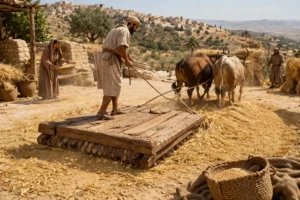 From a contemporary perspective, our modern-day word tribulation is linked to the concept of an ancient threshing sledge. A threshing sledge was an agricultural device that comprised several heavy pieces of lumber embedded with stones or metal studs. A farmer made use of a threshing sledge by dragging it with a pack animal across the stalks of a grain harvest in order to separate the valuable grain from the surrounding husk.
So, this reference to tribulation is associated with the imagery of something that has been crushed or pressed. Over time, this grew into a symbolic representation that expressed the idea of intense suffering or distress. While those afflictions may arise from the circumstances of our lives, they often come to us in the form of our relationships with others. The following excerpt from Jesus’ Sermon on the Mount is highly instructive in this regard…
“Blessed are you when they revile and persecute you, and say all kinds of evil against you falsely for My sake. Rejoice and be exceedingly glad, for great is your reward in heaven, for so they persecuted the prophets who were before you” (Matthew 5:11-12).
Therefore, we are reminded that “Peace with God does not always result in peace with other people. Nevertheless, the fact that we have peace with God and a relationship with Him, with assurance of standing acceptable in His presence, enables us to view present difficulties with joy. We can ‘rejoice (‘exult’) in tribulations’ because God has revealed that He uses them to produce steadfast endurance (‘perseverance’) and ‘proven character’ in those who relate to their sufferings properly…” (3)
(1) G2347 thlipsis Mounce Concise Greek-English Dictionary of the New Testament https://www.billmounce.com/greek-dictionary/thlipsis
(2) G2346 thlibo W.E Vine, Vines Expository Dictionary of New Testament Words Volume 2, Rev Terry Kulakowski, Editor. See https://www.blueletterbible.org/lexicon/g2346/kjv/mgnt/0-1/
(3) See Stanley D. Toussaint, “Suffering in Acts and the Pauline Epistles,” in Why, O God? Suffering and Disability in the Bible and Church, pp. 189-90. Quoted in Dr. Thomas L. Constable, Notes on Romans 2021 Edition p 101.