
“Their throat is an open grave; they use their tongues to deceive. The venom of asps is under their lips” (Romans 3:13 ESV).
Here in Romans 3:13, the progression of ideas follows a logical sequence that begins with the throat and moves to the tongue. Much like the polluted speech that emerges from the open grave of the throat, these individuals “…use their tongues to deceive (to mislead and to deal treacherously)” (AMPC). This goes far beyond the simple act of lying, for it also expresses the ideas of fraud, (1) guile, (2) and “to lure, as by a bait.” (3)
The New Testament epistle of James offers what is perhaps the most vivid characterization of the tongue in this regard…
“The human tongue is physically small, but what tremendous effects it can boast of! A whole forest can be set ablaze by a tiny spark of fire, and the tongue is as dangerous as any fire, with vast potentialities for evil. It can poison the whole body, it can make the whole of life a blazing hell.
Beasts, birds, reptiles and all kinds of sea-creatures can be, and in fact are, tamed by man, but no one can tame the human tongue. It is an evil always liable to break out, and the poison it spreads is deadly” (James 3:5-8 Phillips).
This allusion to poison from James 3:8 leads us into the venomous reference that concludes Romans 3:13: “the poison of asps is under their lips” (NET). That analogy finds its origin in the following quote from Psalm 140:3: “They sharpen their tongues like a serpent; The poison of asps is under their lips.” While several types of asps were active on the African and European continents in the Biblical era, these verses likely refer to one specific variety…
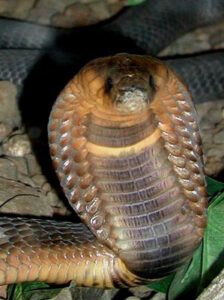 “The Egyptian cobra (Naja haje) is a venomous snake also known as the Asp is one of the largest cobra species found in the African continent… The highly venomous Egyptian cobra is extremely dangerous, their venom contains primarily neurotoxins as well as cytotoxins…This is why Egyptian cobras are considered one of the most venomous snakes in Africa and responsible for many human fatalities, it can even kill an adult elephant in 3 hours. Its neurotoxic venom destroys nerves and tissue, and causes paralysis and will result in death due to respiratory failure within a short period of time.” (4)
So, taken together, this passage incorporates the symbolism associated with the serpent’s treacherous act of deception in the Garden of Eden along with the lethal aftermath that arose from the sin that followed.
Image Attribution: John Walker, derivative work by Soli, CC BY 2.0, via Wikimedia Commons
(1) G1387 dolioo. Mounce Concise Greek-English Dictionary of the New Testament https://www.billmounce.com/greek-dictionary/dolioo
(2) G1387 – dolioo – Strong’s Greek Lexicon (KJV). (n.d.). Blue Letter Bible. https://www.blueletterbible.org/lexicon/g1387/kjv/tr/0-1/<s/mall>
(3) Deceit, deceitful, deceitfully, deceitfulness, deceive, deceivableness – Vine’s Expository Dictionary of NT Words – StudyLight.org. (n.d.). StudyLight.org. https://www.studylight.org/dictionaries/eng/ved/d/deceit-deceitful-deceitfully-deceitfulness-deceive-deceivableness.html
(4) Egyptian Cobra, the mythical and deadly asp. (n.d.). Snake Facts. https://snake-facts.weebly.com/egyptian-cobra.html