
“Those people who don’t know about God’s Law will still be punished for what they do wrong. And the Law will be used to judge everyone who knows what it says” (Romans 2:12 CEV).
The axiological argument for God’s existence seeks to demonstrate God’s existence by highlighting the presence of universal moral absolutes. If we can demonstrate the existence of transcendent moral absolutes that are universally acknowledged, then such laws must naturally derive from a transcendent source as well.
One such example is this: it is wrong to end the life of another human being arbitrarily and without cause. This universal moral principle asserts that it is always wrong to take a life indiscriminately without justification or reason. While every culture may debate the precise definition of a justifiable homicide, all cultures share the mutual understanding that it is wrong to kill another human being without any reason.
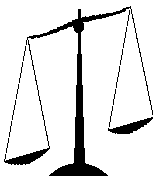 Another transcendent moral law states, it is wrong to be unjust. While injustice may take different forms, there is cross-cultural agreement on this general principle. In fact, we can find an ancient expression of this idea in the Biblical book of Proverbs: “The Lord detests the use of dishonest scales, but he delights in accurate weights” (Proverbs 11:1 NLT).
We can find another example in the following principle: it is wrong to be unfair. For instance, anyone who has ever said, “It’s not fair…” is someone who accepts the reality of this objective moral law. Even small children recognize this law, as any parent of a small child will undoubtedly attest. To underscore this idea, let’s return to another quotation from the author and apologist C. S. Lewis…
“Whenever you find a man who says he does not believe in a real Right and Wrong, you will find the same man going back on this a moment later. He may break his promise to you, but if you try breaking one to him he will be complaining ‘It’s not fair…'” (1)
Of course, many reject the idea that transcendent moral values exist. But a person who does not believe in the existence of these absolute moral standards still adheres to at least one absolute moral standard. That absolute moral standard is this: there are no absolute moral standards.
So, if transcendent moral absolutes exist for every culture, tribe, and society, then there must be a transcendent source from which those absolute moral laws derive. This helps explain why “…people who don’t know about God’s Law will still be punished for what they do wrong” as we read here in Romans 2:12.
(1) Lewis, C. (1960). Mere Christianity. Macmillan Paperbacks Edition [pg. 5]
Image Attribution: Unfair, public domain, via Wikimedia Commons